

Decades of research show that relations between racially stigmatized outgroups in the United States – such as Black, Asian, and Latino communities – are generally characterized by tension, conflict, and occasionally violence, but less commonly, cooperation (Benjamin Reference Benjamin2017; McClain and Karnig Reference McClain and Karnig1990; McClain et al. Reference McClain, Carter, Soto, Lyle, Grynaviski, Nunnally, Scotto, Kendrick, Lackey and Cotton2006). As people of color (PoC) now comprise nearly 40% of the US population, fostering greater political unity among these groups has become increasingly consequential in an era of intense political polarization. Experimental research shows that making salient shared discrimination between racially stigmatized groups increases expressions of solidarity between PoC, which in turn correlates with greater support for policies benefiting those groups (Pérez, Vicuña, and Ramos Reference Pérez, Vicuña and Ramos2024). For example, Black adults who are primed to think about shared discrimination with Latinos report stronger solidarity with them, which is associated with increased support for pro-Latino policies (Rogbeer, Kim, and Pérez Reference Rogbeer, Kim and Pérez2025). Similar patterns appear among Asians, Latinos, and Middle Eastern and North Africans (MENA) when shared discrimination is primed (e.g., Eidgahy and Pérez Reference Eidgahy and Pérez2024).
Despite this growing evidence, it is unclear whether shared discrimination appeals elicit solidarity uniformly across different PoC subgroups. Although PoC sometimes function as a politically coherent mega-category (Engelhardt et al. Reference Engelhardt, Pérez, Goldman, Huo, Nteta and Tropp2025), Asian, Black, and Latino Americans differ substantially in their identification with this group depending on ethnicity, nativity, partisanship, education, and political ideology (Chin et al. Reference Chin, Luna, Huo and Pérez2023; Pérez Reference Pérez2021). For example, liberal Asian and Latino Americans are substantially more likely to identify as PoC than their conservative counterparts, whereas Black Americans show no such ideological division (Starr and Freeland Reference Starr and Freeland2024). Importantly, perceptions of similarity and linked fate also vary along these demographic lines, with various PoC differing in the degree to which they see their experiences as shared, and their collective futures as connected (Dawson Reference Dawson1994; Kim Reference Kim2000; Kaufmann Reference Kaufmann2003; Pérez, Vicuña, and Ramos Reference Pérez, Ramos and Vicuña2022; Masuoka and Junn Reference Masuoka and Junn2013; Sanchez and Masuoka Reference Sanchez and Masuoka2010; Wong et al. Reference Wong, Ramakrishnan, Lee, Junn and Wong2011). Because shared discrimination appeals are designed to activate a greater sense of commonality (Cortland et al. Reference Cortland, Craig, Shapiro, Richeson, Neel and Goldstein2017), this documented heterogeneity within and across PoC subgroups could plausibly moderate the strength of shared discrimination appeals.
Nevertheless, the formal evaluation of these moderated effects has been hampered by statistical power considerations. Detecting a small two-way interaction (d = 0.10) with 80% power requires approximately 3,100 participants (Sommet et al. Reference Sommet, Weissman, Cheutin and Elliot2023), far exceeding the typical sample size (N ≈ 800) used in published solidarity experiments (Pérez, Vicuña, and Ramos Reference Pérez, Vicuña and Ramos2024). To address this limitation, we synthesized eight experiments with a common design to create a large meta-analytic dataset of study participants (N = 5,813). This approach facilitates examination of several theoretically driven moderators of shared discrimination’s effects on solidarity, including race/ethnicity, partisanship, ideology, nativity, education, gender, and age. We predicted that Black adults, Democrats, liberals, US-born individuals, college-educated people, females, and younger PoC would express stronger solidarity following shared discrimination appeals. Contrary to expectations, our preregistered meta-analysis found no evidence of significant interactions between shared discrimination and these specific moderators. Our findings suggest that shared discrimination appeals effectively foster solidarity across a broad and diverse swath of PoC, which aligns with other emerging work on this mechanism (Engelhardt et al. Reference Engelhardt, Pérez, Goldman, Huo, Nteta and Tropp2025; Rogbeer and Pérez Reference Rogbeer and Pérez2026). Given the heterogeneity documented in prior research on PoC political behavior, the absence of moderation further underscores the political coherence of this mega-category in specific situations.
Who responds to shared discrimination?
With a profoundly diverse mega-group like PoC, it is reasonable to expect that reactions to shared discrimination appeals might be systematically conditioned by one’s race/ethnicity (Dawson Reference Dawson1994), politics (e.g., partisanship) (Pérez, Lee, and Luna Reference Pérez, Lee and Luna2025), demographics (e.g., nativity) (Abrajano and Alvarez Reference Abrajano and Alvarez2010), and other factors. We engage relevant race and politics research to yield hypotheses about how specific individual differences might moderate shared discrimination’s effect on solidarity.Footnote 1
Race and ethnicity
Shared discrimination appeals assume that Black, Asian, Latino, and other PoC identify with the mega-group PoC. Research establishes that, generically, ingroup identification depends on the perceived alignment between the self and the ingroup’s prototype in a specific context – that is, the ingroup’s segment who defines the category’s norms and views (Turner et al. Reference Turner, Hogg, Oakes, Reicher and Wetherell1987). Racially stigmatized individuals (including Black people) recognize Black Americans as the most prototypical person of color, followed by Latinos, and then Asian Americans (Pérez Reference Pérez2021). As the “central tendency” within this mega-group, we predict that Black adults will respond more strongly to shared discrimination appeals than other PoC (H1).
Partisanship and ideology
Growing political polarization is tightening the relation between individuals’ partisanship and ideology (Levendusky Reference Levendusky2009), producing greater overlap between Democratic (Republican) partisanship and liberal (conservative) beliefs. Specifically, Democrats are strongly associated with racial liberalism and Republicans with racial conservatism (Zhirkov and Valentino Reference Zhirkov and Valentino2022). Consequently, many Democratic PoC have internalized their party’s racial egalitarianism, while Republican PoC adopt their party’s color-blind ideology, which downplays racism and discourages mobilization against its structural and interpersonal forms (Zhirkov and Valentino Reference Zhirkov and Valentino2022). Consider that despite their ideological diversity (Dawson Reference Dawson1994), Black Americans overwhelmingly close ranks with Democrats as the better party to express their racial ingroup’s political interests (White and Laird Reference White and Laird2020). Most Latino and Asian adults are also Democrats and hold racially liberal views (Pérez, Lee, and Luna Reference Pérez, Lee and Luna2025; Wong et al. Reference Wong, Ramakrishnan, Lee, Junn and Wong2011), while their right-of-center counterparts express views undermining PoC solidarity. Thus, we hypothesize that Democrat PoC (H2) and liberal PoC (H3) will express stronger solidarity than Republican and conservative PoC following shared discrimination appeals.
Nativity
Significant shares of Asian (54%), Latino (32%), and Black (12%) Americans are immigrants who were born abroad (Krogstad and Im Reference Krogstad and Im2025; Moslimani and Noe-Bustamante Reference Moslimani and Noé-Bustamante2023). This nuance partly indexes the degree to which individuals are socialized into the US racial hierarchy and their place in it (Portes and Rumbaut Reference Portes and Rumbaut2001). Immigrants report weaker perceptions of discrimination than their native-born peers (Oskooii Reference Oskooii2016), which blunt their recognition of shared discrimination with other PoC (Wang et al. Reference Wang, Minervino and Cheryan2013). Hence, we hypothesize that shared discrimination will produce a stronger solidarity effect among US-born PoC (H4).
College education
Earning a college education produces hierarchy-attenuating preferences (Sidanius and Pratto Reference Sidanius and Pratto1999). Indeed, university campuses often promote multiculturalism, which raises individual awareness about racial disparities and encourages them to strive for greater inter-group equality (Kirby et al. Reference Kirby, Tabak, Ilac and Cheryan2020; Kteily et al. Reference Kteily, Sheehy-Skeffington and Ho2017). In-depth interviews with college-educated Black, Latino, and Asian adults further indicate they are attuned to the structural roots of racial inequality and keen on uprooting them (Pérez Reference Pérez2021). Therefore, we hypothesize that college-educated PoC will react more intensely to shared discrimination (H5).
Age and gender
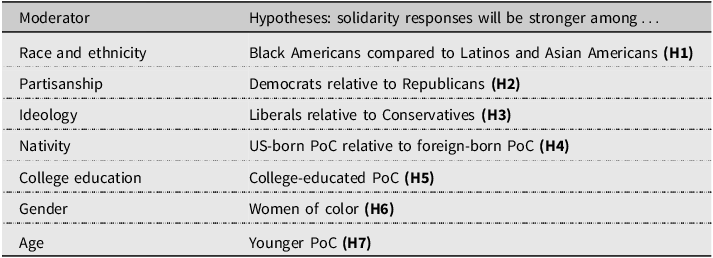
Age and gender uphold oppressive systems throughout the globe, including the United States (Sidanius and Pratto Reference Sidanius and Pratto1999). Indeed, older individuals and males are significantly more likely to prefer hierarchal relations between social groups (Zubielevitch et al. Reference Zubielevitch, Osborne, Milojev and Sibley2023) – a pattern also characterizing older PoC and men of color (Geiger and Reny Reference Geiger and Reny2024; Robertson and Tesler Reference Robertson and Tesler2024). Thus, we anticipate that older PoC (H6) and men of color (H7) will be less responsive to shared discrimination appeals. Table 1 catalogs our seven preregistered hypotheses. Our preregistrationsFootnote 2 are reported in the appendix (A.1).
Hypotheses

Table 1. Long description
A table listing hypotheses about solidarity responses among different groups. The table has two columns: Moderator and Hypotheses. The Moderator column lists seven factors: Race and ethnicity, Partisanship, Ideology, Nativity, College education, Gender, and Age. The Hypotheses column provides specific hypotheses for each moderator. Row 1: Race and ethnicity, Black Americans compared to Latinos and Asian Americans (H1). Row 2: Partisanship, Democrats relative to Republicans (H2). Row 3: Ideology, Liberals relative to Conservatives (H3). Row 4: Nativity, US-born PoC relative to foreign-born PoC (H4). Row 5: College education, College-educated PoC (H5). Row 6: Gender, Women of color (H6). Row 7: Age, Younger PoC (H7).
Research design
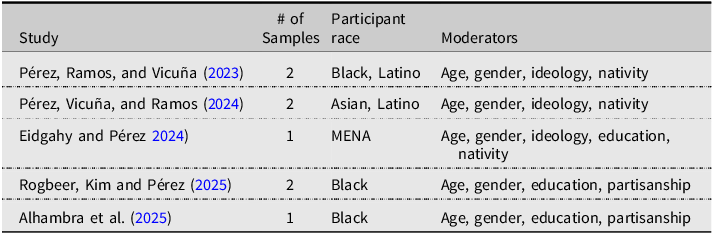
We test our claims by synthesizing eight published between-subjects experiments with conceptually similar designs (Table 2). Participants first reported demographic information before being randomly assigned to a control or treatment condition. Control participants read a mock Associated Press (AP) article about giant tortoises, while treated participants read a mock AP article describing experiences of shared discrimination between their racial ingroup and a stigmatized racial outgroup. Each article included a title, two paragraphs, and visuals, emphasizing how discrimination against an outgroup is comparable to that experienced by one’s ingroup.
Published studies included in meta-analysis

Table 2. Long description
A table summarizing studies with details on samples, participant race, and moderators. The table has five rows and four columns. Column headers are Study, # of Samples, Participant race, and Moderators. Row 1: Study, Pérez, Ramos, and Vicuña (2023); # of Samples, 2; Participant race, Black, Latino; Moderators, Age, gender, ideology, nativity. Row 2: Study, Pérez, Vicuña, and Ramos (2024); # of Samples, 2; Participant race, Asian, Latino; Moderators, Age, gender, ideology, nativity. Row 3: Study, Eidgahy and Pérez (2023); # of Samples, 1; Participant race, MENA; Moderators, Age, gender, ideology, education, nativity. Row 4: Study, Rogbeer, Kim and Pérez (2025); # of Samples, 2; Participant race, Black; Moderators, Age, gender, education, partisanship. Row 5: Study, Alhambra et al. (2025); # of Samples, 1; Participant race, Black; Moderators, Age, gender, education, partisanship.
Consistent with a facilitative design (Sniderman Reference Sniderman, Druckman, Green, Kuklinski and Lupia2011), which encourages people to behave in a way they are predisposed to act, our shared discrimination treatment uses a similarity principle to foster a broader sense of “we” (Cortland et al. Reference Cortland, Craig, Shapiro, Richeson, Neel and Goldstein2017). Accordingly, this treatment primes preexisting memories, experiences, and attributes (Tourangeau et al. Reference Tourangeau, Rips and Rasinski2000; Zaller Reference Zaller1992), which motivate non-White individuals toward solidarity with other racially stigmatized individuals (Pérez, Vicuña, and Ramos Reference Pérez, Vicuña and Ramos2024). The full-length articles used in our manipulation are presented in the appendix (A.2).
Post-treatment, participants completed 2–3 items, depending on the study, which assessed PoC solidarity. One regular item across samples used a 5-point strongly (dis)agree scale to indicate whether “I feel solidarity with PoC, which include African Americans, Asian Americans, and Latinos.” We coded our solidarity outcome so that higher numbers reflect stronger solidarity levels. Gender, nativity, education, and partisanship were binary-coded so that 1 represents PoC who self-identified as male, US-born, bachelor’s degree holders, and Democrat, respectively. Age and ideology were rescaled to a continuous 0–1 range across studies, with 18-year-olds and extreme conservatives coded as 0 and 94-year-olds and extreme liberals coded as 1. We placed all variables on a common 0–1 scale to facilitate interpretation of our estimates.
For each moderator, we estimated OLS regression models predicting solidarity from treatment, a focal moderator, and their interaction, plus controls for all remaining individual differences (Kam and Trussler Reference Kam and Trussler2017). For instance, when evaluating partisanship’s moderation of shared discrimination’s effect, we control for age, gender, and education. Our model is given as:
 $$Solidarit{y_i} = {b_0} + {b_1}(Treatment) + {b_2}(Moderator) \,\,\,\,\,\,\,\,\,\,\,\,\,\,\,\,\,\,\,\,\,\,\,\,\,\,\,\,\,\,\,\,\,\,\,\,\,\,\,\,\,\,\,\,\,\,\,\,\,\,\,\,\\ + {b_3}(Treatment \times Moderator) + {C_i}{b_i} + {\varepsilon _i}$$
where C is a vector of study covariates. We then extracted coefficients and standard errors for the intercept, main effects, and interaction terms for each study and meta-analyzed them in a random-effects model with restricted maximum likelihood (REML) to account for sampling error and between-study heterogeneity. This approach lets us synthesize these previously published experiments in a pooled sample to assess whether any systematic trends emerge across these unique and racially diverse studies.
Each experiment was originally administered to a specific racially homogeneous sample, so race of respondent was not collected within studies. Therefore, to examine the moderating impact of race/ethnicity, we estimated an OLS regression for each sample, predicting solidarity by treatment condition, including available covariates. We then entered these coefficients and standard errors into a separate REML random-effects regression.
Results
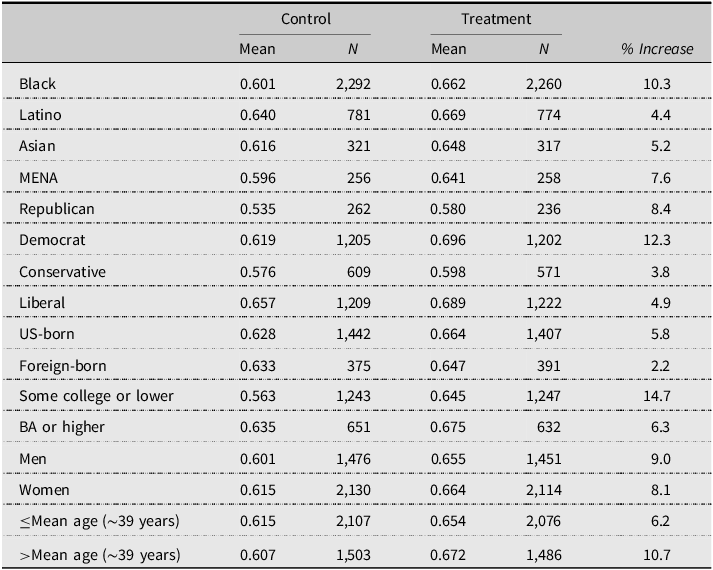
Table 3 presents average solidarity scores by control and treatment conditions for each moderator, along with solidarity’s relative increase across these experimental conditions. These raw scores suggest shared discrimination produced the largest relative gains (14.7%) in solidarity among PoC without a bachelor’s degree. We observe the smallest gains (2.2%) among foreign-born respondents, who reported a hearty baseline solidarity level (M = 0.633).
Pooled mean solidarity by treatment condition and moderator level

Table 3. Long description
A table comparing solidarity scores across different groups and treatment conditions. The table has 20 rows and 6 columns. Column headers are Control Mean, Control N, Treatment Mean, Treatment N, and Percent Increase. Row labels include categories such as Black, Latino, Asian, MENA, Republican, Democrat, Conservative, Liberal, US-born, Foreign-born, Some college or lower, BA or higher, Men, Women, Less than Mean age, and Greater than Mean age. Each row presents the mean solidarity scores for control and treatment groups, the number of participants in each group, and the percent increase in solidarity scores from control to treatment. Notable trends include the highest percent increase in solidarity among those with some college or lower education (14.7 percent) and the lowest increase among foreign-born respondents (2.2 percent).
To examine whether these raw differences in solidarity are meaningful, we ran a random-effects meta-analysis for each moderator separately, while controlling for the remaining moderators (Kam and Trussler Reference Kam and Trussler2017). In our meta-analysis, Black samples comprise half of all studies, whereas Asian, Latino, and MENA samples are each represented by one or two studies. Since participant race/ethnicity varies at the study level rather than within studies, smaller samples contribute less information to our meta-analysis. Thus, our estimates for race/ethnicity are less precise, as reflected in their relatively larger standard errors and wider confidence intervals (Jackson and Turner Reference Jackson and Turner2017).Footnote 3 A similar limitation applies to education and partisanship, which were measured in fewer than five samples – the recommended minimum for adequately powered random-effects meta-analytic tests (Jackson and Turner Reference Jackson and Turner2017). The remaining moderators – ideology, nativity, gender, and age – were each measured in five or more samples, providing greater leverage to detect and interpret significant effects.
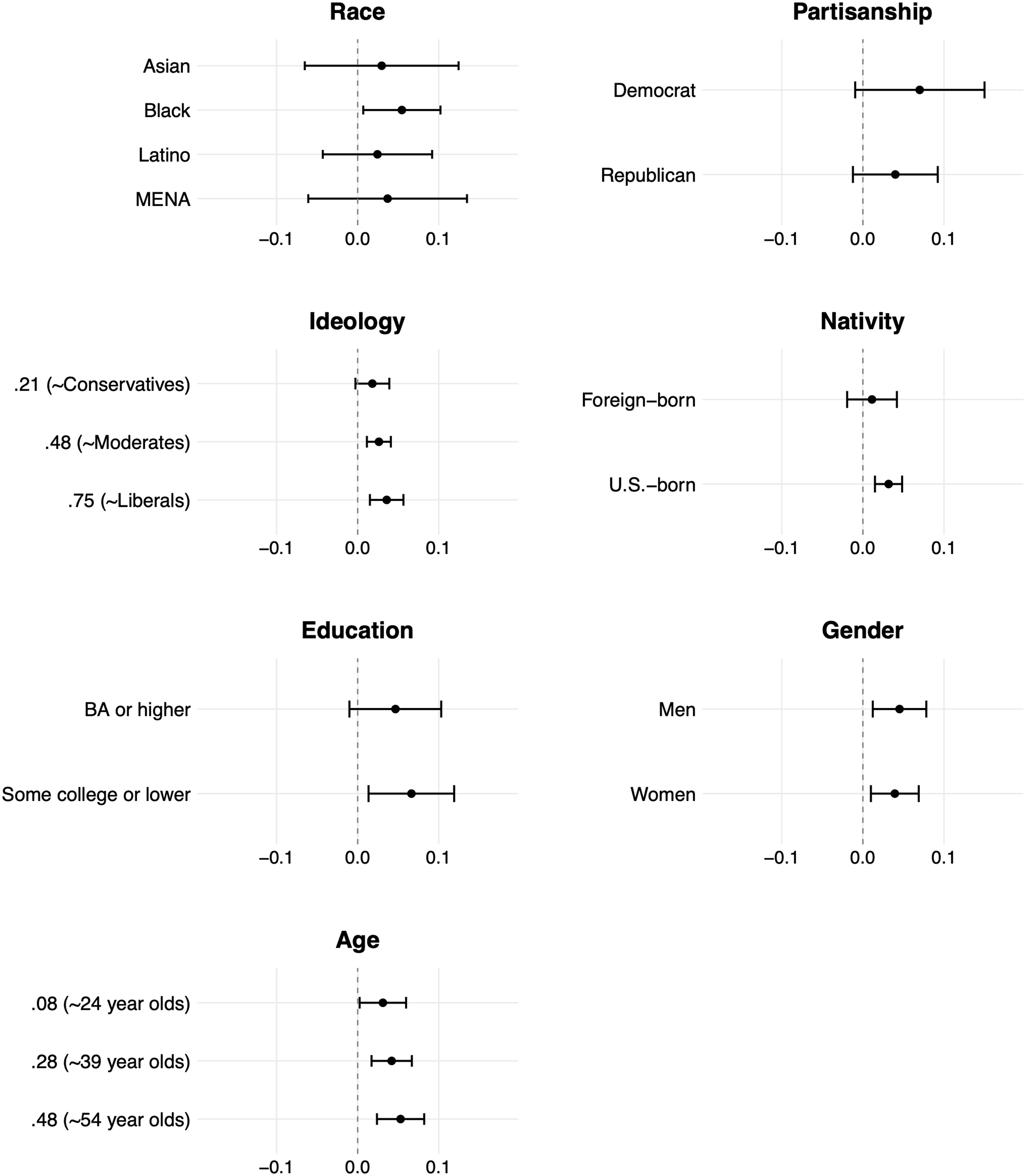
Figure 1 displays shared discrimination’s effect (x-axis) by each proposed moderator (y-axis). These raw patterns suggest that shared discrimination appeals may be more impactful among Black respondents (relative to other PoC), Democrats (relative to Republicans), liberals (relative to conservatives), and US-born (relative to foreign-born) – consistent with our hypotheses. However, shared discrimination appeals seem to be slightly more effective among older PoC, male PoC, and those without a bachelor’s degree – all of which ran counter to our hypotheses.
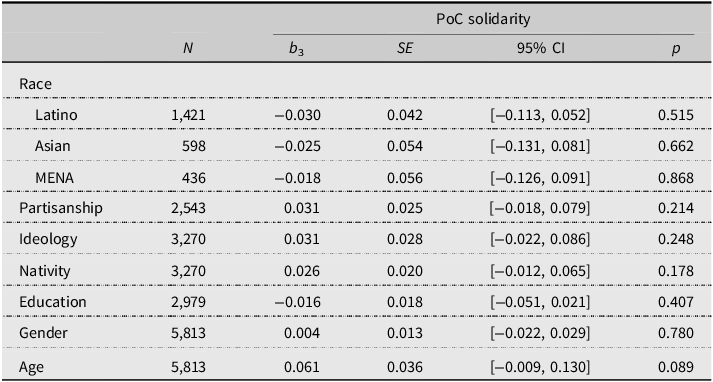
Nevertheless, Table 4 reveals that despite the variability observed in Figure 1, the confidence intervals and p-values for each interaction term (i.e., treatment × [specific moderator]) are generally indistinguishable from zero. Moreover, most estimated interaction effects are substantively modest, ranging from a low of 0.004 (men relative to women) to a high of 0.061 (youngest relative to oldest PoC). Still, as more solidarity studies become available, it behooves researchers to reassess these trends (Alhambra et al. Reference Alhambra, Ortiz, Pérez, Huynh, Bany-Mohammed, Rad, Sherrill, Castillo and Crawford2025).
Meta-analyzed interactions between shared discrimination and moderators

Table 4. Long description
A table comparing the interactions between shared discrimination and various moderators. The table has 8 rows and 5 columns. The columns are labeled N, b3, SE, 95% CI, and p. The rows are labeled Race, Partisanship, Ideology, Nativity, Education, Gender, and Age. Each row provides values for the columns. For example, the row labeled Latino under Race shows N as 1,421, b3 as -0.030, SE as 0.042, 95% CI as [-0.113, 0.052], and p as 0.515. The table provides detailed statistical data on the interactions between shared discrimination and various moderators.
Raw effects of shared discrimination on solidarity by level of moderator.
Note. Point estimates reflect shared discrimination’s effect on solidarity (0–1 scale) with 95% confidence intervals. For age and ideology, marginal effects are shown at the mean, +/− one standard deviation.

Conclusion
Against a backdrop of research emphasizing heterogeneity within and between communities of color, our main finding that shared discrimination appeals resonate broadly challenges conventional expectations. Yet these results do align with other emerging evidence showing that shared discrimination cues exert similarly uniform effects on solidarity across racial groups (Engelhardt et al. Reference Engelhardt, Pérez, Goldman, Huo, Nteta and Tropp2025; Rogbeer and Pérez, Reference Rogbeer and Pérez2026). One possible explanation for this pattern is that, by activating perceptions of commonality, shared discrimination appeals temporarily override heterogeneity in PoC identification by rendering this mega-category situationally salient (Pérez Reference Pérez2021), which is highly consistent with the psychology of ingroup formation (Turner et al. Reference Turner, Hogg, Oakes, Reicher and Wetherell1987). Under these conditions, perceived intragroup differences are reduced, and demographic and political differences may become less psychologically relevant than a situationally salient PoC category. Taken as a whole, then our results imply that diversity among PoC may be less consequential for solidarity than is commonly assumed.
Nonetheless, important sources of variation can still exist and merit further testing. For example, responses to shared discrimination appeals could plausibly differ based on individual-level sociopolitical (e.g., social dominance orientation) and symbolic dispositions (e.g., racial attitudes) which shape how individuals interpret inequality and approach political decisions (Duckitt and Sibley Reference Duckitt and Sibley2010; Sears Reference Sears, Iyengar and McGuire1993). Testing whether these psychological orientations moderate responses to shared discrimination represents an important avenue for future research, along with our previous recommendation to continuously reassess the moderators we tested as new solidarity experiments are published (Alhambra et al. Reference Alhambra, Ortiz, Pérez, Huynh, Bany-Mohammed, Rad, Sherrill, Castillo and Crawford2025).
Finally, although not statistically significant, the observed trends for two moderators – age and education – ran counter to our predictions. Specifically, the effectiveness of shared discrimination appeals appeared to increase with age and was more pronounced among PoC who had not completed college. Considering that roughly half of our samples consisted of Black Americans, this hints at two directions for additional testing going forward. First, shared discrimination appeals may be particularly effective among older Black Americans, who generally attribute racial disparities to structural factors more than younger Black adults (Smith Reference Smith2014). This implies that older Black adults might be more responsive to solidarity appeals, which requires more extensive data for adequate testing. Similarly, although Black adults with a college education might be more exposed to research about discrimination’s detrimental effects, it is also plausible that Black adults without a complete college education experience more opportunities in the “real world” to collaborate more with other PoC, such as Latinos (Pérez Reference Pérez2021; Rogbeer et al. Reference Rogbeer, Kim and Pérez2025). Here, more data are also needed to fully test this prospect. In the meantime, our findings highlight the promise of shared discrimination activation as a generic mechanism for fostering solidarity among PoC and underscore the value of continued efforts to reappraise its robustness across contexts and racially stigmatized populations.
Supplementary material
The supplementary material for this article can be found at https://doi.org/10.1017/XPS.2026.10038.
Data availability
The data, code, and any additional materials required to replicate all analyses in this article are available at the Journal of Experimental Political Science Dataverse within the Harvard Dataverse Network (Rogbeer et al. Reference Rogbeer, Ortiz and Perez2026) at https://doi.org/10.7910/DVN/QLEM9Q.
Competing interests
The authors have no conflicts of interest to declare.
Ethics statement
This study is a meta-analysis of previously published studies and did not involve the collection of new data by the authors. Accordingly, institutional review board approval was not required for the present research. All included studies were originally conducted under the ethical standards and approval procedures of their respective institutions.


 Open access

