Introduction
The neurodevelopmental hypothesis of schizophrenia posits abnormal brain development as a cause of this illness (Murray & Lewis, Reference Murray and Lewis1987; Weinberger, Reference Weinberger1987). Empirical support for this hypothesis comes from population-based longitudinal studies demonstrating an association between subtle alterations in motor, cognitive, language and social development in early life and the risk of adult schizophrenia (Jones et al. Reference Jones, Rodgers, Murray and Marmot1994; Crow et al. Reference Crow, Done and Sacker1995; Cannon et al. Reference Cannon, Bearden, Hollister, Rosso, Sanchez and Hadley2000, Reference Cannon, Caspi, Moffitt, Harrington, Taylor, Murray and Poulton2002). Common neurodevelopmental disorders (NDs) of childhood such as autism, dyslexia and dyspraxia share many similarities with schizophrenia (Bassett et al. Reference Bassett, Scherer and Brzustowicz2010; Owen et al. Reference Owen, O'Donovan, Thapar and Craddock2011), which typically manifests itself in young adulthood. These conditions are more common in men and are associated with cognitive deficits and neurological soft signs (Owen et al. Reference Owen, O'Donovan, Thapar and Craddock2011). Genetic studies suggest an overlap of risk between schizophrenia, autism and other neurodevelopmental conditions such as attention deficit hyperactivity disorder (ADHD) (Kirov et al. Reference Kirov, Rujescu, Ingason, Collier, O'Donovan and Owen2009; Bassett et al. Reference Bassett, Scherer and Brzustowicz2010; Williams et al. Reference Williams, Zaharieva, Martin, Langley, Mantripragada, Fossdal, Stefansson, Stefansson, Magnusson, Gudmundsson, Gustafsson, Holmans, Owen, O'Donovan and Thapar2010). Family history of schizophrenia is associated with risk of autism (Sullivan et al. Reference Sullivan, Magnusson, Reichenberg, Boman, Dalman, Davidson, Fruchter, Hultman, Lundberg, Langstrom, Weiser, Svensson and Lichtenstein2012). It has been suggested that childhood autism and adult schizophrenia share overlapping pathogenic mechanisms arising from disruptions in brain development (Owen et al. Reference Owen, O'Donovan, Thapar and Craddock2011).
Although there is substantial inter-individual variation within common childhood NDs, there is also a great deal of overlap in their clinical presentation and aetiology (Richardson & Ross, Reference Richardson and Ross2000). Specific language impairments in autism and dyslexia may be underpinned by the same genetic aberration (Vernes et al. Reference Vernes, Newbury, Abrahams, Winchester, Nicod, Groszer, Alarcon, Oliver, Davies, Geschwind, Monaco and Fisher2008). Evidence of neurocognitive deficits such as low IQ or processing speed in autism, dyspraxia and dyscalculia suggest that there is some degree of neurodevelopmental aberrations in these conditions (Scalais et al. Reference Scalais, Nuttin, Galluzzo and Maria2005; Butterworth & Reigosa, Reference Butterworth, Reigosa, Berch and Mazzocco2007; Matson & Shoemaker, Reference Matson and Shoemaker2009). Therefore, an increased risk of psychotic outcomes in the future among individuals with these disorders in childhood will be consistent with the neurodevelopmental view of schizophrenia. However, longitudinal studies of schizophrenia among individuals with childhood NDs are limited (Hutton et al. Reference Hutton, Goode, Murphy, Le Couteur and Rutter2008).
It has been suggested that childhood psychotic experiences (PEs) may be important antecedents of adult schizophrenia. These are associated with risk of psychotic illness in adult life along with several risk factors for schizophrenia (Poulton et al. Reference Poulton, Caspi, Moffitt, Cannon, Murray and Harrington2000; Horwood et al. Reference Horwood, Salvi, Thomas, Duffy, Gunnell, Hollis, Lewis, Menezes, Thompson, Wolke, Zammit and Harrison2008; Polanczyk et al. Reference Polanczyk, Moffitt, Arseneault, Cannon, Ambler, Keefe, Houts, Odgers and Caspi2010; Kelleher & Cannon, Reference Kelleher and Cannon2011; Zammit et al. Reference Zammit, Kounali, Cannon, David, Gunnell, Heron, Jones, Lewis, Sullivan, Wolke and Lewis2013). Recently, two studies have reported an increased risk of PEs in early adolescence for autistic traits (speech problem, social problem, rituals) (Bevan Jones et al. Reference Bevan, Thapar, Lewis and Zammit2012) and a diagnosis of autism spectrum disorder (ASD) in childhood (Sullivan et al. Reference Sullivan, Rai, Golding, Zammit and Steer2013). Similar to the current study, these were based on data from the Avon Longitudinal Study of Parents and Children (ALSPAC) birth cohort. However, they did not include any other NDs as exposure.
Identification of a linear relationship between IQ deficit in the pre-morbid period and future risk of schizophrenia is a key piece of evidence underpinning a developmental aspect to the disorder (Khandaker et al. Reference Khandaker, Barnett, White and Jones2011). IQ deficit is present in different stages of schizophrenia and is one of the most important predictors of functional outcome (Gold et al. Reference Gold, Goldberg, McNary, Dixon and Lehman2002). Population-based studies have also reported cognitive deficits in childhood among individuals reporting PEs later in childhood or adolescence (Horwood et al. Reference Horwood, Salvi, Thomas, Duffy, Gunnell, Hollis, Lewis, Menezes, Thompson, Wolke, Zammit and Harrison2008; Polanczyk et al. Reference Polanczyk, Moffitt, Arseneault, Cannon, Ambler, Keefe, Houts, Odgers and Caspi2010; Niarchou et al. Reference Niarchou, Zammit, Walters, Lewis, Owen and van den Bree2013). Therefore, prospective studies of the effects of IQ and related cognitive factors on the association between childhood NDs and later psychotic outcome may help to elucidate the developmental pathways to psychosis.
Using data from the population-based ALSPAC birth cohort, we report associations between six common childhood NDs (dyslexia, dyspraxia, dysgraphia, dysorthographia, dyscalculia and ASD) up to age 9 years, neurocognitive performance assessed as IQ, short-term memory, working memory between ages 9 and 11 years, and the risk of PEs at age 13 years. We predicted that NDs would increase the risk of PEs, and intermediary neurocognitive deficits would explain this association.
Method
Description of cohort
The ALSPAC birth cohort is based on all pregnant women resident in the county of Avon, a geographically defined region in the southwest of England, with expected dates of delivery between April 1991 and December 1992 (www.alspac.bris.ac.uk). The initial ALSPAC cohort consisted of 14 062 live births and 13 988 infants still alive at 12 months (Boyd et al. Reference Boyd, Golding, Macleod, Lawlor, Fraser, Henderson, Molloy, Ness, Ring and Davey2013; Fraser et al. Reference Fraser, Macdonald-Wallis, Tilling, Boyd, Golding, Davey, Henderson, Macleod, Molloy, Ness, Ring, Nelson and Lawlor2013). Avon included both urban and rural areas, and the population was broadly representative of all children in the UK. The parents completed regular postal questionnaires about all aspects of their child's health and development since birth. Since the age of 7 years, the children attended an annual assessment clinic where they participated in a range of face-to-face interviews and physical tests. This study is based on 8220 individuals with data on NDs at age 9 years.
Ethical approval for the study was obtained from ALSPAC Ethics and Law Committee and the Local Research Ethics Committees.
Assessment of NDs
The ALSPAC parents completed a questionnaire when the study child was on average 9 years old. A variety of questions were asked about health and development of the child including a specific item on NDs. In that item, the lead in ‘Have you ever been told that your child has:’ was followed by a list of six specific disorders: dyslexia (developmental reading disorder); dyspraxia (coordination disorder); dysgraphia (difficulties in writing); dysorthographia (difficulties in spelling); dyscalculia (inability to learn or comprehend arithmetic); and autism, Asperger's syndrome or ASD. For each disorder the parent ticked ‘yes’ or ‘no’; if ‘yes’, the child's age at diagnosis. Using these data we created a single binary variable, ‘any ND’, that was used as the primary exposure.
Assessment of neurocognitive performance
IQ and short-term memory (average age 9 years)
IQ was measured by the Wechsler Intelligence Scale for Children, 3rd UK edition (WISC-III UK; Wechsler et al. Reference Wechsler, Golombok and Rust1992). A shortened version of the test was applied by trained psychologists, whereby only alternate items were used for all subtests, with the exception of the coding subtest, which was administered in its standard form. The digit span subtest of WISC-III UK was used as a measure of short-term memory.
Working memory (average age 11 years)
The computerized Counting Span Task was used (Case et al. Reference Case, Kurland and Goldberg1982), which simultaneously tests information processing and storage abilities. A child's working memory span was calculated automatically by the computer program. The maximum score a child could achieve was five (i.e. all correct). We used the span score, the main outcome measure for this task.
Assessment of PEs
PEs were assessed by the semi-structured Psychosis-like Symptoms interview (PLIKSi) at a mean age of 12.9 years (s.d. = 0.23). The PLIKSi comprised 12 ‘core’ questions derived from the Diagnostic Interview Schedule for Children version IV (DISC-IV; Shaffer et al. Reference Shaffer, Fisher, Lucas, Dulcan and Schwab-Stone2000) and the Schedules for Clinical Assessment in Neuropsychiatry version 2.0 (SCAN 2.0; WHO, 1994). It included key symptoms covering the three main domains of positive psychotic symptoms: hallucinations (visual and auditory); delusions (delusions of being spied on, persecution, thoughts being read, reference, control, grandiose ability and other unspecified delusions); and experiences of thought interference (thought broadcasting, insertion and withdrawal). This allowed an observer-based rating for the presence of any PEs in the past 6 months (further classed as suspected and definite). We used any PEs as the primary outcome, and definite PEs as a secondary outcome. These groups were compared with rest of the cohort. The PLIKSi has good inter-rater reliability (κ = 0.7) and test–retest reliability (κ = 0.5) (Horwood et al. Reference Horwood, Salvi, Thomas, Duffy, Gunnell, Hollis, Lewis, Menezes, Thompson, Wolke, Zammit and Harrison2008). The interview and coding procedure have been reported in detail elsewhere (Horwood et al. Reference Horwood, Salvi, Thomas, Duffy, Gunnell, Hollis, Lewis, Menezes, Thompson, Wolke, Zammit and Harrison2008).
Statistical analysis
Linear regression compared mean scores of IQ and memory tasks between those with and without NDs. The mean difference [and 95% confidence interval (CI)] between groups was calculated for each task. Age at the time of testing (in days), gender, father's social class and ethnicity were included as potential confounders. Logistic regression examined the association between total IQ score and ND. Linearity of association between IQ and ND was examined by including a quadratic term (square of IQ score) within the logistic regression model.
Binary logistic regression calculated odds ratios (ORs) for PEs in those with, compared with those without, NDs. Age at the time of assessment of PEs (in weeks), gender, ethnicity, father's social class and maternal education were included as potential confounders. Because of the limited number of individuals with PEs, multivariable regression was used to calculate ORs separately only for dyslexia. In addition, we used the likelihood ratio test to examine whether an alternative approach to defining the exposure variable provided a better fit to the data compared with the null, binary coding (any ND versus none). The alternative coding of the exposure included five discrete categories (no NDs; dyslexia only; dyspraxia only; ASD only; multiple NDs).
We examined whether the association between any PEs and NDs could be explained by deficit in total IQ (Baron & Kenny, Reference Baron and Kenny1986). First, separate logistic regression models assessed the associations between: (1) exposure (NDs) and outcome (PEs); (2) exposure and mediator (total IQ score); and (3) mediator and outcome, controlling for exposure. Finally, for exposure–outcome, exposure–mediator and mediator–outcome, all three regression lines were fitted simultaneously in a single model using MPlus (Muthen & Muthen, Reference Muthen and Muthen1998–2014). We expected, in the final step, that the exposure–outcome relationship would be attenuated (partial mediation) or eliminated (complete mediation). In case of partial mediation, the extent to which the ND–PE estimate was attenuated after inclusion of total IQ (the mediator) was also calculated. This procedure was repeated using working memory as the potential mediator. Mediating effects of IQ and working memory on the association between dyslexia and PEs were also examined.
Sensitivity analyses
To examine the association between any ND, IQ and PEs more rigorously, we repeated all analyses after excluding cases of ASD (i.e. any ND included dyslexia, dyspraxia, dyscalculia, dysgraphia and dysorthographia but not ASD). This is because two previous studies from the ALSPAC cohort have reported an association between autism and later PEs (Bevan Jones et al. Reference Bevan, Thapar, Lewis and Zammit2012; Sullivan et al. Reference Sullivan, Rai, Golding, Zammit and Steer2013).
Results
Frequency of NDs at age 9 and baseline characteristics
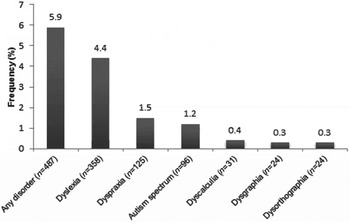
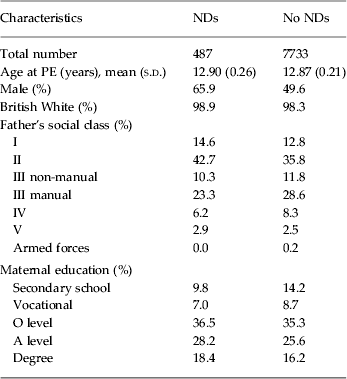
Of the total 8220 children, 487 (5.9%) were reported to have an ND at age 9. Of these, 417 children (5.1%) had only one ND and 70 (0.9%) had more than one ND. Dyslexia was the most common disorder (Fig. 1); dysgraphia and dysorthographia were reported to be present in the same 24 children. NDs were more common in boys than girls (Table 1).
Frequency of parent-reported neurodevelopmental disorders (NDs) at age 9 years in the Avon Longitudinal Study of Parents and Children (ALSPAC) birth cohort.

Baseline characteristics of individuals with and without neurodevelopmental disorders (NDs) in ALSPAC

ALSPAC, Avon Longitudinal Study of Parents and Children; PE, psychotic experience; s.d., standard deviation.
NDs at age 9 and neurocognitive performance between ages 9 and 11
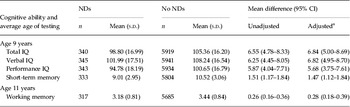
Compared with children with no ND, children with ND at age 9, as a group, performed worse on all measures of IQ, short-term memory and working memory between ages 9 and 11 (Table 2). The results were very similar after adjusting for several potential confounders.
Neurocognitive performance in children with and without neurodevelopmental disorders (NDs) in ALSPAC

ALSPAC, Avon Longitudinal Study of Parents and Children; CI, confidence interval; s.d., standard deviation.
a Adjusted analyses included age at the time of testing, gender, ethnicity and father's social class as potential confounders.
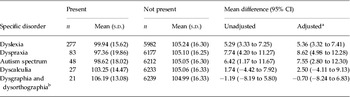
We also examined total IQ at age 9 separately in six specific NDs (Table 3). Compared with the rest of the cohort, mean total IQ was lower in all disorders except dysgraphia and dysorthographia.
Total IQ at age 9 years in children with a specific neurodevelopmental disorder (ND) versus no ND in ALSPAC

ALSPAC, Avon Longitudinal Study of Parents and Children; CI, confidence interval; s.d., standard deviation.
a Adjusted analyses included age at the time of testing, gender, ethnicity and father's social class as potential confounders.
b Both dysgraphia and dysorthographia were reported to be present in these 21 children.
Distribution of IQ scores in children with and without NDs
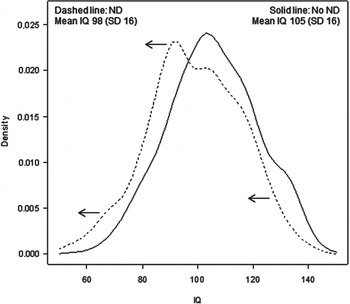
There was a linear association between IQ and ND, consistent with the left shift of the entire distribution of IQ scores in ND; p < 0.0001 (Fig. 2). The quadratic term (square of IQ) within the logistic regression model of IQ and ND was not significant (p = 0.22). Similar patterns were observed for individual disorders, dyslexia and ASD.
Distribution of total IQ scores in children with and without neurodevelopmental disorders (NDs) at age 9 years in the Avon Longitudinal Study of Parents and Children (ALSPAC).

NDs at age 9 and risk of PEs at age 13
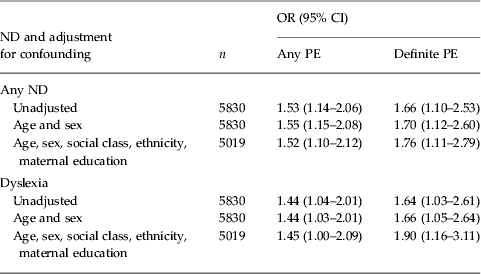
Data on NDs at age 9 and PEs at age 13 were available for 5830 individuals; of these, 313 (5.4%) had NDs. In the group with no NDs, 711 (12.9%) developed PEs, of which 285 (5.2%) were definite PEs. However, in the group with NDs, 58 (18.5%) developed PEs, of which 26 (8.3%) were definite PEs. Proportions of PEs were also higher in the group with dyslexia: 17.7% any PEs and 8.3% definite PEs.
The risk of PEs was significantly higher among individuals with, compared with those without, NDs (Table 4). Evidence of these effects remained after adjusting for age at the time of assessment of PEs, gender, father's social class, ethnicity and maternal education. A similar increase in risk was observed for dyslexia and ASD. The likelihood ratio test for the alternative categorical versus binary measure of NDs was not significant (χ 2 = 0.432, df = 4, p = 0.97). This provides further evidence that the risk of PEs was not significantly different across discrete categories of NDs.
Risk of psychotic experiences (PEs) at age 13 years among individuals with neurodevelopmental disorders (NDs) at age 9 years in ALSPAC

ALSPAC, Avon Longitudinal Study of Parents and Children; OR, odds ratio; CI, confidence interval.
Effects of neurocognitive deficits on the association between NDs and PEs
In the bivariate logistic regression, there was a significant association between NDs at age 9 and risk of PEs at age 13 (effect estimate 0.234, s.e. = 0.085, p = 0.006). Separate regressions showed significant associations between ND and IQ, and between IQ and PEs after controlling for ND. Finally, for ND–PEs, ND–IQ and IQ–PEs, all three regression lines were fitted simultaneously in a single model using MPlus. In this step, the association between ND and PEs was attenuated but still remained significant (effect estimate 0.195, s.e. = 0.085, p = 0.02). The magnitude of attenuation was 17% (95% CI 10–25), suggesting partial mediation of the ND–PEs association by IQ. However, there was no evidence of any effect of working memory scores on the association between ND and PEs. Similarly, the dyslexia–PEs association was attenuated by 16% (95% CI 10–24) after including IQ as the potential mediator; working memory did not affect this association.
Sensitivity analyses
The associations between NDs, neurocognitive performance and risk of PEs remained almost unchanged after excluding cases of ASD (n = 96) (see online Supplementary material).
Discussion
Our findings demonstrate that children with common NDs (ASD, dyslexia, dyspraxia, dysgraphia, dysorthographia and dyscalculia), as a group, show significant deficits in a range of neurocognitive domains. We also found that nearly a fifth of these children developed PEs at the end of follow-up. The group with NDs at age 9 years, compared with those without, had a nearly twofold increased risk of developing PEs at age 13 years (both suspected/definite PEs and definite PEs only). Evidence for this remained after adjusting for several potential confounders. The risk of PEs did not differ significantly across discrete categories of NDs. There was a linear association consistent with the left shift of the distribution of IQ scores in NDs, which partly explained the association between NDs and PEs. Both neurocognitive deficit and increased risk of PEs among individuals with NDs may be markers of underlying aberration in brain development. Thus, these findings are consistent with the neurodevelopmental hypothesis of schizophrenia (Murray & Lewis, Reference Murray and Lewis1987; Weinberger, Reference Weinberger1987).
These findings are also consistent with the notion that NDs that typically manifest in childhood (such as autism) or in young adulthood (such as schizophrenia) share overlapping pathogenic mechanisms linked with perturbation in brain development (Owen et al. Reference Owen, O'Donovan, Thapar and Craddock2011). Cross-sectional studies suggest that large proportions of individuals with childhood or adult onset schizophrenia meet criteria for ASD (Rapoport et al. Reference Rapoport, Chavez, Greenstein, Addington and Gogtay2009; Unenge Hallerback et al. Reference Unenge, Lugnegard and Gillberg2012). However, longitudinal studies of the risk of adult schizophrenia among individuals with childhood autism or other NDs are scarce. We could identify only one study that reported that, out of 135 individuals with childhood ASD, none had developed schizophrenia at follow-up (Hutton et al. Reference Hutton, Goode, Murphy, Le Couteur and Rutter2008). However, this could be related to the small sample size. Two recent studies from the same cohort as ours have reported an increased risk of PEs in early adolescence for autistic traits (speech problem, social problem, rituals) (Bevan Jones et al. Reference Bevan, Thapar, Lewis and Zammit2012) or a diagnosis of ASD in childhood (Sullivan et al. Reference Sullivan, Rai, Golding, Zammit and Steer2013). However, the current study is distinct in several ways. The previous studies focused only on autism whereas the current study examined six common NDs including ASD (dyslexia, dyspraxia, dysgraphia, dysorthographia, dyscalculia and ASD). We also included various neurocognitive measures such as IQ, short-term memory and working memory as outcomes. This is important because effects of cognitive deficits on the association between NDs and PEs may shed light on developmental pathways to psychotic disorders.
It has been suggested that PEs in childhood or adolescence may provide a valid paradigm (‘symptomatic high-risk approach’) for studying the development of adult psychotic disorders (Kelleher & Cannon, Reference Kelleher and Cannon2011; Murray & Jones, Reference Murray and Jones2012). This is supported by several observations. Prospective birth cohort studies have reported increased risk of psychotic disorders in adult life among individuals reporting psychotic symptoms in childhood (Poulton et al. Reference Poulton, Caspi, Moffitt, Cannon, Murray and Harrington2000; Zammit et al. Reference Zammit, Kounali, Cannon, David, Gunnell, Heron, Jones, Lewis, Sullivan, Wolke and Lewis2013). Childhood psychotic symptoms are familial and heritable (Polanczyk et al. Reference Polanczyk, Moffitt, Arseneault, Cannon, Ambler, Keefe, Houts, Odgers and Caspi2010). They are associated with various risk factors for schizophrenia, such as low birthweight (Thomas et al. Reference Thomas, Harrison, Zammit, Lewis, Horwood, Heron, Hollis, Wolke, Thompson and Gunnell2009), cognitive deficits in the pre-morbid period (Horwood et al. Reference Horwood, Salvi, Thomas, Duffy, Gunnell, Hollis, Lewis, Menezes, Thompson, Wolke, Zammit and Harrison2008; Niarchou et al. Reference Niarchou, Zammit, Walters, Lewis, Owen and van den Bree2013), pregnancy and birth complications (Zammit et al. Reference Zammit, Odd, Horwood, Thompson, Thomas, Menezes, Gunnell, Hollis, Wolke, Lewis and Harrison2009) and childhood atopic disorders (Khandaker et al. Reference Khandaker, Zammit, Lewis and Jones2014). Population-based studies suggest that psychotic symptoms in the general population and those observed in psychotic disorders may exist on a continuum (van Os et al. Reference van Os, Linscott, Myin-Germeys, Delespaul and Krabbendam2009). Finally, neurophysiological studies have reported common underlying mechanisms for psychotic symptoms occurring in healthy individuals and in schizophrenia (Howes et al. Reference Howes, Shotbolt, Bloomfield, Daalman, Demjaha, Diederen, Ibrahim, Kim, McGuire, Kahn and Sommer2013).
We found that the ND–PEs association (and the dyslexia–PEs association) could be partly explained by deficit in IQ, but not working memory. This is consistent with current evidence that strongly supports an important role for general cognitive ability, as measured by IQ, in the pathogenesis and prognosis of schizophrenia. Deficit in IQ, which is present from the pre-morbid period through to adult life, is one of the most consistent findings in schizophrenia epidemiology (Aylward et al. Reference Aylward, Walker and Bettes1984; Jones et al. Reference Jones, Rodgers, Murray and Marmot1994; Rajji et al. Reference Rajji, Ismail and Mulsant2009; Khandaker et al. Reference Khandaker, Barnett, White and Jones2011). In addition, it has been reported that IQ is a more sensitive and reliable predictor of functional outcome in schizophrenia than measures of specific ability (Gold et al. Reference Gold, Goldberg, McNary, Dixon and Lehman2002).
An explanation for not detecting a larger mediating effect of IQ could be the outcome studied. Adolescent participants with PEs in our sample are almost certainly a heterogeneous group. In many cases these symptoms are likely to be part of development whereas in some they may be more pathological (De Loore et al. Reference De Loore, Gunther, Drukker, Feron, Sabbe, Deboutte, van Os and Myin-Germeys2011; Rubio et al. Reference Rubio, Sanjuan, Florez-Salamanca and Cuesta2012). Thus, any underlying biological effect (such as mediation by IQ) may have become diluted. Follow-up of these individuals would help us to understand the effect of IQ deficit on different trajectories of early-life PEs.
Limitations of this study include the use of parent-reported data rather than diagnosis of NDs by formal assessments. However, several observations suggest that these parent-reported data are acceptable. For example, in our sample at age 9 years, 1.2% children were reported to have ASD. A population-based study by Baron-Cohen et al. (Reference Baron-Cohen, Scott, Allison, Williams, Bolton, Matthews and Brayne2009) reported that the prevalence of ASD is 1.5% among 5–9-year-old British schoolchildren. Similarly, in our sample, prevalence of dyslexia was 4.4%. The prevalence of dyslexia among school-age children in England has been reported to be 4–8% (Hulme & Snowling, Reference Hulme and Snowling2009). Finally, marked discrepancy between verbal and performance IQ has been reported to be a feature of developmental dyspraxia (Scalais et al. Reference Scalais, Nuttin, Galluzzo and Maria2005). This is reflected in our sample: the adjusted mean differences in verbal and performance IQ between children with and without dyspraxia were 4.63 (95% CI 0.94–8.32) and 12.69 (95% CI 8.90–16.49) respectively. However, it is difficult to be certain about specific diagnoses from parent-reported data. Childhood NDs are often co-morbid with each other, and there is a considerable overlap in their presentation and aetiology (Richardson & Ross, Reference Richardson and Ross2000; Vernes et al. Reference Vernes, Newbury, Abrahams, Winchester, Nicod, Groszer, Alarcon, Oliver, Davies, Geschwind, Monaco and Fisher2008). Therefore, we used any ND as the primary exposure, rather than individual disorders.
Of the 487 children with NDs at age 9, 174 did not attend the assessment for PEs at age 13. If there was an over-representation of individuals with ND who also developed PEs in our sample, this would lead to spurious overestimation of the ND–PEs association. However, there was no reason to believe that this was the case. In our sample, missing data were associated with lower social class and poorer maternal education. Both of these factors are associated with higher risk of PEs, and overall, poorer health outcomes.
In our sample, NDs were relatively more common in children of mothers with better education and in those with higher socio-economic status (SES). This is consistent with previous studies from both the UK and the USA reporting an increased prevalence of autism among individuals with higher SES (Wing, Reference Wing1980; Thomas et al. Reference Thomas, Zahorodny, Peng, Kim, Jani, Halperin and Brimacombe2012). However, it has been suggested that sampling bias and differential access to health care may explain the social class effect in autism. A population-based study from Sweden that reported an association between lower parental SES and ASD in offspring argues that the burden of autism in lower social class groups may have been previously underestimated (Rai et al. Reference Rai, Lewis, Lundberg, Araya, Svensson, Dalman, Carpenter and Magnusson2012). In ALSPAC, both lower SES and poor maternal education are associated with the risk of PEs. Thus, any bias arising from potential misclassification of autism-exposed children with lower SES as unexposed might have led to underestimation of the true ND–PEs association in our study.
To reduce the duration of assessment so that the children were less likely to tire, IQ was measured using a shortened version of the WISC-III. Alternate items (always starting with item number 1 in the standard form) were used for all 10 subtests, except for the coding subtest, which was administered in its full form. This approach has been used successfully in the past in other studies (Stricker et al. Reference Stricker, Merbaum and Tangeman1968; Finch & Chihldress, Reference Finch and Chihldress1975). We do not have any reliability and validity data for this approach. However, IQ data obtained using this method show robust correlations with other concurrent neurocognitive measures, such as working memory, short-term memory and sociodemographic factors such as social class, age. Together, they indicate that this may be a time-efficient yet reliable way of measuring IQ in large epidemiological studies.
To our knowledge, this is one of the first longitudinal studies of common childhood NDs, subsequent neurodevelopment and the risk of psychotic outcomes. Our findings suggest that future studies of neuropsychological outcomes among individuals with NDs should also include PEs. In the future, birth cohort-based neuroimaging studies will be useful for elucidating specific neural networks that underlie the associations between childhood NDs, cognitive performance and subsequent psychotic symptoms.
Supplementary material
For supplementary material accompanying this paper, please visit http://dx.doi.org/10.1017/S0033291714000750.
Acknowledgements
We are grateful to all families who took part in this study, the midwives for their help in recruitment, and the whole ALSPAC team, including interviewers, computer and laboratory technicians, clerical workers, research scientists, volunteers, managers, receptionists and nurses.
This work was supported by a doctoral clinical research training fellowship from the Wellcome Trust to Dr Khandaker (094790/Z/10/Z); Wellcome Trust (095844/Z/11/Z and 088869/Z/09/Z) and National Institute for Health Research (NIHR) (RP-PG-0606-1335) grants to Prof. Jones, also supporting Dr Stochl. The UK Medical Research Council and the Wellcome Trust (grant ref. 092731) and the University of Bristol provide core support for ALSPAC.
Declaration of Interest
Prof. Jones is co-inventor on patent PCT/GB2005/003279 (methods for assessing psychotic disorders) and has received research support from GlaxoSmithKline 2006–2010. He directs the NIHR Collaborations for Leadership in Applied Health Research and Care for Cambridgeshire and Peterborough (CLAHRC-CP), which include this study.