Introduction
The World Health Organization (WHO, 2016) estimates that 615 million people were diagnosed with an anxiety or depressive disorder in 2013. Globally, anxiety and depressive disorders are the two most prevalent reported mental disorders (Carpenter et al., Reference Carpenter, Andrews, Witcraft, Powers, Smits and Hofmann2018; Steel et al., Reference Steel, Marnane, Iranpour, Chey, Jackson, Patel and Silove2014). Anxiety and depressive disorders have separate diagnoses and symptomology, yet they share common aetiological and maintenance pathways (Gorman, Reference Gorman1996; Norton & Paulus, Reference Norton and Paulus2017). It has been estimated that amongst those with a primary anxiety disorder, 60–70% also have a comorbid depressive disorder (Brown, Antony, & Barlow, Reference Brown, Antony and Barlow1995; Brown, Campbell, Lehman, Grisham, & Mancill, Reference Brown, Campbell, Lehman, Grisham and Mancill2001; Roy-Byrne et al., Reference Roy-Byrne, Stang, Wittchen, Ustun, Walters and Kessler2000). Further, 40–50% of individuals with a primary depressive disorder report a comorbid anxiety disorder (Kessler et al., Reference Kessler, Sampson, Berglund, Gruber, Al-Hamzawi, Andrade and Wilcox2015). Whilst neither condition is the result of a single unitary cause, scholars suggest that an explanation for high comorbidity is shared aetiology across disorders (Cerdá, Sagdeo, Johnson, & Galea, Reference Cerdá, Sagdeo, Johnson and Galea2010; Mathew, Pettit, Lewinsohn, Seeley, & Roberts, Reference Mathew, Pettit, Lewinsohn, Seeley and Roberts2011; Stein, Scott, Jonge, & Kessler, Reference Stein, Scott, Jonge and Kessler2017; Talkovsky, Green, Osegueda, & Norton, Reference Talkovsky, Green, Osegueda and Norton2017). Not only do the disorders share diagnostic criteria, especially between major depressive disorder and generalised anxiety disorder, they also demonstrate similar biological and neurochemical mechanisms (Cerdá et al., Reference Cerdá, Sagdeo, Johnson and Galea2010; Talkovsky et al., Reference Talkovsky, Green, Osegueda and Norton2017) as well as cognitive factors (e.g., misappraisal) and emotional avoidance (Norton & Paulus, Reference Norton and Paulus2017).
Cognitive-behavioural therapy (CBT) is referred to as the current ‘gold standard’ or best available treatment for anxiety and depressive disorders (David, Cristea, & Hofmann, Reference David, Cristea and Hofmann2018; Hartley & Casey, Reference Hartley and Casey2013). Although CBT has traditionally been modified to target specific diagnoses, the field is moving towards transdiagnostic CBT (tCBT), which has shown excellent treatment efficacy and improved outcomes across comorbid presentations (Barlow et al., Reference Barlow, Ellard, Fairholme, Farchione, Boisseau, Allen and Ehrenreich-May2011; Norton, Reference Norton2017; Pearl & Norton, Reference Pearl and Norton2017; Sherman, Tonarely, & Ehrenreich-May, Reference Sherman, Tonarely and Ehrenreich-May2018). The key difference between traditional CBT and tCBT is that tCBT focuses on the global formulation of the individual's diagnoses, whereas traditional CBT focuses on the primary presenting disorder (Barlow et al., Reference Barlow, Ellard, Fairholme, Farchione, Boisseau, Allen and Ehrenreich-May2011; Norton et al., Reference Norton, Barrera, Mathew, Chamberlain, Szafranski, Reddy and Smith2013). As anxiety and mood disorders have been recognised as having shared underlying factors such as increased emotional reactivity and a heightened tendency to view experiences as aversive, tCBT is suggested as the most appropriate, unified set of therapeutic principles (Farchione et al., Reference Farchione, Fairholme, Ellard, Boisseau, Thompson-Hollands, Carl and Barlow2012; Harvey, Waktins, Mansell, & Shafran, Reference Harvey, Waktins, Mansell and Shafran2004). Symptom improvement during CBT and tCBT tends to occur incrementally (Tang, DeRubeis, Beberman, & Pham, Reference Tang, DeRubeis, Beberman and Pham2005); however, evidence exists that substantial symptom reductions can occur suddenly between consecutive therapy sessions, termed ‘sudden gains’ (Abel, Hayes, Henley, & Kuyken, Reference Abel, Hayes, Henley and Kuyken2016; Deschênes & Dugas, Reference Deschênes and Dugas2013; Hardy et al., Reference Hardy, Cahill, Stiles, Ispan, Macaskill and Barkham2005; Stiles et al., Reference Stiles, Leach, Barkham, Lucock, Iveson, Shapiro and Hardy2003; Tang & DeRubeis, Reference Tang and DeRubeis1999).
These rapid and often critical transition points were first documented in a sample of depressed patients by Tang and DeRubeis (Reference Tang and DeRubeis1999), who found that sudden gains were associated with greater outcomes at post treatment and accounted for a large proportion of overall improvement (51%). Tang and DeRubeis described sudden gains as being large in both absolute and relative magnitude, as well as stable with respect to symptom fluctuation. Seventy-nine percent of sudden gain participants in this study remitted to sub-clinical levels of depression (Beck Depression Inventory [BDI] score <10; M = 5.9) post-treatment, whereas non-sudden gain participants had a mean post-treatment BDI score of M = 16.8.
Criteria for Sudden Gains
Tang and DeRubeis (Reference Tang and DeRubeis1999) defined a set of criteria that needed to be met for a symptom improvement to be classed as a sudden gain. To identify as a sudden gain, the non-linear trajectory needed to be the following:
(1) large in absolute magnitude
(2) large relative to pre-gain levels
(3) large relative to symptom fluctuations preceding and following the gain
Since the original definition, the literature has varied on different criteria to classify sudden gains (Gaynor et al., Reference Gaynor, Weersing, Kolko, Birmaher, Heo and Brent2003; Hardy et al., Reference Hardy, Cahill, Stiles, Ispan, Macaskill and Barkham2005; Stiles et al., 2003; Vincent & Norton, Reference Vincent and Norton2018; Vittengl, Clark, & Jarrett, Reference Vittengl, Clark and Jarrett2005).
Sudden gains are more common amongst individuals with depressive disorders (typically 40–50%; Abel et al., Reference Abel, Hayes, Henley and Kuyken2016; Hardy et al., Reference Hardy, Cahill, Stiles, Ispan, Macaskill and Barkham2005; Kelly, Roberts, & Ciesla, Reference Kelly, Roberts and Ciesla2005) than those with anxiety disorders (typically 15–20%; Bohn, Aderka, Schreiber, Stangier, & Hofmann, Reference Bohn, Aderka, Schreiber, Stangier and Hofmann2013; Deschênes & Dugas, Reference Deschênes and Dugas2013; Norton, Klenck, & Barrera, Reference Norton, Klenck and Barrera2010). Whilst there is a marked difference in the prevalence of sudden gains during treatments for depression versus anxiety, little is known about why this occurs. It is possible that sudden gains have been prominent in depression treatment due to a correlate of depression that is highly modifiable; alternatively, the cyclical nature of depressive episodes may play a role.
Surprisingly, comorbid disorders have received little attention in the sudden gains literature. Aderka, Nickerson, Boe, and Hofmann (Reference Aderka, Nickerson, Boe and Hofmann2012) noted in their meta-analyses that there were high levels of heterogeneity of conditions across sudden gains studies and, therefore, results were difficult to compare. Within anxiety literature more broadly, Olatunji, Cisler, and Tolin (Reference Olatunji, Cisler and Tolin2010) found that overall comorbidity was unrelated to the effect size of treatment outcomes at post-treatment or follow-up. Only one prior study has reported data on the impact of comorbidity in the sudden gains literature. Hofmann, Schulz, Meuret, Moscovitch, and Suvak (Reference Hofmann, Schulz, Meuret, Moscovitch and Suvak2006) observed within their anxiety sample of sudden gain participants that 27% of participants who experienced sudden gains had a comorbid major depressive disorder, whereas only 15% without a comorbid depressive disorder experienced a sudden gain. This difference did not reach statistical significance (p = .13); however, the discrepancy in occurrence rates in their study, combined with the differences in rates of sudden gains between studies of individuals with principal depressive disorders versus studies of individuals with principal anxiety disorders, does suggest that sudden gains may be related to depressive symptomology (Hofmann et al., Reference Hofmann, Schulz, Meuret, Moscovitch and Suvak2006). This may be due to the malleability of depressive symptoms, in comparison with anxiety symptoms (Norton et al., Reference Norton, Klenck and Barrera2010). It remains unclear whether sudden gains are a phenomenon more common in those with depressive disorders or are present in other population groups such as those with anxiety disorders, due to the high frequency of comorbidity across emotional disorders.
This study will, therefore, theoretically extend the literature to examine whether sudden gains occur at differential rates between anxiety and comorbid depression participants in contrast to anxiety-only participants. This study aims to investigate the differences in sudden gains amongst individuals experiencing anxiety-only disorder(s) compared with those experiencing both an anxiety disorder and a comorbid depressive disorder. In previous studies, those examining sudden gains in samples with principal diagnoses of depression tend to show higher rates than do studies examining individuals with principal anxiety diagnoses. Further, the one previous study (Hofmann et al., Reference Hofmann, Schulz, Meuret, Moscovitch and Suvak2006) looking at principal anxiety diagnoses with or without comorbid depression showed equivocal results that were suggestive of those with comorbid depression showing higher rates of sudden gains. It was, therefore, hypothesised as follows:
-
H1: Those who experience sudden gains will have greater treatment outcomes (pre- to post-treatment change) than those who do not experience sudden gains.
-
H2: The incidence of sudden gains will be greater amongst participants with comorbid anxiety and depression than amongst those in the anxiety-only sample.
Methods
Participants
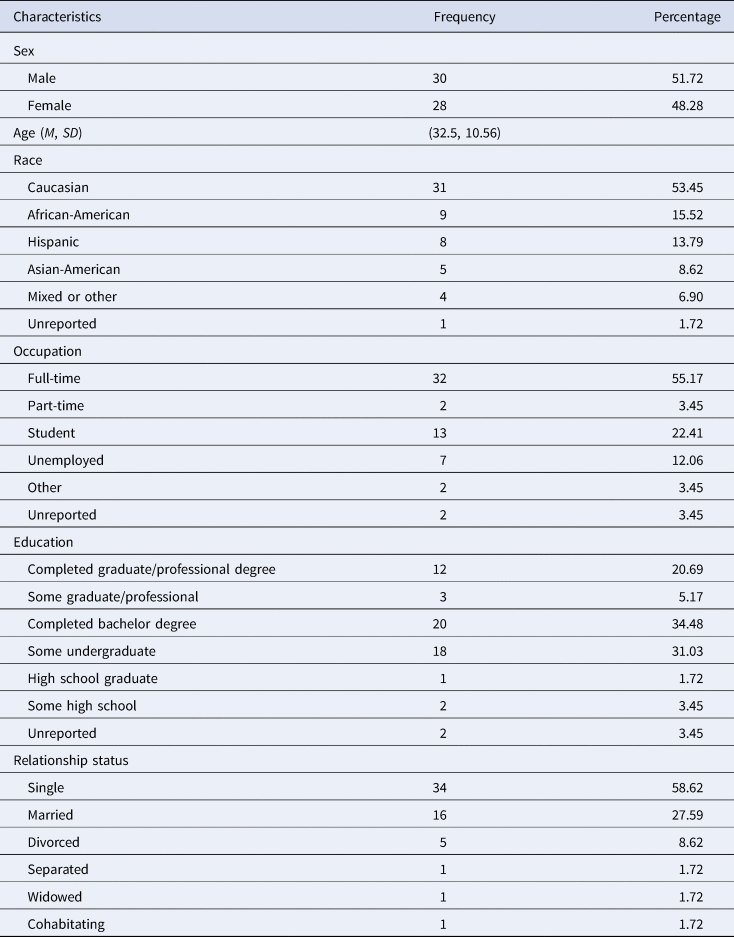
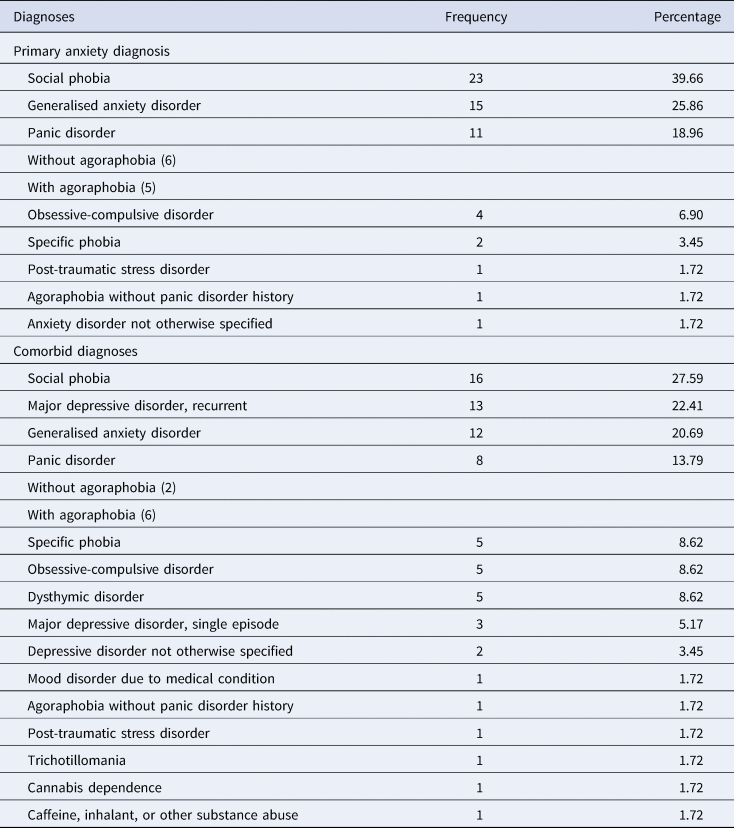
The sample consisted of 58 adults aged between 20 and 58 years (M = 32.5 years, SD = 10.56, 48% female) who participated in a 12-week group tCBT programme at a specialty anxiety research clinic. Of the overall sample, 36.2% had a comorbid depressive disorder, as measured by the Anxiety Disorders Interview Schedule for DSM-IV (ADIS-IV). The anxiety-only group (n = 37) had four participants who experienced a sudden gain. The comorbid anxiety and depression group (n = 21) had seven participants who experienced a sudden gain. There were 11 treatment groups in this study in total. Further information on the original recruitment method and inclusion criteria can be found in Norton (Reference Norton2008, Reference Norton2012a) and Norton and Barrera (Reference Norton and Barrera2012). Demographics for the study sample are included in Table 1, and DSM-IV diagnoses are displayed in Table 2.
Sample Demographics

Note: N = 58.
DSM-IV Diagnoses

Note: N = 58. Diagnoses made with ADIS-IV. Comorbid diagnoses sum to greater than 100% and N = 58 due to participants with multiple comorbidities.
Treatment Protocol and Therapists
This study utilised data from the tCBT condition from the original (Norton, Reference Norton2008; Reference Norton2012a; Norton & Barrera, Reference Norton and Barrera2012) studies. The implemented treatment protocol consisted of a single 2-h session each week for 12 weeks (Norton, Reference Norton2012b). This transdiagnostic method of treatment minimises the use of diagnostic distinctions and moves towards confronting fearful stimuli regardless of its specific nature (Norton, Reference Norton2008). The protocol consisted of three key features: psychoeducation and self-monitoring, cognitive restructuring, and exposure to feared stimuli. Further information on this protocol can be found in Norton (Reference Norton2012b).
Materials
Anxiety Disorders Interview Schedule for DSM-IV (Brown, Di Nardo, & Barlow, Reference Brown, Di Nardo and Barlow1994)
All participants were administered the ADIS-IV at intake to assess each of the anxiety disorders, depressive disorders, and related disorders (e.g., obsessive-compulsive disorder, post-traumatic stress disorder, etc.). Scores ranged from 0 (not severe at all) to 8 (extremely severe or distressing). Scores above 4 were indicative of clinical severity (Brown et al., Reference Brown, Campbell, Lehman, Grisham and Mancill2001). The ADIS-IV demonstrated good to excellent inter-rater reliability across a diverse range of diagnoses and populations (Brown et al., Reference Brown, Campbell, Lehman, Grisham and Mancill2001; Gordon & Heimberg, Reference Gordon and Heimberg2011; Piqueras, Olivares, & Hidalgo, Reference Piqueras, Olivares and Hidalgo2012; Rutter & Brown, Reference Rutter and Brown2015). Diagnostic agreement was found to be very high across principal and comorbid disorders (86%; Norton, Reference Norton2012a). The CSR ratings demonstrated a high degree of internal consistency with an intra-class coefficient (ICC) rating of .77 (Norton, Reference Norton2012a). Where possible, the same interviewers assessed the same participants pre- and post-treatment.
The State-Trait Anxiety Inventory-State Version (Spielberger, Reference Spielberger1983)
The State-Trait Anxiety Inventory-State Version (STAI-S) is a 20-item self-report measure of state anxiety that was administered at the commencement of each therapy session (Norton, Reference Norton2008). The STAI-S was used to measure present feelings of anxiety and determine whether or not participants had experienced a sudden gain between sessions. Statements such as ‘I feel calm’ and ‘I feel upset’ were rated on a four-point Likert scale ranging from 1 (not at all) to 4 (very much so). Total scores ranged between 20 and 80, with higher scores indicating higher levels of state anxiety. In the current sample, internal consistency at session one was in the excellent range α = .91.
Criteria for Sudden Gains
Criterion One — Absolute Magnitude
A symptom decrease of nine or more units on the STAI-S was considered large enough to constitute a sudden gain. This value is the reliable change index (RCI) first implemented in the sudden gains literature by Stiles et al. (2003). The RCI was calculated using the STAI-S score from the initial session (α = .90, SD = 10.37) and rounded to the closest integer. The RCI is commended for its meaningful theoretical background and ability to be compared across measures (Hardy et al., Reference Hardy, Cahill, Stiles, Ispan, Macaskill and Barkham2005; Norton et al., Reference Norton, Klenck and Barrera2010). Criterion one is listed as an equation below, where N = pre-gain session and N + 1 = post-gain session.

Criterion Two — Relative Magnitude
The symptom decrease must have a minimum decline of 25% from the pre-gain score to the post-gain score. This is consistent with the original Tang and DeRubeis (Reference Tang and DeRubeis1999) criteria. Tang and DeRubeis (Reference Tang and DeRubeis1999) used ratio scales with a zero-reference point; however, the STAI-S needed to be adjusted to create a zero-reference point to allow for meaningful inferences (Dour, Chorpita, Lee, & Weisz, Reference Dour, Chorpita, Lee and Weisz2013; Tang et al., Reference Tang, DeRubeis, Beberman and Pham2005). The STAI-S has a minimum possible score of 20. The equation for criterion two is given below.

Criterion Three — Relative to Symptom Fluctuation
The change preceding and following the sudden gain needs to be stable for it to be a significant difference rather than a reflection of emotional instability. This study used Vittengl et al.'s (2005) criteria of treating the t-value with a cut-off score of 2.50 (Collins & Coles, Reference Collins and Coles2017; Goodridge & Hardy, Reference Goodridge and Hardy2009; Hardy et al., Reference Hardy, Cahill, Stiles, Ispan, Macaskill and Barkham2005). To ensure stability of the gain, sessions were counted as sudden gains only if they had STAI-S data when at least two session scores before or after the gain were available (Tang & DeRubeis, Reference Tang and DeRubeis1999).
The equation for the third criterion was that the mean difference between the STAI-S scores of the three sessions proceeding and following the gain was at least 2.50 times greater than the pooled standard deviation of these two groups of STAI-S scores of these sessions.
Statistical Analyses
All statistical analyses were performed with IBM Corp (2016) SPSS Statistics (version 24). Descriptive analyses were conducted. Two-way mixed factorial ANOVAs were run to compare pre- and post-gain STAI-S scores between those who did and did not experience a sudden gain. Chi square analyses were conducted to test whether sudden gains occurred at a higher rate amongst participants with anxiety and comorbid depression than amongst those with anxiety only.
Results
Identifying Sudden Gains
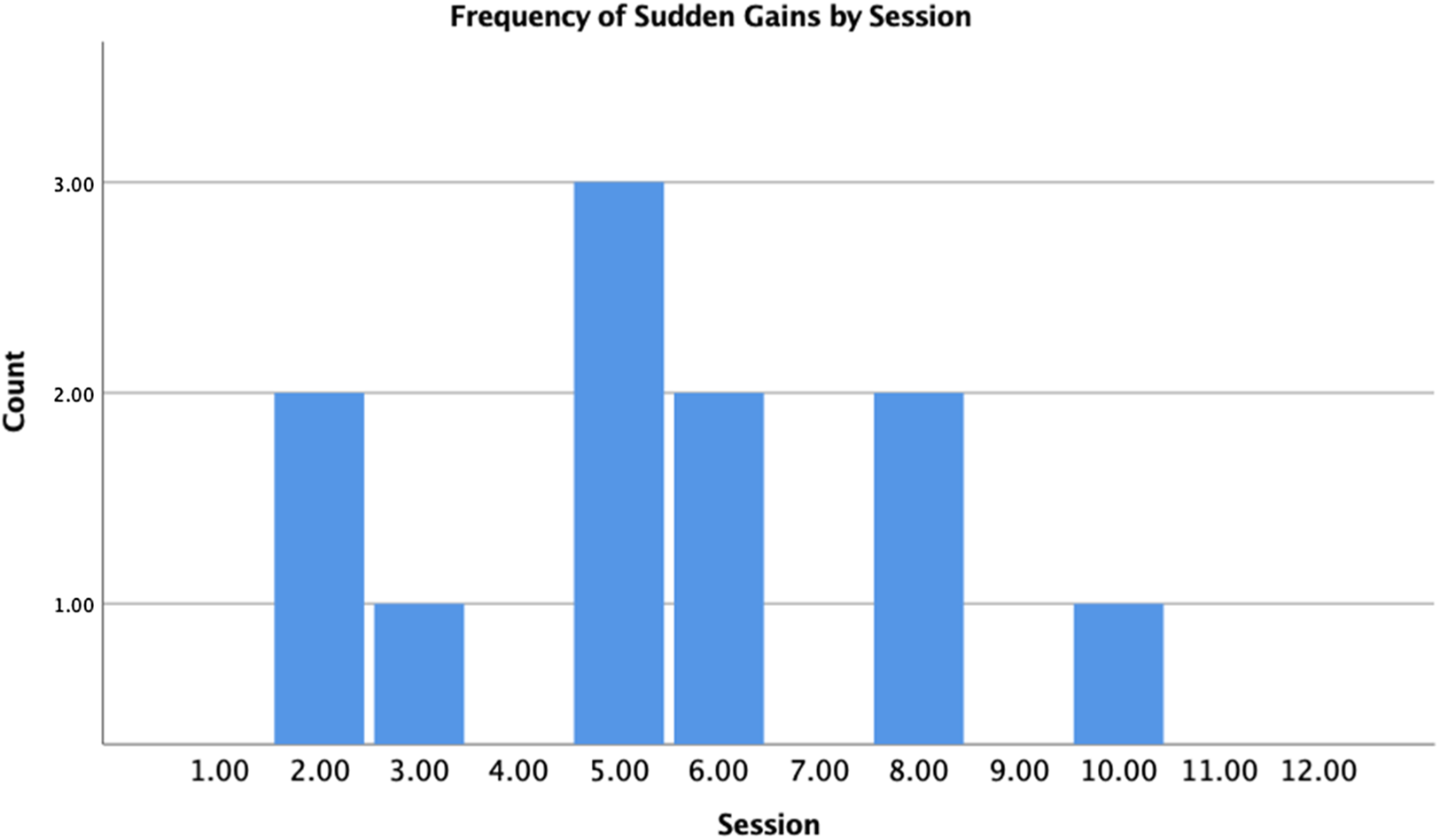
Eleven sudden gains occurred in a sample of 58 participants (19.0%). Sudden gains were spread across the 12 treatment sessions (median session number = 5, see Figure 1). Further, over half of the sudden gain participants reported comorbid depression alongside their primary anxiety disorder (n = 7). No differences were observed on pre-treatment primary diagnosis CSR between participants who did (M = 6.18, SD = 0.87) and did not (M = 5.66, SD = 1.03) experience a sudden gain, F(1,56) = 2.43, p = .125, ηp2 = 0.041.
Frequency of sudden gain occurrence across treatment sessions.

Sudden Gains and Treatment Outcome
The average magnitude of sudden gains was 13.45 STAI-S units, which accounted for 76% of the overall treatment improvement amongst the sudden gains group. Consistent with hypothesis one, the main effect of time F(1, 56) = 54.33, p < .001, ηp2 = 0.49 was significant with a large effect size, indicating that on average, participants improved over time. The main effect of sudden gains was not significant F(1, 56) = 0.07, p = .79, ηp2 = 0.001; however, the interaction between time and sudden gains was significant F(1, 56) = 7.07, p = .01, ηp2 = 0.11 with a medium effect size, indicating that participants in the sudden gains group reported a greater reduction of symptoms over time (as measured by the STAI-S) than non-sudden gain participants. This suggests that the sudden gains group had significantly greater treatment outcomes from sessions 1 to 12 than the non-sudden gains group.
Sudden Gains and Comorbid Depression
As hypothesised, participants with comorbid anxiety and depression were more likely to be classified as having a sudden gain in comparison with those in the anxiety-only group, X2 (1, N = 58) = 4.42, p = .035, φ = .28 with medium effect size. Table 3 displays the frequencies of the distribution of sudden gains across comorbid depression and anxiety-only samples.
Relationship Between Sudden Gains and Comorbid Depression

Discussion
Previous research on sudden gains in depression has typically yielded higher rates than research using anxiety disorder only samples. This study aimed to investigate the differences between comorbid anxiety and depression and anxiety-only participants. Approximately 20% of our sample experienced a sudden gain, which is consistent with prior sudden gains research in anxiety samples (Clerkin, Teachman, & Smith-Janik, Reference Clerkin, Teachman and Smith-Janik2008; Deschênes & Dugas, Reference Deschênes and Dugas2013; Hofmann et al., Reference Hofmann, Schulz, Meuret, Moscovitch and Suvak2006). Sudden gains accounted for approximately 76% of total symptom improvements within the sudden gain participants, which was higher than prior studies (50–65%; Aderka, Anholt et al., Reference Aderka, Anholt, van Balkom, Smit, Hermesh and van Oppen2012; Hofmann et al., Reference Hofmann, Schulz, Meuret, Moscovitch and Suvak2006; Norton et al., Reference Norton, Klenck and Barrera2010).
In support of the first hypothesis, sudden gain participants had significantly larger reductions in anxiety symptoms (pre- to post-treatment STAI-S scores) than non-sudden gain participants. This replicates the findings of Tang and DeRubeis (Reference Tang and DeRubeis1999) and Norton et al. (Reference Norton, Klenck and Barrera2010), who observed significantly greater outcomes for sudden gain participants in both primary depression and primary anxiety samples, respectively. Further, there were no particular sessions in our study that were analogous with sudden gains, rather they were observed across the 12 sessions non-systematically.
Hypothesis two predicted that the incidence of sudden gains would be elevated in the comorbid depression and anxiety sample, compared with the anxiety-only sample. This hypothesis was also supported by the findings. While very few studies in the sudden gains literature have explored comorbidity, this finding does support the consistently higher rates of sudden gains observed in depression-only samples (40–50%; Abel et al., Reference Abel, Hayes, Henley and Kuyken2016; Hardy et al., Reference Hardy, Cahill, Stiles, Ispan, Macaskill and Barkham2005) when compared with anxiety-only samples (15–20%; Bohn et al., Reference Bohn, Aderka, Schreiber, Stangier and Hofmann2013; Norton et al., Reference Norton, Klenck and Barrera2010).
Our results suggest that the incidence of sudden gains in anxiety samples may be, in part, a function of comorbid depression. This is not to imply that sudden gains are exclusive to depressive samples, as the current study still reported incidents of sudden gains in the anxiety-only sample. Rather, depressive samples may be able to provide further insight into the nature of sudden gains and their possible antecedents. This study makes several future research suggestions to pursue this question further. Firstly, the cyclical nature of major depressive disorder has been associated with fluctuating episodes (van Lang, Ferdinand, & Verhulst, Reference van Lang, Ferdinand and Verhulst2007). This may provide an explanation as to why we may observe more frequent sudden gains in depressive disorders, as the large drops in symptomology that we term a sudden gain, may be reflective of the end of a depressive cycle. Thus far in the sudden gains literature, this cyclical explanation has not been investigated; however, it is an area to consider for future research. Further, clients with depression have previously shown faster and larger improvements in symptoms following CBT than those with anxiety disorders (Bohn et al., Reference Bohn, Aderka, Schreiber, Stangier and Hofmann2013; Norton et al., Reference Norton, Klenck and Barrera2010).
Additionally, several studies of sudden gains in depression (Tang & DeRubeis, Reference Tang and DeRubeis1999; Tang et al., Reference Tang, DeRubeis, Beberman and Pham2005) and anxiety disorder samples (Norton et al., Reference Norton, Klenck and Barrera2010) suggested that those experiencing sudden gains tended to show greater evidence of cognitive change in the pre-gain session than did those who did not experience a sudden gain. No investigation of the content of these cognitive changes was described, however, which may open other areas for investigation. For example, it may be that some depressogenic cognitions or cognitive styles may simply be more malleable, which may account for the increased incidence of sudden gains in depressed samples. Alternatively, it may be that these cognitive changes may additionally instil a sense of hopefulness, which could have an additional knock-on effect on depressive hopelessness symptoms.
Finally, many of the studies on sudden gains in samples of individuals with depressive diagnoses used more cognitively focused interventions (e.g., Tang & DeRubeis, Reference Tang and DeRubeis1999; Tang et al., Reference Tang, DeRubeis, Beberman and Pham2005), while those examining sudden gains in anxiety disorders employed interventions that typically emphasise exposure predominantly (Norton et al., Reference Norton, Klenck and Barrera2010). Therefore, it could be argued that the greater incidence of sudden gains in depressed samples may be more a function of intervention style rather than diagnosis. However, in the current study, individuals with comorbid depressive diagnoses still showed a greater incidence of sudden gains than those with anxiety disorders only, despite receiving the same treatment protocol. Even so, an examination of diagnosis (anxiety disorders or depression) by treatment emphasis (cognitive challenging vs. behavioural focused) may yield new potential insights.
This study was not without limitations. We did not have a measure of depressive symptom change across treatment. The STAI-S (Spielberger, Reference Spielberger1983) was used at the beginning of each session to measure state anxiety, observing for any changes in anxiety over the previous week. The current study did not control for depressive symptom change, which may have provided valuable comparisons between the comorbid depression and anxiety group and the anxiety-only group. Future studies should consider employing measures such as the Depression Anxiety Stress Scales (DASS; Lovibond & Lovibond, Reference Lovibond and Lovibond1995) designed to maximally discriminate between depressive and anxious symptoms.
The current study found that individuals with comorbid depression and anxiety had a higher incidence of sudden gains than anxiety-only participants. This finding has led to the suggestion that depressive disorders may provide further insight into the function of sudden gains. Future studies should continue to examine comorbidity within the sudden gains literature to either support or challenge these findings. These findings have contributed valuably to the sudden gains literature and provided many avenues of direction for future research into the nature of sudden gains and their relationship with depressive disorders.
Funding
This research received no specific grant from any funding agency, commercial or not-for-profit sectors.
Conflicts of interest
PJN receives royalty payments from Guilford Press for the treatment manual used in the trials from which these data were collected. SD reports no conflicts of interest.