Can the international community prevent combatants from intentionally killing civilians during interstate war? Given the high-stakes nature of war, there are reasons to be skeptical about third parties’ abilities to influence war participants’ behavior. Perhaps as a result, scholars studying the determinants of civilian targeting during war have largely overlooked the role played by third parties in shaping states’ wartime policies. Instead, research has focused primarily on dyadic and country-level factors such as strategic considerations, domestic institutions, and ratification of international law in determining a combatant’s use of strategic violence towards civilian populations.Footnote 1
Yet a growing body of research suggests that the international community can influence states’ foreign policies in areas as diverse as commitments to international courts, human rights practices, dispute settlement, democratization and conflict propensity.Footnote 2 We build on this burgeoning research to examine the role played by third-party states in attenuating the intentional targeting of non-combatants during interstate war. We argue that combatants will intentionally target fewer civilians in war when they expect third parties to punish them for doing so. Third-party states, in turn, will be most likely to act when two conditions hold. First, they must regard the protection of civilians during war as a highly salient issue. Third parties that have ratified the relevant legal prohibitions against non-combatant targeting in war will be likely to value civilian protection norms, and consequently will be more willing to encourage behavior that upholds them. Secondly, attempts to alter combatant state behavior will be most effective when third parties have significant leverage over combatant states; specifically, allies and trade partners of war participants can use existing networks of interaction to impose meaningful costs/benefits on war combatants.
Based on this logic, we hypothesize that combatants will kill fewer civilians in war as their trade and alliance networks come to be dominated by third parties that have ratified the legal conventions prohibiting the intentional targeting of non-combatants during war. We test this argument on a dataset of all interstate wars from 1900–2003. Across a range of statistical tests, we find strong and consistent support for our hypothesis: combatants kill fewer civilians in war when their alliance and trade networks are dominated by ratifiers.Footnote 3
This article makes several important contributions to existing scholarship. First, we identify a previously overlooked determinant of civilian targeting during interstate war: third-party networks’ influence. Understanding the causes of civilian victimization is of critical importance, as civilian populations often bear the brunt of the costs of war, and civilian loss of life is perhaps the most direct manifestation of these costs. Relatedly, we identify a new area – wartime behavior towards civilians – in which the international community plays a significant role in shaping state behavior, thereby advancing the literature on how third parties influence foreign policy decisions.Footnote 4
Thirdly, we show that international law has important indirect effects on war participants by influencing third parties’ incentives. While the mechanism we propose focuses on the coercive power of third parties, the law is an integral part of our argument in that the impetus for third parties to use their leverage to sway combatant behavior is based upon their adoption of (and adherence to) the norms espoused in international humanitarian law. We thus identify a new role for international law that many scholars have overlooked, and in doing so show that researchers typically underestimate the law’s impact by focusing solely on its direct effects. Further, by focusing on third parties’ – rather than war combatants’ – treaty ratification status, we avoid problems of selection bias that hinder many empirical analyses in the international law literature.Footnote 5
The article proceeds as follows. First, we briefly review the recent literature on how third parties influence state behavior. Secondly, we develop our theory of how third-party networks influence war combatants’ behavior towards civilian populations in war. Thirdly, we review our research design, measurement of variables, and present our empirical results. Finally, we conclude by discussing the implications of our findings and avenues for future research.
THIRD-PARTY INFLUENCE ON STATE BEHAVIOR
In recent years, scholars have begun to systematically examine the international community’s impact on states’ foreign policies. Several important insights come out of this literature. First, it demonstrates that, broadly speaking, third parties matter. They influence state behavior, both within and outside the context of interstate war, in a variety of ways. Existing research demonstrates, for example, that third parties influence dispute resolution processes,Footnote 6 conflict propensity,Footnote 7 the survival of democratic regimes,Footnote 8 and ratification of and compliance with human rights treaties.Footnote 9
Secondly, this burgeoning literature demonstrates that third parties that provide important political, military or economic support to a given state are particularly well situated to influence that state’s behavior. Goodliffe et al., for instance, find that International Criminal Court ratification is more likely when states’ ‘dependence networks’ create an implicit link between ratification and continued or additional network benefits.Footnote 10 Likewise, Hafner-Burton demonstrates that third-party coercion can improve states’ compliance with human rights standards by linking the benefits of integration through preferential trade agreements to improved human rights practices.Footnote 11 Finally, this literature demonstrates that who states interact with matters. The normative beliefs of relevant third parties determine their willingness to exert pressure on a combatant state, whether through a process of socialization or more materially based coercion processes.Footnote 12 In the next section, we build and expand upon these insights to develop a theory of third-party influence on combatant state behavior toward civilian populations during interstate war.
THIRD PARTIES AND THE EFFECTIVENESS OF INTERNATIONAL HUMANITARIAN LAW
This section argues that combatants will intentionally target fewer civilians during interstate war when their alliance and trade networks – those of particular importance during war – are dominated by third parties that have ratified the Hague/Geneva Conventions. Under these conditions, combatant states will anticipate higher pay-offs for compliant behavior than for behavior that violates the norms espoused by these legal conventions, and will have incentives to protect civilian life.
We focus theoretically and empirically on combatants’ expectations of how third parties will respond to their treatment of civilian populations during war, arguing that leaders incorporate the expected reactions of third parties into their decision-making calculus.Footnote 13 As Goodliffe et al. argue, ‘if governments care about the economic, security, and political goods their network partners provide, they can anticipate likely reactions of their partners and behave in ways they expect their partners will approve’.Footnote 14 That is, combatants anticipate the likelihood that interested third parties will provide positive inducements (carrots) or punishments (sticks) in order to alter the pay-offs of a given strategy or policy.
Third parties’ reactions are important to combatants because they can have a meaningful impact on both wartime and post-war pay-offs. Most directly, third parties influence war outcomes and the costs of war by providing or withholding critical economic or military support to combatants during the conflict. Thus a combatant state’s expectations regarding third-party responses play a non-trivial role in that combatant’s strategic decision making. Anticipated positive reactions from third parties increase the state’s expected pay-off from avoiding intentional civilian targeting, while anticipated negative responses decrease the expected pay-off from choosing a course of action that is at odds with legal prohibitions against civilian targeting. Consequently, combatants are most likely to alter their behavior when they have a relatively high expectation of third-party involvement, while they are less likely to do so when they have a low expectation that third parties will act, ceteris paribus.
Based on this logic, we argue that combatant states are less likely to intentionally kill civilians when they interact with third parties that have (1) the willingness to act based on the norms espoused by international humanitarian law and (2) sufficient leverage over target states to meaningfully alter pay-offs. As we argue below, the willingness condition is met when third parties have ratified the relevant treaties proscribing civilian targeting, while the leverage condition is met when third parties are alliance or trade partners, as these are the states whose support is imperative during conflict.
Third-party Treaty Ratification as a Signal of Norm Salience/Adoption
Combatants are less likely to target civilians in war when they expect third-party sanctions for doing so. Third-party states, in turn, will be more willing to take action to protect non-combatants in war when they regard civilian protection as a highly salient issue. We define salience as the importance or priority a state places on a particular legal obligation, independent of the actual content or requirements of the law. High-salience obligations are those that states place a high normative value on, while low-salience obligations lack this normative valuation.Footnote 15
Identifying which third parties view civilian protection as a high-salience issue is non-trivial, as states’ preferences are unobservable. Combatant states must therefore assess third parties’ preferences based upon observable third-party behavior. Specifically, third-party states that have ratified the Hague/Geneva Conventions or the 1977 Additional Protocols prohibiting the intentional targeting of civilians are more likely than those that have not ratified to regard the protection of non-combatants in war as highly salient.Footnote 16 While scholars have examined compliance with this body of law,Footnote 17 our argument is distinct in that we are interested in how these legal conventions influence the willingness of third-party states to pressure combatants to protect civilians in war. Thus we expand upon the traditional compliance literature by examining the indirect influence that international law exerts, via third-party pressure, on war participants. This approach has potentially important implications for the role of international law in world politics, as focusing only on international law’s direct influence ‘potentially underestimates broader treaty effects’.Footnote 18
Third-party states that have ratified the laws prohibiting the intentional targeting of civilians are more likely to regard the norms embodied in these treaties as highly salient, and thus reward states that refrain from targeting civilians while punishing those that do not.Footnote 19 Scholars have put forward two primary explanations for norm adoption during and after ratification. First, some argue that the law establishes appropriate standards of conduct, and that states comply with treaties that they have ratified because of the logic of appropriateness.Footnote 20 The law creates shared understandings through a process of internalization, which shapes states’ perceptions of their identities and ultimately influences how they ought to behave. States abide by the law because they believe it is the right thing to do. The same logic applies here: third parties that ratify the Conventions/Protocols are more likely to value the norms embodied in these international legal instruments than states that refrain from doing so. As Morrow argues, ‘treaties are a public signal that a state accepts a standard by ratifying it’.Footnote 21
Other scholars point to the costs of ratification to explain why states that ratify treaties will be more inclined to act in accordance with the relevant legal principles.Footnote 22 In these accounts, treaty ratification indicates a third party’s salience type because ratification can be politically costly. In most countries, treaty ratification requires the approval of legislative, parliamentary or other domestic actors. Often, formal procedures requiring legislative majorities or supermajorities are required for ratification.Footnote 23 The United States, for instance, requires the advice and consent of two-thirds of the Senate for successful ratification. More generally, by requiring domestic approval, the ratification process entails costs for governments that only some are willing to pay, such as changing existing laws, legislative opposition and obtaining support from military elites. High-salience third parties are likely to pay these ratification costs, while low-salience types will be unwilling to do so. According to this argument, therefore, treaty ratification functions like a separating equilibrium, as only third parties that have adopted the relevant norms will pay the costs of ratification.Footnote 24
Both of these mechanisms suggest that third parties that ratify treaties are more likely to adopt (or have already adopted) the norms embodied in them. Thus from the perspective of the war combatant, international humanitarian law functions as a useful screening mechanism, allowing combatants to distinguish high-salience from low-salience third parties.Footnote 25 Third parties that have ratified the relevant prohibitions against civilian targeting have demonstrated their adherence to the norm of civilian protection during war through their willingness to pay the costs of ratification or through the discursive process surrounding ratification, and are thus expected to more willingly absorb the costs of coercive policies designed to bring combatant behavior in line with international humanitarian law. In contrast, combatants will be uncertain about non-ratifiers’ willingness to enact policies to promote compliance because they have not demonstrated their normative commitment to the legal obligation through the ratification process. Consequently, combatants will expect a higher likelihood of third-party involvement when they interact primarily with third-party ratifiers. This decreases the pay-offs and therefore the likelihood and severity of intentional non-combatant targeting during war.Footnote 26
Power, Leverage and Network Ties
In order to alter combatant behavior, third parties must also have leverage over the combatant such that the provision or withholding of benefits significantly affects the leader’s strategic calculus. That is, third parties must have the opportunity to alter a combatant’s pay-offs for civilian targeting through the provision of benefits or imposition of punishments.Footnote 27
The central implication of this insight is that only some third parties have the ability to alter target states’ behavior, and that this ability derives from existing, non-trivial ties between combatants and third parties. Specifically, allies and trade partners can exert significant leverage over combatants’ behavior during war because they interact regularly with the combatant state. Their existing network ties to the combatant provide them the opportunity to alter combatants’ pay-offs from pursuing specific strategies during war. Thus allies and trade partners can influence combatant pay-offs for civilian targeting during war by linking the provision of economic and military support to civilian protection, and can also induce states to protect civilians through the implicit or explicit promise of future (that is, post-conflict) benefits or punishments. In contrast, third parties that lack these pre-existing network ties are unlikely to have the necessary leverage to credibly threaten to alter pay-offs either during or after conflict, and therefore will be unable to meaningfully influence combatant behavior.Footnote 28
In the context of war, allied support in the form of burden sharing, for instance, can help combatants prevail by increasing their military capabilities and offsetting the human and material costs of using force.Footnote 29 Other types of support, such as access to bases, supply routes, and strategic and tactical advice, can also provide combatants with an advantage in war.Footnote 30 Byman and Waxman argue, for instance, that using force requires support that is often only available from regional allies.Footnote 31 Likewise, maintaining alliance ties in the immediate post-war period is also likely to be important to war combatants. States may be compromised militarily in the aftermath of war, and may require the assistance of allies in case conflict reignites.Footnote 32
Trade partners can also influence the costs of war in several ways. First, research suggests that third parties are more likely to intervene on behalf of combatant states when they are economically interdependent with those states,Footnote 33 suggesting that trade partners are a clear set of actors whose support combatants are keen to maintain during war. More generally, states often suffer significant economic loss and damage during conflict,Footnote 34 and maintaining strong trade ties may help them recover from wartime losses more quickly. Similarly, trade can help combatant states compensate for the reallocation of resources away from consumer goods and towards the war effort during conflict, and can provide the resources, equipment and other related services necessary to wage war, such as arms transfers and other forms of military equipment.Footnote 35 It is therefore useful for combatants to maintain positive relations with trade partners to ensure that they maintain these benefits during war.Footnote 36 Finally, should combatant states behave in ways that undermine their positive relationships with trade partners, they may face sanctions that cut the flow of arms, decrease industrial output and diminish the available capital.Footnote 37 Thus trade partners have leverage over combatants and the opportunity to alter a combatant’s wartime and post-war pay-offs for civilian targeting. They can, as a result, influence combatant behavior towards civilian populations during war.
Based upon the above argument, we expect combatants whose allies/trade partners have ratified the relevant conventions to be less likely to target non-combatants during war. Importantly, however, most combatants’ networks include a combination of ratifiers and non-ratifiers. Therefore, the overall ability of third parties to curb combatant civilian targeting in war likely depends on the relative strength of ratifier third parties within existing networks. For alliance networks, military strength is the important determinant of leverage, while in the context of trade networks, the total volume of trade with ratifiers versus non-ratifiers is key. Thus, as ratifiers come to control a greater proportion of total capabilities or total trade within a combatant’s networks, these networks become ratifier dominated, and will be better able to induce behavior that protects civilian populations during war.Footnote 38
Empirical Implications
The theory developed above suggests that third parties can influence combatants’ treatment of civilian populations if they have adopted the norms espoused in international humanitarian law and if they are network members of the combatant, and thus have sufficient leverage to alter the pay-offs for compliant versus non-compliant behavior. When third-party states regard civilian protection norms as salient, they will be more likely to alter their policies towards the combatant state, and when they have the ability to alter a combatant’s pay-offs, those policy changes are likely to succeed.
The logic of this argument generates the following empirical implication: combatants will kill fewer civilians in interstate war when they interact with third parties that have ratified the relevant legal conventions and can impose costs for violations or provide benefits for compliance through existing alliance or trade ties. As a result, the number of intentional civilian deaths in interstate war is inversely related to the strength or influence of ratifiers within a combatant’s alliance and trade networks.
Hypothesis: A war combatant will intentionally target fewer non-combatants in war as the relative influence of ratifier third parties within its alliance and trade networks increases.
RESEARCH DESIGN AND MEASUREMENT
We test our theoretical argument using the Valentino et al. dataset on interstate wars from 1900–2003.Footnote 39 The dataset includes all wars with at least two independent states that result in a minimum of 1,000 conflict-related fatalities in a period of twelve or fewer months during the course of the conflict.Footnote 40 The unit of analysis in our study is the war combatant. Dyadic wars always have two observations, one for each state, while two different criteria are used to code the relevant participants in multilateral wars in the Valentino et al. data: each combatant is included separately when there is little or no policy co-ordination among the disputants (for example, different fronts in World War II), while states are aggregated into a single observation when there is extensive policy coordination, such as a unified command structure under a single state’s control (for example, the 1991 Gulf War).Footnote 41 These coding rules generate a total of 148 war participants (that is, observations) across the eighty wars in the dataset.Footnote 42
Response Variable
The response variable is the number of non-combatants (that is, civilians) intentionally killed by each combatant during the course of a war, as coded by Valentino et al. A non-combatant is defined as ‘any unarmed person who is not a member of a professional group or guerilla military group and who does not actively participate in hostilities by intending to cause physical harm to enemy personnel or property’.Footnote 43 Non-combatant deaths are coded as intentional if the combatant state (1) directly, purposefully targets civilians for death or (2) indirectly targets civilians through coercive policies expected to result in widespread non-combatant death, such as forced relocations, starvation blockades or the intentional destruction of food/water supplies. Excluded from this measure are civilian deaths that are the unintentional consequence of fighting. For example, civilians killed because they were caught in the crossfire are excluded, as are deaths that result from disease, malnutrition, or starvation caused by the breakdown of social programs and economic production during war. Also excluded are deaths that result from the unauthorized or rogue behavior of low-level commanders or individual soldiers.Footnote 44 This measure is appropriate for the current project, as third-party states that value humanitarian law are likely to disapprove of policies that intentionally put civilians at risk, even if those civilians are targeted only indirectly.Footnote 45
In the data, the average number of non-combatants killed is 125,673. The minimum is zero, and the maximum is 5,000,000 (Germany, Eastern Front, World War II). The data are thus skewed; we log the response variable to account for this in the primary analysis below, and we create a four-category variable in the Appendix to further address any concerns about the influence of outliers. The results are consistent with those presented below.
Explanatory Variables of Theoretical Interest
Our key explanatory variables capture the extent to which a combatant state anticipates the imposition of costs/benefits for targeting versus protecting civilians during war. As discussed above, combatant states will have a high expectation of third-party reactions when they interact with relatively strong ratifier states in their alliance and trade networks. To measure this expectation, we generate two variables that capture the strength of ratifiers within alliance and trade networks, respectively.
We use a three-step procedure to code the network variables: (1) identify the relevant set of third parties, (2) distinguish between ratifier and non-ratifier network members and (3) calculate the relative influence of ratifiers within each network. First, we identify all allies and trade partners for each war combatant in the dataset using the Correlates of War (COW) Alliance datasetFootnote 46 and the COW National Trade data,Footnote 47 respectively.
Secondly, we classify each network member (that is, ally or trade partner) as a ratifier or non-ratifier. A third party is coded as a ratifier if it ratified the relevant treaty prohibiting the intentional targeting of non-combatants before the onset of the war in question. Four treaties cover the different time periods in our analysis: (1) the 1899 Hague Convention, (2) the 1907 Hague Convention, (3) the 1949 Geneva Convention and (4) the 1977 Additional Protocols to the Geneva Convention. A third party state is coded as a ratifier if it ratified the 1899 Hague Convention for the period between 1899 and 1906, the 1907 Hague Convention for the 1907–1948 period, the 1949 Geneva Convention for the 1949–1976 period, or the 1977 Additional Protocols thereafter.Footnote 48 All other states are coded as non-ratifiers.
After identifying network members and their ratification status, we calculate the relative importance of ratifiers versus non-ratifiers within each network. For the alliance network variable, we sum the military capabilities of all ratifiers within the network and generate a ratio by dividing the network’s ratifier capabilities by the network’s total (ratifier and non-ratifier) capabilities.Footnote 49 This procedure generates a measure of the relative influence of ratifier states within each combatant’s alliance network. For example, the alliance network variable equals 0.8 if ratifiers possess 80 per cent of the total military capabilities in the combatant’s alliance network. War combatants with no relevant third parties (that is, no alliance partners) receive a zero on this variable.
The trade network variable is constructed in a similar manner. We generate a ratio that incorporates the relative influence of ratifier versus non-ratifier states in the network. To do this, we calculate the total trade between the combatant and all ratifiers in the network, and divide by the combatant’s total trade with all trade partners (ratifiers and non-ratifiers). This produces a variable that measures the proportion of a combatant’s total trade that occurs with ratifiers, or the relative importance of third-party ratifier states in each trade network. Values above 0.5 indicate that the majority of the combatant’s trade volume is with ratifier states, while values below 0.5 indicate that the bulk of the combatant’s trade occurs with non-ratifier states.
The mean value for the alliance ratifier network variable is 0.47, while it is 0.57 for the trade ratifier network variable. The minimum and maximum for both variables is 0 and 1, respectively. We also observe interesting variation within wars. In the 1956 Suez Crisis, for example, ratifiers held 34 per cent of Egypt’s alliance network’s capabilities, while controlling 49 per cent of capabilities within Israel, UK and France’s collective alliance network. In the first Kashmir War, ratifiers in India’s trade network were responsible for 56 per cent of India’s total trade, while Pakistan’s ratifier trade partners controlled only 30 per cent of that state’s total trade. Importantly, the correlation between the two network variables is 0.29, suggesting that states’ trade and alliance networks are sufficiently different; the two variables are picking up on two distinct sources of leverage.
Control Variables
We include a variety of control variables to account for conflict, combatant and adversary characteristics that are likely to influence intentional civilian targeting during war. These variables are included to control for alternative explanations for civilian targeting, allowing us to better isolate the impact of our proposed coercion mechanism. However, a pared-down model including a more limited set of controls is presented in Appendix Table S6, and the results remain consistent.
First, we control for the combatant’s strategy using two variables that previous research demonstrates are highly influential and consistent predictors of civilian targeting.Footnote 50 The first of these variables, Attrition, equals 1if the combatant engaged in attrition during the war, and 0 otherwise. Attrition is defined as a ‘strategy that seeks to wear down the adversary’s ability to fight by destroying or capturing large portions of the adversary’s military forces in a large number of large-scale battles’.Footnote 51 Building on existing research, we expect states fighting wars of attrition to target greater numbers of civilians. Targeting enemy civilians becomes a more attractive strategic choice during costly wars of attrition, as it provides a way of coercing the enemy to surrender without having to pay the high costs of defeating enemy forces militarily.Footnote 52 Furthermore, civilian populations play a central role in supporting the war effort during wars of attrition, and are therefore a more attractive target for the enemy, which can weaken its opponent militarily without having to target military installations directly.Footnote 53
The second strategy variable, Counterinsurgency, is coded 1 if the combatant engaged in counterinsurgency during the war, and 0 otherwise. Counterinsurgency involves an adversary using guerrilla tactics when the combatant formally controls all or most of the territory where fighting occurs. It often involves the use of small, mobile fighting units and population control tactics such as relocation away from guerrilla strongholds.Footnote 54 We expect counterinsurgency to generate more civilian deaths because targeting civilians in counterinsurgency wars is a useful coercive tactic. Because guerrillas rely heavily upon the civilian population for food, shelter, information and other support, targeting civilians is an easy way for combatants to undermine the enemy’s war effort relatively cheaply and effectively. Civilians are an easy target because they are immobile, difficult to conceal and are often left unprotected.Footnote 55
We also control for the combatant’s war aims. War Aims is coded 1 if the combatant seeks either territorial conquest or regime change, and 0 otherwise. We expect combatants seeking territorial conquest to target civilians strategically: eliminating potentially adversarial populations reduces the risk that the conquering army will face rebellion in the future.Footnote 56 Similarly, combatants seeking regime change are likely to target civilians because, like territorial conquest, regime change represents an expansive war aim that opponents will fight hard to avoid. Opposing governments will not easily give in to attempts to remove them from power. Therefore, combatants seeking regime change may resort to civilian victimization as a coercive measure to induce concessions at a lower cost.Footnote 57
We control for the duration of the conflict with a variable, Duration, which equals the natural log of the total length of the war in days. It is important to control for duration for two reasons. First, protracted wars likely increase combatants’ desperation and willingness to target enemy civilians as a way to end the war quickly and limit their own losses.Footnote 58 Secondly, civilians become more integral to the war effort in long wars, as the military relies more heavily upon the population’s productive capacity to supply weapons, ammunition and food as war drags on. Thus civilian populations become more strategically valuable targets as war duration increases.Footnote 59
Fifth, we include a measure of the fighting’s proximity to the combatant’s homeland territory. This control, which comes from Valentino et al., is a dummy variable coded 1 if the ‘primary ground theater of the conflict was located at least 1,500 miles from the combatant’s homeland’.Footnote 60 As the authors note, the location of fighting in relation to homeland territory is a key determinant of civilian deaths, as it determines the level of access a combatant has to adversary population centers. Combatants will have less access and kill fewer civilians when they are farther from the theater of war, as force projection becomes more difficult over greater distances. Distant wars are also likely to involve less crucial war aims, which makes civilian targeting less likely.
We also control for the total number of military fatalities suffered by the combatant. Following Valentino et al., military personnel include both professional and irregular troops that are engaged in active combat.Footnote 61 We log this variable to account for its skewed distribution. This variable is expected to increase civilian deaths, as higher military fatalities suggest more difficult wars, which, as previous research shows, are correlated with greater civilian deaths.Footnote 62
We also include controls for combatant characteristics expected to influence the decision to target non-combatants. First, we control for the combatant’s regime type using Polity data.Footnote 63 Democracy equals 1 if the state receives a six or greater score on the polity scale, and 0 otherwise. While the literature is mixed on this, we expect more democratic states to kill fewer civilians. It is also important to control for combatant regime type, because democratic combatants might be more likely to ally/trade with other democracies, which, in turn, are more likely to have ratified humanitarian law. Controlling for combatant democracy ensures that the statistical results are not simply capturing the fact that democracies may be less likely to target civilians and more likely to have ratifier allies/trade partners. Secondly, we account for the direct impact of international law with a variable that equals 1 if the combatant is a Hague/Geneva/Protocols ratifier, and 0 otherwise. A combatant receives a 1 on this variable if it ratified the 1899 Hague Convention for the period between 1899 and 1906, the 1907 Hague Convention for the 1907–1948 period, the 1949 Geneva Convention from 1949 to 1976, and the 1977 protocols thereafter.Footnote 64
Thirdly, we control for the combatant’s trade openness using data on total imports plus exports.Footnote 65 More economically open states are expected to kill fewer civilians because they will suffer greater consequences than less economically open states if trade partners reduce or stop trading with them as a result of their targeting non-combatants. Fourthly, we control for whether the war combatant has (1) a major power ratifier ally or (2) a major power ratifier trade partner. We include these two controls to ensure that our main variables are not simply capturing the effect of major power third parties pressuring their combatant allies/trade partners to avoid escalating conflicts and dragging them into the fight. These variables equal 1 if the combatant has at least one major power ratifier ally or trade partner, respectively.Footnote 66
Finally, we control for adversary characteristics that are likely to impact non-combatant targeting in war.Footnote 67 First, we include a measure of the adversary’s total population. We log this variable due to its skewed distribution. We also include an adversary regime-type variable that equals 1 if the adversary receivers a six or greater on the net-Polity scale. We also include two additional variables that account for the relationship between combatants. The first is a measure of relative military capabilities from Valentino et al.Footnote 68 We expect combatants who are relatively more powerful than their adversaries to kill greater numbers of civilians, all else equal, as they are (1) more capable of targeting their opponent’s population and (2) less likely to face retaliation in kind from a relatively weak adversary.Footnote 69 This variable is measured as the combatant’s share of the total capabilities of all combatants in the war, and is derived from data on military personnel, military expenditures and the quality ratio (expenditures per personnel).Footnote 70 Secondly, based on recent research, we include an identity variable that equals 1 if the combatant is a European state and the adversary is a non-European state, as European combatants are more likely to kill non-European than European civilians.Footnote 71 Combatants are coded as European if they ‘participated in the initial codification of the law of war in the late nineteenth century and […] were generally perceived by European states as members of the European community at the time of codification’.Footnote 72
EMPIRICAL RESULTS
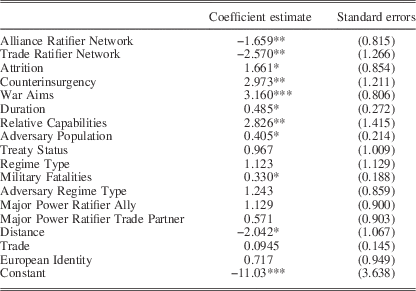
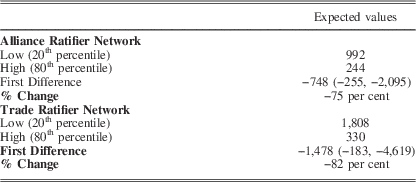
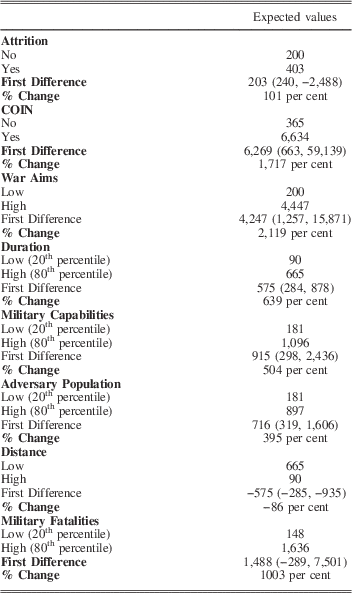
We use ordinary least squares (OLS) with robust standard errors clustered on the conflict to estimate our models. We also take the natural log of our response variable to account for its skewed distribution.Footnote 73 The results of the primary analysis are presented in Table 1, while Table 2 presents expected values and first differences to show the substantive impact of our results and to allow us to compare our findings with other explanations for civilian targeting.
Determinants of Civilian Killing in Interstate Wars, 1900–2003

Note: n=148. Robust standard errors in parentheses, clustered on war *p<0.10, **p<0.05, ***p<0.01
Substantive Results for Network Variables

Note: 95 per cent confidence intervals presented for first differences.
The results presented in Table 1 provide strong support for our theoretical argument. First, the coefficient estimate on the alliance network variable is negative and statistically significant. Consistent with our theoretical argument, this indicates that a combatant is less likely to intentionally target non-combatants in war as the strength of ratifiers in its alliance network increases. The first differences and percentage changes can be found in Table 2.Footnote 74 As expected, we find strong substantive support for our argument. When ratifier allies are weak (network variable at 20th percentile), a war participant kills an average of 992 non-combatants, while it only targets, on average, 244 civilians when ratifier allies are strong (network variable at 80th percentile). Thus a war participant allied with strong ratifiers kills 75 per cent fewer civilians than a combatant whose alliance network is dominated by non-ratifiers.
As Table 1 indicates, the trade network variable also has a meaningful impact on the behavior of war participants; the coefficient estimate for the strength of ratifiers in the trade network is negative and statistically significant. Thus a war participant kills fewer non-combatants as the influence of ratifiers within its trade network increases. The substantive effects provide further support for the influence of trade networks (Table 2). When a combatant’s trade network is not dominated by ratifiers (variable at 20th percentile), it intentionally kills an average of 1,808 non-combatants in war. In contrast, a war participant kills an average of only 330 non-combatants when ratifiers dominate its trade network (variable at 80th percentile), an 82 per cent reduction.
Comparing these results to leading explanations for civilian targeting, the substantive results for significant control variables in Table 3 show that, as expected, strategy (attrition and counterinsurgency), war aims, duration, military capabilities, adversary population and military fatalities significantly increase the number of civilian deaths. Moving from low to high values on these variables increases the number of civilians intentionally killed by 203, 6,269, 4,247, 575, 915, 716 and 1,488, respectively. The number of intentional civilian fatalities decreases by 575 deaths when we move the distance variable from low to high. Importantly, these results suggest that the influence of third parties is non-trivial in comparison to leading determinants of civilian targeting. The alliance and trade network variables have substantive effects on par with many of these controls.
Substantive Results for Control Variables

Note: 95 per cent confidence intervals presented for first differences.
Overall, these results provide strong support for our theoretical expectations. The relative strength of ratifiers among a combatant’s allies and trade partners is both a statistically significant and substantively meaningful predictor of intentional civilian deaths. In the Appendix, we estimate several robustness checks that provide further support for these findings. Specifically, our results are consistent when we recode our network variables to focus more explicitly on ‘sincere ratifiers’ (Appendix Table S1), when we include additional controls to account for similarity between combatants and their network members (Appendix Table S2), when we restrict our sample to combatants without major power ratifier allies (Appendix Table S3) or to only difficult wars (Appendix Table S3), when we account for potential conditional effects of network influence (Appendix Table S4), when we drop coalition wars and occupations (Appendix Table S5), when we add controls for the United States and post-1945 as well as when we run a more parsimonious model (Appendix Table S6), when we recode our dependent variable as a categorical variable to address the potential influence of outliers (Appendix Table S7), and when we compare the influence of in-network ratifiers to out-of-network ratifiers (Appendix Table S7). A full discussion of these additional tests is available in the Appendix.
Importantly, we also include tests of the underlying mechanism in Appendix Tables S8–S12. These secondary models test the underlying argument that third-party ratifiers are more likely than non-ratifiers to punish combatants for targeting civilians in war. In Appendix Tables S8 and S10, we find that increasing non-combatant deaths significantly decreases trade volume with ratifier trade partners, while also significantly increasing the likelihood of alliance termination with ratifier allies. The number of civilian deaths, however, has no impact on trade volume or alliance duration with non-ratifiers. These results suggest, as expected, that combatants pay an economic and military price for intentionally targeting civilians when their network partners are ratifiers.
Illustrative Cases
This section supplements the findings from our statistical analysis with a brief overview of cases that help illustrate the logic of the argument. It is important to note that while the evidence presented below is suggestive, we cannot rule out the possibility that the pattern of behavior observed is not strictly due to third parties’ desire to uphold humanitarian law.Footnote 75 Further, we do not intend to imply with these examples that the risk to civilian populations is the only factor influencing combatant or third-party behavior. Wartime decisions are complex and likely influenced by a number of strategic concerns, including (but not limited to) the impact on civilians.
The Ethiopia–Eritrea border war of 1998–2000 provides a clear illustration of the power of trade partners in curbing combatant behavior during war. Just weeks after the conflict began in May 1998, Eritrea and Ethiopia began exchanging air strikes, each attacking airports and surrounding areas in the other country. A 5 June attack by Eritrea included the dropping of cluster bombs on civilians near an elementary school in Mekele, with Ethiopia claiming sixty civilians died in the attack.Footnote 76 This was followed, days later, by an Eritrean air assault on the Ethiopian town of Adigrat in which four civilians were killed and another thirty wounded. An Eritrean helicopter gunship also destroyed an emergency food warehouse. With tens of thousands of refugees flooding Adigrat at this time, the loss of this emergency relief threatened additional civilian lives.Footnote 77 Estimates at the time put the civilian death toll from these bombing raids, in just the first weeks of fighting, at over fifty Ethiopians and Eritreans.Footnote 78
Just three days after the aerial bombardment of Adigrat, emissaries from Italy, in conjunction with US President Clinton, brokered a moratorium on airstrikes or the threat of airstrikes in the Ethiopia–Eritrea conflict.Footnote 79 Italian envoy Rino Serri shuttled back and forth between the two capitals in order to reach this deal, and Clinton spoke with the leaders of both countries.Footnote 80 A statement from the White House highlighted that the agreement would ‘limit the risk’ to civilians’,Footnote 81 while Assistant Secretary of State for African Affairs, Susan Rice, stressed that it was ‘in accordance with International Law’.Footnote 82
Importantly, both Italy and the United States were important trade partners for Ethiopia and Eritrea when this deal was struck. They were Ethiopia’s fourth- and fifth-largest trade partners, respectively, and Eritrea’s second- and fifth-largest trade partners, respectively, constituting 16 per cent of Eritrea’s total trade and a full quarter (25 per cent) of Ethiopia’s.Footnote 83 Accordingly, the pressure exerted by Italy and the United States as highly influential trade network members for both combatants successfully limited the civilian costs of the Ethiopia–Eritrea border war. A US Institute of Peace report suggests that had third parties not intervened to curtail the airstrikes, the conflict could have expanded substantially, with significantly more loss of civilian life.Footnote 84
The War of Attrition between Israel and the Arab states, and surrounding military engagements, provides additional evidence supporting the logic of our argument. During the 1950s reprisal operations, Israel launched a series of disproportional attacks in retaliation for terrorist incidents coming from Jordan. The vast majority of those killed during the early years were unarmed civilians traveling around the border areas who fell victim to landmines or Israeli Defence Forces (IDF) gunfire. On 12 October 1953, a grenade was thrown into a Tel Aviv house, killing one woman and two children. In retaliation, the IDF sent a special commando unit named Unit 101, led by Ariel Sharon, into the border village of Qibya; sixty of the town’s inhabitants were killed during this incursion. The Qibya operation sparked a wave of international condemnation. The United States suspended economic aid to Israel, and the UN Security Council condemned Israel in the ‘strongest’ terms. In response, the IDF switched from civilian to military targets, resulting in a steep decline in civilian casualties and Western denunciation of Israel’s disproportionate reprisals shortly thereafter.Footnote 85
Similar events were replayed nearly two decades later during the War of Attrition between Israel and Egypt. Initially, Israel’s confidence in America’s support of its campaign was reflected in Israeli Ambassador Yitzak Rabin’s statement that one ‘would have to be blind, deaf and dumb not to sense how much the [American] administration favors our military operations’.Footnote 86 However, less than year later, in February 1970, rising civilian casualties alienated the United States. After seventy civilians were killed and another fifty injured in a bombing at al-Khanka, only about ten miles north of Cairo, Ambassador Rabin was summoned to the State Department to hear of Washington’s stern disapproval of Israel’s deep penetration bombings. In March of that year, feeling that the operation was now unwise, the United States postponed its sale of military hardware to Israel. This case thus highlights the very tangible costs incurred when combatant states engage in military operations that alienate important ratifier network members.Footnote 87
Finally, even in the Suez Crisis, where US pressure on the United Kingdom, France and Israel was primarily over avoiding drawing the United States into the fight and preventing increased Soviet influence in the Arab world, some scholars note that concern over civilian lives played a role. France and Britain were cautious to avoid targeting civilians during the crisis. Early on, Britain diverted bombers away from Cairo, fearing that civilians might be killed in the process.Footnote 88 Nasser capitalized on this reticence by proclaiming the crisis a ‘people’s war’, and had the armed forces don civilian clothing. This deterred the British and French from bombing out of fear of alienating both their publics and the international community.Footnote 89 President Eisenhower directly cautioned British Prime Minister Anthony Eden against ‘sending British troops into heavy concentrations of civilian population’.Footnote 90 Although the United States certainly had other reasons for opposing the invasion, this suggests the European states involved attempted to minimize civilian casualties, at least in part, out of fear of alienating their major ratifier ally, the United States.Footnote 91
CONCLUSION
This article proposed a theoretical framework to explain how third-party states reduce the intentional targeting of civilians in war. We posited that combatants kill fewer civilians when they expect third parties to punish them for doing so, and that third-party states are more likely to act when they have both the willingness and the opportunity to influence combatant behavior. We thus hypothesized that war combatants kill fewer non-combatants in interstate wars when they interact with influential allies and trade partners that have ratified the relevant treaties, and tested our argument on a dataset of interstate wars from 1900–2003. Across a range of statistical analyses, we found strong support for our theoretical argument. Increasing the military/economic influence of ratifiers within a combatant’s alliance and trade networks significantly decreases the number of civilians killed by that combatant during interstate war.
Our article makes several important theoretical and empirical contributions. First, we show that third parties can serve as an important constraint on war combatants’ treatment of civilian populations. We thus identify a novel determinant of behavior towards civilians in war. Secondly, we identify a new indirect role for international humanitarian law by focusing on how it shapes the behavior of third-party actors. This result is especially consequential, given that it expands upon traditional, narrow conceptions of the law’s influence as primarily via traditional compliance or reciprocity mechanisms. Finally, our theoretical argument also has important implications for scholars studying international influence on foreign policy decisions more generally. Our argument on the conditions under which third parties will intervene can easily be applied to other areas of world politics beyond our interest in international humanitarian law.
Our findings also suggest several avenues for future research. First, third-party ratifiers might influence combatant compliance with other laws of war beyond civilian protection. Are combatants less likely to violate laws on chemical weapons or treatment of prisoners of war, for instance, when they interact with influential ratifiers of these legal obligations? Secondly, there are likely many other determinants of third-party behavior. This article focuses on normative considerations, but security and economic concerns are also likely to influence third-party involvement in constraining war participants. In particular, the desire to avoid being drawn into the war via escalation, as noted in our discussion of the Suez Crisis, is likely to impact third-party behavior.
Finally, while this study pertains to intentional targeting in interstate war, the findings may have implications for unintentional targeting and combatant behavior in other types of conflicts, such as civil war. The 2003 Iraq War, for example, shows how third-party allies can force combatants to modify their war plans to limit civilian deaths resulting from collateral damage.Footnote 92 US plans to employ overwhelming force to compel an immediate Iraqi surrender at the outset of the war were hindered by international opinion, as Britain vetoed several questionable targets scheduled to be bombed during the initial air campaign. Evidence indicates that Washington’s key coalition partner forced the United States to alter its ‘Shock and Awe’ strategy due in part to concerns about the response from the international community; the United States ultimately halved its initial air campaign against Iraq.Footnote 93 Third parties may also be able to constrain governments and rebel groups from targeting civilians during civil conflict. For example, according to a recent report in the New York Times, the US Government prohibited Israel from sending US-made Cobra helicopters to the Nigerian Government because Washington was concerned that Nigerian attacks on Boko Haram resulted in excessive civilian casualties.Footnote 94 Ultimately, these examples suggest that future research should examine networks’ influence upon a variety of behaviors across multiple types of conflict.