Introduction
Anemia is very common in older individuals. Although what is considered normal for hemoglobin levels in older age is not clearly defined, substantial data have shown that anemia is more prevalent with increasing age, with the exception of women of childbearing age who have a high prevalence of anemia due to reproductive loss. Using the World Health Organization (WHO) thresholds for anemia (<12.0 g/dl in women and <13.0 g/dl in men), 4.4% of men and 6.8% of women aged 50–64 years in the USA have anemia, compared to 7.8% and 8.5% aged 65 and 74 years, 15.7% and 10.3% aged 75–84 years of age, and 26.1% and 20.1% aged over 85 years, respectively (Guralnik et al., Reference Guralnik, Eisenstaedt, Ferrucci, Klein and Woodman2004). Most studies on anemia in Brazil have been related to children or pregnant women, and data are scarce for anemia in elderly people. In rural areas, adult anemia is most prevalent in the elderly and is associated with hookworm infection (Brooker et al., Reference Brooker2007; Jardim-Botelho et al., Reference Jardim-Botelho2008). However, most elderly people in Brazil live in urban areas, and these results probably cannot be extrapolated to them. Growing evidence indicates that lower hemoglobin concentrations in this age group are related to a worse prognosis in several clinical conditions, including chronic heart (Ezekowitz et al., Reference Ezekowitz, McAlister and Armstrong2003) and renal (Roberts et al., Reference Roberts, Foley, Weinhandl, Gilbertson and Collins2006) failure, falls, and hip fracture (Halm et al., Reference Halm2004). Older people with anemia also have an increased risk of hospitalization and increased overall mortality rates (Culleton et al., Reference Culleton, Manns, Zhang, Tonelli, Klarenbach and Hemmelgarn2006; Da Silveira et al., Reference Da Silveira2008).
A possible association between anemia and dementia is still a subject for debate. Beard et al. (Reference Beard, Kokmen, O'Brian, Anía and Melton1997) addressed this issue more than ten years ago, using two different approaches. The first was a case-control study in Rochester, MN (USA) involving 255 patients diagnosed with Alzheimer's disease (AD) and their matched pairs. An overall odds ratio (OR) of 1.88 (95% confidence interval (CI) 1.17–3.03) was found for anemia according to WHO criteria. This difference was significant for women (OR 1.96, 95% CI, 1.11–3.47) but not for men (OR 1.81, 95% CI 0.75–4.39), possibly due to the small sample size. However, the second approach – a cohort study of the same population, including 618 elderly people with anemia and a median follow-up of 5.1 years – did not find anemia to be a risk factor for AD (OR 0.98, 95% CI 0.67–1.37) (Beard et al., Reference Beard, Kokmen, O'Brian, Anía and Melton1997).
Three other studies, one each in the USA, Australia, and India, illustrated the controversial association between dementia and anemia. Using hospital-discharge data in South Carolina, Sanderson et al. (Reference Sanderson, Wang, Davis, Lane, Cornman and Fadden2002) analyzed 15,013 persons diagnosed with dementia. Comparing these patients to an equal number of age, sex, and race-matched subjects revealed no association between anemia and dementia when considering all causes of dementia and when separately analyzing Alzheimer's disease or vascular dementia. In a community-based study in Australia, including 245 people with a mean age of 84.9 years, anemia was found to be connected to vascular dementia but not AD (Milward et al., Reference Milward, Grayson, Creasev, Janu, Brooks and Broe1999). Pandav et al. (Reference Pandav, Chandra, Dodge, DeKosky and Ganguli2004) conducted a cross-sectional study in Ballabgarh, India of 605 people aged 55 years or older, 26 of whom were diagnosed with AD. Hemoglobin levels were inversely related to the prevalence of AD in men, suggesting that these conditions could be related in developing countries (Pandav et al., Reference Pandav, Chandra, Dodge, DeKosky and Ganguli2004). Atti et al. (Reference Atti, Palmer, Volpato, Zuliani, Winblad and Fratiglioni2006) followed a cohort of initially dementia-free individuals (defined by the absence of DSM-III-R criteria and a Mini-Mental State Examination (MMSE) score of 26 or higher), reporting a higher risk of developing AD, but not vascular dementia, in subjects with anemia compared to those without anemia (Atti et al., Reference Atti, Palmer, Volpato, Zuliani, Winblad and Fratiglioni2006). Recently, a nine-year follow-up study found a positive association between anemia at baseline and decline in memory test performance during the first three years of follow-up, but not thereafter (Deal et al., Reference Deal, Carlson, Xue, Fried and Chaves2009).
In the “São Paulo Ageing & Health (SPAH) Study”, a cross-sectional study evaluating the prevalence of dementia, total blood cell counts were obtained. The objective of the cross-sectional study reported here was to address a possible association between anemia and dementia in this population sample of low-income, elderly people.
Methods
Study design and participants
This report is based on data from the SPAH study, which consisted of a cross-sectional one-phase survey that was carried out in São Paulo. The SPAH study was primarily designed to investigate the epidemiology of dementia in older people living in disadvantaged areas of São Paulo. Out of 2266 eligible participants aged 65 and over, 2072 (91.4%) consented to participate and were assessed for dementia by trained mental health professionals. All participants in the SPAH study whose total blood cell counts could be determined (1948; 94.0%) were included in the present report. The study's protocol is detailed elsewhere (Scazufca et al., Reference Scazufca2008a).
São Paulo is a very large city with 10.8 million inhabitants. The SPAH study focused on all residents aged 65 years and older in 66 census sectors (smallest administrative areas) in the borough of Butantan (total population in this age stratum, ~63,000). The selected sectors were the most deprived in the borough, with numerous shanty towns and primary care units covered by the Family Health Strategy, a new primary care program in Brazil sponsored by the federal government and preferentially localized in the poorer areas of the city. Whenever a census sector was selected, all residents were invited to participate in the study.
Identification and recruitment were performed by systematically knocking on the doors of all households. Eligibility was based exclusively on age at the time of recruitment, with the exception of institutionalized individuals who were not included. Sample size was calculated to be 2000 people based on an expected 5% prevalence of dementia.
Procedure
Subjects who agreed to participate were invited to a 90-minute interview carried out by eight trained mental health workers at the participants’ homes approximately one week after recruitment. Information about age, race, education, socioeconomic status, medical history, and cognitive and daily-life function was collected using a standardized questionnaire. A nurse assistant performed the anthropometric assessments, blood pressure measurement, and phlebotomy at the participants’ homes 2–15 days after the assessment interview. An informant was also identified for each participant. People living in the same household aged 16 years or older, or a relative or friend familiar with the participant's life history, were eligible to be informants.
Anemia and dementia diagnosis
Anemia diagnosis was based on an automated total blood cell count, classified according to WHO criteria (hemoglobin concentration <120 g/l for women and <130 g/l for men). Dementia diagnosis was based on DSM-IV criteria. Prevalent dementia was assessed with a harmonized one-phase dementia diagnostic procedure developed by the 10/66 Dementia Research Group and validated for use in population-based studies of low- and middle-income countries (Prince, Reference Prince2000). Information regarding cognitive impairment, with a detailed assessment at the onset and during the course of the dementia syndrome, was collected from both the participants and their informants. Diagnostic tools included the Community Screening Instrument for Dementia (CSI-D) (Hall et al., Reference Hall, Gao, Emsley, Ogunniyi, Morgan and Hendrie2000); a modified version of the CERAD ten-word list learning task with delayed recall; the animal naming verbal fluency task from the CERAD (Welsh et al., Reference Welsh1994); the Geriatric Mental State (GMS, a semi-structured clinical interview for the assessment of mental status) (Copeland et al., Reference Copeland, Dewey and Griffiths-Jones1986; Prince et al., Reference Prince2005); and a structured neurological assessment to ascertain the presence of lateralizing signs, parkinsonism, ataxia, apraxia, and primitive reflexes. The interview with informants consisted of inquiries about the participant's functional and cognitive daily function according to the CSI-D, and a brief history of the participant's function and cognitive decline based on the History and Etiology Schedule Dementia Diagnosis and Subtype (HAS-DDS) schedule (Dewey and Copeland, Reference Dewey and Copeland2001), which was completed when CSI-D indicated dysfunction. The HAS-DDS schedule was also used to define probable dementia subtypes, such as AD, vascular dementia, or mixed dementia, which was defined as the presence of characteristics from either previous subtypes or a previous history of parkinsonism.
High blood pressure and diabetes diagnosis
High blood pressure was defined as a positive medical history of high blood pressure, current treatment for high blood pressure, or systolic blood pressure ≥ 140 mm Hg and/or diastolic blood pressure ≥ 90 mm Hg. Diabetes mellitus was defined as a positive medical history of diabetes, current use of insulin or hypoglycemic oral drug treatment, or a fasting blood glucose level ≥ 126 mg/dl.
Other variables
Participants were divided into three groups according to education level: no formal education, 1–3 years of formal education, and 4 or more years of formal education. To analyze personal monthly income, individuals were separated based on having a monthly income up to US $247 or greater than US $247. Smoking was categorized as up to 10 pack-years or more than 10 pack-years. Race was classified by the interviewer as white, black, mixed, or other. A history of alcohol abuse was recorded as present or absent.
We obtained thyroid and thyroid stimulating hormone (TSH) serum levels for a subset of 1298 (66.6%) participants. Thyroid dysfunction was assessed using TSH and free-T4 (F-T4), and considered the routine use of thyroid hormones or antithyroid medications. Cut-off levels for TSH were < 0.4 μIU/ml for hyperthyroidism and > 4.0 μIU/ml for hypothyroidism. Cut-off levels for F-T4 were < 0.8 ng/dl for hypothyroidism and > 1.9 ng/dl for hyperthyroidism. Participants were classified into five categories according to both hormones: clinical hyperthyroidism, low serum TSH combined with high levels of F-T4; subclinical hyperthyroidism, low serum TSH with normal levels of F-T4; euthyroidism, normal TSH and normal FT4; subclinical hypothyroidism, high TSH with normal F-T4; and clinical hypothyroidism, high TSH combined with low levels of F-T4 (Benseñor, Reference Benseñor, Lotufo, Menezes and Scazufca2010). Similarly, plasma creatinine levels were obtained from 1035 (53.1%) participants as an estimate of renal function.
Ethical considerations
Participants provided written informed consent. If a participant was unable to consent because of mental or physical incapacities, a signed agreement was obtained from the informant. When subjects were illiterate, the information sheet and consent form were read aloud and verbal witness consent acquired.
Statistical analysis
Analyses were performed using SPSS 16.0. Data entry was carried out twice and checked for consistency. Possible known risk factors or confounders for dementia (including sex, age, diagnosis of high blood pressure or diabetes, monthly personal income, education level, smoking pack-years, history of alcohol abuse and race) were analyzed using a χ2 test (for categorical variables) or one-way ANOVA (for continuous variables) when applicable. We also used a full binary logistic regression model to assess the relationship between the presence of anemia and the variables cited above.
A two-step logistic regression was performed to evaluate a possible association between anemia and dementia. In the first step (model 1), data were only controlled for age. In the second step (model 2), data were adjusted for all variables with a p < 0.20 between groups in the univariate test in Table 1, including age, hypertension diagnosis, education level, monthly income, and smoking status. Race was also included in model 2 as a possible confounder for its relationship with hemoglobin levels as suggested previously (Guralnik et al., Reference Guralnik, Eisenstaedt, Ferrucci, Klein and Woodman2004). A 95% CI was calculated for each estimate. The models were then repeated, considering the diagnosis of anemia as the dependent variable.
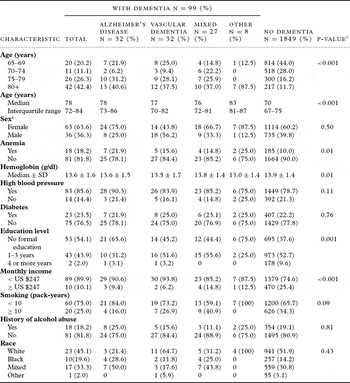
General characteristics of participants with or without dementia and its subtypes (N = 1948)

† Comparing individuals with any subtype of dementia and individuals without dementia.
All values are expressed as absolute counts (percentage of valid cases), unless otherwise specified.
* p = 0.025 for comparison among dementia subtypes. None of the other comparisons among dementia subtypes reached significance.
We also considered hemoglobin as a continuous variable and performed an analysis of covariance (ANCOVA) to compare the mean hemoglobin levels of patients with and without dementia and its subtypes. In the first step, data were adjusted only for age. Then, we included the same variables as those in model 2 of the logistic regression: age, hypertension diagnosis, education level, monthly income, smoking status, and race. P < 0.05 was considered significant.
Results
In the 66 census areas, 2267 subjects met the inclusion criteria. Among these subjects, 195 did not agree to participate, leaving 2072 participants. Valid blood samples could not be obtained for 124 individuals; therefore, this report is based on 1948 participants with total blood cell counts and assessments for dementia. The frequency of dementia was not significantly different in elderly people with and without a total blood cell count (p = 1.0).
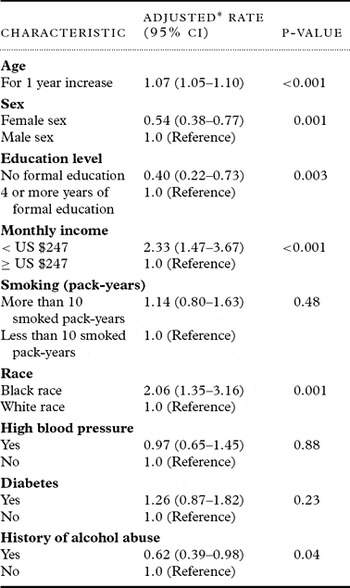
Anemia was diagnosed in 203 (10.2%) participants and dementia in 99 (5.1%). Among the participants with dementia, 32 (32.3%) cases were due to AD, 32 (32.3%) to vascular disease, 27 (27.3%) had mixed dementia, and 8 (8.1%) had other forms of dementia. Table 1 shows the relationship between dementia (and its subtypes) and several sociodemographic factors and frequent comorbidities in this population. Participants with dementia were older and had a lower personal monthly income and education level than those without dementia. Participants who did not have dementia were more prone to have smoked 10 or more pack-years of cigarettes during their lifetime compared to those with dementia. The occurrence of anemia was higher in participants with dementia compared to those without. A higher frequency of anemia was found in Afro-Brazilians compared to the white population (15.4% vs. 8.9%; p = 0.01) and in individuals with lower monthly income compared to a higher monthly income (11.7% vs. 6.5%; p = 0.001). After adjusting for other known variables, the interactions between these conditions were maintained (Table 2).
Odds ratios and 95% confidence intervals (CI) for possible factors associated with anemia

* For each characteristic, the logistic regression model included adjustment for all other variables in the table.
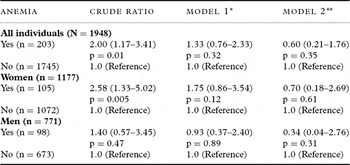
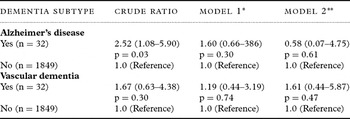
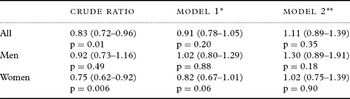
Table 3 shows the results of the logistic regression. The OR of dementia according to the presence or absence of anemia was presented in three models: as a crude ratio, adjusted for age, and after multivariate adjustment for age, hypertension diagnosis, smoking status, education level, and income. The risk of dementia in elderly people with anemia, compared to those without anemia, lost significance after adjusting for age and did not substantially change after multivariate adjustment. When data on thyroid and renal function were included in the analysis, no significant change occurred. No association was found between anemia and dementia when gender was analyzed separately or specifically for AD or vascular dementia (Tables 3 and 4).
Crude and adjusted odds ratios and 95% confidence intervals for the association between dementia and anemia (N = 1,948) in men and women

*Model 1, adjusted for age; **Model 2, adjusted for age, hypertension diagnosis, smoking status, education level, race, and income.
Crude and adjusted odds ratios and 95% confidence intervals for the association between dementia and anemia (N = 1948) in men and women

*Model 1, adjusted for age; **Model 2, adjusted for age, hypertension diagnosis, smoking status, education level, race, and income.
Similarly, a slight but significant difference was found when the mean hemoglobin levels of participants with and without dementia were compared (13.6 vs. 13.9 g/dl, respectively, p = 0.01). When the ANCOVA adjustment was performed, initially only for age, and then for all known variables potentially associated with dementia, this relationship vanished (p = 0.22 and p = 0.76, respectively) (data not shown). Table 5 shows the OR of dementia associated with a 1.0 g/dl increase in hemoglobin levels.
Odds ratios and 95% confidence intervals for dementia associated with each 1.0 g/dl increase in hemoglobin levels

*Model 1, adjusted for age; **Model 2, adjusted for age, hypertension diagnosis, smoking status, education level, race, and income.
Discussion
Our results did not show an association between anemia and dementia in this population sample of very low-income elderly people in São Paulo. Anemia and dementia are frequent disorders in older people, occurring concomitantly in many cases. In some individuals, low hemoglobin levels can worsen or trigger cognitive impairment. On the other hand, patients with a diagnosis of dementia may be prone to nutritional deficiencies, an important etiological factor for anemia that is probably even more important in low-income populations (World Health Organization, 2001). Our data show both anemia and dementia in this sample of aging people. However, in this population, an association between these conditions appears to be exclusively mediated by aging.
Pandav et al. (Reference Pandav, Chandra, Dodge, DeKosky and Ganguli2004) reported a significant inverse association between hemoglobin concentration and dementia prevalence in men, but not women. Our study found no association between anemia and dementia according to sex. This disagreement could be explained by differences in the subjects’ characteristics between the two studies; subjects in the Pandav et al. study lived in a rural area, whereas subjects in this analysis lived in a metropolitan area of a large city. The prevalence of anemia in the Pandav et al. study was also higher (30.0% for men and 49.9% for women) than in the present study. Another possible reason for the disagreement in results is that, when hemoglobin is analyzed as a dichotomous variable (presence or absence of anemia) instead of a continuous variable, less severe cases are typically more represented. When a similar analysis was performed in the Indian study, an association with dementia was not found (Pandav et al., Reference Pandav, Chandra, Dodge, DeKosky and Ganguli2004). We can speculate that a possible association between anemia and dementia could be present only in patients with very low hemoglobin concentrations, but the number of such subjects in this analysis is very small. The findings of Atti et al. (Reference Atti, Palmer, Volpato, Zuliani, Winblad and Fratiglioni2006) also point to a possible dose-response effect, as association with dementia vanished when higher cut-offs were used for anemia diagnosis.
Beard et al. (Reference Beard, Kokmen, O'Brian, Anía and Melton1997) found a positive link in their case-control study that was not confirmed in their cohort study. The diagnosis of anemia in the former study was obtained by analyzing hemoglobin concentrations from a two-year period before the investigation. From our point of view, the association might be explained by a higher incidence of acute disease and hospitalization rates in patients with dementia, which could transiently impact hemoglobin concentrations and account for potential bias. In fact, the prevalence of anemia was very high (33.5%) in the case-control report of Beard et al. (Reference Beard, Kokmen, O'Brian, Anía and Melton1997). This type of bias can be prevented in a population-based sample such as ours. As indicated by Deal et al. (Reference Deal, Carlson, Xue, Fried and Chaves2009), more information is needed to understand the long-term effects of low hemoglobin levels on cognitive function.
An interesting relationship was found between low-income status and the diagnosis of anemia. Possible explanations include: low income may be a marker of lower quality nutritional intake, poorer access to the health system, or delayed or suboptimal treatment, as previously demonstrated in patients with diabetes (McCall et al., Reference McCall, Sauaia, Hamman, Reusch and Barton2004).
Our study has several strengths. We used a population-based sample from an area of low-income people more vulnerable to dementia as a consequence of an adverse life course, including low levels of formal education (Scazufca et al., Reference Scazufca2008b). A lack of exposure to more complex mental activities can result in less cognitive reserve (Valenzuela, Reference Valenzuela2008). Anemia is also more common in low-income groups. Thus, anemia may be more common in elderly subgroups (De Benoist et al., Reference De Benoist, McLean, Egll and Cogswell2008). If a real association exists between anemia and the risk of dementia in low-income populations, we had the best chance to demonstrate it. Our negative results suggest a real non-association. Another strength is that the diagnosis of dementia was made according to the 10/66 Dementia Research Group diagnosis, which was validated for use in population-based studies in low- and middle-income countries (Prince, Reference Prince2000).
A possible bias to the negative result is that, in this very low-income sample, death generally occurs from cardiovascular disease before the age at which people usually develop dementia. Various causes of anemia may be concurrent in this population. Some of the causes may even have a direct impact on cognitive performance. We were able to control for the data on thyroid and renal function, but other measurements to determine the etiology of anemia were not performed at baseline. Specific causes of anemia may be more closely related to dementia than others. Additionally, as pointed by Atti et al. (Reference Atti, Palmer, Volpato, Zuliani, Winblad and Fratiglioni2006), some dementia subtypes may be more associated to anemia than others.
In conclusion, the prevalence of both anemia and dementia increases with age. Despite physiopathological reasoning for a possible association between these two conditions, an association was not found in this low-income population from São Paulo, Brazil.
Conflict of interest
None.
Description of authors' roles
Dr. Santos and Dr. Benseñor collaborated on the study design, data collection, statistical analysis, and wrote the paper. Dr. Scazufca and Dr. Menezes collaborated on the study design, data collection, and assisted with writing the paper. Dr. Lotufo collaborated on the study design, statistical analysis, and assisted with writing the paper.