There are ~6000 described species of thrips (Thysanoptera), which have been recorded from all types of ecosystems around the world (Buckman et al. Reference Buckman, Mound and Whiting2013; ThripsWiki 2017). These small creatures are opportunistic and exhibit a wide range of life histories. About half of the known species are fungivorous, 40% are phytophagous on plant tissues of angiosperms, and the remaining species feed on mosses, gymnosperms, or predate on small arthropods (Mound Reference Mound2005; Morse and Hoddle Reference Morse and Hoddle2006).
A dead animal exposed in the environment becomes an ephemeral resource susceptible to be exploited by many organisms (Hanski Reference Hanski1987). At present, over 1000 species of arthropods have been recorded from cadavers worldwide (Goff Reference Goff2010). According to Braack (Reference Braack1987), and Catts and Goff (Reference Catts and Goff1992), five ecological categories of organisms can be found on carrion: (i) necrophagous species, feeding on corpse tissues (Diptera and Coleoptera); (ii) omnivorous, feeding on the carrion and associated fauna (Hymenoptera); (iii) parasitoids and predators, including Hymenoptera that parasitise immature necrophagous species, such as Diptera or Coleoptera; (iv) opportunistic species, which use the cadaver as a refuge or are not necrophagous, but occasionally obtain nutrients from the bodies as a food supplement; and (v) incidentals, arthropods like Collembola, Acari, and Araneae, which use the corpse as an extension of their normal habitat.
Although Thysanoptera is not considered forensically important, species have been recorded from different types of carrion, such as, guinea pigs (Cavia porcellus (Linnaeus); Mammalia: Caviidae) in Australia (Bornemissza Reference Bornemissza1957), rodents (Mammalia: Rodentia) in the United Kingdom (Putman Reference Putman1978), chicken (Gallus gallus (Linnaeus); Aves: Phasianidae) carcasses in Spain (Arnaldos et al. Reference Arnaldos, García, Romera, Presa and Luna2005), and domestic pigs (Sus scrofa Linnaeus; Mammalia: Suidae) in Hawaii, Colombia, and Argentina (Davis and Goff Reference Davis and Goff2000; Pérez et al. Reference Pérez, Duque and Wolff2005; Battán Horenstein et al. Reference Battán Horenstein, Roso and García2012). Nevertheless, all these studies did not identify the species of thrips involved with those cadavers. A unique detailed study of thrips associated with carcasses was carried out in Spain, where 132 individuals belonging to 15 species were collected from chicken carcasses, Thrips tabaci Lindeman (Thripidae) being the most abundant species (Berzosa et al. Reference Berzosa, Arnaldos, Romera and García2001). All these studies suggest that the presence of thrips in cadavers is common and it would be important to pay more attention on them.
While conducting a field study into the diversity and abundance of insects associated with pig carrion in the highlands of Chiapas, Mexico (Mañas-Jordá Reference Mañas-Jordá2017), we noticed the presence of several thrips in the collecting containers of Schoenly traps (Schoenly Reference Schoenly1981) modified by Prado e Castro et al. (Reference Prado e Castro, Chichorro, Serrano and García2009). This finding was unusual because thrips have never been reported in this type of environment in Mexico. We hypothesised that these thrips were associated with plants near to where we placed the traps, and for some unknown reason, they were attracted to the pig carrion. The objective of this work was to identify the species of thrips in order to contribute to the knowledge of arthropods associated with carrion.
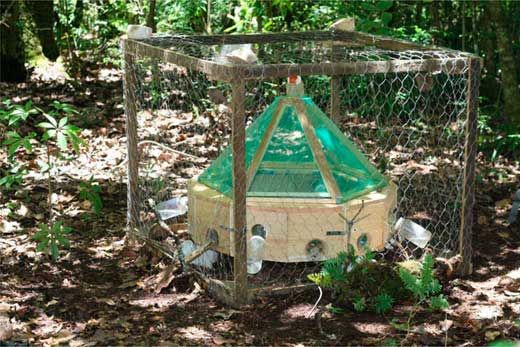
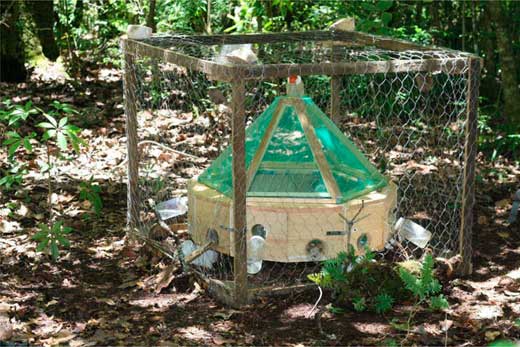
The survey was conducted in two localities in the highlands of Chiapas, Mexico, at elevations between 2100 and 2600 m. The first locality is a 136-ha forested site located in the Huitepec Natural Reserve, where oaks belong to the genus Quercus Linnaeus (Fagaceae) are the predominant tree species: Quercus acutifolia Née, Q. candicans Née, Q. crispipilis Trelease, Q. laurina Humboldt and Bonpland, Q. rugosa Née, and Q. skutchii Trelease. The rest of canopy is formed by Alnus acuminata Kunth (Betulaceae) and Arbutus xalapensis Kunth (Ericaceae) (Ramírez-Marcial et al. Reference Ramírez-Marcial, Ochoa-Gaona, González-Espinosa and Quintana-Asencio1998). The second locality is a 4-ha urban site with cattle (Bos taurus Linnaeus; Mammalia: Bovidae) activity, within the city of San Cristóbal de las Casas, where the dominant trees are Cornus excelsa Kunth (Cornaceae), Crataegus mexicana de Candolle (Rosaceae), and Cupressus lindleyi Klotzsch ex Endlicher (Cupressaceae), (García-Méndez et al. Reference García-Méndez, Lorenzo, Vázquez and Reyna-Hurtado2014). The sampling of insects was conducted for one year, starting in August 2015. Suckling, 5-kg S. scrofa, were used as bait. The pigs were euthanised according to the official Mexican norm for sacrifice of domestic and wild animals (NOM-033-131 SAG/ZOO-2004), using an intravenous injection of 100 mg of xylazine and 6.3 g of sodium 132 pentobarbital. Immediately after death they were transported to the study sites and placed inside Schoenly traps (Fig. 1), a device that catches a wide array of carrion insects, recording a continuous collection throughout the study. Samples were taken daily during the first month and, every other day from the second month onwards. Collecting containers included soapy water with 20% ethanol. Thrips caught in traps were taken to the laboratory and preserved in 70% ethanol. They were mounted on slides using Hoyer’s medium and dried in an oven at 45 °C for one week. Taxonomic keys by Mound and Marullo (Reference Mound and Marullo1996) were used for species identification, and corroborated by comparison with specimens at the Australian National Insect Collection, Commonwealth Scientific and Industrial Research Organisation, Canberra, Australia. Voucher specimens are deposited in the reference collection of the senior author (F.I.).
A Schoenly trap baited with a 5-kg suckling pig, installed in the highlands of Chiapas, Mexico.
A total of 27 individuals (26 adults and one larva) belonging to seven species of three families of Thysanoptera were captured in Schoenly traps. The identity of thrips was as follows (number of individuals in parenthesis): a second instar of Aeolothrips species (Aeolothripidae) (1), Frankliniella brunnea Priesner (Thripidae) (2), Frankliniella fusca (Hinds) (4), Frankliniella trinidadensis Hood (1), Neohydatothrips portoricensis (Morgan) (Thripidae) (15), Thrips simplex (Morison) (2), Wegenerithrips admirabilis Johansen (Thripidae) (1), and Stephanothrips bradleyi Hood (Phlaeothripidae) (1). Of these, four species (=four individuals) (F. brunnea, F. fusca, N. portoricencis, and W. admirabilis) were present in the Huitepec Natural Reserve, and seven species (=23 individuals) (Aeolothrips species, F. brunnea, F. fusca, F. trinidadensis, N. portoricencis, T. simplex, and S. bradleyi) were recorded in the locality of San Cristóbal de las Casas. All thrips were collected in a period of four months, from August to November, and most individuals (n=15) within the first month of captures. The rainy season in this area usually runs from May to October.
Several hundred insect species associated with cadavers have been documented since the middle of the 1800s, when the modern recognition of entomology in human and animal decomposition originated (Hall Reference Hall2001). Out of 522 species of animals recovered from pig carcasses in South Carolina, United States of America, 84% (438) were insects (Catts and Goff Reference Catts and Goff1992). Tantawi et al. (Reference Tantawi, El-Kady, Greenberg and El-Ghaffar1996) mentioned that insects represented 86% of total arthropods collected on pig carcasses in Egypt. Elsewhere in Africa, the proportion of insects in carcasses of wild animals was 95% (Villet Reference Villet2011). Diptera and Coleoptera are the most predominant orders in decomposing corpses (Byrd and Castner Reference Byrd and Castner2001), but it is also quite common to find species of Ephemeroptera, Hymenoptera, Hemiptera, Isoptera, Lepidoptera, Orthoptera, Plecoptera, Siphonaptera, and Trichoptera, among others (Baz et al. Reference Baz, Difrian, Martín-Vega and Baena2010; Villet Reference Villet2011; Ries and Blochtein Reference Ries and Blochtein2015; Mañas-Jordá Reference Mañas-Jordá2017). The first study mentioning the presence of thrips in carrion was carried out in Australia (Bornemissza Reference Bornemissza1957), but the species in this and other studies (Putman Reference Putman1978; Davis and Goff Reference Davis and Goff2000; Arnaldos et al. Reference Arnaldos, García, Romera, Presa and Luna2005; Pérez et al. Reference Pérez, Duque and Wolff2005; Battán Horenstein et al. Reference Battán Horenstein, Roso and García2012) were not identified. Berzosa et al. (Reference Berzosa, Arnaldos, Romera and García2001) provided a list of 15 species of thrips recovered from decomposing cadavers, Thrips tabaci being the most abundant species. The seven species reported here is the second record of thrips recovered from cadavers worldwide.
The feeding habits described for Frankliniella brunnea, F. fusca, Neohydatothrips portoricencis, and Thrips simplex, indicate that these species are phytophagous, while Wegenerithrips admirabilis has been associated with mosses, Stephanothrips bradleyi is presumably fungivorous, and Aeolothrips species are facultative predators of thrips and other small arthropods (Mound and Marullo Reference Mound and Marullo1996). However, thrips have a reputation for being opportunistic (Mound and Teulon Reference Mound and Teulon1995), and feeding by these insects on other sources cannot be discounted. Unexpectedly, most individuals were recorded from the urban plot of San Cristóbal de las Casas, rather than in the Huitepec Natural Reserve where thrips populations should be higher due to plant diversity. This fact would suggest (at least in the case of San Cristóbal de las Casas, where the plot was used for cattle) that thrips were attracted to the trap, and that their capture was not incidental.
Carrion-baited traps have been effective collecting a wide array of insects belonging to different orders (Ries and Blochtein Reference Ries and Blochtein2015). The low number of studies recording small insects, such as Thysanoptera, might be because they have been overlooked in sampling. Typically, most insect inventories have been done through individual hand collecting where numerous small insects are difficult to detect. In this sense, the main advantage of the Schoenly trap is that it allows an extensive capture of arthropods that are attracted to carcasses (Prado e Castro et al. Reference Prado e Castro, Chichorro, Serrano and García2009). The occurrence of thrips in the Schoenly traps suggests an attraction to one or more components of the trap, rather than an incidental presence, as many species of thrips have been captured in other surveys (Berzosa et al. Reference Berzosa, Arnaldos, Romera and García2001). Besides, considering that Thysanoptera is an order closely related to Hemiptera (Johnson and Triplehorn Reference Johnson and Triplehorn2005), and that there are over 100 species of Hemiptera attracted to different types of carrion (Payne et al. Reference Payne, Mead and King1968; Baz et al. Reference Baz, Difrian, Martín-Vega and Baena2010; Eger et al. Reference Eger, Brailovsky and Henry2015), the possibility that thrips were also attracted to carrion seems plausible. In fact, it is remarkable how carrion appears to be an important source of food for numerous phytophagous insects in the orders Lepidoptera, Hymenoptera, and Hemiptera in the Neotropical region (Baz et al. Reference Baz, Difrian, Martín-Vega and Baena2010). Clearly, further research is needed to verify if thrips can feed opportunistically on, or at least are attracted to, carcasses.
Acknowledgements
The authors thank the financial support and student scholarship to S.M.J. provided by “El Consejo Nacional de Ciencia y Tecnología (CONACYT)” from Mexico. The technical assistance of Manuel Girón-Intzin and José Antonio Ortiz-Girón is greatly appreciated. They thank the two anonymous reviewers, whose comments helped improve this manuscript.