Introduction
Cognitive behaviour therapy (CBT) is used to treat a variety of mental health disorders, including depression and anxiety. CBT is not always available to patients because of a shortage of therapists and long waiting times. Alternative modes of delivery have been developed, including group therapy, bibliotherapy and computerized CBT (CCBT). CCBT is used to treat depression as well as other mental health disorders. There is now substantial evidence that CCBT is an effective alternative to CBT for the treatment of mild to moderate depression and anxiety (Kaltenthaler et al. Reference Kaltenthaler, Shackley, Stevens, Beverley, Parry and Chilcott2002, Reference Kaltenthaler, Parry and Beverley2004, Reference Kaltenthaler, Brazier, De Nigris, Tumur, Ferriter, Beverley, Parry, Rooney and Sutcliffe2006). Two CCBT software programs were recently recommended by the National Institute of Health and Clinical Excellence (NICE, 2006) for use in the UK National Health Service. These programs are now in use throughout the UK as well as other countries.
Health technology assessment
A recent health technology assessment (HTA) in the UK examined the clinical and cost-effectiveness of CCBT for the treatment of depression and anxiety (Kaltenthaler et al. Reference Kaltenthaler, Brazier, De Nigris, Tumur, Ferriter, Beverley, Parry, Rooney and Sutcliffe2006). HTA, by necessity, is a process that is rapid, fit for purpose and informs decision making. The process of HTA provides a systematic review of the evidence on clinical effectiveness of a new technology as well as a cost-effectiveness analysis. Information on patient acceptability, although also important, is often lacking.
Patient acceptability
Within the time and financial constraints of a technology appraisal it is difficult to explore the issue of patient acceptability in sufficient depth. However, patient acceptability is a key component to consider when evaluating the implementation of a new technology. A new health-care technology, such as CCBT, may be clinically effective but unacceptable to patients for a variety of reasons. Patients may be unhappy with the length or type of treatment or think that an alternative treatment may be preferable. This will have obvious consequences for the implementation of new technologies. Treatment acceptability is important for ethical, methodological and practical reasons. First, there is an ethical obligation to understand more about which treatments are most acceptable and the reasons why others are unacceptable to patients. Second, if two treatments are compared in a randomized trial where one is markedly less acceptable than the other, both the external and internal validity of the findings is threatened. External validity is reduced where only a proportion of screened patients are willing to enter the trial or receive a treatment. Internal validity is compromised if there is differential drop-out between the two conditions, particularly where patients are lost to follow-up in an intention-to-treat design. Finally, the acceptability of therapy to patients is a prime factor attenuating the clinical effectiveness of services as delivered compared with the efficacy of treatments demonstrated in clinical trials. For example, in the psychological treatment of depression it is commonly found that a substantial proportion (more than a quarter) of the eligible group does not wish to enter therapy or drops out (Keller et al. Reference Keller, McCullough, Klein, Arnow, Dunner, Gelenberg, Markowitz, Nemeroff, Russell, Thase, Trivedi and Zajecka2000). This attrition rate will reduce the impact of the intervention on the target group.
Acceptability is one of six indicators of service quality outlined by Maxwell (Reference Maxwell1992)alongside effectiveness, safety, equity, efficiency and accessibility, although, of these, most attention has been paid to clinical effectiveness. Very little has been reported about the acceptability of CCBT compared with traditional approaches, but other evidence suggests different delivery formats do affect CBT acceptability. For example, comparison of the acceptability of group versus individual delivery of CBT in primary care for anxiety disorders showed that, when given a free choice of group or individual CBT at the end of the waiting list period, the overwhelming majority (95%) of the waiting list patients chose individual CBT (Sharp et al. Reference Sharp, Power and Swanson2004). Little is known about why some people find computerized treatment unacceptable. A study of factors determining the uptake of a CD-ROM-based CBT self-help treatment for bulimia (Murray et al. Reference Murray, Guadelupe, Bara-Carril, Grover, Reid, Langham, Birchall, Williams, Treasure and Schmidt2003) found that those patients who declined the computerized method had a significantly lower expectation of the usefulness of self-help for themselves, although not for others. Their overall attitudes to self-help were similar to those of the group who engaged with the computerized treatment. They were as likely to have used self-help previously and they were as confident in using a computer. However, qualitative exploration revealed a range of concerns and anxieties about computer treatment, some of which were based on misunderstandings about this form of treatment. This study suggests that taking simple steps to identify and correct misperceptions can improve acceptability. The acceptability of CCBT for a variety of other conditions has also been explored. Newman et al. (Reference Newman, Consoli and Barr Taylor1997a)reported information on acceptability of CCBT for the treatment of anxiety, Ghosh et al. (Reference Ghosh, Marks and Carr1988)for phobias, Newman et al. (Reference Newman, Kenardy, Herman and Barr Taylor1997b)and Kenardy et al. (Reference Kenardy, Johnston, Thomson, Dow, Newman and Barr Taylor2003)for panic disorder and Zabinski et al. (Reference Zabinski, Wilfley, Clafas, Winzelberg and Barr Taylor2004)for eating disorders. Griffiths & Christensen (Reference Griffiths and Christensen2006)in their review of randomized controlled trials (RCTs) of internet interventions for mental disorders found that seven of the 15 included studies reported information on user satisfaction. The findings indicate consistently positive evaluation by users.
Our aim was to review systematically the sources of information on patient acceptability within a recent technology appraisal of CCBT for patients with depression. We hypothesized that, although clinical outcome data for CCBT have been promising, patient acceptability data have been less so. As many research studies in this field do not measure or report acceptability directly, we used proxy indices. The following were identified as possible sources of information about patient acceptability: CCBT take-up rates; patient drop-out rates and reasons for drop-outs; and questionnaires or surveys (either alone or as part of a trial) that covered patient acceptability or satisfaction. Take-up rates were defined as the percentage of patients who agreed to start treatment relative to the total number approached with the option to have CCBT. Drop-outs were defined as patients who began a course of treatment but left before the treatment was completed.
Method
Searches
Fifteen electronic bibliographic databases (including Medline, PsycINFO, CINAHL and EMBASE) were searched, covering biomedical, health-related, science, social science and grey literature (including current research). In addition, the reference lists of relevant articles were checked and various health services research-related resources were consulted via the internet. These included HTA organizations, guideline-producing bodies, generic research and trials registers and specialist mental health sites.
Search terms were broad and were a combination of free-text and thesaurus terms. Population terms, such as depression, were combined with intervention terms such as cognitive therapy and computer, for example. This was supplemented by more specific searches on named packages such as Beating the Blues, Overcoming Depression, Cope, etc. identified in the initial searches. Databases were searched from 1966 to June 2007. Authors of relevant studies identified in the searches were contacted for additional studies. Unpublished studies obtained from authors were included if relevant outcome data were reported.
Types of studies
Studies were included if they fulfilled the following criteria:
Population: adults with mild to moderate depression with or without anxiety as defined by individual studies.
Intervention: CBT (as defined in the studies) delivered alone or as part of a package of care either via a computer interface (personal computer or the internet) or over the telephone with a computer response.
Outcomes: patient recruitment, drop-outs and information on preference, satisfaction or acceptability of treatment.
Type of studies: RCTs, non-randomized comparative trials and non-comparative trials were included.
No studies reporting outcomes on patient acceptability were excluded. All data from included studies were extracted by one reviewer and checked by a second using a standardized data extraction form.
Results
Patient recruitment and drop-outs
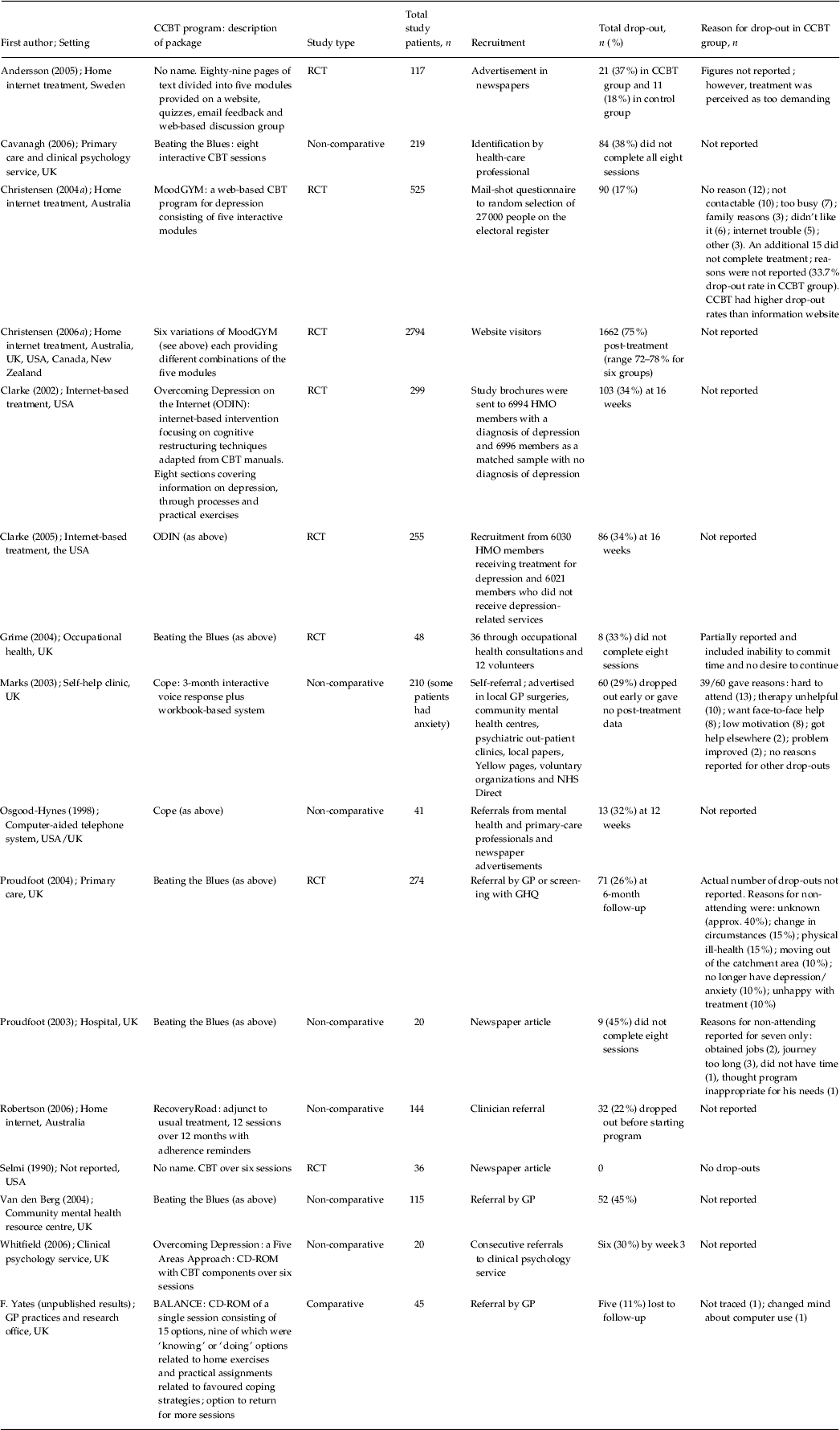
We screened 1591 references and assessed the text of 147 full papers. Sixteen trials of CCBT for depression were identified, of which eight were RCTs, seven were non-comparative trials and one was a comparative, but non-randomized trial. Comparators in these studies included therapist-led CBT, treatment as usual, waiting list control, an internet discussion group, variations of a CCBT program and a depression information website. Methods of recruitment and drop-out rates of participants for the 16 trials are reported in Table 1.
Patient recruitment and drop-outs

CCBT, Computerized cognitive behaviour therapy; GP, general practitioner; RCT, randomized controlled trial; GHQ, General Health Questionnaire; HMO, Health Maintenance Organization.
Drop-outs were calculated by subtracting the number of participants commencing treatment from the number of participants who completed treatment.
Participants in the trials were recruited in different ways: self-selection, for example through responding to advertisements in newspapers or spontaneous visits to a CCBT program website (n=8); health-care professional referral, such as by a general practitioner (GP), mental health services or occupational health (n=6); or a combination of self-referral and health-care professional referral (n=2). Trials also differed in the type of participant recruited (e.g. some were clinically depressed; others were not given a diagnosis of depression).
In one study (Whitfield et al. Reference Whitfield, Hinshelwood, Pashely, Campsie and Williams2006), 80 patients were offered CCBT but only 22 (25%) agreed to take part. Two other studies reported percentages of potential participants who agreed to take part. Clarke et al. (Reference Clarke, Reid, Eubanks, O'Connor, DeBar, Kelleher, Lynch and Nunley2002)reported that, from an initial 13 990 of people approached, only 526 accessed the study website. After adjustments for the number of people with internet access, the authors report an initial engagement rate of 6.0%. Of the 526 interested, 299 (58.6%) agreed to take part in the study. Clark et al. (Reference Clarke, Eubanks, Reid, Kelleher, O'Connor, DeBar, Lynch, Nunley and Gullion2005)approached 12 051 potential participants, of whom 291 (2.4%) accessed the study website and 255 agreed to participate, 200 of whom were from the depressed group (33% of those invited).
The mean percentage drop-out over the 16 trials was 31.75% (s.d.=16.52), the range was 0–75% of participants. The reasons for drop-out were reported in only six trials, the most common reason being participants were too busy or had changes in circumstance, with only two trials reporting that treatment was not useful. A factor that appeared to influence the numbers who dropped out was the duration of treatment, which varied considerably across trials (range 1–33 sessions). It is difficult to make comparisons between packages regarding drop-out rates because of differences in study design, populations and methods for defining drop-outs and level of detail provided in the study.
Patient preferences, satisfaction and acceptability of treatment
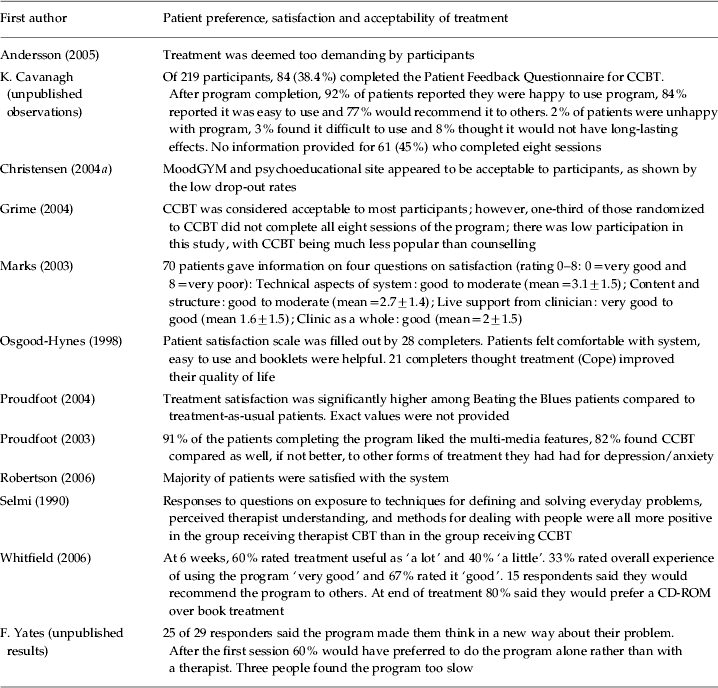
Twelve trials reported information on acceptability and satisfaction associated with CCBT. These trials are shown in Table 2. There was considerable variability in the acceptability and satisfaction of CCBT treatment across trials. Most studies provided information on preference, satisfaction and acceptability only for patients who completed the course of CCBT. No information was provided in any of the studies on the large percentage of participants who had dropped out. The majority of participants responding to questions about CCBT across these 12 trials appeared to rate CCBT treatment positively.
Patient preferences, satisfaction and acceptability of treatment

CCBT, Computerized cognitive behaviour therapy.
Discussion
Sources of information on patient acceptability
With increasing interest in CCBT as an alternative or supplement to therapist-led CBT, it is important to consider just how acceptable CCBT is to patients. This paper systematically reviews information on patient acceptability from take-up rates, patient drop-out rates and surveys on patients' attitudes towards CCBT. Many of the studies only reported information for study completers, giving a distorted view of patients' perceptions of treatment.
Recruitment
In real-life situations, patients who meet criteria for depression may be offered CCBT by their health-care provider. In many of the studies reported in this paper, participants were self-selected, or specifically selected by their health-care practitioners to have CCBT, making it difficult to draw conclusions on how amenable patients will be to CCBT. We identified three studies that looked at take-up rates among patients offered CCBT, ranging from 3.3% to 25%. However, refusal to participate in a trial of CCBT may indicate reluctance to enter a trial, rather than an aversion to CCBT. Qualitative studies could be undertaken to determine why participants deemed to be suitable for CCBT chose not to begin treatment.
Drop-out rates
Reported drop-out rates for CCBT ranged from 0% to 75% in the studies, with a mean percentage drop-out rate of 31.75% (s.d.=16.52). This is comparable to drop-out rates for other psychological therapies. Bower & Rowland (Reference Bower and Rowland2006)in a review of trials of counselling in primary care found drop-out rates ranging from 9% to 46% at 6 weeks or more. Reported drop-out rates for face-to-face CBT range from 5% to 38% (Watkins & Williams, Reference Watkins and Williams1998). Barbui et al. (Reference Barbui, Hotopf, Freemantle, Boynton, Churchill, Eccles, Hardy, Lewis and Mason2004)report drop-out rates of 27% for serotonin reuptake inhibitors and 30% for tricyclic antidepressants.
It is also important to consider that drop-outs from internet CCBT sites may be expected to be higher than from CCBT delivered in other ways. Attrition rates from open-access non-tracked websites have found as few as 1% of users completing a full course of online therapy (Eysenbach, Reference Eysenbach2005). Christensen et al. (Reference Christensen, Griffiths, Korten, Brittliffe and Groves2004b)found, in a study comparing public users of the internet program MoodGYM with trial participants, that 15.6% of public users and 66% of trial participants completed two or more modules. The authors suggest that the formal structure of a trial may be important for compliance. Christensen et al. (Reference Christensen, Griffiths, Groves and Korten2006b)further found that 16% of the original MoodGYM users completed two or more depression assessments compared with 18% of users of the public version of the site (MoodGYM Mark II). Completion of more site material was associated with better psychological outcomes. These issues are important to consider and further work may be needed to determine reasons why users of internet CCBT sites drop out of treatment before completion.
Surveys on acceptability
The questionnaires or surveys we identified gave information on acceptability of treatment only for those patients who had completed treatment, with no information provided for those who had dropped out of treatment. Ten studies provided questionnaire or survey information with most respondents rating CCBT favourably, although, as illustrated in Table 2, information was sketchy. A range of factors including delivery mode, motivation, continuation benefits and discontinuation benefits will affect the acceptability of CCBT to patients (Cavanagh et al. Reference Cavanagh, Shapiro, Zack, Goss and Anthony2003) and in-depth questionnaires or qualitative studies to determine what patients perceive as positive and negative may prove useful.
A further consideration when planning the provision of CCBT programs is the acceptability of this technology to health-care providers. In a study in the UK (Whitfield & Williams, Reference Whitfield and Williams2004), 500 therapists were surveyed, of whom 329 (65.8%) responded. Only 12 (2.4%) were offering any form of computerized self-help. However, more than 90% said they would consider using it in the future. Many practitioners felt that CCBT was not as effective as seeing a practitioner face to face and it may be that some patients believe the same.
Limitations of the review
There are several limitations to the review. There is considerable variability between the studies regarding design, population, method of recruitment and incorporation of CBT components within the software programs used, making it difficult to make comparisons between studies. The range of depression severity and level of co-morbidities also varied considerably between studies. Limited information was available for patients who had discontinued with the CCBT programs. Information on satisfaction was only provided for treatment completers. In addition, recruitment of patients into these studies did not usually represent routine clinical settings. Only three studies reported true take-up rates, making it difficult to draw comparisons with routine clinical situations.
The attrition rates in the study may not be an accurate reflection of attrition rates in ‘real-life’ situations. Patients may be influenced by other factors, such as their relationship with their health-care provider, in reporting positive or negative experiences with CCBT. The information reported here is not necessarily generalizable to other conditions.
Future research
Research into the experiences of CCBT users is required to confirm whether a broader dissemination of CCBT services within health-care systems is appropriate. Key points of the patient care pathway, which could be studied through both survey and intensive qualitative methods, include the process of initial engagement, continuation versus drop-out, and in those completing, satisfaction or regret of undertaking CCBT. Further prospective investigation into factors predicting uptake, outcome and continuation of treatment is needed. Studies of CCBT should record the number of patients initially screened, those who enter the study and those who complete treatment.
Conclusions
Several studies have reported positive expectancies and high satisfaction in routine care CCBT services, for those completing treatment. The limited evidence evaluated suggests that CCBT can be an effective and acceptable treatment for a proportion of people presenting with mild to moderate depression and be part of the range of self-help options offered to patients. However, the magnitude of benefit and acceptability is not clear.
There is limited information on CCBT and patient acceptability for the treatment of depression. Studies of CCBT should include more detailed information on patient recruitment methods. Drop-out rates and reasons for dropping out need to be clearly reported. It is important that well-designed surveys and qualitative studies are included alongside trials to determine levels of patient acceptability.
Acknowledgements
This report was funded by the NIHR Health Technology Assessment Programme (Project number 04/01) and commissioned on behalf of NICE. Parts of it have been published in full in Health Technology Assessment, vol. 10, no. 33. See the HTA programme website (www.hta.ac.uk) for further project information. The views and opinions expressed therein are those of the authors and do not necessarily reflect those of the Department of Health.
Declaration of Interest
None.