Introduction
The treatment gap in mental disorders is well-established. A recent report from the WHO World Mental Health (WMH) Surveys showed that only 13.7% of individuals with a 12-month Diagnostic and Statistical Manual of Mental Disorders, Fourth Edition/Composite International Diagnostic Interview (DSM-IV/CIDI) mental disorder in low/lower-middle income countries, 22.0% in upper-middle income countries, and 36.8% in high-income countries receive any type of professional treatment (Evans-Lacko et al., Reference Evans-Lacko, Aguilar-Gaxiola, Al-Hamzawi, Alonso, Benjet, Bruffaerts and Thornicroft2018). Only a minority of the people getting treatment received at least minimally adequate treatment when compared to accepted treatment guidelines. A major reason for this is treatment dropout (Alonso et al., Reference Alonso, Liu, Evans-Lacko, Sadikova, Sampson, Chatterji and Thornicroft2018; Degenhardt et al., Reference Degenhardt, Glantz, Evans-Lacko, Sadikova, Sampson, Thornicroft and Kessler2017; Evans-Lacko et al., Reference Evans-Lacko, Aguilar-Gaxiola, Al-Hamzawi, Alonso, Benjet, Bruffaerts and Thornicroft2018).
It has long been known that premature interruption of mental health treatment is a common event that has negative consequences both for the patients and the mental health care system (Swift & Greenberg, Reference Swift and Greenberg2012). Numerous studies have been conducted to understand the causes and consequences of treatment dropout (Cooper & Conklin, Reference Cooper and Conklin2015; Fassino, Pierò, Tomba, & Abbate-Daga, Reference Fassino, Pierò, Tomba and Abbate-Daga2009; Roos & Werbart, Reference Roos and Werbart2013). These studies have identified socio-demographic, provider and clinical factors associated with different dropout rates. For example, young age among adults (Wang, Reference Wang2007; Xiang et al., Reference Xiang, Weng, Leung, Tang, Chan, Wang and Ungvari2010), lower socio-economic status (income and education) (Centorrino et al., Reference Centorrino, Hernán, Drago-Ferrante, Rendall, Apicella, Längar and Baldessarini2002; Warden et al., Reference Warden, Rush, Wisniewski, Lesser, Thase, Balasubramani and Trivedi2009a), ethnic minority status (Wang, Reference Wang2007), and lack of health insurance (Edlund et al., Reference Edlund, Wang, Berglund, Katz, Lin and Kessler2002) have all been linked to increased probability of treatment dropout. However, other studies have not found a consistent relationship between these or other sociodemographic factors and treatment dropout (Hoyer et al., Reference Hoyer, Wiltink, Hiller, Miller, Salzer, Sarnowsky and Leibing2016; Olfson et al., Reference Olfson, Mojtabai, Sampson, Hwang, Druss, Wang and Kessler2009). High variability has also been reported in the frequency of dropout. For example, two meta-analyses including studies of psychotherapeutic treatment for a mental disorder reported mean dropout rates of 19.7% (Swift & Greenberg, Reference Swift and Greenberg2012) and 47% (Wierzbicki & Pekarik, Reference Wierzbicki and Pekarik1993). Dropout has also been studied for specific disorders, including depression, posttraumatic stress disorders (PTSD), gambling, substance use disorders (SUD), and eating disorders, among others. For example, Roberts, Murphy, Turner, and Sharman (Reference Roberts, Murphy, Turner and Sharman2020) found that for gambling disorder the treatment dropout rate was 51.3% and significantly associated with older age, higher education, higher levels of debt, online gambling, gambling on poker, shorter duration of treatment, higher depression, experience of previous treatment programs and medication, and adverse childhood experiences; Belleau et al. (Reference Belleau, Chin, Wanklyn, Zambrano-Vazquez, Schumacher and Coffey2017) observed that among individuals with PTSD and SUD, 35 to 62% of individuals drop out of treatment; and Huas et al. (Reference Huas, Godart, Foulon, Pham-Scottez, Divac, Fedorowicz and Rouillon2011) found that for anorexia the dropout rate was above 50%. The inconsistency of findings, variability of methods, and the fact that the vast majority of studies have been carried out only in high-income countries limit generalizability. Moreover, most studies have focused on the analysis of treatments provided for a single disorder in a single treatment sector, which may overestimate dropout from overall sources of care (Olfson et al., Reference Olfson, Mojtabai, Sampson, Hwang, Druss, Wang and Kessler2009).
The WMH Survey Initiative is the largest effort to date to estimate the burden of mental disorders worldwide, providing population epidemiological data of the prevalence, correlates and treatment for mental disorders in all the continents (Andrade et al., Reference Andrade, Alonso, Mneimneh, Wells, Al-Hamzawi, Borges and Kessler2014; Kessler et al., Reference Kessler, Aguilar-Gaxiola, Alonso, Chatterji, Lee, Ormel and Wang2009). WMH has developed a consistent methodology to estimate the burden of mental and substance use disorders. Every year new countries join the initiative, which means that the same survey protocol is implemented in a new country or region, increasing our sample size and expanding the applicability of our results. In addition to previously reported results (Wells et al., Reference Wells, Browne, Aguilar-Gaxiola, Al-Hamzawi, Alonso, Angermeyer and Kessler2013), this study includes data from new surveys conducted in Argentina, Medellin (Colombia), Murcia (Spain), Peru, and Poland. It also includes new variables and stratifies the analyses by early dropout (i.e. dropping out after just 1 or 2 visits) and late dropout (i.e. after the third or subsequent visits). Our objective is to describe the frequency and determinants of dropout in population representative samples from low-, middle-, and high-income countries or regions.
From a health systems perspective, dropout from care represents a relevant outcome: it points to an inefficiency that frustrates the successful efforts of the person and the system to produce a clinical encounter. Indeed, several steps need to take place before such an encounter is possible: the person (or their significant others) needs to acknowledge a problem, reach out to a health care provider, and overcome any barriers to accessibility (such as wait times, out of pocket costs, paperwork, etc). So, understanding the dropout phenomenon and its determinants better is of the utmost importance. As will be described in more detail in the following section, we have developed a distinction between ‘early’ and ‘late’ dropout, depending on whether it occurs during the first two encounters or after the third. This distinction seeks to capture an important clinical consideration: whether the initial contact was somehow frustrated or dissatisfactory for the patient, or whether the initial contact was potentially established, treatment initiated, and then interrupted.
Methods and procedures
Sample
Thirteen WMH surveys were carried out in countries classified by the World Bank as low- or middle-income countries at the time of data collection (combined N = 60 224; weighted mean response rate 81.1%) and 15 in countries classified as high-income (combined N = 77 303; weighted response rate 63.5%) (Table 1). Eighteen of the 28 surveys (6 in low/middle-income countries and 12 in high-income countries) were of nationally representative multistage clustered area probability household samples. Of the surveys that were not nationally representative, two included all parts of the country with the exception of deeply rural areas, one included only selected regions of the country, and the remaining seven included only one or more urbanized areas.
WMH sample characteristics by World Bank income categoriesa

a The World Bank (2012) Data. Accessed May 12, 2012 at: http://data.worldbank.org/country. Some of the WMH countries have moved into new income categories since the surveys were conducted. The income groupings above reflect the status of each country at the time of data collection. The current income category of each country is available at the preceding URL.
b NSMH (The Colombian National Study of Mental Health); IMHS (Iraq Mental Health Survey); NSMHW (The Nigerian Survey of Mental Health and Wellbeing); EMSMP (La Encuesta Mundial de Salud Mental en el Peru); CMDPSD (Comorbid Mental Disorders during Periods of Social Disruption); NSHS (Bulgaria National Survey of Health and Stress); MMHHS (Medellín Mental Health Household Study); LEBANON (Lebanese Evaluation of the Burden of Ailments and Needs of the Nation); M-NCS (The Mexico National Comorbidity Survey); RMHS (Romania Mental Health Survey); SASH (South Africa Health Survey); AMHES (Argentina Mental Health Epidemiologic Survey); ESEMeD (The European Study Of The Epidemiology Of Mental Disorders); NHS (Israel National Health Survey); WMHJ2002-2006 (World Mental Health Japan Survey); NZMHS (New Zealand Mental Health Survey); NISHS (Northern Ireland Study of Health and Stress); EZOP (Epidemiology of Mental Disorders and Access to Care Survey); NMHS (Portugal National Mental Health Survey); PEGASUS-Murcia (Psychiatric Enquiry to General Population in Southeast Spain-Murcia);NCS-R (The US National Comorbidity Survey Replication).
c Most WMH surveys are based on stratified multistage clustered area probability household samples in which samples of areas equivalent to counties or municipalities in the US were selected in the first stage followed by one or more subsequent stages of geographic sampling (e.g. towns within counties, blocks within towns, households within blocks) to arrive at a sample of households, in each of which a listing of household members was created and one or two people were selected from this listing to be interviewed. No substitution was allowed when the originally sampled household resident could not be interviewed. These household samples were selected from Census area data in all countries other than France (where telephone directories were used to select households) and the Netherlands (where postal registries were used to select households). Several WMH surveys (Belgium, Germany, Italy, Poland, Spain-Murcia) used municipal, country resident or universal health-care registries to select respondents without listing households. The Japanese sample is the only totally un-clustered sample, with households randomly selected in each of the 11 metropolitan areas and one random respondent selected in each sample household. Eighteen of the 28 surveys are based on nationally representative household samples.
d Argentina, Brazil, Colombia-Medellin, Iraq, Israel, Japan, New Zealand, Northern Ireland, PRC – Shenzhen, Romania, South Africa and Spain-Murcia did not have an age restricted Part 2 sample. All other countries, with the exception of Nigeria and Ukraine (which were age restricted to ⩽39) were age restricted to ⩽44.
e The response rate is calculated as the ratio of the number of households in which an interview was completed to the number of households originally sampled, excluding from the denominator households known not to be eligible either because of being vacant at the time of initial contact or because the residents were unable to speak the designated languages of the survey. The weighted average response rate is 70.2%.
f Colombia moved from the ‘lower and lower-middle income’ to the ‘upper-middle income’ category between 2003 (when the Colombian National Study of Mental Health was conducted) and 2010 (when the Medellin Mental Health Household Study was conducted), hence Colombia's appearance in both income categories. For more information, please see footnote a.
g People's Republic of China.
h For the purposes of cross-national comparisons we limit the sample to those 18+.
The interviews were carried out face-to-face by lay interviewers monitored closely by supervisors who were trained by the WMH professional survey administration staff from the Survey Research Center (SRC) at the University of Michigan's Institute for Social Research. Training and field quality control procedures are discussed in more detail elsewhere (Pennell et al., Reference Pennell, Mneimneh, Bowers, Chardoul, Wells, Viana, Villagut Saiz, Kessler and Üstun2008). The interviews in most surveys were in two parts. All respondents were administered the Part I interview, which contained assessments of core psychiatric disorders. A subsample of Part I respondents, which included 100% of those with a Part I psychiatric disorder and a probability sample of other Part I respondents, was then administered Part II. This two-part subsampling was done to reduce survey burden among respondents who did not have a disorder. All surveys used a Part I weight to adjust for differences in within-household probability of selection and to post-stratify for discrepancies between the sample and population on known demographic and geographic variables. A Part II weight was then used to adjust for the under-sampling of Part I respondents who did not have any Part I disorder. These weighting procedures are discussed in more detail elsewhere (Heeringa et al., Reference Heeringa, Wells, Hubbard, Mneimneh, Chiu, Sampson, Berglund, Kessler and Üstun2008).
Measures
Translation and administration procedures
The WMH interview schedule was originally developed in English. Translation, back-translation, and harmonization of the interview in local languages for use in the WMH surveys were carried out in each country using WHO guidelines and monitored by a centralized back-translation monitoring committee (Pennell et al., Reference Pennell, Mneimneh, Bowers, Chardoul, Wells, Viana, Villagut Saiz, Kessler and Üstun2008). A mix of paper and pencil and computer administration procedures was used, with low/middle-income countries more likely than high-income countries to use paper and pencil administration. Informed consent was obtained in all countries before beginning interviews. Local Institutional Review Boards approved and monitored the procedures used to protect human subjects.
Diagnostic assessment
DSM-IV disorders were assessed with Version 3.0 of the WHO Composite International Diagnostic Interview (CIDI; Kessler & Üstün, Reference Kessler and Üstün2004), a fully-structured diagnostic interview designed to be administered by trained lay interviewers.
Disorders were assessed using the definitions of the American Psychiatric Association DSM-IV (APA, 1994). The disorders assessed included mood disorders (major depressive disorder, dysthymic disorder, bipolar disorder), anxiety disorders (panic disorder, generalized anxiety disorder, agoraphobia without panic disorder, social phobia, specific phobia, separation anxiety disorder, PTSD), externalizing disorders (attention-deficit/hyperactivity disorder, conduct disorder, intermittent explosive disorder, oppositional-defiant disorder), and substance disorders (alcohol and illicit drug abuse with or without dependence). DSM-IV organic exclusion rules were used to make diagnoses. Methodological evidence collected in clinical reappraisal studies shows that diagnoses based on CIDI 3.0 have generally good concordance with diagnoses based on blinded clinical reappraisal interviews (Haro et al., Reference Haro, Arbabzadeh-Bouchez, Brugha, De Girolamo, Guyer, Jin and Kessler2006; Kessler et al., Reference Kessler, Adler, Ames, Demler, Faraone, Hiripi and Walters2005). This study only included respondents with a diagnosed disorder.
Disorder severity
Twelve-month DSM-IV/CIDI disorders were classified as severe, moderate or mild. Respondents were classified as having a severe 12-month disorder if they met criteria for bipolar I disorder, substance dependence with a physiological dependence syndrome, had a suicide attempt in the past 12 months in conjunction with any 12-month disorder, or if they had at least one 12-month disorder associated with self-reported severe role impairment as assessed with the Sheehan Disability Scale (SDS; Sheehan, Harnett-Sheehan, & Raj, Reference Sheehan, Harnett-Sheehan and Raj1996). Respondents not classified as having a severe disorder were classified as moderate if interference was rated as at least moderate in any SDS domain or if the respondent had substance dependence without a physiological dependence syndrome. The remaining respondents with any 12-month disorder were categorized as mild.
Treatment
All Part II respondents were asked whether they ever received treatment for ‘problems with your emotions or nerves or your use of alcohol or drugs.’ Both outpatient and inpatient treatment are included in the results, as the surveys do not distinguish between treatment settings for each episode of care. Separate assessments were made for different types of professionals, support groups, self-help groups, mental health crisis hotlines, and complementary-alternative medicine (CAM) therapies.
Reports of 12-month treatment were classified into three mutually exclusive categories: treatment by a psychiatrist whether or not treatment was also received from some other healthcare professional; treatment by other mental health professional in the absence of psychiatric treatment; and treatment in the general medical sector only. This classification focuses on the level of specialization of the care required by the patient, which is tied to increased costs and complexity of the care delivered. Hence, disorder severity indicates the need, while the type of services used (as defined above) provides an initial breakdown of the system's resources. Of note, we are not comparing between different providers (in fact, those receiving care from a psychiatrist may also receive care from a psychologist and a general physician), but between levels in a stepped care model that meets increased need with increasingly resource-intensive services.
Treatment dropout
Respondents who received treatment in each healthcare treatment sector in the past 12 months were asked whether treatment had stopped or was ongoing. Respondents that reported they stopped treatment in the healthcare sector were asked whether they ‘quit before the [provider(s) in that sector] wanted [them] to stop.’ Respondents who reported quitting before the provider(s) wanted them to stop were classified as having dropped out from that treatment sector. For purposes of these analyses overall dropout denotes dropping out of all studied healthcare sectors. Further, we distinguished whether dropout occurs during the first two encounters (i.e. early), or after the third (i.e. late). This distinction is consistent with an important clinical consideration: it may take more than one encounter for the patient to sufficiently engage with a provider in order to move to the next stage of care. And, we posit that three or more encounters may indicate that the treatment stage was achieved. We acknowledge that this threshold is to some extent arbitrary, so our findings with this respect should be interpreted with caution.
Predictors
All respondents were asked about health insurance. Responses were classified into the categories state-funded or subsidized, insurance through an employer or national social security, direct private/optional insurance, any other health insurance, and none. Socio-demographic predictors included gender, age (18–29, 30–44, 45–59, 60+), education and family income (each coded low, low-average, high-average, high), and marital status (married/cohabiting, previously married, never married). Given the wide cross-national variation in education, the four categories of educational attainment were coded to be appropriate for the specific country. In high-income countries, the high education category corresponds to a college degree, high-average to some post-secondary education without a college degree, low-average to secondary school graduation, and low to less than secondary education. These thresholds divide the populations of high-income countries into four groups of roughly equal size. The thresholds in other countries were selected to do the same. For family income, we classified high income as greater than three times the within-country median per capita family income (i.e. income divided by number of family members), high-average income as between one and three times than median, low-average as 50–100% of that median, and low income as less than 50% median per capita family income.
Analysis methods
All analyses were carried out using SAS Version 9.4 (SAS Institute Inc., 2002). Cross-tabulations were used to examine the distribution of treatment and dropout rates across sectors. The timing of dropout was examined using Kaplan–Meier curves. Predictors of dropout were examined with survival analysis using a logistic link function. Survival coefficients and these coefficients +/− two standard errors were exponentiated and reported as odds-ratios (ORs) with 95% confidence intervals (CIs). Separate models were examined for early and later dropout. Standard errors of estimates were obtained using the SUDAAN (Research Triangle Institute, 2002) software system to adjust for the geographic clustering and weighting of the WMH data. Multivariate significance tests were made using Wald χ2 tests based on coefficient variance–covariance matrices adjusted for design effects using the Taylor series method. Statistical significance was evaluated using two-sided design-based tests (α = .05).
Results
The distribution of treatment across providers was similar in high-income and low/middle-income countries, with 30.8–32.9% of patients, respectively, treated by a psychiatrist, 22.2–19.4% by other mental health professions but not psychiatrists, and the remaining 47.0–47.7% treated exclusively in the general medical sector (Table 2). Mean (interquartile range) number of visits (across all sectors) in high- and low/middle-income countries was consistently highest among patients seen by psychiatrists [18.4 (3–21), 13.6 (2–12)], intermediate among patients seen by other mental health professionals [13.5 (2–15), 6.2 (1–6)], and lowest among patients seen exclusively in the general medical sector [3.0 (1–2), 2.9 (1–3)].
Number of visits by sector (Part I) and treatment status (Part II) and by treatment among respondents with at least one disorder in the 12 months before interview who received mental health treatment in the past 12 months in the World Mental Health Surveys, by country income group

a Unweighted number of respondents who received treatment in the sector.
b Weighted percentage. Percentages are weighted to adjust for differences in selection probabilities, differential non-response, oversampling of Part II cases and residual differences on sociodemographic variables between the sample and the population.
c IQR: Interquartile range.
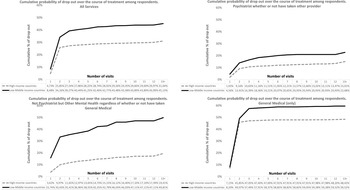
The treatment dropout rate was lowest in both high- and low/middle-income countries among patients treated by a psychiatrist (17.2–18.5%), intermediate among those treated by other mental health professions (19.9–44.2%), and highest among those treated exclusively in the general medical sector (43.2–57.2%) (Table 2). However, these were all lower-bound estimates because the number of patients still in treatment at the time of interview was consistently higher than the number who reported successfully completing treatment, raising the likelihood that some of these patients dropped out of treatment subsequent to the time of interview. An estimate of these cumulative dropout rates was obtained by generating Kaplan–Meier curves based on retrospective data of conditional probabilities of dropout as a function of number of visits (Fig. 1). Projected cumulative dropout was estimated to be close to 30% overall after 13 visits (the largest number for visits over which stable estimates of cumulative dropout could be projected) in high-income countries and ~45% in low/middle-income countries. Projected dropout rates varied from values close to 15% for specialty treatment to nearly 50% for general medical treatment in high-income countries and from 25% for psychiatry treatment to 50% for other mental health specialty treatment and 60% for general medical treatment in low/middle-income countries. The majority of projected dropouts in each curve occurred within two visits. This was especially pronounced among patients seen exclusively in the general medical sector, where well over 90% of all projected dropout occurred after one or two visits.
Probability of drop out over the course of treatment.

Predictors of treatment dropout
Severity and disorder type
Models were estimated separately for dropout after ‘1 or 2’ and ‘3 or more’. The severity of the clinical presentation for respondents with any disorder was a significant predictor in a number of models (Table 3). For both low- and high-income countries, dropout was significantly elevated among patients with mild (OR = 1.8) and moderate (OR = 1.5) disorders after 1–2 visits. In high-income countries, these increased odds were driven by early dropout from psychiatric treatment. The associations of severity and dropout in low/middle-income countries were diverse and more nuanced. In addition to the increased early dropout of people with less severe presentations (also driven by increased dropout from treatment with psychiatrists; OR = 2.2 for mild and 4.7 for moderate), we found a significant association of severity with dropout after 3 or more visits. The direction of these associations was contingent on the type of treatment provided: people with milder clinical presentations had elevated odds of dropout from treatment with a psychiatrist after 3 or more visits (OR = 2.2 for mild and OR = 1.9 for moderate), whereas people with severe presentations that were not seeing a psychiatrist had decreased dropout after 3 or more visits (OR = 0.5–0.4 for moderate in ‘other mental health service’ and ‘general medical’ respectively). No consistent associations were found involving disorder type (see online Appendix Table 1), and the small numbers of respondents with some specific disorders and disorder combinations precluded us from estimating more complex models combining disorder type, number, and severity.
Bivariate associations of 12-month disorder severity with treatment dropout after 1–2 and 3 + visits among patients with 12-month DSM-IV/CIDI disorders in the World Mental Health Surveys, by country income groupa

*Significant at the 0.05 level, two-sided test compared to patients with severe disorders.
a Each model included dummy variable controls for survey and number of visits. The models for any dropout additionally controlled for treatment sector.
Insurance
Patients with no coverage (either in the form of insurance or public mental health services) in high-income countries were significantly more likely to drop out from psychiatric care after 3 + visits than patients who did have insurance (Table 4). This was true regardless of the type of insurance the patient carried (see online Appendix Table 2). The same general pattern for dropout from psychiatric treatment was found in low/middle-income countries (i.e. higher dropout after 3 + visits among patients with no insurance with than with insurance), and this association was also significant for those seeking treatment by other mental health providers. Patients with no insurance in low- and middle-income countries are significantly less likely to drop out after 1–2 visits if they sought help only in the general medical sector.
Bivariate associationsa of health insurance with treatment dropout (after 1–2 and 3 + visits) among patients with 12-month DSM-IV/CIDI disorders in the World Mental Health Surveys, by country income group

*Significant at the 0.05 level, two-sided test compared to patients with any insurance.
a Each model included dummy variable controls for survey and number of visits. The models for any dropout additionally controlled for treatment sector.
Socio-demographics
The socio-demographic variables considered here had generally non-significant multivariate associations with treatment dropout in the 16 multivariate models estimated across sectors crossed by the number of visits separately in low/middle- and high-income countries after controlling for type-severity of disorders and type of insurance. Summary multivariate results are reported in online Appendix Table 3. Perhaps the most striking result is that the indicators of socio-economic status (education, employment, family income) are for the most part unrelated to dropout.
Conclusion and discussion
These findings indicate that dropout during treatment for mental disorders is high, reaching nearly 30% in high-income and 45% in low-income countries. Dropout is higher in general medical rather than in specialist settings (nearly 60% v. 20% in lower income settings), and higher for mild and moderate than for severe presentations. We also found that the lack of financial protection for mental health services is associated with overall increased dropout from specialist care, as well as with increased relative dropout rates for people with milder clinical forms from psychiatric care, and for people with more severe presentations from general medical services, especially in low-income settings.
The results of this study need to be assessed taking into consideration the following limitations. First, data are based on self-report which is susceptible to recall bias. Second, data do not indicate if visits in the previous 12 months correspond to a single episode of care, or if the treatment from two or more professionals occurred within an interdisciplinary care system. In case of visits being conducted by more than one professional, this would underestimate dropout rate. Third, there is heterogeneity across the countries in disorder prevalence (Demyttenaere et al., Reference Demyttenaere, Bruffaerts, Posada-Villa, Gasquet, Kovess, Lepine and Chatterji2004), health system service organization and resources (WHO, 2017) that may affect the conclusions based on pooled analyses, which was necessary to avoid sparse data. Analysis by country income level and inclusion of a variable to capture financial protection through insurance or public services, seek to mitigate this limitation. Fourth, community surveys fail to adequately capture low prevalence disorders (such as schizophrenia) due to methodological constraints; most respondents with these disorders though, can be expected to meet criteria for comorbid anxiety, mood, or substance disorders, and would therefore be indirectly captured in our analyses. Fifth, our analysis focuses on dropout from treatments provided within the healthcare system, and does not consider community supports provided through community-based human services, CAM, and support groups. Sixth, we highlight that the number of visits does not imply a consistent interval of time. One advantage of the application of discrete-time survival analysis models is that it does not require an x-axis related to time (which would be continuous) and also allows inconsistent time intervals. Similar approaches in which Kaplan–Meier curves were used to examine drop out by number of visits have been published before in the area (see e.g. Edlund et al., Reference Edlund, Wang, Berglund, Katz, Lin and Kessler2002; Olfson et al., Reference Olfson, Mojtabai, Sampson, Hwang, Druss, Wang and Kessler2009; Wells et al., Reference Wells, Browne, Aguilar-Gaxiola, Al-Hamzawi, Alonso, Angermeyer and Kessler2013). Seventh, we also acknowledge that we are not able to attribute each episode of care to specific diagnoses. However, mental health providers are expected to treat people as a whole, so it is reasonable to expect that disorders that meet well-established thresholds (such as CIDI diagnosed disorders) would be captured by a clinical assessment performed within the healthcare system. Finally, several country-specific socioeconomic and cultural characteristics may explain variations in help-seeking behaviors: we have shown the impact of financial coverage on dropout rates, but also stigma toward mental illness and other cultural norms may affect people's ability to seek and remain engaged with care, and would be important areas of additional research.
Despite these limitations, our results have important implications for mental health policy and systems planning. In addition to the findings summarized above, our data indicate that the impact of sociodemographic variables on dropout rates is not significant. This may signal that dropout is not so much a consequence of predisposing population characteristics but of how the healthcare system is resourced and organized, or of how treatment is perceived in terms of effectiveness (Andersen, Reference Andersen1995). This is consistent with a previous report of the WMH Survey Initiative (Evans-Lacko et al., Reference Evans-Lacko, Aguilar-Gaxiola, Al-Hamzawi, Alonso, Benjet, Bruffaerts and Thornicroft2018), and provides targets for improvement that are within the health system itself (as opposed to socially pre-determined individual variables).
Dropout generally occurs during the first two visits of care, most likely before beneficial effects of treatment can be produced and perceived by the individual. This is especially true of general medical services, where 90% of dropouts occur before the third session. This is consistent with previous epidemiological and administrative data studies (Olfson et al., Reference Olfson, Mojtabai, Sampson, Hwang, Druss, Wang and Kessler2009; Pan, Liu, & Yeh, Reference Pan, Liu and Yeh2013; Petterson, Miller, Payne-Murphy, & Phillips, Reference Petterson, Miller, Payne-Murphy and Phillips2014; Wells et al., Reference Wells, Browne, Aguilar-Gaxiola, Al-Hamzawi, Alonso, Angermeyer and Kessler2013), and highlights the need to improve training, supervision, support and to review treatment practices for general health providers if they are to be effective entry points to the mental health system. Indeed, patterns of dropout varied remarkably between professionals and country income level. Mean number of visits was higher and dropout rates lower (more than 10 visits and less than 20% dropout rates) for psychiatrists across country income levels. Figures were similar for the ‘other health professionals’ group in high-income countries. However, the figures were very different (3 to 6 mean number of visits and 43% to 57% dropout rates) for the general medical sector across country income levels or for those treated by other mental health professionals in low/middle-income countries. Given that current guidelines call for common mental disorders to be treated in primary care (Fletcher et al., Reference Fletcher, Bower, Gilbody, Lovell, Richards and Gask2009; NICE, 2004), our findings indicate that significant efforts remain to be made before the general medical sector can provide adequate mental care: most people actually drop out before reaching the minimum required number of visits by any standard (APA, 2010; Gautam, Jain, Gautam, Vahia, & Grover, Reference Gautam, Jain, Gautam, Vahia and Grover2017; NICE, 2009).
Our findings also indicate that dropout is significantly associated with severity but not with disorder type. Previous studies have been inconsistent: Simon and Ludman found an association in patients with depression between severity and dropout rates (Pan et al., Reference Pan, Liu and Yeh2013; Simon & Ludman, Reference Simon and Ludman2010), while Warden et al., did not (Warden et al., Reference Warden, Rush, Wisniewski, Lesser, Thase, Balasubramani and Trivedi2009a, Reference Warden, Rush, Carmody, Kashner, Biggs, Crismon and Trivedib). With respect to specific mental disorders, some studies found variability in dropout rates (Fernandez-Arias et al., Reference Fernandez-Arias, Garcia-Fernandez, Bernaldo-de-Quiros, Estupinia Puig, Labrador Encinas and Labrador-Mendez2016; Murphy et al., Reference Murphy, Hodgman, Carson, Spencer-Harper, Hinton, Wessely and Busuttil2015; Oflaz et al., Reference Oflaz, Guveli, Kalelioglu, Akyazi, Yildizhan, Kilic and Oral2015), while others did not (Gonzalez, Weersing, Warnick, Scahill, & Woolston, Reference Gonzalez, Weersing, Warnick, Scahill and Woolston2011). The granularity of our data allows us to go one step further and draw preliminary conclusions that shed light on these inconsistencies. In general, people with milder presentations tend to drop out more and drop out earlier, but this tendency is mostly driven by dropout of treatment with psychiatrists. Data from lower income settings show that, in addition to this increased dropout of people with milder clinical presentations from psychiatric care, there is an increase in dropout of people with more severe presentations from general medical and other mental health services. This finding is relevant for health systems planning because it points to what may be the specific changes required to improve outcomes. Indeed, best practices prescribe the management of common and milder mental disorders through primary care, while reserving the scarce specialist resources for more severe clinical presentations and for supervision of general medical services. Our data indicate that in low- and middle-income settings, there may be inefficiencies and potential quality gaps in how the system is organized: a subgroup of people with milder clinical presentations are receiving care from psychiatrists (and dropping out more than people with severe disorders), while a subgroup of people with more severe clinical forms are not receiving care from psychiatrists (and dropping out more than people with less severe disorders). Hence, a stepped care framework in which milder forms are dealt with directly through general medical services while severe cases are systematically referred to psychiatrists or managed in closer consultations with specialists seems like a promising evidence-based approach.
Finally, these results show a significant effect of financial coverage of health services (in the form of insurance or direct public provision) on dropout rates. Insurance was associated with lower dropout rates after the third visit in patients being treated by psychiatrists both in high-income and low/middle-income countries. In low/middle-income countries, insurance was associated with lower dropout rates in treatment with other mental health professionals as well. Previous studies (which were constrained to the mental health sector and/or were not stratified by service provider) have also found an effect of insurance on dropout rates (Agarwal, Pan, & Sambamoorthi, Reference Agarwal, Pan and Sambamoorthi2013; Warden et al., Reference Warden, Rush, Carmody, Kashner, Biggs, Crismon and Trivedi2009b). Our granular data highlight the impact of financial protection on the continuity of care at different levels of specialization both in low- and high-income settings.
Collectively these findings have implications for policy and health systems planning. First, dropout from mental health treatment is relevant globally because of its high frequency, its potential to increase health care costs due to inefficiencies, and to worsen health outcomes due to missed opportunities to intervene early (Barnicot, Katsakou, Marougka, & Priebe, Reference Barnicot, Katsakou, Marougka and Priebe2011; Swift & Greenberg, Reference Swift and Greenberg2012). Second, extending financial protection and coverage for mental disorders may reduce dropout and therefore improve continuity of care and health outcomes, especially for those that need specialist care. Third, dropout seems to affect diverse subgroups differently, and a holistic, stepped-care approach to providing mental health services can be expected to improve efficiency and quality of care by: (a) grounding the entry point to the mental health system in primary care, which should manage milder clinical presentations; (b) providing adequate training, support and specialist supervision for non-specialists; and (c) streamlining referral to psychiatrists for more severe and complex cases.
Supplementary material
The supplementary material for this article can be found at https://doi.org/10.1017/S0033291720000884.
Acknowledgements
The WHO World Mental Health Survey collaborators are Sergio Aguilar-Gaxiola, MD, PhD; Ali Al-Hamzawi, MD; Mohammed Salih Al-Kaisy, MD; Jordi Alonso, MD, PhD; Laura Helena Andrade, MD, PhD; Lukoye Atwoli, MD, PhD; Corina Benjet, PhD; Guilherme Borges, ScD; Evelyn J. Bromet, PhD; Ronny Bruffaerts, PhD; Brendan Bunting, PhD; Jose Miguel Caldas-de-Almeida, MD, PhD; Graça Cardoso, MD, PhD; Somnath Chatterji, MD; Alfredo H. Cia, MD; Louisa Degenhardt, PhD; Koen Demyttenaere, MD, PhD; Silvia Florescu, MD, PhD; Giovanni de Girolamo, MD; Oye Gureje, MD, DSc, FRCPsych; Josep Maria Haro, MD, PhD; Hristo Hinkov, MD, PhD; Chi-yi Hu, MD, PhD; Peter de Jonge, PhD; Aimee Nasser Karam, PhD; Elie G. Karam, MD; Norito Kawakami, MD, DMSc; Ronald C. Kessler, PhD; Andrzej Kiejna, MD, PhD; Viviane Kovess-Masfety, MD, PhD; Sing Lee, MB, BS; Jean-Pierre Lepine, MD; John McGrath, MD, PhD; Maria Elena Medina-Mora, PhD; Zeina Mneimneh, PhD; Jacek Moskalewicz, PhD; Fernando Navarro-Mateu, MD, PhD; Marina Piazza, MPH, ScD; Jose Posada-Villa, MD; Kate M. Scott, PhD; Tim Slade, PhD; Juan Carlos Stagnaro, MD, PhD; Dan J. Stein, FRCPC, PhD; Margreet ten Have, PhD; Yolanda Torres, MPH, Dra.HC; Maria Carmen Viana, MD, PhD; Harvey Whiteford, MBBS, PhD; David R. Williams, MPH, PhD; Bogdan Wojtyniak, ScD.
Financial support
The World Health Organization World Mental Health (WMH) Survey Initiative is supported by the United States National Institute of Mental Health (NIMH; R01 MH070884), the John D. and Catherine T. MacArthur Foundation, the Pfizer Foundation, the United States Public Health Service (R13-MH066849, R01-MH069864, and R01 DA016558), the Fogarty International Center (FIRCA R03-TW006481), the Pan American Health Organization, Eli Lilly and Company, Ortho-McNeil Pharmaceutical Inc., GlaxoSmithKline, and Bristol-Myers Squibb. We thank the staff of the WMH Data Collection and Data Analysis Coordination Centres for assistance with instrumentation, fieldwork, and consultation on data analysis. None of the funders had any role in the design, analysis, interpretation of results, or preparation of this paper. The views and opinions expressed in this report are those of the authors and should not be construed to represent the views of the World Health Organization, other sponsoring organizations, agencies, or governments.
The Argentina survey – Estudio Argentino de Epidemiología en Salud Mental (EASM) – was supported by a grant from the Argentinian Ministry of Health (Ministerio de Salud de la Nación) – (Grant Number 2002–17270/13−5). The São Paulo Megacity Mental Health Survey is supported by the State of São Paulo Research Foundation (FAPESP) Thematic Project Grant 03/00204-3. The Bulgarian Epidemiological Study of common mental disorders EPIBUL is supported by the Ministry of Health and the National Center for Public Health Protection. The Chinese World Mental Health Survey Initiative is supported by the Pfizer Foundation. The Shenzhen Mental Health Survey is supported by the Shenzhen Bureau of Health and the Shenzhen Bureau of Science, Technology, and Information. The Colombian National Study of Mental Health (NSMH) is supported by the Ministry of Social Protection. The Mental Health Study Medellín – Colombia was carried out and supported jointly by the Center for Excellence on Research in Mental Health (CES University) and the Secretary of Health of Medellín. The ESEMeD project is funded by the European Commission [Contracts QLG5-1999-01042; SANCO 2004123, and EAHC 20081308), (the Piedmont Region (Italy)], Fondo de Investigación Sanitaria, Instituto de Salud Carlos III, Spain (FIS 00/0028), Ministerio de Ciencia y Tecnología, Spain (SAF 2000-158-CE), Generalitat de Catalunya (2017 SGR 452; 2014 SGR 748), Instituto de Salud Carlos III (CIBER CB06/02/0046, RETICS RD06/0011 REM-TAP), and other local agencies and by an unrestricted educational grant from GlaxoSmithKline. Implementation of the Iraq Mental Health Survey (IMHS) and data entry were carried out by the staff of the Iraqi MOH and MOP with direct support from the Iraqi IMHS team with funding from both the Japanese and European Funds through United Nations Development Group Iraq Trust Fund (UNDG ITF). The Israel National Health Survey is funded by the Ministry of Health with support from the Israel National Institute for Health Policy and Health Services Research and the National Insurance Institute of Israel. The World Mental Health Japan (WMHJ) Survey is supported by the Grant for Research on Psychiatric and Neurological Diseases and Mental Health (H13-SHOGAI-023, H14-TOKUBETSU-026, H16-KOKORO-013, H25-SEISHIN-IPPAN-006) from the Japan Ministry of Health, Labour, and Welfare. The Lebanese Evaluation of the Burden of Ailments and Needs of the Nation (L.E.B.A.N.O.N.) is supported by the Lebanese Ministry of Public Health, the WHO (Lebanon), National Institute of Health/Fogarty International Center (R03 TW006481-01), anonymous private donations to IDRAAC, Lebanon, and unrestricted grants from, Algorithm, AstraZeneca, Benta, Bella Pharma, Eli Lilly, Glaxo Smith Kline, Lundbeck, Novartis, OmniPharma, Pfizer, Phenicia, Servier, UPO. The Mexican National Comorbidity Survey (MNCS) is supported by The National Institute of Psychiatry Ramon de la Fuente (INPRFMDIES 4280) and by the National Council on Science and Technology (CONACyT-G30544- H), with supplemental support from the Pan American Health Organization (PAHO). Te Rau Hinengaro: The New Zealand Mental Health Survey (NZMHS) is supported by the New Zealand Ministry of Health, Alcohol Advisory Council, and the Health Research Council. The Nigerian Survey of Mental Health and Wellbeing (NSMHW) is supported by the WHO (Geneva), the WHO (Nigeria), and the Federal Ministry of Health, Abuja, Nigeria. The Northern Ireland Study of Mental Health was funded by the Health & Social Care Research & Development Division of the Public Health Agency. The Peruvian World Mental Health Study was funded by the National Institute of Health of the Ministry of Health of Peru. The Polish project Epidemiology of Mental Health and Access to Care – EZOP Project (PL 0256) was supported by Iceland, Liechtenstein, and Norway through funding from the EEA Financial Mechanism and the Norwegian Financial Mechanism. EZOP project was co-financed by the Polish Ministry of Health. The Portuguese Mental Health Study was carried out by the Department of Mental Health, Faculty of Medical Sciences, NOVA University of Lisbon, with collaboration of the Portuguese Catholic University, and was funded by Champalimaud Foundation, Gulbenkian Foundation, Foundation for Science and Technology (FCT) and Ministry of Health. The Romania WMH study projects ‘Policies in Mental Health Area’ and ‘National Study regarding Mental Health and Services Use’ were carried out by National School of Public Health & Health Services Management (former National Institute for Research & Development in Health), with technical support of Metro Media Transilvania, the National Institute of Statistics-National Centre for Training in Statistics, SC, Cheyenne Services SRL, Statistics Netherlands and were funded by Ministry of Public Health (former Ministry of Health) with supplemental support of Eli Lilly Romania SRL. The South Africa Stress and Health Study (SASH) is supported by the US National Institute of Mental Health (R01-MH059575) and National Institute of Drug Abuse with supplemental funding from the South African Department of Health and the University of Michigan. The Psychiatric Enquiry to General Population in Southeast Spain – Murcia (PEGASUS-Murcia) Project has been financed by the Regional Health Authorities of Murcia (Servicio Murciano de Salud and Consejería de Sanidad y Política Social) and Fundación para la Formación e Investigación Sanitarias (FFIS) of Murcia. The Ukraine Comorbid Mental Disorders during Periods of Social Disruption (CMDPSD) study is funded by the US National Institute of Mental Health (RO1-MH61905). The US National Comorbidity Survey Replication (NCS-R) is supported by the National Institute of Mental Health (NIMH; U01-MH60220) with supplemental support from the National Institute of Drug Abuse (NIDA), the Substance Abuse and Mental Health Services Administration (SAMHSA), the Robert Wood Johnson Foundation (RWJF; Grant 044708), and the John W. Alden Trust.
LHA is supported by the Brazilian Council for Scientific and Technological Development (CNPq Grant # 307784/2016-9) and the State of São Paulo Research Foundation (FAPESP; Project Saúde mental, migração e São Paulo Megacity—M3SP; Grant16/50307-3).
DF is supported by grant RTI2018-100927-J-I00 administrated by Ministerio de Ciencia e Innovación (MCI, Spain), by the Agencia Estatal de Investigación (AEI, Spain), and by the European Regional Development Fund FEDER (FEDER, UE), by Marsden grant E2987-3648 administrated by the Royal Society of New Zealand), and by grant 2017 SGR 622 (GRBIO) administrated by the Departament d'Economia i Coneixement de la Generalitat de Catalunya (Spain).
A complete list of all within-country and cross-national WMH publications can be found at http://www.hcp.med.harvard.edu/wmh/.
Conflict of interest
In the past 3 years, Dr Kessler received support for his epidemiological studies from Sanofi Aventis; was a consultant for Johnson & Johnson Wellness and Prevention, Sage Pharmaceuticals, Shire, Takeda; and served on an advisory board for the Johnson & Johnson Services Inc. Lake Nona Life Project. Kessler is a co-owner of DataStat, Inc., a market research firm that carries out healthcare research.
Ethical standards
The authors assert that all procedures contributing to this work comply with the ethical standards of the relevant national and institutional committees on human experimentation and with the Helsinki Declaration of 1975, as revised in 2008.