Introduction
There is a significant, worldwide burden of CHD with estimates between 8 and 12 per 1000 live births. This estimate appears to be distributed evenly between countries while treatment options are not. Low- and middle-income countries tend to have higher fertility rates, which put a greater burden per wage earner in these countries.Reference Hoffman 1 This is paired with a decreased capacity to surgically repair or palliate children with CHD. Improved local capacity to repair CHD is important for improving the health of these children. In this study, we examine the results of capacity building for repair of CHD in a single-centre, low- and middle-income countries.
After dissolution of the former United Soviet Socialist Republic (USSR), there was a deficiency of cardiac services in Eastern Europe, as has been previously described.Reference Borst 2 In Ukraine, although some paediatric cardiac surgical activity existed in the capital city of Kiev, national authorities determined a need for expansion to provide care in the Eastern part of the country. In 2008, the Ministry of Health of Ukraine requested external assistance in developing paediatric cardiac services and invited an international organisation specialised in providing paediatric cardiac care to develop Kharkiv, Ukraine as an independent regional site.
Good surgical outcomes for children with CHD have been previously demonstrated when a visiting international group operates in low- and middle-income countries. In this report, operative mortality was as low as 2.3% although the case mix-only included surgeries with low complexity. In addition, this data only included operations performed while the visiting team was present and did not report on the development of independent local capacity.Reference Wallen, Arnaoutakis, Blenden and Soto 3 Development of local capacity has been shown,Reference Novick, Stidham and Karl 4 , Reference Fenton, Castillo, Claro and Novick 5 but previous efforts have not compared surgical results before and after intervention by an international team at a single-assisted programme.
In order to build on local capacity to surgically repair children with CHD, an international team was invited to Kharkiv, Ukraine for regular, on-site visits. These visits included on-site supervision, medical education, biomedical engineering support, and implementation of a team-based practice development. In this paper, methods to develop independent capacity is described and outcomes are compared before and after this collaboration.
Materials and methods
This retrospective observational study was approved by the Research/Ethics Committee, and informed consent was waived. The databases from the international programme and from the Zaitcev Institute for General and Urgent Surgery (Kharkiv, Ukraine) were retrospectively queried for patients of age 0–18 years operated between 2000 and 2015. Data were analysed for the 8 years before assistance started (era A: 2000–2007) and the 8 years since commencement of assistance (era B: 2008–2015). The Risk Adjustment for Congenital Heart Surgery-1 (RACHS-1) model of risk stratificationReference Jenkins, Gauvreau, Newburger, Spray, Moller and Iezzoni 6 was used in the current analysis, as it is the only scoring system available throughout the entire database by both local centre and visiting teams. Only cases classified by RACHS-1 were included in the analysis. Non-RACHS-1 surgical cases were defined as either patient ductus arteriosus ligations in neonates or operations not primarily directed towards cardiac repair or palliation, namely peri-operative procedures involving complications or post-operative care such as mediastinal exploration for bleeding or unstable haemodynamics, diaphragmatic plication, pacemaker implantation, and sternal revisions, among others.
Specific data retrieved included RACHS-1 class for all operations, case volume per year, operative mortality, including mortality beyond 30 days if the patient was not discharged, surgeon of record, patient’s age at operation, and gender. Paediatric cardiac catheterisation data were extracted from the Kharkiv database for diagnostic and interventional procedures. Before the assistance program, no paediatric catheterisations were performed.
Local programme description
Zaitcev Institute for General and Urgent Surgery in Kharkiv, Ukraine is a regional general surgical hospital financially supported by the Ukrainian National Academy of Medical Sciences. The referral population is more than 3 million. The cardiac unit serves both adults and children. There is a single-plane cardiac catheterisation laboratory, an operating room for cardiac surgery, and a nine-bed cardiac surgical ICU. None of the local surgeons had paediatric cardiac surgery training before initiation of the training relationship. The lead surgeon had background credentials as an adult cardiac surgeon, and the second only in general surgery. The cardiac surgical ICU team included nurses, anaesthesiologists, perfusionists, and critical care physicians. Anaesthesiologists and perfusionists provide care in the cardiac surgical ICU because of the few dedicated critical care physicians on staff. In Ukraine, as in many parts of former USSR, perfusionists are physicians with medical degrees with either anaesthesiology or intensive care training. Several of the physicians had formalised paediatric training. There are no respiratory therapists or nutrition specialists on staff.
International assistance team description
The international paediatric assistance programme began in 2008. Assistance was provided by teams organised by a single NGO with significant experience-developing programmes in low- and middle-income countries. It consisted of visiting international teams comprising volunteers and paid staff from developed programmes that visited approximately every 3 months for 2-week periods. Initial team members included a paediatric cardiac surgeon, a paediatric anaesthesiologist, a scrub nurse, a perfusionist, critical care physicians, paediatric ICU nurses, a paediatric cardiologist, a respiratory therapist, and a biomedical engineer. Parents and patients were informed of the existence of other paediatric heart programmes in the country and given the option to choose their site of care. From the beginning, to help with language and blending of working cultures, international assistance teams often included physicians and nurses from neighbouring programmes and countries (Kiev, Ukraine, and Minsk, Belarus) who worked or volunteered for the NGO. As local capacity improved, the size of the visiting team was decreased to a surgeon, critical care physician, paediatric ICU nurses, biomedical engineer, and intermittent visits of a paediatric cardiologist.
Description of intervention
The assistance programme included five main components – on-site surgical and interventional activity with hands-on training of the local team, aiming to repair or palliate between 14 and 20 paediatric cases during each trip; medical education with 3–4 on-site lectures per trip, case management conferences before surgery, joint multi-disciplinary ICU rounds, and continuous mentoring during cooperative work; daily surgical planning conference, a quality assessment conference, and morbidity and mortality conferences, which were carried out at the end of each trip with discussion of unexpected re-interventions and mortality; biomedical engineering support with donation of equipment and supplies; modelling of a team-based practice philosophy based on developing team-work culture and horizontal hierarchy, where all team members’ contributions are considered important; nurse empowerment, where nurses are responsible for leading daily rounds and initiating treatments as their experience advanced, training in paediatric advance life support and crisis resource management; teaching of a structured sign-out from the operating room staff to the ICU staff.Reference Catchpole, de Leval and McEwan 7 The collaboration additionally led to the enrolment of the Kharkiv centre in the International Quality Improvement Collaborative (IQIC). The key components of the IQIC programme include creation of a robust worldwide database, utilisation of the RACHS-1 classification, and local staff education on quality-driven best practices using telemedicine platforms.Reference Balachandran, Kappanayil and Sen 8 , Reference Jenkins, Castañeda and Cherian 9
Financial support for the programme was carried out by a combination of international and local charitable donations, and sponsorships, as well as governmental health budget financing, all of which fluctuated during and before the duration of assistance. Details and challenges of programme financing are beyond the scope of this manuscript.
Data analysis
Age of patients in both eras was described as medians and interquartile ranges. Annual case volume, proportion of local surgeon-led surgeries, and operative mortality were expressed as mean and 95% confidence intervals, and team size as mean±SD. Continuous variables were compared using the Mann–Whitney U-test. χ2-test with contingency tables or Fisher’s exact test were used for categorical variables. Data were analysed using internet-based software (www.graphpad.com/quickcalcs, www.socscistatistics.com/tests) and Statistical Package for the Social Sciences (SPSS 15.0) software.
Standardised mortality ratio was calculated by a proportionately weighted observed versus expected RACHS-1 category mortalities. For the expected mortality for each RACHS-1 category, we used the reference values in the recently published dataset of the IQIC for congenital heart surgery in developing world countries.Reference Jenkins, Castañeda and Cherian 9
Results
Surgical volume and age at operation
Using the RACHS-1 classification, 979 paediatric operations were identified. During era A, 154 primary operations were performed with a mean annual case volume of 19.3 at 95% confidence interval (14.3–24.2). During era B, 825 primary operations were performed. Mean annual case volume increased to 103.1 during era B at 95% confidence interval (69.1–137.2) (p<0.0001). In era B, 479 operations were performed during 33 international assistance trips and 346 when the international team was not present.
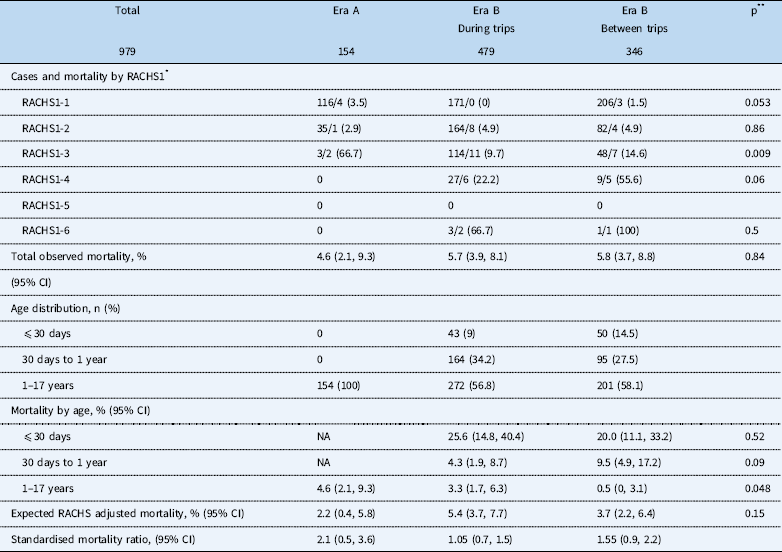
Age at operation decreased significantly after the onset of international cooperation: median age decreased from 7 years (interquartile range 3–12) in era A to 1.3 years (interquartile range 0.5–5) in era B (p<0.0001). Within era B, the median age at operation steadily decreased from 3 (interquartile range 1–9) years at the start of assistance trips to 0.8 (interquartile range 0.3–2.3) years at the end of era B (p<0.0001). There were no neonatal or infant surgeries in era A. In era B, the proportion of operations involving neonates and children age 1 month to 1 year was 11.3 and 31.4%, respectively (Table 1), with the first neonatal operation performed in 2012.
Cases by age, complexity distribution, and mortality.

NA=not applicable; CI=confidence interval.
* Data presented as cases/death (mortality %).
** p for differences in mortality between subgroups (χ2-test contingency tables 2×3 or 2×2).
Mortality by complexity, age, and standardised mortality ratio
Operative mortality in era A, era B between visits, and era B during visits was not statistically significantly different (4.6 versus 5.7 versus 5.8%, p=0.84). There was a small, non-significant, increase in overall mortality with a concomitant increase in case complexity. Case complexity substantially increased after initiation of assistance from the international team. The proportion of cases in RACHS-1 categories 2 and 3 increased during era B when compared to era A, while the RACHS-1 category 1 proportion of the total number of cases substantially decreased. The expected mortality expressed as standardised mortality ratio fell from 2.1 in era A to 1.55 between trips in era B to 1.05 during trips (Table 1).
A statistically significant decrease in RACHS-1 category 3 mortality was observed from 66.7% in era A to 14.6% in era B between international team visits and 9.7% during these visits (p=0.009). Mortality in RACHS-1 categories 1 and 2 did not change between these subgroups. RACHS-1 categories 4 and 6 operations were not performed before the initiation of international assistance, therefore comparisons to era A are not possible, but there was no statistical difference in mortality within these categories in era B during versus between visits (Table 1). Comparison of cases by age is difficult as there were no infant cases in era A. However, in the 1–17 years age group, mortality significantly decreased from 4.6% in era A to 3.3% in era B during visits, and to 0.5% between visits (p=0.048) (Table 1). Cases expected to be more challenging were generally saved for when the international team was present, especially early in the collaboration.
Development of local surgical skills and team sustainability
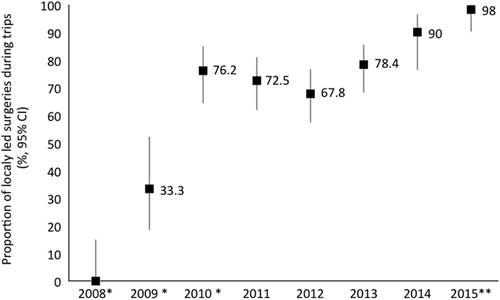
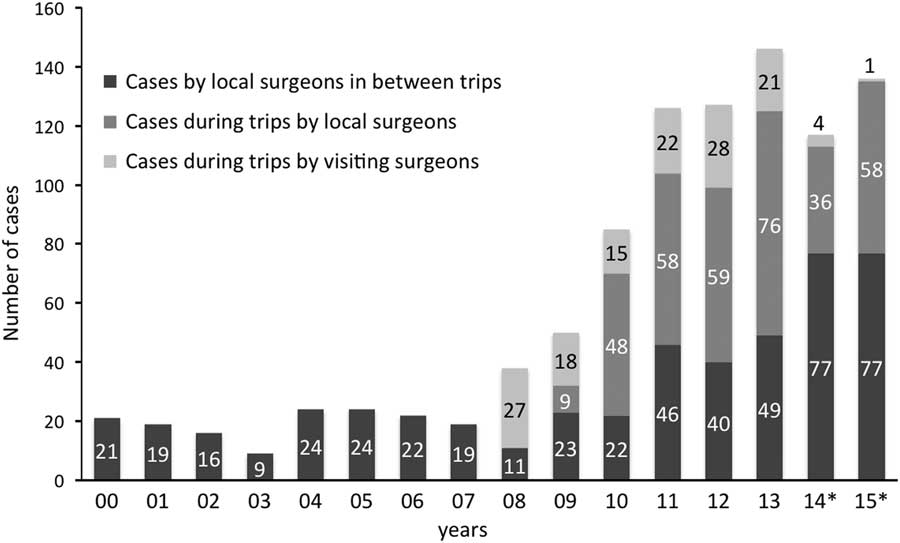
The proportion of local surgeon-led surgeries during international trips significantly increased from 0% in 2008 to 76.2% in 2010, and then to 98% in the final study year (Fig 1). Significant milestones were made by the local team with international team assistance. Between 2008 and 2010, paediatric cardiac surgical education was focussed solely on one individual who continued to be the lead surgeon throughout era B. In 2010, a second surgeon was added who assumed independent operating responsibilities on simple cases in 2012. As the assistance programme progressed, the proportion of independent surgeries performed between visits increased. In the final 2 years of analysis, the majority of cases were performed between international visits (Fig 2). Moreover, in these last 2 years, the majority of cases performed with the international team present were performed entirely by the local team, including anaesthesia and perfusion, with visitors acting primarily as consultants –90% in 2014 and 98% in 2015. This coincided with a decrease in international team size. Initially, the visiting team size in 2008 was 16.0±1.4 and decreased to 6.2±1.1 by 2015 (p=0.003).
Proportion of locally led surgeries during trips. *Differences between years are statistically highly significant (p=0.0018 for years 2008–2009; p=0.0002 for years 2009–2010); **Difference between the first (2008) and the last (2015) years (p=0.0001).

Dynamic of totally independent cases compared to cases during international trips. *Proportion of cases between trips increased statistically significant (p=0.0001) in 2014 and 2015 compared to previous 6 years of era B.

Local and regional education
A number of educational lectures were provided over 8 years of the programme to inform paediatricians both locally and regionally, as well as at the national level on occasions, about the programme in Kharkiv. Local lectures were provided at the perinatal centre twice (2010 and 2015), regional lectures thrice (2011, 2013, and 2014), and national level lectures four times (2012, 2016 [twice], and 2017) for a total of nine lectures or presentations regarding the Kharkiv programme. The local and regional lectures were focussed on the stabilisation of the neonate or infant with critical cardiac defects. Regional and national lectures focussed on quality improvement, endovascular interventions, and improvement in paediatric cardiac surgical results.
Interventional skill training
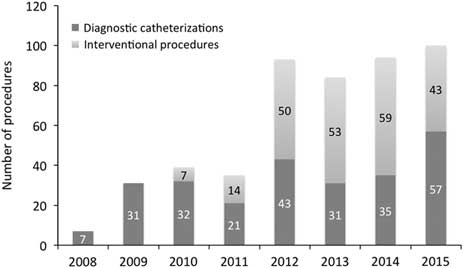
There was no paediatric catheterisation programme in Kharkiv before 2008. Since 2010, an active paediatric cardiac catheterisation programme has been developed with mentoring from visiting paediatric interventional cardiologists. The number of diagnostic and interventional procedures is shown in Figure 3. Since 2010, 250 interventional catheterisation cases have been performed with a mortality of 0.8% (95% confidence interval 0.03–3.1). The number of interventional procedures now outnumbers diagnostic catheterisations.
Development of structural cardiac catheterisations/interventions in era B.

Neonatal referrals
Neonatal cardiac surgery before the beginning of the programme was not performed in Kharkiv; all neonates with critical or complex cardiac issues were transferred directly to centres in Kyiv. We divided the programme into the first (2008, 2009, 2010, and 2011) and second (2012, 2013, 2014, and 2015) 4-year period and found that the number of neonatal surgeries increased from a mean (SD; [95% confidence interval]) of 4.0 (4.2, [1.74–6.26]) to 19.3 (6.6, [17.76–20.73]) between the first and second 4-year periods, respectively (p<0.0001). Neonatal catheter-based interventions in the first and second 4-year periods were 3.0±4.2 and 15.5±4.2, respectively (p=0.0058). The increases in both surgery and catheter-based interventions on neonates were significant over time.
Discussion
The disparity in cardiac care around the world is well documented.Reference Neirotti 10 Efforts to assist in the development of paediatric cardiac programmes around the world vary widely. The herein described collaborative effort with an international NGO that works specifically in developing paediatric cardiac services has led to the local programme increasing case complexity, total case volume, and decreasing standardised mortality ratio. The addition of paediatric catheterisation services to the programme provided the needed services to the children with CHD in Eastern Ukraine.
The Kharkiv centre’s paediatric cardiac experience was limited before the assistance programme. During the period of international assistance, the annual surgical volume increased five-fold, while the average age of patients also decreased more than five-fold. The age range where surgical services are available now approximates the spectrum in developed countries.Reference Pasquali, He and Jacobs 11 , 12 The mortality rate, despite increasing complexity and younger age of operation, also approaches the approximately 4% expected mortality in developed countries.Reference Pasquali, He and Jacobs 11 – 13 These results were achieved in relatively short period of time. In the United States, it took 18 years to reduce the mortality rates from 9.5% in 1988–1990 to 4% in 2003–2005.Reference Welke, Diggs and Karamlou 14 In the United Kingdom, mortality decreased from 11.1% in 1978 to 4.2% in 2000 and to 2.6% in 2010. 15 , Reference Brown, Crowe and Franklin 16
Our data show a significant decline in mortality for RACHS-1 level three patients and in patients of age 1–17 years. Among the age group 1–17 years, absolute mortality was higher during visits from the international team. This was expected as challenging cases with significant co-morbidity were saved for these visits and simpler cases were performed between visits. This practice decreased as local capacity improved, but likely affects the data over era B.
This dataset demonstrates that significant improvements can be made in outcomes for paediatric cardiac surgery in low- and middle-income countries. Capacity can be expanded to young children with mortality rates approaching those of developed countries. Most importantly, and this is shown for the first time in this report, these outcomes can be maintained even when visiting teams are not present. How to achieve these outcomes is of critical importance, which is why we have included a detailed description of the intervention in the methods section.
The development of a new programme in paediatric cardiac services in a region of the country where one did not previously provide complex and infant surgery requires notification and education of the local paediatricians, perinatologists, and obstetricians/gynaecologists if one wants to change referral patterns to the new site. We did this through a series of local, regional, and national lectures and conference presentations. One should not expect an immediate and complete change in referrals when excellent centres are available in the capital city. However, a sustained and consistent programme with improving results and increasing complexity of operations will over time change historical referral patterns as we have shown with our increases in both neonatal surgery and catheter-based interventions.
The ultimate result of the training programme was for the local surgeons to lead 98% of the surgeries under the supervision of the visiting surgeon in the last year of cooperation, as well as an increase in proportion of surgeries between visits. However, in our opinion, the described period or perhaps method of assistance is still not sufficient for training surgeons to master complex critical neonates, where we observed the highest mortality. Similar concerns have been expressed by other authors.Reference Kogon, Karamlou and Baumgartner 17 , Reference Fraser 18 However, significantly improved results in neonatal and complex infant cardiac surgery can be achieved in special circumstances with the visiting team model.Reference Baliulis, Lipnevicius and Sudikiene 19 Methods to increase the case load and mix, leading to an accrued number of neonates which would then theoretically enhance the local surgeons’ experience and hopefully improve outcomes, is a complex issue beyond the scope of the current study. Political and financial restraints, the vicinity of a conflict zone, the absolute lack of neonatal referral patterns, or the possibility to influence such if they exist did not appear at the forefront of the collaboration’s efforts during the study period, but will need to be addressed moving forward.
A similar approach was used to train all team members – ICU nurses, anaesthesiologists, perfusionists, critical care specialists, and cardiologists. The level of capability of trainees in these specialties was achieved faster than for surgeons, which led to a gradual decrease in the size of visiting teams. The addition of paediatric cardiac catheterisation services was a valuable and critical adjunct to the overall growth of the programme. As increased complexity was introduced into the surgical programme, catheterisation was required to provide supportive diagnostic and interventional procedures.Reference Armsby, Beekman and Benson 20
The most fundamental component for success in this type of cooperation resides in the consistent and perpetual commitment to make regular and uninterrupted two-week visits, several times a year, for several years. We believe that this practice not only delivers high standards of surgical care but also aids in the adoption and adaptation of existing Western protocols and recommendations to the specific conditions of low- and middle-income countries.Reference Jonas 21
Practitioners from developed countries face challenges when trying to adapt these recommendations to emerging countries and we feel the experience of an NGO that regularly works in low- and middle-income countries that help in this regard. Commonly encountered problems include a lack of resources, with obsolete equipment, limited laboratory services, lack of supplies, medicines, and instruments. Factors such as the absence of extracorporeal life support, lack of intraoperative paediatric transoesophageal echocardiogram, restricted access to blood products, and inadequate monitoring of perioperative coagulation must be managed.
A second challenge encountered in this experience was the initially perceived moderate to low motivation of local staff to cooperate and believe in the eventual success of the collaboration. In our subjective experience, it took close to a year to build a trusting relationship between local and visiting teams. On the basis of international group’s experience to date, effective local team leadership, a strong desire to change, and sufficient financial support have been the most significant variables leading to the development of a successful programme.
In terms of further development of the described model of international cooperation, we suggest introducing an internet-based academic curriculum. In our opinion, this step may provide additional benefits for more organised theoretical training, increase accountability and motivation of the local teams, and introduce a more standardised process of learning and testing. This could be best achieved by involvement of international societies that are involved in paediatric cardiac care.
Limitations of the study
We were not able to separate the beneficial effect from visiting team coaching from the expected improvement with increased case volume, partially because that coaching allowed for the increased case volume. Funding levels may also have impacted results, but was beyond the scope of this report. We were not able to utilise the full RACHS-1 methodology due to historically incomplete data collection for the specific parameters to calculate RACHS-1 covariates. Similarly, we were not able to analyse morbidity data collated as part of the International Quality Improvement Collaborative, owing partially to incomplete morbidity data, and no equivalent comparison group for era A.
Conclusions
Assistance to a developing programme has led to improved adjusted mortality, increased case volume, increased complexity, and independent operating skills. This model should be considered when implementing programmes to develop local capacity to perform paediatric cardiac surgery in developing countries.
Acknowledgements
We recognise the following individuals who have helped make this project successful: Ms Adi Roche, Founder and President of Chernobyl Children’s International; Dr Vasily V. Lazoryshynets, MD, PhD, Director, Amosov National Institute for Cardiovascular Surgery NAMS of the Ukraine, former Deputy Minister of Health of Ukraine.
Financial Support
This research received no specific grant from any funding agency, commercial or not-for-profit sectors.
Conflicts of Interest
None.