Introduction
In April 1930, the Raymond Ferrand coal mine in Cẩm Phả, Tonkin lost a large quantity of explosives including 185 boxes of mixed dynamite and three rolls of igniting cords. The thieves broke in at a night when the depot had just received seven containers of dynamite instead of its usual three or four loads. The French police accused Bùi Quang Hiếu (aged 56, a former chief at the mine) of orchestrating the intrusion with his three accomplices who were all current workers at the same mine—Bùi Văn Thịnh (aged 45, a sanitary coolie), Nguyễn Ngạc (aged 30, a mining coolie), and Nguyễn Thân (aged 22, a coolie and occasional guard). According to the French police record, the three mining workers were smoking opium on the night of 9 April 1930 in their shared dorm when they were approached by Hiếu, the former chief who happened to stay in a nearby room. Hiếu told the workers that he knew a Chinese who was looking to trade opium for dynamite. The three coolies and Hiếu then left their rooms in the middle of the night and then came back hours later, still wet from the rain. A coolie witness overheard that the four individuals had just returned from their meeting with Sam A Nhi, a Chinese dealer. Although the police did not find any explosives at Nhi's house, they uncovered three hidden holes, each one a third of a metre in depth, which, the police believed, must have been the place where Nhi had concealed the stolen property. The French police initially suspected the involvement of leftist and nationalist factions given the daring break-in and the size of the loss but, like many other thefts at the mines, at least according to the French view, all would boil down to opium. ‘Without doubt, the AnnamiteFootnote 1 thieves must have exchanged dynamite for opium,’ the police concluded.Footnote 2 Despite their efforts, the French colonial authorities were unable to retrieve the lost explosives as, drawing from their previous experience, ‘the dynamite must be heading right now to Yunnan, China where they would be swapped for opium’.Footnote 3
The case of Bùi Quang Hiếu was among hundreds of thefts caught by the French colonial police and certainly among many more that went undetected. As the most common crime at Tonkinese coal mines, the crime of theft attracted a diverse group of individuals from inside and outside the mines. Vietnamese workers were the primary perpetrators of theft, plundering different kinds of commodities from broken coal, wood, and cement to prohibited materials like explosives. The workers did not act alone, as theft cases were often collective jobs in which miners collaborated with outside dealers to smuggle these stolen properties. This article explores an underground world of crime and illicit acts at Tonkinese coal mines and their neighbourhood that managed to stay under the radar of both the French surveillance system and the Vietnamese nationalist movement. Using the theft of dynamite as a case study, it seeks to reveal a multilayered and multisited history of the miners, their collaborators, and a shadow transnational economy that were all bound in the illicit but highly lucrative trade of contraband.
The coal-mining industry in literature
Economic models that focus on the relationship between the metropole and the colony, the centre and its satellites, or the core and the periphery have profoundly shaped the economic history of colonial Vietnam and other parts of the formerly colonial word. According to these models, the rise of Vietnam as a major coal exporter in the world in the 1920s and 1930s was closely tied to the process of industrialization and commercialization that took place in Vietnam under the French rule.Footnote 4 In other words, it has become a convention that French capital and technology helped transform the coal-mining industry in Vietnam into an economic engine of the French empire. Larger scholarship on industrialization and empire in East Asia has also detailed in similar terms how the Japanese experiments with the latest extractive technologies and social engineering turned the vast coalfields of Manchuria into a ‘laboratory of modernity’ and led to the emergence of trans-war technocratic regimes in East Asia.Footnote 5 Marxist economic historians disputed the modernity theory by arguing that coal mining in Vietnam and many other parts of the developing world thrived on the regimes of coercion and surveillance, and deprived its profits from cheap, available labour rather than technology.Footnote 6 However, despite their different views, Marxist historians also adopted the same metropole–colony models in attributing the economic inequality in Indochina and the impoverishment of the Vietnamese working class to the French drastic methods of extraction and exploitation.
While much of colonial historiography has called for the need to ‘treat both the colony and the metropole in a single analytic field’,Footnote 7 the emphasis on the interplay between the metropole and the colony could obscure or miss the important economic connections that existed between Vietnam and the other parts of the Asian region, particularly China. While the rise of coal mining in Vietnam has often been associated with the French economic presence, there had been a thriving mining economy across the Chinese–Vietnamese borderland since the eighteenth century—one that operated on kinship relations, trading networks, ethnic affinity, and shifting political allegiances.Footnote 8 Like the rice trade and opium-farming business in colonial Southeast Asia, the coal industry in Vietnam was built upon the precolonial structures of labour, networks, and mining expertise of which the Chinese played a crucial role. For centuries, Chinese commercial interests, service providers, and miners worked with Vietnamese and other local ethnic minorities to extract coal and other mineral resources such as tin, zinc, silver, and copper in the uplands and middle lands of northern Vietnam.Footnote 9 Although the French were able to replace Chinese syndicates in controlling mining rights and resources, the establishment of modern mining enterprises did not entirely erase pre-existing structures as Chinese and Vietnamese businesses, contractors, and their workers continued to provide labour and services to the industry and its neighbouring towns. In a broader economic picture, it was the economies of Asia rather than Europe that determined the ebb and flow of coal production in Vietnam, as more than 70 per cent of the coal output was shipped to the ports of China, Japan, and Southeast Asia. My article therefore argues that the coal-mining industry in colonial Vietnam was not French or European in nature except in the narrow sense of business organization or capitalist investment. In fact, the industry was built upon the coexistence or competition between different forces, both state and non-state, local and transnational that extended well beyond the framework of empire.
My investigation of theft crime situates the mine workers at the heart of a clandestine, vibrant economy that operated across the Chinese–Vietnamese borderland. Although previous scholarship has offered much detail on the economic and labour aspects of coal mining, few studies have looked at the ways in which the mining industry also created a highly mobile, transient environment that nurtured a transnational shadow economy and other secret networks. Since Eric Tagliacozzo's ground-breaking work on trafficking and smuggling across empires in Southeast Asia, an increasing number of studies have explored the shadow world of illicit economic activities that operated in parallel with and in defiance against state monopoly and surveillance.Footnote 10 Scholars have traced the cross-border illegal movements of people and contraband including alcohol and opium, and how this clandestine economy affected both the states and local communities.Footnote 11 In this highly shifting environment, a new cast of characters had successfully adapted themselves to the new economic opportunities brought by the imposition of a modernizing colonial state upon local structures. The stories of opium syndicates and their smugglers, roaming bandits, itinerants, and other mobile populations have exposed illicit economic networks that were becoming more sophisticated and adaptive, matching with the surveillance capacity of the colonial states and extending their tentacles over formal enterprises and their workforce.
In the highly volatile and fluid landscape of northern Vietnam, mine workers and their supervisors stole explosives and other companies’ assets and then smuggled them to the black market in exchange for cash and opium. Outside the mines, Chinese and Vietnamese retail and syndicate traffickers, many of whom were former workers themselves, distributed these stolen commodities to businesses and opium syndicates across the Chinese–Vietnamese frontier. The scope of theft crime at Tonkinese coal mines and the intensity of conflict around it show that theft constituted one of the most lucrative wage supplements for the workers. Mine workers and their collaborators were able to adapt to the new economic opportunities brought by the new coal wealth, fluid borders, the shifting demography of the mining towns, and the political fragility of the colonial state. Despite the intense surveillance of the French colonial state, these actors were able to carve out their discreet space and self-sustaining systems that rivalled those of the formal mining economy. Therefore, any social and economic history of French colonial Vietnam must take into account the significance of these secret networks, their trans-Asian connections, and the diverse role of non-state actors.
The prevalence of crime in the mines and their neighbourhood also exposed the limits of the French disciplinary power and labour management.Footnote 12 Although French capitalism expanded the scale of the industry, low wages and the lack of social welfare pushed many of its workers into the arms of criminal gangs. Incompetent control of prohibited materials like dynamite also led to many crimes of opportunities. The operation of several crime rings inside the mines with many reaching the upper echelon of the company contributed to the erosion of the racial and professional hierarchy that was supposed to be the backbone of the French power structures at the mines. They also cast a shadow upon the projection of the coal mines as a cradle of the latest technology and social engineering as, in reality, Tonkinese mines and their neighbourhood could easily act as the breeding ground for vices, crimes, and illicit acts.
Lastly, a focus on the miners’ crimes can provide another perspective from which to understand the history of the Vietnamese working class. In explaining the roots of the Vietnamese revolution, studies of modern Vietnam tended to reduce the labour history of the coal mines to the history of the mining proletariat and their radicalization—a linear, straightforward narrative of the workers’ downtrodden, miserable existence and their later self-organization, which culminated with their participation in the nationalist cause in the 1930s and 1940s.Footnote 13 In order to depict the political awakening of Vietnamese miners, historians have examined their different forms of mobilization such as economic strikes, political demonstrations, secret societies, and prison university. I argue that crime should also be treated as an important site for the workers to organize. Workers did not just build their bonds through common misery and political organization. They also forged a shared identity through collective crimes and illicit pleasure activities like gambling, drinking, and opium smoking. By engaging in these acts, these miners wanted to take control of how and with whom they wanted to spend their time while resisting the authorities’ attempts to regulate their private life. Their elaborate theft schemes reflected the workers’ ability to evolve and adapt to the different strategies of labour surveillance. This autonomy and dynamism hence complicated the idealist construction of the model and politically conscious Vietnamese mine workers in Marxist and nationalist scholarship of modern Vietnam.
Tonkinese coal mines and their mobile workforce
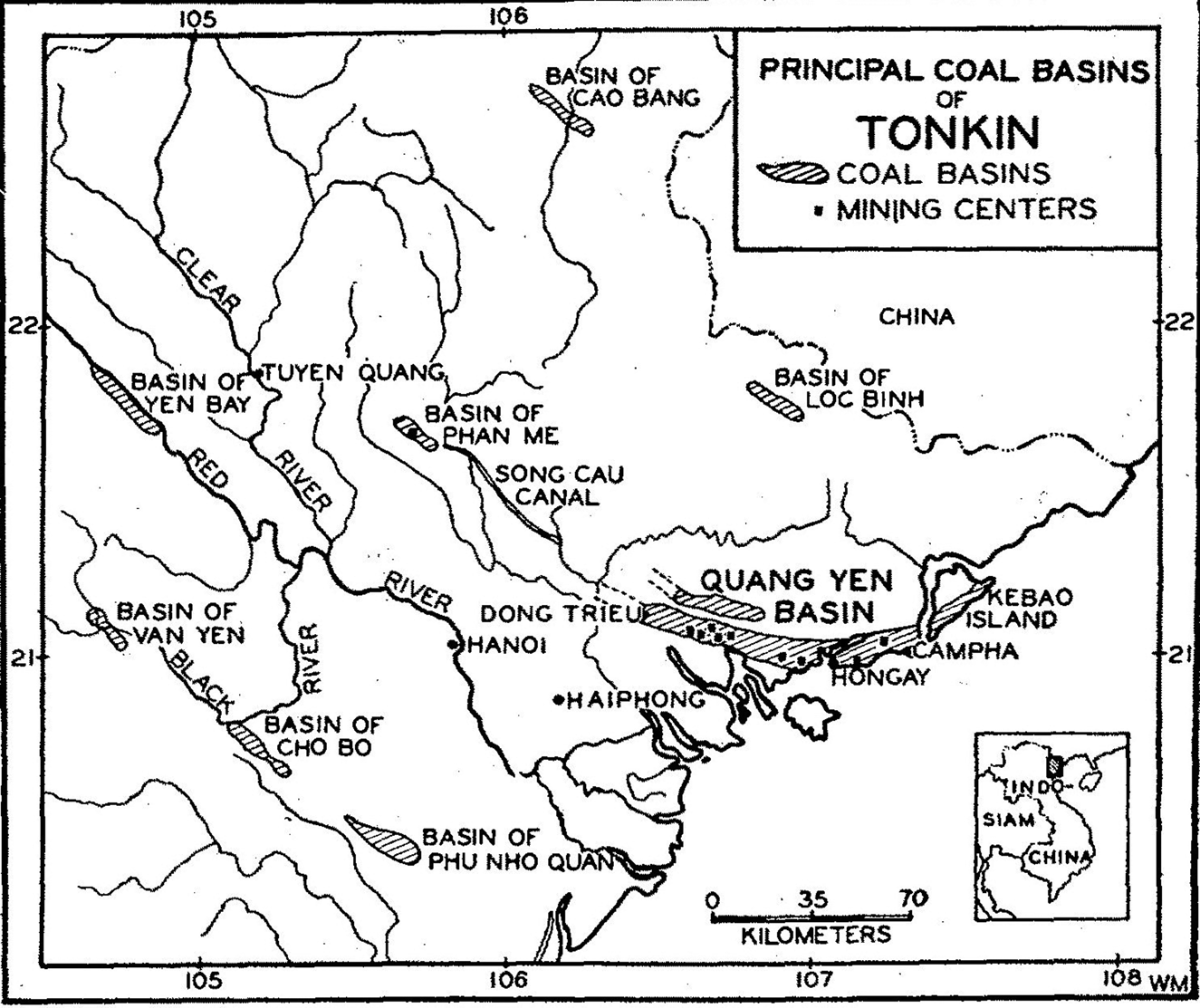
Before the French arrival, coal and mineral resources such as tin, zinc, and copper had been mined in northern Tonkin in small operations. Coal was mostly consumed locally and therefore did not exert much influence beyond its sites of extraction. The Nguyen dynasty had licensed extractive rights to local businesses, mostly owned by the Chinese. Chinese bandits such as the Yellow and Black Flags also competed ferociously to control these mines. After their pacification campaigns, the French wrestled the mining rights from the Nguyen court and granted new licences to French capitalists, speculators, and Vietnamese investors. Under the French rule, more exploratory research was conducted to fully access the capacity and location of coal deposits in northern Tonkin. The best coal deposit of Tonkin was situated along a 150-kilometre-long basin extending from Bắc Ninh province in the west to the island of Kế Bào near the Chinese frontier, passing through the major mines of Đông Triều and Hòn Gay (Figure 1). The coal mines of Tonkin were renowned for their large capacity, satisfying both domestic consumption and the increasing global demand for energy during the interwar period. In addition to its abundance, Tonkinese coal was mostly anthracite, which was highly valued for its high carbon level and consistency. The deposits of Hòn Gay and Kế Bào also had the advantage of being located on the Gulf of Tonkin coastline, making it easy to transport coal to foreign markets.
The coal basin of Tonkin. Source: E. Willard Miller, ‘Mineral Resources of Indo–China’, Economic Geography, vol. 22, no. 4 (October 1946): 270.

Coal mining played an essential role as the economic engine for the French empire in Asia. The annual coal output increased from 200,000 tons in the 1890s to more than 2 million tons in the 1930s. By 1938, coal production had reached 2,335,000 tons and accounted for over 63 per cent of the total value of mining output in Indochina.Footnote 14 Rice, rubber, and coal become the three most important exports of French Indochina. In 1929, Indochina exported 1.4 million tons of rice, earning a revenue of 1.7 billion francs. During the same period, it shipped 10.3 thousand tons of rubber and 1.3 million tons of coal with respective values of 113 million and 104 million francs.Footnote 15 Approximately more than 75 per cent of the total coal production was exported. In 1939, coal exports reached 1,790,000 tons, with 37 per cent destined for Japan, 28 per cent for China, and 14 per cent for other Asian territories including the Philippines, Thailand, and Hong Kong. Only 7 per cent of the coal exports was shipped to France.Footnote 16 Indochina became the tenth largest exporter of coal in the world and the second largest in the Far East, ranked only after Manchuria.Footnote 17
The coal-mining industry of Tonkin therefore attracted a large labour force. At its peak in the 1930s, it employed more than 60,000 workers, both full-time and seasonal. While the world demand for coal was expanding and new technology successfully applied in both open-pit and underground mines, the mining companies were never able to rely on a stable workforce. The ethnic composition of the mine workers had changed rapidly since the beginning of the mines in the 1880s. Labour data from the Société Francaise des Charbonnages du Tonkin (SFCT), the largest French coal-mining company in Indochina with their control of about 80 per cent of coal output, showed that, towards the 1930s, Vietnamese workers accounted for 91 per cent of the workforce, then came the Chinese (7.5 per cent) followed by the French/European (less than 1 per cent) (Table 1). Women were in the minority, occupying less than 10 per cent of the jobs.Footnote 18 These figures contrasted with the labour patterns of the late nineteenth century, when Chinese workers had constituted the majority of the mining labour force. The French had relied heavily on Chinese migrant labour in the early days of the mines to take advantage of their prior mining experiences and availability. Many of these Chinese workers had previously worked for the Chinese-owned mining enterprises in the region. Some migrated from southern China. The recruitment of migrant labour was very crucial, as most of the mines in northern Tonkin were located in the sparsely populated provinces of Quảng Yên and Thái Nguyên. Despite their efforts, French mining companies were not successful in recruiting Vietnamese peasants from the delta provinces of southern Tonkin because of the low pay of the mining jobs and the requirement for relocation to northern provinces. As Hoàng Cao Khải, the viceroy of the Nguyễn court, replied to the request from the Resident of France in Tonkin about sending more peasants to the mining towns of Kế Bào and Hòn Gay in 1898:
The humble habitants (of the delta) love their natal home. The two places (Kế Bào and Hòn Gay) are too far away. They are also mountainous and foreign land. If the peasants stay at home, they could still earn ten or twenty cents a day which are sufficient for their families. But if they leave their villages and bring their wives and children to the mines, their future would remain very uncertain. Therefore, the people in these (delta) provinces expressed their wish to remain in their home villages.Footnote 19
Ethnic and gender composition of labour at the Société Française des Charbonnages du Tonkin (SFCT) in 1932

Source: État statistiques sur la production, la consommation et le personnel de la S.F.C.T à Hongay en 1932, SFCT 327, VNA–I.
The arrival of tens of thousands of Chinese coolies to the mines, however, caused the French unexpected problems that had worsened over the years. Many Chinese workers came to Vietnam without proper documentation. They also commanded higher salary than Vietnamese labourers. For manual jobs at the mines, a Chinese coolie could earn from 30 to 40 cents per day, while Vietnamese workers were only paid from 20 to 30 cents.Footnote 20 According to the French observations, some Chinese coolies did not stick with the mining jobs for long, often abandoning their post to join Chinese bandits and pirates wreaking havoc in local villages. As the Resident Superior of Tonkin maintained, despite their advantages over the Vietnamese labourers, the formation of large communities of Chinese coolies around the coal mines posed a serious challenge to the security of the northern region, which was already being plagued by the problems of anti-colonial rebellions, banditry, and illegal trafficking:
Pertaining to the heavy work at the mines, Chinese workers are more valuable than the Annamites, the latter often being held back by their mediocre physical force, low resistance to changing climate and also their lack of discipline to complete assigned tasks. However, in political view, we cannot remain indifferent to the continuous infiltration of the Chinese coolies into the high regions of Tonkin. Their large and expanding population made it difficult to survey. Revolutionaries and bandits often chose to take refuge in the Chinese quarters of the mines where propaganda and radical ideas was freely circulated.Footnote 21
Security and economic concerns about the Chinese ‘rebellious workforce’ led to more intense efforts by the companies to recruit Vietnamese coolies from the delta regions of Tonkin. Demographic and economic changes in the 1920s and 1930s made it easier for the French mining companies to attract Vietnamese migrant workers. Overpopulation and the shrinking land resources in the delta pushed many of its men and women to migrate for better economic opportunities. Tens of thousands of peasants left the rice villages of Nam Định, Thái Bình, and Ninh Bình to move farther north. Their arrival altered the ethnic composition of the mines, with Vietnamese now occupying 90 per cent of the labour force and Chinese coolies downsizing to less than 10 per cent in the 1930s and 1940s.
The displacement of the Chinese mine workers was just one manifestation of the fragile labour situation at Tonkinese coal mines. Migrant Chinese and Vietnamese workers accounted for from 60 to 80 per cent of the workforce and their population ebbed and flowed according to the fluctuations in the global demand for coal and the changing economic circumstances of the miners. The mine labourers, steeped in traditions of mobility and transience, often deserted the mines after the short stints to seek work in agriculture, burgeoning urban industries, railroads, and ports, or simply to go home. The underemployment of the workforce further compounded the question of labour instability. Although tens of thousands of workers technically worked for the numerous French and Vietnamese mining businesses, few among them were offered long-term contracts. In reality, from 98 to 99 per cent of the mining labour worked as day labourers. For example, only 165 Vietnamese out of 18,000 workers at SFCT company earned a monthly salary. The data for SFCT also show that the number of working days for Chinese and Vietnamese workers averaged about 211 days a year, which meant four days a week for each worker.Footnote 22 But those who worked fewer than 150 days a year, which is equivalent to 11 or 12 days a month, accounted for 75 per cent of the workforce. Most of these chronically underemployed and underpaid workers were coolie miners whose job security was almost non-existent. Coolie miners worked mostly as coal hewers and loaders who delivered coal from underground chambers or open pits to the ports. While the mining workforce in other places was gradually organized along the lines of full-time salaried workers,Footnote 23 the coal mines of Tonkin depended largely on part-time day labourers. The lack of job security struck the migrant coolie workforce the hardest, as they lacked a local support system that they could fall back on in times of difficulty. As a result, for many of these semi-skilled or unskilled miners, especially those with family to support, the daily wage of their intermittent job was hardly enough to constitute their only source of income.
Immigrant mine workers remained a transient and erratic workforce even when the industry became a regional powerhouse in the 1930s. The subcontracting system in which the companies relied on independent contractors known as the cai for labour recruitment and management put the workers at a severe disadvantage.Footnote 24 Subcontracting allowed the companies to reduce costs by paying the cai directly for the completion of a certain task. The cai then deducted their own profit before distributing these payments to their workers. In order to prevent workers’ desertion, the cai often held back their salary as a form of deposit. Workers’ dependence on the cai and the companies’ disposal of their welfare responsibility mean that workers had fewer employment benefits and worse working conditions and earned lower wages than did salaried workers. Without job security, social welfare, settled housing, and a close-by family, many sojourner coolies found it hard to lay down their roots. Those who were out of a job often chose to remain in the vicinity of the mines, hoping to make a living in the burgeoning mining towns or waiting to be hired for another short-term stint. The sporadic nature of the job turned many of these coolies into semi-drifters who had the tendency to fall back into criminal activities during their period of unemployment or after the expiration of their contracts. Returning to their home village was not an option either, as the shortage of cultivable land in the delta did not guarantee another job in waiting. Some coolies were even too poor to afford the cost of their return trip.Footnote 25
This volatile, floating workforce found themselves easily drawn into the surrounding mining towns, which were already infested with illegal activities. The towns of Hòn Gay and Vàng Danh and the port of Cẩm Phả had been long the magnets for illegal opium traffic, prostitution, and gambling enterprises.Footnote 26 Bandits and pirates also found the mine communities easy targets for extortion and looting. Armed clashes between the police and these gangs were not unusual in these mining frontiers.Footnote 27 Clandestine businesses in these neighbourhoods attracted a large undocumented population who carried fluid and ambiguous colonial labels such as vagabonds, itinerant traders, rebels, pirates, river boatmen, petty criminals, and traffickers. Unsurprisingly, many among these destitute inhabitants were ex-coolies at the mines. The growth of this diverse and complex itinerant population in the surrounding neighbourhood created a favourable condition for crime to fester and spill over into the mines and their workers.
Dynamite theft and its patterns
The most common crime at Tonkinese coal mines was theft of the companies’ assets such as coal, cement, wood, dynamite, and work equipment.Footnote 28 These crimes varied in form from the opportunistic and petty stealing of broken coal to organized raids against the companies’ warehouse and convoys. Some of these daring organized robberies caught the attention of the press, such as the attack against Mr Trần Văn Lập, an accountant of Clotilde mines in June 1934. Mr Lập was riding a coal train when four individuals attacked him and took away his wage bag containing more than 1,000 piastres.Footnote 29 Or the burglary at Clariette mines on August 1940 that caused the loss of a newly installed pump engine valued at 1,100 piastres.Footnote 30 According to the police, plenty of evidence on both cases pointed in the direction of insider jobs. In the train robbery, the thieves must have known Mr Lập and his scheduled delivery of wages. The burglars who removed the pump must have been informed about the absence of the French warehouse manager on the night of the crime.
This article focuses specifically on the theft of explosives because of its scope and significance. Whereas theft of commodities such as coal and cement was often overlooked unless they caused large losses, the French mining companies and local police keep very detailed records on the loss of explosives because of the danger of these materials and the security threat if they fell into the wrong hands. Explosives comprised dynamite, other blasting powders, and their triggering devices such as detonators, igniter cords, and safety fuses. These materials were often stored in cartridges or boxes and kept in closely guarded warehouses. Dynamite was among the most desirable commodities due to its restrictive use and the high demand for it on the black market. The larceny of dynamite was considered the most damaging theft crime, not just because it could affect production, but also because of its impact on the security of the colonial state. The French authorities were strongly concerned that, when stolen, these materials could be smuggled into the hands of the Chinese bandits, pirates, criminals, or, worst, the communists and other groups deemed as radicals. As a result, according to the Resident Superior of Tonkin (RST), the theft of dynamite ‘cannot be ignored as it would engender consequences of particular gravity’ and that ‘rigorous attention must be exercised to follow the laws regulating the use of explosives’.Footnote 31
The French police and mining companies kept a very close watch over the transportation, storage, and use of dynamite. The law of 30 June 1911 specified the strict conditions under which dynamite must be stored and transported. Dynamite warehouses must be guarded day and night. The warehouse manager must be living within the vicinity of the storage. He had to keep detailed logs on the inflow and outflow of these materials as well as the list of all visitors. He also had to make sure that all the materials remained intact at the end of each day.Footnote 32 The 1908 criminal laws against the theft of explosives prescribed imprisonment from one month to one year and a fine from 100 to 10,000 francs. The law was revised in 1931 and 1935 to prescribe more restrictionsFootnote 33 and control over the transport and use of explosives, and an increase in the sentences to several years in prison against dynamite-theft perpetrators. These measures, according to the Resident Superior of Tonkin, were still not severe enough to stop the flow of explosives to the black market.Footnote 34
When a theft was reported, the mining company and the police would open their investigation. Police and court reports provide crucial materials for the reconstruction of these crimes, as they contained testimony of the perpetrators, witnesses, and investigators. A typical official report on theft would disclose the background information of relevant parties as well as how and why the crimes happened. However, like any other official sources, these files also had their own limitations. First, under the pressure of the police, suspected individuals might lie about their motives and actual involvement. The French police was aware about this problem and, as a result, they often cross-examined all involved parties and came up with their own conclusions about the crime. Second, although these files could provide many details on what happened in a single case, they lacked statistical data that could point to larger patterns. I therefore mined through all of these theft files and then used their information to reconstruct major patterns of the crimes, the identity of the perpetrators and their motives, and the fate of stolen commodities. Although these sources were potentially biased and incomplete, their extensive coverage and treatment of a large number of cases could still offer important clues on the many aspects of theft crimes. This was particularly important given the lack of documents on theft crimes, especially those containing the voices of underrepresented groups like migrant workers, petty criminals, and crime syndicates.
Although it was impossible to quantify the loss of explosives, as many of the cases probably went undetected or unreported to authorities, the expansion of the mines from the 1920s to 1940s led to the more widespread use of dynamite and, as a result, a higher number of theft crimes. During this period, tons of dynamite and tens of thousands of detonators were stolen from the coal mines. The extent and prevalence of dynamite larceny were so alarming that the French Resident of Quảng Yên had to ask for the creation of new guarding station to protect SFCT assets.Footnote 35 Some of the most notorious cases included the illegal removal of eight containers of 32,000 detonators weighting about 200 kilograms at SFCT company in March 1930. This ‘extremely serious case’, according to the Resident Superior of Tonkin, ‘could cause the gravest consequences to the security of the company as well as the security of the entire colony’.Footnote 36 Or the loss of 180 kilograms of explosive at the Đồng Đăng coal-mining company, which took the authorities until in August 1941 to discover.Footnote 37 Night-time break-in cases often led to significant loss amounting to hundreds of boxes of dynamite and igniter cords.Footnote 38 Most of the theft cases, however, involved petty stealing, with workers being caught carrying a couple of blasting-powder boxes or a dozen detonators. When the crime involved supervisors and managers, the damage was often covered up through elaborate schemes, thus making it impossible to tally the total cost of stolen property. For example, in 1941, a warehouse manager named Trần Văn Uẩn of SFCT admitted that he frequently stole a small number of detonators under his guard and then sold them to the black market. The police arrested Uẩn and his dealers but no one knew for sure how many detonators Uẩn had sneaked out of the mines.Footnote 39
Hundreds of individuals were brought in for police questioning about their involvement in dynamite theft. Their profiles reflected the diverse racial, ethnic, and professional make-up of both the mining workforce and their nearby mining towns. Migrant workers from Thái Bình and Nam Định, the two most populated provinces in the delta, accounted for more than 80 per cent of those who were involved in dynamite theft. It was no coincidence that migrants from delta provinces also made up a substantial portion of the prison population in Thái Nguyên province, one of the coal-mine provinces in northern Tonkin.Footnote 40 These figures reinforced the fact that migrant workers were very susceptible to theft crime, possibly due to the sporadic nature of their job, their low wages, and the lack of local support. Most of these migrant miners worked as coolies, while a smaller number of them occupied more specialized jobs such as drillers and blasters. Unsurprisingly, the blasters were behind many theft cases, since their jobs allowed them to get regular access to explosives. For example, in December 1942, a blaster named Vũ Tuất from Đông Triều mining company (Société Francaise des Charbonnages du Dong Trieu (SCDT)) stole 200 detonators, 197 boxes of dynamite, and 90 metres of bickford cord, and hid them under a bamboo panel. According to the Resident of France in Quảng Yên, the theft exposed a serious lack of surveillance over the distribution and the storage of explosives at Đông Triều mining company, which Tuất was able to take advantage of.Footnote 41 Because of their easy access to explosives, blasters had a strong reputation inside the mines as the first point of contact for dynamite dealers. As Trần Văn Nguyên, a dynamite dealer, confessed to the police in another theft case, he acquired the commodity through the father of a blaster named Đinh at Clotilde mines in Vàng Danh. Nguyên knew exactly whom to approach, as the blasters were well known at the mines for their role in dynamite theft:
My wife is a friend with the father of the blaster named Đinh at Clotilde mines. One day, he asked if she knew anyone who were looking for explosives. Through my wife, I told him that I was interested. He then sold me 4 boxes of dynamite and 106 detonators. The rate he charged was 2.60 piastres for one hundred detonators.Footnote 42
The French police were well aware of the role of the blasters but they could not do anything effective to stop the outflow of explosives. In the words of the police chief at Uông Bí, ‘it has become a pattern at Clotilde mines in Vàng Danh that blasters stole dynamite and detonators almost every day and then sold them to the black market for a derisory sum of money’.Footnote 43
Blasters and coolies, however, were not the only insiders who committed larceny. Theft crime also reached the upper echelon of the companies, drawing in those such as secretaries, chiefs of mining sites, warehouse managers, contractors, and even the police. The bigger the scale of the theft, the higher the rung of the leadership it could reach. In September 1942, the security police at Uông Bí arrested an organized band of thieves who were responsible for the loss of 30,000 detonators at Đông Triều mining company. According to the police, Lê Văn Nội, a mining chief at SCDT, was the principle instigator of the crime who made an unauthorized copy of the key used for the opening of the dynamite warehouse. Aiding Nội in his intrusion were Dương Văn Thuận (a coal loader), Đinh Văn Hiếu (a coal hauler), two other coolies, and Đàm Trí Công (a private policeman of the company). A search of Thuận's house uncovered eight more boxes of dynamite stored inside a trunk and buried underneath the house.Footnote 44
Although no crime was exactly the same, one could point to the major pattern of these cases. Theft crime happened mostly as a collective job, as stealing was just one step in the process. In Tonkinese coal mines, several rings of operation were founded upon the strong collaboration between those who had access to the materials, those who conducted the deeds, and those responsible for smuggling the stolen commodities out of the mines. Police files showed plenty of evidence on many well-coordinated intrusions when the thieves had insider information, such as the exact location of the dynamite, the schedule of the warehouse managers, and the security details of the location. In many cases, the thieves did not even bother breaking the door or removing the wall, as they knew how to get inside without being detected.
In the case of a break-in at Kế Bào mines on the night of 3 September 1924 that resulted in the loss of 67 kilograms of dynamite and 18,029 detonators, the French police concluded that ‘the intruders must have known the place very well as they only took away the boxes containing explosives while leaving others unopened. The thieves left behind fake footprints on a chest at the crime scene to make it look like an external break-in’.Footnote 45 The loss of 55 kilograms of explosives in April 1930 at SFCT also caused suspicions among the police. According to the French inspector Versini, although the padlock and lock appeared to be tampered with, no prints or evidence left on the entrance or the leading stairs pointed in the direction of an external intrusion. ‘The burglary must have been orchestrated by the warehouse manager and his guard,’ he concluded.Footnote 46 Organized crime, if coordinated well, often managed to stay under the radar for a long period of time. Only when mishap occurred were the police be able to uncover these elaborate plots. For example, in the loss of 2,000 of detonators at Đông Triều mines on October 1941, the police accidentally detected the unusual shape of a container of dynamite. A closer look showed that its rear end had been previously opened, which allowed the thieves to remove the dynamite and replace it with wood.Footnote 47
Outside the mines, the lucrative trade of explosives drew in a more diverse crowd of traffickers and dealers. A substantial number of these petty dealers were vagrants and drifters. Workers told police about suspicious-looking individuals circling the mines looking to buy and sell things to workers. Police records turned up almost nothing about these drifters, as they carried no identification papers, which made it impossible to know their domicile, family, and criminal history. The line between those inside and outside the mines was not always clear. Many among these dealers were ex-workers who were able to tap on their former connections and familiarity with the inner working of the companies in order to build an insider network of supply. The case of Ninh Trui, a 20-year-old mining coolie originally from the village of Văn Lâu in Nam Định, was a typical example of an ex-miner-turned-criminal in Tonkinese coal mines. Ninh lost his job at SFCT company but, instead of returning to Nam Định, he chose to stay near the mines by sharing lodging with his brother, Ba Đen, who was also a mining coolie. Ninh frequently sneaked into the mines and, when he was arrested by the police, he had successfully stolen 51 boxes of dynamite from different mining sites of the company.Footnote 48
Some dealers alternated between being a part-time worker and a smuggler. Low-skilled coolies who could only be employed for part-time seasonal work were drawn into the trade in larger numbers. Many among these dealers, however, were career dynamite traffickers who had several previous run-ins with the law. These professional dealers often worked for larger contraband syndicates in the mining towns, which explained how they could possess a large amount of cash to purchase thousands of detonators at once.
The close connections between the workers and the criminal population of the mining towns was the direct outcome of the shifting economy and demography of these communities triggered by the rapid expansion of the coal mines in the 1920s and 1930s. Migrant workers were not the only ones who arrived here to make a living. A subgroup of criminals, vagrants, bandits, and the unemployed were also attracted to the new economic opportunities at the mines. Businesses, both legal and illegal, sprang up to meet the demands of tens of thousands of workers. Many male workers were unable to resist the allures of the towns and, as a result, they became addicted to opium, gambling, and prostitution. Vietnamese newspapers described how local brothels, gambling houses, and opium dens were bursting with activity in the afternoon right after the miners received their daily salaries. Intense competition between syndicates resulted in customer solicitation, backstabbing, and frequent street fights.Footnote 49
While it was impossible to know exactly how many workers were addicted to opium and other vices in the towns, the economic consequences of these illicit activities were severe. Opium-smoking workers were estimated to spend from 40 to 70 per cent of their annual income for the drug.Footnote 50 Dynamite theft therefore became a form of supplementary income for these illicit pleasure activities. Workers stole dynamite and then sold to dealers for opium, which made opium addiction the most common motive behind theft at the mines. The exchange of opium for explosives also explained why the majority of dealers and traffickers were Chinese, given the Chinese syndicates’ control of the illegal opium trade in northern Vietnam.
After their conquests of Tonkin in the 1880s, the French attempts to monopolize the opium trade in Indochina struck against Chinese commercial interests, which had been the patrons of opium farms and their distribution network in the nineteenth century. The French were not the only ones with monopoly interests over opium farms, as, across Southeast Asia, the Dutch and the British also made similar moves to put the opium business under imperial control. As a result, literature on opium and other contraband trades after the late nineteenth century often focuses on the colonial regimes of monopoly and taxation, their impact, and the local opposition.Footnote 51 Marxist and communist studies perceived opium addiction and other social vices at the mines as the ‘tools’ of French mine owners and administrators to ‘enslave’ and ‘control’ the workers.Footnote 52 Few scholars have, however, offered insight into how Chinese opium consortiums were able to adapt and reinvent themselves to cope with the French draconian systems of surveillance and repression, and how their activities contributed to the rise in opium usage and other illicit acts in Vietnam. As the colonial state tightened its control over the lucrative trade of opium, Chinese syndicates were forced to find new ways to sustain their operation. Many of them moved into the emerging mining towns where the rich resources of the mines, their large workforce, and the fragile political order in these frontier communities could offer better money-making schemes. These syndicates diversified their business by trading new commodities, managing gambling houses and brothels while pulling their opium-trading operation underground. Chinese dealers preyed on the mine workers, since these miners had collaterals that were their wages and access to the companies’ assets. As Vũ Đình Phúc, a 37-year-old coolie of Clotilde mine in Uông Bí and a native from Tiền Hải, Thái Bình, confessed to the police that ‘the Chinese goes to Clotilde mine every two or three days to trade opium for dynamite’. Phúc knew neither their names nor their domicile, but he did sell them the dynamite that he had stolen from the company.Footnote 53 The availability and accessibility of opium led to the widespread use of the drug in Tonkinese coal mines and, consequently, the prevalence of theft crime among workers.
For many poor coolie workers at the mines, the financial reward from theft was also too attractive to ignore. Like the theft of gold and copper in other mines around the world,Footnote 54 dynamite theft also became an effective wage supplement for Vietnamese coal miners. Male coolie miners could earn from 20 to 28 cents per day for their work, while more specialized skills could bring them a daily wage of from 30 to 35 cents. On the black market, 100 detonators could fetch as much as seven piastres, which could easily equal one or two months of wages. A small box of dynamite powder could sell for 90 cents or one week of salary. This source of wage supplement was even more crucial given the seasonal and part-time nature of the many coolie jobs at the mines.
While opium addiction and financial hardship were the most common motives behind theft crime, workers also were drawn into the theft by their co-workers and supervisors. Many workers committed the crime when they were asked by someone of close acquaintance, either their supervisor, contractor, or roommate. Hence, almost all theft cases at Tonkinese coal mines were collective theft that involved a group of workers who knew each other through work or cohabitation.Footnote 55 In the coal mines, the shared danger of the mining job and the mutual dependence of teammates for safety and survival created a strong sense of interdependence and loyalty. After work, the fatigue and sickness caused by the long working hours and the physically consuming nature of the job also encouraged fraternal affinities that contributed to the strong bondage between miners. The need to share and commiserate with others was particularly strong among migrant workers, who also suffered from family separation. After a long shift, workers passed the hours by drinking, playing cards, or smoking opium. And, when the alcohol, opium, and money ran out, it was then that theft came into the picture. The arrest of a coolie named Duơng Văn Bích, a mechanic named Nguyễn Văn Bằng, and their subcontractor Nguyễn Văn Chinh for the theft of 39 detonators at Đông Triều mining company was a typical case that illustrated the complex interdependence between these workers. According to the testimony of these individuals, Chinh and Bằng illegally obtained the detonators and then assigned Bích, who was Chinh's subordinate, to sell them to an external dealer—a woman named Cao Thị Thìn. Although Thìn paid 27 cents for ten detonators, Chinh only rewarded Bích with three cents for his delivery job. When asked by the police why he accepted such a ‘tiny commission’ to do this risky job, Bích confessed that he only did it because Chinh was his superior. Bằng, the mechanic who collaborated with Chinh in stealing the detonators, admitted that, although he was not financially rewarded for his participation in the theft, Chinh did compensate him with an invite to smoke opium at Chinh's house.Footnote 56
Dynamite theft and a transnational shadow economy
After exiting the mines, dynamite was moved around in a network that extended to communities along the Gulf of Tonkin and those across the Chinese border. A substantial portion of dynamite was sold to Vietnamese fishermen along the Gulf of Tonkin for blast fishing. Fishermen purchased dynamite from dealers or, in some cases, directly from the workers.Footnote 57 In November 1940, police arrested an organized band led by Phạm Văn Dũng, the secretary of Đông Triều mining company who was in control of a clandestine but thriving business of selling dynamite to fishermen in the sea town of Trà Cổ. Dũng attempted to bribe an Afghan blaster named Gulab Khan at Clotilde mine into selling him 2,500 detonators at the rate of 7 piastres per 100 detonators. He also revealed to Khan that he would need an additional 20,000 detonators to meet the increasing demand for dynamite. Khan notified the authorities, who helped organize a sting operation. Dũng was arrested after leaving Khan's house while carrying 500 detonators. Initially, the size of the theft and Dũng's financial capacity convinced the authorities that Dũng and his accomplices could be the agents of ‘extremist organizations’. Dũng later admitted that his group had been selling dynamite to the fishermen in Trà Cổ for a long time, which enabled them to build a stable network of both supply and distribution.Footnote 58
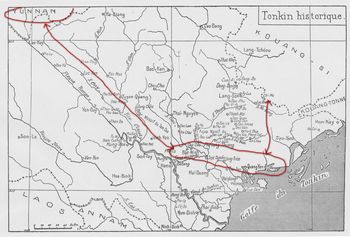
The remaining dynamite was moved across the Chinese border in exchange for opium. That explained why Yunnan and, to a lesser degree, Guangxi were the major destinations for these explosives because of their role as the opium distribution and production centres for South China and Vietnam.Footnote 59 Opium had long been smuggled from China to Vietnam in the 1860s and 1870s by the Chinese commercial interests and rebel groups such as the Black Flags and Yellow Flags gangs who used the profit from the drug trade to fund their banditry activities (Figure 2). The high value of the piastre and local preference for the stronger, rougher taste of Yunnan opium made Tonkin an attractive market for Chinese opium.Footnote 60 Seeing the lucrative profits from the opium trade, the French colonial government in Indochina imposed their monopoly over the production and distribution of the drug in the 1890s, which consequently pushed Chinese syndicates to find new methods to sustain their operations. Dynamite was first brought to Hải Phòng port, which was connected to Yunnan by the Kunming–Hai Phong railway. From here, dynamite was smuggled across the border to Yunnan, where it was sold to Chinese builders for their road construction. According to the French police, the Chinese construction of the Kim-Tcheou–Tong-Hing route alongside the Chinese–Vietnamese border led to an increasing demand for explosives. ‘It was very possible that the Chinese had conferred with the indigenous personnel at the mines to acquire the dynamite at cheap price,’Footnote 61 said the police. Chinese syndicates then used the revenues from these trades to purchase Yunnan opium, which would be then smuggled back to Vietnam for consumption.
Opium–dynamite trade routes between Vietnam and China. Source: The author.

Different kinds of evidence pointed to the strong connections between the dynamite trade and opium. First, it was the opium dealers, most of them Chinese, who provided the drug to Vietnamese workers in exchange for dynamite. The French police recognized this pattern but admitted that they were unable to stop these trades. As the chief of police at Uong Bi described:
At the Clotilde mines in Vàng Danh, the blasters often stole a large quantity of explosives and then sold them cheaply to the petty Chinese buyers. Those small dealers would then move the dynamite to larger syndicates in Đông Triều, Hải Phòng and Quảng Yên. The price of a small dynamite cartridge varied from 50 to 90 cents. Since this fraudulent traffic was greatly remunerated, there were organizations that specialized in dynamite trading. The stolen materials were then used for blast fishing along Hạ Long Bay or smuggled to China where each box could be traded for 90 cents.Footnote 62
Other evidences of the dynamite–opium trade came from police raids against Chinese gangs who were found possessing a huge amount of both dynamite and opium. For example, in April 1941, the French police in Quảng Yên arrested a Chinese boat in Yên Lập, a river that was within a short distance from Tong-hing of China. The boat was carrying a group of seven Chinese who were armed with pistols. On the boat, police found 600 kilograms of opium and 200 kilograms of dynamite. Further investigation revealed that the waterway along Yên Lập river became a favourite trading route, where explosives and opium were moved by boat across the Vietnamese–Chinese border.Footnote 63
While there was no clear estimate about the size of this dynamite–opium economy, the huge value and profit from trading these commodities pointed to the vibrancy and intensity of this clandestine business. Many workers relied on theft as a supplement for their wage income. Several gangs, both Chinese and Vietnamese, competed for their control of the illegal trades. Fights between these gangs happened frequently. In many cases, it was the violence between these gangs that drew the attention of the police and led to their recovery of stolen commodities. For example, in June 1941, a Vietnamese dynamite trafficker named Nguyễn Văn Chí who was very well known with the police got into a huge fight with two Chinese dealers named Tchong Sat and Lay Pau in Cẩm Phả port. According to the police, Chí agreed to sell to the Chinese a very large amount of dynamite. The Chinese, however, wanted to deduct 200 piastres from the previously agreed price. Chí then decided to withdraw from the deal. The Chinese responded by attacking and robbing Chí of his dynamite and then fled into the woods. Chí immediately called for help from three of his associates, who chased after the Chinese. In the end, the Chinese left behind the dynamite to run for their lives. The French retrieval of the dynamite led to the arrest of Chí and his accomplices.Footnote 64
In conclusion, the high frequency of theft crimes at the mines attests to the fragility and vulnerability of the French surveillance system and the formal mining economy. As the French economic presence created both challenges and opportunities, Vietnamese mine workers and their army of Chinese dealers and traffickers displayed their ingenuity and adaptability in building a strong secret network of collaboration and interdependence that was able to infiltrate the upper structure of the industry while remaining aloof to the nationalist call for structural changes. This transnational clandestine economy that evolved around the dynamite–opium trade was a clear testimony to importance of trans-Asian networks and the role of non-state actors in the history of modern Vietnam.
The illegal trades of dynamite and opium also underscore the autonomy, mobility, and fragmentation of the Vietnamese working class. The prevalence of theft crime showed that many Vietnamese workers did not fit the profile of a model, politically conscious group in Marxist literature. Workers were actively engaged in crime and their involvement was primarily motivated by financial and personal needs rather than their attachment to political cause. In reality, the intermittent nature of the mining jobs sent thousands of workers into a state of semi-vagabondage in which they were forced to wear different hats. It was not uncommon to see a mining coolie juggling his various identities such as worker, addict, dealer, and vagrant. As much as the mining towns of northern Tonkin became the incubator for revolutionary movement, they were also the breeding ground for opium, prostitution, vagrancy, and crime.