Technology Research
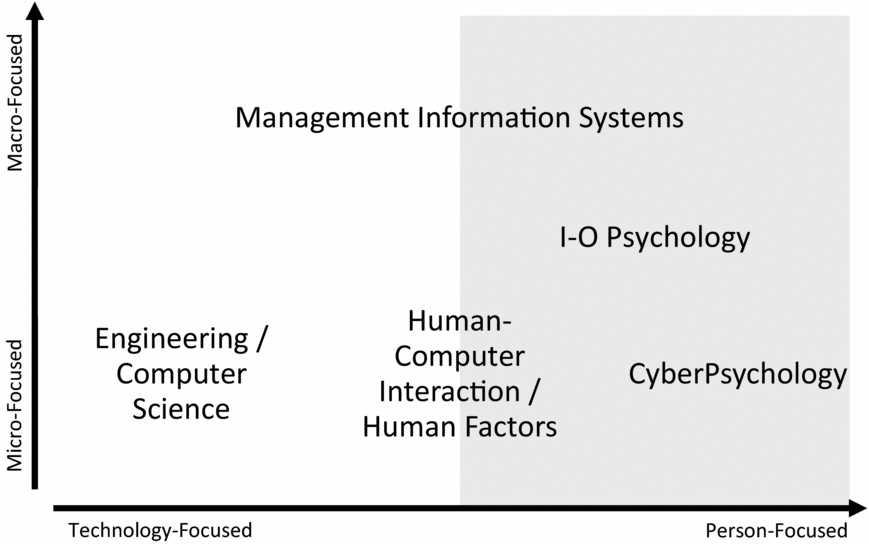
The following discussion considers six fields that are focused on technology-oriented research: engineering/computer science, human-computer interaction/human factors, cyberpsychology, and management information systems. Figure 1 provides a summary guide of these selected fields that may provide insights relevant to I-O psychologists. This figure plots the fields along two axes, showing whether the fields are more technology- or person-focused, as well as whether they are more micro- or macro-focused. By “technology-focused,” we refer to a field's tendency to be concerned with the creation and application of technologies. Although relevant fields may consider the human–technology interface, they are first and foremost concerned with the technology itself. “Person-focused” refers to a field's tendency to be concerned with how the person is impacted by or reacts to technology, sometimes ignoring the characteristics of a technology altogether. On the other hand, “micro-focused” refers to a field's tendency to focus on the technology or user at the individual level of analysis. “Macro-focused” refers to a field's tendency to focus on the systems level, either systems of technologies or human social systems.
Figure 1.
Map of six technology-oriented fields and I-O psychology.
Figure 1 does not include boxes or lines that separate these fields, because the boundaries among them are not firm. That is, many journals may be most relevant to a single field (i.e., cyberpsychology), but commonly publish papers that could be considered within the domain of another field (i.e., human–computer interaction/human factors). Below, quotations from various journals’ mission statements are used to exemplify these broader fields. These journals are not necessarily the premier journals in these fields, but their mission statements represent the goals and directions of their relevant research domains.
Engineering/Computer Science
Computers & Electrical Engineering provides rapid publication of topical research into the integration of computer technology and computational techniques with electrical and electronic systems. The journal publishes papers featuring novel implementations of computers and computational techniques in areas like signal and image processing, high-performance computing, parallel processing, and communications. Special attention will be paid to papers describing innovative architectures, algorithms, and software tools. (Computers and Electrical Engineering,
2017, bold in original)
Researchers in the fields of engineering and computer science are primarily concerned with the development of new technologies. Although technology is always meant to be used by a person (sometimes even unknowingly), contributions in engineering and/or computer science do not always include this human–computer link. Instead, it is common for many contributions to detail the creation of new hardware, software, and/or processes that can be subsequently used in various technological applications (Ji et al., Reference Ji, Zhao, Cheng, Xu, Zhang and Wang2012; Tuncer & Yildirim, Reference Tuncer and Yildirim2012). In the example of computer-based training research, it would be plausible for an engineering and/or computer science researcher to develop a new virtual-reality training system, in which trainees could practice realistic behaviors in a completely artificial environment. The eventual publication could detail the specifications of the hardware and the function of the software. The publication could also note potential advantages and disadvantages of the virtual reality system's application, but a detailed analysis of user reactions would likely not be required.
Due to the emphasis on technologies rather than people, engineering and computer science are considered more technology-focused than person-focused. Likewise, because contributions are more focused on the creation of new individual technologies, rather than the management of entire technological systems, engineering and computer science are often considered more micro-focused than macro-focused.Footnote
1
These attributes place engineering and computer science in the bottom-left corner of Figure 1.
Human–Computer Interaction/Human Factors
Papers published in Human Factors leverage fundamental knowledge of human capabilities and limitations—and the basic understanding of cognitive, physical, behavioral, physiological, social, developmental, affective, and motivational aspects of human performance—to yield design principles; enhance training, selection, and communication; and ultimately improve human-system interfaces and sociotechnical systems that lead to safer and more effective outcomes. (Human Factors, 2017)
Researchers in the fields of human–computer interaction and human factors are primarily concerned with the impact of design features on user reactions. Contributions in these two fields often detail the attributes of a certain technology (although not as thoroughly as engineering or computer science) as well as user's reactions to the technology (Onnasch, Wickens, Li, & Manzey, Reference Onnasch, Wickens, Li and Manzey2014; Plummer, Schuster, & Keebler, Reference Plummer, Schuster and Keebler2017). Returning to the example of a computer-based training, a human–computer interaction and/or human factors researcher may test whether three different virtual reality systems provide different training results, with the hypotheses that the differing levels of presence will be the cause of any outcomes. The publication could detail the predictors of presence (i.e., technological and user characteristics) as well as the effects of presence on outcomes (i.e., enjoyment, performance). It may also identify certain individual differences that cause users to react differently to varying levels of presence, and therefore obtain different results for the three different virtual reality systems. The publication could provide some descriptions of the system, but a detailed analysis of the hardware and software specifications would likely not be included.
Due to the balanced focus on technologies and people, human–computer interaction and human factors are considered both technology- and person-focused. Because contributions are focused on applications of individual technologies, these two fields are considered more micro-focused than macro-focused. These attributes place human–computer interaction and human factors in the bottom-middle of Figure 1.
Cyberpsychology
Computers in Human Behavior is a scholarly journal dedicated to examining the use of computers from a psychological perspective. . . . The computer is discussed only as a medium through which human behaviors are shaped and expressed. The primary message of most articles involves information about human behavior. Therefore, professionals with an interest in the psychological aspects of computer use, but with limited knowledge of computers, will find this journal of interest. (Computers in Human Behavior, 2017, bold in original)
Researchers in the field of cyberpsychology are primarily concerned with the reaction of people to technologies and/or attributes of technology. Although closely related to human–computer interaction and human factors, it places a greater focus on the person rather than the technology. Publications in cyberpsychology sometimes do not even detail the characteristics of a technology at all, but rather entirely focus on peoples’ reactions to the technology (Howard & Jayne, Reference Howard and Jayne2015; Vitak, Crouse, & LaRose, Reference Vitak, Crouse and LaRose2011). Again, in the example of computer-based training research, a cyberpsychology researcher may test the user characteristics that predict virtual reality training success. This would involve measuring several individual differences, having participants complete a virtual reality training, then measuring the outcomes. The publication would describe the virtual reality training system, but the greatest focus would be placed on detailing how and why certain individual differences may predict these training outcomes. Given the focus on individual differences and predicting personal outcomes, the researcher would be less likely to directly compare multiple different virtual reality systems.
Due to the emphasis on people rather than technologies, cyberpsychology is considered more people-focused than technology-focused. Likewise, due to the focus on individual technological applications, cyberpsychology is considered to be more micro-focused than macro-focused. These attributes place cyberpsychology in the bottom-right of Figure 1.
Management Information Systems
The editorial objective of the MIS Quarterly is the enhancement and communication of knowledge concerning the development of IT-based services, the management of IT resources, and the use, impact, and economics of IT with managerial, organizational, and societal implications. Professional issues affecting the IS field as a whole are also in the purview of the journal. (MIS Quarterly, 2017)
The field of management information systems is broad, but associated researchers tend to be concerned with the application of technology from a macro perspective—at least, more so than the other fields described above. Typically, studies in management information systems investigate the factors that contribute to the implementation and management of technologies, taking a higher-level systems approach rather than a lower-level person approach (Leonardi, Reference Leonardi2011; Polites & Karahanna, Reference Polites and Karahanna2012). Using the example of computer-based training, a management information systems researcher may analyze the organizational characteristics that cause businesses to implement cutting-edge training programs, such as virtual reality training. The results could show that organizations often implement such programs after feeling pressures from stakeholders to be innovative, rather than any actual benefits of the technology itself. Alternatively, a management information systems researcher could analyze the technological characteristics that cause businesses to implement these training programs. The results could show that organizations implement virtual reality training programs that possess certain characteristics (such as ease of use, advanced user graphical displays, or sophisticated analytics reporting) rather than provide better training outcomes, and the publication could detail the technological specifics of these programs.
Due to the emphasis on both people and technology, management information systems is considered to be both people- and technology-focused. The focus on systems and overall implications, however, causes management information systems to be considered more macro-focused than micro-focused. These attributes place management information systems in the top of Figure 1.
I-O Psychology
Organizational Behavior and Human Decision Processes publishes fundamental research in organizational behavior, organizational psychology, and human cognition, judgment, and decision-making. . . . Topics covered by the journal include perception, cognition, judgment, attitudes, emotion, well-being, motivation, choice, and performance . . . we place a premium on articles that make fundamental and substantial contributions to understanding psychological processes relevant to human attitudes, cognitions, and behavior. (Organizational Behavior and Human Decision Processes, 2017)
After reviewing these other fields, a primary question remains unanswered: Where does I-O psychology fit in the broader scheme of technology research?
First and foremost, I-O psychology researchers are concerned with people. Relevant theories and models are created to explain the emotions, cognitions, and behaviors of people; and the vast majority of I-O psychology researchers are likely unfamiliar with the detailed specifications of most any technological system. For this reason, it seems clear that I-O psychology is less relevant to engineering and computer science, and it is unlikely that any created theories or models to study technology in I-O psychology would pull heavily from these two fields.
I-O psychology does share some overlap with human–computer interaction and human factors, but these two fields often study the design elements of technology. I-O psychologists may be less interested in these types of contributions. This is not to say, however, that I-O psychologists are always uninterested in contributions from human–computer interaction and human factors, as studying design elements can provide information regarding specific psychological processes. For instance, researchers can test various technologies to prompt certain psychological effects, such as presence, and discover that manipulating presence may indeed improve user performance. Thereby, an inference can be derived regarding psychological effects through studying design elements. Further, researchers in human–computer interaction and human factors often include individual differences in their investigations of technologies, such as whether computer self-efficacy moderates the presence–performance relationship. These investigations of individual differences have a clear relevance to I-O psychology. Thus, models in I-O psychology may be able to pull from prior research in human–computer interaction and human factors.
I-O psychology is entirely relevant to cyberpsychology. In fact, many publications in cyberpsychology could be considered technology research taken from an I-O psychology perspective. For instance, cyberpsychology researchers have long been interested in the topic of personal Internet use at work, known as cyberslacking (Vitak et al., Reference Vitak, Crouse and LaRose2011), which is likewise being increasingly studied in mainstream I-O psychology outlets. Therefore, not only could cyberpsychology be relevant to model creation in I-O psychology, but it is already being used for identical purposes. It could even be considered that all research on the psychological effects of technology at work is a combination of both cyberpsychology and I-O psychology perspectives, even if not explicitly intended by the author.
Last, I-O psychology is also relevant to management information systems. I-O psychology researchers have shown an ever-growing interest in studying higher-level phenomena (Kozlowski, Chao, Grand, Braun, & Kuljanin, Reference Kozlowski, Chao, Grand, Braun and Kuljanin2013; Morgeson & Hofmann, Reference Morgeson and Hofmann1999), and it may be ideal to draw from prior work in management information systems to inform about technological dynamics at these higher levels. Particularly, prior knowledge regarding technology adoption and management from a macro perspective could benefit from the micro perspective of I-O psychology and vice versa.
So, where does I-O psychology fit? We propose that it is close to cyberpsychology on the technology-focused versus person-focused spectrum; however, it may occasionally drift towards the technology-focused side, sometimes even approaching human–computer interaction and human factors. We also propose that it is close to cyberpsychology on the micro-focused versus macro-focused spectrum; however, it may drift up to higher levels, and it may even approach management information systems in various research domains. Therefore, I-O psychology does not fill an entirely unique space within the domain of technology-oriented fields, but it may instead serve as a bridge between these fields.
Implications and Future Directions
We extend the call by Morelli et al. (Reference Morelli, Potosky, Arthur and Tippins2017) for I-O psychology researchers to create conceptual models of technology through a further examination of other domains focused on technology-oriented research. This extension is intended to provide a broader focus for I-O psychology, which would allow I-O psychologists to leverage advances in technology-oriented research from other fields and incorporate those advancements in future research.
Given this positioning, certain implications should be considered for the creation of technology models in I-O psychology. I-O psychology researchers should first consider the types of contributions that they wish to make for research and practice (i.e., technology-focused vs. person-focused, micro-focused vs. macro-focused). Identifying a specific type of contribution can direct researchers toward other domains outside of I-O psychology that may aid in the research process. Figure 1 can serve as a preliminary map for this effort.
Once a contribution has been identified, researchers should evaluate existing models created in other fields before moving forward with the creation of new models. It is possible, if not probable, that existing models in these other fields can also address many research questions that I-O psychologists have regarding technology in the workplace. Models in cyberpsychology, for example, may be able to be directly applied in I-O psychology research, due to the overlap between the two fields. Perhaps more importantly, I-O psychologists may be able to modify these models to provide new insights, not only to benefit I-O psychologists, but also to benefit researchers in these other fields.
Further, many of these fields have already developed theories and “theoretical or conceptual framework[s] of technology . . . that transcend individual studies of specific hardware or software applications” (Morelli et al., Reference Morelli, Potosky, Arthur and Tippins2017, p. 635). Once again, it is possible that new theories and frameworks are needed, but these other fields have already developed quite a few. It may be more fruitful to modify these prior theories and frameworks to fit I-O psychology needs, and it may be possible that many of these theories and frameworks do not need to be modified at all. Thus, knowing what is beyond the field of I-O psychology may be necessary to identify what is needed within the field of I-O psychology, and, as posited by Stinchcombe (Reference Stinchcombe1982), it is often better to build from the trunk of prior theory than it is to work with new twigs of thought.
Once these resources have been exhausted, it may indeed be appropriate to develop new models, theories, and frameworks to better understand technology from an I-O psychology perspective. Of course, any contribution should draw from other relevant fields, and understanding the orientation of these other fields could benefit novel contributions.
Relatedly, practitioners can solve technology-related issues through considering the positioning of I-O psychology in the broader scheme of technology research. It is often difficult to identify the solution to a technological issue without identifying whether it is an issue with the technology itself or the user. Once this has been determined, practitioners can perform a more focused exploration of fields associated with I-O psychology to determine a solution to their specific issue, and Figure 1 can once again be used as a guide for this effort.
Last, future researchers should consider additional characteristics of associated fields to identify, at a more detailed level, possible theories and frameworks that could support I-O psychology research. Other field characteristics beyond those presented in the current commentary (micro- vs. macro-focused, technology- vs. person-focused) could be the treatment of processes (cross-sectional vs. longitudinal) and research approaches (empirical- vs. theoretical-focused). The process characteristic could be used to identify whether associated fields typically take a process focus and analyze the longitudinal developments of users as they interact with technology or whether they take a fixed focus and analyze cross-sectional snapshots of users. Similarly, the research approach characteristic could identify whether associated fields typically produce contributions that are empirical and data-driven or whether contributions are theoretical and propositional. To graphically depict all of the associated field characteristics, researchers could use the same depiction that Teece (Reference Teece1996) used to identify multiple archetypical firms by scope, structure, and integration. Extension of Teece's (Reference Teece1996) graphic could enable I-O psychology researchers to quickly identify other fields that have desired characteristics for their models, theories, and frameworks.




 You have
Access
Morelli, Potosky, Arthur, and Tippins (Reference Morelli, Potosky, Arthur and Tippins2017) make a timely and appropriate call for authors to create conceptual models of technology in industrial-organizational (I-O) psychology. We agree with their call, but we believe that Morelli et al. overlooked the contributions of related fields that conduct research on technology in the workplace that are already consistent with their call. For this reason, we briefly detail other fields that commonly study the dynamics of technology and its influence on the workplace, followed by a discussion regarding the place of I-O psychology in the broader scheme of technology research. This discussion can aid future authors in conceptualizing appropriate contributions to the study of technology in I-O psychology as well as identifying whether these contributions benefit other fields. Perhaps more importantly, this discussion can help identify where I-O psychology fits in the broader scheme of technology research and which associated fields may be most readily available to aid in the creation of new models—two questions that currently seem unanswered.
Technology Research
The following discussion considers six fields that are focused on technology-oriented research: engineering/computer science, human-computer interaction/human factors, cyberpsychology, and management information systems. Figure 1 provides a summary guide of these selected fields that may provide insights relevant to I-O psychologists. This figure plots the fields along two axes, showing whether the fields are more technology- or person-focused, as well as whether they are more micro- or macro-focused. By “technology-focused,” we refer to a field's tendency to be concerned with the creation and application of technologies. Although relevant fields may consider the human–technology interface, they are first and foremost concerned with the technology itself. “Person-focused” refers to a field's tendency to be concerned with how the person is impacted by or reacts to technology, sometimes ignoring the characteristics of a technology altogether. On the other hand, “micro-focused” refers to a field's tendency to focus on the technology or user at the individual level of analysis. “Macro-focused” refers to a field's tendency to focus on the systems level, either systems of technologies or human social systems.
Map of six technology-oriented fields and I-O psychology.
Figure 1 does not include boxes or lines that separate these fields, because the boundaries among them are not firm. That is, many journals may be most relevant to a single field (i.e., cyberpsychology), but commonly publish papers that could be considered within the domain of another field (i.e., human–computer interaction/human factors). Below, quotations from various journals’ mission statements are used to exemplify these broader fields. These journals are not necessarily the premier journals in these fields, but their mission statements represent the goals and directions of their relevant research domains.
Engineering/Computer Science
Computers & Electrical Engineering provides rapid publication of topical research into the integration of computer technology and computational techniques with electrical and electronic systems. The journal publishes papers featuring novel implementations of computers and computational techniques in areas like signal and image processing, high-performance computing, parallel processing, and communications. Special attention will be paid to papers describing innovative architectures, algorithms, and software tools. (Computers and Electrical Engineering, 2017, bold in original)
Researchers in the fields of engineering and computer science are primarily concerned with the development of new technologies. Although technology is always meant to be used by a person (sometimes even unknowingly), contributions in engineering and/or computer science do not always include this human–computer link. Instead, it is common for many contributions to detail the creation of new hardware, software, and/or processes that can be subsequently used in various technological applications (Ji et al., Reference Ji, Zhao, Cheng, Xu, Zhang and Wang2012; Tuncer & Yildirim, Reference Tuncer and Yildirim2012). In the example of computer-based training research, it would be plausible for an engineering and/or computer science researcher to develop a new virtual-reality training system, in which trainees could practice realistic behaviors in a completely artificial environment. The eventual publication could detail the specifications of the hardware and the function of the software. The publication could also note potential advantages and disadvantages of the virtual reality system's application, but a detailed analysis of user reactions would likely not be required.
Due to the emphasis on technologies rather than people, engineering and computer science are considered more technology-focused than person-focused. Likewise, because contributions are more focused on the creation of new individual technologies, rather than the management of entire technological systems, engineering and computer science are often considered more micro-focused than macro-focused.Footnote 1 These attributes place engineering and computer science in the bottom-left corner of Figure 1.
Human–Computer Interaction/Human Factors
Papers published in Human Factors leverage fundamental knowledge of human capabilities and limitations—and the basic understanding of cognitive, physical, behavioral, physiological, social, developmental, affective, and motivational aspects of human performance—to yield design principles; enhance training, selection, and communication; and ultimately improve human-system interfaces and sociotechnical systems that lead to safer and more effective outcomes. (Human Factors, 2017)
Researchers in the fields of human–computer interaction and human factors are primarily concerned with the impact of design features on user reactions. Contributions in these two fields often detail the attributes of a certain technology (although not as thoroughly as engineering or computer science) as well as user's reactions to the technology (Onnasch, Wickens, Li, & Manzey, Reference Onnasch, Wickens, Li and Manzey2014; Plummer, Schuster, & Keebler, Reference Plummer, Schuster and Keebler2017). Returning to the example of a computer-based training, a human–computer interaction and/or human factors researcher may test whether three different virtual reality systems provide different training results, with the hypotheses that the differing levels of presence will be the cause of any outcomes. The publication could detail the predictors of presence (i.e., technological and user characteristics) as well as the effects of presence on outcomes (i.e., enjoyment, performance). It may also identify certain individual differences that cause users to react differently to varying levels of presence, and therefore obtain different results for the three different virtual reality systems. The publication could provide some descriptions of the system, but a detailed analysis of the hardware and software specifications would likely not be included.
Due to the balanced focus on technologies and people, human–computer interaction and human factors are considered both technology- and person-focused. Because contributions are focused on applications of individual technologies, these two fields are considered more micro-focused than macro-focused. These attributes place human–computer interaction and human factors in the bottom-middle of Figure 1.
Cyberpsychology
Computers in Human Behavior is a scholarly journal dedicated to examining the use of computers from a psychological perspective. . . . The computer is discussed only as a medium through which human behaviors are shaped and expressed. The primary message of most articles involves information about human behavior. Therefore, professionals with an interest in the psychological aspects of computer use, but with limited knowledge of computers, will find this journal of interest. (Computers in Human Behavior, 2017, bold in original)
Researchers in the field of cyberpsychology are primarily concerned with the reaction of people to technologies and/or attributes of technology. Although closely related to human–computer interaction and human factors, it places a greater focus on the person rather than the technology. Publications in cyberpsychology sometimes do not even detail the characteristics of a technology at all, but rather entirely focus on peoples’ reactions to the technology (Howard & Jayne, Reference Howard and Jayne2015; Vitak, Crouse, & LaRose, Reference Vitak, Crouse and LaRose2011). Again, in the example of computer-based training research, a cyberpsychology researcher may test the user characteristics that predict virtual reality training success. This would involve measuring several individual differences, having participants complete a virtual reality training, then measuring the outcomes. The publication would describe the virtual reality training system, but the greatest focus would be placed on detailing how and why certain individual differences may predict these training outcomes. Given the focus on individual differences and predicting personal outcomes, the researcher would be less likely to directly compare multiple different virtual reality systems.
Due to the emphasis on people rather than technologies, cyberpsychology is considered more people-focused than technology-focused. Likewise, due to the focus on individual technological applications, cyberpsychology is considered to be more micro-focused than macro-focused. These attributes place cyberpsychology in the bottom-right of Figure 1.
Management Information Systems
The editorial objective of the MIS Quarterly is the enhancement and communication of knowledge concerning the development of IT-based services, the management of IT resources, and the use, impact, and economics of IT with managerial, organizational, and societal implications. Professional issues affecting the IS field as a whole are also in the purview of the journal. (MIS Quarterly, 2017)
The field of management information systems is broad, but associated researchers tend to be concerned with the application of technology from a macro perspective—at least, more so than the other fields described above. Typically, studies in management information systems investigate the factors that contribute to the implementation and management of technologies, taking a higher-level systems approach rather than a lower-level person approach (Leonardi, Reference Leonardi2011; Polites & Karahanna, Reference Polites and Karahanna2012). Using the example of computer-based training, a management information systems researcher may analyze the organizational characteristics that cause businesses to implement cutting-edge training programs, such as virtual reality training. The results could show that organizations often implement such programs after feeling pressures from stakeholders to be innovative, rather than any actual benefits of the technology itself. Alternatively, a management information systems researcher could analyze the technological characteristics that cause businesses to implement these training programs. The results could show that organizations implement virtual reality training programs that possess certain characteristics (such as ease of use, advanced user graphical displays, or sophisticated analytics reporting) rather than provide better training outcomes, and the publication could detail the technological specifics of these programs.
Due to the emphasis on both people and technology, management information systems is considered to be both people- and technology-focused. The focus on systems and overall implications, however, causes management information systems to be considered more macro-focused than micro-focused. These attributes place management information systems in the top of Figure 1.
I-O Psychology
Organizational Behavior and Human Decision Processes publishes fundamental research in organizational behavior, organizational psychology, and human cognition, judgment, and decision-making. . . . Topics covered by the journal include perception, cognition, judgment, attitudes, emotion, well-being, motivation, choice, and performance . . . we place a premium on articles that make fundamental and substantial contributions to understanding psychological processes relevant to human attitudes, cognitions, and behavior. (Organizational Behavior and Human Decision Processes, 2017)
After reviewing these other fields, a primary question remains unanswered: Where does I-O psychology fit in the broader scheme of technology research?
First and foremost, I-O psychology researchers are concerned with people. Relevant theories and models are created to explain the emotions, cognitions, and behaviors of people; and the vast majority of I-O psychology researchers are likely unfamiliar with the detailed specifications of most any technological system. For this reason, it seems clear that I-O psychology is less relevant to engineering and computer science, and it is unlikely that any created theories or models to study technology in I-O psychology would pull heavily from these two fields.
I-O psychology does share some overlap with human–computer interaction and human factors, but these two fields often study the design elements of technology. I-O psychologists may be less interested in these types of contributions. This is not to say, however, that I-O psychologists are always uninterested in contributions from human–computer interaction and human factors, as studying design elements can provide information regarding specific psychological processes. For instance, researchers can test various technologies to prompt certain psychological effects, such as presence, and discover that manipulating presence may indeed improve user performance. Thereby, an inference can be derived regarding psychological effects through studying design elements. Further, researchers in human–computer interaction and human factors often include individual differences in their investigations of technologies, such as whether computer self-efficacy moderates the presence–performance relationship. These investigations of individual differences have a clear relevance to I-O psychology. Thus, models in I-O psychology may be able to pull from prior research in human–computer interaction and human factors.
I-O psychology is entirely relevant to cyberpsychology. In fact, many publications in cyberpsychology could be considered technology research taken from an I-O psychology perspective. For instance, cyberpsychology researchers have long been interested in the topic of personal Internet use at work, known as cyberslacking (Vitak et al., Reference Vitak, Crouse and LaRose2011), which is likewise being increasingly studied in mainstream I-O psychology outlets. Therefore, not only could cyberpsychology be relevant to model creation in I-O psychology, but it is already being used for identical purposes. It could even be considered that all research on the psychological effects of technology at work is a combination of both cyberpsychology and I-O psychology perspectives, even if not explicitly intended by the author.
Last, I-O psychology is also relevant to management information systems. I-O psychology researchers have shown an ever-growing interest in studying higher-level phenomena (Kozlowski, Chao, Grand, Braun, & Kuljanin, Reference Kozlowski, Chao, Grand, Braun and Kuljanin2013; Morgeson & Hofmann, Reference Morgeson and Hofmann1999), and it may be ideal to draw from prior work in management information systems to inform about technological dynamics at these higher levels. Particularly, prior knowledge regarding technology adoption and management from a macro perspective could benefit from the micro perspective of I-O psychology and vice versa.
So, where does I-O psychology fit? We propose that it is close to cyberpsychology on the technology-focused versus person-focused spectrum; however, it may occasionally drift towards the technology-focused side, sometimes even approaching human–computer interaction and human factors. We also propose that it is close to cyberpsychology on the micro-focused versus macro-focused spectrum; however, it may drift up to higher levels, and it may even approach management information systems in various research domains. Therefore, I-O psychology does not fill an entirely unique space within the domain of technology-oriented fields, but it may instead serve as a bridge between these fields.
Implications and Future Directions
We extend the call by Morelli et al. (Reference Morelli, Potosky, Arthur and Tippins2017) for I-O psychology researchers to create conceptual models of technology through a further examination of other domains focused on technology-oriented research. This extension is intended to provide a broader focus for I-O psychology, which would allow I-O psychologists to leverage advances in technology-oriented research from other fields and incorporate those advancements in future research.
Given this positioning, certain implications should be considered for the creation of technology models in I-O psychology. I-O psychology researchers should first consider the types of contributions that they wish to make for research and practice (i.e., technology-focused vs. person-focused, micro-focused vs. macro-focused). Identifying a specific type of contribution can direct researchers toward other domains outside of I-O psychology that may aid in the research process. Figure 1 can serve as a preliminary map for this effort.
Once a contribution has been identified, researchers should evaluate existing models created in other fields before moving forward with the creation of new models. It is possible, if not probable, that existing models in these other fields can also address many research questions that I-O psychologists have regarding technology in the workplace. Models in cyberpsychology, for example, may be able to be directly applied in I-O psychology research, due to the overlap between the two fields. Perhaps more importantly, I-O psychologists may be able to modify these models to provide new insights, not only to benefit I-O psychologists, but also to benefit researchers in these other fields.
Further, many of these fields have already developed theories and “theoretical or conceptual framework[s] of technology . . . that transcend individual studies of specific hardware or software applications” (Morelli et al., Reference Morelli, Potosky, Arthur and Tippins2017, p. 635). Once again, it is possible that new theories and frameworks are needed, but these other fields have already developed quite a few. It may be more fruitful to modify these prior theories and frameworks to fit I-O psychology needs, and it may be possible that many of these theories and frameworks do not need to be modified at all. Thus, knowing what is beyond the field of I-O psychology may be necessary to identify what is needed within the field of I-O psychology, and, as posited by Stinchcombe (Reference Stinchcombe1982), it is often better to build from the trunk of prior theory than it is to work with new twigs of thought.
Once these resources have been exhausted, it may indeed be appropriate to develop new models, theories, and frameworks to better understand technology from an I-O psychology perspective. Of course, any contribution should draw from other relevant fields, and understanding the orientation of these other fields could benefit novel contributions.
Relatedly, practitioners can solve technology-related issues through considering the positioning of I-O psychology in the broader scheme of technology research. It is often difficult to identify the solution to a technological issue without identifying whether it is an issue with the technology itself or the user. Once this has been determined, practitioners can perform a more focused exploration of fields associated with I-O psychology to determine a solution to their specific issue, and Figure 1 can once again be used as a guide for this effort.
Last, future researchers should consider additional characteristics of associated fields to identify, at a more detailed level, possible theories and frameworks that could support I-O psychology research. Other field characteristics beyond those presented in the current commentary (micro- vs. macro-focused, technology- vs. person-focused) could be the treatment of processes (cross-sectional vs. longitudinal) and research approaches (empirical- vs. theoretical-focused). The process characteristic could be used to identify whether associated fields typically take a process focus and analyze the longitudinal developments of users as they interact with technology or whether they take a fixed focus and analyze cross-sectional snapshots of users. Similarly, the research approach characteristic could identify whether associated fields typically produce contributions that are empirical and data-driven or whether contributions are theoretical and propositional. To graphically depict all of the associated field characteristics, researchers could use the same depiction that Teece (Reference Teece1996) used to identify multiple archetypical firms by scope, structure, and integration. Extension of Teece's (Reference Teece1996) graphic could enable I-O psychology researchers to quickly identify other fields that have desired characteristics for their models, theories, and frameworks.
Conclusion
Moving forward, future research should indeed develop more conceptual models of technology from an I-O psychology perspective; however, researchers should be cognizant of technology research performed in other fields. It is not always necessary to reinvent the wheel, but rather an existing wheel can be modified to better fit the vehicle of I-O psychology, resulting in benefits for I-O psychology as well as other similar research domains. Thus, identifying other fields that address similar technology-oriented research questions may be an important first step whenever a new conceptual model is developed.