Introduction
Sociolinguistic research has gone a long way towards defining different dimensions of language policy and planning (LPP), ranging from top-down to bottom-up approaches, or from macro to meso/micro layers. The question of how individual language practices relate to higher-level (i.e. societal, national, or institutional) language policy, however, continues to be a central issue in LPP research (Hult Reference Hult2010; see also Schiffman Reference Schiffman1996; Ricento Reference Ricento2000; Hornberger & Johnson Reference Hornberger and Johnson2007). Scholars have recently characterised individuals’ language practices in communication as implementing their ‘practised language policy’ (Bonacina-Pugh Reference Bonacina-Pugh2012) or performing their ‘under the radar participation’ in language policy (Zhao & Baldauf Reference Zhao and Baldauf2012), considering these practices as involving or being influenced by the external force of the top-down policy (Curdt-Christiansen Reference Curdt-Christiansen2009). In practising their language, individuals commonly refer to the rule-governed patterns of ideologies and consensual behaviours (i.e. formal and informal language policies) recognised by the speech community (see Gumperz Reference Gumperz, Gumperz and Hymes1972; Labov Reference Labov, Fasold and Schiffrin1989; Silverstein Reference Silverstein, Schieffelin, Woolard and Kroskrity1998; Shohamy Reference Shohamy2006; Spolsky Reference Spolsky2009). In the family, for example, family members’ language choices are often influenced by the sociolinguistic ecology inside and outside the home as well as parents’ language beliefs. In school, likewise, students and other school members are required to use the language that is believed to be the norm in the educational environment and that reflects the common ideology of its administrators and the national government. Similarly, individuals sometimes change the way they speak in order to be more effective in communication. This can occur when they are reminded by other speakers who want to remedy what they perceive as language problems or assert their own beliefs, position, and power.
Organisations, groups, or individuals therefore can all be ‘language policy actors’ (Zhao & Baldauf Reference Zhao and Baldauf2012) who claim authority to intervene in people's language practices and enact their formal/informal language policies. Understanding the nature of individual language practices under the influence of different levels of external interventions is therefore significant to build up, pursue, and implement institutional- or societal-level LPP (Nguyen & Hamid Reference Nguyen and Hamid2018). There has been extensive research concerning individuals’ language practices influenced by the external force of policy or management (i.e. family, school, community, or workplace) (e.g. Kingsley Reference Kingsley2010; Bonacina-Pugh Reference Bonacina-Pugh2012; Nakayiza Reference Nakayiza2013; Barrett Reference Barrett2017; Boyd, Huss, & Ottesjö Reference Boyd, Huss and Ottesjö2017; Nandi Reference Nandi2018). Very few studies, however, have particularly focused on individuals’ language practices under the influence of a range of various levels of interventions including institutions, communities, and other individuals in the domains, as well as their engagement with these interventions. The present study attempts to contribute to the existing literature on this sparsely researched issue, drawing on a group of Vietnamese ethnic minority students’ experiences and perspectives.
Theoretical framework
In this study, I refer to individuals’ language practices in the face of external interventions as individual language management and discuss degrees of engagement. This serves as the principal theoretical lens for the study in order to gain insights into their individual language management. I first go into the way I distinguish external language management and individual language management.
External language management and individual language management
Language management was primarily mentioned by Jernudd & Neustupný (Reference Jernudd, Václav Neustupný and Laforge1987) in their Language Management Theory, which has later been extensively discussed by Nekvapil (e.g. Reference Nekvapil2007, Reference Nekvapil, Nekvapil and Sherman2009, Reference Nekvapil2016), Spolsky (e.g. Reference Spolsky2004, Reference Spolsky2007, Reference Spolsky2009), and other language researchers. While Spolsky refers to language management as explicit intervention in others’ language, emphasising the adjustment design stage of management, Nekvapil—echoing Jernudd & Neustupný—characterises language management as behaviour towards language, proposing five consequential stages of the management process, including deviation, note, evaluation, adjustment design, and implementation. For Nekvapil, when there are ‘problems’ in societal, institutional, and individual language practices, management can be applied as a way of considering and dealing with the problems. Nekvapil, in addition, distinguishes simple management and organised management. Simple management is found in single-interactional level language practices, where the speaker notes a problem in his/her interlocutor's discourse, evaluates the problem, and selects an adjustment plan (policy) for the problem. Organised management, by contrast, appears in transinteractional level and institutional language practices, where a group of people, a community, or an institution assumes that there are problems in language use among its members and claims to resolve the problems by imposing (formal or informal) language policies on the members (Nekvapil Reference Nekvapil, Nekvapil and Sherman2009, Reference Nekvapil2016). In both simple and organised management, individuals, groups, or organisations use their policies to intervene in their interlocutor/members’ language practices. Nekvapil & Nekula (Reference Nekvapil, Nekula, Liddicoat and Baldauf2008) suggest that simple and organised management are interdependent, as organised management often influences simple management, and organised management may also result from simple management (see also Nakayiza Reference Nakayiza2013).
Jernudd, Neustupný, Nekvapil, and Spolsky, however, did not pay much attention to individuals who are the targets of management acts. In this study, I consider individuals’ language practices under the influence of external simple and organised management as individual language management, referring to Spolsky's (Reference Sloboda, Nekvapil, Sherman and Kaderka2009, Reference Spolsky2018) notion of language management in his tripartite component framework of language policy. I argue that language management is always inseparable from individuals’ language practices. In using language, they have to negotiate and manage to decide their own choices among different alternatives. That management is then fulfilled by their explicit decisions on language under the influence of external interventions. When there are observable efforts by someone or some group that has or claims authority over the individuals to modify their language practices (Spolsky Reference Spolsky2009), they have to express more explicit responses to these pressures. Individual language management occurs when individuals make decisions to maintain or adjust their language practices in dealing with external simple and organised management/interventions (hereafter I use interventions interchangeably with management to distinguish external management from individual management). Different from simple and organised management, which are external authorities who claim/impose management on other individuals, individual management can be seen as self-management—one's attempt to modify their own language practices (Spolsky Reference Spolsky2018). Individual language management involves acts of implementing a policy individuals apply to themselves to monitor or control their own language under interventions by others which, in turn, may influence the interveners and their language policies.
Degrees of engagement with external language management
The view of engagement as a manifestation of individual language management in this study emphasises the ways in which individuals react to external interventions. For Diamantaki, Rizopoulos, Charitos, & Kaimakamis (Reference Diamantaki, Rizopoulos, Charitos, Kaimakamis, Willis, Roussos, Chorianopoulos and Struppek2010), individuals entail various degrees of engagement in participating in different social encounters (see also Lave & Wenger's (Reference Lave and Wenger1991) discussion on language learners’ different degrees of engagement in different social practices). A number of studies have emerged that discuss how individuals respond to external situations and conditions with various degrees of engagement (e.g. Canagarajah Reference Canagarajah1999; Guardado Reference Guardado2009; Augustyniak Reference Augustyniak2016; Heller & McLaughlin Reference Heller, McLaughlin, Kim, Wortham and May2017; Ali & Hamid Reference Ali, Obaidul Hamid, Ghim Lian, Chua, Taylor-Leech and Williams2018). Canagarajah (Reference Canagarajah1999), for instance, describes ‘reproduction’ and ‘resistance’ as two degrees of engagement with the dominant practices and ideologies of English teaching/learning by teachers and students. Heller & McLaughlin (Reference Heller, McLaughlin, Kim, Wortham and May2017) likewise maintain that in educational settings, individuals’ language-choice practices are manifestations of their reproduction and resistance to various forms of external authorities. In line with such discussion, Ali & Hamid (Reference Ali, Obaidul Hamid, Ghim Lian, Chua, Taylor-Leech and Williams2018) classify three levels of engagement—which they call ‘resistance’, ‘accommodation’, and ‘dedication’—with macro language policies by teachers who are considered as active policy implementers.
In reacting to external language management, individuals hence may determine different degrees of engagement in the management process—which are embedded in certain interactional situations, interpersonal relations, environments, local sites, and social contexts. The degrees of engagement can be suggested by building on Petrovic & Kuntz's (Reference Petrovic and Kuntz2013) framework of responses to language policy. In discussing strategies of reframing language policy in liberal democracies, Petrovic & Kuntz suggest that there are three ways of approaching language policy: responding within the existing frame, reinterpreting the existing frame, and reframing. I believe that these levels of response can inform not just societal or institutional policy concerns but also individual language management. For individuals who manage their language practices reacting to external interventions, responding is the status quo—where they maintain and adapt to the existing state of language, without much modification or change (Petrovic & Kuntz Reference Petrovic and Kuntz2013). This is common for those who follow top-down organised language management to adjust to the institution of which they are a member. Ethnic minority students, for example, may experience the mainstream school as one of the most powerful forces that intervenes and remedies their language practices (Spolsky Reference Spolsky2007), while the ethnic community is where they can feel pressure to follow the common rule of language loyalty (Tosi Reference Tosi, Extra and Verhoeven1999). They therefore often respond to these institutions’ language management by adapting to the existing language state to assert their sense of belonging to these environments.
Reinterpreting is where individuals generate and invoke new meaning—that is, elaborating upon, defining, and refining to reflect language more (or less) accurately (Petrovic & Kuntz Reference Petrovic and Kuntz2013). When someone claims to intervene in their language practices, they can elaborate, reinterpret, and redefine this intervention, and consider whether to conform to or deviate from the intervention, thereby generating their own language. For ethnic minority students, their parents and L1 (first language) peers can intervene to maintain their L1 use, while their mainstream-school teachers and L2 (mainstream language) peers can have an important influence on their shift to L2. Depending on their relationship with each individual, they can either conform to or deviate from that individual's attempt to intervene in their language practices.
Reframing is where individuals consider their language management and practices as a manner of meaning-making to counter conceptual frames on language, that is, at a higher level, to conceptualise the function of language (Petrovic & Kuntz Reference Petrovic and Kuntz2013). Petrovic & Kuntz argue that reframing, which necessarily involves responding and reinterpreting, has the highest potential for substantive change. By responding and reinterpreting, individuals hence can conceptualise their language management and practices as a ‘contextually enacted way’ of doing their identity work (Van Lier Reference Van Lier, Lantolf and Poehner2008:163), as their critical understanding of, as well as their active decision-making regarding language, are resources for performing or highlighting various aspects of their identities (Leeman, Rabin, & Roman-Mendoza Reference Leeman, Rabin and Roman-Mendoza2011). In other words, individuals respond to and reinterpret external language management, and at a higher level, reframe their identity through language—the identity that orients towards certain frames or images that they alter. Ethnic minority students, by adapting to, conforming to, and deviating from interventions by different institutions and individuals, may manage to implement their own language policies (i.e. maintaining their L1 practices and/or shifting to L2), thereby constructing an identity associated with the L1 and L2.
Context
In Vietnam, there are fifty-four ethnic groups officially recognised by the Vietnamese government, of which the majority Kinh (Viet) constitutes about 85% of the total population (Central Population and Housing Census Steering Committee 2019). In the Central Highlands where the present study's research site is located, ethnic minorities account for around 38% of the population. In the past, most of the local residents here were ethnic minority people. Since the government undertook resettlement projects in the 1990s, the number of Kinh lowlanders has rapidly increased, and tribal people have been ‘transformed’ into a minority (Rambo Reference Rambo and Mackerras2003).
There are still social and ethnic distances that have a negative impact on Kinh and minority relations in the Central Highlands. Kinh people are seen to have more economic and political power, and more advantages in accessing education, services, and modern technology (Tran Reference Tran2014). Due to these distances, minorities are often perceived by Kinh as ‘backward’, ‘superstitious’, ‘ignorant’, or ‘culturally underdeveloped’ (Rambo Reference Rambo and Mackerras2003; McElwee Reference McElwee2008; Taylor Reference Taylor2008; Choi Reference Choi2014). Unfortunately, many minority people tend to judge themselves by the Kinh's standards, and believe that they should learn from the latter to better develop (Rambo Reference Rambo and Mackerras2003; Truong Reference Truong and London2011; Choi Reference Choi2014). Kinh settlers have also contributed to the assimilation pressure imposed on minority people (Taylor Reference Taylor2008). For McElwee (Reference McElwee2008), the massive influx of Kinh migrants to the region and the dominance of Kinh culture has led to the loss of culture among minorities, including the loss of their ethnic languages.
Among approximately 100 languages spoken across the country (Lavoie Reference Lavoie2011), Vietnamese—the language of the Kinh majority—has been promoted as a single official language for national communication (Tran Reference Tran2014). Vietnamese is commonly used for most social, political, educational, cultural, and economic activities throughout the country (Nguyen & Hamid Reference Nguyen and Hamid2017b). Ethnic minorities have no choice but to limit their ethnic languages in their family and community and join the mainstream society using mainly Vietnamese. Minority people have been hence traditionally bilingual in their ethnic languages and Vietnamese (although some still lack exposure to the Vietnamese language; Kosonen Reference Kosonen, Benson and Kosonen2013). For many Kinh people, however, minority languages are not important or prestigious in society compared to Vietnamese. The idea of language hierarchy hence has been common in Vietnamese society. Tran (Reference Tran2014) observes that the dominance of Vietnamese can encourage young people of ethnic minority groups who are affected by the practical value of the mainstream language to give up their ethnic languages and shift to Vietnamese.
Language and education of ethnic minority people have been a considerable concern of the Vietnamese government (Nguyen & Hamid Reference Nguyen and Hamid2016). It is stated in different versions of the constitution that all of the people of Vietnam have the right to use and maintain their mother tongues to develop their own cultures (e.g. Vietnamese Government 1960, 1992, 2013). The government, however, has underlined that diversity should not compromise national integration and unity, which can be accomplished through the mastery of the Vietnamese language. They have also maintained that it is the duty of Vietnamese citizens of all ethnicities to learn and use the national language (Vietnamese Government Council 1980), putting more pressure on the maintenance and propagation of minority languages (Le & O'Harrow Reference Le and O'Harrow2007). Rambo (Reference Rambo and Mackerras2003) indicates that these policies have shown some ‘internal contradictions’, and there is a tension between the government's vision of national integration and the desire to recognise minorities’ language and culture rights.
Despite the government's public commitments supporting minority languages in policy documents, these policies have not been fully put into practice. Vietnamese is currently the only and mandatory language of instruction in public general education. The focus on Vietnamese as the primary language has left little place for minority languages in education (Kirkpatrick & Liddicoat Reference Kirkpatrick and Liddicoat2017). Although the Educational Law (Vietnamese Government 2005) remains clear that minority students are enabled to learn their ethnic languages, very few schools in non-Vietnamese-speaking areas have fully implemented this policy (Lavoie Reference Lavoie2011). Consequently, most minority children who are exposed to their ethnic languages and have little or no experience of Vietnamese are put at a disadvantage in their early schooling. Many students do not have opportunities to read and write in their ethnic languages. There are only a few so-called ‘bilingual’ programs in which some minority languages are taught in primary schools as a subject (Lavoie & Benson Reference Lavoie and Benson2011). Kirkpatrick (Reference Kirkpatrick2010) however comments that the aim of these programs was not really to maintain the minority languages, but to use students’ L1 literacy for quickly teaching Vietnamese literacy and accommodate them with the Vietnamese language.
Methodology
The present study examines minority students’ language practices, focusing on the ways they engage with external organised and simple language management (or interventions). I applied a qualitative approach for this research to provide a detailed description of the participants’ language management. The study draws on the participants’ experiences of and perspectives on their language practices in different situations and contexts. The findings are not generalisable, but useful for opening up a new conceptual ground around language practices and language management for further debate (Harrison Reference Harrison2007).
Research site and participants
This article is part of a larger-scale project that examines bilingual identity of ethnic minority students in the Central Highlands of Vietnam. The research site was Indochina College (a pseudonym) located in a province in the Central Highlands. This college facilitated access to minority students ,as I had personal and professional networks there.
Participants were reached on grounds of convenience related to personal relations, availability, and efficiency in time. Purposive sampling was used to select a group of participants that reflected the college and the province's ethnic diversity. The diverse sample was expected to allow me to collect rich descriptive data. Other criteria were gender and students’ college major. However, I could not maintain the equal representation of gender and college major, as recruiting participants depended on their availability and consent to participate in the study.
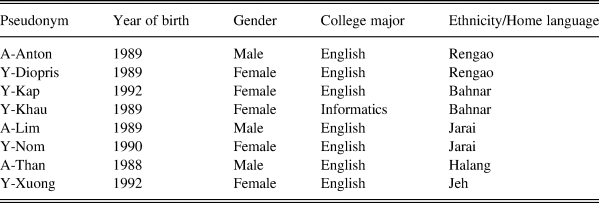
Eight students who were finally willing to talk about their language experience agreed to be focal participants of the larger project previously mentioned. They belong to five different ethnic minority groups. They all have spoken their ethnic language as L1 since they were small, learnt Vietnamese as L2 since going to school (although some of them may have contact with Kinh people and Vietnamese earlier), and studied English as a foreign language in school from secondary to college level. Some of them know, to varying degrees, one or two other local minority languages. The students were either in the final year of their studies or had recently graduated from the college at the time of data collection (see Table 1).
Information about the participants.

In addition, the eight participants were requested to introduce one of their parents or family members to participate in an interview. I succeeded in meeting with one of each student's family members: A-Anton's brother, Y-Diopris’ sister, Y-Kap's mother, Y-Khau's sister, A-Lim's mother, Y-Nom's mother, A-Than's brother, and Y-Xuong's uncle.
Data collection and analysis
Multiple forms of data for the original project—including a student questionnaire, student interviews, biographies, journals, and parent interviews—came from fieldwork carried out between December 2012 and May 2013. A questionnaire was used to collect information about the language background of minority students in the college and find potential focal participants. Student interview was the central method for gathering information from the focal participants. Language biographies, language experience journals, and parent interviews were used to provide supplementary data about the eight students’ language practices and beliefs.
The present study is based on self-reported data obtained from semistructured interviews with the students (and their family members), as an interview was useful to gather information about the participants’ ‘understandings of the value and meaning’ of their language practices (Codó Reference Codó, Wei and Moyer2008:161). For the purpose of the study, it may be difficult to find how the students were influenced by different levels of language management (i.e. school, community, parents, peers, and teachers) using interactional data. An interview was therefore more practical to collect a large amount of information about stories occurring across time, situations, and contexts—recounted by the participants. I maintain Canagarajah's (Reference Canagarajah2016:4) view that the experiences and perceptions the students narrated are not inconsequential to their actual interactions, and as ‘people do act on their beliefs’, interview data is valued for understanding of their communicative practices. In addition, in this study, I refer to the participants’ language practices as their ‘individual language management’ and ‘language policy’, which are well reflected in the interview data.
Multiple interviews were employed in order to cover a broad range of questions prepared for student interviews. There were three interview sessions with each student (twenty-four interviews in total). I met the students in quiet cafés that ensured their privacy and convenience. The length of the interviews ranged between thirty minutes and two hours each. Data from the first interview round, which constitute the empirical basis of the present study, focused on particular themes such as language practices, language habits, and bilingualism. Themes related to the students’ language management under the influence of external interventions were revealed in their stories about language use in different situations and contexts. The interviews were intertwined with personal conversations that unfolded naturally, and a gentle process of questioning appropriate to each participant was followed. All conversations were in Vietnamese and were audio-recorded with the students’ consent.
Interviews with the students’ parents/family members, which were also arranged in cafés, took place between January and May 2013, after three interviews with each student were finished. The questions concentrated on their observation of the student's language use inside and outside the family. Each interview lasted about one hour. The conversations were also in Vietnamese and were audio-recorded.
Data were thematically coded and analysed following a grounded theory, which is commonly used to understand the ‘participants’ recounting of actual events and actions’ (Strauss & Corbin Reference Strauss and Corbin1998:58). Three main steps of coding, namely open coding, axial coding, and selective coding, were applied for analysing the data. The three phases allowed me to systematically interpret, organise, and connect representative themes that emerged from the data to a more macro ideological explication related to the study's theoretical concepts (i.e. responding, reinterpreting, reframing). In the data interpretation process, I make use of multiple sources of data, as well as similar information from different interview conversations with each participant, to confirm evidence. Selected segments from interviews, which were quoted in the analysis, were translated into English. As I have suggested elsewhere, school, ethnic community, and other individuals had a profound influence on the students’ language practices and beliefs (Nguyen & Hamid Reference Nguyen and Hamid2016, Reference Nguyen and Hamid2017a, Reference Nguyen and Hamidb, Reference Nguyen and Hamid2018; Nguyen Reference Nguyen2018).
Findings
Engaging with organised management
Each of the domains in which the students existed, such as the school or the ethnic community, had its own language policies that managed its members’ language behaviours (Spolsky Reference Spolsky2007). In engaging with the organised management, they commonly responded to the school or the community's policies to reproduce the institution's existing discourse of language without much alternative. The school intervened in the students’ language practices to promote the mainstream language and assimilate them into the school's common climate, while the ethnic community tended to maintain their ethnic language and preserve the customary relationships among its members.
Adapting to the school's language policy
School, by its very nature, is a domain organised to intervene and remedy its students’ language (Spolsky Reference Spolsky2009). As previously discussed, public schools in Vietnam use Vietnamese as the uniform language of instruction for students of all ethnicities, implementing the nation's policy that favours Vietnamese as the primary language in education. The clearest impact of school as a language management authority comes from its policies aiming at assimilating minority students through the mainstream language and imposing the Vietnamese-only policy on them.
The students were exposed to pressure from this institution to modify their language practices (Spolsky Reference Spolsky2009). They experienced Vietnamese as the only language of instruction from primary school until college. In this environment, they had felt an obligation to use Vietnamese, a language that was different from their L1 (Nguyen & Hamid Reference Nguyen and Hamid2017a; Nguyen Reference Nguyen2018). The students all confirmed that Vietnamese was used right from the first days of first grade, regardless of whether their teachers were from the Kinh majority or minority communities. Y-Nom and Y-Khau, for example, related that in first grade, their teachers used Vietnamese only in their teaching and did not have sympathy for minority students’ language difficulties.
Under this management regime, the students had gradually adopted Vietnamese as a vital language in their study and communication at school to ensure their survival. They used Vietnamese most of the time, especially since going to secondary school where Kinh students were the majority, as they were required to fall in line with the school language practices and join their mainstream peers. Y-Xuong, for example, revealed that her choice of using more Vietnamese in school was due probably to the impact of the surroundings.
In high school, I spoke the general language (Vietnamese) more at that time, because in that environment, Kinh friends were around. There're only two or three, three or four friends from my ethnic group. Kinh were the majority…. So, we talked in Vietnamese. Then in the college, perhaps it becomes a habit, we speak Vietnamese much in the college. So I use Vietnamese here most of the time.
The dominance of Vietnamese was a strong motivation for the students to learn and use this language extensively. They responded to the dynamics of school management power by reproducing the school's existing discourse of language without much modification, that is, developing and maintaining their Vietnamese use. In realising that Vietnamese was important for them to survive in this environment, they managed to improve their Vietnamese and frequently use the L2. Their adaption to the school's language policy was also embedded in the majority-language context where their Kinh peers were around and the mainstream society where Kinh people were dominant. School was hence the most influential intervention authority that attempted to transform the minority students into the mainstream through language.
Adapting to the community's language policy
The students’ ethnic community also had informal language policies to manage its members’ language practices for the purpose of preserving its group solidarity. When some young members brought the mainstream language to the community and frequently used it together with their ethnic language, others thought that this was a risk to their customary L1-based communication and relationships. The community therefore claimed to intervene in its members’ language practices by imposing the L1-priority/L1-development policy on the latter.
As the ethnic language was maintained by the community, especially by older people, in spite of the penetration of Vietnamese, the students still frequently used their L1 in in-group communication. As Y-Kap and Y-Khau pointed out, preference of L1 over Vietnamese inside the community was common in communication between people in their villages. Similarly, A-Anton related that his community had an informal policy that their ethnic language, Rengao, should have priority over Vietnamese (and other languages) for communication. Some members in the community often reminded others of the ‘language law’ if someone in the village tended to use more Vietnamese. As A-Anton revealed:
They have to [speak Rengao]. Because at present, if someone from another village gets married to a person in my village, although they are Jarai or Bahnar, they are obliged to speak Rengao by the villagers.
The community's management in an effort to maintain their ethnic language were also found in Y-Xuong's story. She revealed that the first time she learnt her L1 written form was when she was ten years old, in a language class organised by her villagers. Y-Xuong related:
Y-Xuong: Learn my home language… sort of… they taught us the language with the alphabet.
Interviewer: Who were they?
Y-Xuong: They're some brothers or aunts in the village. That means, my village organised that class… so we could know our language and wouldn't lose our roots.
Given this community management, the students came to understand that in their village, home language should be used first, as it was preferred for communication between members of the community. A-Anton said that he managed to use as much L1 as possible when he was at home or in the village and reminded his village friends who tended to use Vietnamese about maintaining L1 in the community. He thought that if many villagers tried to speak more Vietnamese, his community would be in ‘disorder’ and they would be in the risk of ‘losing roots’. Y-Xuong, after attending the language class, could read and write in her L1 to a certain degree. She said that the language class organised by her village helped her to have more knowledge about her L1 and develop awareness of preserving her roots.
The students responded to their ethnic community's language management by reproducing the community's existing discourse of language, that is, making efforts to preserve their L1. Considering their ethnic language as a key marker of their group membership, they managed to involve themselves in the community's process of intervening in the invasion of Vietnamese in in-group interactions by maintaining their L1 use, reminding others about the L1-priority law or learning and developing their L1 literacy, as in the cases of A-Anton and Y-Xuong. Their adaption to the community's language policy was also embedded in the L1-dominant context in which the consensus on maintaining the customary L1 habit contributed to the group's sense of itself as expressed through its ideology about its language (Myers-Scotton Reference Myers-Scotton2007). The students’ feelings of in-group solidarity connected to their language practices may hence be enhanced by the group's intervention.
Engaging with simple management
In engaging with simple forms of management by other individuals, the students were actively reinterpreting and redefining the interventions to manage language their own way. They either conformed to or deviated from—in other words, agreed or refused to implement— the adjustment plan/policy suggested by the intervener.
Conforming to others’ intervention
The students often showed their willingness to implement language adjustment plans suggested by others when they strategically manipulated their language practices in observing the appropriateness of ways of speaking (Ma Reference Ma2004) to suit the addressee and the immediate interaction in a specific situation and context. Evidence of conformity come from Y-Diopris, Y-Kap, Y-Xuong, Y-Nom, and A-Anton's stories about their language practices under interventions by their parents, teachers, and peers.
In a minority family, which language should be given priority and to what degrees other languages are to be accepted are common concerns of parents who have the right to manage the language of the family. Parents of the students, in general, preferred using the home language for communication within the family, as this was their language norm. They sometimes considered the mainstream language a risk to the family's generational connection. Y-Diopris’ mother's position is a typical example of this. Y-Diopris’ sister revealed that her mother sometimes explicitly reminded her children that at home their ethnic language needed to be the first choice. She related: ‘Our mom often said to us… “At home, you need to speak our language. You can speak Kinh (Vietnamese) or other languages when you are out. At home, no need to speak that language (Vietnamese) to anyone” ’. Y-Diopris’ mother seemed to note that her children's Vietnamese use in the home was not customary. She hence reminded them about the appropriate language use among the family members.
Agreeing with her mother's position, Y-Diopris managed to keep the habit of using L1 most of the time in her communication with her parents. She said: ‘When using languages in talking to my parents, I'm still polite. I never reply to my parents in Vietnamese when they ask me in the local language (L1)’. Y-Diopris hence reinterpreted her mother's language reminder that by using L1, she was showing respect to her parents and to the family's customary language habit (Nguyen & Hamid Reference Nguyen and Hamid2017a; Nguyen Reference Nguyen2018). Conforming to her mother's intervention, she implemented the former's L1-only policy by maintaining L1 use, considering this as a sign of politeness to those who were in the family's higher ranks.
Some parents were instrumental in their children's shift to languages of greater utilitarian value (Ng & Wigglesworth Reference Ng and Wigglesworth2007), including the mainstream language, as they believed these languages were crucial for their children's social mobility and success. Some students revealed that their parents intervened in their language practices by often reminding them of the importance of Vietnamese and the need to be fluent in this language. Y-Xuong, for example, said that her parents encouraged her to enhance Vietnamese communication skills that would be useful for her future work and social contacts. She related:
When my friends came… or when my teachers called (phoned), or older people called me, then I spoke Vietnamese. My mom often said that I should speak loudly, so people can understand me when I get out [and contact more people] later on. If [I] still hummed and hawed like that, they couldn't understand me… then it would be disadvantageous for me.
Y-Xuong's language practices were impacted by her parents’ management efforts. She used Vietnamese in her home communication without much restriction. She hence defined and reinterpreted her parents’ reminders that Vietnamese was the key that could help her integrate with mainstream society, and that improving the L2 was essential for her (Nguyen Reference Nguyen2018). She conformed to her parents’ expectation in making decisions related to her Vietnamese practices and development, thereby preparing herself to reach out to the mainstream society where Vietnamese was dominant.
Language intervention by teachers was also reported by the students. Teachers are sometimes a tool of management, who are responsible to their school for management of its language policies (Spolsky Reference Spolsky2009). Some students narrated that their teachers tended to criticise them for using their home language and wanted them to speak Vietnamese only. Y-Nom, for example, related that in her college, she managed to avoid using her L1 when her teachers were in the class because one of the teachers said that it was not polite to speak in a language that other people did not understand.
If I was in my class, I was certainly not allowed to use it (my L1)…. Previously, Ms. Minh said that, she mentioned to us, she said that if we went to school, we should make sure that everyone could understand what we said so we shouldn't use it (our L1). When we studied in her course, [she said] we should be polite.
Accepting the teacher's intervention, Y-Nom avoided using L1 in the presence of her teachers, as she reinterpreted this intervention as a reminder of teachers’ power in the classroom, and of the necessity to be ‘polite’ and to maintain a moderate atmosphere where everyone shared the same language. Y-Nom's conformity to her teacher's management was also aligned with her adaptation to the college's Vietnamese-medium policy.
Majority peers were other powerful simple management actors who often encouraged the minority students to speak more L2. Many students reported that their Kinh peers, who may believe that their minority counterparts’ use of languages other than Vietnamese was not good for the shared climate, wanted the latter to use Vietnamese only. A-Anton, for example, related that some of his high school classmates, including both Kinh and minority students, had a ‘language agreement’ to use Vietnamese only in their class, and the Kinh students would remind the minority students and intervene in their language practices if the latter ‘violated’ this agreement. Reinterpreting his Kinh peers’ Vietnamese-only rule, A-Anton may understand that he should conform to them if he did not want to be isolated. He therefore avoided using his L1 and other minority languages, and decided to use Vietnamese as a means of joining the L2 peers and confirmed his position as a member of the class community in which Kinh students were dominant.
By contrast, the students’ same-ethnicity peers sometimes intervened to maintain the former's L1 use, perhaps because they thought that using the mainstream language or inserting this language into their ethnic language was a sign of disunity in their same-language relationship. A-Anton revealed that his L1 friends in the village sometimes reminded each other about using L1 properly: ‘They would hate me if I tried to speak Vietnamese. They would say “You want to show off? … You think I don't know Vietnamese?” ’. For that reason, he conformed to the peers’ intervention and used L1 in in-group communication. He reinterpreted this intervention that using a lot of Vietnamese in the village may be seen as a manifestation of ‘showing off’ and ‘losing one's roots’. His worry of being disparaged for ‘showing off’ was a sign of attentiveness to the reactions of people in his community against Vietnamese brought from school and the mainstream society by young members.
Interestingly, A-Anton in turn also intervened in other village friends’ language use.
In my village there're some people who are studying in Saigon, Hanoi… They visit home once a year. We had some drinks together and [they] spoke Vietnamese… But, [we] scolded them: “just left home only one year, you want to show off? Forget your root? In the future if there're ten people like you, this village's going to be in disorder, losing roots”.
A-Anton's effort of intervening in others’ language, which was similar to the way his peers intervened in his own language practices, is a clear manifestation of his reinterpretation of others’ intervention, as he generated and invoked the new meaning of their discourse about language by expecting other friends to re-implement the language adjustment he had implemented. This can also be seen as a kind of domino-style management in which A-Anton and his L1 peers reminded each other about the community's common language rule.
Deviating from others’ intervention
Language management, however, is not automatically successful (Spolsky Reference Spolsky2007). Although conformity to others appeared to be more common for the students, they occasionally showed their unwillingness to implement language adjustment plans suggested by others, when they strategically manipulated their language practices in confirming their own positions. Evidence of their deviation from other individuals’ intervention are found in Y-Nom, Y-Khau, and Y-Diopris’ stories about their language practices in dealing with interventions by their parents and peers.
In Y-Nom's family, her parents sometimes expressed concern over their children's language practices and tried to manage these. Y-Nom's mother revealed that Y-Nom's father did not like mixing their home language, Jarai, with Vietnamese in their family talk: ‘Usually, we speak Jarai and some Kinh language at the same time, I mean Vietnamese… Then he said “If speaking in Jarai, keep using Jarai entirely” ’. Y-Nom's mother also said that she sometimes tried to correct Y-Nom and her other children's way of using words in their L1. However, it appeared that Y-Nom's parents’ efforts of intervening in their children's language use were not very successful. Both Y-Nom and her mother observed that Y-Nom did not manage to change her habit of mixing her L1 and Vietnamese as much as her father would have liked. She also could not use L1 words in her talk to the extent that her mother expected. Y-Nom may reinterpret her parents’ interventions in the ways she spoke L1 as informal notes or comments rather than as language rules. She hence decided that the language issues mentioned by her parents were not very serious, and therefore it was not necessary to immediately implement the parents’ adjustment plans. Y-Nom may also deviate from her parents’ interventions because her use of language mixing and of some certain L1 words had become her habits, and it was not easy for her to change these habits.
Deviation was also revealed in Y-Khau and Y-Diopris’ reactions toward their peers’ interventions, when they used the latter's unpreferred language. Y-Khau, for example, said that sometimes her L1 friends commented that she was overusing Vietnamese in talking with them. She, however, still managed to keep the habit of adding Vietnamese to her L1 in her interaction with same-ethnicity peers. Similarly, Y-Diopris related that her Kinh classmates in her secondary school complained when she talked to another friend in her L1 because they thought that she said something behind their back. She added that at that time those complaints did not affect her much, and she managed to keep using her L1 in the class whenever necessary. It is indicated that both Y-Khau and Y-Diopris, in these situations, may not care much about their peers’ comments. They deviated from the peers’ interventions and decided to maintain their language preference.
Along the same line, Y-Diopris said that she sometimes experienced interventions by her L1 peers, when they expressed negative attitudes towards her Vietnamese use. As she related:
It's because we often speak in the language (Vietnamese)… because in my hamlet, some friends didn't go to school, or haven't completed their schooling… They hate us, don't want to make friends, say bad things about us. They said that we showed off…
Compared to Y-Khau's reaction to her L1 peers’ previously discussed comments on her Vietnamese use, Y-Diopris seemed to consider her experience more serious. Y-Diopris, however, reinterpreted then ignored these peers’ intervention efforts, managing to continue using Vietnamese in front of them to affirm her own language position. Y-Diopris deviated from her peers possibly because she did not appreciate criticisms from those she thought were showing a lack of goodwill in their suggested adjustment plans for her language practices.
Discussion
In the findings reported in the previous section, I have provided examples of individual language management by focusing on the minority students as powerful agents whose language practices were influenced by ‘exposure to the educational field’ and ‘alignment with their ethnic group’ (Revis Reference Revis2019:12), as well as different consensual language behaviours defined by their individual interlocutors. Their language management was embedded in the underlying ideologies about ‘which languages should be used where and with whom’ and in which communication circumstance (Nakayiza Reference Nakayiza2013:287). They commonly adapted to organised management (responding) and conformed to or deviated from simple management (reinterpreting). The boundary between their responding and reinterpreting strategies sometimes seemed blurred, as organised management often influences simple management, and organised management may also result from simple management (Nekvapil & Nekula Reference Nekvapil, Nekula, Liddicoat and Baldauf2008). The students’ conformity to their teacher and majority peers’ demands for using Vietnamese, for example, aligned with their adaptation to the school's Vietnamese-only policy. A-Anton's adaption to the community's L1-priority policy may influence his conformity to his same-village peers’ demands for using L1 in in-group interactions.
Based on the findings, I argue that the students responded to and reinterpreted external interventions, thereby reframing their identity through language. Below I discuss their individual language management, referring to the three concepts of responding, reinterpreting, and reframing.
Responding
The students’ language practices underpinned the discourses that constituted the school and their ethnic community. They responded to the language policy of the school and the ethnic community by adapting to the common climate and its language effort—either effort of assimilating or conserving—to assert their sense of belonging to that environment. On the one hand, the students responded to the school effort of assimilating by developing and using Vietnamese as a means of integrating themselves with the mainstream. On the other hand, their response to the effort of conserving manifested in the way they managed to maintain their L1 under the intervention by their ethnic community. It is indicated from the students’ adaptation to organised management by the school and the ethnic community that, as groups or institutions can create a ‘background situation’ (Bentahila Reference Bentahila1983) where social considerations are more important, their members often have to adapt to the groups’ policy to harmonise their membership with the groups, and maintain ‘the continuity of the status quo’ (Guardado Reference Guardado2009:119). Organised management by groups/institutions hence can play a decisive role in determining or maintaining the patterns of their members’ language practices in the domain. For minority students being influenced by the pressure of assimilation into the mainstream society, however, although they can adapt to both assimilating and conserving efforts from the school and their community, management by the school powerfully encourages their shift to L2, while management by the community may not be sufficient to motivate all of them considering a loyalty to L1.
Reinterpreting
The students were often informed of a need to modify their language practices to be more effective in communication by other individuals (their parents, teachers, or peers, for example) in different situations (Spolsky Reference Spolsky2009). These individuals, in general, expected them to either maintain their L1 use and preserve the L1, or increase their L2 use and participate in the mainstream. The students reinterpreted these expectations to evince two main accommodation tendencies. In some situations, they showed their ‘desire for approval’ to the interlocutor (conforming) (Ng & Wigglesworth Reference Ng and Wigglesworth2007), and decided to accommodate the ways that brought on the least cultural and linguistic conflict amongst them (Park Reference Park2008). In some other situations, they expressed their ‘desire for dissociation’ from the interlocutor's intervention attempt (deviating) (Ng & Wigglesworth Reference Ng and Wigglesworth2007) and maintained their language behaviours to assert their own position. The students’ choices of conforming to or deviating from other people's intervention were determined by their relationship with those people, as well as their ‘understanding of what is appropriate to the domain’ (Spolsky Reference Spolsky2009:3). Their individual language management, however, was not only ‘in-discourse’ management, but also conscious or unconscious efforts to manage their language repertoires (Nakayiza Reference Nakayiza2013), where they tried to maintain their L1 or shift to the L2. For minority students being exposed to the mainstream language, their management of L1 and L2 in engaging with others’ intervention may appear intermittent or ad hoc, but can have a significant impact in their immediate environments’ language practices (Zhao & Baldauf Reference Zhao and Baldauf2012). This eventually affects the language maintenance or shift of their ethnic community (Nakayiza Reference Nakayiza2013), as well as the language climate of society as a whole.
Reframing
The students, in reacting to external interventions, conceptualised their individual language management to attain a greater outcome in constructing their critical persona. In this process, they functioned their engagement with external interventions (i.e. responding and reinterpreting) as a manifestation of their ‘practised language policy’ (Bonacina-Pugh Reference Bonacina-Pugh2012) where they pushed themselves towards the common flow while still attempting to maintain the ties with their ethnic and cultural origin. In adapting to the common climate, the students responded to the community's effort of conserving to reframe their identity as maintenance and the school's effort of assimilating to reframe their identity as transformation. In conforming to or deviating from other individuals’ management, they either supported or refused the interlocutor's intervention in the maintenance or transformation tendencies in their language practices. Their individual language management was hence their way of enacting identity as they positioned themselves in either ‘ethnic space’ or ‘mainstream space’ through their use of particular management strategies (Revis Reference Revis2015). This reflects their critical understanding of their language management practices, as well as their active decision-making regarding language in reframing the management to construct their bilingual identity in which both maintenance and transformation lines were active (Nguyen Reference Nguyen2018).
Conclusion
This study has examined Vietnamese ethnic minority students’ language practices under the influence of external interventions. I consider these practices a kind of individual language management where the students reacted to efforts by someone or some group that had or claimed authority over them to modify their language (Spolsky Reference Spolsky2009). In that process, they performed different degrees of engagement, thereby making decisions to manage—that is, maintain or adjust—their language practices. The idea of individual language management and the three degrees of engagement with external interventions—responding, reinterpreting, and reframing—can be reapplied in other studies on individual language behaviours and ground-level language policy.
In managing their language practices in the face of external interventions, the students oriented themselves to both maintenance and transformation lines. It is revealed from their different ways of engaging in others’ management processes that although they held both maintenance and transformation in high regard, they had to navigate themselves between the ‘two apparently countervailing forces’ (Ferguson Reference Ferguson2013:132): the majority language associated with the assimilatory pressure of the mainstream society and their ethnic language connected to the urge to preserve their ethnic identity. Their choice of reframing an integrated identity in which both assimilation and preservation were valued was advantageous, as it allowed them the flexibility to choose from equally active and available identities in certain situations and contexts (Lopez, Frawley, & Peyton Reference Lopez, Frawley and Peyton2010). However, how they would retain their engagement with both maintenance and transformation for themselves under the pressure of integration into the mainstream and the weakening of their community's ethnolinguistic vitality is still a challenging question.
The study has limitations related to its small sample size, which may affect the possibility of relating the findings about the minority students’ language management and practices to more macro LPP. As I previously argued, however, the ways that the students managed their language practices in engaging with external interventions can be seen as implementing their individual language policy, which can have an influence on the interveners and the latter's language policies. Language management by individuals, as suggested by Sloboda (Reference Sloboda, Nekvapil, Sherman and Kaderka2009), can inform qualitative features of language practices in society as a whole. Therefore, some implications can be drawn from the findings.
The students’ individual language management reported in this article supports evidence for Fairbrother & Masuda's (Reference Fairbrother and Masuda2012) observation that top-down language planners and policymakers may consider managing particular language issues to be very different from those seen at individual-level language practices, and ignore the complexity of single-interactional language situations instead of assuming responsibility for their management (Nakayiza Reference Nakayiza2013). An example of this can be found in the school's language management—a process in which the school imposed its L2-only policy on minority students without adequately considering the latter's actual language habit and language needs. Language policies, therefore, should be formulated at and reflect different levels of language ideologies and practices, as this could ensure ‘equal distribution of functions of languages’ across different levels of language practices in different domains (Nakayiza Reference Nakayiza2013:291). In addition, as school is an important organised management authority that transferred minority students from maintenance to transformation through its language policies, it should positively intervene in and reinforce minority students’ maintenance orientation. Schools should be the pioneer in supporting minority languages and constructing positive views on language diversity. As it is shown in the findings of the present study, Vietnamese had penetrated into the ethnic communities, and members of the communities had to manage their and other members’ L1 practices under the invasion of the majority language. Ethnic communities therefore should retain their role as a strong management regime in maintaining L1 practices among their members and preserving their ethnolinguistic vitality, which is vital for the sustenance of their already endangered languages.