Introduction
Second language acquisition (SLA)Footnote 1 is now an established discipline, represented in both graduate programmes bearing its name and in programmes in Applied Linguistics, TESOL and foreign language education graduate programs. It boasts journals and conferences specifically devoted to it and it figures conspicuously in conferences such as this one. While controversy exists regarding its exact boundaries, with some researchers (e.g. Doughty & Long Reference Doughty and Long2003) arguing that it constitutes a branch of cognitive psychology and others (e.g. Firth & Wagner Reference Firth and Wagner1997, Reference Firth and Wagner2007) that it is primarily a social phenomenon, there is broad agreement about what the main areas of the discipline are (i.e. those associated with the description of second language (L2) learner language, whether narrowly of broadly defined, and the explanation of how it is acquired).
SLA originated in the felt need of a number of teachers-cum-researchers (e.g. Corder, Hatch, Schumann, Long, Cook, and myself) to understand how learners learn a second language (L2) in both untutored and tutored settings so as to better incorporate those experiences that were found facilitative of learning into the actual practice of language teaching. Thus, the close connection between theory and research in SLA and language pedagogy was established from the start. Over years this nexus eroded as SLA increasingly sought to establish itself as an academic discipline in its own right but the connection is still there, as evident in, for example, the continuing interest in form-focused instruction, in the role that theory and research in SLA play in the advocacy of language teaching approaches such as total physical response and task-based teaching and in the identification of general principles that can inform specific methodological practices such as corrective feedback. Arguably, SLA is still at heart an applied rather than a pure discipline.
SLA researchers have not been slow to assert the importance of SLA for language pedagogy. Spolsky (Reference Spolsky1990: 610), for example, commented ‘we have a traditional concern to consider not just the explanatory power of a theory but also its relevance to second language pedagogy’. Long (Reference Long2006: 156), with teachers and teacher educators in mind, viewed SLA as ‘a field with considerable social consequences for millions of people all over the world’. SLA researchers have also written voluminously about the relationship between SLA and second/foreign language teaching (see, for example, Tarone, Cohen & Dumas Reference Tarone, Cohen and Dumas1976; Hatch Reference Hatch1978; Krashen Reference Krashen1983; Lightbown Reference Lightbown1985, Reference Lightbown2000; Long Reference Long1990, Reference Long2006; Nunan Reference Nunan1990, Reference Nunan1991; Schachter Reference Schachter1993; Crookes Reference Crookes1993; Ellis Reference Ellis1994, Reference Ellis1997, Reference Ellis2008; Van Lier Reference Van Lier1994; Gass Reference Gass1995; Markee Reference Markee1997; Kramsch Reference Kramsch2000; the articles in the special issue of The Modern Language Journal volume 89.3 (2005) on methodology, epistemology, and ethics in instructed SLA research; Han Reference Han2007; Pica Reference Pica2008). In addition, there is a lengthy literature addressing the relationship between Applied Linguistics (of which SLA constitutes a subfield) and language pedagogy (e.g. Widdowson Reference Widdowson and Widdowson1984, Reference Widdowson1990, Reference Widdowson2000; Davies Reference Davies1999; Larsen-Freeman Reference Larsen-Freeman2000; Bygate Reference Bygate2004, Reference Bygate2005).
There is, however, no consensus on the nature of the relationship between SLA/Applied Linguistics and language pedagogy. As Bardovi-Harlig (Reference Bardovi-Harlig1995: 151) pointed out, ‘the relationship of pedagogy to second language acquisition is a complex one that is not clearly agreed on by applied linguists’. In fact, a number of sometimes conflicting positions can be identified, ranging from a super-cautious ‘don't apply’ (Hatch Reference Hatch1978) to a confident ‘go ahead and apply’ (Long Reference Long1990) while also claiming that the relationship should not be one-way but symbiotic (Van Lier Reference Van Lier1994; Pica Reference Pica2008).
I have considered each of these positions in detail elsewhere (see Ellis Reference Ellis2008). Here I want to examine the nature of the SLA/language pedagogy relationship both more generally and more concretely. First I would like to place the debates evident in the different positions listed above in a broader context by examining the nature of the theory/practice nexus – because the issues at stake do not just concern SLA. Second, I will consider a number of options for bridging the divide that many commentators consider exist. Third, I would like to probe the relationship in terms of a framework that links (i) SLA researchers, (ii) classroom researchers, (iii) teacher educators and (iv) language teachers and, using this framework, attempt to formulate a set of principles that can guide the nexus.
The theory/research and language pedagogy divide
Discussions of the gap between research and theory on the one hand and practice on the other can be found in a number of professional areas – law, medicine and education. Friedson (1977, cited in Eraut Reference Eraut1994: 53), for example, describes how medical practitioners operate, a group whom we might expect to act ‘scientifically’:
One whose work requires practical application to concrete cases simply cannot maintain the same frame of mind as the scholar or scientist: he cannot suspend action in the absence of incontrovertible evidence or be sceptical of himself, his experience, his work and its fruit. Dealing with individual cases, he cannot rely solely on probabilities or on general concepts or principles: he must also rely on his own senses. By the nature of his work the clinician must assume responsibility for practical action, and in so doing he must rely on his concrete, clinical experience.
The divide that Friedson illustrates is encapsulated in the general distinction between ‘technical’ and ‘practical knowledge’. Technical knowledge is explicit; it exists in declarative form that has been codified. There are established procedures, such as the ‘scientific method’, for determining it and disputing it. Technical knowledge is also generalized in the sense that it takes the form of laws that can be applied to many particular cases. For this reason, it cannot be rapidly applied when immediate decision-making is required. Practical knowledge, in contrast, is procedural; it is readily available to handle specific cases in concrete situations. It is not acquired scientifically but experientially and is fully expressible only in practice. Thus, there is a world of difference between studying and acquiring technical knowledge and developing and using practical knowledge. This core distinction is, of course, reflected in L2 acquisition itself – in the difference between explicit knowledge/learning and implicit knowledge/learning of a second language (L2) (Ellis Reference Ellis2009).
The divide in education (including language education) is fully documented. Hirst (Reference Hirst and Tibbles1966: 40), drawing on work in the philosophy of education, noted that:
To try to understand the nature and pattern of some practical discourse in terms of the nature and patterns of some purely theoretical discourse can only result in its being radically misconceived.
Using an amusing fictional account of a teacher's attempts to apply the results of research concerning strategies for teaching about race relations, Stenhouse (Reference Stenhouse1975) demonstrated that whereas researchers are concerned with what works by and large or for the most part, teachers can only concerned with what will work in their own teaching contexts. Applied linguists, SLA researchers and teacher educators have followed Stenhouse's lead. Brumfit (Reference Brumfit1983: 61) pointed out that ‘learning to perform competently is never the same as learning to explain the process of performance’. Pennycook (Reference Pennycook1994) talked about the ‘incommensurability of discourses’ of those engaged in academe and practice. Freeman & Johnson (Reference Freeman and Johnson1998: 399) noted that ‘research knowledge does not articulate easily and cogently into classroom practice’. Byrnes (Reference Byrnes2000: 489) commented on the diverse voices evident
between theory and practice, between research and teaching as general goods, between researcher and teacher as valued members of the profession, between those who initiate change on the basis of the exigencies of the classroom and those who prefer to base it on research evidence that can more easily garner and intellectual primacy, between those who determine the focus of research and those who are relegated to being its consumers.
Bygate (Reference Bygate2004: 17), in a general discussion of the pragmatic nature of Applied Linguistics, acknowledges ‘the outsider's account cannot by definition be the insider's account’.
Implicit in these comments is a critical perspective on the divide. This is frequently made explicit. Researchers and teachers inhabit different social worlds and communicate through different ‘Discourses’ – defined by Gee (Reference Gee1990: 143) as ‘a socially acceptable association among ways of using language, of thinking, feeling, believing, valuing and acting that can be used to identify oneself as a member of a socially meaningful group’. Discourses are not equal – some accrue greater social value than others. Kramsch (Reference Kramsch1985) noted that the ‘input metaphor’ – so prevalent in SLA (Block Reference Block2003) – constructs SLA researchers as those who study input and teachers as those who mediate it. She commented ‘as we know, delivery and mediation have never been so highly valued in academia as discovery and exegesis’ (p. 12). Clarke (Reference Clarke1994) in an article entitled ‘The dysfunctions of the theory/practice discourse’ views the Discourses of researchers and teachers in terms of a centre–periphery divide, pointing out that a ‘strata of expertise’ underlies the theory/practice divide, with theoreticians at the centre and teachers in the periphery. Clarke objects to the fact that teachers are invariably positioned as recipients of proclamations from researchers. His solution to this inequitable situation is to reconstitute the centre–periphery divide by placing teachers on top. Clarke's article is a strident call for teachers to reject research and instead value their own Discourse. Along the same lines, Templer (Reference Templer2008) has proposed that ‘silenced teachers’ need to be given a voice by making their own accounts of language teaching more readily available.
However, not everyone accepts the existence of a theory–practice divide. Lantolf (Reference Lantolf2008) rejects this dualism and argues that from the point of view of sociocultural theory there can be no separation – ‘research is praxis’. Certainly, it is possible to talk about both theory and practice with regard to both research and teaching but clearly too the ‘practice’ that researchers engage in is of a very different kind to the ‘practice’ of teachers. Similarly, ‘theory’ as understood by researchers is also different from the ‘theory’ that informs teachers’ actions. Whereas the former is ‘espoused’, emphasising explicitness and couched in the language of technical knowledge, the latter is a theory of action, is largely implicit and based on practical knowledge (Schon Reference Schon1983). These distinctions are clearly evident in the different Discourse worlds that researchers and teachers inhabit.
Bridging the divide
There are two ways of addressing this divide. One way is revolutionary – change the underlying social structure that is responsible for the power imbalance in the Discourse worlds of researchers and teachers. This is the solution advocated by Clarke and, more recently, by Stewart (Reference Stewart2006). Noting that ‘who tells the story of teaching and how it gets told matters a great deal’ (p. 422), Stewart argues that what is needed is ‘teachers’ research’, i.e. research done by teachers for teachers. He dismisses the viability of collaborative research (discussed below), claiming that teacher–researcher collaboration simply prolongs the inequality that exists between them. However, while such calls for revolution are likely to resonate with some (especially perhaps those in the practitioner camp) and serve as a useful reminder to others (especially those in the researcher camp) of the need for researchers to acknowledge their privileged status and to take care not to exploit it, they are unlikely to lead to change. As I will argue later, we do need an academe capable of conducting research and building espoused theories of language learning. There is nothing so practical as a good theory (Lewin Reference Lewin1952: 246) but only providing it is put to effective use.
The alternative, then, is to consider how the divide between researchers and teachers, between theory and practice, can be bridged. As I pointed out in Ellis (Reference Ellis1997), this involves considering how a transfer of knowledge can be achieved. How can the researcher's technical knowledge be made available to teachers in such a way that it can impact on their teaching? How can what teachers know and do inform the theories that researchers seek to build? In other words, how can technical knowledge inform practical knowledge and vice-versa? The answer to these questions requires the services of a mediator. In the case of education, this job falls primarily to the teacher educator. I will consider the role to be played by teacher educators later. First, though, I will examine some of strategies for achieving a transfer of knowledge between researchers and teachers.
Pedagogical implications
The customary way in which researchers seek to make the results of their research available to teachers is by means of an ‘implications’ section tacked on to the end of a research report. There are problems for both researchers and teachers in such a strategy. TESOL Quarterly 41.2 (2007) published an interesting exchange about the value of including pedagogical implications in its research articles. Han (Reference Han2007) criticized the tendency of research articles to ‘ostentatiously link the research to practice’ by means of an implications section. In justification of such a view she pointed out that ‘in the domain of SLA . . . not every topic is relevant to second language teaching, and the ones that are relevant may bear a direct or indirect, actual or potential, and above all complex relationship to teaching’ (p. 31). In contrast, Chapelle (Reference Chapelle2007) bluntly (and surely rightly) argued ‘if an author can state no implications for teaching and learning, TESOL Quarterly is the wrong journal’ (p. 405) and went on to point out that the author is in the best position to make the first attempt at pedagogical implications and so should do so. For teachers, the problem of implications is different. All research – including research based on an experimental design and the use inferential statistics intended to ensure generalizability – is necessarily conducted in a specific research site (not always a classroom), which may or may not share characteristics with the instructional site in which an individual teacher operates. It does not follow then that the implications drawn from a single study are of any relevance to the individual teacher. It is for this reason that I have argued that research can only afford what Stenhouse (Reference Stenhouse1975) has called ‘provisional specifications’, which teachers need to evaluate in terms of whether they are applicable to their own classrooms. This calls for the identification of evaluation criteria that might help teachers to decide which ‘implications’ are worth acting on, an issue I will return to later.
An alternative to basing pedagogical implications on specific research studies might be to base them on theories that have been tried and tested through research. Krashen (Reference Krashen1983) noted that he made the mistake of initially trying to apply the results of research to pedagogy before realising that what was needed was a pedagogically-oriented theory of L2 acquisition that could provide teachers with a clear set of principles for constructing and implementing language curricula. The result, as we all know, was Monitor Theory (later revamped as the Input Hypothesis), which, for some time, had a demonstrable impact on language teaching. The advantage of applying a theory such as Krashen's is that it affords a set of very general illuminative ideas that are applicable to a wide range of instructional settings. The danger is that the theory might not be right and also, even if it is right, might afford ideas not practical in particular cultural contexts. I would argue that a theory, like an individual research study, can provide no more than ‘provisional specifications’.
Making SLA accessible
One problem with both of these strategies is that many teachers do not read reports of research studies perhaps because they lack the technical knowledge to make sense of them but more likely because they do not have the time needed to locate and read the reports. For this reason, if teachers do come into contact with SLA research it is via the summative (and often simplified) accounts available in books specially written for teachers. Bygate (Reference Bygate2004) argued that applied linguists (and I would argue SLA researchers too) need to be doubly accountable – to the academy and to the lay community. The latter include teachers. The question arises, then, as to how SLA theory and research can be made accessible to teachers. There are two ways in which this might be achieved. One is to prepare summaries of the main findings. In Ellis (Reference Ellis1997) I suggested that such summaries will need to make a principled selection of the issues of relevance to teachers, to provide surveys of the findings of research that has addressed these issues, to evaluate these findings in terms of their validity and trustworthiness, and to present them in a language that is comprehensible to teachers. I also addressed how such summaries might be organized, suggesting that rather than basing them on constructs from SLA (e.g. fossilization), it might be better to base them on pedagogical concepts (e.g. error correction). The second way in which SLA might be made accessible to teachers is by ‘telling a story’ (Bygate Reference Bygate2005). This means abandoning the expository discourse of summaries in favour of a narrative discourse that arguably corresponds more closely to how teachers make sense of their work (Freeman Reference Freeman1994). One way in which this might be done is through carefully selected case studies of classroom learners and of instructional interventions in language learning (what Freeman & Johnson (Reference Freeman and Johnson1998) referred to as ‘situated accounts’). As Crandall (Reference Crandall2000: 40) noted ‘case studies and stories . . . provide a means of bridging theory and practice and demonstrating the complexity of teaching as a profession’. In this way we might also be able to achieve the ‘critical research reporting’ that Canagarajah (Reference Canagarajah1996) has argued is needed.
Researcher–teacher collaboration
A better strategy, perhaps, is ‘embedding research in the realities of practice’, which Uccelli & Snow (Reference Uccelli and Snow2008: 633) suggest involves addressing how to build researcher–practitioner collaborations so that they are ‘feasible, robust and mutually informative’. They suggest that one way might be to build ‘field sites’ in school districts where practitioners nominate issues of concern and then co-construct solutions with researchers who function as ‘engineers constructing tools to solve problems of practice’. They point out that, for this to work, there is a need for systematic ways for researchers to find out what practitioners think and what problems they face. They draw on Hudson's (Reference Hudson2008) distinction between ‘ideas’ and ‘models’ to suggest how this might be achieved. ‘Ideas’ refer to concepts about the nature of language (and, I would add, language learning) whereas ‘models’ provide explanations (which are necessarily controversial in nature). When researchers function within the confines of academe they will be focused on developing models but when they don their ‘applied’ hats and move out into the world they need to focus on developing ‘ideas’ for educational practice. In other words, researchers need to adjust their practices to meet the requirements of practitioners. Uccelli & Snow's arguments point in exactly the opposite direction to Krashen's – better to explore an ‘idea’ than try to apply a theory.
The importance of researchers consulting teachers in order to identify the specific problems that need to be addressed is also emphasised by Bygate (Reference Bygate2004). Bygate notes that central to any discussion of the role of Applied Linguistics (and by implication applied SLA as well) is the issue of ‘problematicity’. In a thoughtful discussion of this he argues that ‘real world problems’ (the solution of which is the goal of Applied Linguistics) need to be defined not just in terms of the academy but in ways that make sense to non-applied linguistic members of the community. This involves addressing a number of key questions:
Who has identified the problem?
How have the data been collected, by whom, under what circumstances, and for
what purposes?
Who analyses the data?
Who evaluates the overall findings?
What happens with the results?
He then notes that many of the problems addressed by Applied Linguistics are not located in any problems perceived by the lay community, that the findings of research are rarely submitted back to the lay communities for membership checking, that the findings are rarely converted into a programme of action and that potential solutions are therefore not tried out and evaluated. This rather bleak picture is a wake-up call to researchers to re-examine how they can successfully embed their research in actual practice.
Teacher-research
The strategy favoured by many commentators (in both SLA and education) is some form of teacher-research. From the teacher's perspective, this can serve a dual purpose. First, it enables teachers to investigate solutions to problems that they have identified in their own classroom. That is, it potentially has a practical outcome – identifying obstacles to learning and finding ways of overcoming them. Second, more generally, it encourages the reflection that is considered central to the process of teacher development. From the SLA researcher's perspective, the advantages are less clear, as the problems that the teacher elects to investigate may have no or limited relevance to the problems that the SLA researcher is concerned with and also the methodological limitations that are evident in much teacher-research may make its findings of little value to the academe. Van Lier's (1994) proposal that teacher- research can feed back into SLA is well-taken but probably not realistic. I cannot think of a clear example of an action research study that has had any impact on SLA.Footnote 2 Pica (Reference Pica2008), however, has argued that the current exploitation of tasks in the classroom affords an opportunity for bi-directional applications.
There is the question of what form teacher-research should take. Traditionally, the model of teacher-research most commonly advocated is action research (see e.g. Wallace Reference Wallace1997, Burns Reference Burns1999). But there are problems with this model. One concerns the extent to which such research needs to match the standards of scientific research. Brumfit & Mitchell (Reference Brumfit and Mitchell1990) argued that it should for, like other forms of research, it is just as concerned with ‘clear understanding’. However, Wells (Reference Wells, Wells, Bernard, Gianotti, Keating, Konjevic, Kowal, Maher, Mayer, Moscoe, Orzechowska, Smieja and Swartz1994: 28) argued that because the goal was ‘the personal and professional growth of the practitioner’, teacher-research ‘should be judged less in terms of the ‘quality of the product or the rigor of its methodology, and more in terms of the learning that results from the person carrying it out’. A more significant problem concerns the fact that teachers do not find it easy to carry out action research. Nunan (Reference Nunan1990) noted that the Australian teachers he studied experienced technical problems in designing their research (e.g. formulating appropriate research questions). Nunan also noted that action research was extremely time-consuming, a point taken up by Allwright (Reference Allwright2003) in proposing an alternative form of teacher-research – exploratory practice. This is not directed at solving problems but at developing the participants’ (meaning both the teacher's and the learner's) understanding of ‘the quality of life’ in the classroom. Allwright (Reference Allwright2005: 27) explains that exploratory practice was developed out of two ethical concerns – ‘the damaging split between researchers and teachers and the high risk of burnout associated with current proposals for teacher-based classroom research’. An example of an exploratory study that has drawn on (and challenged) an SLA construct (negotiation of meaning) can be found in Slimani (Reference Slimani2003). In general, however, the relationship between SLA and either action research or exploratory practice remains tenuous.
To sum up, for those committed to forging a second language acquisition – language pedagogy nexus (henceforth SLA–LP nexus) (and there are voices opposed to this), a number of strategies exist: the addition of an implications section to SLA research reports, the preparation of texts (in the form of summaries or stories) that make SLA research accessible to teachers, collaborative research involving SLA specialists and teachers and different forms of teacher-research (action research and exploratory practice). These strategies need not be seen as alternatives but as mutually supporting. In general, they raise two key questions:
1. What can SLA offer teachers?
2. How can SLA have an impact on what teachers do?
To search for answers to these questions I will now propose and explore a model of the SLA–LP nexus.
A framework for examining the SLA–LP nexus
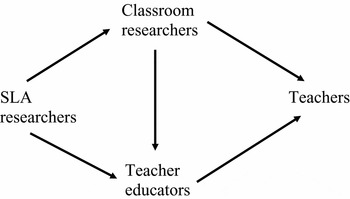
The first premise of the framework, shown in Figure 1, is that relationships need to be specified in terms of the actors involved rather than, abstractly, in terms of the kinds of actions they perform. Thus, I will talk about SLA researchers, classroom researchers, teacher educators and teachers rather than researching, teacher development and teaching. This is because if a nexus is to be established then it must necessarily be so in terms of the roles and relationships of the actors. A second premise of the model is that the relationships among these actors are to a certain extent prescribed by the social worlds they inhabit. Thus, SLA researchers are in general more likely to be in contact with teacher educators and classroom researchers while teachers are more likely to be in contact with classroom researchers and teacher educators. In other words, it is the classroom researchers and teacher educators who function as mediators between SLA researchers and teachers. Of course, actors can assume more than one identity. For example, SLA researchers often also function as teacher educators while teachers can act as classroom researchers. Finally, it should be noted that the roles performed by these actors are, to some extent at least, determined by the wider context in which they operate – the culture and policies of the educational establishments where they work.
A framework for examining the second language acquisition – language pedagogy nexus.

SLA researchers
Following Kramsch (Reference Kramsch2000), two kinds of SLA researchers can be identified – those who engage in ‘basic research’, which focuses on the general principles and processes of L2 acquisition and is directed at constructing a general theory, and ‘applied research’, which focuses on the teaching and learning of specific L2s in classroom or naturalistic settings. As a field of enquiry, SLA has increasingly rewarded researchers engaged in basic research, a good example being the current attention given to the work on emergentist theories by researchers such as Nick Ellis (see, for example, Ellis Reference Ellis2002). A characteristic of much basic research is the ‘internecine feuding and fragmentation’ (Larsen-Freeman Reference Larsen-Freeman2000: 165) that arises as researchers seek to promote and immunize their own preferred theories and epistemologies over those of their rivals. It is basic research and the controversies that this gives rise to that commentators such as Freeman & Johnson (Reference Freeman and Johnson1998) and Allwright (Reference Allwright2005) probably had in mind when they argued that ‘academic research . . . is of negligible value to current classroom participants, who need their understandings now’ (Allwright, op. cit., p. 27). More promising for building a nexus with practitioners, then, is applied research. Applied researchers take as their starting point questions of pedagogical significance and also are cognisant of classroom realities (Han Reference Han2007). They take care when proposing pedagogical implications, bearing in mind the kind of criteria proposed by Magnan (Reference Magnan2007) (e.g. implications might be presented as ‘informed questioning’ rather than ‘declarations’) and Cook (Reference Cook1999).
Classroom researchers
Classroom researchers are researchers who conduct their research in or on actual classrooms. Applied SLA researchers may or may not be classroom researchers and classroom researchers may or may not have a background in SLA. Many applied SLA researchers elect to conduct their research in a laboratory setting, seeking to make a connection with teachers by selecting participants (learners and teachers) drawn from real-life classrooms. Other applied researchers, however, investigate learners and teachers within classroom contexts. There are advantages and disadvantages of so doing. The main advantage is that research carried out within classrooms has high ecological validity and thus is more likely to be heeded by practitioners.Footnote 3 The main disadvantage is that usually it is necessary to make use of intact classes, which precludes the possibility of forming randomized groups for experimental studies. Research conducted in classrooms need not necessarily be any more applicable to language pedagogy than research conducted in laboratories. As Wright (Reference Wright, Flowerdew, Brock and Hsia1992) noted, what is really needed is research on classrooms rather than research in classrooms. Nor does it follow that research conducted in (or on) a specific classroom can be transmitted to teachers in the form of recipes for effective practice, as the same problem of ‘transfer’ of research findings from one classroom setting to another discussed earlier applies.
Teacher educators
Teacher educators can adopt a number of different roles (Wallace Reference Wallace1997). They can function as transmitters of information about SLA. As Wallace noted, this role assumes an applied science theory-to-practice model of education. Teacher educators can also function as mentors, as in a craft or apprenticeship model of education. Finally, they can function as awareness-raisers, encouraging teachers to examine their own teaching practice as in a reflective model of education. According to Crandall (Reference Crandall2000), there has been a gradual shift in the role played by teacher educators. While the mentor role has always been evident in programmes that include a practicum, teacher educators have increasingly abandoned the transmitter role in favour of the awareness-raising role. Crandall's own view (which I endorse) is that teacher education requires teacher educators to engage with teachers in all three roles depending on the specific needs of individual teachers.
Somewhat surprisingly, there have been relatively few studies of how teacher educators approach SLA when functioning in these different roles and even less of what impact they have on teachers. I will briefly consider a sample of those studies that I have been able to locate and try to draw some general lessons from them.
Badger, McDonald & White (2001) sought to encourage students taking an undergraduate course in SLA as part of a BA degree to reflect on their own beliefs about language learning and teaching. They administered Lightbown & Spada's (Reference Lightbown and Spada1993) questionnaire to the students at the beginning and the end of the course. They reported no significant changes in the responses of a control group that did not take the course. In the SLA group, statistically significant changes were evident to seven of the statements in the questionnaire. In general, these changes indicated a movement away from a behaviourist view of language learning (e.g. the students became less convinced of the importance of imitation and L1 interference).
Angelova (Reference Angelova and Bartels2005) also set out to investigate to what extent her students modified their views about language learning over time. In this case the participants were a mixed group of teacher trainees (experienced and novice: native and non-native speakers of English). They took part as students in a series of mini-lessons in Bulgarian – a language they had no prior knowledge of. A 20-item Likert scale questionnaire was administered before and after the lessons. In addition, the participants completed a journal and engaged in focus-group discussions after completion of the mini-lessons. The questionnaire revealed relatively few radical changes in beliefs, with most of the changes consisting of a strengthening or weakening of an original belief. However, an exception concerned their perceptions of the role of imitation, which was viewed favourably initially but generally rejected later. A key finding of the journals was the trainees’ increased awareness of how learners feel when they are learning a new language, in particular the high level of frustration they experience. Angelova noted that the trainees found the mini-lessons more useful than traditional transmission methods of teacher education.
Erlam (Reference Erlam2008) reported a study of her own involvement in an inservice-teacher education workshop in which she specifically set out to bridge the gap between research and teaching. Her starting point was a set of general principles culled from a literature review of instructed language learning (Ellis Reference Ellis2005) and reports of case studies of how ‘expert’ language teachers demonstrated evidence of these principles in their own teaching (Erlam, Sakui & Ellis Reference Erlam, Sakui and Ellis2006). Erlam's approach consisted of giving the workshop participants a key word for each principle and asking them to specify the principle, inviting them to discuss why they thought the case studies failed to provide evidence for some of the principles in classroom practice, and then encouraging them to discuss the relevance of the principles and case studies for the teaching contexts in which they worked.
McDonough (Reference McDonough2006) reported the results of her attempts to involve a group of teaching assistants at a university in the USA in action research as part of a graduate-level seminar. Her aim was to provide the students with experience in conducting classroom research and disseminating its findings. The main findings of this study were that the participants did succeed in broadening their view about research (e.g. they came to see that it could be qualitative as well as quantitative), changed their initially negative views about conducting research collaboratively, used the insights they gained from the research to change their own teaching practices, and continued to work on their action research projects after the seminar had ended.
All of these studies demonstrate that knowledge of SLA can have an effect on trainees’ beliefs about language learning. In the case of Badger et al. (Reference Badger, McDonald and White2001), a fairly traditional course where they functioned mainly as transmitters of knowledge about SLA brought about changes in the students’ beliefs. In the case of Angelova (Reference Angelova and Bartels2005), Erlam (Reference Erlam2008) and McDonough (Reference McDonough2006), more innovative educational practices (mini-lessons in an unknown language, awareness-raising activities based on published research and an action research project) were also found to have an impact on trainees’ beliefs. However, only one study (McDonough) investigated whether the teacher education had any effect on the trainees’ actual teaching. We are a long way from knowing which teacher educator role has the greatest effect on teachers and teaching. There is clearly a need for more research on the roles that teacher educators can play in mediating between SLA researchers and teachers.
Teachers
A distinct pendulum swing has taken place in Applied Linguistics over the last thirty of so years. Where the 1970s and 1980s were characterized by a focus on the learner and a concern for ensuring that teaching took account of how learners learn, the 1990s and the first decade of this century have been more concerned with teacher cognitions and teacher-learning (Freeman & Johnson Reference Freeman and Johnson1998). Teachers are no longer seen as technicians implementing methods prescribed by SLA researchers but as individuals with their own sets of beliefs about teaching, formed in large part by their prior experiences of classrooms as learners and as trainee teachers, and with their own theories of action that guide the decisions they make as they teach. Thus, the key question has become not ‘What do teachers need to know about SLA?’ but ‘How can SLA contribute to teacher-learning?’ This question can only be answered if teachers are allowed to articulate the specific issues relating to learning that they see as important and in need of attention. As Bahns (Reference Bahns1990: 115) put it ‘the initiative for applying results of any kind to any field of practice must come from the practitioners themselves’. This is, of course, the principle that guides practitioner research.
There is, however, a problem in this. What if teachers, lacking in any knowledge of SLA, identify issues in need of attention that have nothing to do with L2 acquisition? McDonough (Reference McDonough2006), in the action research study described above, listed the topics her students elected to investigate. They were the effectiveness of specific teaching practices (e.g. grammar instruction), ways of encouraging class participation, techniques for transitioning between classroom activities and broader issues to do with course assessment and syllabus design. None of these were specifically concerned with L2 acquisition. Teachers, understandably, are concerned with teaching rather than learning. Given this, teachers may need some input about SLA to help them ‘theorize’ their problems in relation to learners and learning. As Widdowson (Reference Widdowson1990) pointed out, teacher-research cannot take place unless teachers engage in the process of conceptual evaluation. A familiarity with SLA will help teachers identify and shape problems about learners and learning as well as inform them about the kinds of instruments and procedures they will need to investigate them.
However, as Widdowson went on to argue, any input must be ‘client-centred’. Thus, the question arises as to which SLA topics should figure in an SLA course/guide for teachers. Pica (Reference Pica1994) provided an answer to this. She took as her starting point not SLA but the questions that teachers had asked her ‘both in the privacy of their classrooms and in the more public domain of professional meetings’ (p. 50). These questions covered such topics as the relative importance of comprehension and production, the role of explicit grammar instruction, and the utility of drill and practice. Interestingly, one topic that figures strongly in SLA textbooks – the order and sequence of acquisition – did not figure in the list of questions.Footnote 4
This model of the SLA–LP nexus enables us to see the importance of examining the roles of the various actors involved – SLA researchers, classroom researchers, teacher educators and teachers. It suggests that the key roles are those played by classroom researchers and teacher educators, who function as mediators between SLA researchers and teachers. It also suggests that the topics that classroom researchers choose to investigate and teacher educators choose to include in their courses need to be filtered through teachers’ own ideas about what is important for learning but that these ideas need to be fine tuned by a better understanding of SLA. Building on these insights, I will now attempt to formulate a set of general principles that can guide how SLA can be effectively used in language teaching.
SLA research and language teaching: some guiding principles
The principles that I propose below are directed at designing a course in SLA as part of a graduate programme in TESOL or foreign language teaching.Footnote 5 They concern the ‘what’ and the ‘how’ of the relationship between SLA research and language teaching – what SLA topics are of relevance to teachers and how technical knowledge drawn from SLA can interface with the practical knowledge that informs actual teaching.
Principle 1: The overall goal of an SLA course for teachers should be to contribute to teacher-learning by assisting teachers to develop/modify their own theory of how learners learn an L2 in an instructional setting.
A corollary of this principle is that the theory that teachers develop should be explicit. Teachers are likely to come to the SLA course with a set of beliefs about how learning takes place. The purpose of an SLA course is to assist them to evaluate these beliefs and modify them in the light of information from SLA that they find relevant to their own instructional setting.
Principle 2: The topics covered in an SLA course need to be demonstrably relevant to teaching.
Relevance can be achieved in two ways. The way often advocated is to invite the teachers themselves to identify the topics they find relevant. However, as noted above, teachers may not be able to evaluate the relevance of some SLA topics until they have information about them. An alternative strategy, therefore, might be to consult handbooks for teachers (e.g. Harmer Reference Harmer1983; Ur Reference Ur1996) to identify pedagogic issues deemed important for teachers and then relate these to SLA topics.
Principle 3: The topics covered in an SLA course should consist of ‘ideas’ rather than ‘models’.
For example, it would be preferable to tackle an idea such as ‘learners inevitably and naturally commit errors’ and ‘learners sometimes make errors and sometimes don't’ than to examine models such as Krashen's Monitor Model or N. Ellis’ emergentist theory of learning. Theoretical positions should emerge out of the ‘ideas’ discussed in the course.
Principle 4: The texts selected for an SLA course need to be comprehensible to teachers who lack technical knowledge about SLA.
In effect, this means that the text should have been written for teachers and not for SLA researchers or applied linguists (or even for students preparing to become applied linguists). A good example of an accessible text for teachers is Lightbown & Spada (Reference Lightbown and Spada2006). In addition, teachers might be invited to refer to more technical texts (e.g. Ellis Reference Ellis2008) to research specific topics of interest to them in greater detail.
Principle 5: Specific research articles used as readings should be selected bearing in mind the kind of criteria proposed by Cook (Reference Cook1999). Ideally, these articles should be reports of classroom research rather than laboratory studies.
Principle 6: Any proposals emanating from the SLA ‘ideas’ examined in the course or from the pedagogical implications of research articles should be viewed as ‘provisional’, to be evaluated in the light of teachers’ own classrooms and experiences of learning and teaching an L2. This process of evaluation needs to be conducted explicitly.
One way of facilitating evaluation might be to make use of published responses to articles. For example, Nobuyoshi & Ellis’ (Reference Nobuyoshi and Ellis1993) study of ‘pushed output’ elicited a response from Hopkins & Nettle (Reference Hopkins and Nettle1994). After reading both the original article and the response, teachers can decide to what extent they consider Nobuyoshi & Ellis’ pedagogical proposals applicable to their own classroom.
Principle 7: Teachers can benefit from reflecting on their own experience of learning a new language as part of the SLA course.
As in Angelova (Reference Angelova and Bartels2005), teachers can be given mini-lessons in a new language which have been designed to expose them to specific pedagogical practices (e.g. deductive grammar teaching, task-based teaching), to relate these to ‘ideas’ from SLA introduced in the course, and to evaluate the practices in terms of their own experiences of learning.
Principle 8: Awareness-raising tasks based on L2 data or on SLA texts can be used to encourage teachers to evaluate the relevancy of specific ‘ideas’. Such tasks may prove more effective in making the link between technical and practical knowledge than more traditional, transmission modes of teacher education.
Awareness-raising tasks serve two purposes in teacher education. They guide teachers to the self-discovery of ‘ideas’ and they encourage reflection on ‘ideas’ presented to them in texts. An example of an awareness-raising task directed at self-discovery can be found in Ellis (Reference Ellis1994) while a good example of awareness-raising activities designed to stimulate reflection can be found in Erlam's (Reference Erlam2008) report of her inservice workshop for teachers.
Principle 9: Teachers need opportunities to become researchers in their own classroom as well as consumers of SLA research. This can be achieved in a variety of ways – through collaborative research with an SLA researcher or through action research and exploratory practice.
In the case of collaborative research, it is important that it is the teacher who identifies the issues to be investigated, not the SLA researcher. That is, the issues must be drawn from teachers’ own understanding of language pedagogy as this is practised in their own classrooms. The role of the SLA researcher should be that of facilitating the teacher's research by providing relevant information from SLA and helping to develop appropriate data collection instruments and procedures.
In the case of action research, teachers will identify problems relating to their own teaching. In the case of exploratory practice they will identify aspects in the life of their classroom that they wish to gain a better understanding of. These problems and issues are not likely to be the kinds of problems and issues that SLA researchers would choose to examine. This is not important. What is important is that teachers are able to relate SLA ideas to their own research questions. SLA is best viewed as a body of technical knowledge that can illuminate pedagogically inspired questions.
It may also be useful to encourage teachers to give public presentations of their research. McDonough (Reference McDonough2006) reported that the teaching assistants in her course appreciated the assistance they received in publicly disseminating their research. One advantage of this is that it narrows the gap between ‘researchers’ and ‘teachers’. A variety of ways of reporting teacher-research should be encouraged, including narrative forms of reporting.
Principle 10: It is always the teacher who ultimately determines the relevance of SLA constructs and findings for teaching, not the SLA researcher. As Freeman & Johnson (Reference Freeman and Johnson1998: 409–410) put it:
Clearly any understanding of teaching must be anchored in examinations of learners and learning. However, teaching as an activity cannot be separated from either the person of the teacher as a learner or the contexts of school and schooling in which it is done.
A corollary of this principle is that it is the SLA researcher who determines the relevance and acceptability of the findings of teacher-research for SLA.
These principles are unlikely to be agreed to by every SLA researcher, teacher educator or teacher. They require SLA researchers to be prepared to put aside the requirements of the academy in which they work, at least when they take on the role as teacher educators. They require teacher educators to allow teachers a much greater say in the content of SLA courses than is the norm and also to acknowledge that traditional modes of transmitting knowledge about SLA may not be the most effective way of assisting teachers to develop/modify their own theories of language learning. It requires teachers to accept that technical knowledge is of relevance to their own teaching and to seek ways in which they can make it relevant. These principles are perhaps best seen as a set of proposals for how to design and implement an SLA course for teachers that can be challenged and, hopefully, investigated empirically. Thus a final proposal is as follows:
Principle 11: Teacher educators mounting SLA courses for teachers (or including SLA content in methods courses) need to engage in evaluation of these courses in order to establish which ‘ideas’ teachers found useful and which teacher-education methods were most successful in helping teachers develop/modify their own theories of language learning.
Examples of such evaluation can be found in the studies by Badger et al. (Reference Badger, McDonald and White2001), Angelova (Reference Angelova and Bartels2005) and McDonough (Reference McDonough2006).
Conclusion
My central argument in this paper has been that if SLA researchers wish to ensure that their work is of relevance to language teachers they need to adopt a mediating role by examining how, as teacher educators,Footnote 6 they can facilitate the process by which technical knowledge about SLA can interface with teachers’ own practical knowledge of teaching. To this end I have posed a number of strategies for achieving this, culminating in a set of eleven principles for guiding the relationship.
My perspective, therefore, has been that of an applied SLA researcher. The purpose of an applied SLA researcher is not to assume the relevance of SLA to language pedagogy but rather to enquire into its applicability. This is what I have tried to do. SLA has the same status as linguistic description. Just as ‘what is a “good” description in reference to “sound linguistic principles” cannot be assumed to be good for language pedagogy’ (Widdowson Reference Widdowson2000: 28), so what is a ‘good’ research and theory in SLA should not be assumed to be of value to language teachers. Nor can we assume that SLA is the only or even the primary source of technical knowledge about language pedagogy.
Finally, I should make it clear that I am not proposing that all SLA research should be of the applied variety. There is clearly a need for SLA research to advance our theoretical and empirical understanding of L2 acquisition. This can be pursued without any reference to language pedagogy although, as the growing literature on form-focused instruction demonstrates, one of the main ways of advancing SLA as an academic discipline is by investigating how instruction affects learning.
Acknowledgements
I would like to acknowledge the support provided by Graeme Porte
Rod Ellis is Professor in the Department of Applied Language Studies and Linguistics, University of Auckland, and the Cheung Kong Scholar Chair Professor at Shanghai International Studies University. His published work includes articles and books on second language acquisition, language teaching and teacher education. His main books are Understanding second language acquisition (Oxford University Press. 1985; BAAL Book Prize, 1986) and The study of second language acquisition (Oxford University Press, 1994, 2nd edition in 2008; Duke of Edinburgh prize 1995). Other books are Learning a second language through interaction (1999), Planning and task performance in a second language (2005), both published by John Benjamins, Task-based learning and teaching (2003) and (with Gary Barkhuizen) Analyzing learner language (2005), both published by Oxford University Press. He has also published several ELT textbooks and is also currently editor of the journal Language Teaching Research.