Introduction
The population is ageing rapidly, and the new generation of older people is living longer, albeit not necessarily in better health than their predecessors (Agahi and Parker Reference Agahi and Parker2005). Older people must cope with and adapt to new challenges related to their own ageing as well as to contextual changes. They have to learn how to live with impairments, diseases and loss of energy, friends or significant others (Baltes, Wahl and Schmid-Furstoss Reference Baltes, Wahl and Schmid-Furstoss1990). After retirement, leisure activities constitute a relatively large part of their daily lives. For that reason, in the last decades, increasing attention has been given to the relationship between participation in leisure activities and ageing (Kelly and Ross Reference Kelly and Ross1988). However, little is known about how older people spend their leisure time, how active they are, which activities they perceive as leisurely, what are the most common activities they engage in, and to what extent diseases and physical impairments affect their activities.
In gerontology, three main theories have developed concerning participation in activities by the older population. Initially, Lawton (Reference Lawton, Rowles and Ohta1983) proposed that health, activities of daily living (ADL) and cognition provide the basic competences for the actual leisure activity involvement, and that these factors affect the kinds of activities in which the older person engages. Subsequently, Baltes and Baltes (Reference Baltes, Baltes, Baltes and Baltes1990) identified continuity and adaptation as the major path to a healthy lifestyle in old age. According to their theory of ‘selective optimisation with compensation’ (SOC), older people use three strategies to cope with changes resulting from old age: (1) selection: the choices and priorities older people make when they limit their activities due to losses in resources, (2) optimisation: engagement in activities in order to increase and maintain physical and cognitive capacities necessary to an active lifestyle, (3) compensation: strategies that allow the older person to continue participation in the chosen activities despite losses. Lately, Rowe and Kahn (Reference Rowe and Kahn1997) proposed the model of ‘successful ageing’ based on three components: avoidance of disability, maintenance of physical function and active engagement with life. Stimulated by this theoretical background, several cross-sectional studies have been conducted to identify the patterns of leisure activities in the older population (Baltes et al. Reference Baltes, Wahl and Schmid-Furstoss1990; Herzog et al. Reference Herzog, Kahn, Morgan, Jackson and Antonucci1989; Hillerås et al. Reference Hillerås, Jorm, Herlitz and Winblad1999; Lawton, Moss and Fulcomer Reference Lawton, Moss and Fulcomer1987; Verbrugge, Gruber-Baldini and Fozard Reference Verbrugge, Gruber-Baldini and Fozard1996). However, there are still limited data concerning the influence of health-related factors on the participation pattern.
An active lifestyle has been found to be related to life satisfaction and positive affect (Brown, McGuire and Voelkl Reference Brown, McGuire and Voelkl2008; Kelly and Steinkamp Reference Kelly and Steinkamp1997), lower stress (Patterson Reference Patterson1996), less depression (Glass et al. Reference Glass, Mendes de Leon, Marottoli and Berkman1999), decreased mortality risk (Jacobs et al. Reference Jacobs, Hammerman-Rozenberg, Cohen and Stessman2008; Kaplan et al. Reference Kaplan, Strawbridge, Cohen and Hungerford1996; Steinbach Reference Steinbach1991), better cognition (Crowe, Andel and Pedersen Reference Crowe, Andel and Pedersen2003; Fabrigoule et al. Reference Fabrigoule, Letenneur, Dartigues, Zarrouk, Commenges and Barberger-Gateau1995; Karp et al. Reference Karp, Paillard-Borg, Wang, Silverstein, Winblad and Fratiglioni2006; Verghese et al. Reference Verghese, Lipton, Katz, Hall, Derby, Kuslansky, Ambrose, Sliwinski and Buschke2003; Wang et al. Reference Wang, Karp, Winblad and Fratiglioni2002), and better overall health. Participation also acts as a buffer that helps people to maintain life satisfaction in the face of loss (Silverstein and Parker Reference Silverstein and Parker2002). On the other hand, inactivity has been found to be linked to deteriorated physical and cognitive functions in the older population (Garfein and Herzog Reference Garfein and Herzog1995).
Out-of-home mobility is an important factor in modern society since it contributes to the improvement of overall quality of life. Within Europe and between rural and urban areas, important differences in the activity patterns outside the home have been observed (Mollenkopf et al. Reference Mollenkopf, Marcellini, Ruoppila, Széman and Tacken2005; Ruoppila et al. Reference Ruoppila, Marcellini, Mollenkopf, Hirsiaho, Baas, Principi, Ciarrocchi and Wetzel2003). At the regional level, differences associate with economical, cultural, climatic and historical factors (de Groot et al. Reference De Groot, Verheijden, de Henauw, Schroll and van Staveren2004; Piro, Noess and Claussen Reference Piro, Noess and Claussen2006). At the individual level, health, as well as economic, social and technical resources, affect out-of-home mobility (Mollenkof et al. Reference Mollenkopf, Marcellini, Ruoppila, Széman, Tacken and Wahl2004). The complex causal relationship between an older person and the environment is probably mutual (Lawton Reference Lawton1986). Previously, we reported in the Kungsholmen Project that engagement in mental, social, or productive activities was related to a decreased risk of dementia (Wang et al. Reference Wang, Karp, Winblad and Fratiglioni2002) and that engagement in a broad spectrum of activities that included more than one of the three (social, mental or physical) components seemed more beneficial than to be engaged in activities limited to only one of these components (Karp et al. Reference Karp, Paillard-Borg, Wang, Silverstein, Winblad and Fratiglioni2006).
This study maps the pattern of leisure activity in an ageing population, and describes its heterogeneity in relation to contextual and health-related factors. The specific aims are: (1) to describe the frequency of participation in individual leisure activities as well as in overall activity types (categories) in the older population, (2) to relate the pattern of leisure activity to demographic and social aspects as well as to mental and physical health, (3) to examine whether the pattern of participation in ‘at least one activity’ and in different activity types varies by demographic, social and health-related factors.
Data and methods
Study population
All residents of the Kungsholmen district of Stockholm, Sweden aged 75 years or older in October 1987, either living at home or in institutions (n=2,368), were asked to participate in the initial examination of the Kungsholmen Project. Of those, 181 individuals died before the examination, 69 moved out of the area, and 308 refused to participate, leaving 1,810 individuals who were surveyed at baseline. The subjects were interviewed by nurses, examined by physicians, and tested by psychologists. Detailed procedures are available elsewhere (Fratiglioni et al. Reference Fratiglioni, Grut, Forsell, Viitanen, Grafstrom, Holmen, Ericsson, Backman, Ahlbom and Winblad1991). Each subject was sent a personal letter explaining the study and the importance of participation, but clearly stating that it was voluntary and that at any time they could discontinue their participation. Approval was obtained from the ethical committee of Karolinska Institutet. Among the 1,810 eligible participants, 110 subjects did not undergo clinical examination and 77 participants had missing information on leisure activities, leaving 1,623 subjects available for the present study.
Assessment of leisure activities
Assessment of leisure activities was based on an open question during a personal interview and was carried out by trained nurses. The subjects were asked (translated from the Swedish): (a) Do you have any interest(s) in which you participate regularly? (b) If yes, which one(s)? The reported activities were only those perceived by the respondents as leisurely and non-obligatory. At first, 31 different activities were grouped into five activity types (mental, social, physical, productive and recreational) according to the classification adopted in previous studies (Bassuk, Glass and Berkman Reference Bassuk, Glass and Berkman1999; Hultsh, Hammer and Small Reference Hultsch, Hammer and Small1993; Wang et al. Reference Wang, Karp, Winblad and Fratiglioni2002). Subsequently, the categorisation of activity types was reviewed by two independent raters. The two raters agreed on the activity type groupings of 90 per cent of the activities. The remaining 10 per cent of the activities were discussed by the two raters until a consensus was reached regarding to which activity type group the individual activity should be assigned.
Assessment of demographic and contextual factors
Age and gender were obtained from the National Population Register. Education was assessed according to the highest level of schooling reported by the subjects. Social network items were obtained in a personal interview by trained nurses and included marital status, living arrangement, parenthood, close social ties, and frequency of and satisfaction with these connections. A four-item social network index of three categories (rich, moderate, and poor or limited social network) was constructed in a previous study (Fratiglioni et al. Reference Fratiglioni, Wang, Ericsson, Maytan and Winblad2000) and applied.
Assessment of health-related factors
Mental disorders
Depressive symptoms were assessed by two self-reported symptoms: being in a low mood and/or often feeling lonely. Both of these symptoms are included in the Center for Epidemiological Studies-Depression Scale (Radloff and Teri Reference Radloff and Teri1986), and the item ‘feel in low mood’ has been assessed to be as accurate as the Geriatric Depression Scale (GDS) (Yesavage and Brink Reference Yesavage and Brink1983) in screening for depression (Mahoney et al. Reference Mahoney, Drinka, Abler, Gunter-Hunt, Matthews, Gravenstein and Carnes1994). Cognitive function was measured using the Mini-Mental State Examination (MMSE) (Folstein, Fosltein and McHugh Reference Folstein, Folstein and McHugh1975). The MMSE has 11 subscales (maximum score in parentheses) that are summarised into a total score (30) which comprises orientation to time (5), orientation to place (5), immediate word recall (3), attention (5), delayed word recall (3), naming (2), repetition (1), following commands (3), reading (1), writing (1), and design copy (1). An MMSE score of 23 or less was considered as impaired cognition and of 24 or more as no cognitive impairment. A recent study investigated the reliability of the MMSE by measuring the inter-rater agreement and found that the overall concordance between general practitioners and neurologists working in Alzheimer's Evaluation Units was high (Kappa=0.86) (Pezzotti et al. Reference Pezzottti, Scalmana, Mastromattei and Di Lallo2008).
Dementia diagnosis was according to the Diagnostic and Statistical Manual of Mental Disorders, third edition-revised (DSM-III-R) (American Psychiatric Association 1987) criteria, which incorporate a combination of findings from the medical examination, cognitive testing and patient history, as well as information from the proxy, and followed a three-step diagnostic procedure (Fratiglioni et al. Reference Fratiglioni, Grut, Forsell, Viitanen, Grafstrom, Holmen, Ericsson, Backman, Ahlbom and Winblad1991): (1) the examining physician made a first preliminary diagnosis; (2) all cases were then independently reviewed by a specialist who made a second diagnosis; and (3) in the case of disagreement, a third opinion was requested from a senior physician before the final diagnosis was accepted. When only one item of the diagnostic criteria was not fulfilled, the subject was classified as affected by ‘questionable dementia’. In this study, participants diagnosed with ‘questionable dementia’ were considered as demented. The diagnostic procedure of dementia has been validated with a relatively high overall agreement on diagnosis (k=0.70) (Fratiglioni et al. Reference Fratiglioni, Grut, Forsell, Viitanen and Winblad1992a).
Somatic diseases
Information on somatic disease was gathered from the hospital discharge diagnoses through the Stockholm Computerised Inpatient Register System. Disease diagnoses were based on the International Classification of Disease, 8th edition (ICD-8) (World Health Organisation 1967): coronary heart disease (ICD-8: 410–414), cerebrovascular disease (ICD-8: 430–438), diabetes mellitus (ICD-8: 250), malignancy (ICD-8: 140–208 and 230–239), and hip fracture (ICD-8: 820). Somatic diseases were defined as the presence of any of the above diseases. The hospital discharge diagnoses were used to detect the somatic diseases in our study. However, the prevalence of some diseases, e.g. vascular disorders, might be underestimated. Whereas a stroke causes hospital admission in more than 90 per cent of cases in Sweden (Alfredsson, von Arbin and de Faire Reference Alfredsson, von Arbin and de Faire1986), isolated hypertension or diabetes seldom require hospital care.
Physical function was assessed with the Katz index of Activity of Daily Living (ADL) (Katz et al. Reference Katz, Ford, Moskowitz, Jackson and Jaffe1963). Physical limitation was defined as the inability in at least one of the basic ADL items: bathing, dressing, toileting, continence, feeding, or transferring. Brorsson and Asberg (Reference Brorsson and Asberg1984) have previously reported that the Katz Index of Activity of Daily Living (ADL) (Katz et al. Reference Katz, Ford, Moskowitz, Jackson and Jaffe1963) has a good reliability and construct validity.
Statistical analyses
Simple descriptive statistics were used to assess the distribution of the participation in the 31 individual activities by age group and gender. The means and standard deviations of the number of activities among the leisure groups were calculated. The chi-squared test was used to assess differences among these groups regarding number of activities, contextual and health factors. Logistic regression analysis was used to estimate the odds ratios (OR) of the participation in ‘at least one activity’ and in mental, social, physical, productive, and recreational activities in relation to the contextual and health factors.
In all multivariate logistic regression models, age (75–79, 80–84, 85+ years), education (elementary school <8 years, intermediate school 8–12 years, high school >12 years) and social network (rich, moderate, poor or limited social network) were entered as categorical variables. Sex (female versus male), depressive symptom(s) (none versus at least one depressive symptom), cognitive impairment (⩽23 MMSE score versus ⩾24), dementia (yes versus no), somatic disease(s) (none versus at least one somatic disease) and physical limitation (none versus inability in at least one ADL) were entered as dichotomous variables.
Results
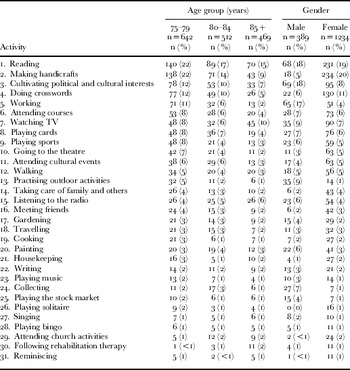
The non-participants were comparable to the participants in terms of age (83±5 versus 82±5 years, mean±s.d.), sex (77% versus 76% females), and education (elementary school 60% versus 61%; intermediate school 20% versus 19%; high school 16% versus 19.5%). Table 1 lists the 31 activities, that were perceived as leisurely by age and gender. As expected, the general tendency was for more participation in ‘challenging’ activities among the young-old (aged 75–79 years), and a decline with increasing age (e.g. working, making handicrafts, and going to the theatre). However, among a number of activities, a steady level of participation with age is noticeable (e.g. gardening, travelling, and writing). More passive activities, such as watching TV and listening to the radio, were more popular among the oldest-old. Several activities were gender-specific and were either more practised by men (e.g. following political and cultural interests, working, practising outdoor activities) or by women (e.g. making handicrafts, doing crosswords). Furthermore, in general men were more active.
Participation in the 31 individual activities by age and sex

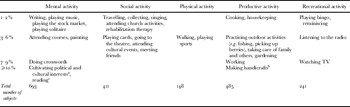
Table 2 shows the percentage of older people participating in activities by activity type. The most prevalent individual activities included one productive (making handicrafts) and two mental (reading, cultivating political and cultural interests) activities; these were enjoyed by at least 10 per cent of the sample. The most prevalent activity type was mental activities (43%), whereas the least prevalent was physical activities, with only nine per cent of participating in some type of physical activity.
Total number and percentage of subjects participating in different leisure activities

10%a 16%b, 19%c.
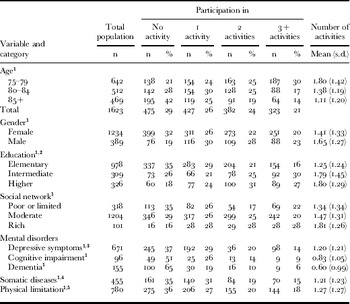
Socio-demographic characteristics of the participants by their participation in leisure activities
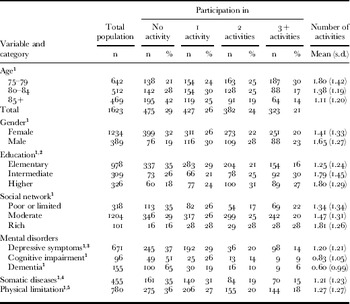
Notes: 1. Differences significant at p<0.01, (chi-squared test). 2. Education: 10 subjects have missing information. 3. Depressive symptoms: 61 subjects have missing information. 4. Somatic diseases: 82 subjects have missing information. 5. Physical limitation: 53 have missing information. s.d.=standard deviation.
Pattern of participation in leisure activities according to contextual and health indicators are reported in Table 3. About 70 per cent of the population was engaged in at least one individual activity and 50 per cent in at least two. The young-old subjects and men were more active than their counterparts. One-third of the young-old participants participated in three or more individual activities while most men participated in at least one activity. Participants with higher education and a rich social network were more active and engaged in a larger number of activities. Among people with mental disorders, two-thirds of the demented, one-half of the cognitively impaired, and one-third of the depressed participants were inactive. About one-third of the participants with somatic disease(s) and physical limitation had no activity, and only a few of them engaged in two or more activities. The mean number of activities in the study population was 1.47 (s.d.=1.32). The young-old (75–79 years-old) were the most active, and participated in on average nearly two activities (1.80), while the older participants had less participation (1.30 activities for the 80–84 years old and 1.00 for those aged 85+ years). Participants with a higher educational level and a rich social network reported almost two activities (1.80) while those with elementary education (1.25) or a poor or limited social network (1.34) were more prone to report only one activity. In general, participants with mental disorders were less active – participants with dementia were the most inactive (0.60). Also, the participants who had at least one somatic disease and/or some kind of physical limitation, despite the crude definition of the criteria, were less active than the average participant. A high variability within gender and age groups, contextual and health status factors was observed.
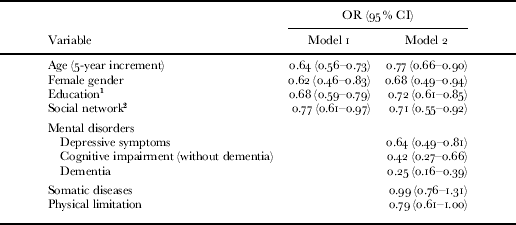
The pattern of participation in ‘at least one activity’ was strongly associated with age, gender, education and social network. Additional controls for mental disorders, somatic diseases and physical limitations confirmed these associations and indicated that contextual and health-related factors were also independently related to the participation in at least one activity, with the exception only of somatic diseases. Less participation was found in advanced age, and among women, people with a lower education level, limited social network, mental disorders, as well as physical limitations. Dementia was the factor most related to inactivity. Additional analyses showed no significant interaction between physical limitations and any of the mental disorders (Table 4).
Odds ratio (OR) and 95% confidence interval (CI) of participation in ‘at least one activity’ in relation to contextual and health factors
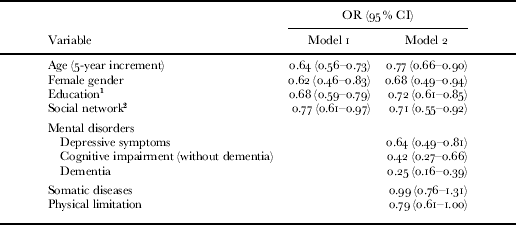
Notes: 1. One unit decrease in education level (elementary=3; intermediate=2; higher=1). 2. Social network (poor or limited=3; moderate=2; rich=1).
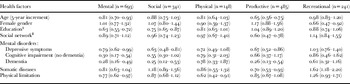
The pattern of participation in the five activity types in relation to the contextual and health factors is shown in Table 5. People in advanced old age were less active in mental and productive activities, and women participated less in recreational activities. Subjects with a lower education level participated less in mental and social activities while those with a limited social network decreased participation in productive activities. With the presence of either depressive symptoms or dementia, older people were less active in mental, social and productive activities, while the ones with cognitive impairment participated less in mental activities. Participants with somatic disease engaged less in productive but more in recreational activities. As expected, physical limitation was related to less participation in physical activities, but it was also unexpectedly related to decreased involvement in mental activities. Additional stratification analysis by gender revealed that, among men, contextual factors were not related to participation, or only marginally so. Among women, similar results from the whole population were observed, with the exception that the older participants were less active in physical activities (OR=0.67; CI: 0.50–0.90) and those with dementia were less active in recreational activities (OR=0.38; CI: 0.18–0.87). In summary, the findings of Table 5 reveal the unique relation of each of the studied factors to the specific activity types. While participation in activities belonging to the mental activity type group was influenced by older age, lower education level, mental disorders and physical limitation, participation in physical activity type activities was influenced only by physical limitations.
Odds ratio (OR) and 95% confidence interval (CI) of participation in the five activity types in relation to contextual and health factors

Notes: 1. One unit decrease in education level (elementary=3, intermediate=2, higher=1). 2. Social network (poor or limited=3; moderate=2; rich=1). ORs and 95% CIs were derived from logistic regression with demographic and health indicators simultaneously in the same model.
Discussion
We have described the pattern of participation in leisure activities in an older urban population in relation to different contextual factors and health indicators. The major findings from the study can be summarised as follows: (1) in spite of the advanced age, the majority of the population was active; (2) reading was the most popular individual activity, and the category of mental activities in general was the most popular type of activity; (3) advanced age, female gender, low education, poor or limited social network, mental disorders and physical limitation were associated with lower engagement in ‘at least one activity’; (4) contextual factors and health indicators were related differently to the five activity types, and category of mental activities was the most affected by all factors.
Our findings are in agreement with previous studies that have reported that most older people have an engaged lifestyle (Verbrugge et al. Reference Verbrugge, Gruber-Baldini and Fozard1996) and are involved in a variety of activities, and also that cognitive status and physical function explain a significant amount of the variance in activity engagement (Kolanowki et al. Reference Kolawnoski, Buettner, Litaker and Yu2006). Our finding that mental activities, particularly reading, are the most common leisure activities is in line with other studies (Hillerås et al. Reference Hillerås, Jorm, Herlitz and Winblad1999; Horgas, Wilms and Baltes Reference Horgas, Wilms and Baltes1998; Hu Reference Hu1990). An explanation for this finding may be that these activities usually do not require partner(s), special environments, or much expense (Baltes et al. Reference Baltes, Wahl and Schmid-Furstoss1990).
We observed that most of the young-old were involved in three or more activities while most of the old-old were inactive. The relation of decreasing activity to increasing age was independent of the contextual factors, functional and cognitive difficulties. We can presume that more time and energy are needed in advanced age for obligatory activities, such as IADL and ADL, which constrains the amount of time available to be devoted to leisure activities (Horgas et al. Reference Horgas, Wilms and Baltes1998; Lawton et al. Reference Lawton, Moss and Fulcomer1987).
Pattern of participation in ‘at least one activity’ varied across demographic factors as well as by health indicators, except somatic disease. Interestingly, women were less active than men, independently of the contextual factors, functional and cognitive difficulties. It can be speculated that women might not report certain activities, such as cooking or household chores, as they do not perceive these activities as leisure. It is important to note that older women may have reduced opportunities for leisure activities because of lower socio-economic status and less out-of-home mobility (Larson Reference Larsson2007; Mollenkopf et al. Reference Mollenkopf, Marcellini, Ruoppila, Széman, Tacken and Wahl2004). Low education level, as an indicator of lower socio-economic status and financial means, may lead to a more restricted choice of leisure activities (Kelly and Ross Reference Kelly and Ross1988; Strain et al. Reference Strain, Grabusic, Searle and Dunn2002) and may influence lifestyle choices (Pohjolainen et al. Reference Pohjolainen, Heikkinen, Lyyra, Helin and Tyrkko1997). Poor social network was related to a decreased number of individual activities engaged in, even after adjustment for contextual factors and health indicators. It is likely that older persons with a limited social network have less opportunity to participate in leisure activities. Finally, as expected, people with physical limitations and mental disorders were less active (Everard et al. Reference Everard, Lach, Fisher and Baum2000).
Our findings show that the five activity types were related differently to the contextual factors and health indicators. Surprisingly, advanced age was related to less participation in mental activities, regardless of the status of health conditions, including sight, even though this type of activity is suitable even in very old age (Baltes et al. Reference Baltes, Wahl and Schmid-Furstoss1990). An explanation may be a general decrease of interest in such particular activities. However, less participation in productive activities in advanced age is expected, since these activities are rather demanding (Glass et al. Reference Glass, Seeman, Herzog, Kahn and Berkman1995). Our finding that women participate less in recreational activities is consistent with an earlier report that women tend to spend (or report) more time in housework and cooking activities than recreational activities (Lawton et al. Reference Lawton, Moss and Fulcomer1987). Lower education level was found to be related to less participation in activities of the mental and social types. These types of activity probably attract participants who have had an education beyond the elementary level for their intellectual content. A limited social network was related to less participation in activities of the productive type, which is in line with our previous study that has suggested that a number of the activities belonging to this group have an important social component, since their ‘product’ is intended to be given to or shared with others (Karp et al. Reference Karp, Paillard-Borg, Wang, Silverstein, Winblad and Fratiglioni2006). In addition, a person with a poor or limited social network might not be able to engage in many activities that require a companion.
Participants with depressive symptoms and dementia were less active in mental, social and productive activities. We can speculate that either living with dementia or experiencing loneliness and/or feeling in low mood are mental states that prevent the older person from being fully active. Some mental disorders are often connected to mental fatigue and physical exhaustion, which naturally restrain a person from participation in challenging activity types (Berger et al. Reference Berger, Fratiglioni, Forsell, Winblad and Bäckman1999). However, the lower participation of the cognitively impaired applied only to mental activities, which suggests that their cognitive limitation was no obstacle towards a relatively active life. In line with a previous report (Herzog et al. Reference Herzog, Kahn, Morgan, Jackson and Antonucci1989), lower participation in productive activities (30%) and higher participation in recreational activities (60%) were related to the presence of somatic disease. Productive activities are rather challenging for an older person and some (e.g. cooking and housekeeping) need to be done regularly, which could be difficult in the presence of illness. On the other hand, most recreational activities are sedentary and less cognitively and physically challenging, and it is therefore sensible to think that persons with somatic disease were able to engage more often in activities of this type. Finally, the participants with physical limitation were less active in physical and mental activities. This is consistent with the finding that physical functioning is associated with cognitive functioning in older adults (Newson and Kemps Reference Newson and Kemps2005).
In separate analyses, we examined whether sight and vision impairment was related to participation in activities. The findings did not reveal any influence. Additionally, gender-specific analysis showed that the contextual factors had more influence among the women.
The present study has several strengths that deserve to be mentioned. First, it is a large community-based study that involves older people living in the community. Secondly, an open-ended question was used to obtain information about leisure activities directly from the participants or from proxies in the case of cognitive impairment or dementia. This method of ascertainment allows the gathering of a large range of information about personal perceptions of what is a leisure activity among the participants. The interpretation of the findings, however, needs to take into account some limitations. First, the open-ended question may not have captured detailed information and some activities may not have been reported. Secondly, information from the proxies may be less accurate than from the subjects. However, our findings are in agreement with two earlier studies that used activity-specific questionnaires in suggesting that demented older people are less active (Resnick, Fries and Verbrugge Reference Resnick, Fries and Verbrugge1997; Schroll et al. Reference Schroll, Jonsson, Mor, Berg and Sherwood1997). Finally, the pattern of leisure activities can only be generalised to older urban community dwellers of Northern Europe, as the activity pattern depends on various personal and environmental aspects that differ substantially from country to country (e.g. climate, traditions and infrastructure). For instance, older urbanites more frequently use public transport, for which reasonably good health is needed (de Groot et al. Reference De Groot, Verheijden, de Henauw, Schroll and van Staveren2004; Mollenkopf et al. Reference Mollenkopf, Marcellini, Ruoppila, Széman and Tacken2005). In fact, older persons with a limited social network, women, and those with impaired health and low economic resources tend to be particularly at risk of losing their ability to be active and mobile, especially outside their home (Mollenkopf et al. Reference Mollenkopf, Marcellini, Ruoppila, Széman, Tacken and Wahl2004).
Regarding the theory of activity participation in old age, our findings confirm that: (1) health conditions affect the pattern of activities in which an individual engages (Lawton Reference Lawton, Rowles and Ohta1983); (2) people with somatic disease do not reduce their participation, but rather compensate through new strategies that allow them to remain active, which supports the construct of ‘selective optimization with compensation’ (Baltes and Baltes Reference Baltes, Wahl and Schmid-Furstoss1990); and (3) high participation in activities among people with a rich social network supports the concept of ‘successful ageing’ (Rowe and Kahn Reference Rowe and Kahn1997).
The present study provides insights about the pattern of leisure activities among older community dwellers and the specific types of activity in which they are engaged. Recognition of the various, multidimensional and individualised ways to handle ageing and its consequences may help draw attention to the need for specific facilities for older people, especially among those experiencing mental and physical difficulties.
Acknowledgements
This study was supported by Solstickan (Sweden), the American Alzheimer Association, the Swedish Council for Working Life and Social Research (FAS), the Gamla Tjänarinnor Foundation, Swedish Brain Power, and the Centre for Health Care Science at Karolinska Institutet.