Introduction
Implicit memory does not require the intentional retrieval of the information presented during the study phase and is typically measured via repetition priming—a facilitation in the processing of previously encoded stimuli, relative to new stimuli (Stone, Ladd, Vaidya, & Gabrieli, Reference Stone, Ladd, Vaidya and Gabrieli1998). The present study examined repetition priming in patients with schizophrenia and healthy controls in word-stem completion (WSC) and verb generation (VG), and assessed the hypothesis that an increase in response competition should reduce priming more in patients than in controls.
Research on implicit memory has long been dominated by the Transfer-Appropriate-Processing (TAP) theory (Franks, Bilbrey, Lien, & McNamara, Reference Franks, Bilbrey, Lien and McNamara2000), which emphasizes a distinction between perceptual and conceptual priming. Data-driven implicit tasks (e.g., word-fragment and WSC) require the retrieval of the perceptual properties of the encoded stimuli. In contrast, conceptually driven implicit tasks (e.g., category exemplar generation) require the retrieval of the semantic properties of the stimuli. Experimental manipulations often have been found to dissociate these two types of priming, supporting the validity of the TAP principles (Mulligan, Reference Mulligan2008).
However, an alternative approach has gained popularity in the past two decades. Under this theoretical framework, the key differentiation would be that between identification (non-competitive) and production (competitive) priming (Gabrieli et al., Reference Gabrieli, Vaidya, Stone, Francis, Thompson-Schill, Fleischman and Wilson1999; Vaidya et al., Reference Vaidya, Gabrieli, Keane, Monti, Gutiérrez-Rivas and Zarella1997). Identification tasks (e.g., lexical decision, word-fragment completion) are those in which participants must identify, classify, or verify the attributes of target stimuli, and each response is limited to a single item. On the other hand, production tasks (e.g., WSC) are those in which participants must use a cue to produce a response, but the cue does not limit that response to a single item. Rather, the target stimulus must be selected amongst an array of plausible alternatives. Gabrieli et al. (Reference Gabrieli, Vaidya, Stone, Francis, Thompson-Schill, Fleischman and Wilson1999) maintained that a higher amount of attentional resources should be devoted to the encoding of target items in production than in identification tasks, because only in the former tests the studied stimuli must be selected amongst competing solutions. In agreement, they reported that patients with Alzheimer’s disease exhibited reduced priming in two production tasks (WSC and category exemplar generation), but intact priming in two identification tasks (picture naming and category verification).
Besides the forms of processing, the nature of the dependent measure must be also taken into account (e.g., Light, Prull, LaVoie, & Healy, 2000). Both identification and production tasks can assess repetition priming in terms of response latencies (e.g., lexical decision and VG) or the proportions of correct responses (e.g., perceptual identification and WSC). However, several findings suggest that the type of dependent measure might moderate attention effects in implicit memory. In particular, a meta-analysis by Light et al. (2000) found that the negative effects of ageing on implicit memory were more apparent in tasks using accuracy than reaction time measures, and Mulligan and Peterson (2008) reported that divided-attention manipulations known to reduce priming in accuracy-based tasks had no negative effects on the RT-based tasks of lexical decision and category verification. Thus, in the present study the effects of response competition were investigated in production tasks using both accuracy (WSC) and RT measures (VG).
Crucially, while the above-mentioned studies manipulated the level of response competition by using different tasks (Gabrieli et al., Reference Gabrieli, Vaidya, Stone, Francis, Thompson-Schill, Fleischman and Wilson1999; Vaidya et al., Reference Vaidya, Gabrieli, Keane, Monti, Gutiérrez-Rivas and Zarella1997), the present experiments compared priming in the low- and high-response-competition versions of the same tasks. Research conducted with this alternative methodology has typically failed to support the assumptions of the identification/production distinction (Prull, Reference Prull2010, Reference Prull2013; Spataro, Mulligan, & Rossi-Arnaud, Reference Spataro, Mulligan and Rossi-Arnaud2010). Geraci and Hamilton (Reference Geraci and Hamilton2009), for instance, had younger and older adults encoding a list of target words and then performing a WSC task with unique solutions (the low-response-competition condition) or multiple solutions (the high-response-competition condition). In contrast with the predictions of the identification/production hypothesis, no significant effects of ageing were observed, irrespective of the degree of response competition.
To date, the status of implicit memory in schizophrenia has been poorly characterized. Patients with schizophrenia show the same priming as healthy controls in tasks of lexical decision (Sponheim, Steele, & McGuire, Reference Sponheim, Steele and McGuire2004), perceptual identification (Schwartz, Rosse, & Deutsch, Reference Schwartz, Rosse and Deutsch1993) and word-fragment completion (Soler, Ruiz, Vargas, Daśi, & Fuentes, Reference Soler, Ruiz, Vargas, Dasí and Fuentes2011). In contrast, reduced priming in patients has been observed in studies using the conceptual tasks of category exemplar generation (Ruiz, Soler, Fuentes, & Tomás, Reference Ruiz, Soler, Fuentes and Tomás2007) and category verification (Marques et al., Reference Marques, Spataro, Cestari, Sciarretta, Iannarelli and Rossi-Arnaud2015). As concerns WSC, the results have been mixed, with evidence of both intact priming (Clare, McKenna, Mortimer, & Baddeley, Reference Clare, McKenna, Mortimer and Baddeley1993; Kazes et al., Reference Kazes, Berthet, Danion, Amado, Willard, Robert and Poirier1999; Perry, Light, Davis, & Braff, Reference Perry, Light, Davis and Braff2000; Soler, Ruiz, Dasí, & Fuentes-Durá, Reference Soler, Ruiz, Dasi and Fuentes-Durá2015) and impaired priming (Kern, Hartzell, Izaguirre, & Hamilton, Reference Kern, Hartzell, Izaguirre and Hamilton2010; Randolph, Gold, Carpenter, Goldberg, & Weinberger, Reference Randolph, Gold, Carpenter, Goldberg and Weinberger1993). Hence, with the exception of category verification, the overall pattern of results seems to be consistent with the predictions of the identification/production account, because the only tasks in which patients with schizophrenia exhibit reduced priming are those based on competitive, production processes (category exemplar generation and WSC).
However, drawing clear conclusions from between-task comparisons is difficult, because implicit tests vary on several dimensions in addition to the critical dimension of the number of legitimate responses. Therefore, in the following experiments the performance of patients with schizophrenia and healthy controls was compared in two versions of the WSC task with few or many solutions (Experiment 1; Geraci & Hamilton, Reference Geraci and Hamilton2009), and two versions of the VG task with one dominant response or no dominant response (Experiment 2; Prull, Reference Prull2010, Reference Prull2013). The use of different versions of the same tasks allowed us to isolate the effects of retrieval competition while holding constant the type of response, type of dependent measure, etc. (Spataro et al., Reference Spataro, Mulligan and Rossi-Arnaud2010). The aims were to determine whether patients with schizophrenia showed reduced priming in production tasks, and whether their deficits were magnified in the high-response-competition conditions. More specifically, the identification/production hypothesis of implicit memory would be supported if, compared to healthy controls, patients exhibit reduced priming in the high-response-competition versions of the two tasks, but intact priming in the low-response-competition versions. If this were the case, we expected to find in both experiments a significant three-way interaction between Item Status, Response Competition, and Group.
Experiment 1: Word STEM Completion
Experiment 1 examined repetition priming in the few- and many-solution versions of the WSC task.
Method
Participants
Twenty-four patients with schizophrenia (9 females) and 24 healthy controls (15 females) participated in Experiment 1. Patients were recruited from the Acute Psychiatric Care Unit of the ‘San Giovanni Evangelista’ Hospital (Tivoli, Italy), after approval from the local Research Ethics Board. All of them met the standard diagnostic criteria for schizophrenia, as determined by the Structured Clinical Interview of DSM-IV (American Psychiatric Association, 1994), medical history, and the joint consensus of the senior psychiatrists of the research team. Exclusion criteria were no history of substance abuse, traumatic brain injury, epilepsy, or other adverse neurological conditions. All the patients were stabilized by at least 1 week at the time of testing and treated with antipsychotic neuroleptics at clinically determined dosages—atypical only: N=10; typical only: N=12; both: N=2. The mean dose of antipsychotic medication in chlorpromazine equivalents was 376.58 mg (SD=274.80). Symptom severity indexes, as assessed with the Positive and Negative Syndrome Scale for Schizophrenia (PANSS: Kay, Opler, & Lindenmayer, Reference Kay, Opler and Lindenmayer1988), were 17.36 (positive scale), 21.76 (negative scale), and 34.74 (general psychopathology). Control participants were recruited from a variety of sources, and all of them denied a history of psychiatric disorders or other neuropsychological diseases. Written informed consent was obtained from all participants.
There were no significant differences between the two groups in terms of age, M(patients)=42.5, SD=10.3, vs. M(controls)=36.3, SD=14.9, t (46)=−1.67, p=.10, and the ratio of males to females, χ(1) 2=3.03, p=.082. However, healthy controls (M=15.1; SD=1.6) were more educated than patients (M=12.5; SD=3.6), t (46)=3.28; p=.002.
Design and Materials
Experiment 1 followed a 2 (Group: patients with schizophrenia vs. controls)×2 (Response Competition: low- vs. high-response competition)×2 (Item Status: studied vs. unstudied) mixed design.
A set of 60 words and the corresponding stems was selected from a pilot study in which 115 undergraduate students of the University Sapienza of Rome were presented with 100 word-stems and asked to complete each of them with the first word that came to mind. Using a median split procedure, we selected 30 words corresponding to few-solution stems (range: 3–20; M=13.10) and 30 words corresponding to many-solution stems (range: 27–64; M=39.30).
This critical set of 60 words was further divided into two sub-lists of 30 words (A–B). Each list included 15 words corresponding to few-solution stems and 15 words corresponding to many-solution stems. Independent sample t tests showed that the two sub-lists did not differ in the mean completion rates of stems (List A=15% and List B=14%, t(58)=0.13; p=.90), as well as in the length in letters (List A=7.16 and List B=7.10; t(58)=0.18; p=.89) and written frequency (taken from the CoLFIS vocabulary: Bertinetto et al., 2005; List A=111.23 and List B=113.79; t(58)=−0.08; p=.93) of the target words. The two sub-lists were used to counterbalance study status across participants. An additional set of 20 words and the corresponding stems were selected to be used as filler items in the encoding phase (10) or practice items in the test phase (10).
Procedure
The experiment consisted of three phases: an encoding phase, a brief interval, and a test phase. During encoding, participants read aloud 40 items, including 30 critical words (15 corresponding to many-solution stems and 15 corresponding to few-solution stems) and 10 filler words. The order of presentation was pseudo-randomized, such that no more than 3 words of the same type could appear in a row. Each trial comprised a fixation point (+) for 1000 ms, a word for 2000 ms and a pause for 1500 ms. Learning was incidental, since participants were not explicitly instructed to remember them.
After a brief interval (5 min of free-flowing conversation), participants were presented with a total of 70 stems, including 60 critical stems (15 few-solution stems of studied words, 15 many-solution stems of studied words, 15 few-solution stems of unstudied words, and 15 many-solution stems of unstudied words) and 10 practice stems. Each trial comprised a fixation point (+) for 1000 ms, a stem remaining on the screen until the participant’s response, and a pause for 1500 ms. The instructions were to complete each stem with the first word that came to mind.
Results and Discussion
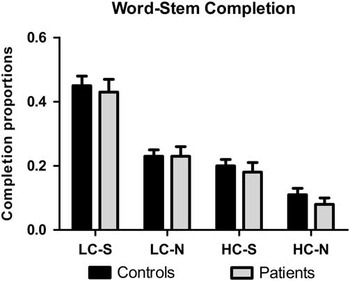
As mentioned above, patients with schizophrenia were significantly less educated and numerically older than healthy controls. We did not correct statistical analyses for the first variable, because fewer years of education are a common characteristic of schizophrenia due to the early onset of the disorder (Silverstein, Bakshi, Nuernberger, Carpinello, &Wilkniss, 2005). Thus, the mean proportions of stems completed with studied and unstudied words (illustrated in Figure 1) were submitted to a 2 (Item Status)×2 (Response Competition)×2 (Group) mixed analysis of covariance (ANCOVA), with age as the covariate. The results showed: (a) a significant main effect of Response Competition, F(1,45)=12.95, p=.001, η p 2=0.22, indicating that completion rates were higher for few- than for many-solution stems (M=0.34, SD=0.12, vs. M=0.15, SD=0.08); (b) a significant main effect of Item Status, F(1,45)=7.43, p=.009, η p 2=0.14, indicating that completion rates were higher to stems corresponding to studied than unstudied words (M=0.32, SD=0.14 vs. M=0.17, SD=0.08, respectively);
Mean proportions of stems completed in the word-stem completion task (adjusted for age), as a function of Group, Item Status, and Response Competition. Bars indicate standard errors. Note. LC-S=low competition condition, studied words; LC-N=low competition condition, new (unstudied) words; HC-S=high competition condition, studied words; HC-N=high competition condition, new (unstudied) words.

No other effect was significant, including the critical three-way interaction between Item Status, Response Competition and Group, F(1,45)=0.38, p=.54, indicating that increasing the level of response competition did not result in a selective reduction of priming in schizophrenic patients. Instead, the absence of a significant two-way interaction between Item Status and Group, F(1,45)=0.002, p=.96, demonstrates that both groups achieved significant priming by completing more stems of studied than unstudied words—for patients: M=0.31, SD=0.13 vs. M=0.16, SD=0.07, F(1,45)=22.18, p<.001; for controls: M=0.33, SD=0.12 vs. M=0.18, SD=0.08, F(1,45)=22.79, p<.001.
To assess the effects of medication on implicit performance, we computed Pearson’s correlations between the mean chlorpromazine-equivalent doses of antipsychotics and the proportions of stem completed by patients in each condition. Only the negative correlation with the proportions of stems completed with studied words in the high-response-competition condition reached significance, r(23)=−0.41, p=.048.
To summarize, the results of Experiment 1 were inconsistent with the predictions of the identification/production hypothesis of repetition priming, according to which patients with schizophrenia were expected to show reduced priming in the many-, but not in the few-solution version of the WSC task. Instead, our data join a body of research showing intact word-stem priming in schizophrenia (Clare et al., Reference Clare, McKenna, Mortimer and Baddeley1993; Kazes et al., Reference Kazes, Berthet, Danion, Amado, Willard, Robert and Poirier1999; Perry et al., Reference Perry, Light, Davis and Braff2000; Soler et al., Reference Soler, Ruiz, Dasi and Fuentes-Durá2015).
It is important to address the question of whether power was sufficient to detect a significant three-way interaction. To simplify, post hoc power computations were performed on priming scores, so that the critical three-way interaction between Item Status, Response Competition, and Group corresponded to the two-way interaction between Response Competition and Group. The to-be-reached effect size was estimated from Marvel, Schwartz, and Isaacs (Reference Marvel, Schwartz and Isaacs2004; Experiment 2), who examined the errors produced by patients with schizophrenia and healthy controls in the few- and many-solution versions of the WSC task. In that study, the effect size of the Group by Competition Condition interaction was d=0.28. Using the software G*Power 3.1 (Faul, Erdfelder, Lang, & Buchner, 2007), it turned out that the post hoc power to achieve a significant two-way interaction of the same size was 0.91.
Experiment 2: Verb Generation
Experiment 2 examined repetition priming in two versions of the VG task having one dominant verb response (the low-response-competition condition) or no dominant verb response (the high-response-competition condition).
Method
Participants
An independent sample of 22 patients with schizophrenia (15 women) and 34 healthy controls (21 women) participated in Experiment 2. There were no differences between the two groups in terms of ratio of males to females, χ(1) 2=0.24, p=.62. However, patients were older and less educated than controls, M(patients)=42.5, SD=10.3, vs. M(controls)=33.9, SD=13.8, t(54)=2.51, p=.01, and M(patients)=13.0, SD=3.5, vs. M(controls)=15.8, SD=2.1, t(54)=−3.76, p<.001.
Participants were recruited following the same exclusion criteria described in Experiment 1. Among the patients with schizophrenia, 14 were treated with atypical neuroleptics, 7 with typical neuroleptics and 1 with both. The mean daily oral dose was 350.37 (SD=211.24) chlorpromazine equivalents. PANSS symptom severity indexes were 17.06 (positive scale), 21.97 (negative scale), and 34.72 (general psychopathology scale).
Design and Materials
Experiment 2 followed the same mixed design of Experiment 1. A set of 88 nouns were selected from a pilot study in which 100 undergraduate students of the University Sapienza of Rome (Italy) were presented with 120 nouns and told to generate the first verb semantically associated to each of them. The selection criterion was aimed at creating two noun groups differing in terms of response competition (see Thompson-Schill, D’Esposito, Aguirre, & Farah, Reference Thompson-Schill, D’Esposito, Aguirre and Farah1997). Low-competition nouns (N=44) were those for which the ratio between the frequencies of the first- and second-most common verb responses was high (range: 3–48; M=9.35). For example, for the noun chiave (“key”), the verbs aprire (“to open”; frequency=72) and girare (“to turn”; frequency=12) were the first and the second most common completions: hence, the response strength ratio was 72/12=6. On the other hand, high-competition nouns (N=44) were those for which the response strength ratio was low (range: 1–3; M=1.80). For example, for the noun lettera (“letter”), the verbs scrivere (“to write”; frequency=57) and spedire (“to mail”; frequency=21) were the first and the second most common completions: hence, the response strength ratio was 57/21=2.71.
This original set was randomly divided into two sub-lists (A–B) of 44 nouns. Each sub-list included 22 low-competition and 22 high-competition nouns. A series of between-item t tests for independent samples showed that the nouns included in the two sub-lists were equated on response strength ratio (List A=5.34 vs. List B=5.81, t(86)=−0.33, p=.74), written frequency (List A=248.02 vs. List B=245.27, t(86)=0.05, p=.96), and length in letters (List A=6.30 vs. List B=6.25, t(86)=0.12, p=.90). These sub-lists were used to counterbalance study status across participants. An additional set of 20 concrete nouns were selected to be used as practice items in the encoding (10) or test (10) phases.
Procedure
The experiment consisted of three phases: an encoding phase, a brief interval and a test phase. During the encoding phase, participants were presented with a total of 54 nouns, including 22 high-competition, 22 low-competition, and 10 practice nouns. The instructions were to produce, as quickly as possible, the first verb semantically associated to each noun that came to mind. The order of presentation was pseudo-randomized, with the constraint that no more than three nouns of the same type could appear in a row. Each trial comprised a fixation point (+) for 500 ms, a noun that remained on the screen until a vocal response was recorded, and a pause for 2000 ms. Learning was incidental, since participants were not told to remember the words.
After a brief interval (5 min of free-flowing conversation), participants were presented with a total of 98 nouns, including 88 critical nouns (22 low-competition studied, 22 high-competition studied, 22 low-competition unstudied and 22 high-competition unstudied nouns), and 10 practice nouns. Task instructions were the same as those illustrated for the encoding phase.
Results and Discussion
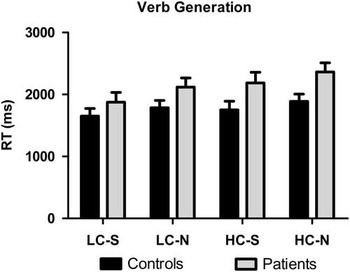
As mentioned above, patients with schizophrenia and controls differed in terms of both age and education. As in Experiment 1, we did not correct for education (Silverstein et al., 2005). Thus, the mean correct RTs (illustrated in Figure 2) were submitted to a 2 (Item Status)×2 (Response Competition)×2 (Group) mixed ANCOVAs, with age as the covariate. Microphone failures, errors and RTs greater than 2.5 SD from the overall mean of each participant were excluded (12% and 4% of data for patients with schizophrenia and controls, respectively). The results showed: (a) a significant main effect of Response Competition, F(1,53)=4.76, p=.030, η p 2=0.08, indicating that verb responses were slower to high- (M=2047 ms, SD=728 ms) than to low-competition nouns (M=1857 ms, SD=701 ms); (b) a significant main effect of Item Status, F(1,53)=15.76, p<.001, η p 2=0.23, indicating that verb responses were faster to studied (M=1867; SD=751 ms) than to unstudied nouns (M=2038 ms, SD=671 ms); (c) a non-significant trend toward a main effect of Group, F(1,53)=3.46, p=.068, η p 2=0.06, indicating that verb responses tended to be slower for patients with schizophrenia (M=2136 ms; SD=1122 ms) than for healthy controls (M=1769 ms; SD=890 ms); (d) a significant interaction between Response Competition and Group, F(1,53)=4.54, p=.038, η p 2=0.07. A follow-up analysis of simple effects indicated that that the verb responses of patients with schizophrenia were slower than those of controls for high-competition nouns, M=2274, SD=1166 ms vs. M=1820 ms, SD=927 ms, F(1,53)=4.89, p=.031, η p 2=0.09, but not for low-competition nouns, M=1997, SD=1129 ms vs. M=1717 ms, SD=890 ms, F(1,53)=2.01, p=.16. Conversely, the effect of Response Competition was significant in both groups, although numerically larger in patients, F(1,53)=19.69, p<.001, η p 2=0.27, than in controls, F(1,53)=4.27, p=.044, η p 2=0.08.
Mean RTs in the verb generation task (adjusted for age), as a function of Group, Item Status, and Response Competition. Bars indicate standard errors. Note. LC-S=low competition condition, studied words; LC-N=low competition condition, new (unstudied) words; HC-S=high competition condition, studied words; HC-N=high competition condition, new (unstudied) words.

No other effect was reliable, including the critical three-way interaction between Item Status, Response Competition, and Group, F(1,53)=0.43, p=.51. As in Experiment 1, this result indicates that increasing the degree of response competition did not selectively reduce priming in patients. If anything, the absence of a significant two-way interaction between Item Status and Group, F(1,53)=0.97, p=.33, demonstrates that both groups exhibited significant priming by responding faster to studied than to unstudied nouns—for patients: M=2036, SD=1204 ms, vs. M=2250 ms, SD=1077 ms, F(1,53)=13.60, p<.001, η p 2=0.20; for controls: M=1698, SD=957 ms, vs. M=1833 ms, SD=852 ms, F(1,53)=8.50, p=.005, η p 2=0.14.
No significant correlations emerged between the mean chlorpromazine-equivalent doses of antipsychotics and the RTs of patients, all r(21)s<0.16, p>.48.
As in Experiment 1, we estimated the post hoc power to achieve a significant three-way interaction. Computations were again performed on priming scores, such that the three-way interaction between Item Status, Response Competition, and Group could be reduced to the two-way interaction between Response Competition and Group. The to-be-reached effect size was drawn from Marvel et al. (Reference Marvel, Schwartz and Isaacs2004; Experiment 1), who examined the errors produced by schizophrenic patients and healthy controls in the high- and low-competition versions of the VG task. In that study, the effect size of the interaction between Group and Competition Condition was d=0.24. Using the software G*Power 3.1 (Faul et al., 2007), it turned out that the post hoc power to obtain a significant two-way interaction of the same size was 0.94.
In summary, Experiment 2 found a pattern of results similar to that reported in Experiment 1, which did not support the predictions of the identification/production hypothesis. Clearly, the possibility to make appropriate generalization between the two sets of data should be tempered by considering that Experiment 1 and 2 used different samples of participants and different dependent variables. In addition, two other limitations merit discussion. First, the verb responses of our participants were quite slow, when compared with those obtained in previous studies (Prull, Reference Prull2010, Reference Prull2013). This result might be due to the fact that the present sample was older and slightly less educated than the typical student samples used in experimental research; in fact, participants’ ages correlated positively with the RTs to studied nouns (r=0.29, p=.033 and r=0.28, p=.035 in the low- and high-competition conditions), and the number of education years correlated negatively with the RTs to studied and unstudied nouns in both conditions (r<−0.23; p<.086). In addition, we must note that the mean response strength ratio of our low-competition nouns (M=9.35) was somewhat lower than that obtained by Prull (Reference Prull2010: M=17.89), possibly suggesting less automatic processes of VG. A second limitation is that, for patients with schizophrenia, a substantial amount of data (12%) was eliminated from statistical analysis, because of errors or inappropriate responses (“um”). This appears to be a general methodological problem associated with the use of the VG paradigm, since the proportion of removal for healthy adults (4%) was similar to that reported by Prull (Reference Prull2004; 4.94%).
General Discussion
The present study examined the effects of repetition priming and response competition in patients with schizophrenia and healthy controls in two different implicit tasks, WSC and VG. The main results can be summarized as follows. First, response competition influenced both the proportions of stems completed (higher to few- than to many-solution stems) and the RTs of verb responses (slower to high- than to low-competition nouns), suggesting that our manipulations were effective. Second, repetition priming facilitated the performance of patients and healthy controls to the same extent in both tasks. Third, implicit priming in patients with schizophrenia was not disproportionally impaired by increases in response competition, as indicated by the absence of significant three-way interactions between Item Status, Response Competition and Group. Notably, the latter result held in both experiments, despite previous evidence suggesting attentional differences between accuracy- and RT-based tasks (Light et al., 2000).
When considered in the context of previous research, our data raise problems for the distinctions between perceptual-conceptual and identification/production processes. As mentioned above, the TAP theory distinguishes between perceptual and conceptual processing (Franks et al., Reference Franks, Bilbrey, Lien and McNamara2000), and suggests that the achievement of significant priming should demand more attention resources in conceptual than in perceptual tasks (Mulligan & Hartman, Reference Mulligan and Hartman1996). When applied to schizophrenia, the TAP theory predicts that patients should exhibit reduced priming in conceptually, but not in perceptually driven implicit tasks (Marques et al., Reference Marques, Spataro, Cestari, Sciarretta, Iannarelli and Rossi-Arnaud2015), because attentional problems are one of the hallmarks of cognitive deficits in schizophrenic patients (Barch & Ceaser, Reference Barch and Ceaser2012). In contrast with this hypothesis, we found that patients showed intact priming in the VG task, which has been characterized as conceptual in nature (Seger, Rabin, Desmond, & Gabrieli, Reference Seger, Rabin, Desmond and Gabrieli1999; Thompson-Schill & Kan, Reference Thompson-Schill and Kan2001). Similarly, the distinction between identification and production processes suggests that patients with schizophrenia should be impaired in production, but not in identification priming tasks. This is because only production tasks require the selection of the studied items amongst an array of alternative responses—a process supposed to be attention demanding (Gabrieli et al., Reference Gabrieli, Vaidya, Stone, Francis, Thompson-Schill, Fleischman and Wilson1999). However, we found intact priming in patients in word stem completion and VG, two tasks clearly based on production processes—particularly in the high-competition versions (Prull, Reference Prull2013). Moreover, a previous study found a significant deficit in the conceptual task of category verification (Marques et al., Reference Marques, Spataro, Cestari, Sciarretta, Iannarelli and Rossi-Arnaud2015), which is based on identification processes and thus should be spared in schizophrenia.
A primary aim of our study was to evaluate the role of response competition in the performance of patients with schizophrenia. To overcome the limits of a between-task comparison, drawing on past research, we devised two versions of the WSC task with few or many solutions (Geraci, Reference Geraci2006; Geraci & Hamilton, Reference Geraci and Hamilton2009), and two versions of the VG task with one dominant response or no dominant response (Prull, Reference Prull2013). The present findings provide no evidence in support of the hypothesis that the patients’ impairment in repetition priming should be more apparent in conditions of high than low response competition. From this point of view, our conclusions are in agreement with several previous studies that have used the same approach and have failed to support the predictions of the identification/production distinction (Geraci, Reference Geraci2006; Geraci & Hamilton, Reference Geraci and Hamilton2009; Prull, Reference Prull2004, Reference Prull2010, Reference Prull2013; Spataro et al., Reference Spataro, Mulligan and Rossi-Arnaud2010). Methodological differences between studies might have a causal role in explaining the discrepant results reported in literature. Recent research has shown that patients with schizophrenia achieve the same word-stem priming as control participants, when issues related to the lexical and perceptual characteristics of stimuli are carefully controlled (Soler et al., Reference Soler, Ruiz, Dasi and Fuentes-Durá2015). In a similar way, drawing inferences from the comparison of different set of studies may lead to inaccurate conclusions about the role of response competition in schizophrenia, because the effects of retrieval competition are confounded with differences due to the type of response, the type of dependent measure, and the general nature of retrieval cues (Spataro et al., Reference Spataro, Mulligan and Rossi-Arnaud2010). Instead, our data demonstrates that, when all other factors are kept constant, the manipulation of response competition does not produce negative effects on the implicit performance of patients with schizophrenia.
More generally, the current results bear additional evidence on the question of the functional status of search and selection processes in schizophrenia (Marvel et al., Reference Marvel, Schwartz and Isaacs2004). Desmond, Gabrieli, and Glover (Reference Desmond, Gabrieli and Glover1998) examined brain activations in healthy individuals while they covertly completed three-letter stems with few or many solutions. The results showed that, in the few-solution condition, activation was higher in the right cerebellar vermis and hemisphere than in the frontal cortex; in contrast, in the many-solution condition, brain activation was higher in the left middle frontal gyrus than in the cerebellum. The authors proposed that the left frontal lobe contributed to the selection of a word among multiple competing alternatives, whereas the right cerebellum contributed to the search of a specific word. In Experiment 1, the correlation between the mean doses of antipsychotics and the proportions of studied words produced in the high-response-competition condition suggested a mild effect of symptoms’ severity on selection processes.
Likewise, in Experiment 2 the marginal main effect of Group and the significant interaction between Response Competition and Group were indicative of at least a small effect of patient status on processing speed. Impaired processing speed is a common feature in schizophrenia and a robust predictor of functional outcome (Sanchez et al., Reference Sanchez, Ojeda, Pena, Elizagarate, Yoller, Gutierrez and Ezcurra2009). Of interest, a recent study showed that activation of the dorsolateral prefrontal cortex correlated with the severity of patients’ processing speed impairment (Woodward, Duffy, & Karbasforoushan, 2013). The neural overlap with the putative locus of selection processes (Desmond et al., Reference Desmond, Gabrieli and Glover1998) might explain why the processing speed deficit of patients with schizophrenia was exacerbated in conditions of high-response competition. Additional neuroimaging studies are needed to corroborate this hypothesis.
To summarize, we showed that patients with schizophrenia have intact priming in two production tasks, WSC and VG, supporting the conclusion that implicit memory is spared in this psychiatric disorder (Clare et al., Reference Clare, McKenna, Mortimer and Baddeley1993; Kazes et al., Reference Kazes, Berthet, Danion, Amado, Willard, Robert and Poirier1999; Perry et al., Reference Perry, Light, Davis and Braff2000; Ruiz et al., Reference Ruiz, Soler, Fuentes and Tomás2007; Schwartz et al., Reference Schwartz, Rosse and Deutsch1993; Soler, Cestari, & Rossi-Arnaud, 2011; Soler et al., Reference Soler, Ruiz, Dasi and Fuentes-Durá2015; Sponheim et al., Reference Sponheim, Steele and McGuire2004). In addition, the repetition priming of patients was not selectively impaired in the high-response-competition versions of the two tasks, providing additional problems for the identification/production hypothesis of implicit memory (Geraci, Reference Geraci2006; Geraci & Hamilton, Reference Geraci and Hamilton2009; Prull, Reference Prull2004, Reference Prull2010, Reference Prull2013; Spataro et al., Reference Spataro, Mulligan and Rossi-Arnaud2010).
Acknowledgments
There was no conflict of interests for this article.