The Revolutions of 1848 and 1918/19 resulted in the martyrdom of German opposition members whose burial sites – the Cemetery of the March Revolution (Friedrichshain) and the Public Cemetery in Friedrichsfelde, respectively – would be consecrated and desecrated, contested and reinterpreted, relocated and redesigned, ignored and filled with pomp over the course of modern history. The radically altering status of these burial sites resulted from changes of regime and official ideology, and changing political relations in Berlin, Germany and Europe; strained relations between German socialists and communists playing an especially salient role. This case study, then, illustrates an especially convulsive trajectory in the politics of commemorative landscapes,Footnote 1 involving a dynamic relationship between ‘objective’ official history and the broader, diffuse realm of memory – from which it emerges and which it in turn shapes – as changes in regime led to the alignment and divergence of the perspectives of the German state and German communists.Footnote 2 Artifacts, quotations, paintings and landscapes of commemoration can function, in different situations, as components in a narrative of history or as devices of memory, used to contest the same narrative.Footnote 3 This case study vividly illustrates movement between history and memory, and displays glimpses of the role individuals play as agents and subjects of this interchange.Footnote 4 Yet, subtleties in the semantics of place are also evident, as slight shifts in location or in the design of a memorial bear implications not evident to those unfamiliar with the intricacies of the political and spatial context. The urban environment, in which social action occurs, is comprised of a mosaic of place-based meanings inscribed in a network of physical spaces. This article includes a micro-level analysis of this process of ‘inscription’ focusing on two sites.
The method used to analyse meaning in the urban landscape is situated between Koshar's approach to collective memory and semiotic approaches to the built environment. Koshar analyses the transformation of collective memory through a ‘triad’ including human agents, the ‘highly resonant parts of a memory landscape’ and ‘themes and symbols that are the raw material of the framing devices and meanings themselves’.Footnote 5 In this article, the triad is evident in the agency of Wilhelm Pieck, socialist political parties, and Berlin municipal government, the resonance of the cemeteries and the themes and symbols represented in memorial designs. An additional layer of analysis is added, examining how themes and symbols are borne in the landscape.Footnote 6 Meaning is seen as the product of three factors operating simultaneously: (1) representation, (2) spatial relations and (3) place-based associations. Representation includes text, symbols and icons that are inscribed in physical space in physical media, i.e. architecture, sculpture, bas-relief, banners, etc.Footnote 7 Spatial relations include physical qualities such as size, proportion, distance, direction and pattern as applied to the space(s) constituting a place, its connection to surrounding spaces, the representations it contains, etc.Footnote 8 Spatial relations are critical in determining meaning in the landscape; equivalent to syntax in language. Spatial qualities simultaneously function at a pragmatic level, enabling, enhancing, detracting from or even eliminating certain sizes and types of social activities. Finally, when a physical space acquires social meaning, it becomes a ‘place’. Place-based associations may be formed through representations and social activities occurring there, from spontaneous, dramatic events to regular ritualistic activity. Thus, place functions as a repository of meaning inscribed through representation and social action. Conversely, social action and representation acquire their meaning, in part, from existing place-based meaning.
Recent publications on Berlin have considered the relationship between identity politics and landscapes of commemoration, but the cemeteries have not been examined in this regard.Footnote 9 East German monographs on these sites were written from the perspective of the communist state,Footnote 10 thus identity politics were only examined to the extent that they promoted the values of the German Democratic Republic (GDR). This article examines the changing relationship between state history, political practice and place-based identity, without regarding any of these factors as determinant. Place-based identity does not appear as a tool of communist history, but as a medium of both memory and of history.
Revolution of 1848: Cemetery of the March Revolution (Friedrichshain)
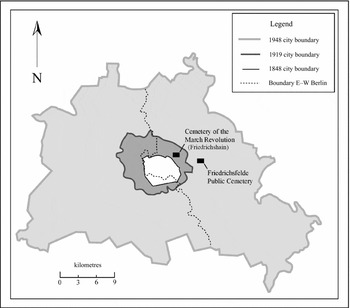
Revolution spread through Europe in 1848 as oppressed workers and a powerful middle class rose up against monarchal rule.Footnote 11 In Berlin, the revolution began on 18 March, when, after a few days of minor street-fighting, demonstrators assembled before the Berlin Palace to petition the Prussian king. Shots were fired into the crowd, barricades went up throughout the city and fighting ensued. The following morning the king withdrew his troops from the city and was forced to make concessions, although the monarchy gradually managed to nullify the reforms.Footnote 12 The revolutionaries brought some of the 270 fallen to the Palace courtyard on stretchers decorated with flowers, twigs and laurel leaves. After calls from the crowd, the king appeared on the balcony and removed his hat in a gesture of recognition. A public funeral ceremony took place a few days later: ‘the Revolution's Victims were brought . . . along Unter den Linden, past the Palace, across Alexanderplatz and through Landesberg Gate [later Leninplatz] to Friedrichshain, where they were ceremoniously interred’.Footnote 13 Now sanctified, this cemetery at the periphery of Berlin became the destination of an annual pilgrimage by Berlin workers to honour those who died in the revolution (Figure 1).Footnote 14 According to Marxist–Leninist historiography, the Revolution of 1848 was Germany's ‘bourgeois-democratic revolution’, a major step in the progression of the German nation towards socialism, though less important than the Revolution of 1918/19, which was taken as the socialist revolution.Footnote 15
Location map. Martyrs of the both revolutions were buried just beyond the borders of the city of their times. The communist revolutionaries of 1918/19 hoped to bury their martyrs with those of 1848, but were forced to the periphery by the Social-Democratic government. Map adapted from R. Bauer and E. Hühns et al., Berlin: 800 Jahre Geschichte in Wort und Bild (Berlin, VEB Deutscher Verlag der Wissenschaften, 1980), p. 23; Berlin, ‘Pharus-Plan’ (Berlin, Pharus, 1940). Cartography by Dayna Tinsley.

Revolution of 1918/19: the Memorial of the Revolution (Friedrichsfelde)
The first socialist political parties in Germany emerged in the 1860s, and were merged in 1875 to form the Socialist Labour Party, which later became the Social Democratic Party of Germany (SPD).Footnote 16 World War I ultimately moulded the political boundaries of socialism in Germany, as splinter groups formed to express their opposition. The radical Spartacists, led by Karl Liebknecht and Rosa Luxemburg, followed the Soviet model of socialism, which included internationalism, revolution and ‘dictatorship of the proletariat’. In contrast, the SPD remained nationalist, reformist and in favour of parliamentary democracy. In 1918, uprisings, strikes and the collapse of the war effort led to the resignation of the Kaiser and declaration of a new German republic. Conflict between the SPD and socialist splinter groups shaped the effort to design the new government, with battles in the political arena and on the streets. The Spartacists formed the Communist Party of Germany (KPD) in January 1919 and instigated a large uprising in March. The ruling SPD allied itself with militarists, who then subdued the uprisings, resulting in over 1,200 deaths, the arrest of numerous communist leaders, the murder of Liebknecht and Luxemburg and a seemingly unbridgeable gap between the SPD and KPD. In August 1919, the new constitution was ratified and the Weimar Republic was founded as a parliamentary democracy.
The KPD requested permission to bury Liebknecht and Luxemburg in the Cemetery of the March Revolution, but was declined by the Magistrat (administrative branch of Berlin's municipal government). At this point, Wilhelm Pieck, one of the founders of the KPD, began his long-running involvement with the cemeteries. He would go on to represent the KPD in the German parliament from 1928 until the National Socialists' (Nazis) assumption of power in 1933, when he went into exile in Moscow Pieck, and other KPD leaders personally brought the issue to the attention of the mayor of Berlin, who claimed that there was no more space available in the cemetery. Instead, the Magistrat allocated a plot in Friedrichsfelde, located beyond the city boundaries at that time (Figure 1). The SPD, viewing themselves as heirs of the 1848 Revolution in a lethal conflict with the KPD since the Revolution of 1918/19, could only balk at the prospect of interring communist martyrs alongside the ‘democratic’ martyrs of 1848. Spatially peripheralizing the burial site, relegating the fallen revolutionaries to the urban edge, reduced its significance in the city's symbolic landscape.
The decision to construct a memorial for Luxemburg, Liebknecht and other martyrs was made at the end of 1923 by the leaders of the KPD, including Wilhelm Pieck.Footnote 17 The corner stone for the Memorial of the Revolution (Revolutionsdenkmal) was laid by Pieck on 15 June 1924, the fifth anniversary of Rosa Luxemburg's burial. According to communist sources, the police interfered with the KPD's procession to the cemetery at various points and only small delegations were permitted entry. A few hundred participated in the ceremony, and Wilhelm Pieck buried a capsule including a statement vowing to avenge the fallen heroes of the revolution.Footnote 18
The memorial, completed in April 1926, was built of brick with black mortar. Stretching 12 metres long, 4 metres high wide and 6 metres high: ‘the memorial awoke a gloomy, but . . . massive impression. Rising up defiantly from the memorial was a long flagpole, upon which a red flag waved. On the right side of the memorial a large Soviet Star was fastened.’Footnote 19 The words ‘Ich war – ich bin – ich werde sein’ appeared on the memorial, and were attributed to Rosa Luxemburg writing on revolution.Footnote 20 The wall-like form of the memorial was to recall the ‘Wall of Federalists’ against which the Paris Commune was shot in 1871. The masonry blocks were to symbolize the power and massiveness of the working-class movement.Footnote 21 Thus, the communist tenets of ‘internationalism’ and ‘revolution’ were central to the design and manifest in several ways. The memorial monumentally asserted the role of German communist martyrdom in the teleology of world historical progress towards socialism, a distinctly communist perspective inscribed on the edge of Berlin, where tolerated by the state.
The memorial was unveiled on 13 June 1926. Pieck delivered the keynote speech, depicting the SPD as serving the forces of reaction and calling for the organization of a revolution to overthrow the Weimar Republic – which, according to Marxist–Leninist teleology, was necessary for historical progress towards true socialism.Footnote 22 Every January thereafter, until the Nazi seizure of power, the KPD organized a march to the memorial where a ceremony was held. The event came to be known as the ‘L-L-L Ceremony’ in honour of Liebknecht, Luxemburg and Lenin, and was deeply etched in the memory of KPD members. Pieck spoke at the ceremony every year he was able until the Nazi seizure of power.Footnote 23
The National Socialist era: effacement
The KPD and SPD remained adversarial throughout the life of the Weimar Republic. On occasion, the KPD collaborated with their arch-enemy, the Nazis, in actions to undermine the SPD and the Republic. In the elections of November 1932, the Nazis received the most votes, but the combined votes of the two socialist parties was larger, a fact that would not be forgotten after the war. Hitler was appointed chancellor in 1933, and soon members of both the KPD and SPD were arrested, tortured and murdered.
National Socialist history was extremely averse to sites of communist memory, and effacement was quickly initiated. Iconography and text, as the most explicit and easily removable expressions, were targeted first: the Soviet star and the words of Rosa Luxemburg were quickly removed from the memorial. Visitors regularly came to the cemetery, but were either driven off, or were ‘arrested, interrogated and usually sent to prison or a concentration camp’.Footnote 24 In 1935, the Nazis dismantled the memorial, exhumed the graves of socialists and interred newly deceased civilians. The sarcophagus containing Liebknecht's remains was buried at an unmarked site where it survived the war, but Luxemburg's were never recovered.Footnote 25 This effacement of place assaulted communist memory, as a component in a broader effort to destroy communism itself.
Although not directly targeted, the Cemetery of the March Revolution was neglected and in a state of disarray at the end of the war. In Nazi state history, the 1848 Revolution ‘appeared outwardly as the bourgeoise revolution’, but ‘in reality represents the beginning of the battle for internationalism, parliamentarism, and capitalism, therefore the world domination of Jewry’.Footnote 26
The communist Magistrat: re-sanctification and ‘unity’
With the end of World War II in May 1945, Berlin was divided into four sectors, each within the jurisdiction of one of the four major allies. The Soviet Sector (later East Berlin) included the historic core of the city and both of the revolutionaries' cemeteries. The Soviets were the first to occupy the city, and thus established the German-run local government, including the Magistrat (administrative branch of Berlin's government) and City Council (executive branch), and placed communists in key positions in the government. In an effort to appear independent of the Soviet system, the government called for an ‘anti-fascist, democratic front’ consisting of all political parties opposed to the fascist past, in other words, all permitted parties.Footnote 27 The focal point of this attempted, inter-party rapprochement was the relationship between the SPD and KPD, as the tragic events of the Nazi Era provided impetus for members of both parties to pursue unity. Walter Ulbricht (the most powerful figure in the KPD and later in the GDR) initiated a ‘clarification process’ to develop a common platform as a basis for unification. The SPD soon began losing enthusiasm for the effort as their complaints about Soviet Military Administration (SMAD) favouritism towards the KPD went unattended. After the communists' disastrous showing in Hungarian and Austrian elections in autumn 1945, the SMAD and KPD began a coercive unification process, including ‘a ban on [SPD] assemblies, support for proponents of unity and massive intimidation and arrest of opponents of unity’.Footnote 28 The KPD and the Eastern Zone SPD were forcibly merged to form the Socialist Unity Party (SED) on 22 April 1946, while the SPD in the Western Zones remained independent after voting down the merger.Footnote 29 Animosity between the Western SPD and the SED continued throughout the life of the GDR.
On 28 May 1945, just nine days after being established by the SMAD, the Berlin Magistrat resolved, ‘A grove of honour will be erected to the honour of all deceased pioneers and as an exhortation to all citizens of the new Berlin’,Footnote 30 initiating post-war planning regarding the revolutionaries cemeteries. It is clear from Pieck's file notes that all correspondence on the project was directed to him and that he was in charge of the project.Footnote 31 This is logical, given the depth of Pieck's emotional attachment to the site and the issue as he was a personal friend of many communists buried in Friedrichsfelde and could easily have been among them.Footnote 32 Pieck surveyed the site on 6 December 1945 and wrote to Karl Maron (deputy mayor of Berlin and member of the Central Committee of the SED) calling for a Magistrat resolution to reconstruct the memorial.Footnote 33 Pieck suggested combining the graves of the ‘old socialists’ (pre-1918 Social Democrats who had not been buried at the memorial) with those from the 1918/19 Revolution. He also suggested turning the Cemetery of the March Revolution into a memorial site. The Magistrat followed all of Pieck's suggestions, passing a resolution on 17 December 1945. The basis for reconstructing the memorial was to make the living generation aware of the sacrifices made by the socialist movement to battle feudalism, imperialism and fascism, and the continuation of this battle in the present day, against the remnants of fascism.Footnote 34 The ‘anti-fascist, democratic front’ as a common cause of opposition to feudalism and fascism was easier to define than a clear vision of the future, or even a present identity, beyond ‘democracy’ – a term employable to bestow legitimacy on innumerable forms of government.Footnote 35
In January 1946, Pieck used the L-L-L Ceremony as a platform to prepare for the upcoming unification of the SPD and KPD, or more aptly, the absorption of the former into the latter. Pieck spoke near a wooden replica of the original memorial:
The goals of Reaction . . . were supported by the disastrous division of the KPD and SPD. That we both stand united here at the graves of the victims is a sign that we have learned. We do not want to repeat the mistakes of 1918 and want to vow that we will not rest until unity has been established.Footnote 36
This assertion of reconciliation would be symbolically demonstrated by combining the graves of heroes recognized by the Social Democrats (old socialists) with communist martyrs, creating a unified place of commemoration. However, the communist content of the original memorial in Friedrichsfelde strongly hinted at the future identity of the unified workers' party, and the addition of the bodies of ‘old socialists’ to this reconstructed memorial suggests they were part of a linear progression leading to communism – a co-optation of memory.
SPD victory and increasing tension: shifting plans
In April 1946, the forced merger of the socialist parties into the SED led to increased tension between the SMAD and Berlin residents. In the October 1946 elections in Berlin, the SED obtained just 20 per cent of the vote, compared with 49 per cent for the SPD, which now controlled the City Council. The Soviets initiated a campaign of terror directed at Berliners supporting the Western allies, with thousands disappearing from the streets of East and West Berlin.Footnote 37 Tension escalated further in June 1947 with the announcement of the Marshall Plan and the Soviet veto of anti-communist Ernst Reuter's (SPD) election as mayor of Berlin. The SED soon changed its self-depiction from a member of the ‘anti-fascist front’, to the leader of the ‘battle for German unity’, fighting against the efforts of the Western allies to split the nation.
In November 1946, Pieck continued his efforts to move the project forward and proposed changes to the resolution from 1945 in a letter to Mayor Werner (unaffiliated).Footnote 38 Furthering his concept, he called for a combination of graves from the 1848 Revolution, the ‘old socialists’ (Wilhelminian Era), those from the Revolution of 1918/19 and some ‘prominent Communist and Social Democratic leaders murdered by Hitler’.Footnote 39 Thus, the memorial would display a complete historical representation of working-class martyrdom for social progress. Pieck presented a layout, including a ‘memorial sculpture’ in the centre of a large circle, and he did not specify any hierarchical treatment of the martyrs of different eras. Political overtones are evident in the shift in interest from reconstructing the Memorial of the Revolution to this new design; it was less overtly communist, less tied to communist tradition, and thus less alienating to former SPD party members, whom the SED was especially interested in winning over after the poor electoral showing. Pieck concluded, expressing his hope that a new resolution would not be necessary to implement this plan as it would be subject to the approval of the SPD-controlled City Council as confirmed by Karl Maron.Footnote 40 Two days later, the issue of combining the graves ‘on a worthy site’ was brought to the communist-controlled Magistrat, which decided that a new resolution was not necessary. Pieck developed a design programme, including: a large space for ceremony participants to assemble, separate entrance and exit paths to accommodate large ‘flowing demonstrations’, and a ‘massive grandstand in front of the memorial between the paths’.Footnote 41 Thus, while Pieck was attempting to appeal to the SPD in terms of symbolism, an overt gesture, the functional layout of the complex (spatial order) was intended for one of the key communist tools of indoctrination, the ‘demonstration’ or political rally, a more covert content.
On 5 December, the new City Council elected Otto Ostrowski (SPD) as mayor of Berlin, and the project disappeared from the files for a few months. During his speech at the L-L-L Ceremony in January 1947, Pieck brought the issue to the public. He established the anti-fascist credentials of the German working-class movement and designated the KPD as the ‘most progressive part’ of the movement, thereby maintaining a common heritage for the KPD and SPD, while granting the former primacy. He also described some basics of his plan: a site near the entrance of the cemetery and the inclusion of socialists from three eras in a common grave site.Footnote 42
In March, the Magistrat turned its attention to Friedrichshain, resolving to ‘lay a wreath’ at the cemetery on 18 March, and to renovate the cemetery for next year's hundredth-anniversary celebration. The existing form was to be closely followed: memorial slabs lying strewn about were to be returned to the raised central area and grouped as a central element to express unity and the narrow path would be widened to accommodate large delegations.Footnote 43Neues Deutschland reported on the ceremony, describing the neglected condition of the cemetery and questioning whether the fighters of the 1848 Revolution had been forgotten, before declaring that the SED had not, as evidenced by their ceremony. The SED was depicted as the true representative of the German working class and German nation: the heirs of the Revolution of 1848; an attempt to co-opt the cemetery and its associated heritage. The article concluded by pointing to the physical neglect of the cemetery due to war and Nazism and asserted that its restoration is the duty of the Berlin Magistrat and all democratic organizations. The western Tagesspiegel did not report on the event.Footnote 44
In June, Mayor Ostrowski called for a design competition for the memorial, although the site had not yet been determined. Pieck had been in contact with Ostrowski over the issue and presented him with some sketches for the design of a memorial.Footnote 45 The Magistrat and SED reached an agreement for the design competition with a jury comprised by two members of the Magistrat, one person from each of the two socialist political parties, an architect, a landscape architect, a representative of the unions and the mayor of the district Lichterfelde.
The politics of the memorial location proved quite interesting. A document in Pieck's files dated 1 December 1947 reported on the advantages of the Friedrichshain site, including less extensive grave transferral, greater architectural possibilities and, foremost, ‘Crowds of people could march onto this area without hindrance.’Footnote 46 These latter two advantages were due to the large undeveloped space in the park around the cemetery. The next day Pieck wrote to Karl Maron of his interest in the construction of ‘Project No. 2’ in Friedrichshain and requested that he reach an agreement with the SPD regarding the matter.Footnote 47 It seems likely that Pieck was willing to abandon his original desire to return to the site of the Memorial of the Revolution for this site as, along with the spatial advantages and reduction of conflict surrounding disinterment, the SED members of the jury could exert influence on the design of one of the SPD's sacred sites, rather than giving the SPD members of the jury a chance to influence the shape of the communists' sacred site in Friedrichsfelde.
The design competition was held for the site in Friedrichsfelde, which, given Pieck's interest in the Friedrichshain site, was likely the result of SPD influence. The jury met on 15 February 1948, but failed to reach an agreement on the basic nature of the memorial. With political tensions running high, disputes among jury members fell along predictable lines. Pieck called for a ‘grandiose memorial . . . that provides a frame for impressive commemorative ceremonies’, and claimed that none of the entries satisfied this requirement.Footnote 48 Ernst Reuter countered, stating that the Magistrat's original goal was to create a ‘place of silent reflection, whose calm and simplicity should not be disturbed, in which one's feelings would be moved’.Footnote 49 Thus, Pieck desired a spatial form enabling the place-based meaning of the site to be linked with social activities of political indoctrination, whereas Reuter consciously sought a spatial form that excluded these social activities. Architect Heinrich Tessanow pointed out that the decision could only be based on criteria stated in the competition guidelines, and a decision was reached, primarily on aesthetic grounds.
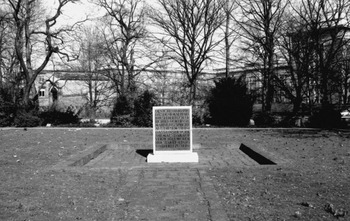
While the competition was underway, the Magistrat's Department of Building and Housing began renovating the Cemetery in Friedrichshain in preparation for the upcoming hundredth anniversary of the 1848 Revolution.Footnote 50 A simple stone block less than two metres high was placed in the centre of the cemetery, set in a slightly sunken quadratic block (Figure 2), bearing the inscription:
The SPD-controlled City Council exerted its authority to assume control of the ceremony as Otto Suhr (SPD), chairman of the City Council, presided. As common among Western politicians at this time, he emphasized the importance of freedom, stating that Berlin must ‘fight for its most elementary rights’. He clearly insinuated that basic rights were not respected in the Eastern sector, thus the SED was heir to the reactionary monarchy, not the revolutionaries.Footnote 51 Neither the Soviet commandant nor leading East German politicians were present. The SPD expressed and built upon the place-based meaning of the cemetery as a site of social-democratic martyrdom for democracy and the right of self-determination, while excluding communist memory.
Cemetery of the March Revolution. In preparation for the 100th anniversary of the Revolution of 1848, the cemetery was renovated and a modest memorial was placed in its centre. Photograph by author, Fall 1999.

Division: a communist memorial
East–West tensions began rapidly increasing in June 1948 with the introduction of a new Western currency and the Soviet response, the infamous Blockade. The allies responded with the Airlift to keep West Berlin from collapsing and coming under Soviet control. In September, communist demonstrators disrupted meetings of the local government, which relocated to West Berlin, and a duplicate government was established by the communists in East Berlin. In May 1949 the Soviets called off the blockade, but division was imminent. In May the West German state was founded and in October the East German state was founded. Wilhelm Pieck became the first president of the GDR, but Walter Ulbricht, as 1st secretary of the SED held ultimate political authority.
In early 1948, the project in Friedrichshain was tabled as the larger political issues occupied centre stage. After the division of the Magistrat, with both memorial sites falling in the East, the SED-controlled Eastern Magistrat had a free hand to take up the project without interference. They would now impose their official historical narrative of working-class progress in the landscape with no compromises for the SPD. In February 1949, the Politburo received a proposal calling for a tombstone for Liebknecht and Luxemburg, and the construction of a memorial for the ‘deceased of the workers' movement’ across from the Cemetery in Friedrichshain, mainly for advantages in holding mass demonstrations.Footnote 52 However, Pieck decided to shift the memorial to Friedrichsfelde, further evidencing that his previous interest in the Friedrichshain plan emerged from political jostling with the SPD. Pieck wrote to the new mayor of the Eastern Magistrat, Friedrich Ebert (SED), requesting a new resolution for the memorial, as the winning design from the competition would not accommodate ‘large memorial rallies’, and urging the speedy implementation of the project. Pieck included a sketched plan for a memorial in Friedrichsfelde, and reiterated many of the basic design features he had developed in 1946. The location would be the site of the original memorial, requiring the removal of approximately 200 graves from the Nazi era, which would no longer be a problem. He stated that the representatives of various departments within the Magistrat and District Friedrichsfelde had agreed to his suggestions, ‘subject to its artistic execution’.Footnote 53 Ebert consulted members of the Magistrat and decided that the memorial should be built on a more accessible site near the entrance of the cemetery, an idea which was apparently accepted.Footnote 54 In March 1949, Ebert wrote to Pieck of an imminent Magistrat resolution and the need to find a new group of artists, as the competition-winning team had ‘declined to alter their plans in accordance with [Pieck's] proposal’.Footnote 55
In early 1950, East German historical research institutions compiled lists of murdered anti-fascists for the Central Committee of the SED.Footnote 56 Yet Pieck maintained authority over the project. In fact, one letter warned that no list of ‘deceased socialists’ was to be used before obtaining Pieck's approval.Footnote 57 His concerns about large-scale ceremonies emerged again in a letter to Ebert in September 1950, when he demanded that a chapel and several trees be removed, because the path needed to be widened.Footnote 58 Pieck also maintained exacting control over all inscriptions, his detailed list of plaques providing detailed categories for the victims.Footnote 59 The inner circle around the memorial stone was to be reserved for communist martyrs of 1918/19 and the Nazi Era, whereas the ‘old socialists’ were to be placed in the outer circle. This hierarchical layout contrasts with Pieck's previous design, in which no graves were placed inside the circle.
A twenty-ton stone was placed in the centre of the memorial, bearing the inscription ‘The deceased admonish us.’ Commemorative plaques were placed around this stone for Karl Liebknecht, Rosa Luxemburg and Franz Mehring (martyrs of the 1918/19 Revolution) and for four communist martyrs murdered during the Nazi Era. Years later, the three leading figures in the founding of the East German state were buried in the inner circle: Wilhelm Pieck, Walter Ulbricht and Otto Grotewohl. Thus, the focal point of the memorial linked communist martyrdom with the founding of the communist state. A walkway encircled this central area and was itself circled by another series of graves, including leading communist and social-democratic leaders from all eras up to the founding of the GDR. Finally, a four-metre-high wall surrounded this outer circle and contained urns with the remains of more communist and social-democratic leaders, and later included communists who passed away after the founding of the GDR.
In January 1951, the memorial was dedicated at the annual L-L-L Ceremony, which remained one of the largest state ceremonies in East Germany. Typically, large, front-page articles reported mass marches of the Berlin working class to the site (150,000–200,000 participants), where they lay wreaths and flowers at the memorial. Leading communist functionaries would then deliver speeches on the significance of the Revolution of 1918/19 for the development of socialism and the contemporary political situation (Figure 3). The re-monumentalized memorial site was now being used to transmit the most rigid, teleological and totalizing of histories; communist memory and (East) German state history came into alignment.
In contrast, the memory of the March Revolution faded in significance in the new state history. Ceremonies were held at the Cemetery in Friedrichshain in 1949 and 1950, although reportage was brief.Footnote 60 Thereafter, 18 March was stricken from the commemorative calendar; apparently, the ‘bourgeoise revolution’ was too closely associated with the West.
Decline and fall of the GDR: contestation
The mutability of memory and its potential for resuscitation after decades of submersion in a rigidly controlled history became evident as political dissent emerged in the late GDR. Citizens' rights advocates attempted to use the ceremony as a platform in 1988, carrying placards citing Rosa Luxemburg, ‘Freedom is always the freedom of dissenters.’Footnote 61 The Stasi arrested approximately 200 ‘trouble-makers’, some of whom were kept in prison while others were deported to the West. Neues Deutschland ignored the disturbances, giving especially prominent coverage to ‘over 200,000 Berliners marching to the graves of Karl and Rosa’ in a ‘Powerful Demonstration for Socialism and Peace’.Footnote 62 In January 1989, as its demise drew closer, the GDR further increased the pomp, with even more elaborate press coverage reporting 250,000 in attendance at the ceremonies.Footnote 63
The Berlin Wall was breached on 9 November 1989, and in December the communist party acknowledged the legitimacy of opposing political parties.Footnote 64 A new period of political contestation was begun, inviting the contestation of memory and place-based meaning. The 1990 L-L-L Ceremony, grandiose but less controlled, expressed the communist leadership's (now SED-PDS) desire to win elections slated for 6 May and preserve the East German state.Footnote 65 A separate demonstration was held on Alexanderplatz by the SPD (East and West). The leader of the newly formed Eastern SPD condemned the SED as a Stalinist party that would have been opposed by Luxemburg, and the rally concluded with a procession to the Cemetery of the March Revolution.Footnote 66 The conservative Christian Democratic Union (CDU) won the East German elections and the two Germanys were reunited on 3 October 1990. With East Berlin under the rule of the Federal Republic, the Socialists' Memorial was returned from the realm of official history to its original realm of oppositional memory.
In the early 1990s, demonstrations organized by the PDS (Party of Democratic Socialism, the restructured SED) and left-wing organizations continued to draw tens of thousands of participants.Footnote 67 In 1994 and 1995, the number peaked at 80,000 participants citing a variety of reasons for attending. The PDS remained prominent and an assortment of communist parties, including Stalinists, could be found promoting various causes. Many participants carried flags of the East German state or its political organizations; some denouncing the present system, while others denounced the GDR, but valued socialist ideals, or simply wanted to pay respect to the deceased who fought for social progress. In 1996, rioting involving minor left-wing groups and the police broke out along the edge of the demonstration. The following year, the PDS leadership attended, but called for ‘silent and individual reflection’, in an attempt to distance themselves, and the ceremony, from a coalition of left-wing radical groups, using the event to protest as a means of political expression, i.e. opposition to right-wing radicalism, the decline of the welfare system, NATO involvement in Yugoslavia and even the Federal Republic of Germany itself.Footnote 68 The cleft between a large group of former East German communists quietly and nostalgically honouring the deceased, and a smaller group of young, left-wing radicals asserting political claims and clashing with police continued through the late 1990s and into the present decade. In January 2000, threats by right-wing radicals led to temporary co-operation between police and demonstrators; however, violent conflicts returned the following year.Footnote 69 Attendance declined slightly in 2003, dropped 30 to 40 per cent in 2005 and remained at this lower level in 2006.Footnote 70 Some attribute this to the ageing of former SED members; however, the number of radical youth seems to have declined as well. Both the radical Marxist–Leninist Party of Germany (MLPD) and the PDS argue that attendance has remained steady.Footnote 71 The PDS notes an increase in international participation that should continue to grow due to the founding of the European Left party, which was represented by delegates of various nations at the 2005 meeting.Footnote 72 Time will tell if the event and the memorial are beginning to lose or gain significance.
Conclusion
The transformation of the burial sites of Berlin's revolutionaries presents a poignant example of vagaries in the politics of commemoration and the place-making process. First, changes in regime and in political relations repeatedly altered the status and treatment of the cemeteries, often in dramatic ways, yet place-based meaning is not, at any moment, infinitely malleable. Effacement of memorial sites, such as the Nazi destruction of the Memorial of the Revolution, reveals the power of places that must be attacked as opponents. Simply ignoring the presence of memorials may seem more effective at denying their significance, but neither approach can immediately erase their meaning for the entire population. After years of neglect during the Nazi Era, the Cemetery of the March Revolution again became a focal point of commemorative activity in 1946. It is precisely such continuity in memory that guides the reinterpretation of places, allowing neither arbitrary, nor unbounded changes in meaning. Claims about the significance of a place and its associated traditions, and their pertinence to contemporary issues, are effective to the extent to which they draw upon memory. When activists seized the name of Luxemburg and used the annual procession to the Socialists' Memorial to express dissent in 1988, they operated within a frame of meaning established by the memory of Luxemburg – a dissenter with a readily available quote to oppose state repression.
Second, the relationship between politics and urban space is not only marked by dramatic change, in which the newly empowered seek to inscribe their visions on the landscape in bold statements, but also evidences subtle shifts in meaning, evoked by changes in location and design. For instance, the communists' decision to construct a new memorial in Friedrichshain rather than reconstructing the Memorial of the Revolution was intended to appeal to the common heritage of the socialist parties through place-based meaning. This was to be reiterated through symbolism in the design of the memorial, which would position martyrs of 1848 and 1918/19, and social democratic leaders murdered under Nazi rule, around a central memorial stone. Yet, the idea of moving the memorial from the original site to the edge of the cemetery was an attempt to provide space for communist social practice (mass-ceremonies) while tying into place-based associations that would appeal to SPD – maintaining the search for a common identity while preventing SPD influence in shaping the communist site in Friedrichsfelde.
Third, both the dramatic transformations and subtle changes in these burial sites are illustrative of the relationship between personal lives, collective memory and official history. Acts of burial and consecration enshrined the lives of opposition leaders in the landscape. Through ceremonies, public education and private visits the memorial sites accrued meaning for citizens of Berlin, Germany and beyond. When regimes changed, the status of memorial spaces changed for better or worse, thus official state perspectives on the memorial were brought into or out of alignment with those of individuals and groups, sometimes with severe consequences. The Memorial of the Revolution was a peripheralized though tolerated site of dissent during the Weimar Republic. The Nazi assumption of power established an official history averse to socialism, leading to the demolition of the memorial, exhumation of graves and interment of non-socialists. Its meaning as a sanctified place was, however, not expunged from memory, as individuals continued private visits to the site, leading to their persecution. With the fall of the Nazi government, communists were free to express their beliefs in commemorative ceremonies, and Wilhelm Pieck, who attached great personal meaning to the site, played the dominant role in shaping the new commemorative space. The founding of the GDR and adoption of the socialist world view transformed the site into a place of official history, an ‘objective’ inscription of the national past. Yet, the memory of the socialist martyrs remained a dormant reservoir extending well beyond the limits of the official history presented in state ceremony. Hence the emergence of dissenters at the 1988 ceremony, and eruption of myriad perspectives on the memorial, as the wall and socialist history crumbled in 1989. More recently, these views have consolidated around the views of the PDS and the radical coalition, led by the MLPD, which demands its use as a site of political expression. The MLPD in particular sees the commemoration as a rallying point for continuing the revolutionary work of attaining ‘true socialism’ in Germany, discounting the form implemented in the GDR.Footnote 73 The PDS asserts that the memorial is a ‘symbol of social justice, solidarity and the peaceful living and working together of peoples’, and sees increasing international significance as it becomes a rallying point for the new European Left Party.Footnote 74 The MLPD's and PDS's understanding of the memorial differ notably from each other, as do both from the SED's earlier state-promoting interpretations, but the diversity and flexibility of memory allows such sites to adapt to new political purposes while exhibiting sufficient continuity in meaning to maintain legitimacy for significant numbers.