
I. INTRODUCTION
The assembly of compact or extended 2- and 3-D structures from molecular or nano-building blocks is of immense current interest due to the potential for unexpected, synergistic, and novel properties. Reference Feynman1 Central to the production of such materials is tailored nano-building blocks Reference Roll2–Reference Roll, Asuncion, Kampf and Laine4 and hierarchal mesoscale ordering, Reference Antonietti and Ozin5 ultimately providing exquisitely defined, gradient properties. Reference Neubrand and Rödel6,Reference Lee, Stinton, Berndt, Erdogan, Lee and Mutasim7 This concept argues for highly symmetrical nano-building blocks at smallest scale, offering diverse and easily modified functionality. In other words, a properly chosen macromolecular building block of nanometer scale should allow the design of materials on a nm by nm basis, in a “bottom-up” approach. Reference Feynman1,8,Reference Eigler and Schweizer9
Seminal studies of borane clusters by Professor William Lipscomb Reference Lipscomb, Pitochelli and Hawthorne10–Reference Lipscomb12 led to his award of the 1976 Nobel Prize. 13 The isolation and characterization of the decahedral B10H10 2− by Lipscomb and Reddy Reference Lipscomb, Pitochelli and Hawthorne10,Reference van der M. Reddy and Lipscomb14 nearly coincided with the isolation of the dodecahedral B12H12 2− by Hawthorne and Pitochelli Reference Pitochelli and Hawthorne15 ; and this foundation opened the door to studies of borane clusters by inorganic chemists around the world. Reference Preetz and Peters16–Reference Bregadze20 Carboranes (dicarba-closo-dodecaboranes, C2B10H12) and metallacarboranes have been extensively explored and documented by Grimes Reference Grimes21–Reference Grimes25 and Bregadze, Reference Bregadze20 while Hosmane Reference Hosmane, Maguire and Chakrabarti26,Reference Gao and Hosmane27 and others have collected and reviewed the state of boron science, Reference Hosmane28 particularly applications in boron-neutron capture therapy (BNCT), Reference Hosmane, Maguire, Zhu and Takagaki29 polymers, Reference Kolel-Veetil, Keller, Abd-El-Aziz, Carraher, Pittman and Zeldin30–Reference Patel, Swain, Abd-El-Aziz, Carraher, Pittman and Zeldin34 liquid crystals, Reference Kaszynski35–Reference Ringstrand37 electro-optical, Reference Matsumi and Chujo32,Reference Jelliss and Hosmane38–Reference Pelter, Pardasani and Pardasani40 non-linear optics, Reference Vöge, Gabel and Hosmane41–Reference Ma, Yan, Guan, Qiu and Su43 and materials science. Reference Dash, Satapathy, Maguire and Hosmane44–Reference Davidson, Wade, Marder and Hughes46 Given the extensive available literature, this review is narrowly focused on ionic, all-boron clusters derived from low-cost borohydride salts and the opportunities for their use as thin films in electrochemical cells and polymer precursors for refractory ceramic materials.
Thin-films are a particularly cost-effective realization of nano-structured materials, since thin-film functionality is often primarily related to the surface area of the film instead of the volume of material within the film. As will be described in detail, borohydride clusters are an exquisitely tunable example of nano-building blocks suited for such applications. Reference Sanchez, Soler-Illia, Ribot, Lalot, Mayer and Cabuil47 Unfortunately, high “off the shelf” prices and classical syntheses incorporating pyrophoric and deadly toxic reagents have placed an inordinately high barrier in the way of potential materials research. Reference Miller, Muetterties, Boone, Garrett, Hawthorne and Muetterties48 The final portion of this report collects an interrelated set of synthetic routes to interesting closo-borohydride clusters Reference Middaugh and Muetterties49 starting from low-cost borohydride salts, while avoiding the need for typically required toxic boron compounds, particularly diborane, pentaborane, decaborane, and boron trihalides.
II. HYBRID MATERIALS CONTEXT
Beyond the realm of purely inorganic chemistry, borohydride clusters are excellent precursors for complex hybrid materials that incorporate both organic and inorganic components. Reference Sanchez, Soler-Illia, Ribot, Lalot, Mayer and Cabuil47,Reference Sanchez, Belleville, Popall and Nicole50 There are many motivations to explore hybrid materials constructed from nano-building blocks, where functionality may now be modified by organic or inorganic synthetic methods to incorporate novel bonding modes, patterns, and geometries (e.g., mesoporous organosilicates, Reference Sanchez, Soler-Illia, Ribot, Lalot, Mayer and Cabuil47,Reference Sanchez, Belleville, Popall and Nicole50 zeolite Reference Morris51 , or metal organic frameworks Reference Kim, Chen, Reineke, Li, Eddaoudi, Moler, O'Keeffe and Yaghi52,Reference Yaghi, O'Keeffe, Ockwig, Chae, Eddaoudi and Kim53 ) typically with enhanced thermal stability.
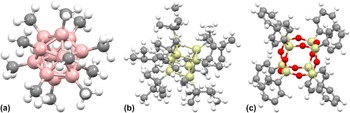
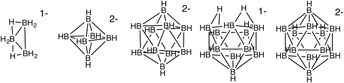
Though all hybrid materials incorporate organic and inorganic components, the nature of the interaction between these components naturally leads to two classifications. Sanchez and co-workers define Type I hybrid materials as consisting of inorganic and organic molecular components that interact weakly with each other (van der Waals forces, hydrogen bonding, etc.). Reference Sanchez, Soler-Illia, Ribot, Lalot, Mayer and Cabuil47 In Type II hybrids, inorganic and organic atomic species are linked by covalent or iono-covalent bonds, Reference Sanchez, Soler-Illia, Ribot, Lalot, Mayer and Cabuil47 incorporating the advantages of the organic and inorganic components with molecular homogeneity (Fig. 1).
Hybrid clusters (L–R): icosahedral borane, Reference Peymann, Knobler and Hawthorne54 cubic silaprismane, Reference Matsumoto, Higuchi, Kyushin and Goto55 and silsesquioxane. Reference Hossain, Hursthouse and Malik56

Type II hybrid materials include many polymer systems, Reference Allcock57 for example: polycarbosilanes, Reference Richter, Roewer, Böhme, Busch, Babonneau, Martin and Müller58 organoboron polymers, Reference Kolel-Veetil, Keller, Abd-El-Aziz, Carraher, Pittman and Zeldin30–Reference Matsumi and Chujo32,Reference Siebert and Chujo59–Reference Viñas, Núñez, Teixidor and Hosmane69 and phosphazenes. Reference Allcock70 An enormous number of boron containing hybrid materials have been synthesized due to the flexible chemistry of boron, including organoboron conjugated oligomers and polymers, Reference Matsumi and Chujo32,Reference Matsumi, Chujo, Davidson, Wade, Marder and Hughes33,Reference Siebert and Chujo59,Reference Cheng and Jäkle71 while boronate (boronic acid ester) polymers have been explored by Lavigne. Reference Niu, O'Sullivan, Rambo, Smith and Lavigne72,Reference Tilford, Gemmill, zur Loye and Lavigne73 The latter system has been used as the basis for 2-D and 3-D covalent organic frameworks. Reference Tilford, Gemmill, zur Loye and Lavigne73–Reference El-Kaderi, Hunt, Mendoza-Cortes, Cote, Taylor, O'Keeffe and Yaghi76
In contrast to these hybrid polymers, the Type II polyhedral boranes, Reference Preetz and Peters16–Reference Körbe, Schreiber and Michl19,Reference Kaszynski35,Reference Yinghuai, Yan, Maguire, Hosmane and Chauhan45,Reference Middaugh and Muetterties49,Reference Peymann, Knobler and Hawthorne54,Reference Sivaev, Bregadze and Kuznetsov77–Reference Sivaev, Bregadze and Sjöberg92 silaprismanes Reference Matsumoto, Higuchi, Kyushin and Goto55,Reference Wiberg, Finger and Polborn93–Reference Matsumoto, Higuchi, Hoshino, Koike, Naoi and Nagai97 and silsesquioxanes Reference Hossain, Hursthouse and Malik56,Reference Voronkov and Lavrent'yev98–Reference Laine and Roll101 offer nano-building block characteristics: e.g., 3-D symmetry, allowing for the possible assembly of highly ordered structures with continuity on the atomic level and access to a wide range of chemical functionality. Reference Sanchez, Soler-Illia, Ribot, Lalot, Mayer and Cabuil47 Therefore, the focus for this discussion is the use of ionic borohydride clusters as nano-building blocks, incorporating their unique 3-D aromatic bonding structure Reference Grimes24,Reference Dash, Satapathy, Maguire and Hosmane44,Reference Middaugh and Muetterties49,Reference Lee, Farha, Hawthorne and Hansch90,Reference Kaim, Hosmane, Záliš, Maguire and Lipscomb102–Reference von R. Schleyer, Subramanian, Jiao, Najafian, Hofman and Siebert107 and the ability serve as weakly coordinating anions. Reference Peymann, Knobler, Khan and Hawthorne86,Reference Strauss108–Reference Ivanov, Davis, Miller, Anderson and Strauss116
III. FUNCTIONALIZATION OF IONIC BOROHYDRIDE CLUSTERS AS NANO-BUILDING BLOCKS
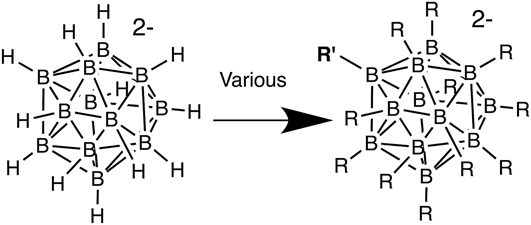
The primary borohydride clusters of interest in this report are B6H6 2−, B10H10 2−, and B12H12 2−. The aromatic nature of the closo-ionic borohydride clusters Reference Middaugh and Muetterties49,Reference Poater, Solà, Viñas and Teixidor103–Reference von R. Schleyer, Subramanian, Jiao, Najafian, Hofman and Siebert107 provides an opening to electrophilic aromatic substitution, which has been extensively explored for perhaps the most stable and well-known boron cluster is the icosahedral B12H12 2− dianion. Reference Sivaev, Bregadze and Sjöberg92,Reference Gabel, Mai and Perleberg117 Further reviews of the B6H6 2− and B10H10 2− dianion chemistries Reference Preetz and Peters16,Reference Sivaev, Prikaznov and Naoufal17,Reference Middaugh and Muetterties49 spell out the wide variety of functionalities which can be incorporated, including hydroxyl, Reference Peymann, Herzog, Knobler and Hawthorne88,Reference Bondarev and Hawthorne118–Reference Peymann, Knobler and Hawthorne120 methyl, Reference Peymann, Knobler and Hawthorne54,Reference Peymann, Knobler, Khan and Hawthorne86 halogen, Reference Geis, Guttsche, Knapp, Scherer and Uzun113,Reference Strauss, Davidson, Wade, Marder and Hughes115,Reference Ivanov, Davis, Miller, Anderson and Strauss116,Reference Knoth, Miller, Sauer, Balthis, Chia and Muetterties121–Reference Knoth, Sauer, England, Hertler and Muetterties128 thiol, Reference Komura, Aono, Nagasawa and Sumimoto85,Reference Tolpin, Wellum and Berley129 and amine Reference Ivanov, Davis, Miller, Anderson and Strauss116,Reference Hertler and Raasch130 groups. Cationic dimethyl sulfide groups Reference Yisgedu, Chen, Schricker, Parquette, Meyers and Shore67,Reference Shore, Hamilton, Kultyshev, Leung and Yisgedu131,Reference Kultyshev, Liu, Meyers, Shore, Davidson, Wade, Marder and Hughes132 can be incorporated, where the addition of three groups makes the cluster itself cationic. Reference Hamilton, Leung, Kultyshev, Chen, Meyers and Shore133 Introduction of a carbonyl group Reference Knoth, Sauer, Miller and Muetterties134,Reference Knoth, Sauer, Balthis, Miller and Muetterties135 can be used to form carboxylic acid groups or hydroxymethyl Reference Knoth136 groups, while a variety of boron–carbon bonds can be introduced, Reference Gabel, Mai and Perleberg117 including the addition of a conjugated tropenylium ring. Reference Harmon, Harmon and MacDonald137–Reference Harmon, Harmon and MacDonald139 Alkoxy groups can be added via hydroxyl functionalities with alkyl halides and base. Reference Farha, Julius, Lee, Huertas, Knobler and Hawthorne89,Reference Sivaev, Sjöberg, Bregadze and Gabel140,Reference Peymann, Lork and Gabel141 Cyclic ethers can be reacted with acid exchanged borane dianions and ring-opened on the borane cluster surface to add hydroxy-, amino-, carboxy-, and carboranyl-ether Reference Semioshkin, Sivaev and Bregadze142–Reference Sivaev, Bregadze, Sjöberg, Davidson, Wade, Marder and Hughes147 substitutions. Scheme 1 provides a schematic overview of available derivative geometry of B12H12 2−.
Mono- and per-functionalization of the B12H12 2− dianion. (R, R′=OH, X, CH3; R=X and R′=OH, NH3 +; R=H and R′=OH, SH, NH3 +, CO+, COOH, O–(CH2) n –Y, Y=OH, NH2, COOH, CB11H11).

Per-functionalized ionic borohydride clusters have been used extensively as highly stable macromolecular anions. Reference Preetz and Peters16,Reference Sivaev, Prikaznov and Naoufal17,Reference Middaugh and Muetterties49,Reference Sivaev, Bregadze and Sjöberg92 Recently, a wide variety of closomers have been synthesized and characterized in the Hawthorne research group, where a per-hydroxyl functionalized B12H12 2− dianion is grafted with ether or ester functionality. Reference Farha, Julius, Lee, Huertas, Knobler and Hawthorne89–Reference Jalisatgi, Kulkarni, Tang, Houston, Lee and Hawthorne91,Reference Pushechnikov, Jalisatgi and Hawthorne148–Reference Bayer and Hawthorne153 While there is much focus on boron-neutron capture therapy, the electrochemical behavior of B12H12 2− dianions is very promising, as it ranges from reversible reduction-oxidation behaviors, Reference Lee, Farha, Hawthorne and Hansch90,Reference Morris, Gysling and Reed154–Reference Wixtrom, Shao, Jung, Machan, Kevork, Qian, Axtell, Khan, Kubiak and Spokoyny158 including the formation of stable radicals when permethylated Reference Peymann, Knobler, Khan and Hawthorne86,Reference Peymann, Knobler and Hawthorne87,Reference King, Zharov and Michl159,Reference Valášek, Štursa, Pohl and Michl160 or perchlorinated Reference Boeré, Kacprzak, Keßler, Knapp, Riebau, Riedel, Roemmele, Rühle, Scherer and Weber161 ; to exceptional electrochemical stability in the presence of alkali metals when perchlorinated Reference Dey and Miller162–Reference Johnson and Brody165 or perfluorinated. Reference Ionica-Bousquet, Muñoz-Rojas, Casteel, Pearlstein, Kumar, Pez and Palacín166,Reference Ivanov, Casteel, Pez and Ulman167
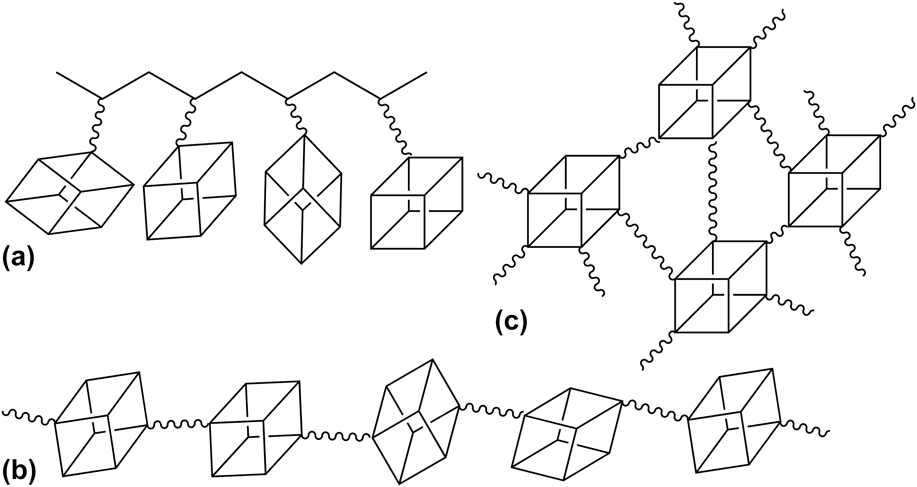
The availability of monofunctional clusters allows for the grafting of clusters onto linear polymers [Fig. 2(a)]. Recently Shore and co-workers have shown that methacrylate and styryl groups can be incorporated into methyl-/dimethyl-sulfide functionalized B12H12 2− dianion clusters, allowing for a range of chain-growth polymers to be synthesized. Reference Yisgedu, Chen, Schricker, Parquette, Meyers and Shore67 Reinvestigation of polyhalogenated B12H12 2− with one hydroxyl functionality, Reference Ivanov, Davis, Miller, Anderson and Strauss116,Reference Zhang, Liu and Duttwyler124 first synthesized in the 1960's, Reference Knoth, Miller, England, Parshall and Muetterties127,Reference Knoth, Sauer, England, Hertler and Muetterties128 has allowed for clusters with one hydroxylated or aminated vertex and eleven chlorinated or fluorinated vertices to be synthesized. The ability to combine both hydroxyl and amine functionalities with halogenation of the remaining B–H bonds Reference Ivanov, Davis, Miller, Anderson and Strauss116,Reference Zhang, Liu and Duttwyler124,Reference Knoth, Miller, England, Parshall and Muetterties127,Reference Knoth, Sauer, England, Hertler and Muetterties128 suggests possibilities for highly stable ion-exchangers and electrolytes. Reference Vogel and Meier-Haack168–Reference Soloveichik172
Polymer architectures available with borane polyfunctional nano-build blocks: (a) Monofunctional NBB grafted onto linear polyolefin; (b) difunctional NBB for step-growth polymers; (c) pentafunctional NBB for network polymer.

In the case of the hydroxyl functionalization, mono-, di-, tri-, and tetra-functionalized monomers can be isolated Reference Peymann, Knobler and Hawthorne120 for use as step-growth monomers [Fig. 2(b)] or as “cores” in a network polymer [Fig. 2(c)]. Of the boron-based clusters, carboranes have been most perhaps explored in polymer systems, where they are found to offer extraordinary thermal stability and elastomeric properties. Reference Grimes60–Reference Packirisamy64 While the relative cost of these materials represents significant barriers to many “bulk” uses, the combination of thermal stability and molecular cluster structure is very promising for preceramic polymer systems in the production of refractory thin-films and fibers, as to be discussed. Reference Corriu173–Reference Li, McCann, Xia and Marquez175
IV. IONIC BOROHYDRIDE CLUSTERS FOR ELECTROCHEMICAL APPLICATIONS
Electrolytes are key for applications from fuel cells to flow batteries Reference Winter and Brodd169–Reference Soloveichik172 to sensors, Reference Bakker176,Reference Bobacka177 and boron clusters have been demonstrated to be unique and stable electrolyte materials with high stabilities and ionic conductivities. Reference Dey and Miller162–Reference Ivanov, Casteel, Pez and Ulman167 Recently, solid-state studies of B12H12 2− salts have demonstrated superionic alkali metal cation conductivity (∼0.1 S/cm), Reference Udovic, Matsuo, Unemoto, Verdal, Stavila, Skripov, Rush, Takamura and Orimo178,Reference Tang, Udovic and Stavila179 a key property for the production of next-generation electrolyte materials not reliant on lithium chemistry. This is not entirely remarkable given that the derivatives of the B12H12 2− dianion are considered to be some of the most unreactive, non-coordinating ions ever discovered. Reference Avelar, Tham and Reed112–Reference Kessler, Knapp, Sagawe, Scherer and Uzun114,Reference Ivanov, Davis, Miller, Anderson and Strauss116,Reference Boeré, Derendorf, Jenne, Kacprzak, Keßler, Riebau, Riedel, Roemmele, Rühle, Scherer, Vent-Schmidt, Warneke and Weber122 Perhaps reflecting a similar order/disorder transition, the crystal structure of K2B12F12, has been found to show propensity for the incorporation and diffusion of water molecules, Reference Peryshkov, Popov and Strauss180 which may be of importance as polymer electrolytes are often dependent on water for proton diffusion. Reference Schmidt-Rohr and Chen181
Regarding previous explorations of ionic borohydride clusters in batteries, thirty-five years ago, B12Cl12 2− and B10Cl10 2− were demonstrated to be a stable electrolyte material in the presence of metallic lithium Reference Dey and Miller162–Reference Johnson and Brody165 ; unfortunately, this achievement has seen little recognition or reinvestigation, even in the face of intense interest in the area of electrochemical cells based on lithium stable electrolytes. More recently, Li2B12F12 has out-performed LiPF6 in carbonate-based electrolytes. Reference Ionica-Bousquet, Muñoz-Rojas, Casteel, Pearlstein, Kumar, Pez and Palacín166 Comprehensive halogenation studies of the dodecahedral borate dianions were reported in 1964, Reference Knoth, Miller, Sauer, Balthis, Chia and Muetterties121 but synthesis of the perfluorinated dodecaborate cluster in acetonitrile using fluorine diluted in nitrogen has recently been optimized. Reference Peryshkov, Popov and Strauss125 The perchlorinated species is significantly more accessible, requiring only sulfuryl chloride, Reference Gu and Ozerov123 dramatically reducing safety issues in comparison to fluorine gas.
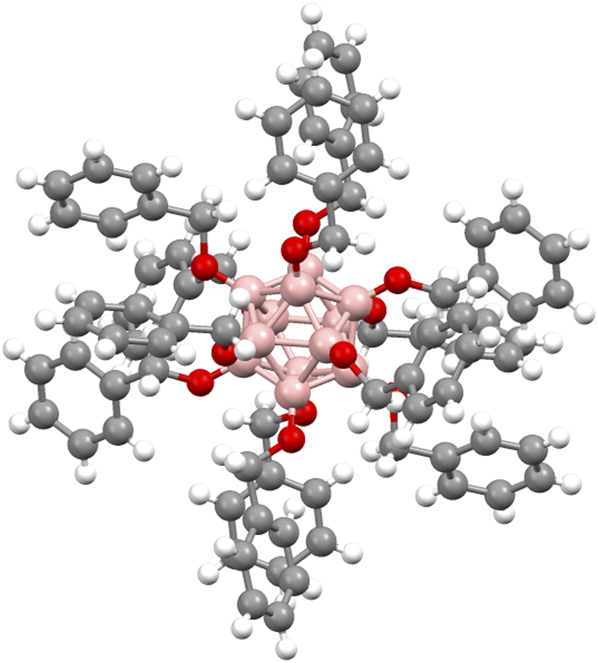
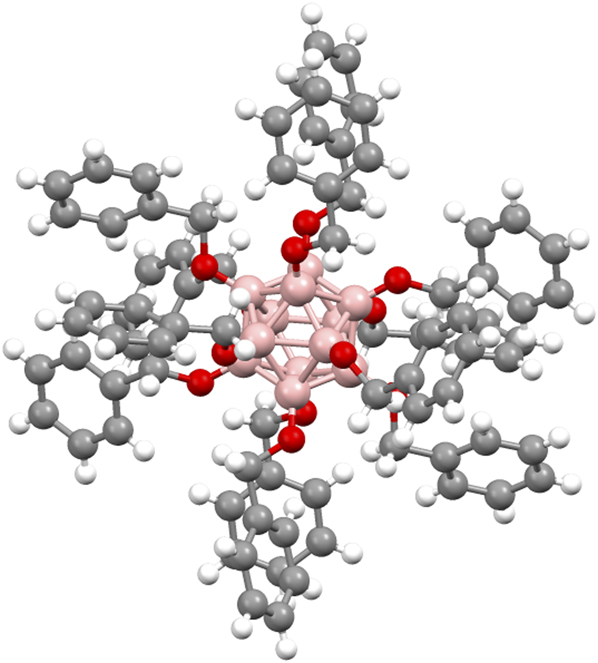
The per-alkoxy derivatives (Fig. 3) have been explored by Hawthorne's group, and “pseudometallic” properties in the form of reversible oxidation behavior were found. Reference Lee, Farha, Hawthorne and Hansch90 This type of electron-shuttle-storage behavior opens the door to sensors, batteries, and other electrochemical devices. Reference Winter and Brodd169,Reference Bakker176,Reference Bobacka177 Already, electrochemical detection of base pair matches in DNA via incorporation of borane clusters has been demonstrated, with the potential to simplify genetic analysis through high match specificity and simultaneous use alongside other electrochemical labels for nucleotides. Reference Jelen, Olejniczak, Kourilova, Lesnikowski and Palecek182,Reference Hvastkovs and Buttry183 The low toxicity of the deca- and dodeca-borate clusters (LD50 approximately 1 g/kg) has already led to many applications in boron neutron capture therapy Reference Hosmane, Maguire, Zhu and Takagaki29,Reference Sivaev, Bregadze and Kuznetsov77,Reference Pushechnikov, Jalisatgi and Hawthorne148–Reference Hawthorne and Pushechnikov150,Reference Muetterties, Balthis, Chia, Knoth and Miller184–Reference Feakes, Shelly, Knobler and Hawthorne189 ; while new microwave synthesis techniques will enhance accessibility. Reference Wixtrom, Shao, Jung, Machan, Kevork, Qian, Axtell, Khan, Kubiak and Spokoyny158
The closomers, dodeca-benzyloxy-dodecaborate dianion. Reference Farha, Julius, Lee, Huertas, Knobler and Hawthorne89
One key demonstration of the utility of such clusters for sensor applications has come in the form of ion selective sensors. Reference Bakker176,Reference Bobacka177 This is an ideal application for anionic boron clusters due to their chemical stability, permanently ionic nature, and presumtive delocalization of the cluster itself to facilitate electronic integration. Dramatic enhancements in stability against leaching of anionic sites were found in initial ion sensing studies, Reference Qin and Bakker190 while the mono-hydroxy-dodecaborate anion was recently reported to show interesting aqueous oxidation behaviors. Reference Fojt, Fojta, Grüner and Vespalec191 Such clusters could be ideal for grafting stable anions onto a polymer backbone and should open broad doors to fundamental studies of these ionomers to assess the potential electrochemical applications.
V. SOLUTION-PROCESSIBLE REFRACTORY PRECURSORS
Ultra High Temperature Ceramics Reference Fahrenholtz, Wuchina, Lee and Zhou192–Reference Fahrenholtz, Hilmas, Talmy and Zaykoski194 in the form of refractory thin-films are of critical importance for high temperature applications, particularly wing leading edges in next generation hypersonic vehicles. Reference Hill195 Recent reviews have noted the important role of boride materials in this area, particularly noting the dependence of the behavior on compositional control. Reference Fahrenholtz, Wuchina, Lee and Zhou192–Reference Fahrenholtz, Hilmas, Talmy and Zaykoski194 While refractory diboride ceramics are often layered structures, the boron carbide Reference Balakrishnarajan, Pancharatna and Hoffmann196 and β-boron Reference Schmirgeld, Zuppiroli, Brunel, Delafon, Templier, Emin, Aselage, Beckel, Howard and Wood197 structures are dominated by icosahedral cluster geometries, as in B12H12 2−. In fact, β-boron was found to be “first covalent solid which is not amorphized by ion irradiation,” Reference Schmirgeld, Zuppiroli, Brunel, Delafon, Templier, Emin, Aselage, Beckel, Howard and Wood197 suggesting that there may be inherent advantages to incorporating these clusters in refractory thin-films.
While carboranes have been incorporated in polymers for many years, Reference Grimes60,Reference Packirisamy64 in terms of polymer derived ceramics Reference Corriu173–Reference Li, McCann, Xia and Marquez175 the neutral cluster B10H14 [or decaborane(14)] has been used most extensively. In these polymers, the decaborane(14) may be complexed with a difunctional ligand or reacted with alkyne groups. Reference Packirisamy64,Reference Schwab, Stewart, Dudeck, Kozmina, Katz, Bartram, Wuchina, Kroenke and Courtin198,Reference Kokado and Chujo199 Sneddon and co-workers have worked extensively in this area, with many contributions, Reference Su and Sneddon200–Reference Guron, Kim and Sneddon206 including the exploration of hydroboration chemistry to couple decaborane(14) with olefins, while Spencer and co-workers explored metal borides derived from decaborane. Reference Kher, Tan and Spencer207–Reference Romero209 Unfortunately, the inherent toxicity, volatility, and flammability of decaborane(14) is a severe barrier to scalability and a significant hurdle for any investigator seeking to initiate research in this area.
One result related to the topic at hand is that the decaborane(14) clusters within the polymers have been found to rearrange to the B10H10 2− dianion, Reference Packirisamy64 presumably due to the higher stability of the closo cluster structure, Reference Middaugh and Muetterties49 highlighting the ability for boron clusters to rearrange. In fact, decades ago, gadolinium and cerium borides were synthesized by dehydrogenation of the corresponding metal B10H10 2− salts. Reference Itoh, Tsuzuki, Yogo and Naka210 Recent preliminary research has in fact demonstrated the conversion of Li2[B10H10] into the ceramic Li2B9, as well as Na2[B10H10] into Na3B20. Reference Panda211 These limited results suggest that a rich set of ceramic materials could be derived from ionic borohydride clusters. The combination of nano-scale structural control, in the form of polyhedral anions, and the ability to target homogeneous solution processing is an area of strength, enhancing compositional control by reducing the need for highly heterogeneous, solid-state reactions. In general, thin-films are an area where materials chemistry and molecular or polymeric precursors can excel. Reference Sanchez, Soler-Illia, Ribot, Lalot, Mayer and Cabuil47,Reference Corriu173–Reference Li, McCann, Xia and Marquez175
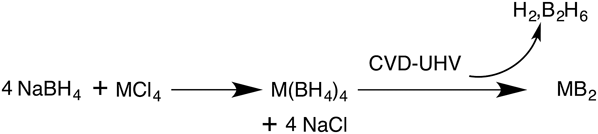
In this discussion, it is critical to acknowledge the history and use of transition metal borohydrides produced by metathesis with alkali metal borohydrides (Scheme 2). In fact, as early as 1949 researchers were converting metal borohydrides into conformal boride thin-films. Reference Hoekstra and Katz212 Unfortunately, these highly volatile compounds are pyrophoric and more suited to chemical vapor deposition processes under ultra-high vacuum conditions (Scheme 2). Reference Hoekstra and Katz212–Reference Jayaraman, Klein, Yang, Kim, Girolami and Abelson218
Borohydride metathesis and decomposition to metal diboride.

In contrast, Fujii and Ozawa reported the metathetical exchange of borohydride anions between NaBH4 and MgCl2 produced a viscous liquid precursor to magnesium diboride, potentially containing polymeric boro(oxo)hydride species, for ultimate use in superconducting tapes. Reference Fujii and Ozawa219,Reference Fujii and Ozawa220 A report by Gallagher and co-workers Reference Gallagher, Rhine and Bowen221 and patent literature from Tebbe and Baker Reference Tebbe and Baker222 detail the production borane cluster oligomers and polymers from transition metal borohydride condensation in organic solution, converting these solids ultimately into metal borides in powder, film, or solid form. More recently, Girolami, et al. demonstrated that metathesis (Scheme 3) with the B3H8 1− cluster Reference Bykov, Zhizhin and Kuznetsov223,Reference Ryschlewitsch, Nainan, Miller, Todd, Dewkett, Grace, Beall, Hawthorne, Leyden and Parshall224 with chromium (III) salts yield a distillable, liquid precursor that can be used to deposit chromium diboride thin films, Reference Goedde and Girolami225,Reference Goedde, Windler and Girolami226 as well as magnesium and titanium B3H8 1− salts. Reference Kim, Yang, Abelson and Girolami227,Reference Kim, You and Girolami228 Shore and co-workers synthesized the ammonium salt via ion exchange from NaB3H8 in ammonia. Reference Huang, Chen, Yisgedu, Meyers, Shore and Zhao229
Proposed octatrihydroborate metathesis in the manner of Girolami et al. Reference Goedde and Girolami225–Reference Kim, You and Girolami228

The apparent generality of the metathesis approach coupled with the natural condensation and rearrangement of borohydride oligomers suggests that many more opportunities exist for solution-processible metal boride precursors. Recent work has demonstrated the synthesis of indium and chromium B12H12 2− salts, Reference Van, Kleeberg and Schleid230 but as with the carefully studied decomposition processes associated with hydrated magnesium salts, up to 250 °C, there are a number of complicating processes presumably from the complexed water. Reference Chen, Lingam, Huang, Yisgedu, Zhao and Shore231 The simplified schematic of the metathesis shown in Scheme 3 should not presume to overshadow the difficulties in controlling unwanted complexation by coordinating solvents, Reference Huang, King, Chen, Hoy, Yisgedu, Lingam, Shore, Woodward and Zhao232,Reference Dunbar, Macor and Girolami233 a formidable challenge in the isolation of pure molecular precursors. However, it may be that a lack of certainty in the exact chemical structure of a precursor will not eliminate its utility in the production of boride thin-films. Reference Fujii and Ozawa219,Reference Fujii and Ozawa220
In both of the applications discussed, accessibility to a variety of polyhedral borohydride clusters is key; however, even the price of the cesium dodecahydroborate, perhaps the most available higher polyhedral ionic borohydride cluster, is high (approximately $20/g). 234 Of course, application of these materials in an engineering context will require that researchers have ready access to multi-gram scale quantities of these ionic clusters for materials research, preferably directly from sodium borohydride without the need for other neutral and exceedingly toxic neutral borane compounds or corrosive and toxic boron trifluoride. Reference Miller, Muetterties, Boone, Garrett, Hawthorne and Muetterties48,Reference Ryschlewitsch, Nainan, Miller, Todd, Dewkett, Grace, Beall, Hawthorne, Leyden and Parshall224 The following section will discuss opportunities for exploration in this area.
VI. “GREENER” ROUTES TO IONIC BOROHYDRIDE DERIVED CLUSTERS
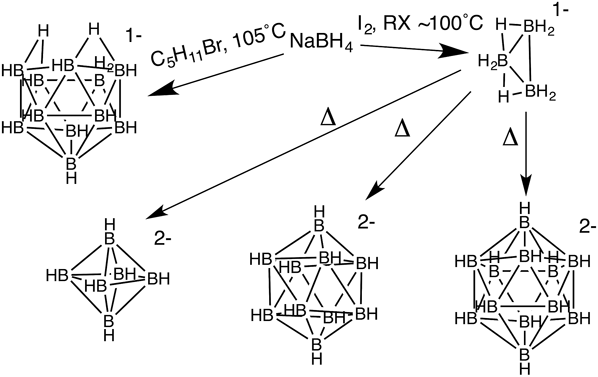
As described, the borohydride clusters of interest in this report are the stable dianionic species B6H6 2−, B10H10 2−, and B12H12 2−, but to better outline their synthesis, we will now introduce the monoanionic B3H8 1− and B11H14 1− species. While there exist a number of interesting syntheses via thermolysis for B12H12 2− dianions, Reference Preetz and Peters16,Reference Sivaev, Prikaznov and Naoufal17,Reference Sivaev, Bregadze and Sjöberg92,Reference Hansen, Paskevicius, Li, Akiba and Jensen235 Komura and co-workers showed that B12H12 2− could be synthesized directly from borohydride using iodine. Reference Komura, Aono, Nagasawa and Sumimoto85 Geis and co-workers expanded on this report and showed that B3H8 1− was a direct intermediate in the formation of the dodecahedral dianion. Reference Geis, Guttsche, Knapp, Scherer and Uzun113 Literature routes show that B3H8 1− and B11H14 1− anions are directly available from the reaction of sodium borohydride with iodine or alkyl halides, respectively (Scheme 4). Reference Dunks, Barker, Hedaya, Hefner, Palmer-Ordonez and Remec84,Reference Ryschlewitsch, Nainan, Miller, Todd, Dewkett, Grace, Beall, Hawthorne, Leyden and Parshall224,Reference Bykov, Mal'tseva, Generalova, Zhizhin and Kuznetsov236 The three higher polyhedral dianions are all accessible through the thermal rearrangement of B3H8 1−, Reference Miller, Miller and Muetterties82,Reference Ellis, Gaines and Schaeffer237–Reference Agafonov, Solntsev, Vinitskii and Kuznetsov239 which can be formed in situ from BH4 1−, which allows for one-pot reactions. Reference Komura, Aono, Nagasawa and Sumimoto85,Reference Geis, Guttsche, Knapp, Scherer and Uzun113 The particulars of these pathways have been published previously, so the goal herein is to direct readers toward these relatively “Green” syntheses.
Routes to ionic borohydride clusters: B3H8 1−, B6H6 2−, B10H10 2−, B11H14 1− and B12H12 2−.

One key aspect of the materials applications of borohydrides and borohydride clusters toward materials research ends is stability and safety. As mentioned above, the tetravalent metal borohydrides can be used to directly form metal boride thin-films, but they are well-known as pyrophoric, burning spontaneously on contact with air. Reference Hoekstra and Katz212 In contrast, sodium borohydride (NaBH4) is a shelf stable solid that slowly decomposes in neutral water, rapidly in acidic water, Reference Schlesinger, Brown, Finholt, Gilbreath, Hoekstra and Hyde240,Reference Mikheeva and Breitsis241 but which can be recrystallized from strongly basic aqueous solutions. Reference Dunks, Barker, Hedaya, Hefner, Palmer-Ordonez and Remec84 B3H8 1− with alkali metal or quaternary ammonium counter-cations, is stable in water, Reference Pylypko, Zadick, Chatenet, Miele, Cretin and Demirci242 as is the recently isolated Ca[B11H14 1−]2 complex. Reference Titov and Petrovskii243 In general, the B3H8 1− and higher polyhedra are typically isolated and purified using water.
Such contradistinctions lead to very necessary warnings when there is even potential for formation of volatile boranes. Reference Miller, Muetterties, Boone, Garrett, Hawthorne and Muetterties48 The reader is pointed to the use of acetone gas “scrubbers” Reference Kabbani78,Reference Ryschlewitsch, Nainan, Miller, Todd, Dewkett, Grace, Beall, Hawthorne, Leyden and Parshall224 as a straight-forward method to destroy any toxic diborane gas formed during synthesis. Hydrogen gas is formed in these rearrangements, as well as alkanes in some reactions, so proper safety and fume-hood procedures must be followed. Again, the relative stability of the ionic borohydride clusters, particularly in the alkali metal form, is a critical advantage during cluster synthesis. Since transition metals are by-and-large Lewis acids, and as such may catalyze the decomposition of borohydrides to release hydrogen, Reference Schlesinger, Brown, Finholt, Gilbreath, Hoekstra and Hyde240 care should be exercised when exchanging these cations. Reference Van, Kleeberg and Schleid230
The enhanced stability of the polyhedral anions appears to peak at the dodecahedral dianion B12H12 2−, which is recrystallized from hot water and even in the earliest studies showed tremendous chemical stability toward concentrated inorganic acids and bases. Reference Middaugh and Muetterties49,Reference Knoth, Miller, England, Parshall and Muetterties127 In fact, several recent studies examining the borohydride anion as a potential hydrogen rich fuel have identified B12H12 2− as an apparent thermodynamic end point for borane oligomers that form under release of hydrogen extensively rearrange. Reference Garroni, Milanese, Pottmaier, Mulas, Nolis, Girella, Caputo, Olid, Teixidor, Baricco, Marini, Suriñach and Baró244–Reference Teprovich, Colón-Mercado, Ii, Ward, Greenway, Missimer, Hartman, Velten, Christian and Zidan246 This is noted, as that curious readers will see that thermolysis reactions of B3H8 1− or borohydride oligomers that are conducted at high temperatures and long times generally show higher yields of B12H12 2−.
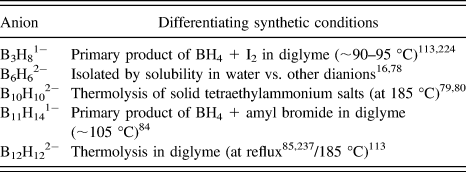
Table I below provides a listing of the ionic borohydride clusters shown in Scheme 4 above with syntheses selected on the basis of minimizing reactant toxicity. For each anion, key differentiating synthetic conditions are given. Due to toxicity concerns, preparations with boron trifluoride diethyl etherate are not listed, although it is acknowledged that historically these have been used extensively in the synthesis of these anions. This does however allow for a comparison of the iodine and amyl bromide syntheses. In particular, it appears likely that iodine and amyl bromide are very likely capable of producing both the B3H8 1− and B11H14 1− anions. The latter opens routes in to mono-carborane CB11H12 1− and R-CB11H11 1− systems. Reference Franken, King, Rudolph, Rao, Noll and Michl247,Reference Körbe, Sowers, Franken and Michl248
Reaction Conditions for synthesis and isolation of specific ionic borohydride clusters.

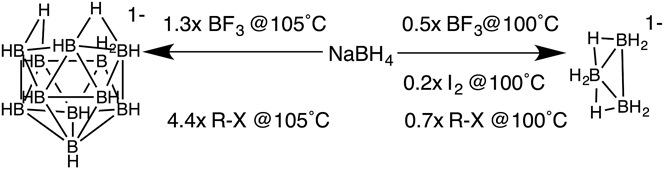
Scheme 5 shows the contrasting published ratios of BF3, Reference Dunks, Barker, Hedaya, Hefner, Palmer-Ordonez and Remec84,Reference Ryschlewitsch, Nainan, Miller, Todd, Dewkett, Grace, Beall, Hawthorne, Leyden and Parshall224 I2, Reference Ryschlewitsch, Nainan, Miller, Todd, Dewkett, Grace, Beall, Hawthorne, Leyden and Parshall224 and alkyl halide Reference Dunks, Barker, Hedaya, Hefner, Palmer-Ordonez and Remec84,Reference Bykov, Mal'tseva, Generalova, Zhizhin and Kuznetsov236 to NaBH4. It is important to note that the stoichiometries specified in Scheme 5 are taken from the reported experimental details and often differ significantly from the hypothetical, balanced stoichiometries for the reactions given in those references. Resolving these differences and filling in the unknown ratios is expected to lead to a better understanding of the fundamental borane chemistry at work. For instance, BF3 is a Lewis acid, I2 is a halogen, both are quite different from alkyl halides, yet it seems that all three coordinate the rearrangement of borane oligomers.
Contrasting routes to mono-anionic borohydride clusters.

VII. CONCLUSION
In conclusion, this review has attempted to outline the large potential materials science opportunities in the area of ionic borohydride clusters, particularly for electrochemical and refractory thin-film applications. Exploring the nature of the “Greener” syntheses outlined here will certainly reveal discoveries regarding the underlying chemistry of boron clusters. As such, it is hoped that this article will illuminate new avenues for exploration in materials chemistry, with great potential to open new thin-films applications.
ACKNOWLEDGMENTS
The author gratefully acknowledges support from Dr. Eric Wuchina and ONR Grant N000141310371. As well, the author also gratefully acknowledges Professor Richard M. Laine for his introduction to Hybrid Materials and Nano-Building Blocks, leading to many subsequent explorations.