

Introduction
On beef farms in Ireland and elsewhere, providing feed is the single largest variable cost (Finneran et al., Reference Finneran, Crosson, O Kiely, Shalloo, Forristal and Wallace2012). Grazed grass, grass silage and concentrates are the most common feedstuffs offered to ruminants in Irish production systems, and usually rank from cheapest to most expensive in that order (Finneran et al., Reference Finneran, Crosson, O Kiely, Shalloo, Forristal and Wallace2012). In Ireland and other temperate climate countries, seasonality of grass growth means that the majority of cattle are housed during the winter months and typically offered grass silage-based diets (McGee, Reference McGee2005; Finneran et al., Reference Finneran, Crosson, O Kiely, Shalloo, Forristal and Wallace2012). To reduce winter feed costs and increase profitability, compensatory growth can be exploited as part of the production cycle where young growing cattle are destined to return to pasture post-winter (McGee et al., Reference McGee, Drennan and Crosson2014). For suckler-bred ‘weanling’ cattle returning to pasture, a daily live weight gain during the indoor winter of c. 0.50 kg for steers (Kyne et al., Reference Kyne, Drennan and Caffrey2001) and c. 0.65 kg for bulls (Marren et al., Reference Marren, McGee, Moloney, Kelly and O’Riordan2013) is sufficient to exploit subsequent compensatory growth from grazed grass. These growth rates can be achieved by offering cattle moderate-to-high nutritive value grass silage to appetite supplemented with 0.5 to 2.0 kg fresh weight of a concentrate ration, depending on silage nutritive value (Kyne et al., Reference Kyne, Drennan and Caffrey2001; Marren et al., Reference Marren, McGee, Moloney, Kelly and O’Riordan2013).
Concentrate rations offered to beef cattle in Ireland are predominantly cereal-based but other feed ingredients, mainly imported, are available. Citrus pulp, the dried solid residue remaining when citrus fruits are squeezed for juice, is one such ingredient; it is high in digestible fibre and low in starch relative to cereal-based ingredients (Bampidis and Robinson, Reference Bampidis and Robinson2006). From a review of the literature, McGee (Reference McGee2005) concluded that there were inconsistent effects of replacing starch with digestible fibre in the concentrate supplement on the dry matter intake (DMI) and performance of growing cattle offered grass silage-based diets. Furthermore, there are relatively few reported comparisons evaluating DMI and performance of beef cattle offered dried citrus pulp (Bampidis and Robinson, Reference Bampidis and Robinson2006), especially as a supplement to grass silage.
The objective of this experiment was to determine the effects of replacing rolled barley with citrus pulp in a barley-soyabean meal concentrate supplement on intake and performance of suckler-bred male cattle offered grass silage.
Material and methods
Animals, experimental diets and management
All procedures involving animals in this study were conducted under an experimental license in accordance with the cruelty to Animals Act 1876 and the European Communities (Amendment of Cruelty to Animals Act 1876) Regulation 2002 and 2005 (www.dohc.ie/other_health_issues/pausp).
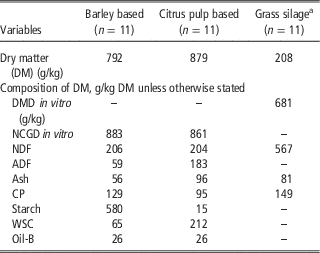
Male ‘weanling’ cattle sourced directly from commercial beef suckler herds in Ireland were used. They comprised of spring-born (120) bulls, from Charolais or Limousin (n=48; 346 kg live-weight (LW), SD 28.6; 234 days of age, SD 19.0) and Aberdeen Angus (n=72; 309 kg LW, SD 32.6; 224 days, SD 20.2) sires. Following arrival at Grange research centre, animals were treated for the control of internal and external parasites, and vaccinated against Clostridial and respiratory diseases. Prior to commencing the experiment they were housed in a slatted floor shed in groups of four and offered a diet of grass silage ad libitum and 2 kg per head daily of a barley-based concentrate. After 6 weeks, 40 bulls were castrated (24 Charolais/Limousin, 16 Aberdeen Angus) based on weight, and accommodated separately from the intact males; 8 weeks post-arrival, animals were weighed twice on consecutive days, and blocked by gender, sire breed and live weight. From within block, animals were randomly assigned to one of two concentrate types offered as a supplement (1.6 kg DM per head daily) to grass silage: (1) Barley/soya-based control ration (rolled barley 862 g/kg, soya bean meal 60 g/kg, cane molasses 50 g/kg, and minerals and vitamins 28 g/kg fresh weight) (BAR) or (2) citrus pulp (citrus pulp 855 g/kg, soya bean meal 80 g/kg, cane molasses 53 g/kg, and minerals and vitamins 12 g/kg fresh weight) (CIT). The concentrates were prepared as coarse mixtures. Both concentrates were formulated to have similar levels of PDIE (true protein digestible in the small intestine when energy limits microbial protein synthesis) on a DM basis (106 g/kg) based on tabulated values (Institut National de la Recherche Agronomique (INRA), 2004, 2010) and were balanced for minerals and vitamins (Table 1). Cattle were accommodated in groups of four in 30 pens (lying area=c. 2.40 m2 per animal) in two slatted, concrete floor sheds with each shed balanced for treatment. The duration of the experiment was 101 days.
Chemical composition and in vitro digestibility of the concentrate rations and grass silage offered

NCGD=neutral cellulase plus gamanase digestibility; WSC=water-soluble carbohydrate.
a Fermentation characteristics of the grass silage offered: pH, 4.04; lactic acid, 25 g/kg DM; acetic acid, 9 g/kg DM; propionic acid, 1 g/kg DM; butyric acid, 1 g/kg DM; ammonia, 71 g/kg total N.
Grass silage was harvested from a perennial ryegrass (Lolium perenne) dominant sward, on 27 and 29 May 2014. It was mowed with a rotary mower and wilted for 36 h, before harvesting using a precision-chop harvester. Due to low herbage water-soluble carbohydrate (WSC) concentration, a proportion of the crop was treated with a 60% formic acid solution at a rate of 2 litres/tonne of fresh forage at harvesting. Silage was compacted in silos to ensure expulsion of air before sealing with 2 layers of black polythene sheeting weighted with tyres. All treatments received the same silage simultaneously. Silage was offered ad libitum (proportionately 0.05 to 0.10 in excess of daily intake) on a pen basis. Fresh silage was weighed and offered daily before concentrate feeding, and refusals were weighed back and discarded each Friday in order to estimate pen intake for the preceding four days. Concentrates were offered in one daily feed each morning on top of the grass silage. All animals had free access to clean, fresh water.
Growth and body composition
Animal live weight was recorded using a calibrated scales on consecutive days at the beginning and end of the experiment and every 21 days throughout. Weighing was carried out in the morning, prior to feeding and average daily live-weight gain (ADG) was calculated for each animal by regressing live weight on time. Animals were ultrasonically scanned using an automatic real-time scanner (HS-2000, with a HLV-4212 2.0 MHz linear ultrasonic probe; Honda Electronics Co., Ltd, Aichi Pref, Japan) at the beginning and end of each experiment. On the animal’s right side, m. longissimus depth was measured at the 3rd lumbar vertebra from the interface with the back fat layer to the bone, and back fat depth was measured at the 3rd lumbar vertebra, the 13th thoracic rib and the rump (P8 site) as described by Conroy et al. (Reference Conroy, Drennan, Kenny and McGee2010). To provide a more objective description of morphology, linear body measurements were recorded at the beginning and end of the experiment (Fitzsimons et al., Reference Fitzsimons, Kenny, Deighton, Fahey and McGee2013).
Rumen fermentation and blood variables
To characterize rumen fermentation patterns, a 20 ml rumen fluid sample was obtained once from each animal circa 2 h post-concentrate consumption, on day 87 using a trans-oesophageal sampler (Fitzsimons et al., Reference Fitzsimons, Kenny, Deighton, Fahey and McGee2013). Ruminal fluid pH and concentrations of NH3–N, volatile fatty acid (VFA) and lactic acid were determined according to Owens et al. (Reference Owens, McGee, Boland and O’Kiely2008). Blood samples were collected from each animal via jugular venepuncture immediately before and 2 h after concentrate feeding on day 87. Samples were processed, stored and concentrations of glucose, urea, β-hydroxybutyrate (βHB) and non-esterified fatty acids (NEFA) were determined as described by Lawrence et al. (Reference Lawrence, Kenny, Earley, Crews and McGee2011).
Feed sampling and analysis
Representative samples of the grass silage and concentrates offered were obtained once weekly at feeding, and stored at −18°C prior to processing. Juice was squeezed from fresh silage samples to determine pH and concentrations of lactate, NH3–N and VFA as described by O’Kiely (Reference O’Kiely2011). Duplicate 200 g samples of grass silage were dried at 40°C for 48 h for DM determination, ground through a Wiley mill (1 mm aperture; Arthur H. Thomas, Philadelphia, PA, USA) in preparation for chemical analysis. Duplicate 200 g samples of concentrates, were dried at 98°C for 16 h for DM determination. A third concentrate sub-sample was dried at 40°C for 48 h and ground through a 1 mm sieve using a Teactor 1093 Cyclotec sample mill (Höganäs, Sweden) in preparation for chemical analysis. Determination of in vitro DM digestibility (DMD) of the silage was carried out according to O’Kiely (Reference O’Kiely2011). Neutral cellulase plus gamanase digestibility of the concentrates was determined according to Ministry of Agriculture, Fisheries, and Food (1993). Neutral detergent fibre (NDF) and ADF concentrations were determined using the ANKOM Technologies filter bag technique (O’Kiely, Reference O’Kiely2011), and ash was determined by complete combustion in a muffle furnace at 550°C for 5 h. Crude protein (N×6.25) concentration was measured using a Leco FP-428 nitrogen analyser (St. Joseph, MI, USA). Starch and WSC concentrations were determined as described by O’Kiely (Reference O’Kiely2011). The concentration of oil-B (acid hydrolysis/ether extract) was measured using a Soxtec instrument (Tecator, Höganäs, Sweden).
Statistical analysis
All data were analysed using Statistical Analysis Software (SAS v9.3, Inst. Inc., Cary, NC, USA). Normality of distribution and homogeneity of variance were analysed using the UNIVARIATE procedure. For intake and feed efficiency data, pen was the experimental unit (n=15/treatment). Data were analysed using the GLM procedure. The statistical model contained the fixed effect of concentrate type. For all other variables individual animal was the experimental unit. Data were analysed using mixed model methodology (MIXED procedure). The model contained the fixed effect of concentrate type and block was included as a random effect. For end of trial ultrasonic measurements of body composition and post-concentrate feeding plasma metabolite concentrations, initial ultrasonic measurements and pre-feeding metabolite concentrations were included as covariates, respectively. Differences between treatment means were tested for significance using the PDIFF statement.
Results
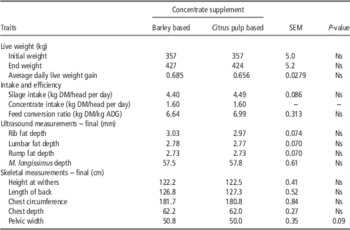
The grass silage offered was of moderate feeding value, as indicated by its in vitro DMD and CP concentration and well-preserved as shown by the pH value and ammonia concentration (Table 1). Silage DMI and feed conversion ratio did not differ (P>0.05) between concentrate supplement types (Table 2). Final live weight, daily live weight gain, ultrasonic measures of fat and m. longissimus depth, and measures of skeletal size were unaffected (P>0.05) by concentrate type.
Influence of concentrate supplement type on growth, intake, body composition and skeletal size of growing cattle offered grass silage
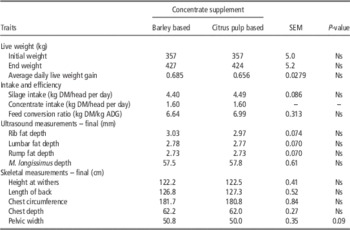
DM=dry matter; Ns=not statistically significant.
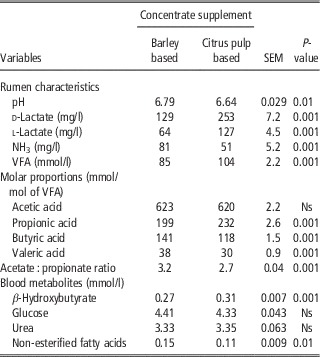
Animals offered CIT had a lower rumen pH (P<0.01) and acetate : propionate ratio (P<0.001), and higher (P<0.001) concentrations of ruminal VFA post-feeding than those offered BAR (Table 3). Concentrate supplement type had no effect (P>0.05) on molar proportion of acetic acid. Propionic acid proportion was lower (P<0.001) and proportions of butyric acid (P<0.001) and valeric acid (P<0.001) were higher in BAR than CIT supplemented animals. Animals fed BAR had lower concentrations of plasma βHB (P<0.001) and higher concentrations of plasma NEFA than those offered CIT (P<0.001) (Table 3). Concentrate type had no effect on plasma urea or glucose concentrations (P>0.05).
Influence of concentrate supplement type on post-feeding rumen fermentation characteristics and blood plasma metabolite concentrations in growing cattle offered grass silage

VFA=volatile fatty acid; Ns=not statistically significant.
Discussion
Intake
In the current study concentrate supplementation accounted for 0.26 of dietary DMI and, total DMI equated to 15.5 g/kg of mean live weight, which is similar to previous studies where barley-based concentrates (0.25 dietary DMI) were offered as a supplement to grass silage for growing bulls (15.5 g/kg LW, Marren et al., Reference Marren, McGee, Moloney, Kelly and O’Riordan2013) and, steers and heifers (16.1 g/kg LW, Kyne et al., Reference Kyne, Drennan and Caffrey2001). There is much equivocation in the published literature regarding the effect of energy supplement type on intake of grass silage by growing cattle (McGee, Reference McGee2005). In accord with our findings, Steen (Reference Steen1995) reported that where barley was replaced with citrus pulp, albeit at higher feeding level (ca. 0.4 dietary DMI) than our study, grass silage DMI was unaffected in growing steers. Similarly, O’Kiely and Moloney (Reference O’Kiely and Moloney1994) comparing barley and molassed sugar beet pulp (MSBP) as supplements (0.25 dietary DMI) to grass silage reported that silage DMI was unaffected by concentrate type. In contrast, Keane (Reference Keane2005) found that silage DMI was higher for steers supplemented (0.40 dietary DMI) with barley compared to MSBP, whereas Pesonen et al. (Reference Pesonen, Joki-Tokola and Huuskonen2014) reported the opposite when 300 g/kg DM of the barley in a supplement (0.50 dietary DMI) was replaced with MSBP. In the study of Keane (Reference Keane2005) inclusion of soya bean meal with MSBP reduced the difference observed in DMI. Compared to citrus pulp, MSBP also has a negligible starch concentration but has only half of the concentration of sugar and double the concentration of NDF, and a somewhat higher CP (88 v. 63 g/kg) concentration (INRA, 2004).
Rumen fermentation
The scientific literature is inconsistent on the effect of feeding citrus pulp on rumen acidity. In their review, Arthington et al. (Reference Arthington, Kunkle and Martin2002) concluded that citrus pulp ingestion may act to increase ruminal pH when replacing cereals such as maize or barley, whereas a more recent review by Bampidis and Robinson (Reference Bampidis and Robinson2006) reported no effect on rumen pH in most instances where citrus pulp replaced cereals. Structural carbohydrates have slow rumen degradation rates compared to starch, sugars and pectins (González et al., Reference González, Manteca, Calsamiglia, Schwartzkopf-Genswein and Ferret2012). The depression in pH observed in our experiment by replacing barley with citrus pulp may be due to the high sugar and pectin concentrations in citrus pulp superseding its higher fibre. On a DM basis, citrus pulp consists of ~0.22 pectin and 0.24 sugars (Bampidis and Robinson, Reference Bampidis and Robinson2006), and in the present experiment the CIT concentrate had a sugar concentration of 213 g/kg. However, the statistically significant difference in rumen pH between BAR and CIT was small (6.79 v. 6.64), and values were above the threshold (5.6) for sub-acute ruminal acidosis (González et al., Reference González, Manteca, Calsamiglia, Schwartzkopf-Genswein and Ferret2012). As a high pectin energy source, citrus pulp is often associated with an increase and decrease in the molar proportions of acetic and propionic acids, respectively, resulting in a higher acetate : propionate ratio (Bampidis and Robinson, Reference Bampidis and Robinson2006); however, these changes did not occur in this experiment. Similarly, Owens et al. (Reference Owens, McGee, Boland and O’Kiely2008) found no signficant effect on rumen VFA from sucrose addition to grass silage-based diets, which was attributed to the possible overriding influence of the grass silage fermentation pattern.
Animal growth
Live weight gain in the present experiment was consistent with previous research where growing suckler bulls were offered comparable grass silage to appetite and a similar level of concentrate (Marren et al., Reference Marren, McGee, Moloney, Kelly and O’Riordan2013). In accord with our results, Steen (Reference Steen1995) found that replacing barley with citrus pulp (c. 0.4 dietary DMI) in grass silage diets for growing cattle did not affect ADG. Similarly, O’Kiely and Moloney (Reference O’Kiely and Moloney1994) (0.25 dietary DMI) and Keane (Reference Keane2005) (0.40 dietary DMI) reported no difference in ADG between growing steers offered grass silage supplemented with MSBP-based or barley-based concentrates.
Information in animal feed databases indicate that citrus pulp has the same feeding value as barley for growing cattle (INRA, 2004, 2010). In this experiment, replacing barley with citrus pulp plus additional (20 g/kg) soyabean meal resulted in a comparable intake of grass silage and supported similar animal performance.
Conclusion
Citrus pulp can replace barley in concentrate supplements for growing cattle offered grass silage without negatively affecting performance. This gives beef producers more opportunity to source cost-effective concentrates.
Acknowledgements
The authors gratefully acknowledge support from the Department of Agriculture, Food and the Marine under the Research Stimulus Fund (Projects 11/S/122 and 11/S/322), and assistance from staff at Teagasc Animal & Grassland Research and Innovation Centre, Grange.