


Introduction
Over 23,600 asylum-seekers were receiving Home Office support in the UK during the third quarter of 2010 (Home Office, 2010). Asylum-seekers, unlike refugees, do not have residency in their host country, and await a decision on their claim for protection under the Refugee Convention or the European Convention on Human Rights (Refugee Council, 2010). They have usually left their country following threats, war, persecution and/or torture and frequently experience post-migration stressors, including family separation, social isolation, housing and financial problems (Burnett and Fassil, Reference Burnett and Fassil2002). Unsurprisingly, PTSD appears to be a relatively common problem for asylum-seekers (Drozdek, Noor and Lutt, Reference Drozdek, Noor and Lutt2000; Silove, Sinnerbrink, Field, Manicavasagar and Steel, Reference Silove, Sinnerbrink, Field, Manicavasagar and Steel1997).
TFCBT has the strongest evidence base in the treatment of PTSD (NICE, 2005), but there is a lack of treatment outcome data for asylum-seekers and uncertainty about whether such treatment is appropriate for this group. A key concern is that all asylum-seekers face the possibility of being repatriated and the potential threat of further trauma. Many also experience post-migration stressors that may undermine their sense of security. It is believed that this lack of security and the ongoing threat of further trauma may limit the acceptability and effectiveness of TFCBT (NICE, 2005). It has also been suggested that using PTSD diagnoses for victims of war or persecution may unethically locate pathology within individuals rather than within their experiences of social injustice (Summerfield, Reference Summerfield2001).
Ehlers and Clark's cognitive model suggests that PTSD persists when past trauma is processed in a way that leads to a sense of serious current threat (Ehlers and Clark, Reference Ehlers and Clark2000). It is thought that this can occur when traumatic memories are not processed adequately and remain in a sensory form rather than as part of autobiographical memories, causing aspects of the trauma to be re-experienced vividly and involuntarily (Brewin, Dalgleish and Joseph, Reference Brewin, Dalgleish and Joseph1996; Ehlers and Clark, Reference Ehlers and Clark2000). The aims of TFCBT are to enable traumatic memories to be fully processed, so that they become integrated with ordinary autobiographical memories, reducing the occurrence of distressing intrusions; and to address any negative appraisals that are maintaining the sense of current threat (Ehlers and Clark, Reference Ehlers and Clark2000). For asylum-seekers it seems reasonable to assume that the possibility of repatriation and further trauma would contribute to a sense of serious current threat, and may undermine the effectiveness of TFCBT. Indeed there is some evidence that fear of repatriation contributes to the risk of ongoing PTSD (Steel et al., Reference Steel, Silove, Brooks, Momartin, Alzuhairi and Susljik2006).
The NICE guidelines for PTSD acknowledge the lack of treatment outcome data for asylum-seekers and refugees (NICE, 2005), and for pragmatic reasons suggest a phased approach to treatment, based on the work of Herman (Reference Herman1992). The first phase involves establishing safety; addressing primary needs, such as accommodation, benefits, family separation, physical problems; and establishing a trusting therapeutic relationship. Once a sufficient sense of stability and security has been established then the use of TFCBT may be considered to treat persisting PTSD. The third phase involves helping clients to reconnect with their communities and rebuild their lives. These guidelines raise the question of whether it is possible for asylum-seekers to achieve a sufficient degree of stability and security to engage in and benefit from TFCBT.
Treatments that have been specifically developed for traumatized survivors of war and torture include Testimony psychotherapy (Cienfuegos and Monelli, Reference Cienfuegos and Monelli1983) and Narrative Exposure Therapy (NET; Neuner, Schauer, Klaschik, Karunakara and Elbert, Reference Neuner, Schauer, Klaschik, Karunakara and Elbert2004). These treatments resemble TFCBT in that they include exposure to traumatic memories; and an adapted form of Testimony is sometimes used within a CBT framework in cases of multiple or prolonged trauma (see Grey and Young, Reference Grey and Young2008). However, there are also distinctions between these approaches: TFCBT places more emphasis on full emotional exposure and cognitive-restructuring (Grey and Young, Reference Grey and Young2008); NET involves constructing a detailed account of the person's whole biography and not just the traumatic events; and Testimony psychotherapy has a more explicit political focus, as it was originally used as a method of gathering evidence to promote political change. Preliminary treatment outcome data for refugees are encouraging for both Testimony psychotherapy (Weine, Kulenovic, Pavkovic and Gibbons, Reference Weine, Kulenovic, Pavkovic and Gibbons1998), and NET (Neuner et al., Reference Neuner, Schauer, Klaschik, Karunakara and Elbert2004). Also, a recent randomized controlled pilot study found moderate treatment gains in a group of asylum-seekers who had received NET (Neuner et al., Reference Neuner, Kurreck, Ruf, Odenwald, Elbert and Schauer2009). Otherwise there is a dearth of treatment outcome data for asylum-seekers.
There is clearly a need to investigate the acceptability and efficacy of interventions for asylum-seekers with PTSD. Our study considered the acceptability of TFCBT for asylum-seekers with PTSD by exploring their experiences of this treatment. Given our specific focus on experience, and the lack of prior research in this area, we adopted a qualitative approach, using IPA (Smith, Osborn and Jarman, Reference Smith, Osborn, Jarman, Murray and Chamberlain1999). IPA is concerned with how people make sense of their experiences within their own personal, social and cultural contexts (Smith and Osborn, Reference Smith, Osborn and Smith2003). This is relevant given the participants’ complex and uncertain circumstances, and their different cultural backgrounds.
Method
Participants and procedure
Participants were recruited through clinicians working with asylum-seekers at three outpatient services offering specialist treatment for PTSD and one primary care service. All services offered CBT involving TFCBT and were in different regions in England and Wales. Clinicians identified clients who were asylum-seekers at the time of treatment, had a primary diagnosis of PTSD, had received at least two sessions of TFCBT and at least five sessions of psychological therapy in total within the last 6 months, and could speak English at full conversation level. TFCBT involved focusing on traumatic events and their meaning, through imaginal reliving (Ehlers and Clark, Reference Ehlers and Clark2000) and/or adapted Testimony within a CBT framework (see Grey and Young, Reference Grey and Young2008). Clients were excluded if they were actively psychotic or detained under mental health legislation, or if their inclusion was considered to be potentially unhelpful by their therapist. Seven potential participants were pre-selected by their clinicians as being eligible and willing to take part, and all agreed to participate and gave written consent.
Interviews
Semi-structured interviews were conducted by the first author, lasted between one and two hours, and were audio-recorded and transcribed verbatim. They covered the following topics: participants’ lives when they came to therapy and at the time of the interview; their experiences of receiving a diagnosis of PTSD; their experiences of therapy, focusing on TFCBT in particular; and factors affecting their ability to cope with TFCBT and their difficulties.
Descriptive information
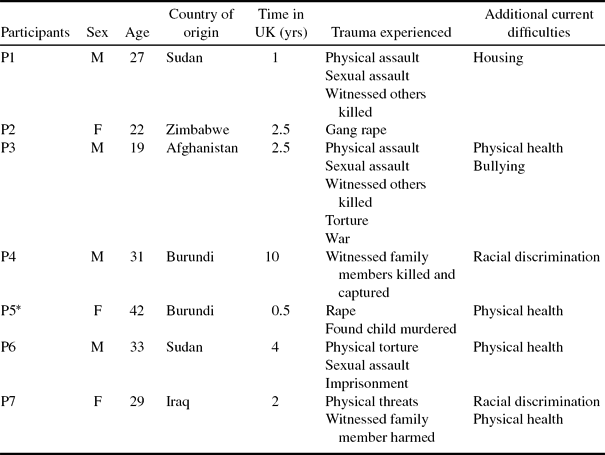
Information was obtained from the participants’ clinicians following the interviews regarding the participants’ demographic details, the traumas they had experienced, the therapy they had received, and the stage that their asylum application had reached. All participants had had their claims for refugee status rejected at least once. Table 1 provides brief descriptive information about the participants. All participants received a phased approach to treatment, with CBT based psycho-education and symptom management, involving activity scheduling or anxiety management, being provided before TFCBT. The median number of therapy sessions received was 8 (range 7–20). The median number of TFCBT sessions was 3 (range 2–10). TFCBT involved imaginal reliving for four participants, adapted testimony within a CBT framework for one participant, and a combination of adapted testimony and imaginal reliving for two participants.
Descriptive information about participants

* P5 had received refugee status when interviewed, all other participants were asylum-seekers.
Analysis
The interview transcripts were analysed by the first author using IPA, following the recommendations of Smith and Osborn (Reference Smith, Osborn and Smith2003). After repeated reading, each transcript was coded descriptively, staying close to the participants’ claims and concerns, in order to identify and understand their experiences. The transcripts were then coded again, with a more interpretative focus (which drew on language-use, context, and emergent patterns), in order to develop an account of the meaning of those experiences for each participant. Preliminary themes were identified in each transcript, and then listed, clustered, labelled, and re-classified into a structure of super-ordinate and subordinate themes. Themes across transcripts were then integrated, further contextualized, and often redefined. This was an iterative process guided by the data, and by insights derived from the analysis and existing research.
The first author kept a research diary to record her perceptions about emerging themes and their connections whilst conducting, transcribing and analysing the interviews. This was to enhance the researcher's reflexivity on her adapting preconceptions and their influence on the analysis. A number of credibility checks were undertaken. A researcher experienced in using IPA provided supervision and triangulation throughout. The data, coding and analysis were discussed with other qualitative researchers, resulting in minor changes to the labelling and organization of three super-ordinate themes. One clinician experienced in using TFCBT with asylum-seekers reviewed an independent audit trail to verify the validity of the analysis, which resulted in one minor change to one theme. Two other clinicians reported that the findings resonated with their experiences of using TFCBT with asylum-seekers. All of the final themes were supported by multiple data extracts of which only a small proportion have been used here.
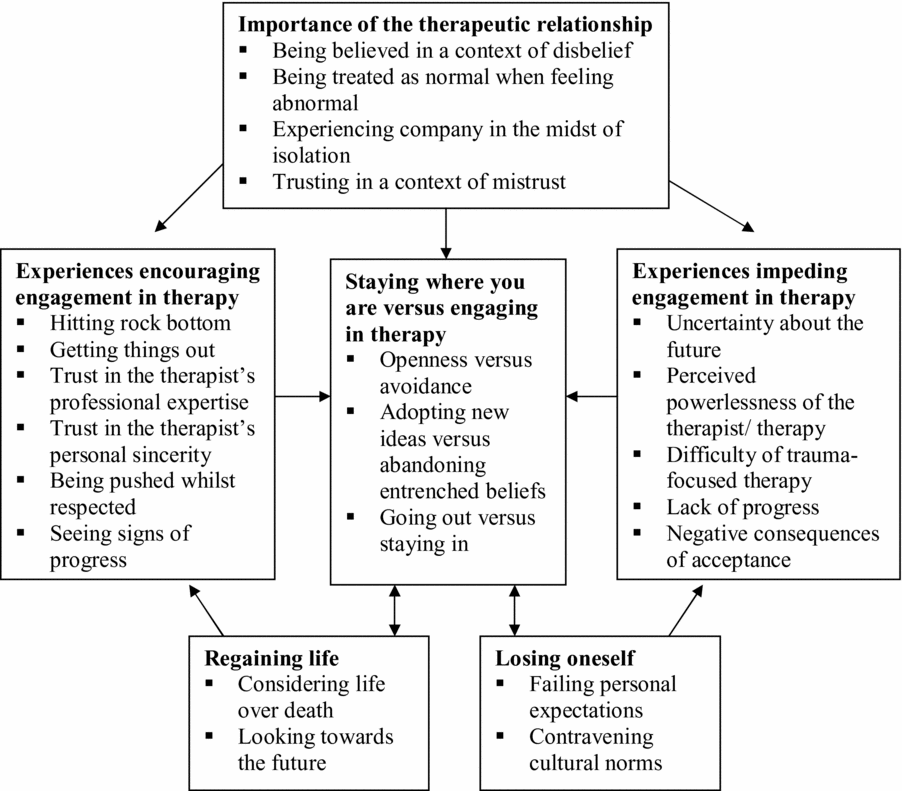
The aim was to closely describe and explain participants’ common and distinct experiences in a coherent narrative account. A model of the analysis was constructed to clearly outline the themes and their relationships (see Figure 1).
Structure of the analysis
Results
Participants’ accounts suggested that they all experienced ambivalence about engaging in therapy. They seemed to be motivated to engage in therapy in the hope they would be helped, and simultaneously deterred by what TFCBT involved. Such ambivalence, delineated in the theme “staying where you are versus engaging in therapy”, was interpreted as central in participants’ experiences of therapy. Various experiences appeared to influence whether or not participants engaged in TFCBT, described within the themes “experiences encouraging engagement in therapy” and “experiences impeding engagement in therapy”. Furthermore, the valued, facilitative, therapeutic conditions, described within the theme “importance of the therapeutic relationship”, appeared to help participants to undertake demanding therapeutic tasks. Finally, the different consequences of receiving therapy for participants, encompassed in the themes “losing oneself” and “regaining life”, also appeared to contribute to participants’ ambivalence.
Staying where you are versus engaging in therapy
All participants, except P7, described how following their therapist's advice to recount past traumas conflicted with their desires to avoid talking about these:
P1: Someone is forcing you to talk about them and you, you are trying to forget them [. . .] you are forced to remember, so you feel discouraged and you feel no happy, no happy. You feel angry at the time.
Participants described having different views to their therapist concerning the trauma, perceptions of themselves and explanations for their symptoms. Some participants attributed their problems to external negative forces, such as witchcraft. All three female participants had blamed themselves for their traumatic experiences, as they felt partly responsible for what had happened (such as being raped or witnessing others being harmed). Therapy seemed to help them reduce their self-blame. However, many participants grappled with whether to accept or reject new perspectives offered in therapy:
P7: I didn't accept the idea that I'm not, that I am strong, that I am brave, because I was so hard about myself and I was trying to convince him that, you know, that I am weak [. . .] sometimes I feel that he might be right.
Some participants also articulated their struggle in following therapists’ suggestions of increasing daily activities when they had been socially withdrawn and inactive. It appeared that participants wanted to consider their therapists’ ideas and cooperate with their instructions in the hope of being helped, but battled with their opposing instincts.
Experiences encouraging engagement in therapy
All clients, except P3, relayed a sense of “hitting rock bottom” before they came to therapy, in which they experienced a particularly difficult time in their lives and contemplated suicide:
P2: I was really getting at the end of my rope. I was, I was tired of, sort of, like fighting to be alive [. . .] I was really, really close to just ending everything.
Desperation seemed to motivate participants to try out seemingly aversive strategies, including discussing past traumas, to overcome their problems. A hope that “getting things out” may exorcise their traumas and relieve their distress appeared to motivate engagement. All but P4 found being open about their experiences was cathartic and reported being able to discuss past traumas with increasing ease.
Participants understood their therapists to be trained and experienced, and this facilitated “trust in the therapist's professional expertise”, which appeared to aid engagement:
P5: He [therapist] deals with these people who have problems so he tells you like that. He can't just tell you from nowhere to do things, so it must have a result. [. . .] I used to force myself to do it just because I feel that it's going to help me.
P1, P4, P5 and P7 reported that their therapist discussed a PTSD diagnosis with them. Some described that this increased their confidence in the therapists’ abilities to identify and treat their difficulties:
P7: With this diagnosis they can lead me to the way I can deal with this illness.
In addition to trusting the therapist's professional expertise, the participants also spoke about perceiving their therapists to be genuinely concerned for them, over and above their job. This was demonstrated through practical help, attentive listening, and signs of empathy, and it was perceived to facilitate the participants’ engagement in therapy:
P1: So as the time goes she, you know, I could say anything to her without getting, you know, without even minding about it, but if she had, if she has not won my love, some of the things, it's not easy to talk about it, you know. So that's the way, you know, she made me feel that surely she's a good, she's a good person, she's a friend, she's concerned with my life.
“Being pushed whilst respected” by therapists within a strong therapeutic alliance appeared to encourage participants’ engagement in difficult therapeutic processes:
P5: Sometimes I tell him, “No, I don't want to speak any more”. He will, sometimes he will push me to speak. . .
Finally, the participants were encouraged by “seeing signs of progress” regarding their ability to talk with increasing ease about past traumas, and positive changes in their mood, concentration, appetite, sleep, self-worth, and hopes concerning the future. These changes helped them to persevere with therapy:
P5: I started maybe feeling a bit of difference. That's when I used to force myself “You have to go. No, be strong, go and they are helping you”, so I end up going.
Experiences impeding engagement in therapy
All participants described great difficulties with engagement in TFCBT. They described experiencing anticipatory anxiety, vivid visualizing of traumatic events, re-experiencing associated emotions, physical heaviness, pain and exhaustion. Understandably, this contributed to ambivalence about engagement:
P2: When you come, you have to really like talk about it and how you're feeling and that brings it like to the surface and it's really raw and that's really hard and sometimes, you know, you don't feel like doing that ‘cause it's painful
“Lack of progress” such as experiencing ongoing nightmares, shame and anger was also felt to impede engagement. For instance, P4 described how his ambivalence about attending therapy was linked to his uncertainty about its efficacy:
P4: Up ‘til now I don't know if it's helpful hundred percent or not because I do sometime cancel the appointment with her [therapist]. Just I had a strongly feeling to, to stop come here and sometime I feel like and sometime I ring her and say “can I make appointment with you?”. So it's like levels of feeling and I don't know for how long I will see her.
There were some negative consequences involved in accepting past traumas, and again, these were obstructions to engagement. For instance, P2 explained how such acceptance forces recognition of people's brutality:
P2: I used to think that you could find good in everyone [. . .]. But after what happened, it's just, it's changed, it's made me realize that that was sort of like a dream world. I was just naïve. The world isn't really like that, so that's really hard for me to accept. I still can't fully accept that.
Moreover, in accepting the past and recovering, participants may have feared negating the horror of their experiences and colluding with an approach that regards them rather than others and the world as being responsible for their difficulties:
P7: Is it something wrong with this world or it's with me?
All participants expressed anxiety and “uncertainty about the future” as they awaited a decision on their asylum claim:
P4: It's like you are on death row waiting to die. Maybe you are going to die in a few days time [. . .] it's like insecurity, hopelessness, anxiety and all these sort of things, you see.
This uncertainty about the future caused them to question the possible benefits of therapy:
P2: So there wouldn't be a point to this if I'm just going to be sent back home again.
Therapists had no control over their clients’ asylum status. Most of the participants (all except P7) seemed to find that their engagement in therapy was undermined by the “perceived powerlessness of the therapist or therapy” in this regard. Also, given the magnitude of their experiences, participants doubted that therapy could eliminate the pain, and consequently questioned whether to engage in therapy.
Importance of the therapeutic relationship
The therapeutic relationship appeared vital to engagement. Particular qualities appeared salient in participants’ descriptions. Some participants described how people doubted their accounts as they sought asylum, and recounted the importance of being believed by their therapist. Many participants recalled feeling abnormal and ashamed due to their problems and valued having their normality reaffirmed by their therapists. Participants recounted how therapists affirmed their normality by listening with respectful understanding, providing reassurance, telling them about other people who had similar experiences, and by providing information about PTSD.
All participants experienced isolation. Either they had few friends and were separated from family, or they felt unable to discuss their traumatic experiences with other people. In the midst of isolation, their therapist's company was highly significant:
P1: When you are just alone like that, things trouble you, you know. You are lonely. But when you have somebody to talk to, you feel a bit ok.
The one participant who had finished treatment, found this distressing due to the close relationship forged with the therapist:
P7: I'm suffering now because our sessions came to the end just last month and I feel as if I am forbidden from meeting or seeing someone who I really, really admire and love and need.
Such a strong reaction to the end of therapy seems understandable in the context of isolation and finding it difficult to confide in other people. However, we do not know how typical it is, because this participant was the only one whose therapy had ended.
Several participants described problems trusting people following their traumas and initially distrusted their clinician. Over time, participants described gaining whole-hearted trust in their therapist, despite their original suspicions:
P7: He forced me to trust him, whereas I am a person who doesn't trust people and I was telling him everything. I was myself shocked because I thought, you know, he is a doctor, he might tell anybody about my experience.
Trust in the therapist appeared vital to participants and their engagement.
Losing oneself
Many participants felt they had “lost themselves” or felt “weak” in having post-trauma difficulties. Receiving therapy appeared to compound participants’ sense of failure:
P2: It makes me feel like, like I'm weak, like, you know, I'm not a strong person. ‘Cause if I was then I wouldn't be needing [. . .] someone else to help me deal with what's happened to me.
For P5 and P7, receiving a diagnosis of PTSD signified a “disease” or “illness”:
P7: I was sad that I am suffering from this illness. Even though, you know, I didn't consider it as an illness before. I was just thinking it's bad experience and trauma and I need someone's help. I was sad and I am still sad ‘cause I want to provide myself with a normal life.
It seems likely that perceptions of themselves as weak or unwell may have diminished participants’ self-efficacy and impeded their engagement in challenging treatment.
For several participants, stigma and “contravening cultural norms” in receiving help from mental health services exacerbated their feelings of weakness:
P3: You are ok if you haven't got any problem, Afghani people is happy with you. If you have a problem, like me, they make a joke, [. . .] they call me all the time, “you mad, you mad” and I'm feeling very sad.
Some participants explained that with few or no mental health services in their countries of origin, strong negative cultural stereotypes about people accessing such services prevailed.
Regaining life
Alongside losing one's identity in accessing services, a sense of regaining identity through therapy was observed in participants’ accounts. Many participants described how attending therapy enabled them to regain their lives, and some described how it prevented them committing suicide:
P7: Meeting with [therapist] it was all for me, you know, to help me to have a new life ‘cause otherwise if I hadn't met, if I hadn't met him, I wouldn't have carried, I wouldn't have carried on my life really.
Through therapy, participants described “looking towards the future” and seemed empowered to envisage more optimistic possibilities:
P4: I think coming to therapy has given me slight changes [. . .] it's like these are tiny hopes, slightly hope, and I think probably, maybe as days goes by might, maybe, I don't know, I'm not sure, maybe I'll feel, you know, much better.
P7 also articulated the dichotomy participants faced regarding loss and gain as they recover from their experience:
P7: I think with all of those problems and experiences you always have two ways either to lose everything and to lose yourself or to improve and develop skills and your brain and yourself first of all and I think I was put by [therapist] in the second way, so that I can really you know create a better person, not the same, even, but a better person.
Discussion
Summary of findings
Central to all participants’ accounts was conflict concerning whether or not to engage in therapy. All participants described finding TFCBT extremely difficult, but most participants also reported benefits. A number of factors appeared to impede engagement in therapy including uncertainty about the future/fear of repatriation; perceived powerlessness of the therapist or therapy to help them; lack of progress; negative implications of accepting past traumas; and, for all participants, perceiving attending therapy as a sign of failure. Contextually, having extensive difficulties encouraged most participants’ engagement, rather as a last resort. Other factors encouraging engagement included: beliefs that disclosing traumas would aid recovery; trusting therapists’ professional skills and personal sincerity; therapists’ respectful active prompting to persist in TFCBT; and seeing signs of progress. The importance of the therapeutic relationship was highlighted. Notably, some participants appreciated affirmation through being believed, and the majority through being understood, supported and having their normality affirmed.
Perceived benefits of TFCBT
Most participants reported relief and improvements in their mood, concentration, appetite, sleep, self-worth and optimism following TFCBT. Perceived improvements and altered perspectives following TFCBT appeared to help them to re-embrace life and develop hopes for the future, rather than contemplate suicide. This is in line with case reports describing relatively positive outcomes of using TFCBT with asylum-seekers (e.g. Basoglu, Ekblad, Baarnhielm and Livanou, Reference Basoglu, Ekblad, Baarnhielm and Livanou2004; Grey and Young, Reference Grey and Young2008). However, most participants suggested that TFCBT had not alleviated their nightmares, shame and anger. It is unclear whether ongoing problems were due to the limited efficacy of TFCBT, the fact that, for most participants, therapy was incomplete, or other factors.
Fear of repatriation and further trauma
Despite most participants reporting benefits, uncertainty about the future/fear of repatriation did appear to impede engagement in therapy for all participants. Some participants expressed their fears of experiencing further trauma or being killed. It is notable that the one participant (P4), who appraised TFCBT as ineffective, appeared highly concerned about the probability of being killed should he be repatriated. This is consistent with Ehlers and Clark's model, which proposes that perceptions of serious current threat maintain PTSD (Ehlers and Clark, Reference Ehlers and Clark2000). Hence we might expect the severity of the perceived threat of further trauma to be more important than lack of refugee status per se in limiting the effectiveness of TFCBT, but this requires further investigation.
Having the security of refugee status may make it easier for individuals to engage in TFCBT. However, the uncertainty associated with seeking asylum can continue for long periods and, given that PTSD symptoms can be highly distressing and disabling, postponing TFCBT may not necessarily be preferable. The findings of our study are consistent with the view that it may be possible for some asylum-seekers with PTSD to engage in and experience benefits from TFCBT; and that lack of refugee status per se should not preclude the possibility of using TFCBT as part of a phased approach to treatment (see Grey and Young, Reference Grey and Young2008).
Challenges of TFCBT
Participants in our study appraised TFCBT as exceedingly difficult, anxiety provoking and physically draining. There is some evidence that ambivalence about engaging in TFCBT, and finding it a painful process, may be a common reaction, and not solely the experience of asylum-seekers (Shearing, Lee and Clohessy, Reference Shearing, Lee and Clohessy2011). In our study, scepticism about whether therapy could help appears to have added to its challenging nature, perhaps exacerbated by unfamiliarity with psychological therapy. Participants’ concerns about experiencing recovery as slower than anticipated and encountering ongoing complaints also seemed to heighten their difficulties in coping with TFCBT. Accounts of other clients’ experiences of therapy might help alleviate these difficulties. Indeed, some participants reported that hearing about other clients’ experiences increased their hope in therapy.
Participants appeared to wrestle with the effects of accepting past traumas on their world-views and their interpretations of responsibility. Van der Veer (Reference Van der Veer1992) suggests that self-blame may protect against feelings of helplessness or rage resulting from acknowledging that nothing could have prevented past traumas. Participants’ concerns that the evidence or significance of their traumas would be lost seem to mirror Holocaust survivors’ desires to bear witness to experienced atrocities (Bettelheim, Reference Bettelheim1980). Hence, perhaps Testimony psychotherapy and NET may be advantageous in this respect, by providing evidence of clients’ traumas and injustices (Fischman and Ross, Reference Fischman and Ross1990).
Furthermore, participants construed their PTSD symptoms and their receipt of therapy as threatening their identity. The fact that psychiatric services were often very limited or unavailable in the participants’ countries of origin may have contributed to stigmatizing beliefs about psychological problems. This is consistent with reports of increased stigma concerning psychological problems amongst refugees (Webster and Robertson, Reference Webster and Robertson2007). Interestingly, participants in our study recounted how therapists helped to affirm their normality through listening with respectful understanding, reassurance and telling them about other people who had similar experiences.
PTSD terminology
There has been some debate concerning the helpfulness of PTSD diagnoses for victims of war or persecution. There is concern that diagnoses may unethically locate pathology within people rather than within their experiences of social injustice (Summerfield, Reference Summerfield2001). However, it is also suggested that using PTSD diagnoses may help normalize symptoms and promote research and treatment development (Mezey and Robbins, Reference Mezey and Robbins2001). The findings of our study appear to lend support to both sides of the debate. Four participants reported receiving a PTSD diagnosis. This seemingly increased some participants’ trust in their therapists’ skills and helped normalize their experiences. However, some participants simultaneously interpreted a PTSD diagnosis as evidence that they were “ill”, perhaps compounding their sense of themselves as “mad” or “weak”, alongside perceived stigma concerning mental illness. Hence it appears that using PTSD diagnoses may have both helpful and unhelpful consequences. Nonetheless, it seems important to actively counteract any stigma; promote the view that symptoms associated with past traumas are an understandable/natural reaction to highly traumatic experiences; and to reaffirm clients’ strengths.
Role of therapeutic relationship
The therapeutic relationship appeared to be very important to participants, which is consistent with reports from clinicians specializing in this area (e.g. Rees, Blackburn, Lab and Herlihy, Reference Rees, Blackburn, Lab and Herlihy2007). Participants valued being believed, support, confidentiality and having their normality affirmed. These factors may be especially important to asylum-seekers, given participants’ reports of encountering disbelief and isolation, distrusting others following their traumas (see also Tribe, Reference Tribe2002; Webster, Reference Webster2002), and feeling abnormal for experiencing emotional difficulties and accessing therapy. Moreover, it is possible that negative beliefs concerning their normality and others’ trustworthiness may be amended following positive contradictory experiences within the therapeutic relationship (see Beck et al., Reference Beck, Freeman, Pretzer, Davis, Fleming and Ottaviani1990).
Participants described valuing their therapists’ sincere concern in helping them to cope with TFCBT. Non-judgemental, attentive listening with empathy seemed important in participants experiencing genuine compassion. Furthermore, participants relayed that praise, encouragement, reminders of the purposes of TFCBT, and emphasis on their freedom to stop discussing past traumas helped them to persevere with therapy. These attributes are consistent with Rogers’ (Reference Rogers and Koch1959) facilitative therapeutic conditions and could be conceptualized within a motivational interviewing framework, in view of participants’ accounts of ambivalence about engaging in therapy (Miller and Rollnick, Reference Miller and Rollnick1991).
Furthermore, participants evaluated therapists’ practical support as indicative of their genuine care. This finding supports the value of advocacy and the phased approach to treatment as suggested by NICE (2005), which emphasizes establishing trust and addressing primary needs before offering TFCBT.
Given participants’ reported social isolation and the importance of the therapeutic relationship, it may be unsurprising that the only participant who had ended therapy found this exceedingly difficult. We do not know how typical this reaction is as none of the other participants had completed treatment, but careful preparation for the ending of treatment, including the identification of other forms of support, may be especially important for this group.
Limitations of the analysis
Asking participants directly about their experiences presented some challenges; English was not the first language of the participants, they drew upon a range of cultural frameworks, and some may have been experiencing memory and concentration difficulties caused by PTSD. Despite these difficulties, powerful insights into the participants’ experiences were gained.
The sample's size, heterogeneity and several biases limit the generalizability of the findings. The sample is homogenous in three key respects: all had experienced traumatic events, CBT involving TFCBT, and were seeking asylum in the UK. However, due to the small pool of potential participants, there was diversity in the sample regarding age, gender, country of origin, traumas experienced and stage in treatment. Furthermore, clinicians did not approach clients who had disengaged from therapy. TFCBT may have been offered to clients less preoccupied with threats of repatriation, and with more stable social circumstances; and therapists may have invited clients to participate who had seemingly benefited from therapy. Participants may differ from non-English speaking clients, who would have encountered interpreters in therapy. Participants may have been reluctant to disclose negative experiences of therapy due to being interviewed in settings where they had received therapy, or because of high appreciation and regard for clinicians. However, most participants reported difficulties experienced in therapy.
Research implications
Further research is required to confirm the preliminary findings of this study: to ascertain the acceptability and effectiveness of TFCBT for asylum-seekers, and the impact of the severity of the perceived threat of further trauma on treatment outcome. The acceptability and effectiveness of NET for asylum-seekers with PTSD also appears worthy of further investigation.
Acknowledgements
We would like to thank the Service for Traumatized Asylum-Seekers and Refugees in Oxford for their help, support and recruitment of the majority of the participants, and the other participating clinicians and services. We are grateful to all the participants for speaking so extensively about their experiences of therapy.
The research was undertaken in partial fulfilment of the requirements of the degree of Doctor of Clinical Psychology, validated by the University of Oxford. A full version of the manuscript including all Tables is available from the first author.



Comments
No Comments have been published for this article.