Introduction: A way in …
Beginnings are riddles.Footnote 1
Feminist theory works with that which [philosophy] pronounces inessential, contingent and superfluous. This is the domain of the aesthetic.Footnote 2
I read about the weight of a man's shoe. I begin to think about the weight of writing, the heaviness of words, and the (im)possibilities around writing sexual violence. There is too much. It is too much. Too much sorrow and pain. And degradation. The more I read, the more the list goes back and back and back. I stare at the Rape of the Sabine Women in the National Gallery in London. I am taken with Magritte's La Viol. I try to look at Goya's etchings on the Disasters of War online. I ponder over the Chapman Brothers ‘defamation’ of some of Goya's etchings in their Insult to Injury. They draw a line (or a cartoonish pig, cow or donkey …) in/on the story, or rather onto the face or body of the violator or violated. I read about sexual violence in varied places round the globe. Though it is the case, I think, that it seems more virulent, more ‘uncivilized’, more unfathomable, though at the same time too fathomable in ‘far away places’; Africa and India still burgeon Western popular colonial and media/social-network fuelled imaginations. ‘Rape in the Congo’, the woman on the Delhi bus, the young Indian vet … The list goes forward and forward and forward …
… writing this history is like touching madness.Footnote 3
Three broad sets of enquiries structure this article, which I briefly introduce here before moving to explicate them more fully subsequently. First, I am curious about persistent quests for the ‘right theory’. Though not typically described like this, this remains a significant endeavour in International Relations,Footnote 4 even if perpetually problematised, not least by feminist theorising. Reflecting on the latter, my second set of enquiries question how some theories become positioned as ‘too radical’ or ‘too much’ and thus deemed to fall outside the bounds of useful theory, at least in disciplinary imaginaries. The issue that instigated my questions, and the site joining these two sets of enquiries together, involves feminist analyses of sexual violence, specifically inferences that these analyses have played a key role in rendering sexual violence against men politically and theoretically obscure. This is a very significant claim, though my response is not to deny that feminist work can cause harm, but to more carefully explore what seems to emerge as a paradox within feminist disciplinary work. This is, that at its heart, feminist work espouses destabilising intentions, yet within disciplines, such work necessarily requires the accolade of utility and acceptability, which is often elusive if theory is perceived as ‘too much’, something which arguably afflicts various forms of feminist and critical theorising. To unravel the intricate theoretical issues embedded in these claims and predicaments, I explore more closely the vexed concept of ‘sexual violence’ itself – a conceptual combination that I argue is untheorisable without the work of feminist theorising. This exploration leads to my third set of enquires, which return more directly to the destabilising intentions of feminist theory through a rethinking of the work of feminist theory. The work of feminist theory, I assert, was never meant to mimic conventional theorising, indeed there is a radical thinking potential in feminist theorising that perhaps dissipates when too neatly formulated. As such in this article, my aim is to offer a disorderly reading or presentation of feminist theory, one that draws on an eclectic range of approaches and muses. I refer to this work as the aesthetics of feminist theorising, which I unpack and explain more fully in a section later on the article.
The structure of the article is as follows. First, I clarify my thinking about sex, gender, and violence in the context of the search for the ‘right theory’ in relation to theorising sexual violence against men. The next section explains the aesthetic work of feminist theory and how I work with it in this article. The subsequent three sections are devoted to stories about three ‘men’. In the final section I will draw the threads of the discussion together and return to reflect on my central questions. I now move to further clarify the three sets of enquires which drive the work of this article.
Feminist research has had a significant amount of representational success in the discipline of IR, for example in publishing, teaching, and at conferences, even if in publishing this success has been more apparent in more conventional arenas. By the latter I mean feminist work that more overtly appears to contribute to conventional subjects, topics and ways of theorising, such as security, militarism, terrorism and familiar approaches to theory and methodology. However, one topic that has, perhaps unusually, become a key disciplinary and publishing concern within IR (and more broadly) is one that is very intimately paired with feminist theorising, namely, sexual violence. Sexual violence against women has notoriously been part of warscapes for centuries, if egregiously untheorised, except, of course, by both perpetrators and violated. The international attention paid to the incidences of sexual violence committed during the war in ex-Yugoslavia in the 1990s helped to catapult such violence more decisively into political and disciplinary spotlights, and since then, a burgeoning amount of literature and numbers of policies have been produced, most of this concerning sexual violence against women.Footnote 5 Theoretical and empirical attention to such violence within International Relations is surely welcome, yet I think for feminist scholars it must raise questions about the functions of such work in the context of feminist intentions to transform patriarchal and colonial disciplinary structures and institutions.
The latter, perhaps provocative comment, folds into the second set of enquiries, which concern the work of theory conventionally positioned as radical, or falling outside the bounds of useful theory in disciplinary imaginaries.Footnote 6 Here questions about ‘balance’ and the lengths to which theory can travel emerge as central,Footnote 7 for example – when is a theory or theoretical approach ‘too much’ and thus rendered unhelpful and thus in contradiction to the integrity of disciplinary canons and histories? Or, possibly worse, when does a theory become understood as ‘causing harm’? A recent moment I noticed the latter articulated was in relation to theorising sexual violence against men.Footnote 8 I was intrigued by inferences that scholarly contributions of feminist theories were being held to account for representing sexual violence against men as politically and theoretically invisible or incomprehensibleFootnote 9 and thus in large part responsible for persistent inattention to sexual violence against men – ‘one of the main reasons for lack of focus on sexual violence against men is due to the almost exclusive focus on women powered by narrow feminist constructions of masculinity and sexual violence, also reflected in academic and policy discourse’Footnote 10 – surely invoking ‘blood’ on feminist hands.Footnote 11 Arguments denying or robustly qualifying these assertions are plentiful,Footnote 12 though what perhaps surprised me, was that I did not disagree with the claims of ‘feminist harm’ in the context of inattention to sexual violence against men. Or rather I could easily trace the veracity of the gendered logics on which the claims of such harms were based.
Implying that feminist work can cause violence or be violent can swiftly be read as very troubling. Though as Anne Sisson Runyan and I have argued elsewhere, feminism is necessarily violent.Footnote 13 How could this not be the case given intentions to fundamentally destabilise mainstream and established structures, institutions, and practices that are convincingly argued to be inevitably indebted to structures of racism and sexism.Footnote 14 I would argue that even the more benignly presented (or received) forms of feminist work have this intention somewhere enveloped in their theoretical frameworks and existential commitments.Footnote 15 Though it must also be the case that the elimination of patriarchal and colonial structures and institutions was never going to be easy or comfortable, even if imagined as achievable at all.Footnote 16 Still there was something ‘other’ that troubled me about theoretical discussions around sexual violence against men when framed in contrast to sexual violence against women. Here the issue of ‘balance’ and the harms incurred by ‘theory gone too far’ most obviously emerged, for example in calls for ‘gender inclusivity’ and gender balance.’Footnote 17 Though rather than directly engage this specific debate, my focus was drawn more acutely to the concept of sexual violence itself. The attachment of ‘sexual’ to ‘violence’ has mattered a great deal in feminist theorising given the historical invisibility of sexual violence against women (in a very broad sense across private and public realms).Footnote 18 I would assert that the conceptual combination ‘sexual violence’ was unthinkable, or perhaps better, untheorisable, without the work of feminist theories. A brief foray into relevant literatures shows an abundance of pertinent examples.Footnote 19 Though to restate the point, it is not that sexual violators or the sexually violated did not have ‘knowledge’ of the violence being done, if an unnamed knowledge. Lawrence Kramer is eloquent on this, ‘sexual violence cannot be cured by making men aware of how brutal it is. They already know how brutal it is.’Footnote 20
But I write here about sexual violence in perhaps too abstract, even too cold a way. Certainly my desire to push at questions around concepts, theory and methodology, not least in this context, makes me pause. But I know that how we ‘think things’ into ‘words and concepts’ matters hugely. I know that how we imagine connections into reality, or conversely, into triviality matters hugely.Footnote 21 So many people have and continue to suffer pain, hardship, and even death, which go either unnamed or inappropriately named. Thus it remains vastly important to keep questioning conceptual formations, and methodological and theoretical commitments, including those emanating from feminism. As such I agree that it is important to interrogate the ways feminist theory is charged with constituting conceptual and theoretical knowledges that participate in rendering sexual violence against men consistently invisible – and there is much work being done in this arena. This includes work that resists or refutes these claims, as well as work that illustrates the harms done.Footnote 22 This is all-important work, if perhaps largely remaining within more established or conventional disciplinary argumentation around honing in on the ‘right theory’.
This folds into the third component structuring this article, which is more explicitly theoretical and methodological. I understand all theorising to be a form of fiction – ideas, concepts, hopes, and beliefs all packaged together with the twine of power to form a ‘body’ of ‘knowledge’. Theories have proliferated in the discipline of IR, though more masculinely tinged ones regularly emerge as dominant with the place of feminist scholarship lingering as a residual question.Footnote 23 Yet feminist theories have clearly found some place within the disciplinary boundaries of IR, though I continue to wonder about the evaporation of the destabilising intentions of feminist theorising. Feminist theory is nothing if not complex,Footnote 24 full of fruitful complications and contradictions and operating at ‘deeper theoretical levels with slower moving sediments of relations of power and meaning … with real effects on life and meaning, difference and desire’.Footnote 25 I am curious about these slower moving sediments with ‘real effects’, and how they might help expose some of the logics of thinking about gender/sex,Footnote 26 about power, about theory and about methodology not least as we often work with these in IR. This is especially important as, in my view, conventional logics invite violence closer and closer. This formulation of feminism, which I refer to as aesthetic, draws on an eclectic range of muses and sources, which I will explain in a dedicated section later in the article.
Choreographing gender: Theorising violence
I wonder about how we write about gender, about the words we use, and about the steps and the choreographed sequences we move through to make recognisable connections in the stories we present.Footnote 27 Nothing is ‘wrong’ with the plethora of feminist inspired stories about gendered matters global and political that grace the field of IR, indeed they are overwhelmingly scholarly and revelatory. But these are always potentially dangerous knowledges, as those in powerful positions usually know (including religious and political leaders, the latter currently including Viktor Orban, Andrzej Duda, Jair Bolsonaro, and Klaus Iohannis). So when we write ‘dangerous’ stories about gender, I wonder what Emily Martin meant when she claimed that the power of women's stories will ‘change the world’.Footnote 28 It is a grand claim – ‘to change the world’ – how can what we write about gender change the world?
My questions about gender, violence, and feminist theory are largely driven by an abiding interest in the relationships between gender (as construct), feminism (as theory), and violence (as a product of gender),Footnote 29 particularly in relation to how we make and unmake the connections between all of these in our constructions of knowledge about global politics.Footnote 30 By feminism as theory, I primarily mean to highlight and work with the radical difference of feminism ‘as theory’ and the methodological openings this can create. Despite the wealth and diverse riches of feminist theory available, my sense is that feminisms’ alterity, or its potential-possible alterity, is relentlessly positioned as ripe for, and beckoning domestication.Footnote 31 But I am especially driven to interrogate the powerful energies and impacts of the constitutive character of sex-gender in global politics. Sex-gender appears to accrue huge political and legislative attention in this realm, yet little seems to dent its violent work across the globe, not least in its materialisation as sexual violence – intimately, locally, nationally, and internationally. And it is on the cruel axis of violence that conventional IR and feminist-decolonial-queer work on global politics perhaps coincides, but this is not a coincidence of affinity, I think. The many violences unearthed by feminist-decolonial-queer work oftentimes become disciplinarily served back, explicitly and implicitly, rendered as ‘unimportant, ‘impossible to shift’, too challenging’, or, violent in and of itself, at least in the face of conventional global problems.
In my relentless noticing of gendered-sexed-raced violences, my attention was drawn to research being done to construct appropriate theorising (the ‘right’ theory) about sexual violence against men, particularly in times of conflict and postconflict. The work to secure better theory about sexual violence against men emerged as understandably urgent given its egregious neglect. As relatively recentlyFootnote 32 as 2007, Sandesh Sivakumaran credibly stated that ‘relatively little material exists on the subject [sexual violence against men] and the issue tends to be relegated to a footnote’.Footnote 33 This claim of neglect is credible and persistent,Footnote 34 though a brief survey of current literature in the field confirms that this form of violence is no longer quite so demeaned or ignored, if still significantly limited.Footnote 35
But, as indicated in the introduction, theorising sexual violence against men raises intriguing questions about sex, about gender, and about hierarchy, not least in light of the allegations about feminist theoretical violence, for example:
One of the main reasons for a lack of focus on sexual violence against men is due to the almost exclusive focus on women powered by narrow feminist constructions of masculinity and sexual violence, also reflected in academic and policy discourses.Footnote 36
Most of the contemporary scholarship on sexual violence in armed conflict is not only biased toward the female gender but is heavily influenced by feminist monopolisation of that space that has sought to describe such violence as … only perpetrated against the female gender by male members of society.Footnote 37
Given these and similar claims, the need to reconsider the copious attention to sexual violence against women might seem appropriate. It is, of course the case that the concept of gender has been an enormous gift to feminist theorising as it has helped to produce profuse illustrations about how women's traditionally demeaned bodies have so consistently materialised as ‘easy’ targets for sexual violence. Neatly choreographed gendered narratives, such as ‘masculinised entitlement’ and/or women ‘out of place’ are plentiful in feminist archives. So abundant is this work both across academic disciplines and filtering into national and international policies and legislations that questions should surely be asked about the relentless and persistent epidemic character of sexual violence across the globe. Did ‘women's stories’ of sexual violence not have the capacity to change the (patriarchal and colonial) world after all? Could ‘men's stories’ about sexual violence change the world?
I pose these latter questions rhetorically as a way to think further about the concept of gender and the consequent neat choreographies that materialise into use. Here I offer more specific illustrations of how some of these familiar sequences of gendered thinking have led to what I refer to as gradations of ‘obviousness’ in relation to what gender does and how gender can be deployed as an explanatory concept. For example, it has become obvious that sexual violence is unquestionably abhorrent in any circumstances and that attempts to effectively deal with its effects and prevent its future occurrence should be at the core of political and theoretical interventions. Yet the couplet ‘sexual violence’ – in practice and in theory – remains troublingly enigmatic. The relationship between ‘sex’ and ‘violence’ is a notoriously unsettled one, any connection between the two typically presented by more conservative institutions as a deviation from ‘correct’ versions of sex that are usually related to procreation, sometimes love. Women in many of these traditional narratives appear as simply containers for procreation, men as providers. However, when sex and violence become too difficult to separate, as with sexually violent acts,Footnote 38 what swiftly emerges as seemingly obvious or certainly increasingly noted, is that there is some form of opposition between sexually violent acts perpetrated against men compared to those acts perpetrated against women.Footnote 39 This is clearly evidenced in objections to the limited attention to sexual violence against men as indicated by this headline: ‘Everybody Has Heard the Women's Stories. But Nobody Has Heard the Men's.’Footnote 40 As discussed earlier, this difference of attention has been attributed to the work of feminism in both theory and practice. And it is indeed the case that feminist writers have worked very hard to ‘highlight the sexual victimisation of women’Footnote 41 especially as this was exposed as an ‘everyday occurrence’,Footnote 42 and have produced a wealth of work on this over many decades and which surely has been responsible for the now abundant attention to the relentless incidences of violence against women. Yet we also know very well that gender is not only about women, thus the apparent lack of sustained theoretical and political interest in sexual violence against men is very curious. Humans are capable of all manner of violent acts and this kind of violence is not unusual. It is also not that sexual violence against men, especially in zones of conflict, has not visibly featured across the centuries. Goya's Disasters of War etchings tell explicit stories about sexually violated men.Footnote 43 Though it is also correct to say that sexual violence against women drenches artistic, literary, and public imaginations. The list here would be a lengthy one: The Rape of the Sabine Women, Jack the Ripper, tales of everyday domestic violence, televisual dramas, and the ‘sex slaves’ of contemporary ‘extremist groups’. Moreover the prevalence of sexual violence against women seemingly increases in war and conflict scenarios, its reporting has become immediate (more or less), its salacious presence at the top of international political agendas assuring a good press and attention from researchers and policymakers alike. It is a very ‘sexy’ topic, a disturbingly obvious paradox, perhaps.
It is now not news that rape, sexual assault, and sexual mutilation have become among some of the ‘preferred methods’ of inflicting pain in wars/conflict; ‘war’ offers permission to deliver a whole host of inventive and brutal levels of pain. However, given increasingly documented incidences of sexual violence against men, the ongoing imbalance of gendered attention is causing growing concern. Men suffer from sexually violent attacks – why not simply include them in as serious ways as female victims? It should be straightforward, it should be obvious, though it seems it is not, and the reasons why are complex and thus any solutions are necessarily also complex. Though gendered solutions to the problem of sexual violence (against women) have proliferated, frequently invoking calls for behavioural changed in practices of and expectations around masculinity. For example Janie Leatherman suggests that dismantling the aggressive foundation of the social construction of hegemonic masculinity is crucial in the fight against sexual violence in conflict.Footnote 44
The ‘common-sense’ of calls to reformulate masculine behaviours, expectations, and their concomitant valuing, relies heavily on familiar choreographies of gender. Conventional theorisations of masculinity as enmeshed in hierarchies of gender very well demonstrates how masculinity creates problems for men (and not just women). This neatly sequenced version of gender thinking has been eagerly swept up in theory and practice and for very good reasons. The acceptance of the profound and differential impact of ‘learned gender’ and its varied hierarchies opened many spaces for policymakers and activists to push agendas not possible before. But the idea that there exists a clear and uniform set of ‘gender-steps’ that might be deployed to ‘right the wrongs’ of gender (or at least attempts to do so) in the same way for all genders falters very quickly in many of the debates about how to effectively theorise sexual violence against men which I now further illustrate.
In the context of sexual violence against men, that ‘the facts speak for themselves’ has taken on a certain solidity, certainly that incidences of sexual violence against men simply but powerfully need to be afforded visibility and credibility to properly open up chances for justice and reparations to follow. If one opens a book on sexual violence in conflict, one is usually immediately assailed by a searing list of sexually violent incidents. The detail has become familiar. But what does the list do? ‘Facts’, certainly as critical scholars understand them, never speak for themselves, but are ventriloquised through ‘sedimented layers of previous interpretations’Footnote 45 or some facts, as Barbara Tomlinson puts it, ‘seem already true before the moment of argument’.Footnote 46 But it's not that ‘the list’ of sexual violations doesn't have impact – perhaps more affective than cognitive – though we might ask how certain or clear the separation between ‘feeling’ and ‘thinking’ is. When I show an image from Goya's Disaster of War Footnote 47 in classes and talks, one (of the many) which depicts the act of severing a man's penis, many in the audience wince; unsurprisingly. How does this sensory reaction affect or even constitute how we can think about sexual violence against men?
Of course, the facts of violence against women, not least sexual violence, did, it seems, begin to ‘speak for themselves’. Importantly so, as Emily Martin made clear some time ago, women's stories of violence ‘are not trivial … they are radical, they are threatening, they would mean revolution’.Footnote 48 Could it be just the same for men? That the facts of sexual violence against men simply but powerfully need to be afforded visibility and credibility opening chances for justice and reparations to follow? Can gender be so conceptually simple especially when it has seemed to belong (only) to women despite decades of more nuanced and attentive theorising? Erring on the side of theoretical and sensory caution around discussions of sexual violence is usually good advice as Sorcha Gunne and Zoë Brigley Thompson reminds us:
A powerful subject like rape [or sexual violence] can be a trap … we can be so seduced into thinking the material itself is so strong … we don't have to engage with it very deeply – an outpouring of emotion or an emphasis on graphic detail will suffice.Footnote 49
It might be claimed that familiar choreographies of gender have rendered unassailable the truth that sexual violence against women is exponentially more prevalent than such violence against men. The truth of the former is endlessly put forward, often indicated by the typically bracketed or footnoted inclusion of male victims in theory and policy.Footnote 50 Yet might it be the case that such violence is (more or less) equally divided against all kinds of gendered bodies? The answer to this (and the route to that answer) is complex, though perhaps more interesting are the atmospheres of incredulity about the veracity of claims that incidences of sexual violence are (more or less) equally divided (or suffered) by both genders.Footnote 51 Many continue to insist that ‘women and girls are the primary victims of this [sexual] violence’.Footnote 52 However, work over the last decade or so has clearly unearthed and made visible (empirically, conceptually, legislatively) sexual violence against men in a range of conflict and postconflict zones. Men are indeed a gender too and their vulnerability to violence associated with gender (notably that to which the label of ‘sexual’ get attached) surely must be recognised as such. Importantly though, this does beg a specific question about gender, which is: are men the same (kind of) gender as women? Is gender just a thing of ‘equalness’? Given that the concept of gender is predicated on ideas of difference, and notoriously hierarchical and sexualised difference, we should ask how can men and women be deemed to be the same kind of gender especially when it comes to sexual violence?
To pose this conundrum another way, what does it mean to say that men are (a) gender too? The markers of femininity and masculinity, notwithstanding their considerable variations over time and cultures are, it seems, remain indelibly marked by their difference to each other.Footnote 53 Thus, to make claims about the gender of specific forms of violence named sexual is to invoke, however ephemerally, the workings of gender in their differentially masculinised and feminised shapes. And the ways that masculinity and femininity in all their constructed and shifting pluralities are conjured, have different kinds of implications (to each other). Think of Hélène Cixous's comment, ‘when we say to a woman that she is a man or to a man that he is a woman, it's a terrible insult. This is why we cut one another's throats.’Footnote 54 Cixous's comment is wildly provocative; what can she mean? Rather than pick through the destabilising choreography of gendersex in Cixous's thinking here to work out what she might mean, I want to work with the permission of her theoretical imagination to unravel more sinuously how we might think about how we write through and with feminist theory about sexgender and about violence.
Improvising with feminism: The aesthetics of feminist theorising
Ocean Vuong's exquisite novel On Earth We're Briefly Gorgeous is a letter to his mother.Footnote 55 Spreadeagling across decades and lives, and peppered with invocations of America's brutal war in Vietnam in the mid-twentieth century, the poetic intertwining of love, hate, sex, survival, violence, migration, friendship and pain provides a graceful methodological muse for my discussion here. ‘Memory is a choice’, the narrator's mother tells the author/her son.Footnote 56 Vuong's mother perhaps too coolly and too firmly suggests choice is powerful, about power. But in the warm casing of Vuong's words, I take ‘memory is a choice’ as more of an epistemological droplet of honey, which helps me to think awry about feminist academic knowledge production. He affirms, ‘I was once foolish enough to believe knowledge would clarify, but some things are so gauzed behind the layers of syntax and semantics, behind days and hours, names forgotten, salvaged and shed, that simply knowing the wound exists does nothing to reveal it.Footnote 57 Such ‘knowing’ feels too painful. Detached from any psychoanalytic tethering, the sense of ‘memory is a choice’ pushes me to imagine that it can be a choice to rethink some of the concealed possibilities of feminist theory, not least within IR. I settle on the permission giving vapours of the idea that ‘memory is a choice’, at least in the poetic embrace in which Vuong gifts this thought to us. Not a form of linear memory, nor as a kind of nostalgic restoration, but to catch hold for a while to the shadows of the radical thinking potential of the aesthetics of feminist theorising. My aim is not to work with or offer a formalised framework of feminist aesthetics, but rather an improvised version. This style of work is motivated by questions about the difference that thinking with feminist theory makes, or might make in full flight – recall my claim that feminism redefines the notion of theory. For Hilde Hein, conventional theory advances knowledge ‘only at the cost of diminishing what is knowable’.Footnote 58 One might think about this in relation to the historical and persistent absence of voices and stories of those ‘othered’ in global politics, amounting to a diminishment of what and who is knowable, at least more than fleetingly.Footnote 59 What feminist use is this kind of theory?
Simply knowing the wound exists does nothing to reveal it.Footnote 60
To try and disturb the asphyxiation of conventional theory, even if for a short while, my methodology involves working at and through the borders of theory, epistemology, and methodology in order to connect seemingly disparate phenomenon and/or objects and ideas. To put this another way, I am ‘inquiring into the border between the somatic, the psychic and the conceptual’,Footnote 61 to which I add the fictional and the imagined. To do the illustrative work of this, I focus on three images, one a photo portrait, one an image of an engraving, and one less a ‘pictorial’ (or ‘actual’ picture) image – and more something conjured from the description. They all involve what we can call men, or bodies/beings depicted as male – at least at first glance. And they all seem to travel through their gender/s in very painful ways. I write about some of this travelling to try and grapple with the ways thinking has begun to stick too well to what we think gender is, what it does and how it is sutured to sex and violence.
The kinds of literatures and muses I use to help think about what I refer to as the aesthetics of feminist thinking are varied. It includes some of the recent work in International Relations on aesthetics and visualities,Footnote 62 as well as scholarship on aesthetics and creativity.Footnote 63 I also draw on an eclectic range of feminist theorising.Footnote 64 There is a rapidly growing body of work on aesthetics within International Relations that offers a range of approaches. This includes a focus on ‘hermeneutic interpretation’, which is in part a critique of empiricism, and part expressing dissatisfaction with placing disciplinary theoretical hopes primarily on one set of knowledge practices, namely ‘social scientific’.Footnote 65 This work branches out into more critical approaches that draw heavily on the work of Jacques Rancière, and especially his work on the ‘distribution of the sensible’Footnote 66 – ‘our perception of facts and phenomena that have become so self-evident that we no longer recognise that they exclude as much as they reveal’.Footnote 67 This is suggestive of the need to disrupt common sensical representations as well as an analytical need to investigate our worlds in terms of particular ‘aesthetic regimes’. Rancière describes the latter as a ‘mode of articulation between ways of doing and making, their corresponding forms of visibility, and possible ways of thinking about their relationships’.Footnote 68 The idea of ‘sensible politics’ emanating from Rancière's work opens up all kinds of questions about ‘what can be sensed’ as well as ‘what makes sense’.Footnote 69 William Callahan articulates this critical aesthetic mode as involving a ‘reconfiguration of the word/image relation',Footnote 70 in particular how the idea of ‘intervisuality’ implies that an image ‘never stands alone’.Footnote 71
These insights are very helpful for the work of this article, not least the idea that an image ‘never stands alone’. Yet this oeuvre largely does not have destabilising feminist intentions and epistemological commitments at its core. The creative work of scholars of feminism and coloniality is more focused on theoretical, methodological, and disciplinary destabilisation, which I maintain are at the heart of feminist thinking.Footnote 72 Taking risks, ‘unlearning’ and pushing at an idea because it ‘feels right’ are some of the aesthetic qualities of this work.Footnote 73 Here, the realm of sensate everydayness materialises as crucial. The pains, pleasures, and dross of everyday lives has been a perennial feminist interest, indeed ‘those elements that fill most of our lives … aesthetics has a real sense of the confusions of ordinary life as we navigate and register the sensual materiality of the exterior’.Footnote 74 Ben Highmore also queries how, in the establishment archive of work on aesthetics ‘the ambitious curiosity about affect, the body and senses ended up fixated on the [narrow areas] of beauty and the sublime’?Footnote 75 Similarly, Bettina Papenburg and Marta Zarzycka reject understandings of aesthetics as revolving around universalising claims concerning beautyFootnote 76 also reviving thinking about ordinary sensory perception.
Drawing on this genre of work as well as taking permission from the narrative gifts of writers like Ocean Vuyong and Hélène Cixous, my methods gel into a form of anti-disciplinary method assisted by parataxis. The latter is a literary style marked by ‘things lodged next to things, the junctions missing or cut. It makes everything a little bit jerky and fragile … but is a good mode for shattering the “self” of a text.’Footnote 77 I draw on these disparate sources and muses to help open up what counts as insightful theory and methodology as well as raising questions about the work of words, especially as we see and feel them on the page/screen. These include questions about what words can and cannot do, and perhaps conversely, what agential work visuals do which we think we are not noticing.
Feminist work that works to mimic conventional theory perhaps inevitably fails given feminist theory is necessarily a very different kind of theory to malestream theorising,Footnote 78 which minimally means welcoming and working with the novel and unexpected – a hallmark of a creative feminist aesthetic approach. There are dangers and drawbacks to this manner of work of course, as like new art, ‘new’ or unfamiliar theory risks non-comprehension or violence, while ‘familiar art/theory’ reaffirms the reliably certain and same;Footnote 79 ‘there is a glamour to sameness’.Footnote 80 This is why remembering the radical limits of feminist theory remains a choice, though never an easy or sometimes possible one to make.
Con-fusion. Confusion is not the opposite of the rational order but a radically different order.Footnote 81 Con-fusion is the fusing together of disparate material in ways that aren't reconciled into clear and discrete synthesis. The pedagogy here is performative with deep resonances of care. The pedagogy here is not something that can be simply extracted or applied. Readers will have to feel their way through, aesthetics after all is about a theorizing of the passions, the senses, the intimate. Intimacy – fleshy beings - close to us – the ordinary/everyday? Secrecy?
Memory is a choice.
I wonder: when writing, am I transgressing?Footnote 82
As scholars of gender and global politics, we are usually taught to be very careful about not going over the edges of our writing, or perhaps more accurately, keeping inside the gender steps of our writing and offer work that is disciplinarily palatable. Trying to explain gender, the work gender does, the damage gender causes, the ways this might all be curtailed – we have let loose an avalanche of words, so many of them beautifully connected up with reason and logic, all the while drenched in the politics and emotions of feminist energies in all its contradictions, multiplicities, uneasinesses, and profound commitments. Making legible sexed violence on female marked bodies is a remarkable illustration of this. Such violence so often not understood or seen as violence, except painfully to its recipients, and also to its perpetrators. Many more stories might still be offered detailing how much of this violence is still unseen, unrecorded, or perhaps more brutally, uncared for – its existence remains globally rampant. The idea that ‘women's stories will change the world’, which I interpret as referring emergent epistemic revelations about the powerful political work of sexgender provoked by these stories, feels bleakly unfulfilled. Given all the words we have and their stellar gender choreography, I wonder why.
Words have nothing in common with the atrocities committed.Footnote 83
Choosing to remember a man with diamonds in his eye through the fissures of feminist theory.
The man with diamonds in his eye
To make the private into something public is an action that has terrific consequences on the pre-invented world.Footnote 84
Words deploy a visibility that can be blinding.Footnote 85
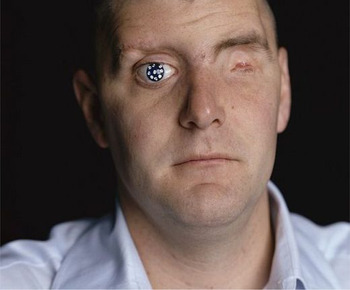
The wordless immediacy of the visible (Figure 1). A white man, not smiling, we might say or think ‘disfigured’. The figure of this man seems spoiled. We perhaps desire an unspoiled image, or hope for some form of recognisable wholeness. It feels unhappy. Though not all is spoiled in immediate view, but there is something about the eyes. Context is perhaps important, and I can tell you where this was exhibited, where I saw it and what information was offered. This is a photo-portrait that was part of ‘The Sensory War 1914–2014’ exhibition at the Manchester Art Gallery marking the centenary of the First World War. The photographer is Timothy Greenfield Sanders and the ‘title’ of the portrait is ‘Michael Jernigan, Marine Corps, 2006’.Footnote 86 Jernigan lost his sight in an attack with an IED (Improvised Explosive Device) while serving in Iraq. Jernigan and his wife split up and Jernigan had the diamonds from his (ex-)wife's wedding ring set into one of his eight prosthetic eyes. I want to linger awhile on the pains and promises one might sense here through the telling of this context. I also want to follow some of the trails of sex/gender and military/violence through the lure and promise of diamonds so coldly presented here.
The man with diamonds in his eye.
Source: Permission to reproduce this image kindly granted by the photographer. Portrait by Timothy Greenfield-Sanders, ‘Michael Jernigan, Marine Corps, 2006’. From ‘Injured Soldiers and Marine’ series.

Military promises of ‘family lives’ supported in return for the unconditional promise to kill ‘others’. Soldier-men made men through this uber masculine Faustian pact; bodies made super-hard with fantastic body armour and high-tech gadgetry. This steely social contract offers assurances, relying on conditional continuity and commitment, faithfulness, and stability. Such temptation: the bait and rewards of a man made whole – a man/made – so easily broken; so easily shattered. This all surely shows in this man's face, the man with diamonds in his eye. A grotesque allusion to a James Bond-esque villain.
‘To make the private into something public is an action that has terrific consequences on the pre-invented world.’Footnote 87 Riffing on feminism's propelling of the feminised private into the realm of its provenance, we can perhaps begin to feel what Olivia Laing means by the ‘terrific consequences’. The gender-sexed pretence of the domestic, of the natural, of the instinctual, re-emerge in public-social worlds as acts of violence, giving ‘real life’ to the claim that feminist theorising has markedly alerted the terrain of thinking about violence. Wages for housework, for childbirth/rearing? Exposing white masculine standardised norms as fictional – if deadly real – with the lives of all other ‘others’ as also entirely fictional but always violently in relation? There is always feminised, othered brazenness to these pugnacious truths, especially when not tempered by obeisance to patriarchal instruction, for example through an acceptable feminine form, a subservient or pleasing racialised form – ‘an attractive white woman’, or an ‘entertaining black man’. Though even these are temporally restricted – time will run out one way or another.
‘Beginnings are indeed riddles’, the opening epigraph and methodological question. We already know so much about this man. We recognise a man, a white man. In a world of white supremacy, perhaps the stark male whiteness appears comforting, for some, at first, though there is no smile. And we see disfigurement, but also something not quite recognisable – what is that in his right eye? That might be all we ‘know’ without the information provided by the museum. What is for many an arresting image, becomes perhaps horrifying, though perhaps laced with white sympathy. Diamonds? The diamonds from his ex-wife's wedding ring? The script of pre-invented worlds begins to unfold. Is it a kind of revenge? Bitter revenge? But towards whom? Revenge is always towards something, someone, surely? The trails and entrails of ‘what, why, how and who for?’ scatter and spreadeagle across minds and hearts echoing Vuyong's eloquent ruching of the intimate and the global. Connecting all of these thoughts up in methodologically sanitised ways is perhaps precisely not what artists intend. And it is surely not my job to impute intention.
But I sense the violence of moving through genders in this image and through ideas of what holds sex together. Becoming a man, no, more of a man through the promises of military manliness, especially perhaps one so white. Perhaps the ever-important question – where are the women? – might drift to thinking surfaces more quickly if this man were not white. Not knowable of course. This maybe not a man anymore, especially not a man/soldier, still for many the epitome of what a man is – ‘all a man can be’ – even if corporeally presenting as female. Such is the enigma of the boundaries around gender and sex – quite flimsy, so quick to change, yet so violent. The diamonds wreak their beauty to break this story to us. Fused in heat, given arbitrary but fiscally loaded meaning, spewing oppositional worlds of beauty, love, and riches in the mire of exploitation, poverty, and pain – blood diamonds. And, of course, illusion. The cold cruel diamonds facing everyone who cares to look, and to linger. Who cares to look, to really look?
The man who became a woman
To allow women to be like men would be to risk men becoming like women.Footnote 88
When we say to a woman that she is a man or to a man that he is a woman, it's a terrible insult. This is why we cut one another's throats.Footnote 89
The idea of crossing or changing gender can be a fascinating and terrible one, not least given the possibility that it might be a question about transgender. Questions about transgender especially in relationship with feminist theory are contemporarily extremely fraught.Footnote 90 One set of contentious arguments has it that transwomen can never be women given their earlier and putatively formative lives as males. The questions I pursue here are not explicitly about transgender as this has become popularly understood, rather they are about how to think about sexual violence enacted on male-marked bodies. Yet the spectre of gender-change is wholly relevant given in some contexts sexual violence perpetrated on men as a consequence of particularly penetrative sexual violence can ‘turn a man into a woman’.
At the trial of Jean-Pierre Bemba one of the witnesses reported that his rapist had said after the attack, ‘you are a woman now’. This comment was reported by a witness at the trial at the International Criminal Court, where Bemba had been charged with crimes against humanity and war crimes.Footnote 91 The forced removal of a man's ‘manliness’ through an act of sexual violence is powerfully invoked here. His wife left him because he ‘wasn't a man’ anymore. We are invited to understand it as a bodily, psychical, and phenomenological insult imposed by a male rapist on his male victim – a cruelly foisted interpellation. Or for Dhia al Shweiri, a former prisoner in Abu Ghraib, ‘we are men. It's OK if they beat me. Beatings don't hurt us: it's just a blow. But no one would want [his] manhood to be shattered. They wanted us to feel as though we were women, the way women feel, and this is the worst insult, to feel like a woman.’Footnote 92
When a woman is raped, does she become something gendered other? A man? An ungendered being? Or does she remain a woman, perhaps even ‘more so’ than before? These questions are, at one level, abstract, esoteric, and the connections to the pain and suffering of raped men – the ‘shadow beings … the most destroyed people’Footnote 93 – might seem unsympathetically distant. What of the bloody trails of ‘homosexualisation’ and ‘feminisation’ that have been increasingly documented?Footnote 94 Or the loss of status, loss of wives and families, the loss of identity, the loss of place. And the pain – pain of all kinds including the symbolic infantilisation of wearing nappies.
But to ask again – if a woman who is raped becomes a man? Perhaps it is the more ‘sensible’ and gender conforming idea is that a woman who is raped is (once again) confirmed as a woman. ‘What is gender, after all, but one of the most telling texts of sexual difference, a term that simply if profoundly consolidates the known?’Footnote 95 Gender's presumption of a ground can never hold.Footnote 96 ‘Is not the rush to know gender a particularly anxious move to shut down the very overflowing of the text that gender open up?’Footnote 97
Is there then a radical distance between masculinity and femininity spiked through with differentially temporal, spatial, and corporeal places? Do femininity and masculinity materialise in different sites and with different vulnerabilities – corporeally, physically, psychically, and imaginatively? Is there something about masculinity that desires, needs or invites an ‘intactness’ that femininity can more easily let go of, or have opened up, like a hymen? Is damage to masculinity, even as an idea or ideal, too difficult to suture, unlike a vagina? Thus masculinity's ‘falling apart’ emerges as ‘too much to bear’? Powerful heteronormative structuring completing the ‘impossibility’ of deconstruction here – posing questions about the masculine woman, for example, become problematic, perhaps impossible, inviting closer a question that prowls in discussions around the sexual violation of men – is it worse for men?
This is not a man – ‘how’ is a body?
One of the most extraordinary and most brutal incidences of historically lingering sexual violence that might be encountered is one that was violently produced through the pitiless prisms of race, gender, and colonialism. This violence was enacted on the woman known as ‘the Hottentot Venus’. Her real name buried, Sarah (Saartjie) Baartman was born on the South African frontier in the 1770s, where she lived for nearly three decades. She then spent five years in Europe before dying in Paris in 1815.Footnote 98 Images of her ‘as’ the Hottentot Venus are easily locatable via the Internet, most usually ones showing her being inspected by white colonising men peering curiously and excitedly at her ‘excessively large’ buttocks – ‘a supposedly paradoxical freak of race and sexuality, both alluring and primitive’.Footnote 99 The last few years of her short life have been relentlessly presented as standing in for ‘the whole’, but even on death she did not escape violation. Her corpse was dissected by ‘then revered’ scientist Georges Cuvier who remade her into a plaster cast – she was seemingly always available to be made, unmade, and remade – accessible for tens of thousands to see, indeed millions given the throngs who attended the Universal Exhibition in Paris in 1889. ‘Even while dead the female still engenders her sexual punishment.’Footnote 100 Her brain, skeleton, and sexual organs remained on display in a Paris museum until 1974 and her remains were not repatriated and buried until 2002 when Nelson Mandela arranged for her return and burial.
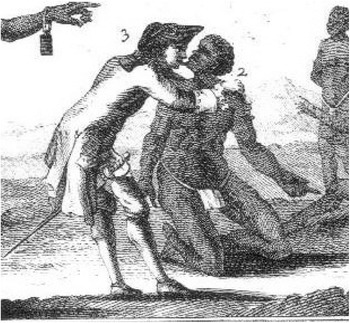
I chose not to show an image of Saara Bartman here, mindful of Avery Gordon's words about a slave belonging to a white man in nineteenth-century America who had been ordered to pose nude for the benefit of scientific studies, ‘she was just a piece of data waiting for his words to write her up, to pass her down to us as social science’.Footnote 101 Or as Trinh T. Minh-ha articulates, ‘it's as if everywhere we go, we become Someone's private zoo’.Footnote 102 Though I recall part of her life here to remind us of how the pitiless prisms of race, gender, and colonialism are sutured so cruelly and closely to sexualised violence – ‘silence is how black women die’.Footnote 103 The image I have chosen to include here is from the Afro-American Slave Trade and depicts a similar, if less well known site (and sight) of colonial and racial inspection and control (Figure 2). This image, discussed eloquently by Frederik Charles Staidum Jr, has the caption which states, ‘A Britishman licks the chin of a Negro to verify his age and to discover, by the taste of his sweat, if he is ill.’Footnote 104 As Staidum claims,
Penetration figures heavily within this image, as the European enslaver pries the African male's mouth open and peers in. Like the use of the tongue [in a previous engraving] this act of insertion is seemingly asexual, but the White man's ability to trespass on to and into the Black male body speaks to absolute power to transcend any boundary.Footnote 105
How is a body?
Source: Laurent, fec. Illustration for [Chambon], ‘Le commerce de L'Amérique par Marseille’ (Avignon, 1764), vol. II, pl. XI, facing p. 400: ‘Marché d'esclaves’. Copper engraving. Page: 249 x 190 mm. The image is available in the public domain.

Staidum goes on to describe the scene as an ‘uninvited transgression’ given the unsought licking of the flesh, elaborating; ‘He licks the flesh of the African, in order to determine the African's state of health, which is not an uncommon act for the time period …the forced exchange of bodily fluids is tainted with the threat of sexualized violence.’Footnote 106 In contemporary imaginaries, the chin, nose, or ears do not readily appear as a potential corporeal site of sexual assault, yet as Staidum states, ‘in nineteenth-century inconographics [sic] and physiognomy, ears were constructed, as were genitalia, as organs that exposed pathological essence, particularly of prostitutes and sexual women’.Footnote 107 Thus, within the world of nineteenth-century medical conventions and aesthetics, a sexual value was attached to facial anatomy. Examining the ear or other facial features, then, can be likened to examining the genitalia for reproductive potential or sadistic pleasure.
What might we take from this exhibition of violation? How does it help with my questions about theorisations about sexual violence against men? Perhaps it might provoke us to ask more uninhibited questions about what counts as a sexual organ, and what the consequences are of being so deeply in the thrall of conventional and contemporarily defined sexual parts and acts; recall Gayle Rubin's insight that sexual acts are ‘burdened with an excess of significance’.Footnote 108 We might want to further pursue analytical failures in regard to the idea of ‘social construction’; as Carol Vance reminds us, ‘the physiology of orgasm and penile erection no more explain a culture's sexual schema than the auditory range of the human ear explains its music’.Footnote 109 We might also reconsider how we vastly underestimate, despite academic appearances to the contrary, the ways in which bodies and subjectivities are exhaustively and microscopically constituted through the heavily textured range of identity categories that we periodically appear to ‘know’ (and do) something about. Queered and raced bodies persistently disappear in this analytic scenario, slipping so often away from the ‘secured’ realm of the ‘unviolatable’. The popular concept of ‘intersectionality’ has seemed, especially in academic vernacular, to seductively if illusorily to offer a way out of this dilemma.
Real eroticism is about how somebody's sweat tastes.Footnote 110
I read about the weight of a man's shoe. I begin to think about the weight of writing, the heaviness of words, and the (im)possibilities around writing sexual violence. There is too much. It is too much. Too much sorrow and pain. And degradation …
Pulling at threads
Feminist philosophy … represents the return of the repressed.Footnote 111
I opened this article esoterically, though this is not meant as an exclusionary gesture, but rather to open up thinking about how we theorise and how we make methodological connections. I struggle to write words that ethically and effectively tell about sexual violence. I struggle as an academic writing with and through feminism, certainly the kind of feminism I am immersed in. Cixous's thinking is helpful here with her suggestion that ecriture feminine has the possibility of propelling into existence ‘alternative forms of relation, perception and expression’.Footnote 112 And I have no hesitation in affirming that my use of Cixous's thinking is entirely removed from putative essentialist figurations of gendered bodies. My preferred articulation would be ecriture feministe. Though it is not so much words that incur struggle, but conventional methodological and theoretical limitations on their choreography on the page and on the intellectual thinking landscape, certainly within disciplinary boundaries conventionally proffered.
But there feels to be something effortless about how meanings ooze from images, and in the images I use here, forms of cognitive visual shorthand surely bespeak stories of masculinity, violence, gender, superiority, loss, and pain. I wonder about what is conjured by the image of the man with diamonds in his eye – a painful series of detonations, one secreted in the earth, another delivered through feminised rejection, another shattering promises of a military-man-made-whole – the sparkling promise of stones of love, tossed back in a cold return. Masculinity – a made up thing brimming with hefty, weighty meanings always dripping with violence. Femininity seems to not hold the same measure of meaning, though one might sense the grave work of the liminal connections between love, sex, and heteronormative promises of whole lives. I think about masculinity as it leaks in and out of the image of the man with diamonds in his eye, and I want to ask the question – is it worse for men? I am not invested in what the answer is, or what ‘it’ might be taken to mean, though it might of course be about sexual violence. That the question has form, this is what matters. And conversely that the question, ‘does the raped woman turn into a man’, materialise as a nonsensical one. This all matters. Gender emerges as not a thing of equalness. Can women's stories ‘change the world’? Will men's?
Masculinity, a feign life force that keeps dropping like bombs onto our worlds. The familiar voices, rhetorics, affects, and seductions of masculinity drip feeds COVID-19. Seeps around Blacks Lives Matter protests and white entitlement refusals.Footnote 113 Simulates and stimulates the behaviours of governmental leaders in supposed epitomes of democracy – Johnson and TrumpFootnote 114 as exemplars supreme. Masculinity – offering secret avenues of violence cosily wrapped up in something else – protection, ignorance, desire. Yet it is in the realm of images charged with value, pressure, feeling, images recognized and misrecognized, conscious and unconcise, that actual sexual violence is grounded.’Footnote 115 But lives and ideas continue to get sutured together, or ripped apart flailing, screaming on the altar of the promises of masculinity. This is one place that I think sexual violence hides and is nurtured, where gendersex has a seemingly seamless home. The man with diamonds in his eye gives glimpses into the ways in which masculinity is always violent, if sometimes not noticed, or even confused with supposed opposites. And how this is entirely wrapped up in choreographies of gendersex – relentlessly forcing borders between gendered and sexual violence and constantly making new ones. That a man can violently become a woman through sexed violence, reveals much about the violence of sexgender. Or that licking an ‘other's’ chin reeks of racialised and sexualised invasion.
Identifying feminist work as in large part responsible for the rendering of sexual violence against men as too ‘unseen’ in theory provoked my attention. It is not that I place feminist theory as ‘innocent’ or infallible – far from it, rather I thought the criticism important to consider. Though my (re)searching did not lead me to conclude that feminist theorising was responsible for the lack of attention to sexual violence against men, even if it might be, more that it indicated so many hesitations to drawing on the riches of feminist theory's alterity in order to push further at the connecting corridors between sex, gender, and violence and the connecting bridges that make these such seemingly warm partners. I began to wonder more acutely about the work of masculinity in this context. Think of how the activities captured in the remit of ‘sexual violence’ have proliferated now there is more serious attention being paid to sexual violence against men. A father watching/seeing a daughter defiled. A father knowing such a fact. A son doing. A man feeling. New boundaries to transgress, to penetrate. These different trajectories of masculinely inflected experiences of sexual violence suggest that we should be asking new questions about that deathly relationship between sexgender and violence. Part of this process, or way into imagining what kinds of questions we might ask – one way to reach for this is through different methodological routes and forms of writing, a persistent feminist quest.
People suffer violations that have become described as sexual violence. This appears to be a major issue globally, which noticeably worsens in times of conflict. This is, of course, a huge problem. Though it matters very much that the idea of sexual violence – or its noticing, documenting, and legislating against – has been notoriously about female marked bodies. Being able to think – literally – of this so seriously is fundamentally linked to the development of feminist theory. Yet, as I understand it, feminist theory proposes revolutionary thinking and acting – ‘changing the world’. Thus surprisingly, the concept of gender, when utilised to seriously think about sexual violence against male marked bodies, emerges as both banal and problematic. This is illustrated in part through the dualistic antagonism that has periodically emerged, positing gender as either a simple apolitical equation, or a force sequestered by feminists and made unavailable for theorising sexual violence against men. Though the problem begins to splinter here – is the problem with feminist usurpation of gender as ‘its own’, preventing appropriate use by those wanting to theorise about sexual violence against men? Or is the problem that the concept of gender has become unrecognisably prosaic given its feminist provenance? I would argue that a good deal of recent work on sexual violence against men, certainly within the discipline of IR, works within the realms of this ‘splinter’ as I describe it here. Much of this work is nuanced and empirically rich, yet I am left with a sense of binaried stuckness, which I discussed earlier in regard to choreographies of gender and gradations of obviousness.
Epistemology-methodology-ontology – something of an irreverent Möbius strip, yet conventionally constrained and contained for academic presentation. Disregarding these containments remains, I would argue, one of the primary intentions of feminist scholarship. Thus, my sense of ‘something not quite right’ in the flows of argumentation around gender and gender's place in theorising about sexual violence against men pushed me to pursue alternative routes to thinking and writing about ‘theorising’. ‘Memory is a choice’, Vuong reminds, and I wanted to remember how it is that ‘feminist theory works with that which [philosophy] pronounces inessential, contingent and superfluous’.Footnote 116 Inessential, contingent, and superfluous – heavily value-laden words that I worked with tangentially to reimagine the contradictory ways sexgenderviolence work together to keep reproducing. Choosing not to focus on what already looks to be sexual violence was key, as the sealed loops of embedded gender knowledge seem to hinder further thinking movement. Yet the work of masculinity, as always in some form of opposition to femininity, materialised as a site and sight of attention. Hence the stories of three men, or really imaginations of three men. My intention was to create a something of a ‘system of visibility’ through words, imagination, and feminist looking. Focusing on an image, returning to it again and again to think through the many gendered layers of associations and assumed meanings and short cut connections – I think this can expose some of the more secretive, or less loud ways that gender is so intimate with violence. And it does not matter if the image is ‘real’, fictional, or imagined – literature surely tells more about life than a policy briefing or academic textbook.
One of the tasks of theoretical thinking as I see it, is to keep posing the question ‘what if one conceived of the world in this way’? What if one imagined a feminist world, or perhaps a world where gendersex bore no meaning – what non-violence might these images speak of, or reveal? My point is not to say that a gendersex free world would have no violence – how could anyone know the answer to this? What I do know, is that gendersex is a forceful progenitor and greedy producer and feeder of violence, how then, might we think about the pain each of these three ‘men’ endure/d; their painful cruel shards? How might we imagine these subjects if gendersex did not exist – feminist theory as offering the chance to think nothing of gender – to reimagine gendersex as empty? Where might we travel theoretically to think this through?
Acknowledgements
I want to thank Shine Choi, Cristina Masters, and Elisabeth Prügl for their super helpful comments on earlier versions of this article. I also want to thank the editors and the anonymous reviewers for helping me to get this article into a much better shape than it started out.