


1 Introduction
In this paper, we show that making use of intergenerational transfers can be necessary and sufficient to achieve a Pareto improvement if otherwise non-internalizable intragenerational externalities exist. In order to generate intragenerational externalities that are not a consequence of an ad-hoc restriction of the set of admissible mechanisms, we use an environment with asymmetric information. For this class of problems, the realization of intragenerational gains from trade – or, what is the same, the internalization of intragenerational externalities – is not trivial because mechanisms cannot be directly contingent on the information parameters of the problem. Our argument that intergenerational transfers can improve the allocation is based on the relaxation of participation constraints that hold if a generation tries to implement a potentially Pareto-improving mechanism. Although it is difficult to find externalities that have no intergenerational component in practice, a number of externalities in production and consumption mostly affect adults in their working age. It is therefore worthwhile to analyze the limiting case in which intergenerational components do not exist.
To be more specific, suppose that individuals can take actions that affect – through some arbitrary channel – the wellbeing of other individuals in the same generation. While the actions are observable, the types that may, for example, determine the psychic and monetary costs associated with these actions are private information. The most prominent application for such problems can be found on insurance markets, which may be partitioned by birth cohorts to generate purely intragenerational externalities. Purchasing insurance is then generally associated with externalities for the other insured in that contract. Consequently, first-best full insurance contracts will be offered in the market equilibrium only for some individuals (Dionne and Doherty, Reference Dionne, Doherty and Dionne1992). In such a situation, there is scope for attaining first-best allocations through a Pareto-improving mechanism that entails subsidization of high-risk types. As another example, take the determination of public and private preventive and curative care in case of an infectious disease. Let that disease be dangerous only for the elderly, say some type of influenza. Any treatment has positive externalities within that generation, but not across generations because the next generation will have to combat new viruses. The problem of the government is now to determine the aggregate willingness to pay for the measures through some Clarke–Groves or d'Aspremont–Gérard–Varet mechanism.
A government tries to implement a mechanism that induces every individual to take an action that yields in combination an efficient allocation. However, the implementation of a mechanism has to ensure that everybody is at least as well off as in a reference allocation without this mechanism. This requirement does not create a problem if individuals are sufficiently similar. With efficiency gains approximately equally distributed, everybody is willing to pay a lump sum that finances the incentive payments of a direct mechanism. Having a more differentiated population often implies a situation in which some individuals have a rather low willingness to pay for achieving a proposed efficient allocation. In the asymmetric-information framework, these individuals cannot be identified ex ante and compensated accordingly. Consequently, some types earn information rents, and the maximum lump sum that can be collected may not cover the expenses for the incentive payments in full. As a result, the transfer mechanism is not feasible if it has to be self-financing. A minimum period deficit (MPD) arises to be able to internalize intragenerational externalities.
Intergenerational transfers from the young to the old can close the gap between necessary expenses and the maximum revenue that can be collected without harming anyone in the old generation. This can take the form of a pay-as-you-go (PAYG) pension entitlement for the old being contingent on actions taken during their working life, a flat pension benefit, or public debt in general. However, the problem to finance the MPD of the mechanism arises again for the young who – depending on the link between MPD and population size – may or may not face the same structure of intragenerational externalities as in the predecessor generation and who, in addition, have to be compensated for the transfer they have given to the old. It turns out that an intergenerational Pareto optimum can be achieved at a debt per capita converging to zero if and only if the population growth rate exceeds both the interest rate and the growth rate of the MPD.
Our contribution adds a new argument to the literature dealing with the Pareto-improving role of intergenerational transfers. Our finding that the transfer scheme is sustainable if and only if the growth rate of the economy exceeds both the interest rate and the MPD growth rate is important in two respects.
1. It shows that even if the MPD turns negative when the population reaches a critical size, the ability to achieve an intergenerational Pareto improvement is up to the dynamic inefficiency of the economy. This finding points to a substantial conflict of interest: consider a structure of the intragenerational externality such that intragenerational efficiency is feasible without additional transfers from a critical population size on, where the economy is dynamically efficient. Intergenerational transfers may then transform a Pareto inefficient intertemporal economy into a Pareto efficient one, but this transformation is no intergenerational Pareto improvement.
2. It shows that in all cases where the interest rate falls short of the growth rate of the MPD, a Pareto-improving introduction of a PAYG scheme that allows the implementation of a first-best mechanism is even more difficult to achieve than what may be perceived from the literature. In this case the relevant comparison is not between population growth rate and interest rate, but between population- and MPD-growth rate.
By the same token, our contribution may be seen as turning around an argument from the debate on Pareto improvements by abolishing a PAYG scheme being financed by distortionary taxation (Breyer, Reference Breyer1989; Homburg, Reference Homburg1990; Fenge, Reference Fenge1995; Brunner, Reference Brunner1996). Gains for each generation may be realized by getting rid of static inefficiencies that would not exist without the PAYG scheme. This view overlooks that the static inefficiencies may arise when the PAYG scheme is abolished. The literature so far still lacks a convincing argument for the existence of static inefficiencies of PAYG schemes that are not consequences of ad-hoc restrictions. It rather starts with an ad-hoc inefficiency of the PAYG scheme that cannot be justified within the model. Hence, the conclusion that the replacement of an inefficient PAYG system by an efficient-funded system creates an efficiency gain is true but misleading, because it would have been possible to reform the PAYG system in a way as to remove the static inefficiency in the first place. Conversely, in our framework it is the introduction of the PAYG scheme that enables the economy to remove static externalities that may result from asymmetric information. Hence, if an undistorted economy exhibits static inefficiencies because of informational asymmetries, abolishing a PAYG scheme may create static inefficiencies that could otherwise be internalized. We consider asymmetric information as a natural starting point for explaining persistent static inefficiencies and borrow from the literature on mechanism design (e.g. Makowski and Mezzetti, Reference Makowski and Mezzetti1994).
The literature has put forward four lines of argument to show that intergenerational transfers may be necessary to Pareto-improve the allocation of an intertemporal economy.
The first argument is based on the dynamic inefficiency of an overlapping-generations economy if individual preferences for old-age consumption are sufficiently strong. High rates of private savings may imply a capital stock that is too high. Channelling savings away from the capital market is thus a means to make every generation better off (Samuelson, Reference Samuelson1958; Diamond, Reference Diamond1965).
Second, in an economy with exogenous interest rate intergenerational transfers play the role of a chain letter. As long as some type of transversality condition is not violated and no last period exists, intergenerational transfers can make every generation better off (Spremann, Reference Spremann1984).
Third, Merton (Reference Merton, Bodie and Shoven1983) argues that if the risks on capital and labor markets are not perfectly and positively correlated, it may be useful to introduce some element of PAYG financed intergenerational redistribution in order to efficiently hedge risks.
Fourth, intergenerational externalities, for example in the form of human capital investments between parents and children (Peters, Reference Peters1995; Kolmar, Reference Kolmar1997; Sinn, Reference Sinn2000), in the form of technological externalities because of increasing returns to scale (Wigger, Reference Wigger2001), or in the form of the exploitation of a non-renewable resource create a sufficient argument in favor of intergenerational transfers. In each case intergenerational gains from trade exist. These gains can be captured by implementing a scheme in which the older generation receives a PAYG pension as a compensation for sacrificing consumption opportunities during the working period in favor of the younger generation. Intergenerational transfers are necessary to achieve a Pareto improvement because the generation that has to make the sacrifice would inevitably be worse off if it changed its incentive scheme as to internalize the externality without transfers.
Our argument can be perceived as an alternative to the justifications related to hedging and intergenerational externalities as these need not hold at the same time. In contrast, it turns out that intergenerational Pareto improvements are possible only if dynamic inefficiency prevails. Thus, the internalization of intragenerational externalities through PAYG schemes is complementary to the arguments of overcoming dynamic inefficiencies and using chain letters.
Apart from these efficiency considerations, the emergence of PAYG schemes can be rationalized by an equity argument. If the currently old generation is comparatively poor, its lot can be improved by redistribution from the young to the old so as to maximize a Rawlsian or utilitarian intertemporal welfare function. Similar in spirit is the concept to use PAYG schemes as a device for intergenerational risk-sharing (Gordon and Varian, Reference Gordon and Varian1988; Shiller, Reference Shiller1999). Finally, following Browning (Reference Browning1975), it has been argued that PAYG schemes are likely to be founded, extended and sustained in the political process because old workers and retirees will either get a pension without paying contributions or exhibit a high rate of return on their remaining future contributions.
The remainder of our paper is organized as follows. In the next section, we introduce the basic model of intragenerational externalities in an economy characterized by intertemporally segregated generations and a structure of asymmetric information. Section 3 describes the set of Pareto-efficient allocations and first-best mechanisms that induce one of these allocations. Subsequently, Section 4 discusses participation constraints and presents a necessary and sufficient condition under which a self-financing first-best mechanism is no longer feasible. Section 5 analyzes the issue of sustainability when both intragenerational and intergenerational transfers are used to achieve a first-best allocation, and the final Section 6 concludes.
2 The model
We consider a discrete time model in which we have a sequence t = 1, … of periods. In every period of time there lives a number m t of individuals, constituting generation t. Our assumption that generations do not overlap should not be taken literally. It represents a reduced form of a standard overlapping-generations framework in which no intergenerational spillovers exist except for potential transfers. This convention is used in order to keep the notation as simple as possible. Focusing on intragenerational externalities, we stress that choices of individuals do not affect previous or succeeding generations. In an extension, we borrow from the standard overlapping-generations model the property of possible transfers from younger to older generations. In every period t, an individual i = 1, … , m t is characterized by her type θit∊Θit ⊂ 핉. This type is her private information. Denote by θt the vector of realized types  $\left\{ {\theta _{i}^{t} \comma \ldots\comma\,\theta _{m^{t} }^{t} } \right\}$, being an element of the set of potential type profiles
 $\rmTheta ^{t} \equals \rmTheta _{\setnum{1}}^{t} \times\ldots\times \rmTheta _{m^{t} }^{t} $. For convenience, we assume that the type determines the utility function of an individual, U(.,θit). The probability distribution governing nature's choice of types Ψt(θt) is common knowledge, and individual draws are statistically independent.
Every individual can choose an action a it from a set of possible actions A it. The vector of actions is denoted by  $a^{t} \equals \lcub {a_{\setnum{1}}^{t} \comma \ldots\comma\, a_{m^{t} }^{t} } \rcub$, and
 $A^{t} \equals A_{\setnum{1}}^{t} \times\ldots\times A_{m^{t} }^{t} $ is the collection of action sets in period t. The utility of an individual depends both on the choices of all individuals in her generation, a t, and on a transfer b it∊핉,
 $b^{t} \equals \lcub b_{\setnum{1}}^{t} \comma \, \ldots\comma\, b_{m^{t} }^{t} \rcub \,\in \,B^{t} \equals {\bb R}^{m^{t} } $ of a storable private good. The utility function of an individual is given by
 $$U\lpar a^{t} \comma b_{i}^{t} \comma {\theta} _{i}^{t} \rpar \equals v\lpar a^{t} \comma \theta _{i}^{t} \rpar \plus b_{i}^{t} \comma \quad i \equals 1\comma\ldots\comma m^{t}.$$
In accordance with the literature on mechanism design, the utility function is assumed to be additively separable between a t and b it and linear in the latter argument. The first component v will be called action utility. It fulfills the single-crossing property,
 $$v\lpar a_{i}^{t} \comma a_{ \minus i}^{t} \comma {\ihats{\theta }\hskip1pt}_{i}^{t} \rpar \minus v\lpar \mathop {\bar{a}}\nolimits_{i}^{t} \comma a_{ \minus i}^{t} \comma \mathop {\ihats{\theta }\hskip1pt}\nolimits_{i}^{t} \rpar \gt v\lpar a_{i}^{t} \comma a_{ \minus i}^{t} \comma \mathop {\tilde{\theta }}\nolimits_{i}^{t} \rpar \minus v\lpar \mathop {\bar{a}}\nolimits_{i}^{t} \comma a_{ \minus i}^{t} \comma \mathop {\tilde{\theta }}\nolimits_{i}^{t} \rpar \,\Leftrightarrow \,\mathop {\ihats{\theta }\hskip1pt}\nolimits_{i}^{t} \gt \mathop {\tilde{\theta }}\nolimits_{i}^{t} \wedge \,a_{i}^{t} \ne \mathop {\bar{a}}\nolimits_{i}^{t} \comma $$
which generates convenient monotonicity properties (Milgrom, Reference Milgrom2004).
This formulation of an allocation problem allows for a very general structure of spillovers and types of goods that are traded within the economy. Virtually any type of intragenerational interdependency between individual actions and utilities can be interpreted as a special case of the above specification, ranging from perfectly rival to perfectly non-rival goods.
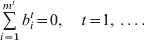
In our basic setup, we abstain from intergenerational transfers. This implies that the transfer budget must be balanced in every period:
 $$\mathop{\sum}\limits_{i \equals \setnum{1}}^{m^{t} } b_{i}^{t} \equals 0\comma \quad t \equals 1\comma\ldots.$$
In the following we analyze the case that generations are intertemporally separated. This means that the choices made by members of generation t have no impact on the economic environment or the number of individuals in period t + 1 or any other future period. In addition, we assume that intergenerational transfers are absent in the initial situation prior to the implementation of an efficient mechanism. In this reference allocation, individual i in period t achieves a utility level of U iM(θt), where the vector of reservation utilities in period t is denoted by  $U^{M} \lpar \theta ^{t} \rpar \equals \lcub U_{\setnum{1}}^{M} \lpar \theta ^{t} \rpar \comma\ldots\comma U_{m^{t} }^{M} \lpar \theta ^{t} \rpar \rcub $. This initial situation can have various interpretations. In a positive interpretation of the model, it can range from anarchy to a private-property economy, or any form of a more explicit institutional structure that generates a potentially inefficient outcome. In a normative contractarian interpretation of the model, it can be a situation of ideal equality under a veil of ignorance (Rawls, Reference Rawls1971). Irrespective of the precise interpretation of this initial situation, it leads to a vector of reservation utilities for every individual in each generation. This vector specifies a minimum acceptance point for every individual in the sense that every allocation that generates a lower level of utility can be blocked.
To summarize, an economy is characterized by {m t, U, U M, Θt, A t, B t}t = 1, ….
3 Pareto-efficient allocations and direct mechanisms
We start by a characterization of Pareto-efficient allocations. First note that the set of Pareto-efficient allocations can be found by the maximization of the unweighted sum of utilities because of the assumption of quasi-linear utilities. The case of intertemporally separated generations is particularly easy to solve because the intertemporal optimum {a t, b t}t = 1, … can be derived by the separate solution of each period's optimal policy {a t, b t} for the case of symmetric information.
Recalling the budget equation (3), any first-best efficient allocation for every period t has to satisfy
 $$\mathop {\max}\limits_{a\lpar \theta ^{t} \rpar \comma \,\,b\lpar \theta ^{t} \rpar } \,\,\mathop{\sum}\limits_{i \equals \setnum{1}}^{m^{t} } \left( {v\lpar a\lpar \theta ^{t} \rpar \comma \theta _{i}^{t} \rpar \plus b_{i}^{t} \lpar \theta ^{t} \rpar } \right) \equals \mathop {\max}\limits_{a\lpar \theta ^{t} \rpar } \,\mathop{\sum}\limits_{i \equals \setnum{1}}^{m^{t} } v\lpar a\lpar \theta ^{t} \rpar \comma \theta _{i}^{t} \rpar.$$
In general, the optimal choice of a t will be a function of θt because otherwise the type would be irrelevant. Denote by a t*=a t*(θt) such an optimal solution and by P(θt) the maximum sum of utilities. The linear terms b*(θt) are indeterminate within a certain range and will be used to control incentives.
We are looking for conditions under which intergenerational redistribution is necessary and sufficient for a Pareto improvement. It is therefore necessary to assume that every generation chooses an institutional structure that is as efficient as possible, given that no transfers between generations occur. Any argument in favor of intergenerational redistribution that is not based on an inevitable friction of the intratemporal problem is ad hoc in the sense that a better organization of the intratemporal allocation problem would be an alternative to intertemporal redistribution.
In order to implement a t* the society can use a period-t mechanism M t = {S t, f} that assigns strategy sets  $S^{t} \equals \lcub S_{\setnum{1}}^{t} \comma\ldots\comma S_{m^{t} }^{t} \rcub $ to every individual i = 1, …, m t in period t and a mapping f:S t→A t×B t that selects a choice vector a t for any given vector of strategies s t. We call an allocation (a t, b t) Bayesian implementable if it is a Bayesian–Nash equilibrium of the game induced by mechanism M t.
We know from standard implementation theory that every choice vector a t that can be implemented by an arbitrary mechanism can also be implemented by a direct mechanism M dt = {Θt,(a t*(.),b t*(.))} (Mas-Colell et al. Reference Mas-Colell, Whinston and Green1995). Because we want to focus on the role of intergenerational transfers under ideal institutional structures we will therefore restrict our attention to optimal direct mechanisms in the following.
Our analysis follows the approach of Makowski and Mezzetti (Reference Makowski and Mezzetti1994) who in contrast to most of their predecessors first look at conditions under which the incentive compatibility constraints are fulfilled and then analyze the participation constraints. This way of dealing with the problem is analytically easy to handle and is more adequate to our problem than the alternative approach to assume that the participation constraints are fulfilled and then check for the incentive compatibility constraints. We will first characterize the first-best efficient direct mechanism. In the next section, we investigate the conditions under which a Pareto-improving implementation of this mechanism is or is not possible. The latter case defines necessary conditions for the Pareto-improving role of intergenerational transfers. In order to complete our argument in favor of intergenerational transfers, we finally have to characterize conditions under which a scheme of intra- and intergenerational transfers is also sustainable.
Denote by E t[.] the non-contingent expected value and by E it[.] the contingent expected value of [.] for a given type θit, i = 1, …, m t. A Bayesian–Nash equilibrium of the direct mechanism M dt is a vector of strategies θt such that
 $$\eqalign{ E_{i}^{t} \lsqb U\lpar a^{t} \lpar \theta ^{t} \rpar \comma b_{i}^{t} \lpar \theta ^{t} \rpar \comma \theta \hskip1pt_{i}^{t} \rpar \rsqb \tab \ \geqslant \ E\hskip1pt_{i}^{t} \lsqb U\lpar a^{t} \lpar \mathop {\ihats{\theta }\hskip1pt}\nolimits_{i}^{t} \comma \theta _{ \minus i}^{t} \rpar \comma b_{i}^{t} \lpar \mathop {\ihats{\theta }\hskip1pt}\nolimits_{i}^{t} \comma \theta _{ \minus i}^{t} \rpar \comma \theta _{i}^{t} \rpar \rsqb \,\, \cr \forall \,\,\mathop {\ihats{\theta }\hskip1pt}\nolimits_{i}^{t} \tab \in\, \rmTheta _{i}^{t} \,\,\forall \,\,i \equals 1\comma\ldots\comma m^{t}. \cr} $$
It is now straightforward to characterize the properties of an efficient direct mechanism. In order to implement a t*(θt), individuals need to have an incentive to reveal their true type θit.
Lemma 1.Any efficient direct mechanism involves a transfer rule obeying
 $$b_{i}^{t} \lpar \mathop {{\ihats{\theta }\hskip1.5pt} ^{t} }\hskip-3pt\nolimits_{i} \comma \theta _{ \minus i}^{t} \rpar \equals E^{t} \left[ {\mathop{\sum}\limits_{j \ne i} v\lpar a^{t \ast } \lpar \mathop {\ihats{\theta }\hskip1pt}\nolimits_{i}^{t} \comma \theta _{ \minus i}^{t} \rpar \comma \theta _{j}^{t} \rpar } \right] \plus \gamma _{i}^{t} \comma \quad i \equals 1\comma\ldots m^{t} \comma $$
where γitis a constant.
Proof. See Appendix A. □
Lemma 1 states that the transfer is equal to the sum of the expected action utilities of all other individuals plus a constant. This rule ensures that everybody acts so as to maximize the sum of all expected utilities.
4 Feasibility without intergenerational transfers
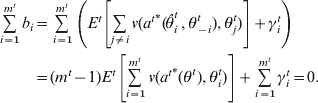
Without intergenerational transfers the budget constraint  $\sum\nolimits_{i \equals \setnum{1}}^{m^{t} } \,b_{i}^{t} \equals 0$ has to be fulfilled. In order to find out whether the first-best mechanism is feasible without relying on external resources, we have to check if the constant terms γt can be chosen so as to balance the budget. Denote by D t(γt) the expected deficit of the efficient mechanism with constant terms γt. If
 $\gamma _{\setnum{1}}^{t} \equals\ldots\equals \gamma _{m^{t} }^{t} \equals 0$, the expected deficit is equal to
 $$D\lpar 0\rpar := \lpar m^{t} \minus 1\rpar E^{t} \lsqb P\lpar \theta ^{t} \rpar \rsqb \equals \lpar m^{t} \minus 1\rpar \,\,E^{t} \left[ {\mathop{\sum}\limits_{i \equals \setnum{1}}^{m^{t} } v\lpar a^{t \ast } \lpar \theta ^{t} \rpar \comma \theta _{i}^{t} \rpar } \right].$$
Hence, an efficient mechanism can be implemented without intergenerational transfers if and only if the sum of constant terms γt, multiplied by −1, is not smaller than D(0), where the boundary is determined by
 $$\eqalign{ \mathop{\sum}\limits_{i \equals \setnum{1}}^{m^{t} } b_{i} \equals \tab \mathop{\sum}\limits_{i \equals \setnum{1}}^{m^{t} } \,\left( {E^{t} \left[ {\mathop{\sum}\limits_{j \ne i} v\lpar a^{t \ast } \lpar \mathop {\ihats{\theta }\hskip1pt}\nolimits_{i}^{t} \comma \theta _{ \minus i}^{t} \rpar \comma \theta _{j}^{t} \rpar } \right] \plus \gamma _{i}^{t} } \right) \cr \equals \tab \lpar m^{t} \minus 1\rpar E^{t} \left[ {\mathop{\sum}\limits_{i \equals \setnum{1}}^{m^{t} } v\lpar a^{t \ast } \lpar \theta ^{t} \rpar \comma \theta _{i}^{t} \rpar } \right] \plus \mathop{\sum}\limits_{i \equals \setnum{1}}^{m^{t} } \gamma _{i}^{t} \equals 0. \cr} $$
Assume that the reservation utility of individual i in the case that the mechanism is not implemented is equal to U iM(θt). The precise specification of this reservation utility depends on the status quo alternative that is used as a benchmark for the evaluation of the implementation of an efficient mechanism, as being discussed in Section 2. Since the qualitative nature of our argument does not rely on the numerical values of the U iM(θt), we do not have to specify the economic environment that generates them. However, we will analyze the allocation of a private good in a private-property economy as an example in Section 6. The assumption of private property will then generate an explicit value of the reservation utilities.
Given this framework, Proposition 1 describes the necessary and sufficient condition for being able to implement a first-best allocation without intergenerational transfers.
Proposition 1.If and only if 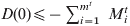 $D\lpar 0\rpar \leqslant \minus \mathop{\sum}\nolimits_{i \equals \setnum{1}}^{m^{t} } \,\,M_{i}^{t} $with
 $$M_{i}^{t} := \mathop {\max}\limits_{\theta _{i}^{t} \,\, \in \,\,\rmTheta _{i}^{t} } \left\{ {E_{i}^{t} \lsqb U_{i}^{M} \lpar \theta ^{t} \rpar \rsqb \minus E_{i}^{t} \left[ {\mathop{\sum}\limits_{j \equals \setnum{1}}^{m^{t} } \,v\lpar a^{t \ast } \lpar \mathop {\ihats{\theta }\hskip1pt}\nolimits_{j}^{t} \comma \theta _{ \minus j}^{t} \rpar \comma \theta _{j}^{t} \rpar } \right]} \right\}$$
holds in every period, it is possible to implement an intertemporally efficient allocation without intergenerational transfers.
Proof. See Appendix B. □
Proposition 1 indicates under which condition intergenerational transfers may be useful to achieve a Pareto improvement. Note that the threshold values M it will typically be negative if the sum of the expected action utilities is positive, and vice versa.
The proof of Proposition 1 shows that the lump-sum payments that can be imposed on an individual are restricted from above. If the condition stated in Proposition 1 is violated, it is no longer possible to arrive at a first-best allocation by means of a self-financing mechanism. Of course, this does not exclude a Pareto improvement compared to the reference allocation through some other self-financing mechanism.
The feasibility problem is in fact a result of asymmetric information. The next proposition demonstrates that in a world with symmetric information the first-best allocation can be achieved without intergenerational transfers.
Proposition 2.With symmetric information implementing a first-best allocation is feasible without relying on intergenerational transfers.
Proof. See Appendix C. □
Proposition 2 is easily understood. If information about the individuals' types is symmetrically distributed, differentiated lump-sum payments can be used. It is then possible to design the transfer structure such that everybody gets exactly her reservation utility while the first-best action vector is induced. Such a scheme will be associated with a budget surplus because internalizing the externalities at a balanced budget must lead to a higher sum of expected utilities. The arising budget surplus can then be distributed to make everybody better off. With asymmetric information, many individuals may receive unavoidable information rents if a mechanism is implemented in order to achieve a first-best allocation. As a result, the gain in aggregate utility may not be sufficient to finance these rents.
5 Sustainability with intergenerational transfers
We know from the above analysis that a first-best efficient allocation can be reached only if the transfer rule (6) is fulfilled in all periods. Recalling that Lemma 1 describes the set of efficient direct mechanisms, the question as to whether it is actually possible to implement a first-best efficient allocation is answered by finding out if γt can be set such that an intra-generationally Pareto efficient mechanism is self-financing, i.e., the condition outlined in Proposition 1 is fulfilled. Depending on the structure of the intragenerational allocation problem, this condition may or may not be fulfilled if information is asymmetrically distributed. If the gains from trade from the implementation of an efficient mechanism are sufficiently large for all realizations of types θt, we can expect that the implementation of an efficient mechanism is in fact a Pareto improvement. However, it is easy to construct examples where this condition is not satisfied. For example, Myerson and Satterthwaite (Reference Myerson and Satterthwaite1983) have shown that it is impossible to reach efficiency in a situation of bilateral trade with private property rights if gains from trade exist in expectation, but not for every realization of types. If such a situation occurs, intergenerational transfers may play a Pareto-improving role. In order to demonstrate this, let
 $$\bar{W}\lpar \theta ^{t} \comma m^{t} \comma a^{t} \comma U^{M} \rpar \equals D\lpar 0\rpar \plus \mathop{\sum}\limits_{i \equals \setnum{1}}^{m^{t} } M_{i}^{t} $$
be the minimum period deficit (MPD) necessary to implement a first-best efficient allocation in generation t. In general,  $\mathop {\bar{W}}\nolimits^{t} $ depends on the nature of the allocation problem, the preferences of the individuals, and the size of the population.
In the following we extend our basic model of intertemporally separated generations by allowing for transfers from any younger generation t + 1 to its predecessor generation t. This can be done by simply reinterpreting (1) as representing the indirect utility function of the standard overlapping-generations (OLG) model where the individual has already optimized her savings behavior. A storage technology exists such that the interest rate is zero, where resources can be added up across periods. Transfers do not alter production in the economy, and we exclude the option to invest budget surpluses in order to generate some additional output in the next period. Later on, we also consider the possibility of a fixed positive interest rate, corresponding to a standard OLG model of a small open economy.
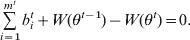
Given that every generation t + 1 pays a transfer W(θt) to its predecessor generation, the budget constraint (3) of a generation t becomes
 $$\mathop{\sum}\limits_{i \equals \setnum{1}}^{m^{t} } b_{i}^{t} \plus W\lpar \theta ^{t \minus \setnum{1}} \rpar \minus W\lpar \theta ^{t} \rpar \equals 0.$$
Intergenerational transfers can hence make it possible to implement an efficient allocation for all generations t if and only if
 $$\bar{W}\lpar \theta ^{t} \rpar \leqslant W\lpar \theta ^{t} \rpar \minus W\lpar \theta ^{t \minus \setnum{1}} \rpar \comma \quad t \equals 1\comma\ldots.$$
Neglecting the asymptotic behavior of W(.) such a transfer scheme is possible to implement in principle (see Spremann, Reference Spremann1984). The problem is to construct a scheme which is sustainable. For a finite time horizon, a first-best mechanism is called sustainable if it is possible to cover all budget deficits. If we have an infinite time horizon, the corresponding condition is that public debt per capita converges to zero. Our notion of sustainability is of course very narrow. It is also conceivable to call a scheme sustainable if debt per capita does not exceed a finite threshold or even if the ratio between public debt and GDP does not exceed some finite number. However, neither alternative is a generalization of the requirement in the finite horizon framework that all debt has to be repaid.
Assume that the intergenerational transfer mechanism is first to be implemented in period t = 1 and that a transfer  $\mathop {\bar{W}}\nolimits^{\setnum{1}} $ is first paid to generation 1 by generation 2. We can easily derive the necessary and sufficient condition for being able to implement a first-best mechanism when the economy ceases to exist at the end of period T.
Proposition 3.For every finite time horizon T a necessary and sufficient condition for the implementation of a first-best mechanism in every period is that the sequence of transfers  $\lcub W^{t} \rcub _{t \equals \setnum{1}\comma\ldots\comma T} \equals \lcub \sum\nolimits_{i \equals \setnum{1}}^{t} \,\mathop {\bar{W}}\nolimits^{i} \rcub _{t \equals \setnum{1}\comma\ldots\comma T} $satisfies
 $\sum\nolimits_{i \equals \setnum{1}}^{T} \,\mathop {\bar{W}}\nolimits^{i} \leqslant 0$.
Proof. See Appendix D. □
Proposition 3 states that deficits in some periods have to be at least compensated by surpluses in other periods. Otherwise, it is impossible to cover every budget deficit that arises between the first period t = 1 and the last period T. Given that the nature of the allocation problem and the preferences of the individuals do not change over time, this condition can only be fulfilled if there is either positive or negative population growth. With a constant population size and  $\mathop {\bar{W}}\nolimits^{t} \hskip-1pt\gt 0$ for some t, the deficit
 $\mathop {\bar W}\nolimits^{t} $ is constant and positive in all periods. In Appendix G, we will present an example of an economy with only private goods in which $\mathop {\bar{W}}\nolimits^{t} $ decreases in m t. The following corollary is an immediate implication of Proposition 3.
Corollary.There exists no Pareto-improving introduction of a sequence of transfers $\lcub W^{t} \rcub _{t \equals \setnum{1}\comma\ldots\comma T} \equals \lcub \sum\nolimits_{i \equals \setnum{1}}^{t} \,\mathop {\bar{W}}\nolimits^{i} \rcub _{t \equals \setnum{1}\comma\ldots\comma T} $ with  $\mathop {\bar{W}}\nolimits^{t}\hskip-1pt \ne 0$for at least one t that implements a first-best mechanism in every period.
Proof. See Appendix E. □
With a finite time horizon it is impossible to make every individual in each generation better off by introducing intergenerational transfers. While a Pareto-efficient allocation may be achieved by implementing the scheme of intra- and intergenerational transfers, a generation that is a net payer can even do better in the absence of the intergenerational transfer scheme. In that case it can implement a first-best allocation for its members and leave the full period budget surplus for their consumption. Even if it is possible to eliminate all inefficiencies over time, it is not possible to do so in a Pareto-improving way.
Next we focus on an infinite time horizon. The gross intergenerational transfer in the receiving generation is w(θt)=W(θt)/m t per capita. We start by considering the situation in which the population grows at a constant rate μ=m t + 1/m t − 1 ∀ t and the minimum deficit  $\bar{W}$ grows at a constant rate η ∀ t, depending on the exact nature of the allocation problem. Further, we introduce the interest rate r ⩾ 0. Proposition 4 collects the conditions under which debt per capita converges to zero.
Proposition 4.With an infinite time horizon and constant growth rates of the population and the period budget deficit, implementing a first-best mechanism in every period is sustainable if and only if the rate of population growth, μ, is higher than the maximum of the interest rate and the growth rate of the deficit, η, that is, μ > max{η, r}.
Proof. See Appendix F. □
Since aggregate debt increases steadily irrespective of the growth rate of the deficit, a positive rate of population growth is necessary for having a debt per capita that converges to zero. Per assumption, the minimum debt of the current budget deficit grows at rate η, while debt related to all earlier budget deficits grows at the interest rate r. Therefore, aggregate debt as the sum over such components never grows at a rate that is higher than max {η, r}. As the limiting cases may occur, debt per capita converges to zero if and only if μ > max{η, r}, that is, population grows at an even higher rate.
The condition μ>r states that dynamic inefficiency is necessary for sustainability of the intergenerational transfer scheme. This property can be related to the justification for PAYG schemes by a dynamic inefficiency of the economy, that is μ>r in a situation without PAYG transfers. The case η > μ>r is worthwhile exploring: the economy is in a state of dynamic inefficiency, but the growth rate of the MPD exceeds the population growth rate. In this case, there is no Pareto-improving PAYG scheme that allows the implementation of first-best mechanisms in all periods and that is consistent with the transversality condition that debt per capita converges to zero. Hence, it turns out the standard criterion for the existence of Pareto-improving PAYG schemes is misleading if one takes into consideration that static inefficiencies may be an unavoidable and systematic attribute of the economy under consideration. It must be replaced by the stronger condition μ > max{η, r}.
Propositions 3 and 4 have some obvious implications for the more general scenarios without constant growth rates. For example, if the growth rate of the population is always positive and higher than the growth rate of the aggregate deficit, debt per capita will converge to zero. In contrast, if the population does never increase and the budget deficit is always positive, the intergenerational transfer scheme is not sustainable.
Of course, $\mathop {\bar{W}}\nolimits^{t} $ is in general a function of the population size,  $\mathop {\bar{W}}\nolimits^{t} \hskip-1pt\equals \bar{W}\lpar m^{t} \rpar $. Whether $\bar{W}$ rises or falls with an increasing population depends on the nature of the problem. In the bargaining problem presented in Appendix G, $\bar{W}$ decreases with a rising population because a hold-up problem vanishes as the size of the market increases. In contrast, we expect an increasing deficit for any conventional public goods provision problem because the probability that a voter's misrepresentation of preferences is decisive becomes small. Following this reasoning, Mailath and Postlewaite (Reference Mailath and Postlewaite1990) have shown that an efficient public good provision will not take place with a self-financing mechanism when the population becomes large. It is conceivable that this may even yield a scenario in which the period deficit grows faster than the population for any population growth path with positive growth rates. Thus, dynamic inefficiency of the economy is not sufficient to implement a sustainable scheme of intergenerational transfers that removes the static inefficiencies in all periods.
We can draw some additional conclusions by recalling Propositions 3 and 4. Debt per capita will converge to zero if population increases at a minimum growth rate μmin>r while at the same time the function $\bar{W}$ is non-increasing. With an increasing function $\bar{W}$, the intergenerational transfer scheme is sustainable if in every period the rate of population growth exceeds both the interest rate and the growth rate of the deficit. Further, a shrinking population may go along with a sustainable scheme if we have budget surpluses for small populations and budget deficits for large populations. If the deficit is positive for all population sizes, a constant or shrinking population can never imply that debt per capita converges to zero.
6 Concluding discussion
We have demonstrated that implementing a first-best allocation in an environment with asymmetric information and only intragenerational externalities can require the use of intergenerational transfers. Since the self-financing constraint of the mechanism cannot be satisfied, additional funds are needed. These funds are provided by the succeeding generation, which can be achieved by setting up a PAYG pension scheme. Of course, if an alternative source for receiving the additional government revenue is available as, for example, borrowing from abroad, the problem may also be solved without making use of PAYG pensions or some similar arrangement. However, if government borrowing on a perfect capital market is considered, it should be noted that the debt will never be repaid by the generation that receives the benefits. Otherwise, future tax payments will be taken into account such that the additional funds today do not contribute to relax the participation constraints. If future generations have to pay back the internal or external public debt, the transfer scheme is virtually identical to a PAYG pension scheme. A sustainable scheme with a per-capita debt converging to zero and budget deficits in every period requires that the initial inter-temporal allocation is not dynamically efficient. Hence, achieving a first-best allocation in every period is possible only if an intergenerational Pareto improvement can already be realized by introducing the PAYG scheme without tackling the externality problem. Our argument states that additional welfare gains can then be captured by having the necessary additional resources to implement a first-best allocation in every period.
Noting that all major OECD economies tend to be dynamically efficient (Abel et al., Reference Abel, Mankiw, Summers and Zeckhauser1989) suggests that our results show the impossibility of a sustainable scheme of intergenerational transfers if budget deficits occur in every period. Such a conclusion may be premature, however. In particular, the vast majority of the observations cited in Abel et al. refer to economies in which PAYG pension schemes are already in place. As both the introduction and extension of a PAYG pension scheme decrease aggregate savings, it cannot be excluded that dynamic inefficiency would prevail in a counterfactual situation without intergenerational transfers. For example, let the minimum period deficit be stationary, the population growth rate lie at 1%, and the real interest rate at 2%. Such an observation suggests that a sustainable intergenerational Pareto improvement is not feasible. However, this turns out to be wrong if the interest rate without the PAYG scheme lies around 0.5%. On the other hand, the secular trend of aging through lower fertility is expected to imply lower growth rates in the long run, making it even less likely to achieve an intergenerational Pareto improvement.
The proposed scheme can also work in a shrinking economy, which may be characterized by a negative population growth rate. An efficient allocation in all periods can, for example, be achieved when we have budget surpluses in smaller economies. With budget surpluses in some periods, at least one generation of net contributors can improve its position by abolishing the transfer scheme. When the notion of sustainability is relaxed by allowing for some finite per-capita debt in the limit or a positive maximum debt–output ratio, a growing population may no longer be necessary for a sustainable scheme with budget deficits in every period. If we allow for growing labor productivity, a constant or even declining population can go along with an increasing aggregate output over time.
If the proposed scheme is not sustainable, using some resources from intergenerational transfers will generally harm at least one of the succeeding generations. However, the typical situation in practice will be that achieving a first-best allocation in one generation involves some elements of intergenerational spillover in the sense that it enlarges the production capacities in the next generation. As already stated at the outset, such a component of intergenerational spillover would already necessitate intergenerational transfers.
Appendix A – Proof of Lemma 1
Compare the condition for an efficient allocation (4) with the individual condition for rational behavior in a Bayesian–Nash equilibrium, (5). Recalling the utility function (1) then shows that both problems coincide if and only if b t fulfills (6). With this transfer the individual maximization problem reads:
 $$\mathop {\max}\limits_{\mathop {\ihats{\theta }\hskip1pt}\nolimits_{i}^{t} \, \in \,\rmTheta _{i}^{t} } \,\,E_{i}^{t} \left[ {\,v\lpar a^{t \ast } \lpar \mathop {\ihats{\theta }\hskip1pt}\nolimits_{i}^{t} \comma \theta _{ \minus i}^{t} \rpar \comma \theta _{i}^{t} \rpar \plus \mathop{\sum}\limits_{j \ne i} \,v\lpar a^{t} \lpar \mathop {\ihats{\theta }\hskip1pt}\nolimits_{i}^{t} \comma \theta _{ \minus i}^{t} \rpar \comma \theta _{j}^{t} \rpar } \right] \plus \gamma _{i}^{t} \comma \quad i \equals 1\comma\ldots\comma m^{t}.$$
For every individual i = 1, …, m t, the maximum of this function is at  $\mathop {\ihats{\theta }\hskip1pt}\nolimits_{i}^{t} \equals \theta _{i}^{t} $ by construction. It can easily be verified that the class of efficient mechanisms is unambiguously determined except for the constant terms γit (see D'Aspremont and Gérard-Varet, Reference D'Aspremont and Gérard-Varet1979).
Appendix B – Proof of Proposition 1
The implementation of an efficient mechanism M dt is Pareto-improving if and only if
 $$E_{i}^{t} \left[ {\mathop{\sum}\limits_{j \equals \setnum{1}}^{m^{t} } \,v\lpar a^{t \ast } \lpar \mathop {\ihats{\theta }\hskip1pt}\nolimits_{j}^{t} \comma \theta _{j}^{t} \rpar \comma \theta _{j}^{t} \rpar } \right] \plus \gamma _{i}^{t} \geqslant E_{i}^{t} \lsqb U_{i}^{M} \lpar \theta ^{t} \rpar \rsqb \comma \quad i \equals 1\comma\ldots\comma m^{t}.$$
Noting that γit cannot be contingent on θit because of the asymmetry of information, this condition has to be fulfilled for all possible realizations of the type, implying that:
 $$\gamma _{i}^{t} \geqslant M_{i}^{t} := \mathop {\max}\limits_{\theta _{i}^{t} \,\, \in \,\,\rmTheta _{i}^{t} } \left\{ {E_{i}^{t} \lsqb U_{i}^{M} \lpar \theta ^{t} \rpar \rsqb \minus E_{i}^{t} \left[ {\mathop{\sum}\limits_{j \equals \setnum{1}}^{m^{t} } v\lpar a^{t \ast } \lpar \mathop {\ihats{\theta }}\nolimits_{j}^{t} \comma \theta _{ \minus j}^{t} \rpar \comma \theta _{j}^{t} \rpar } \right]} \right\}\comma $$
which defines a participation constraint for individual i in period t. Hence, only if
 $$D\lpar \gamma ^{t} \rpar \equals D\lpar 0\rpar \plus \mathop{\sum}\limits_{i \equals \setnum{1}}^{m^{t} } \gamma _{i}^{t} \leqslant 0\,\, \Leftrightarrow \,\,D\lpar 0\rpar \leqslant \minus \mathop{\sum}\limits_{i \equals \setnum{1}}^{m^{t} } \gamma _{i}^{t} \leqslant \minus \mathop{\sum}\limits_{i \equals \setnum{1}}^{m^{t} } M_{i}^{t} $$
holds, it is possible to implement an efficient mechanism without intergenerational transfers.
Appendix C – Proof of Proposition 2
With symmetric information, type-contingent transfers γit can be used. The threshold levels are given by
 $$\gamma _{i}^{t} \geqslant M_{i}^{t} := E_{i}^{t} \left[ {U_{i}^{M} \lpar \theta ^{t} \rpar } \right] \minus E_{i}^{t} \left[ {\mathop{\sum}\limits_{j \equals \setnum{1}}^{m^{t} } v\lpar a^{t \ast } \lpar \mathop {\ihats{\theta }}\nolimits_{j}^{t} \comma \theta _{ \minus j}^{t} \rpar \comma \theta _{j}^{t} \rpar } \right].$$
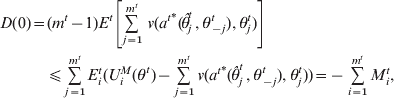
Implementing a first-best allocation without intergenerational transfers is feasible if
 $$\eqalign{ D\lpar 0\rpar \equals \tab\lpar m^{t} \minus 1\rpar E^{t} \left[ {\mathop{\sum}\limits_{j \equals \setnum{1}}^{m^{t} } \,v\lpar a^{t \ast } \lpar \mathop {\ihats{\theta }}\nolimits_{j}^{t} \comma \theta _{ \minus j}^{t} \rpar \comma \theta _{j}^{t} \rpar } \right] \cr \tab \leqslant\mathop{\sum}\limits_{j \equals \setnum{1}}^{m^{t} } E_{i}^{t} \lpar U_{i}^{M} \lpar \theta ^{t} \rpar \minus \mathop{\sum}\limits_{j \equals \setnum{1}}^{m^{t} } v\lpar a^{t \ast } \lpar \mathop {\ihats{\theta }\hskip1pt}\nolimits_{j}^{t} \comma \theta _{ \minus j}^{t} \rpar \comma \theta _{j}^{t} \rpar \rpar \equals \minus \mathop{\sum}\limits_{i \equals \setnum{1}}^{m^{t} } M_{i}^{t} \comma \cr} $$
which is equivalent to
 $$\mathop{\sum}\limits_{j \equals \setnum{1}}^{m^{t} } E_{t}^{i} \left[ {v\lpar a^{t \ast } \lpar \mathop {\ihats{\theta }}\nolimits_{j}^{t} \comma \theta _{ \minus j}^{t} \rpar \comma \theta _{j}^{t} \rpar } \right] \geqslant \mathop{\sum}\limits_{j \equals \setnum{1}}^{m^{t} } E_{t}^{i} \left[ {U_{i}^{M} \lpar \theta ^{t} \rpar } \right].$$
This latter condition is always satisfied with strict inequality because gains from the coordination of actions exist.
Appendix D – Proof of Proposition 3
According to (11), the minimum intergenerational transfer sufficient to implement an efficient mechanism for all generations 1, …, t is equal to
 $$W^{t} \equals \mathop{\sum}\limits_{i \equals \setnum{1}}^{t} \,\mathop {\bar{W}}\nolimits^{i}\hskip-2pt.$$
Noticing this condition, the claim is an immediate consequence of the definition of a sustainable scheme.
Appendix E – Proof of Corollary
Every minimum deficit  $\mathop {\bar{W}}\nolimits^{t} \gt 0$ in an arbitrary period t has to be covered by a subsequence of surpluses
 $\mathop {\bar{W}}\nolimits^{\tau } \lt 0$, τ⊂{1, …, T}. In these periods τ it would have been possible to implement an efficient mechanism without any transfers. Hence, any transfer $\mathop {\bar{W}}\nolimits^{\tau } \lt 0$ reduces consumption in period τ, which implies that at least one individual is worse off compared to the status quo.
Appendix F – Proof of Proposition 4
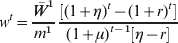
With a constant population growth rate, population at time t is equal to m t = (1 + μ)t − 1m 1. When  $\mathop {\bar{W}}\nolimits_{t \plus \setnum{1}} \sol \mathop {\bar{W}}\nolimits_{t} \minus 1 \equals \eta $ is the growth rate of the minimum period deficit, the aggregate minimum debt at time t can be expressed as
 $W^{t} \equals \mathop {\bar{W}}\nolimits^{\setnum{1}} \sum\nolimits_{i \equals \setnum{1}}^{t} \,\mathop {\left( {1 \plus r} \right)}\nolimits^{t \minus i} \lpar 1 \plus \eta \rpar ^{i \minus \setnum{1}} $. Hence, debt per capita in period t can be written as
 $$w^{t} \equals {{\mathop {\bar{W}}\nolimits^{\setnum{1}} } \over {m^{\setnum{1}} }}{{\left[ {\lpar 1 \plus \eta \rpar ^{t} \minus \lpar 1 \plus r\rpar ^{t} } \right]} \over {\lpar 1 \plus \mu \rpar ^{t \minus \setnum{1}} \left[ {\eta \minus r} \right]}}$$
if η≠r, and  $w^{t} \equals \lpar t\mathop {\bar{W}}\nolimits^{\setnum{1}} \lpar 1 \plus r\rpar ^{t} \rpar \sol \lpar m^{\setnum{1}} \lpar 1 \plus \mu \rpar ^{t \minus \setnum{1}} \rpar $ if η=r. The claim then follows immediately from considering limt → ∞w t.
Appendix G – Example with private goods
We assume that a private (that means rival and excludable) good is traded and that private property exists, which determines the reservation utility of each individual.
Assume that at every point of time t there is a potential seller of an indivisible unit of a private good, called individual 1. This individual has with probability 1/2 a utility of consuming her good that is equal to 1, and with probability 1/2 a utility of consuming her good that is equal to 0. There are m t − 1 ⩾ 1 potential buyers of the good with utilities of a or (1+a), a∊(0, 1), and probabilities 1/2, 1/2 respectively. The utilities represent types, and the random draws are independent of each other. Each individual learns her type before trade takes place, but not the types of the other individuals. Denote by a it∊{0, 1}, 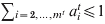 $\sum\nolimits_{i \equals \setnum{2}\comma\ldots\comma m^{t} } \,a_{i}^{t} \leqslant 1$, the act of trading the good with individual i at t. Normalizing the utility in case of no consumption to zero, this implies a utility before transfers of
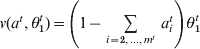 $$v\lpar a^{t} \comma \theta _{\setnum{1}}^{t} \rpar \equals \left( 1 \minus \mathop{\sum}\limits_{i \equals \setnum{2}\comma\ldots\comma m^{t} } \,a_{i}^{t} \right) \theta _{\setnum{1}}^{t} $$
for individual 1, and
 $$v\lpar a^{t} \comma \theta _{i}^{t} \rpar \equals a_{i}^{t} \theta _{i}^{t} $$
for individuals i = 2, …, m t.
As in Myerson and Satterthwaite (Reference Myerson and Satterthwaite1983), the problem is to implement a mechanism that induces every individual to reveal her type and at the same time satisfy the governments' budget constraint. Intuitively, the mechanism has to avoid a scenario in which agents are not willing to engage in mutually beneficial trade. This may happen if they can rationally expect to get better terms by not agreeing to the proposed price and continuing the bargaining process. An efficient mechanism implies an ex-post surplus of max{θ1t, …, θmt}. Given this surplus the expected deficit of an uncompensated Clarke-Groves-Vickrey mechanism is equal to
 $$\eqalign{ D^{t} \lpar 0\rpar \equals \tab\lpar m^{t} \minus 1\rpar E\lsqb \max\lcub \theta _{\setnum{1}} \comma\,\ldots\comma \theta _{m}^{t} \rcub \rsqb \equals \lpar m^{t} \minus 1\rpar {{\left( {2^{m^{t} } \minus 2} \right)\lpar 1 \plus a\rpar \plus 1 \plus a} \over {2^{m^{t} } }} \cr \equals \tab \lpar m^{t} \minus 1\rpar {{\left( {2^{m^{t} } \minus 1} \right)\lpar 1 \plus a\rpar } \over {2^{m^{t} } }}. \cr} $$
The maximum transfer M it that individual i is willing to accept without generating a conflict with its participation constraint is equal to
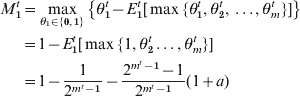 $$\eqalign{ M_{\setnum{1}}^{t} \equals \tab\mathop {\max}\limits_{\theta _{\setnum{1}} \,\,\in \,\, \lcub \setnum{0}\comma \setnum{1}\rcub } \left\{ {\theta _{\setnum{1}}^{t} \minus E_{\setnum{1}}^{t} \lsqb \max\lcub \theta _{\setnum{1}}^{t} \comma \theta _{\setnum{2}}^{t} \comma\ldots\comma \theta _{m}^{t} \rcub \rsqb } \right\} \cr \equals \tab 1 \minus E_{\setnum{1}}^{t} \lsqb \max\lcub 1\comma \theta _{\setnum{2}}^{t}\ldots\comma \theta _{m}^{t} \rcub \rsqb \cr \equals \tab 1 \minus {1 \over {2^{m^{t} \minus \setnum{1}} }} \minus {{2^{m^{t} \minus \setnum{1}} \minus 1} \over {2^{m^{t} \minus \setnum{1}} }}\lpar 1 \plus a\rpar \cr} $$
for individual 1, and
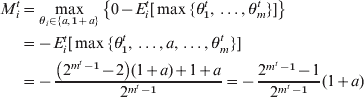 $$\eqalign{ M_{i}^{t} \equals \tab\mathop {\max}\limits_{\theta _{i} \,\,\in \,\, \lcub a\comma \setnum{1} \plus a\rcub } \left\{ {0 \minus E_{i}^{t} \lsqb \max\lcub \theta _{\setnum{1}}^{t} \comma\ldots\comma \theta _{m}^{t} \rcub \rsqb } \right\} \cr \equals \tab\minus E_{i}^{t} \lsqb \max\lcub \theta _{\setnum{1}}^{t} \comma\ldots\comma a\comma\ldots\comma \theta _{m}^{t} \rcub \rsqb \cr \equals\tab \minus {{\left( {2^{m^{t} \minus \setnum{1}} \minus 2} \right)\lpar 1 \plus a\rpar \plus 1 \plus a} \over {2^{m^{t} \minus \setnum{1}} }} \equals \minus {{2^{m^{t} \minus \setnum{1}} \minus 1} \over {2^{m^{t} \minus \setnum{1}} }}\lpar 1 \plus a\rpar \cr} $$
for individuals i = 2, …, m t. Hence, the intergenerational net transfer that is necessary to balance the budget is equal to
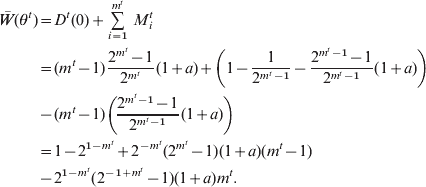 $$\eqalign{ \bar{W}\lpar \theta ^{t} \rpar \equals \tab D^{t} \lpar 0\rpar \plus \mathop{\sum}\limits_{i \equals \setnum{1}}^{m^{t} } \,M_{i}^{t} \cr \equals \tab \lpar m^{t} \minus 1\rpar {{2^{m^{t} } \minus 1} \over {2^{m^{t} } }}\lpar 1 \plus a\rpar \plus \left( {1 \minus {1 \over {2^{m^{t} \minus \setnum{1}} }} \minus {{2^{m^{t} \minus \setnum{1}} \minus 1} \over {2^{m^{t} \minus \setnum{1}} }}\lpar 1 \plus a\rpar } \right) \cr \minus \tab \lpar m^{t} \minus 1\rpar \left( {{{2^{m^{t} \minus \setnum{1}} \minus 1} \over {2^{m^{t} \minus \setnum{1}} }}\lpar 1 \plus a\rpar } \right) \cr \equals\tab 1 \minus 2^{\setnum{1} \minus m^{t} } \plus 2^{ \minus m^{t} } \lpar 2^{m^{t} } \minus 1\rpar \lpar 1 \plus a\rpar \lpar m^{t} \minus 1\rpar \cr \minus \tab 2^{\setnum{1} \minus m^{t} } \lpar 2^{ \minus \setnum{1} \plus m^{t} } \minus 1\rpar \lpar 1 \plus a\rpar m^{t}. \cr} $$
It is straightforward to check that the sign of this condition depends on a as well as on m t. The locus  $\bar{W}\lpar \theta ^{t} \rpar \equals 0$ is given by a monotonically decreasing and convex function a(m t), with a<a(m t) implying that
 $\bar{W}\lpar \theta ^{t} \rpar \gt 0$. Two results from the literature emerge as special cases. First, for m t = 2 we get
 $\bar{W}\lpar \theta ^{t} \rpar \equals \lpar 1 \minus a\rpar \sol 4 \gt 0$. This is the famous impossibility result by Myerson and Satterthwaite (Reference Myerson and Satterthwaite1983) who were the first to show that bilateral trade is necessarily inefficient for small groups of traders. Second, for m t → ∞ we get
 $\lim_{m^{t} \to \infty } \bar{W}\lpar \theta ^{t} \rpar \equals \minus a \lt 0$, which replicates the result by Gresik and Sattherthwaite (Reference Gresik and Satterthwaite1989), who have shown that the inefficiency vanishes if the number of potential traders increases. Hence, there is no need for intergenerational transfers in our example if the economy is sufficiently large.
On the other hand, if a<a(m t) holds, balancing the budget is only possible by means of intergenerational transfers. However, in a growing economy, m t + 1>m t ∀ t, with a zero interest rate it is always possible to find a non-exploding scheme. Noting that m t + 1⩾m t + 1 in this case, the range in which a>a(m t) is valid will be reached in finite time. Therefore, there exists an intergenerational transfer scheme from the young to the old that allows the implementation of a Pareto-efficient mechanism in every period t if T is sufficiently large. If T → ∞ a Pareto-improving transfer scheme always exists.


