Good Morning.
First off, I'd like to give my respect to the elders and to my ancestors. Much thanks to Duke University, Slippage, and all those who made the Collegium for African Diaspora Dance (CADD) and Afro-Feminist Performance Routes possible—especially to Professor Thomas DeFrantz who is crossing this river with us.
Since Monday, we have been experiencing the physical notion of “giving, receiving and returning,” which is, in an African perspective, “the meaning of reciprocity,” as Professor Katrina Hazzard said yesterday.
I'm very pleased to be here. In these last five days, I've had the pleasure of sharing ideas and inspirations about dance, education, creativity, and our common processes, finding new spaces, south to south connections, and new epistemologies. We have also been amplifying how we can put together our Black multiplicity by collecting feelings, annunciations, and solidarities.
My talk today will bring up a project that is occupying bodies (and also my body) in São Paulo, Brazil. But I also will share with you some art projects rooted in the search for self-determination, autonomy, and power that is in the bodies of Black artists in Brazil
This is the city of São Paulo, the largest city in the southern hemisphere. It's the largest city in Brazil with a population defined by a long history of migration and an expressive and unsuspected Black presence.
Black people played an important role in the formation of São Paulo, the process of producing wealth, and the foundations of social, cultural, and economic life. Despite the official history, which has always narrated the Black presence as secondary, the Black population contributed in several instances to social life in São Paulo and in Brazil in general, forging collective ideas of freedom and social justice, imagining other ways to live, negotiating spaces, and standing for recognition and citizenship.
In order to understand the Black presence in Brazil, it is crucial to review the myth of racial democracy and the impacts of the unfinished abolition of slavery. The idea that Brazil is a mixture of races where all people live in harmony is still a lie that lives in the imaginations of many and impacts the fight for equality and justice in the country. Black scholars, activists, and artists have been investigating the historical protagonism of the Black population, seeking to amplify their agencies, social movements, and connections, as well as all the social movements that brought forth racial policies and changed scenarios and cultural experiences.
Our Magazine (www.omenelick2ato.com)
I'm the co-editor of O Menelick 2° Ato—an editorial magazine dedicated to valuing, reflecting and documenting artistic and intellectual production in the African diaspora, as well as the manifestations of popular and Black urban westerner culture, with a special emphasis on Brazil.
Its first printed edition circulated in 2010, mostly in the city of São Paulo. The magazine's name is a tribute to the newspaper O Menelick, a periodical created in São Paulo in 1915 and is considered to be the forerunner of the intellectual affirmation movement of Black Brazilians, known as the Black press in São Paulo.
The magazine is freely distributed in cultural and educational centers and focuses on the Black organizations and projects located in the economically underprivileged outskirts of São Paulo. Our aim is to provide free access to qualified information and amplify the Afrodiasporic perspectives of the world.
An average of two thousand copies are distributed of each edition. In more than nine years of uninterrupted activities, we have produced twenty printed editions of the magazine, distributed free of charge in several states in Brazil (and in countries such as the US, France, Germany, England, Angola, Mozambique, Senegal, and Japan)—over forty thousand copies. We have published around two hundred articles (95 percent never having been published before), written by important intellectuals, scholars, students, artists, and Black Brazilian writers.
We make Afro Brazilian culture visible in a society rife with racial inequality. Although more than 50 percent of the Brazilian population self-identifies as Black, Afro Brazilians have almost no presence nor voice in mainstream Brazilian media. The magazine gives a space for Afro Brazilian artists and thinkers to share their perspectives and projects, their ideas, creativity, and concerns about the twenty-first-century Black community in Brazil. We believe that art is a powerful way to make the struggle and contribution of Black people recognized so that we may move forward.
Furthermore, we advocate for an awareness of the experiences of Afro Brazilians from underprivileged areas, whose voices have not been included neither in the national narratives of Brazil nor in the dominant and singular understandings of Black identity in the Americas.
Throughout our journey, we have partnered with more than one hundred artists and intellectuals who, like us, believe that producing a collection of strong content committed to the plurality of Black realities is fundamental for the construction of democratic relations.
We believe that by documenting and amplifying twenty-first-century Black cultural experiences in the Americas, we are creating something very positive for our audience and society—a body of co-created knowledge with real social impact that functions as an educational research resource for present and future generations.
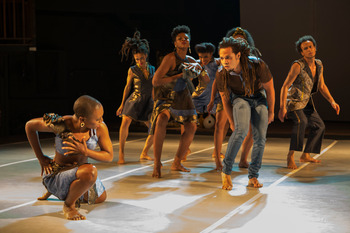
Dance performance: Chica - Cia Ëtnica. Directed by Carmen Luz. Photographer: Claudia Ferreira.

This is our response to the brutality of our times.
Let's flip the page and introduce some artists, which we have had the honor to highlight in the magazine and whose work has been, in a way, part of the history of self-determination of the Black population in São Paulo's contemporary art scene. I'm offering a quick portrait of their work in order to discuss the impact these artists have made. They are attempting to redefine values that have been steadily withering away, owing to numerous displacements, silences, and inequalities in our daily lives, as they forge artistic strategies with an eye toward change.
Carmen Luz
The artist, choreographer, and moviemaker Carmen Luz has been dedicating herself to research on Black women in contemporary dance, teaching, creating dance pieces and making documentaries and films. She conceived and directed Um filme de dança (2013), a pioneering documentary about Black dance in Brazil, bringing speeches of a multiplicity of Black Brazilian dancers, portraying dance as a space of resistance and invention. Her work is an incomparable contribution to the history of Afro Brazilian dancers and to the history of dance in Brazil, which had related itself mostly to hegemonic aesthetics. While showing the history, certain perspectives, and thoughts of several dancers from different cities in Brazil, Carmen addresses questions about why Black artists are always relegated to minor and “subalternized” spaces. All these answers are related to the structural race inequality that defines the country's history.
Nave Gris Cia Cênica
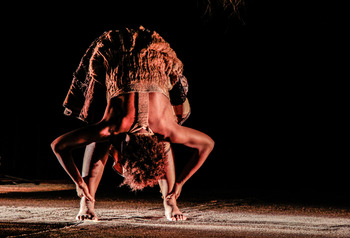
In the piece Dikanga Kalunga (2014) by Nave Gris Cênica Company (choreographed and performed by the dancer Kanzelumuka, who is one of the researchers teaching in CADD), the varied universe of traditional Bantu expression was the seed for a creation that endowed the body with the elements of ancestral relationships and archetypes of these cultures that are so deeply rooted in the sociocultural makeup of Brazil. The profound research makes the piece not just a frivolous collage dressed up as “reinterpretation” of Bantu essences or origins, but rather a thoughtful appropriation of conceptions of space, time, and sacred gestures. Nave Gris introduces the audience to the Bantu foundations of the Black Brazilian experience, and at the same time it provokes the imagination and the understanding of memory as an actualization of a life lived.
Performance: Dikanga Kalunga. By Kanzelumuka/Nave Gris Cia Cênica. Photographer: Maísa Sá.

Luciane Ramos Silva
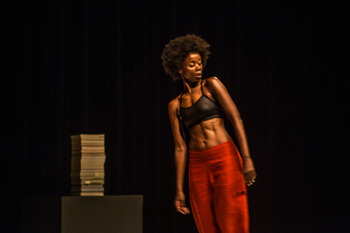
This is me. As an artist who lives around and with other artists, I assume my role not just as an audience or observer or researcher, but as an artist who is at odds. My life as anthropologist and dancer made me shed light on the interconnection of history, social experience, and the body. In the solo piece called Eyes at My Back and a Smile at the Corner of My Lips (2015/2016), I discuss the notion of coloniality of gesture, meaning how the colonial perspectives are alive in the culture, in the senses, and even in people's self-images, traversing time, space, and bodies. As a dance that explores diasporic experiences, Eyes at My Back … is a kind of crossing, in an Atlantic and counterhegemonic sense, where the body is the time and space of our differences and the critical occupations of the world. The piece relates to a long-term history where some bodies were defined as “the same” and some as “the others,” or the West and the rest, or whites and the rest. Using imaginary fiction and layers of history, the piece points out that there are those who reimagine, and there are those who interrogate and try to change the sense of being. This change will be possible, bringing some concepts that are foundations for the Black experience; as Professor Muniz Sodré affirmed, irony is a foundation for Black life.
Performance: Eyes at My Back. By Luciane Ramos Silva. Photographer: Daisy Serena.

Capulanas Cia de Arte Negra
Founded by a group of Black women from the outskirts of the city, the group is mostly based on Black theater aesthetics. Their work Sangoma (2013) dedicates itself to approaching issues such as Black women's health, deepening the questions around it and demystifying certain notions, such as the ones leading to the belief that Black women have a higher tolerance for pain, which results in discriminatory and neglectful treatment in public hospitals. By upending these stereotypical perceptions of the body, the artists recover some care, love, and healing. In their piece called lalodês (2018), the group makes a manifesto of healing and pleasure, telling the story of an autonomous beehive-city led by Black women. The dramaturgy reconstructs Black feminine forms of being, existing and re-existing. Portrayed as intergalactic women, they open up the imagination to place women in powerful positions in society.
Renata Felinto
Renata Felinto's production intertwines discussions on gender, race, and culture, challenging the hegemonic system of visual arts bringing up African-based aesthetics. In the performance field, she produced, among others, (see supplementary material) the performance White Face and Blonde Hair, from the series I Wanna Be Sexy (2012). The character created by Felinto walks down Oscar Freire Street (located in a rich commercial area of São Paulo) wearing a blonde wig, whitening makeup, and purchasing expensive items. In the piece, the composition Ride of the Valkyries—composed by the German musician Richard Wagner (1813–1883)—is remixed with a funk beat and highlights the artifice of framing an aesthetical and social norm.
Michelle Matiuzzi
As an artist who places her body mostly in the arena of performance, Musa Matiuzzi, as she calls herself on social media, proposes a kind of poetic provocation that opens up the stereotypes about Black female bodies. Drawing from the history of racism in Brazil, she brings an impertinent performativity that plays with normative esthetics and perspectives, causing dense feelings to the public, while showing blood, entrails, and liquids referring to the representation of Black women's bodies and Black Brazilian's life. The expression Merci Beaucoup, Blanco!, the name of her performance, a mixture of languages of Latin origin, is normally used to designate gratitude. But Matiuzzi ironically manipulated the words, subverting them and talking about the impacts of racism on the Black self. In this piece, the artist paints her own Black body with white paint, proposing not exactly a reflection on how image and language are tools for the propagation of racism but provoking noises in the imaginary.
Rosana Paulino
Rosana Paulino is one of the most celebrated Afro Brazilian visual artists. Her twenty-five-year career focuses on the long-oppressed history of Afro Brazilian women, among other subjects. Utilizing installations, engravings, collages, drawings, and sculptures, Paulino's artwork opens up a profound discussion about the issues of race, gender, and identity, which are strong challenges to the affirmation of Afro Brazilian people. Her Wall of Memory (1994–2015) sheds light on another very important subject of her work: the memory. In a collection of her family portraits, she sewed several pictures together, showing them as an ensemble and a collective—the opposite of the commonsense perspective of Black families based on the ideas of loss and disruption. By discussing memory and Black agency, she brings visibility and rewrites the official history.
Finally, since I began my talk, taking the time to look at you and recognizing each and every one of you here, I would like to read a quote by Beatriz Nascimento—a historian, Afro Brazilian militant and Pan-African Quilombo theorist.
É preciso imagem para recuperar a identidade, tem que tornar-se visível, porque o rosto de um é o reflexo do outro, o corpo de um é o reflexo do outro e em cada um o reflexo de todos os corpos.
It takes image to recover identity, it has to become visible, because the face of the one is the reflection of the other, the body of one is the reflection of the other and in each of us lies the reflection of all bodies.
Thank you.
Supplementary Material
The supplementary material for this article can be found at https://doi:10.1017/S0149767721000267