Introduction
This paper studies recent practice from 2010 to 2012 in the Nuuk music scene in Greenland, of individuals and groups claiming internationally familiar labels like underground and alternative for their music and musical activities. Social agents among the Nuuk youth formed an underground scene, using international labels as inspiration, as part of a strategy to bypass the established local music scene and bring change to the general musicscape in Greenland. The change valued by agents from this Nuuk underground scene was informed by a position of nationalism with a cosmopolitan outlook that can be called ‘cosmopolitan nationalism’ (cf. Regan-Lefebvre Reference Regan-Lefebvre2009, p. 4). The voiced aim of the underground scene was to create a cultural supply in Greenland that was equal to other globalised Western nations, thereby establishing Greenland as a modern nation-state, an owner of universal modernity. This reading places the Nuuk underground scene as part of an (at least) 150-year-old nation-building process, in which Greenlandic nationalism has been used as part of an anticolonial struggle. Music became part of this process with the first Greenlandic composers who, inspired by romantic nationalism, praised Greenlandic nature as well as Inuit ancestors in their lyrics (Langgård Reference Langgård, Langgård and Thisted2011, p. 126, 130, 142; Thór et al. Reference Thór, Joensen, Thorleifsen and Thór2012, p. 441). Such musical expressions of romantic nationalism still stand their ground in Greenlandic popular music, in song lyrics about the beauty of Greenlandic nature, as well as in songs about national myths and heritage (cf. Otte Reference Otte2013, p. 17). While the predominant romantic nationalism in Greenland is thus focused on underlining cultural difference, the cosmopolitan nationalism in the Nuuk underground scene has been focused on performing with transnational cultural similarity with alternative popular culture in certain Western nations.
This study lies within the topic of music and nationalism, which is an area that has led to a great deal of significant research, as seen by the sheer number of scholarly works that focus on connections between music and nationalism, or that compile nations and musical styles (cf. Baily Reference Baily and Stokes1994; Reily Reference Reily and Stokes1994; Slavková Reference Slavková2010; Bohlman Reference Bohlman2011). The topic is also one of the more researched areas in the very limited number of studies that focus on popular music in Greenland (cf. Lynge Reference Lynge1981; Johansen Reference Johansen1991). However, research on a sub-scene centred on relatively unknown bands and artists has not been done in Greenland. I furthermore argue that the activities making up this scene have insights to offer on the global spread of popular music styles, since sociologist Motti Regev, in a comparative study on pop-rock music disseminated worldwide, has asserted that this spread happens through a process of expressive isomorphism. Through this process, national ‘versions’ of pop-rock, typically drawing on folk music elements, often emerge as the dominant local approach to the legitimisation of pop-rock music production (Regev Reference Regev2013). While this is certainly the case for the dominant music scene in Greenland, where an explicit ‘greenlandification’ of pop-rock music first happened in the 1970s, the Nuuk underground scene suggests a different local approach to legitimising the adoption of ‘foreign’ popular music styles. This approach was one of isomorphism, because similarity was performed but the discourse among the social agents within the scene on what their musical activities had to offer them was locally distinct in that it was a nationalist one.
Framing and fieldwork
When framing the object of this paper I use the term ‘scene’ as a descriptive term for a number of music-centred events and social relations. As communication studies researcher Will Straw indicates, the term was first introduced into social science by American Studies researcher Barry Shank (Straw Reference Straw and Gelder2005, p. 469), whose subjects of study – participants in the Austin, Texas rock'n’roll scene in the 1980s – spoke of ‘scenes’ when interviewed (Shank Reference Shank1994). This was not the case among the interviewees for this paper, but I found that the term, as it has been conceptualised by anthropologist Sara Cohen, better captures the informal, afflux and complex nature of the activities I have framed as the Nuuk underground scene. Cohen suggests that the ‘scene’ term is often used to conceive of ‘… situations in which distinctions between informal and formal music activity, and between the activities and roles of music audiences, producers, and performers, are blurred’ (Cohen Reference Cohen, Horner and Swiss1999, p. 239). She has further observed that local scenes have a cosmopolitan outlook towards change located elsewhere (Cohen Reference Cohen, Horner and Swiss1999, p. 244).
Drawing on Cohen's conceptualisation of scenes, I apply the term to frame a social space in which individuals can claim varying roles, and interact on the basis of some sense of shared musical taste or thematic approach to music production and consumption that has a cosmopolitan outlook. I claim legitimacy for this framing in that, as I will return to, most of the subjects interviewed for this paper shared the opinion that there were a number of bands and artists in Nuuk and Greenland that were not receiving attention from the established music industry in Greenland, because their music fell outside the conventional. Therefore these bands and artists were in need of alternative spaces for music practice in which innovation was valued. The music produced by these bands and artists was very diverse, but there was nonetheless a core of social agents that organised, performed at and participated in the events described in this paper. The activities forming the Nuuk underground scene clearly had a form of cosmopolitan outlook in that, while the events through which the scene manifested itself took place in the small geographical area that constitutes downtown Nuuk, agents from the scene evaluated activities through a double optic: with one eye on national cultural production and one eye on cultural production in certain Western nations. The scene I investigate in this paper can therefore not be captured in a local or national optic only, but must be viewed as part of global cultural flows as well (cf. Appadurai Reference Appadurai1990, p. 296).
Most of the fieldwork for this paper was conducted with a small team of exchange students from the University of Copenhagen, as part of a workshop I conducted at Ilisimatusarfik, University of Greenland, during the spring semester of 2012. This paper therefore owes a great deal to Kristine Wedel Alsman, Thorbjørn Bornhøft and Elise Ligaard, who participated in the research process for a period of three months by conducting interviews and focus group interviews, and by engaging with some of the social agents in this cultural field. This gave my fieldwork a dimension of second-hand backstage participant observation, since these students were capable of coming much closer to the agents than I could. By bringing observations back to classroom discussions, the students enabled me to gain a more in-depth understanding of the logics behind the Nuuk underground scene.
The interviews for this paper were carried out with organisers of different underground events in Nuuk and the musicians who performed at such events. Furthermore, two focus group interviews were conducted with students from the gymnasium (high school) in Nuuk. These students had participated in the electronica festival Naqqarmiut prior to the interviews, as part of their curriculum. The focus group interviews were thus done with youth that did not necessarily identify with the Nuuk underground scene, and the responses gained from these underlined that only a minority of the Nuuk youth participated regularly in the Nuuk underground scene and appreciated the type of music activities taking place there.
To respect the interests of all respondents, statements are kept as anonymous as possible in this paper.
Building a scene: underground, alternative and mainstream in Nuuk
The first music event in Nuuk that to my knowledge claimed the label ‘underground’ was Støt Nuuk's Undergrundsmusik (‘Support the underground music in Nuuk’Footnote 1), which took place in June 2010, and has since been referred to as ‘the first Nuuk underground’. It was organised by two young men, Miki Hegelund and Kunuk Flügge, who were both about 20 years old at that time, and who had both been playing in the band, Handicap Ramp to Party Garden.
This first Nuuk Underground event took place at one of Nuuk's smallest venues, and the novelty in introducing the underground label was stressed by the national newspaper, Sermitsiaq, when it posted a press release for the event on its online news page. This press release had been written by Hegelund and Flügge, and in it they claimed the labels ‘alternative’ and ‘underground’ on behalf of the event. Beneath the press release, an editor of Sermitsiaq had pasted Wikipedia's definition of underground (Netredaktionen 2010).
The first Nuuk Underground event was organised because Flügge and Hegelund had been denied a chance to perform at Katuaq (the cultural venue of Greenland) with their bands. Being dissatisfied with the available opportunities for more or less unknown bands to perform in Nuuk, they gathered bands that were willing to perform for free – they were themselves members of several of these bands. They obtained all the necessary equipment, funds and permissions for the event; they produced posters and flyers to promote it. Allegedly, some people thought the flyers were tickets because they had never been handed a flyer before. The ticket price was kept low at 20 kr. (less than US$4) and, judging from attendance, the first Nuuk Underground event was a success. Several hundred young people crammed into the small house that hosted the event. When Flügge and Hegelund, with help from an additional group of organisers, hosted a similar event the following year (named Nuuk Underground 2.0), it was moved to the somewhat larger venue, Nuup Katersortarfik (the village hall in Nuuk) (Otte Reference Otte2012a).
By the time fieldwork was done for this paper, the organisers behind the first Nuuk Underground events were no longer active as event organisers in Nuuk. Hegelund had moved to Copenhagen, but Flügge remained an active figure in the Nuuk underground scene, albeit as performer and front row spectator. His on-stage role had shifted as well. He used to perform as a singer in the band, My Itchy Little Finger (MILF), where he had growled and spat out hateful lyrics on top of heavily distorted riff-based music consisting of guitar, bass and drums. Now he had moved back on stage, and was the drummer in a new band called Eyes for Another.
The motivation behind the first Nuuk Underground events, the form through which they were organised and their claims to being underground and dedicated to alternative music, seemed directly influenced by the punk ethic ‘Do It Yourself’ (DIY). This ethic became popular among some musicians and cultural agents in Europe and North America during the 1970s and 1980s. It is usually described as a response to the dominance of the corporate music industry, which was inaccessible to most people. The DIY ethic, on the other hand, was basically about taking matters into your own hands, working with what you had, releasing your own music and setting up your own shows (Haenfler Reference Haenfler2010, pp. 33–4). Eventually this ethic resulted in local alternative music industries and infrastructures rising in some urban centres. Bands and music circulating within these systems were often labelled ‘alternative’ or ‘indie’Footnote 2 (Straw Reference Straw and Gelder2005, p. 471). During the 1990s some independent record companies partnered up with multinational record companies. Rather than describing a system for music practice, indie became a buzzword labelling some loosely defined qualities of different cultural commodities, qualities that made them alternative compared to other products (Newman Reference Newman2009, p. 17). While alternative music can therefore today be explicitly commercial, the label underground is often used to refer to non-commercialised alternative music (Shuker Reference Shuker2008, p. 99).
The events and initiatives forming the underground scene were similarly, at least partly, viewed as attempts to bypass the established system of music practice in Greenland, of which the agents forming the scene were critical. A repeated criticism of the established scene was that ticket prices at concerts were too high (Otte Reference Otte2012a; Research Team 2012), and that established artists did not ‘rock out’ when performing, but rather just stood still and played their instruments (Bornhøft 2012; Ligaard 2012). The DIY strategy and underground and alternative labels applied to the Nuuk context were thus spurred by dissatisfaction with the established music scene in Greenland, and initially more specifically with one of the major players in this scene – Katuaq.
Despite the initial criticism of Katuaq, the record label Atlantic Music was the main player from the established Greenlandic music scene that was being criticised by underground agents during our fieldwork. The criticism levelled against Atlantic Music suggested that their productions had become too monotonic, that the company was too focused on conventional music with Greenlandic lyrics and that Atlantic Music was a cold business that did not treat its artists decently (Bornhøft 2012; Ligaard 2012). One interviewee expressed his dissatisfaction with Atlantic Music in these words:
What they [Atlantic Music] played was just shit. Very clean. And my band [left out intentionally] was in contact with them, and we told them we would like to record an album for them, and they said ‘no thanks’. […] Without wanting to explicitly tell us the reason. But we knew that it was because our music was so experimental and because they did not think that there was much space for it in Greenland.Footnote 3 (Alsman 2012)
As this quotation shows, the agent viewed Atlantic Music as a record label that did not support the national creative frontier in music production, but only the conventional ‘shit’. However, in technical terms, Atlantic Music is an independent record company and multinational record companies have never been directly present in Greenland. The few independent record companies that the country has hosted in recent times went through several years of crisis which have left Atlantic Music as the only record company in Greenland with any significant activity since Ice Music closed in 2012. Illegal copying and sharing of music is believed to be the main problem, and even Atlantic Music has significantly cut down on the company's activities as a result of this (Mølgaard Reference Mølgaard2014). What the music industry in Greenland has experienced during the last few years is similar to international tendencies in the music industry. The Internet and the availability of cheap but relatively high quality recording equipment have shifted the power from corporations to amateurs and hobbyists in the international music market (Rojek Reference Rojek2011, p. 202).
Instruments and recording equipment have long been available to Greenlanders through shipment, but Internet access has a history of being very expensive in Greenland, just as computers are not necessarily available to young people not living in urban centres (Rygaard Reference Rygaard2003, pp. 298–300). Nonetheless, technological development has caused a shift in the Greenlandic music industry as it has elsewhere. During our fieldwork, a widespread method for sharing music that bypassed the Internet but had the same effect was by use of cell phone technology (Otte Reference Otte2012b). A result of the financial crisis caused by illegal sharing of music has been that Atlantic Music has become less willing to take chances on new artists.
In 2012 Katuaq, unlike Atlantic Music, managed to embrace the underground scene by hosting underground events. As the underground scene started to influence the opinion of Nuuk youth, Katuaq therefore did not turn into an object of criticism as much as Atlantic Music. Being the official cultural venue of Greenland, Katuaq has assured funding from the Self-Government of Greenland and the municipality of Sermersooq, and is therefore also in a different economic position from a private record company.
Using Katuaq as a venue for underground events, however, spurred some scepticism in the underground scene. One of the organisers behind another underground event, NUIMA, explained his concerns in an interview:
To begin with, I was a bit sceptical about Katuaq and underground. It's more or less unknown bands. At first, I thought: ‘No!’ But then again, Katuaq is providing us with gear. They are providing us with a place to be. They are providing us with good terms. (Bornhøft 2012)
When NUIMA took place, Katuaq had already hosted the underground event Naqqarmiut, which was held first in March 2012 and was organised by Lu Berthelsen who had also performed at the first two Nuuk Underground events. His presence at the first of these events was frequently recalled by others, because Berthelsen had been approached by the police when standing just outside the venue, naked. This situation had gained status as an epic moment in the short history of the Nuuk underground scene. In the past, Berthelsen had been playing guitar in a progressive metal band when he lived in Aarhus in Denmark; however, after returning to Greenland some years ago, motivated by the lack of electronic music in Greenland, he started making electronica (Alsman 2012). I initially became aware of him because of his involvement with the Nuuk Gay Prides that first took place in 2010 and which had been partly organised by agents who were also active in the Nuuk underground scene. Berthelsen was one of the people who made the first Pride happen, and he has performed at the later events as well. I expect his identity as self-declared bisexual with a preference for performing in drag (something he explicitly explained as a protest against homophobia in Greenland; Alsman 2012), was the reason for his commitment to the Nuuk Gay Prides, but his involvement in these, as well as his engagement in gender-bending performances, has toned down considerably since he partnered up with the equally colourful punk Maaliaaraq, with whom he now has two children.
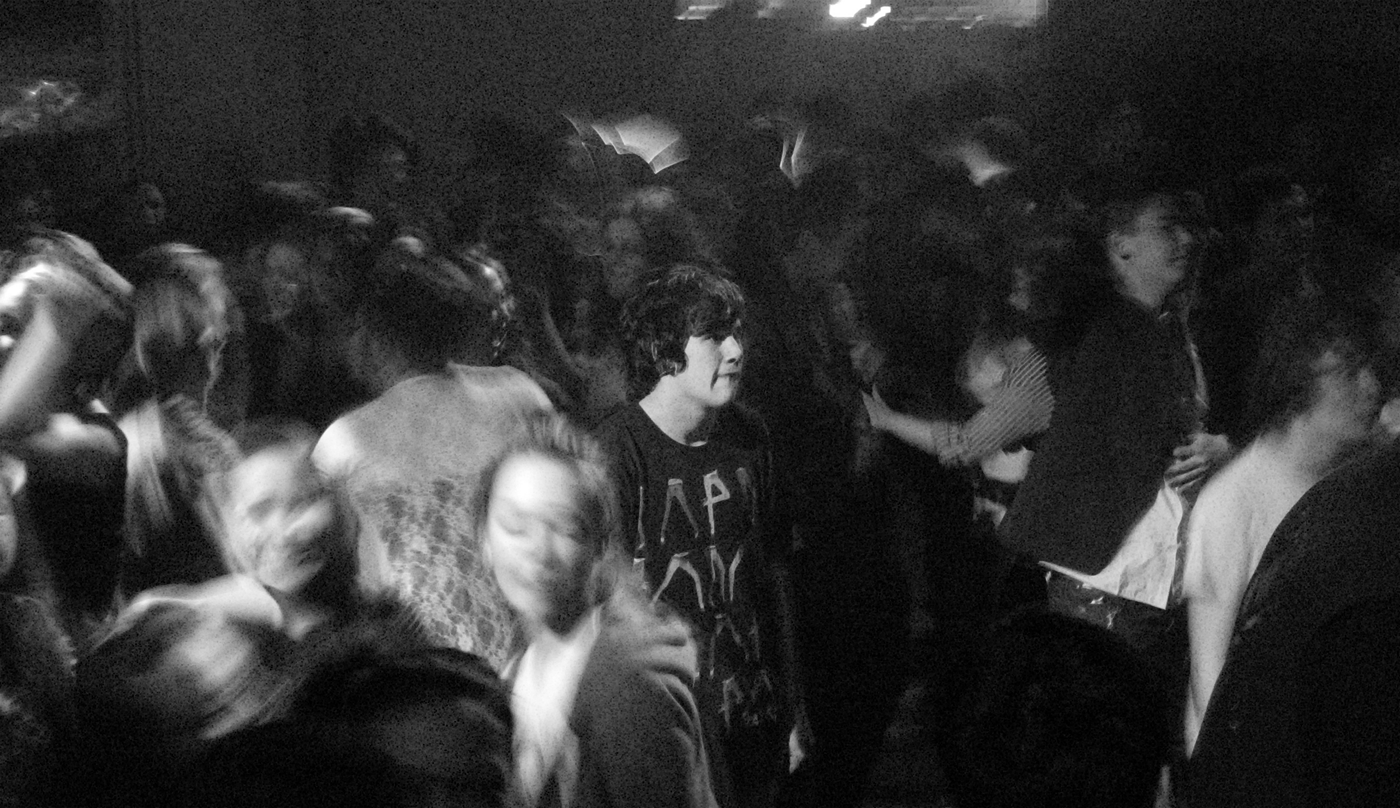
Unlike the other underground events mentioned, which were not dedicated to any particular style of music, Berthelsen's event, Naqqarmiut, was dedicated specifically to electronica and was dominated by acts within the subgenre of dub-step. The word naqqarmiut, directly translated as ‘people who live on the bottom’, can be viewed as a translation of the label ‘underground’, while it can also be seen as a reference to the heavy use of bass sounds in the dub-step genre (Alsman 2012). Naqqarmiut attracted around 200 (mostly) young people who danced the night away to the sounds of locally produced dub-step, and the performance of one artist who had been flown in from Denmark for the event (see Figure 1).
The audience at Naqqarmiut. Photo: Andreas Otte.

Being a participant at the first Naqqarmiut, I observed that the audience was reticent at first. The setup of a handful of DJs standing around a podium on stage and glaring into a computer was an unfamiliar one for a music event in Nuuk. However, as the schizophrenic mixture of heavy synthetic sub-bass and whirling treble alarm-bell-like sounds filled the room, backed up by an impressive light show, the dance floor started to fill up and audience participation increased as the evening drew on. An additional Naqqarmiut event was held in Katuaq in November 2012.
By providing facilities for underground events like Naqqarmiut and later NUIMA, Katuaq created space for the underground scene, while at the same time remaining the preferred venue for established artists in Greenland. As the fieldwork for this paper came to an end in the summer of 2012, the ‘mainstream’ antipode to the Nuuk underground scene was therefore mainly Atlantic Music and a handful of broadly popular and highly visible Greenlandic bands and artists.
Non-commercialism, status and strategy
The Nuuk underground scene gained influence through the same technological development that was viewed as the major threat against the established music industry in Greenland. The Internet was particularly important to the activities in the underground scene, because it provided agents with inexpensive access to their target groups through Facebook, and allowed bands and artists to present material on web pages like YouTube and Soundcloud at very low cost. So, unlike the established music scene, the activities forming the underground scene did not depend on gaining financial income.
Online activities promoting underground bands and artists were formalised when a young man by the name of Inuuteq Kriegel, along with photographer Mikael Lindskov Jacobsen, developed an initiative in 2011 called Subkite Project. Subkite Project was explicitly dedicated to promoting underground bands and artists, and did this by making simple, but relatively high quality videos showing quasi-live performances. Kriegel and Lindskov then posted these videos on YouTube and promoted them through Facebook (cf. Subkite Project on Facebook).
Another means to promote the underground scene in Nuuk was the popular satirical television programme Labrador Kangian (‘East of Labrador’) aired on the national TV channel KNR (Kalaallit Nunaata Radioa) in 2011 and 2012. The programme drew inspiration from international satirical TV shows, and made fun of everyone from fishermen to local celebrities, which sometimes resulted in mediated complaints (Qvist Reference Qvist2012). Furthermore, several of the programmes took a satirical stance towards established Greenlandic artists. The last show of the second season featured Lu Berthelsen, the organisers behind Naqqarmiut, walking around the set naked, this time with no interference from the police. Kriegel was one of the producers behind the first season, and the first five programmes featured interviews and music videos with bands and artists connected to the Nuuk underground scene. Four out of these five videos were credited to Subkite Project.
Unlike most other agents in the Nuuk underground scene, Kriegel did not identify as a musician, but as a dedicated music enthusiast. He had rare knowledge of non-established bands from different places in Greenland, which he had tracked down through the Internet and personal contacts. In conversation, he also revealed his considerable knowledge of international popular music history. Kriegel mainly influenced the Nuuk underground scene as an agent who made things happen. He seemed particularly proud that he had twice played a key role in organising concerts with the Danish-based (but South Greenlandic-originating) band, Small Time Giants, before the band became well known and had more established connections. Kriegel had helped both with setting up a venue for the band to perform at, and with finding someone willing to finance the band's travel expenses (Otte Reference Otte2012c).
The Nuuk underground scene was founded on the volunteer initiatives of young amateur agents like Kriegel and bands and artists that performed for free (Bornhøft 2012; Otte Reference Otte2012a). Therefore, the scene did not suffer because of technological developments threatening the economy in the established music scene in Greenland, but was enabled by them. The non-commercial logic behind the underground label was thus present in the activities compounding the Nuuk underground scene, and was one of the reasons for its relative success. The social agents in the Nuuk underground scene therefore acted without any immediate concerns for economic gain. Yet this, too, begs the question: what then motivated them to take the actions that constituted the scene?
When bands and artists were asked about future aspirations, their responses did not exclude commercialisation: ‘At the least, I have to release something and then hope it will be a success’ (Alsman 2012), and: ‘We hope that this CD is going to be a stepping stone towards becoming a more established band, so we can get out there and perform some more’ (Ligaard 2012). In fact all the bands and artists with whom we spoke aspired to release albums and gain larger audiences. They did not speak of this in terms of economic gain, but did not explicitly exclude it either. Underground was thus mainly viewed as a category, a temporary status for bands and artists that had not yet released albums and did not have a large fan base (Otte Reference Otte2012a, Reference Otte2012b; Ligaard 2012). That this category also contained the creative frontier was however stressed occasionally, as one artist explained:
With underground music, there is a lot of space for you to experiment without having people say: ‘No way, that is too weird!’ and say that they don't want to listen to it. With underground music, you have the audience you need in order to play around with the music. (Alsman 2012)
Regev has asserted that internationally the label ‘alternative’ is viewed by some as a quality synonymous with past and present creative frontiers, and thus with music that tops the aesthetic hierarchy (Regev Reference Regev2013, p. 143). As is expressed in the quote above, similar ideas of the underground label as a signifier of superior aesthetic quality were present in the Nuuk underground scene. There was a conviction that the new and innovative had a better chance of flourishing in an underground space. However, staying within this space was not the goal of the bands and artists interviewed.
An approach to underground as a temporary status was also traceable among event organisers. Two of the agents who we mainly interviewed because of their activities in organising underground events did not disagree with the idea that Greenland should have a more professionalised music industry. Their criticism was rather levelled at the faces of the industry, as revealed in such comments as: ‘Sometimes it just feels like the people working in it [the music industry], are not the ones that should be working in it’ (Bornhøft 2012).
Using the label ‘underground’ to create a non-commercialised local music scene was thus a strategy for bands, artists and event organisers, through which they attempted to challenge the established music scene in Greenland, while hoping this would better their status. Agents did not necessarily share an ideology of non-commercialism towards music making in general. What they did share was an opinion that the general music scene in Greenland had to change, and that this change should come from below.
DIYN (do it for your nation): newness and change
The initiatives mentioned so far show that it was possible for relatively few agents to establish a multidimensional underground scene in Nuuk in a relatively short space of time. The reason why this happened so fast was of course that Nuuk already had a number of bands and artists that could be identified under the label ‘underground’. The label thus worked as a banner for bands and artists to gather around, a symbol of some degree of shared understanding which created the experience of a scene with a sense of space, power and purpose. An organiser behind the underground event NUIMA has described how this space crystalised to him at the first Nuuk Underground: ‘Your eyes were opened to the fact that this could be done in Greenland. That it [Greenland] wasn't just a tiny shitty place’ (Bornhøft 2012).
This citation further shows something that was very typical among agents within the Nuuk underground scene, namely that they viewed their activities within a national frame. There was also a clear tendency for them to legitimise their behaviour through this frame, in claims such as: ‘I do it to further Greenlandic electronica music culture’ (Alsman 2012), and ‘I do think it is important that musicians, in all of Greenland actually, should get a chance to come out and perhaps perform a little more’ (Otte Reference Otte2012a).
A similar emphasis on the national frame was made in an interview when one of the agents spoke of the neo-prog band Torluut! (‘Exclamation mark!’ [name of the band]):
I was surprised because they danced and lay down on the ground … or stage. And they all danced. At the end of it, they threw condoms out to people. Then I thought ‘you haven't seen that in Greenland before. You haven't seen that among Greenlanders before.’ (Bornhøft 2012)
This quotation also exposes a high degree of focus on newness within a national frame. While throwing out condoms at concerts was not necessarily cutting edge in an international context, this performance by Torluut! was given significance because it was new in a local Greenlandic context, rather than it being evaluated in relation to global newness. The performance, in the eyes of the agent interviewed, brought a certain desirable element of change to the national music scene.
A similar stress on the importance of newness in music was made in an interview where this kind of change was explicitly discussed as part of a development towards national independence:
When we look at how our country is developing … we have reached Self-Government and something new has to happen. […] It is very much connected to what is happening in society. We need something different and we need something new, some new thinking. (Ligaard 2012)
National contextualisations of newness in performances within the Nuuk underground scene were, however, done simultaneously with positioning the national space within a wider international arena through comparison with culture from certain Western nations. Such a double optic was stressed to me at one of the corresponding underground events – NUIMA, which was held in June 2012. The name of the event – NUIMA – has no official meaning in itself, but is a stem to the word for a prominent or visible person nuimasoq, as well as the word nuimanngitsoq, which is the opposite of nuimasoq (Bornhøft 2012). Hence NUIMA can be related to the word ‘upcoming’, which was a category the organisers included at their event, though they actually distinguished between being upcoming and underground. Upcoming was not a category they associated with strict expectations of charismatic performance or non-commercialisation in the same way that they did with the category ‘underground’ (Bornhøft 2012). NUIMA took place in Katuaq and was organised by Hans Ole Amossen, Naleraq Eugenius, Pipaluk Lind and Inuuteq Kriegel (cf. NUIMA on Facebook). All of them were in their early 20s and had been playing in bands that performed at the first two Nuuk Underground events. The main differences between NUIMA and the earlier Nuuk Underground events were that NUIMA was organised by different people, and these people founded NUIMA as a society to ensure that any profit from the event would be used for future events (the small profit from the first Nuuk Underground events was shared by the organisers). The organisers behind NUIMA also wanted to make an event that was less dominated by rock music, compared to the first two Nuuk Underground events (Bornhøft 2012).
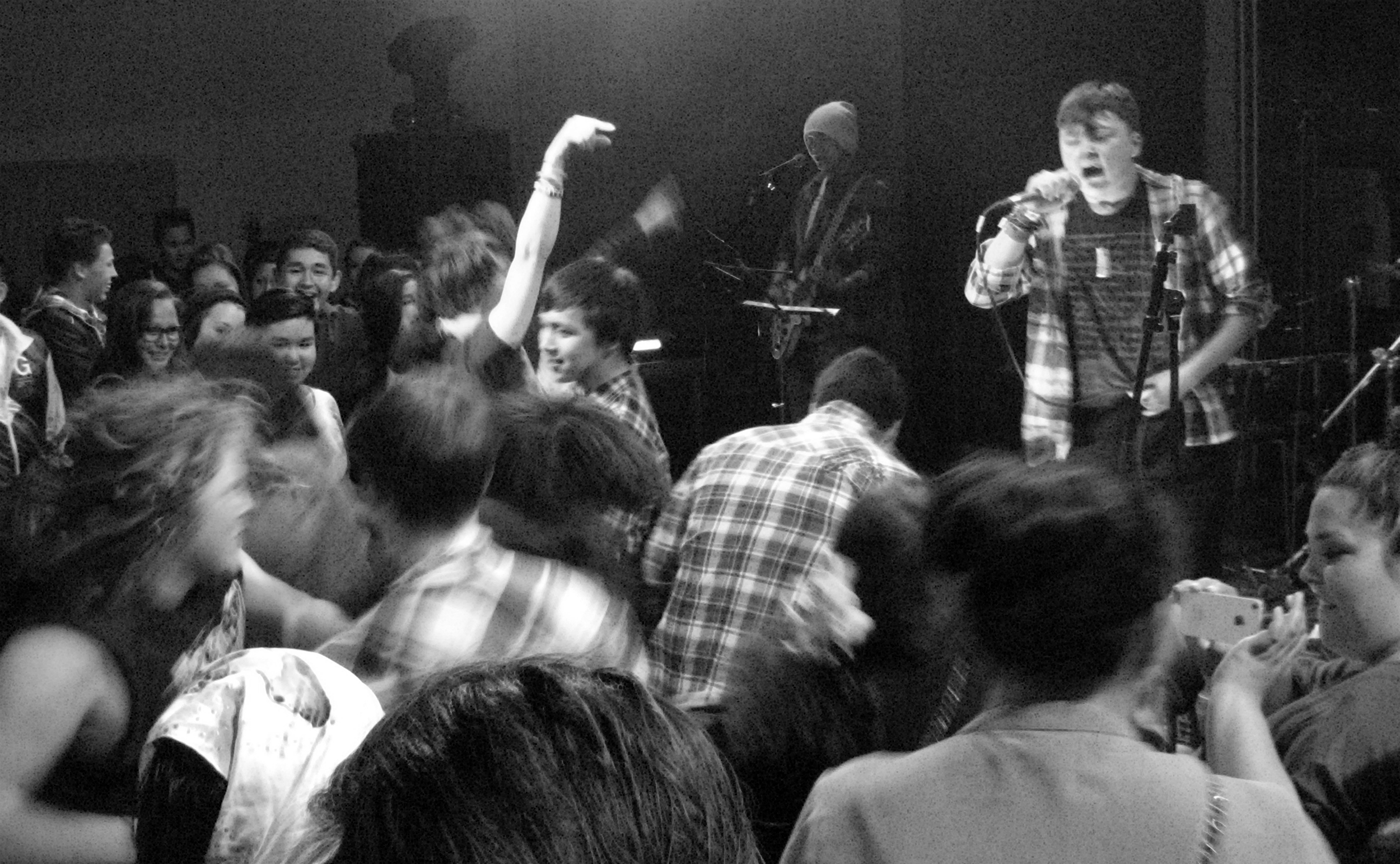
As NUIMA unfolded, I spoke informally with one of the organisers. We had just experienced a successful performance by Kunuk Flügge's new band, Eyes for Another. The performance had included a fair bit of theatrical momentum and expression of tense emotions from the band's lead singer, backed up by Flügge on drums along with a bass player and two guitarists (see Figure 2). As I discussed the performance with the agent, he said to me: ‘It is so great, that now Greenland has a band like this as well’ (Field notes, 20 August 2012).
Eyes for Another performing at NUIMA. Photo: Andreas Otte.
In this statement, the agent clearly placed the performance within a national space, but also oriented it towards some place more than just Greenland, that had long had this type of band. He seemed delighted that the performance had in some sense pushed Greenland a step up the ladder towards equality, or perhaps it had restated this equality by proving that Greenland continuously produced new bands and artists of a similar standard to the global creative frontier.
An outside global standard was thus present as a significant other in the Nuuk underground scene, against which the performance in the local national context was defined and judged (cf. Wilk Reference Wilk, Cohen, Wilk and Stoeltje1996, p. 127). The statement also suggests that the successful performance from Eyes for Another induced a sense of national pride for the agent, which draws attention to the nationalist discourse in the scene. While the Nuuk underground scene clearly emerged through processes of globalisation, by which the ideologies, strategies, sounds and behaviour used in the scene were made available to these Nuuk youth, the commitment to a national framing of the scene illustrates that processes of globalisation happen in conjunction with local context. Sociologist Roland Robertson has attempted to grasp this type of globalisation process by introducing the concept ‘glocalisation’ (Robertson Reference Robertson1992, p. 173). In the case of the Nuuk underground scene, the local context was one in which nationalism was a dominant ideology, while the music scenes from where the DIY strategy and the labels ‘underground’ and ‘alternative’ had been appropriated were not likely to include a nationalist discourse. This is supported by ethnomusicologist Philip V. Bohlman's observation that in European modernity, music is often asserted to exist: ‘in a metaphysical domain separate from cultural forces such as nationalism …’ (Bohlman Reference Bohlman2011, p. 11). Within this logic, Bohlman argues, connecting music with nationalism devaluates music. However, in the Nuuk underground scene, a nationalist discourse was a way of valuating music and legitimising activities since these were given importance by agents in the scene, as activities through which Greenlandic youth could supply Greenland with their own versions of genres like dub-step, neo-prog, post-hardcore and punk, and thereby induce a sense of national pride to these youth.
In the case of the Nuuk underground scene, the glocalisation process through which it emerged displays differences from a general assertion on the spread of pop-rock music made by Regev. Regev engages with the question of how different internationally recognisable cultural forms, appearing to be different, really are. This is a question anthropologist Richard Wilk has also engaged with in his writing on ‘structures of common difference’ (Wilk Reference Wilk, Cohen, Wilk and Stoeltje1996, p. 118). Regev claims that there is a ‘global structural dimension’ in the spread of pop-rock music, in which similar styles of pop-rock music with similar kinds of differences emerge in different countries, with similar meaning attributed to them. He views this claim as evidence that the spread of pop-rock music follows a line of expressive isomorphism: ‘through which national uniqueness is standardized so that expressive culture of various different nations, or of prominent social sectors within them, comes to consist of similar – although not identical – expressive forms, stylistic elements, and aesthetic idioms’ (Regev Reference Regev2013, p. 11). Regev's claim is therefore that, while pop-rock music appears to be locally different (usually nationally), it actually is much the same throughout the globe (Regev Reference Regev2011, p. 559).
I argue that the use of alternative and underground labels in the service of a nationalist agenda in the Nuuk underground scene suggests that Regev's model does not cover the complete picture of the spread of pop-rock subgenres into the world since, in my optic, the Nuuk underground scene is a case in which forms of popular music activity were appropriated without necessarily putting emphasis on standardised national uniqueness. The meanings ascribed to these musical activities were nonetheless changed in accordance with the specific context, where nationalism was a dominant ideology, making the Nuuk underground scene a different kind of glocalisation process from the one described by Regev (expressive isomorphism). The Nuuk underground scene was a case of clean isomorphism, because distinctiveness was more in the meaning applied to the activities than in the musical expression.
Cosmopolitanism, popular music history and universal modernity
Despite the nationalist agenda of the Nuuk underground scene, the change it brought about was clearly informed by a cosmopolitan outlook towards other scenes, something I consider a practice of cosmopolitanism. The term cosmopolitanism can, however, mean quite different things, and has sometimes been defined as an ideal, as in a definition by political theorist David Held, who conceptualises the term to cover; a cross-cultural openness towards others, the capacity to mediate between national cultures, communities and styles of life (Held Reference Held, Held and Koenig-Archibugi2003, pp. 84, 168). This ideal is, however, difficult to realise as a global practice and has been criticised by sociologist Robert J. Holton (Reference Holton2009, p. 114), who has labelled cosmopolitanism: ‘a worldview and way of life suited to the more powerful and wealthy’ (Holton Reference Holton2009, p. 9).
Considering Holton's critique, it may seem no coincidence that the key social agents from the Nuuk underground scene all came from relatively economically sound backgrounds, and had repeated opportunities to travel abroad. This had in some cases been important for them in gaining new musical input, as one of the agents explained:
Music has taken new directions you know. Now, I am addicted to the internet and I find bands myself. It is very … Like after Nirvana, I tried to find out what was similar to Nirvana, and then I read that Kurt Cobain had been very into Sex Pistols. Then I thought: ‘what is that?’ I had read so much about them but never listened to them, because YouTube had not been invented back then […] Then I found it in Bulgaria – a compilation CD […] And then I started listening to Sex Pistols, and I still do. (Otte Reference Otte2012c)
Many of the agents had also lived abroad, primarily in Denmark, for a period of time, where they had experienced a different kind of music scene from the one in Greenland. Their relatively economically sound backgrounds had thus, to some extent, enabled their cosmopolitan outlook.
Further reservations in relation to ideals of cosmopolitanism, like that of Held's, must also be made for my use of the term ‘cosmopolitanism’. I use it to describe openness and attentiveness to culture and especially music elsewhere, but it is important to underline that, with the agents in the Nuuk underground scene, I found that this openness and attention was, in practice, oriented in very specific directions. What I label as cosmopolitanism in the Nuuk underground scene thus concretely took the form of openness, and cosmopolitan outlook/attentiveness towards, and eagerness to engage in, alternative music production associated with certain Western nations and their creative frontiers.
This direction of attention was stated explicitly by an agent:
… I think Greenlandic music stands very still. I don't think a lot of new stuff comes around. What is innovative here was innovative perhaps ten years ago in the rest of the world, perhaps mostly in the USA and England and Denmark. (Otte Reference Otte2012a)
This interviewee clearly oriented towards music scenes in other nation-states but specifically towards the Western nations that dominate the international cultural market (The United States and England) and also towards Denmark. The reason why Denmark was mentioned must be because Denmark is a major reference point for many Greenlanders, who are highly exposed to Danish culture through media and travel.Footnote 4 For some, the impact of Danish culture in Greenland is viewed as cultural imperialism, but this did not seem to be the case for most of our respondents. Rather, the Danish music scene was mentioned as a source of inspiration for agents in the Nuuk underground scene, and a reference point for privileged youth in Nuuk in general (Alsman 2012; Ligaard 2012; Research team 2012).
A selective cosmopolitan outlook was thus evident in the Nuuk underground scene on several levels and alone in the claiming of labels such as underground and alternative. It was also more likely that you would find artists and bands performing songs with English lyrics at underground events than in the established music scene, where Greenlandic lyrics were highly dominant (Otte Reference Otte2012d, p. 55). Furthermore, when asked about inspiration for their musical productions and behaviour, the bands, artists and agents we interviewed only rarely mentioned Greenlandic music as inspiration. Instead, they were more likely to mention internationally famous bands like Muse, Underoath, Metallica, Pantera, Sex Pistols, Nirvana and Blink 182 (Ligaard 2012; Otte Reference Otte2012a, Reference Otte2012b, Reference Otte2012c). These bands have all engaged with a commercial multinational music industry, and are thus in some sort of opposition to an underground status. In the context of the broader Greenlandic music scene, along with a DIY approach, however, these bands were used as inspiration for behaviour that was valued as new and alternative by the agents. This was a consequence of the existence of an established national tradition of rock music with Greenlandic lyrics. Compared to this nationally mainstream tradition (which is in line with Regev's hypothesis of expressive isomorphism) the musical production and behaviour in the Nuuk underground scene could often be viewed as alternative and new, despite the mainstream tradition in Greenland being probably seen as more alternative from an outsider's perspective than the music found in the underground scene.
Agents in the Nuuk underground scene, however, experienced the established music scene as being behind the times as compared to other music scenes (Otte Reference Otte2012a). It is therefore striking that the bands mentioned by respondents as inspiration for underground musical production were all formed before the millennium, most of them well before the millennium, stretching back to the mid-1970s. Why this focus on popular music history while claiming to want to catch up with Western music's creative frontier?
The reason is not that the agents did not have access to, or did not listen to, more recent musical productions from artists outside Greenland. Rather, I think that by bringing an internationally familiar canon of alternative (though commercialised) music into the conversation, the agents attempted to claim the history of pop-rock music as their own. Regev has asserted that pop-rock music has been consolidated and legitimised as a signifier of universal modernity (Regev Reference Regev2013, p. 9). By bringing up the names of some of the most defining artists in Western pop-rock music history, the agents from the Nuuk underground scene wanted to signal that this development had been taking place for them in Greenland, as much as elsewhere. By identifying with this history, they thereby claimed ownership of universal modernity. Their cosmopolitan outlook was thus not only oriented towards contemporary music activities in Western urban centres but also towards historical time in the form of epic points in Western pop-rock music history. The nationalist discourse in which this cosmopolitan outlook emerged meanwhile showed that this ownership of universal modernity was not only claimed on behalf of individuals in the Nuuk underground scene, but on behalf of the nation as well. Creating a scene that signalled ownership of this universal modernity thus helped Greenland to be something more than ‘just a tiny shitty place’ (Bornhøft 2012). With this nation-building project, the cosmopolitan nationalism in the Nuuk underground scene was engaged with positioning Greenland in an equal position with (other) Western nations.
The history and logic of cosmopolitan nationalism in Greenland
The dynamics between cosmopolitanism and nationalism remain somewhat unclear in academic writing. Cosmopolitanism is sometimes claimed to include a disdain for the national, just as cosmopolitans through history have been regarded as enemies of the nation (Beck Reference Beck2006, p. 3; Holton Reference Holton2009, pp. 5, 9). From a nationalistic perspective, cosmopolitanism may be problematic because the view of subjects within a nation as somewhat united is preferred, and cosmopolitanism is claimed to have a general focus on individualism that puts universalistic views of human rights above all other norms (cf. Held Reference Held, Held and Koenig-Archibugi2003, p. 169; Beck Reference Beck2006, p. 122). An etymological investigation into cosmopolitanism, however, reveals that the term as such does not exclude the combination of nationalism and cosmopolitanism, but rather suggests a double allegiance to the local and the global (Holton Reference Holton2009, p. 4). Such positions indeed have been observed.
Writer Thomas Mann (1875–1955) has described a double allegiance to both cosmopolitanism and nationalism, as he, during WWI, wrote that he considered sympathy for the cosmopolitan to be inseparable from German nationality (Beck Reference Beck2006, p. 11). More recently, historian Jennifer Regan-Lefebvre has described a position of cosmopolitan nationalism in her biography of Irish politician Alfred Webb (1834–1908). Regan-Lefebvre uses the term to conceptualise the position and persuasion she finds with Alfred Webb, that cross-cultural interaction has something inherently good to offer in the form of ideas, networks and skills, and by lending status to claims for self-government as a universal right of all people, rather than focusing on exclusive ethnic identity (Regan-Lefebvre Reference Regan-Lefebvre2009, p. 4). As with the nationalism I found in the Nuuk underground scene, Webb's nationalism, according to Regan-Lefebvre, thus had a focus on transnational similarities rather than difference, hence its cosmopolitan character.
The cosmopolitan practices in the Nuuk underground scene were, however, not only focused on locating similarity, but also on producing similarity with certain Western nations and through this project reaching equal status to them. Similar nationalist strategies of striving for a national image identical to nations experienced as holding superior power have actually long been part of the political strategies for nation-building in Greenland. Learning other languages in order to read foreign literature and get an education abroad has been part of elite strategies to break free from a history of cultural seclusion and a move towards Greenlandic independence (cf. Thisted Reference Thisted, Alberdi, Nørregaard, Kastrup and Kristensen2002, p. 89; Heinrich Reference Heinrich2012, pp. 248–49). Experiences of cultural seclusion are rooted in Greenlandic history, because Greenland, until WWII, was relatively secluded from the rest of the world, although some parts more than others. This strategy was put in effect by the Danish state as coloniser, allegedly to protect the Greenlandic people. The situation changed when the United States intervened in Greenland after Denmark was occupied by Germany in 1940. During the war, culture and goods from America and Europe were increasingly introduced in Greenland, and when the war ended and Denmark revoked administration of Greenland, there was a feeling that returning to the former state of relative seclusion was not an option (Heinrich Reference Heinrich2012, pp. 27, 103, 173). During negotiations in 1946, in which the post-war future of Greenland was considered, the priest Gerhard Egede made the following statement on behalf of the national council in Greenland:
… now the National Council is convinced that a sufficient basis is present to support ongoing changes, since the people's desire to economically and culturally reach the same level as other nations, has become so strong that the National Council cannot ignore it. (Heinrich Reference Heinrich2012, p. 230, my own translation)
Even though different strategies for nation-building have been practised since then, the words of Gerhard Egede about reaching an equal cultural level compared to other nations were identical to the nationalist project for agents in the Nuuk underground scene.
A period of greenlandification, running from the 1970s, however, followed the post-war period and included identification with other formerly colonised and indigenous people in both politics and art (cf. Sørensen Reference Sørensen and Tägil1995, p. 102). Expressions of a globalised late-modern identity with a national grounding in Greenland – which I would call cosmopolitan nationalism – has, however, also recently been observed by literate Kirsten Thisted. She asserts that such a position avoids direct postcolonial victimisation and essentialism and opens up a number of positions for identification, by shifting attention away from the ambiguous colonial relationship with Denmark and by embracing all the potential relations offered to Greenlanders by globalisation (cf. Thisted Reference Thisted, Høiris and Marquardt2011, pp. 551–2).
There are, however, similarities between the nationalist ideology behind the greenlandification project and the cosmopolitan nationalism within the Nuuk underground scene. One such is the importance of national pride. In the dominant romantic-oriented nationalism in Greenland, national pride can be induced by awareness of the national past and by upholding or (re)inventing tradition. Within the Nuuk underground scene, national pride, on the other hand, seemed to be something that could be earned by looking towards the future in order to be among the cultural frontier of nations. National pride could thus be induced through cultural production equal to the global creative frontiers. However, perhaps the eagerness to prove equality simultaneously indicated that the agents did not in general conceive of their national identity in an equal position with Western nations.
The idea of reaching equality with certain other nations through cultural evolution in Greenland can be traced back to Augo Lynge's (1931) science fiction novel, Ukiut 300-nngornerat (300 Years Later). In his novel, Greenland in the year 2021 (300 years after the arrival of the missionary Hans Egede) has become a multi-ethnic country in which animal husbandry is a major industry along with tourism, and where people eat their dinner to concerts transmitted on the radio from major cities on the other side of the globe (Lynge Reference Lynge1989, p. 25).
Lynge's novel was directly inspired by the kind of sociocultural evolutionist thought that was promoted in Greenland by Knud Rasmussen (Thór et al. Reference Thór, Joensen, Thorleifsen and Thór2012, pp. 445–6; cf. Lynge Reference Lynge1989, p. 97). This view placed Greenland in a contemporary subaltern position and therefore suggested that the nation needed to go through a process of cultural evolution in order to mature. This kind of hierarchical sociocultural view was widely acknowledged at that time, and was being used by the colonial administration to justify special systems in Greenland, like the commercial monopoly of the Royal Greenlandic Company of Commerce (KGH) (Thór et al. Reference Thór, Joensen, Thorleifsen and Thór2012, pp. 444–5). Hence, eagerness to reach or expose an equal cultural maturity with the colonising country, for obvious reasons, has a long history, especially among the Greenlandic elite.
Clifford Geertz has noted in his writings on postcolonial states that such orientation towards power centres is quite typical for new states. He explains this with the global importance of citizenship in a modern nation-state being a broadly negotiable claim to personal significance. In order to be recognised as responsible agents that matter, people in new states need to build modern nation-states. Personal and national identity building thus become interdependent, because one needs to be from a modern nation-state in order to be someone in the world (Geertz Reference Geertz, Hutchinson and Smith1994, p. 30).
The agents in the Nuuk underground scene, as individuals, could be perceived as ‘Western’ cosmopolitans. They travelled, had social networks across national borders, were bi- or trilingual, used state-of-the-art technology and social media and lived in an urban setting. But their collective identity as Greenlanders was not likely to connote these qualities, neither internally nor externally, as this identity was connected to positive and negative racist stereotypes of Greenlanders as native peoples (cf. Bjørst Reference Bjørst2008, pp. 23–4). Rebuilding Greenland into a nation with a cosmopolitan image could then become a precondition for realising these individuals’ cosmopolitan identities on a collective national level. The agents from the Nuuk underground scene therefore needed to connect their cosmopolitan behaviour to the dominant ideology of nationalism, in order to try and change perceptions of Greenlandic identity into something that could include modern cosmopolitans, rather than Greenlandic identity being in opposition to such a cosmopolitan identity. This illustrates that cosmopolitanism may only be an individualistic project as long as the individual's cosmopolitan identity does not clash with its collective identities. If there is a fundamental contradiction between these two identities, as I believe was the case for agents in the Nuuk underground scene, cosmopolitanism can be turned into a national project for those wanting to fully realise their cosmopolitan identity and their national identity simultaneously.
Greenlandification or cosmopolitanisation
By attempting to legitimise their cosmopolitan behaviour through logics of nationalism, the agents from the Nuuk Underground scene engaged in a general negotiation of forms of appropriate nationalist behaviour in Greenland, which must be understood in relation to other forms of nationalist behaviour already considered appropriate. The cosmopolitan nationalism of the Nuuk underground scene, and its concern with performing similarity with other nations, was to a large extent defined against the greenlandification discourse and its romantic nationalist doctrine.
While romantic nationalism may be viewed as a generalised recipe of locality (cf. Robertson Reference Robertson, Featherstone, Lash and Robertson1995, p. 26), it is centred around culture as difference through a focus on history, heritage, environment and language – national attributes that constituted Johan Gottfried Herder's Volkgeist (‘folk spirit’) and Wilhelm von Humboldt's Nationalcharakter (‘national character’) (Hastrup Reference Hastrup2004, pp. 29–31). Based on this nationalist logic, folk music, and genres making use of it, became a way of identifying nations in 19th-century Europe by claiming the distinctive history considered necessary for a nation (Bohlman Reference Bohlman2011, p. 31). This logic has had an impact in Greenland as well, where a focus on national cultural differences has been used politically in what could be labelled as ‘strategic essentialism’ (cf. Spivak Reference Spivak1987, p. 205), and has played a part in the struggle towards self-government (Otte Reference Otte2012d, p. 6; Gad Reference Gad2009, p. 149).
A romantic perspective of national identity as difference had a revolutionary impact on popular music in Greenland when the cultural form went through a greenlandification process with the band Sume in the 1970s. This process was mainly evident in a shift towards composing pop/rock music with Greenlandic lyrics. These lyrics were often explicitly political and concerned with issues of national or local relevance. Sume also introduced performances of ethnic particularity and place into popular music, often through the deployment of elements from precolonial Inuit culture. The incredible ongoing success of this band proves the popularity of this approach towards the cultural form of popular music (cf. Otte Reference Otte2013, p. 12). Through this process, popular music became an important element in a romantic nationalist anticolonial struggle that has an independent Greenlandic nation as its goal.
This kind of approach to popular music production has been noted by Bohlman as being a way through which music helps make a nation because it mixes history and myth into complex myths of the nation and its future. Music becomes national in this process because it ‘reflects the image of the nation so that those living in the nation recognise themselves in basic but crucial ways’ (Bohlman Reference Bohlman2011, pp. 15, 59). A process of nationalising popular music, however, does not omit a cosmopolitan outlook according to Regev, because it reflects a worldview in which world culture consists of one entity composed of numerous subunits. Such a worldview is fundamental to Regev's model of expressive isomorphism, and he labels the end result of such a process as ‘aesthetic cosmopolitanism’, which covers cultural agents participating in innovative expressive frontiers, because these have the power to signify modernity and contemporariness, while also using their national culture as a resource (Regev Reference Regev2013, pp. 9, 13, 30). Regev's model thus describes a process somewhat similar to the greenlandification process in Greenlandic popular music history, and stresses that this process also has a cosmopolitan character. Nonetheless, to the agents from the Nuuk underground scene, the dominant greenlandification approach to music making and music activities did not symbolise participation in innovative expressive frontiers.
The greenlandification discourse has been noted to result in a valorising of the past and life in small settlements, where the location of the true Greenland and true Greenlandic identity has been believed to reside (Bjørst Reference Bjørst2008, pp. 23–4; Rygaard Reference Rygaard and Langgaard2010, p. 232). The gallery of characters found in the Nuuk underground scene would therefore not have been identified as true Greenlanders within this discourse. This could have led them to stop identifying with the nation and perhaps focus simply on their cosmopolitan identities or their identities as residents of the urban setting, Nuuk. However, as shown here, they did identify themselves and their musical activities as Greenlandic, and thereby engaged in music production and discourse that was in tension with the greenlandification discourse and its music. Perhaps this shows what an impact a heavily promoted logic of nationalism can have on a population. It also shows that agents engaging with such a logic can manage to change the spectrum of appropriate nationalist behaviour within certain social relations, and engage in a general negotiation of how the national community should be imagined, and what behaviour is appropriate for its members (cf. King Reference King2004, p. 17).
Bohlman has asserted that music can both symbolise and articulate nationalism, and that it also participates in the formation of nationalism (Bohlman Reference Bohlman2011, p. 23). While the musical activities in the Nuuk underground scene usually did not include national culture or symbolic representations of the nation, they were nonetheless engaged in the formation of nationalism. The activities making up the Nuuk underground scene were viewed as having an impact on the identity of the nation, because they included particular kinds of performances by national subjects in a particular national place. The Nuuk underground scene, in the eyes of its agents, therefore changed the soundscape of Greenland and, through these performances, made Greenland equal to Western nations.
The discourse within the Nuuk underground scene thus showed acceptance of nationalism as a legitimation discourse, but the agents in the scene were engaged in the formation of a nationalism that was alternative from the dominant discourse. It was different because they were not concerned with symbolising and articulating nationalism in their musical production. Rather, their nationalism was evident because they inscribed their music production (which they believed to be similar to the global creative frontier) into a national frame and a nation-building project.
Perspectives on Nuuk underground
Rygaard has noted in her urbanisation studies of Greenland that ‘… especially the youth, wants more and more of the world’ (Rygaard Reference Rygaard and Langgaard2010, p. 235). The Nuuk underground scene was experienced as a way of opening up the local music scene to the outside world, by becoming more like scenes in certain parts of the world. However, this project of becoming more like other parts of the world seemed to be based on a notion of hierarchy, oriented towards quite specific Western nations holding a position of cultural hegemony for agents in the Nuuk underground scene. Attempts to reach or prove equality with these cultural power centres can thus be seen as affirmations of experiences of inferiority and awareness of cultural domination. Yet, agents from the Nuuk underground scene nonetheless managed to create their own epic moments of local underground music history, which opened up Greenland and made the country bigger and better, in their experience.
The Nuuk underground scene was, however, only a moment in time: a moment when a group of young people, dissatisfied with the scape and scope of the Greenlandic music scene, acquired the labels ‘underground’ and ‘alternative’; and brought change to the Greenlandic music scene. The moment may now already have passed. Some among the privileged youth constituting this scene have gone abroad to do post-secondary education or have become involved in other things. The cosmopolitan nationalism present in the underground scene, however, continues to be a nationalist strategy for some people in Greenland.
Building the Nuuk underground scene was a way of forging social relations centred on a shared understanding that nationalism could be more outward-oriented than how it was practised within the dominant ideology in Greenland. This manifestation of shared understandings enabled new forms of musical behaviour in the music scene of Greenland, and has left it in a new state of changing.
Acknowledgements
The author would like to thank colleagues from Minority Studies and Comparative Cultural Studies (University of Copenhagen), and especially Lars Højer, Erik Steinskog and Kirsten Thisted, for critical comments on early drafts of this paper.