In past decades, parental emotion socialization, which refers to the complex roles that parents play in socializing children’s emotional development (Eisenberg et al., Reference Eisenberg, Cumberland and Spinrad1998; Eisenberg, Reference Eisenberg2020), has become a critical construct in developmental psychology. One crucial aspect of parental emotion socialization is parents’ own expressivity of emotions, which refers to parents’ predominant and persistent style of exhibiting their emotions in the family context (Halberstadt et al., Reference Halberstadt, Cassidy, Stifter, Parke and Fox1995; Nelson et al., Reference Nelson, O’Brien, Calkins, Leerkes, Marcovitch and Blankson2012). Parents’ emotional expressivity provides a template for children to learn the display rules of emotions and gain an understanding of others’ emotional expressions (Morris et al., Reference Morris, Silk, Steinberg, Myers and Robinson2007; Jones et al., Reference Jones, Abbey and Cumberland1998). Repeated exposure to parents’ emotions can contribute to children’s emotional reactivity and their attachment bond with parents (Aktar & Bögels, Reference Aktar and Bögels2017; Chen et al., Reference Chen, Zhou, Eisenberg, Valiente and Wang2011; Valiente et al., Reference Valiente, Eisenberg, Shepard, Fabes, Cumberland, Losoya and Spinrad2004). Thus, the emotion expressed by parents in families is of particular importance to children’s socioemotional adjustment.
Recently, a growing body of empirical research documents that the endorsement of parental emotion expressivity and its links to children’s adjustment outcomes vary across cultures (Raval & Walker, Reference Raval and Walker2019). The progress supports a prevailing consensus that parents’ emotional expressivity should be discussed from a cultural perspective, but research on this topic is still incomplete. One notable limitation is that extant literature has established culture-specific characteristics of parents’ emotional expressivity by contrasting Western societies/groups/ethnicities (e.g., European-Americans) with Non-Western ones (e.g., Chinese, Indian Americans, African Americans). However, little attention has been paid to differences in parents’ emotional expressivity in urban versus rural societies, which can be distinguished from each other based on their social, economic, and historical circumstances (Bradley, Reference Bradley and Bornstein2002; Chen & Li, Reference Chen and Li2012). The ongoing worldwide sociodemographic trend is a movement away from traditional, agricultural, and interdependent rural societies and toward modern, industrial, and independent urban societies (Greenfield, Reference Greenfield2009). To investigate parents’ emotional expressivity in urban and rural societies is particularly instructive because it can facilitate the understanding of how the sociodemographic transition may contribute to emotion socialization in families.
It is also important to point out that past research on parents’ emotional expressivity has focused largely on children in infancy or early and middle childhood, while little focus has been paid to adolescence (i.e., ages 12–18) (Cotar-Konrad, Reference Cotar-Konrad2016; Stocker et al., Reference Stocker, Richmond, Rhoades and Kiang2007). Adolescence is a time of many socioemotional challenges, such as increased emotional volatility, a higher premium on social acceptance, and more emotionally charged parent–child conflict (Brand & Klimes-Dougan, Reference Brand and Klimes-Dougan2010; Jaworska & MacQueen, Reference Jaworska and MacQueen2015). Parents’ emotional expressivity may be particularly salient to adolescents’ adaptiveness considering its function in children’s socioemotional development, and consequently deserves more attention. In view of the above research gaps, the present research investigated the salience of parents’ emotional expressivity and how parents’ emotional expressivity associates with adolescents’ adjustment in urban and rural families living in mainland China.
Type of emotions expressed by parents
Regarding parents’ emotional expressivity, the framework proposed by Halberstadt et al. (Reference Halberstadt, Cassidy, Stifter, Parke and Fox1995) depicts particularly detailed profiles. According to Halberstadt et al. (Reference Halberstadt, Cassidy, Stifter, Parke and Fox1995), emotions expressed by parents can be differentiated into four types: positive dominant, positive submissive, negative dominant, and negative submissive emotions. Parental expressivity of positive-dominant emotions is characterized by expressing more aggressive and assertive positive emotions such as pride, admiration, or support for each other; parental expressivity of positive submissive-emotions involves expressions of more gentle positive emotions such as sympathy, readiness to help, or to do a favor; parental expressivity of negative-dominant emotions pertains to the display of negative emotions that are hostile or assertive, such as anger, contempt, and blaming; parental expressivity of negative-submissive emotions refers to the display of negative emotions that are associated with vulnerability, such as sadness, apology, and embarrassment (Chen et al., Reference Chen, Zhou, Eisenberg, Valiente and Wang2011; Konrad, Reference Konrad2016).
A corresponding self-report measure titled Self-Expressiveness in the Family Questionnaire (SEFQ) was developed by Halberstadt and his colleagues (Reference Halberstadt, Cassidy, Stifter, Parke and Fox1995) to assess the four types of emotional expressivity. Notably, SEFQ is the most commonly used scale in extant research investigating parents’ emotional expressivity in both Western and non-Western families. Therefore, culture-specific characteristics of parents’ emotional expressivity are generally investigated and elucidated around these types of emotions expressed by parents.
Cultural orientations in urban and rural societies and the cultural perspective in parents’ emotional expressivity
Undeniably, the individualism versus collectivism delineation is the major means of describing, explaining, and predicting people’s similarities and differences across cultural groups (e.g., nations, ethnic groups, societies) in psychology (Bhawuk, Reference Bhawuk2017; Oyserman et al., Reference Oyserman, Coon and Kemmelmeier2002). More individualistic or collectivistic orientations represent cultural priorities for self or others (Markus & Kitayama, Reference Markus and Kitayama1991). To be specific, individualistic cultures see individuals as unique and independent, which means that self-autonomy, personal feelings, and free expression are emphasized in this cultural context. In contrast, collectivistic cultures foster group cohesion, value social harmony and norms, and take into account others’ expectations.
Rural and urban societies vary in their priorities for individualism-collectivism. The prototypical independent orientation is relatively more valued in modern and urban societies, whereas the prototypical collectivistic orientation is comparatively more endorsed in traditional rural societies (see details in Greenfield, Reference Greenfield2009; Kagitcibasi, Reference Kagitcibasi, Berry, Segall and Kagitcibasi1997; Keller, Reference Keller2003). The development of independent versus collectivist socio-cultural conceptions is situated in family socialization and caregiving patterns. Urban children are encouraged to learn more independent qualities and skills such as assertiveness, competitiveness, self-reliance, and initiative; their caregivers are more likely to be permissive or authoritative. Rural children, on the other hand, are expected to demonstrate more collectivistic attributes such as respect and obedience; their caregivers are more likely to be demanding, restrictive, intrusive, and punitive (Bornstein et al., Reference Bornstein, Putnick, Suwalsky, Venuti, de Falco, de Galperín, Gini and Tichovolsky2012; Chen, Fu, et al., Reference Chen, Fu, Zhao, Grusec and Hastings2015; Chen & Li, Reference Chen and Li2012).
Although researchers agree that there are notable cultural variations in urban and rural societies, to our best knowledge, no empirical work has yet been conducted to examine whether there are cultural differences in parental emotion socialization, including parents’ emotional expressivity, between the two societies. A small body of cross-cultural research has found support for the variations of parents’ emotional expressivity in individualistic and collectivistic cultures from the perspective of comparing nations or ethnics endorsing different cultural orientations (see review paper by Cole & Tan, Reference Cole, Tan and Hastings2015; Friedlmeier et al., Reference Friedlmeier, Corapci and Cole2011; Raval & Walker, Reference Raval and Walker2019). The well-documented cultural variations in individualistic and collectivistic families exist in the salience (i.e., mean level) of parents’ emotional expressivity and its links to children’s outcomes. We review and discuss these discrepancies in the next sections to provide insights into parents’ emotional expressivity in urban and rural societies.
The salience of parents’ emotion expressivity across cultures
Emotional expression plays a crucial role in people’s lives by serving both intrapersonal and interpersonal functions, and as such, it is influenced by cultural priorities for individualism or collectivism. In particular, free expression of emotions and open communication of emotions are relatively more encouraged in individualistic cultures, in which emotions are assumed to support self-assertion and to be effective in influencing others; in contrast, emotion suppression and control are comparatively more preferred in collectivistic cultures, due to relationship and social harmony concerns (Hareli et al., Reference Hareli, Kafetsios and Hess2015; Matsumoto et al., Reference Matsumoto, Seung and Fontaine2008).
Consistent with the literature demonstrating that cultures differentially encourage and reinforce emotional expression, a relatively limited cross-cultural literature has pointed out that the salience of parents’ emotional expressivity varies between individualistic and collectivistic cultures (Raval & Walker, Reference Raval and Walker2019). Specifically, parents with individualistic orientations generally tend to express more emotions in the family setting than their counterparts with collectivistic orientations. Notably, the higher level of emotional expressivity in individualistic cultures compared to that in collectivistic cultures is more likely to be found in the parental expression of positive emotions (Camras et al., Reference Camras, Bakeman, Chen, Norris and Cain2006; Camras et al., Reference Camras, Kolmodin and Chen2008; Chen, Zhou, et al., Reference Chen, Zhou, Main and Lee2015; Chen & Zhou, Reference Chen and Zhou2019a). Past findings concerning parents’ expression of negative emotions across cultures have been mixed. Several studies have shown no variations in parents’ expressivity of general negative emotions (i.e., not differentiating dominant and submissive ones) across nations/ethnicities emphasizing more collectivism and those valuing more individualism (Camras et al., Reference Camras, Bakeman, Chen, Norris and Cain2006; Camras et al., Reference Camras, Kolmodin and Chen2008; McCord & Raval, Reference McCord and Raval2016). Other studies have shown that parents’ endorsement of collectivism (i.e., Chinese orientation) is negatively associated with their expressivity of negative-dominant (ND) emotions and negative-submissive (NS) emotions (Chen & Zhou, Reference Chen and Zhou2019a; Chen & Zhou, Reference Chen and Zhou2019b).
Although no empirical research has directly contrasted parents’ emotional expressivity in urban versus rural societies, past literature supports the existence of culture-specific expressive behaviors in urban and rural societies. For instance, one study found that village individuals reported more anger control than urban individuals in Ghana (Morelen et al., Reference Morelen, Zeman, Perry-Parrish and Anderson2011). Based on the different cultural contexts of urban and rural societies, presumably urban parents who endorse more individualistic values express more emotions than their rural counterparts who advocate for more collectivistic values.
The links between parents’ emotional expressivity and children’s outcomes across cultures
Overall, in both individualistic and collectivistic cultural contexts, positive emotions expressed by parents, no matter whether they are dominant or submissive, are more likely to predict children’s adjustment outcomes than negative emotions expressed by parents (Chen et al., Reference Chen, Zhou, Eisenberg, Valiente and Wang2011). Relative to parental expression of negative submissive emotions, parental expression of ND emotions is more robustly linked to poor child outcomes (e.g., poor self-regulation) (Eisenberg, Gershoff, et al., Reference Eisenberg, Gershoff, Fabes, Shepard, Cumberland, Losoya, Guthrie and Murphy2001; Milojevich & Haskett, Reference Milojevich and Haskett2018).
Cultural variations have been demonstrated mainly in the strength of associations between parents’ expression of positive emotions and child outcomes. To be specific, parents’ expression of positive emotions is consistently reported to negatively relate to children’s maladaptive outcomes (and to positively relate to children’s adaptive outcomes) in Western families (Michalik et al., Reference Michalik, Eisenberg, Spinrad, Ladd, Thompson and Valiente2007). For non-Western families, however, several studies with participants from Asian backgrounds (e.g., Chinese and Indian) have documented that parents’ expression of positive emotions had no associations with children’s development (Chen, Zhou, et al., Reference Chen, Zhou, Main and Lee2015; Eisenberg, Liew, et al., Reference Eisenberg, Liew and Pidada2001; Morelen et al., Reference Morelen, Jacob, Suveg, Jones and Thomassin2013; McCord & Raval, Reference McCord and Raval2016; Kyeong et al., Reference Kyeong, Cheung and Cheung2021). Nevertheless, the positive roles of parents’ expression of positive emotions in children’s development have been reported in non-Western cultural contexts. For example, one study has shown that Chinese parents’ expression of positive emotions is linked with children’s adaptive adjustment (i.e., reduced externalizing problems and increased social competence) (Chen et al., Reference Chen, Zhou, Eisenberg, Valiente and Wang2011). In sum, despite some inconsistencies in non-Western culture, a general trend is that parents’ expression of positive emotions in children’s development has a greater role in individualistic cultures than in collectivistic cultures.
This cultural difference in parents’ positive emotion expressivity is in line with cultural normativeness theory, which posits that more normative parenting behavior will relate to better (or less adverse) child outcomes (Deater-Deckard & Dodge, Reference Deater-Deckard and Dodge1997; Lansford et al., Reference Lansford, Godwin, Al-Hassan, Bacchini, Bornstein, Chang, Chen, Deater-Deckard, Di Giunta, Dodge, Malone, Oburu, Pastorelli, Skinner, Sorbring, Steinberg, Tapanya, Alampay, Uribe Tirado and Zelli2018). The logic behind cultural normativeness theory is that children’s reappraisal and evaluation of parenting can moderate the relations between parenting and children’s outcomes. For example, when children perceive a negative parenting practice to be normative within their culture or society, they may evaluate their parents’ use of it as less aberrant or objectionable (or as more correct), and are therefore are less likely to be impacted negatively (Gershoff et al., Reference Gershoff, Grogan-Kaylor, Lansford, Chang, Zelli, Deater-Deckard and Dodge2010; Helwig et al., Reference Helwig, To, Wang, Liu and Yang2014). Numerous studies provide empirical support for cultural normativeness theory. For example, the association of corporal punishment with children’s negative outcomes (e.g., aggression and child anxiety) was less strong when children perceived these techniques to be more normative in their culture (Gershoff et al., Reference Gershoff, Grogan-Kaylor, Lansford, Chang, Zelli, Deater-Deckard and Dodge2010). Similarly, some parenting practices that are considered positive – for example, encouraging children to express their emotional distress – are unrelated to children’s adaptiveness in Asian cultures, even though they tend to benefit children’s development in Western cultures (Tao et al., Reference Tao, Zhou and Wang2010). Additionally, cultural normativeness theory has been supported by investigations of parenting in urban and rural societies. For instance, parental encouragement of initiative-taking tends to relate more strongly with children’s social competence in Chinese urban and urbanized groups, where it is more typically endorsed than in Chinese rural groups (Chen & Li, Reference Chen and Li2012).
On the basis of the above literature, then, cultural normativeness theory can presumably predict the relations between parents’ emotional expressivity and children’s outcomes in urban and rural societies. Note that, as mentioned in the previous section, urban parents are expected to endorse higher levels of emotional expressivity, especially positive emotions, when compared with rural parents. According to cultural normativeness theory, parental expressivity of positive emotions may be more likely to have stronger associations with children’s adaptiveness in urban families than in rural families.
A focus on adolescents’ emotional wellbeing and expressivity
Although parental expressivity likely influences a spectrum of child outcomes (Michalik et al., Reference Michalik, Eisenberg, Spinrad, Ladd, Thompson and Valiente2007), we focus on adolescents’ emotional wellbeing and emotional expressivity in the present research, as these two constructs are crucial for adolescents’ socioemotional adjustment (Chaplin & Aldao, Reference Chaplin and Aldao2013; Choi, Reference Choi2018). Emotional wellbeing is often used as an umbrella term that signifies the quality of an individuals’ unpleasant or pleasant emotions and experiences (e.g., sadness, anxiety, worry, depression, joy, happiness, satisfaction with life) (Oberle, Reference Oberle2018). Emotional expressivity refers to individuals’ general tendency to express and communicate their emotions to others (Pollastri et al., Reference Pollastri, Raftery-Helmer, Cardemil and Addis2018).
Notably, the bulk of research exploring relations between parents’ emotional expressivity and children’s emotional wellbeing and expressivity has made comparative analyses of positive and negative emotions expressed by parents. For instance, past research has demonstrated that compared with parental display of negative emotions, parents’ display of positive emotions results in children experiencing and expressing more positive and less negative emotions (Bai et al., Reference Bai, Repetti and Sperling2016; Eisenberg, Gershoff, et al., Reference Eisenberg, Gershoff, Fabes, Shepard, Cumberland, Losoya, Guthrie and Murphy2001; Halberstadt & Eaton, Reference Halberstadt and Eaton2002; Sallquist et al., Reference Sallquist, Eisenberg, Spinrad, Gaertner, Eggum and Zhou2009; Valiente et al., Reference Valiente, Eisenberg, Shepard, Fabes, Cumberland, Losoya and Spinrad2004). However, we know virtually nothing about how dominant and submissive emotions expressed by parents predict children’s emotional wellbeing/expressivity. To our best knowledge, there is only one recently published paper that has explored this issue. In this research (Kyeong et al., Reference Kyeong, Cheung and Cheung2021), family expressivity of NS emotions had no significant relation with adolescents’ emotional experience 6 months later among participants in America and China. However, family expressivity of ND emotions predicted less positive emotional experiences only among American adolescents but not Chinese. To advance the understanding of dominant and submissive emotions, this research would need to explore how four types of emotions expressed by parents (i.e., positive-dominant, positive-submissive, negative-dominant, and negative-submissive emotions) link with adolescents’ emotional wellbeing and expressivity.
Moreover, although there is consensus that parents’ emotional expressivity has implications for children’s emotional expressivity, the mechanisms through which parents’ emotional expressivity predicts children’s emotional expressivity are not yet fully understood. Past researchers have proposed that parents’ emotional expressivity predicts children’s emotional expressivity through conveying their attitudes toward emotion expression or by modeling ways of expressing emotions to children (Valiente et al., Reference Valiente, Eisenberg, Shepard, Fabes, Cumberland, Losoya and Spinrad2004). Here we propose another possibility, which is that parents’ emotional expressivity may predict children’s emotional expressivity by changing children’s emotional states. The hypothesis is proposed on basis of two lines of research. First, prior research on childhood in Western cultures suggests that parents’ emotional expressivity may create an atmosphere that influences children’s emotional reactivity or arousal (Valiente et al., Reference Valiente, Eisenberg, Shepard, Fabes, Cumberland, Losoya and Spinrad2004; Yang & Wang, Reference Yang and Wang2019). Moreover, psychology literature has documented that individuals reporting more frequent experiences of emotions (e.g., negative emotions) are also more likely to show the related emotion expression (e.g., negative emotions) (Bedwell et al., Reference Bedwell, Cohen, Spencer and Simpson2019; Gross et al., Reference Gross, John and Richards2000). Taken together, these findings suggest that children’s emotional well-being may mediate, at least partly, the link between parents’ emotional expressivity and children’s emotional expressivity. For instance, when children are exposed to parents’ negative emotions, children may themselves experience more negative emotions, such as depression, and the increasing negative emotions experienced by children may motivate them to express more negative emotions.
Overview of the present research
Mainland China has traditionally been viewed as a collectivistic society. However, over the past several decades, it has been changing into a highly competitive and market-oriented society (Liu et al., Reference Liu, Lu and Chen2013). Urban and rural Chinese families have experienced these social and cultural changes differently. In particular, there are major social and economic reforms, such as the opening of markets in China, that have been largely limited to urban cities, while those in rural areas have continued to live mostly agricultural lives (Weıchold & Barber, Reference Weıchold and Barber2009). Therefore, Mainland China may represent an important case for contrasting parents’ emotional expressivity in urban versus rural societies.
Since mothers commonly assume primary responsibility for the routine care and nurturance of their children, most studies on emotion in parent–child interactions have focused on the mother-child dyad (Barry & Kochanska, Reference Barry and Kochanska2010). Accordingly, this research focuses on emotion-related interactions between mothers and their adolescent children.
The current study has three central objectives. The first goal is to examine possible urban-rural disparities in the salience of mothers’ emotional expressivity. According to past research concerning parents’ emotional expressivity in individualistic and collectivistic cultural contexts, urban mothers (i.e., more individualistic) would presumably be more likely to express positive emotions than their rural counterparts (i.e., more collectivistic). Concerning parents’ expressivity of negative emotions, as inconstant findings have been reported in existing cross-cultural research, urban parents might either express higher levels of negative emotions than rural parents, or that no significant variations would be found between the two societies.
The second goal is to explore whether the type of society (i.e., urban or rural) moderates the relationships among parents’ emotional expressivity, adolescents’ emotional wellbeing, and adolescents’ emotional expressivity. We measured adolescents’ emotional wellbeing using the indicators of self-esteem and depression. Although self-esteem and depression do not present a complete picture of emotional wellbeing, the two indicators have been considered as critical markers of adolescents’ emotional well-being (Thomas et al., Reference Thomas, Chan, Scott, Connor, Kelly and Williams2015; Wang et al., Reference Wang, Pomerantz and Chen2007).
Inspired by past research on how parents’ emotional expressivity affects children’s adjustment, we expected that parental expression of positive emotions, both dominant and submissive, would positively relate to adolescents’ emotional wellbeing and expressivity, while parental expression of negative emotions (especially dominant ones) would negatively relate to adolescents’ emotional wellbeing and expressivity. In addition, according to cultural normativeness theory, we expected culture to moderate the relationship between parents’ emotional expressivity, especially parents’ expression of positive emotions, and adolescents’ adjustment outcomes.
The third goal is to investigate the possible mediating role that adolescents’ emotional wellbeing plays in the link between parents’ emotional expressivity and adolescents’ emotional expressivity. We expected that adolescents’ emotional wellbeing would partially mediate the relationship between parents’ emotional expressivity and adolescents’ emotional expressivity. Specifically, considering the consistency of emotional feelings and expression, we hypothesized that adolescents’ self-esteem would mediate the relationship between maternal expressivity of positive emotions and adolescents’ expression of positive emotions; adolescents’ depression would mediate the relationship between maternal expressivity of negative emotions and adolescents’ expression of negative emotions.
Method
Participants and procedure
The data for this study came from a longitudinal project on parenting and adolescents’ socioemotional development in China. The sample included students from two urban middle schools in Guangdong Province (N = 283, 37.20% are boys; Mean age = 14.13, SD = .44) and seven rural middle schools in Hunan Province (N = 247, 41.20% are boys; Mean age = 14.09, SD = .74). Students who finished at least 50% of the full survey items were included. The students participated in the project voluntarily, and consent forms were acquired from students and their parents. The average recruitment rate for the project was 59.34% in the urban schools and 68.10% in the rural schools. Among urban students, 1.90 % of their mothers had an educational level of primary school, 7.00 % had an educational level of junior high school, 34.30% had an educational level of senior high school, and 56.80% had an educational level of bachelor’s degree and above. Among rural students, 38.40% of their mothers had an educational level of primary school, 44.30 % had an educational level of junior high school, 14.80% had an educational level of senior high school, and 2.50 % had an educational level of bachelor’s degree and above. Additionally, about 5.59% of urban students’ mothers were single because of divorce, separation without a legal divorce, or being widowed. In the rural sample, about 4.43% of mothers were single because of divorce, separation without a legal divorce, or being widowed.
Consent forms were acquired from students and their guardians. The headteachers who were responsible for the management of the classes in schools helped to deliver and collect surveys. The students completed the scales in their classrooms. The project was approved by the research ethics committee of the primary author’s University.
Measures
Demographic information
Adolescents reported their own age and gender (1 = boy; 2 = girl) as well as their mother’s educational attainment (1 = primary school; 2 = junior high school; 3 = senior high school; 4 = bachelor’s degree and above) and marriage status (1 = married; 2 = single).
Maternal emotional expressivity
Self-expressiveness in the family questionnaire (SEFQ; Halberstadt, Reference Halberstadt1986) was used to measure four types of mothers’ emotional expressivity in families: a) expression of positive-dominant (PD) emotions (10 items, e.g., “showing forgiveness to someone who broke a favorite possession”), b) expression of positive-submissive (PS) emotions (8 items, e.g., “exclaiming over a beautiful day”); c) expression of ND emotions (10 items; e.g., “showing contempt for another’ s actions”), and c) expression of NS emotions (9 items; e.g., “sulking over unfair treatment by a family member”). A 7-point scale ranging from 1 (very unlikely) to 7 (very likely) was used for these two measures. The reliability (Cronbach’s αs) of each subscale ranged from .73 to .89. The Chinese version of SEFQ has been used previously with Chinese families and demonstrated good reliability and validity (Chen & Zhou, Reference Chen and Zhou2019b; Chen, Zhou, et al., Reference Chen, Zhou, Main and Lee2015).
Adolescents’ emotional expressivity
Adolescents’ emotional expressivity was assessed using items from Gross and John (Reference Gross and John1998). Eleven items were used to measure adolescents’ expression of positive emotions (e.g., I often laugh so hard that my eyes water or my sides ache) and nine items were used to evaluate adolescents’ expression of negative emotions (e.g., If I were disgusted by something, my face would show it). Participants rated items from 1 (almost never) to 7 (almost always). The reliabilities (Cronbach’ s αs) for the subscale assessing expression of positive emotions and expression of negative emotions were .85 and .78, respectively. The Chinese version of this scale has been used in Chinese samples and demonstrated decent reliability and validity in Chinese adolescents (Wang et al., Reference Wang, Lü and Qin2013).
Adolescents’ emotional wellbeing
Adolescents’ emotional well-being was assessed using scales measuring self-esteem and depression. Self-esteem was assessed with 6 items (e.g., I feel that I have a number of good qualities) adapted from Rosenberg (Reference Rosenberg1965). Depression was assessed using 10 items (e.g., I felt depressed) adapted from Kohout et al. (Reference Kohout, Berkman, Evans and Cornoni-Huntley1993). Participants rated items of self-esteem and depression from 1 (almost never) to 7 (almost always). The reliabilities (Cronbach’ s αs) for the subscale assessing self-esteem and depression were .87 and .76, respectively. The translated Chinese instruments have been used with Chinese adolescents in past literature and showed good reliability and validity (Lin, Reference Lin2015; Wang et al., Reference Wang, Pomerantz and Chen2007; Yang et al., Reference Yang, Xiong, Garrido, Zhang, Wang and Wang2018).
Analytic strategy and results
Power analysis
Power analyses were performed to ascertain that an appropriate sample size would be achieved for the main analyses of this research, namely, multivariate analysis of variance (MANOVA) and mediation analysis with structural equation modeling (SEM). The software package G*Power (Faul et al., Reference Faul, Erdfelder, Lang and Buchner2007) was used to determine the required sample size for MANOVA with two groups/levels. To find a medium effect size (f 2) of .16, G*Power recommended 64 participants for two response variables and 80 participants for four response variables as the minimum sample size to detect differences between groups and interactions with a power of .8, accepting the conventional α-error probability of .05. Following the recommendation of Schoemann et al. (Reference Schoemann, Boulton and Short2017), a Monte Carlo power analysis with 5,000 replications was conducted to compute the sample size for the planned mediation analysis. We used the average sample size (r = .21) in social psychology, which was suggested by Richard et al. (Reference Richard, Bond and Stokes-Zoota2003), to set the expected effects size for each correlation of our mediation model. The result suggested that a sample of 378 participants was sufficient to detect all hypothesized direct and indirect effects with a power of .8. Overall, the above power analyses indicated that the sample size of the current research (N = 530) conferred sufficient statistical power.
Data screening
Prior to data analyses, we identified and removed careless or inattentive (C/IE) responding using long-string analyses (Costa & McCrae, Reference Costa, McCrae, Boyle, Matthews and Saklofske2008; Curran, Reference Curran2016), wherein the data of responders who selected the same response option for all items of one specific scale (e.g., responding ‘Strongly Agree’ for all the items on the scale assessing maternal emotional expressivity) were excluded. After that, the C/IE responses were excluded and labeled as missing values together with the actually missing responses (i.e., blank responses in observation) for final analyses. The proportion of missing values, including C/IE responses and actually missing responses, across each scale was around 8%–13%. Since careless or insufficient responders in survey data generally range from 10% to as high as about 30% in practical research (Huang et al., Reference Huang, Liu and Bowling2015; Meade & Craig, Reference Meade and Craig2012), therefore, the proportion of missing values in this research is reasonable.
Measurement invariance of main variables across urban and rural societies
Since measurement invariance (MI) is regarded as a prerequisite to comparing group means (Putnick & Bornstein, Reference Putnick and Bornstein2016), multigroup confirmatory factor analytic tests with robust maximum likelihood (MLR) were performed in Mplus 7.4 to assess the psychometric equivalence of variables across urban and rural samples. As recommended by Enders and Bandalos (Reference Enders and Bandalos2001), full information maximum likelihood (FIML) was used to handle missing value. We started with a configural model, in which all parameters were freely estimated but the same factor structure was specified across the two groups. Then, full metric invariance was tested by equating factor loadings across the two groups. Lastly, the scalar invariance model was tested, in which equality constraints were specified for all indicator intercepts across the two groups. Model fit (Chiorri et al., Reference Chiorri, Marsh, Ubbiali and Donati2016; Marsh et al., Reference Marsh, Hau, Grayson, Maydeu-Olivares and McArdle2005) was evaluated using Comparative Fit Index (CFI; ≥.95 for good; ≥.90 for acceptable), Root Mean Square Error of Approximation (RMSEA; ≤.06 for good, ≤.08 for acceptable), and Standardized Root Mean Square Residual (SRMR; ≤.05 for good, ≤.10 for acceptable). Moreover, using the criteria recommended by prior literature (Cheung & Rensvold, Reference Cheung and Rensvold2002; Rutkowski & Svetina, Reference Rutkowski and Svetina2014), changes in CFI of .02, RMSEA of .03, and SRMR of .03 were used to detect metric invariance and changes in CFI of .01, RMSEA of .015, and SRMR of .015 were appropriate for scalar invariance tests.
Because full MI (i.e., configural, metric, and scalar) is often not supported, research has suggested that at least partial invariance (e.g., releasing constraints on one or more loadings or intercepts or both) must be established before continuing with tests of latent mean differences or relations among constructs using the partially invariant factor (Milfont & Fischer, Reference Milfont and Fischer2010; Putnick & Bornstein, Reference Putnick and Bornstein2016). According to past literature (Steenkamp & Baumgartner, Reference Steenkamp and Baumgartner1998; Vandenberg & Lance, Reference Vandenberg and Lance2000), a factor can be considered partially invariant if more than half of the items on a factor are invariant. Hence, if a form of MI (i.e., metric or scalar) was rejected, we tested items’ loadings or intercepts to achieve partial MI by freely estimating several items’ parameters across groups.
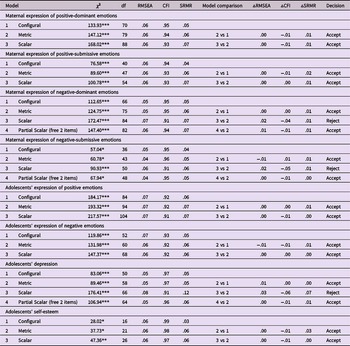
As shown in Table 1, configural, metric, and scalar invariance were observed for subscales assessing maternal expression of PD emotions and PS emotions as well as adolescents’ expression of positive emotions, expression of negative emotions, and self-esteem. For subscales measuring maternal expression of ND emotions and NS emotions as well as adolescents’ depression, configural, metric, and partial scalar invariances were achieved.
Summary of tests of measurement invariance of assessed variables across urban and Rural group

Note. *p < .05. **p < .01. ***p < .001. CFI = Comparative Fit Index; SRMR = Standardized Root Mean Square Residual; RMSEA = Root Mean Square Error of Approximation.
Mean level differences of main variables across urban and rural societies
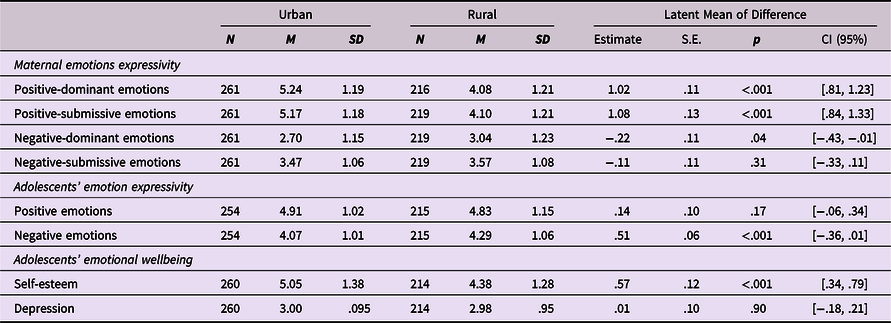
Given the results of MI, latent mean differences of assessed variables (i.e., mothers’ emotional expressivity, adolescents’ emotional expressivity, and adolescents’ emotional wellbeing) in urban and rural societies were evaluated in Mplus 7.4. FIML was used to deal with missing values. To compare the latent means between societies, we set the latent mean of the rural group at 0 and the latent mean of the urban group was freely estimated. The results showed that urban mothers expressed higher levels of PD and PS emotions, along with a lower level of ND emotions, compared to their counterparts in the rural society (ps < .05, See Table 2). Moreover, compared with rural adolescents, urban adolescents showed a higher level of self-esteem and a lower level of expression of negative emotions (ps < .05, See Table 2). No society differences were found in maternal expression of NS emotions and adolescents’ expression of positive emotions and depression (ps > .05, See Table 2).
Descriptive statistics and mean level difference of assessed variables across urban and rural groups

Note. CI = Confidence Interval.
Correlations among the main variables in urban and rural societies
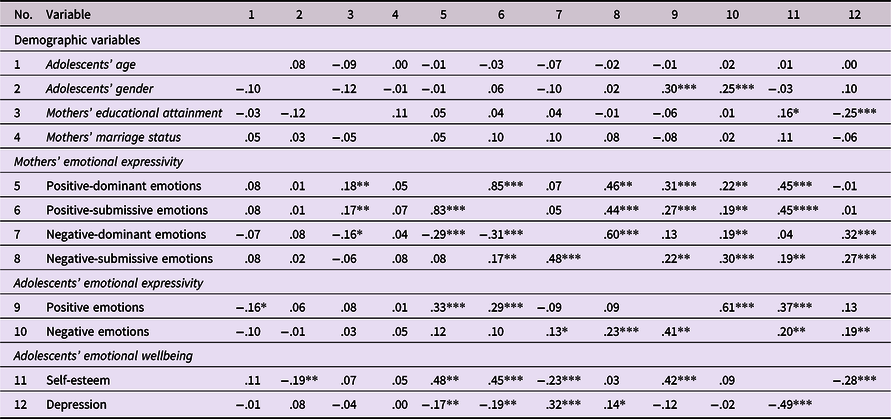
Spearman’s correlations of main variables were computed for urban and rural groups using SPSS 21.00 (See Table 3). Pairwise deletion was used to handle missing values. Given that demographic variables, including adolescents’ age and gender as well as mothers’ educational attainment, were correlated to major assessed variables of this research (i.e., mothers’ emotional expressivity, adolescents’ emotional wellbeing, and adolescents’ emotional expressivity), those demographic variables were controlled in analyses of mediation and moderated mediation effects.
Spearman’ correlations among major assessed variables

Note. *p < .05. **p < .01. ***p < .001. The values above the diagonal line represent intercorrelations in rural community and below the diagonal line are intercorrelations in urban community.
Mediation and moderated mediation effects
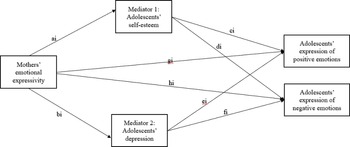
The main variables were standardized in analyses of mediation and moderated mediation effects. The analyses were performed using maximum likelihood estimation with 5,000 bootstrapped iterations in Mplus 7.4. FIML was used to deal with missing values. In each mediation model, one type of mothers’ emotional expressivity was set as the predictor, adolescents’ self-esteem and depression served as the two mediators, and adolescents’ positive and negative emotions represented two “outcome” variables. In total, four mediation models for four types of mothers’ emotional expressivity were conducted. The planned mediation model and the names of each path are shown in Figure 5 of the Appendix. In the present research, the indirect effects from mothers’ emotional expressivity to adolescents’ emotional expressivity via adolescents’ emotional wellbeing are estimated by ai*ci, ai1*fi, bi*ci, bi*fi. Given that demographic variables may confound results, we controlled for those demographic variables relevant to mothers’ emotional expressivity and adolescent adjustment based on the correlation analyses.
Following the recommendation of Edwards and Lambert (Reference Edwards and Lambert2007), multigroup comparison procedures were used to determine whether the estimated parameters differed significantly between groups. Hence, the differences between the direct, indirect, and total effects of mediated models in the two societies were tested using the Grouping and MODEL CONSTRAINT commands, which involved testing structural model estimates (Ryu & Cheong, Reference Ryu and Cheong2017; Stride et al., Reference Stride, Gardner, Catley and Thomas2015). For this purpose, the mediation models were estimated for the urban group and rural group separately. The group difference in the direct effect of mothers’ emotional expressivity on adolescents’ emotional wellbeing (estimated by ai and bi in the single-group analysis) was estimated by (ai-G1 − ai-G2) and (bi-G1 − bi-G2). Similarly, the group difference in the direct effect of mothers’ emotional expressivity on adolescents’ emotional expressivity (that is estimated by gi and hi in the single-group analysis) was estimated by (gi-G1 − hi-G2) and (gi-G1 − hi-G2). The group difference in the total effect of mothers’ emotional expressivity on adolescents’ expression of positive emotions, which is estimated by (ai*ci+bi*ei+gi) and (ai*di+bi*fi+hi) in the single-group analysis, was estimated by ((ai-G1*ci-G1+bi-G1*ei-G1+gi G1)− (ai-G2*ci-G2+bi-G2*ei-G2+gi G2)) and ((ai-G1*di-G1+bi-G1*fi-G1+hi-G1)- (ai-G2*di-G2+bi-G2*fi-G2+hi-G2)). The indirect effect of mothers’ emotional expressivity on adolescents’ expression of negative emotions was estimated by (ai-G1*ci-G1), (ai-G1*fi-G1), (bi-G1*ci-G1), (bi-G1*fi-G1) in Group 1 and (ai-G2*ci-G2), (ai-G2*fi-G2), (bi-G2*ci-G2), (bi-G2*fi-G2) in Group 2, respectively. The estimated difference in the indirect effect was estimated by (ai-G1*ci-G1− ai-G2*ci-G2), (ai-G1*fi-G1− ai-G2*fi-G2), (bi-G1*ci-G1− bi-G2*ci-G2), (bi-G1*ci-G1− bi-G2*ci-G2). Significant group difference suggests the moderating effects of society.
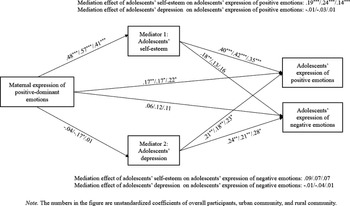
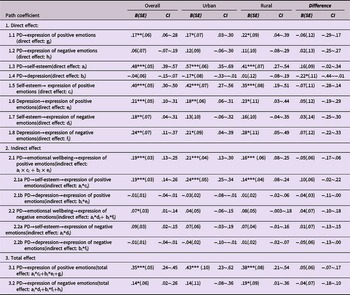
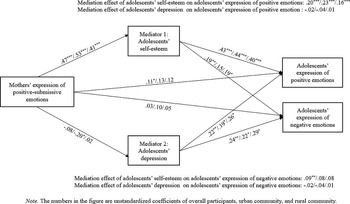
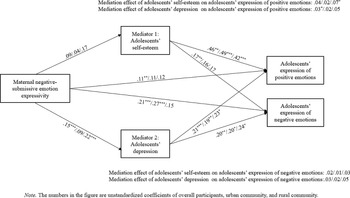
The results for the predictive effects of maternal expression of positive-dominant emotions on adolescents’ emotional expressivity are shown in Figure 1 (for more details, see Table 4 of Appendix). Maternal expression of PD emotions positively predicted adolescents’ expression of positive and negative emotions (Total effect, B = .35 and .14, respectively, ps < .05). Also, there was a direct effect of maternal expression of PD emotions on adolescents’ self-esteem (B = .48, p < .05), but its direct effect on adolescents’ depression was not significant (B = −.04, p > .05). The results reveal that the effect of maternal expression of PD emotions on adolescents’ expression of positive emotions was mediated by adolescents’ self-esteem (see indirect effect labeled as 2.1a in Table 4: B = .19, p < .05) but not adolescents’ depression (see indirect effect labeled as 2.1b in Table 4: B = −.04, p > .05). Moreover, the effect of maternal expression of PD emotions on adolescents’ expression of negative emotions was mediated by neither adolescents’ self-esteem (see indirect effect labeled as 2.2a in Table 4: B = .09, p > .05) nor adolescents’ depression (see indirect effect labeled as 2.2b in Table 4: B = −.01, p > .05). When type of society was added as a moderator, only the difference in the direct effect of maternal expression of PD emotions on adolescents’ depression was significant (B = −.22, p < .05). Notably, the direct effect of maternal expression of PD emotions on adolescents’ depression was significant in the urban society (B = −.17, p < .05) but not in the rural one (B = .01, p > .05).
Parameter Estimates (Unstandardized Coefficients) in the Mediation Model of Mothers’ Expression of Positive-Dominant Emotions, Adolescents’ Emotional Wellbeing, and Adolescents’ Emotional Expressivity.

Results of mediation and moderated mediation effects: mothers’ expression of positive-dominant emotionss serving as the predictor in model 1

Note. *p < .05. **p < .01. ***p < .001. CI = 95 % Confidence Interval. Demographic variables (i.e., adolescents’ age, adolescents’ gender, and mothers’ educational attainment) were controlled.
PD = Expression of Positive-Dominant Emotions. The results present unstandardized coefficients, SEs, and CIs. N urban = 249, N rural = 200.
Model fit indexes: chi-square = .00, RMSEA = .00, CFI = 1.00, TLI = 1.00, SRMR = .00.
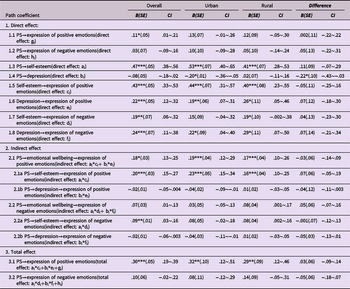
The results for the predictive effects of maternal expression of positive-submissive emotions on adolescents’ emotional expressivity are shown in Figure 2 (for more details, see Table 5 of Appendix). Maternal expression of PS emotions positively predicted adolescents’ expression of positive (Total effect, B = .30, p < .05) but not negative emotions (Total effect, B = .10, p > .05). Also, there was a direct effect of maternal expression of PS emotions on adolescents’ self-esteem (B = .47, p < .05), but its direct effect on adolescents’ depression was not significant (B = −.08, p > .05). The results reveal that the effect of maternal expression of PS emotions on adolescents’ expression of positive emotions was mediated by adolescents’ self-esteem (see indirect effect labeled as 2.1a in Table 5: B = .19, p < .05) but not adolescents’ depression (see indirect effect labeled as 2.1b in Table 5: B = −.04, p > .05). Moreover, the effect of maternal expression of PS emotions on adolescents’ expression of negative emotions was not mediated by adolescents’ self-esteem (see indirect effect labeled as 2.2a in Table 5: B = .09, p < .05) but not adolescents’ depression (see indirect effect labeled as 2.2b in Table 5: B = −.02, p > .05). When type of society was added as a moderator, only the difference in the direct effect of maternal expression of PS emotions on adolescents’ depression was significant (B = −.22, p < .05). Notably, the direct effect of maternal expression of PS emotions on adolescents’ depression was significant in the urban society (B = −.20, p < .05) but not in the rural one (B = .02, p > .05).
Parameter Estimates (Unstandardized Coefficients) in the Mediation Model of Mothers’ Expression of Positive-Submissive Emotions, Adolescents’ Emotional Wellbeing, and Adolescents’ Emotional Expressivity.

Results of mediation and moderated mediation effects: mothers’ expression of positive-submissive emotionss serving as the predictor in model 2

Note. *p < .05. **p < .01. ***p < .001. CI = 95 % Confidence Interval. Demographic variables (i.e., adolescents’ age, adolescents’ gender, and mothers’ educational attainment) were controlled.
PS = Expression of Positive-Submissive Emotions. The results present unstandardized coefficients, SEs, and CIs. N urban = 249, N rural = 200.
Model fit indexes: chi-square = .00, RMSEA = .00, CFI = 1.00, TLI = 1.00, SRMR = .00.
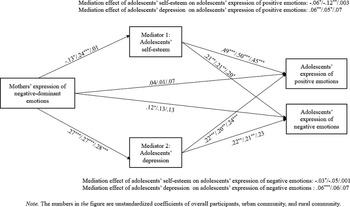
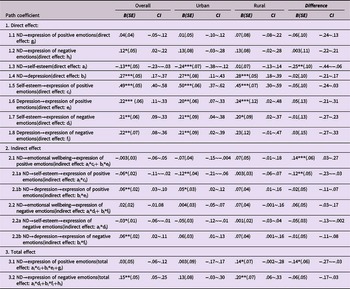
The results for the predictive effects of maternal expression of negative-dominant emotions on adolescents’ emotional expressivity are shown in Figure 3 (for more details, see Table 6 of Appendix). Maternal expression of ND emotions negatively predicted adolescents’ expression of negative (Total effect, B = .15, p < .05) but not positive emotions (Total effect, B = .03, p > .05). Also, the direct effects of maternal expression of ND emotions on adolescents’ self-esteem (B = −.13, p < .05) and depression were both significant (B = .23, p < .05). Moreover, the effect of maternal expression of ND emotions on adolescents’ expression of negative emotions was mediated by both adolescents’ self-esteem (see indirect effect labeled as 2.2a in Table 6: B = −.03, p < .05) and depression (see indirect effect labeled as 2.2b in Table 6: B = .06, p < .05). When the society was added as a moderator, only the difference in the direct effect of maternal expression of ND emotions on adolescents’ depression was significant (B = −.25, p < .05). Notably, the direct effect of maternal expression of ND emotions on adolescents’ self-esteem was significant in the urban society (B = −.24, p < .05) but not in the rural one (B = .01, p > .05). Type of society moderated the total effect that maternal expression of ND emotions had no adolescents’ expression of positive emotions (B = −.14, p < .05). The total effect that maternal expression of ND emotions had no adolescents’ expression of positive emotions is positive in rural society (B = .14, p < .05) but no urban society (B = .003, p > .05)
Parameter Estimates (Unstandardized Coefficients) in the Mediation Model of Mothers’ Expression of Negative-Dominant Emotions, Adolescents’ Emotional Wellbeing, and Adolescents’ Emotional Expressivity.

Results of mediation and moderated mediation effects: mothers’ expression of negative-dominant emotions serving as the predictor in model 3

Note. *p < .05. **p < .01. ***p < .001. CI = 95 % Confidence Interval. Demographic variables (i.e., adolescents’ age, adolescents’ gender, and mothers’ educational attainment) were controlled.
ND = Expression of Negative-Dominant Emotions. The results present unstandardized coefficients, SEs, and CIs. N urban = 249, N rural = 200.
Model fit indexes: chi-square = .00, RMSEA = .00, CFI = 1.00, TLI = 1.00, SRMR = .00.
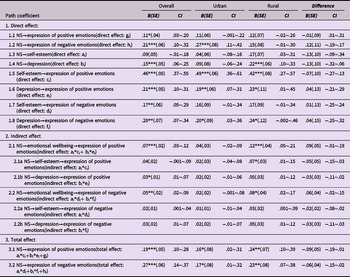
The results for the predictive effects of maternal expression of negative-submissive emotions on adolescents’ emotional expressivity are shown in Figure 4 (for more details, see Table 7 of Appendix). Maternal expression of NS emotions positively predicted adolescents’ expression of negative (Total effect, B = .11, p < .05) and positive emotions (Total effect, B = .21, p < .05). Also, the direct effect of maternal expression of NS emotions on adolescents’ self-esteem was not significant (B = .09, p < .05), but on depression it was significant (B = .15, p < .05). Moreover, the effect of maternal expression of NS emotions on adolescents’ expression of positive emotions was mediated by adolescents’ depression (B = .03, p < .05) but not self-esteem (B = .04, p > .05). When the type of society was added as a moderator, no significant difference was found in the effects that we compared (B = −.25, p < .05).
Parameter Estimates (Unstandardized Coefficients) in the Mediation Model of Mothers’ Expression of Negative- Submissive Emotions, Adolescents’ Emotional Wellbeing, and Adolescents’ Emotional Expressivity.

Mediation Model of the Relationship Among Mothers’ Emotional Expressivity, Adolescents’ Emotional Wellbeing, and Adolescents’ Emotional Expressivity.

Results of mediation and moderated mediation effects: mothers’ expression of maternal negative-submissive emotions serving as the predictor in model 4

Note. *p < .05. **p < .01. ***p < .001. CI = 95 % Confidence Interval. Demographic variables (i.e., adolescents’ age, adolescents’ gender, and mothers’ educational attainment) were controlled.
NS = Expression of Negative-Submissive Emotions. The results present unstandardized coefficients, SEs, and CIs. N urban = 249, N rural = 200.
Model fit indexes: chi-square = .00, RMSEA = .00, CFI = 1.00, TLI = 1.00, SRMR = .00.
Discussion
Our findings document that cultural variations exist in the salience of mothers’ emotional expressivity and its links to adolescents’ emotional adjustment in urban and rural families. Another important contribution is the finding of the mediating role of adolescents’ emotional wellbeing in relations between mothers’ emotional expressivity and adolescents’ emotional expressivity.
The salience of mothers’ emotional expressivity in urban and rural societies
According to our results, urban adolescents reported that their mothers expressed more PD and PS emotions than their counterparts in the rural society. This finding generally supports our hypotheses and is consistent with the past findings that compared parental emotional expressivity across nations and ethnicities with different levels of individualism and collectivism (Camras et al., Reference Camras, Bakeman, Chen, Norris and Cain2006; Camras et al., Reference Camras, Kolmodin and Chen2008; Chen, Zhou, et al., Reference Chen, Zhou, Main and Lee2015; Chen & Zhou, Reference Chen and Zhou2019a).
As noted before, past literature shows a tendency for parents with individualistic orientations to exhibit more negative emotions, including ND emotions, compared to parents with collectivistic orientations (Chen & Zhou, Reference Chen and Zhou2019a; Chen & Zhou, Reference Chen and Zhou2019b; McCord & Raval, Reference McCord and Raval2016). However, unexpectedly, our research shows that urban mothers (i.e., more individualistic) tend to a show lower level of ND emotions than rural parents (i.e., more collectivistic). One explanation for this unexpected result comes from previous research suggesting that rural parents are more intrusive, punitive, and restrictive – for instance, preferring obedience and conformity – than urban parents (Bornstein et al., Reference Bornstein, Putnick, Suwalsky, Venuti, de Falco, de Galperín, Gini and Tichovolsky2012). Thus, rural mothers’ patterns of child-rearing (e.g., the use of punishment or criticism) may make rural adolescents perceive that their mothers exhibit more ND emotions such as anger, contempt, and blaming. In other words, the varying methods of parenting in rural and urban families may outweigh the variance due to cultural orientations of individualism-collectivism.
The links between mothers’ emotional expressivity and adolescents’ outcomes in urban and rural societies
In line with past work (Bai et al., Reference Bai, Repetti and Sperling2016; Halberstadt & Eaton, Reference Halberstadt and Eaton2002; Kyeong et al., Reference Kyeong, Cheung and Cheung2021), our findings generally suggest that parents’ expression of positive emotions, no matter whether they are dominant or submissive, may be more likely to facilitate, while negative emotions expressed by caregivers may be more likely to disturb, adolescents’ emotional wellbeing. For example, the results of this research showed that parents’ expression of positive emotions, whether dominant or submissive, positively linked to adolescents’ increased self-esteem; in contrast, parents’ expression of negative emotions, whether dominant or submissive, positively associated with adolescents’ increased depression.
Moreover, the research supports the notion that children in expressive families, no matter the types of emotions expressed by their parents, may learn over time to express their own emotions (Valiente et al., Reference Valiente, Eisenberg, Shepard, Fabes, Cumberland, Losoya and Spinrad2004). For example, parental expression of positive- dominant and -submissive emotions were related to adolescents’ increased positive emotion expressivity, and parental expression of negative- dominant and -submissive emotions were linked to adolescents’ increased negative emotion expressivity.
As noted in the Introduction, the current study is probably the first to investigate the implications of parents’ expressivity of dominant and submissive emotions for adolescents’ emotional wellbeing and expressivity, respectively. Their roles in adolescents’ outcomes should be discussed with a consideration of the societies that families live in. In both urban and rural societies, maternal expression of PD and PS emotions tend to be associated with adolescents’ adaptiveness, such as enhanced self-esteem and higher levels of emotional expressivity. Also, in both urban and rural societies, maternal expression of ND and NS emotions tend to be linked with both adolescents’ maladaptiveness such as increased depression and adolescents’ adjustment such as higher levels of expression of negative emotions.
Importantly, the type of society moderates the relations between mothers’ emotional expressivity and adolescents’ outcomes. In particular, mothers’ expression of PD and PS emotions, which are more common in the urban society, both have significant links to lower levels of depression in urban adolescents but not in rural adolescents. Moreover, mothers’ expressivity of ND emotions, which is more common in the rural society, negatively predicted urban adolescents’ self-esteem but not rural adolescents’, and positively predicted rural adolescents’ positive emotion expressivity but not urban adolescents’.
The above results concerning the moderation role of society in associations of maters’ emotional expressivity and adolescents’ outcomes provide support for cultural normativeness theory: that is, more normative parenting behavior will relate to better (or less adverse) child outcomes (Deater-Deckard & Dodge, Reference Deater-Deckard and Dodge1997; Lansford et al., Reference Lansford, Godwin, Al-Hassan, Bacchini, Bornstein, Chang, Chen, Deater-Deckard, Di Giunta, Dodge, Malone, Oburu, Pastorelli, Skinner, Sorbring, Steinberg, Tapanya, Alampay, Uribe Tirado and Zelli2018). The mechanism for cultural normativenss theory may have its roots in adolescents’ differing interpretations of the same parenting practice (Gershoff et al., Reference Gershoff, Grogan-Kaylor, Lansford, Chang, Zelli, Deater-Deckard and Dodge2010; Helwig et al., Reference Helwig, To, Wang, Liu and Yang2014). For example, rural adolescents may be more likely to regard parents’ ND emotions as normal and appropriate (e.g., less likely to interpret these emotions as evidence of parental hostility or rejection), which then reduces the negative function of parents’ expressivity of ND emotions. In contrast, urban adolescents may be more likely to believe that parents’ positive emotional expressivity is normal and appropriate (e.g., more likely to feel warmth and love from parents if parents commonly express such emotions), which then boosts the positive functions of parental positive expressivity. Future empirical research may directly assess children’s evaluation of parental emotion expressivity and investigate whether children’s evaluation could moderate the association between parental emotion expressivity and its implications for children’s outcomes.
Cultural normativeness theory has also found empirical evidence in other dimensions of parental emotion socialization. For example, parenting practices such as encouragement of children’s expression of emotional distress (more common in Western culture) and minimizing children’s negative emotions (more common in Asian culture) are unrelated to children’s adaptiveness in Asian cultures, even though the former tends to benefit, and the latter tends to disturb, children’s development in Western cultures (Tao et al., Reference Tao, Zhou and Wang2010). Past studies, together with the findings of this research, indicate the significance of cultural normativeness theory in explaining cultural variations of parenting.
The mediating role of adolescents’ emotional wellbeing in the relations between mothers’ and adolescents’ emotional expressivity
The results generally support our assumption about the mediating role of adolescents’ emotional wellbeing in the relation between mothers’ and adolescents’ emotional expressivity. Thus, it is plausible that, on the one hand, parents’ emotional expressivity in families may have an indirect effect on adolescents’ emotional expressivity. Specifically, parents’ emotional expressivity can induce children’s emotional reactivity or arousal (Valiente et al., Reference Valiente, Eisenberg, Shepard, Fabes, Cumberland, Losoya and Spinrad2004; Yang & Wang, Reference Yang and Wang2019), which then motivates children to communicate their emotions more to others. On the other hand, the results of this research suggest that parents’ emotional expressivity can still predict adolescents’ emotional expressivity after controlling for adolescents’ emotional wellbeing. This indicates that parents’ emotional expressivity may directly link to children’s emotional expressivity by modeling ways of expressing emotions or conveying information concerning how to display emotions to children.
Limitations and future directions
Overall, the results of this research have implications for promoting urban and rural adolescents’ socioemotional development by focusing on mothers’ emotional expressivity. Still unresolved, and not addressed in the current study, is that without assessing specific dimensions of culture (i.e., individualism and collectivism), the mechanisms through which culture influences mothers’ emotional expressivity in urban and rural societies cannot be tested. Additionally, we didn’t examine the direction of effects between mothers’ emotional expressivity and adolescents’ adjustment, a limitation that can be addressed using a longitudinal design in future research. Future research could also examine the specific interpretive processes through which children’s outcomes are influenced differently by the same parenting practice – for example, by measuring adolescents’ affective reactions (e.g., whether they feel loved or disliked by the parent) or cognitive reappraisals (e.g., normativeness of the practice in their society) of specific types of parental emotional expressivity. Moreover, the current study focused on the interaction between mothers’ emotional expressivity and adolescents’ adjustment; however, different patterns may emerge for fathers’ emotional expressivity (Lindsey et al., Reference Lindsey, Caldera and Rivera2013). Thus, additional research is warranted to elucidate the roles of mothers’ and fathers’ emotional expressivity in children’s development. Lastly, to simplify the analysis, we only added the variables of interest as the manifest variable in our mediation analysis. Thus, it is worthwhile to include both the measurement and mediation models in the same analysis in future replication studies with larger sample sizes.
Conclusion
This research underscores the important role of mothers’ emotional expressivity in the family and reveals that its salience and links to adolescents’ outcomes differ in urban and rural societies. Moreover, this research documents that mothers’ emotional expressivity has an indirect effect on adolescents’ emotional expressivity through adolescents’ emotional wellbeing. The present research supports the significance of culture in emotion socialization and provides new insights in understanding the role that family emotional expressivity plays in adolescents’ emotional functioning.
Funding statement
Data collection of this research was supported by the Funding of General Projects of Education and Scientific research in 2019 in the 13th five-year plan of Guangdong Province (2019YQJK110), the Funding of National Natural Science Foundation of Guangdong Province (2020A1515010949), and the funding from the Shenzhen Humanities & Social Sciences Key Research Bases of Tsinghua Shenzhen International Graduate School.
Conflict of interest
None.