Introduction
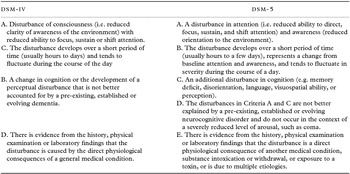
Delirium is a very common condition in hospitalized patients with higher rates in the elderly, those with prior cognitive deficits (Franco et al., Reference Franco2010) and those receiving intensive (Ely et al., Reference Ely2004), and palliative care treatment (Breitbart and Alici, Reference Breitbart and Alici2008). Delirium is a significant independent predictor of poor outcomes, including elevated morbidity and mortality (Witlox et al., Reference Witlox, Eurelings, de Jonghe, Kalisvaart, Eikelenboom and van Gool2010). However, although delirium has been recognized and studied for almost three millennia, its nomenclature, definitions, and diagnosis remain confusing and challenging (Adamis et al., Reference Adamis, Treloar, Martin and Macdonald2007). During the 20th century the concept of delirium has evolved within the ICD and DSM classification systems. The DSM-III and the revised edition DSM-III-R (American Psychiatric Association, 1980; 1987) were important landmarks in delirium nomenclature as they included more precise criteria and the term “clouding of consciousness” was introduced. If an organic cause was not “evident” it could be “presumed,” if tortuously, “the disturbance cannot be accounted for by any non-organic mental disorder.” In the fourth edition (DSM-IV, American Psychiatric Association, 1994) the disorders included in the delirium section were listed according to presumed etiology. However, in the recent fifth edition DSM-5 (American Psychiatric Association, 2013), there are differences in content and wording of the criteria (Table 1) that may influence case identification. Specifically, the removal of the term “consciousness,” and the focus on reduced awareness may impact upon delirium assessment practices and diagnosis rates.
The DSM-IV and DSM-5 criteria for delirium

A number of studies have applied delirium criteria from these previous versions of DSM (as well as ICD-10) to a single population to compare diagnosis rates; Harwood et al. (Reference Harwood, Hope and Jacoby1997) reported that the DSM-III-R classification generated a diagnosis of delirium in only 40% of patients whom they diagnosed as having delirium by clinical assessment. Liptzin et al. (Reference Liptzin1991) applied delirium criteria from DSM-III, DSM-IIIR and ICD-10 to a sample of elderly patients. They found that different patients were identified as delirious by the various systems, and that the overlap between groups was only moderate. Cole et al. (Reference Cole, Dendukuri, McCusker and Han2003) compared the DSM-III, DSM-IV, and ICD-10 criteria and found that DSM-IV criteria for delirium were the most inclusive and that the results were similar between patients with or without dementia. Moreover, Laurila et al. (Reference Laurila, Pitkala, Strandberg and Tilvis2003) evaluated the DSM-III, DSM-IIIR, DSM-IV, and ICD-10 (clinical) criteria for delirium and they confirmed previous results. Finally, a recent retrospective study which compared DSM-IV and DSM-5 criteria from an international multisite dataset that included patients from general hospital, palliative care and consultation-liaison psychiatry settings (Meagher et al., Reference Meagher2014), reported that DSM-5 criteria were more restrictive and identified a lower number of delirious patients compared to DSM-IV.
Because different criteria can influence delirium rates and can impact considerably upon both clinical care and research case identification, a comparison of how those criteria perform in the same patient population is of importance. Thus, the aim of the present study was to determine how the new DSM-5 criteria might differ from the previous DSM-IV in detecting rates of delirium in elderly medical inpatients newly admitted to a general hospital. A secondary aim was to investigate the agreement between different diagnostic methods, including the DSM III, DSM III-R, DSM-IV, and DSM-5 criteria by using the CAM and DRS-R98 as proxies for DSM III-R and DSM III.
Methods
Setting
The study was performed between July 2013 and October 2013 in a university teaching general hospital. Patients were admitted for acute assessment, from home via the emergency department or from other hospital admission wards if they needed specialist assessment in elderly care units.
Patients
All acute medical admissions of patients aged 70 years old and over were approached for permission to enter the study within 72 h (3 days) of admission. Patients were excluded if:
-
1. they were in the hospital for more than 3 days.
-
2. were readmitted to the unit, and had been studied on a previous admission.
-
3. had severe aphasia, were intubated, with severe sensory problems, or were non-English speaking.
Clinical assessments
demographics
Demographic data (gender, age) were collected from medical records (files and hospital computerized database).
delirium assessment and measurements
Delirium severity was measured using the Delirium Rating Scale Revised-98 (DRS-R98), a 16-item rating scale with 13 severity items and 3 diagnostic items. The 13-item severity section can be scored separately from the 3-item diagnostic section; their sum constitutes the total scale score with a maximum score of 46. The DRS-R98 Severity scale score ranges from 0 to 39 with higher scores indicating more severe delirium and a cut-off score >15 is consistent with a diagnosis of delirium (Trzepacz et al., Reference Trzepacz, Mittal, Torres, Kanary, Norton and Jimerson2001). The DRS-R98 is a revision of the DRS which was developed as a complement to the DSM-III criteria to measure the severity of delirium.
Delirium presence was assessed with three methods:
Confusion Assessment Method (CAM). The CAM is based in DSM-IIIR criteria to detect delirium. The four “cardinal” criteria of CAM are acute onset and fluctuating course, inattention, disorganized thinking, and altered level of consciousness. These contribute to an algorithm for diagnosis of delirium. The presence of both first and second and either the third or fourth criteria are required for a diagnosis of delirium.
DSM-IV criteria (see Table 1) and
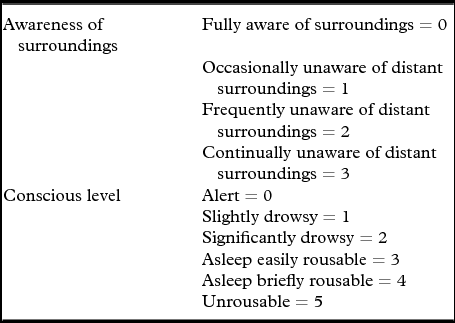
DSM-5 criteria (Table 1). To facilitate a more objective assessment of consciousness (DSM-IV) and awareness (DSM-5), we measured these two symptoms by using two items from the Reversible Cognitive Dysfunction Scale (RCDS; Treloar and Macdonald, Reference Treloar and Macdonald1997a; Reference Treloar and Macdonald1997b). Those two items are shown in Table 2.
Assessment of awareness and consciousness using the items from reversible cognitive dysfunction scale

diagnosis of pre-existing cognitive impairment (dementia)
Participants with pre-existing cognitive impairment were identified using all available sources (medical files, GP files, relative's history and neuroimaging) according to clinical criteria.
Assessments were conducted by two trained raters with established high interrater reliability, prior to the study and experience and expertise in administration of the scales. To further enhance interrater reliability, difficult ratings were discussed and rated by consensus between both raters under the supervision of one of the authors (DA). Each participant has been interviewed by the same rater with all the scales. The raters were aware of the protocol and the research questions.
ethics
The procedures and rationale for the study were explained to all patients but because many patients had cognitive impairment at entry into the study, it was presumed that many might not be capable of giving informed written consent. Because of the non-invasive nature of the study, the Local Research Ethics Committee approved an approach to establish consent by virtue of augmenting patient assent with proxy consent from next of kin (where possible) or a responsible caregiver for all participants. Patients with capacity who refused to participate, and patients without capacity whose relatives refused assent were excluded from the study. Patients in agreement but lacking capacity and with no available relatives were entered in the study until they regained capacity or relatives were contactable. This was in accordance with previous research in delirium (Adamis et al., Reference Adamis, Treloar, Martin and Macdonald2010; Sweet et al., Reference Sweet2014)
statistical analyses
Data were analyzed using SPSS v19 (IBM) and STATA v11. The agreement between the two classification systems were examined by using tetrachoric correlation coefficients (ρtetr) assuming that both classification systems measure a latent trait which is continuous (delirium). Similarly, polychoric correlation coefficients were calculated to investigate the diagnostic agreement between DSM-5, DSM-IV, DRS-R98 (dichotomous) and CAM.
Results
A total of 215 patients were approached. Of these, eight declined to participate, and seven were excluded due to severe aphasia (n = 5) and severe sensory problems (n = 2). Thus the studied sample consisted of the remaining 200 (93% of the total population considered).
Sample description
The mean age of the studied sample was 81.1 years old (SD 6.5; median 82, and interquartile range 10) and of these 100 (50%) were females. The mean length of hospital stay was 7.9 days (SD 7.5, median 6, and interquartile range 6). Previous history of cognitive impairment was identified in 126 (63%) participants.
Delirium prevalence
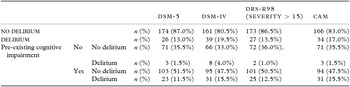
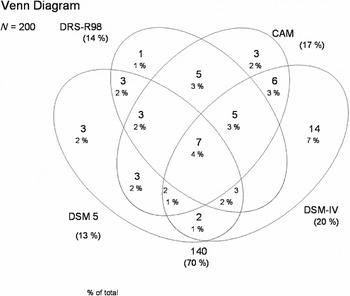
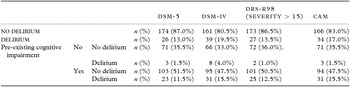
By applying delirium criteria from the DSM-5, DSM-IV, CAM, and DRS-R98 (with a cut-off of >15 on the severity score scale), the rates of delirium diagnosis are shown in Table 3. DSM-IV criteria were the most inclusive (n = 39), followed by the CAM (n = 34), DRS-R98 (n = 27) and the most restrictive were the DSM-5 criteria (n = 26). Figure 1 (Venn diagram) shows the overlap of the number of cases identified as delirium using the different classification criteria. Of note, 30% of the sample met criteria for delirium according to at least one of the classification systems.
Delirium diagnosis rates for the overall population as well as according to pre-existing cognitive impairment
The diagram shows the numbers and percentages of the cases identified as delirium among the different classification criteria.

agreement between dsm-5 and dsm-iv
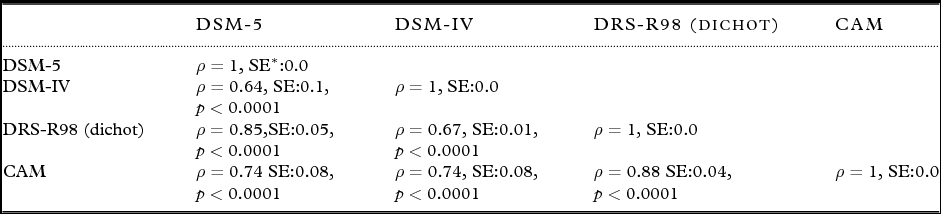
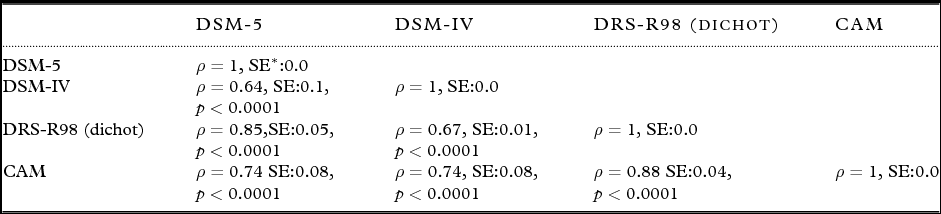
The agreement between the DSM-IV and DSM-5 classification systems (ρtetr) was 0.64 and the standard error was 0.1 (p < 0.0001). When the agreement was calculated for those with and without pre-existing cognitive impairment, the agreement was slightly lower in those with pre-existing cognitive impairment (n = 126) (ρtetr = 0.63, Std error = 0.12, p < 0.001). However, the numbers of delirium cases in the subsample without pre-existing cognitive impairment were very small (three cases were identified with DSM-5 vs. eight cases with DSM-IV) and this precludes firm conclusions.
agreement among dsm-5, dsm-iv, drs-r98 (dichotomous) and cam
The agreements (polychoric correlation coefficients) among the four criteria are shown in Table 4. It can be seen from Table 4 that there was significant agreement between all the scales/criteria had a significant agreement among themselves, with the highest between the CAM and DRS-R98, while the lowest was between DSM-IV and DSM-5.
Agreement among different criteria and scales
*SE: standard error.
Discussion
We found that different criteria for delirium impacted significantly upon the frequency of identification of delirium. Moreover, we found considerable disparity between the actual cases identified by each system. These findings concur with some previous studies with respect to the frequency of delirium detection, although to our knowledge this work is the first to include DSM-5 criteria for delirium assessed for prospectively. For instance Cole et al. (Reference Cole, Dendukuri, McCusker and Han2003), and Laurila et al. (Reference Laurila, Pitkala, Strandberg and Tilvis2003) also showed a discrepancy in the prevalence of delirium depending on the kind of criteria used (ICD-10, DSM-III, DSMIII-R, DSM-IV). Similarly Kazmierski et al. (Reference Kazmierski2008) and Thomas et al. (Reference Thomas, Kreisel, Oster, Driessen, Arolt and Inouye2012) also found that DSM-IV criteria were more inclusive compared to ICD-10 in patients developing delirium after cardiac surgery and in elderly with dementia respectively. The inclusion of disorganized thinking as a criterion in DSM-IIIR (Liptzin et al., 1993), and the wide range of mandatory features in ICD-10 are key factors that underpin this finding (Meagher et al., Reference Meagher, Maclullich and Laurila2008). Some studies have suggested that DSM-IV criteria identify a greater number of cases because it includes many cases that are of subsyndromal severity (Meagher et al., Reference Meagher, Leonard, Donnelly, Conroy, Adamis and Trzepacz2011; Reference Meagher2014). However, the similarity in many outcomes for so-called subsyndromal cases, along with detailed phenomenological studies that suggest that subsyndromal delirium represents a delirium of less phenomenological intensity, but with a similar range of features to full delirium, suggests that this greater inclusivity may be both justified and desirable. (Cole, Reference Cole2013; Martinez-Velilla et al., Reference Martinez-Velilla, Alonso-Bouzon, Cambra-Contin, Ibanez-Beroiz and Alonso-Renedo2013). In the present study we found that 30% of the sample met some criteria for delirium with any classification system which perhaps represent the so-called subclinical/subsyndromal cases by some approaches. Subsyndromal delirium is addressed under “attenuated delirium syndrome” in DSM-5 but to date remains unstudied.
Nevertheless a recent retrospective analysis of a large pooled multisite database which compared the DSM-IV and DSM-5 criteria had similar findings to the present study whereby DSM-5 criteria identified fewer cases of delirium largely due to issues around accurately identifying disturbance of awareness (Meagher et al., Reference Meagher2014).
A number of factors may contribute to the greater inclusiveness noted for DSM-IV compared to DSM-5. First of all, DSM-5 has one more diagnostic criterion compared to DSM-IV and this additional diagnostic requirement theoretically can reduce the number of cases (Blazer and van Nieuwenhuizen, Reference Blazer and van Nieuwenhuizen2012). Second, Criterion D of DSM-5 requires that Criteria A and C are not better explained by an established or evolving neurocognitive disorder and do not occur in the context of a severely reduced level of arousal, such as coma. Thus, criterion D excludes low arousal states such as coma which were included in DSM-IV. DSM-5 positive that are DSM-IV negative are due to having altered consciousness but appearing aware while the DSM-IV positives that were DSM-5 negative are because the patient had impaired awareness but was fully conscious. Similarly this criterion may also exclude or raise doubt about the diagnostic relevance of psychotic symptoms which occur during the course of dementia. The third and most important reason is the introduction of disturbed awareness in DSM-5 instead of altered consciousness in DSM-IV, although in both criteria inattention is involved. For DSM-IV inattention is frequently used as evidence of disturbed consciousness, while in DSM-5 unawareness is considered as a separate phenomenon from inattention. However, there is an ongoing debate as to whether attention, consciousness, and awareness are distinct modalities and the extent to which they are interconnected such that a disturbance of one can affect the others. For instance it has been suggested that attention and awareness can be fully dissociated (Koch and Tsuchiya, Reference Koch and Tsuchiya2007; Block, Reference Block2011) or that attention can operate without consciousness and vice versa (Van den Bussche et al., Reference Van den Bussche, Hughes, Humbeeck and Reynvoet2010; Sacks, Reference Sacks2012) or that perhaps they are independent but with close interactions (Aru and Bachmann, Reference Aru and Bachmann2013).
Although it is beyond of the scope of this paper to review the relevant literature about awareness, attention, and consciousness, it seems from this study and previous work that DSM-5 criteria for delirium are more restrictive than DSM-IV. In the present study, we did not consider any method of diagnosis as better or preferred. However, a previous survey among delirium researchers (Morandi et al., Reference Morandi2013) and a recent opinion paper from the European Delirium Association and American Delirium Society (2014) suggest that inclusiveness is better as it increases clinical awareness and patient safety through delirium identification and prevention.
A limitation of this study is that we did not have adequate numbers of delirious patients without previous cognitive impairment, to allow separate testing of the agreement between the criteria. Similarly, we did not assume any “gold standard” (given that we actually assessed the agreement between “gold standards”) to arrive at any conclusion as to the “best” criteria. However, independently of the reasons that DSM-IV identifies more delirium cases, this study can confirm that both classification systems (and their antecedents) have significant agreement in the identification of the same concept (delirium). Furthermore, this study also can confirm that those classification systems identify different cases of delirium. This could have clinical, financial, and research implications. However, clarity of diagnosis is required for classification but also has implications for prediction of outcomes, further research looking at outcomes could assist a more detailed evaluation of these new DSM-5 criteria.
Conflict of interest
None.
Description of authors’ roles
All the authors participated in the study design, interpretation of results, the drafting of manuscript and all approved the final version. Dr Adamis has the responsibility for the statistical analysis of the data.
Acknowledgments
Sligo Regional Hospital. Research and Education Foundation, research seed grant.