Introduction
What do subject pronouns, interrogative words, and sentential negators have in common? In some studies of intra-sentential code-switching, including the seminal analyses of Spanish–English bilingual speech, it has been claimed that switches immediately following these three categories are very infrequent and often provoke ambivalent reactions when presented for acceptability judgments (e.g., Ebert, Reference Ebert2014, Muysken, Reference Muysken2000; Peñalosa, Reference Peñalosa1980; Timm, Reference Timm1975). Perhaps not coincidentally, items from these same three categories are rarely borrowed even in the most intense language contact situations, and almost never are entire paradigms borrowed. At the same time numerous apparent counter-examples to these putative code-switching restrictions have been adduced (e.g., Berk-Seligson, Reference Berk-Seligson1986; Clyne, Reference Clyne1987; Mahootian & Santorini, Reference Mahootian and Santorini1996; Prince & Pintzuk, Reference Prince and Pintzuk2000; Woolford, Reference Woolford1983), which leave open the more general question of whether specific classes of words inherently act cross-linguistically as partial barriers to intra-sentential code-switching. The present study represents a first attempt at addressing this question by examining data from a unique bilingual environment involving two languages in which issues of morphosyntactic (in)compatibility are effectively absent. This configuration allows for successively exploring language switches one grammatical category at a time, thereby maximally isolating any potential behavior patterns that might adhere to specific switch-types in otherwise identical morphosyntactic frames.
In response to observed preferences for and against grammatically defined intra-sentential code-switching sites, as well as to imbue models with predictive power, a number of syntactically-based proposals have been put forth. The earliest models were primarily predicated on linear congruence surrounding potential switch points (e.g., Lipski, Reference Lipski and Paradis1978; Pfaff, Reference Pfaff1979; Poplack, Reference Poplack1980; Timm, Reference Timm1975), and did not directly address possible links between specific grammatical categories reported to be disfavored in code-switching and clause-internal structural relations. This line of approach was later extended to generative phrase-structure rules, in attempts to characterize bilingual grammars’ generation of code-switched sentences (e.g., Rivas, Reference Rivas1981, Sankoff & Poplack, Reference Sankoff and Poplack1981) and their psycholinguistic implications (Sridhar & Sridhar, Reference Sridhar and Sridhar1980). Subsequent approaches grounded in models of syntactic structure have focused on the presence or absence of government relationships (DiSciullo, Muysken & Singh, Reference DiSciullo, Muysken and Singh1986), the Functional Head Constraint (Belazi, Rubin & Toribio, Reference Belazi, Rubin and Toribio1994), prohibitions against switching closed-class items (Azuma & Meijer, Reference Azuma and Meier1997; Doron, Reference Doron1983; Joshi, Reference Joshi, Dowty, Karttunen and Zwicky1985; Prince & Pintzuk, Reference Prince and Pintzuk2000) or system morphemes (Myers-Scotton, Reference Myers-Scotton, Grenoble and Whaley1998), the lexical-functional category distinction (Chan, Reference Chan2008), Minimalist-based (lexical) feature mismatches (Jake, Myers-Scotton & Gross, Reference Jake, Myers-Scotton and Gross2002; MacSwan, Reference MacSwan2000, Reference MacSwan, Bhatia and Ritchie2004, Reference MacSwan2005; van Gelderen & MacSwan, Reference Van Gelderen and MacSwan2008; but cf. Hebblethwaite, 2007), and optimization of competing constraints (Muysken, Reference Muysken2013; also Bhatt, Reference Bhatt1997; Hogeweg, Reference Hogeweg2009). Reconciling apparently conflicting approaches is made more difficult by the fact that putative counter-examples often come from different languages than those used in support of proposed constraints. Teasing apart the contributions of language-specific and putatively universal constraints is further complicated by the fact that substantially different morphosyntactic systems are often at stake: presence or absence of null subjects, object clitics, verb raising, do-support, presence or absence of negative concord, preverbal vs. postverbal negation, as well as contrasts between prepositions and post-positions, V-O and O-V word order, and the like. Even in language pairs whose morphosyntactic structures are ‘more or less’ the same there are usually subtle differences that confound the issue of determining the precise factors responsible for observed preferences and possible restrictions on intra-sentential code-switching. Also at stake is the nature of the proposed constraints themselves, which may be probabilistic rather than absolute and universal (already hinted at in Sankoff & Poplack, Reference Sankoff and Poplack1981), further complicating both corpus-based and interactive probes into likely intra-sentential switches.
The conundrums posed by the possible interrelatedness of language typology and language-switching restrictions give rise to the question of whether there are in fact any grammatical categories at all that are singled out cross-linguistically as impediments to intra-sentential code-switching, or whether reported observations as to the undesirability of switching certain types of words (e.g., pronouns, negators, and interrogatives) can be reduced to language-specific epiphenomena. Ideally a test environment in which to probe more deeply into the possibly ‘special’ status of specific categories in the context of intra-sentential switching would involve languages that not only share identical phrase structure and syntactic mechanisms (i.e., both linear and structural identity) while having non-cognate lexicons, but which also employ exactly the same (bound) grammatical morphemes but lexically disjoint sets of words for the categories in question (e.g., pronouns, negators, and interrogative words). In order to share identical grammatical morphemes there would have to be some sort of genealogical relationship between the languages, but this is hardly compatible with having non-cognate lexicons.
Do such language pairs exist? Among the languages of the world there are a few possible candidates, which result from a relatively unusual process related to creolization and known as intertwining or relexification. Intertwined languages – of which only around half a dozen have been unequivocally identified – essentially combine the morphosyntactic structures of one language and the lexical roots of another, in a fashion both quantitatively and qualitatively different from the usual borrowing that takes place in language contact environments (cf. the studies in Bakker & Mous, Reference Bakker and Mous1994 and Matras & Bakker, Reference Matras and Bakker2003). In order to test whether items such as negators, interrogatives, and pronouns embody non syntactically-grounded language-switching restrictions, the intertwined language must be spoken together with the language that supplied the morphosyntactic underpinnings. Such a scenario embodies the possibility of replacing any and all relexified items – including negators, pronouns, interrogatives, and other nominally functional elements as well as verbs, nouns, and adjectives – with the original patrimonial (non-relexified) equivalents. If such switching occurs spontaneously in naturalistic speech – or if interactive experiments reveal no significant differences in either production or preference based on the category of the switched items, this would suggest purely language-specific (and probably syntactic) origins for observed language-switching restrictions, which by inference would be more evident in the case of languages separated by greater typological distance. On the other hand if even with identical morphosyntactic frames – including identical affixes and other grammatical morphemes – a subset of categories such as negators, pronouns, and interrogatives exhibits different properties from other lexical content items with respect to language switching, this would lend support to claims that specific grammatical categories are quasi-universally relevant in constraining intra-sentential code-switching. At the same time, even if it is possible to suggest a common syntactic process that both links the CS-inhibiting categories and collectively separates them from other grammatical categories, a test environment with identical morphosyntactic frames would provide a probe for contributing factors not linked to specific syntactic configurations, e.g., semantic or pragmatic.
The present study represents a first attempt at addressing the possible cross-linguistic relevance of specific grammatical categories in intra-sentential code-switching. The data come from northern Ecuador, where the traditional indigenous language Quichua (as the language of the former Inca empire is referred to in EcuadorFootnote 1) is spoken in contact with a language known as Media Lengua, which consists essentially of Quichua morphosyntax but in which Spanish roots have replaced patrimonial Quichua roots for nearly all nouns, verbs, and adjectives, as well as pronouns, interrogatives, and negators (due to the agglutinative character of the languages it is not possible to put other functional categories to the test). Groups of Quichua–Media Lengua bilinguals participated in interactive tasks designed to individually isolate grammatical categories and examine their behavior in code-switched environments. The data reveal that under appropriate experimental conditions, language switches immediately following interrogatives and pronouns were acknowledged as not belonging to either Quichua or Media Lengua and were rejected at higher rates than switches after lexical content items.
Media Lengua: a true mixed or intertwined language
An Ecuadorian mixed language
The intense and sustained contact between Spanish and Quechua languages in the Andean region of South America (especially Peru, Bolivia, and Ecuador) has led to the incorporation of Spanish affixes in many varieties of Quechua (e.g., Muysken, Reference Muysken2012a, Reference Muysken2012c) as well as varying degrees of lexical borrowing, typically nouns, verbs, and some adjectives (e.g., Sánchez, Reference Sánchez2012). In most cases this produces no more than the usual contact-tinged regional dialects, with one extraordinary exception. In at least two locations in Ecuador a new language has arisen, whose morphosyntax – including all agglutinative affixes – comes from Ecuadorian Quichua while nearly all lexical roots (nouns, verbs, adjectives, adverbs, pronouns, interrogatives) are derived from Spanish.Footnote 2 This ‘new’ language is generally referred to as Media Lengua ‘half language,’ in reality a misnomer since this same term has habitually been employed in the Spanish-speaking world in reference to the broken speech of language learners or individuals with language impairments. Ecuadorian Media Lengua is a complete language, distinct from both Spanish and Quichua, and is spoken natively in several communities together with Spanish and/or Quichua. Media Lengua was first described by Muysken (Reference Muysken1979, Reference Muysken, Valdman and Highfield1981, Reference Muysken1988, Reference Muysken and Thomason1997, Reference Muysken, Bhatiaj and Ritchie2012b), for some rural communities near the town of Salcedo in the Ecuadorian province of Cotopaxi, to the south of Quito. Today only a few speakers of this variety, also known as quechua chico or utilla ingiru “little Quechua”, remain (Shappeck, Reference Shappeck2011), but in the province of Imbabura to the north of Quito, Media Lengua is alive and well in several small communities (Gómez Rendón, Reference Gómez Rendón, Olbertz and Muysken2005, Reference Gómez Rendón2008; Stewart, Reference Stewart2011, Reference Stewart2013, Reference Stewart2015). In Imbabura the language is sometimes also referred to as chaupi shimi or chaupi lengua “half-language”, chapu shimi “mixed language”, chapushka-chapushka “all mixed up”, and – particularly by young students – quichuañol. Media Lengua is quite different from dialects of Quechua that have incorporated numerous Spanish borrowings, due to the systematic replacement of virtually all Quichua roots by Spanish-derived roots. Muysken (Reference Muysken1988, p. 409) notes that “[. . .] what is peculiar about Media Lengua is not so much that it contains Spanish words (many dialects of Quechua do as well), but that all Quechua words, including core vocabulary, have been replaced.” Crucially for the purposes of the present study, this includes Spanish-derived pronouns, interrogative words, and negators, items which are not typically borrowed during contact situations, and especially not entire paradigms (e.g., Matras, Reference Matras, Matras and Bakker2003, p. 159). Although some varieties of Quechua (not in Ecuador) have as much as 40% of Spanish borrowings, in Media Lengua upwards of 90% of the lexicon is Spanish-derived. The large gap between Spanish-laced Quechua dialects and Media Lengua is not occupied by any intermediate varieties (Bakker & Muysken, Reference Bakker, Muysken, Arends, Smith and Muysken1994, p. 44), and the range of grammatical categories and the semantic distribution of Spanish-derived items in Media Lengua are much broader than Spanish borrowings in Ecuadorian Quichua (Nortier & Schatz, Reference Nortier and Schatz1992, pp. 181, 187), which in particular do not include pronouns, interrogatives, negators, or other free morphemes that might be classified as functional categories (except for Spanish conjunctions, which are essentially nonexistent in Quichua).
Quichua is an agglutinative post-positional head-final language, and as a result Spanish functional categories such as prepositions, determiners, and subordinators are never mapped onto Quichua. In particular Quichua has no recognizable determiners (although shuk “one” could sometimes be construed as an indefinite article), Quichua post-positions are not replaced by or relexified from Spanish prepositions in Media Lengua (Dikker, Reference Dikker, Stolz, Bakker and Salas Palomoa2008), nor do the Quichua phrase-final complementizer affixes –shpa (same subject) and –kpi (switch reference) alternate with Spanish forms. Media Lengua pronouns and interrogatives behave morphosyntactically just like nouns, as free morphemes to which agglutinative morphemes can be added, while the first half of the negator (mana) is not a clitic or agglutinative morpheme but rather a free-standing word. As a result it is not possible to couch the experimental manipulation of Spanish-derived vs. Quichua-derived elements in Media Lengua strictly in terms of lexical-functional dichotomies such as might be done in Spanish–English switching. All Spanish-derived elements in Media Lengua are free morphemes or lexical roots (e.g., of verbs), irrespective of whether pronouns, interrogatives, and negators are classified as functional categories, while all of the remaining putatively functional elements in ML are bound morphemes and come from Quichua.
The nature of Media Lengua
Media Lengua is not a form of code-switching or an approximation to Spanish by Quichua-dominant speakers, but rather a stable and consistent language with well-defined speech communities, and recognized by its speakers as being systematically different from both Spanish and Quichua (Muysken, Reference Muysken and Thomason1997, p. 409). Media Lengua is no more intelligible to Spanish speakers than Quichua is. Few non-indigenous Spanish speakers understand Media Lengua although quite a few have acquired some knowledge of Quichua. Quichua speakers from regions where Media Lengua is not spoken experience a similar inability to understand this language, although recognizing it as ‘some kind of’ Quichua (Muysken, Reference Muysken and Thomason1997, p. 375; Stewart, Reference Stewart2011, p. 36; informally verified by the present author). An example of Imbabura Media Lengua is given in (1); Spanish-derived roots are in italics and tonic syllables in this agglutinative language are underlined:
(1)


All of the lexical roots are derived from Spanish: yo “I”, vos “you (s.)”, media lengua, hablar “to speak”. querer “to wish”, but monolingual Spanish speakers are unable to parse this utterance, cast in a Quichua morphosyntactic frame. Media Lengua speakers do not make the language up as they go along; to spontaneously translate novel utterances as well as rework Spanish lexical roots with Quichua phonotactics would represent cognitive demands resulting in slower and at least partially dysfluent speech, which does not occur. Speakers produce Media Lengua with the same fluency and spontaneity as Spanish and/or Quichua and routinely conduct entire conversations in ML. Moreover there are fossilized remnants of archaic Spanish pronunciation not found in contemporary Andean Spanish such as kaza (Sp. casa “house”), kuz(i)na (Sp. cocinar “to cook”), and azi (Sp. hacer “to do”), in which the presence of intervocalic [z] (non-existent in Spanish since the 16th century) indicates that speakers are not simply inserting Spanish elements as they go along (Muysken, Reference Muysken1988, p. 410).
Media Lengua in Imbabura
In Imbabura province Media Lengua is predominantly spoken in the communities of Angla and Casco Valenzuela, both located in the parroquia “parish” of San Pablo del Lago, in the cantón “county” of Otavalo. Angla has perhaps two hundred families while Casco Valenzuela has less than half that number (Gómez Rendón, Reference Gómez Rendón, Olbertz and Muysken2005, p. 43; Reference Gómez Rendón2008, p. 51). The villages consist of clumps of dwellings interspersed with garden plots and pastures, and are located on opposite slopes of a small valley; by foot they are about twenty minutes apart. Angla has a pre-school and a chapel, while Casco Valenzuela has only a small health center. The children of both communities go to the school in El Topo, another hamlet located in the same valley, about equidistant from both Angla and Casco Valenzuela. Despite the fact that one can walk between Topo and Casco in less than fifteen minutes, in Topo Media Lengua is not spoken natively by most adult speakers, although many of the children acquire it from their classmates in school. Quichua is still the predominant home language in Topo, and is the dominant language of older speakers in Angla, while younger residents of Angla and most residents of Casco Valenzuela prefer to speak Media Lengua, although they are also fluent in Quichua.
Media Lengua is also spoken in Pijal, a community located adjacent to the Spanish-speaking town of González Suárez, near the Pan American Highway and located more than an hour's walk downhill from the aforementioned communities. In Pijal, whose Media Lengua is described by Stewart (Reference Stewart2011, Reference Stewart2013, Reference Stewart2015), some older residents are fluent in both Quichua and Media Lengua, but younger residents are increasingly turning to Spanish as the dominant language. About ten minutes on the opposite side of the González Suárez plaza lies the community of Gualacata, where Media Lengua is also spoken by some older residents, usually with family ties to Pijal.Footnote 3 The location of the Media Lengua-speaking communities in shown on the map in Figure 1.
Location of Media Lengua-speaking communities in Imbabura.

Media Lengua appears to have been formed very quickly, perhaps in no more than a decade (Bakker, Reference Bakker, Matras and Bakker2003, p. 136). Moreover, Media Lengua does not represent a cline or continuum of relexification, ranging from mostly Quichua to mostly Spanish lexical roots. Rather, the replacement of Quichua roots by Spanish roots is nearly complete. No living or previously identified speakers constitute ‘missing links’, i.e., speaking a Media Lengua variety less relexified than the currently spoken language: “we have no documentation of a transitory phrase between the supposed CS behaviour preceding the genesis of the mixed language [. . .] the lack of documentation of a transitional phase in all cases of the genesis of mixed languages speaks against the hypothesis of a slow development” (Bakker, Reference Bakker, Matras and Bakker2003, pp. 129–130). The ‘all or nothing’ aspect of Media Lengua is also reflected in the fact that although speakers in the communities in which Media Lengua is used clearly differentiate this language from Quichua, fluent intra-sentential Quichua–Media Lengua code-switchingFootnote 4 (e.g., switching of entire constituents or monotonic switches from one language to the other) has not been observed by the present author nor reported by other researchers.Footnote 5 What does occasionally occur is the insertion of individual Quichua lexical items into Media Lengua. But, as the following experiments will corroborate, switching pronouns, interrogatives, and negators has not been observed. Even less frequent is the insertion of Spanish-derived (i.e., Media Lengua) roots into Quichua, beyond well-integrated Spanish loanwords.Footnote 6 In particular, Spanish-relexified verb roots are almost never introduced into Quichua. Although the question of why relexification occurred at all among Quichua–Spanish bilinguals remains unresolved, the following question may be amenable to experimental techniques:
Why did relexification take place (almost) all at once, with so little evidence of intermediate clines or continua?
The results of the experiments described in the following sections, including un-timed acceptability judgments, language classification, and concurrent memory-loaded repetition, may shed light on this question as well, and will be briefly discussed in the Afterword (Appendix S2).
Although Media Lengua is an established language in the communities in which it is spoken, some speakers exhibit ambivalence as regards its use and even legitimacy (e.g., Gómez Rendón, Reference Gómez Rendón2008, p. 18). Based on the author's many visits and conversations with community residents, including teachers and civic leaders, within the communities themselves there are no overt sociolinguistic strictures against using Media Lengua. Disparaging comments can occasionally be heard in the neighboring communities of Topo and Ugsha; some teachers in the bilingual school in Topo have been heard to criticize Media Lengua; and a recent sociolinguistic survey (Jarrrín Paredes, Reference Jarrín Paredes2013) revealed ambivalence towards the use of Media Lengua even by speakers who prefer to use this language. This ambivalence in accepting Media Lengua at par with Quichua and Spanish adds to the well-documented difficulties in eliciting acceptability judgments for any code-switched exemplars, even in communities where code-switching is commonplace (e.g., Mahootian & Santorini, Reference Mahootian and Santorini1996, p. 473). This ambivalence, together with the fact that with the exception of the ethnographic interviews conducted by Gómez Rendón (Reference Gómez Rendón, Olbertz and Muysken2005, Reference Gómez Rendón2008) Media Lengua speakers in Angla, Casco Valenzuela, and Topo had no familiarity with linguistic research, provide the backdrop against which the experiments to be described below must be situated.
Pronouns, interrogation, and negation in Quichua and Media Lengua
Cole (Reference Cole1982) provides a description of Imbabura Quichua (IQ). Quichua and Media Lengua are agglutinative languages with post-positions and predominantly O-V word order. Like Spanish, Quichua and Media Lengua are null subject languages, in which person and number information is reflected in verbal suffixes.
Personal pronouns
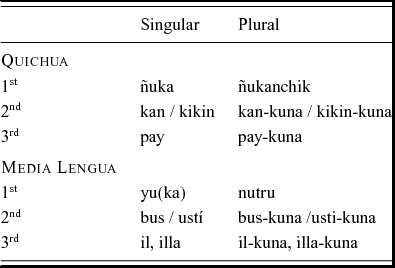
In IQ and ML pronouns are invariant in subject and complement positions, differentiated by affixes such as the topicalizer –ka for subjects, -ta for direct objects, -man for indirect objects, -manda for benefactive, and –pak for genitive. The one exception is the first-person singular accusative infix –wa- found in both declarative and imperative utterances. The IQ and ML pronouns are given in Table 1:
Imbabura Quichua and Media Lengua (subject) pronouns

The principal difference between the Quichua and ML pronominal systems is the fact that Media Lengua has adopted Spanish gender-differentiated third person pronouns, unlike in Quichua. In addition, Imbabura Quichua frequently employs kikin “same” as a respectful 2nd person address pronoun roughly corresponding to Spanish usted (ustí in ML); kikin-kuna is the plural form corresponding to Spanish ustedes (usti-kuna in ML). Most other Quechua varieties do not distinguish formal and familiar 2nd person pronouns.Footnote 7
Negation
Verbal negation in IQ is normally handled by the disjunctive combination (ma)na . . . chu, whose behavior is similar to French ne . . . pas;Footnote 8 mana is reduced to na in casual speech and the final chu is occasionally omitted. Media Lengua uses preverbal no or nu (< Spanish no) plus postverbal chu, as in (2):Footnote 9
(2)

Interrogation
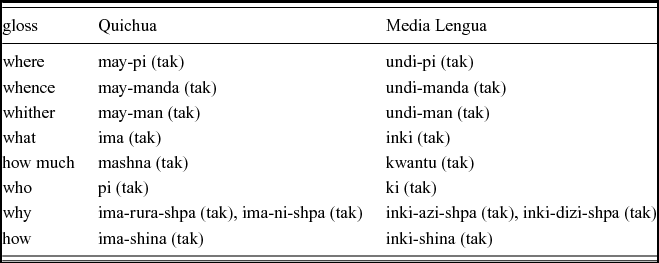
Interrogative words in IQ and ML are normally fronted as in Spanish, and optionally combined with the clitic –ta(k), as in (3). Most interrogative words are bimorphemic, combining an interrogative stem and an adverbial postposition. The ML roots are derived from Spanish, reducing the Spanish five-vowel system to conform to the three vowels of Quichua. Table 2 gives the forms.
Imbabura Quichua and Media Lengua interrogative words

Examples of interrogative utterances are given in (3).
(3)

Absolute interrogatives (those with “yes” or “no” answers) are marked with -chu attached to the constituent(s) being questioned.
What type(s) of code-switching?
The vast literature on bilingual code-switching embodies many definitions of the term itself. In the present study attention is limited to intra-sentential language switching, variously defined as language switches within a single clause or complementizer phrase (CP; cf. Jake, Reference Jake1994, p. 271) or switches below sentential boundaries (MacSwan, Reference MacSwan2000, p. 38). A more general definition is “alternate sentence fragments in the two languages, each of which is grammatical by monolingual standards from the standpoint of appropriate function words, morphology, and syntax” (Sankoff, Poplack & Vanniarajan, Reference Sankoff, Poplack and Vanniarajan1990, p. 71). Muysken (Reference Muysken2000, p. 3), further illustrated by Deuchar, Muysken & Wang (Reference Deuchar, Muysken and Wang2007), divides intra-sentential code-switches into insertion (of lexical items or entire constituents) from one language into a structure from the other language), alternation (between structures from different languages), and congruent lexicalization (of material from different lexical inventories into a shared grammatical structure).Footnote 10
In the following sections various combinations of Quichua and Media Lengua are discussed in terms of possible constraints on intra-sentential code-switching. In order to begin the exploration of language-switching possibilities between these two grammatically identical but lexically distinct languages, the decision was made to zero in on a subset of the ‘usual suspect’ pool instantiated by free morphemes whose Media Lengua counterparts are relexified from Spanish (in this case interrogatives, negators, and pronouns), together with lexical content root morphemes (nouns, verbs, adjectives). These items were experimentally targeted as tightly as possible by switching them one at a time while leaving the remainder of the sentence unchanged. This decision inevitably raises the issue, also mentioned by an anonymous reviewer, of whether such mixtures could be construed as simply (nonce) borrowings, and therefore substantially irrelevant to the study of code-switching restrictions. Sankoff et al. (Reference Sankoff, Poplack and Vanniarajan1990, p. 72) distinguish code-switching, which requires access to the syntactic apparatus of both languages, from borrowing, which operates independently of the grammar of the donor language, while cautioning that single-word code-switches may be superficially indistinguishable from borrowings. Given that Quichua and Media Lengua share not only the same grammatical and phonotactic patterns but also the same bound grammatical morphemes, most of the criteria that have been proposed to distinguish borrowings from (insertion) code-switches are moot. This includes the distinction between linear and structural approaches to code-switching restrictions, where linear constraints require the preservation of superficial constituent order of sentences in both languages and structural constraints are based on syntactic dependencies and disfavor switches between elements that are lexically dependent on each other (e.g., Muysken, Reference Muysken1987). For any combination of words the Quichua–Media Lengua interface provides maximum neutrality (in the sense of Muysken, Reference Muysken1987; Reference Muysken2000, pp. 30–31), i.e., freedom from language-specific structural or linear syntactic constraints. In principle, therefore, no grammatical limitations should impede language switching between any two words taken from Quichua or Media Lengua. As a consequence, if experimental results show that preference for or against language switching is modulated by the grammatical category of the switched words – whether or not in their entirety they are regarded as nonce-borrowings, insertional code-switches, or congruent lexicalization – extra-syntactic factors will be implicated.Footnote 11 It is for these reasons that the present study is confined to single-word switches involving only four categories (pronoun, interrogative, negator, lexical content word), which provide the maximum opportunity for isolating code-switching behavior. To the extent that these preliminary probes indicate a consistent contribution to code-switching constraints (which in this case must necessarily be semantic or pragmatic), the search may subsequently be extended to a more diverse range of intra-sentential language switches.
First experiment: un-timed acceptability judgment
Prior to the initiation of the present project, informal conversations between the author and Media Lengua speakers had produced assurances that community members ‘knew’ when a given utterance was in Quichua or Media Lengua, albeit without explanation or independent verification. In an attempt to determine the extent to which speakers differentiate Quichua and Media Lengua as well as to probe for reactions to unattested mixed configurations, a speeded acceptability judgment task with oral responses was conducted (e.g., along the lines of Bader & Meng, Reference Bader and Meng1999; Felser, Sato & Bertenshaw, Reference Felser, Sato and Bertenshaw2009), with timeout after two seconds. This was an unfamiliar task for all participants, and failure to respond within the two-second window was a frequent occurrence, as were requests for repetition (not allowed). More than half of the participants responded “yes” to almost all stimuli, irrespective of language, giving ‘perfect’ scores for recognition of Quichua and Media Lengua stimuli but also the unrealistic inference that all putatively mixed stimuli were equally acceptable. One method of correcting for categorical responses that could be generated without even listening to the stimuli is to calculate the d-prime values for each participant. D-prime scores are based on the rate of correct responses (“hits”) minus the rate of false positive responses (“false alarms”).Footnote 12 In the case of stimuli representing Quichua, Media Lengua, and putatively mixed Quichua–ML utterances, a hit represents a response as acceptable for an all-Quichua or all-ML stimulus, and a false alarm represents a response as acceptable for a nominally mixed Quichua–ML stimulus.
Participants whose d-prime scores reflect adequate discrimination significantly distinguished Quichua, Media Lengua, and nominally mixed Q–ML utterances, but there were no significant results for grammatical category (lexical items, interrogatives, pronouns, negators).
In view of the difficulties experienced with the speeded task, an un-timed acceptability judgment experiment was conducted. It was hypothesized that providing an environment as free from performance pressures as possible offered the greatest possibility for obtaining reliable judgments.
Method
Participants
A total of fifty one Quichua–Media Lengua bilinguals from Angla, Casco Valenzuela, Topo, and one from Pijal, participated (twenty six adults and twenty five adolescents ages 15–19); this was the total of available participants during the available time frame. The adolescents had received classes in Quichua and Spanish in the local school while none of the adults had received formal training in Quichua and some had no formal schooling at all. All were native speakers of Imbabura Quichua and Media Lengua; proficiency in Spanish ranged from rudimentary among some of the oldest participants to near-native among many of the youngest. The participants were recruited with the help of community leaders and teachers in the Topo school. All were compensated for their time.
Materials
The stimuli consisted of a total of 113 recorded utterances, of which seventeen were in canonical Imbabura Quichua, twenty were in Media Lengua, and the remaining seventy-six contained various combinations of IQ and ML. Among the mixtures were switches following subject pronouns (20), interrogative (21), and negative items (17), as well as lexical roots of nouns, adjectives, and verbs (18). Each of the nominally mixed utterances contained only a single mixed element. Example stimuli are given in the appendix; a more extensive list is found in Appendix S1. Two teachers from the same communities, native speakers of Quichua and Media Lengua (who have collaborated with the author and previous researchers) corroborated the classification of the stimuli as all-Quichua, all-Media Lengua, or mixed Q–ML. All of the stimuli were originally recorded by the author; upon arrival in the communities several speakers’ repetitions of the stimuli were recorded until exemplars were found in which no dysfluencies or hesitations accompanied any of the mixed examples. Three female voices with almost identical fundamental frequencies (F0) and intonational patterns provided the definitive test stimuli; each stimulus utterance was normalized for intensity.
Procedure
A script was created in the PEBL experiment-building platform (Mueller & Piper, Reference Mueller and Piper2014) and the program and audio stimuli were loaded onto a laptop computer. Participants listened through over-the-ear headphones and were instructed to touch the right shift key (covered with a green circle sticker) for utterances that they found acceptable, the left shift key (with a red sticker) for unacceptable utterances, and the space bar (with a blue sticker) if they failed to understand the stimulus or were otherwise unable to respond. “Acceptable” was explained as a configuration that participants used or had heard. It was not revealed that some of the utterances contained putative mixtures of Quichua and Media Lengua. Several practice utterances were presented prior to beginning the session. Screen icons served as reminders of the choices (shown in Figure S1). The program computed results and reaction times for each participant.
Results and discussion
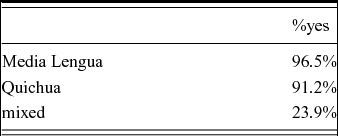
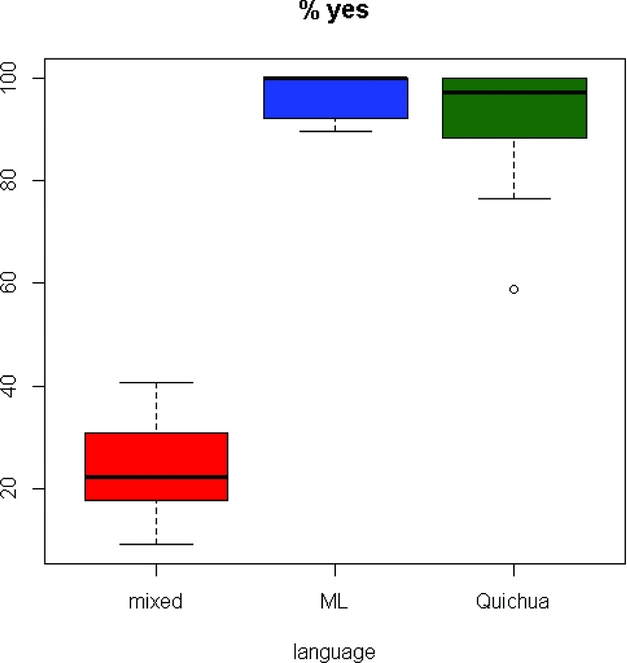
The ability to discriminate languages for participants with adequate d-prime scores (N = 30) is shown in Table 3 and Figure 1. A repeated-measures ANOVA performed on the arcsine-transformed proportion of “acceptable” responses demonstrated that the languages were distinguished at a very significant rate: F(2,87) = 109, p < .0001. A Tukey test showed that Quichua vs. mixed and Media Lengua vs. mixed differed significantly (p < .0001) but there was no significant difference between responses to Quichua and Media Lengua stimuli (p = .29). The results reveal that speakers do in fact distinguish both Quichua and Media Lengua utterances from arbitrarily mixed combinations.
Results of un-timed acceptability judgment task, high d-prime participants (N = 30)

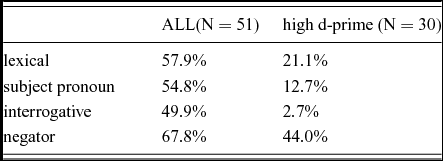
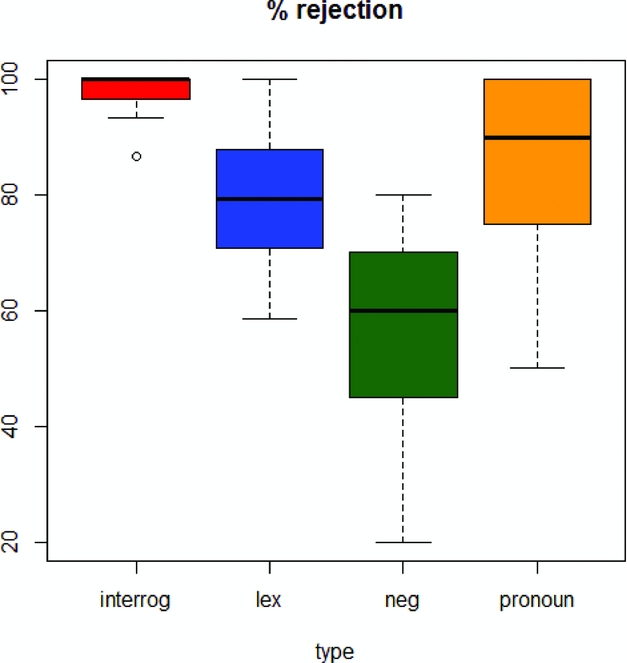
The results of the un-timed acceptability task for type of one-word switches are given in Table 4 and Figure 2. A large main effect was found for the high d-prime group: F(3,116) = 56.02, p < .0001. A Tukey test shows significant differences between lexical content items and interrogatives (p < .0001) and between lexical items and subject pronouns (p < .003), and also – in a negative fashion – between lexical items and negators: (p < .00001). The relatively low rejection rate for switched negators may be due to the minimal perceptual difference between Media Lengua/Spanish no and Quichua (ma)na.
rate of acceptability of one-word switches in the stimuli; un-timed

Rates of acceptance in un-timed acceptability judgment task (high d-prime participants).

Respondents took longer to react to mixed utterances (average 1506 ms) than to stimuli in Media Lengua (1288 ms) or Quichua (1415 ms). There was a by-subject main effect across languages for (log-transformed) reaction times: F(2, 5308) = 6.02, p = .002, with significant differences between Quichua and mixed (p = .002) but not between Quichua and Media Lengua (p = .25) or Media Lengua and mixed utterances (p = .29). The reaction-time data were not fine-grained enough to show significant differences in reaction times among the various grammatical categories,Footnote 13 although for each of the grammatical categories average reaction times were lower for low d-prime participants than for high d-prime respondents. In view of the considerable inter-subject variation in reaction times a linear mixed-effects model was fitted in R with participant as random intercept; the results confirm significant differences among languages (p < .0001).
Despite the fact that the experimental design is nominally off-line (un-timed), the average reaction times for all stimuli were well below the two-second timeout window for the aforementioned speeded task: 1553 ms for all participants and 1732 ms for high d-prime participants. Only one participant's average reaction times exceed the two-second mark (2492 ms). While acknowledging that participants were under no obligation to respond quickly, the resulting reaction times (averaging as low as 811 ms for high d-prime participants) were consistent with a de facto on-line task, and may be cautiously interpreted as at least partially reflective of on-line strategies. The fact that average reaction times in the un-timed task were lower than the two-second timeout window of the speeded task is clearly related to the linguistic ecology of these speech communities, where prior to the initiation of the present project metalinguistic inquiries had never occurred and residents’ choice of languages and grammatical configurations had not been subject to explicit prescriptive dictates. It has been noted that speeded grammaticality tasks can produce higher rates of acceptance than when time for reflection is allowed, e.g., “illusions of grammaticality” (Phillips, Wager & Lau, Reference Phillips, Wagers, Lau and Runner2011). In a research environment in which the principal languages have no extensive written tradition and whose speakers have no school- or community-inspired metalinguistic awareness or experience with interactive experimental tasks, it may be advisable to allow for reflection and to eschew overly rapid or forced-choice techniques at least until participants have developed sufficient familiarity with such procedures. The fact that in the un-timed task participants did not have to commit verbally but rather could ‘anonymously’ press computer keys may also have contributed to a less stressful environment.
How acceptable is “acceptable”?
Both forced-choice and scalar acceptability judgments have been employed in code-switching research, and although direct comparison with the Quichua–Media Lengua data can only be approximated, the fact that the Ecuadorian participants did not categorically reject all nominally disallowed code-switches is not out of line with the results of other studies, even those involving languages with considerable morphosyntactic differences. This includes Aguirre (Reference Aguirre1981, p. 304; Reference Aguirre1985, p. 65) and Koronkiewicz (Reference Koronkiewicz2014, pp. 83–99 for Spanish–English switches after subject pronouns, Ebert (Reference Ebert2014, pp. 192–198) for Spanish–English switches after WH-interrogatives, Giancaspro (Reference Giancaspro, Cabrelli Amaro, Lord, de Prada Pérez and Aaron2013) for Spanish–English auxiliary-VP switches, and similar studies for other bilingual environments, in which as many as half of putative code-switching violations were accepted in judgment tasks. Even code-switching configurations claimed to be disallowed based on non-occurrence in spontaneous speech and rejection by linguistically savvy bilinguals often evoke more tolerant reactions when presented to a broader cross-section of respondents. Lack of formal and prescriptive grammar training also makes for less cohesive responses than those of “naïve grammarians” (as described by Bradac, Martin, Elliott & Tardy, Reference Bradac, Martin, Elliott and Tardy1980). The acceptability judgment data can be further calibrated by determining the extent to which participants can be induced to actually produce putatively unacceptable combinations.
Second experiment: un-timed language classification
In order to further verify the postulated partial links between certain types of Quichua–Media Lengua mixing and acceptability and to directly probe speakers’ partitioning of languages and explicit awareness of mixed Q–ML utterances, a language-classification experiment was conducted several months later.
Method
Participants
A total of fifty speakers from Angla, Casco Valenzuela, and Topo participated (twenty-nine adults and twenty-one older adolescents). Three had participated in the acceptability judgment task. All were compensated for their time. The results of two of the adults had to be discarded due to their confusion and inability to fully comprehend the instructions.
Materials
The stimuli consisted of a total of seventy recorded utterances, a subset of the stimuli used in the previous experiments. Fourteen were in Imbabura Quichua, eighteen in Media Lengua, and the remainder mixed utterances with a single item from the non-base language: switches following subject pronouns (9), interrogative (10), and negative items (8), as well as lexical roots of nouns, adjectives, and verbs (11).
Procedure
As with the acceptability task, a PEBL script was created. Participants listened to the stimuli and were instructed to press the right shift key (covered with a red dot) for utterances all in Quichua, the left shift key (covered with a green dot) for utterances all in Media Lengua, and the space bar (covered with a blue dot) for utterances containing a mixture of Quichua and Media Lengua. The colored dots also appeared on the screen, together with pictorial icons: a woman in traditional indigenous dress for Quichua, a couple (one Caucasian, one indigenous) for Media Lengua, and a composite face picture for mixed (shown in Figure S2). The program compiled responses and reaction times.
Results and discussion
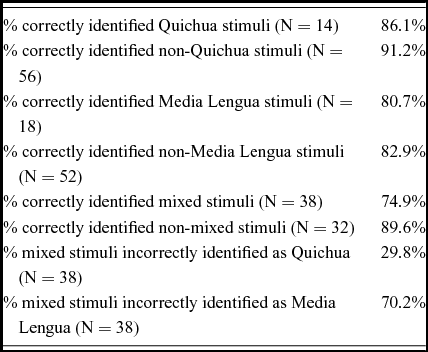
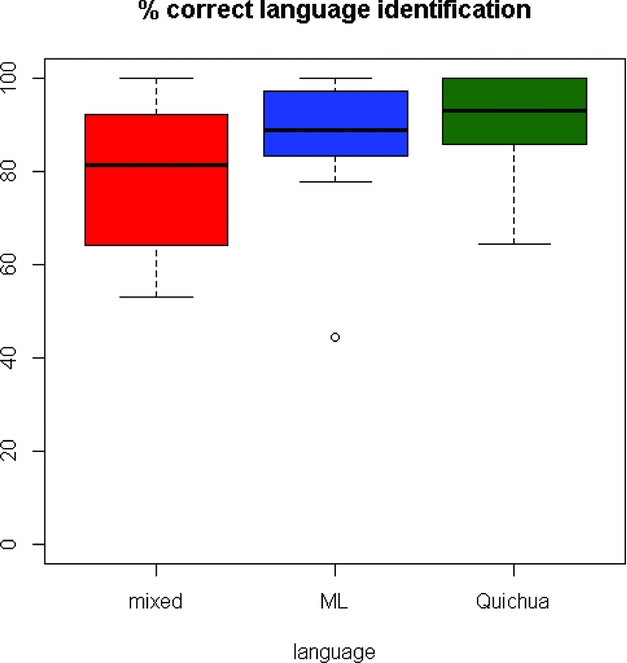
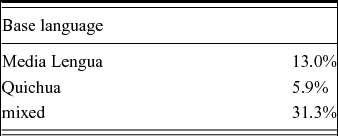
The results of the language-classification experiment are shown in Table 5 and Figure 3.
Rates of correct language identification (N = 48)

Rejection rates, un-timed acceptability judgment (high d-prime participants).

There was a main effect for language: F(2, 93) = 6.72, p < .002, with significant differences between Quichua and mixed (p = .001) but not between Quichua and Media Lengua or Media Lengua and mixed. For correct identification of stimuli not belonging to a particular language the results are: F(2,93) = 9.35, p = .0001, with significant differences between Quichua and Media Lengua (p < .0002) and Media Lengua and mixed (p < .02), but not between Quichua and mixed. This suggests greater accuracy in identifying the canonical community language (Quichua) and the presence of some ambivalence towards Media Lengua.
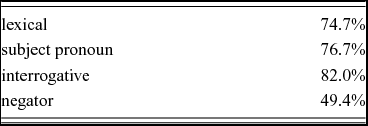
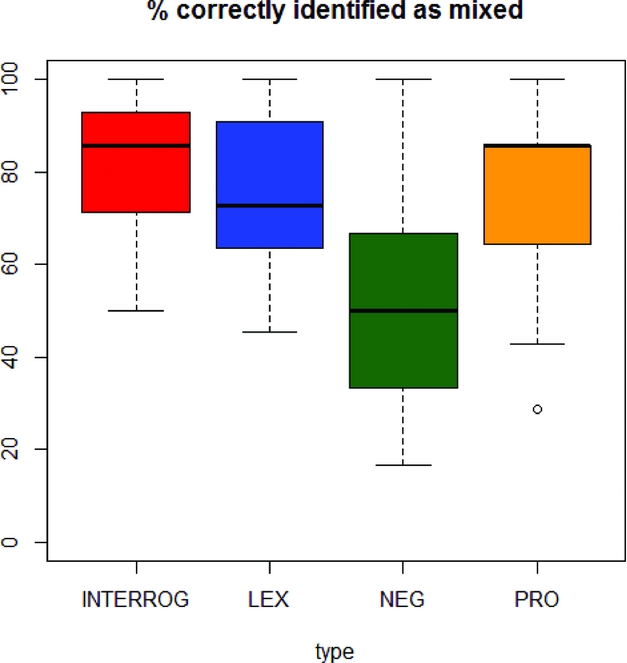
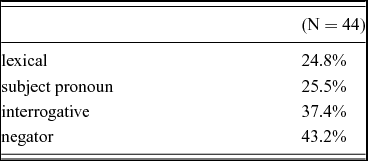
Even with the high rate of correct identification of mixed utterances there were differences across grammatical categories as shown in Table 6 and Figure 4.
Rate of identification as mixed of mixed Quichua-Media Lengua stimuli

Rate of correct language identification; language classification experiment.

There was a main effect for grammatical type: F(3, 428) = 51.88, p < .0001, with significant differences between lexical items and negators (p < .0001) and lexical items and interrogatives (p = .01) but not between lexical items and pronouns.
Reaction times (Quichua average 1302 ms, Media Lengua 1488 ms, mixed 1622 ms) also showed a by-subjects main effect for language: F(2, 4197) = 21.74, p < .0001), with significant differences between Quichua and mixed and Quichua and Media Lengua (p < .0001), but not Media Lengua and mixed. This is also consistent with the higher degree of accuracy in identifying all-Quichua stimuli. The differentiation by language was confirmed by a linear mixed-effects model with participant as random intercept (p < .0001). Within the mixed group there were no significant differences in reaction time based on grammatical category.
A reviewer has raised the question of whether one-word switches as employed in the present study (exemplified in the Appendix) are regarded by Quichua–Media Lengua bilinguals as true switches from one language to other, or simply as exogenous insertions, noting that insertions typically involve content words with specific lexical meaning, not basic (grammatical) items such as interrogatives and pronouns. The inherent conceptual difficulties in distinguishing insertion from alternation in the Quichua–Media Lengua interface have already been described; in support of the hypothesis that rejection of utterances as unacceptable reflects acknowledgment of such stimuli as mixed, a Pearson correlation test was performed on the responses to the thirty-eight mixed utterances common to both the acceptability judgment and the language classification experiments. The correlation between judgment as unacceptable and classification as mixed is .74 (p < .0001), indicating a high degree of correspondence. The correlation for lexical items is .76 (p = .005) and for grammatical items (negators, pronouns, interrogatives) the correlation is .72 (p < .0001). T-tests of overall response rates between the two experiments show no significant difference for lexical items (p = .26) and only a very slight difference for grammatical items (p = .04). These figures suggest that utterances in which a pronoun, interrogative, negator, or lexical root stands out as belonging to a different language than the remaining words are in fact regarded as language switches (mixing) rather than simply as less felicitous nonce borrowings (insertions). Ultimately, however, it may not be possible to unequivocally separate insertion, alternation, and even nonce borrowing among Quichua–Media Lengua bilinguals.
Third experiment: concurrent memory-loaded repetition
A third, on-line experiment was conducted, in which respondents interacted more directly with the stimuli. The experiment used concurrent memory-loaded repetition, which was achieved by retaining digits in memory, (a version of the technique employed e.g., by Dick, Bates, Wulfeck, Ayedelott Utman, Dronkers & Gernsbacher, Reference Dick, Bates, Wulfeck, Ayedelott Utman, Dronkers and Gernsbacher2001; McDonald, Reference McDonald2006; Waters, Caplan & Yampolsky, Reference Waters, Caplan and Yampolsky2003; also Gordon, Hendrick & Levine, Reference Gordon, Hendrick and Levine2002). Elicited repetition has been used experimentally in the study of bilingual speech – including code-switching – by Azuma and Meier (Reference Azuma and Meier1997), Clyne (Reference Clyne1972), Meijer and Fox Tree (Reference Meijer and Fox Tree2003), and Treisman (Reference Treisman1965), among others. The rationale of such tasks is that “when listeners hear a sentence that exceeds the capacity of their short-term memory, they will pass it through their own grammar before repeating it” (Gullberg, Indefrey & Muysken, Reference Gullberg, Indefrey, Muysken, Bullock and Toribio2009, p. 34). In the case of bilingual stimuli, adding memory demands to the repetition potentially increases the cognitive load to the point where more subtle aspects of bilingual competence may be revealed. Previous work, e.g., by Miller and Isard (Reference Miller and Isard1963), Marlsen-Wilson (Reference Marlsen-Wilson1985), and the studies reviewed by Vinther (Reference Vinther2002), has shown that in sentence repetition tasks, respondents’ errors frequently reflect their own grammars, i.e., what they would have said instead of what was actually said. In the case of stimuli containing nominally Quichua and Media Lengua elements, it was hypothesized that respondents would more accurately repeat combinations that they themselves might produce, while stimuli containing configurations felt to be unnatural or unacceptable to respondents would result in ‘correction’ in the direction of the respondents’ preferred structures, as well as omission of elements implicitly regarded as unacceptable. At the same time the uncertainty associated with participants’ interpretations of “acceptability” would be bypassed by the request to simply repeat all stimuli without evaluation or modification.
Method
Participants
A total of forty-four speakers from Angla, Casco Valenzuela, and Topo participated; this included twenty-one adults and twenty-three adolescents (ages 15–19), recruited as in the acceptability judgment task, and representing all available participants at the time. Three also participated in the latter task (conducted nearly a year later). All were compensated for their time.
Materials
The stimuli were drawn from a group of 150 recorded utterances (the set from which the stimuli for the original timed acceptability task were drawn), of which twenty-six were in canonical Imbabura Quichua, thirty-one were in ‘canonical’ Media Lengua of Angla/Casco Valenzuela, and the remaining ninety-three contained various combinations of IQ and ML. Among the mixtures were switches following subject pronouns (22), interrogative (24), and negative items (23), as well as lexical roots of nouns, adjectives, and verbs (24). Each of the nominally mixed utterances contained only a single mixed element. Each stimulus consisted of a recording of four randomly generated numbers (ranging from 1 to 9), a 500 ms gap, the target utterance, another 500 ms gap, and a beep. Two sets of stimuli were prepared, one with numbers pronounced in Media Lengua (nearly identical to the Spanish counterparts), and the other with the numbers in Quichua. Each of these sets was then divided into two groups of 75 stimuli each, identical to those used in the acceptability judgment task. This yielded four stimulus sets, two with numbers in Spanish/Media Lengua and two with numbers in Quichua.
Procedure
Respondents were given the choice of listening to the numbers in either Spanish/Media Lengua or Quichua. Participants were instructed to listen to the numbers and retain them in memory and then listen to the test utterance. Upon hearing the beep they were to repeat the digits held in memory and then repeat the test utterance exactly as heard. The fact that some of the utterances contained putative mixtures of Quichua and Media Lengua was not disclosed. The stimuli were presented on a portable computer; participants listened through headphones and the stimuli and responses were digitally recorded on separate channels. Each participant responded to a single set of seventy-five stimuli; the stimulus sets were alternated between successive participants.
Results and discussion
Overall rates of modification
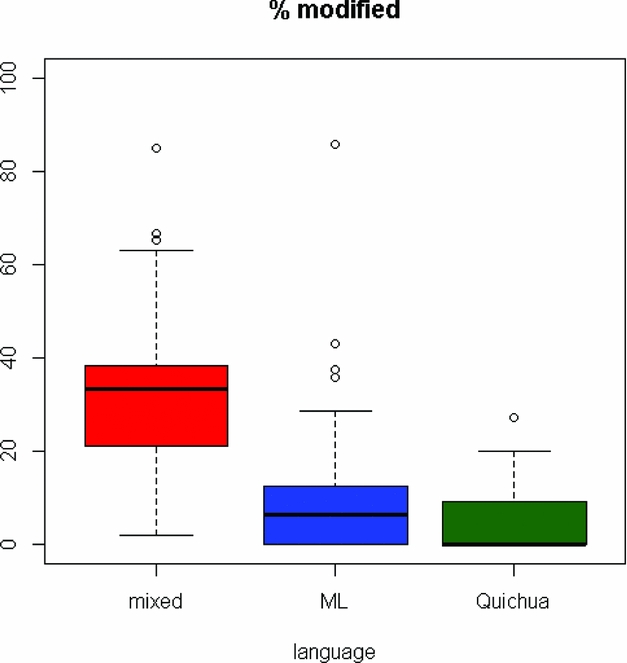
The repetition task was completely new to all participants, but all put forth obviously genuine efforts to repeat the numbers and stimulus utterances as accurately as possible. In the case of all-Quichua and all-Media Lengua stimuli most repetitions did not alter the fundamental structure; deviations from the source stimuli were limited to occasional omissions or paraphrases. A few respondents spontaneously ‘translated’ several nominally acceptable Media Lengua utterances into Quichua, evidently reflecting their own ambivalence towards Media Lengua. Table 7 gives the relative rates of spontaneous modification of the test stimuli, where modification is limited to the spontaneous translation of one or more words in the test utterance into the opposite language. Figure 5 displays the results. A large main effect was revealed for source language: F(2, 126) = 51.36; p < .0001. A Tukey test confirmed significant differences between Quichua and mixed (p < .0001), and between Media Lengua and mixed stimuli (p < .0001), but not between Quichua and Media Lengua stimuli (p = .37).
rate of spontaneous modification (language-switching) during repetition task

Rate of correct identification of mixed Quichua–Media Lengua stimuli.

Modification involving pronouns, negators, interrogatives, lexical content items
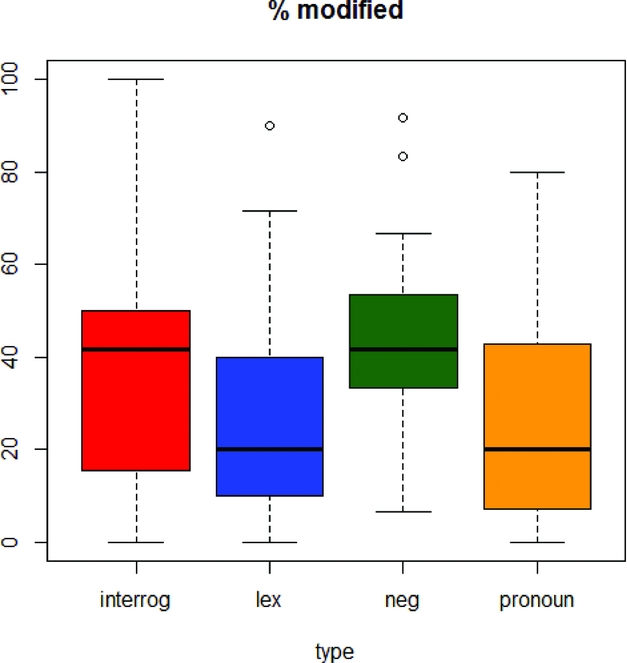
For purposes of studying the possible effects of single-word switches of subject pronouns, interrogatives, negators, and lexical roots of verbs, nouns, and adjectives, only direct substitution of these items by the analogous word in the opposite language was calculated as a modification. Table 8 gives the results for all participants. A main effect for category was revealed (i.e., substitution of either the switched element or surrounding elements in order to achieve a monolingual string with identical meaning and morpheme order): F(3, 168) = 8.64; p < .0001. A Tukey test reveals a significant difference between lexical items and interrogatives (p = .03) and between lexical items and negators (p = .0005), but not between lexical items and subject pronouns (p = .96). Although the average switching rate for subject pronouns was a bit higher than that for lexical content items this difference does not reach significance, due in large measure to the very high standard deviation (22.5%). The results are displayed in Figure 6.
rate of spontaneous one word language-switching during repetition of mixed stimuli

language modification rates, concurrent memory-loaded repetition (all participants).

modification rates, concurrent memory-loaded repetition (all participants).

Correlations among switching types
The results of the third experiment indicate that even in the absence of any morphosyntactic differences Quichua–Media Lengua bilinguals spontaneously repair code-switches after interrogatives – but not subject pronouns – at a significantly higher rate than when lexical categories are switched. Negators are also switched at significantly higher rates, but given the minimal perceptual differences between Quichua (ma)na and Media Lengua nu the possibility that participants simply overlooked switches involving negators cannot be dismissed a priori. The pattern of spontaneous substitutions during repetition shows considerable inter-subject consistency. A Pearson's correlation test for replacement of switched lexical items vs. switched interrogatives yields a coefficient of .84 (p < .0001) and between replacement of switched lexical items and switched negators a correlation of .87 (p < .0001); the correlation for switched interrogatives vs. switched negators is .80 (p < .0001). These figures are consistent with the conclusion that spontaneous switching of negators is not simply the result of failure to discern incongruous negators in the stimuli, as originally suggested for the results of the first experiment. On the other hand there was no significant correlation between spontaneous replacement of switched lexical items and switched pronouns. In other words while individual participants may vary in the absolute replacement rates of switched items, the relative behavior of lexical items, interrogatives, and negators is relatively stable; only pronouns show greater inter-subject variability. Overall the avoidance of switches involving interrogatives and negators is gradient rather than categorical, given both the complete morphosyntactic congruence and the symbiotic relationship between Quichua and Media Lengua, but factors other than syntax presumably account for the differential behavior of negators and interrogatives. In the following sections one such factor – semantic dependencies – will be tentatively put forward as a possible contender.
General discussion
In all of the experiments, participants reacted to aurally presented stimuli rather than spontaneously producing un-primed utterances, and an anonymous reviewer has pointed out that partial avoidance of certain configurations does not necessarily mean that they never occur in natural speech, but only that they may be quite infrequent. In defense of the conclusions presented below, there is a high degree of convergence among the results of the acceptability task, the language classification task, and the repetition task. Moreover during the acceptability and language classification tasks as well as during debriefing following the repetition task, several participants explicitly stated that stimuli containing switches of pronouns, interrogatives, and negators were improper, and asserted that while Media Lengua was as valid as Quichua, speakers should use one language or the other and should not produce mixed configurations.
It has been noted that Quichua–Media Lengua bilinguals have not been observed to engage in constituent-level code-switching or monotonic language shifts. Since Q and ML share identical morphosyntax the putative scarcity of intra-sentential code-switching effectively comes down to the possibility for juxtaposing Spanish-derived and Quichua-derived lexical roots within a common morphosyntactic matrix. The results of the experiments suggest that the Quichua–Media Lengua dichotomy is somewhat permeable in the case of nouns, verbs, and adjectives, whence the relatively higher rates of acceptance of putatively mixed stimuli involving these categories. On the other hand pronouns and interrogatives in one of the languages provoke a higher rate of rejection/correction when juxtaposed with lexical items from the other language.
The un-timed acceptability task and the repetition task confirm a preference against switching between Quichua and Media Lengua after interrogatives and – in repetition at least – after negators, and the language-classification task reveals that switches involving these items are more likely to be classified as mixed than switches of lexical content words such as nouns, verbs, and adjectives. Switches after subject pronouns show greater intra-speaker variability, in some instances patterning with interrogatives and negators and in others behaving in a fashion indistinguishable from lexical content items. Given that Quichua and Media Lengua share identical morphosyntax including all agglutinative morphemes (post-positions, verbal and nominal inflections), it can be concluded that some non-syntactic factors are also operative in constraining possible mixing of these two languages. The experiments reported here aid in triangulating non-syntactic contributions to Media Lengua–Quichua code-switching preferences but do not directly address the root causes that target the aforementioned elements. Consequently the following discussion is simply offered as the first step in the process of elimination to isolate the individual contributions to code-switching constraints.
Syntactic constraints alone cannot fully account for any ‘special’ status enjoyed by interrogatives, negators, and sometimes pronouns in the Quichua–Media Lengua environment – in which virtually all morphosyntactic variables have been stripped away. There are at least two obvious contenders for factors contributing to the putative lexical vs. grammatical category asymmetries. The first involves limitations on the cognitive resources available during language processing. The second possibility involves logical-semantic and/or discourse-pragmatic features inherent in pronouns, negation and interrogation, which in turn may entail consequences for production. In view of the increasing evidence that processing and production are inextricably linked (e.g., Pickering & Garrod, Reference Pickering and Garrod2014), the implications of the Quichua–Media Lengua dyad for both avenues of approach will be briefly discussed.
The possible role of sentence processing limitations
Some syntactic phenomena that appear to stem from fundamental grammatical constraints can be plausibly attributed to the more general availability of language processing resources, and establishing a firm basis for choosing one interpretation over the other is fraught with difficulties (Phillips, Reference Phillips2013). Before evaluating the Quichua–Media Lengua data against this putative dichotomy, the processing resources associated with negation and interrogation will be briefly reviewed. A processing cost is frequently associated with unanticipated language switches (e.g., Abutalebi, Brambati, Annoni, Moro, Cappa & Perani. Reference Abutalebi, Brambati, Annoni, Moro, Cappa and Perani2007; Li, Reference Li1996; Macnamara & Kushnir, Reference Macnamara and Kushnir1971; Moreno, Federmeier & Kutas, Reference Moreno, Federmeier and Kutas2002; inter alia). If additional processing costs accrue to negation and interrogation, the combined effects could potentially impinge on the desirability of code-switches following negative and interrogative elements. Participants in the repetition task exhibited a strong tendency to produce negative and interrogative items in the same language as the remainder of the utterance, despite the fact that these items behave identically in both languages, differing only in the lexically-specified phonetic form (and in the case of negation only minimal differences between Spanish-derived ML nu and Quichua [ma])na).
Negation
There is cross-linguistic evidence that negative utterances take longer to process than the corresponding affirmative combinations as well as evoking different processing strategies and electrophysiological manifestations (e.g., Clark & Chase, Reference Clark and Chase1972; Dale & Duran, Reference Dale and Duran2011; Fischler Bloom, Childers, Roucos & Perry, Reference Fischler, Bloom, Childers, Roucos and Perry1983; Glenberg & Kaschak, Reference Glenberg, Kaschak and Ross2003; Gough, Reference Gough1965; Miller, Reference Miller1962; Nieuwland & Kuperberg, Reference Nieuwland and Kuperberg2008; Wason, Reference Wason1961, Reference Wason1965; Wason & Jones, Reference Wason and Jones1963; Wason & Johnson-Laird, Reference Wason and Johnson-Laird1972). Although the apparent cost associated with negation is manifested in processing rather than production, implicit code-switching restrictions presumably emerge from the dynamic interplay of production and processing in a speech community. The minimal perceptual distance between Media Lengua nu . . . chu and Quichua (ma)na . . . chu resulted in a relatively low rejection rate for language switches after negators, and therefore precluded pursuing a processing-based analysis.
Interrogation
Interrogative utterances with fronted WH-elements embody filler-gap dependencies, linking the WH-word and the gap (trace) represented by the extraction site. Since the syntactic distance between the fronted interrogative word and its associated gap can be arbitrarily long, the filler (WH) element must be held in working memory until the point at which the filler-gap relationship can be processed. There is a body of research that points toward a processing cost for filler-gap dependencies, modulated by both syntactic and semantic factors (e.g., Clifton & Frazier, Reference Clifton, Frazier, Carlson and Tanenhaus1989; De Vicenzi, Reference De Vicenzi1996; Felser, Clahsen & Münte, Reference Felser, Clahsen and Münte2003; Fiebach, Schlesewsky & Friederici, Reference Fiebach, Schlesewsky and Friederici2002; Frazier & Flores d'Arcais, Reference Frazier and Flores d'Arcais1989; Hawkins, Reference Hawkins1999; King & Just, Reference King and Just1991; Kluender & Kutas, Reference Kluender and Kutas1993; Nicol & Swinney, Reference Nicol and Swinney1989; Stowe, Reference Stowe1986; Stowe, Tanenhaus & Carlson, Reference Stowe, Tanenhaus and Carlson1991, among many others). The increased cognitive demand associated with filler-gap dependencies is consistent with the observed disfavoring of language switches between the filler WH-element and the language in which the gap is embedded. Future research is needed to determine whether the specific syntactic and semantic configurations linking WH-words and their associated gaps are correlated with reactions to language switching following the fronted interrogative element.
Shortcomings of a processing-based account
The experimental results from Quichua–Media Lengua bilinguals confirm the degraded status of code-switches immediately following negative and interrogative items, even in the absence of demonstrable grammatical differences between the two languages. At first glance the cross-linguistic existence of processing costs associated with negation and filler-gap WH-dependencies seems to offer a prima facie case for attributing at least part of the code-switching restrictions exhibited by Quichua–Media Lengua bilinguals to general availability of cognitive resources rather than to specific grammatical configurations. Further reflection, however, calls into question a simple reductionist account. The mixed Quichua–Media Lengua utterances containing language switches following negative and interrogative items posed no obvious processing difficulty, as witnessed by the ease with which these same utterances were parsed to produce responses (average 1388 ms and 1474 ms, respectively) in the acceptability task and repeated (with and without spontaneous ‘correction’) in the repetition task. Participants evidently experienced no difficulty in constructing on-line representations from the mixed utterances, even those that have not been observed to occur in naturalistic speech. Although in these tasks participants responded to deliberately manipulated utterances rather than producing them spontaneously, the apparent ease with which these stimuli were handled can be construed as a form of overgeneration, e.g., when on-line processes construct representations that are judged as unacceptable in off-line tasks (Phillips, Reference Phillips2013, p. 170). Since the ability to generate such representations, e.g., in the processing tasks represented in the present study, is clearly well within normal human cognitive abilities, Phillips suggests that this discrepancy points to the existence of a formal grammatical constraint rather than an inherent cognitive limitation.
Quichua and Media Lengua have identical syntactic structures, identical agglutinative morphology, and identical phonotactics (with only occasional slight differences, e.g., Gómez Rendón, Reference Gómez Rendón2008, pp. 60–68; Stewart, Reference Stewart2013), and the un-timed judgment and concurrent memory-loaded repetition tasks reveal significantly different patterns for negative and interrogative elements as opposed to lexical categories. The preference against code-switches in these environments may therefore underlie an incremental production cost, tangible and measurable but clearly not impossible to overcome. If this differential behavior is reflective of formal grammatical constraints, then presumably the loci of these constraints lie outside the realm of morphosyntax and phonology.
The possible role of code-switching production costs
When bilingual speakers are faced with controlled involuntary switching tasks, a measurable production cost has frequently been detected (e.g., Meuter & Allport, Reference Meuter and Allport1999; Goldrick, Runnqvist & Costa, Reference Goldrick, Runnqvist and Costa2014), whereas when given the option of switching languages voluntarily, switching costs diminish (Gollan & Ferreira, Reference Gollan and Ferreira2009; Gollan, Kleinman & Wierenga, Reference Gollan, Kleinman and Wierenga2014). Even in the latter case language switching is part of an experimental paradigm; the true cost (if any) associated with spontaneous code-switching in naturalistic conversation cannot be quantified experimentally, especially given widely varying parameters of relative proficiency and momentary lexical availability (e.g., Heredia & Altarriba, Reference Heredia and Altarriba2001) as well as asymmetries in grammatical complexity (e.g., Myers-Scotton & Jake, Reference Myers-Scotton and Jake2013). In the repetition experiment participants were in effect induced to code-switch if the mixed stimuli were to be accurately reproduced, and the spontaneous ‘corrections’ resulting in monolingual strings can be taken as an indirect measure of production costs. Since Quichua–Media Lengua switching appears not to tax the cognitive resources involved in language processing, and since language-specific syntactic constraints have been ruled out, any formal grammatical constraints that impinge on unfettered code-switching must derive from the semantics and pragmatics of negation and interrogation, and must manifest themselves during production. The production of sentential negation requires specification of the scope of negation (e.g., Carpenter & Just, Reference Carpenter and Just1975; for Imbabura Quichua: Cole, Reference Cole1982, pp. 84–85), which in turn presupposes knowledge of the grammatical structure defining that scope. There is also evidence that negative utterances mentally co-exist with the corresponding affirmative utterances (e.g., Khemlani, Orenes & Johnson-Laird, Reference Khemlani, Orenes and Johnson-Laird2012, p. 553; also Orenes, Beltrán & Santamaría, Reference Orenes, Beltrán and Santamaría2014). Interrogatives with fronted WH-elements require structural knowledge of the ensuing utterance sufficient to locate the gap from which the WH element has been extracted. Conceptually, the formulation of a negative or interrogative utterance involves not only pre-planning at least enough of the utterance to encompass the respective syntactic domain but also in effect a back-tracking feedback loop encompassing the endpoints of that domain.Footnote 14
Moving beyond syntax: logical-semantic considerations
Much work on bilingual language production has focused on utterance preplanning, language selection, inhibitory control, and lexical retrieval, including the possibility that more than one locus of selection may exist (Kroll, Bobb & Wodniecka, Reference Kroll, Bobb and Wodniecka2006). The semantic dimension has been closely tied to individual lexical items, but the implications for code-switching of logical operators such as interrogation, negation, existentials, and quantification have yet to be fully explored.
Pronouns are not always ‘special’
There was a consistent tendency for average pronoun values to be higher than for lexical content items in concurrent memory-loaded repetition, but the broad dispersion of responses (high standard deviations) resulted in non-significant differences in the aggregate between subject pronouns and lexical content items. On the other hand in the un-timed acceptability task, shifts after pronouns were rejected at a significantly higher rate than shifts after lexical content items. Forces both favoring and disfavoring a ‘special’ status for subject pronouns can be adduced. The fact that both Quichua and Media Lengua are null subject languages with identical behavior of pronouns appears to be a contributing factor in those cases where subject pronouns patterned with full nouns and other lexical content items, since in null subject languages it has been argued that overt subject pronouns do not occupy the syntactic position of subjects (e.g., VP-internal) but rather are topicalized (e.g., Grinstead, Reference Grinstead2004; Ordóñez, Reference Ordóñez1997; Ordóñez & Treviño, Reference Ordóñez and Treviño1999; also Luján, Reference Luján1985, Reference Luján1986; Montalbetti, Reference Montalbetti1984, Reference Montalbetti, Jaeggli and Silva-Corvalán1986). In Spanish–English code-switching, subject pronoun switching is usually unacceptable, due to the status of English as a non-null subject language, but switching can occur with coordinated pronouns, hanging topics, clefting, modification, and prosodic stress (Koronkiewicz, Reference Koronkiewicz2012, pp. 1–2; Reference Koronkiewicz2014), all cases in which overt pronouns are obligatory in Spanish. Gumperz (Reference Gumperz1977, p. 26) has suggested that reported constraints against switching between pronouns and verbs may have to do with the fact that many pronouns are short, although when they can be contrasted or stressed switching may occur. In all of these instances a case can be made for a left periphery location, i.e., a configuration that has not been observed to disfavor code-switching. Cardinaletti and Starke (Reference Cardinaletti, Starke and van Riemsdijk1999) contrast strong, weak, and clitic pronouns. Strong pronouns have the semantics of a full noun phrase, can be coordinated and modified, cannot be phonologically reduced, receive word stress, and can be prosodically stressed. Weak pronouns are not referential and cannot be modified or prosodically stressed. In both Quichua and Media Lengua subject pronouns are strong and are frequently accompanied by the topicalizer –ka, confirming their status as elements on the left periphery behaving like fully lexical noun phrases (e.g., Muysken, Reference Muysken and Kiss1995, p. 385; Sánchez, Reference Sánchez2010, p. 45). As such they frequently pattern with other nouns in the interactive tasks. In the classification proposed by Jake (Reference Jake1994), overt pronouns in null-subject languages like Quichua and Media Lengua are discourse-thematic (content) morphemes, and combinations of an embedded language (EL) pronoun in a matrix language (ML) constituent should in principle be licit. The classification would account for the fact that some Quichua–Media Lengua shifts involving pronouns behaved no differently from lexical content words, but the observation that under some circumstances pronoun shifts pattern more closely with interrogatives and negators awaits further elucidation.
At the same time pronouns are anaphoric in nature, requiring an (explicit or implicit) antecedent for full semantic interpretation. Since switching languages arguably impacts semantic retrieval (for example, in the case of language-tagged lexemes as proposed e.g., by Poulisse & Bongaerts, Reference Poulisse and Bongaerts1994, p. 42), a case can be made that keeping pronouns in the same language as the presumed antecedents is the optimal strategy for ensuring efficient processing (e.g., Jaeger & Tily, Reference Jaeger and Tily2011, p. 325). This viewpoint is consistent with the asymmetry exhibited by many Quichua–Media Lengua bilinguals, who rejected language switches following subject pronouns in the acceptability task but exhibited little difficulty in reproducing such switches in the repetition task.
Summary: the possible role of semantically-linked elements
Unlike lexical content items, interrogatives, negators, and pronouns are inextricably linked semantically to other elements in the discourse. For interrogatives the link is the filler-gap relationship while negators are linked to the element(s) covered by the scope of negation. In both instances the semantically linked elements must be present in the same utterance. Moreover interrogatives and negators affect the truth value of utterances and “form the backbone of propositions” (Matras, Reference Matras2000, p. 83). Pronouns are semantically linked to antecedents, which do not necessarily have to occur in the same utterance and may even be inferred purely pragmatically, e.g., through shared knowledge between interlocutors (first- and second-person pronouns) or non-verbal gestures (e.g., pointing).
That this proposal is on the right track is suggested by the differential behavior of third-person pronouns vs. first- and second-person pronouns in the experimental tasks. In the repetition task language shifts occurred after third-person pronouns at a significantly higher rate than after first- and second-person pronouns (Welch-t (80.21) = 4.30, p < .0001). In the un-timed acceptability task for the high d-prime respondents, switches after third-person pronouns were rejected at a higher rate than switches after first- and second-person pronouns (Welch-t (31.08) = 3.06, p < .005). Moreover by considering only spontaneous replacement of third-person pronouns in the repetition task, the rate of replacement rises to 47.6%, the main effect for grammatical type remains (F(3, 168) = 5,24, p = .002), and a Tukey test reveals significant differences between lexical roots and pronouns (p = .004) as well as between lexical roots and negatives (p = .005) and between lexical roots and interrogatives (p = .04).
The difference in the immediacy of the semantically linked elements may underlie the greater variability in the behavior of pronouns as opposed to interrogatives and negators in the Quichua–Media Lengua mixed utterances. There may also be a contribution from syntactic frames with intrinsic semantic content (e.g., Kako, Reference Kako2006), and from entrenched combinations, e.g., formulas or “big words” (Dąbrowska, Reference Dąbrowska2000, Reference Dąbrowska2004), acquired piecemeal and perhaps more resistant to language switching. In the Quichua/Media Lengua data it is not clear that entire classes of pronouns, negators, and interrogatives are represented in such formulas or schemata to a greater extent than verbs, nouns, or adjectives, but the limited data do provide some hints of a contribution from entrenched combinations. For example, the lexically mixed utterances in (4) were rejected at very high rates (100% and 93%, respectively), possibly because telling children to “come [in] and go to bed” is a frequently occurring speech act in both Quichua and Media Lengua.Footnote 15
(4)

More generally, switching languages between semantically linked elements potentially interferes with “robust information transfer” (Jaeger, Reference Jaeger2013),Footnote 16 and this may ultimately be the true production cost as reflected in the avoidance of such switches between the morphosyntactically identical Quichua and Media Lengua.
Conclusions
Since Quichua–Media Lengua bilinguals employ identical syntactic structures in both languages, the data reported in this study do not constitute a rejection of the many well-argued models of code-switching that postulate syntactically-grounded constraints, and which are often based on typologically diverse language dyads. As to whether any available syntactic model is responsible for the differential behavior of Quichua/Media Lengua pronouns, interrogatives, and negators as opposed to lexical roots, the present study remains agnostic,Footnote 17 although it is clear that code-switching restrictions based only on linear congruence cannot be relevant. What the data do indicate is that even when morphosyntactic considerations are removed from the discussion, not all switch-types may have been created equal. In the present study code-switches after interrogatives and negators do not appear to significantly impede processing but do exhibit clinal avoidance during elicited production. Switches after subject pronouns evoke relatively few repetition difficulties but are frequently flagged as unacceptable in judgment tasks. Furthermore, third-person pronouns, which require explicitly identified antecedents, pattern with interrogatives and negatives while first- and second-person pronouns, whose antecedents are immediately obvious, pattern with lexical items. By process of elimination factors converging on communicative efficiency (e.g., Jaeger & Tily, Reference Jaeger and Tily2011), in this case semantic configurations with possible pragmatic implications, emerge as the most likely source of the residual code-switching constraints.
Matras (Reference Matras2000, p. 95) observes that “Approaches in cognitive linguistics that rely on an interpretation of structures and their usage by speakers, rather than on experimental data, face a general problem of scientific replicability and so of persuasiveness [. . . .]” The procedures reported in this study represent the first steps of an experiment-based venture for which no antecedent research provided guideposts. The techniques described herein were developed after considerable trial and error, and further refinements will be incorporated as the research continues. As such, the data and analyses must be regarded as both preliminary and tentative, and are offered in the spirit of adventure, drawing upon a hitherto unexplored bilingual configuration.
The interpretation of the initial results has combined documented research findings and a bit of speculation. Matras (Reference Matras2000, p. 96) also notes that as “with many attempts to explain, rather than just describe, occurrences in language, we risk speculating about the causes of processes. However, such speculations once formulated can indeed be put to the test.” The first tests have been reported here, and the ensuing speculation embodies the testable hypothesis that altering the nature of semantic dependencies (and/or truth conditions) will affect both judgment and production of language mixing among Quichua–Media Lengua bilinguals, and may also affect code-switching preferences among typologically more diverse language dyads.
Some imperfections in the present research design are inherent in the languages themselves: Imbabura Quichua continues to freely borrow from Spanish and there is considerable inter-speaker variation as to the use of Spanish loan-words, while the separation of grammatical and lexical items in Media Lengua occasionally demonstrates some leakage of Quichua lexical roots (e.g., Gómez Rendón, Reference Gómez Rendón2008, pp. 158–167). Also at stake is a linguistic ecology in which experimental techniques such as the ones described here must be adapted to a reality vastly different from university laboratories and highly literate school-trained populations. The potential for new insights compensates for the less than pristine experimental environment, and perhaps most satisfyingly, research of this sort demonstrates that data from small and marginalized speech communities can contribute to the search for answers to far-reaching questions in linguistics (in the spirit of Jaeger & Norcliffe, Reference Jaeger and Norcliffe2009).
Supplementary Material
For supplementary material accompanying this paper, visit http://dx.doi.org/10.1017/S1366728916000468
Appendix: sample of mixed Quichua–Media Lengua stimuli
(1)
(2)
(3)
(4)
(5)
(6)
(7)
(8)