Introduction
The genus Alpheus Fabricius, 1798, commonly known as pistol shrimp or snapping shrimp, is one of the most hyper-diverse and ecologically significant groups within the family Alpheidae Rafinesque, 1815. With over 300 species described globally (Hurt et al., Reference Hurt, Hultgren, Anker, Lemmon, Lemmon and Bracken-Grissom2021), Alpheus represents one of the richest genera under the infraorder Caridea. These small crustaceans are renowned for their unique snapping claws that generate cavitation bubbles for hunting and communication (Schmitz and Herberholz, Reference Schmitz and Herberholz1998). They inhabit a wide range of habitats, including coral reefs, rocky shores, mangrove forests, and estuarine environments, predominantly in shallow tropical waters (Chace, Reference Chace1988). The ecological roles of snapping shrimps are multifaceted, as they often engage in mutualistic, co-evolved relationships with gobiid fish genera such as Ctenogobiops, Stonogobiops, and Amblyeleotris (Karplus and Thompson, Reference Karplus and Thompson2011). Snapping shrimps, mostly considered as trash or bycatch in India, sometimes gain economic importance globally or regionally through marine ornamental aquarium trade and as food (Anker, Reference Anker2023; Harikrishnan and Kurup, Reference Harikrishnan and Kurup2008). Species like A. bellulus (Miya and Miyake, Reference Miya and Miyake1969) and A. djeddensis (Coutière, Reference Coutière1897) are highly priced in the marine ornamental trade, but their culture techniques and seed production are still not addressed (Calado et al., Reference Calado, Lin, Rhyne, Araújo and Narciso2003; Harikrishnan and Kurup, Reference Harikrishnan and Kurup2008). Despite their ecological and economic importance, the diversity and distribution of Alpheus remain poorly explored in the Indian region (Thangaraj et al., Reference Thangaraj, Kartick, Kumar, Annadurai and Ramesh2022).
During routine fishery samplings from stake nets in Cochin estuary, located in southwest coast of India, in 2007, a previously undocumented species of Alpheus was discovered, marking its first species of Alpheus from the region. The present report encompasses morphological and molecular descriptions of the new alpheid species, with detailed comparisons to closely related congeners, in addition to information on its habitat preferences and distribution. This research contributes to the broader understanding of the estuarine ecosystem and underscores the need for sustained biodiversity documentation in the region.
Materials and methods
The type series for the new species is deposited in Zoological Survey of India (ZSI) Museum, Kozhikode, Kerala, India, and School of Industrial Fisheries (SIF, CUSAT). Morphometric measurements were taken from 20 individuals using a dial calliper to the nearest 0.1 mm and the weight was recorded in an electronic balance to nearest 0.001 g. The carapace length, (cl in millimetres) was measured from tip of rostrum to posterior margin of carapace.
Genotyping
DNA extraction and quantification
Total genomic DNA was extracted from the pleopods of specimens following spin column protocol for purification of total genomic DNA using M-GeneFlow™ DNA extraction Kit from tissues. Quantification of extracted DNA was performed using a spectrophotometer (Nanodrop 2000).
PCR amplification and sequencing
The partial sequences of mitochondrial COI and 16S rRNA genes were amplified using the primer pairs COIF 5’ CCTGCAGGAGGAGGAGACCC 3’/COIF(R) 5’ CGTCGTGGTATGCCDTTTARWCCTA 3’ (Jose and Harikrishnan, Reference Jose and Harikrishnan2017) and 16S–L2 5’ TGCCTGTTTATCAAAAACAT 3’/1472 5’ AGATAGAAACCAACCTGG 3’ (Bracken-Grissom et al., Reference Bracken-Grissom, Robles and Felder2014), respectively. The DNA extracts were amplified using EmeraldAmp® Polymerase Chain Reaction master mix (Takara, Japan). 50 µL PCR reaction mix samples were prepared and amplified using a Corbett gradient thermal cycler. The temperature profile for amplification consisted of an initial step of 3 min at 95°C; followed by 38 cycles of 60 s at 95°C, a gradient programme of 45–55°C for 60 s as annealing temperature and 90 s at 72°C; followed by a final extension of 30 min at 72°C (Programmed for this study). 1.2% Agarose gel was used to visualize the PCR products. Amplicons exhibiting intense bands on gel after documentation were outsourced for purification and sequencing.
Data analysis
Sequences were manually edited and compiled using BioEdit 7.0.9 (Hall, 1999) and aligned with Clustal X (Thompson et al., Reference Thompson, Higgins and Gibson1994). The 16S nucleotide sequences submitted were published in NCBI with accession numbers PX572927-930. The COI sequences were also published in NCBI with accession numbers JX413121-124, PV708082 and PV703819. For performing molecular analyses, COI sequences were not considered owing to the scarcity of homologous sequences in public databases (Jose and Harikrishnan, Reference Jose and Harikrishnan2017). 16S rRNA sequences generated for this study were considered for molecular analyses and additional 16S sequences were incorporated (Table 1) for generating a phylogenetic tree (Maximum likelihood) and genetic distance data using MEGA version 12 (Kumar et al., Reference Kumar, Stecher, Suleski, Sanderford, Sharma and Tamura2024).
Details of sequences used for molecular analysis (Sl No – Serial number)

Taxonomy
Systematics
Family: Alpheidae Rafinesque, 1815
Genus: Alpheus Fabricius, 1798
Species: Alpheus madhusoodanai sp. nov.
Type material. Holotype: 1♂ (cl- 19.5 mm), India, Kerala, Cochin Estuary (9°59’09”N 76°14’43”E: S1), Stake-net bycatch, coll. Harikrishnan Mahadevan, 01 May 2007, ZSI/ WGFRS/ I.R.-INV. 28801.
Paratypes: 1♂ (cl- 14 mm), India, Kerala, Cochin Estuary (9°59’09”N 76°14’43”E), Stake-net bycatch, coll. Harikrishnan Mahadevan, 01 May 2007, ZSI/ WGFRS/ I.R.-INV. 28802. 2 ♂ (cl- 9.5 mm), India, Kerala, Cochin Estuary, (10°01’38”N 76°14’44”E: S2), Stake-net bycatch, collected by K. P. Vishnu, 01 February 2025, SIF/ HK/CR/25/101.
Non-type materials. 1♂ (cl- 13.1 mm) India, Kerala, Cochin Estuary (10°01’38”N 76°14’44”E), Stake-net bycatch, coll. Kaimakulangara Vishnu, 29 January 2025, SIF/ HK/CR/25/102. 1 ov. ♀, (cl- 7.9 mm) India, Kerala, Cochin estuary (10°01’38”N 76°14’44”E), Stake-net bycatch, coll. Kaimakulangara Vishnu, 29 January 2025, SIF/ HK/CR/25/103. 1♂ (cl- 11.7 mm) India, Kerala, Cochin estuary (10°01’37”N 76°14’42”E), Stake-net bycatch, coll. Kaimakulangara Vishnu, 29 January 2025, SIF/ HK/CR/25/116. 1♂ (cl- 10.9 mm) India, Kerala, Cochin estuary (9°59’01”N 76°14’38”E), Stake-net bycatch, coll. Kaimakulangara Vishnu, 28 May 2025, SIF/ HK/CR/25/122. The propodus and dactylus of the fourth pereopod are absent (see Figure 1).
Alpheus madhusoodanai sp. nov. Colour pattern, male, non-type, recently deceased (Cl- 10.9 mm, SIF/HK/CR/25/122), Cochin estuary, Kochi, Kerala, India.

Comparative material. Alpheus rapacida (De Man, Reference De Man1908): 1 ♂ (cl- 11.2 mm) India, Kerala, Cochin estuary (9°59’06”N 76°14’37”E), Stake-net bycatch, coll. Kaimakulangara Vishnu, 2 March 2025, SIF/ HK/CR/25/104. 1 ♀ (cl- 19.3 mm) India, Kerala, Cochin estuary, (9°59’06”N 76°14’37”E), Stake-net bycatch, Kaimakulangara Vishnu, 27 April 2025, SIF/ HK/CR/25/123.
Description: Small to medium-sized species of Alpheus (cl- 19.5 mm) belonging to the brevirostris group, with chela greatly compressed and quadrangular in cross section. Body laterally compressed. Carapace smooth (Figure 2A). Pterygostomial angle rounded. Cardiac notch not very distinct. Rostrum triangular, not reaching distal margin of first article of antennular peduncle. Post-rostral carina sharply defined as a strong straight ridge, extending posteriorly to origin of orbital hoods. Eyes completely covered by well-developed orbital hoods, clearly separated from rostral crest by rostral groove. Supra orbital teeth absent, anterior margin rounded.
Illustrations of Alpheus madhusoodanai sp. nov. (Male, CL 11.6 mm, SIF/HK/CR/25/116) from Cochin estuary, Kerala, India. A, Lateral view of carapace; B, Dorsal view of frontal region of carapace and antennular segments; C, Ventromesial spine of first antennular segment; D, Mandible; E, First maxilla; F, Second maxilla; G, First maxilliped; H, Second maxilliped; I, Third maxilliped (Scale A & B, 5 mm; C, D, E, F, G, & H, 1 mm; I, 2 mm).

Antennule (Figure 2B): Proximal segment of antennular peduncle robust, with acute and very prominent, anteriorly directed, ventromesial tooth (Figure 2C). Stylocerite oval, with acute distal spine not reaching anterior margin of proximal segment. Medial segment elongated, subcylindrical, 2.4 times of proximal segment. Distal segment as long as wide, 0.6 of length of visible part of proximal segment; upper flagellum biramous; accessory ramus fused with main ramus by 22 segments; accessory ramus long, filiform on free part with group of aesthetascs.
Antenna (Figure 2A-B): Antennal peduncle stout, basicerite with strong distolateral spine, carpocerite robust, reaching up to distal end of distal segment of antennular peduncle. Carpocerite not exceeding scaphocerite lamella. Scaphocerite slender, blade narrow, lateral margin concave. Distolateral tooth of scaphocerite strong, slightly exceeding lamella reaching beyond antennular peduncle. Proximal margin of lamella broad.
Mandible (Figure 2D): with two-segmented palp at the junction of incisor and molar processes. Distal segment of palp bearing long setae at margin; proximal segment long bearing few setae at the distal medial edge. The incisor process with ten teeth, middle ones stouter and larger. Molar process well developed, obliquely truncated anteriorly.
First maxilla (Figure 2E): with bilobed palp; outer lobe broad, ovate and without long setae; inner lobe short with one long stout setulose seta. Upper lacinia broad with 32 distal short serrate spines. Lower lacinia slender with outer margin covered with serrulate, setae more distally.
Second maxilla (Figure 2F): Basal endite well developed, distally bilobed with outer margin serrated with medium to long setae. Upper lobe with long setae in upper distal margin, lower lobe with medium to small setae, coxal endite moderately developed; smaller than basal endite and with a few long setae. A short papilla, non-setose and deeply truncated distally. Scaphognathite well developed with outer margin fringed with small setae, basal part of medial margin produced.
First maxilliped (Figure 2G): Slender; endopod with a few long non-setulose setae on the medial margin and the distal end bearing only one plumose seta. Basal endite broad; fringed with marginal setae and spines, submarginal setae restricted on to the cleft of basal endite. Coxal endite not bilobed, exopod well developed, flagellum slender, distal end with long plumose setae, caridean lobe well developed.
Second maxilliped (Figure 2H): basis and ischium short; merus shorter than ischio-basis; propodus expanded antero-medially; dactylus narrow, margin densely setose with stouter spines. Epipod oval. Exopod slender, long plumose setae at the base and the distal end.
Third maxilliped (Figure 2I): Endopod slender; antepenultimate segment slender, spatulate, curved inwards, with slender non-setulose setae on inner margin. Penultimate segment stout, inner distal margin provided with long non-setulose setae which extending up to the ultimate segment. Ultimate segment 1.8 times of penultimate segment; fully covered with long plumose setae. Exopod well developed, reaching up to distal end of antepenultimate segment of endopod. Basal segment bears five long non-plumose setae reaching up to tip of antepenultimate segment. Epipodite strap-like
First chelipeds: First pair of chelipeds unequal, asymmetrical and carried extended.
Major chela (Figures 3A–D): Ischium short and stout. Merus 3.2 times as long as broad, elongated sub-quadrangular in cross section, surface not granulate, dorsal margin unarmed, except for single medial seta and the distodorsal cluster of setae; ventromesial margin with six movable spines and one large acute tooth at distal end; ventrolateral margin serrated; extensor margin unarmed. Carpus short, cup shaped. Chela elongated, 3 times as long as wide, strongly compressed, quadrangular in cross section, palm with minor sculpturing, except for shallow transverse notch on distodorsal margin and longitudinal ridge on dorsal margin and a median ridge starting distally from base of fixed finger, proximally nearly up to carpal articulation. Area distal to the ridge depressed. Movable finger more than half of palm, occupying distal 0.35. Dactylus paddle-like. Plunger reduced, defined only by proximal angle. Pollex crossing over dactylus when closed. Palm and base of fixed finger granulate. Dorsal and ventral margins of chela fringed with long, mesially directed, setae. Inner margin of propodus bearing a row of setae. Proximal third of dactyl finely granulated. Distal and inner margins of dactyl setose.
Illustrations of Alpheus madhusoodanai sp. nov. (Male, CL 11.6 mm, SIF/HK/CR/25/116) from Cochin estuary, Kerala, India. A, Dorsal view of major chela; B, Ventral view of major chela; C, Dactylus of major chela (Dorsal view); D, Merus of major chela; E, Dorsal view of minor chela; F, Ventral view of minor chela; G, Merus of minor chela (Scale A, B, D, E, & F, 5 mm; C & G, 2 mm).

Minor chela (Figures 3E–G): Ischium short and stout. Merus almost triangular. Almost 4.5 times long as wide; ventrolateral edge serrated but without spines. Ventromesial margin with six movable spines with long non setulose setae and one large acute tooth at distal end; distodorsal margin with two or three long non setulose setae. Extensor margin of merus with a single seta medially. Carpus short, roughly cup shaped and stout. Palm swollen, 2 times longer than wide, shorter than fingers. Palm granulated dorsally and ventrally. Fingers not balaeniceps in both sexes; long, robust, poorly excavated with long hairs directed forward on mesial side. Fingers at most 1.6 times the length of palm. Dactylus with an oblique-flat teeth on the proximal margin.
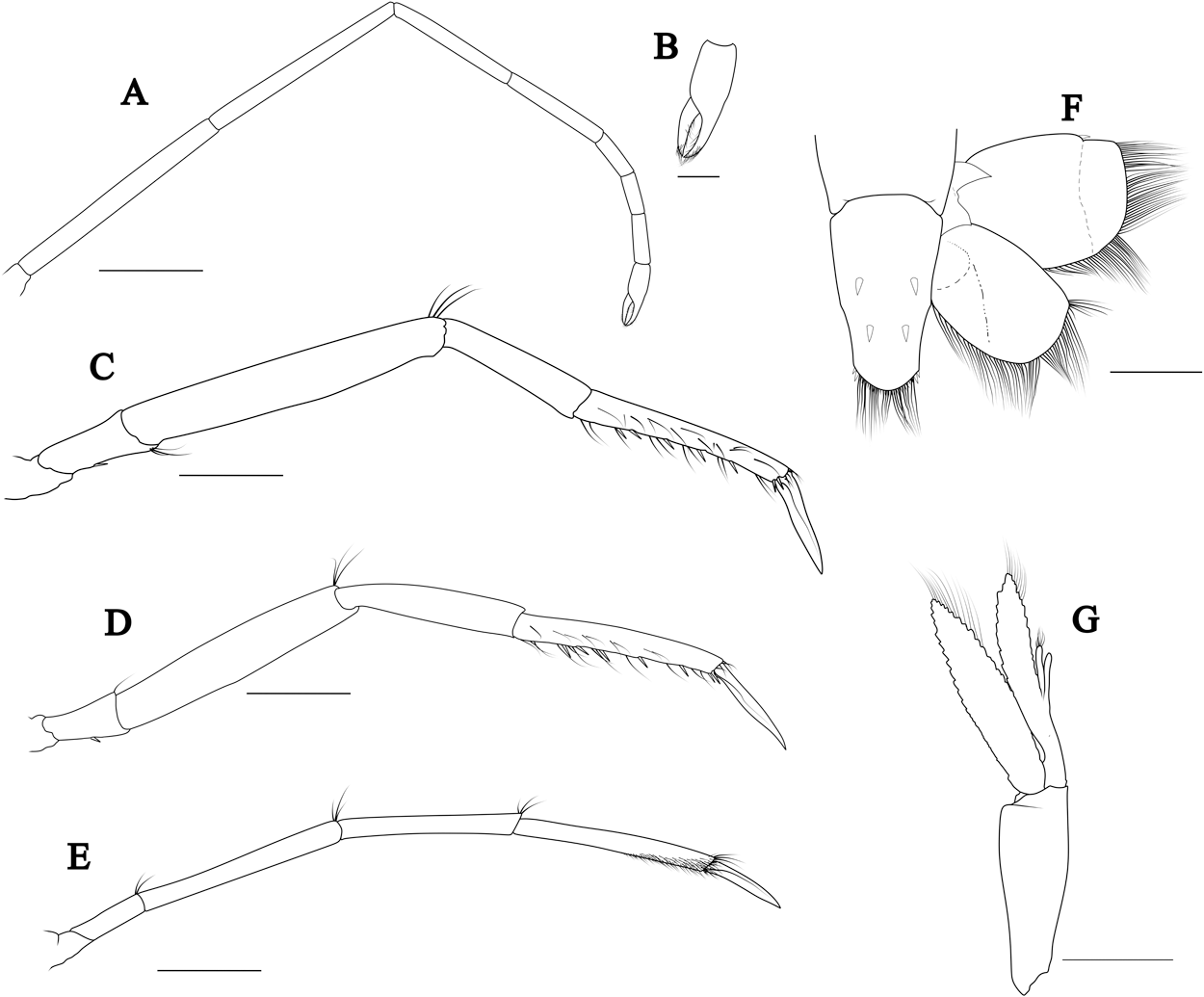
Second cheliped (Figures 4A–B): slender, ischium as long as merus; ischium and merus without setae or spines. Carpus five segmented, first segment longer than second segment, ratio of carpal articles from proximal to distal 10:9:3:3:4. Chela (Figure 4B) fingers subequal to palm length, with fine short forwardly directed non-setulose setae at the cutting edges; group of short setae at the distal margin of fingers at outer side.
Illustrations of Alpheus madhusoodanai sp. nov. (Male, CL 11.5 mm, SIF/HK/CR/25/116) from Cochin estuary, Kerala, India. A, Second pereopod; B, Chela of second pereopod; C, Third pereopod; D, Fourth pereopod; E, Fifth pereopod; F, Telson & Uropod; G, Second pleopod of males (endopod and exopod partially denuded) (Scale A, C, D, E, & F, 2 mm; B, 0.5 mm; G, 1 mm).

Third pereopod (Figure 4C): Stouter than fourth and fifth pereopods, ischium short, with stout cuspidate seta on lateroventral margin. Ischium with few setae distally on ventral margin. Ischium ¼ times the length of merus. A row of long setae at the distal end of merus on the extensor margin. Propodus with five forwardly directed, equally distanced spiniform setae along with long setae and two spiniform setae distally. Dactylus subspatulate.
Fourth pereopod (Figure 4D): Ischium armed. Merus stouter, without spines. Setae distally on extensor margin. Carpus shorter than propodus; propodus with five slender spiniform setae, row of long setae in the inner mesial side and a pair of spiniform setae distally. Dactylus long and subspatulate.
Fifth pereopod (Figure 4E): Ischium, merus, and carpus devoid of spines. Few setae distally on extensor margin of each segment. Propodus with transverse row of setae on setae on the lateral side of distal half. Dactylus subspatulate.
Pleopods (Figure 4G): Second pleopod of males with appendix masculina longer than appendix interna.
Telson and uropod (Figure 4F): Uropod with bifid protopods. Exopod and endopod unequal, exopod larger. Exopod ending with an acute movable spine. Endopod unarmed. Telson broad, tapering towards posterior margin. shorter than exopod. Telson bearing 2 pair of movable spines. First pair at 0.3 and second pair at 0.6, the length of telson. Two pair of distolateral spines, inner being shorter.
Colour pattern (Figure 1): Adult specimens having olive green chelipeds ending in peach-coloured fingertips. The propodus finger strikingly blue. The body is green with one to two dark bluish-green to brown lateral stripes traversing across pleura on both sides. Fresh specimens display distinct blue and orange coloration on distal part of each pereopod articles. Mature specimens with sharply defined single black spot along dorsal medial line on posterior margin of first and fourth abdominal somites. Uropods and telson with translucent olive coloration with posterior margins being translucent blue.
Etymology: The new species is named after Dr. B. Madhusoodhana Kurup, for his significant contributions to fish biodiversity, fisheries taxonomy and ecology, and sustainable management of fisheries resources in the state of Kerala, south India.
Type locality (Figure 5): Cochin estuary, southwest coast of India.
Map of study area.

Distribution. Currently known only from the type locality.
Ecology. The stake-nets, which collected the specimens, were operated at a depth of 3 meters and were located near mangrove patches. The species was collected from estuarine region having a salinity level of 19.9 ± 4.0 PSU. During the pre-monsoon period, the abundance of this species was high at Site B, S2 (Figure 5) which is located at 8 km away from the estuarine opening. However, during monsoon season, when the salinity of the lake drops due to heavy rainfall and fresh water influx from the adjoining rivers, these shrimps migrate from station S2 to Site A (S1) which is nearer to estuarine mouth. During early post monsoon, its distribution is limited to S1 as in monsoon, and the population is re-established at station S2 during late post monsoon. In situ observations revealed that the shrimp was found to be a burrowing type, bulldozing substratum with the first pair of chelipeds and picking up larger particles with strong minor chela.
Molecular characterization of Alpheus madhusoodanai sp. nov. using 16S gene
A phylogenetic tree based on maximum likelihood (ML) analyses for the selected Alpheus species is depicted in Figure 6. The analysis involved 1000 pseudo replications and utilized Kimura 2-parameter as the chosen substitution model. Synalpheus fritzmuelleri and Synalpheus ubatuba represented the preferred outgroups (Accession numbers: EU868642 and OR046568, respectively). As expected, the phylogenetic tree was monophyletic with all the congeners of genus Alpheus assembling within a major clade (Figure 6). The new species A. madhusoodanai sp. nov., shared a common ancestor with A aff. rapacida (Madagascar and Singapore) and A. brevirostris Olivier, 1811 (Singapore). The former species evolved from a common ancestor with A aff. rapacida (French Polynesia).
Maximum likelihood tree for Alpheus madhusoodanai sp. nov. and related species.

Haplotypes of the newly described species arrayed within a single major clade with high bootstrap support revealing possibilities for lack of genetic variations. In addition, all the incorporated congeners of genus Alpheus belonging to the brevirostris group exhibited assemblage according to their intra/interspecific divergence. Finding from the phylogenetic tree was confirmed using genetic distance data (Figure 7). The genetic distance of the newly described species was estimated to be zero, confirming lack of haplotypic variations among the 16S rRNA gene sequence. The intra- and interspecific divergence of other congeners are detailed in Figure 7 and supplementary file.
Mean percentage genetic distance of related species and Alpheus madhusoodanai sp. nov.

Remarks
A total of 26 species of snapping shrimps has so far been reported from India (Bhuti et al., Reference Bhuti, Shakuntala and Sankolli1975; De Grave et al., Reference De Grave, Krishnan, Kumar and Christodoulou2020; Jha et al., Reference Jha, Raveendran, Ragesh, Babu and Edwin2019; Kajal, Reference Kajal2024; Kemp, Reference Kemp1915; Madhavan et al., Reference Madhavan, Purushothaman, Dhas and Ajith Kumar2023; Pillai, Reference Pillai1991; Purohit et al., Reference Purohit, Saini, Soni, Trivedi and Vachhrajani2014; Purushothaman et al., Reference Purushothaman, Abhilash, Kumar and Lal2021, Reference Purushothaman, Bharathi, Damodhar, Kumar and Lal2023; Radhakrishnan et al., Reference Radhakrishnan, Deshmukh, Maheswarudu, Josileen, Dineshbabu, Philipose, Sarada, Pillal, Saleela, Chakraborty, Dash, Sajeev, Thirumilu, Sridhara, Muniyappa and Sawant2012; Ramachandran et al., Reference Ramachandran, Varghese, Unnikrishnan, Gulati, Ayoob and Ramalingam2019; Samuel et al., Reference Samuel, Sreeraj, Krishnan, Parthiban, Sekar, Chamundeeswari and Ramesh2016; Thomas, Reference Thomas1976; Vaitheeswaran, Reference Vaitheeswaran2017), of which, 9 belonged to brevirostris group (Kajal, Reference Kajal2024). The newly identified species can be classified within A. brevirostris species group (Banner and Banner, Reference Banner and Banner1982; Chace, Reference Chace1988) owing to its compressed and unsculptured major chela having sub-quadrangular cross-section. According to Komai & Ohtomi (Reference Komai and Ohtomi2018), about 50 species within brevirostris group were described, and several additional species, including A. samudra (De Grave, Krishnan, Kumar & Christodoulou, Reference De Grave, Krishnan, Kumar and Christodoulou2020), A. mannarensis Purushothaman, Abhilash, Ajith Kumar & Lal, 2021, and A. alaincrosnieri (Anker, Reference Anker2020), were identified after 2018.
The absence of balaeniceps dactylus in the minor chela of male A. madhusoodanai sp. nov. differentiates it from other brevirostris group species such as A. macroskeles Alcock and Anderson, 1894, A. acutocarinatus De Man, 1909, A. bellulus (Miya and Miyake, Reference Miya and Miyake1969), and A. miersi Coutiere, 1898, which possess the balaenicep condition in males. The paddle-shaped major chela and longer first carpal article in the second cheliped of the presently described species make distinct morphological differences with A. leptocheles (Banner and Banner, Reference Banner and Banner1975), along with its close relative A. samudra. Alpheus rapax, reported also from Indian waters, can be easily distinguished from A. madhusoodanai sp. nov. by its shorter merus of the first cheliped. In A. rapax, merus in first cheliped is less than 2.5 times than wide (Thomas, Reference Thomas1976), in contrast to more than 3 times as long as wide in A. madhusoodanai sp. nov. Further, A. rapax has a wider major chela 2.8 to 2.5 times as long as wide (Banner and Banner, Reference Banner and Banner1982; Thomas, Reference Thomas1976), while large chela of A. madhusoodanai sp. nov. is over 3 times as long as wide. The U-shaped transverse groove of A. rapax is much wider (Banner and Banner, Reference Banner and Banner1966; Banner and Banner, Reference Banner and Banner1982) compared to narrow ‘U’ shaped groove in A. madhusoodanai sp. nov. The longitudinal ridge through the medial face of palm in A. madhusoodanai sp. nov. has not been reported in A. rapax. A. digitalis De Haan, 1844 in De Haan, Reference De Haan1833–1850 (previously A. distenguendus) was previously reported from India, from the Gulf of Kutch and the Gulf of Mannar (Purohit et al., Reference Purohit, Saini, Soni, Trivedi and Vachhrajani2014; Vaitheeswaran, Reference Vaitheeswaran2017). The presence of an acute tooth on distodorsal margin of merus of first pair of chelipeds and absence of transverse groove on superior margin of major chela (Banner and Smalley, Reference Banner and Smalley1969; Banner and Banner, Reference Banner and Banner1982; Hayashi and Nagata, Reference Hayashi and Nagata2002; Sha et al., Reference Sha, Wang and Cui2019) are two major features separating A. digitalis from A. madhusoodanai sp. nov., which lacks the acute tooth and possesses a narrow transverse groove on the superior margin of major chela. The post rostral carina extends into carapace beyond the base of orbital hoods in A. digitalis (Banner and Smalley, Reference Banner and Smalley1969) while it extends posteriorly only up to the origin of the orbital hood in A. madhusoodanai sp. nov. A. digitalis also differs from A. madhusoodanai sp. nov. by its major chela merus being 2.7 times as long as broad (vs. major chela merus 3 times as long as broad in A. madhusoodanai sp. nov.). Alpheus rapacida (De Man, Reference De Man1908), a species having close similarity in morphology to the newly described species, has been previously reported from Cochin estuary by (Pillai (Reference Pillai1991)). A. rapacida, with its rostral carina extending up to mid length of the carapace differs from our specimen having carina reaching posteriorly only up to the origin of orbital hood. A. rapacida differs from the described species in presence of sub-acute tooth distally on extensor margin of merus of major chela (Banner and Banner, Reference Banner and Banner1981), which A. madhusoodanai sp. nov. lacks. A. madhusoodanai sp. nov. is characterized by ‘U’ shaped transverse notch on superior margin of major chela which is absent in A. rapacida. In A. rapacida, the ischium of the first pair of chelipeds are armed with 2 to 3 movable spines (vs. unarmed ischium in chelipeds of A. madhusoodanai sp. nov.). The specimens of A. rapacida collected from Cochin estuary did not agree with the description of carpal articles of second pair of pereopods by (Banner and Banner, Reference Banner and Banner1981), but agrees with the original description (De Man. Reference De Man1908). The carpal ratio in A. madhusoodanai sp. nov. is 10:9:3:3:4 whereas in A. rapacida, it is 10:11:3:3:5. A. rapacida also differs from our specimens in live colouration and is also characterized by a dark spot on either side of fourth abdominal somite.
Within the brevirostris group, the morphological traits of A. madhusoodanai sp. nov. are closely related to Alpheus dispar (Randall, Reference Randall1840), A. brevicristatus, and A. brevirostris, which, however, have so far not been reported from Indian waters. The presently described species can be easily separated from A. brevicristatus, with its distally unarmed ventromesial margin of merus of first chelipeds and lack of sexually dimorphic balaenicep dactylus as in males of A. brevicristatus (Sha et al., Reference Sha, Wang and Cui2019). A. dispar, is a species originally described from Philippines (Randall, Reference Randall1840), has sub-balaenicep dactylus on minor chela of males and fingers of minor chela are more than 2.5 times the length of palm (Chace, Reference Chace1988) in contrast to A. madhusoodanai lacking sexual dimorphism in male minor chela and shorter fingers to palm ratio in minor chela (only 1.5 times the length of palm). A. dispar, having post-rostral carina extending posteriorly up to the mid length of carapace (Chace, Reference Chace1988), differs from the newly described species having post-rostal carina extending only upto origin of orbital hood. Further, the rostrum in A. dispar reaches the anterior margin of first segment of antennular peduncle (Chace, Reference Chace1988) and can be easily distinguished from A. madhusoodanai sp. nov., in which the rostrum does not reach the anterior margin of the proximal segment of the antennular peduncle. A. dispar has rostrum reaching the anterior margin of first segment of the antennular peduncle (Chace, Reference Chace1988) and can be easily distinguished from A. madhusoodanai with a rostrum not reaching up to the end of proximal segment. Anker and De Grave (Reference Anker and De Grave2016) provided coloured images of A. dispar (see Figures 6 and 7 in Anker and De Grave, Reference Anker and De Grave2016). The specimens of (Anker and De Grave, Reference Anker and De Grave2016) shows a white heart shaped pattern near posterior margin of fourth abdominal segment dorsally (consistent in multiple specimens) which is absent in A. madhusoodani sp. nov. The newly described species has bright blue fixed finger of minor chela and blue margin of telson and uropod, which is not present in the photographs of A. dispar in Anker and De Grave (Reference Anker and De Grave2016). Bruce (Reference Bruce1994) provided a greyscale image of chelae of first legs of holotype (see Figure 6D in Bruce, Reference Bruce1994). It is evident that A. dispar has fingers of minor chela more than two times the length of palm, differentiated from the newly described species having fingers of minor chela 1.6 times as long as palm. The curvature at tip of minor chela fingers of A. dispar (Bruce, Reference Bruce1994) is a feature absent in A. madhusoodanai sp. nov. The plunger of major chela in A. dispar is moderately pronounced (Bruce, Reference Bruce1994) differentiating the species from the newly described species having plunger defined only by the proximal margin. A. brevirostris differs from the newly described species by the presence of an acute distal tooth on the superior margin of merus of large chela, which is absent in A. madhusoodanai sp. nov. A. brevirostris also has carpocerite reaching only up to half the length second antennular article (Banner & Smalley, Reference Banner and Smalley1969), whereas in A. madhusoodanai sp. nov. it reaches the level of anterior margin of the third antennular article. Findings based on morphological characters were reflected in the phylogenetic tree and genetic distance data based on the 16S rRNA gene.
Genetic congruency and monophyly of A. madhusoodanai sp. nov were established based on phylogenetic tree and genetic distance data, confirming its existence as an endemic member of brevirostris group of genus Alpheus.
Supplementary material
The supplementary material for this article can be found at https://doi.org/10.1017/S0025315426101052.
Acknowledgements
The author wishes to express his sincere thanks to Dr. Mini Sekharan, Director of the School of Industrial Fisheries, CUSAT, Kochi, for providing facilities and support for his research. DJ expresses his gratitude to Prof. Sunil Kumar Singh, Director of CSIR-NIO, Goa.
Author contributions
In situ collection of samples and associated data: K. P. Vishnu, Nidhin Balachandran, and Abhai Krishna Unnikrishnan. DNA Barcoding: Deepak Jose. Diagrams and photographs: K. P. Vishnu. Writing: K. P. Vishnu, Deepak Jose, and Harikrishnan Mahadevan.
Funding
This research received no specific grant from any funding agency, commercial or not-for-profit sectors.
Competing interests
The authors declare none.
Data availability
All the data generated for the study are made available in this article and supplementary materials.