

Introduction
Casting a bronze inscription was undoubtedly the most ambitious and complex way of fixing a text to a material medium during the Western Zhou period (1045–771 b.c.e.).Footnote 1 Following the Late Shang (ca. 1250–1045 b.c.e.) tradition, casters in the Zhou period further advanced their inscription-casting technique to a level of refinement that proved to be extremely challenging for both forgers’ imitations and modern scholarly reconstructions. Recent years have seen increasing attention to the techniques employed to transmit a text to a clay mold prior to casting, with some significant contributions to our understanding of the issue.Footnote 2 The preparation of an inscribed clay mold for casting, however, represented only the final step in the scrupulous process of inscription-making, which was preceded in many cases by several instances of writing on perishable media. However, as the earliest manuscripts unearthed so far postdate the Western Zhou period by half a millennium, such instances of writing remain buried by time. Unlike research on inscription-making, which can to a certain extent rely on direct evidence of debris of ceramic molds recovered from the ancient bronze foundry sites, an inquiry into “writing before inscribing” can draw only on the indirect testimony of inscriptions themselves. As a consequence, scholars have focused on those aspects of their creation that are readily extractable from their contents: the process of their composition or compilation and, more specifically, the process of selection of what an inscription is going to say.Footnote 3 But were the composers concerned also with how the inscription was going to say it? And if so, which “formal” aspects of their inscriptions mattered? Apart from the drafts, did the casters rely on some other, auxiliary technical manuscripts during the inscription-making? And what were the material qualities of the writing supports employed in this process? To the best of my knowledge, no attempt has been made to explore these questions.
Such questions are by no means trivial. Viewing inscriptions as witnesses (perhaps not always entirely faithful ones) of their long-perished drafts or master copies brings the perspective of textual scholarship into the field of epigraphy. If we include the issue of textual transmission in our research on the creation of bronze inscriptions, not only we can gain a better understanding of occasional mistakes or textual discrepancies in bronze texts, but, more importantly, we are compelled to appreciate all other possible facets of the relationship between an inscription and its exemplar (that is, its draft, master copy, or any other kind of Vorlage), including the question of form. During such inquiries, we necessarily touch upon aesthetics, and more specifically, the symmetry in epigraphic display. There has been some discussion as to whether symmetry was desired in the decoration of early Chinese bronzes.Footnote 4 When we regard inscriptions as witnesses of their exemplars, the question of symmetry turns out to be more complex: the fact that an inscription was cast with an asymmetrical layout does not necessarily mean that it was not planned to be symmetrical. At this point, the consideration of material qualities of writing supports used in inscription-making might shed some additional light on the way the process of transmission from a perishable to a durable medium influenced the content and form of the final cast inscription, and it might also indicate how much readability mattered to the casters. Finally, an examination of the use of exemplars in bronze workshops can offer some insights into the level of craftsman's literacy, workflow of inscription-making, and related division of labor during the Western Zhou. On a more general level, such considerations also can inform discussion of the function of bronze inscriptions and textual display in Early China.
To shed more light on the use and nature of perishable media in the production process of bronze inscriptions, and in turn to address the issues outlined above, I will explore the available evidence from the Western Zhou period (1045–771 b.c.e.). To be sure, the evidence for such an inquiry, always an indirect one, can only be extracted by close scrutiny of epigraphic data. In the first step, I will survey the evidence of the visual qualities of inscriptions to explore what information was specified in an inscription's master copy. Next, I will examine the evidence of textual anomalies in inscriptions to reconstruct the use of manuscripts in the process of transmission of the text from a perishable to a durable medium. Such an undertaking takes its toll in a more descriptive style of the essay. I believe, however, that the generous reader will find the conclusions based on such a detailed treatment to be rewarding.
Inscription Drafts, Layout, and the Properties of the Master Copy
Scholars generally agree that prior to casting, a draft of the intended inscription was prepared in written form, presumably on a perishable writing support, such as wooden or bamboo tablets or strips. Such an assumption seems reasonable, as the sole reliance on oral transmission of the draft would require its memorization by several individuals, which would clearly be inefficient, particularly with longer texts. Moreover, the use of written exemplars is implied by the occasional occurrence of fission (fen shu 分書), a scribal error where two or more components of a single graph are written divided as separate graphs.Footnote 5
There is no consensus as to who was responsible for drafting the inscriptions, and it is likely that different modes of composition and production of inscriptions coexisted. The traditional view, which goes back to the Li ji 禮記,Footnote 6 holds that the inscriptions were composed by the donors of the vessels themselves. Uniformity in the wording and structure of the investiture inscriptions, however, led certain scholars to challenge this view, and to assume a degree of central guidance in the composition of these inscriptions.Footnote 7 While there can be no doubt that certain types of inscriptions were based on fixed-format administrative documents, the question is whether a sort of general underlying structure pervading the inscriptions should be envisioned as a top-down royal monopoly on inscription drafting or rather as a bottom-up effort to adhere to a conventional epigraphic style of the high elite that also might have served as marker of social status.
Recent research seems to suggest bottom-up dynamics in the process of inscription composition, with the lineage as a basic unit. Li Feng has shown that both aristocrats in the regional states and members of non-Zhou peripheral societies cast their own inscribed bronzes, and most recently Li has suggested that major aristocratic lineages in the royal domain could produce inscribed bronzes as well.Footnote 8 Similarly, my own analysis of epigraphic behavior reflected in contemporary sets of bronze inscriptions reveals that, from the available evidence, the highest degree of uniformity in inscriptions’ structure and content can be seen in inscriptions produced within the same lineage, and in certain cases, certain textual patterns are reiterated in the inscriptions of several generations of lineage members.Footnote 9 It is quite likely that aristocrats of higher status had their own scribal resources; such specialists might have been, among other scribal tasks, responsible for drafting inscriptions.Footnote 10
The complexity of the drafting procedure varied. While composition of a short inscription of several characters did not constitute a significant scribal challenge, for the longer ones, especially the so-called “investiture inscriptions” (usually 50 or more characters), the compiler would need to draw on various official documents, extract the relevant content from them or rework them for the needs of the inscription, be familiar with the common inscriptional formulas, and occasionally, make use of rhymes.Footnote 11 The final draft of the inscription was then submitted to the bronze workshop for casting. It is not clear whether the text of the inscription was fully completed before arriving at the workshop, or whether the initial draft could have been completed, elaborated, or adjusted by the workshop specialists. This was the case in, for example, ancient Roman stonecutter shops (officinae), in which the stonecutters would polish the original drafts of inscriptions provided by customers, often adding standard (and versed) formulae based on manuals created and shared by the stonecutter community.Footnote 12 Comparable manuals or repertoire catalogues were possibly used by Han dynasty stone relief carvers.Footnote 13 Although fragmentary evidence suggests that the drafts of bronze inscriptions were largely accomplished before reaching the workshop,Footnote 14 it may still be useful to make a terminological distinction between the draft text sent to the workshop and the final outcome of the compositional and editorial processes—the ultimate exemplar of text that was to be cast in bronze. I will refer to the former as “draft” and to the latter as “master copy.” Of course, it is possible that the drafts were fully accomplished and served directly as master copies for the inscriptions.Footnote 15 The main focus of the following discussion will be the master copy, and all subsequent instances of writing involved in the process of production of a bronze inscription in the Western Zhou period.
Any discussion on the nature of the master copy must bear in mind the basic epigraphic features of bronze inscriptions. While spatial limitations played some role in the setting of the column length (best exemplified by the gui 簋 lid inscriptions; see Figure 3 below), a pervasive trend in alignment observable on vessels with larger inscriptional surfaces (e.g., pan 盤, ding 鼎, gui, or xu 盨) was to keep the length of all columns largely equal, by allotting each column the same or similar number of spaces on the virtual inscriptional checkerboard, and at the same time to keep the inscription's vertical dimension longer than the horizontal one—that is, to keep the number of columns smaller or equal to the number of character-spaces in each column.Footnote 16 This habit is observable also in very short inscriptions (fewer than ten characters), and possibly mimics the common appearance of texts written on perishable media.
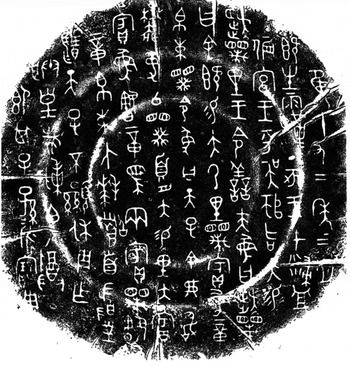
In addition, the column length appears to have been constrained by other than these symmetry- and proportion-driven factors. A quick comparison reveals that of the 50 longest Western Zhou gui inscriptions,Footnote 17 23 (46%) have exactly ten character-spacesFootnote 18 in each column, or the predominant (at least three-quarters) number of character-spaces per column is ten. The remaining inscriptions typically have an uneven length of columns (between eight and fourteen characters). A similar situation is observed in the case of the ding inscriptions (eleven out of the twenty longest, 55%). The longest column ever to appear consistently (more than three quarters of the columns) on gui vessels contains fourteen character-spaces (the lid of Shi Li gui 師𠭰簋, Jicheng 04324.2);Footnote 19 on ding vessels, the longest column is eighteen character-spaces (Hu ding 㫚鼎 inscription, Jicheng 02838). There is also a significant number of shorter inscriptions with five character-spaces per column. It is probably not a coincidence that some of the most exquisite instances of Western Zhou epigraphy, such as the Larger Yu ding 大盂鼎 (Jicheng 02837) or the Shi Qiang pan 史墻盤 (Jicheng 10175), both have 15 character-spaces per column. These observations suggest that five character-spaces was a basic length unit for laying out the inscriptions, and that ten character-spaces was the preferable and perhaps default length of a column in longer inscriptions (c. 80 characters and more) to which the inscription-makers tried to adhere when possible.
In general, inscriptions of any length could be cast in bronze, regardless of the exact number of characters, following either strictly or loosely the requirements of symmetry and proportions. At the same time, however, there are scores of inscriptions in the present corpus, typically those with fine calligraphy, that strive to adhere to certain aesthetic qualities by maintaining an equal number of character-spaces in each column.Footnote 20 As a result, many inscriptions achieve an ultimately symmetrical layout with all the characters in alignment both vertically and horizontally, i.e., the so-called stoichedon style.Footnote 21
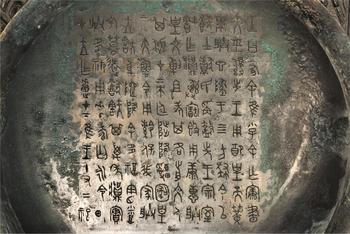
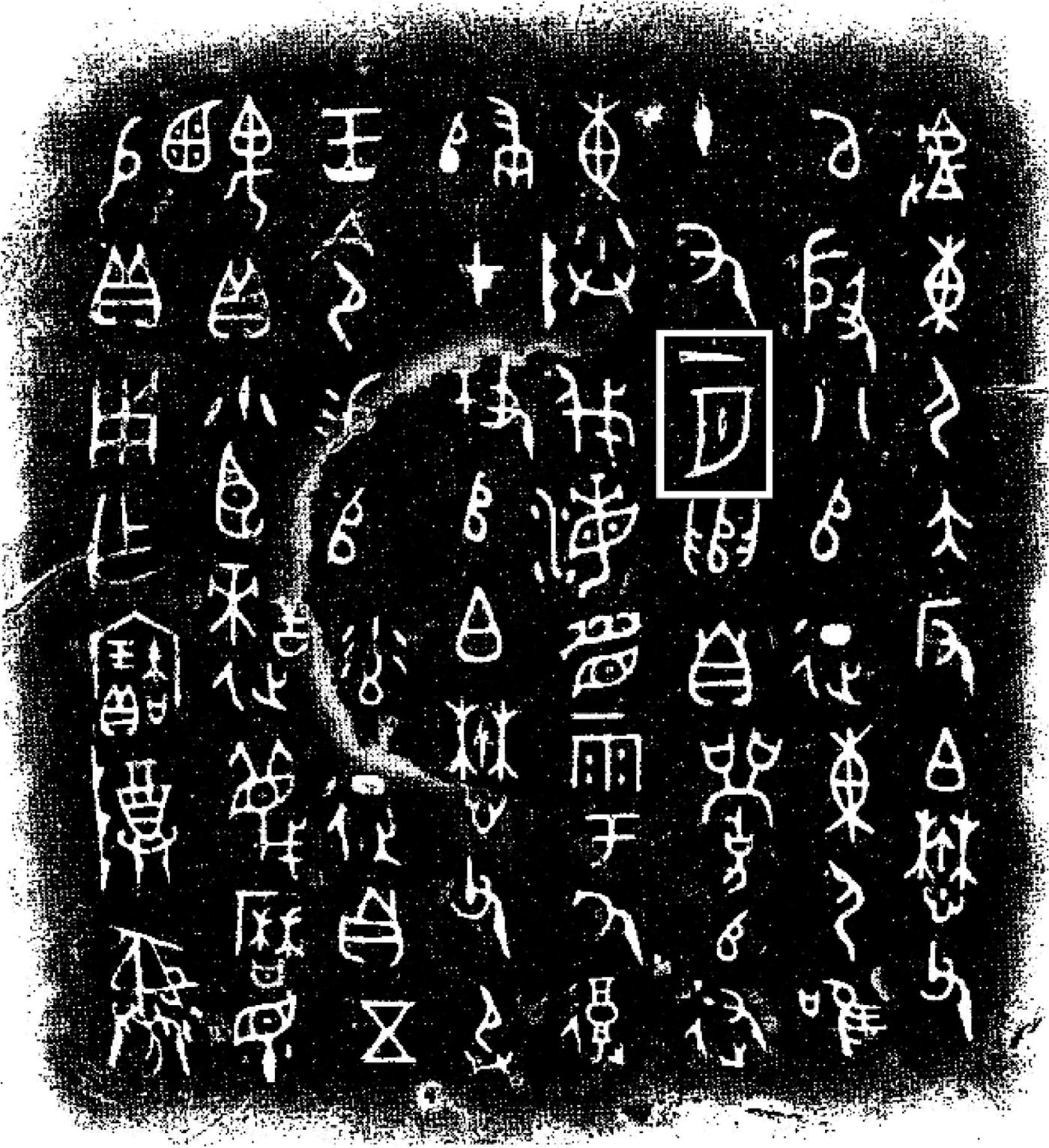
It is important to note that the stoichedon layout is often reached only with the assistance of various “space-saving” devices such as the use of ligatures and the (intended) sharing of a single character-space by two or more characters (both referred to as hewen 合文 “combined graphs” in Chinese scholarship)Footnote 22 or the use of reduplication marks (chongwenhao 重文號).Footnote 23 The “combined graphs” hewen are particularly crucial for discussion of the nature of the inscriptions’ master copy. For example, consider the Hu gui 㝬簋 inscription (Jicheng 04317, Figure 1), cast in the twelfth year of King Li's 厲王 reign (ca. 846 b.c.e.) and commissioned by none other than King Li himself. The inscription was cast using a neat rilievo grid that divides the writing surface into twelve columns, each consisting of ten character-spaces, totaling exactly 120 character-spaces.Footnote 24 All character-spaces are carefully filled with one character or, on three occasions, with two characters (xiao zi 小子 [VI.6]  ; zai xia 才下 [XII.5]
 and shi you 十又 [XII.10]
 ), all being instances of a shared character-space commonly seen in Western Zhou bronze inscriptions.Footnote 25 To achieve the aesthetic stoichedon style, laying out this inscription involved a division of the text into twelve columns, setting the column length in ten character-spaces and, in order to fit the text to this regular grid, the use of space-saving devices—“combined graphs” hewen—in three places.
The inscription on the Hu gui tureen (after Zhang Tian'en 張天恩, ed., Shaanxi jinwen jicheng 陝西金文集成, vol. 5, Baoji juan: Fufeng 寶鷄卷: 扶風 [Xi'an: San Qin, 2016], 128–129). Reproduced with permission.Footnote 26
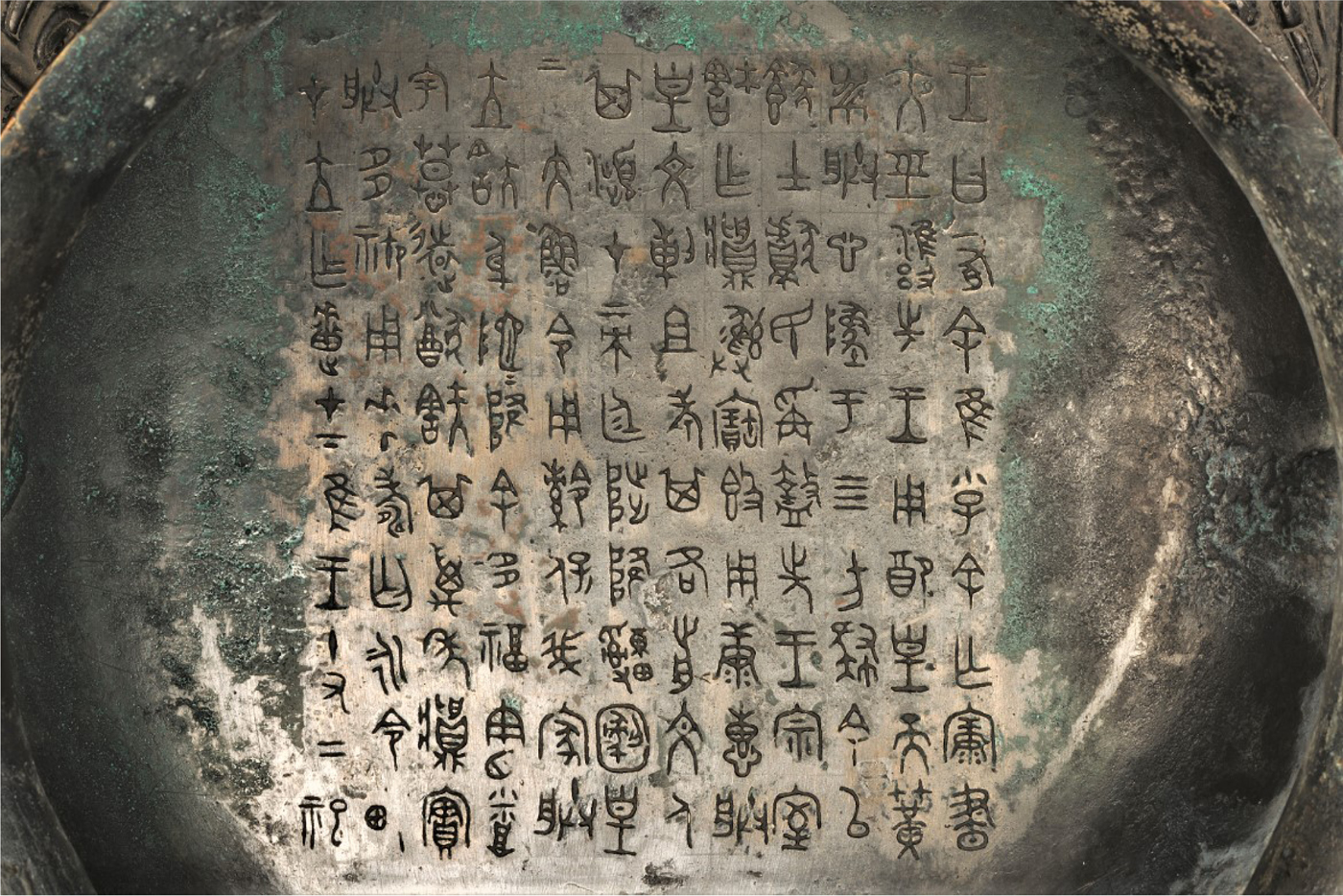
Moreover, the presence of a 12×10 rilievo grid confirms that such mise-en-page was indeed a result of previous planning and was not a random or ad hoc solution. This suggests that either the composer or the person responsible for the transfer of the text from the master copy onto the clay slab, which may be conveniently referred to as the ordinator,Footnote 27 had to operate consciously with the notion of character-space. A character-space was the fundamental structural unit that, together with layout, constituted the basic operational framework for the composing/editing and the transfer of the text to the inscriptional surface, a process that is termed ordinatio or “ordination” in Roman epigraphy. The conscious use of the notion of character-space and of commonly seen “combined graphs” hewen suggest that the 12×10 layout of the Hu gui inscription was the result of meticulous planning, possibly already during the compositional process.
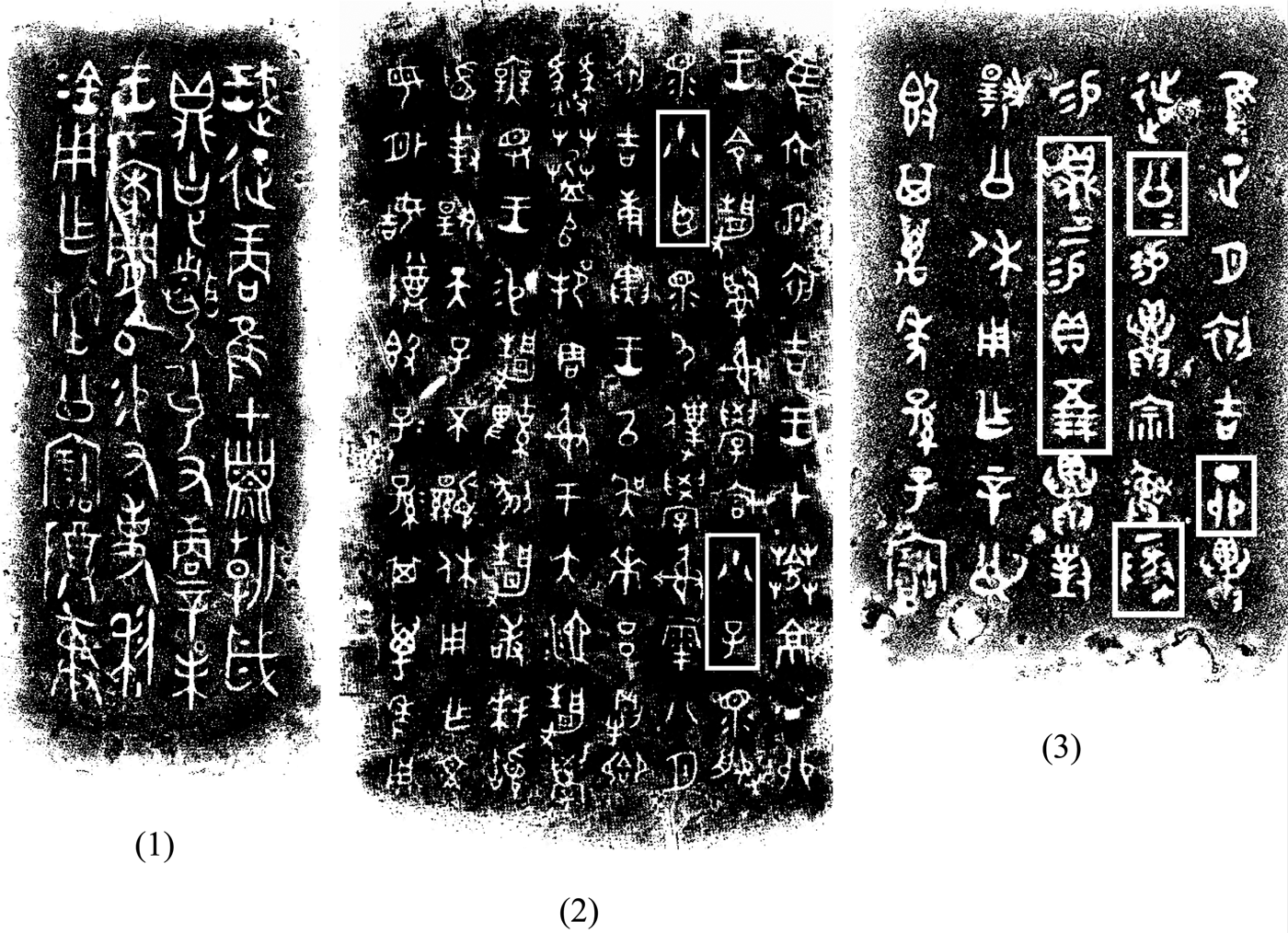
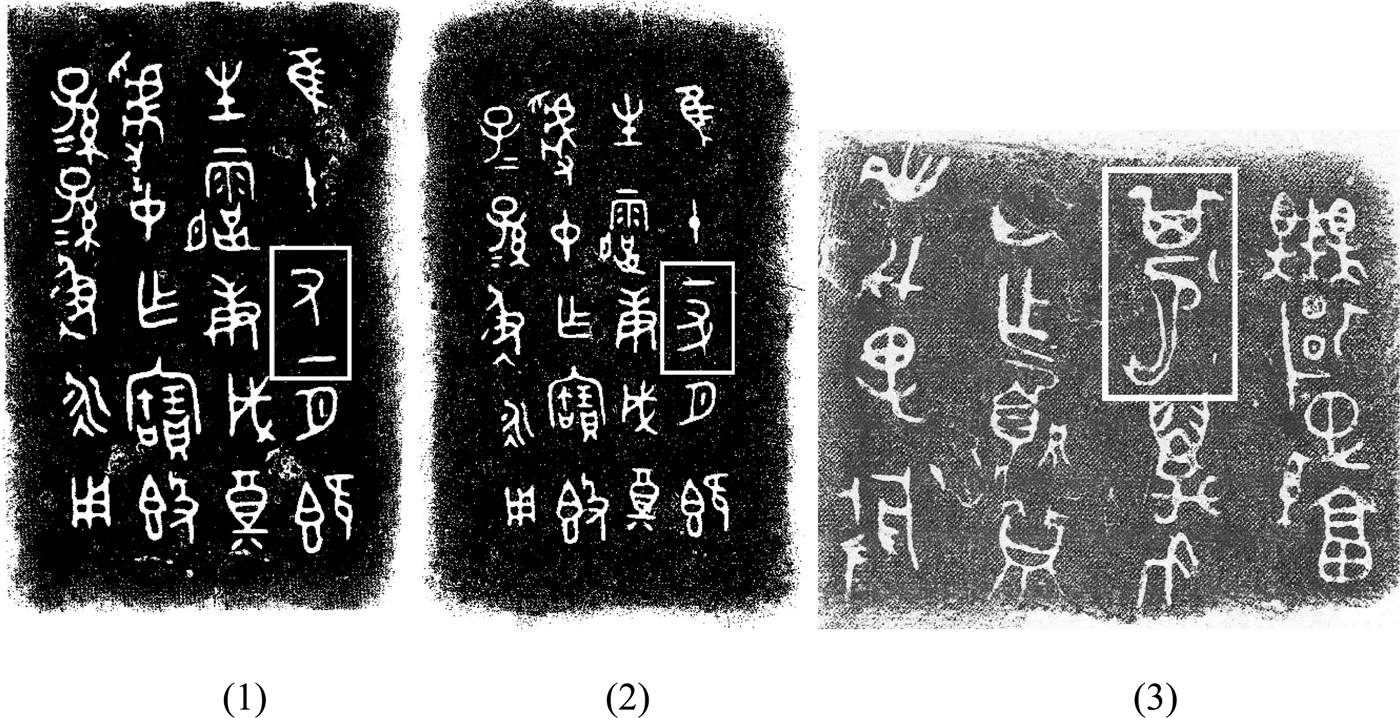
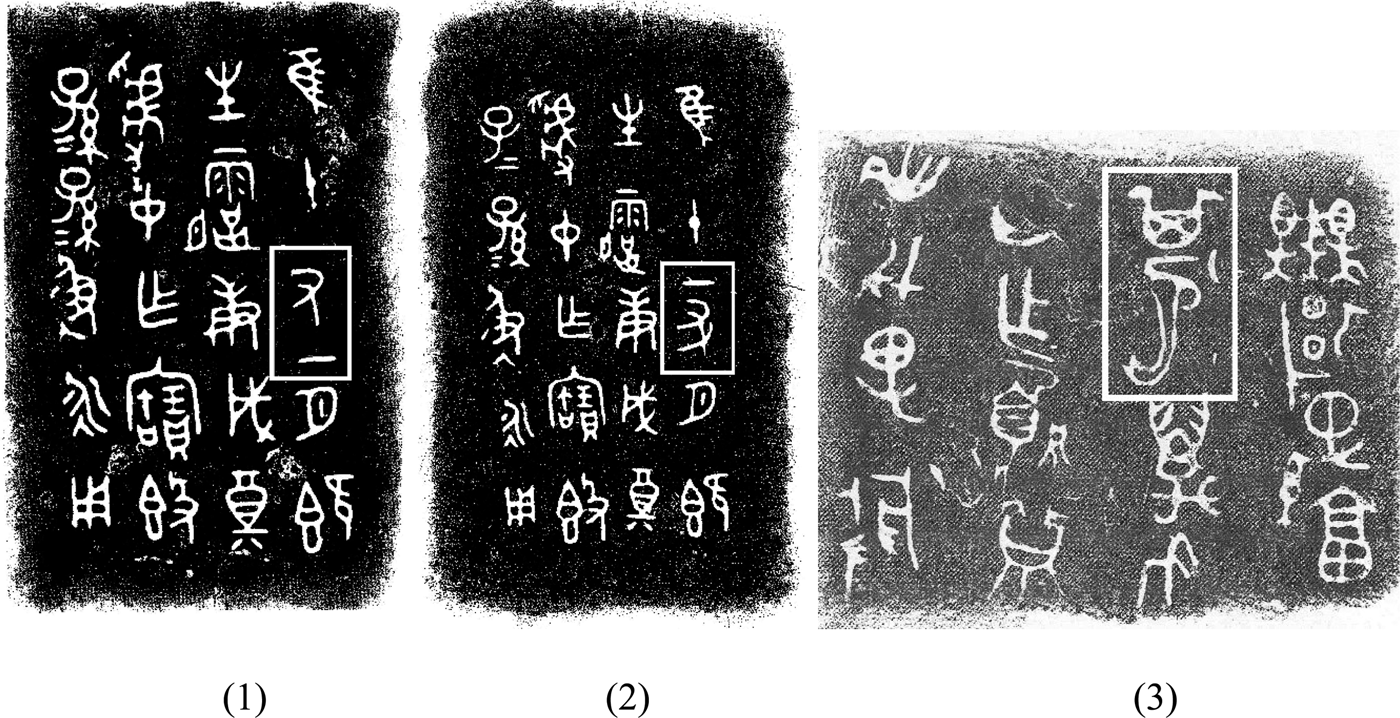
The origins of the quest for a symmetrical layout can be traced to the very beginning of the Zhou dynasty. The inscription on the bottom of the Li gui 利簋 (Jicheng 04131, Figure 2.1), one of the earliest Western Zhou vessels cast probably during the reign of King Cheng 成王 (ca. 1042–1006 b.c.e.), runs in four columns, each of them numbering eight characters. Notice that in the first column, the name of King Wu 武王, commonly written as 珷王 in most Early Western Zhou inscriptions,Footnote 28 is shortened to 珷. It is clear that the Li gui inscription opted for an abbreviated form of the common designation 珷王, and the reason for that might well be that its composers aspired to reach a certain symmetry of the text, although in this period it was reached solely at the abstract, arithmetic level of equal number of character-spaces in each column and not at the visual level embodied by the stoichedon style.
Rubbings of Li gui (1), Jing gui (2) and Min gui (3) inscriptions.

The real stoichedon style in the layout of inscriptions, in which every character-space is equally high and wide, appears towards the middle of the Early Western Zhou period, with the Larger Yu ding 大盂鼎 (cast presumably in the twenty-third year of the reign of King Kang 康王, r. 1005–978 b.c.e.)Footnote 29 as its foremost representative, but is more prominent from the reign of King Mu 穆王 (956–918 b.c.e.), with the Jing gui 静簋 (Jicheng 04273) as an exquisite example (Figure 2.2). In this instance, even the commonly abbreviated compounds xiao chen 小臣 (“minor servitors”) and xiao zi 小子 (“young boys”) are written in full, with each character being assigned an equally sized character-space. Compare also the Min gui 𬹠簋 inscription (Jicheng 04159, Figure 2.3), a rather short text in which no fewer than five space-saving devices are employed to maintain the 5×7 layout, which most likely was the master-layout: one ligature (wu peng 五朋, III.5), three character-space sharings (ding mao 丁卯 [I.6], yi si 一肆 [II.7], er xi 二錫 [III.3]) and one reduplication mark (gong, gong 公二 [II.2]).
Many other inscriptions assume the stoichedon layout with the help of conventional space-saving devices, especially the “combined graphs” hewen, and some of them will be scrutinized in the following discussion. There are also inscriptions like that of the aforementioned Jing gui that achieve a neat stoichedon layout without the help of a single instance of hewen, or even like that of the Shanfu Ke xu 善夫克盨 (2nd half of 9th century b.c.e., Jicheng 04465) that assume the stoichedon format and their overall number of character-spaces is in multiples of ten. It is therefore hardly by coincidence that the inscriptions like those of the Xing zhong 𤼈鐘 (Jicheng 00246–250), Shi Chen ding 師晨鼎 (Jicheng 02817) or on the above-mentioned Jian gui (all from the middle of the ninth century b.c.e.) all have exactly one hundred character-spaces. All such inscriptions must have been planned with the utmost care, anticipating the desired symmetry of the layout. In such cases, the ultimate wording of the text cast into the bronze was a result of a compromise between the intended content and the formal appearance of the text. To be sure, the content of the inscription mattered, but so did the form of its presentation.
It is thus reasonable to expect that a master copy of such well-planned inscriptions would specify the desired layout, either in the form of annotation or more likely by direct execution of the layout,Footnote 30 along with suggestions of instances of “combined graphs” and reduplication. I will call this planned intended layout a “master-layout.”
Master-Layout and Its Violations
While in the case of Hu gui and scores of other vessels the actual cast layout seems to follow the master-layout accurately, several instances in sets of vessels on which identical inscriptions are reproduced show that such a master-layout was not always preserved. This situation is best exemplified by the case of the set of eight Ci gui 此簋 tureens (Jicheng 04303–04310), unearthed together with another three Ci ding 此鼎 cauldrons in 1975 from a cache in Dongjiacun 董家村 in Qishan 岐山 County, Shaanxi, and dating to the Late Western Zhou period (ca. 809 b.c.e.). All vessels and their lids bear identical inscriptions. Li Feng's meticulous analysis of their calligraphic features indicates that three individuals were responsible for inscribing these vessels, and thus provides solid grounds for the discussion of their master copy.Footnote 31
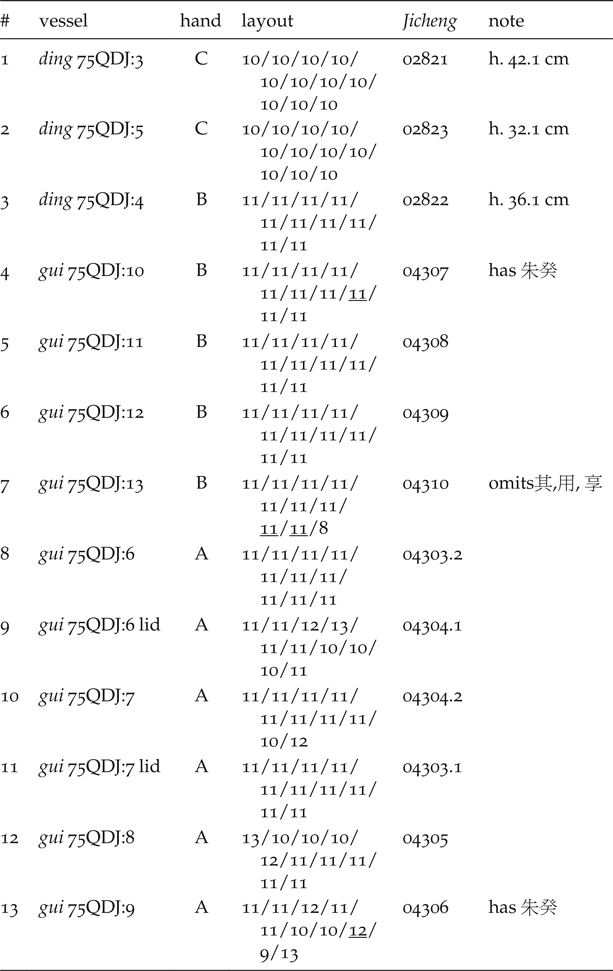
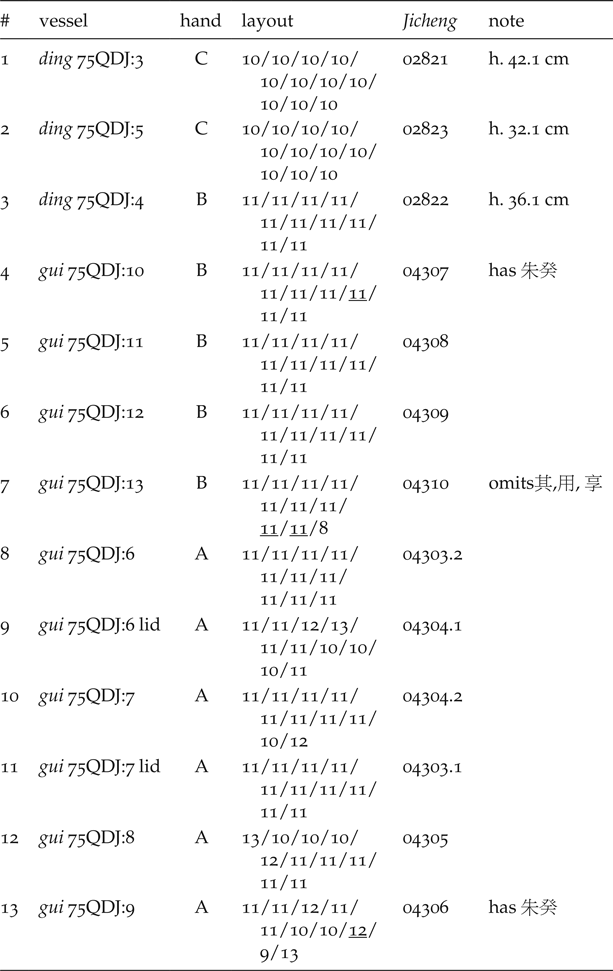
The inscription contains exactly 110 characters, which are, as expected, arranged either into eleven (11×10 characters) or ten columns (10×11 characters). The former is the case for the two Ci ding inscriptions (ding 75QDJ:5 [Jicheng 02823] and 75QDJ:3 [Jicheng 02821]), which are both inscribed by one hand (Li Feng's type C), preserving a neat, stoichedon arrangement. The third ding (75QDJ:4 [Jicheng 02822]), inscribed by another hand (Li Feng's type B), shifts the mise-en-page to the latter form, accommodating eleven characters into each of the ten columns, preserving the “arithmetic”Footnote 32 but not the visual symmetry of the inscription. The same hand also inscribed one subset of four gui tureens (75QDJ10–13 [Jicheng 04307–04310]), with more or less the same visual effect.Footnote 33 We thus have two ordinators opting for different layouts, while we can expect that they based themselves on the same master copy. In this case, the master-layout was subject to variation, but the overall (arithmetic) symmetry of the inscription was still preserved.Footnote 34
A more layout-intrusive variation can be observed in the subset of four gui inscribed by type A calligraphy (75QDJ:6–9 [Jicheng 04303–04306]). While hand B was still precisely and coherently following the master-layout, hand A, the calligraphy of which is remarkably inferior to hand B, adhered to it only twice (Jicheng 04303.1 and 04303.2), mostly failing to abide by it (see Table 1). The penultimate column of the Jicheng 04303.2 inscription reveals clear traces of the ordinator's struggle to fit all eleven characters into this column. Lack of experience seems to have taken its toll here.
Layout of the inscriptions in the set of Ci's vessels
A pair of inscriptions on the vessel and lid of the Jian gui 諫簋 (Jicheng 04285) from the end of the Middle Western Zhou period offers another, albeit rare, violation of the master-layout. Whereas the lid inscription has a rather neat alignment of ten character-spaces in all ten columns, the inscription cast into the inner bottom of the vessel runs only in nine columns, each composed of eleven character-spaces, omitting one character-space (i.e., the character you 攸 [𨦷] [“bronze-plated”] from the compound you le 攸 [𨦷] 勒 [“bronze-plated bridle”] in the VIII.3 position on the vessel inscription). Both inscriptions were written in the same hand, and the careful stoichedon order on the vessel's inscriptions suggests that the omission was an intentional step in the pursuit of equal length of all the columns and, in turn, a higher aesthetic quality of the inscription.Footnote 35 Here, the form seems to have overruled the content.
It is evident that in addition to cases where the ultimate layout preserves the intended arrangement of the master-layout, as in the inscriptions on Hu gui, Jing gui or Min gui above, there were also instances in which a symmetrical master-layout was assigned, but where the ultimate outcome for some objective or subjective reason did not follow this assignment.
Among objective reasons, we can cite the lack of space, a phenomenon often seen on the gui lid inscriptions where the ordination had to accommodate to the smaller round surface and thus did not follow the master-layout. Inscriptions on bells, which constitute a special category in regard to layout, could also be meticulously planned with regards to the character-space count, but such efforts are often traceable only on the largest bells in a graded chime, while the layout of the inscriptions on the remaining smaller bells is driven mostly by the need to accommodate as many characters as possible (see, for example, the discussion of the set of Liangqi zhong 梁其鐘 below).Footnote 36 Violation of the master-layout did not necessarily lead to the violation of symmetry. The above case of Jian gui shows that when the master-layout was not observed, ad hoc measures could be taken to maintain visual symmetry.
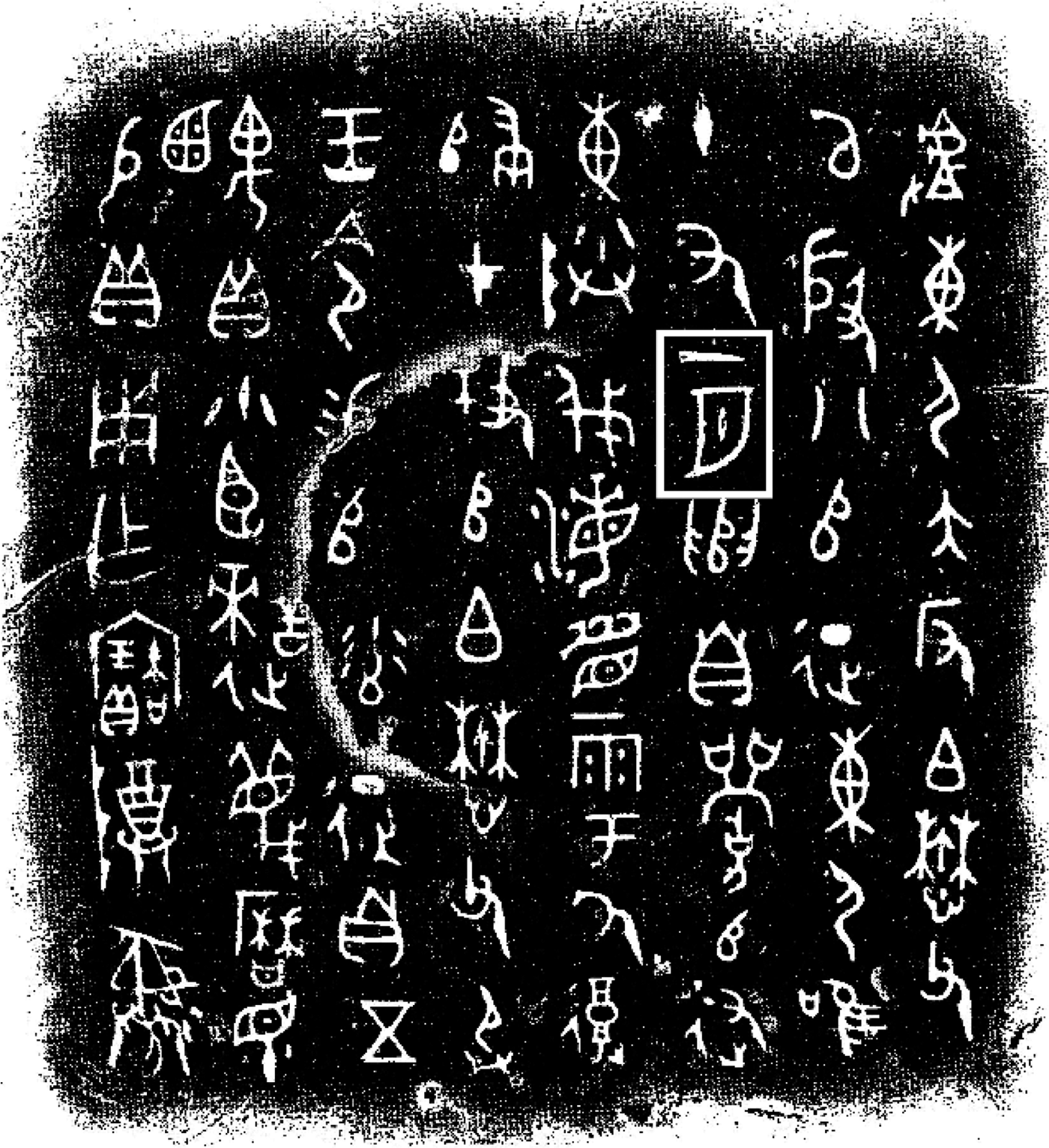
Subjective factors contributing to a misrepresentation of the master-layout included lack of experience (such as the set of Ci gui inscribed by hand A), and possibly also contamination from the ordinator's writing habits. For example, the Xiaochen Qiu gui 小臣 簋 inscription (Figure 4, Jicheng 04238–39) contains 64 characters arranged in eight columns, and the layout of eight character-spaces per column would be expected. However, the characters yi yue 一月 (“first month”) in the third column (III.3) were executed such that they share one character-space. As a result, the ultimate (Jicheng 04239 [vessel and lid] and 04238 [vessel]) or penultimate (04238 lid) column has only seven character-spaces.Footnote 37 Indeed, the common scribal habit reflected in contemporary inscriptions was to condense yi yue into a hewen. It is likely that in order to achieve symmetry, the two characters were written separately in the master copy of this inscription, but a negligent ordinator performed them in a habitual way—as hewen, thereby decreasing the number of character-spaces in the inscription and violating the assigned layout.Footnote 38
Violation of master-layout due to lack of space (Da gui 大簋 lid, Jicheng 04299).

Rubbing of the lid of Xiaochen Qiu gui (Jicheng 04239.1) inscription.
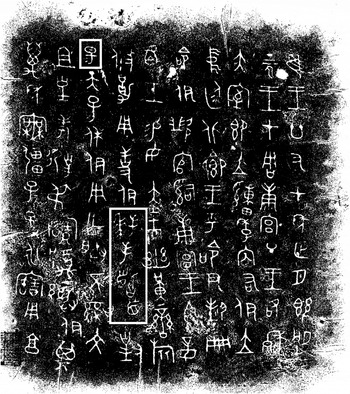
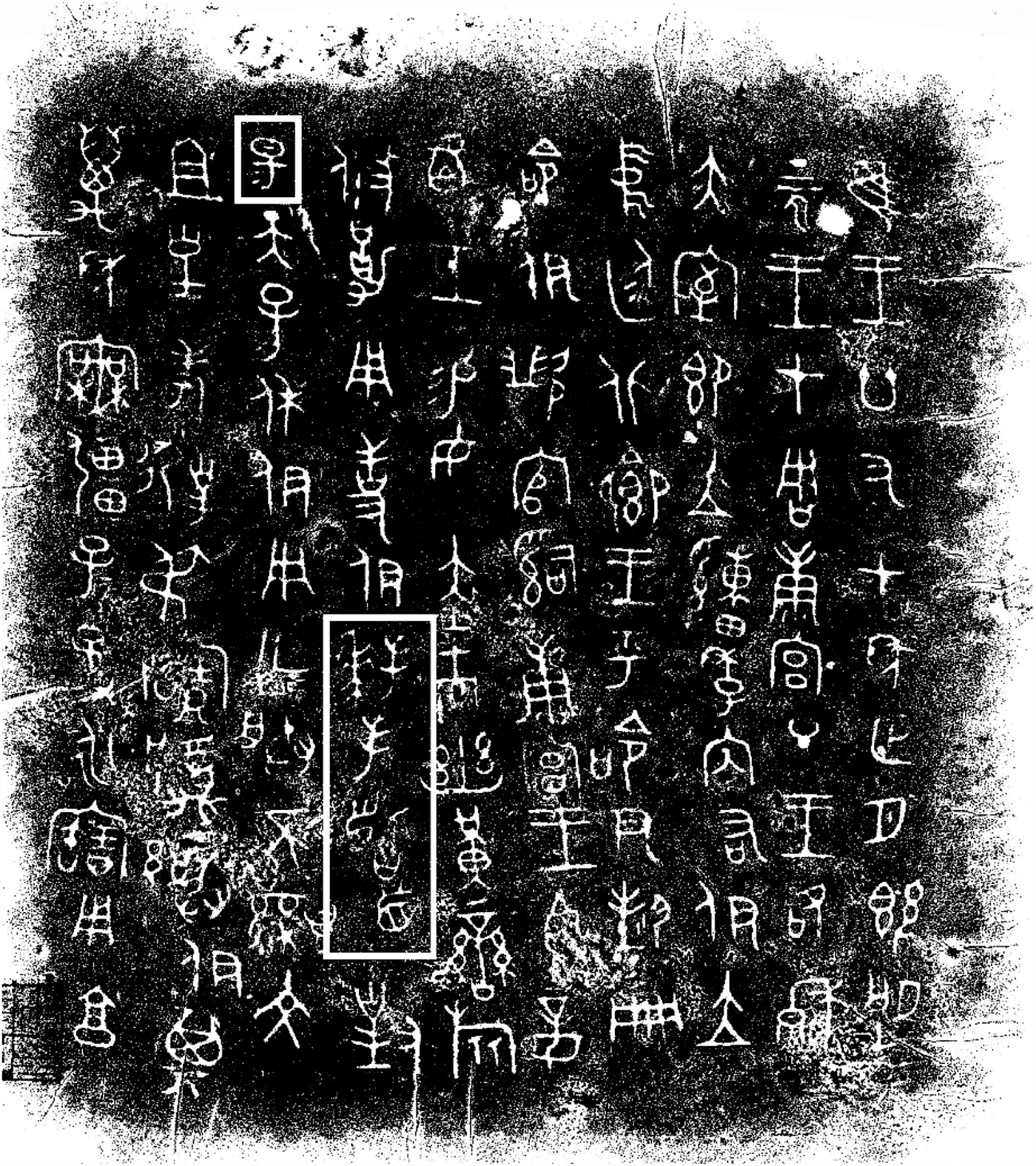
Another type of ordinator writing habit penetrating an inscription's text can be observed in the Yin gui 尹簋 inscription (Figure 5, Jicheng 04287), dating to the twenty-seventh year of King Xuan (801 b.c.e.). Of the ten columns, nine contain ten character-spaces, making use of the standard hewen in II.1 (ding hai 丁亥); however, column VIII accommodates eleven character-spaces. Although it is possible that the master copy did plan 102 characters in 101 character-spaces, note that instead of the commonly used abbreviated form bai qi shou 拜稽首, column VII has the full form bai shou qi shou 拜手稽首 (“with folded hands bowing prostrate”) (Figure 5, outlined), which was in vogue for a certain period in the Middle Western Zhou, but appears to be rather anachronistic in this late inscription. The abbreviated version bai qi shou was largely preferred in bronze inscriptions, perhaps for space-saving or rhythmical purposes; it seems likely that in the spoken language, the full tetra-syllabic version was employed.Footnote 39 It is possible that the ordinator included the character shou 手 simply because this was how the phrase was usually vocalized.Footnote 40 One other common cause for the violation of master-layout, the unintentional omission of a character during the ordination, will be discussed later.
Rubbing of the Yin gui inscription (Jicheng 04287), with the characters bai shou qi shou and yang outlined.
Not all of the bronze inscriptions seek arithmetic or even visual stoichedon style symmetry in terms of layout; in fact, it may well be that the majority of them were drafted without taking the question of symmetry into account. However, a number of inscriptions still conspicuously employ space-saving devices to achieve symmetry in their graphic presentation. It appears that in such well-planned inscriptions, their intended visual organization constituted a fixed framework by which the contents had to abide. What mattered was not only what to write, but also how to present it. In light of the above discussion, I believe we have good reason to assume that the final outcome of the composition or compilation process, i.e., the master copy, visually reflected the intended master-layout of the inscriptions, specifying instances of ligatures, sharing of character-spaces, reduplications and, in a few cases, paragraph spacing.Footnote 41 For various reasons, some of which include, apart from mistakes, the lack of experience or contamination by conventional scribal habits, the final outcome did not always respect the assignments of the master copy. Thus, when reading bronze inscriptions, we should first ascertain how much symmetry mattered to their producers, and thereby identify and duly appreciate their visual qualities that arguably present formal limitations to the text being analyzed.
Between “Instruction” and “Production”: The Blueprint
In the above discussion, I assessed what can be assumed about the information contained in the master copy based on the visual qualities of bronze texts. In this section, I focus on the actual use of the manuscripts in the process of “ordination,” i.e., the laying out of an inscription's text on the clay mold (“inscription block”). In the majority of cases, an inscription was prepared on a separate clay slab, which upon completion was embedded into a niche in the inner mold of the casting assembly and then used for casting.Footnote 42 Since it should not be automatically assumed that the text of an inscription was copied directly from the master copy, the term “blueprint” will be used in the following discussion to refer to the manuscript from which the text was copied on the clay slab.Footnote 43
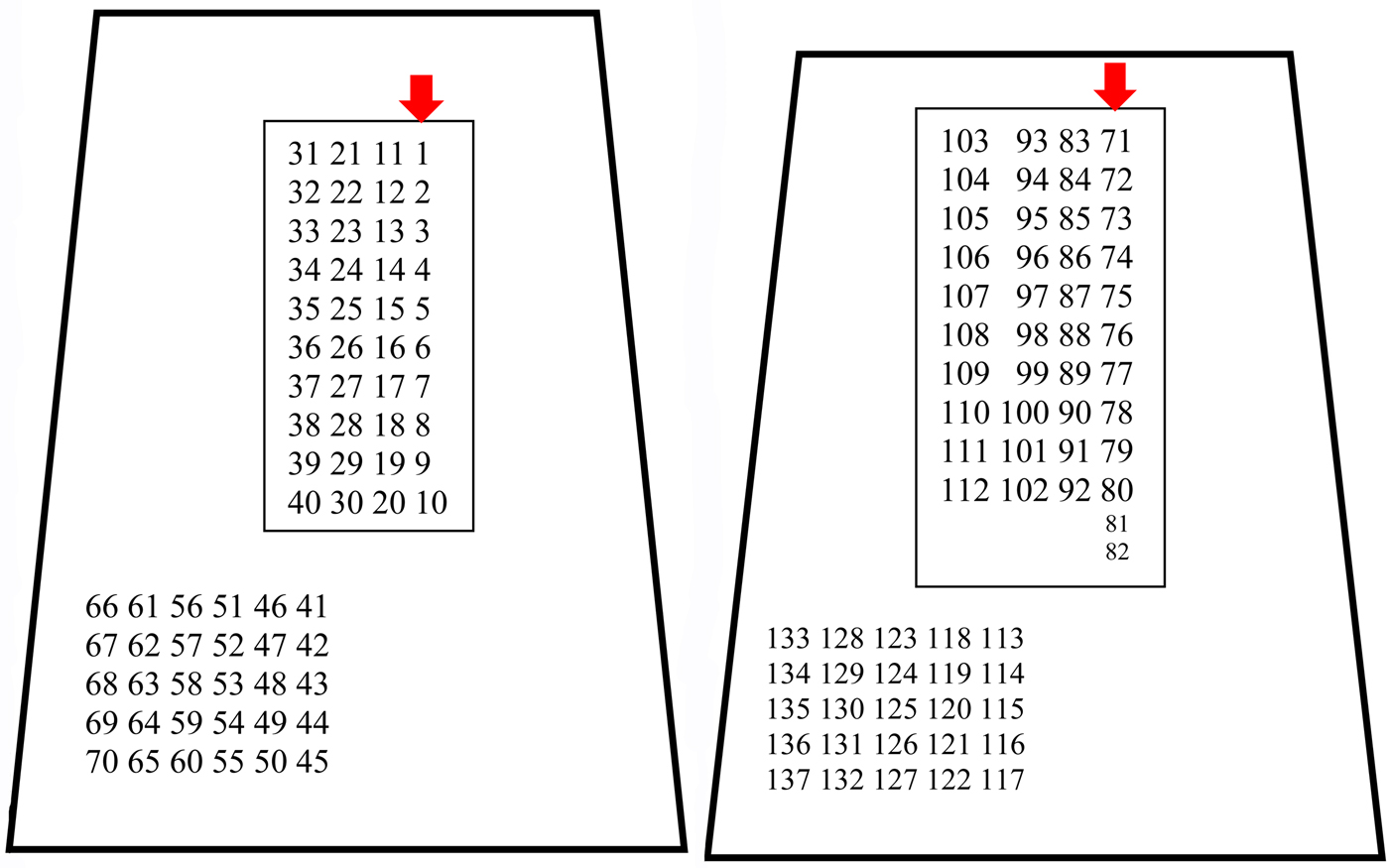
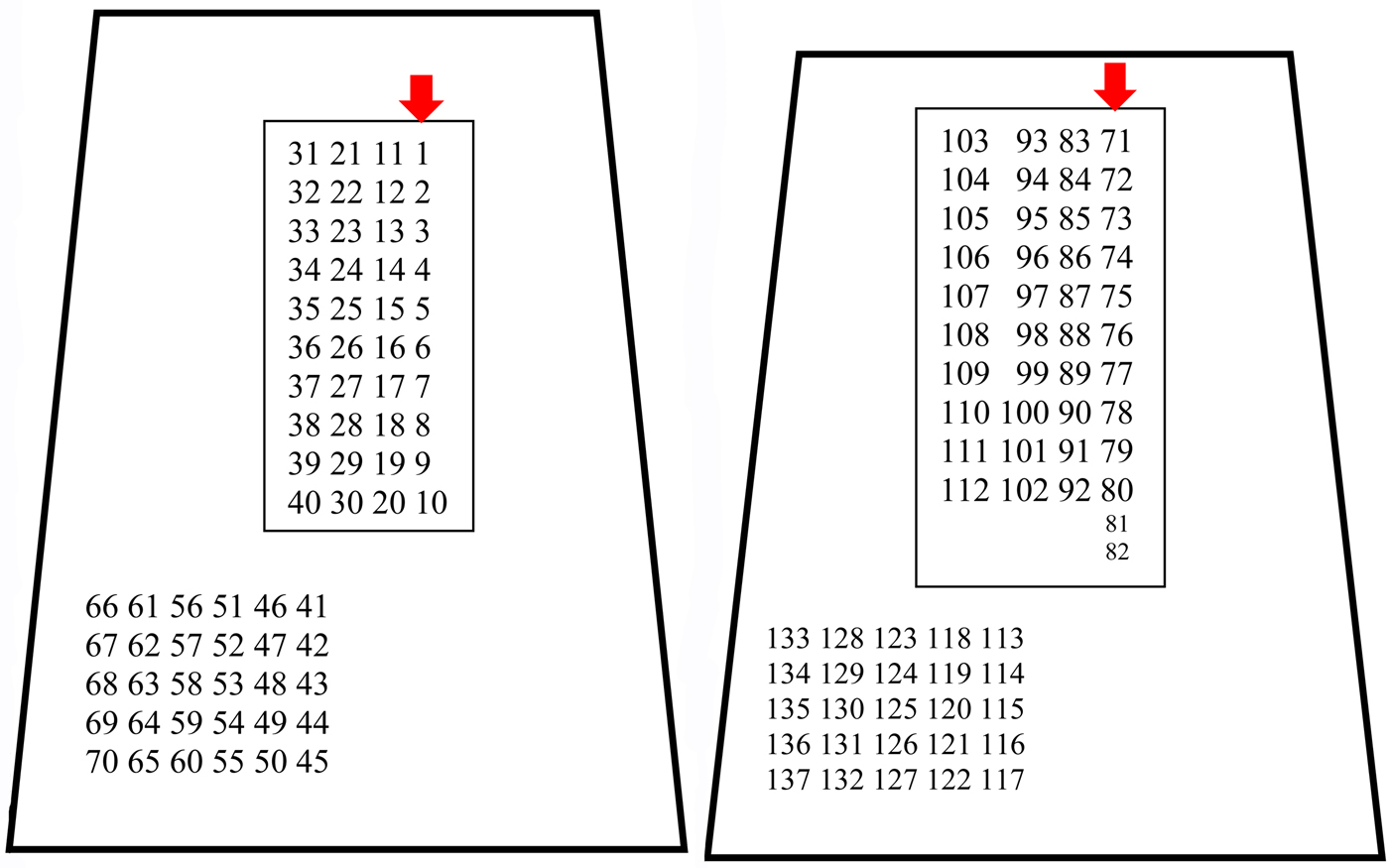
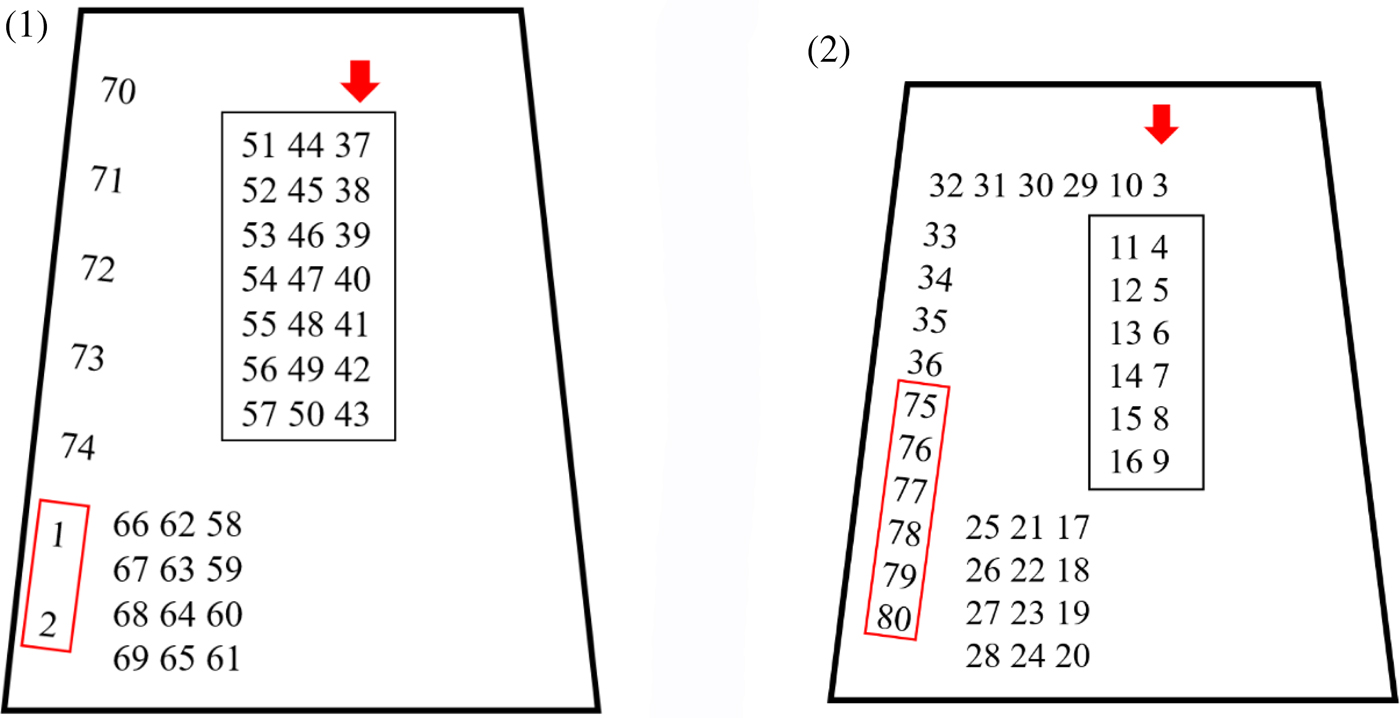
Inscriptions on the set of Late Western Zhou Liangqi zhong 梁其鐘 bells (Jicheng 00189–192) yield valuable evidence for the inquiry into the process of textual transmission from perishable to durable media.Footnote 44 An incomplete set of six bells was unearthed in 1940 from a cache in Fufeng county 扶風縣, Shaanxi, and was subject to an extensive study by Noel Barnard and Cheung Kwong Yue 張光裕 in the mid-1990s.Footnote 45 An inscription of 137 characters was cast divided onto two pairs of larger bells, with bells A (Jicheng 00187) and B (Jicheng 00188) forming the first pair, and bells C (Jicheng 00189) and D (Jicheng 00190) forming the second pair, and presumably also on four smaller bells from which only the first two bells are extant (bells E [Jicheng 00191] and F [Jicheng 00192], in the latter case only in the form of rubbing). It is these two smaller bells that are crucial to the present discussion. Unlike the inscriptions on the four larger bells, which contain only one minor defect (the character Liang 梁 is missing in the inscription on the left-hand side of the lower-belt section of bell D), inscriptions on the smaller bells E and F exhibit serious discrepancies in textual sequence that have hitherto not been satisfactorily explained. For convenience, Figure 6 shows the correct textual sequence on bells A and B, and the characters are numbered 1–137 according to this sequence. The textual corruption on bells E and F is depicted in Figure 7.
Inscription layout on Liangqi zhong bells A (left) and B (right).
Inscription layout (1) on Liangqi zhong E and (2) on Liangqi zhong F (the arrows indicate the usual beginning of the text).
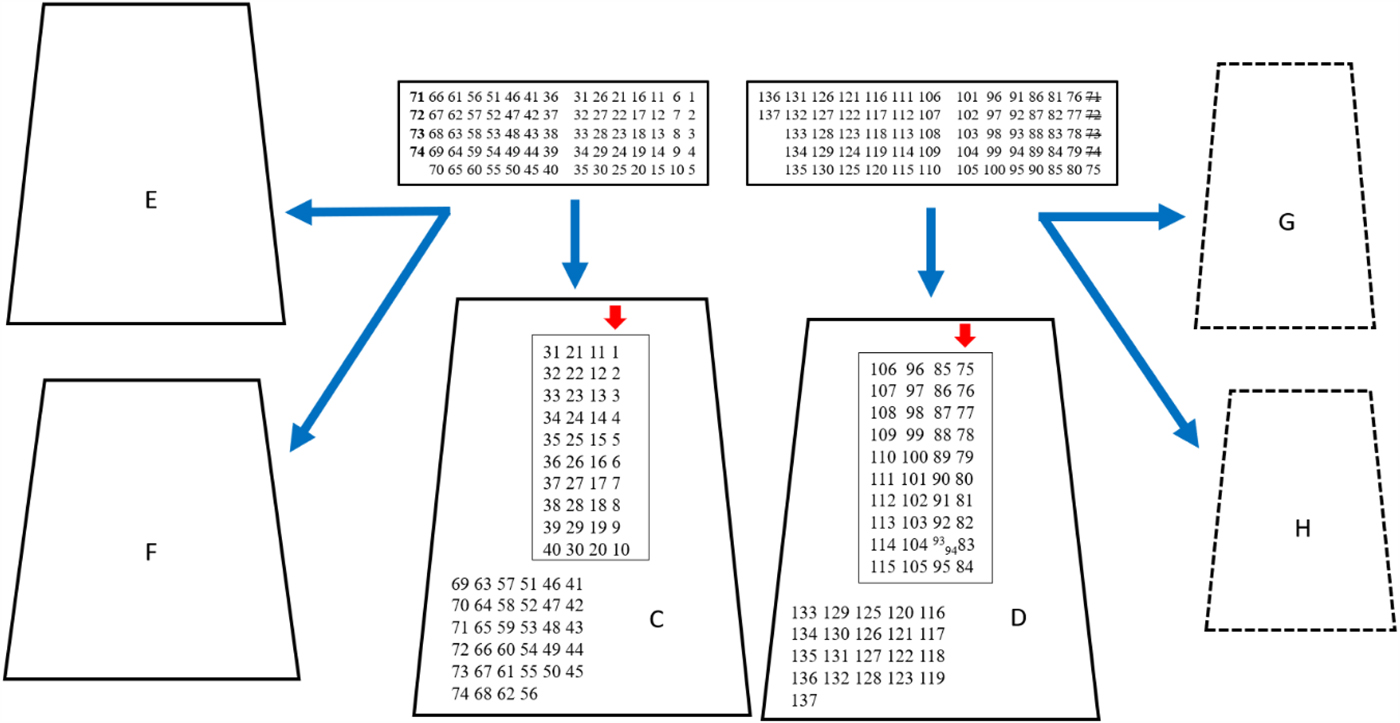
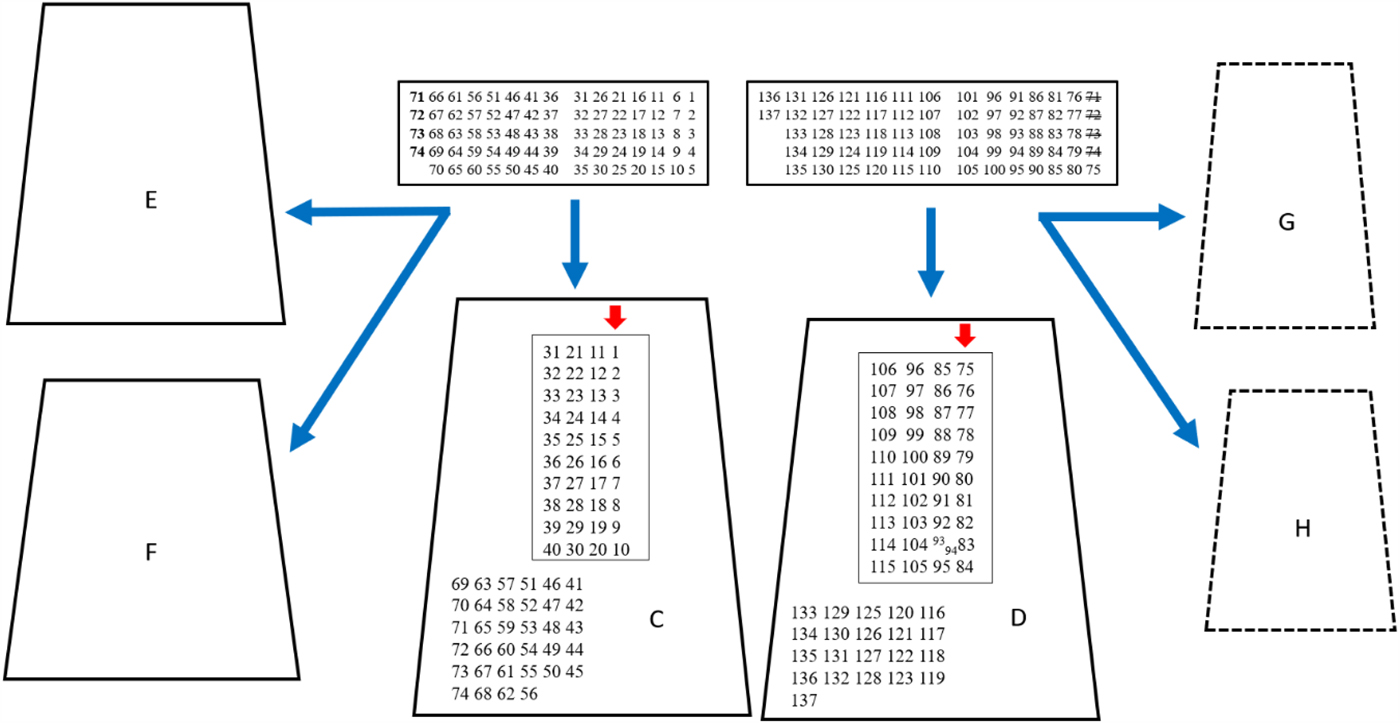
Scheme of sharing a blueprint for inscriptions on bells C =E+F and D = G+H.
Instead of the expected opening phrase Liangqi yue 梁其曰 (“Liangqi says”), that is, starting the textual sequence from character 1 as on bell A in Figure 6, the text on bell E begins with the phrase bi Tian zi, Tian zi yi shi Liangqi 辟天二子二 (夷)Footnote 46事 (使) 梁其 (“assists the Son of Heaven, the Son of Heaven, oh, sent Liangqi”). That is, it begins with the inscription's thirty-seventh character, and runs unbroken to render thirty-eight characters of this sequence, all the way until the seventy-fourth character according to the original sequence. Next, the text leaps back to the very first two characters of the entire inscription, Liangqi 梁其 (from the opening sentence Liangqi yue 梁其曰). The situation is diagrammed in Figure 7.1.
Correspondingly, the text on bell F continues with the remaining characters of this opening sequence (yue 曰 …) all the way to character 36, after which it skips characters 37–74 (which are already present on bell E) and continues on, starting from character 75 (see Figure 7.2). The two missing bells (G–H) probably bore the rest of the inscription, i.e., characters 81–137.
Discontinuity in textual sequence led Barnard to the conclusion that at least five more bells must have been part of the chime.Footnote 47 In fact, Wang Shimin 王世民 had already shown that the problematic textual sequence can actually be rearranged to form a complete inscription, and thus the subset could have comprised no more than four bells.Footnote 48 This is undoubtedly correct, but what were the causes for such a distortion in textual sequence?
Note that the places of content discontinuity do not coincide with the borders of the inscription slabs, as is sometimes the case when an inscription was prepared on several clay slabs that were then embedded into the inner mold in wrong order.Footnote 49 I thus believe that the clue that reveals the reason for this textual corruption lies in the consideration of the writing supports employed in the process of preparation of the inscription for casting.
As a first step, I suggest focusing on the two breaks in textual sequence, first between characters 36 and 37 and second between characters 74 and 75. What would be the objective reasons for breaking the text exactly in these places? Notably, the inscription divided onto bells C and D breaks exactly after 74 characters, with bell C bearing 74 and bell D bearing the remaining 63 character-spaces of the inscription.Footnote 50 We could thus assume that two separate blueprints were used for the ordination of the inscription on bells C and D, one with 74 characters and another with the remaining 63 characters, and that once the production procedure turned to the last subset of the four smaller bells (E–H), the same blueprints prepared for the larger bells C and D were employed. However, as the inscription needed to be divided now onto four and not two bells, it was necessary to split the two larger textual units on the two blueprints into four smaller units, i.e., one for each bell. This procedure is schematized in Figure 8.
It is noteworthy that bells E–H are based on blueprints for bells C and D and not on blueprints for bells A and B. There might be an easy explanation of this: The inscription on bell A contains exactly 70 characters and that on bell B 67 characters, obviously a result of more mathematical than contextual planning. In fact, in the transition between bells A and B, the inscription breaks in the middle of the dedication yong zuo zhen huang / zu kao he zhong 用乍朕皇/且考龢鐘 (“and thus making for my august / ancestors and father [these] harmonious bells”), which might have been perceived as disruptive, as it breaks both the syntactical and rhythmical unit. On bell C's inscription, the length was expanded from 70 to 74 characters to include the whole dedication phrase on the same bell, rather than splitting it down the middle.Footnote 51 While it is possible that a new blueprint reflecting these changes was prepared for the inscription on bells C and D, it is more likely in my view that these changes were incorporated directly into the extant blueprint of bells A and B, by adding four characters to the original blueprint for bell A and deleting four characters from the beginning of the original blueprint for bell B. The latter possibility is reflected in the blueprint reconstructions in Figures 8–9.
Blueprint for the Liangqi zhong bells, alternative with four smaller blueprints, taking account of textual adjustments (added characters in bold, deleted characters crossed).

Several scenarios can be devised for the following step; I will limit the presentation here to what appears to be the most likely, which still requires a detailed specification of the nature of the blueprint. It will be shown below that the inscriptions on the set of Ci's vessels or the Larger Ke ding 大克鼎 used blueprints that contained five characters in each column, presumably to facilitate the ordination process. In such a scenario, the split between characters 36 and 37 appears almost exactly in the middle of the blueprint. Here, too, it is possible that the blueprint for bell C, originally containing 70 (plus four additional) characters, was split into two parts (containing 35 and 35+4 characters respectively), but to avoid splitting the compound su xi 夙夕 (“day and night”)—characters 35 and 36—the character xi 夕 was copied on the first half of the blueprint (1–35[+36]) and deleted from the second (originally 36–70[+4], now 37–70[+4]).
In fact, it is quite possible that four smaller blueprints were originally produced for this set of bells, each containing 35 (only the last blueprint 32) characters with five characters per column (Figure 9). These were then used for ordination of inscriptions on bells A and B. Before ordination of inscription on bells C and D, a textual adjustment to facilitate readability of the inscription was made in these blueprints, namely adding four characters at the end of the second blueprint (originally containing characters 36–70, now 36–74) and deleting the same four characters from the beginning of the third blueprint (originally containing characters 71–105, now 75–105). Still further adjustment was made when the ordination turned to inscriptions on bells E and F: One character was added at the end of the first blueprint (originally 1–35, now 1–35+36), and this character was deleted from the beginning of the second blueprint (originally 36–74, now 37–74). Whether further adjustments were made cannot be assessed, since bells G and H have been lost.Footnote 52
In any case, the mistake must have occurred in the following stage. Instead of using the first part of the blueprint with characters 1–36, the ordinator mistakenly took the second part with characters 37–74 and engraved them on the clay slabs for bell E. After engraving all the characters from this blueprint (37–74), he switched (perhaps since there was still space available) to the second part of the original blueprint (with characters 1–36) and continued the ordination. He would have first added two characters (1–2) to bell E and continue the ordination on the new bell F. After engraving all the characters from the second blueprint here (3–36), he would then turn to the third small blueprint and continue engraving characters 75–80, by which he filled the inscriptional space of bell F. After this step, we would expect him to have continued engraving the remaining text on the clay slabs for bells G and H (now lost).
The case of the Liangqi zhong inscriptions enables us to make several basic observations. First, the production of presumably eight bells of a single chime was performed in consecutive order, beginning from the largest bell and proceeding to the smaller bells.Footnote 53 This observation is particularly important, given that the three pairs of bells were each inscribed by a different hand,Footnote 54 further supplementing the observation made by Hayashi Minao 林巳奈夫 and further elaborated on by Li Feng that identical inscriptions could be inscribed by different hands.Footnote 55
Second, during the process of production of clay slabs with identical inscriptions, the text was apparently not copied from one inscribed slab to another, but always from an independent manuscript.Footnote 56 Moreover, the consecutive production of the inscriptions suggests that a single exemplar, composed of two or four parts, was consulted in the process of the ordination of the entire set of inscriptions on Liangqi's bells. During the ordination process, the individual parts of the manuscript were very likely adjusted after the first pair of clay slabs was inscribed, and then again before inscribing the third subset of bells. It is possible that two larger blueprints were graphically or even physically bisected before the ordination turned to the subset of smaller bells, but it is more likely that four smaller blueprints were used from the beginning. As the size of the inscriptional area differs for every single bell in a graded chime, it seems reasonable to assume that the master-layout was not specified in the master copy. On the other hand, it is very likely that the blueprint contained five characters in each column. Note that the confusion with respect to textual sequence followed after the annotations were made in the blueprint.Footnote 57
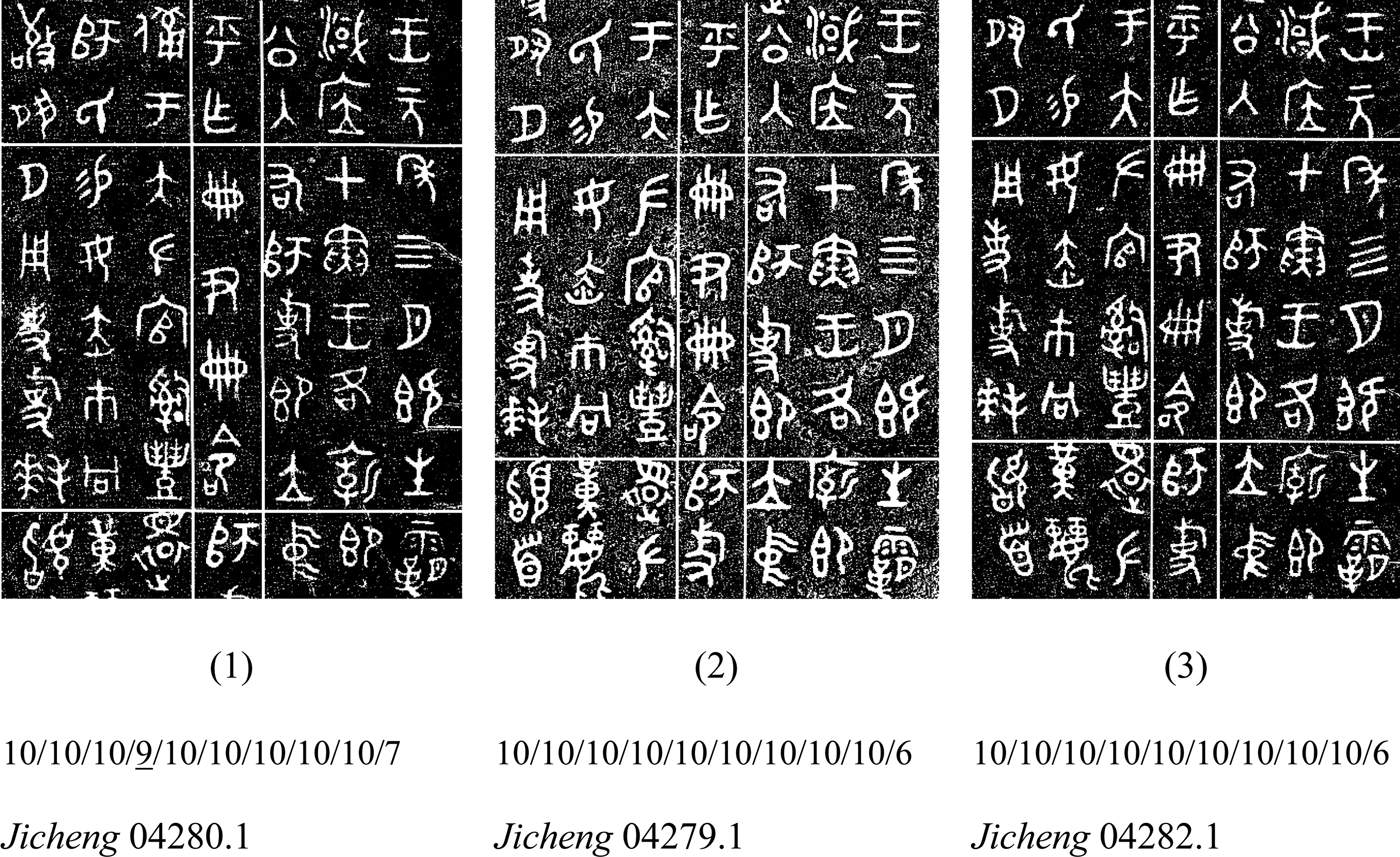
There is evidence suggesting that the ordination procedure and sharing of a single blueprint, as reconstructed above, was not particular to the Liangqi zhong, but rather represents a more general practice. Consider, for example, the set of four First Year Shi Shi gui 元年師𬀈簋 (Jicheng 04279–04282) tureens excavated in 1961 in a cache in Zhangjiapo 張家坡 near present-day Xi'an and dating to the reign of King Yi 夷王 (r. 865–858 b.c.e.).Footnote 58 The inscription on the inner bottom of these vessels counts ninety-seven characters in ten columns, with ten characters per column, except for the final column with seven characters. Three of these tureens were preserved with lids, whose inscriptions are identical to the vessel inscriptions, except for one important difference: the character Ke 克 from the personal name of Zuoce Yin Ke 作冊尹克, a person who is said to have read the royal investiture to the donor of the vessel Shi Shi 師 𬀈, is omitted in all three lid inscriptions (Figure 10, compare IV.6 in the vessel inscriptions).
Inscriptions on the three lids of First Year Shi Shi gui, detail of the fourth column (caption omits the first character in each column).
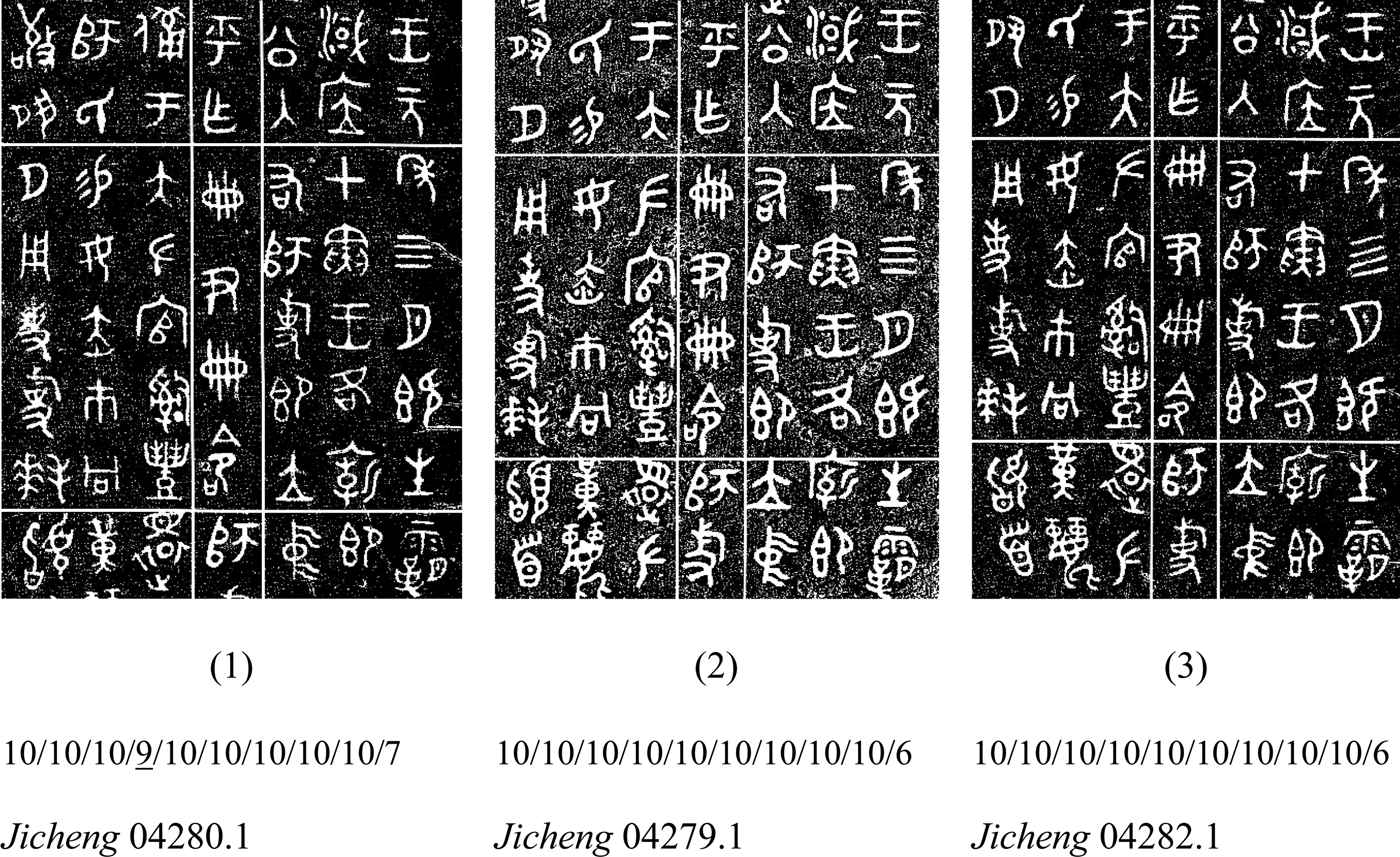
Noticeably, all three lid inscriptions (Jicheng 04279.1, 04280.1, 04281.1) were executed by the same hand as the inscriptions on the inner bottoms of three vessels (Jicheng 04280.2, Jicheng 04281 and Jicheng 04282.2); only the vessel inscription Jicheng 04279.2 was executed by a different hand. This shows that the ordination did not proceed holistically in the “vessel–lid” manner, but rather in batches: “all vessels–all lids” (or vice versa).
The textual deviation between lid and vessel inscription suggests that either 1) all three lid inscriptions were engraved after a different blueprint than the inscriptions for the vessel bottoms and that this different blueprint did not register the character Ke 克, either due to an eye-slip in the process of copying from the master copy or due to intentional omission, or 2) the same blueprint was used, but there was a deliberate decision to omit the character Ke after the ordination of vessel inscriptions was accomplished.
The layout of the three lid inscriptions seems to support the second possibility. While the lid inscriptions Jicheng 04279.1 and Jicheng 04282.1 are aligned more or less in a regular, stoichedon style with ten character-spaces per column (except for the last column with six characters), the inscription Jicheng 04280.1 diverges in an interesting way: The fourth column, where the character Ke was placed in the vessel inscriptions, has only nine character-spaces, with the rest of the inscription following exactly the layout of the vessel inscriptions (i.e., seven characters in the last column). The four characters ce yin ce ming 冊尹冊命 (VI.4–7) in the fourth column cover five character-spaces and disrupt the otherwise careful stoichedon layout (see Figure 10.1 and compare with Figures 10.2 and 10.3). It is more than likely that this lid inscription was originally ordinated with 97 characters, including the character Ke in the fourth column, but for unknown reasons this character was subsequently deleted, and the four characters ce yin ce ming were laid out again to cover proportionally a larger inscriptional surface of five character-spaces. The omission of the character Ke was then presumably marked in the manuscript serving as a blueprint for the inscription, and other lid inscriptions were thereafter ordinated without this character, preserving a neat alignment.Footnote 59 The observation that the ordination of the lid inscriptions occur in consecutive order is corroborated by the fact that all are laid out by a single hand. As in the case of Liangqi zhong, here too more vessels shared the same blueprint, which was subject to textual adjustments during the ordination.
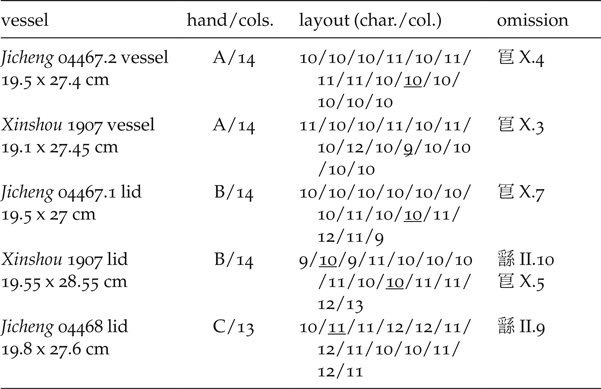
A more puzzling case is the set of Late Western Zhou Shi Ke xu 師克盨 containers and their inscriptions. Two vessels and three lids are preserved: both vessels are inscribed by one hand (A) and three lids by two other hands (B and C, see Table 2), and it is reasonable to expect that the set was originally formed by four xu vessels (and four lids).Footnote 60 The two vessels inscribed by hand A omit the character mi 冟 (“canopy”) in column X, as do two lid inscriptions inscribed by hand B. However, the lid inscription Xinshou 1907 also omits the character you  (“indeed”) in the second column, which is an omission shared by the Jicheng 04468 lid inscription by hand C (see Table 2). This variance in omitted characters again confirms the observation that the inscriptions were not copied from one slab to another, but rather from an independent written medium. Conversely, the fact that omissions are shared by more inscriptions indicates that they were not caused haphazardly. If we presuppose the consecutive ordination procedure, we must conclude that this blueprint originally contained both characters you and mi, and that for unknown reasons, they were marked to be left out.
Basic information about the Shi Ke xu inscriptions

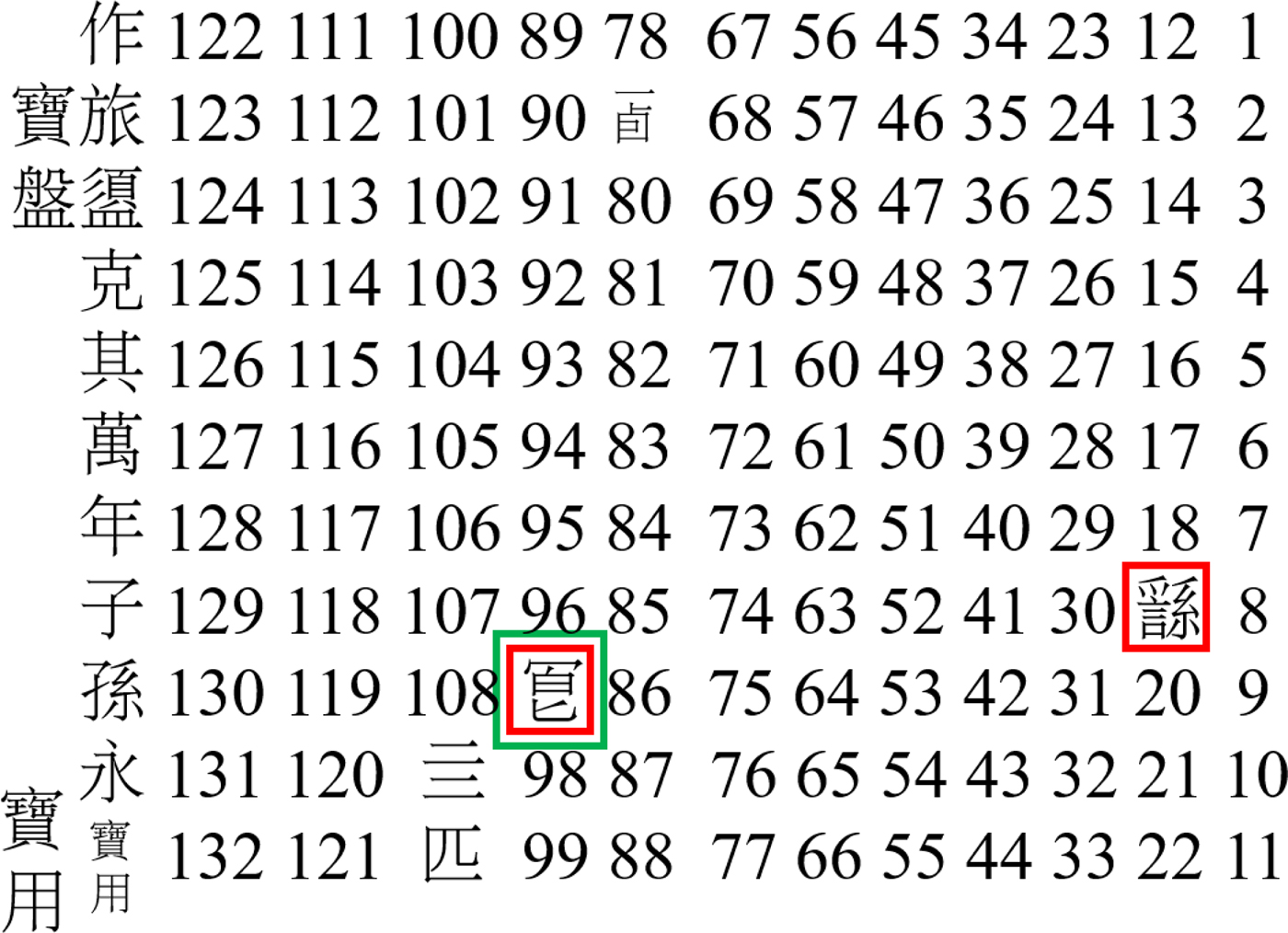
Supposing that both mi and you were originally included in the blueprint and thus in turn in the master copy, we can assume that the inscription was conceived to contain 145 characters. From the layout of the extant inscriptions, we may further conjecture that two instances of hewen were planned for this inscription, yi you 一卣 (or chang yi 鬯一) and si pi 四匹,Footnote 61 giving a total of 143 character-spaces, and the master-layout can be thus reconstructed as thirteen columns with eleven character-spaces each (Figure 12).
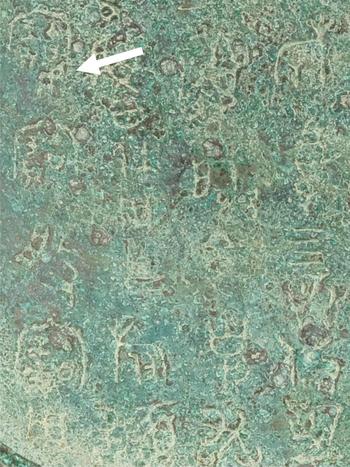
Note also that in the Xinshou 1907 lid inscription, four redundant characters, bao pan bao yong 寶般(盤)寶用 (“precious pan-basin, use it as treasure”), are added at the very end of the inscription (Figure 11).Footnote 62 This reveals that the blueprint for this xu inscription was also planned to be used for a pan 盤 inscription, and the characters bao pan 寶盤 (“precious pan”) were noted in the blueprint to replace the characters lü xu 旅盨 (“xu for lü-ing,”) probably somewhere close to these characters or at the end of the blueprint.Footnote 63 This indicates that a single blueprint was reused for several types of vessels (here pan and xu), which further corroborates the consecutive production hypothesis.
Detail of the ending of the Xinshou 1907 lid inscription. This vessel is housed in Saint Louis Art Museum, Spink Asian Art Collection, as a bequest of Edith J. and C. C. Johnson Spink (36:2014). Reproduced with permission. Characters bao yong bao pan bao yong 寶用寶般寶用 appear in the very left-hand column, with the arrow pointing at the reduced character yong 用.
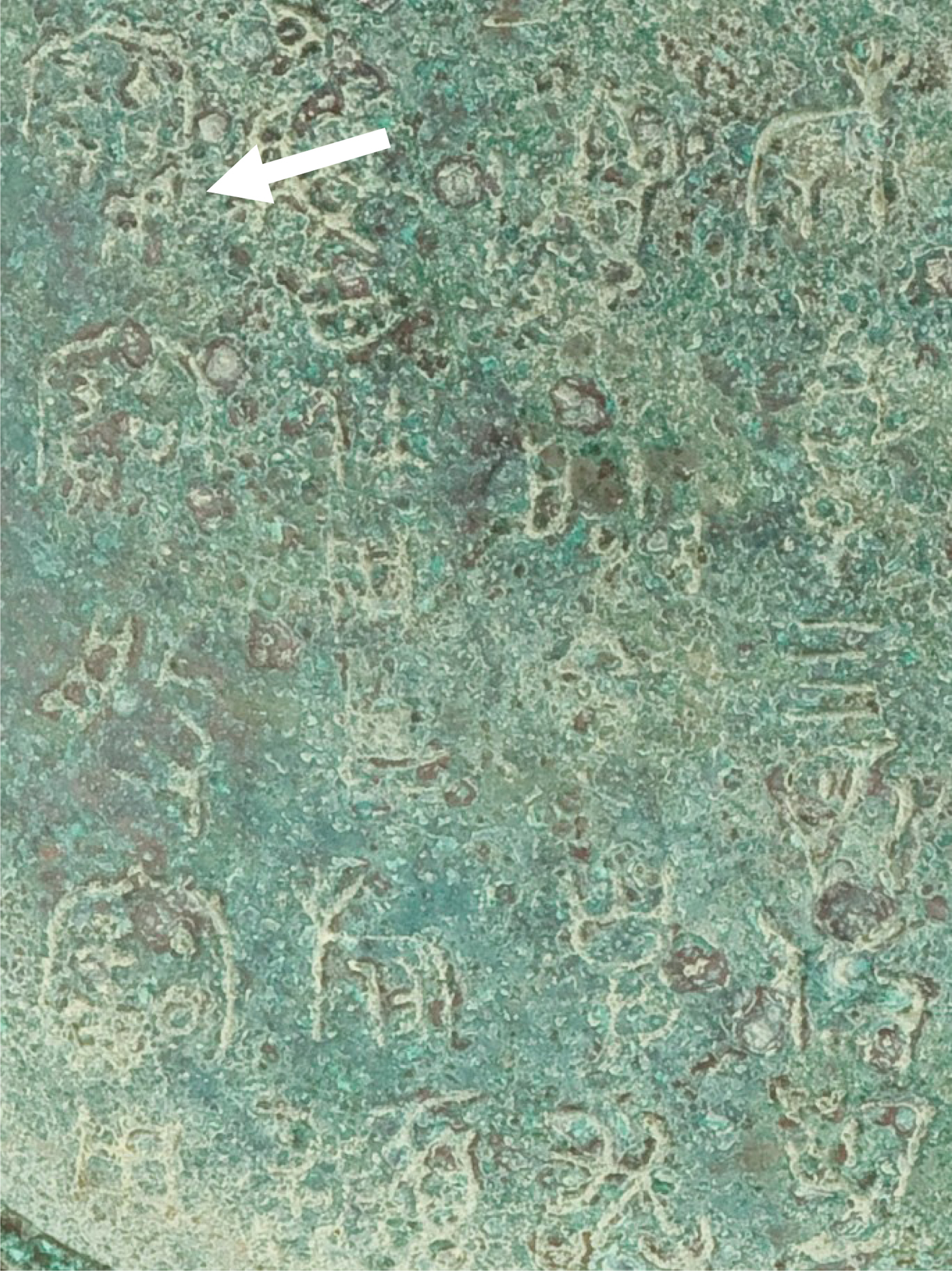
The repetition of bao yong 寶用 (“use it as treasure”) is even more revealing. To explain the textual discrepancies in the Shi Ke xu inscriptions, I would like to tentatively suggest the following scenario as visualized in Figure 12: Examining the abovementioned ligatures, yi 一 is consistently ligated throughout all five inscriptions (either with chang or you), but si pi is generally written separately in two character-spaces. It is thus possible that si pi was accidentally written in full on the blueprint that was prepared for the ordination of the inscriptions. Such a decomposition of the planned ligature then resulted in one extra character in the ultimate column of the blueprint, a problem initially solved by compressing the last two characters bao yong into a single character-space. Notice that this compression is still observable on the Xinshou 1907 lid inscription (Figure 11). However, since this compression is rather unusual, prior to the ordination the ordinator probably decided to omit one character of the inscription to preserve the visual quality of the layout. For an unknown reason, he first opted to omit the character mi, which he probably also marked in the blueprint. All of the characters following after mi were thus ordinated one character-space ahead of their blueprint position. Possibly at this stage, two full-size characters bao yong were added next to the original compressed bao yong characters to enhance the clarity of the phrase in the blueprint.
Schematic reconstruction of the blueprint used for Xinshou 1907 lid.

Based on this blueprint, inscriptions on the vessels were produced (only two are extant now, both by hand A). The ordination of the lid inscriptions then continued using the same blueprint. However, once the lay out of the first lid was concluded (Jicheng 04467.1 by hand B), it was decided to stet the character mi and to omit the character you instead; thus, you was also marked for omission in the blueprint. It was also before the lay out of the second lid inscription that the two characters bao pan were noted close to the characters lü xu, which suggests that prior to the ordination of this second lid inscription, the blueprint was borrowed to produce a pan inscription, and an annotation of alternative wording (bao pan) was thus included in the blueprint. It is possible that the omission of mi was reconsidered on this occasion, replaced by the omission of the character you.Footnote 64 This would also be another suitable moment for addition of the characters bao yong.
Subsequently, hand B again laid out the inscription for the xu lid, now omitting the character you but also mistakenly omitting the character mi. This is understandable, if we consider the graphically confusing situation in the blueprint: the character mi was originally marked for omission in the blueprint, but after it was stetted, a further annotation must have been added to clarify that this character was now to be retained. The confusion of hand B is even more evident in the last line, where it first copies bao yong in the original compressed form and then attaches the four annotated characters bao pan bao yong to the end of the inscription. This mistake becomes more understandable in the visualization in Figure 12, in which the state of the blueprint during the Xinshou 1907 lid ordination is reconstructed. The supposed 13×11 master-layout is used, and places of space-saving and additional notes are marked. With such a layout, the characters bao pan bao yong appear at the very end of the text, and their inclusion in the Xinshou 1907 lid inscription can be easily understood. The confusion of hand B suggests that the changes in the blueprint were made by someone other than hand B himself, possibly by a superior ordinator who was responsible for the textual adjustments or even some kind of “blueprint management.”Footnote 65 The interruption of the ordination process of the xu inscriptions by the ordination of a pan inscription might have also been a contributing factor, as it is clear that at this point, textual adjustments were made in the blueprint.
Finally, hand C would lay out two remaining lid inscriptions correctly, omitting only the character you as planned. We may thus reconstruct the production procedure as follows:
Vessels 1–4 (two lost, two inscribed by hand A: Jicheng 04467.2 and Xinshou 1907) →lid 1 (hand B: Jicheng 04467.1) → lid 2 (hand B: Xinshou 1907) → lids 3–4 (hand C: Jicheng 04468, another one lost)
The cases of the Liangqi zhong, First Year Shi Shi gui, and Shi Ke xu inscriptions all point to a consecutive mode of ordination, during which a single manuscript served as an exemplar for every single instance of ordination. Moreover, the fact that this manuscript could be and indeed was subject to further ad hoc corrections, markings, and possibly even physical division can be traced based on textual discrepancies preserved in these inscriptions. A question thus arises as to whether such auxiliary manuscripts can be identified with the supposed master copy that served as the ultimate model for the text of inscriptions. We have seen that the hypothetical blueprint of the Shi Ke xu inscription misrepresented the master-layout that was very likely planned and specified in the master copy, and the same phenomenon was observed above in the Xiaochen Qiu gui inscriptions (Figure 4), where the mistaken inclusion of hewen is repeated by two different hands. These seem to suggest that the blueprint that the ordinator followed during the process of “lettering” the inscription was not the master copy itself, but yet another auxiliary manuscript. The failure to track the original ligature si pi during the laying out of the Shi Ke xu inscription further suggests that the ordinator had only the mistaken blueprint at hand and did not consult the master copy, which was probably stored in a safe place. The blueprints thus represent a transition between the phase of “instruction,” which was concerned with the text to be inscribed, and the phase of “production,” during which the text was transferred to the durable medium.Footnote 66 While the production of such an intermediary manuscript may seem somewhat superfluous at first, there are at least two practical reasons for the existence of blueprints,Footnote 67 and these will be discussed in the following sections.
Note on the Proofreading of Bronze Inscriptions
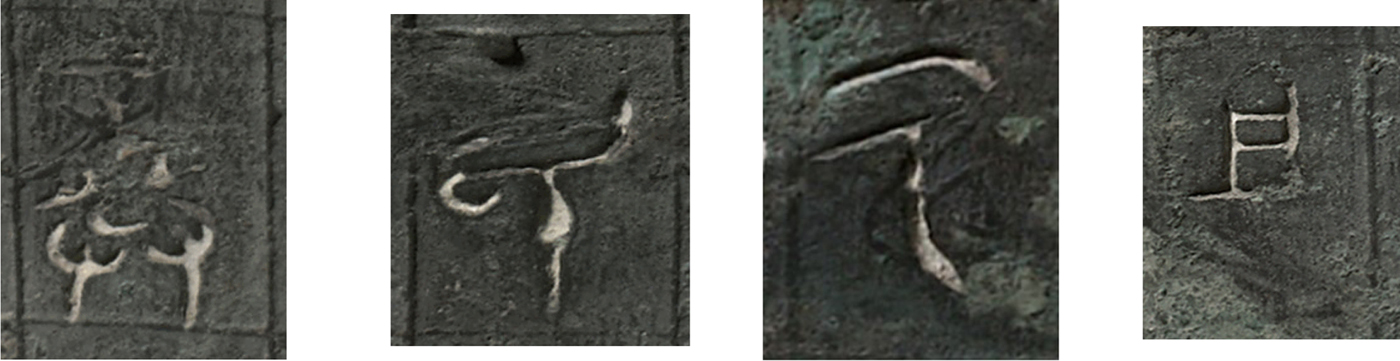
The first practical reason is proofreading. The textual discrepancies exemplified by the inscriptions analyzed above are rather rare, and there is generally a surprising scarcity of mistakes in Western Zhou bronze inscriptions. It is also worth noticing that when a mistake appears in a set of inscribed vessels, it is usually in those produced later in a sequence, while the first inscriptions (on the largest vessels) were prepared with the utmost care (see n.53 above). This general observation necessarily leads to the assumption that some routine mechanisms for proofreading the ordinated texts were usually in place. Unlike bamboo strips, where corrections were usually made by scraping the ink off together with a tiny layer of the writing surface and are thus visible even to the naked eye, a mistake on a clay slab became virtually invisible after it was corrected because the clay could be simply leveled up and characters engraved again, leaving no traces of correction. One inscription that preserves traces of characters to be erased from the slab, that of the famous Larger Ke ding 大克鼎, will be discussed below. In addition to this example, only a handful of apparent instances of textual corrections can be noted in the entire corpus of several thousand Western Zhou inscriptions. Three of them are listed here and visualized in Figure 13:
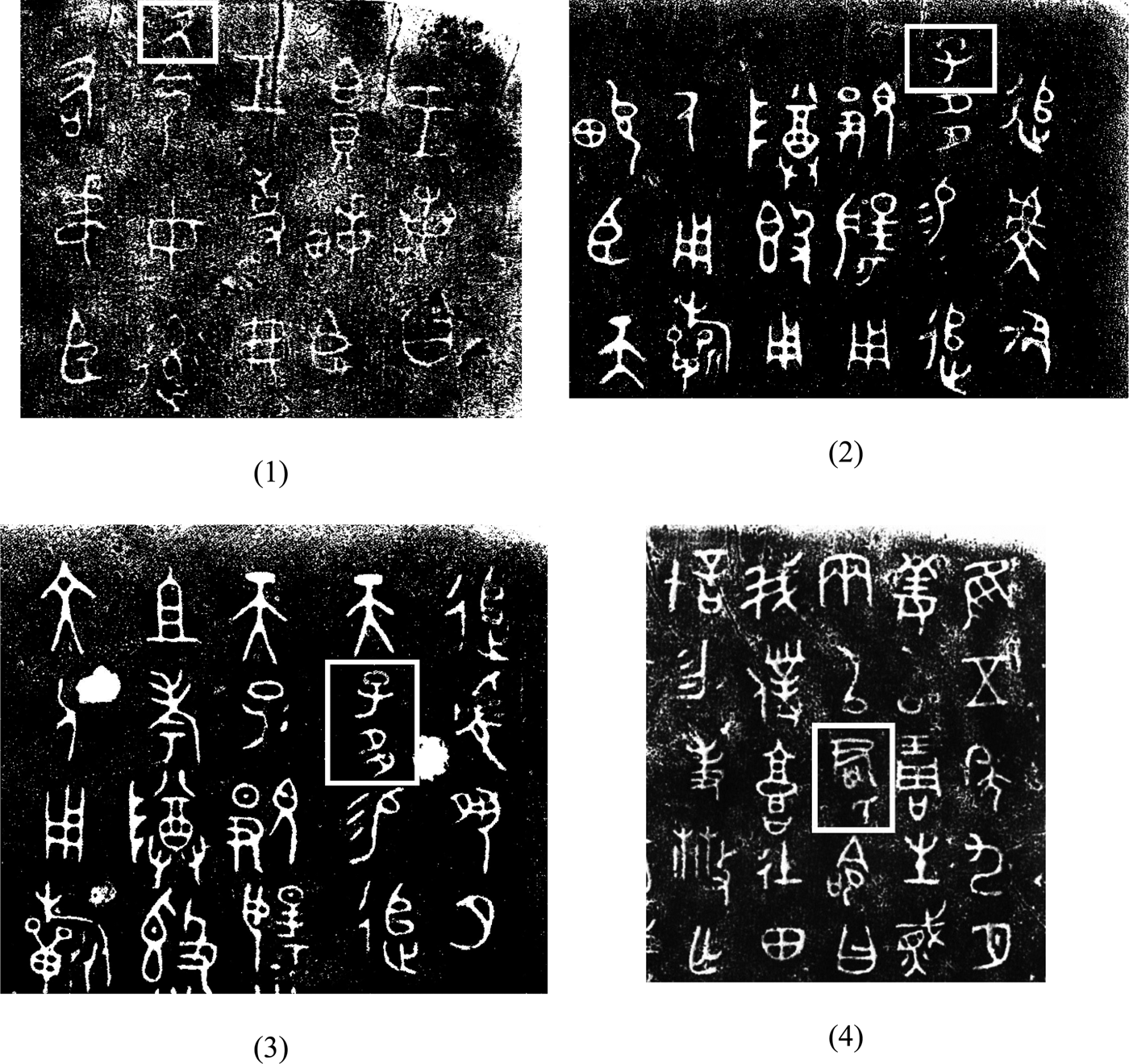
1. Shi Yuan gui 師㝨簋 inscription (Late Western Zhou, Jicheng 04314, Figure 13.1): jue 氒 was omitted before gong 工 (III.1), then added in a smaller size above the upper margin of the inscription, though not before gong but mistakenly before the neighboring ling 令 (IV.1).
2. Zhui gui 追簋 inscription (Late Western Zhou, Jicheng 04219, Figure 13.2): either the character duo 多 or zi 子 was omitted in the phrase Tian zi duo xi Zhui xiu 天子多錫追休 (“the Son of Heaven repeatedly awarded beneficence to Zhui”). If the character zi 子 was omitted, it sufficed later to add it in a smaller size above the upper margin of the inscription before the character duo 多 (i.e. on the correct place in the textual sequence). If duo 多 was omitted, it was necessary to delete zi and rewrite the two characters. Another Zhui gui (Jicheng 04220, Figure 13.3) obviously also originally omitted one of the characters, so here also the original character had to be deleted and two smaller graphs zi duo 子多 were crowded into one character-space. In certain other Zhui gui inscriptions, especially in Jicheng 04221, 04222, and 04223.1, the character zi is written in full but duo 多 and xi 錫 appear crowded. This would point to the fact that the character originally omitted was indeed duo and not zi.
3. Two Diaosheng zun 琱生尊 inscriptions (Late Western Zhou, Mingtu 11816–17, Figure 13.4): the character shi 氏 was omitted from the compound jun shi 君氏 “milady” in both inscriptions (III.3–4), then added under the character jun 君 in a small size; this possibly involved rewriting the character jun (or the lower part of). In this case, the omission substantially influenced the overall layout qualities of the inscription. The zun inscription was designed to accommodate eight character-spaces in each of 14 columns, but due to the omission, the ultimate column in the actual cast inscription has only seven character-spaces, while the third column had to accommodate an additional character. This confirms that as in the previous cases of Shi Yuan gui, Zhui gui, and the abovementioned Shi Shi gui, the mistake was noticed only after the process of ordination was terminated, or it was in such an advanced stage that the ordinator considered it too tiresome to delete such a large portion of engraved text and lay it out again from scratch. Considering that similar corrections are usually found in the first lines of the inscriptions, this reveals that the ordination proceeded from the beginning of the text, rather than from its end. It is likely that the ordinator would still take pains to rewrite several lines in case he discovered a mistake in the final lines of the ordinated text. Notably, the same omission is repeated several times in Zhui gui inscriptions by at least two distinct hands and twice in Diaosheng zun inscriptions by two distinct hands, but in each case was later detected and corrected.
Details of corrections on (1) Shi Yuan gui (Jicheng 04314), (2) Zhui gui (Jicheng 04219), (3) Zhui gui (Jicheng 04220), and (4) Diaosheng zun (Mingtu 11816).

The cases of the Shi Yuan gui, Zhui gui, and Diaosheng zun inscriptions seem to corroborate the fact that two separate manuscripts were used during the inscription production: one that incidentally contained the mistake (the blueprint), and another based on which the mistake was detected and corrected (the master copy). Based on this, we can postulate the existence of the proofreading procedure in the chaîne opératoire of the production of a bronze inscription. It is conceivable that the master copy was kept untouched away from possible editorial changes or even physical damage that may have occurred during the ordination process in the workshop and served as a basis for proofreading. To secure the safety of the master copy, another manuscript such as the blueprint would be produced for the purposes of the ordination. It seems that in cases where identical inscription was reproduced on several vessels in the set, sometimes only a part of the inscriptions was proofread.Footnote 68
In light of these observations, we can formulate another cause for the violation of an inscription's master-layout: an omission of a character and its subsequent addition during the proofreading. Inscriptions with this type of mistake are fairly easy to identify, especially among those with the stoichedon format, as their ultimate column has one character-space less than the preceding columns, while one of these preceding columns contains one additional “squeezed” character that violates the stoichedon layout. The earliest instance of this phenomenon I am aware of is the inscription on the Lu gui 䚄簋 (Mingtu 05362), usually dated to the twenty-fourth year of King Mu (933 b.c.e.).Footnote 69 The inscription contains exactly 110 characters, neatly arranged in a stoichedon format into eleven columns; the master-layout is thus clearly predictable as 11×10. However, one character was obviously dropped during the ordination in the fifth column of this inscription, either nai 乃 (V.2) or zu 且 (V.3), and as a consequence, the last column contains only nine characters. During proofreading, the missing character was inserted on its due position, but as this position was already occupied by another character, this character had to be erased and both characters (nai zu 乃且) recarved again in a limited space, which resulted in violation of the stoichedon layout at this spot in a similar fashion as observed in the above cases of Zhui gui and Diaosheng zun inscriptions. Based on the Lu gui inscription, the proofreading procedure can be traced with some confidence to as early as the end of the tenth century b.c.e.Footnote 70
Further insight into the proofreading process can be gained from the following pair of inscribed vessels. In the set of Late Western Zhou Zheng Guo Zhong gui 鄭虢仲簋 (Jicheng 04024–26) inscriptions, the dating formula shi you yi yue 十又(有)一月 (“the eleventh month”) is miswritten at least onceFootnote 71 as shi yi you yue 十一又月 (“*eleven and a month”) (Jicheng 04024.2). As already observed by Guo Moruo 郭沫若, the incidental transposition of characters you 又 and yi 一 was obviously noticed during the inscription-making and was indicated by a transposition sign in shape of a curving stroke written over the bottom part of the character you (see Figure 14.2).Footnote 72 A similar correction was further noted by Sun Zhichu 孫稚雛 in the Late Western Zhou to Early Chunqiu Bi yi 箄匜 (Jicheng 10251) inscription, where the characters qi 其 and yi 匜 are misplaced, but a transposition sign, “(”, was added on the right-hand side next to the two characters to mark the correct reading sequence (Figure 14.3).Footnote 73 At the present stage it is impossible to determine whether these editorial marks were copied from the blueprint or were an ad hoc solution during the ordination. The former case would hint that the blueprints were also proofread, and that the obelisms were copied only by mishap. The latter case would suggest that besides effacing and recarving of text, other corrective measures were acceptable, too.Footnote 74 In any event, it is conceivable that these marks followed general conventions, and the two short inscriptions thus offer a glimpse on how copyediting marks might have looked in this period.
Transposition signs in (2) the Zheng Guo Zhong gui inscription (Jicheng 04024.2) vis-à-vis (1) Jicheng 04025.2 and in (3) Bi yi inscription (Jicheng 10251).
Note on the Production Technique of Bronze Inscriptions
Another motive to produce blueprints might have been the technique of inscribing the clay slabs itself. The traditional and widely accepted view holds that the inscriptions were first carved onto a clay slab and, after having dried, were impressed into an inscription mold (mingwenxin 銘文芯), which would then be embedded into the inner core mold that formed the part of the piece-mold casting assemblage. The ordinator would thus inscribe the characters in positive writing in a right-to-left direction, identical to the physical appearance of the final inscription. This is the so-called “master-pattern” technique.Footnote 75 However, several scholars suggested that yet another different technique was employed in the bronze inscription production: the so-called “tube-lining” (or “piping,” nitiao duisufa 泥条堆塑法).Footnote 76 In tube-lining, the text (or contours of a decorative motif) is first sketched (engraved) in mirror-reverse form. Thin clay cords are then modelled or piped into these grooves, possibly using a bag with semi-liquid clay, so that they are anchored in the grooves and yet stand out in relief.Footnote 77 Zhang Changping 張昌平 has recently provided convincing evidence for tube-lining being employed in the fifth century b.c.e.,Footnote 78 and a very recent excavation of a bronze foundry at the Guanzhuang 官莊 site, Xingyang 滎陽, Henan Province, yielded shreds of inscription slabs that confirm the use of tube-lining by the Early Chunqiu period at the latest.Footnote 79 The calligraphy on these slabs differs significantly from the inscription slab unearthed from the Xiaomintun 孝民屯 site at Anyang 安陽, but scholars have already indicated that this one also was produced using tube-lining or similar techniques.Footnote 80 While the origins of the tube-lining technique will require further investigation, considering the calligraphic unity of Early Chunqiu and Late Western Zhou inscriptions, there seems to be no doubt that tube-lining was in use during the Late Western Zhou period and quite likely even earlier.
This technique possibly had some influence on the nature of the writing process that preceded the ordination of an inscription: Should tube-lining be employed, the ordinator would need to align the inscription in mirror writing in the left-to-right direction.Footnote 81 From this perspective, it is possible that an auxiliary manuscript would be prepared to ease the transmission of the positive master copy text into a mirror-reverse inscription, and it is conceivable that this manuscript itself would be written in mirror writing.Footnote 82
While it is not the purpose of this article to argue for the tube-lining technique, it should be noted that this technique more or less resolves all the debated issues in the production of a bronze inscription, beginning from the use of rilievo grid-lines and ending with the question of why, if the inscriptions were mechanically imprinted from the master-pattern, no traces of mechanical reproduction of inscribed text are found in the Western Zhou inscriptions.Footnote 83
Final Case: The Larger Ke ding Inscription
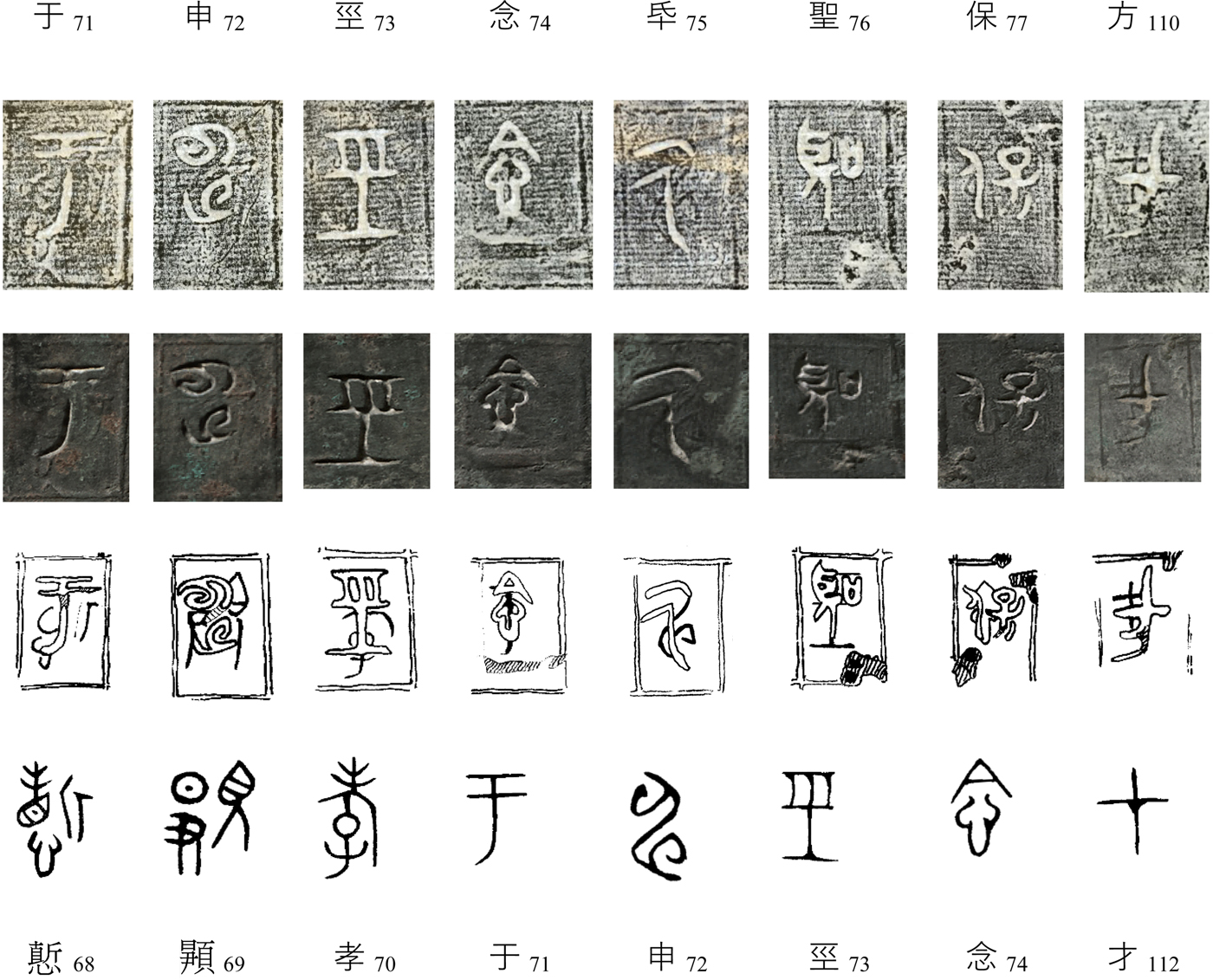
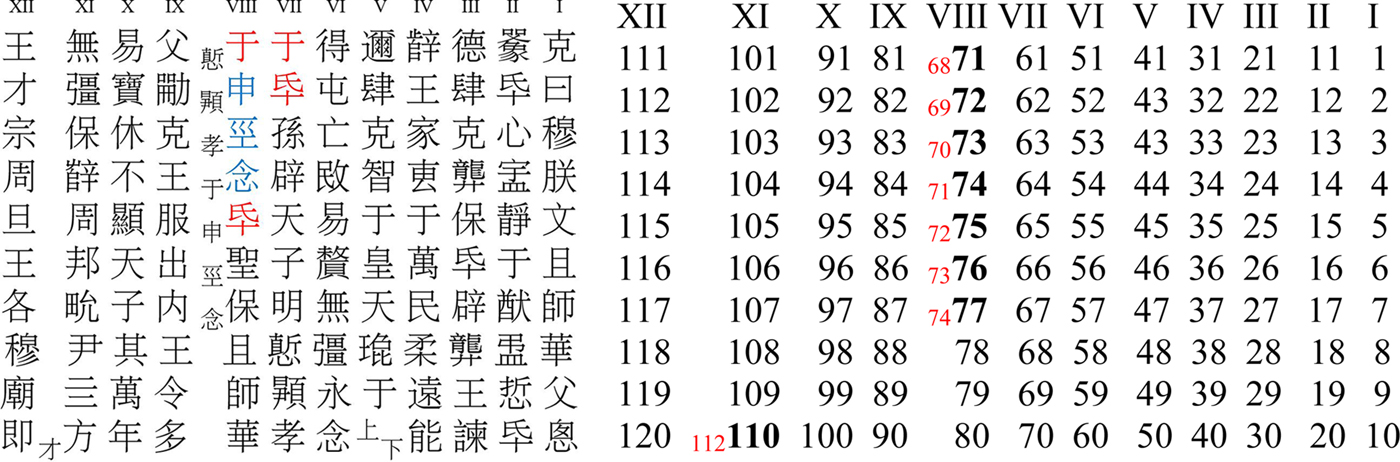
The two factors discussed above, proofreading and tube-lining, can be illustrated by the singularly important inscription cast in the Late Western Zhou period on the inner wall of the Larger Ke ding 大克鼎 (Jicheng 02836), now in the collection of the Shanghai Museum. During his studies of inscriptions with the rilievo grid, Noel Barnard noticed on the rubbing of the Larger Ke ding the presence of several “ghost” characters, i.e., fine rilievo lines centrally located in the graphic spaces of the inscription's intaglio characters, as if these were written over them. Barnard identified these traces of rilievo strokes as sketchings of the characters that were to be engraved into the clay slab, and he provided an initial reconstruction of the sketch-lines visible on the rubbing.Footnote 84 In a recent article, Li Feng identified three of these “ghost” characters.Footnote 85 In a rejoinder to Li Feng's article, Zhou Ya 周亞 of the Shanghai Museum confirmed the existence of this phenomenon and provided detailed photographs and clearer rubbings of the characters in question, but without further elaboration.Footnote 86 Close examination of these materials now enables us to decipher the “ghost” characters with some confidence, and the results are presented in Figure 15.Footnote 87 It is obvious that the “ghost” text running “under” the final inscription in column VIII can form a textual sequence that is identical to that preserved in the extant inscription; however, for some reason, the sketched text is shifted three characters back (see Figure 17). Another “ghost” character (zai 才) under the last character in column XI (XI.10, fang 方) suggests that in this instance, the textual sequence is shifted two characters forward (the ultimate correct location of zai is XII.2).
Details of the instances of “ghost” characters in the Larger Ke ding inscription.

This phenomenon suggests that the original ordering of the inscription was flawed, and the inscription needed to be laid out de novo. If we suppose that the final inscription as we see it today faithfully reflects the text in the master copy, we can assume that two mistakes occurred during the original ordination. First, as indicated by the post-position of the “ghost” characters in column VIII, three characters must have been added to the textual sequence at some point of ordination, most likely as a result of dittography. Second, the pre-position of the “ghost” character zai 才 two spaces ahead indicates that five characters were omitted somewhere between columns VIII and XI (see Figure 16).
Visualization of the final layout and position of “ghost” characters in the Larger Ke ding inscription.
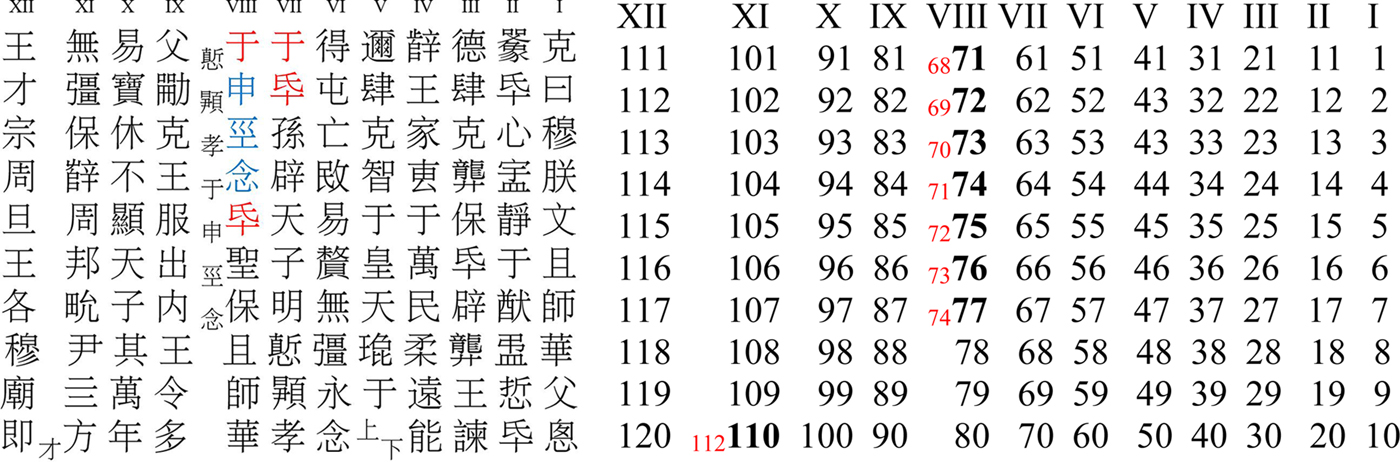
A quick inspection of the Larger Ke ding inscription reveals that the first section of the inscription is indeed prone to bring about dittography: Both column VIII (with the sketch-lines) and neighboring column VII begin with the character yu于. In column VIII, the sequence runs yu shen jing nian jue 于申巠念氒, while column VII has the sequence yu jue 于氒. It appears more than likely that during the ordination of column VII, four (sic) characters from the neighboring column VIII (shen jing nian jue申巠念氒) were mistakenly incorporated into column VII right below the first character yu, and only after laying out the character jue which was, coincidentally, planned to follow immediately after yu in column VII, the ordination returned to the correct order. This shifted the textual sequence three characters back, exactly as is indicated by the “ghost” characters.
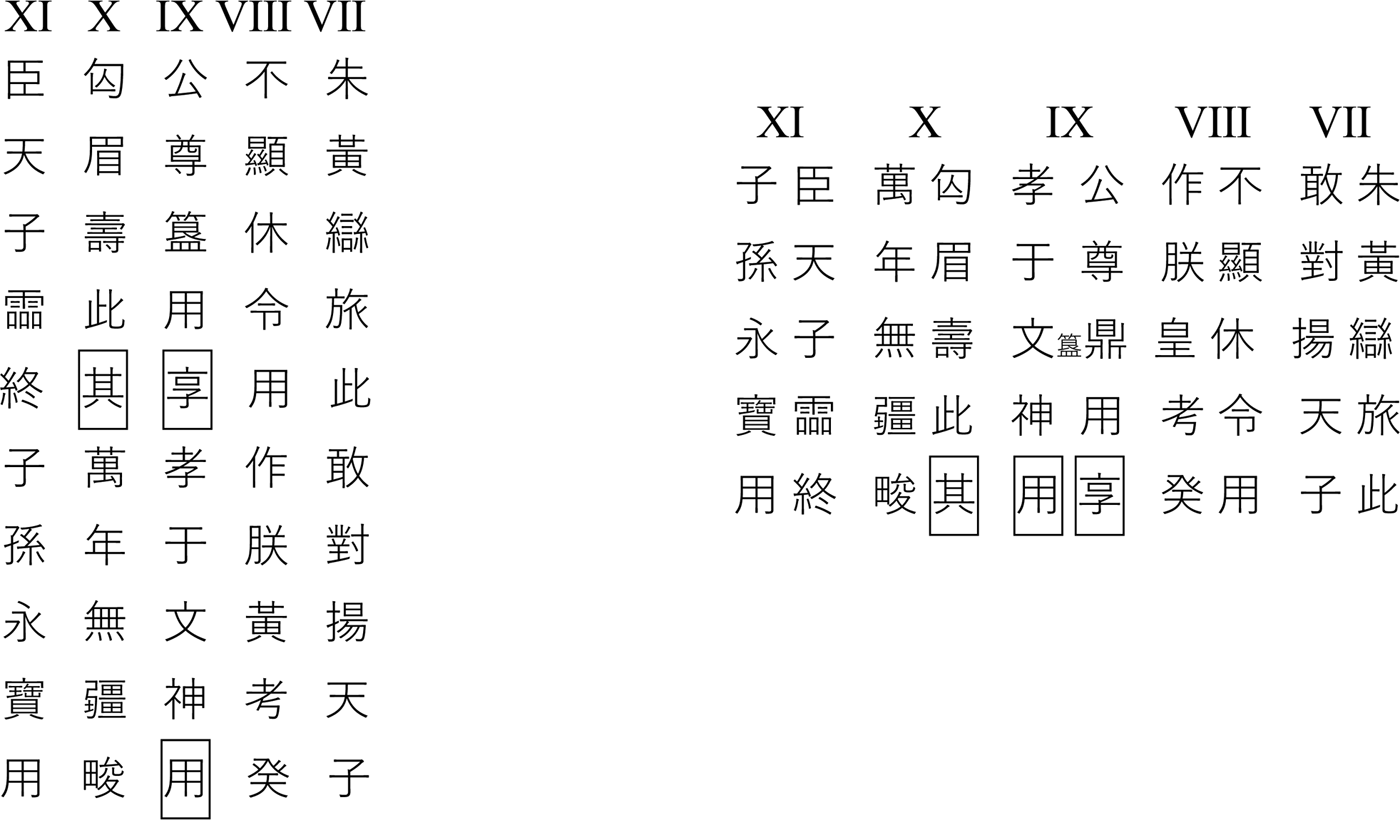
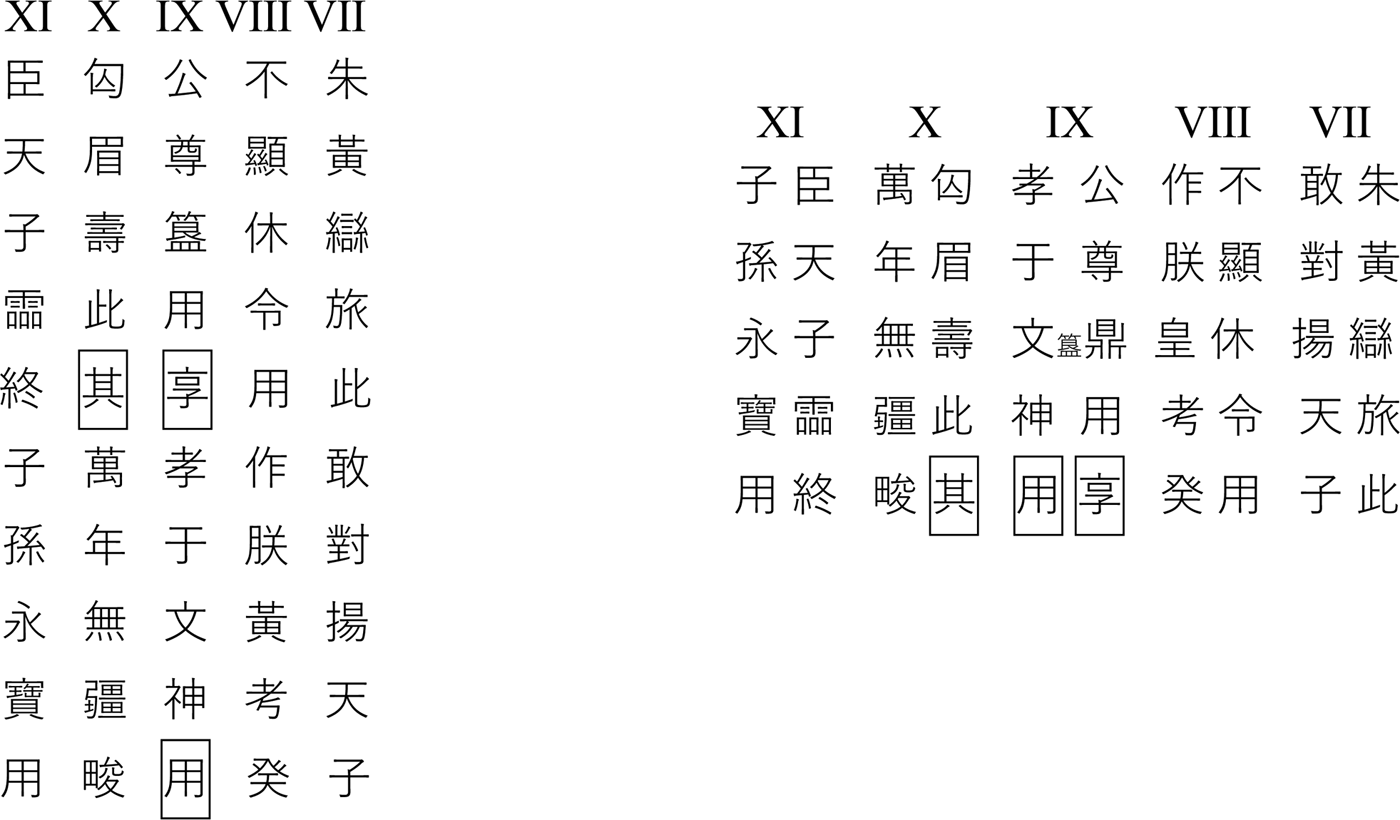
The subsequent omission of five characters indicated by the appearance of the character zai 才 under the character fang 方 is more problematic. No two characters appearing in the position of the fifth or tenth character-space in each column are sufficiently similar to provide grounds for consideration of haplography. This finding leads to a consideration of the possibility that the text on the blueprint might have been divided into shorter textual sequences of five characters per column to facilitate the ordinator's orientation in the process of copying long columns in mirror-writing. While this was perhaps not the case for the Shi Ke xu inscriptions, such division seems to explain best the textual mismatch in the Liangqi zhong inscription analyzed above. The case of the aforementioned Ci gui further confirms that this was indeed a practice in at least some Late Western Zhou bronze workshops. As noted above, the inscription on one of the gui tureens, 75QDJ:13 (Jicheng 04310, layout 10×11), omits three characters, namely, the character xiang 享 in column VIII and the characters yong 用 and qi 其 in column IX. The occasional omission of characters is not uncommon in bronze inscriptions; however, if we project the location of omitted characters on the supposed master-layout for the two Ci ding (Jicheng 02821, 02823, layout 11×10), we can observe that the omitted characters are positioned either as the fifth (xiang, qi) or the tenth (yong) character of the column (Figure 17 left). If we rearrange the layout into five characters per column, the three omitted characters end up in the bottom position in three neighboring columns (Figure 17 right). We can thus conjecture that despite its difference in layout (ten columns with eleven characters each), the 75QDJ:13 gui inscription was laid out using the 11×10 blueprint of the 75QDJ:3/5 ding inscriptions, and the omission of the three characters was brought about by physical damage to the blueprint or by accidental covering of the characters during the ordination process. This case further corroborates the above observations that one blueprint was reused by several ordinators working on a set of identical inscriptions, and that one blueprint was reused for several types of vessels (here ding and gui).Footnote 88 Further circumstantial evidence can be drawn from the inscription on the smallest Forty-third Year Qiu ding 卌三年逑鼎 (YJ4 [Mingtu 02512]), which, most likely for spatial reasons, omits exactly 15 character-spaces si yi, huang kao qi yan zai shang, yi zai xia, mu mu bing ming de  彝, 皇考其嚴才上, 廙才下, 穆二秉明德 (“sacrificial vessel. [My] august father is majestic on high, respected below, beautifully holding fast the bright virtue”). As this omission disrupts the syntax of the remaining inscription, it is very likely that the blueprint for the set of Forty-third Year Qiu ding cauldrons also contained five character-spaces in each column, and that for the sake of space, three columns were mechanically dropped in the process of ordination of the YJ4 vessel's inscription.
The master-layout of the 75QDJ:3 and 75QDJ:5 Ci ding inscriptions (left) and reconstruction of their short-column blueprint (right). The characters omitted on the 75QDJ:13 gui inscriptions are marked by enclosure. The character gui 簋 is noted next to the character ding 鼎 (right).
Returning to the Larger Ke ding inscription, it is possible that its blueprint was written in five-character columns like that of the Ci vessels, and that somewhere between the ordination of columns IX and XI, one column was unintentionally dropped, resulting in the pre-position of the “ghost” character zai.
But how did the “ghost” characters come into being? In my opinion, the otherwise problematic existence of the rilievo sketch-lines in the Larger Ke ding inscription can be easily explained by the tube-lining technique: The characters were first carved into a clay slab according to the blueprint, and it was during this carving that the two mistakes discussed above appeared. After the sketch of the inscription was carved but before the tube-lining itself, the text was proofread and mistakes were detected. Relevant parts of the text were recarved over the existing grooves, which were for some reason left unleveled. Subsequently, the corrected text was tube-lined, resulting in a rilievo text with leftovers of intaglio grooves of sketched characters in several places.Footnote 89 Once cast, this resulted in the intaglio inscription with rilievo traces of sketch characters. Note that should these sketched “ghost” characters be explained by the commonly accepted “master-pattern” technique, the sketch of this inscription would also have to be carved in mirror-reversed form, then imprinted, recarved again, imprinted once more, and only then embedded into the inner mold, not to mention that the only reason for such a deviation from the standard “master-pattern” procedure would be the creation of undesired “ghost” characters and the rilievo grid-line that was, for the most part in this inscription, as well as in the majority of other cases, polished off after casting.Footnote 90
Moreover, in his treatment of the Larger Ke ding, Zhou Ya noticed another remarkable feature of this inscription: Several characters, for example, gong 龏 (III.4), min 民 (IV.7), jue 氒 (VIII.5) and zu 且 (VIII.8), as listed in Figure 18, are cast partially in rilievo and partially in intaglio form.Footnote 91 There seems to be little doubt that this phenomenon is a result of the rilievo strokes on the clay slab being washed away by molten bronze during the casting procedure. Should the inscription be produced by the “master-pattern” technique, the swept strokes would either leave no trace or slight intaglio traces. In the present case, however, the strokes that were swept away are still preserved in rilievo form, a phenomenon that cannot be explained by the “master-pattern” technique other than that this was indeed the caster's intention.Footnote 92 Contrary to such an unlikely scenario, this phenomenon is easily explained by the tube-lining technique, in which in case the rilievo clay cords would be washed away, the remaining intaglio sketch grooves would turn into rilievo strokes after casting.Footnote 93
Detail of the characters in the Larger Ke ding inscription, from left to right: gong 龏 (III.4), min 民 (IV.7), jue 氒 (VIII.5) and zu 且 (VIII.8).
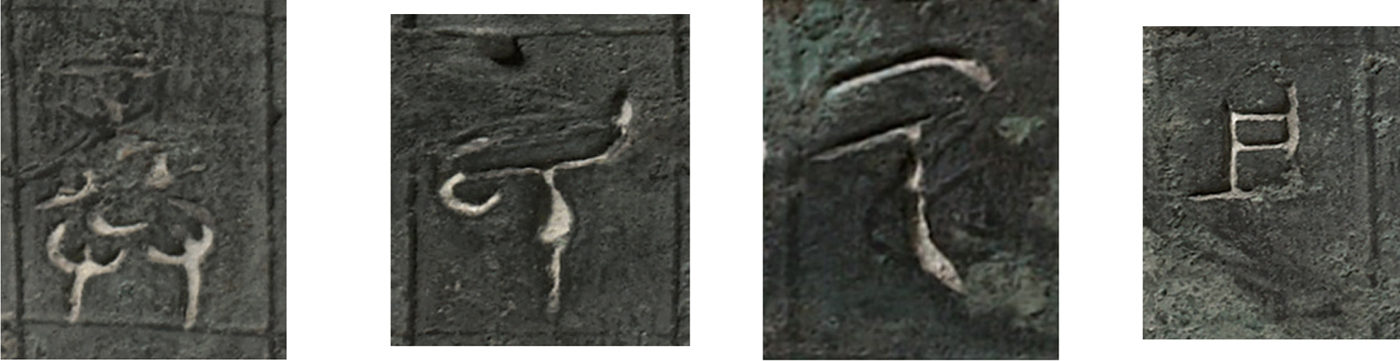
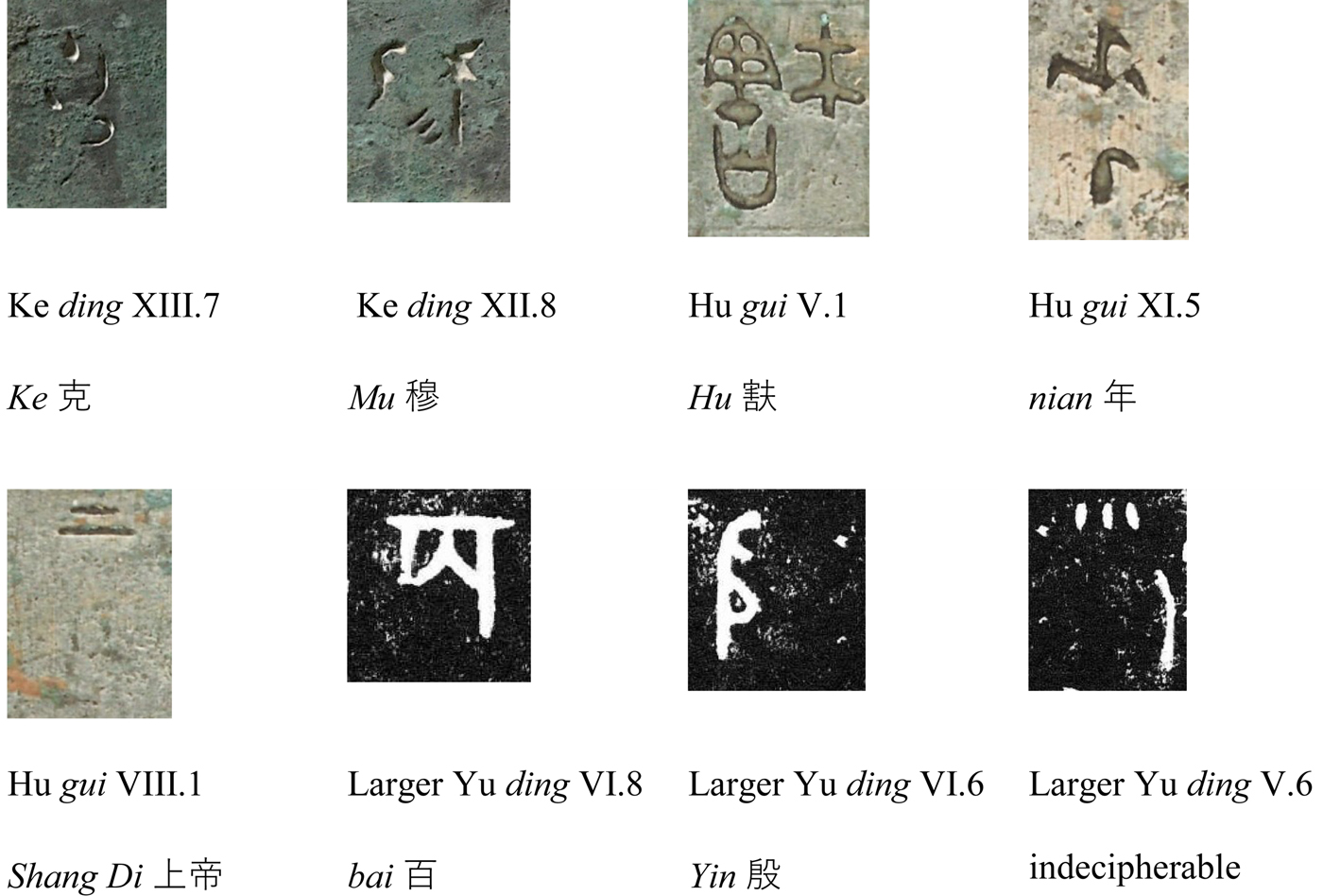
Characters of this sort are present in nearly every column on the right-hand half of the Larger Ke ding inscription. I believe it is this feature that explains best why this part of inscription was left unpolished. If it were polished, the rilievo strokes of many characters would disappear, and as a result, several characters would become illegible. Proceeding from the left part of the inscription, the artisans probably realized this after having polished columns XIII, XII, and the upper part of columns XI–IX, which rendered the characters wu 無 (XI.1), bao 保 (XI.3), Mu 穆 (XII.8), and especially Ke 克 (XIII.7) well-nigh illegible (see Figure 19), and subsequently dismissed the polishing procedure.Footnote 94 It appears that in this case, the casters were concerned with the legibility of the inscription they produced.Footnote 95 Characters with “missing” strokes, a phenomenon fairly widespread in Western Zhou bronze epigraphy, can thus be easily understood in light of the above discussion, as they represent remnants of the rilievo strokes that appeared on places where the clay cords broke off or dropped during the casting and that were subsequently polished off. This phenomenon often occurs repeatedly within the same inscription; in the above-mentioned Hu gui, for example, it occurs at least ten times; notice the slightly rilievo leftovers of polished strokes still visible in the characters Hu 㝬 (V.1) and Di 帝 (VIII.1). Among the earlier inscriptions, the Larger Yu ding inscription has at least five instances of missing strokes. Some of these are given in Figure 19.
Detail of characters with polished strokes from the Larger Ke ding, Hu gui, and Larger Yu ding inscriptions.

The palimpsestic feature of the Larger Ke ding inscription sheds additional light on several issues discussed in this article. Together with the inscription on 75QDJ:13 Ci gui, it suggests that the textual arrangement in the blueprint might have been adjusted to ease the ordination by breaking longer columns into two parts of equal length, in this case, five character-spaces. This practice seems to be corroborated by the Liangqi zhong case above, where the blueprint was further split into four (or two two-sided) pieces of equal length. Such a solution necessarily required that a brief annotation specifying the desired master-layout be provided in the blueprint. Disregarding or misinterpreting such an annotation would then lead to alteration of the assigned master-layout. Recall the case of Ci's vessels where one ordinator laid out 110 character-spaces in eleven columns with ten character-spaces while another opted for ten columns with eleven character-spaces.
In terms of inscription-making technique, the Larger Ke ding inscription corroborates the existence of the tube-lining technique during the Late Western Zhou and suggests that it was already widespread during the Middle Western Zhou. The reason we do not see more “ghost” characters in other inscriptions is simply because the inscriptions were usually finalized by polishing.Footnote 96 As for proofreading, the Larger Ke ding inscription specifies the time when it was performed: after the sketch of an inscription was carved, but before it was tube-lined.
Conclusion: Implications for the Study of Bronze Inscriptions
Making use of the notions of “character-space” and “master-layout,” the inscriptions were planned with the utmost care and their production demanded a major mobilization of technological resources. From this point of view, any argument about textual corruption, omission, or mistake in a bronze inscription must take as its departure point an analysis of the visual qualities of an inscription. In fact, any consideration of an inscription must begin with the evaluation of its layout in order to grasp the basic framework to which the inscription's text was confined. With its compositional and visual standards, the bronze inscriptions were not mere documents cast in bronze; they constituted a genre of their own.Footnote 97
In his introduction to a volume on the visual qualities of medieval inscriptions, Antony Eastmond writes:
Inscriptions have tended to be treated as collections of words, whose materiality is incidental. Such assumptions underlie the origins of the great corpora of inscriptions, which were often motivated by positivist concerns about the factual content that could be gleaned by reading such texts … The essential premise of this book is that inscriptions are not just disembodied words that can be studied in isolation. Instead they must be considered as material entities, whose meaning is determined as much by their physical qualities as by their contents. None of the chapters seeks to deny the importance of reading inscriptions. Indeed the contents remain important and are central to understanding the ways in which they have been set up and used. However, in addition to their contents, the ways in which words were presented to onlookers is a key source of information and a generator of meaning that should not be ignored. Meaning can be generated simply by the formal qualities of inscriptions: the shape and arrangement of the script used, the size of letters, the legibility and readability of the inscription … Meaning is further developed by the relationship between the texts and their physical contexts. The layout and sequencing of texts can affect how viewers interact with the buildings or landscapes in which they are located. The visual qualities of texts, the ways in which they wrap around buildings or cluster in particular places, can give them agency to encourage ritual or other interactions between readers/viewers and the texts or monuments.Footnote 98
Despite certain qualitative differences, such as placement and size, Eastmond's observation is highly relevant to the Western Zhou bronze inscriptions. Through the study of manuscripts used in the process of preparation of bronze inscriptions for casting, it became clear that in many cases, the bronze inscriptions were conceived not as “collections of words,” but rather as visually relevant display texts whose graphic presentation mattered so much that it would actually set certain limitations for their content: In the process of the negotiation of the content of an inscription, it was sometimes the form that prevailed over the meaning. A new notion that entered contemplations about the textual display in Western Zhou times was symmetry. From the second half of the tenth century b.c.e., after a century or so in which the quest for symmetry was occasionally reflected by the equal character count in each column, the regular stoichedon style of layout became a popular mode of textual display on bronze inscriptions cast by Western Zhou elites to the extent that the composition of a bronze text would sometimes take account of it. When reading these texts, our first task should be to identify whether and to what extent their content is circumscribed by their form. The issue that awaits further inquiry is the underlying causes that sparked such developments.Footnote 99 However, the desired symmetry was not always achieved, and the complexity of the transfer of the text from the master copy to the inscription mold is to be blamed.
The visual self-awareness of bronze texts is utterly relevant not only for the discussion about symmetry and early Chinese aesthetics, but also for any philological research that touches upon the bronze inscriptions, be it research on grammatical phenomena in the language of bronze inscriptions, where an intentional omission can serve as an argument for grammatical acceptability of the abbreviated form,Footnote 100 or research into textual analogies, both among several inscriptions and between inscriptions and other unearthed or transmitted texts. It goes without saying that the sharing of blueprints by different vessel types has direct implications for the study of vessels’ self-appellations, a trending research topic in recent years.
Inquiry into the manuscript world beyond the clay slabs also yields important observations about the organization of bronze inscription production. Note, however, that most of the evidence surveyed in this article dates to the Late Western Zhou, and the observations thus pertain first to this period. While the existence of master copies was expected, the intermediary manuscripts or blueprints represent hitherto unknown instances of writing. Based on the inscription's master copy, a blueprint served as the ultimate exemplar for the ordination of an inscription, and could be subject to further adjustments, corrections, annotations, markings, or divisions. Despite such treatment, a single blueprint would be used by different ordinators working consecutively to produce an entire set of inscriptions on various vessel types. One may only speculate what the reasons for such an economy in the production organization could have been, but the possibility that the blueprint was rendered in mirror-writing could be one of the contributing factors.Footnote 101 Upon ordination, the intact master copy was used for proofreading of the engraved text. Overall, the manuscripts certainly were not overused in a bronze workshop. Regarding their physical qualities, it was a practice in some major bronze workshops to break the longer columns into five character-spaces in order to ease the ordination process. Since it was possible to add an annotation next to the ultimate column of the Shi Ke xu blueprint, and since the whole chunk of text was misplaced during the ordination of the Liangqi zhong, it seems more likely that these auxiliary manuscripts were written on solid wooden or bamboo tablets rather than on bound bamboo strips; this hypothesis is further corroborated by the fact that so far not a single instance of a misplaced or missing strip has been identified in Western Zhou bronze inscriptions.Footnote 102
Importantly, the case of Larger Ke ding inscription also proves that the tube-lining technique was in use by the Late Western Zhou period and places the proofreading procedure between the engraving of sketch characters and the final tube-lining. Both observations can serve as subsidiary indicators of the authenticity of an inscription. The reconstruction of the procedure of preparation of a (longer) bronze inscription for casting during the Late Western Zhou times may thus be schematized as follows:
→draft of the inscription
→ (=) master copy (specifying master-layout)
→blueprint (mirror-reversed?)
→ordination (engraving mirror-reversed sketch-line characters on the clay slab)
→proofreading
→corrections
→tube-lining
→casting
→polishing
Although this study does not answer the question of the authorship of an inscription, it can contribute to discussion regarding a donor's involvement in the composition and production processes. In this instance, intentional textual omissions are of high importance and should receive further attention. Were these omissions necessarily approved by the donor of the vessel, or were they performed based on the judgment of the ordinators in the workshop? The cases of First Year Shi Shi gui, Jian gui, and Shi Ke xu seem to indicate the latter possibility. The fact that most of these omissions take into account their context further indicates that the ordinators relied on a certain degree of literacy in their work. This seems to be corroborated by the prevalent location of corrections in the beginning lines of inscriptions, which shows that ordination followed the direction of the text from its beginning, and thus that the ordinators preferred to write the text in its natural sequence.
Incorporation of proofreading into the workflow of inscription-making shows the high concern that the workshop had with delivering a readable product. Moreover, the rearrangement of the text on the Liangqi zhong inscription and unfinished polishing of the Larger Ke ding reveal that certain effort was made by ordinators and craftsmen to facilitate both the readability and legibility of these inscriptions.
The case of Shi Ke xu suggests that a certain hierarchy existed among ordinators. In the lineage-based craftsman communities of Western Zhou times, we can expect that experienced senior ordinators would instruct and supervise the less experienced junior ordinators.Footnote 103 It might well be that it was chiefly these junior ordinators who were responsible for the kind of textual infelicities surveyed in this article. In light of the complexity of skills demanded in the process of ordination, it appears that this would be a highly specialized occupation that was not available in every bronze foundry. Possibly as a result, even inscriptions disregarding the prescribed master-layout could have been considered a satisfactory outcome.
Any philological work should be aware of the processes by which the text under scrutiny came into being. Although we do not have the comfortable evidence in the form of shop signs inviting ancient Roman passersby to have their inscriptions laid out and carved,Footnote 104 some insight into the complexity of the process by which a bronze inscription came into being can be gained from the above discussion. I believe that the scattered imprints of the ephemeral manuscript world in the enduring realm of cast inscriptions, complemented by archeological surveys of bronze foundry sites, will gradually yield an increasingly vivid image of the complex and dynamic background of the great cultural phenomenon of bronze inscription casting in Early China.