




No CrossRef data available.
Fosterage, Kinship, and Legend: When Milk Was Thicker than Blood?
Published online by Cambridge University Press: 31 January 2005
Extract
When social ties are put to the test, proverbs affirm, those of consanguinity usually prevail: “Blood is thicker than water”; or as Arabs put it, “Blood is thicker than milk” (Lane 1893:1097). These enigmatic adages refer to former institutions of adoptive kinship in western Eurasia, contrasting the blood of natal kinship with the water of baptism or “spiritual kinship” in Christendom, and with infant fosterage or “milk kinship” in Islam. Other sayings, cited as epigraphs above, argue that the nurture of such adoptive kinship may match or supersede natal kinship, just as baptismal sponsorship was supposed to create a spiritual cognation superior to that of mere flesh and blood (Gudeman 1972; Guerreau-Jalabert 1995).
Information
- Type
- Research Article
- Information
- Copyright
- © 2004 Society for Comparative Study of Society and History
“Le lait va aussi loin que le sang!” dit un vieux proverbe Ossétien (Kovalevsky 1893: 213).
“Milk is more significant that rod [agnation] . . . it lasts forever” (Filipović 1982:131–33).
“Fostering is two-thirds of a child's nature” (Irish proverb, cited in Gwynn 1913:106–7).
When social ties are put to the test, proverbs affirm, those of consanguinity usually prevail: “Blood is thicker than water”; or as Arabs put it, “Blood is thicker than milk” (Lane 1893:1097). These enigmatic adages refer to former institutions of adoptive kinship in western Eurasia, contrasting the blood of natal kinship with the water of baptism or “spiritual kinship” in Christendom, and with infant fosterage or “milk kinship” in Islam.1
On this broad (non-jural) usage of adoptive kinship for familial relations created by pro-parenthood, see Parkes (2003: 744). Reference to christening water in the English proverb is recorded from the eighteenth century, although the saying has obscure (possibly Gaelic) origins before its mention in John Ray's English Proverbs of 1670. On Arab milk kinship counterposed with ritual or sacrificial blood-kinship, see Robertson Smith (1885: 48).
Ritual kinship and milk kinship have comparable and connected social histories in western Eurasia, which were examined in earlier essays in this journal (Parkes 2001; 2003). But while Christian godparenthood has been well explored in symbolic ethnography (Fine 1994; Héritier-Augé and Copet-Rougier 1995), the significance of infant fosterage seems poorly documented (cf. Khatib-Chahidi 1992; Corbier 1999). Its ethnographic neglect may be due to its widespread modern demise as an institution of clientage. But its former significance may be retrieved from accounts of peripheral regions of western Eurasia where allegiance fosterage persisted until recent times.2
On such allegiance fosterage, distinguishable from the “crisis fostering” of orphans by close kin, see Parkes (2003: 743f., after E. Goody 1982 on “alliance fosterage”).
Cuckold Kinship
In his social history of child abandonment and fostering, John Boswell (1988: 84f.) alluded to a common disparaging metaphor for such adoptive kinship: the cuckoo's alien nesting of its eggs. From antiquity, the cuckoo became emblematic of a perverted kind of parentage, elaborated in allegorical bestiaries (Mannhardt 1858) and riddling verse about abuses of fosterage as “cuckold kinship” (Crawford 1999:124–25). Notoriously, the “ingrate cuckoo” was supposed ultimately to devour its attendant nurse and adoptive siblings (Hardy 1879:64–65; see, e.g., Shakespeare's King Lear I, iv, l. 235). Colonial disparagements of allegiance fosterage recurrently evoked this ancient avian imagery of perverted parentage. Gerald of Wales, whose twelfth-century diatribes against the evils of Irish and Welsh fostering are well known (Parkes 2003: 755), thus decried “the cuckoo who would devour his foster-parents when fully grown” (Speculum duorum, ed. Richter 1974:6), doubtless alluding to Welsh customary inheritance of peasant farmholdings by noble fosterlings (Smith 1992:21). Eight centuries later, Colonel Reginald Schomberg wryly observed how, in the Hindu Kush, “foster-parents continually show great devotion and abnegation to this cuckoo [sc. princely fosterling] in their nest, and their own children suffer” (1938:226; cf. Parkes 2001:12, 26).
Colonial abhorrence of cliental fosterage and its “unnatural ties” of cuckold kinship was vividly expressed in a royal report submitted to James I by the Attorney-General of Ireland, Sir John Davies (1612). Fosterage, together with gossipred or spiritual kinship, was one of “two customs proper and peculiar to the Irishry, which being the cause of many strong combinations and factions, do tend to the utter ruin of a commonwealth”:
[T]hey put away all their children to fosterers, the potent and the rich men selling, the meaner sort buying the alterage [fostering, Irish altram] of their children. And the reason is because in the opinion of this people fostering hath always been a stronger alliance than blood, and the foster-children do love and are beloved of their foster-fathers and their sept more than of their own natural parents and kindred, and do participate of their means more frankly, and do adhere unto them in all fortunes with more affection and constancy . . . The like may be said of gossipred or compaternity (Davies 1612 in Morley, 1890:296–97).
Like Gerald of Wales, Sir John Davies recognized the anarchic implications of adoptive kinship in instigating factional coalitions and conspiracies:
Now, these two customs [fostering and gossipred] become exceedingly evil and full of mischief in this realm . . . For they made strong parties and factions, whereby the great men were enabled to oppress their inferiors and to oppose their equals; and their followers were borne out and countenanced in all their lewd and wicked actions. For fosterers and gossips, by the common custom of Ireland, were to maintain one another in all causes lawful and unlawful, which, as it is in a combination and confederacy punishable in all well-governed commonweals, so was it not one of the least causes of the common misery of this kingdom (Ibid.).
Sir John Davies was one of the main architects of the English juridical dismantling of Irish traditional states in the seventeenth century (Pawlisch 1988). His denigration of their “barbarous” and “unnatural” customs was therefore designed to justify his own radical plans for Ireland's imperial reformation, just as Gerald of Wales had earlier staked moral claims to colonization with an identical disparagement of Celtic fosterage (cf. Gillingham 1992). But despite their ideological motivation, these colonial opinions were not ungrounded in observation (Fitzsimons 2001). Tributary factions of adoptive kin did seem to have an affinity with instabilities of dynastic succession in segmentary states, albeit consolidating power once succession was secured (Parkes 2003:760). Nor was such fosterage invariably condemned in colonial imagination. Some English observers, such as Edmund Campion in the sixteenth century, rather admired how the Irish “love tenderly their fosterchildren, and bequeathe to them a childes portion whereby they nourish sure friendshippe, so beneficial in every way, that commonly five hundredth kyne and better are given in reward to winne a nobleman's childe to foster” (“A History of Ireland” [1571] in Ware 1809:19).
Colonial denigration of fosterage may also be matched by its troubled indigenous evaluation. Surveying its legendary representations in this essay, we shall observe a recurrent moral ambivalence surrounding its challenges to contrary claims of consanguinity. Allegiances of foster-kinship might be romantically valorized as emblems of secure trust in segmentary states of episodically violent animosities, “whereby they nourish sure friendshippe.” Yet these delegated parental ties, like similar bonds of spiritual kinship, were recognized to be compacts of a somewhat fictitious filiation between disparate ranks. They might even encourage exploitative social parasitism and treachery towards one's natal kind, when “preferring their foster-children and milk-siblings (alumnos et collactaneos), they would persecute their own brothers and cognate kin (fratres et cognatos)” (Gerald of Wales, Topographia Hibernica Dist. III, c. 23; ed. Dimock 1867:167–68). Fealty and treachery, natural sociality and unnatural allegiance, incest and kin-slaying—these emerge as recurrent motifs in the narrative symbolism of tributary fosterage:
All who have suck'd the same breasts are very kind and loving, and confide more in each other than if they were natural brothers, so that they will have an aversion even to their own brothers for the sake of these (William Good “Descriptions and Customs of the Wild Irish” in Camden 1722, ii:1418).
The foster-brothers—I mean the children of the nurse and strangers that have sucked her milk—love one another better than natural brothers, and hate them in respect of the other . . . and some oppose their own brothers to death that they might save their foster-brothers from dangers thereof (Fynes Moryson's “Itinerary” [1592] in Falkiner 1904: 318).
Milk and Blood: Atalyk Fosterage in Abkhazia
Infant fosterage in premodern Eurasia was commonly identified with consanguineal kinship created by suckling breastmilk, as is still recognized in Islamic law.3
On Islamic milk kinship, see references in Parkes (2003: 746–51) and Parkes (n.d.a; also Ensel 2002). Cf. Dixon (1999: 221) on ancient Roman fosterage: “The root meaning of fostering inheres in the relation of feeding at the breast of someone other than the mother . . . The relationship was generally one of patronage, but cast in terms of quasi-kinship between people of unequal social standing.”
Abkhazians considered kinship created by delegated suckling fully equivalent to consanguinity. As Aristotle and Galen had supposed, breastmilk was thought to be a purified refinement of a woman's uterine blood.4
Aristotle De generatione animalium IV.viii. Milk's derivation from a woman's uterine blood, conveyed by veins linking the womb to the breasts, was a widespread Eurasian notion, also found in Arab medicine (Giladi 1999), thus underpinning both Islamic and eastern Christian canonical reckonings of milk kinship (Parkes n.d.a; Benkheira 2001). Its implications for breastfeeding and delegated nursing are detailed in the Gynecology of Soranus of Ephesus (Temkin, ed. 1956: 88–101).
Aristotle Politics I: 1252. Attic homogalaktes was plausibly interpreted as an archaic term of milk kinship by Wilamowitz (1889: 57, n.16). For further discussion, including its gloss by Philochorus and Pollux, see Jacoby (1954 I: 321–23, II: 231), Hammond (1961: 79–80), and Derks (1995). Modern Greek omoghalaktes is noted by Kenna (2001: 89) as an extant term for milk-siblingship by co-suckling in island Greece, where it is still treated as an impediment to marriage.
This ideal collaboration among milk kin was, however, subject to ambivalent reflection. Abkhazian oral histories recounted tragic treacheries among milk-brothers, as well as gross abuses of trust, including incestuous “profanation of the breast” committed by fostered lords on their kinswomen by milk. Inal-Ipa comments: “With this so-called ‘mutual assistance’ [of milk kin] in bloodfeuds, as in all similar affairs, the side of the good old atalyk fosterer, being peasantry, suffered incomparably more, as one might expect” (1956:102). Blood debts of vengeance among nobility could be exacted on their peasant foster-kin as proxy victims. Yet disparities of rank entailed disparities of vengeance and compensation among milk kin, belying a supposed reciprocity of mutual obligation created by sacred breastmilk: “If a prince killed a peasant, then the kin of the latter had no rights of blood vengeance; for as they said, ‘The blood of a peasant is not worth the blood of a prince.’ And so, in place of a murderous prince, his atalyk fosterer had to answer for the blood he had spilled” (ibid.). Just as Schomberg had reported grumbling resentments of vassal fosterers in the Hindu Kush—where “foster-brothers have spent all their substance on some useless brat of the aristocratic class, and in return have received no recompense, no gratitude, and no protection” (1938:225)—it may be indicative that the Abkhazian term akhupka for a fostered ward was proverbial for an overindulged ingrate. An obnoxious visitor would be told: “You allow yourself a lot of liberties, just as if you were our akhupka [fosterling]” (Benet 1974:58).
Abkhazian milk kinship could be extended by symbolic suckling at the breast, incorporating adults as well as infants, with identical moral obligations and impediments on marriage to those created through infant fosterage. Ritual adoption by token suckling or “breast-biting” (akءukatshara) was employed to defuse suspicions of adultery or to create conciliatory milk kinship after bloodfeud. It was also used to create reciprocal bond-partnerships, with a mutual “biting of the breast” of one or both of the adoptive brothers' mothers, and occasionally of their own male nipples, as also occurred in the Hindu Kush (Inal-Ipa 1956:72f.; cf. Parkes 2000:276). But such symbolic adoption was primarily deployed as a performative rite of fealty between peasant and lord, the latter assuming the role of akhupka fosterling, and so receiving “his share” of tribute and labor services in a kinship idiom of foster-prestations. Collective vassalage by “breast-biting” adoption would be undertaken by whole village communities with regional bailiffs, allied by real or symbolic milk kinship to feudatory overlords, who were allied in turn as fosterers and milk kin to ruling princes (Inal-Ipa 1956:74–75). Caucasian atalyk fosterage thus comprised a pervasive feudatory network of tributary allegiances, similar to milk-kinship chains of dynastic fealty in the Hindu Kush (Parkes 2001). In both regions, milk-kinship ties were perpetuated by reiterated contracts of fosterage in each generation, treated as social “heirlooms” of hereditary vassalage or tenant service (Inal-Ipa 1956:18).
Inal-Ipa's ethnography of Abkhazian milk kinship also elucidates the narrative symbolism of infant fosterage elsewhere in western Eurasia. In an Old Irish tale of Fergus Mac Léti, for example, this legendary king of Ulster was said to be instructed by leprechauns in their custom of “sucking at the nipple” as a token of submission (Binchy 1952:41–42). This rite is evinced in Old Irish sayings treated by O'Brien (1938), which explain why cích “breast, nipple” became synonymous for “peace-treaty” and “friendship,” and why “breast-sucking” (sugere mammellas) refers to sworn loyalty in the Confession of St Patrick. Gricourt (1957) noticed other allusions to such symbolic suckling recurring in Irish hagiographies, suggesting that Celtic fosterage, like Norse fóstr-kinship, may have been once instituted as a form of tributary milk kinship comparable with atalyk fosterage in the Caucasus.6
This is confirmed by Maier (1999). Provision for crib-clothes in the Cáin Íarraith laws indicates that early Irish fosterage was commonly inaugurated by infant nursing (Ó hInnse 1943:8f.; Kelly 1988:87), as is also attested in a late Elizabethan tract reported by Fitzsimons (2001; see n. 21 below). Cf. Smith (1992: 11–12) on “placing upon the breast” in medieval Welsh fosterage; also Schultze (1936) and Strauch (1980) on early Germanic Milchbrüderschaft. On comparable milk-kinship allegiance and dynastic fosterage in medieval Armenia, see Bedrosian (1984) and Gadzhieva (1995) on atalyk fosterage and milk kinship in eighteenth- and nineteenth-century Daghestan.
Fosterage and Legend
Over seventy years ago, the French classicist Louis Gernet published an erudite essay, “Fosterage et légende” (1932), examining numerous instances of such infant fosterage in the Homeric epics. A recurrent motif was that of the hero, such as Theseus, sent away at birth to be nursed and raised by maternal kin. Infant nursing of princes might be undertaken for their protection, as was Nestor, fostered at Gerenia before his return to rule at Pylos. Sometimes a legacy of heirlooms was deposited for the child to retrieve on maturity, such as the sword and boots deposited under a rock for Theseus. In legends of Attic kings, fostering by maternal kin might be concluded by epiklerate in-marriage, securing succession from an avuncular fosterer and father-in-law (cf. Bremmer 1983). Other Greek myths and legends simply related the “carrying” of heroes at birth to their appointed nurses, whose husbands would serve as the child's pedagogue: the mythical prototype of such foster-tutelage was the centaur Cheiron, who successively raised such heroes as Achilles as warrior, Actaeon as hunter, and Asclepios as healer (Fig. 1). Gernet concluded that infant fosterage must have been institutionalized in archaic Greece.

Achilles entrusted by his father Peleus to the fosterage of the centaur Cheiron. (Other depictions normally show the hero as a babe in arms.) 5th cent. BC red figure stamnos in the Musée de Louvre, Paris (G186). Illustration from Herman (1987:24, Fig. 1A)
Epigraphic analyses of funerary epitaphs—particularly among Greeks of Asia Minor (Cameron 1939)—corroborate such delegation of infants to subordinate fosterers, creating ties of adoptive kinship (threptós, syntrophoi) apparently similar to those of Caucasian atalyk fosterage (cf. Nani 1944; Levick et al. 1988:xliv–lvi). Etruscan depictions of the mythical adoption by suckling of an adult Hercules by the goddess Hera or Juno (Fig. 2) suggest milk kinship symbolically underpinning such fosterage, as was adduced by Josef Kohler (1905; cf. Deonna 1954:250–55; Renard 1964). Diodorus of Sicily, alluding to this myth in the first century B.C., already supposed it to be an archaic Greek rite of adoptive parentage, noting that it was “a ceremony still in use among barbarians when they want to adopt a child” (Diodorus IV ch. 39.2).7
Identical rites of symbolic adoption by suckling, typically associated with milk kinship, have been observed throughout the eastern Mediterranean: e.g., Baddeley (1940, I: 263) for Caucasians, Armenians, Azerbaijanis, and Kurds; Granqvist (1947: 114) for Palestinian Arabs; Ciszewski (1897: 104–5) for Bulgarians; and Sant Cassia and Bada (1997: 147) for modern Greeks. Cf. Leclant (1951) and Roehrig (1990) on similar dynastic rites of suckling and milk kinship in ancient Egypt.

The ritual suckling of Hercules (Hercle) by Hera or Juno (Uni), establishing the mortal hero's apotheosis within the Olympian pantheon by milk kinship. Etruscan bronze mirror engraving from Volterra in the Museo Archeologico, Florence (72740; see Monaco 1933). Illustration from Deonna (1954:153, Planche VI, Fig. 9).
Oedipus Threptós: Foster-Kinship in Ancient Greek Legend
Gernet showed that ancient Greek legends of infant fosterage were preoccupied with predicaments of succession and alliance among ruling descent lines. Building on earlier scholarship that had focused on symbols of exposure and fosterage in legends relating to Oedipus (Comparetti 1867; Constans 1881; Robert 1915; cf. Nilsson 1922), Gernet suggested that fostering and adoptive kinship might have served as an effective strategy of heirship (cf. J. Goody 1973), often securing succession by uterine filiation. Repeated allegiances of combined fosterage and marriage between royal descent lines were notable in Attic as well as Theban dynastic legends, and Gernet discerned related motifs of ambivalent hostility between mother's father and daughter's child. The latter was typically exposed at birth—like Oedipus—before being accepted for fosterage and succession, sometimes achieved by the fosterling's ominously predicted murder of his mother's father. For Gernet, such legends reflected ancient rites of royal initiation and investiture by foster-adoption. A similar scheme of archetypal myths of fostering had been proposed by Luria (1927), subsequently elaborated in Vladimir Propp's (1944) formulaic analysis of Oedipal myths and their medieval legacy in tales of Judas, Pope Gregory, and Andrew of Crete. Various kinds of incest and kin-slaying were motivated by the fated child's exposure at birth—typically due to his own incestuous conception—followed by his suckling and fosterage by animals, monsters, or social outcastes, his achievement of sovereignty by regicide, and his apotheosis as a miraculous god or repentant saint buried deep within the earth.8
On these Oedipal legends, see Edmunds (1985) and Bremmer (1987a), together with the articles collected in Edmunds and Dundes (1983). On “fosterage and avunculate,” see Bremmer (1976; 1983), who makes a plausible case for fostering by matrilateral kin as a common Indo-European institution (cf. Jaski 1999: 28–30), entailing clientage and/or succession by favored offspring of female agnates. See also n. 21 below.
Whatever the merits of Gernet and Propp's reconstructions of former uterine succession (or matriliny), infant fosterage in ancient Greek legends did seem to be associated with myths and rites of foundational sovereignty. It was also regularly associated with morally ambivalent predicaments of incest and kin-slaying, equally attested in Roman legends of Romulus (Bremmer 1987b:26–30). Propp's prototypical Oedipal motifs—the infant exposure and fosterage of a future ruler, often raised by humble shepherds or blacksmiths, as by supernatural spirits or animals—have since been shown to comprise a widespread Eurasian mythology of divine sovereignty, as exhaustively demonstrated in The Sargon Legend by Brian Lewis (1980).9
Lewis (1980: 149–209) summarizes over seventy Eurasian tales featuring the infant exposure and fostering of heroes or divine rulers—including Sargon of Akkad, Moses, Cyrus, and Romulus—collating earlier surveys of this heroic tale type by Gerhard Binder (1964) and Donald Redford (1967). Bremmer (1987b: 26–27) discusses its original formulation by the Austrian mythographer J. G. von Hahn.
The Sasruquo Complex: Legendary Milk Kinship in the Caucasus
Legends of the Caucasus primarily concern the heroic exploits of the Narts, a mythical generation of divine brothers born to the goddess Satanay (Dumézil 1930; 1965; Colarusso 2002). Most admired was the lastborn Nart, Sasruquo. Miraculously conceived from a rock—by an incestuous union of Satanay with her paternal cousin Bataraz—Sasruquo was shortly sent into fosterage:
Unable to be nursed by his appointed foster-mothers due to his preternatural heat, Sasruquo was nourished on molten iron by the divine blacksmith Aynar, who thence becomes the hero's foster-father and initiator. He is even tempered in the smith's forge, rendering his body almost invincible. Later mocked as a bastard by his Nart brothers (or foster-brothers), Sasruquo sets out to seek his true father. This quest instigates his heroic adventures, whereby he retrieves millet seeds and fire stolen by giants. Their defeat is enabled by the treachery of a giantess, who adopts Sasruquo as her milk-son after his suckling at her breast. With the help of this giant milk-mother, Sasruquo “the milk-sucker” recaptures the stolen millet seeds and fire from the giants, later engaging in mortal combat those of his Nart brothers who had tyrannically oppressed their peasants. But Sasruquo is defeated when his Nart brothers ally themselves with the angry giants. They obtain from an old sorceress his one vincible secret: his knees or heel, originally grasped by the tongs of the fostering smith Aynar, which they cut through with a discus. Sasruquo is then dismembered and buried alive beneath a tumulus, awarding his miraculous powers to wild animals who refused to drink his blood.10
This synopsis collates Abkhazian Nart epics of Sasruquo with other Caucasian legends of this popular hero related in John Colarusso's Nart Sagas from the Caucasus (2002). On Sasruquo's suckling-adoption by the giantess, narrated in an Abaza legend, see Colarusso (2002: 210). On variants of Sasruquo's fostering and fire-tempering by a divine blacksmith, evidently reminiscent of Achilles, see Colarusso (2002: 53, 186, 388) and Tuite (1998: 314).
These legends of Sasruquo exemplify the plot motifs of proto-Oedipal fostering myths reconstructed by Propp, together with those of related Greek hero myths of Achilles, Prometheus and Perseus discussed by Gernet (cf. Tuite 1998). Born of an incestuous union, and fated to slay his own sons by impetuous accident, only incest committed by Sasruquo seems missing from Propp's archetypal schema (although this may be intimated in Abkhazian accounts of his physical incorporation of a devoted sister; see Dumézil 1968:563–67). Incest occurs in other Caucasian legends linking infant fosterage and exposure with tributary rule. An Abkhazian tradition of the origin of its princely dynasty thus derived it by “breast-profaning” descent from an only daughter of a former emperor of the Caucasus, Awblaa, reminiscent of Danae and Perseus (Apollodorus II iv.i, Frazer, ed. 1921 I:155; Binder 1981):
Sinfully ravished by her trusted atalyk milk-father, his fearful kin put the princess in a chest cast upon the waters. Subsequently discovered by a handsome youth, who marries her, the princess was again assaulted by the milk-brother of this husband. She then fled with her newborn child to the protection of a shepherd, before being reunited with her father at a feast given by the shepherd's lord. There she recognizes her old atalyk foster-father, who was executed together with the “breast-profaning” milk-brother of her husband. Her son Apsha [=Abkhaz] was then installed by Awblaa as the first ruler of Abkhazia (Inal-Ipa 1956:26–27).
Another Jocasta-tale, “Father and Son from the Same Womb,” related as a true story by Abkhazians, told of the unwitting marriage of a woman with her own abducted son, resulting in tragic suicide.11
This Abkhazian story ressembles widespread folktales of mother-son incest associated with exposure and fosterage treated in essays collected in Edmunds and Dundes (1983). S.v. Aarne and Thompson (1964), Tale Types 931–933. On the “mother's tragedy” as a prologue to the fostered male hero's biography, see Bremmer (1987b: 27–29).
The Keloghlan Boy: Fostering by Giants
Tales of the suckling adoption of legendary heroes by female giants have an extraordinarily wide distribution throughout Eurasia, as was revealed in Emmanuel Cosquin's essay, “Le lait de la mère et le coffre flottant” (1908). Examining a Malay legend about the introduction of Islam to Java, Cosquin noticed its ubiquitous Eurasian parallels. These included classic motifs of the infant exposure of a hero in a box cast upon the waters, followed by his divine suckling and child fostering.12
On this coffre flottant motif, see Krappe (1927: 12, n. 43) and Holley (1949). A parallel legend to Cosquin's Indonesian myth, recounting a similar introduction of Islam to Madagascar, is treated by Ottino (1984). Segmentary-tributary regimes of cliental milk kinship were characteristic of traditional states in both Indonesia and Madagascar.
See The Keloghlan and the Padishah's Youngest Daughter, in the Uysal-Walker Archive of Turkish Oral Narrative (Uysal-Walker 2003, vol. 29, Story 918: 87–111, on the internet). On the generic motif, s.v. Thompson (1956: T671 “Adoption by Suckling”).
Cosquin discovered that this story of milk-kinship adoption by a giantess was told throughout Turkic Central Asia and the Caucasus (cf. Roux 1967:52; Dumézil 1931:127–31; Grigolia 1962:159). It was found in Iranian oral traditions about comparable dev ogresses; and it has been documented throughout the Hindu Kush (Jettmar 1975:228–29, 436).14
As readers of my earlier essay on milk kinship in the Hindu Kush (Parkes 2001) would expect, motifs of exposure and infant fosterage also typified its dynastic legends: e.g., the founding of the Trakhane ruling house of Gilgit by the princely offspring of a tyrant king, cast in a box onto the river, whose lowly fosterers from the outlying village of Chilas thence become hereditary milk-kin counselors to rulers of Gilgit (Ghulam Muhammad 1904: 124–25; cf. Lewis 1980: 183). This coffre flottant motif, combined with suckling-adoption by a giantess, also occurred in the mythology of the non-Muslim Kafirs of the Hindu Kush (Jetmmar 1975: 75–76).
Koljevic (1980: 197–98, 347–48) references V. S. Karadzic's collections of Serbian epic poetry on this topic (also including kumstvo ritual kinship with supernatural creatures). Cf. Filipović (1982: 139) on milk kinship with vila spirits; also Kabakova (1995) and Parkes (n.d.b) on milk kinship allegiance in other South Slav legends.
“Fostering by Giants” reappears in Old Norse sagas examined by Hilda Ellis (1941). As she curiously noted, “the relationship of the man to the supernatural woman is rather a peculiar one; it is as foster-mother rather than as wife or mistress that he seems to regard her . . . the giantess becomes the protector and guardian of the hero for the rest of his life; he is often told to call upon her in time of need, when she will come to his assistance” (Ellis 1941:71). Her giant husband, if not dispatched by the hero, becomes his foster-father, male nurse (nutritor), and initiator (pedagogus). Ellis finally noted parallels with medieval Celtic legends, such as the fostering of the Irish child-hero Cú Chulainn by the shape-shifting amazon Scáthach.16
Fosterage and warrior training in the wilderness by fénnid sorceresses recurs in legends of the famous Fenian hero Finn, including his suckling by a druidess milk-mother who is later transformed into a monster (Nagy 1984; 1985: 99–123). Cosquin's classic fable of suckling-adoption by a giantess also occurs in a Scottish Gaelic tradition (Carmichael 1954: 282) noted by Maier (1999: 155 n. 14).
Cú Chulainn's Conundrum: Celtic Kinship Interlace
The Irish hero Cú Chulainn (see Fig. 3) had a similarly disputed paternity and supernatural birth as the Caucasian Nart hero Sasruquo.17
See Guyonvarc'h and Le Roux (1965). This correspondence is noted by Colarusso (2002: 335; cf. Tuite 1998). The parallel initiation of Sasruquo and Cú Chulainn by blacksmiths seems uncannily matched by a similar slaying of their own sons with magical weapons forged by these smiths (cf. Ó hUiggin 1996 with Colarusso 2002: 352–55). On filial slaughter, often associated with Oedipal incest and parricide, see de Vries (1957); also Róheim's (1925) contrived but perhaps inspired comparison of Cú Chulainn with Oedipus. For comparison with Achilles (and hence again with Sasruquo), see Sergent (1999).
Cú Chulainn, named Sétanta at birth, was supposed to be the offspring of a miraculous union between the god Lug and his mother Deichtine, variably represented as an alienated sister or daughter of King Conchobar of Ulster. On his birth, he is immediately given in fosterage to Cet mac Mágach, an exiled vassal of the Irish over-king, who in turn hands him over to his own foster-parents, Srian and Gabur, for nursing. The infant Sétanta thus becomes a milk-brother of their son Lóeg, who is taken from his mother's breast to nourish the hero, and who will afterwards serve as his devoted charioteer (Hollo 1998:16, after Thurneysen 1912:43-48).
Sétanta is later taken into childcare by the blacksmith Culann, referred to as his aite “foster-father,” from whom he is renamed Cú Chulainn, the hound of Culann, after impetuously killing the smith's watchdog. Prior to this, after leaving his parents and infant fosterers, he commends himself as a five-year-old vassal to King Conchobar of Ulster, seating himself upon the king's knee as a sign of his adoptive affiliation (cf. Thurneysen 1930). Conchobar then appoints his sister Finnchóem as the hero's new foster-mother. Other prominent Ulstermen compete for the honour of further fostering the heroic child, who is subsequently raised and trained in martial arts by the amazon druidess Scáthach together with other noble youths, who thereby become his comaltai “foster-brothers-in-arms” (Synopsis from van Hamel 1933:1–8, 39).
Cú Chulainn's multiple fosterage (Fig. 3) thus provided him with widespread adoptive linkages throughout Ulster (Jaski 1999:24–28; Boll 2002:46–54). As he later boasted to his beloved Emer: “Well have I been brought up by my dear foster-father Conchobar. . . . Among chariot chiefs and champions, among jesters and druids, among poets and learned men, among the nobles and lords of Ulster have I been reared, so that I have all their manners and gifts” (Cross and Slover 1936:158f.). Joseph Nagy pertinently commented on the narrative and symbolic functions of these adoptive linkages within the ranked segmentary order of Irish kingdoms: “Cú Chulainn is fostered by representatives of all segments of society, high and low. He is thus recreated in the image of society and is obligated to defend it in its entirety as payment for his fosterage” (1984: 28). But such plural fosterage was not uncommon in medieval Ireland: it was normal for a child of high status to be appointed a principal fosterer at birth, who would then subcontract the child's nursing and training to sub-fosterers, variously skilled in educational arts (Charles-Edwards 1993:79). Fostering was thereby “used by great dynasts, particularly in the form of multiple fosterage, to acquire a political following of lesser nobles” (Ó Córrain 1977:77). For Cú Chulainn, however, these plural fostering relations also play fundamental moral roles in juxtaposition with other ties of kinship and contract.

Cú Chulainn's foster kin.
An ingenious essay on “The Sister's Son in Early Irish Literature” by Tomás Ó Cathasaigh (1986) shows how these juxtaposed allegiances of Cú Chulainn replay an ancient morality play of primordial kinship obligations, recasting a mythical drama already enacted in an earlier legend of The Second Battle of Mag Tuired (Gray 1982). Its relational predicaments concerned the divided paternal and maternal kinship loyalties of the cross-cousins Lug and Bres, respectively fostered offspring of the maritally allied Túatha Dé Danann gods and the Fomoiri demons:
After the divine king Núada is maimed in battle, the Túatha Dé Danann women plead for his replacement by Bres, their gormac “dutiful son” or adopted sister's child. This deviation from agnatic succession proves disastrous: Bres was a hopeless king for the Túatha Dé Danann, treacherously allowing his Fomoiri agnatic kinsmen to impose excessive taxes on his subjects, and ultimately to invade them. His counterpart cross-cousin Lug then rallies the Túatha Dé Danann against the Fomoiri, whom he defeats by slinging a stone at his own mother's father—the giant-king Balor—so powerful that the giant's evil eye is cast back through his head to rout his own Fomoiri army. Lug then wrests from his defeated cousin Bres the secrets of regular cereal cultivation, allowing him to succeed as a prosperous divine king (Synopsis from Oosten 1985:116–33 and Ó Cathasaigh 1986:146–51).
Here we again witness the fated killing of a tyrant sovereign by his fostered daughter's son, as identified by Gernet and Propp in archaic Oedipal legends. Yet this Irish myth is unquestionably a morality tale about the propriety of agnatic succession, counter-posed with infidelities of misplaced “nepotistic” allegiance to “alien” uterine kin. Far from being a reflection of adoptive matrilineal succession, as Gernet and Propp might have supposed, these legends dramatize moral precepts about basic principles of contract (folad) intrinsic to Irish clientship and clan lordship (Ó Cathasaigh 1986:131; cf. Patterson 1994: 316f.). The ultimate message of the tale is that a gormac, “adoptive sister's son,” should never be elected to kingship: his bilateral allegiances engender a cumulative breakdown of all social contracts in the kingdom, only reversed by Lug's heroic assertions of agnatic loyalty.
Now, Cú Chulainn was supposed to be the divinely conceived son of Lug.18
Cf. Gray (1990). Lug appears to Cú Chulainn on the eve of his final battle and defeat of the Connachta, healing and rousing his wounded son to action with a poetic eulogy (O'Rahilly 1976: 184).
Like Bres, Cú Chulainn is the purported sister's son of an alien ruler, King Conchobar of Ulster. Yet unlike Bres, Cú Chulainn re-contracts undivided allegiance to Conchobar, his foster-adoption superseding his supposed natal tie as Conchobar's gormac (his adoptive sister's son or daughter's son), reconfirmed through fosterage by Conchobar's sister Finnchóem in Ulster. Cú Chulainn's non-agnatic status evidently disqualified him from royal succession; but it perfectly qualified him for his heroic role as war champion of Ulster. As a client of Conchobar, Cú Chulainn would never have dreamed of replacing or succeeding his combined maternal uncle (or mother's father), foster-father, and lord. He therefore resists Queen Medb's attempts to inveigle him in treachery—unlike his foster-father Fergus and several foster-brothers, seduced by Medb to turn against their clan-lord and king, who thus replicate in an agnatic key the uterine treachery of Bres. The pathos of the battle scenes concerns Cú Chulainn's confrontation with his former aite fosterer-father Fergus—obliged by duties of adoptive kinship secretly to assist his dalta fosterling—counterposed with his former comaltai “foster-brothers-in-arms,” who fight and are regrettably slain on the battlefield.19
See Wong (1993) and Boll (2002: 158–63) on the complex emotional ties of foster-kinship and family vengeance in these tragic conflicts manipulated by Medb; also O'Rahilly (1976: 94–95, verses 3106–42, trans., pp. 206–7) for Cú Chulainn's poetic lament on killing his comalta foster-brother Fer Diad, “loved comrade, my kith and kin.” Entangled ties of foster-kinship also surround the death and avenging of Cú Chulainn: in a version of the Aided Chon Culainn, vengeance is taken by his primary foster-brother Conall Cernach, son of Conchobar's sister Finnchóem, on the Connachta champion, Cet mac Mágach—that is, the foster-father who had originally arranged the hero's suckling with his own wet-nurse Gabur according to a Compert Chon Culainn tradition (see Fig. 2; Thurneysen 1912: 43–48; cf. Guyonvarc'h and Le Roux 1965–1966)—who is also sometimes represented as Conall Cernach's maternal uncle.
Foster-brotherhood here scarcely proved thicker than blood kinship—once all social ties had been corrupted by betrayals to Conchobar as Ulster's elected tribal king. Only Cú Chulainn, the devoted gormac or fostered “sister's child” of the kingdom, manages to reverse disorder, like Lug, by exemplifying his duties of contractual allegiance. Ó Cathasaigh concludes: “[T]he relationship between sister's son and maternal kin . . . can be greatly beneficial to society, or greatly destructive of social order; the sister's son must be integrated into society by means of a solemn contract; and the social good will be served only if the obligations imposed by that contract are duly discharged by both sides. The social order of the sister's son can be summed up in the word goire [filial devotion], and this is reflected in gormac, which came to replace the inherited [Indo-European term] nia as the designation of ‘sister's son’” (1986:160).
Bart Jaski (1999), however, indicated that the hypocoristic gormac, or “dutiful child,” was not a regular synonym for sister's son: it was a specific adoptive term, typically for the offspring of a female agnate taken into endowed fosterage and hence quasi-adoption by an heirless maternal relative.20
See Ó Cathasaigh (1986: 136–40) on gormac, whose reflex is Modern Irish garmhac “grandson”; and cf. Welsh mab gwaer (Binchy 1956). On the adoptive affiliation of cadet offspring of female agnates, which such patronal fostering facilitated, see Charles-Edwards (1993: 312f.) and Patterson (1994: 243f.). Cú Chulainn's variable identity as either “sister's son” or “daughter's son” to Conchobar might suggest this classificatory natal status as the child of an alienated female agnate (cf. Huld 1961).
The Moral Ambivalence of Foster-Kinship
As Jaski indicated, the poignancy of foster-ties persisting through political enmities was portrayed by the primary narrator of the Táin Bó Cúailnge: Cú Chulainn's aite foster-father Fergus, beguiled by queen Medb to join her Connachta forces against Ulster, yet who secretly assists his fosterling and demands fair play in his combat. But other foster-kin of the hero, similarly seduced by Medb's promises of conquered land, or espousal of her daughter, agree to fight him: “Cú Chulainn regrets that they seek him out for combat, and appeals to their bond as foster-brothers and to their mutual affection. However, none of them retreats, and all share the same fate. Their deaths highlight the destructiveness of warfare, which rips through bonds of brotherhood and comradeship” (Jaski 1999:26–27).
Yet these were Cú Chulainn's “foster-brothers-in-arms”: adoptive conscripts and sworn companions raised together in warrior training under Scáthach (cf. Wong 1993). Their disloyalty is therefore understandably contrasted with the firmer loyalty of aite foster-fathers like Fergus, contractually obliged to protect his dalta fosterling; or of Cú Chulainn's devoted milk-brother Lóeg, his ever faithful charioteer, taken away from the breast of his own mother so that the infant hero could be nursed in his place (Hollo 1998:16; cf. Nagy 1999:216, 219, 223–26 on their symbolic “twinning”); or, indeed, of his co-raised foster-brother Conall Cernach, who ultimately avenges the hero's death. Although infant suckling, nursing, and child fosterage were lexically conflated by this time, medieval Irish legends seem to have retained a moral partitioning of differential degrees of adoptive kinship through altram fosterage, where nurturant duties of adoptive parenthood and cliental allegiances of milk kinship remained fundamental.21
On cliental and patronal alignments of allegiance-fosterage, see Parkes (2003: 743–44, 766–67). Patronal child fosterage in early medieval Europe seems commonly associated with senior maternal kin (Bremmer 1976; 1983; cf. R. H. Bremmer 1980; Smith 1992: 7–9; Nolte 1995). Anticipating feudal commendation, it supplanted cliental infant fostering in developing patrimonial states, albeit perpetuating its traditional terms of milk kinship for child fostering (Parkes 2003: 766). A late Elizabethan tract on Ireland, however, indicates cliental fostering by noble “miltch nurses” persisting at the end of the sixteenth century, together with several kinds of “dry fosterage”: their political ties of fealty, in combination with gossipred (spiritual kinship including covenants of confraternity), are highlighted in this recently edited document (Fitzsimons 2001, citing London PRO State Papers 63/203/119, pp. 121–25). In addition to published references on Irish fosterage cited in Parkes (2003:754f.), see Ó hInnse (1943) and dissertations by Bronagh Ní Chonaill (1996) and Sheila Boll (2002).
In a concise three-page article, Colin Ireland alerted precise attention to this hitherto neglected “Ambiguous Attitude toward Fosterage in Early Irish Literature” (1997). One maxim bluntly declared that “Fosterage should be impugned!” Another counseled, “Better a small kindred than a great deal of fosterage.” As Ireland comments, “By stressing the fine ‘kin, family group’ over the concept of altramm [fosterage] it appears to favour blood relationships to contractual ones.” An Old Irish triad cynically condemned all such precarious contracts: “Three dark things of the world: giving a thing into keeping, guaranteeing, fostering.” A treatise on princely education observed that “Every indecorous person is a fosterer,” and “Everyone is tranquil until it comes to fosterage.” Colin Ireland finally remarks that “this last statement suggests that keeping all parties involved in a fosterage contract satisfied was not an easy task” (1997:95).
Ambivalence is reflected in other Irish legends of fosterage (cf. Boll 2002: ch. 4). In Esnada Tige Buchet, the once prosperous hospitaller Buchet is reduced to abject penury by the profligate visits of his royal fosterling's brothers: prodigal princes whose perpetual hosting drives Buchet into destitute exile. Yet he is redeemed when his foster-daughter marries the king of Tara, rewarding her foster-father with her maritally endowed property (Charles-Edwards 1993: 81–82). Social parasitism by fostered lords and their noble kin—recalling those “ingrate cuckoos” of Gerald of Wales—is further evinced in a Welsh saying that it was among the “curses of a cenedl kindred” to have the son of a chieftain imposed upon it by coerced fosterage (Ellis 1982 I:385). Llinos Beverly Smith (1992:21f.) also noted medieval Welsh legends treating “the theme of jealousy and rivalry between natural brothers and the unholy alliance of foster-brothers,” inciting fratricidal feuding, as in the opening passage of Breuddwyd Rhonaby. While often sentimentally idealized, bonds of foster-kinship could thus be vilified as topics of villainous treachery, or seigniorial manipulation (Smith 1992:24–25; cf. Anderson 2004).
Norse and Icelandic sagas betray similar uneasiness about foster-kinship. Just as Irish law prescribed “avenging the foster-son of the kin” as one of “four blameless killings” (Kelly 1988:89), Icelandic law prescribed rights of vengeance for foster-kin equivalent to cognate kin (Laws of Early Iceland 1980: 154f.). But in saga literature underlying inequalities of status and power are often highlighted. In the Laxdaela saga, the central character Dórdr was thus obliged to seek sanctuary from a powerful chieftain, Höskuldr, by abjectly taking his bastard son Oláfr into fosterage:
The fosterling Oláfr, sired illegitimately from a slave concubine, turns out to be the son of a captured Irish princess, whose innate nobility wins his father's heart over his legitimate sons and heirs. On Höskuldr's death, being debarred from inheritance, Oláfr is bequeathed a treasured ring and sword that his father had been given by king Hákon of Norway. At Höskuldr's funeral feast, the jealousy of his half-brother Dorleikr required Oláfr to repeat the act of deference that had initiated his own fosterage: he offers to raise Dorleikr's son Bolli as his fosterling, since, as the Old Norse saying went, “he is called the lesser man who fosters another's child.” But despite their childhood companionship, Bolli subsequently fell out with Oláfr's son Kjartan, when both woo fair and fickle Gudrún. Goaded by her to prove his devotion by attacking Kjartan, Bolli dealt his foster-brother a fatal sword-blow. Old Oláfr, who had foreseen this family tragedy, refused to take blood vengeance on his fosterling; but his widow, who had lovingly nursed and raised Bolli, ultimately incited another son to slay him.22
Synopsis after Magnusson and Pálsson (1975). On Norse and Icelandic legendary treatments of foster-kinship, see Du Chaillu (1889 II: chs. 4–5), and Robert Brown's (1998) dissertation on the internet; also Parks and Caldwell (2002).
This convoluted family saga again juxtaposes Hammel's (1968) “alternative social structures” of kinship, alliance, and adoptive allegiance that we witnessed in Irish legends. The nurturant bond of foster-fatherhood persists in spite of enmities with natal kin; but ties of foster-brotherhood fail.23
The Faithless Foster-Brother is an indexed “type motif” characteristic of medieval Irish and Icelandic legends: see under Thompson Motif P273.2 in Boberg (1956) and Cross (1952) for its typical themes of treachery and quasi-incestuous adultery.
Ambivalence surrounding allegiances of fosterage was equally evident in Inal-Ipa's recorded recollections of the Abkhazian atalyk institution, as also portrayed in the Nart legends of the Caucasus. Heroic ideals of loyalty among milk kin were again highlighted by contrasted acts of horrifying treachery, “breast-profaning” rape, and other tyrannical abuses of status and power. Even popular fables of milk kinship with ogresses and cannibal giants evince this duplicity: subaltern child-heroes such as the Keloghlan Boy trick a supernatural being into treachery of her kind by a cunning performative act of symbolic adoption, furtively sucking her nipple from behind her back, or feeding a giant loaves secretly adulterated with breastmilk. This effectively fools these clumsy powers into complicity with the poor boy's quest, as with the hero Sasruquo and his giantess. But such tricked adoption seemed scarcely a responsible social contract; it was rather portrayed as a cunningly twisted inversion of cuckold kinship, a warped weapon of the weak.
James Scott's (1990) Gramscian perspectives on folklore would indicate that these popular tales of peasant cunning might encrypt “hidden transcripts” of a latently resistant political consciousness, ironically exposing the status inequalities disguised by foster kinship. Yet Inal-Ipa's Abkhazian ethnography showed its heroic idealization at least equivalent to its cynical deprecation in collective memory. Such ambivalent evaluation, contrasting real and ideal allegiances of foster-kinship, was equally evident in Irish and Icelandic legends, also counterposing contractual ties of fosterage with natal ties of consanguinity. Fosterage and milk kinship were again acknowledged to be somewhat fictitious devices of familial allegiance to superior powers, variously represented in fables and legends as supernatural monsters or as temporal lords. Yet these admittedly manipulated kinship ties were validated in legend as legitimate means of empowerment: the fostering vassal exploited internecine animosities among ruling status groups, just as the fostered Keloghlan Boy exploited feuding rivalries in the fabulous world of giants and cannibal ogres. The Oedipal fosterling, distributed as a child through all orders of society, thereby embraced these orders as his familial domain, albeit also often embracing their societal antinomies by his unnatural acts of familial incest and kin-slaying. As Scott (1976) originally argued, a traditional “moral economy” (or natural law) perforce respected reasonable reciprocities of contractual allegiance between innate status unequals: of patronal protection and of cliental support, as well as of communal solidarity in the face of tyranny, which ranked tributary polities even hegemonically demanded (cf. Reynolds 1984). The moral ambivalence of fosterage in this political context, troublesomely combining kinship loyalties with vassalic or villeinal duties, was therefore emblematic of an ambivalent political morality arguably inherent in segmentary-tributary polities (Parkes 2003: 768–71), which were integrated by means of such adoptive kinship.
Conclusion
“I give you milk to become the brother of my sons . . . Among us Berbers milk kinship is equivalent to heredity” (from The Bayan Legend, cited in Gautier 1927:251).
“Cette fille est ma soeur de lait, et ce lien qui ne nous en parait pas un, n'est pas sans force pour les gens de cet état . . .” (Choderlos de Laclos, Les liaisons dangereuses, lettre LXXXI from La Marquise de Merteuil to Vicomte de Valmont).
This outline survey of narrative representations of allegiance fosterage appears to corroborate our earlier conjectures of its former prevalence and social significance in premodern Europe and Asia.24
Yet I have scarcely discussed here the narrative symbolism of milk kinship in Islamic Asia, which I intend to treat separately (cf. Parkes n.d.a). Similar moral ambivalence surrounding asymmetric allegiances of milk kinship may be equally illustrated in Iranian, Arab, and Berber legends. But an additional Muslim emphasis is upon milk kinship as a tragically discovered jural barrier to intended marriage, which remains a stock motif in Arab romantic literature and soap opera. For a combination of this theme with that of the Keloghlan Boy, exemplifying other motifs of Turkish süt milk kinship, see Kamber and Arzu in the Uysal-Walker Archive of Turkish Oral Narrative (Uysal and Walker 2003, vol. 23, Story 723: 54–77).
As Thomas Trautmann (1981:425) has indicated, dispersed or “extensive” rules of marital alliance in western Eurasia precluded possibilities of regularly consolidating familial allegiances of tributary rule, characteristic of segmentary states able to deploy “intensive” strategies of marital alliance (such as Dravidian kingdoms of South India). Rules of dispersed marital alliance, on the other hand, “give no opportunity to place marriage at the center of the web of political alliances” (1981:426; cf. J. Goody 1983:31–33). Adoptive kinship through fosterage, however, did provide an alternative opportunity for creating and perpetuating “intensive” webs of tributary allegiance. It was capable of regularly replicating linkages between ruling descent lines, as Gernet discerned in archaic Greece, and of extending these linkages as feudatory chains of unilateral alliance, as exemplified in the Hindu Kush and the Caucasus.25
Ó hInnse (1943: 159) indicates a similar perpetuation of cliental allegiances of fosterage in late medieval Ireland, where “the fostering of a chief's son was usually given to one of his sub-familes [sc. retainers or vassals], and the names of these families constantly recur in the State Papers . . . e.g., the O Donnellys as fosterers to the O Neills, and the O Gallaghers to the O Donnells.” Reiterated clan and family allegiances of fosterage, combined with contracts of “manrent” fealty, are also archivally documented for early modern Highland Scotland (Skene 1890: 321–23; Curle 1896; cf. Wormald 1985:205 no. 2, 206 no. 5, 255 no. 13, 392 no. 73).
Allegiance between non-marriageable status categories also accounts for dynastic deployments of milk kinship in Arab caliphates (Parkes 2003: 747; cf. also Crone 1998: 7), together with typically “intensive” intra-dynastic marital alliance. Spiritual kinship subsequently substituted for such allegiances of cliental fosterage in medieval Christendom. But its normal patronal alignment of sponsorship, or simple intensification of natal kinship, rendered godparenthood a less morally problematic construction of adoptive kinship (Parkes 2003: 769–70; cf. Fine 1994), as was courtly “apprentice fosterage” among knightly elites in medieval Europe (Guerreau-Jalabert 1999: 275–77; Le Jan 1993; cf. Parkes 2003: 766).
Ambivalence surrounding former political deployments of fosterage might also explain its neglect in historical and ethnographic scholarship.27
This former political significance of tributary fosterage was recognized by such foundational anthropologists and juristic historians as Sir Henry Maine, Josef Kohler, Max Pappenheim, and S. R. Steinmetz (referenced in Parkes 2003; cf. Gwynn 1913; Bühler 1962). While communal kinship fosterage and adoption among social equals is receiving increasing anthropological attention (e.g. Carsten 2000, and ethnographic cases referenced in the final paragraph below), more problematic asymmetric alignments of allegiance fosterage in socially ranked communities remain significantly neglected (see n. 29 below).
The “unnaturalness” of these tributary foster-relations—delegating children to alien households for purposes of political allegiance—has therefore always been recognized. Foster-kinship might be dogmatically identified with consanguinity; for it thereby served as a means of substantively allying disparate status groups through clientelism disguised as kinship, with obvious benefits of secured protection and support for all parties in conditions of insecurity and episodic violence characteristic of segmentary-tributary polities. From a subaltern perspective, represented in popular fables, it was an allegiance that could be manipulated by cunning, as Sasruquo and other child heroes co-opted the powerful world of cannibal giants to their advantage by means of milk-kinship adoption. For dynastic rulers and local lords, it was a valuable mechanism of tributary control, mustering loyal support in their internecine struggles for supremacy, as Inal-Ipa amply documented in Abkhazia.28
Cf. Ó Corráin (1977: 77): “Fosterage [in Ireland] was a solemn contractual relationship and formed a primary bond between families and individuals so related—a bond, for obvious rea-sons in a segmentary system, on occasion more reliable than the bonds of actual kinship since supporters acquired in this way could never become one's rivals for office within one's own lineage.” Cf. Parkes (2001: 9, 21–27) on such segmentary dynastic rivalries orchestrating milk-kinship allegiances in the Hindu Kush, which might be read as an appropriate ethnographic coda to this essay.
Nor was it ever wholeheartedly believed in popular opinion or proverbial wisdom. For unlike communal fostering among fellow kin—which may allow a full conflation of adoptive kinship with natal kinship (e.g. Marshall 1977; Guemple 1979; Carsten 1991; Weismantel 1995; Alber 2003)—allegiance fosterage, by its unnatural insinuation of kinship with differential status and power, has always been hedged with moral uncertainties. As Arabs paradoxically put it, “blood is thicker than milk;” yet foster-kinship might match natal kinship as a strategic relationship “equivalent to heredity.” Maybe more so: as an ever adaptable kinship, whose inter-status allegiances through wet-nursing or child-raising persist in parts of Europe and Latin America, as in Islamic Asia.29
For example, Twine (1998) on criação fostering and spiritual sponsorship in Brazil; Sant Cassia and Bada (1996) on patronal fosterage and godparental sponsorship of children taken into domestic service in Greece. Cliental allegiance through milk kinship survives vestigially in Central Asia (Verpaalen 1997), and in North Africa (Ensel 2002), and perhaps still in parts of the Balkans (Filipović 1982; Kaser 1995: 257ff.; Benovska-Sabkova 2001; Parkes n.d.b).
Acknowledgments: I am most grateful to Jan Bremmer, whose longstanding scholarship on fosterage has been a major inspiration and referential resource. I am also indebted to Nick Allen, Sheila Boll, and Gene Hammel for detailed comments and corrections; to anonymous reviewers of CSSH, and to Tom Trautmann and David Akin for editorial assistance. This essay was written during academic study leave funded by the Arts and Humanities Research Board, United Kingdom. The Faculty of Social Science of the University of Kent awarded a grant for translation of Inal-Ipa (1956).
References
Aarne A.
Thompson S.
1964
The Types of the Folk-Tale. 2d rev. ed.
Helsinki
Academia Scientarum Fennica (Folklore Fellows Communications 184)
Alber E.
2003
Denying Biology: Parenthood and Fosterage in Northern Benin.
Ethnos
68
4
487
506Google Scholar
Anderson K.
2004
Urth Noe e Tat: The Question of Fosterage in High Medieval Wales
North American Journal of Welsh Studies
4
1
1
11Google Scholar
Baddeley J. F.
1940
The Rugged Flanks of the Caucasus. 2 vols.
London
Oxford University Press
Bedrosian R.
1984
Dayeakut'iwn in Ancient Armenia.
Armenian Review
37
23
47
Internet version at <http://rbedrosian.com/day1.htm>Google Scholar
Benet S.
1974
Abkhasians: The Long-Living People of the Caucasus
New York
Holt, Rinehart and Winston
Benkheira M. Hocine
2001
Donner le sein c'est comme donner le jour: la doctrine de l'allaitement dans le sunnisme médiéval
Studia Islamica
92
5
52Google Scholar
Benovska-Sabkova M.
2001
Die Verwandtschaftsbande: Realität und Symbol. Bruderschaft und Milchverwandtschaft in Norwest Bulgaria
U. Brunnbauer and K. Kaser, eds.
Vom Nutzen der Verwandten: Soziale Netzwerke in Bulgarien
Vienna
Böhlau, 200–18
Binder G.
1964
Die Aussetzung des Königskindes: Kyros und Romulus
Meissenheim am Gleim
Anton Hein (Beiträge zur klassischen Philologie 10)
Binder G.
1981
Danae
K. Ranke, ed.
Enzyklopädie des Märchens, vol. 3
Berlin
259–63
Boberg I. M.
1956
Motif-Index of Early Icelandic Literature
Copenhagen
Biblioteca Arnamagnaeana
Boll S. M.
2002
Foster-Kin in Conflict: Fosterage as a Character Motivation in Medieval Irish Literature
Ph.D. thesis
University of Cambridge, Department of Anglo-Saxon, Norse, and Celtic Studies
Boswell J.
1988
The Kindness of Strangers: The Abandonment of Children in Western Europe from Late Antiquity to the Renaissance
London
Allen Lane
Bremmer J. N.
1983
The Importance of the Maternal Uncle and Grandfather in Archaic and Classical Greece and Early Byzantium.
Zeitschrift für Papyrologie und Epigraphik
50
173–86Google Scholar
Bremmer J. N.
1987a
Oedipus and the Greek Oedipus Complex
J. N. Bremmer, ed.
Interpretations of Greek Mythology
London
Croom Helm
41
59
Bremmer J. N.
1987b
Romulus, Remus and the Foundation of Rome
J. N. Bremmer and N. M. Horsfall, eds.
Roman Myth and Mythography
University of London, Institute of Classical Studies
Bulletin Supplement 52
25
48
Bremmer J. N.
1999
Fosterage, Kinship and the Circulation of Children in Ancient Greece
Dialogos: Hellenic Studies Review
6
1
20Google Scholar
Bremmer R. H.
1980
The Importance of Kinship: Uncle and Nephew in Beowolf.
Amsterdammer Beiträge zur älteren Germanistik
15
21
38Google Scholar
Brown R.
1998
The Indo-European Institution of Fosterage in the Old Icelandic Tradition
M.A. thesis
University of North Carolina
<http://www.unc.edu/home/wrbjr>
Camden W.
1722
Britannia. 2 vols. 2d ed.
Transl. E. Gibson
London
Awnsham Churchill
Cameron A.
1939
Θρεπτόσ and Related Terms in the Inscriptions of Asia Minor
W. M. Calder and J. Keil, eds.
Anatolian Studies Presented to W. H. Buckler
Manchester
Manchester University Press
27
62
Carmichael A.
1954
Carmina Gadelica. Vol. 5.
Edinburgh
Oliver and Boyd
Carsten J.
1991
Children in Between: Fostering and the Process of Kinship on Pulan Langwahi, Malaysia.
Man
26
425–43Google Scholar
Carsten J.
2000
Introduction
Cultures of Relatedness: New Approaches to the Study of Kinship
New York and Cambridge
Cambridge University Press
1
36
Charles-Edwards T. M.
1993
Early Irish and Welsh Kinship
Oxford
Clarendon Press
Christiansen R. T.
1959
Giants and Dragons
Studies in Irish and Scandinavian Folktales
Copenhagen
Rosenkilde and Bagger
33
80
Ciszewski S.
1897
Künstliche Verwandtschaft bei den Südslaven
Leipzig
Verlag des Verfassers
Colarusso J.
2002
Nart Sagas from the Caucasus
Princeton N.J.
Princeton University Press
Comparetti D.
1867
Edipo e la mitologia comparata
Pisa
Tipografia Nistri
Constans L. E.
1881
La légende d'Oedipe
Paris
Maisonneuvé
Corbier M.
1999
Introduction: Adoptés et nourris
Adoption et fosterage
Paris
Editions de Boccard
5
34
Cosquin E.
1908
Le lait de la mère et le coffre flottant: légendes, contes et mythes comparés.
Revue des Questions Historiques
83
353
425Google Scholar
Crawford S.
1999
Childhood in Anglo-Saxon England
Stroud
Sutton Publishing
Crone P.
1998
The ‘Abbasid Abna’ and Sasanid Cavalrymen.
Journal of the Royal Asiatic Society
8
1
1
19Google Scholar
Cross T. P.
1952
Motif-Index of Early Irish Literature
Bloomington
University of Indiana Press
Cross, T. P. and C. H. Slover, eds.
1936
Ancient Irish Tales.
London
G. G. Harrap
Curle A. O.
1896
Notice of Four Contracts of Bonds of Fosterage; with Notes on the Former Prevalence of the Custom of Fosterage in the Scottish Highlands.
Proceedings of the Society of Antiquaries of Scotland
30
10
22Google Scholar
Davies J.
1612
A Discovery of the True Cause Why Ireland was Never Entirely Subdued nor Brought under Obedience of the Crown of England until the Beginning of His Majesty's Happy Reign. London: John Iaggard. Repr
H. Morley, ed.
Ireland under Elizabeth and James the First
London
G. Routledge, 1890
213
342
Deonna W.
1954
La légende de Pero et de Micon et l'allaitement symbolique.
Latomus
13
140–66, 356–75Google Scholar
Derks H.
1995
A Note on Homogalaktes in Aristotle's Politika
Dialogues d'Histoire Ancienne
21
2
27
40Google Scholar
Dixon S.
1999
The Circulation of Children in Roman Society
M. Corbier, ed.
Adoption et fosterage
Paris
Editions de Boccard
217–30
Du Chaillu P. B.
1889
The Viking Age. 2 vols.
London
Murray
Dumézil G.
1930
Légendes sur les Nartes, suivis de cinq notes mythologiques
Paris
Institut d'Études Slaves
Dumézil G.
1965
Le livre des héros
Légendes sur les Nartes, traduites de l'Ossète, avec un introduction et des notes
Paris
Éditions Gallimard
Dumézil G.
1968
Mythe et épopée I
Paris
Éditions Gallimard
Edmunds L.
1985
Oedipus: The Ancient Legend and Its Later Analogues
Baltimore
Johns Hopkins University Press
Edmunds, L. and A. Dundes, eds.
1983
Oedipus. A Folklore Casebook
New York
Garland
Ellis H. R.
1941
Fostering by Giants in Old Norse Saga Literature.
Medium Aevum
10
70
85Google Scholar
Ellis T. P.
1926
Welsh Tribal Law and Custom in the Middle Ages. 2 vols.
Oxford
Clarendon Press
Emerson R. F.
1984
Charismatic Kingship: A Study of State-Formation and Authority in Baltistan.
Journal of Central Asia
7
2
95
133Google Scholar
Ensel R.
2002
Colactation and Fictive Kinship as Rites of Incorporation and Reversal in Morocco.
Journal of North African Studies
7
4
83
96Google Scholar
Falkiner C. L.
1904
Illustrations of Irish History and Topography
London
Longmans
Filipović M.
1982 [1962]
Kinship by Milk among South Slavs
E. A. Hammel et al., eds.
Among the People: Native Yugoslav Ethnography (Selected Writings of Milensko S. Filipović)
Ann Arbor
University of Michigan, Dept. of Slavic Languages and Literature (Papers in Slavic Philology 3)
127–48
Fine A.
1994
Parrains, marraines: La parenté spirituelle en Europe
Paris
Fayard
Fitzsimons F.
2001
Fosterage and Gossiprid in Late Medieval Ireland: Some New Evidence
P. Duffy, D. Edwards, and E. Fitzpatrick, eds.
Gaelic Ireland c. 1250–1650: Land, Lordship and Settlement
Dublin
Four Courts Press
138–49
Földessy E.
1996
Le lait de l'homme, de la femme et de l'ogresse: idéologie masculine et pratique féminine de la parenté de lait dans le monde musulman arabo-berbère.
Neprajzi Ertesito
78
59
74Google Scholar
Fox R.
1988
The Virgin and the Godfather: Kinship Law versus State Law in Greek Tragedy and After.
Journal of the Steward Anthropological Society
17
1–2
141–92
Repr. 1993 in Reproduction and Succession: Studies in Anthropology, Law and Society. Piscataway, N.J.: Transaction PublishersGoogle Scholar
Frazer J. G.
1921
Apollodorus. The Library. 2 vols.
Trans. and notes. Cambridge, Mass.
Harvard University Press (Loeb Classical Library 121)
Gadzhieva S. S.
1995
Atalychestvo i pobratimstvo v Dagestane, XVIII-nach. XX vv.
[The atalyk fostering institution and ritual brotherhood in Daghestan from the eighteenth to twentieth centuries]. Makhachkala
Dagestanskoe knizhnoe izd-vo
Gautier E. F.
1927
Siècles obscurs du Maghreb
Paris
Payot
Gerald of Wales [Giraldus Cambrensis]
1867
Topographia Hibernica [Topography of Ireland]
J. D. Dimock, ed.
Opera V.
London
Longmans, Green, Reader, and Dyer
Gerald of Wales [Giraldus Cambrensis]
1974
Speculum duorum [A mirror of two men]
M. Richter, ed.
Cardiff
University of Wales Press
Gernet L.
1932
Fosterage et légende.
Mélanges Gustave Glotz
I. Paris
Les Presses Universitaires de France
385–95
Repr. in Droit et société dans la Grèce ancienne. Paris: Recueil Sirey, 1955, 19–28
Ghulam Muhammad
1907
Festivals and Folklore of Gilgit.
Memoirs of the Asiatic Society of Bengal
I
7
93
127Google Scholar
Giladi A.
1999
Infants, Parents and Wet Nurses: Medieval Islamic Views on Breastfeeding and Their Social Implications
Leiden
Brill Academic Publishers
Gillingham J.
1992
The Beginnings of English Imperialism.
Journal of Historical Sociology
5
392
409Google Scholar
Goody E. N.
1982
Parenthood and Social Reproduction
Cambridge
Cambridge University Press
Goody J.
1973
Strategies of Heirship.
Comparative Studies in Society and History
15
3
20Google Scholar
Goody J.
1983
The Development of the Family and Marriage in Europe.
Cambridge
Cambridge University Press
Granqvist H. N.
1947
Birth and Childhood among the Arabs.
Helsinki
Söderström
Gray E. A.
1982
Cath Maige Tuired: The Second Battle of Mag Tuired
Nass, Co. Kildare
Irish Texts Society
52
Gray E. A.
1990
Lug and Cú Chulainn: King and Warrior, God and Man.
Studia Celtica
24
5
38
52Google Scholar
Gricourt J.
1957
A propos de l'allaitement symbolique: Le domaine irlandais.
Collection Latomus
28
249–57Google Scholar
Gudeman S.
1972
The Compadrazgo as a Reflection of the Natural and Spiritual Person.
Proceedings of the Royal Anthropological Institute
1971
45
71Google Scholar
Guerreau-Jalabert A.
1995
Spirituset caritas. Le baptême dans la société médiévale
F. Héritier-Augé and E. Copet-Rougier, eds.
La parenté spirituelle
Paris
Éditions des Archives Contemporaines
133
203
Guerreau-Jalabert A.
1999
Nutritus/oblatus: Parenté et circulation d'enfants.
M. Corbier
Adoption et Fosterage
Paris
Editions de Boccard
263–90
Guemple L.
1979
Inuit Adoption
Ottawa
Canadian Ethnology Service Papers
47
Gwynn E. J.
1913
Fosterage
J. Hastings, ed.
Encyclopaedia of Religion and Ethics, vol. 6.
Edinburgh
T. and T. Clark
104–9
van Hamel A. G.
1933
Compert Con Culainn and other Stories
. Dublin: Dublin Institute for Advanced Studies (Mediaeval and Modern Irish Series, 3)
Hammel E. A.
1968
Alternative Social Structures and Ritual Relations in the Balkans
Englewood Cliffs, N.J.
Prentice-Hall
Héritier-Augé, F. and E. Copet-Rougier, eds.
1995
La parenté spirituelle
Paris
Éditions des Archives Contemporaines
Herman G.
1987
Ritualised Friendship and the Greek City
Cambridge
Cambridge University Press
Huld M. E.
1961
Cu Chulainn and his IE kin.
Zeitschrift für celtische Philologie
38
238–41Google Scholar
Huys M.
1995
The Tale of the Hero Who Was Exposed at Birth in Euripidean Tragedy: A Study of Motifs
Leuven
Leuven University Press
Inal-Ipa S. D.
1956
Sotsialnaya sushnost atalychestvo v Abkhazii v XIX veke [The social reality of the Atalyk fosterage institution in nineteenth-century Abkhazia]
Sukhum
Alashara Publishers (Works of the Abkhazian Institute of Language, Literature and History, vol. XXV)
Engl. transl., eds., B. George Hewitt and P. Parkes, Atalyk: Fosterage and Feudatory Milk Kinship in Abkhazia, in preparation
Ireland C.
1997
The Ambiguous Attitude toward Fosterage in Early Irish Literature
D. Disterheft, M. Huld, and J. Greppin, eds.
Studies in Honour of Jaan Puhvel: I, Ancient Languages and Philology
Washington, D.C.
Institute for the Study of Man
93
96
Jacoby F.
1954
Die Fragmente der Griechischen Historiker. Teil 3b (supplement) I, Text, II Notes, etc.
Leiden
E. J. Brill
Jaski B.
1999
Cú Chulainn, gormac and dalta of the Ulstermen
Cambrian Medieval Celtic Studies
37
1
31Google Scholar
Jettmar K.
1975
Die Religionen des Hindukusch
Stuttgart
W. Kohlhammer
Kabakova G.
1995
Le sein et le lait maternel dans l'imaginaire des Slaves.
La Revue Russe
8
83
89Google Scholar
Kaser K.
1995
Familie und Verwandtschaft auf dem Balkan
Vienna
Böhlau
Kelly F.
1988
A Guide to Early Irish Law
Dublin
Dublin Institute of Advanced Studies
Kenna M. E.
2001
Greek Island Life. Fieldwork on Anafi
Amsterdam
Harwood Academic Publishers
Khatib-Chahidi J.
1992
Milk Kinship in Shi'ite Islamic Iran
V. Maher, ed.
The Anthropology of Breast-feeding
Oxford
Berg
109–32
Kohler J.
1905
Milchverwandtschaft bei den Etruskern.
Zeitschrift für vergleichenden Rechtswissenschaften
18
73
75Google Scholar
Koljevic S.
1980
The Epic in the Making
Oxford
Clarendon University Press
Kovalevsky M. M.
1893
Coutume contemporaine et loi ancienne. Droit coutumier ossétien éclairé par l'histoire comparée. Repr. Paris
Amsterdam
Éditions Rodopi, 1970
Krappe A. H.
1927
Balor with the Evil Eye
New York
Institut des études françaises, Columbia University
Lane E. W.
1893
An Arab-English Lexicon
London
Williams and Norgate
A. Dennis et al., trans.
1980
Laws of Early Iceland
Grágas I: The Codex Regius of Gragas with Material from other Manuscripts
Winnipeg
University of Manitoba Press
Leclant J.
1951
Le role du lait et de l'allaitement d'après les textes des pyramides.
Journal of Near Eastern Studies
10
123–27Google Scholar
Le Jan R.
1993
Apprentissages militaires, rites de passage et remises d'armes au haut Moyen Age.
Éducation, apprentissages, initiation au Moyen Age. Actes du 1er Colloque International de Montpellier (Cahiers du CRISIMA 1)
211–32
Levick, S. et al., eds.
1988
Monumenta Asiae Minoris Antiqua IX: Monuments from Aezantis
Journal of Roman Studies
Monograph 4
London
Lewis B.
1980
The Sargon Legend
Cambridge Mass.
American School of Oriental Research
Luria S.
1927
Ton sou huion phrixon (Die Oidipussage und Verwandtes)
Raccolta di Scritti in Onore di Felice Ramorino
Publicazioni della Università Cattolica del sacro Cuore, 4th series, Scienza Filologiche
7
289
314Google Scholar
Magnusson, M. and H. Pálsson, transl.
1975
Laxdaela Saga
London
The Folio Society
Maier B.
1999
Sugere mammellas: A Pagan Irish Custom and its Affinities
R. Black et al., eds.
Celtic Connections: Proceedings of the Tenth International Congress of Celtic Studies. Vol. 1
East Linton
Tuckwell Press
152–61
Mannhardt W.
1858
Der Kukuk.
Zeitschrift für deutsche Mythologie und Sittenkunde
3
209–98Google Scholar
Monaco G.
1933
Uno specchio del Museo Arch. di Firenze colla rappresentazione di Herakles allattato da Hera.
Atti Pont. Accad. Romana di Arch
VIII
1931–1932
163–85Google Scholar
Morley, H., ed.
1890
Ireland under Elizabeth and James the First
London
G. Routledge
Nagy J. F.
1984
Heroic Destinies in the Macnímrada of Finn and Cú Chulainn
Zeitschrift für Celtische Philologie
40
23
39Google Scholar
Nagy J. F.
1985
The Wisdom of the Outlaw: The Boyhood Deeds of Finn in Gaelic Narrative Tradition
Berkeley
University of California Press
Nagy J. F.
1999
Conversing with Angels and Ancients: Literary Myths of Medieval Ireland
Dublin
Four Courts Press
Ní Chonaill B.
1996
The Child that Binds: Fosterage—A Lifelong Process
M.Phil. thesis
University of Dublin, Trinity College
Nolte T.
1995
Das Avunkulat in der deutschen Literatur des Mittelalters.
Poetica
27
225–53Google Scholar
O'Brien M. A.
1938
On the Expression “Sugere Mammellas” in the Confessio Patricii. Miscellanea Hibernica 13.
Études celtiques
3
372–73Google Scholar
O'Curry E.
1873
Manners and Customs of the Ancient Irish. 2 vols.
London
Williams and Norgate
Ó hInnse S. [J. Henchy]
1943
Fosterage in Early and Mediaeval Ireland
Ph.D. thesis
Dublin
National University of Ireland (University College Dublin)
Ó hUiginn R.
1996
Cú Chulainn and Connla
H. Tristram, ed.
(Re)Oralisierung
Tübingen
Gunter Narr Verlag
223–46
Oosten J. G.
1985
The War of the Gods: The Social Code in Indo-European Mythology
London
Routledge & Kegan Paul
O'Rahilly, C., ed.
1976
Táin Bó Cúailnge: Recension I
Dublin
Dublin Institute for Advanced Studies
Ottino P.
1984
L'abandon aux eaux et l'introduction de l'Islam en Indonésie et à Madagascar.
Études sur l'Océan Indien
Paris
Collection des travaux de l'Université de la Réunion
193
222
Parkes P.
2000
Kinship as Anger: Relations of Resentment in Kalasha Divination
M. Böck and A. Rao, eds.
Culture, Creation and Procreation: Concepts of Kinship in South Asian Practice
Oxford
Berghahn
271–96
Parkes P.
2001
Alternative Social Structures and Foster Relations in the Hindu Kush: Milk Kinship Allegiance in Former Mountain Kingdoms of Northern Pakistan
Comparative Studies in Society and History
43
1
4
36Google Scholar
Parkes P.
2003
Fostering Fealty: A Comparative Analysis of Tributary Allegiances of Adoptive Kinship.
Comparative Studies in Society and History
45
4
741–82Google Scholar
Parkes P.
N.d.a
“Theories of Milk Kinship: Substance, Structure, Symbol.”
Ms. under journal reviewGoogle Scholar
Parks A.
Caldwell L. W.
2002
The Burning of Njal as a Failure of Fosterage
Edda (Norsk Tidssrkift for Litteraturforskning). 2002, no. 2.
Patterson N. W.
1994
Cattle Lords and Clansmen. The Social Structure of Early Ireland. 2d ed.
New York
Garland
Pawlisch H.
1985
Sir John Davies and the Conquest of Ireland
Cambridge
Cambridge University Press
Propp V.
1944 [1983]
Oedipus in the Light of Folklore. P. Coote, trans
L. Edmunds and A. Dundes, eds.
Oedipus. A Folklore Casebook
New York
Garland
76
121
Renard M.
1964
Hercule allaité par Junon
M. Renard and R. Schilling, eds.
Hommages à Jean Bayet
Brussels: Collection Latomus
70
611–18Google Scholar
Reynolds S.
1984
Kingdoms and Communities in Western Europe, 900–1300
Oxford
Clarendon Press
Robert C.
1915
Oidipus: Geschichte eines poetischen Stoffs im grieschischen Altertum. 2 vols.
Berlin
Weidmann
Roehrig C. H.
1990
The Eighteenth Dynasty Titles Royal Nurse, Royal Tutor, and Foster Brother/Sister of the Lord of the Two Lands
Ph.D thesis
University of California at Berkeley
Sant Cassia P.
Bada C.
1997
For One's Soul: Adoption, Fostering and the Growth of Koumbaria
The Making of the Modern Greek Family
Cambridge
Cambridge University Press
145–63
Schomberg R.C.F.
1938
Kafirs and Glaciers: Travels in Chitral
London
Hopkinson
Schultze A.
1936
Zur Rechtsgeschichte der germanischen Brüdergemeinschaft.
Zeitschrift der Savigny-Stifftung für Rechtsgeschichte, germanistische Abteilung
56
330–40Google Scholar
Scott J. C.
1976
The Moral Economy of the Peasant.
New Haven
Yale University Press
Scott J. C.
1990
Domination and the Arts of Resistance.
New Haven
Yale University Press
Sergent B.
1999
Celtes et Grecs I: le livre des héros
Paris
Payot
Skene W. F.
1890
Celtic Scotland: A History of Ancient Alban. Vol. III: Land and People. 2d ed.
Edinburgh
David Douglas
Smith L. B.
1992
Fosterage, Adoption and God-Parenthood: Ritual and Fictive Kinship in Medieval Wales.
Welsh History Review
16
1
1
35Google Scholar
Smith W. Robertson
1885
Kinship and Marriage in Early Arabia
London
Charles & Black
Staley J.
1982
Words for My Brother: Travels between the Hindu Kush and the Himalayas
Karachi
Oxford University Press
Strauch D.
1980
Milchbrüder
Lexicon des Mittelalters. Vol. V.
Munich
Artemis Verlag
Temkin, O., ed.
1956
Soranus' Gynecology
Baltimore
Johns Hopkins University Press
Thompson S.
1956
Motif-Index of Folk-Literature
Bloomington
Indiana University Press
Thurneysen R.
1912
Zu irischen Handschriften und Litteraturdenkmälern, I.
Abhandlungen der Königlichen Gesellschaft der Wissenschaften zu Göttingen, Phil.-Hist. Klasse, N.F.
14
2Google Scholar
Thurneysen R.
1930
Mittelir. glún-dalta “Knie-ziehsohn.”
Zeitschrift für vergleichende Sprachforschung
47
169–72Google Scholar
Trautmann T. R.
1981
Dravidian Kinship
Cambridge
Cambridge University Press
Twine F. W.
1998
Racism in a Racial Democracy
Brunswick, N.J.
Rutgers University Press
Uysal A. E.
Walker W. S.
2003
The Uysal-Walker Archive of Turkish Oral Narrative
Lubbock
Texas Tech University
Facsimile Mss. <http://aton.ttu.edu/>
van Hamel A. G.
1933
Compert Con Culainn and Other Stories
Dublin
Mediaeval and Modern Irish Series 3
Verpaalen K.
1997
De kleur, de kleur is wit. Melkverwantschap in Kyrgyzstan
MA dissertation
University of Nijmegen
Netherlands
de Vries J.
1957
Le conte irlandais Aided Oenfir Aífe et le théme du combat du père et du fils dans quelques traditions indo-européennes
Ogam
9
122–38Google Scholar
Ware J.
1809 [1633]
Ancient Irish Histories. 2 vols.
Dublin
Hibernia Press
Weismantel M.
1995
Making Kin: Kinship Theory and Zumbagua Adoption
American Ethnologist
22
685
709Google Scholar
von Wilamowitz-Möllendorf U.
1889
Euripides Herakles I
Berlin
Weidmann. Repr. Darmstadt: Wissenschafliche Buchgesellschaft, 1969
Wong D.
1993
Combat between Fosterbrothers in Táin Bó Cúailnge.
Proceedings of the Harvard Celtic Colloquium
13
119–44Google Scholar
Wormald J.
1985
Lords and Men in Scotland: Bonds of Manrent, 1442–1603
Edinburgh
John Donald
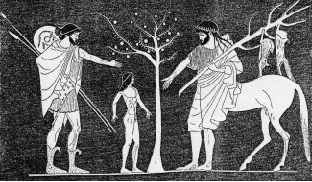
Achilles entrusted by his father Peleus to the fosterage of the centaur Cheiron. (Other depictions normally show the hero as a babe in arms.) 5th cent. BC red figure stamnos in the Musée de Louvre, Paris (G186). Illustration from Herman (1987:24, Fig. 1A)
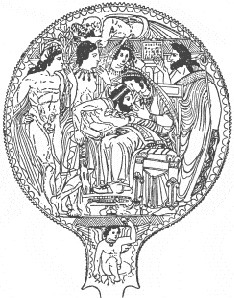
The ritual suckling of Hercules (Hercle) by Hera or Juno (Uni), establishing the mortal hero's apotheosis within the Olympian pantheon by milk kinship. Etruscan bronze mirror engraving from Volterra in the Museo Archeologico, Florence (72740; see Monaco 1933). Illustration from Deonna (1954:153, Planche VI, Fig. 9).
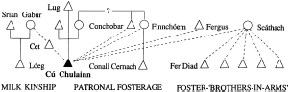
Cú Chulainn's foster kin.
 You have
Access
- 43
- Cited by