1. Introduction
Evolutionarily, the fittest individuals are those whose behavior best suits their ecological niche. But environments are rarely static. As they change, so too must the behavior of organisms if they are to continue to survive and reproduce. Behavioral innovation—“the introduction of a new or modified learned behavior not previously found in the population” (Reader and Laland Reference Reader and Laland2002, 14)—is one way organisms maintain their adaptedness. Classic examples include the exploitation of novel food sources and invention of novel tool types, but the pool of possible behavioral innovations is almost endless.
In addition to driving individual adaptedness, behavioral innovation has been linked to large-scale evolutionary patterns in morphology and culture, such as the rapid diversification of the beaks of the Galapagos finches (Tebbich, Sterelny, and Teschke Reference Tebbich, Sterelny and Teschke2010). More proximately, behavioral innovativeness is associated with a range of cognitive capacities, including insight (e.g., Shettleworth Reference Shettleworth2012), problem solving (e.g., Taylor, Knaebe, and Gray Reference Taylor, Knaebe and Gray2012), causal cognition (e.g., Starzak and Gray Reference Starzak and David Gray2021), and creativity (e.g., Boden Reference Boden2004).
Despite its significance, what constitutes a behavioral innovation is debated. There are multiple, conflicting definitions in the literature (Table 1).Footnote 1 These definitions tend to be binary, and disagree on whether innovation refers to a unique processFootnote 2 (definition [iii]), or type of behavioral product (definition [i]), or some mixture of the two (definition [ii] or [iv]) (Reader and Laland Reference Reader, Laland, Simon and Laland2003; Arbilly and Laland Reference Arbilly and Laland2017).
Four prominent definitions of innovation
| Definition | Source |
|---|---|
| (i) “An innovation can be: a solution to a novel problem, or a novel solution to an old one; a communication signal not observed in other individuals in the group (at least at that time) or an existing signal used for a new purpose; a new ecological discovery such as a food item not previously part of the diet of the group.” | (Kummer and Goodall Reference Kummer and Goodall1985, 205) |
| (ii) “the introduction of a new or modified learned behavior not previously found in the population” | (Reader and Laland, Reference Reader and Laland2002, 14) |
| (iii) “the process that generates in an individual a novel learned behavior that is not simply a consequence of social learning or environmental induction.” | (Ramsey, Bastian, and Van schaik Reference Ramsey, Bastian and Van schaik2007, 393) |
| (iv) “In the physical realm, a behavioral innovation is a new, useful, and potentially transmitted learned behavior, arising from asocial learning (innovation by independent invention) or a combination of asocial and social learning (innovation by modification), that is produced so as to successfully solve a novel problem or an existing problem in a novel manner.” | (Carr, Kendal, and Flynn Reference Carr, Kendal and Flynn2016, 1515) |
It is hardly surprising that there are multiple definitions of behavioral innovation in the literature given the broad disciplinary interest in the phenomenon. Attempts to establish a single unified definition have not succeeded (Overington et al. Reference Overington, Cauchard, Ann Côté and Lefebvre2011; Reader and Laland Reference Reader, Laland, Simon and Laland2003; Ramsey, Bastian, and Van schaik Reference Ramsey, Bastian and Van schaik2007; Tebbich et al. Reference Tebbich, Griffin, Peschl and Sterelny2016).
Establishing which cognitive processes are responsible for behavioral innovation and its evolutionary implications, however, does not require an agreed definition from the outset. Rather, we can learn what the most useful and empirically accurate definition(s) of innovation are through broad enquiry about the phenomena of interest and refinement. The multi-dimensional framework for characterizing and comparing putative cases of behavioral innovativeness presented here has been developed in this pluralist, instrumentalist spirit. It is designed to focus our investigations of the causes of behavioral innovation, the evolutionary role of innovation, and the evolutionary drivers of innovativeness within species. The framework (inspired by Arbilly and Laland’s [Reference Arbilly and Laland2017] discussion of the “magnitude of innovation”) sits outside of the debate regarding the appropriate definition of innovation and its nature, acting as a tool for guided inquiry intended to help resolve disagreement.
I begin by introducing Arbilly and Laland’s (Reference Arbilly and Laland2017) novel quantitative measure of the magnitude of innovation—the degree to which an innovative behavior is novel (§2.1). Using this measure, we can compare the impacts of different types of innovation in an evolutionary context. Magnitude qua Arbilly and Laland (Reference Arbilly and Laland2017) has limited usefulness beyond the modelling context, however. It is simply too abstract for most applied situations (§2.2). Here, I further develop magnitude of innovation for broader use (§3). I break down innovation into its components through an analysis of the wire-bending behavior of Betty, a New Caledonian Crow (§3.1). Although this interpretation has since been undermined (Betty’s wire-bending was initially interpreted to be a paradigmatic example of animal innovation), understanding why this was so, and looking at why it is no longer considered as such, gives insight into the components of innovation. We can represent these components, and variation within them, in a multidimensional space (§3.2). This framework has several virtues (§3.3): it allows us to compare cases of behavioral innovation, identify commonalities within clusters of behavioral innovation in the tree of life, and identify the impact of major transitions in cognition on the innovativeness of species. It is also easily revised as we learn more about the nature of innovation. Ultimately, the framework makes it possible to test whether transitions in cognition generate transformations in behavioral innovativeness and other claims about the underlying causal history of behavioral novelties.
2. Magnitude of innovation
2.1 Ordering innovations
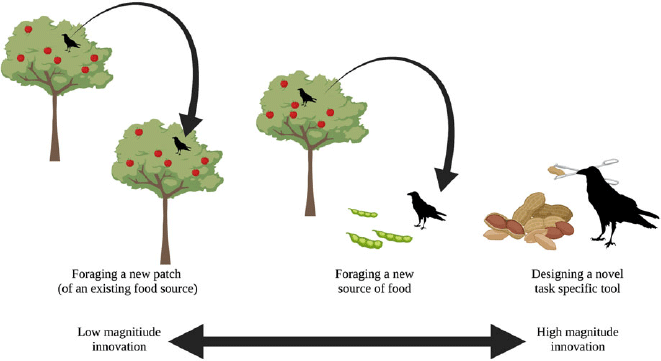
Arbilly and Laland (Reference Arbilly and Laland2017) propose a novel quantitative measure—the magnitude of innovation—which they use in modelling the evolutionary implications of various hypothetical innovations. They define the magnitude of an innovation as the degree to which it deviates from the mean behavior of the population. They illustrate their idea by comparing various hypothetical foraging innovations in a single species and ordering them from low magnitude to high magnitude (see Figure 1).
Magnitude of innovation as a way of ordering behavioral innovations according to the degree of novelty from the behavioral norm. The putative examples and ordering are drawn from Arbilly and Laland (Reference Arbilly and Laland2017). Created with biorender.com.

Whilst this basic definition is sufficient for Arbilly and Laland’s (Reference Arbilly and Laland2017) purpose in modelling evolution at a very abstract level, their account of the magnitude of innovation is insufficiently well-developed for the further purpose of classifying cases of innovation in most applied contexts. This is because, although magnitude is reasonably a real property of innovations, Arbilly and Laland don’t offer an empirically tractable means of actually measuring it on a single objective scale, which leaves us with intuitive measurements as employed in making the simple orderings in Figure 1. This raises challenges for interpreting their models and using magnitude in applied situations. In the next section, I make these limitations clearer before offering a more developed account of magnitude in Section 4 which overcomes these challenges.
2.2 Limits to magnitude
Once we move beyond single species and within-domain comparisons, ordering innovations from low to high magnitude is not straight-forward nor intuitive. To illustrate, consider two highly cited examples of innovation:
-
(a) Imo potato washing: In the 1960s, primatologists studying a troop Japanese macaques left sweet potatoes on a beach to entice them into the open to feed. One young female Japanese macaque, Imo, spontaneously washed her sweet potatoes in the sea before eating them. Other macaques in the troop observed and learned Imo’s potato washing innovation. The practice spread rapidly throughout the population and was embellished upon (Kawai Reference Kawai1965). Imo’s behavior was startling because, while researchers had observed macaques brushing dirt off their food, they had not observed any individuals washing food—this was a novel behavior to the group, and a clear example of behavioral innovation.
(b) British tit milk bottle opening: First observed in the 1920s, British tits (great tits and blue tits) can spontaneously learn to peck the foil caps of milk bottles left on doorsteps to get to the cream (Hinde and Fisher Reference Hinde and Fisher1951; Fisher and Hinde Reference Fisher and Hinde1949). Whilst neither the motor action itself (pecking), nor the context in which pecking occurs (foraging) are novel, the food source being accessed clearly is and hence this is also considered a clear case of behavioral innovation.
Whilst both examples of foraging innovations, these cases are not identical. When potato washing, Imo employed a motor action (wiping) that was already part of her behavioral repertoire. She also used the action to solve a problem for which that motor action is typically employed (to clean dirty potatoes). What is innovative is that she was using the behavior in a novel context (washing in water, rather than brushing on land). In contrast, although the British tit were also using an existing motor action in their repertoire (pecking), it was to access an entirely new food stuff (cream) found in an entirely novel context (milk bottles on doorsteps). Whilst both behaviors would not be classed as high magnitude innovations on Arbilly and Laland’s (Reference Arbilly and Laland2017) scale, neither falls neatly into the low magnitude category, and I struggle when trying to assess which is “more innovative” than the other. It is unclear how we should integrate varying degrees of novelty across the different dimensions of innovation into overall measures for comparison once we move away from simple comparisons.
Here, I present an alternative approach which builds on the basic insight offered by Arbilly and Laland—that the deviation of an innovation from the mean behavior of the population can be used to order novelties—which is more empirically tractable and useful. I begin by breaking down innovation into its basic dimensions.
3. The multi-dimensional alternative
3.1 Opening the black box: an analysis of a paradigmatic case of innovation
Several characteristics unite classical examples of innovation. The case of Betty the New Caledonian Crow, once seen as a paradigmatic example of a high magnitude behavioral innovation, illustrates these features well.
Famously, Betty spontaneously bent a straight piece of garden wire into a hooked tool and used it to lift a food-baited bucket from a plastic well (Weir, Chappell, and Kacelnik Reference Weir, Chappell and Kacelnik2002). Whilst New Caledonian Crows manufacture and use twig and leaf tools in the wild (Hunt and Gray Reference Hunt and Gray2004), Betty had no experience with wire and appeared to manipulate it in an innovative manner to solve a novel problem. In follow-up studies Betty manipulated another novel material (aluminum strips) in the same manner to make a hooked tool and solve similar problems (Weir and Kacelnik Reference Weir and Kacelnik2006).
Betty’s wire-bending behavior was lauded as a paradigmatic example of animal innovation and animal intelligence. Subsequent work by Rutz et al. (Reference Rutz, Shoko Sugasawa, van der Wal and St Clair2016) has shown, however, that the specific motor actions Betty performed are expressed by wild birds in bending their natural hooked stick tools, so she may have simply been blindly demonstrating a relatively stereotypical species-typical behavior. This new evidence does not undermine the claim that Betty’s wire bending is a behavioral innovation of some order (it is a novel solution to a novel problem to some degree), but it does undermine its status as a high magnitude innovation. Looking at the original descriptions of Betty’s wire bending innovation (before more information about the baseline behaviors of the species were known) remains informative of what a paradigmatic behavioral innovation looks like.
In the original paper describing the behavior, Weir et al. (Reference Weir, Chappell and Kacelnik2002, 981) state that “…at least one of our birds is capable of novel tool modification for a specific task. In the wild, New Caledonian crows make at least two sorts of hook tools using distinct techniques, but the method used by our female crow is different from those previously reported and would be unlikely to be effective with natural materials. She had little exposure to and no prior training with pliant material, and we have never observed her to perform similar actions with either pliant or nonpliant objects.” Even in presenting evidence to counter the dominant analysis, Rutz et al. (Reference Rutz, Shoko Sugasawa, van der Wal and St Clair2016, 1) offer the following as reason why Betty’s behavior “shook the field of comparative cognition”: “Although it was known at the time that these tropical corvids manufacture hooked foraging tools from forked twigs in the wild, Betty’s wire-bending method appeared to be a spontaneous, innovative solution to a novel problem.”
Drawing on both these quotes, three features of Betty’s behavior appear salient to its assessment as a high magnitude innovation:
-
(i) Her apparent lack of experience with the wire (and other pliant material),
-
(ii) the apparently novel behavioral action (bending) she performed, and
-
(iii) the novelty of the problem she solved.Footnote 3
Other features of the Betty case typically emphasized are:
-
(iv) the spontaneity of the behavior (i.e., that it arose without extensive trial and error), and
-
(v) that it was robustly repeated (i.e., suggesting that it was not an accidental, or undirected, action).
Whilst not displaying analogues of all these features, Imo’s potato washing and the British tit milk bottle opening display some. The potato washing innovation involved analogues to (iii), (iv) and (v). The tit milk bottle opening is similar with respect to (i), (iii)Footnote 4, and (v). It appears necessary for something to be an innovation that it has at least some of these properties. In the next section, I use this insight to build my novel framework.
3.2 A more nuanced approach: mapping behavioral innovation
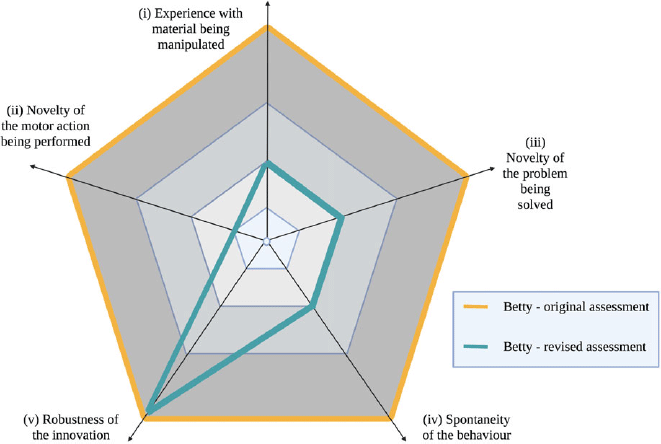
The five different dimensions of innovation outlined in the previous section can be represented in simple a multidimensional space with simple orderings on the dimensions (Figure 2).
Comparing the original assessment of Betty’s behavior as a maximal innovation to the revised assessment which considers the evidence of tool bending behavior in the wild. Created using biorender.com.

The center of the space represents a complete lack of innovation (i.e., behaviors which do not deviate from the mean behavior of the species in any respect, and entirely lack spontaneity and robustness). The further you move from the center of the space along each of the dimensions (i)-(iii) the more novel the behavior is in that dimension. Similarly, spontaneity and robustness increase along dimensions (iv) and (v) respectively.
When mapped on this space (as shown in Figure 2) we can represent the overall magnitude of innovation. High magnitude innovations produce a mapping which tends towards the edges of the space (as for the original assessment of Betty’s behavior). Lower magnitude innovations produce mappings which lie closer to the center (as for the reassessment of Betty’s behavior).
For the purposes of simplicity, I have used a simple radial graph to represent the dimensions of innovation. In practice, a hyperdimensional space may be more objective. Representations within such a space would not be sensitive to the arrangement of the dimensions in the way that they are in a two-dimensional radial graph. Whilst a reason to be cautious in use of the two-dimensional representation, such a graph still has value (see following section).
3.3 Virtues of the multidimensional framework
I. A multidimensional approach allows us to make more accurate and nuanced comparisons of cases of innovation
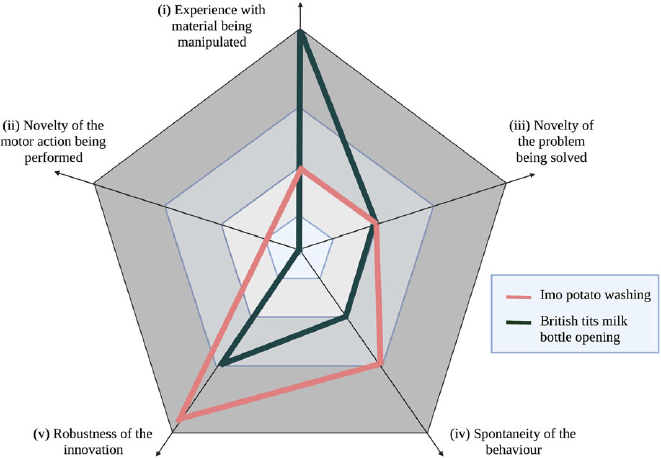
Using this approach, we can compare examples of innovation and their degree of novelty without the need for an overall measure of novelty as required for a straightforward magnitude assessment. As outlined in §2.2, whilst both Imo’s potato washing and the British tit milk bottle opening fall somewhere in the middle of Arbilly and Laland’s (Reference Arbilly and Laland2017) measure (both are foraging for new food), this tells us little about key features of the cases and tends to obscure important differences. For example, when we focus merely on overall magnitude, we lose sight of the fact that that British tit milk bottle opening innovation involves accident and trial-and-error, whilst Imo’s behavior is thought to have been more directed in nature. This sort of difference can be captured multidimensionally without obscuring that the cases are of similar magnitude at the coarse grain (see Figure 3).
The multidimensional approach allows us to capture both magnitude (as the area within the mapping of a behavior) and variation along dimensions of innovation. Created using biorender.com.

II. The framework allows comparisons of innovativeness within species
Using this framework, we can compare the features of different innovations, simply and easily look for patterns in those features, and consider their significance. For example, within species we can explore the drivers of innovation by asking questions such as, do macaque behavioral innovations typically produce a similar mapping? If they do, it seems likely that there are common mechanisms and constraints in their cognition of some sort.
Similarly, we can investigate how innovativeness changes over the lifetime of individuals within species and consider how this relates to life history. Do the innovations of younger individuals, differ from those of older individuals? Why? This framework provides a systematic way to respond to these questions by making it possible to compare the innovativeness of individual animals and consider how their life history and experience influences the trait easily and simply.
III. The framework allows comparison of innovativeness across species and clades
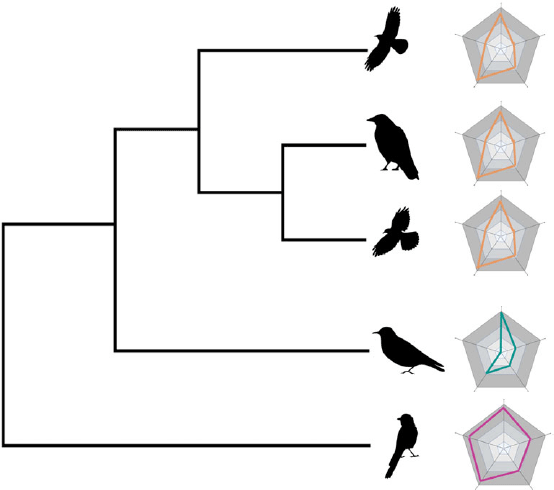
Phylogenetic comparisons are a key source of evidence for hypothesizing about the role of cognitive evolution in transitions in innovativeness. Without a means to represent innovativeness and differences in innovativeness between species, such phylogenetic comparison is difficult. The multidimensional framework offers such a means. We can look for mappings which are exemplified by a particular lineage or clade (see hypothetical example in Figure 4). For example, if there are no innovations observed involving novel motor action within a lineage (as in the uppermost three lineages in the phylogeny in Figure 4), we can reasonably infer some sort of constraint on innovation along this dimension. Similarly, the presence of lots of innovations which involve engagement with novel materials might imply an important role for neophilia in innovation in that lineage.
Looking at the distribution of mappings in a phylogenetic context can be telling of the underlying mechanisms and their evolutionary history. Created using biorender.com.

We can also explore patterns in how innovation changes over evolutionary time. For example, if transitions in innovation have been driven by transitions in cognition (assuming those transitions are marked in the way that transitions in biological organization are) there should be a phylogenetic signature of that, such as path dependencies in the mappings (you only get mapping x evolve after mapping y).
4. Conclusions
The framework for measuring, representing, and theorizing about innovation presented here is novel for its focus on capturing the heterogeneity of the many different types of novel behaviors which fall under the umbrella of behavioral innovation. This heterogeneity is key to understanding the many ways in which innovations arise, and the role of innovation in evolution. Whilst a valuable and informative way to represent and think about innovation, the approach is instrumentally motivated and a first step in a broader endeavor. As we learn more about innovation, the dimensions within the framework may change, interdependences between the dimensions may become apparent, and scales refined. The framework allows us, however, to begin to answer these questions in a way that existing definitions cannot, and is thus a significant contribution to philosophy and the relevant biological literature.
Acknowledgements
Thank you to Marta Halina, Colin Klein, Andy Barron, and Ross Pain, along with audiences at the PSA Meeting in Baltimore, ANU, and the University of Sydney for their generous and insightful comments on the material in this paper.