The marked genetic polymorphism at the αs1-casein locus affects the casein content of goat milk (Martin et al. Reference Martin, Ollivier-Bousquet and Grosclaude1999). Moreover it has been revealed that different αs1-casein allelic variants can affect some milk parameters such as fat content (Grosclaude et al. Reference Grosclaude, Ricordeau, Martin, Remeuf, Vassal and Bouillon1994; Chilliard et al. Reference Chilliard, Rouel and Leroux2006), urea level (Schmidely et al. Reference Schmidely, Meschy, Tessier and Sauvant2002; Bonanno et al. Reference Bonanno, Finocchiaro, Di Grigoli, Sardina, Tornambè and Gigli2007; Avondo et al. Reference Avondo, Pagano, Guastella, Criscione, Di Gloria, Valenti, Piccione and Pennisi2009) and fatty acid profile (Chilliard et al. Reference Chilliard, Rouel and Leroux2006).
Most of these parameters are also strongly influenced by nutrition. However, reports in the literature on the relationships between nutrition and milk protein genotype and their effects on milk characteristics are few and often controversial. Ollier et al. (Reference Ollier, Robert-Granie, Bernard, Chilliard and Leroux2007) evaluated the genes whose expression is bound to dietary characteristics in lactating goats and they found a lower expression level of genes associated with αs1-casein, αs2-casein and β-casein synthesis, after withholding food for 48 h compared with feeding ad libitum. Mackle et al. (Reference Mackle, Bryant, Petch, Hill and Auldist1999) investigated the effects of undernutrition on milk composition in cows characterized by different β-lactoglobulin phenotypes and suggested that the advantage of using animals with strong protein genotype could be counterbalanced by a low nutrient supply. In contrast, Auldist et al. (Reference Auldist, Thomson, Mackle, Hill and Prosser2000), focusing on the effects of different amounts of pasture allowance on milk composition from cows of different β-lactoglobulin phenotypes, found no interactions between nutrition and protein phenotype.
Only a few studies have been carried out on the effect of diet on milk production and composition in goats at different αs1-casein genotypes. In general, it has been shown that strong alleles are associated with a greater efficiency of N utilization, compared with weak alleles (Schmidely et al. Reference Schmidely, Meschy, Tessier and Sauvant2002; De la Torre et al. Reference De la Torre, Serradilla, Gil Extremera and Sanz Sampelayo2008, Reference De la Torre, Ramos Morales, Serradilla, Gil Extremera and Sanz Sampelayo2009).
To our knowledge no investigation has been made of the effect of dietary energy levels on the performance of goats of different αs1-casein genotype. However, in a previous free-choice feeding trial (Avondo et al. Reference Avondo, Pagano, Guastella, Criscione, Di Gloria, Valenti, Piccione and Pennisi2009), we highlight that goats carrying strong alleles voluntarily selected a diet with a higher percentage of energy-rich feeds, compared with goats with weak alleles, thus increasing their milk and casein production. The aim of the present study was to test how Girgentana goats, selected according to different αs1-casein genotype and reared intensively in stalls, respond to complete pelleted diets with different energy levels but of similar protein content.
Materials and Methods
Animals and experimental design
Twenty-seven Girgentana goats in their 2nd to 4th lactation, homogeneous for milk production (1·5±0·3 kg/d), days of lactation (90±10 d) and body weight (35·8±5·5 kg) were selected on the basis of their genotype at αs1-casein locus, as follows: nine goats homozygous for strong (AA) alleles, nine goats homozygous for weak alleles (FF) and nine goats heterozygous (AF). Moreover all the goats were selected taking into account CSN2 and CSN1S2 genotype. In particular all the goats were characterized by strong alleles at the two loci. Goat DNA samples were obtained from hair bulbs according to Bowling et al. Reference Bowling, Stott and Bickel1993. The genotypes of individuals at the CSN1S1, CSN2, and CSN1S2 were determined by means of PCR analyses (Jansà Pérez et al. Reference Jansà, Leroux, Sànchez and Martin1994; Ramunno et al. Reference Ramunno, Mariani, Pappalardo, Rando, Capuano, Di Gregorio and Cosenza1995; Ramunno et al. Reference Ramunno, Cosenza, Pappalardo, Pastore, Gallo, Di Gregorio and Masina2000; Ramunno et al. Reference Ramunno, Cosenza, Pappalardo, Longobardi, Gallo, Pastore, Di Gregorio and Rando2001; Ramunno et al. Reference Ramunno, Cosenza, Gallo, Illario, Rando and Masina2002; Cosenza et al. Reference Cosenza, Illario, Rando, Di Gregorio, Masina and Ramunno2003).
Goats in each genetic group derived from two different farms. The goats were used in a 3×3 factorial arrangement of treatments, with three genotypes (AA, AF, FF) and three diets at different energy levels (100%, 65% and 30% of hay inclusion). The experiment consisted of three simultaneous 3×3 Latin squares for the three genotypes (AA, FF, AF) with one square for each level of hay inclusion in the diet. All the animals, managed according to the guidelines of the Animal Ethics Committee of the University of Catania, were housed in individual pens where goats had access to water and salt blocks. The pre-experimental period consisted of a 12-d period during which the animals received a mix of the three experimental diets ad libitum. The experiment lasted 69 d, from 17 February to 26 April. Each experimental period lasted 23 d and consisted of 15 d for adaptation and 8 d for data and sample collection during which the goats received the scheduled diet ad libitum.
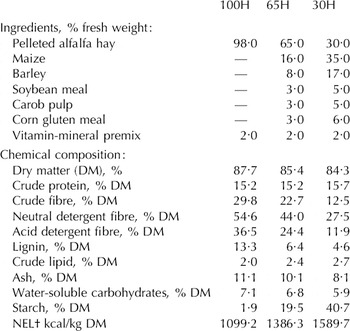
The animals were fed three different diets designed to have the same protein content but different energy levels: a pelleted alfalfa hay (100% H) and two pelleted feeds including 65% (65H) and 30% (30H) of alfalfa hay (Table 1). All ingredients were ground and pelleted (6 mm diameter).
Composition of diets and chemical analyses

† Net energy for lactation
Sample collection and analysis
Individual intakes were measured daily, on the basis of refusals. Individual milk production and milk samples were collected from the morning and evening milking three times for each 8-d collection period. Three samples for each pelleted diet were analysed for dry matter (DM), crude protein (CP), fat (Association of Official Analytical Chemists, 1990), structural carbohydrates (Van Soest et al. Reference Van Soest, Robertson and Lewis1991), water-soluble carbohydrates (WSC) by a modified anthrone method (Deriaz, Reference Deriaz1961), starch by an enzymic procedure (Megazyme International Ireland Ltd., Bray, Co. Wicklow, Ireland). Milk samples, consisting of proportional volumes of morning and evening milk, were analysed for lactose, fat, protein and SCC by an infrared method (Combi-foss 6000, Foss Electric, Hillerød, Denmark). Total nitrogen (TN) and non-casein nitrogen (NCN) were determined by FIL-IDF standard procedures (International Dairy Federation, 1964). From these nitrogen fractions, total protein (TN∗6·38) and casein [(TN−(NCN∗0·994))∗6·38] were calculated. Milk urea content was determined using a differential pH meter (CL10, Eurochem, Savona, Italy).
Body condition (BCS), scored as reported by Santucci & Maestrini (Reference Santucci and Maestrini1985), was measured at the start and the end of the trial.
Blood samples (8 ml) were taken from all goats at the end of the pre-experimental period and at the end of each experimental period by jugular venepuncture using vacutainer tubes containing lithium heparin (Becton, Dickinson and Co.) and immediately placed on ice. Within 1 h of the bleeding, blood samples were centrifuged at 1400 g at 4°C for 20 min and plasma was harvested and stored at −20°C until assayed. A TARGA model 2000 (Technology Advanced Random Generation Analyser, Biotecnica Instruments, Roma, Italy) automated analyser was used to determine glucose, cholesterol, triglycerides, urea, total protein and albumin (Mercury, Riardo, Italy) in plasma samples. Non-esterified fatty acids (NEFA) and beta-hydroxybutyric acid (BHBA) were analysed by using respectively FA 115 and Ranbut commercial kits (Randox Laboratories, Crumlin, Antrim, UK).
Statistical analysis
Individual data for intake, milk production and composition were analysed using the GLM procedure for repeated measures of SPSS (SPSS for Windows, SPSS Inc., Chicago IL, USA). The model included genotype, diets, blocks, periods and genotype×diet. Pre-experimental data of milk production and dry matter intake (DMI) were used as covariates respectively for milk production and composition and for DMI analysis.
Plasma concentrations of the metabolites were analysed by means of GLM procedure and analysis included main effect of αs1-casein genotype (FF, AF, AA), diet (100H, 65H, 30H) and interaction genotype×diet. Data from the pre-experimental period were used as a covariate in plasma parameters analysis. When covariance was not significant (P>0·05) it was not included in the statistical model. Differences between means were tested by least significant differences (LSD). Pearson's correlation coefficients were calculated between the parameters measured in this study.
Results
Table 1 shows the dietary ingredients and chemical composition. As planned when formulating the diets, CP content was similar for all the pelleted feeds, whilst the diets differed markedly in their contents of structural carbohydrates, starch and energy.
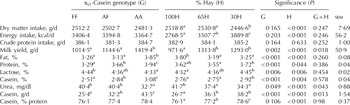
Table 2 reports data on intake, milk yield and composition. DMI was not affected by genotype but was significantly influenced by hay inclusion in the diet (P<0·001), being lower when animals were fed 30H diet compared with 100H and 65H diets.
Least squares means of daily intake, milk yield and composition

a,b,c values within a row without a common superscript letter are significantly different (P<0·05)
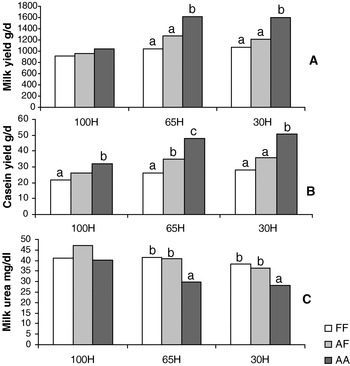
Genotype and diet energy level significantly influenced milk yield: on average AA goats produced more than AF and FF goats (P=0·002) and concentrate diets (65H and 30H) increased milk production over that seen with the hay diet (100H) (P<0·001). Moreover a significant interaction genotype×diet was also found for milk production and casein production (respectively P=0·018 and P=0·013), as highlighted in Figs 1A and 1B. When increasing the energy input, by reducing hay inclusion in the diet at 65% and 30%, goats carrying strong alleles showed milk production increases of 55% and 53%, respectively, compared with increases of 14% and 17% in goats carrying weak alleles; increases in heterozygous goats were intermediate (34% and 27%).
Interaction between genotype (AA, AF, FF) and diet (100H, 65H, 30H) for milk yield (A), casein yield (B) and milk urea (C). Values within diets with different superscript letters are significantly different (P<0·05).

Genotype significantly influenced milk composition and, as expected, the protein and casein percentages (respectively P=0·001; P=0·001) were higher in AA than FF goats with intermediate values in AF goats. Milk fat content was higher in AA goats (P=0·001) than in the other groups, whereas lactose and urea concentrations were significantly lower in AA goats (respectively P=0·006; P=0·049).
Hay inclusion in the diet significantly affected milk composition. Fat and urea contents decreased (respectively P=0·001; P=0·001) when concentrate was included in the diet, whereas protein, lactose and casein contents were higher (respectively P=0·044; P=0·006; P=0·004) when goats were fed with the 30H diet.
A significant genotype×diet interaction occurred for milk urea, which was significantly lower (P=0·043) in AA goats only when fed with concentrates (65H and 30H) (Fig. 1C).
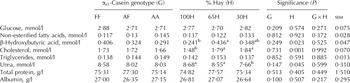
A significant effect of feeding regimen was observed on plasma concentrations of BHBA (P<0·023), cholesterol (P<0·001) and plasma urea (P<0·045); conversely, values of other parameters were not affected by dietary treatments (Tables 3). Concentration of BHBA was higher in the 65H group than in the 100H goats. A similar trend was noticed for cholesterol level. Plasma concentration of urea increased in 100H and 65H groups compared with 30H group.
Least squares means of plasma metabolite concentrations

a,b values within a row without a common superscript letter are significantly different (P<0·05)
There was no significant effect of αs1-casein genotype on plasma metabolites (glucose, NEFA, BHBA and urea). Plasma albumin concentration was not affected by αs1-casein genotype.
Discussion
In our experimental conditions mean intake data were much higher, compared with goats at similar production levels but under different feeding conditions such as pasture (Bonanno et al. Reference Bonanno, Finocchiaro, Di Grigoli, Sardina, Tornambè and Gigli2007; Avondo et al. Reference Avondo, Bonanno, Pagano, Valenti, Di Grigoli, Alicata, Galofaro and Pennisi2008) or roughage and concentrates (Havrevoll et al. Reference Havrevoll, Rajbhandari, Eik and Nedkvitne1995) probably because of the different physical properties of the diets (Forbes, Reference Forbes1995). In fact, intakes were similar to those observed previously in goats under a free-choice feeding system based on whole grains and pelleted hay (Avondo et al. Reference Avondo, Pagano, Guastella, Criscione, Di Gloria, Valenti, Piccione and Pennisi2009). DMI significantly decreased with the high energy diet (H30) possibly because of the lower DM percentage of this diet, compared with 100H and 65H diets.
As already reported by Schmidely et al. (Reference Schmidely, Meschy, Tessier and Sauvant2002) and by Avondo et al. (Reference Avondo, Pagano, Guastella, Criscione, Di Gloria, Valenti, Piccione and Pennisi2009), total DMI was not affected by genotype.
As expected, milk production significantly increased when goats were fed concentrate diets compared with 100% hay. This increase occurred despite the high intake levels reached by goats even when fed only with hay, which allowed an energy input as high as 2768 kcal net energy for lactation (NEL)/d; this energy input is higher than energy requirements indicated by INRA (Morand-Fehr & Sauvant, Reference Morand-Fehr, Sauvant and Jarrige1988) for heavier goats with a milk production of 2 kg/d. This finding illustrates the importance of energy source, starch-rich feeds v. roughage, on efficiency of milk synthesis, which induced the goats to increase their production when fed with concentrate feeds.
Genotype showed an important effect on milk yield in that AA goats were more productive than AF and FF goats. Moreover an interesting energy level×genotype interaction was evident: in fact AA goats showed their milk increase only when fed with concentrates (Fig. 1A). The increase in milk production reached its maximum level at 65% of hay inclusion whereas no further increase was found on further reducing hay inclusion (H30). Previous studies on goats at different αs1-casein genotype do not report significant differences in milk production between strong, weak or intermediate alleles (Schmidely et al. Reference Schmidely, Meschy, Tessier and Sauvant2002; Caravaca et al. Reference Caravaca, Carrizosa, Urrutia, Baena, Jordana, Amills, Badaoui, Sanchez, Angiolillo and Serradilla2009; De la Torre et al. Reference De la Torre, Ramos Morales, Serradilla, Gil Extremera and Sanz Sampelayo2009). De la Torre et al. (Reference De la Torre, Ramos Morales, Serradilla, Gil Extremera and Sanz Sampelayo2009), however, obtained different responses from goats with different CSN1S1 genotype when fed with two CP levels: when fed with a 13·6% CP diet, goats with strong alleles (HG) showed a tendency (not significant) to produce more milk than goats with weak and intermediate alleles (LG), whereas when fed with a 17·7% CP diet, LG goats increased their production but for HG goats milk production remained unchanged. The authors hypothesized that HG goats achieved their maximum capacity for milk protein production with the low protein diet and, for this reason, no further increase in milk production was obtained on increasing CP level further.
In accordance with present results, in a previous study on Girgentana goats in a free-choice feeding system (Avondo et al. Reference Avondo, Pagano, Guastella, Criscione, Di Gloria, Valenti, Piccione and Pennisi2009) we found that goats with strong alleles (AA) were more productive than goats with weak alleles (FF); in fact, as a consequence of feed selection, AA goats voluntarily consumed a diet with a higher energy to protein feeds ratio, compared with FF goats, which probably caused the production increase. Indeed, in the same trial, when the goats were fed a mixture of the five feeds, no difference in milk production was noted between genotypes, even though a very high energy and protein input was reached. On the basis of those results, we hypothesized an indirect effect of genotype on milk yield by way of the difference in selective activity.
Milk quality was strongly affected by feeding and genotype. As expected, owing to the structural carbohydrate levels in the diets, fat increased with percentage of hay. As already reported (Schmidely et al. Reference Schmidely, Meschy, Tessier and Sauvant2002; De la Torre et al. Reference De la Torre, Ramos Morales, Serradilla, Gil Extremera and Sanz Sampelayo2009) milk fat content was higher in goats with high genetic capability. No dilution effect of the higher milk production was noted in this group. The goats were genetically homogeneous for αs2- and β-caseins; this leads us to hypothesize that the differences in protein and in casein levels between the three genetic groups were in line with expected results as each allele contributes to αs1-casein synthesis, taking into account that strong and weak alleles are associated, respectively, with 3·5 and 0·45 g/l of αs1-casein synthesized (Mahé et al. Reference Mahé, Manfredi, Ricordeau, Piacère and Grosclaude1993; Martin et al. Reference Martin, Ollivier-Bousquet and Grosclaude1999; Sacchi et al. Reference Sacchi, Chessa, Budelli, Bolla, Cerotti, Soglia, Rasero, Cauvin and Caroli2005; Marletta et al. Reference Marletta, Criscione, Bordonaro, Guastella and D'Urso2007). On average the high energy diet (30H) caused a significant increase in casein and protein synthesis, in line with results from Morand-Fehr et al. (Reference Morand-Fehr, Sanz Sampelayo, Fedele, Le Frileux, Eknaes, Schmidely, Giger-Reverdin, Bas, Rubino, Havrevall and Sauvant2000). This result might be associated with an improved efficiency of microbial protein synthesis due to the greater availability of non-structural carbohydrate in the rumen (Koenig et al. Reference Koenig, Beauchemin and Rode2003; Broderick, Reference Broderick2003) and to a consequently higher availability of milk protein precursors to the mammary gland.
No genotype×diet interaction was evident for milk casein and protein content. However, in keeping with the different milk production between genotypes, a significant genotype×diet interaction was seen for yield (g/d) of casein. In fact, AA goats fed respectively with 100H, 65H and 30H diets produced 45%, 84% and 80% more casein than FF goats (Fig. 1B).
On average, milk urea levels were significantly lower in AA goats compared with the other genotypes, confirming previous findings for goats of different αs1-casein genotype (Schmidely et al. Reference Schmidely, Meschy, Tessier and Sauvant2002; Bonanno et al. Reference Bonanno, Finocchiaro, Di Grigoli, Sardina, Tornambè and Gigli2007; Avondo et al. Reference Avondo, Pagano, Guastella, Criscione, Di Gloria, Valenti, Piccione and Pennisi2009). In particular, the significant genotype×diet interaction (P=0·043) reflects the fact that milk urea was significantly lower in AA goats, compared with AF and FF goats, only when fed with concentrates (65H and 30H) (Fig. 1C). It is evident that only in this genetic group did the greater energy availability improve the efficiency of milk protein synthesis, thus reducing nitrogen losses.
All the goats used in this study were clinically healthy and the parameters reported represent ‘normal’ values for goats. Blood concentrations of energy indicators (glucose, NEFA and BHBA) and urea were not influenced by genotype, as reported by Chilliard et al. (Reference Chilliard, Rouel and Leroux2006). Concentrations of NEFA of 0·20–0·21 mmol/l have been suggested for lactating does at zero energy balance (Dunshea & Bell, Reference Dunshea and Bell1989). In the present experiment, NEFA (Table 3) were below the critical values suggesting that goats were not mobilizing body fat reserves and animals were in the anabolic phase (McNamara, Reference McNamara1991). These results are in accordance with lactation phase (>90 d) and body weight and condition score (BCS) variations, measured from the start to the end of the trial, which were positive in all groups (respectively in AA, AF and FF goats: body weight variations, +4·9, +4·2 and +5·2 kg, P=0·351; BCS variations, +0·82, +0·90 and +0·99, P=0·188).
In all groups, cholesterol values were within the reference range and close to the lower physiological limit for caprines (Kaneko et al. Reference Kaneko, Harvey and Bruss1997). On average, the higher cholesterol content observed with 65H and 30H diets was linked to the increase of energy input as suggested by the positive correlation (r=0·94; P=0·04) between cholesterol and energy intake. Moreover cholesterol and BHBA, which are synthesized from the same precursor (acetyl-CoA), showed the same trend and this is consistent with the positive correlation between the parameters (r=0·76; P<0·07).
Urea levels in blood and milk during the experiment showed a similar trend (r=0·79; P<0·05) and the lowest values were recorded in the 30H group. The high starch percentage and the low fibre percentage in the 30H experimental diet (Table 1) might increase propionate production in the rumen (Petit & Tremblay, Reference Petit and Tremblay1995), which could spare amino acids for gluconeogenesis (Sloan & Rowlinson, Reference Sloan and Rowlinson1987) and increase the availability of amino acids for milk protein synthesis.
Albumin is the most abundant plasma protein in animal blood and it is produced in the liver. This variable is not a valid marker of nutritional status; rather it is a marker of hepatic functionality (Kaneko et al. Reference Kaneko, Harvey and Bruss1997). In all groups, the albumin levels were close to the lower limit indicated for caprines; Di Trana et al. (Reference Di Trana, Celi, Fedele, Cogliandro and Rubino1994) observed similar values of plasma albumin in Maltese goats, 71–106 d from delivery, which were fed pasture plus a free choice of four types of grain.
Conclusions
The present results support the hypothesis that an interaction exists between αs1-casein polymorphism and dietary energy level. It has been demonstrated that a high energy input improves the efficiency of transformation of the diet into milk and casein yield in goats carrying strong alleles, whereas it does not exert noticeable effects in goats carrying weak alleles. This could imply a need for new feeding recommendations for goats in relation to CSN1S1 genotype.
This research was funded by the Italian Ministry of Education, University and Research (MIUR) (Project of High National Interest PRIN 2007 Genetic polymorphism of caseins in goats. Effects of feeding on milk production and quality, feed intake, metabolic and hormonal responses in goats at different genetic potential to produce casein).