INTRODUCTION
The process and tempo of site abandonment during the Terminal Classic period have concerned Mayanists for more than a century (cf. Aimers Reference Aimers2007; Zralka and Hermes Reference Zralka and Hermes2012), and the fact that both issues continue to be topics for discussion and debate demonstrate that we have yet to fully understand the various human responses and activities that unfolded during this volatile period of Maya prehistory. This situation is perhaps best exemplified by our continued attempts to understand the significance of peri-abandonment deposits in the Maya lowlands. First referred to as “problematical deposits” by researchers at Tikal (Coe Reference Coe1982:49; Moholy-Nagy Reference Moholy-Nagy1997:67), peri-abandonment deposits generally include Terminal Classic (a.d. 750–900) cultural remains that are recovered on or above the floors of “prominent locations in monumental centers” (i.e., elite residences and adjacent to temple pyramids; Aimers et al. Reference Aimers, Hoggarth and Awe2020). As Aimers et al. (Reference Aimers, Hoggarth and Awe2020) note in their introductory paper to this Special Section of the journal, archaeologists working in the Maya area have proposed several functional interpretations for peri-abandonment deposits over more than 30 years of research. The more common of these interpretations include arguments that suggest the deposits represent evidence for rapid abandonment due to invasion and site destruction (cf. Chase and Chase Reference Chase, Chase, Demarest, Rice and Rice2004; Inomata Reference Inomata2008; Inomata and Webb Reference Inomata and Webb2003), or that they are associated with the termination/desecration of buildings, with squatters refuse, or the remains of feasting events (Braswell et al. Reference Braswell, Gunn, Carrasco, Folan, Fletcher, Lopez, Glascock, Demarest, Rice and Rice2004; Mock Reference Mock and Mock1998; Newman Reference Newman2015, Reference Newman2018; Stanton et al. Reference Stanton, Brown and Pagliaro2008; Taschek and Ball Reference Taschek and Ball2003; Tsukamoto Reference Tsukamoto2017; also see Aimers et al. [Reference Aimers, Hoggarth and Awe2020] for a detailed discussion of these interpretations). In this paper, we examine several peri-abandonment deposits that were recovered at the Belize River Valley site of Cahal Pech and compare their associated cultural remains with those recovered at other sites in western Belize. Based on these data, we suggest that the Cahal Pech deposits more likely represent cultural remains associated with propitiation rituals or pilgrimage activities that were conducted by remnant local populations during a protracted period of site abandonment.
Historical Context of Recovery of the Cahal Pech Deposits
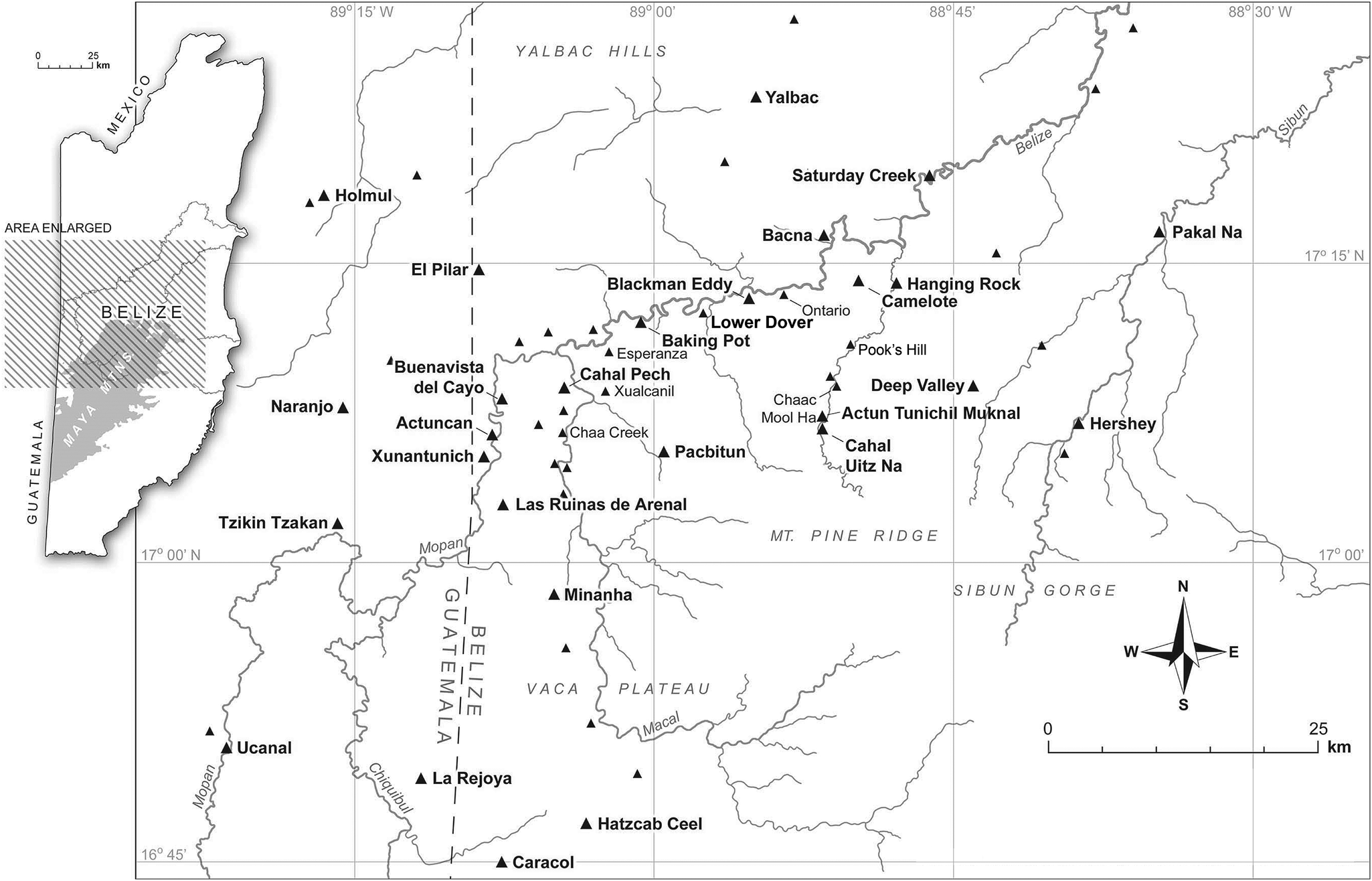
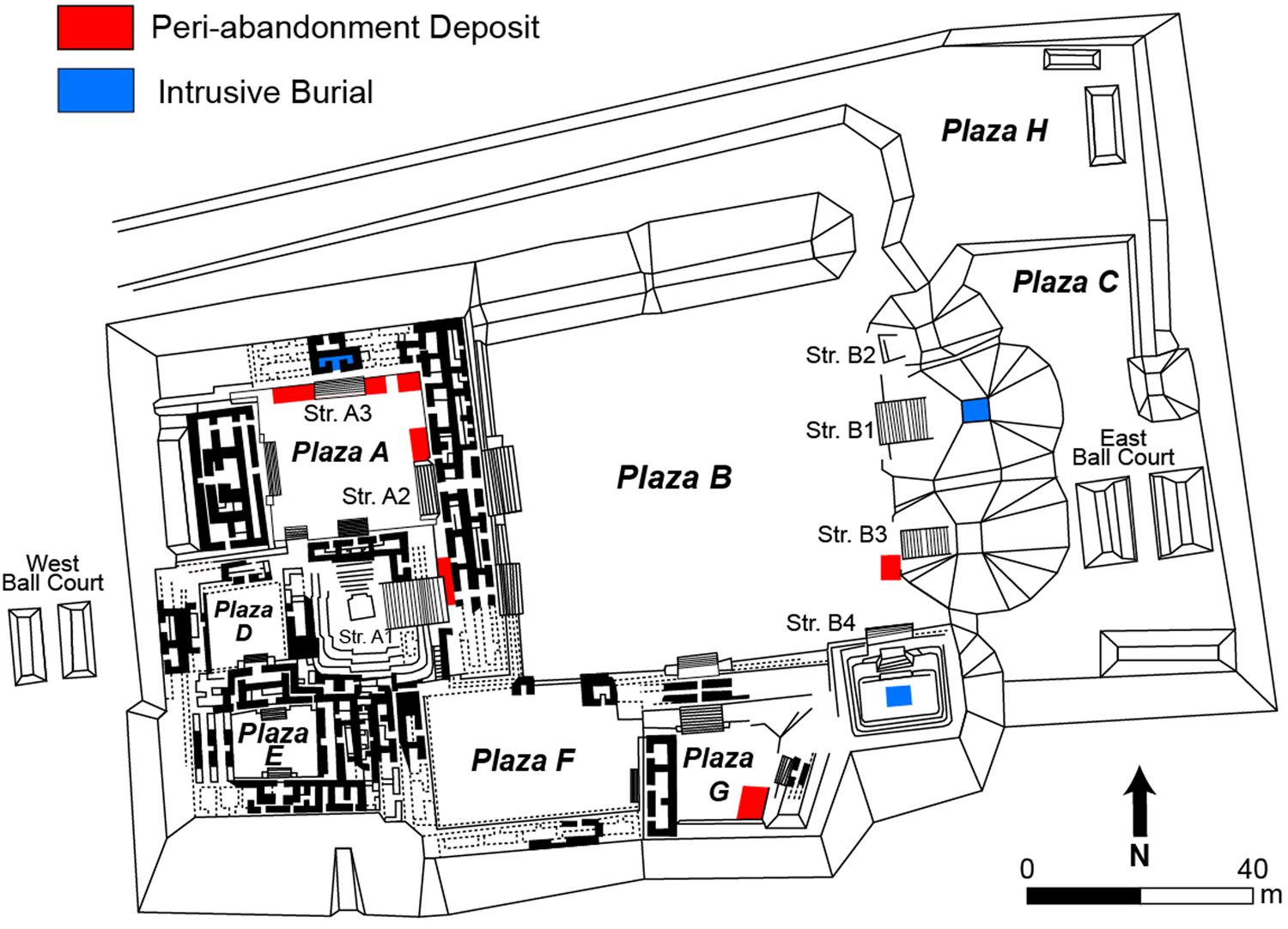
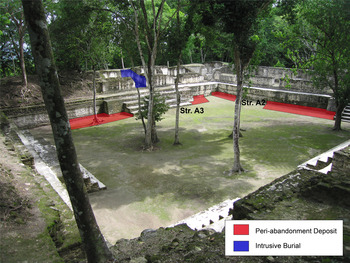
Between 2000 and 2004, the Belize Institute of Archaeology and the Belize Ministry of Tourism and Culture launched a major program of excavation and restoration at several of the major archaeological sites in the country. In Central Belize, the purpose of this Tourism Development Project (TDP) was to enhance the tourism potential of Altun Ha, Cahal Pech, Caracol, Lamanai, and Xunantunich (Figure 1). To achieve the ambitious goals set out by the TDP required that we conduct extensive horizontal exposure of large sections of the monumental architecture in the epicenters of all the sites. These operations included the clearing of terminal phase architecture in the site cores, followed by professional recording and conservation of the buildings exposed. It was during the TDP excavations at Cahal Pech that we first began to uncover peri-abandonment deposits within the royal palace complex in the western half of the site core (Figure 2). We found these deposits above the surface of Plaza A, particularly flanking the stairways of Structures A2 and A3 (Figures 3 and 4), within narrow passageways that led into the palatial courtyard, and within some of the vaulted rooms of the site's elite residences (Awe et al. Reference Awe, Aimers, Helmke and Wrobel2009, Reference Awe, Ebert, Friewald and Green2017a). A key observation made during our excavations in Plaza A was that there was often a thin matrix of soil separating the deposits from the plastered surface of the plaza and terminal architecture. In an effort to understand better the significance of these deposits and the processes by which they became part of the archaeological record, we employed microstratigraphic excavation techniques and contextual analysis throughout our investigations of these features. In the years following the completion of the TDP, the Belize Valley Archaeological Reconnaissance (BVAR) Project, under the direction of Awe and Hoggarth, continued to strategically locate and excavate similar deposits in epicentral locations at several other Belize Valley sites. In this paper, we specifically describe the contexts and nature of the peri-abandonment deposits and activities at Cahal Pech. We also examine the cultural remains associated with these deposits and activities and the implications of these data for understanding ancient Maya responses to sociopolitical decline during the Terminal Classic (ca. a.d. 750–900) period. Other papers in this special issue of the journal provide detailed discussions of the ceramic (Aimers and Awe Reference Aimers and Awe2020) and chert (Stemp and Awe Reference Stemp and Awe2020) artifacts in the peri-abandonment deposits at Cahal Pech and on the results of our investigations of similar deposits at Baking Pot (Hoggarth et al. Reference Hoggarth, Davis, Awe and Helmke2020) and at Xunantunich, Altun Ha, Caracol, and Pook's Hill (Awe et al. Reference Awe, Helmke, Aimers, Ebert, Stemp and Hoggarth2020).
Map of Western Belize, indicating location of sites discussed in text. Map by Helmke.

Map of Cahal Pech site-core, indicating location of peri-abandonment deposits and intrusive burials. Map by Ebert and Mark Campbell.

Location of peri-abandonment deposits and intrusive burial in Plaza A. Photograph by Awe.

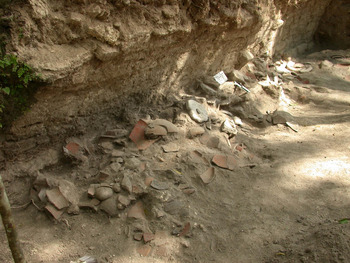
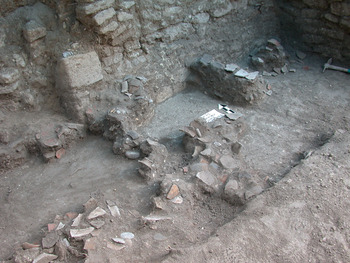
Peri-abandonment deposit on the western flank of the stairside outset of Structure A3 at Cahal Pech. Photograph by Awe.

THE SPATIAL CONTEXT OF PERI-ABANDONMENT DEPOSITS AT CAHAL PECH
As we noted in the Introduction, it was during initial excavation of Plaza A that we began to document peri-abandonment deposits and activities at Cahal Pech. These deposits were particularly concentrated on the flanks of the stairside outsets of Structures A2 and A3, in the northeast corner of Plaza A where Structures A2 and A3 adjoined, inside the central room of Structure A3, and within a narrow alleyway and vaulted tunnel that exit Plaza A to the northwest and southeast (Figure 3). Measuring approximately 2 × 5 m, the deposit to the west of the stairside outset of Structure A3 was the largest deposit recorded at the site (Figure 4). The size of the other deposits averaged about 2 × 4 m, except in the alleyways and vaulted tunnels where they were constricted by the narrow width of these passages. The contextual distribution of the Plaza A deposits and their associated cultural remains suggest that they were likely placed in the various locations within the courtyard during multiple events, all dating to the Terminal Classic period. Our investigations further revealed that the peri-abandonment cultural remains in Plaza A were generally deposited above a thin layer of matrix, which had accumulated on top of the last plastered surface of Plaza A sometime after the buildings had begun to fall into disrepair (Figure 5). This matrix consisted predominantly of soil sometimes interspersed between collapsed architectural debris such as cut stones that once formed part of the walls and roofs of Structures A2 and A3.
Partly excavated peri-abandonment deposit in front of Cahal Pech Structure A3. Photograph by Awe.

Intrusive Burial in Structure A3
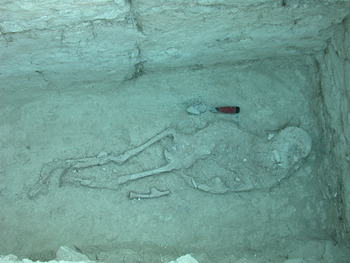
Inside a bench within the central room of Structure A3, we discovered an intrusive burial that contained the remains of a child approximately seven to nine years of age at the time of death (Figure 6). It was apparent that the Maya had cut into the bench to deposit the child's body and associated grave goods. They subsequently filled the cavity with dirt to the level of the bench's original plastered surface, though the surface of the bench was never resealed with a new plaster surface. Instead, two large limestone slabs, which may have fallen off or were removed from the vaulted roof of Structure A3, were placed over the section of the bench that had been cut through for the burial. In association with the child's remains, we recovered three ocarinas, two flutes, and four Spanish Lookout-phase (ca. a.d. 700–900) ceramic vessels, including an imitation slateware vase. We submitted samples of the skeletal remains for accelerator mass spectrometry (AMS) 14C dating but, due to extensive leaching of calcium carbonate from the surrounding matrix, the remaining bone collagen did not meet quality control standards for dating. In spite of the failed 14C dating attempts, the relative date of the grave goods, the intrusive nature of the burial, and the fact that the surface of the bench was not re-plastered after the grave had been filled, all suggested a Terminal Classic date (ca. a.d. 750–900) for the burial.
Intrusive child burial in bench of Structure A3. Photograph by Awe.

Plaza A Deposits
The Plaza A peri-abandonment deposits were mostly spread across the base of Structures A2 and A3, but concentrated in four loci. Two of these were located on the flanks of the stairside outset of Structure A3, one was located on the northern flank of the Structure A2 stairside outset, and the fourth area was located where Structures A2 and A3 join together (Figures 2 and 3). The deposits ranged between 20 to 30 centimeters in depth. Our microstratigraphic excavations indicated that, in most cases, there was a 0.5 to 2 centimeter layer of dirt between the last plaza floor and the bottommost layer of deposits. Cultural remains were usually evenly distributed above floor level, and in between cut stones that had collapsed from the walls of the two buildings. The only instances where we sometimes found deposits sitting directly on the terminal plaza surface were in those areas where plaster had not peeled off the walls, where walls or stairside outsets had not collapsed, or in those areas furthest away from the sides of buildings. This stratigraphy clearly indicated that most of the peri-abandonment cultural remains were deposited sometime after the buildings were no longer being maintained, and during or after the time that they had begun to crumble and fall apart.
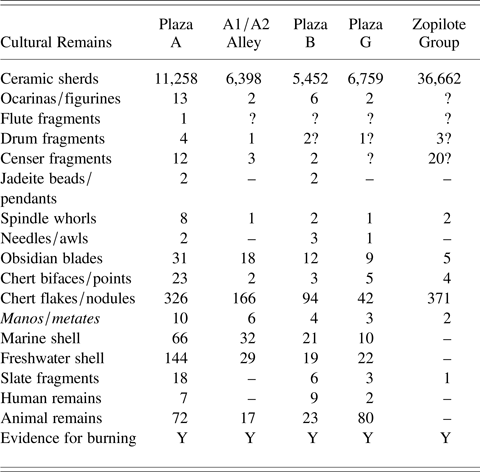
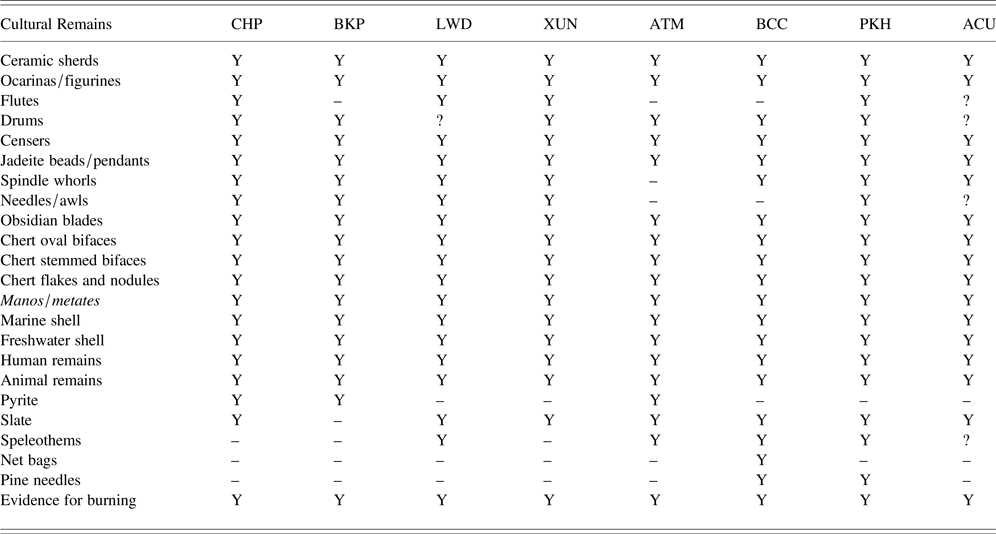
Ceramic remains (Tables 1 and 2), particularly fragmented bowls, dishes, and jars, represented the dominant (n = 11,528) artifact type in the cultural assemblage of the Plaza A peri-abandonment deposits. Other ceramic remains included fragments of censers (n = 12), ocarinas/figurines (n = 13), flutes (n = 1), drums (n = 4), and spindle whorls (n = 2). Analysis of the ceramic remains by Aimers and Awe (Reference Aimers and Awe2020) noted that the assemblage consists predominantly of Terminal Classic Spanish Lookout ceramic types (Gifford Reference Gifford1976:225–288) and that they share typological and chronological similarities with the ceramic artifacts recovered with the intrusive child burial in the bench of Structure A3. Although many sherds in this deposit were large and well-preserved, only a small number of the ceramic vessels were partly reconstructable. The ocarinas and figurines, which predominantly share stylistic parallels with Jaina-type figurines, reflect a somewhat similar pattern. All but one of the 13 ocarinas/figurines were incomplete, with the majority composed of anthropomorphic and zoomorphic effigies with their heads broken off (i.e., “decapitated”), which may imply ritual termination. One of the figurine heads is a solid, hand-modeled Middle Preclassic (900–300 b.c.) Savana Orange specimen. The presence of this sole Preclassic figurine head among a Terminal Classic assemblage suggests that it was likely recovered from an earlier context at the site, curated for some time, and redeposited with the Terminal Classic specimens in the Plaza A deposits (Newman Reference Newman2015, Reference Newman2018).
Cultural remains recovered in peri-abandonment deposits at Cahal Pech, including Plaza A, Structures A1/A2 alleyway, Plaza B, and Plaza G. “Y” indicates evidence for burning activity.

Cultural remains present in peri-abandonment deposits at sites in the Belize Valley: Cahal Pech (CHP), Baking Pot (BKP), Lower Dover (LWD), Xunantunich (XUN), Actun Tunichil Muknal (ATM), Barton Creek Cave (BCC), Pook's Hill (PKH), Aguacate Uno (ACU). “Y” indicates presence of cultural remain type; “N” represents absence of cultural remain type.

Non-ceramic cultural remains in the Plaza A deposits were represented by a variety of lithic and ground stone artifacts, including 23 bifaces, 326 chert nodules and flakes, 31 obsidian blade fragments, 10 mano and metate fragments, six limestone spindle whorls, plus a fragmented jadeite pendant and a jadeite adorno (Audet Reference Audet2006:155–160). The pendant was part of an anthropomorphic effigy with part of the face, large nose, two closed eyes, and top knot still preserved. Animal remains (n = 282) included bones of deer, feline, a variety of bird and smaller mammals, as well as both marine shell and freshwater snails. There were also seven small fragments of human bone, plus high frequencies of charcoal providing evidence of burning in some areas of the deposits.
The contextual distribution of the 23 complete bifaces was particularly interesting as seven of them were found close together on the north flank of the Structure A2 stairside outset, nine were scattered in the northeast corner of Plaza A, and the other seven were to the west of the Structure A3 stairside outset. In their study of the bifaces, Stemp and Awe (Reference Stemp and Awe2020) observed that the contextual and numerical distribution of the bifaces are ideologically significant because the numbers seven and nine are often associated with celestial and underworld realms in Maya cosmology (Miller and Taube Reference Miller and Taube1993:151–152). We should also note that usewear analysis of the bifaces is consistent with use as projectiles. This characteristic is similar to that noted for bifaces dredged from the cenote at Chichen Itza (Sheets et al. Reference Sheets, Ladd, Bathgate and Coggins1992).
In 2013, Kolias (Reference Kolias, Hoggarth and Awe2015) excavated another peri-abandonment deposit in an alleyway or corridor separating Structure A2 and Structure A1. This deposit contained an assemblage of cultural remains similar to those found in the Plaza A deposits, including 6,398 potsherds, a ceramic spindle whorl, 18 obsidian blade fragments, two bifaces, and evidence of burning.
Terminal Classic Peri-Abandonment Deposits and Activities in Plazas B, G, H, and F, and in the Zopilote Group at Cahal Pech
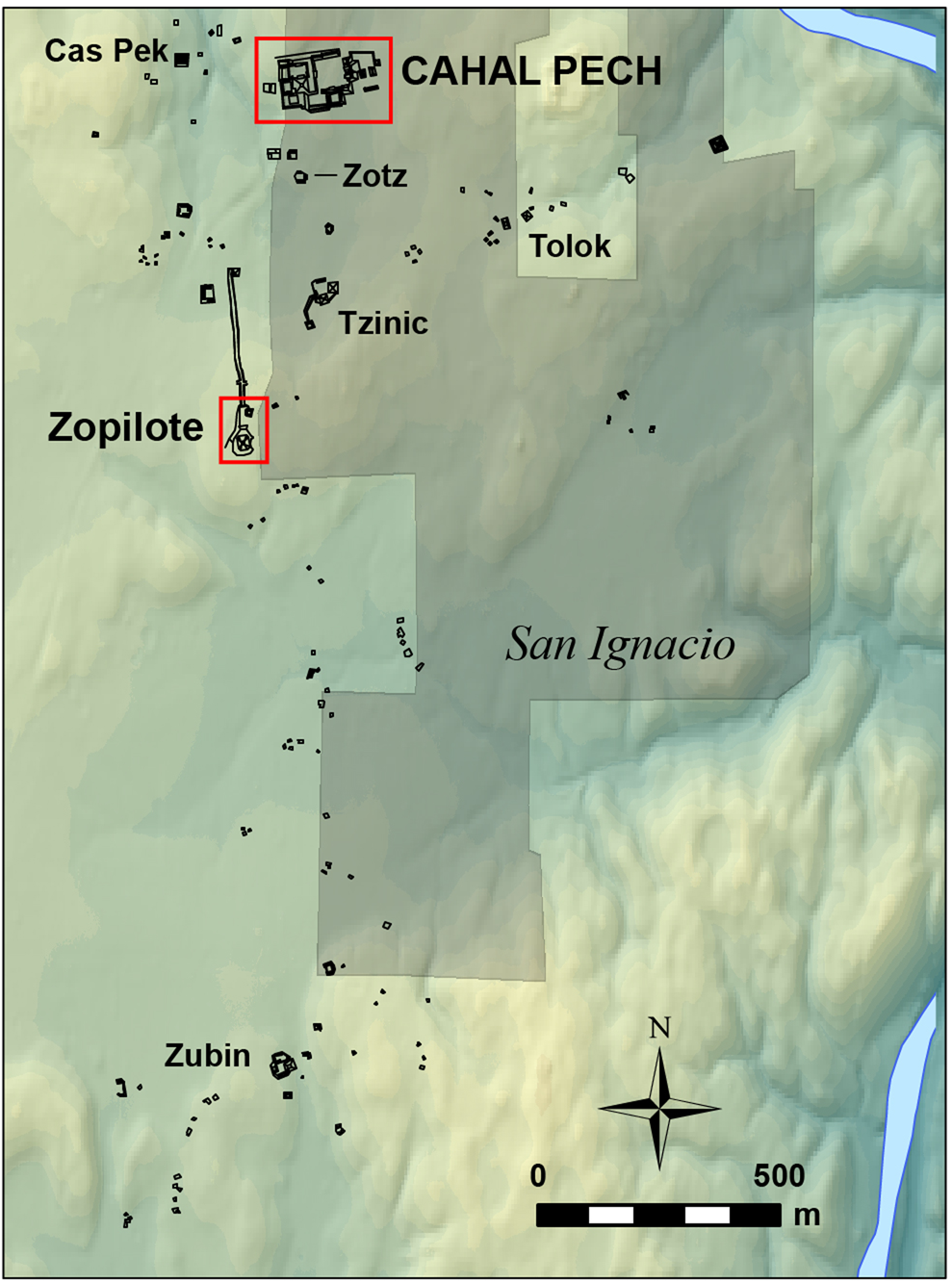
Following the end of the TDP, subsequent investigations at Cahal Pech uncovered additional peri-abandonment deposits in Plazas B and G (Figure 2), and at a causeway termini complex known as the Zopilote Group (Figure 7). We also recovered considerable evidence for other types of Terminal Classic (ca. a.d. 750–900) peri-abandonment activities in Plazas B, C, and H in the site core (Figure 2). Unlike the deposits, which generally consist of cultural remains that were predominantly placed just above plaza and building surfaces, the other types of peri-abandonment activities at Cahal Pech include intrusive burials, the scavenging or harvesting of limestone blocks for reuse in various forms of architecture, and the removal and repositioning of stone monuments.
Location of the Zopilote Group in the Cahal Pech settlement. Map by Ebert.

The peri-abandonment deposit in Plaza B was associated with Structure B3, the southern mound of the site's eastern triadic shrine or “E-Group” (Awe et al. Reference Awe, Hoggarth, Aimers, Freidel, Chase, Dowd and Murdock2017b). This deposit extended southward from the front of the structure's central stairway, and was especially concentrated along the southwestern flank of the stairside outset. The cultural remains in the Structure B3 deposit contained materials similar to those in Plaza A (Table 1), including nine fragments of human remains. An AMS 14C date on a fragment of human bone produced a date of cal a.d. 680–770 (Ebert et al. Reference Ebert, Hoggarth, Culleton, Awe and Kennett2019).
The peri-abandonment deposit in Plaza G was located between the southern stairside outset of Structure G2 and the north wall of Structure G1 (Griffith Reference Griffith, Hoggarth and Awe2014; Stanchly Reference Stanchly, Hoggarth and Awe2014; Peniche May and Beardall Reference Peniche May, Beardall, Hoggarth and Awe2015). The deposit in Plaza G contained 6,759 fragments of broken pottery, 80 fragments of animal remains, a carved bone hair pin, 10 marine shell beads, five chert bifaces/points, 45 chert flakes, one spindle whorl, and three fragments of grinding stones. Unlike the deposits in Plaza A, the Plaza G deposits were mostly located on the surface of the last plaza floor, but this could reflect the fact that Structure G2 is a relatively low platform that had not fallen apart as readily as other larger structures in the site core. Interestingly, the ceramic assemblage in the Plaza G deposits does not include some of the types and formal modes present in Plaza A, perhaps suggesting that the former may date slightly earlier than those of Plaza A (Aimers and Awe Reference Aimers and Awe2020). In summary, the peri-abandonment deposits associated with both Structure B3 and Structure G2 were similar in context and, to some degree, similar in content with those from Plaza A. They also shared a similar stratigraphic and depositional pattern to that observed in Plaza A. These shared characteristics, particularly the contemporaneity of the contexts, reinforces our interpretation that the Maya deposited these cultural remains sometime after, or during, the time that the site had begun to fall into disrepair.
The Zopilote terminus group is located south of the Cahal Pech site core (Figure 7), and is connected to the latter via a 750-m long causeway (or sacbe). At the end of the sacbe rises an 11-m high pyramid and a smaller structure just north of the causeway. Following the discovery and partial excavation of a peri-abandonment deposit at the Zopilote Group in 2015 (Ebert and Fox Reference Ebert, Fox, Hoggarth and Awe2016), the feature was excavated further in 2016 by Fox (Reference Fox2018). The latter investigation uncovered a small section of the peri-abandonment deposit at the base of Structure 2, but noted that the overall composition of the Zopilote deposit, or of the area sampled, was somewhat different from those in the site core. The Zopilote remains (Table 1) contained considerable evidence for the burning of organic material, a total of 371 chert flakes, five obsidian blades, a fragment of a slate wrench, two mano and metate fragments, four chert bifaces, and 36,662 ceramic fragments predominantly composed of bowl, jar, and censer fragments. Fox's (Reference Fox2018) excavation, however, recovered no animal or human remains. The absence of the human and animal remains may simply reflect a sample bias for, unlike the deposits in the site core, the deposit at the Zopilote Group was only partially (20 percent) excavated (Ebert and Fox Reference Ebert, Fox, Hoggarth and Awe2016; Fox Reference Fox2018). Alternatively, differences between the two assemblages could represent differences in the types of peri-abandonment activities that were conducted at different loci of the site core. Besides these differences, Fox (Reference Fox2018) notes that the deposits at Zopilote were layered and separated by thin soil lenses, indicating that the assemblage was likely associated with multiple events over an extended period of time during the Terminal Classic period.
EVIDENCE FOR OTHER PERI-ABANDONMENT ACTIVITIES AT CAHAL PECH
In our above discussion of the peri-abandonment deposits in Plaza A, we noted that we also uncovered an intrusive child burial within a bench in Structure A3. Outside of Plaza A, more than 30 years of investigations at Cahal Pech have also recorded evidence for other types of Terminal Classic peri-abandonment activities on Structures B1 and B4, and in Plazas C and G (Figure 2; Awe Reference Awe1992, Reference Awe2013; Awe et al. Reference Awe, Ebert, Friewald and Green2017a, Reference Awe, Hoggarth, Aimers, Freidel, Chase, Dowd and Murdock2017b; Burke et al. Reference Burke, Wisner, Tappan, Wilson, Stanchly, Ebert, Burke, Hoggarth and Awe2017). On Structure B1, the central pyramid of the eastern triadic shrine or “E-Group,” we recovered Terminal Classic remains in a special deposit and in a burial at the summit of the structure. The special deposit was discovered along the primary axis of Structure B1, a few centimeters below the modern humus surface. The deposit lay in a cavity 60 × 45 cm north-south and was 26 cm thick (Ishihara-Brito et al. Reference Ishihara-Brito, Can, Awe, Hoggarth, Guerra and Awe2013:75–70). It contained two laurel leaf blades of fine-quality chert, with an upside-down skull placed on top of them. Around the skull were several disarticulated fragments of human bone that were capped by a bed of eroded potsherds and a large fragment of a Spanish Lookout ceramic complex Mount Maloney Black bowl. The stratigraphic context of the deposit indicates that a section of the terminal phase stairway of Structure B1 had been removed prior to the placement of the deposit. After the deposit had been placed in the cavity, the cultural remains were covered with dirt, but the cut stones were discarded, and the stairway was not repaired.
The other Terminal Classic feature on Structure B1 consisted of an intrusive burial (BU:B1-1) that was actually excavated by Peter Schmidt in 1969 (Awe Reference Awe1992, Reference Awe2008, Reference Awe2013; Awe et al. Reference Awe, Ebert, Friewald and Green2017a). Schmidt never published this work, but his notes, which are archived in the Belize Institute of Archaeology, mention that the intrusive burial contained the remains of an adult female and five ceramic vessels. Two of the vessels, both modeled censers diagnostic of the Terminal Classic period, share close affinity to Cayo Unslipped ceramics from the Belize Valley, and with the Cambio Ceramic Group from the Peten (Adams Reference Adams1971:57; Gifford Reference Gifford1976:276–286; Sabloff Reference Sabloff and Patrick Culbert1973, Reference Sabloff1975:114–116). The censers are also identical to another that we found in a large Terminal Classic tomb in Plaza H (see the following description of tomb contents for details; Aimers and Awe Reference Aimers and Awe2020). The other vessels in the Structure B1 intrusive burial included three Terminal Classic, Spanish Lookout-phase bowls.
Terminal Classic peri-abandonment activity in Structure B4 is represented by two intrusive burials, BU:B4-1 and BU:B4-2, that we uncovered at the summit of this nondomestic structure. Burial 2 (BU:B4-2) contained the remains of a child in fetal position with no grave goods. Burial 1 (BU:B4-1) was a shallow crypt, bordered by a single line of cut stones, that contained an adult male in extended position and head to the south (Awe Reference Awe1992; Awe et al. Reference Awe, Ebert, Friewald and Green2017a). The only grave good accompanying BU:B4-1 was a tall polychrome cylinder vase from the Cabrito Cream-polychrome ceramic system (Aimers et al. Reference Aimers, LeCount and Awe2019). More significant, however, is the fact that this vase is practically an exact duplicate of a locally made vase found in the Structure H1 tomb described below. AMS 14C analyses of the human remains from BU:B4-1 and BU:B4-2 yielded dates of cal a.d. 680–770 and cal a.d. 670–770, respectively (Ebert Reference Ebert2017; Ebert et al. Reference Ebert, Hoggarth, Culleton, Awe and Kennett2019). These dates clearly confirm the two burials are contemporaneous, that they are coeval with other peri-abandonment activity at Cahal Pech (e.g., the intrusive child burial in Plaza A), and that they are associated with the final phase of occupation at the site.
In Plazas C and H, we recorded evidence for Terminal Classic peri-abandonment activity in Structures C2 and C6, and Structures H1 and H2. In Plaza C, we found a circle of cut stones in the center of the courtyard and aligned with the primary axes of Structures B1 and C1 (Awe Reference Awe1992). The center of the circle appeared to have been burnt, and it is likely that the stones were removed from buildings in the courtyard that were no longer in use. At Cahal Pech, the removal and reuse of facing stones from buildings is most evident on Structure C6 at the south end of Plaza C. When we excavated this building in 2006, we found that almost the entire northern façade of the structure had been removed. The facing stones were then used to construct a low wall that extended 5.2 m westward from the northwestern corner of C6, then turned northward at right angle and extended all the way to the southeastern corner of Structure B1. While some researchers might interpret this low wall as serving defensive purposes, it is more likely that it functioned like the albaradas in the Yucatan; that is, to demarcate or enclose living space.
Another Terminal Classic activity that we recorded in Plaza C was the movement and repositioning of monuments. At the summit of Structure C6, and just northeast of Structure B1, for example, we found fragments of altars that had been removed from their original location and redeposited in their present location. We also found large fragments of two stelae between Structure C6 and the eastern ball court. The butts of these monuments are located in Plaza B, suggesting that the fragments in Plaza C were removed from their original location in Plaza B.
On Structure C2, we uncovered a shallow intrusive grave (BU:C2-1), just a few centimeters below modern ground surface. The grave, which had penetrated the terminal floor of the building, contained the disarticulated and incomplete remains of a child and a few potsherds (Awe and Schwanke Reference Awe, Schwanke, Helmke and Awe2006). AMS 14C dating of the human remains produced a date of cal a.d. 775–890 (Ebert Reference Ebert2017; Ebert et al. Reference Ebert, Hoggarth, Culleton, Awe and Kennett2019). This date overlaps with an AMS 14C date of 710–875 cal a.d. from deer bone in those from the Structure H1 tomb, and with the date acquired from the human remains in the peri-abandonment deposit associated with Structure B3. They do, however, postdate the intrusive burials in Structure B4, and thus could be associated with activities that slightly postdate those in Plazas A, B, and H.
Plaza H is a small, nondescript courtyard in the northeastern corner of the Cahal Pech site core. In addition to a small peri-abandonment deposit in Plaza H, we recovered considerable evidence that: (1) this courtyard was occupied at the same time that the peri-abandonment deposits were being placed in Plazas A and B; and (2) that its use was coeval with the intrusive burials and with peri-abandonment activities described above for Plazas A, B, C, and G. This observation is based on the overlapping AMS 14C dates of human and animal remains in the tomb and other deposits, on the modal and typological similarities between the ceramics from the peri-abandonment deposits with those from the tomb in Plaza H, and by 30 years of data collected by the horizontal excavation of approximately 80 percent of the architecture in the Cahal Pech site core. The latter type of exposure is rare at most of the lowland Maya sites where peri-abandonment deposits have been found. We believe that the limited exposure of site core architecture can potentially skew observations, making it appear that so-called problematic deposits are the final gasps of rapidly abandoning populations rather than residues of activities associated with continued, though limited, use and habitation of the site in question. This is precisely the picture that was unveiled by our investigations in Plaza H.
Several seasons of excavations in Plaza H revealed that this epicentral courtyard was still occupied, albeit to a limited degree, when most of the peri-abandonment deposits and activities were taking place in the Cahal Pech site core. The coeval nature of these activities is suggested by several lines of evidence, including construction activity associated with the last phase of occupation on both Structures H1 and H2, by occupational debris in the courtyard, especially chert debitage and a midden containing Mount Maloney Black pottery, and by BU:H1-1, constructed with cut stones removed from earlier Classic period buildings (Awe Reference Awe2013; Douglas and Brown Reference Douglas, Brown, Hoggarth and Awe2014, Reference Douglas, Brown, Hoggarth and Awe2016; Douglas et al. Reference Douglas, Brown and Awe2015; Johannesen Reference Johannesen2019; Santasilia Reference Santasilia, Hoggarth, Guerra and Awe2012).
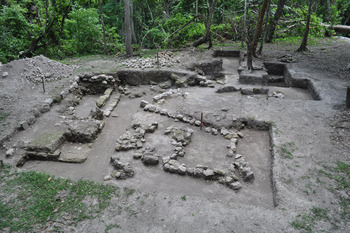
Unlike the earlier and typical Classic period architecture in the site core, the Terminal Classic architecture in Plaza H consist of low building platforms that were mostly constructed of large and crudely shaped boulders (Figure 8). Structure H1/1st is the largest of these buildings. It consists of an L-shaped platform that likely supported a perishable superstructure and, was built directly over an earlier (H1/2nd) Late Classic building. At some time during its short period of occupation, the Terminal Classic inhabitants of the L-shaped Structure H1/1st platform built a large tomb beneath the floor of the eastern section of the building.
Terminal Classic peri-abandonment buildings constructed above Late Classic architecture in Plaza H, Cahal Pech. Photograph by Awe.

The Structure H1 tomb (BU:H1-1) was constructed with cut stones that were pillaged from earlier Classic-period architecture, and contained the remains of a single adult male with head to the south orientation and in extended position (Awe Reference Awe2013). Associated with the burial were a variety of grave goods, including 13 ceramic vessels (Aimers et al. Reference Aimers, LeCount and Awe2019; Aimers and Awe Reference Aimers and Awe2020), approximately 24 complete and fragmented deer bone tubes, a dog tooth necklace made with the teeth of at least 52 juvenile dogs, five obsidian blades, a Maize God effigy jadeite pendant, two jadeite ear flares, two jadeite beads, one modified conch shell, and one shell bead. At the northern end of the chamber were the remains of a small feline, possibly those of an ocelot.
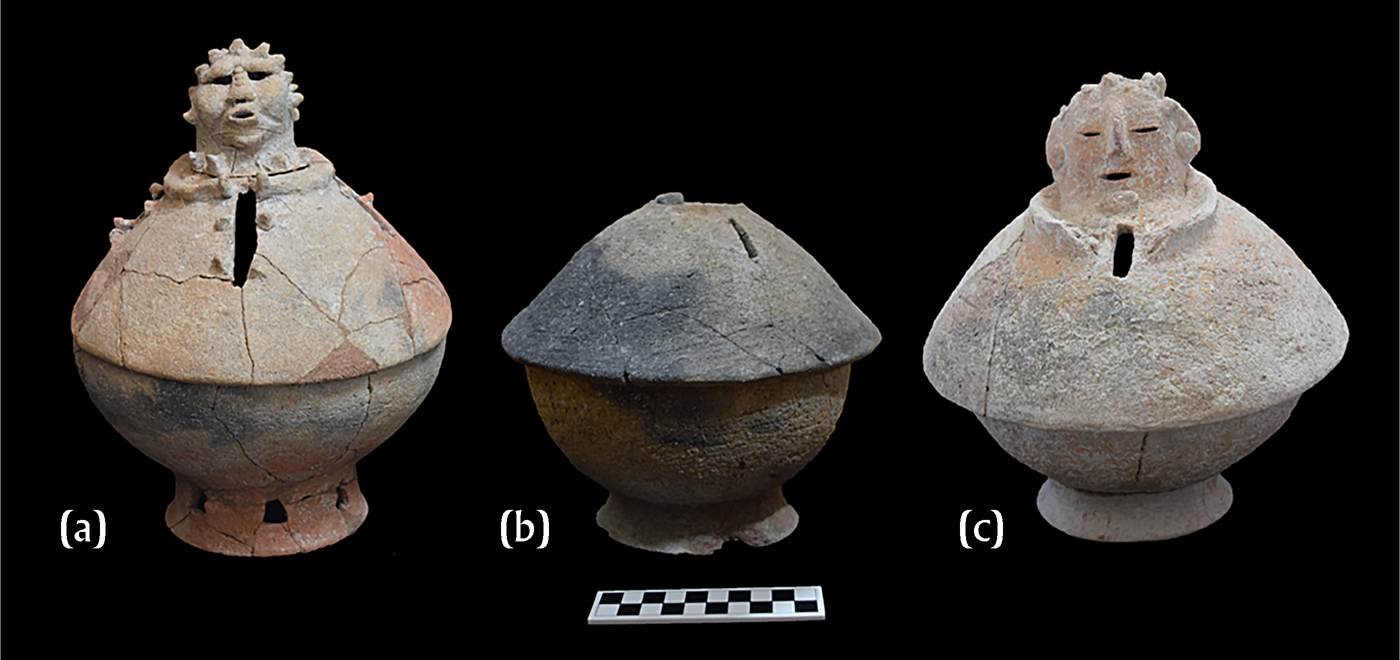
The ceramic vessels are all diagnostic of the Terminal Classic period, a temporal assignment supported by an AMS 14C date of cal a.d. 710–875 acquired from a fragment of one of the deer bone tubes (Ebert et al. Reference Ebert, Hoggarth, Culleton, Awe and Kennett2019). Particularly significant to this study is the fact that the 14C date from the tomb overlaps with several of the 14C dates associated with the other peri-abandonment deposits and intrusive burials described in this paper. Equally important is that several of the ceramic vessels in the tomb are identical to other vessels in three of the aforementioned intrusive burials in Plazas A and B, and with pottery recovered in the peri-abandonment deposits at the site. A lidded censer (excavated as Vessels 3 and 7) from the Structure H1 tomb, for example, is identical to the two anthropomorphic censers discovered by Schmidt in the intrusive female burial (BU:B1-1) at the summit of Structure B1 (Figure 9). Vessel 4, a small, cream-slipped pedestal vase, in the Structure H1 tomb is also similar to the small vase found with the intrusive child burial (BU-A3-1) in Structure A3 in Plaza A (Aimers and Awe Reference Aimers and Awe2020). Vessel 2, a Cabrito Cream polychrome vase thought to be made in the Belize Valley based on neutron activation analysis by Reents and Bishop (Dorie Reents, personal communication 2018) is identical to the single vase found with the intrusive burial (BU:B4-1) in Structure B4 (Aimers and Awe Reference Aimers and Awe2020). What is particularly significant here is that these data collectively indicate that Plaza H was still occupied when the peri-abandonment deposits in Plazas A, B, and G, the H1 tomb, and the intrusive burials were being deposited across the site core of Cahal Pech.
Censers from intrusive burials in (a and b) Structure B1 and (c) Structure H1 Tomb. Photograph by Awe.

DISCUSSION AND CONCLUSION
As we noted in the Introduction of this paper, the process, tempo, and nature of site abandonment during the Terminal Classic period continues to concern archaeologists working in the Maya lowlands. This situation is clearly evident in several of the published syntheses that focus on the Terminal Classic period (cf. Demarest et al. Reference Demarest, Rice and Rice2004), on recent volumes that address questions concerning the collapse of Maya civilization (Iannone Reference Iannone2014; Webster Reference Webster2002), and in the numerous papers that have examined the significance of peri-abandonment deposits (Braswell et al. Reference Braswell, Gunn, Carrasco, Folan, Fletcher, Lopez, Glascock, Demarest, Rice and Rice2004; Chase and Chase Reference Chase, Chase, Demarest, Rice and Rice2004; Moholy-Nagy Reference Moholy-Nagy1997; Inomata and Webb Reference Inomata and Webb2003; Lamoureux-St-Hilaire et al. Reference Lamoureux-St-Hilaire, Macrae, McCane, Parker and Iannone2015; Newman Reference Newman2015, Reference Newman2018; Stanton et al. Reference Stanton, Brown and Pagliaro2008; Taschek and Ball Reference Taschek and Ball2003; Tsukamoto Reference Tsukamoto2017). A review of the latter publications (see Aimers et al. Reference Aimers, Hoggarth and Awe2020) notes that peri-abandonment deposits have been interpreted as evidence for rapid abandonment due to invasion and destruction by marauding armies, that they are associated with the termination/desecration of Late Classic buildings, that they represent squatters refuse, or that they constitute the remains of feasting events. The questions we sought to answer in our contribution to this Special Section of the journal is, what does the evidence from an intensively and extensively excavated site tell us about the nature of peri-abandonment deposits? Do the data from sites like Cahal Pech support any of the aforementioned hypotheses, or do they provide alternative explanations for these archaeological remains?
We argue here that 30 consecutive years of intensive archaeological investigation, and the fact that some 80 percent of the site core has been extensively excavated, make Cahal Pech an ideal laboratory for studying the cultural processes associated with the decline and abandonment of ancient Maya cities in the Belize River Valley. The Cahal Pech data also serve to demonstrate why it is critical for us to examine peri-abandonment deposits in conjunction with other types of contemporaneous activities at the sites where these deposits occur. Indeed, failure to examine these deposits in conjunction with other contemporaneous data and site contexts severely limits our interpretation of their significance, and provides only a small and skewed window for making inferences on the activities that led to their becoming part of the archaeological record.
Results of our long-term and wide-scale investigations at Cahal Pech, coupled with our regional Belize Valley study (Awe et al. Reference Awe, Helmke, Aimers, Ebert, Stemp and Hoggarth2020; Hoggarth et al. Reference Hoggarth, Davis, Awe and Helmke2020), indicate that peri-abandonment deposits, at both the individual site and regional level, share several significant characteristics. These parallels include shared contexts, similarities in artifact assemblages, and evidence for burning. Additionally, our study notes that when a microstratigraphic approach is employed in the excavation of peri-abandonment deposits, it reveals that a thin layer of collapsed debris (or soil matrix) often separates these deposits from the terminal surfaces (floors) of the plazas and buildings on which we discover them. In many cases, these deposits are also located on and in between collapsed architecture. Both of these characteristics strongly indicate that the deposits were placed in the contexts we discover them at a time when the architecture had begun to fall into disrepair, and not during singular episodes of rapid abandonment brought about by martial activities. This observation is further supported by the fact that most of the deposits contain relatively similar artifact assemblages. The regular presence of artifacts such as complete spindle whorls, manos and metates, incense burners, and ocarinas in these assemblages are also not generally associated with militarism and wanton destruction. Neither is the consistent spatial contexts in which these deposits are discovered. These characteristics, in fact, reflect patterned behavior, and suggest that the actors associated with these events consistently sought out the same locations for placing a similar suite of cultural remains. If rapid abandonment associated with sacking and military activity was what caused the presence of these deposits, we would have to assume that the invaders consistently and purposefully chose to destroy similar types of objects and then take the time to place them in the very same places time and time again.
Several other data support the non-militaristic association and significance of these deposits. As we noted above, our investigations of the peri-abandonment deposits at Cahal Pech (also at Baking Pot; cf. Hoggarth et al. Reference Hoggarth, Davis, Awe and Helmke2020) suggests that they accumulated over a protracted period of time, and that they likely represent several episodical depositions. That is, they were not deposited in a singular event, but during several occasions in the Terminal Classic period. This is further supported by the presence of artifacts that appear to have been curated for some time prior to their final deposition in the deposits, and by the fact that most of the ceramics could not be completely reconstructed. A recent study by Newman (Reference Newman2015, Reference Newman2018) notes that the Maya often curated midden-like material and later ritually decommissioned them in special deposits. This practice echoes those of contemporary Maya communities in highland Guatemala (Brown Reference Brown2002), and by the Lacandon and Zinacantecos in Chiapas (McGee Reference McGee2005; Palka Reference Palka2014; Vogt Reference Vogt1969, Reference Vogt1976).
Several characteristics of the peri-abandonment deposits at Cahal Pech also provide limited, if any, support for their association with termination/desecration events. For example, we found no evidence of extensive damage to the structures around which the deposits were discovered (see Hoggarth et al. [Reference Hoggarth, Davis, Awe and Helmke2020] for a list of the archaeological correlates for deposit hypotheses), and while we do find evidence for burning, the latter is predominantly associated with the deposits themselves. Indeed, only in a few cases did we record burn marks on buildings, but these were always in association with the deposits themselves. Other features of the Cahal Pech deposits that negate the termination/desecration hypothesis include the fact that the deposits were placed in their contexts of discovery after and/or during the time that buildings were falling apart, and that they were deposited during multiple rather than singular events.
The feasting hypothesis is also not supported by the Cahal Pech data. For example, feasting events are predominantly conducted in special locations or structures that are “associated with residential corporate households” (Aimers et al. Reference Aimers and Awe2020:70). At Cahal Pech and Belize Valley sites, however, we find the deposits associated not only with elite residential architecture, but also with causeway termini groups, sweat baths, and temples (cf. Awe et al. Reference Awe, Helmke, Aimers, Ebert, Stemp and Hoggarth2020; Hoggarth et al. Reference Hoggarth, Davis, Awe and Helmke2020). Failure to remove the deposits from rooms after these so-called feasts ended would have also rendered the rooms unusable, constituting a very impractical tradition, particularly if the buildings were continued to be used. Additionally, the presence of human remain fragments and complete spindle whorls are not typical in cultural assemblages associated with feasting events.
The above characteristics of peri-abandonment deposits also argue against their association with de facto refuse or middens. If nothing else, years of excavating Maya sites have taught us that middens are not found inside sweat baths, at the base of temples, or in public contexts. Complete spindle whorls, manos and metates, chert bifaces, and jadeite jewelry, are also not typically found in midden assemblages, and neither are human remains or burials with grave goods.
In addition to the peri-abandonment deposits, our long-term and extensive investigations at Cahal Pech also recovered evidence for several activities that were contemporaneous with the deposits. These activities included the displacement and repositioning of monument fragments, the placement of intrusive burials in abandoned buildings, the scavenging and reuse of limestone blocks from earlier architecture, and the construction of albaradas and building platforms like those we located in Plazas C and H, respectively. The contemporaneity of all these activities is suggested by the overlapping AMS 14C dates from several of the contexts that we investigated, and also by the fact that several ceramic vessels in the deposits and intrusive burials are almost identical and coeval in date (Aimers et al. Reference Aimers, Hoggarth and Awe2020).
Given the similarity and contemporaneity of the cultural remains that we recovered in Plazas C and H, we propose two potential scenarios for Cahal Pech during the final years of occupation of this site. First, it is possible that Plazas C and H, which are located in the eastern section of the site core, were occupied or inhabited at the same time that the peri-abandonment deposits and intrusive burials were being deposited in the site's epicenter. Strontium isotope analysis of the human remains from the Structure H1 tomb indicates that the individual is local to the Belize Valley, further suggesting that small groups of locals may have continued to reside at the site, hoping to stick it out and overcome the problems that were affecting the region. Neutron activation analysis of Vessel 2, a Cabrito Cream-polychrome, from the Structure H1 tomb suggests that the vessel is also from the Belize Valley (Dorie Reents, personal communication 2018), lending additional support to the latter interpretation. It is quite possible, therefore, that a small group of people continued to reside at and near the Cahal Pech site core during a time of protracted abandonment, that they continued to conduct rituals in a sacred landscape that was the previous home of their deified ancestors, and to bury their dead within buildings that were falling into disrepair.
The second possible scenario is that a few years after abandonment, Cahal Pech was reoccupied by local Belize Valley folk, possibly from the site's periphery, or from another neighboring settlement. Because the larger vaulted buildings in Plaza A were falling apart, the last occupants of the site chose to construct low platforms with pole and thatch architecture in Plazas C, G, and H. During their relatively brief residence at the site, they scavenged stones from earlier buildings for their own construction needs, they buried their dead intrusively in abandoned buildings, and they conducted propitiation rituals in various other parts of the site core. We suggest that these practices are akin to those still conducted by the Lacandon Maya at Yaxchilan (McGee Reference McGee1990, Reference McGee2005), by the Zinacantecos in the mountains of Chiapas (Vogt Reference Vogt1976), and by Maya villagers in highland Guatemala. In the latter case, Brown (Reference Brown2002) notes that Maya villagers often exhume fragments of bones of deceased ancestors and redeposit them at shrine sites. This could explain why we sometimes discover fragments of human bone in many of the peri-abandonment deposits excavated in western Belize sties. In the end, we may never know for certain which of the two scenarios described above accurately reflects the last hurrah of the Belize Valley Maya. The one thing we are very certain about, however, is that all their attempts to cling to their gloried past failed, and that Cahal Pech was eventually abandoned sometime around the end of the ninth century a.d.
RESUMEN
Investigaciones arqueológicas realizadas por el Proyecto BVAR en Cahal Pech, en el Valle de Belice, descubrieron varios depósitos y áreas de actividad peri-abandono del clásico terminal. Estos depósitos contienen un conjunto rico y diverso de restos culturales que fueron recuperados arriba de y entre elementos arquitectónicos colapsados, asociados a evidencias de actividades de exposición al fuego. En el pasado, los arqueólogos generalmente han interpretado conjuntos similares como “depósitos problemáticos,” desechos “de facto,” con terminación de edificios y profanación, o como evidencia de abandono rápido durante la violenta destrucción de estas ciudades antiguas. Aquí se argumenta que las excavaciones microestratigráficas y el análisis contextual de los datos presentados apoyan de manera limitada estas explicaciones. De manera alternativa, sugerimos que estos depósitos estaban probablemente asociados a rituales peri-abandono que fueron llevados a cabo por pequeñas poblaciones remanentes en Cahal Pech, o por pequeños grupos que continuaron habitando en la periferia del sitio durante las últimas décadas del periodo clásico terminal.
ACKNOWLEDGMENTS
Archaeological excavations at Cahal Pech were conducted under the auspices of the Belize Valley Archaeological Reconnaissance (BVAR) Project directed by Jaime Awe, Julie Hoggarth, and Claire Ebert. Permission to conduct the research described herein was graciously granted by the Belize Institute of Archaeology under the direction of Drs. Allan Moore, John Morris, and Harriot Topsey. Funding for the research and conservation programs at the site were generously provided by the Canadian Commission to UNESCO, the Gordon Childe Fund of the University of London, the Tilden Family Foundation, the Social Sciences and Humanities Research Council of Canada (Awe), the National Science Foundation (BCS-1460369, Hoggarth), the Belize Ministry of Tourism Culture, and the BVAR Project. We extend our sincere gratitude to all these institutions and foundations, to the many members of the BVAR Project, and to the many colleagues who have assisted us during 32 years of investigations in Western Belize.