Bowlby's (Reference Bowlby1969/1982, Reference Bowlby1973) attachment theory claims that mental representations of attachment relationships are acquired through the repeated exposure to a parental caregiver's consistency and responsivity in times of need. In turn, these representations are expected to be relatively stable within individuals over time and serve as a key mechanism by which early caregiving experiences come to shape cognitions, emotions, and behavior in novel interpersonal contexts during childhood and adolescence and into adulthood. Ultimately, these representations are expected to be transmitted across generations. Nonetheless, as Hinde (Reference Hinde and Rutter1988) and others (e.g., Bretherton, Reference Bretherton1992; Thompson, Laible, & Ontai, Reference Thompson, Laible and Ontai2003) have emphasized, Bowlby did not specify the precise form and substance of these representations of early caregiving experiences. As a result, attachment researchers have explored a variety of representational constructs in an effort to understand how, when, and in what form attachment representations emerge (Main, Kaplan, & Cassidy, Reference Main, Kaplan and Cassidy1985; Waters & Waters, Reference Waters and Waters2006).
The adult attachment interview
Within developmental science, the most well-established method for studying attachment representations during late adolescence or adulthood is the Adult Attachment Interview (AAI; Hesse, Reference Hesse, Cassidy and Shaver2008; Main et al., Reference Main, Kaplan and Cassidy1985). The AAI is a semi-structured protocol that focuses on adults’ autobiographical memories of childhood experiences with their primary caregivers, and attachment security is traditionally assessed via the coherence of the interview discourse. Coherence is defined as the degree to which an individual's narrative conforms to Grice's (Reference Grice, Cole and Moran1975) maxims for conversational implicature (Main, Goldwyn, & Hesse, Reference Main, Goldwyn and Hesse2003-2008); specifically, that speakers be informative, truthful (supporting their claims with evidence), relevant, and well organized. That is, individuals rated as coherent in their AAI discourse describe their experiences and relationships with childhood caregivers in an internally consistent but not emotionally overwrought manner (e.g., Roisman, Reference Roisman2009).
Despite its substantial influence on adult attachment scholarship, the AAI presents at least three challenges for researchers. First, on a practical level, the AAI is relatively difficult and expensive to code using the standard coding system. Second, there is considerable conceptual distance between the coherence of AAI narratives and the underlying attachment representations it is meant to assess. In the development of the AAI, Main et al. (Reference Main, Kaplan and Cassidy1985, pp. 66–67) aimed to operationalize adult attachment representations as “a set of conscious and/or unconscious rules for the organization of information relevant to attachment and for obtaining access to that information,” but the coding system scales themselves are not directly descriptive of these rules. Third, recent large sample (Booth-LaForce & Roisman, Reference Booth-LaForce and Roisman2014) and meta-analytic evidence (Verhage et al., Reference Verhage, Schuengel, Madigan, Fearon, Oosterman, Cassibba and Van IJzendoorn2016, Reference Verhage, Fearon, Schuengel, Van IJzendoorn, Bakermans- Kranenburg, Madigan and Brisch2018) suggests that the associations between AAI coherence and other theoretically relevant variables are less strong than early syntheses of the evidence suggested.
Operationalizing attachment representations in terms of the coherence with which adults discuss early caregiving experiences has indeed facilitated a large body of research on the antecedents of attachment representations in adolescence and adulthood (Bakermans-Kranenburg & Van IJzendoorn, Reference Bakermans-Kranenburg and Van IJzendoorn2009; Grossman, Grossman, & Waters, Reference Grossman, Grossman and Waters2006). Nonetheless, the largest studies in this area suggest that AAI coherence is only weakly associated with attachment security in infancy (r ~ .10–.15; Groh et al., Reference Groh, Roisman, Booth-LaForce, Fraley, Owen, Cox, Burchinal, Booth-LaForce and Roisman2014; Pinquart, Feussner, & Ahnert, Reference Pinquart, Feussner and Ahnert2013; Weinfield, Sroufe, & Egeland, Reference Weinfield, Sroufe and Egeland2000), albeit moderately associated with having received sensitive care from mothers during the years prior to maturity (r ~ .30; e.g., Haydon, Roisman, Owen, Booth-LaForce, & Cox, Reference Haydon, Roisman, Owen, Booth-LaForce, Cox, Booth-LaForce and Roisman2014).
One possible explanation for these findings is that the traditional emphasis on assessing attachment representations by focusing on the coherence of adults’ discourse about their childhood caregiving experiences may be less than ideal in producing maximally valid assessments of adult attachment quality. Fortunately, the integration of attachment theory with more modern cognitive approaches has led many to call for and develop complementary assessments of mental representations of attachment-related experiences that can be leveraged to produce potentially more robust evidence linking early caregiving experiences to adults’ attachment representations. In particular, a recently emerging perspective on the development of attachment representations suggests that the quality of early experience with caregivers may be reflected in a cognitive script (Bretherton, Reference Bretherton1985, Reference Bretherton and Osofsky1987)—specifically the secure base script (Waters & Waters, Reference Waters and Waters2006).
The secure base script
The secure base script is a temporal–causal generalization, or schema, that summarizes the basic features of receiving support from an attachment figure during times of need. To date, individual differences in secure base script knowledge have been assessed using two methods: the Attachment Script Assessment (ASA; Dykas, Woodhouse, Cassidy, & Waters, Reference Dykas, Woodhouse, Cassidy and Waters2006; Steele et al., Reference Steele, Waters, Bost, Vaughn, Truitt, Waters and Roisman2014; Waters, Bosmans, Vandevivere, Dujardin, & Waters, Reference Waters, Bosmans, Vandevivere, Dujardin and Waters2015; Waters & Waters, Reference Waters and Waters2006) and a secure base script coding scheme developed for the AAI (AAIsbs; Waters & Facompré, Reference Waters, Facompré, Waters, Vaughn and Watersin press; Waters, Brockmeyer, & Crowell, Reference Waters, Brockmeyer and Crowell2013; Waters, Ruiz, & Roisman, Reference Waters, Ruiz and Roisman2017)Footnote 1. Both of these methods involve coding the extent to which individuals’ narratives of attachment-related events are organized around the secure base script. Specifically, according to Bowlby (Reference Bowlby1988), through repeated interactions with primary caregivers, secure base support (or lack thereof) becomes generalized to include expectations around the consistency and availability of attachment figures and their ability to effectively restore normal, ongoing activities if a threat or disruption occurs. This report continues a line of work described in detail immediately below about the extent to which more access to and elaborated knowledge of the secure base script—as reflected in an adult's ability to generate narratives in which attachment-related threats are recognized, effective help is provided, and the problem is resolved—has its origins in the quality of early caregiving experiences (see Waters & Roisman, Reference Waters and Roisman2019, for a review).
The childhood origins of secure base script knowledge in young adulthood thus far has been examined in the context of three longitudinal investigations (Waters & Roisman, Reference Waters and Roisman2019). The largest sample evidence to date is from a comparative analysis of attachment representations in a subsample (N = 673) of the normative-risk NICHD Study of Early Child Care and Youth Development (SECCYD) cohort (Steele et al., Reference Steele, Waters, Bost, Vaughn, Truitt, Waters and Roisman2014). More specifically, Steele et al. (Reference Steele, Waters, Bost, Vaughn, Truitt, Waters and Roisman2014) reported that direct observations of both maternal and paternal sensitivity across the first 15 years of life predicted variation in secure base script knowledge at age 18 years, as measured with the ASA. Furthermore, variation in ASA scores partially accounted for associations between the same sensitivity measure and coherence as measured in the AAI (contemporaneously measured with the ASA). Similarly, in an adoption study by Schoenmaker et al. (Reference Schoenmaker, Juffer, Van IJzendoorn, Linting, van der Voort and Bakermans-Kranenburg2015) parental sensitivity was predictive of secure base script knowledge, as measured with the ASA, above and beyond AAI coherence. These findings suggest that even in genetically unrelated families, secure base script knowledge can be predicted from sensitive caregiving early in life. The most recent study in this set investigated the antecedents of secure base script knowledge as coded in the AAI. Using data from the high-risk Minnesota Longitudinal Study of Risk and Adaptation (MLSRA) cohort, Waters et al. (Reference Waters, Ruiz and Roisman2017) reported that AAIsbs scores were significantly more strongly associated with observed sensitivity (measured from infancy through age 13 years) than were traditional ratings of coherence applied to the same AAIs.
Taken together, the current literature in this area (Schoenmaker et al., Reference Schoenmaker, Juffer, Van IJzendoorn, Linting, van der Voort and Bakermans-Kranenburg2015; Steele et al., Reference Steele, Waters, Bost, Vaughn, Truitt, Waters and Roisman2014; Waters et al., Reference Waters, Ruiz and Roisman2017) supports the claim that access to and elaborated knowledge of the secure base script has its origins in sensitive caregiving both within normative-risk (SECCYD) and higher-risk (MLSRA) samples, as well as in genetically unrelated dyads (Schoenmaker et al., Reference Schoenmaker, Juffer, Van IJzendoorn, Linting, van der Voort and Bakermans-Kranenburg2015). This set of studies also provides some preliminary evidence that assessments of secure base script knowledge incrementally and/or more strongly retrodict early sensitive parental caregiving compared to the traditional AAI coding system that focuses on the coherence of adults’ discourse about their childhood experiences. The assessment of secure base script knowledge is advantageous over traditional assessments of coherence for both theoretical and practical reasons. Theoretically, the secure base script concept more directly reflects the secure base content of adults’ attachment representations than the traditional AAI coherence-focused coding system. More practically, the AAIsbs is a less resource intensive approach to the assessment of attachment representations than the traditional AAI coding system (Waters, Reference Waters, Thompson, Simpson and Berlinin press).
Nonetheless, at present nothing is known about how early atypical experiences, such as experiences of abuse and/or neglect, shape the acquisition of the secure base script in young adulthood. Importantly, although children form attachments to abusive and/or neglectful caregivers (e.g., Rajecki, Lamb, & Obmascher, Reference Rajecki, Lamb and Obmascher1978), exposure to child maltreatment confers elevated risk for insecure attachments generally (Egeland & Sroufe, Reference Egeland and Sroufe1981) and disorganized attachment in particular (Carlson, Cicchetti, Barnett, & Braunwald, Reference Carlson, Cicchetti, Barnett and Braunwald1989). In contrast to childhood outcomes, the consequences of abuse and/or neglect on attachment quality in adulthood has received little attention in the context of prospective, longitudinal research (but see Raby, Labella, Martin, Carlson, & Roisman, Reference Raby, Labella, Martin, Carlson and Roisman2017). Moreover, the predictive significance of experiences of abuse and/or neglect for later secure base script knowledge has yet to be examined.
The present study
Building on recent findings by Waters et al. (Reference Waters, Ruiz and Roisman2017) in the MLSRA sample, we first tested the hypothesis that experiences of abuse and/or neglect occurring from birth to 17.5 years would be associated with lower AAIsbs scores in young adulthood (age 19 and 26 years). Second, after establishing this omnibus association between abuse/neglect and AAIsbs, specific parameters of experiences of abuse and/or neglect were examined. Based on attachment theory, we hypothesized that abuse perpetrated by primary caregivers (mother and father figures), but not necessarily others, would be associated with lower scores on the AAIsbs in young adulthood. Exploratory analyses also examined the unique role of the developmental timing and type of abuse and/or neglect in explaining variation in AAIsbs in young adulthood. Both timing and subtypes of maltreatment have been important predictors in the maltreatment literature (Cicchetti, Reference Cicchetti2013). For example, the age of onset of maltreatment has been uniquely predictive of a variety of outcomes: early onset has been linked with increased anxiety and depression in adulthood, whereas later onset of maltreatment has been associated behavior problems (Kaplow & Widom, Reference Kaplow and Widom2007). These findings emphasize the need to examine the age at which experiences of abuse and/or neglect occurred. Additionally, physical abuse has been uniquely predictive of maladjustment, such as peer rejection, above and beyond other types of maltreatment (Cicchetti, Reference Cicchetti2013). Again, these findings underscore the need to examine specific parameters of maltreatment as they may be uniquely associated with specific outcomes. Lastly, we examined whether AAIsbs scores more strongly and/or incrementally retrodicted maltreatment compared to previously documented evidence in the MLSRA (Raby et al., Reference Raby, Labella, Martin, Carlson and Roisman2017) involving the traditional coding of the AAI, which focuses on the coherence of adults’ discourse about their childhood experiences.
The MLSRA (Sroufe, Egeland, Carlson, & Collins, Reference Sroufe, Egeland, Carlson and Collins2005b) offers a uniquely informative empirical context in which to investigate the predictive significance of experiences of abuse and/or neglect for secure base script knowledge as it is one of the largest, long-term longitudinal studies of attachment on a sample born into poverty. More specifically, the high-risk nature of the MLSRA has made it possible to study experiences of abuse and neglect by leveraging data that were prospectively acquired from birth to age 17.5 years. In addition, the study contains direct observations of mothers’ sensitive-responsive caregiving from infancy to mid-adolescence and AAI assessments coded for secure base script knowledge in both late adolescence (age 19 years) and young adulthood (age 26 years). Leveraging these design-related strengths, the current investigation provides for a further understanding of the potential antecedents of secure base script knowledge beyond caregiving within the normative range (Schoenmaker et al., Reference Schoenmaker, Juffer, Van IJzendoorn, Linting, van der Voort and Bakermans-Kranenburg2015; Steele et al., Reference Steele, Waters, Bost, Vaughn, Truitt, Waters and Roisman2014; Vaughn et al., Reference Vaughn, Waters, Steele, Roisman, Bost, Truitt and Booth-Laforce2016; Waters et al., Reference Waters, Ruiz and Roisman2017).
Method
Participants
Between 1975 and 1977, expecting mothers who were living below the poverty line and seeking free prenatal services in Minneapolis, Minnesota were recruited to participate in the MLSRA (Sroufe et al., Reference Sroufe, Egeland, Carlson and Collins2005b). At the time of their child's birth, 48% of the mothers were teenagers, 65% were single, and 42% had completed less than a high school education. The current subsample consisted of 178 individuals (47% female) who had completed the AAI at ages 19 or 26 years. Of the 178 participants, 157 participants had complete, prospectively acquired data on experiences of abuse and/or neglect from birth to 17.5 years. Participants were 68% White/non-Hispanic. The subsample did not differ significantly from those who attrited from the original sample on biological sex, ethnicity, or childhood socioeconomic status (SES). However, compared to the analytic sample (n = 157, M = 12.29, SD = 1.61), those excluded (n = 109, M = 11.76, SD = 1.97) had significantly lower maternal education (t [202] = −2.3, p = .02, r = .15, equal variances not assumed). Nonetheless, average levels of maternal education in the current subsample was still equal to or less than a high school education, consistent with this being a high-risk cohort.
Measures
Adult Attachment Interview
Adult Attachment Interviews (AAI) were acquired from participants at ages 19 and 26 years in the MLSRA. The AAI is a semi-structured protocol that focuses on participants’ autobiographical memories of their childhood experiences with their caregivers (Hesse, Reference Hesse, Cassidy and Shaver2016; Main et al., Reference Main, Kaplan and Cassidy1985). As noted in the Introduction, traditionally the AAI has been scored for the coherence of interview discourse using a series of 9-point scales, including an overall coherence of mind rating. All AAIs were coded by trained and reliable coders, and intraclass correlations (ICCs) for the 19- and 26-year coherence ratings were .83 and .87, respectively. In the current analysis, we averaged the 19- and 26-year coherence ratings to maximize sample size and the reliability of the measure.
More recently, individuals’ AAI narratives were also scored for the extent to which the narrative provides evidence of access to and elaborated knowledge of the secure base script (Waters & Facompré, Reference Waters, Facompré, Waters, Vaughn and Watersin press; Waters et al., Reference Waters, Ruiz and Roisman2017). The secure base script coding system for the AAI focuses on individuals’ responses to the first six questions of the protocol (up to and including the question about what the individual did when they were upset as a child) and assesses the extent to which the responses to these questions follow the organizational structure of the secure base script. More specifically, the AAIsbs coding system evaluates two types of content: (a) explicit or implied secure base expectations (e.g., caregiver availability, responsiveness, provision of effective comfort) and (b) recall of specific autobiographical memories that follow the secure base script. AAIsbs is rated on a 9-point scale. Those who receive the highest score provide multiple narrative examples that explicitly follow the secure base script structure. Those who receive the lowest score provide narratives that directly contradict the secure base script (e.g., expectations involving harsh or threatening parenting rather than providing effective comfort). AAIsbs was coded by two trained and reliable coders, with 54% of the 19-year AAIs and 55% of the 26-year AAIs double coded. The secure base coders were not formally trained or certified to code the AAI using the traditional coding system and had not participated in the original coding of the AAIs in the MLSRA. All AAIsbs coder disagreements were resolved through consensus. The remaining AAIs were coded for secure base script knowledge independently by a single coder. ICCs for the 19- and 26-year AAIs were .83 and .82, respectively. To maximize the validity and reliability of the measure, the AAIsbs at ages 19 and 26 were composited to create an AAIsbs early adulthood composite variable.
Adverse caregiving: Abuse and neglect
The MLSRA uses the rubric childhood experiences of adverse caregiving as an umbrella term to refer to a variety of atypical parent-child experiences that were prospectively measured in the MLSRA cohort and are believed to be harmful to children's development. The present study focused exclusively on information collected about MLSRA participants’ adverse caregiving experiences of physical abuse, sexual abuse, and neglect. This information was re-coded to apply contemporaneous definitions of abuse and neglect, to identify the specific perpetrator and ages of the abuse and neglect experiences, and to assess the reliability of those coding decisions. Coding criteria were based on definitions developed by the Centers for Disease Control and Prevention (CDC) in order to “promote consistent terminology and data collection related to child maltreatment” (Leeb, Paulozzi, Melanson, Simon, & Arias, Reference Leeb, Paulozzi, Melanson, Simon and Arias2008, p. 4). The coding included: (a) neglect of a child's basic physical or cognitive needs, defined as a caregiver's failure to provide adequate hygiene, shelter, clothing, medical care, supervision, or education, (b) physical abuse, defined as a caregiver's “intentional use of physical force against a child that results, or has the potential to result in, physical injury” (Leeb et al., Reference Leeb, Paulozzi, Melanson, Simon and Arias2008, p. 14), and (c) sexual abuse, defined as sexual contact (e.g., molestation, rape) or noncontact exploitation (e.g., intentional exposure of child to pornography) by a custodial caregiver or by a perpetrator five or more years older than the target child. Although the CDC criteria only address sexual abuse perpetrated by a caregiver, the inclusion of non-caregiving perpetrators and the use of a five-year cutoff is consistent with other research in this area (e.g., Stoltenborgh, Van IJzendoorn, Euser, & Bakermans-Kranenburg, Reference Stoltenborgh, Van IJzendoorn, Euser and Bakermans-Kranenburg2011).
These CDC definitions were supplemented by a set of more specific coding guidelines that distinguished clear indicators of physical abuse, sexual abuse, and physical/cognitive neglect from ambiguous indicators that were not sufficient for classification in isolation of other evidence. These additional guidelines were developed in consultation with MLSRA senior researchers, Minnesota state law, and available research literature (e.g., Barnett, Manly, & Cicchetti, Reference Barnett, Manly and Cicchetti1993) and are available from the first corresponding author (GIR) upon request. However, the classifications of childhood experiences of abuse or neglect do not necessarily reflect criteria for maltreatment used by child protective services, which vary from state to state. As such, our scoring of abuse and neglect does not necessarily mean that these children or their families were involved with child protective services.
Although emotional unavailability or lack of caregiver responsiveness has proven to be an important dimension of adverse caregiving (especially for young children), with pernicious developmental consequences (National Scientific Council on the Developing Child, 2012; Sroufe et al., Reference Sroufe, Egeland, Carlson, Collins, Grossmann, Grossmann and Waters2005a), this dimension was not included in the current coding criteria due to insufficient information across developmental periods. Similarly, exposure to violence between caregivers and other forms of environmental violence were not included in the current set of codes. Exposure to violence between caregivers is captured by a separate variable in the MLSRA dataset (e.g., Narayan, Englund, & Egeland, Reference Narayan, Englund and Egeland2013), and insufficient information was available to code adequately exposure to other forms of environmental violence.
Judgments regarding abuse and neglect experiences were made for participants whose records had been previously flagged as potentially ever abused or neglected (n = 139, 52% of the original sample). For these cases, all available data collected from birth to 17.5 years (up to 25 assessments) were reviewed for information regarding caregiving quality, physical discipline, supervision, home environment, physical and sexual assault, child protective service involvement, and foster care history. Information was obtained from parent–child observations, caregiver interviews, reviews of available child protection and medical records, adolescent reports, and teacher interviews. Disclosures of childhood physical or sexual abuse during the AAI (George, Kaplan, & Main, Reference George, Kaplan and Main1985), a retrospective interview regarding early caregiving experiences administered at 17.5 years of age, were not included in the present set of codes except in situations in which an experience of abuse was initially identified based on records through age 17.5 years, but there was insufficient detail to code the specific developmental period or perpetrator (e.g., an adolescent disclosed a history of sexual assault without specifying whether the perpetrator was a peer). In these cases, available AAIs were consulted only for clarifying information about the previously identified incident.
Coding focused on the presence or absence of physical abuse, sexual abuse, and/or neglect in each of four developmental periods (infancy: birth to 24 months; early childhood: 25 months to five years; middle childhood: 6–12 years; and adolescence: 13–17.5 years). For incidents of physical and sexual abuse, coders additionally specified the perpetrator. Perpetrators included maternal caregivers (biological mothers, stepmothers, grandmothers), paternal or father figures (biological fathers, stepfathers, adoptive fathers, and mothers’ live-in boyfriends), and non-parental figures (relatives, neighbors, babysitters, and family friends). Two coders reviewed each case and demonstrated good to excellent reliability for all parameters: kappas were between .80 and .98 for presence or absence of physical abuse, sexual abuse, and/or neglect, .80 and .84 for presence or absence of each type during each development period; and .80 and .98 for incidents of physical or sexual abuse by each category of perpetrator. All discrepancies were resolved by consensus.
Within the full sample of MLSRA participants (N = 267), 102 individuals were classified as having ever experienced physical abuse, sexual abuse, and/or neglect; 81 were coded as not having experienced abuse or neglect; and the status of 84 was deemed unclear due to missing data (see below). By developmental period, 47 individuals were classified as being abused and/or neglected in infancy (of the 211 with sufficient data to allow for confident classifications of abuse and/or neglect during this developmental period), 66 in early childhood (of the 185 with sufficient data during this developmental period), 66 in middle childhood (of the 190 with sufficient data during this developmental period), and 21 in adolescence (of the 179 with sufficient data during this developmental period).
Within the sample of those who completed at least one AAI in early adulthood (N = 178), 84 individuals were classified as having ever experienced physical abuse, sexual abuse, and/or neglect. Among participants with histories of abuse and/or neglect, 62% had experienced neglect, 38% had experienced sexual abuse, and 61% had experienced physical abuse (not mutually exclusive). Within the abused/neglected group, 36% experienced abuse and/or neglect in infancy, 63% during early childhood, 71% during middle childhood, and 24% during adolescence (not mutually exclusive). In terms of chronicity, 34% of this group experienced abuse and/or neglect during one developmental period, 32% during two periods, 23% during three periods, and 4% during all four developmental periods; 7% had insufficient data to determine the number of developmental periods during which abuse and/or neglect occurred. Among participants with histories of abuse and/or neglect, 48% experienced one type of abuse and/or neglect, 36% experienced two types, and 9% experienced all three types; 7% had insufficient data to determine the number of abuse/neglect types experienced. With respect to perpetrator, 42% of participants who experienced abusive acts of commission were abused by a maternal perpetrator, 40% by a paternal perpetrator, and 26% by a non-parental perpetrator (not mutually exclusive).
In order to separate participants who had not experienced abuse and/or neglect from those with missing data, the abuse and neglect variables were coded as missing if: (a) the participant was not coded as having been abused or neglected based on the available information, and (b) the participant was missing two or more full assessments within any given developmental period. Within the current sample, 21 participants were classified as having missing information related to abuse and neglect. The remaining 79 individuals comprised the nonabused/nonneglected group; the number of missing assessments for this group did not differ from the group of individuals who were classified as having experienced abuse and/or neglect (t [145.8] = 1.11, p = .27, equal variances not assumed).
For the current study, we created a measure of total experiences of abuse and/or neglect. This variable was calculated from summing the number of types of abuse (physical abuse, sexual abuse, neglect) in each developmental period (infancy, early childhood, middle childhood, adolescence). Because each of these subtypes was coded on a dichotomous basis for each developmental period, the total experiences of abuse and/or neglect exposure measure had a theoretical minimum of zero (i.e., the participant did not experience any type of abuse or neglect from infancy to adolescence) and a theoretical maximum of 12 (i.e., a participant experienced all three subtypes in each developmental period from infancy to adolescence).
Maternal sensitivity
We operationalized maternal sensitivity in a manner identical to the approach described in Waters et al. (Reference Waters, Ruiz and Roisman2017; see also Raby, Roisman, Simpson, Collins, & Steele, Reference Raby, Roisman, Simpson, Collins and Steele2015). Specifically, maternal sensitivity was assessed seven times throughout the first 13 years of life in the MLSRA. In infancy, mother–child interactions were video recorded at 3 and 6 months of age. At 3 months of age, an at-home feeding interaction was filmed with mother–infant pairs. Mothers were instructed to interact with their infant as they normally would during feeding. At 6 months of age, the mother–infant pairs completed two feeding situations and one play interaction. Feeding instructions were the same as the 3-month interaction. For the play interaction, mothers were instructed to play with their infants with a non-standard set of toys. All interactions at 3 and 6 months were coded using Ainsworth's 9-point Sensitivity versus Insensitivity Scale (Ainsworth, Blehar, Waters, & Wall, Reference Ainsworth, Blehar, Waters and Wall1978). Agreement for the 3-month assessment was measured using the Lawlis–Lu index (Tinsley & Weiss, Reference Tinsley and Weiss1975), with agreement defined as a coding discrepancy of two points or less. Coder agreement was moderate to high for the 3-month observation coding (T = .75, p < .05). The 6-month sensitivity scores across the three tasks were averaged (α = .87), and interrater reliability was high (ICCs = .89).
Maternal sensitivity and emotional support were assessed in the laboratory three times at 24 months, 42 months, and 13 years of age. Each task was intentionally designed to be too difficult for the child to complete without assistance. Mothers were instructed to allow their child time to solve the task independently, but to help the child when they thought it necessary. Maternal sensitivity was assessed using a rating scale of the mother's supportive presence during the tasks. This scale measures mother's ability to be emotionally supportive to their child's distress in addition to positively facilitating the completion of the tasks. ICCs for the 24-month, 42-month, and 13-year assessments of supportive presence were .84, .87, and .86, respectively.
At 30 and 72 months of age, the Home Observation for Measurement of the Environment (HOME) Inventory (Caldwell & Bradley, Reference Caldwell and Bradley1984) was used as proxy for maternal sensitivity. The HOME scale is used to assess the quality of the home environment during home visits. The HOME assessment contains multiple subscales; the maternal emotional and verbal responsivity subscale was selected due to the importance of responsivity in both sensitivity and secure base support. The subscale comprised 11 items (α = .72) at 30 months and 6 items (α = .68) at 72 months. Consistent with previous work in the MLSRA (Raby et al., Reference Raby, Roisman, Simpson, Collins and Steele2015; Waters et al., Reference Waters, Ruiz and Roisman2017), sensitivity data from the seven time points were standardized and averaged to form one maternal sensitivity composite (mean r = .30, range = .17–.50, standardized α = .75) representing maternal sensitivity from 3 months to 13 years of age.
Covariates
In order to test if the predictive significance of experiences of abuse and neglect for AAIsbs was independent of key demographic covariates, four control variables consistently used in recent MLSRA analyses (e.g., Raby et al., Reference Raby, Labella, Martin, Carlson and Roisman2017; Waters et al., Reference Waters, Ruiz and Roisman2017; Waters, Raby, Ruiz, Martin, & Roisman, Reference Waters, Raby, Ruiz, Martin and Roisman2018) were included in the analyses detailed below. Control variables included child biological sex, child ethnicity, maternal education during childhood, and childhood SES. A binary variable was created to represent ethnicity (1 = White/non-Hispanic, 0 = other), as a majority of the children in the sample were White/non-Hispanic. Maternal education was operationalized as the number of years of education completed. This information was collected at seven time-points throughout the MLSRA (3 months before the child's birth, 42 months, Grades 1–3, Grade 6, and age 16 years). The information from each time-point was averaged to create a composite measure of maternal education. Childhood SES was based on the primary caregiver's occupation at the time of each assessment. Childhood SES information was collected at seven time points from birth to 16 years (42 and 54 months, Grades 1–3, Grade 6, and age 16 years). At each time point, primary caregivers (often mothers, but in rare cases fathers or grandparents) reported their current occupation. SES was assessed based on caregiver occupation using Duncan's Socioeconomic Index (Stevens & Featherman, Reference Stevens and Featherman1981), a widely used indicator of occupational ranking. Scores from each time point were then averaged to create a composite measure of childhood SES.
Results
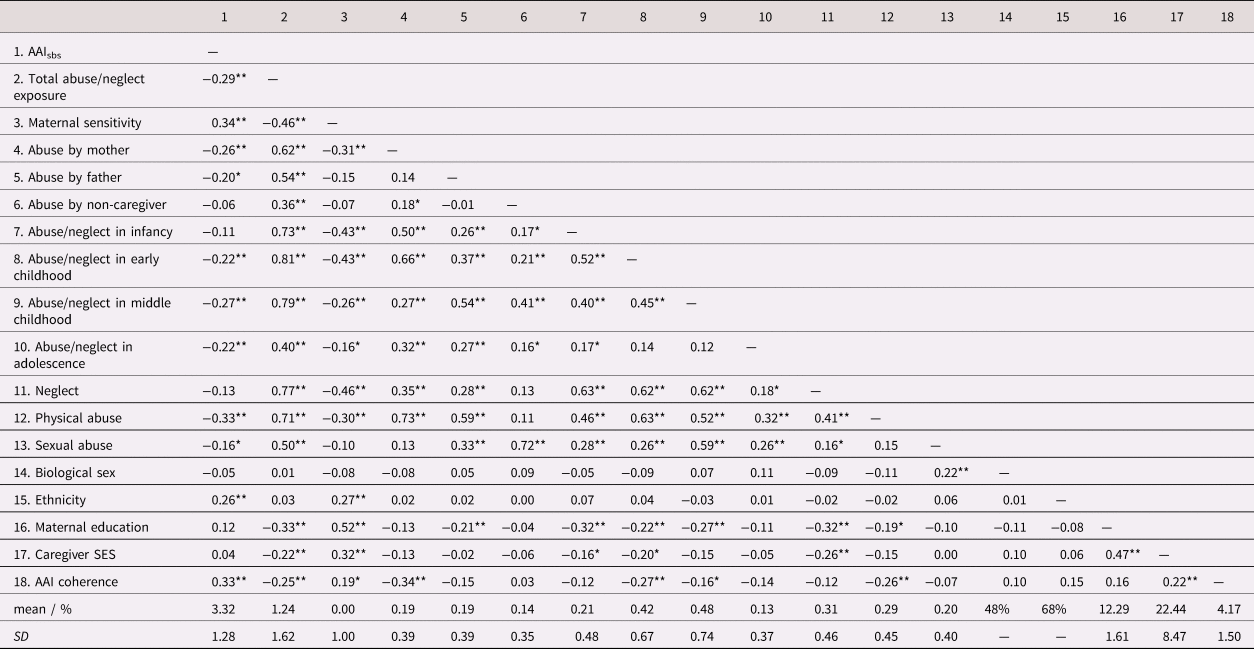
Correlations among the variables included in the regression analyses along with descriptive data on all focal variables appear in Table 1. As reported by Waters et al. (Reference Waters, Ruiz and Roisman2017), individuals who experienced higher levels of observed maternal sensitivity and who were White/non-Hispanic had higher AAIsbs scores in young adulthood. In addition, various aspects of childhood abuse and/or neglect were predictive of lower scores on the AAIsbs in young adulthood. More specifically, we examined the total experiences of abuse and/or neglect from birth to 17.5 years, perpetrator (ever abused by mother, father, or non-caregiver), developmental timing of abuse and/or neglect (ever abused or neglected in: infancy, early childhood, middle childhood, or adolescence), and type (ever physically abused, sexually abused, or neglected). Total experiences of abuse and/or neglect were associated with lower scores on AAIsbs (r = −.29). Furthermore, lower scores on AAIsbs were significantly associated (p < .05) with abuse perpetrated by mother (r = −.26) and father (r = −.20), but not non-caregivers (r = −.06); abuse and/or neglect in early childhood (r = −.22), middle childhood (r = −.27), and adolescence (r = −.22), but not infancy (r = −.11); and experiences of physical abuse (r = −.33) and sexual abuse (r = −.16), but not neglect (r = −.13).
Secure base script knowledge during the Adult Attachment Interview (AAIsbs) by experiences of abuse and/or neglect, covariates
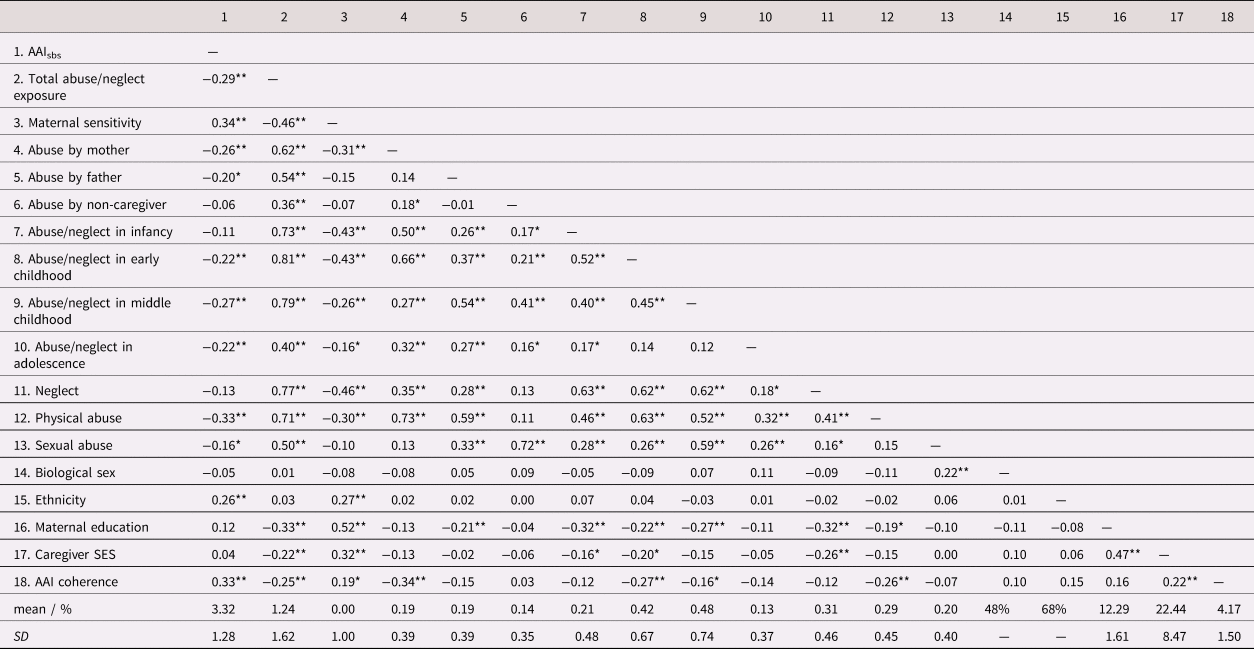
Note. AAIsbs = mean composite of secure base script knowledge assessed in the AAI at age 19 and 26 years. Biological sex was coded as 1 = female, 0 = male. Ethnicity was coded as 1 = White/non-Hispanic, 0 = non-White. SES = socioeconomic status. AAI = Adult Attachment Interview. N = 157.
* p < .05, ** p < .01.
Do experiences of abuse and/or neglect uniquely predict lower secure base script scores above and beyond maternal sensitivity and demographic covariates?
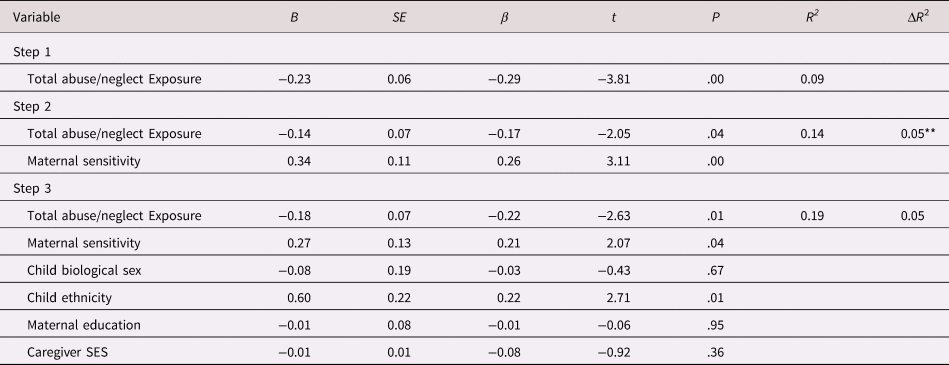
In order to address this research question, a hierarchal linear regression was run in which the measure of total experiences of abuse and/or neglect was included in the initial step. The second step included observed maternal sensitivity from 3 months to 13 years. The final step included covariates (i.e., biological sex, ethnicity, maternal education, and childhood SES). As reported in Table 2, total experiences of abuse and/or neglect uniquely predicted lower AAIsbs scores in step 1 and after controlling for maternal sensitivity (step 1 to step 2, ΔR 2 = .05, p < .01). The inclusion of covariates did not explain significantly more variance in AAIsbs (from step 2 to 3, ΔR 2 = .05, p = .06), though child ethnicity uniquely predicted AAIsbs.
Hierarchical regression of total child abuse/neglect exposure and maternal sensitivity predicting secure base script knowledge during the Adult Attachment Interview (AAIsbs)
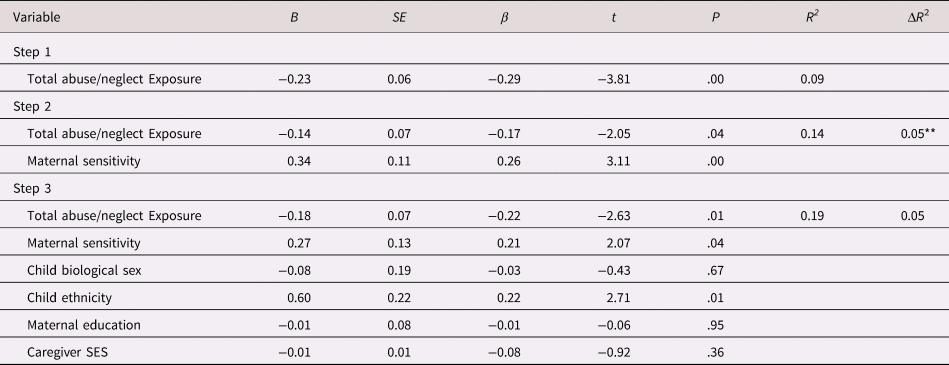
Note. N = 157. Dependent variable = mean composite of secure base script knowledge AAIsbs assessed at age 19 and 26 years. Total abuse/neglect exposure = total number of physical/sexual abuse and neglect experiences from birth to age 17.5 years; maternal sensitivity = overall maternal sensitivity composite from 3 months to 13 years; Child biological sex = child's biological sex at birth coded as 1 = female, 0 = male; child ethnicity = child's ethnicity coded as 1 = White/non-Hispanic, 0 = non-White; maternal education = maternal education from 3 months before birth to age 16 years; caregiver SES = caregiver occupational prestige from 42 months to age 16 years.
** p < .01.
Entering the key predictor in step one of the hierarchal regression allows for the examination of the degree to which the association between total experiences of abuse and/or neglect and AAIsbs is robust to the later inclusion of maternal sensitivity and demographics in subsequent steps of the regression; however, this approach does not provide information on the incremental variance explained by abuse and/or neglect above and beyond covariates. Therefore, we also report this information for all regressions. More specifically, total experiences of abuse and/or neglect explained an additional 4% (p < .01) of the variance in AAIsbs above and beyond maternal sensitivity and demographic variables.
At the request of a reviewer, we also added to our initial regression a term representing the interaction between total experiences of abuse and/or neglect and maternal sensitivity as maternal sensitivity might serve as a protective factor against abuse/neglect. For example, work in this area has demonstrated that maternal sensitivity is a buffer to other types of adversity, such as witnessing interparental violence (Manning, Davies, & Cicchetti, Reference Manning, Davies and Cicchetti2014). The interaction term was not significantly associated with AAIsbs (β = −.31, t [149] = −0.85, p = .40) and did not explain additional significant variance in AAIsbs (from step 3 to 4, ΔR 2 = .004, p = .40). Importantly, however, the current sample is not well-powered to detect novel interaction effects, and therefore caution should be taken when interpreting this null result.
Which aspects of abuse and/or neglect are uniquely associated with the secure base script?
In order to address this research question, we examined three parameterizations of abuse and neglect. Specifically, we examined: (a) perpetrator (ever abused by mother, father, or non-caregiver), (b) timing of abuse and/or neglect (ever abused or neglected in: infancy, early childhood, middle childhood, or adolescence), and (c) specific subtypes (ever physically abused, sexually abused, or neglected). Paralleling the initial regression analyses, three additional hierarchal linear regressions were run. Each regression included the abuse/neglect variables in the initial step, followed by maternal sensitivity in the second step, and demographic covariates were included in the final step. Additionally, to examine the incremental variance explained by the abuse and/or neglect variables, above and beyond controls, each regression was also run with the abuse/neglect variables in the final block (details available from the first author).
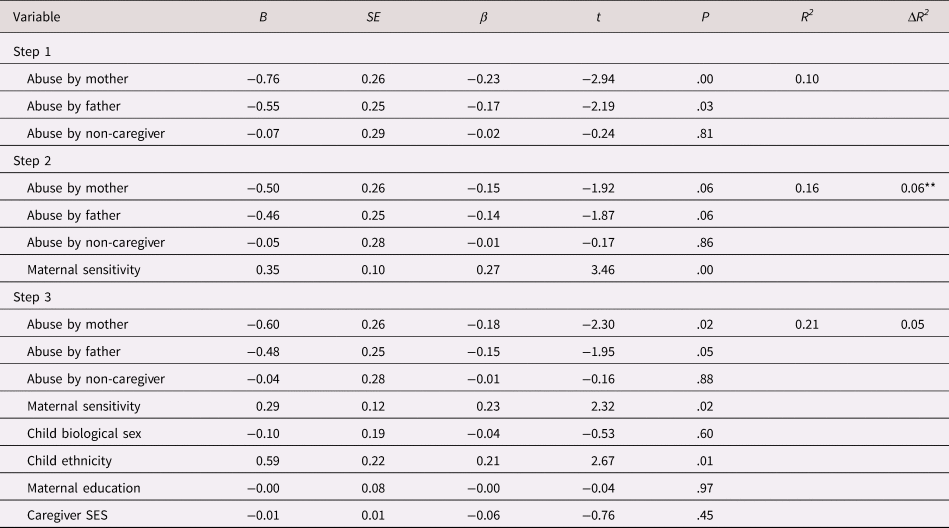
As reported in Table 3, in step 1 abuse perpetrated by mother and father were both uniquely associated with lower AAIsbs scores. These associations were marginally significant when controlling for maternal sensitivity (step 1 to step 2, ΔR 2 = .06, p < .01). The addition of covariates did not explain additional variance in AAIsbs (from 2 to 3, ΔR 2 = .05, p = .07), though abuse perpetrated by mother and father and child ethnicity were once again uniquely associated with AAIsbs. When the covariates and sensitivity were reverse entered as step 1, the second block of abuse perpetrator variables explained an additional 6% (p < .05) of the variance in AAIsbs above and beyond maternal sensitivity and demographic covariates.
Hierarchical regression of abuse exposure by perpetrator and maternal sensitivity predicting secure base script knowledge during the Adult Attachment Interview (AAIsbs)
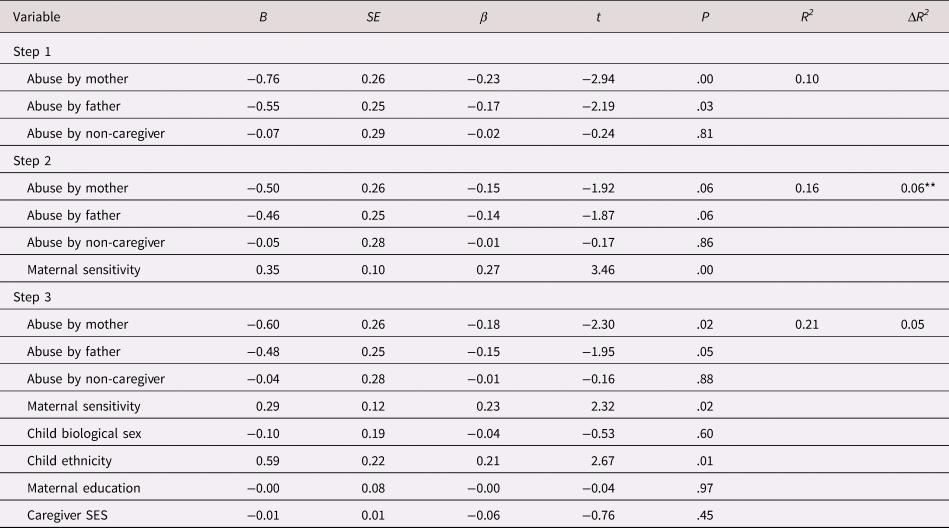
Note. N = 157. Dependent variable = mean composite of AAIsbs assessed at age 19 and 26 years. Abuse by mother = ever physically/sexually abused by mother from birth to age 17.5 years; abuse by father = ever physically/sexually abused by father from birth to age 17.5 years; abuse by non-caregiver = ever physically/sexually abused by non-parent figure from birth to age 17.5 years; maternal sensitivity = overall maternal sensitivity composite from 3 months to 13 years; child biological sex = child's biological sex at birth coded as 1 = female, 0 = male; child ethnicity = child's ethnicity coded as 1 = White/non-Hispanic, 0 = non-White; maternal education = maternal education from 3 months before birth to age 16 years; caregiver SES = caregiver occupational prestige from 42 months to age 16 years to 13 years.
** p < .01.
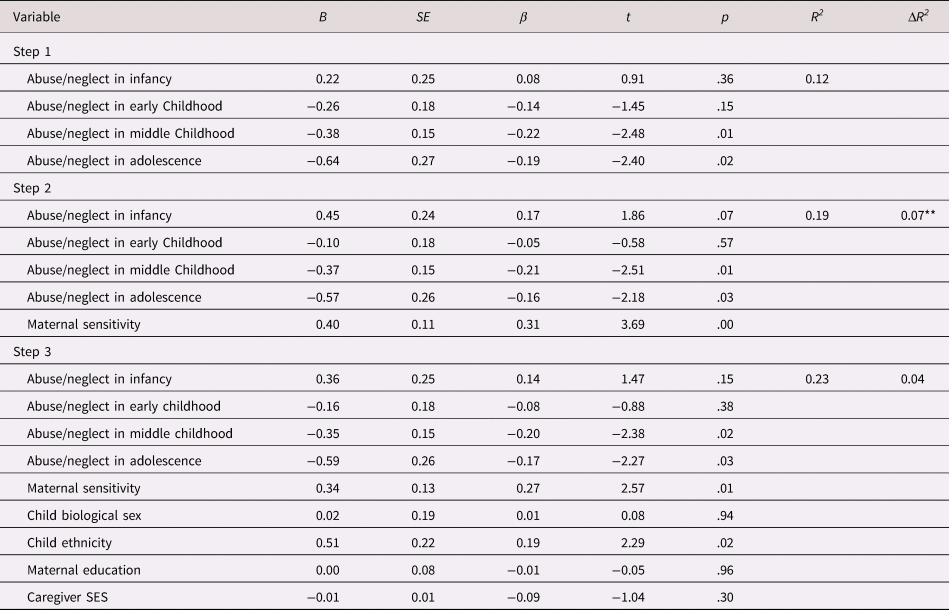
As reported in Table 4, experiences of abuse and/or neglect in middle childhood and adolescence specifically, but not infancy and early childhood, uniquely predicted lower AAIsbs scores, in step 1 and after controlling for maternal sensitivity in step 2 (step 1 to step 2, ΔR 2 = .07, p < .01). The addition of covariates did not explain additional variance in AAIsbs (from step 2 to 3, ΔR 2 = .04, p = .13), though child ethnicity was uniquely predictive of AAIsbs. Also, experiences of abuse and/or neglect in middle childhood and adolescence, but not infancy and early childhood, continued to uniquely predict lower AAIsbs scores with covariates in the model. When the covariates and sensitivity were reverse entered as step 1, the second block of abuse/neglect timing variables explained an additional 8% (p < .01) of the variance in AAIsbs above and beyond maternal sensitivity and demographic covariates.
Hierarchical regression of abuse/neglect exposure in each developmental period and maternal sensitivity predicting Adult Attachment Interview (AAIsbs)
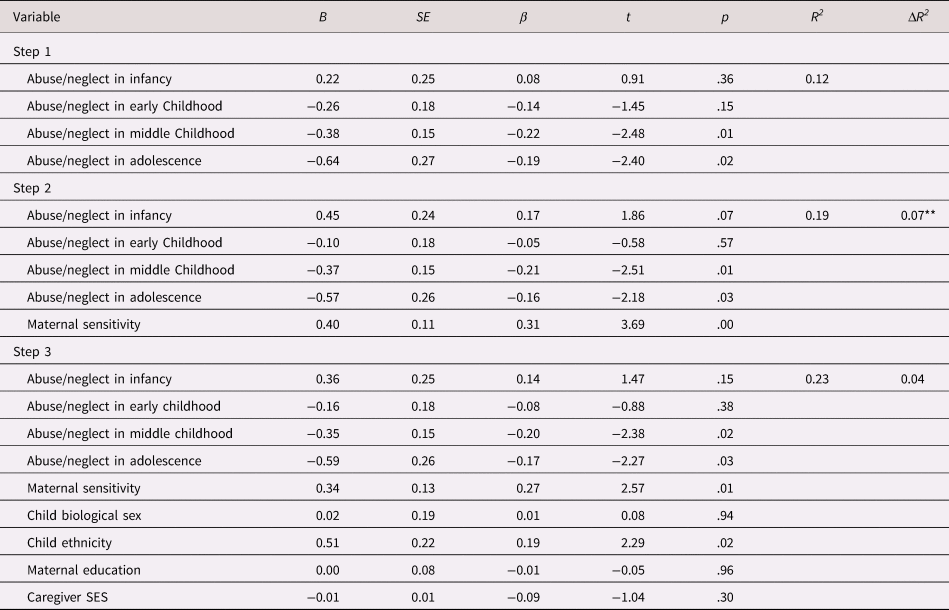
Note. N = 157. Dependent variable = mean composite of AAIsbs secure base script knowledge assessed at age 19 and 26 years. Abuse/neglect in infancy = ever physically/sexually abused or neglected by any perpetrator from 0 to 2 years; abuse/neglect in early childhood = ever physically/sexually abused or neglected by any perpetrator from 3 to 5 years; abuse/neglect in middle childhood = ever physically/sexually abused or neglected by any perpetrator from 6 to 12 years; abuse/neglect in adolescence = ever physically/sexually abused or neglected by any perpetrator from 13 to 17.5 years. Maternal sensitivity = overall maternal sensitivity composite from 3 months to 13 years; child biological sex = child's biological sex at birth coded as 1 = female, 0 = male; child ethnicity = child's ethnicity coded as 1 = White/non-Hispanic, 0 = non-White; maternal education = maternal education from 3 months before birth to age 16 years; caregiver SES = caregiver occupational prestige from 42 months to age 16 years.
** p < .01.
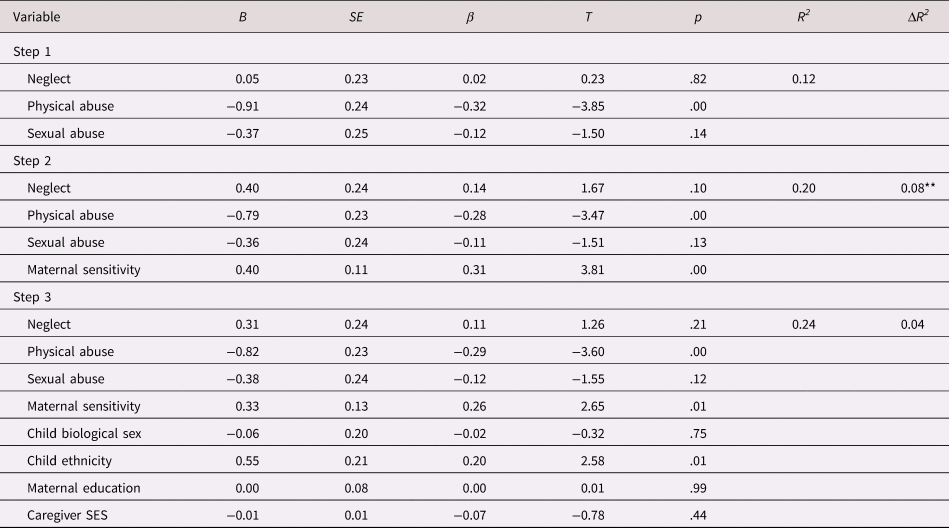
As reported in Table 5, the experience of physical abuse (but not sexual abuse or neglect) uniquely predicted lower scores on AAIsbs both in step 1 and in step 2 while controlling for maternal sensitivity (from step 1 to step 2, ΔR 2 = .08, p < .01). The addition of covariates did not explain additional variance in AAIsbs (from 2 to 3, ΔR 2 = .04, p = .10), though child ethnicity was again uniquely predictive of AAIsbs and physical abuse remained uniquely associated with AAIsbs with all other variables in the model. When the covariates and sensitivity were reverse entered as step 1, the second block of type of abuse/neglect variables explained an additional 9% (p < .01) of the variance in AAIsbs above and beyond maternal sensitivity and demographics.
Hierarchical regression of type of abuse/neglect exposure and maternal sensitivity predicting secure base script knowledge during the Adult Attachment Interview (AAIsbs)
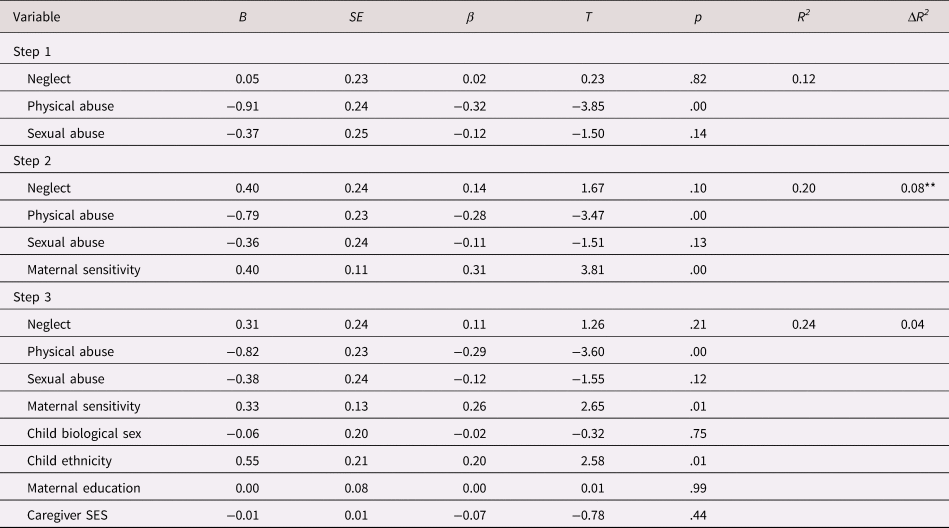
Note. N = 157. Dependent variable = mean composite of AAIsbs secure base script knowledge assessed at age 19 and 26 years. Neglect = ever neglected by any perpetrator from birth to 17.5 years; physical abuse = ever physically abused by any perpetrator from birth to 17.5 years; sexual abuse = ever sexually abused by any perpetrator from birth to 17.5 years. maternal sensitivity = overall maternal sensitivity composite from 3 months to 13 years; child biological sex = child's biological sex at birth coded as 1 = female, 0 = male; child ethnicity = child's ethnicity coded as 1 = White/non-Hispanic, 0 = non-White; maternal education = maternal education from 3 months before birth to age 16 years; caregiver SES = caregiver occupational prestige from 42 months to age 16 years to 13 years.
** p < .01.
Does the secure base script either more strongly or incrementally retrodict lower levels of abuse and/or neglect in childhood compared to coherence of mind?
Bivariate correlations among experiences of abuse and/or neglect, AAIsbs, and AAI coherence are presented in Table 1. Results demonstrated that total abuse/neglect exposure was significantly associated with AAIsbs (r = −.29) and AAI coherence (r = −.25). Results of a Steiger's Z comparison revealed, however, that AAIsbs was not significantly more strongly associated experiences of abuse and/or neglect than was AAI coherence (Z = −0.45, p = .65).
To test whether experiences of abuse and/or neglect were uniquely predictive of AAIsbs scores net of coherence, a fourth step examining coherence (average of the AAI ratings at age 19 and 26) was added to the hierarchal linear regression outlined in Table 2. This regression demonstrated that total experiences of abuse and/or neglect continued to uniquely predict lower AAIsbs net of maternal sensitivity, covariates, and AAI coherence (β = −.13, t [149] = −2.00, p < .05). This suggests that the association between total abuse/neglect and AAIsbs was not fully accounted for by AAI coherence.
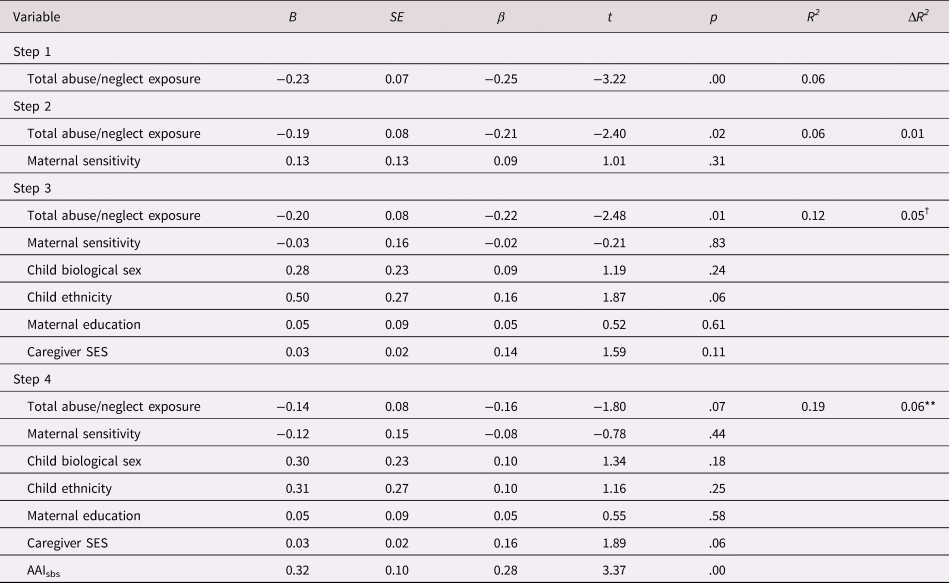
Additionally, to test whether experiences of abuse/neglect were uniquely predictive of coherence net of AAIsbs, a hierarchal linear regression was run in which the measure of total experiences of abuse and/or neglect was included in the initial step. The second step included observed maternal sensitivity, the third step included covariates, and the final step included AAIsbs. As reported in Table 6, experiences of abuse/neglect were uniquely associated with coherence after controlling for maternal sensitivity and demographic covariates. However, this association was only marginally significant after controlling for AAIsbs (β = −.16, t [149] = −1.80, p = .07), indicating that variation in AAIsbs attenuated the association between experiences of abuse/neglect and coherence to nonsignificance.
Hierarchical regression of total child abuse/neglect exposure, maternal sensitivity, and secure base script knowledge during the Adult Attachment Interview (AAIsbs) predicting AAI coherence
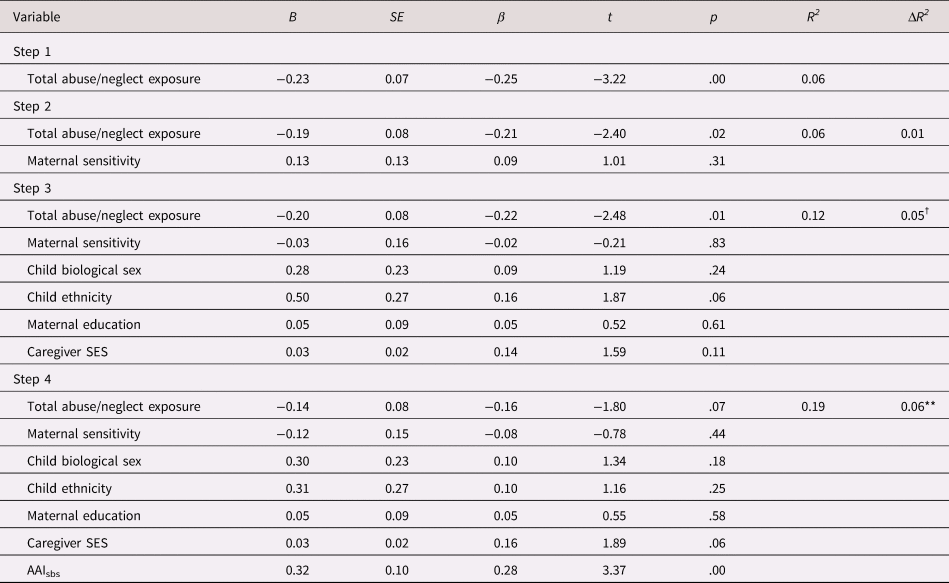
Note: N = 157. Dependent variable = mean composite of AAI Coherence assessed at age 19 and 26 years. Total abuse/neglect exposure = total number of physical/sexual abuse and neglect experiences from birth to age 17.5 years; maternal sensitivity = overall maternal sensitivity composite from 3 months to 13 years; child biological sex = child's biological sex at birth coded as 1 = female, 0 = male; child ethnicity = child's ethnicity coded as 1 = White/non-Hispanic, 0 = non-White; maternal education = maternal education from 3 months before birth to age 16 years; caregiver SES = caregiver occupational prestige from 42 months to age 16 years, AAIsbs = mean composite of AAIsbs assessed at age 19 and 26 years.
† p = .06, ** p < .01.
Discussion
The present study revealed that children who experienced more abuse and/or neglect in the first 17.5 years of life, as hypothesized, produced AAI narratives reflecting less evidence that they had acquired the secure base script by young adulthood. Importantly, this association between abuse/neglect experiences and secure base script knowledge was unique of associations previously established in the MLSRA between maternal sensitivity and secure base script knowledge as well as a set of commonly investigated demographic confounders.
In order to explore which aspects of abuse and/or neglect experiences drove the association between the association between overall exposure to abuse/neglect and later secure base script knowledge, three key aspects of abuse and/or neglect were examined. As anticipated, given that abusive and neglectful caregiving has been linked to more insecure attachment in childhood (Cyr, Euser, Bakemans-Kranenburg, & Van IJzendoorn, Reference Cyr, Euser, Bakemans-Kranenburg and Van IJzendoorn2010; Egeland & Sroufe, Reference Egeland and Sroufe1981), abuse perpetrated by maternal and paternal caregivers (but not others) was uniquely associated with lower AAIsbs scores. These results are consistent with both theory and prior evidence suggesting that attachment quality may be compromised when an attachment figure is a source of distress (Cyr et al., Reference Cyr, Euser, Bakemans-Kranenburg and Van IJzendoorn2010; Main & Hesse, Reference Main, Hesse, Greenberg, Cicchetti and Cummings1990; Schuengel, Bakermans-Kranenburg, & Van IJzendoorn, Reference Schuengel, Bakermans-Kranenburg and Van IJzendoorn1999). The nonsignificant association with non-parental caregivers indicates that it is not necessarily the experience of abuse/neglect per se, but abuse/neglect perpetrated by an attachment figure, that may be driving the association between abuse/neglect and AAIsbs, a finding consistent with attachment theory.
In addition, exploratory analyses that examined developmental timing revealed that abuse and/or neglect occurring in middle childhood and adolescence (but not infancy or early childhood) were uniquely associated with lower AAIsbs scores. On the one hand, these results might be viewed as somewhat inconsistent with attachment theorists’ emphasis on the importance of experience during the first few years of life for the development of attachments (see Fraley, Roisman, & Haltigan, Reference Fraley, Roisman and Haltigan2013). On the other hand, it is also possible that experiences of abuse and/or neglect in later childhood were uniquely predictive of secure base script knowledge in the current study because the AAI specifically requires that participants attempt to recall memories between the ages of 5 and 12 years. It is also possible that developmental timing is confounded with the type of abuse/neglect that occurred. More specifically, instances of physical and sexual abuse were more common during middle childhood and adolescence, whereas experiences of neglect were most common in infancy and early childhood. All of this said, there is a good deal of evidence that abuse and neglect in infancy and early childhood are associated, in enduring ways, with maladjustment (even if not with AAIsbs), as we have shown previously in the MLSRA with respect to adult academic and social skills (Raby et al., Reference Raby, Roisman, Labella, Martin, Fraley and Simpson2019).
Additional exploratory analyses revealed that physical abuse (but not sexual abuse or neglect) was uniquely associated with lower AAIsbs scores. This finding is consistent with previous work on the associations between abuse and/or neglect and attachment quality (Raby et al., Reference Raby, Labella, Martin, Carlson and Roisman2017). Moreover, previous work examining subtypes of maltreatment have also found evidence for the unique predictive significance of physical abuse above and beyond other subtypes such as sexual and emotional abuse. Specifically, physical abuse has been uniquely associated with higher rates of peer rejection (Rogosch, Cicchetti, & Aber, Reference Rogosch, Cicchetti and Aber1995) and lower cortisol levels (i.e., hypocortisolism) in childhood (Cicchetti & Rogosch, Reference Cicchetti and Rogosch2001). The results presented here thus add to the existing maltreatment literature suggesting that experiences of physical abuse, above and beyond other subtypes of abuse, may be associated with poorer psychosocial outcomes.
In contrast to previous evidence from the MLSRA pertaining to maternal sensitivity (e.g., Waters et al., Reference Waters, Ruiz and Roisman2017), the results of this study did not demonstrate that AAIsbs was more strongly associated with experiences of abuse and/or neglect than was AAI coherence, a more traditional marker of secure states of mind about childhood experiences with caregivers. Nonetheless, experiences of abuse and/or neglect were uniquely associated with less access to and/or elaborated knowledge of the secure base script, above and beyond the coherence of participants’ AAI discourse. This finding provides additional evidence that the AAIsbs and coherence coding systems for the AAI are at least partially distinct (Steele et al., Reference Steele, Waters, Bost, Vaughn, Truitt, Waters and Roisman2014; Waters et al., Reference Waters, Ruiz and Roisman2017, Reference Waters, Raby, Ruiz, Martin and Roisman2018). Furthermore, experiences of abuse/neglect were not uniquely associated with coherence after controlling for AAIsbs. This latter result is consistent with arguments made by Waters et al. (Reference Waters, Ruiz and Roisman2017) that access to and elaborated knowledge of the secure base script helps structure and organize the production of a coherent AAI narrative (for further discussion, see Waters & Facompré, Reference Waters, Facompré, Waters, Vaughn and Watersin press; Waters et al., Reference Waters, Ruiz and Roisman2017). Furthermore, this evidence suggests that there is “value added” in using the AAIsbs to retrodict childhood abuse/neglect above and beyond AAI coherence. In combination with the economic savings of the secure base coding system (e.g., reduced training cost, time to reliability, coding time), these findings suggest that there is empirical value in using the AAIsbs coding system over traditional AAI coding systems to assess adults’ attachment representations.
Strengths, limitations, and future directions
The present study is the first to investigate the predictive significance of abuse and neglect for secure base script knowledge in a prospective longitudinal study of a high-risk cohort. These findings programmatically build on previous work examining the antecedents of secure base script knowledge in caregiving within the normative range (e.g., Schoenmaker et al., Reference Schoenmaker, Juffer, Van IJzendoorn, Linting, van der Voort and Bakermans-Kranenburg2015; Steele et al., Reference Steele, Waters, Bost, Vaughn, Truitt, Waters and Roisman2014; Waters et al., Reference Waters, Ruiz and Roisman2017) by suggesting that atypical caregiving experiences of abuse and/or neglect also may uniquely shape the acquisition of the secure base script. This work thus emphasizes the value of investigating contributions of typical and atypical caregiving experiences in the development of secure base script knowledge.
Despite the notable strengths of this prospective longitudinal study, the sample size is only moderately large and the current analysis was based on a sample that is predominately White and non-Hispanic. Future studies investigating the antecedents of secure base script knowledge would therefore benefit from the use of larger, more representative samples. Furthermore, despite investigating the early caregiving experiences identified by attachment theory as the key foundations upon which the secure base script is built (e.g., maternal sensitivity, abuse/neglect), the current analysis explained only about 20% of the total variance in secure base script knowledge (see Table 2). Notably in this regard, Vaughn et al. (Reference Vaughn, Waters, Steele, Roisman, Bost, Truitt and Booth-Laforce2016) examined other aspects of caregiving above and beyond caregiver sensitivity (e.g., parental monitoring, father's presence in the home) and individual level factors (e.g., academic achievement) in understanding the antecedents of more access to and elaborated knowledge of the secure base script as measured in the ASA in the SECCYD. However, even then, these factors only accounted for 24% of the total variance in secure base script scores. These findings are consistent with the possibility that there are both: (a) many adults who acquire knowledge of secure base script despite having experienced less than optimal early care and likewise that (b) some adults do not produce narratives demonstrating evidence of the secure base script despite experiencing high-quality early supports from their primary caregivers.
Of course, such scenarios are themselves entirely consistent with core tenets of attachment theory, which support the notion that attachment representations can be altered based on life experiences (Booth-LaForce et al., Reference Booth-Laforce, Groh, Burchinal, Roisman and Owen2014; Weinfield et al., Reference Weinfield, Sroufe and Egeland2000). Put differently, although early caregiving plays a role in the development of the secure base script, a range of experiential and individual-level factors other the quality of childhood experiences may help to explain why some adults come to produce either more or less secure base script knowledge. Nonetheless, little is known presently about other factors that may attenuate or amplify the association between early caregiving and secure base script knowledge in young adulthood. Thus, studying interpersonal protective factors (e.g., relationships with peers and romantic partners; Collins & Sroufe, Reference Collins and Sroufe1999; Simpson, Collins, Tran, & Haydon, Reference Simpson, Collins, Tran and Haydon2007), contextual risk (Belsky & Fearon, Reference Belsky and Fearon2002), and individual factors (e.g., difficult temperament; Belsky & Pluess, Reference Belsky and Pluess2009) that potentially moderate these associations may further reveal the origins of variation in secure base script knowledge and provide important insights for intervention efforts that aim to mitigate the long-term consequences of childhood abuse and neglect and other forms of low-quality early care.
Acknowledgment
This analysis was in part supported by a National Institute on Aging (R01 AG03945304) grant to Jeffry A. Simpson. Any opinions, findings, and conclusions or recommendations expressed in this material are those of the authors and do not necessarily reflect the views of the National Institutes of Health.