Introduction
Post-operative hypoparathyroidism is a major complication of total thyroidectomy. Even when the parathyroid glands are carefully preserved during surgery, post-operative hypocalcaemia can occur. During surgery for advanced thyroid carcinoma, preservation of the inferior parathyroid glands is particularly difficult. In this study, we retrospectively analysed predictors of the need to continue calcitriol and calcium supplementation in patients who underwent total thyroidectomy for thyroid carcinoma.
Materials and methods
During the 6-year period from July 2017 to July 2023, 104 patients with thyroid carcinoma underwent total thyroidectomy at Kumamoto University Hospital (Kumamoto, Japan). Of the 104 patients, data were collected and analysed from 96 after excluding those who had originally been receiving calcitriol supplementation for osteoporosis or using bone metabolism-related drugs, such as bisphosphonates, and those with impaired renal function (estimated glomerular filtration rate [eGFR] < 30 ml/min/1.73 m2).Reference Ri, Fukasawa, Masuda, Tanaka, Takeuchi and Yoshida1
In our surgical strategy for thyroid carcinoma, we aimed to preserve parathyroid function as much as possible while prioritising complete resection of the tumour lesion. We typically attempt to preserve the upper parathyroid gland on the unaffected side in situ and, if possible, to also preserve the upper parathyroid glands on the affected side. If the lower parathyroid glands are clearly identifiable and completely free of adhesion to surrounding dissected tissues, including metastatic lymph nodes, we mince them for transplantation into the sternocleidomastoid muscle. If discoloration occurred in the glands preserved in situ during surgery, they are removed and minced for transplantation into the sternocleidomastoid muscle. The number of preserved parathyroid glands was calculated based on the surgical records of each surgeon. Generally, prophylactic neck dissection (ND) is not performed in regions without any evident metastases on pre-operative ultrasonography or computed tomography. However, central ND is routinely performed.
Post-operatively, our standard regimen included an intravenous infusion of 8.5 per cent calcium gluconate (20 ml) on the day of surgery and twice daily (morning and evening) on the day following surgery, along with oral administration of calcium lactate (6 g) in three divided doses and calcitriol (1 μg). If symptoms of tetany occurred, an additional injection of calcium gluconate was administered as needed. Serum calcium levels were followed up by adjusting the albumin-corrected calcium value to within the normal range (8.8–10.1 mg/dl). Adjustments were made to account for patients with originally low albumin-corrected calcium values even before surgery. After discharge, the patients were prescribed oral calcium and calcitriol and asked to visit the outpatient clinic once a month. As the serum calcium level increased, the dosage was gradually reduced and oral medication therapy discontinued once the serum calcium level stabilised within the normal range and no symptoms of tetany were observed. For patients without symptoms of tetany but whose serum calcium levels remained slightly below normal, only calcitriol supplementation was continued. In cases where serum calcium levels did not recover even six months after surgery, attempts to further reduce the dosage were abandoned, and a three-month supply of medication prescribed with follow-up visits scheduled every three months.
After thyroid surgery, parathyroid function is usually assessed by measuring parathyroid hormone (PTH) levels.Reference Lalos, Wilhelm, Linke, Taha-Mehlitz, Müller and Posabella2, Reference McMurran, Blundell and Kim3 However, we do not routinely measure PTH levels after thyroid surgery as these measurements are costly, and PTH levels are not necessarily considered for calcium supplementation, although they may serve as a reliable parameter.Reference Košec, Hergešić, Matovinović, Rašić, Vagić and Bedeković4
The collected variables included age, sex, body mass index (BMI), tumour diameter, pathological stage and diagnosis, extent of ND, operative time, intraoperative blood loss, presence of tetany, pre-operative and post-operative (day 1) corrected calcium and phosphate levels, pre-operative eGFR, number of preserved parathyroid glands and methods of preservation.
Statistical analyses were performed using EZR software (Jichi Medical University, Tochigi, Japan), which is a graphical user interface for R (The R Foundation for Statistical Computing, Vienna, Austria).Reference Kanda5 Fisher’s exact test, the Mann–Whitney U test and Firth’s penalised logistic regression analyses were performed. Statistical significance was set at p less than 0.05.
Results and analysis
The clinical profiles of 96 patients with thyroid carcinoma who underwent total thyroidectomy are shown in Table 1. This study included 40 males and 56 females. The BMI of 50 patients was less than 25 kg/m2 and that of the 46 remaining patients was greater than or equal to 25 kg/m2. The maximum diameter of the primary tumour was less than 40 mm in 75 cases and greater than or equal to 40 mm in 21. Of the 96 patients, 87 had papillary thyroid carcinoma, two had follicular thyroid carcinoma, four had poorly differentiated thyroid carcinoma and three had anaplastic thyroid carcinoma. Thirty-nine patients were classified as having stage III or IV disease, and 91 underwent ND. The five patients who did not undergo ND included local recurrence cases following surgeries performed at other institutions and rapidly progressing anaplastic thyroid carcinoma cases, in which the tumour lesion was large and the resected area included a wide central portion despite lymph node dissection not being intentionally performed. Thirty cases underwent central ND only, and 61 underwent central with lateral (with or without upper mediastinum) ND. Regarding operative time, 45 cases required less than 300 minutes, whereas 51 required greater than or equal to 300 minutes (range: 113–886 minutes). The median blood loss was 152.5 cc (range: 0–1882 cc). Post-operatively, 22 (22.9 per cent) of 96 patients developed tetany. During surgery, three or four parathyroid glands were preserved in nine patients, one or two preserved in 65 and no glands preserved in 11. In the remaining 11 patients, the number of preserved parathyroid glands could not be estimated from the surgical records. Regarding the technique used for preserving the parathyroid glands, an attempt was made in 54 patients to preserve them in situ, autotransplantation performed in 12 and both techniques used in eight. The pre-operative median albumin-corrected calcium value was 9.3 mg/dl (range: 8.3–10.3 mg/dl) and that on post-operative day 1 was 8.5 mg/dl (range: 7.3–10.0 mg/dl). The most recent outpatient corrected calcium level recorded at our institution was 9.1 mg/dl (range: 7.2–10.2 mg/dl).
Clinical profiles of the 96 patients with thyroid carcinoma who underwent total thyroidectomy

Table 1 Long description
Among the 96 patients who underwent total thyroidectomy, the median age was 66.5 years. There were 40 men and 56 women. Preoperative body mass index (BMI) was ≥25 kg/m2 in 46 patients. Tumor size was ≥40 mm in 21 patients. A total of 89 patients had either papillary thyroid carcinoma or follicular thyroid carcinoma. Thirty-nine patients had stage III or higher disease. Central neck dissection alone was performed in 30 patients, whereas lateral neck dissection or more extensive lymph node dissection was performed in 61 patients. The operative time was ≥300 minutes in 51 patients. The median intraoperative blood loss was 152.5 mL. Postoperative tetany symptoms occurred in 21 patients.
Abbreviations: AC = anaplastic carcinoma; BMI = body mass index; CND = central neck dissection; eGFR = estimated glomerular filtration rate; FC = follicular carcinoma; LND = lateral neck dissection; * = median; PC = papillary carcinoma; PDC = poorly differentiated carcinoma.
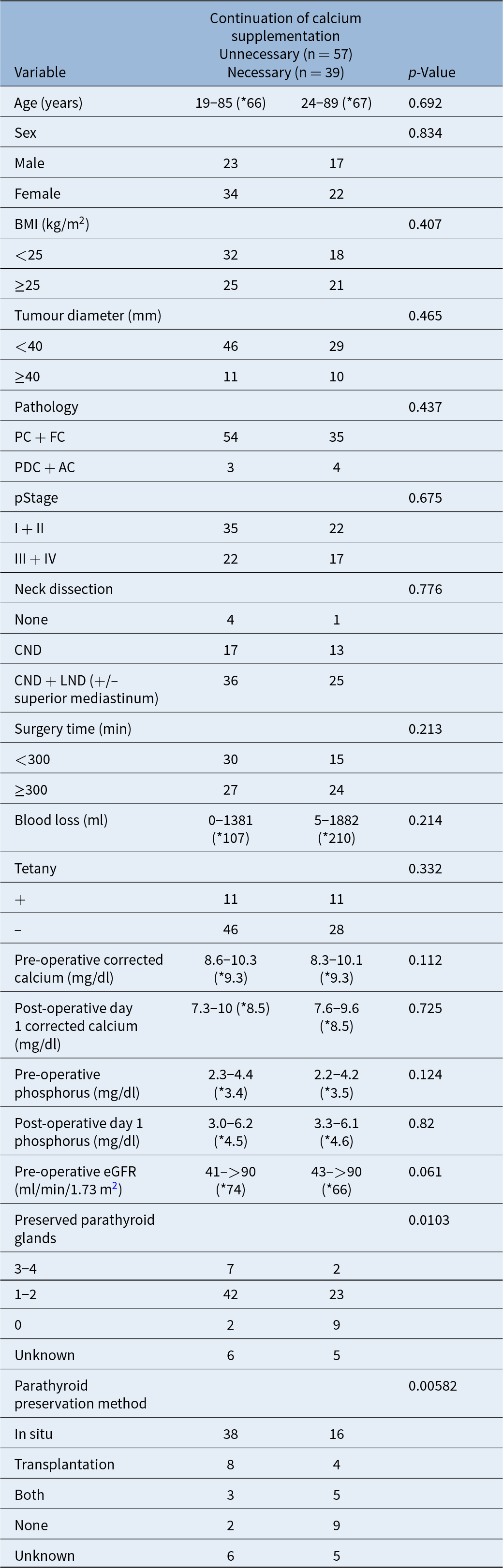
Overall, 39 patients required continued postoperative calcium and calcitriol supplementation. Table 2 shows the univariate analysis of factors related to the need for continued calcium supplementation. The number of preserved parathyroid glands (p = 0.0103, Fisher’s exact test) and preservation technique (p = 0.00582) were significantly associated with the need for continued oral calcium supplementation. Among the patients with three or more preserved parathyroid glands, 22 per cent required continued calcium supplementation, whereas the incidence was 35 per cent in those with one or two preserved glands and 82 per cent in those with no preserved glands. Among the patients whose parathyroid glands were preserved in situ, 30 per cent required continued calcium supplementation. The incidence rate was 33 per cent in patients who underwent autotransplantation alone.
Univariate analysis of factors determining the necessity of calcium supplementation after total thyroidectomy for thyroid carcinoma

Table 2 Long description
Of the 96 patients, 39 required persistent postoperative calcium supplementation, whereas 57 did not. Univariate analysis demonstrated significant differences between the two groups with regard to the number of parathyroid glands preserved during surgery and the method of parathyroid gland preservation.
Abbreviations: AC = anaplastic carcinoma; BMI = body mass index; CND = central neck dissection; eGFR = estimated glomerular filtration rate; FC = follicular carcinoma; LND = lateral neck dissection; * = median PC = papillary carcinoma; PDC = poorly differentiated carcinoma.
Multivariate analyses to evaluate the simultaneous effects of variables on the need for continued calcium intake (Table 3) showed that the number of preserved parathyroid glands was the only independent predictor. When using the reference group of patients with no preserved parathyroid glands, the adjusted odds ratio (OR) for calcium supplementation was 0.122 (95 per cent confidence interval [CI]: 0.0242–0.611; p = 0.0106) in patients with one or two preserved glands and 0.064 (95 per cent CI: 0.00707–0.570; p = 0.0138) in those with three or four preserved glands.
Multivariate analysis of factors determining the necessity of calcium supplementation after total thyroidectomy for thyroid carcinoma

Table 3 Long description
In patients who underwent total thyroidectomy for thyroid carcinoma, multivariate analysis identified the number of parathyroid glands preserved during surgery as the only significant predictor of persistent postoperative calcium supplementation.
Abbreviations: AUC, area under the curve; CI, confidence interval; OR, odds ratio.
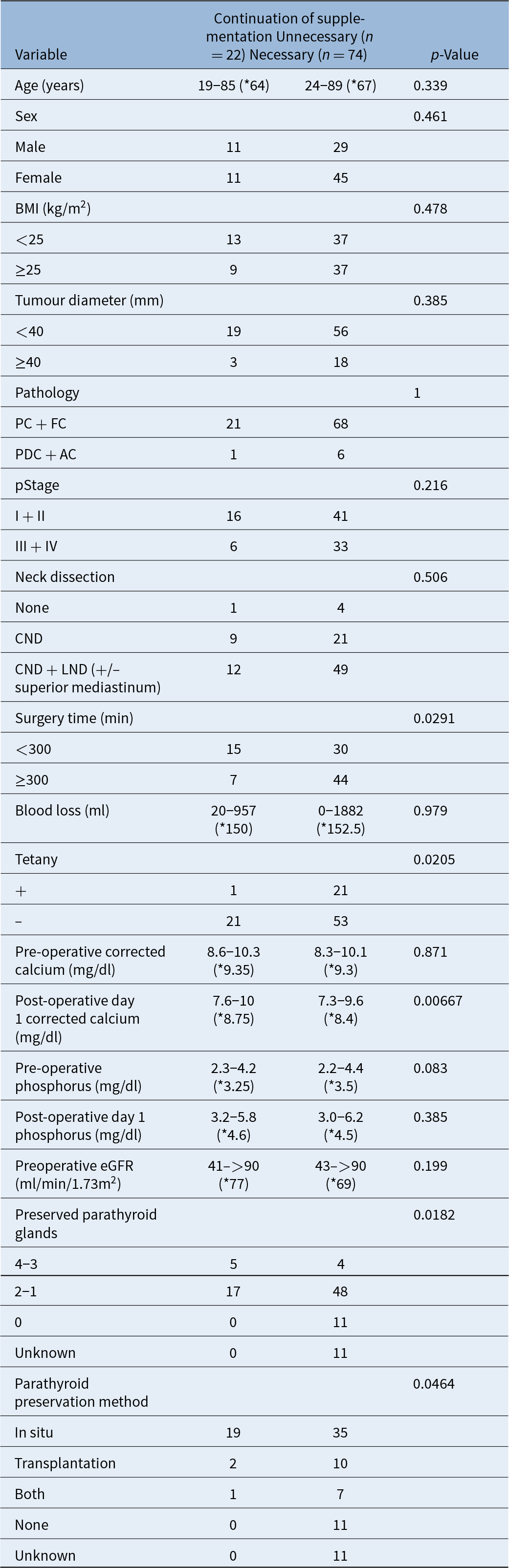
Seventy-four patients required continued medication of calcitriol and/or (±) calcium after total thyroidectomy. Overall, 35 patients required only continuous calcitriol supplementation. Univariate analysis (Table 4) revealed that operative time (p = 0.0291), post-operative symptoms of tetany (p = 0.0205), serum calcium levels on the day following surgery (p = 0.00667), the number of preserved parathyroid glands (p = 0.0182) and the parathyroid preservation technique (p = 0.0464) were significantly associated with the requirement for continued supplementation with calcitriol plus or minus calcium.
Univariate analysis of factors for determining the necessity of calcitriol only or both of calcitriol and calcium supplementation after total thyroidectomy for thyroid carcinoma

Table 4 Long description
Of the 96 patients, 74 required persistent supplementation with calcitriol only or both of calcitriol and calcium. Univariate analysis demonstrated significant associations between this outcome and the number of parathyroid glands preserved during surgery, the method of parathyroid gland preservation, and a decrease in serum calcium levels on the first postoperative day despite adequate calcium supplementation.
Abbreviations: AC, anaplastic carcinoma; BMI, body mass index; CND, central neck dissection; eGFR, estimated glomerular filtration rate; FC, follicular carcinoma; LND, lateral neck dissection; * = median; PC, papillary carcinoma; PDC, poorly differentiated carcinoma.
Multivariate analysis, adjusted for confounding factors (Table 5), demonstrated that the corrected serum calcium level on the first post-operative day was only an independent predictor of the necessity for calcitriol plus or minus calcium supplementation (adjusted OR = 0.132, 95 per cent CI: 0.029–0.459; p = 0.0009).
Multivariate analysis of factors for determining the necessity of calcitriol only or both of calcitriol and calcium supplementation after total thyroidectomy for thyroid carcinoma

Table 5 Long description
Multivariate analysis in patients undergoing total thyroidectomy for thyroid cancer identified a decrease in serum calcium levels on the first postoperative day despite adequate calcium supplementation as the only significant predictor of persistent calcitriol only or both of calcitriol and calcium supplementation.
Abbreviations: AUC, area under the curve; CI, confidence interval; OR, odds ratio.
Discussion
In the present study, only the number of preserved parathyroid glands was significantly associated with the need for continued calcium supplementation. Preserving at least one parathyroid gland in situ is idealReference Su, Gong, Wei, Gong, Li and Zhu6, whereas autotransplantation is an alternative strategy. To ensure the maintenance of parathyroid function through autotransplantation, transplanting at least two parathyroid glands may be necessary.Reference Kihara, Yokomise, Miyauchi and Matsusaka7, Reference Kihara, Miyauchi, Kontani, Yamauchi and Yokomise8 In our study, the proportion of patients who required continued postoperative calcium supplementation was relatively high (40.6 per cent). This high proportion is likely attributable to the fact that the present study included only patients who underwent total thyroidectomy for malignant tumours, routine practice of performing central ND and a high proportion of relatively high-risk cases, such as those with extrathyroidal extension.Reference Turhan, Konca, Elhan, Şahin and Genç9–Reference Chen, Zhao, Du, Wang, Han and Xu11 Prophylactic central ND revealed microscopic metastases in approximately 26 per cent of patients without clinically evident lymph node metastasis. However, this technique has not been shown to improve prognosis and may instead increase the risk of post-operative complications.Reference Sippel, Robbins, Poehls, Pitt, Chen and Leverson12 Nevertheless, given the substantial possibility that central ND contributes to a reduction in local recurrence ratesReference Wang, Cheung, Farrokhyar, Roman and Sosa13 and considering that post-operative recurrence in this area may compromise preservation of the recurrent laryngeal nerve, we routinely perform central ND.
Although preservation of the inferior parathyroid glands may be feasible if they are in the tracheoesophageal groove, they are most often located on the surface of the lower thyroid pole.Reference Hou, Xu, Yuan, Liu, Lu and Liu14 Therefore, even without central ND, preservation of the inferior parathyroid gland in situ is difficult, particularly in high-risk thyroid carcinoma cases. Furthermore, during central ND, the removal of lymph and adipose tissues may cause avascular necrosis of the parathyroid glandsReference Chen, Zhao, Du, Wang, Han and Xu11. Maintaining the superior parathyroid gland in situ on the unaffected side and, if possible, on the affected side is considered optimal to preserve post-operative parathyroid function. Although preserving branches of the inferior thyroid artery is generally considered important because the parathyroid glands are thought to receive most of their blood supply from itReference Chen, Zhao, Du, Wang, Han and Xu11, Reference Zhu, Tian, Xu, Jiang, Sun and Wang15, a cadaveric study involving 52 specimens reported that the superior parathyroid glands are almost always supplied by the superior thyroid artery.Reference Nobori, Saiki, Tanaka, Harihara, Shindo and Fujimoto16 Therefore, the superior thyroid artery should be ligated as distally as possible after its peripheral branching to preserve superior parathyroid perfusion. Identifying the inferior parathyroid gland and performing autotransplantation after tissue mincing appear to be the most effective approaches. As devascularised/removed parathyroid glands are often difficult to distinguish from lymph nodes, they should be biopsied to confirm their identity using frozen sections before autotransplantation.Reference Walker, Paloyan, Kelley, Gopalsami and Jarosz17 However, considering the additional effort and operative time required, focusing on reliably preserving the superior parathyroid glands in situ may be preferable. Ectopic parathyroid glands occur in approximately 23.8 per cent of patients, most commonly involving the left inferior parathyroid gland, which is typically located within the thymus/superior mediastinum.Reference Zhou, Xu, Guo, Chen, Liu and Guo18 However, in our study, all patients in whom the parathyroid glands could not be preserved during surgery required continued post-operative supplementation. Therefore, reliance on ectopic parathyroid glands may be unwarranted.
This study demonstrated that, despite sufficient calcium administration, patients who experienced a considerable decline in serum calcium levels on the first post-operative day required sustained oral supplementation. Notably, 39 patients required both calcium and calcitriol supplementation, whereas 35 continued to receive calcitriol alone. Combined, 77.1 per cent of the patients required continued calcitriol plus or minus calcium supplementation after surgery. In patients who are likely to require calcium supplementation, the concomitant administration of calcitriol may help reduce the risk of hypocalcaemia.Reference Alhefdhi, Mazeh and Chen19 Therefore, at our institution, no cases were reported in which calcium supplementation was administered alone without concomitant calcitriol. As described in the Materials and methods section, our practice is to prescribe calcitriol alone to patients whose serum calcium levels are mildly decreased but do not warrant calcium supplementation. Generally, maintaining calcium levels at or slightly below the lower limit of the normal range is preferable.Reference Bollerslev, Rejnmark, Marcocci, Shoback, Sitges-Serra and van Biesen20 Based on recent data from our hospital, the mean outpatient serum-corrected calcium level in patients who underwent total thyroidectomy for thyroid carcinoma was 9.1 mg/dl. Lowering target serum calcium levels may obviate calcitriol supplementation. In addition, as few reports have been made regarding a management strategy in which only calcitriol is administered in cases of mild postoperative hypocalcaemia without the need for calcium supplementation, investigating the appropriateness of this approach further would be necessary. Therefore, establishing a standard protocol for post-operative calcium and calcitriol supplementation may be crucial.
We acknowledge that this study was limited by its retrospective nature and the fact that it was conducted at a single institution. Moreover, surgeons (five to six) and outpatient physicians (four to five) with varying expertise were involved, and some variation in the degree of caution exercised regarding calcium plus or minus calcitriol supplementation was evident.
• Post-operative hypoparathyroidism is a major complication of total thyroidectomy for thyroid carcinoma
• Preservation of the parathyroid glands is important for maintaining postoperative parathyroid function
• A greater number of preserved parathyroid glands was significantly associated with a lower requirement for continued calcium supplementation
• Preservation of the parathyroid glands in situ was associated with a reduced requirement for long-term supplementation
• Lower corrected serum calcium levels on the first post-operative day may help identify patients at high risk of prolonged calcitriol only or both of calcitriol and calcium supplementation
Conclusion
In cases where total thyroidectomy is performed for thyroid carcinoma, the prevention of permanent post-operative medical supplementation depends on the preservation of as many parathyroid glands as possible during surgery. Patients who exhibit a decline in serum calcium levels on the first post-operative day are at high risk of requiring long-term oral medication.
Acknowledgements
We thank Editage (www.editage.com) for English language editing.
Financial support
This work was supported by a Grant-in-Aid for Scientific Research from the Japan Society for the Promotion of Science(JSPS; Grant number 24K12720).
Competing interests
The authors declare none.
Ethical standards
The authors assert that all procedures contributing to this work comply with the ethical standards of the relevant national and institutional guidelines on human experimentation (Institutional Review Board of Kumamoto University [approval number: 2338]) and with the Helsinki Declaration of 1975, as revised in 2008.