Introduction
The world is going through a demographic transition (the so-called ‘second demographic transition’) characterised by unprecedented changes in family formation and structure: living arrangements go beyond heterosexual marriage, fertility is very low either by postponement of childbearing or childlessness (Zaidi and Morgan, Reference Zaidi and Morgan2017) and life expectancy has greatly increased (WHO, 2015). Low fertility and high longevity result in an increased percentage of older persons in virtually all countries, which imposes several economic and social challenges (Reher, Reference Reher2011), namely for public health policies aimed at increasing positive experiences associated with ageing (WHO, 2015). Several health-related conditions are fairly common in older age, including high disability, dependency and morbidity. Although these generally increase with age, for both genders, women seem more vulnerable than men to high disability and functional limitations (Arber and Cooper, Reference Arber and Cooper1999; Orfila et al., Reference Orfila, Ferrer, Lamarca, Tebe, Domingo-Salvany and Alonso2006; Liang et al., Reference Liang, Bennett, Shaw, Quiñones, Ye, Xu and Ofstedal2008), as well as to disease and chronic conditions (Christensen et al., Reference Christensen, Doblhammer, Rau and Vaupel2009). Hence, as the world population becomes older, the identification and further understanding of the determinants of such gender inequalities in health is crucial for defining targeted healthy ageing-oriented agendas in public health.
Research in health inequalities among older adults have primarily focused on socio-economic determinants, such as educational level (Mackenbach et al., Reference Mackenbach, Stirbu, Roskam, Schaap, Menvielle, Leinsalu, Kunst, Van Oyen, Demarest, Rychtarikova, Dzurova, Andersen, Ekholm, Judge, Tekkel, Prättäla, Martikainen, Desplanques, Jusot, Helmert, Kovacs, Marton, Layte, Costa, Vannoni, Villerusa, Kalediene, Klumbiene, Geurts, Dahl, Strand, Wojtyniak, Santana, Madarasova Geckova, Artnik, Borrell, Esnaola, Regidor, Burström, Fritzell, Lundberg, Bopp and Glickman2008; Campos-Matos et al., Reference Campos-Matos, Russo and Perelman2016; Uccheddu et al., Reference Uccheddu, Gauthier, Steverink and Emery2019) and wealth (Ploubidis et al., Reference Ploubidis, Dale and Grundy2012; Uccheddu et al., Reference Uccheddu, Gauthier, Steverink and Emery2019), whereas gender differences and psycho-social determinants have been overlooked. This is surprising, because the role of psycho-social factors in reducing health inequalities irrespectively of age groups has been increasingly recognised (Stansfield and Bell, Reference Stansfield and Bell2019). Psycho-social factors are at the interplay between social structural factors (e.g. social conditions and experiences) and psychological states (Martikainen et al., Reference Martikainen, Bartley and Lahelma2002; Stansfield and Bell, Reference Stansfield and Bell2019), and include depression symptoms, loneliness feelings, social support and networks, among others. Evidence available shows that the prevalence of depression is higher among older women than men, the former being 1.3–3.4 times more likely to report symptoms of depression (Djernes, Reference Djernes2006). In a similar way, loneliness feelings have been found to predict gender inequalities in health among older people. This is because as people age, they tend to rely on close and stable relationships to meet their emotional needs and, at the same time, the establishment of new relationships declines (Carstensen, Reference Carstensen1992). Thus, changes to their close social network, either by moving to a nursing home (or retirement community) and receiving fewer visits (Adams et al., Reference Adams, Sanders and Auth2004), or grieving a recent loss from their narrower network (Adams et al., Reference Adams, Sanders and Auth2004; Cohen-Mansfield et al., Reference Cohen-Mansfield, Hazan, Lerman and Shalom2016), predict loneliness feelings at older ages. These are more prevalent among older women than men, which might also be due to women's longer life expectancy (Cohen-Mansfield et al., Reference Cohen-Mansfield, Hazan, Lerman and Shalom2016).
The first step towards identifying health inequalities and advancing health and wellbeing at old age is to measure the distribution of health in this group. The general health status of a given population is frequently measured in social and health population surveys by asking individuals to rate their health on a five-point scale that ranges from ‘excellent’ to ‘poor’ (Au and Johnston, Reference Au and Johnston2014), with some variations to exact wording following recommendations from different institutions (Jylhä, Reference Jylhä2009). This single-item measure of health is widely recognised as self-perceived general health (SPGH; also referred to as global self-rated health and self-assessed health) and it takes only a few seconds to answer, thus having a low burden of collection (DeSalvo et al., Reference DeSalvo, Bloser, Reynolds, He and Muntner2006). SPGH is a significant predictor of mortality (Idler et al., Reference Idler, Leventhal, McLaughlin and Leventhal2004), even after controlling for relevant mortality-related variables, such as socio-economic ones (Idler and Benyamini, Reference Idler and Benyamini1997; Knäuper and Turner, Reference Knäuper and Turner2003), and when additional indicators of health status are included in the analyses (Idler and Benyamini, Reference Idler and Benyamini1997; DeSalvo et al., Reference DeSalvo, Bloser, Reynolds, He and Muntner2006). Although the role of SPGH in predicting mortality has been widely investigated (Idler and Kasl, Reference Idler and Kasl1991; Idler and Benyamini, Reference Idler and Benyamini1997; Ferraro and Kelley-Moore, Reference Ferraro and Kelley-Moore2001; Benyamini et al., Reference Benyamini, Blumstein, Lusky and Modan2003; Knäuper and Turner, Reference Knäuper and Turner2003; Idler et al., Reference Idler, Leventhal, McLaughlin and Leventhal2004), less is known about how SPGH reflects the distribution of mental and physical health, both for the general population and stratified by gender.
SPGH lies on individual's own judgement of objective and subjective aspects of health (Tissue, Reference Tissue1972), which adds complexity to this apparent simple health measure, namely because the aspects considered to rate self-health most likely vary among individuals. Jylhä (Reference Jylhä2009) proposed a conceptual model for self-ratings of health that brings together the information used to individual's own assessment of health and the contextual framework under which this evaluation occurs. When asked the question ‘How would you rate your health?’, the person initiates a cognitive process, inherently subjective and context-dependent, that builds on different sources of information. Accordingly, individuals evaluate relevant objective components of health (e.g. clinical information, disease symptoms), taking into account past and present health experiences, comparisons to a reference group, health expectations, age and cultural norms, among others (Jylhä, Reference Jylhä2009). Thus, ratings of self-health may be influenced by several factors, such as socio-economic status (Dowd and Zajacova, Reference Dowd and Zajacova2007; Huisman et al., Reference Huisman, van Lenthe and Mackenbach2007), age (Heller et al., Reference Heller, Ahern, Pringle and Brown2009), educational attainment (Mackenbach et al., Reference Mackenbach, Stirbu, Roskam, Schaap, Menvielle, Leinsalu, Kunst, Van Oyen, Demarest, Rychtarikova, Dzurova, Andersen, Ekholm, Judge, Tekkel, Prättäla, Martikainen, Desplanques, Jusot, Helmert, Kovacs, Marton, Layte, Costa, Vannoni, Villerusa, Kalediene, Klumbiene, Geurts, Dahl, Strand, Wojtyniak, Santana, Madarasova Geckova, Artnik, Borrell, Esnaola, Regidor, Burström, Fritzell, Lundberg, Bopp and Glickman2008) or dependence level (Adams et al., Reference Adams, Sanders and Auth2004; Djernes, Reference Djernes2006; Burke et al., Reference Burke, Schnittger, O'Dea, Buckley, Wherton and Lawlor2012), often exposing uneven distributions of health.
Much research has been devoted to understanding what influences the way people perceive their health. In the particular case of Portugal, a literature review recently summarised the main findings of 71 studies on social determinants of health since the year 2000, with no age stratification (Campos-Matos et al., Reference Campos-Matos, Russo and Perelman2016). Noteworthy, only three studies included in this literature review assessed psycho-social variables, whereas the remaining addressed socio-economic determinants, such as education level, occupation and socio-economic status, among others. For those assessing psycho-social variables, social capital (i.e. support and social activities) was found to be associated with better psychological and physical functioning (Ferreira-Valente et al., Reference Ferreira-Valente, Pais-Ribeiro and Jensen2014) and self-reported health (da Silva, Reference da Silva2014). Overall, inequalities in health have been addressed by measuring self-reported health in relation to material factors, whereas behavioural and psycho-social ones have not been frequently considered and, thus, our understanding of health inequalities is far from complete. Therefore, the main purpose of this study was to examine gender inequalities in how community-dwelling older adults living in Portugal perceive their health status while considering psycho-social and socio-demographic determinants. The following questions were addressed in this study:
(1) Are there gender inequalities in health measured as SPGH?
(2) What are the psycho-social and socio-demographic determinants of self-rated health by Portuguese older men and women?
(3) Is the association of SPGH with relevant psycho-social factors mediated by other social variables under study (i.e. social variables that did not significantly predict SPGH in linear analyses)?
Methods
Study design and participants
This study draws on data from the Portuguese Elderly Nutritional Status Surveillance System (PEN-3S) project. PEN-3S was a nationwide, cross-sectional study that addressed the nutritional status of Portuguese community-dwellers and nursing home residents aged 65 or over with no upper age limit (Madeira et al., Reference Madeira, Peixoto-Plácido, Goulão, Mendonça, Alarcão, Santos, de Oliveira, Yngve, Bye, Bergland, Lopes, Nicola, Santos and Clara2016). This paper relies on data from community-dwellers; determinants of SPGH among nursing homes residents have been previously addressed (Alarcão et al., Reference Alarcão, Madeira, Peixoto-Plácido, Sousa-Santos, Fernandes, Nicola, Santos and Gorjão-Clara2019).
Data from the community sample were obtained in collaboration with the National Food, Nutrition and Physical Activity Survey (IAN-AF 2015–2016). Briefly, a representative sample of the Portuguese non-institutionalised population, Mainland Portugal and the Autonomous Regions of Azores and Madeira Islands, was obtained through multi-stage probability sampling. First, a sample of primary health-care units stratified by the seven NUTS II (Nomenclature of Territorial Units for Statistics II), and weighted by the number of individuals registered in each unit, was randomly selected. In the second stage, registered individuals in each health unit were randomly selected from the National Health Registry stratified by sex and age groups. Survey design and data collection methodologies have been detailed elsewhere (Madeira et al., Reference Madeira, Peixoto-Plácido, Goulão, Mendonça, Alarcão, Santos, de Oliveira, Yngve, Bye, Bergland, Lopes, Nicola, Santos and Clara2016; Lopes et al., Reference Lopes, Torres, Oliveira, Severo, Guiomar, Alarcão, Ramos, Rodrigues, Vilela, Oliveira, Mota, Teixeira, Nicola, Soares and Andersen2018).
Exclusion criteria for the community sample were: individuals living in collective residences or institutions (e.g. nursing homes or hospitals); those not able to provide reliable answers to a questionnaire in Portuguese, such as individuals living in Portugal for less than one year, non-Portuguese speakers and individuals with diminished physical functioning (e.g. blindness, deafness) and/or cognitive impairment assessed using the Mini-Mental State Examination (MMSE).
Eligible participants were invited to participate by telephone; if they confirmed their willingness to enrol in the study, a formal invitation letter with detailed information about the project was sent. According to participants’ preference, interviews were held at their homes or their Primary Health Care Unit after providing written informed consent. Participation rate among eligible individuals was 21.1 per cent for men and 27.5 per cent for women.
Data collection and variables
Trained nutritionists performed data collection, between October 2015 and September 2016, through computer-assisted face-to-face structured interviews. The IAN-AF 2015–2016 method was used to collect demographic, socio-economic and health status (SPGH and clinical conditions) data using the electronic platform ‘YOU, eAT& MOVE’ (Lopes et al., Reference Lopes, Torres, Oliveira, Severo, Guiomar, Alarcão, Ramos, Rodrigues, Vilela, Oliveira, Mota, Teixeira, Nicola, Soares and Andersen2018).
The following demographic and socio-economic variables were collected: age, gender, marital status, education level, household size and composition, employment status, household monthly income and place of residence (according to the geographic location of the Primary Health Care Unit from which participants were sampled and the NUTS II). The SPGH single-item measure, previously described in the Introduction section, was used to assess community-dwellers’ self-perception of general health status in a five-point Likert-type scale, ranging from 1 ‘excellent’ to 5 ‘very poor’ health. Self-reported morbidity was assessed by asking participants if they have ever been diagnosed with cardiac disease, stroke, cancer, diabetes mellitus I and II, hypertension, dyslipidaemia, gastrointestinal disease and depression (responses were coded as yes/no). Cognitive function was assessed using the MMSE (Folstein et al., Reference Folstein, Folstein and McHugh1975; Creavin et al., Reference Creavin, Wisniewski, Noel-Storr, Trevelyan, Hampton, Rayment, Thom, Nash, Elhamoui, Milligan, Patel, Tsivos, Wing, Phillips, Kellman, Shackleton, Singleton, Neale, Watton and Cullum2016). The MMSE is a 30-item instrument that assesses temporal and spatial orientation, working memory, recall, attention, arithmetic capacity, and linguistic and visual-motor skills. Each correct answer receives one point up to the maximum score of 30 points (one point per correct item); high scores indicate high cognitive functioning. MMSE cut-off values previously established for the Portuguese population based on the education level were used to determine participant's cognitive function: illiterate ≤15 points; 1–11 years of education ≤22 points; ≥12 years of education ≤27 points (Guerreiro et al., Reference Guerreiro, Silva, Botelho, Leitão, Castro Caldas and Garcia1994). Cognitively impaired individuals were excluded and statistical analyses refer to non-cognitively impaired participants. For this sample, MMSE Cronbach's alpha was 0.80, which indicates very good internal consistency.
Functional status is a relevant predictor of SPGH (Adams et al., Reference Adams, Sanders and Auth2004; Djernes, Reference Djernes2006; Burke et al., Reference Burke, Schnittger, O'Dea, Buckley, Wherton and Lawlor2012) and refers to the ability of individuals to perform basic activities of daily living (e.g. feeding, grooming, dressing) or instrumental activities of daily living (IADLs; e.g. taking medications, handling finances, doing housework). In the present study, an individual's autonomy to perform IADLs was assessed with the eight-item Lawton Scale; scores range from 0 (low function, dependent) to 8 (high function, independent) (Lawton and Brody, Reference Lawton and Brody1969). This scale has been previously validated for a sample of older non-institutionalised Portuguese adults with good psychometric properties (Araújo et al., Reference Araújo, Pais Ribeiro, Oliveira, Pinto, Martins, Leal, Pais-Ribeiro, Silva and Marques2008); here, Cronbach's alpha was 0.78, which indicates good internal consistency.
Psycho-social variables addressed in this study were depression and loneliness feelings. The 15-item version of the Geriatric Depression Scale (GDS-15) was used to investigate depression symptomatology. GDS-15 has a yes/no response format and does not evaluate somatic symptoms potentially due to medical conditions. Respondents scoring >5 points were categorised as having symptoms of depression, whereas those who scored <5 points were classified as not having symptoms of depression. The psychometric properties of GDS-15 for the Portuguese population have been previously described (Alves Apóstolo et al., Reference Alves Apóstolo, Loureiro, dos Reis, da Silva, Cardoso and Sfetcu2014); in this study, GDS-15 had very good internal consistency as revealed by Cronbach's alpha (0.83).
Loneliness has been widely defined as ‘a subjective negative feeling associated with a perceived lack of a wider social network (social loneliness) or the absence of a specific desired companion (emotional loneliness)’ (Valtorta and Hanratty, Reference Valtorta and Hanratty2016: 518). In this study, loneliness feelings were assessed using the UCLA Loneliness Scale, which is one of the most commonly used instruments for measuring self-perceived isolation, and relational and social connectedness in older age. This 16-item scale has a four-point Likert-type answer format ranging from 1 ‘never’ to 4 ‘frequently’. Total scores range from 16 to 64 points, and high scores indicate high subjective feelings of loneliness or social isolation. The UCLA Loneliness Scale has been validated for the Portuguese population; scores >32 points indicate loneliness feelings (Pocinho et al., Reference Pocinho, Farate and Dias2010). In this study, internal consistency as revealed by Cronbach's alpha was very good (0.89).
Statistical analyses
Descriptive statistics (frequency (%) or mean and standard deviation (SD)), for the entire sample and stratified by gender, were calculated for demographic and socio-economic variables, SPGH, self-reported morbidity, functional status and psycho-social variables (i.e. symptoms of depression and loneliness feelings). Bivariate associations between gender and demographic, socio-economic, self-reported morbidity, functional status and psycho-social variables under study were tested using chi-square tests or independent t-tests as appropriate. In all statistical analyses, SPGH was treated as a continuous variable for two reasons: (a) to avoid the coarseness arising from collapsing five into fewer categories, and (b) under the Central Limit Theorem, the number of random independent observations is large enough (N = 920) to assume that the distribution of values of this scale-type variable approaches a normal distribution and, thus, allows us to use parametric tests that are far more robust than non-parametric ones.
Bivariate Pearson's correlation coefficients (denoted r) were calculated to test for correlations between SPGH and the following variables: age, education level given as number of years of completed education, household size, number of self-reported morbidity conditions, cognitive function, functional status and psycho-social variables under study. Those variables that were significantly correlated with SPGH in the bivariate analysis were tested in multiple linear regression models. Relevant predictors in the final model were retained after backwards elimination of variables, for the entire sample and stratified by gender. We used the F-Snedecor test and the adjusted coefficient of determination (adjusted R 2) to validate regression models and evaluate their predictive performance.
Finally, mediation analyses using a bootstrap approach were conducted to evaluate indirect effects on SPGH; relevant predictors as showed by multiple linear regression models were included in these analyses. Bootstrapping is a non-parametric resampling procedure that makes no assumptions on the sampling distribution of the indirect effect (Hayes, Reference Hayes2013).
In all analyses, statistical significance was set to α = 0.05. Statistical analyses were performed using the Statistical Package for Social Science Software (SPSS), version 24. Mediation analyses based on 500 bootstrap samples were conducted using Process SPSS macro (Preacher and Hayes, Reference Preacher and Hayes2008).
Results
Overall, 1,120 community-dwelling older adults voluntarily enrolled in this study, 1,079 provided information on SPGH. However, after applying MMSE cut-offs, only 920 individuals (85.26%) were not cognitively impaired and were therefore considered eligible for further analyses. Non-eligible and eligible participants did not differ with regards to gender, number of people living in the household and occupation. Cognitively impaired participants were older, had a lower educational level and lower income than non-cognitively impaired individuals.
General characterisation of the sample: socio-economic characteristics and clinical conditions
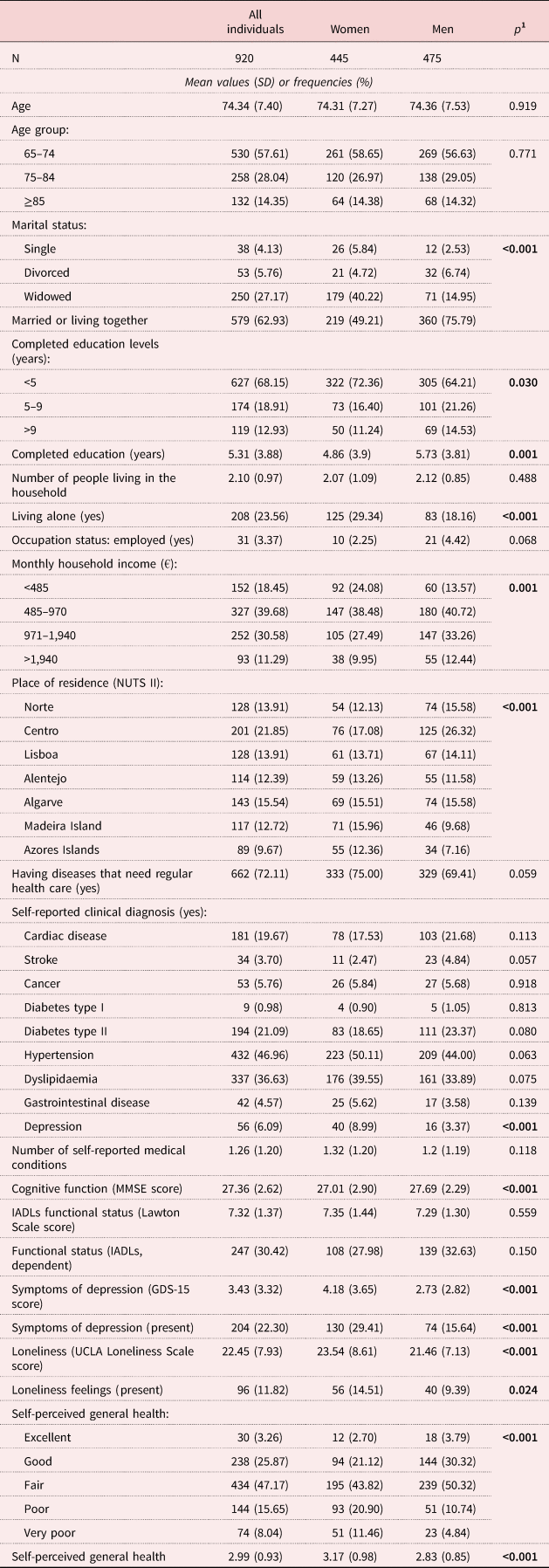
Participants’ demographic and socio-economic characteristics are summarised in Table 1. The study involved 920 participants, 445 (48.36%) were women; the mean age of the sample was 74.34 years (SD = 7.40) and 57.61 per cent were younger than 75 years old. Significant gender differences were found in marital status (49.21% of women versus 75.79% of men were married or living together, and 40.22% of women were widowed versus 14.95% of men, p < 0.001), educational level (72.36% of women versus 64.21% of men were illiterate or only attended primary school, p = 0.030), income (24.08% of women versus 13.57% of men reported a monthly household income of less than €485, which is the Portuguese minimum wage, p = 0.001) and living arrangements (29.34% of women versus 18.16% of men lived alone, p < 0.001).
Demographic and socio-economic characteristics, clinical and psycho-social variables among a sample of community-dwelling Portuguese older adults

Notes: Sample size is variable due to missing data for some variables. 1. After chi-square test (for categorical variables) or t-test (for numeric variables) for comparing gender. Freq.: frequency. SD: standard deviation. NUTS II: Nomenclature of Territorial Units for Statistics II. MMSE: Mini-Mental State Examination. IADLs: instrumental activities of daily living. GDS-15: 15-item version of the Geriatric Depression Scale. Bold text indicates statistical significance at p < 0.05.
Overall, 72.11 per cent of the participants reported having at least one disease requiring regular health care, such as medical examinations and appointments, and no statistically significant differences between genders were found (p = 0.059). The most frequently self-reported chronic diseases were hypertension (46.96%) and dyslipidaemia (36.63%).
Gender inequalities in SPGH, functionality and psycho-social factors
Women and men perceived their general health status differently: 20.90 and 11.46 per cent of women, and 10.74 and 4.84 per cent of men rated their health as poor and very poor, respectively (p < 0.001). SPGH mean scores were 3.17 (SD = 0.98) and 2.83 (SD = 0.85) for women and men, respectively (p < 0.001). The mean score for the Lawton Scale was 7.32 (SD = 1.37; maximum = 8), which indicates that participants, on average, are independent for performing IADLs. Only 30.42 per cent of the participants were considered dependent for performing IADLs and no gender differences were detected (p = 0.559). Significantly more women (29.41%) than men (15.64%) reported symptoms of depression (p < 0.001); the mean scores for depression-related symptomatology (p < 0.001) were 4.18 (SD = 3.65) and 2.73 (SD = 2.82) for women and men, respectively. Gender differences for loneliness feelings (p < 0.001) were detected: the mean scores for the UCLA Loneliness Scale were 23.54 (SD = 8.61) and 21.46 (SD = 7.13) for women and men, respectively. After applying the cut-off values for the UCLA Loneliness Scale, 11.82 per cent of older persons reported loneliness feelings, in particular more women (14.51%) than men (9.39%, p = 0.024).
Determinants of SPGH status
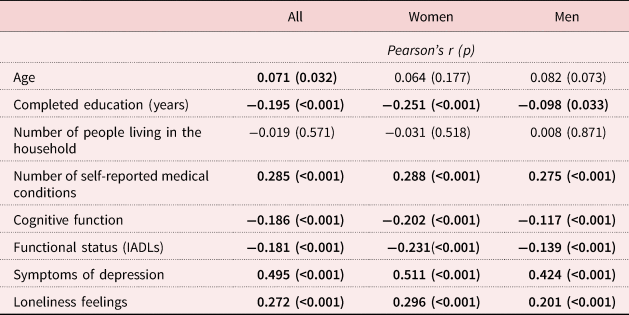
SPGH status was positively associated with symptoms of depression (r = 0.495, p < 0.001), self-reported morbidity given as number of medical conditions (r = 0.285, p < 0.001) and loneliness feelings (r = 0.272, p < 0.001) for the entire sample. Significant correlations, though weaker, were also found between SPGH and the following variables: age, education level, cognitive function and functional status (Table 2). The general patterns described for the entire sample also apply to each gender analysed separately, except for age.
Bivariate correlations of socio-demographic and psycho-social variables with self-perceived general health status

Notes: Values are bivariate Pearson's correlation coefficients and associated p-value. IADLs: instrumental activities of daily living. Bold text indicates statistical significance at p < 0.05.
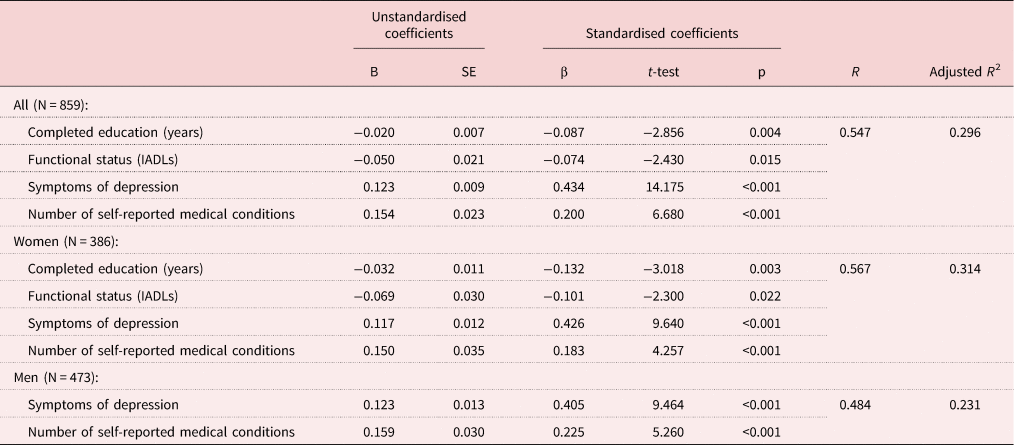
Backwards multiple regression models revealed the following predictors of SPGH for women: symptoms of depression (β = 0.426, p < 0.001), self-reported morbidity given as number of medical conditions (β = 0.183, p < 0.001), education level (β = −0.132, p = 0.003) and functional status (β = −0.101, p = 0.022). This model was statistically significant and accounted for 31.4 per cent of the total variance (Table 3). For men, symptoms of depression (β = 0.405, p < 0.001) and self-reported morbidity given as number of medical conditions (β = 0.225, p < 0.001) were the only predictors retained in the final multiple regression model. This model was statistically significant and accounted for 23.1 per cent of the variance of SPGH (Table 3).
Multiple linear regression models predicting self-perceived general health status

Notes: SE: standard error. R: Pearson's multiple correlation coefficient. Adjusted R 2: adjusted multiple coefficient of determination. IADLs: instrumental activities of daily living.
The indirect effects of predictors removed from the final multiple regression models (cognitive function and loneliness feelings for both genders; functional status for men) on SPGH were tested through mediation analyses. Mediators tested were education level, functional status, symptoms of depression and self-reported morbidity given as number of medical conditions for the entire sample and women, whereas only the latter two were tested for men. Tables 4–6 report the results of mediation analyses.
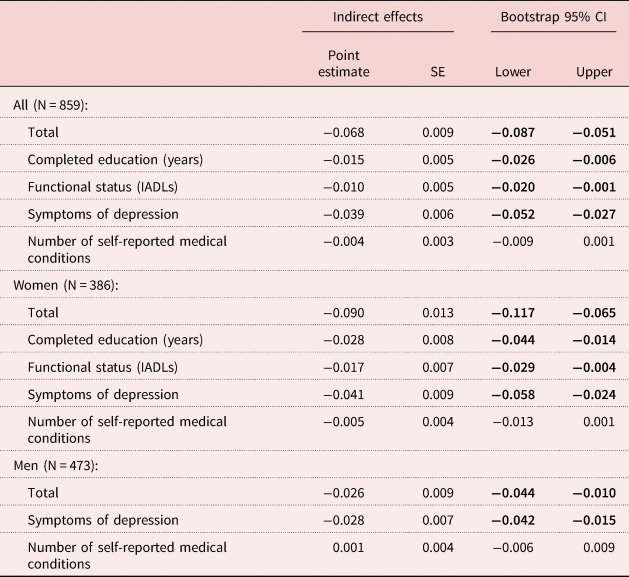
Indirect effects of cognitive function on self-perceived general health status

Notes: SE: standard error. CI: confidence interval. IADLs: instrumental activities of daily living. Bold text indicates statistical significance at p < 0.05.
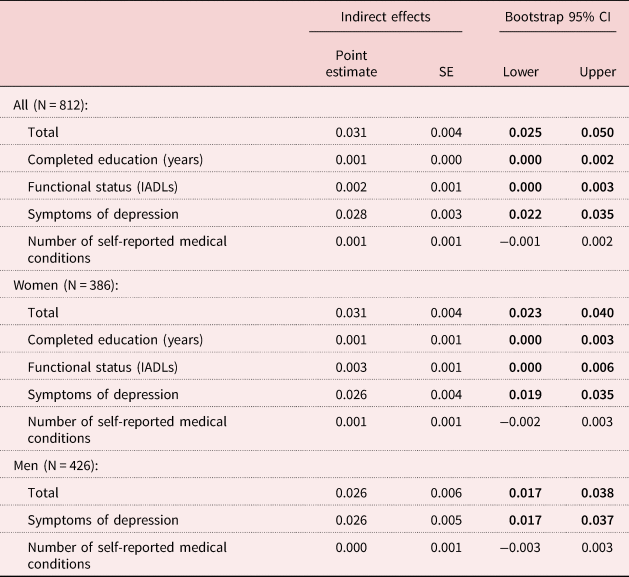
Indirect effects of loneliness on self-perceived general health status

Notes: SE: standard error. CI: confidence interval. IADLs: instrumental activities of daily living. Bold text indicates statistical significance at p < 0.05.
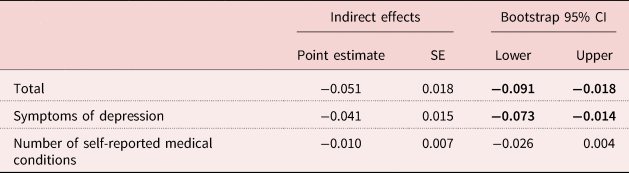
Indirect effects of functional status on men's self-perceived general health status

Notes: N = 426. SE: standard error. CI: confidence interval. Bold text indicates statistical significance at p < 0.05.
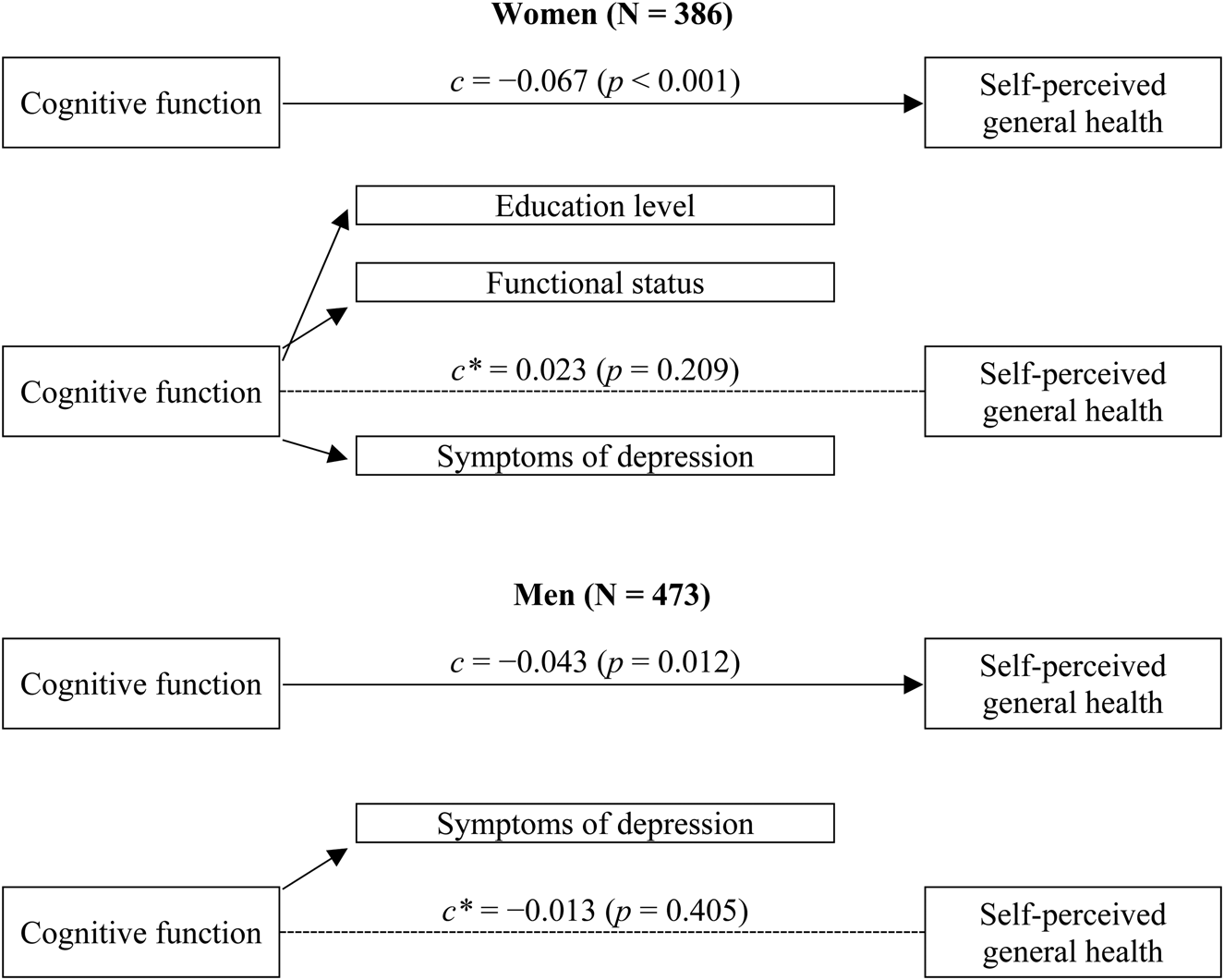
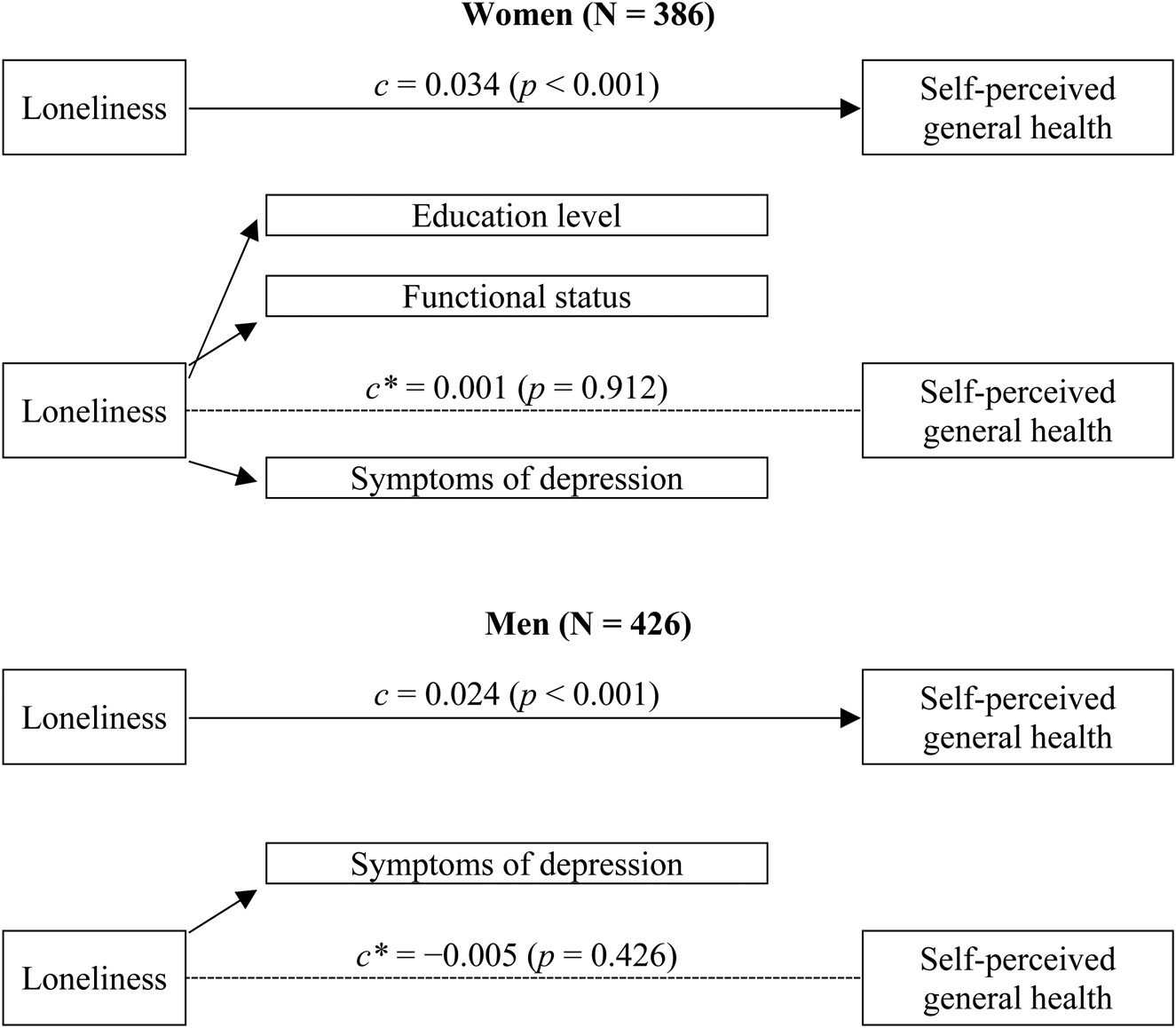
Among women, the set of four variables (education level, functional status, symptoms of depression and self-reported morbidity given as number of medical conditions) had a point estimate of −0.090 and a bootstrap 95% confidence interval (CI) of −0.117 to −0.065; thus, this total indirect effect is significant at p < 0.05 (Table 4). The examination of the individual indirect effects of the four mediators showed that education level, functional status and symptoms of depression, but not self-reported morbidity, contributed to mediate the effect of cognitive function on SPGH among women (Table 4; Figure 1). Similar results were obtained for loneliness feelings (Table 5; Figure 2). The full set of four potential mediators had a point estimate of 0.031 and a bootstrap 95% CI of 0.023 to 0.040; thus, this total indirect effect is significant at p < 0.05 (Table 5). Self-reported morbidity given as number of medical conditions was the only variable that did not contribute to the indirect effect of loneliness feelings on SPGH (Table 5; Figure 2).
Conceptual diagram of total and direct effects, and specific indirect effects of cognitive function (Mini-Mental State Examination) on self-perceived general health through multiple mediators
Notes: c: total effect. c*: direct effect. p: p-value after t-test.

Conceptual diagram of total and direct effects, and specific indirect effects of loneliness on self-perceived general health through multiple mediators.
Notes: c: total effect. c*: direct effect. p: p-value after t-test.

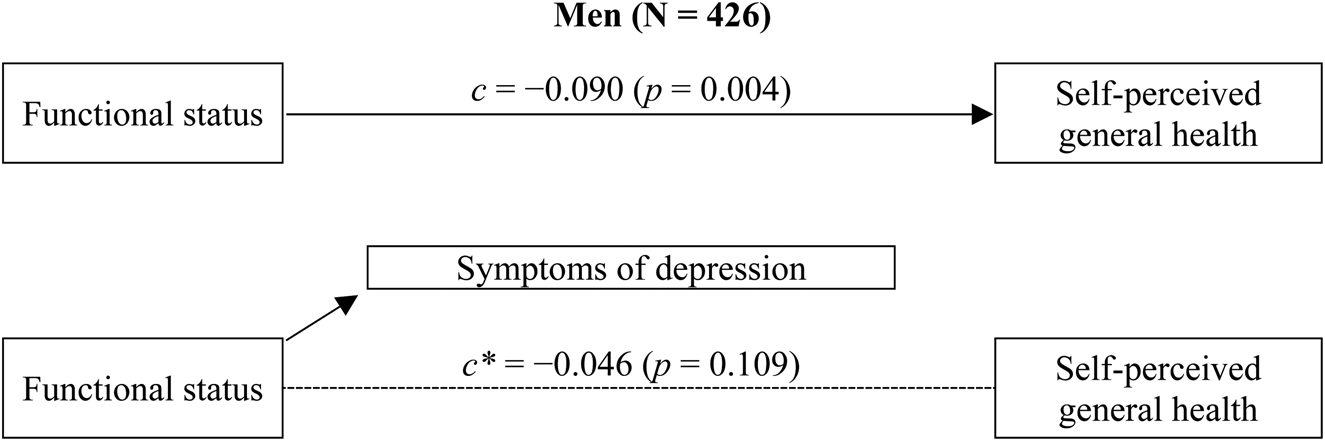
Among men, the total indirect effect of the two variables (i.e. symptoms of depression and self-reported morbidity given as number of medical conditions) included in the mediation analysis of cognitive function on SPGH was significant at p < 0.05 (point estimate = −0.026, bootstrap 95% CI of −0.044 to −0.010; Table 4). If the individual contribution of each variable is considered, only symptoms of depression contributed to mediate the effect of cognitive function on SPGH among men (Table 4; Figure 1). The same general pattern was found for the analyses of indirect effects of loneliness feelings (point estimate = 0.026, bootstrap 95% CI of 0.017 to 0.038; Table 5; Figure 2) and functional status on SPGH (point estimate = −0.051, bootstrap 95% CI of −0.091 to −0.018; Table 6; Figure 3).
Conceptual diagram of total and direct effects, and specific indirect effects of functional status (instrumental activities of daily living) on self-perceived general health through symptoms of depression.
Notes: c: total effect. c*: direct effect. p: p-value after t-test.

Discussion
In the present study, we used a nationally representative sample of community-dwelling, non-cognitively impaired older (aged 65 or older) adults to investigate gender differences in the associations between socio-demographic and psycho-social measures and SPGH. Our results showed that, on average, Portuguese older community-dwellers rate their general health status as ‘fair’. These results are in line with findings from the 2014 European Social Survey: the best overall general health status was reported from Ireland (SPGH mean score of 1.77 out of 5), whereas the poorest health status was reported from Portugal (SPGH mean score of 2.60; Baćak and Ólafsdóttir, Reference Baćak and Ólafsdóttir2017). Also, women in our sample less frequently rated their health as ‘excellent’ or ‘good’, and more frequently as ‘poor’ or ‘very poor’. Similar trends in gender inequalities in health measured as SPGH have been previously reported for Southern European older adults (Leão and Perelman, Reference Leão and Perelman2018), and raise the question of which health determinants are responsible for poor self-rated health as well as for gender inequalities in SPGH.
Bivariate correlations showed that psycho-social variables (i.e. symptoms of depression and loneliness feelings) under study, functional status, education level and self-reported morbidity were associated, although weakly, to self-ratings of health, and the direction of the association was as predicted in the literature. Low educational attainment, dependence for IADLs, self-reported morbidity and symptoms of depression predicted poor self-reported general health in women, as revealed by multiple linear regression models. Altogether, these four factors accounted for 31.40 per cent of the variance in SPGH among women. A slightly different set of factors were found to predict poor self-reported general health in men, and these were restricted to symptoms of depression and self-reported morbidity, which accounted for 23.10 per cent of the variance in SPGH. In both cases, depression was the strongest predictor of SPGH and the set of variables retained in the models explain little of the variance in self-ratings of health. A discussion on this is provided below.
Education level previously has been found to be a strong predictor of inequalities in health (Mackenbach et al., Reference Mackenbach, Stirbu, Roskam, Schaap, Menvielle, Leinsalu, Kunst, Van Oyen, Demarest, Rychtarikova, Dzurova, Andersen, Ekholm, Judge, Tekkel, Prättäla, Martikainen, Desplanques, Jusot, Helmert, Kovacs, Marton, Layte, Costa, Vannoni, Villerusa, Kalediene, Klumbiene, Geurts, Dahl, Strand, Wojtyniak, Santana, Madarasova Geckova, Artnik, Borrell, Esnaola, Regidor, Burström, Fritzell, Lundberg, Bopp and Glickman2008) and mortality (Mackenbach et al., Reference Mackenbach, Stirbu, Roskam, Schaap, Menvielle, Leinsalu, Kunst, Van Oyen, Demarest, Rychtarikova, Dzurova, Andersen, Ekholm, Judge, Tekkel, Prättäla, Martikainen, Desplanques, Jusot, Helmert, Kovacs, Marton, Layte, Costa, Vannoni, Villerusa, Kalediene, Klumbiene, Geurts, Dahl, Strand, Wojtyniak, Santana, Madarasova Geckova, Artnik, Borrell, Esnaola, Regidor, Burström, Fritzell, Lundberg, Bopp and Glickman2008; Huisman et al., Reference Huisman, Read, Towriss, Deeg and Grundy2013), also for the Portuguese population (von dem Knesebeck et al., Reference von dem Knesebeck, Verde and Dragano2006; Eikemo et al., Reference Eikemo, Huisman, Bambra and Kunst2008; Schütte et al., Reference Schütte, Chastang, Thirion, Vermeylen and Niedhammer2013) and immigrants living in Portugal (Dias et al., Reference Dias, Gama and Martins2013). In this study, women were significantly less educated than men (>70% of women completed less than five years of formal education), so we could expect this socio-demographic factor to be a stronger predictor of poor self-rated health in women than men. Indeed, this was the case in the present study: less-educated women rated their health as worse when compared to higher-educated women or men; this pattern has been consistently found in health surveys (e.g. Arber and Cooper, Reference Arber and Cooper1999; Zunzunegui et al., Reference Zunzunegui, Alvarado, Guerra, Gómez, Ylli, Guralnik, Freeman, Karna, Deshpande, Garcia, Kotecha, Philips, Curcio, Freire and Qirjako2015).
Functional status progressively declines over time with differences in speed: available evidence shows that this decline is faster for women than for men (Liang et al., Reference Liang, Bennett, Shaw, Quiñones, Ye, Xu and Ofstedal2008), and the former are more likely to report higher levels of functional impairment (Gorman and Read, Reference Gorman and Read2006; Liang et al., Reference Liang, Bennett, Shaw, Quiñones, Ye, Xu and Ofstedal2008). Differences in biological factors, life expectancy and morbidity might account for gender inequalities in functionality in old age. In the case of the present study, no gender differences in functional status were detected and only approximately 30 per cent of the sample was considered dependent for IADLs. Despite these observations, functionality was found to predict SPGH for women, but not for men, which somehow embodies the growing number of studies pointing out that poor self-rated health in women is associated with high levels of dependency (e.g. Orfila et al., Reference Orfila, Ferrer, Lamarca, Tebe, Domingo-Salvany and Alonso2006; Liang et al., Reference Liang, Bennett, Shaw, Quiñones, Ye, Xu and Ofstedal2008). However, when potential indirect effects of functional status on SPGH were investigated, mediation analyses showed an indirect effect of functionality on SPGH through symptoms of depression for men. Similar results were obtained for loneliness feelings. This indicates that a decline in functionality and increased loneliness feelings still impact SPGH through their effect on mental health via an increase in depression symptomatology among community-dwelling men. Although the set of indicators addressed in the analyses were different, evidence from a comparative study involving three Southern European countries (i.e. Spain, Italy and Portugal) showed that depression symptoms mediated the association between socio-demographic factors (i.e. education level, age and gender) and self-rated health (Leão and Perelman, Reference Leão and Perelman2018).
Results of the present study showed that worse SPGH was significantly and positively associated with self-reported morbidity given as the number of clinical conditions for both genders. Data collected during Wave 4 of the Survey of Health, Ageing and Retirement in Europe from 16 European countries supported the association between reporting multiple chronic diseases and worse SPGH, and this association was particularly strong for Portugal and Hungary, whereas a weaker association was found for Belgium and Switzerland (Palladino et al., Reference Palladino, Lee, Ashworth, Triassi and Millett2016). The presence of multiple chronic health problems is highly prevalent among Portuguese older adults (Rodrigues et al., Reference Rodrigues, Gregório, Sousa, Dias, Santos, Mendes, Coelho, Branco and Canhão2018) and consistently associated with worse SPGH, reduced functional capacity, greater health-care utilisation and depression (Palladino et al., Reference Palladino, Lee, Ashworth, Triassi and Millett2016). Noteworthy, there was no evidence from mediation analyses that reporting of chronic conditions by elderly community-dwellers mediated the effect of cognitive function, loneliness feelings and functional status on SPGH.
Symptoms of depression were found to be a better predictor of low SPGH than the number of self-reported medical conditions for both genders, as revealed by bivariate correlations and standardised coefficients from multiple linear regression models. Previous research has shown that absence of depression is relevant for positive perceived health by community-dwelling persons (Bryant et al., Reference Bryant, Beck and Fairclough2000; Schneider et al., Reference Schneider, Driesch, Kruse, Wachter, Nehen and Heuft2004; Schüz et al., Reference Schüz, Wurm, Schöllgen and Tesch-Römer2011), as well as among institutionalised older adults (Alarcão et al., Reference Alarcão, Madeira, Peixoto-Plácido, Sousa-Santos, Fernandes, Nicola, Santos and Gorjão-Clara2019). However, the opposite direction of this association has also been described: health perceptions may be protective against depression-related symptoms, namely for those functionally impaired (Jahn and Cukrowicz, Reference Jahn and Cukrowicz2012). This suggests a different role of SPGH, other than the one investigated in this study, in the triad of SPGH, depression and functional status. These findings are relevant, given that depression is prevalent among older adults, being particularly high in Portugal in comparison with other European countries (Perelman et al., Reference Perelman, Chaves, Miguel, de Almeida and Matias2018). Further investigation in order to disentangle the contextual associations among these factors is of utmost importance and the results have the potential to inform decision makers with regards to healthy ageing.
Results herein support the multi-dimensionality of the SPGH construct, which adds complexity to its assessment (Schüz et al., Reference Schüz, Wurm, Schöllgen and Tesch-Römer2011). Despite the exclusion of cognitively impaired individuals from this study, a weak though significant correlation between cognitive status and SPGH was detected for non-cognitively impaired older participants. Moreover, mediation analyses showed that a decline in cognitive status indirectly predicted poor self-rated health through effects on education level, functional status and symptoms of depression for women, whereas symptoms of depression was the only mediator between cognition and SPGH for men. Results from elsewhere have shown that a decline in cognitive status of older Irish community-dwellers indirectly affected SPGH through its effect on functional status (Burke et al., Reference Burke, Schnittger, O'Dea, Buckley, Wherton and Lawlor2012).
Overall, functionality and psycho-social and socio-demographic factors investigated in this study significantly predicted SPGH, although they were weakly correlated. This finding is consistent with previous results for Portuguese older adults living in nursing homes (Alarcão et al., Reference Alarcão, Madeira, Peixoto-Plácido, Sousa-Santos, Fernandes, Nicola, Santos and Gorjão-Clara2019) and older Irish community-dwellers (Burke et al., Reference Burke, Schnittger, O'Dea, Buckley, Wherton and Lawlor2012). These raise the question on the adequacy of the factors addressed here as predictors of general health status: community-dwellers in our sample were mainly independent for IADLs (~70%), not depressed (~80%) and did not experience loneliness feelings (>80%); however, on average, they reported their general health status as ‘fair’. The most plausible explanation is that other factors, not considered in this analysis, are better predictors of SPGH for this particular sample. It is indisputable that Portuguese older adults, especially women, constitute a group vulnerable to inequalities in socio-economic conditions, especially with regards to educational level and household monthly income, but also with regards to the way these relate to poor self-rated health (Rodrigues et al., Reference Rodrigues, Gregório, Sousa, Dias, Santos, Mendes, Coelho, Branco and Canhão2018). Therefore, further research should take a contextual framework and, in the particular case of the older Portuguese population, should address how socio-economic conditions allied to material factors (e.g. living conditions, food insecurity or medication reduction due to its monetary cost) may influence health status, directly and indirectly, namely through psycho-social factors (Moor et al., Reference Moor, Spallek and Richter2017) and accounting for gender inequalities in health (Hosseinpoor et al., Reference Hosseinpoor, Stewart Williams, Amin, de Carvalho I, Beard, Boerma, Kowal, Naidoo and Chatterji2012; Malmusi et al., Reference Malmusi, Vives, Benach and Borrell2014).
This study has some limitations. First, data were self-reported and, thus, it is subject to report bias as it depends on participants’ memory and personal interpretation, which may be particularly relevant in the case of older adults. To reduce risk of bias, all individuals who were cognitively impaired following the application of MMSE were excluded. This implies that the most vulnerable groups of older adults were excluded from the analyses on the predictive value of SPGH. Second, details about relevant morbidity dimensions, such as severity or duration of diseases, were not evaluated in this study (only presence/absence of diagnosis was collected). Future studies can overcome this limitation by using objectively measured outcomes, such as biological risk markers or clinical data collected from medical records. Third, no causal relations can be drawn from here, since it was a cross-sectional study. This is even more complicated since SPGH is both the cause and the consequence of the psycho-social factors addressed and, thus, longitudinal studies are required to examine further the direction of the associations between socio-demographic, psycho-social and other factors, and SPGH. Moreover, decisions taken regarding statistical analysis are not consensual; however, we are confident that using SPGH in linear models did not significantly affect the results and main conclusions reached here. This five-point health self-assessment scale has proven robust in linear models (Bryant et al., Reference Bryant, Beck and Fairclough2000; Ferraro and Kelley-Moore, Reference Ferraro and Kelley-Moore2001; Schneider et al., Reference Schneider, Driesch, Kruse, Wachter, Nehen and Heuft2004; Huisman et al., Reference Huisman, van Lenthe and Mackenbach2007; da Silva, Reference da Silva2014; Baćak and Ólafsdóttir, Reference Baćak and Ólafsdóttir2017; Idler and Cartwright, Reference Idler and Cartwright2018) if the following conditions are met: data are normally distributed, the sample is large enough and all categories have a satisfactory number of cases. Indeed, given the sample size of this study (N = 920), it can be assumed, although it will always be controversial, that these assumptions are met. Fourth, several relevant psycho-social determinants were not analysed in this study and these include health-related control beliefs, coping and social support. Future studies that account for both subjective and objective dimensions of social isolation and measures of social disconnectedness among older people will provide some insight regarding their impacts on physical, mental and cognitive health (Beller and Wagner, Reference Beller and Wagner2018; Taylor et al., Reference Taylor, Taylor, Nguyen and Chatters2018).
Notwithstanding these limitations, this study also has several strengths. First, it relies on a nationally representative sample of older community-dwellers. Second, it addressed the effects of psycho-social factors in shaping the health and wellbeing of older individuals and explored gender inequalities in health. Third, results herein have the potential to be used to inform healthy ageing policies. This is particularly relevant, because some of these factors are modifiable through planned and informed interventions. Fourth, the subjective rating of health was complemented by the self-reported diagnosis of morbidity conditions. This is a relevant point, and evidence concerning the impact of multi-morbidity on perceived health will support patients’ management, their health status improvement and increased health-care efficiency (Mavaddat et al., Reference Mavaddat, Valderas, Van Der Linde, Khaw and Kinmonth2014). Altogether, results herein can support targeted and cost-effective interventions because they contribute to the identification of both the most vulnerable groups of the population to inequalities in health and the predictors, some of them being modifiable.
Conclusion
This study provided valuable insights into socio-demographic and psycho-social health factors, which directly or indirectly impact the way older people perceive their health. Gender inequalities in psycho-social determinants predicted differences in SPGH between men and women. Completed years of education, functional status, symptoms of depression and number of medical conditions significantly predicted SPGH among older women, whereas only the latter two were associated with SPGH among older men. Mediation analyses allowed the detection of the indirect effects of cognitive function and loneliness feelings on SPGH among older adults, stressing the relevance of mapping the multiple factors, gender included, and pathways through which psycho-social determinants impact SPGH. This assumes particular relevance, since these results have the potential to inform individually-based interventions.
Acknowledgements
The Portuguese Elderly Nutritional Status Surveillance System (PEN-3S) study was run by a consortium of national and international universities led by the Faculty of Medicine of the University of Lisbon. This study also had the institutional support from the Regional Health Administration Departments and from the Central Administration of the Health System (ACSS). The researchers acknowledge all these institutions and persons involved in all phases of the survey, as well as participants. A special thanks should be given to the National Food, Nutrition and Physical Activity Survey 2015–2016 (IAN-AF 2015–2016) team (in particular to Andreia Oliveira, Duarte Torres and Milton Severo), for their support in the community sampling and the development of data collection software, and also to the interviewers who collected the data.
Financial support
The Portuguese Elderly Nutritional Status Surveillance System (PEN-3S) study was funded by the Public Health Initiatives Programme (PT06), financed by EEA Grants Financial Mechanism 2009–2014.
Conflict of interest
The authors declare no conflicts of interest.
Ethical standards
Ethics approval was obtained from the Ethical Committee of the Faculty of Medicine of the University of Lisbon, the Ethical Committee of the Institute of Public Health of the University of Porto and the Ethical Commissions of each one of the Regional Administrations of Health. Permission to gather personal data was obtained from the National Commission for Data Protection. All participants were asked to provide their written informed consent according to the Ethical Principles for Medical Research involving human subjects expressed in the Declaration of Helsinki and established by the national legislation. All documents with identification data were treated separately and stored in a different and protected data-set.