





Self-harm and suicide are major public health concerns. Self-harm is defined by the NICE guidelines as ‘intentional self-poisoning or injury, irrespective of the apparent purpose.’ 1 This may include acts with or without suicidal intent and those with some degree of ambivalence. While self-harm may serve a variety of functions for the person, it is established as a significant risk factor for future death by suicide. Reference Carroll, Metcalfe and Gunnell2,Reference Bostwick, Pabbati, Geske and McKean3 In older people, self-harm is associated with a 20-fold to 67-fold increase in the odds of an unnatural death compared with a comparison group. Reference Morgan, Webb, Carr, Kontopantelis, Chew-Graham and Kapur4,Reference Murphy, Kapur, Webb, Purandare, Hawton and Bergen5 Suicidal ideation is associated with elevated rates of suicide, up to 10-fold compared with population rates, and highest in older people. Reference Ross, Murphy, O’Hagan, Maguire and O’Reilly6 Suicidal ideation is similarly associated with all-cause mortality in older people. Reference Raue, Morales, Post, Bogner, Have and Bruce7 Self-harm and suicidal ideation are not themselves diagnoses, but they are associated with a range of mental health problems, with a strong relationship between depression and dying by suicide. Reference Bruce, Ten Have, Reynolds, Katz, Schulberg and Mulsant8 Suicidal ideation is common among people with diagnoses of depressive disorders: with rates of 10 to 48% reported in the scientific literature. Reference Bachmann9
Depression is a common mental disorder in later life. In Ireland, the Irish Longitudinal Study on Ageing (TILDA), a longitudinal cohort study, reported a point prevalence of 10% for clinically significant depressive symptoms in an Irish community-dwelling population aged 50 years and over. Reference Regan, Kearney, Savva, Cronin and Kenny10 Depression is especially common in people in long-term care and hospitals, where the point prevalence rates range from 17 to 35%. Reference Blazer11,Reference Rivera, Hirschman and Naylor12 Although much of the research has focused on the association of depression in these settings with quality of life, Reference Naylor, Hirschman, Hanlon, Abbott, Bowles and Foust13 it has been reported that the suicide rate steadily increases with age among people over the age of 60, and there is evidence that rates of suicide attempts steadily reduce with age. Hawton and Harris, in their study of suicide over the lifespan, found that the ratio of self-harm to suicide varied from 10:1 in individuals aged 60 and older to 200:1 among teenagers. Reference Hawton and Harriss14 Even among older adults who died by suicide, the prevalence of self-harm declined with age.
Suicide and its risk factors in older people
In almost all countries older adults have the highest suicide rate, although self-harm is more frequent among young adults and adolescents. This rate is as high as 48.7/100 000 for older men in the USA (over four times the national age-adjusted rate of 11.1/100 000) and 140/100 000 for older men in rural China. Reference Conwell and Thompson15 Definition of ‘older people’ can vary somewhat between countries. Older people are defined as aged 65 and over in studies from the USA and 60 and over in China. Reference Conwell and Thompson15,Reference Sinyor, Tan, Schaffer, Gallagher and Shulman16 These studies reported that the prevalence of social stressors and treatment of any psychiatric disorder decreased with age. In contrast, physical health conditions and bereavement were found to increase with age.
In addition to depression, other risk factors for suicidal death in older adults include being widowed, having other mental illnesses, physical illnesses and bereavement. Reference Bonnewyn, Shah and Demyttenaere17 The 2019 systematic review by Troya et al identified that physical problems are common in older people who present with self-harm, as is increased loneliness, and perceived burdensome ageing. Reference Troya, Babatunde, Polidano, Bartlam, McCloskey and Dikomitis18 Likewise, increased risk of repetition has been reported among older adults with a history of self-harm, and with previous and current psychiatric treatment. Reference Troya, Babatunde, Polidano, Bartlam, McCloskey and Dikomitis18 Sinyor et al identified three clusters among adults over the age of 80 who died by suicide: the first cluster comprised those who were married or widowed, the second comprised individuals who were living alone or socially isolated and the third comprised those with a diagnosis of dementia or depression. Fässberg et al in their systematic review reported that physical disability and a range of physical illnesses were significantly associated with suicidality in older people. Reference Fässberg, Cheung, Canetto, Erlangsen, Lapierre and Lindner19 The authors reported that social factors such as isolation or reduced connectedness are associated with suicidal ideation, self-harm and death by suicide in older adults. Reference Fässberg, Cheung, Canetto, Erlangsen, Lapierre and Lindner19
Depression and suicidal behaviours in older people
While in Ireland the TILDA study has provided a valuable context for the prevalence of depressive symptoms in older adults, to date, there is only one major study of self-harm in older adults in Ireland. It reported a slightly different pattern to international studies, with lower rates of suicide in older people than those reported in international studies. Reference Corcoran, Reulbach, Perry and Arensman20 More recently, in 2024, Troya et al reported higher rates of suicidal ideation in older people during the years of the COVID-19 pandemic. Reference Troya, Corcoran, Arensman and Kavalidou21
Given the high risk of suicide in older adults, identifying the characteristics of self-harm in this population is a clinical priority. Additionally, understanding the clinical, social, geographical and service-related factors associated with suicidal ideations and behaviours is crucial for developing treatments and services that effectively address their needs.
Since older adults have higher rates of death by suicide, and self-harm is a significant risk factor for suicide, examining these variables can help us better identify those at highest risk, including individuals making high-lethality attempts. This information will inform service development and highlight areas where needs are not being adequately met.
Objectives
The primary objective of this research project is to identify the clinical and sociodemographic variables associated with psychiatric admission among older adults who present with self-harm and with suicidal ideation to emergency departments. We also aimed to examine diagnostic profiles and differences between those aged over 60 years presenting with self-harm and those with suicidal ideation.
Methods
This is a cohort study of all patients presenting to Irish emergency departments with self-harm or suicidal ideation aged 60 and over. We utilised the national data-set held by the National Clinical Programme for Self-Harm and Suicide-Related Ideation (NCPSHI) in the Health Service Executive (HSE: the state agency tasked with the provision of health and social care in Ireland). This programme falls under the governance of the National Clinical Programmes for Mental Health and was established in 2010 as a collaborative initiative between the HSE Clinical Strategy and Programmes Division and the College of Psychiatrists of Ireland. In the same year, a working group developed the NCPSHI to ensure that all patients who self-harm or have suicidal ideation and present to the emergency department receive a timely, expert biopsychosocial assessment. 22 The NCPSHI manages the assessment and treatment of self-harm and suicidal ideation in acute hospital emergency departments.
Since 2018, a database has been maintained which includes the demographic and clinical characteristics of people presenting with self-harm and suicidal ideation to emergency departments across Ireland. This national data-set encompasses the years 2018–2022, comprising a 5-year cohort with a total of 72 810 presentations across all age groups. Data on all presentations and clinical activities within the NCPSHI are collected and centrally collated, and this database is held and administered by the NCPSHI. 22 This data includes all anonymised presentation data from the participating adult emergency departments (24 of the 26 emergency departments in Ireland).
The data-set
This data-set is completely anonymised at point of data-entry. The NCPSHI provides the following suicide interventions, which are recorded in the data-set for each presentation: biopsychosocial assessment, letter to general practitioner (GP) sent within 24 h, patient given a collaboratively developed Emergency Safety Plan, collateral history obtained and next of kin involvement. Follow-up calls for those assessed within 24 h of assessment are also recorded. In addition to their clinical role of conducting assessments in the emergency department, the Clinical Nurse Specialists (CNS) of the NCPSHI play a key role in co-ordinating data collection to monitor and evaluate the outcomes of the programme. The NCPSHI also ensures that CNSs and their line managers receive regular training on data collection procedures.
Data collected by the NCPSHI are completely anonymised at the point of entry into the NCPSHI electronic templates. The data-set includes all individuals seen by the liaison psychiatry or on-call psychiatry service, ensuring that data-only presentations are recorded, without any possibility of identifying the individuals themselves. This means that it is not possible to determine whether an individual accounts for multiple presentations.
Sociodemographic information is collected. Since 2018, age group has been recorded under the following age categories <19, 20–29, 30–39, 40–49, 50–59 and >60. Other sociodemographic variables recorded include gender, ethnic background (following the Central Statistics Office ethnicity grouping), employment status (collected since beginning of 2020), hospital and region.
Information is collected regarding the mode of self-harm act and/or type of ideation (suicidal ideation or self-harm ideation), lethality of attempt (collected since beginning of 2020 – this is assessed by the CNS entering the data), substances contributing to the presentation (including alcohol and drugs) and current attendance with a mental health service. Where a person has presented with any form of self-harm, this is recorded as such, regardless of the degree of accompanying ideation. Suicidal ideation is used for people with thoughts of suicide or self-harm, but who have not harmed themselves at this visit. Additional information is recorded on the source of referral: self/family/supportive friend, GP, police, mental health services, voluntary organisations or another source. Details are also recorded regarding referral onwards, including admission to hospital and referral to a range of statutory or voluntary agencies.
Power calculation
Our study was a retrospective cohort analysis of all presentations to the national service (n = 72 810 over 5 years) therefore a power calculation was not required. Older people represented a subgroup (n = 5041; 6.9%) of the total data-set.
Statistical analysis
We examined the characteristics of suicidality in our population, using descriptive analysis. We used chi-square tests for bivariate analysis: this permitted some comparisons between the frequencies of variables between the groups with and without self-harm. We explored clinical and demographic variables associated with suicidal ideation and behaviours using multivariable analysis, to allow us to control for variables including gender, substance use, history of contact with mental health services and admission to hospital. The significance level was set at 0.05 and SPSS software was used (version 29 for macOS; available at: https://www.ibm.com/products/spss-statistics). We conducted subgroup analyses examining the differences between clinical variables associated with self-harm and suicidal ideation in older adults nationally from 2018 to 2022. We examined the relationship between self-harm and suicidal ideation and psychiatric admission using logistic regression and controlled for gender, year of presentation, comorbid substance use and medical admission.
Results
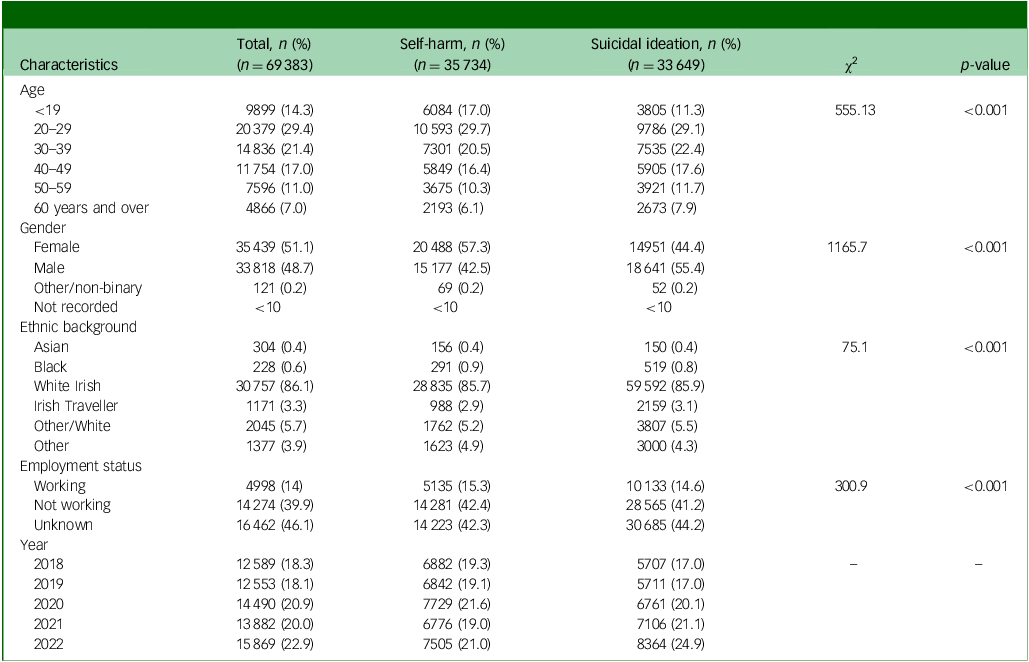
Our data-set comprised 72 810 presentations of all people presenting with self-harm and/or suicidal ideation to 24 emergency departments in Ireland from January 2018 to December 2022. Of these, 3487 presentations did not include the minimum fields required for analysis and were excluded, leaving 69 383 for analysis. The majority of those presentations were of people aged under 60 (n = 64 517), with 4866 (7%) presentations of people aged over 60 years. People aged over 60 years made up 6.1% (n = 2193/35 734) of presentations with self-harm and 7.9% (n = 2673/33 649) of those presenting with suicidal ideation (see Table 1).
Sociodemographic characteristics of people presenting with self-harm compared with those presenting with suicidal ideation

Table 1 Long description
A table comparing sociodemographic characteristics of people presenting with self-harm and suicidal ideation. The table has 6 rows and 10 columns. Column headers are Total, Self-harm, Suicidal ideation, χ2, and P value. Row labels are Age, Gender, Ethnic background, Employment status, and Year. Row 1: Age, Total (n = 69,383), Self-harm (n = 35,734), Suicidal ideation (n = 33,649), χ2, P value. Row 2: <19, 9899 (14.3), 6084 (17.0), 3805 (11.3), 555.13, <0.001. Row 3: 20-29, 20379 (29.4), 10593 (29.7), 9786 (29.1). Row 4: 30-39, 14836 (21.4), 7301 (20.5), 7535 (22.4). Row 5: 40-49, 11754 (17.0), 5849 (16.4), 5905 (17.6). Row 6: 50-59, 7596 (11.0), 3675 (10.3), 3921 (11.7). Row 7: 60 years and over, 4866 (7.0), 2193 (6.1), 2673 (7.9). Row 8: Gender, Total, Self-harm, Suicidal ideation. Row 9: Female, 35439 (51.1), 20488 (57.3), 14951 (44.4). Row 10: Male, 33818 (48.7), 15177 (42.5), 18641 (55.4). Row 11: Other/non-binary, 121 (0.2), 69 (0.2), 52 (0.2). Row 12: Not recorded, <10, <10, <10. Row 13: Ethnic background, Total, Self-harm, Suicidal ideation. Row 14: Asian, 304 (0.4), 156 (0.4), 150 (0.4). Row 15: Black, 228 (0.6), 291 (0.9), 519 (0.8). Row 16: White Irish, 30757 (86.1), 28835 (85.7), 59592 (85.9). Row 17: Irish Traveller, 1711 (3.3), 988 (2.9), 2159 (3.1). Row 18: Other/Whiteee, 2045 (5.7), 1762 (5.2), 3807 (5.5). Row 19: Other, 1377 (3.9), 1623 (4.9), 3000 (4.3). Row 20: Employment status, Total, Self-harm, Suicidal ideation. Row 21: Working, 4998 (14), 5135 (15.3), 10133 (14.6). Row 22: Not working, 14274 (39.9), 14281 (42.4), 28565 (41.2). Row 23: Unknown, 16462 (46.1), 14223 (42.3), 30685 (44.2). Row 24: Year, Total, Self-harm, Suicidal ideation. Row 25: 2018, 12589 (18.3), 6882 (19.3), 5707 (17.0). Row 26: 2019, 12553 (18.1), 6842 (19.1), 5711 (17.0). Row 27: 2020, 14490 (20.9), 7729 (21.6), 6761 (20.1). Row 28: 2021, 13882 (20.0), 6776 (19.0), 7106 (21.1). Row 29: 2022, 15869 (22.9), 7505 (21.0), 8364 (24.9).
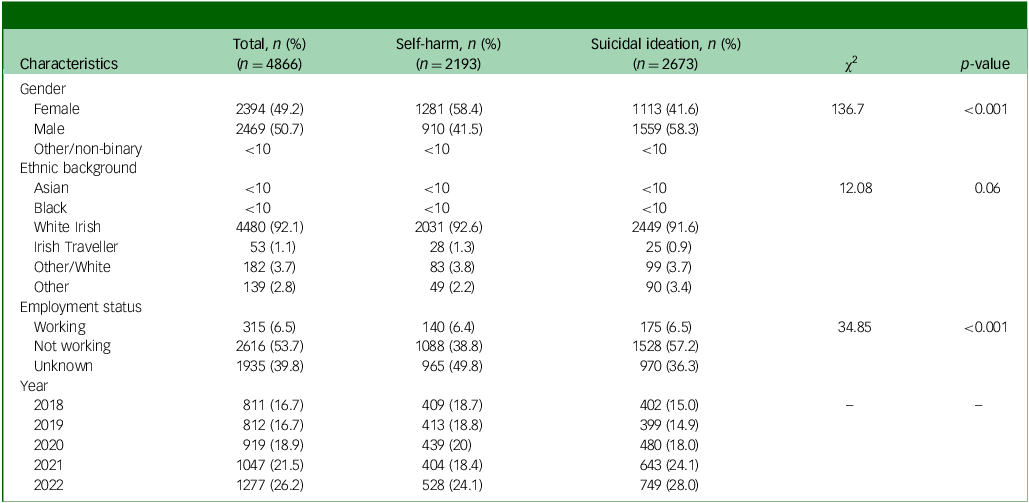
In the group aged over 60 years as a whole, there were similar proportions of men (n = 2469, 50.7%) and women. However, there were higher proportions of older women presenting with self-harm (58.4%) compared with men (41.5%), and higher proportions of men presenting with suicidal ideation (58.3%) compared with women; and these differences were statistically significant (χ2 = 136.7; p < 0.001 see Table 2).
Sociodemographic characteristics of people aged 60 and over presenting with self-harm compared with those presenting with suicidal ideation

Table 2 Long description
A table comparing sociodemographic characteristics of people aged 60 and over with self-harm and suicidal ideation. The table has 4866 total entries, divided into self-harm (2193) and suicidal ideation (2673). It includes columns for gender, ethnic background, employment status, and year. Row 1: Gender, Female, 2394 (49.2), 1281 (58.4), 1113 (41.6). Row 2: Gender, Male, 2469 (50.7), 910 (41.5), 1559 (58.3). Row 3: Gender, Other/non-binary, <10, <10, <10. Row 4: Ethnic background, Asian, <10, <10, <10. Row 5: Ethnic background, Black, <10, <10, <10. Row 6: Ethnic background, White Irish, 4480 (92.1), 2031 (92.6), 2449 (91.6). Row 7: Ethnic background, Irish Traveller, 53 (1.1), 28 (1.3), 25 (0.9). Row 8: Ethnic background, Other/White, 182 (3.7), 83 (3.8), 99 (3.7). Row 9: Ethnic background, Other, 139 (2.8), 49 (2.2), 90 (3.4). Row 10: Employment status, Working, 315 (6.5), 140 (6.4), 175 (6.5). Row 11: Employment status, Not working, 2616 (53.7), 1088 (50.8), 1528 (57.2). Row 12: Employment status, Unknown, 1935 (39.8), 965 (44.8), 970 (36.3). Row 13: Year, 2018, 811 (16.7), 409 (18.7), 402 (15.0). Row 14: Year, 2019, 812 (16.7), 413 (18.8), 399 (14.9). Row 15: Year, 2020, 919 (18.9), 439 (20), 480 (18.0). Row 16: Year, 2021, 1047 (21.5), 404 (18.4), 643 (24.1). Row 17: Year, 2022, 1277 (26.2), 528 (24.1), 749 (28.0).
Consistent with the methodology of the National Clinical Programme for Self-Harm and Suicide-Related Ideation, any field with fewer than ten presentations is presented as <10.
In terms of ethnicity, White Irish people made up the vast majority of presentations in both self-harm and suicidal ideation groups aged over 60 years; 92.6. and 91.6% respectively (p = 0.06). People of Asian or Black ethnicities represented less than 1% of the total presentation (Table 2). Irish Travellers represented 3.1% of presentations across the whole population presenting with self-harm and suicidal ideation, but only 1.1% of the older population.
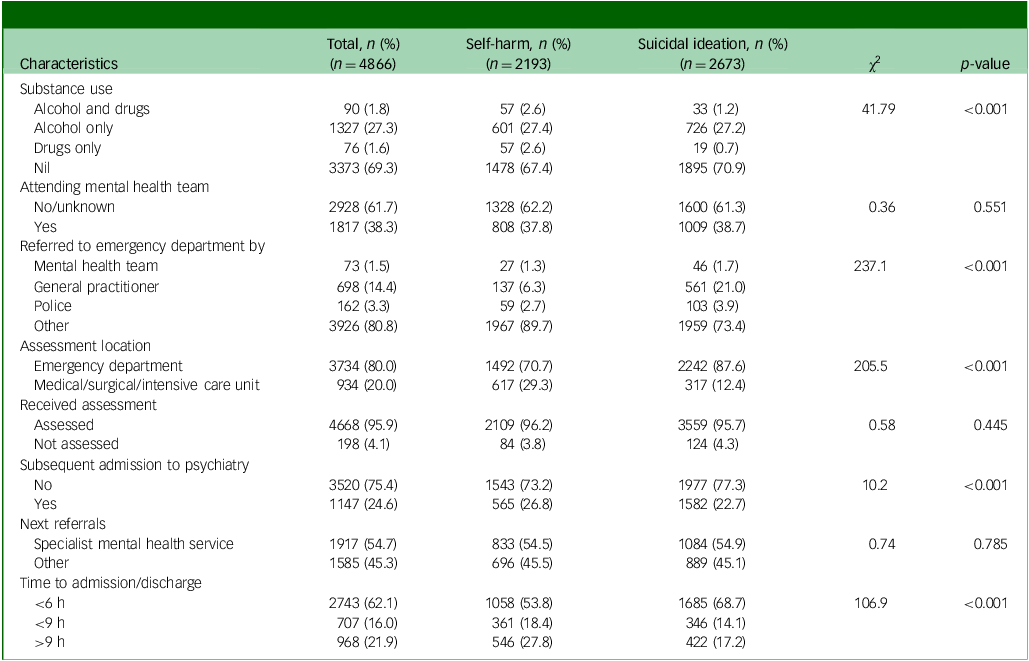
As shown in Table 3, the majority of presentations of people aged > 60 years were assessed in the emergency department (80%). Those people who presented with self-harm were significantly more likely to be assessed on a medical/surgical ward or in an intensive care unit (29.3%, <0.001) than those without self-harm (12.4%, <0.001).
Clinical characteristics of people aged 60 and over presenting with self-harm compared with those presenting with suicidal ideation

Table 3 Long description
A table comparing clinical characteristics of people aged 60 and over presenting with self-harm and suicidal ideation. The table has 11 rows and 6 columns. Column headers are Total (n = 4866), Self-harm (n = 2193), Suicidal ideation (n = 2673), χ2, and P value. Row labels include Substance use, Attending mental health team, Referred to Emergency Department by, Assessment location, Received assessment, Subsequent admission to psychiatry, Next referrals, and Time to admission/discharge. Each row provides specific data points for each category. Notable trends include higher percentages of alcohol use and emergency department assessments among those presenting with self-harm compared to those with suicidal ideation.
While across all ages, the majority of patients were not admitted to a psychiatric ward (n = 53 928, 83.2%), one-quarter (25%) of those aged over 60 were. In the older population, those presenting with self-harm had a higher proportion of admissions than those with suicidal ideation (26.8 v. 22.7%, p < 0.001), and higher than the all-age admission rate in those presenting with self-harm (16.3%).
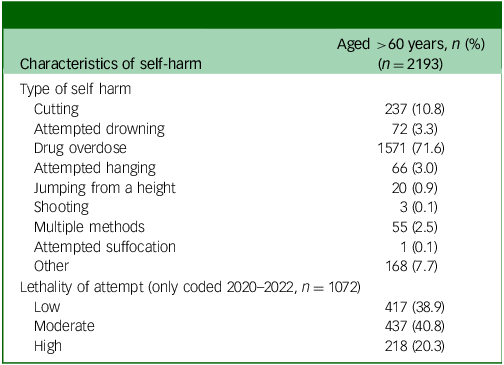
In older people, overdose was the most common method of self-harm, representing 71.6% of all self-harm presentations (n = 1571). Cutting was the second most common, totalling 10.8% of self-harm presentations (n = 237). Of those whose lethality was assessed, one-fifth (20.3%) were deemed to be high lethality (see Table 4).
Characteristics of self-harm in the population aged over 60

Table 4 Long description
A table showing characteristics of self-harm in individuals aged over 60. The table has 11 rows and 3 columns. The columns are labeled Type of self harm, and Lethality of attempt (only coded 2020-2022). The table presents data for individuals aged over 60 years (n=2193). Row 1: Cutting, 237 (10.8 percent). Row 2: Attempted drowning, 72 (3.3 percent). Row 3: Drug overdose, 1571 (71.6 percent). Row 4: Attempted hanging, 66 (3.0 percent). Row 5: Jumping from a height, 20 (0.9 percent). Row 6: Shooting, 3 (0.1 percent). Row 7: Multiple methods, 55 (2.5 percent). Row 8: Attempted suffocation, 1 (0.1 percent). Row 9: Other, 168 (7.7 percent). Row 10: Low lethality, 417 (38.9 percent). Row 11: Moderate lethality, 437 (40.8 percent). Row 12: High lethality, 218 (20.3 percent).
Over one-third of people aged over 60 who presented with self-harm were already attending a mental health service (37.8%), similar to those with suicidal ideation (38.7%); this difference was not statistically significant. It is noteworthy that the majority of presentations with self-harm were not currently attending a mental health service (61.7%). Time to admission or discharge from the emergency department is recorded by the NCPSHI in the following categories: less than 6 h, less than 9 h and more than 9 h (see Table 3). Presentations with self-harm were significantly more likely to wait more than 9 h for admission/discharge (27.8 v. 17.2%, p < 0.001). Those with suicidal ideation were more likely to be admitted or discharged in less than 6 h (68.7 v. 53.8%, p < 0.001).
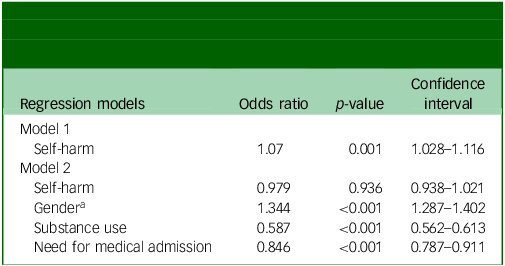
On multivariable analysis, the relationship between self-harm and psychiatric admission was explored (with suicidal ideation as the reference group). On a simple logistic regression model (model 1) there was an odds ratio of 1.07 (95% CI 1.028–1.116) for the relationship between self-harm and subsequent admission in those patients aged 60 years and over. This demonstrated that people presenting with self-harm are 1.07 times more likely to require a psychiatric admission (Table 5). In model 2, which controlled for gender, year of presentation, substance use and need for medical admission, the association was no longer statistically significant with an odds ratio 0.979 (95% CI 0.938–1.021). In this model, male gender, absence of substance use and need for medical admission were all significantly associated with need for psychiatric admission. This suggests that people presenting with self-harm are not more likely to require a psychiatric admission than those presenting with suicidal ideation, after controlling for the other variables.
Logistic regression examining the relationship between self-harm and subsequent psychiatric admission in the population aged over 60 (reference population are those presenting with suicidal ideation)

Table 5 Long description
A table with three columns and six rows, including a header row. The columns are labeled ‘Model’, ‘Odds ratio’, ‘p-value’, and ‘Confidence interval’. The table presents data from two models examining the relationship between self-harm and psychiatric admission in individuals aged over 60. Model 1 shows an odds ratio of 1.07 with a p-value of 0.001 and a confidence interval of 1.028-1.116. Model 2 includes additional variables: gender, substance use, and need for medical admission. The odds ratio for self-harm in Model 2 is 0.979 with a p-value of 0.936 and a confidence interval of 0.938-1.021. Other variables in Model 2 include gender with an odds ratio of 1.344, substance use with an odds ratio of 0.587, and need for medical admission with an odds ratio of 0.846, all having p-values of less than 0.001.
a. For gender, an odds ratio >1 indicates higher odds for males.
Discussion
This study examined the characteristics of people aged over 60 who presented following self-harm and suicidal ideation. It found that self-harm was significantly associated with admission to a psychiatric facility, but not after controlling for gender, substance use and need for medical admission, and these covariates remained significantly associated with subsequent psychiatric admission in this model.
We found that poisoning or overdose is the most common form of self-harm in older people. Troya et al reported a similar pattern in their 2019 systematic review (68.1%), and similarly, lacerations were the second most common method of self-harm. Reference Troya, Babatunde, Polidano, Bartlam, McCloskey and Dikomitis18
The clinical programme has reported overall psychiatric admission rates of 16.8% of the population as a whole undergoing assessment in the emergency department following a presentation with self-harm or suicidal ideation. The admission rates reported in older people are significantly higher for both those presenting with self-harm and suicidal ideation, with the highest rates in older people presenting with self-harm (26.8%). This database does not collect diagnoses, but given that psychiatric admission is a rare outcome reserved for those with more severe mental illness, which is decided only after a detailed mental health assessment and discussion with a consultant psychiatrist, it may be considered a proxy measure for severe mental illness. Reference Walker, Mackay, Barnett, Sheridan Rains, Leverton and Dalton-Locke23,Reference Degli Esposti, Ziauddeen, Bowes, Reeves, Chekroud and Humphreys24 While depression is the illness more commonly associated with suicidal ideations and behaviours, self-harm and suicidal ideations can also be seen in a range of conditions from psychosis to adjustment disorders. Reference Yates, Lång, Cederlöf, Boland, Taylor and Cannon25,Reference Casey, Jabbar, O’Leary and Doherty26 These results suggest that self-harm is not more likely than suicidal ideation to result in psychiatric admission once other variables are controlled for, and that both presentations (self-harm and suicidal ideation) are associated with a need for admission to a similar extent.
Our findings suggest that there are significant differences between older patients who present to the emergency department with self-harm, compared with those presenting with suicidal ideation. Regarding the relationship between self-harm in older people and gender, we found that there were higher proportions of older women presenting with self-harm (58.4%) compared with men (41.5%), and higher proportions of men presenting with suicidal ideation (58.3%) compared with women. This is consistent with the international literature as summarised in the systematic review by Troya et al, which found that among older people, more women than men presented with self-harm. Reference Troya, Babatunde, Polidano, Bartlam, McCloskey and Dikomitis18 This is at variance with the higher suicide rate in older men, and it suggests that while more women engage in self-harm, there may be a higher burden of illness associated with self-harm in older men.
The relatively low proportion of older patients who presented with self-harm or suicidal ideation who were previously known to mental health services is surprising. However, it is consistent with Szücs et al’s finding that an older age of onset of mental illness is associated with suicidal behaviour in older people. Reference Szücs, Perry-Falconi, O’Brien, Keilp, Bridge and Maier27 It suggests that this population may present to hospital in a suicidal crisis, rather than to their GPs at an earlier stage, or perhaps the crisis evolves more rapidly. It is likewise consistent with the findings of the study by Ho et al, which similarly reported that 37.5% of older people had a history of mental illness, in their study of older people who died by suicide in Singapore. Reference Ho, Ho, Tai, Ng and Chia28 They reported that despite the mental illness rate of 37.5%, only 17% had an antidepressant detected on toxicology, which suggests that perhaps adherence to medication was suboptimal. Reference Ho, Ho, Tai, Ng and Chia28 The majority of older people stayed for assessment, and this was higher in those presenting with self-harm, perhaps due to the urgency of medical treatment.
Alternatively, the lower rates of referrals via GPs suggest that access to GPs has become more limited for this population. It raises the question of whether this may have been due in part to COVID restrictions and reduced in-person visits to GPs, so that the emergency department was perceived as the only option. Reference Troya, Corcoran, Arensman and Kavalidou21,Reference Maguire, Kavalidou, Bannan, Doherty and Jeffers29 There is an international move towards the digital provision of care. Reference Schifferdecker, Yang, Mackwood, Rodriguez, Shortell and Akré30,Reference Mackwood, Fisher, Schmidt, Yang, O’Malley and Rodriguez31 It has been identified in the literature that the indiscriminate use of digital solutions may inadvertently exclude older patients. 32
Similarly, medical admission can be seen as a proxy and objective measure for the medical lethality of self-harm. This is consistent with the existing literature which suggests that an older age of onset of symptoms is associated with higher lethality of self-harm. Reference Szücs, Perry-Falconi, O’Brien, Keilp, Bridge and Maier27 If we consider suicidality as a spectrum, it might be seen to extend from suicidal thoughts, through acts with death by suicide as the most severe end of this clinical spectrum. Those patients who require medical admission for self-harm are likely to represent the more severe end of the spectrum than those who can be medically discharged from the emergency department. Reference Mohan, Tembo, McNicholas and Doherty33 Existing research suggests that in addition to having high suicide rates, older people are more likely to die following self-harm. This is thought to be related to the use of lethal means, a greater degree of planning (less impulsivity) and physical frailty Reference Szanto, Gildengers, Mulsant, Brown, Alexopoulos and Reynolds34 (as represented by the need for medical admission as a proxy measure).
Substance use, in this study, was associated with self-harm in older people, and there were similar proportions of people using alcohol among those who presented with self-harm and suicidal ideation. There were significant differences, however, in the use of other substances, with higher proportions of those with self-harm using either drugs and alcohol, or just drugs. Ho et al reported that alcohol was a feature in older people dying by suicide in 23.1% of cases, which is slightly lower than our cohort. Reference Ho, Ho, Tai, Ng and Chia28 That said, the majority of older patients presenting with self-harm and suicidal ideation did not use substances at all, with a higher proportion of those presenting with self-harm using substances, with or without alcohol.
Finally, older people attending the emergency department with suicidal ideation had longer waiting times in the emergency department than those attending with self-harm. This finding is somewhat counterintuitive: we expected that those presenting with self-harm, who likely require medical/surgical input for injuries or poisoning, would be longer in the emergency department, awaiting bloods and a range of clinical opinions. This is important from a service perspective, as the emergency department is a high-stimulus environment which can present challenges for older persons, or indeed anyone experiencing acutely distressing symptoms.
Strengths and limitations
One of the strengths of this study is the utilisation of a national data source of self-harm and suicidal ideation to identify older adults who present with self-harm and suicidal ideation. It includes some clinical information and allows for comparisons to be made between people presenting with self-harm and suicidal ideation across different age profiles. This is the first examination of this data in older people utilising an Irish sample. As an Irish sample, the findings may not be generalisable to other countries.
The retrospective nature of the evaluation limits the study; however, the population studied is a complete clinical sample. It is further limited in that the national data source does not include clinical diagnosis and is presentation-based rather than individual-based, and therefore, repeat presentations of individuals are not captured. This means that the data-set includes individuals with multiple presentations, which may have an impact on the independence assumption of the logistic regression model, and risks bias through incorrect inferences.
Implications
This study raises questions such as the role of psychiatric diagnosis in the consideration of suicidal risk in this population, and further work might examine psychiatric diagnosis in a population presenting with self-harm and suicidal ideation. Furthermore, there is a need for a qualitative assessment to examine the experiences of older people attending emergency departments with suicidal ideation or self-harm: at present, there is limited research in this area. Reference Wand, Peisah, Draper and Brodaty35 This would help to consider the motivations and the themes which underlie self-harm in this vulnerable and high-risk population. This study adds evidence in an Irish context of the importance of acknowledging the high morbidity and risk associated with older people presenting with self-harm and suicidal ideation. Further prospective research in this area could inform future practice.
The results of this study demonstrate the significant differences in characteristics of older people presenting to Irish emergency departments with self-harm compared with suicidal ideation, where previously a paucity of data existed. The association with needs for both mental and physical healthcare identified among older people makes it imperative to identify the characteristics of self-harm in this population. This would help us to understand the factors associated with increased risk and to develop treatments and services to meet their needs. The number of presentations among older people makes it imperative to understand the factors driving these presentations, and to tailor our services to meet the needs of older people presenting to emergency departments for care.
Data availability
The data are not publicly available due to the data-set being primarily the property of the National Clinical Programme for Self-Harm and Suicide-Related Ideation, Health Service Executive, Ireland.
Acknowledgements
The authors acknowledge the work conducted by the National Clinical Programme for Self-Harm and Suicide-Related Ideation in maintaining the database, and the work done by the clinical nurse specialists and other team members around the country who enter the data. No artificial intelligence tools have been used in the research or writing process for this manuscript.
Author contributions
F.H. took a lead on writing the first draft and supported the conceptualisation and formal analysis of the work. A.M.D. served as lead for conceptualisation, formal analysis and visualisation. K.K., V.R., G.M. and M.J.N. contributed equally to investigation and data curation, and contributed equally to writing (review and editing).
Funding
This research received no specific grant from any funding agency, whether commercial or not-for-profit.
Declaration of interest
A.M.D. is a member of the BJPsychOpen editorial board. The author confirms that they did not take part in the review or decision-making process of this paper.
Ethical standards
The authors assert that all procedures contributing to this work comply with the ethical standards of the relevant national and institutional committees on human experimentation and with the Helsinki Declaration of 1975, as revised in 2013. All procedures involving human subjects/patients were approved by the Clinical Research Ethics Committee of University College Dublin – reference number LS-LR-22-167.
Consent statement
As the data were fully anonymised and collected as part of routine care, individual-level consent is not required, and the Ethics Committee approved this.

 Open access


eLetters
No eLetters have been published for this article.