

Introduction
In a 2016 telephone survey, a representative sample of Americans were asked to list their biggest financial regrets (Bell, Reference Bell2016). The most frequently mentioned financial regret was “not saving for retirement early enough.” In another survey, close to half of Dutch participants indicated that they felt they should devote more time and effort to their own retirement preparation; 40% had never taken time to think about their post-retirement income and expenditures; 59% had not looked at their online pension overview; and 63% had not looked at the annual pension statement that they received in the mail (Wijzer in Geldzaken, 2016). In addition to the low uptake of information, people tend to stick with default retirement savings rates and strategies, regardless of whether these fit their needs (e.g., Madrian & Shea, Reference Madrian and Shea2001; Carroll et al., Reference Carroll, Choi, Laibson, Madrian and Metrick2009). People who actively plan and prepare for retirement by gathering information on how much they have saved already, by estimating how much money they need after retirement and by adjusting their saving strategy accordingly are more likely to end up with adequate savings than those who do not actively plan and prepare (Ameriks et al., Reference Ameriks, Caplin and Leahy2003; Lusardi & Mitchell, Reference Lusardi and Mitchell2007). This makes inertia in retirement preparation one of the great challenges for behavioral scientists and policy-makers. How can it be that so many people knowingly postpone retirement preparation only to later regret it?
One possible answer to this question is that people fail to take timely action because they do not care enough about retirement saving at the time that they should start preparing. Only later on, when they find out that they have not saved enough, do they start to care and – as a consequence – experience regret over previous inaction. Put differently: people do not find retirement saving important enough at the time when they ideally should take action. If this is true, then policies aimed at increasing or emphasizing the importance of retirement saving could be expected to get people to start saving earlier. Indeed, many countries increase or emphasize the importance of retirement saving by providing long-term financial incentives, such as tax advantages and employer matching policies (Antolín et al., Reference Antolín, De Serres and De la Maisonneuve2004; Attanasio et al., Reference Attanasio, Banks and Wakefield2004; Engelhardt & Kumar, Reference Engelhardt and Kumar2007). In addition, the last decade has seen an increasing number of attempts to explicitly educate and inform eligible consumers about the important benefits of financial incentives to save for retirement (Choi et al., Reference Choi, Laibson and Madrian2011). A common assumption behind these polices appears to be that people postpone retirement preparation because they do not appreciate or understand its long-term importance; emphasizing the importance of retirement preparation, therefore, should spur people to action. However, studies on retirement saving do not support this assumption.
Two recent strands of research suggest that the presumed link between increased importance and increased action in retirement preparation is not very strong. First, there is evidence that many people who already care and worry about retirement saving remain passive nonetheless (Choi et al., Reference Choi, Laibson, Madrian, Metrick and Poterba2002; Nibud, 2015). In the USA, an annual poll identified “not having enough money for retirement” as participants’ number one financial worry for every single year since polling on the issue started 17 years ago (Gallup, 2016, 2017a, 2017b). When a sample of 1537 Dutch persons (51% female, M age = 42.83, SD = 13.95, range = 18–66) were asked to what extent they agreed with the statement “having enough retirement savings is important for me,” 78% answered “I agree to some extent,” “I agree” or “I fully agree” (Krijnen et al., Reference Krijnen, Zeelenberg and Breugelmans2016). These attitudes toward retirement saving as being one of the most important financial matters stand in stark contrast with the widespread failure to adequately prepare for retirement (Kim & Hanna, Reference Kim and Hanna2013; Munnell, Reference Munnell2015).
Second, research finds that policies aimed at increasing the importance of retirement saving (such as subsidies and employer matching) have little to no effect on how much people save. Financial incentives had almost no effect on savings rates in Denmark (Chetty et al., Reference Chetty, Friedman, Leth-Peterson, Nielsen and Olsen2014). Employer matching failed to raise 401(k) contributions in the USA, even when additional information about these benefits was provided (Choi et al., Reference Choi, Laibson and Madrian2011). When some companies opted to completely remove the contribution match from their retirement plan with automatic enrollment, they saw average contribution rates go down by only 0.65% of pay – a decline much less spectacular than one might have expected given the financial consequences of employer matching (Beshears et al., Reference Beshears, Choi, Laibson, Madrian and Wise2010).
To summarize, the common explanation for inertia in retirement preparation in terms of people not appreciating its importance fails, both in terms of the assumption (most people do already appreciate its importance) and in terms of the consequences (changes in actual importance do not lead to matching changes in behavior). Furthermore, a practice of simply emphasizing the importance of retirement saving may even backfire by causing decision deferral rather than spurring people to action (Krijnen et al., Reference Krijnen, Zeelenberg and Breugelmans2015). This raises the question: What does promote timely retirement preparation if importance does not?
Distinguishing intention and action
To answer this question, we think it is necessary to distinguish between people's intentions and actions in retirement preparation. More specifically, we propose that people's perceptions of the importance of retirement saving do predict their intentions to prepare, but that there is no direct effect of importance on actions. Instead, on the basis of existing literature on intentions and behavior, we propose that another factor does predict both intentions and actions, namely the perceived difficulty of retirement preparation. Thus, we expect that difficulty, instead of importance, will be the primary factor in predicting whether people act on their intention to prepare for retirement. Let us explain below the sources that guided our thinking on this issue.
The Theory of Planned Behavior is one of the most frequently used theories outlining how intention relates to action (Ajzen, Reference Ajzen1991). The Theory of Planned Behavior proposes that attitudes and subjective norms predict intention. People plan to do things that they evaluate as favorable, positive, beneficial or important and that other people expect them to do. But people do not always act on their intentions. To account for this intention–action gap, the Theory of Planned Behavior includes perceived behavioral control, which refers to “people's perception of the ease or difficulty of performing the behavior of interest” (Ajzen, Reference Ajzen1991, p. 183). According to the theory, perceived behavioral control directly predicts both intention and action, whereas perceived importance affects action only indirectly, through intentions. Put differently, what people end up doing is a function of both what they plan to do and what they think they can do. The role of perceived behavioral control in the Theory of Planned Behavior resonates with ideas in Action Identification Theory and Construal Level Theory.
Action Identification Theory (Vallacher & Wegner, Reference Vallacher and Wegner1987) states that when people are considering or performing an action, they use either higher-level identifications (i.e., why am I doing this?) or lower-level identifications (i.e., how am I doing this?). Stressing higher-level identification, such as through an emphasis on importance, promotes stability and persistence in the execution of familiar, automated actions. However, a focus on lower-level identification is crucial for persistence in the execution of unfamiliar, difficult actions. Thus, for a task as complex as retirement preparation, understanding how to perform it may be more predictive of successful execution than understanding why to perform it.
Construal Level Theory incorporates much of Action Identification Theory and extends it to choices over time (Liberman & Trope, Reference Liberman and Trope1998; Trope & Liberman, Reference Trope and Liberman2003). It distinguishes between higher-level construal, with a focus on an action's desirability (i.e., why should I do this?), and lower-level construal, with a focus on an action's feasibility (i.e., how should I do this?). The theory also proposes that desirability considerations are relevant to planning for the distant future, whereas feasibility considerations are more relevant to immediate action (Liberman et al., Reference Liberman, Trope, McCrea and Sherman2007; McCrea et al., Reference McCrea, Liberman, Trope and Sherman2008). Whether people actually take action depends mostly on the action's feasibility, not on its desirability.
To summarize, the Theory of Planned Behavior, Action Identification Theory and Construal Level Theory suggest that importance should be directly related to the intention to prepare for retirement, but not to the action of actually preparing. By the same reasoning, difficulty – referring to the sense of incapability or insecurity in understanding and dealing with retirement matters, similar to perceived behavioral control in the Theory of Planned Behavior – should be related to both intention and action. Such expectations are in line with the literature on procrastination: the delay of an intended course of action (Steel, Reference Steel2007).
Procrastination is the result of people's tendency to put greater weight on considerations in the present than on considerations in the future. People procrastinate actions that seem desirable in the long run but require immediate investments in the form of effort, time or money (Strotz, Reference Strotz1955; Ainslie, Reference Ainslie1975; Akerlof, Reference Akerlof1991; O'Donoghue & Rabin, Reference O'Donoghue and Rabin1999; Fischer, Reference Fischer1999). Based on the link between procrastination and present-biased preferences, O'Donoghue and Rabin (Reference O'Donoghue and Rabin2001) proposed an insightful model. When people form intentions, they consider all available information: both temporally distant considerations (i.e., importance) and temporally proximate considerations (i.e., difficulty). However, when people contemplate whether to take immediate action, they consider only temporally proximate considerations. This means that, for our understanding of retirement preparation, it is pivotal to distinguish between the temporally distant factor of perceived importance and the temporally proximate factor of perceived difficulty, as well as between intentions and actions.
Perhaps surprisingly, the reasoning that importance and difficulty play different roles in predicting intention and action in retirement preparation has not been directly studied before. In this article, we report on a series of surveys in which we relate considerations of the importance and difficulty of retirement preparation to the completion of concrete steps that people can take to prepare for retirement, such as storing their pension administration in a structural way and identifying the different sources of income that they will have after retirement. By distinguishing between people's intention to prepare and their reported preparations, we will be able to examine the relative weight that is given to considerations of importance and difficulty at each stage.
Study 1
A survey was administered by the Dutch National Institute for Family Finance Information (‘Nibud’). The goal of the survey was to assess the preparedness for retirement and attitudes toward retirement saving among a representative sample of Dutch participants. It was designed by a team of Nibud researchers (one of whom is the fourth author) and administered online by Survey Sampling International.Footnote 1
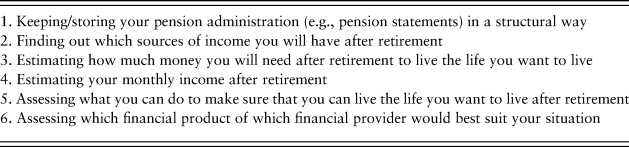
The survey included a set of questions assessing participants’ intentions and actions regarding six key retirement preparations (e.g., estimating monthly income after retirement and assessing which financial product of which financial provider would best suit the situation; see Table 1 for a complete list). This setup enabled us to identify people who had the intention to prepare for retirement as well as people who acted on their intentions using latent class analysis (LCA). The idea underlying LCA is that the subgroup to which a participant belongs is a latent, unobserved variable that can be deduced from the relationship between a set of observed indicators (McCutcheon, Reference McCutcheon1987). In this case, we suspected that intentions and actions regarding the six retirement preparations would be indicators of underlying latent classes; presumably, some people have no intention to prepare for retirement, some people have the intention to prepare but fail to follow through on this and some people have the intention and put that intention into action. Our goal with LCA was to identify subgroups of participants based on their intentions and actions in preparation for retirement. Once identified, this latent class variable would be regressed on the relevant predictors that we added to the survey after consultation with Nibud researchers: we asked participants about the perceived importance of retirement saving and the perceived difficulty of retirement preparation.
Six key retirement preparations as determined by the Dutch National Institute for Family Finance Information (Nibud), used in Studies 1 and 2

Method
The sample of 1171 participants who completed the survey were representative of the Dutch population between 25 and 64 years old in terms of age (M = 44.82; SD = 11.03), gender (49% female) and region of residency. Data collection took place between 30 June 2015 and 10 July 2015.
Participants were presented with six key retirement preparations, determined by Nibud experts on personal finance (see Table 1). For each preparation, participants indicated whether they (1) completed it without help, (2) completed it with help, (3) did not complete it but intended to do so in the future or (4) did not complete it and did not intend to do so in the future.
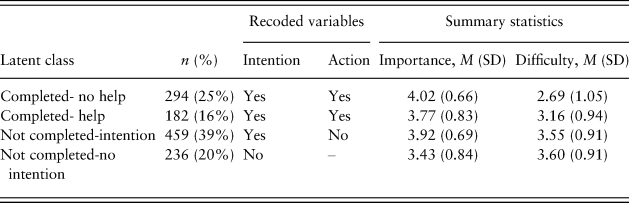
To classify participants, we performed a latent class analysis using the poLCA package in R (Linzer & Lewis, Reference Linzer and Lewis2011). We included categorical responses to the six retirement preparations. Because each response was a variable with four answer categories, we ran the LCA using a four-class solution. Based on the pattern of class-conditional probabilities, we assigned labels to the four classes along the lines of the four answer categories: (1) completed-no help, (2) completed-help, (3) not completed-intention, and (4) not completed-no intention. See online Supplementary Material for a plot of the class-conditional probabilities. The LCA was then used to predict class membership for each participant. See Table 2 for the distribution of participants across the four predicted classes.
Distribution of participants over the four predicted classes, recoding from predicted class to variables intention and action and summary statistics of importance and difficulty per predicted class in Study 1

To distinguish between intention and action, predicted class was transformed into two binary variables: intention (i.e., is the participant classified as having the intention to prepare for retirement? 0 = no; 1 = yes) and action (i.e., is the participant classified as putting their planned retirement preparation into action? 0 = no; 1 = yes). Participants whose predicted class was completed-no help, completed-help or not completed-intention received a value of 1 on the variable intention. Participants whose predicted class was not completed-no intention received a value of 0 on this variable. Participants whose predicted class was completed-no help or completed-help received a value of 1 on the variable action.Footnote 2 Participants whose predicted class was not completed-intention received a value of 0 on this variable. Participants whose predicted class was not completed-no intention received no value on the variable action. See Table 2 for recoding from predicted class to variables intention and action.
Importance of retirement saving was measured by the statement “I find it important to have sufficient retirement savings later in life” (1 = completely disagree; 5 = completely agree; M = 3.82; SD = 0.76). Difficulty of retirement preparation was measured by the statement “I find it difficult to understand retirement saving” (1 = completely disagree; 5 = completely agree; M = 3.28; SD = 1.02). See Table 2 for summary statistics of importance and difficulty per predicted class.
Participants indicated their household income, gender and age and answered three questions about basic financial concepts (i.e., inflation, compounding interest and risk diversification), which were combined into a single financial literacy score ranging from 0 to 3 (Lusardi & Mitchell, Reference Lusardi and Mitchell2011). See online Supplementary Materials for more details on the questions asked in the survey and for the variables used in the analyses.
Results and discussion
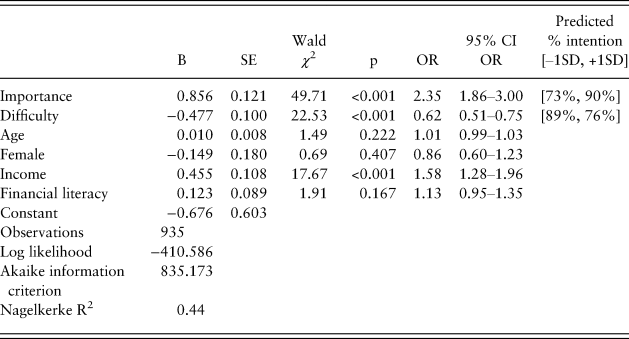
Table 3 shows the results of a binary logistic regression analysis with importance and difficulty as predictors, age, gender, income and financial literacy score as covariates and intention as the dependent variable. Higher scores on importance were associated with a higher likelihood of intention, and higher scores on difficulty were associated with a lower likelihood of intention. The effect of importance on intention was significantly larger than the effect of difficulty on intention, χ 2(1, 928) = 8.04, p = 0.005.
Binary logistic regression analysis with intention as the dependent variable (Study 1). Last column shows predicted percentage of people having intention to prepare for retirement for 1 SD below and above the mean of importance and difficulty, respectively, while holding all other variables constant at their mean. CI = confidence interval; OR = odds ratio

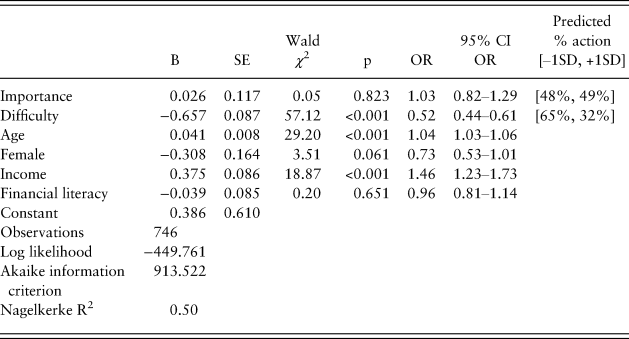
Table 4 shows the results of a second binary logistic regression analysis with the same predictors and covariates, but this time with action as the dependent variable.Footnote 3 Importance did not predict the likelihood of action. Higher scores on difficulty were associated with a lower likelihood of action. The effect of difficulty on action was significantly larger than the effect of importance on action, χ 2(1, 739) = 21.24, p < 0.001.
Binary logistic regression analysis with action as the dependent variable (Study 1). Last column shows predicted percentage of people taking action to prepare for retirement for 1 SD below and above the mean of importance and difficulty, respectively, while holding all other variables constant at their mean. CI = confidence interval; OR = odds ratio

These findings thus support the reasoning put forward in the introduction. The intention to prepare for retirement is predicted by how important people find retirement saving, but whether people act is predicted better by how difficult people find retirement preparation.
Study 2
Method
Study 2 was a near-direct replication of Study 1 with a different subject pool and administered as part of a different large-scale survey. This time, 1021 participants completed a survey administered online by market research company Motivaction International on behalf of Aegon (a multinational life insurance, pensions and asset management company located in The Netherlands).Footnote 4 In the analyses reported below, we included 832 participants between the ages of 18 and 64 (M age = 46.17; SD = 13.16; 49% female).Footnote 5 Data were collected between 3 October 2016 and 7 October 2016.
The questions of interest were identical to Study 1, except for some minor changes. First, for each of the six preparations – which were the same preparations as in Study 1 – participants indicated whether they (1) completed it (with or without help), (2) did not complete it but intended to do so in the future or (3) did not complete it and did not intend to do so in the future. This is different from Study 1 in that there were no separate response options for completion with help and completion without help. Second, participants responded to statements about the importance of retirement saving (M = 5.34; SD = 1.35) and the difficulty of retirement saving (M = 4.74; SD = 1.66) on a seven-point Likert scale (1 = completely disagree; 7 = completely agree) instead of on a five-point Likert scale as was used in Study 1. See Table 5 for summary statistics of importance and difficulty per predicted class. Third, this survey did not include a measure of financial literacy. Age, gender, education level and household income were included as covariates. See online Supplementary Materials for more details on the questions asked in the survey and for the variables used in the analyses.
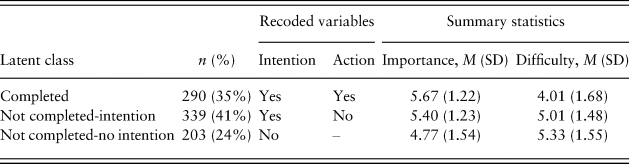
Distribution of participants over the four predicted classes, recoding from predicted class to variables intention and action and summary statistics of importance and difficulty per predicted class in Study 2

Similar to the procedure used for the LCA in Study 1, we included categorical responses to the six retirement preparations. Because this time each response was a variable with three answer categories, we ran the LCA using a three-class solution. Based on the pattern of class-conditional probabilities, we assigned labels to the three classes along the lines of the three answer categories: (1) completed, (2) not completed-intention and (3) not completed-no intention. See online Supplementary Material for a plot of the class-conditional probabilities. The LCA was then used to predict class membership for each participant. See Table 5 for the distribution of participants over the three predicted classes.
Predicted class was transformed into two binary variables: intention (0 = no, 1 = yes) and action (0 = no, 1 = yes). The variable intention was 1 for participants whose predicted class was completed or not completed-intention. The value was 0 for participants whose predicted class was not completed-no intention. The variable action was 1 for participants whose predicted class was completed. The value was 0 for participants whose predicted class was not completed-intention. Participants whose predicted class was not completed-no intention got no value on the variable action. See Table 5 for recoding from predicted class to variables intention and action and for summary statistics of importance and difficulty per predicted class.
Results and discussion
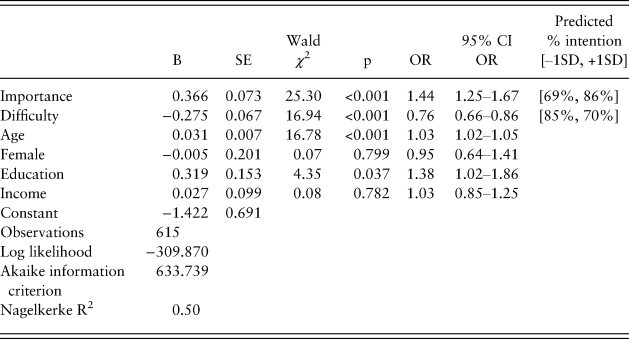
See Table 6 for the results of a binary logistic regression analysis with importance and difficulty as predictors, age, gender, education and income as covariates and intention as the dependent variable. Higher scores on importance were associated with a higher likelihood of intention and higher scores on difficulty were associated with a lower likelihood of intention. The effect of importance on intention was not significantly different from the effect of difficulty on intention, χ 2(1, 608) = 0.93, p = 0.335.
Binary logistic regression analysis with intention as the dependent variable (Study 2). Last column shows predicted percentage of people having intention to prepare for retirement for 1 SD below and above the mean of importance and difficulty, respectively, while holding all other variables constant at their mean. CI = confidence interval; OR = odds ratio

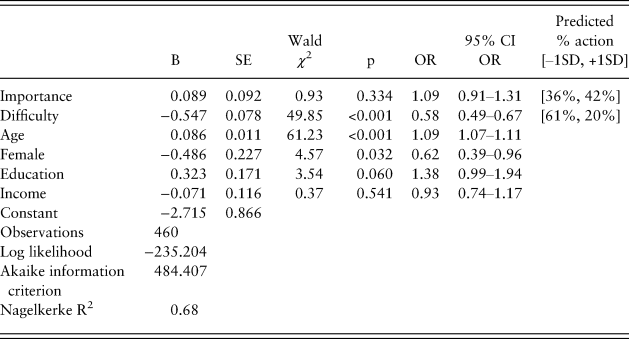
Table 7 shows the results of a similar binary logistic regression analysis, now with action as the dependent variable.Footnote 6 Importance did not predict the likelihood of action. Higher scores on difficulty were associated with a lower likelihood of action. The effect of difficulty on action was significantly larger than the effect of importance on action, χ 2(1, 453) = 15.52, p < 0.001.
Binary logistic regression analysis with action as the dependent variable (Study 2). Last column shows predicted percentage of people taking action to prepare for retirement for 1 SD below and above the mean of importance and difficulty, respectively, while holding all other variables constant at their mean. CI = confidence interval; OR = odds ratio

Study 2 thus replicates the findings of Study 1. The results from Studies 1 and 2 supported our hypotheses regarding intention and action in retirement preparation. In both studies, the intention to prepare for retirement was positively associated with perceived importance of retirement saving and negatively associated with perceived difficulty of retirement preparation, whereas the likelihood of completing retirement preparation was only negatively associated with perceived difficulty and not significantly associated with perceived importance. Together, these findings help us to understand why people so often fail to follow up on their intentions to prepare for retirement. The weight that people put on two basic considerations – importance and difficulty – differs between when people form intentions and when they decide to complete their actions.
Robustness checks: propensity to procrastinate
Because both Studies 1 and 2 rely on almost identical (and certainly imperfect) operationalizations of the constructs under investigation, we performed a series of robustness checks using a different operationalization of the dependent variable: a single-item measure of the propensity to procrastinate. See Tables 8–10 for the results of these checks and online Supplementary Materials for a complete description of the methods.
Ordinal logistic regression analysis with propensity to procrastinate as the dependent variable. CI = confidence interval; OR = odds ratio

Ordinal logistic regression analysis with propensity to procrastinate as the dependent variable. CI = confidence interval; OR = odds ratio

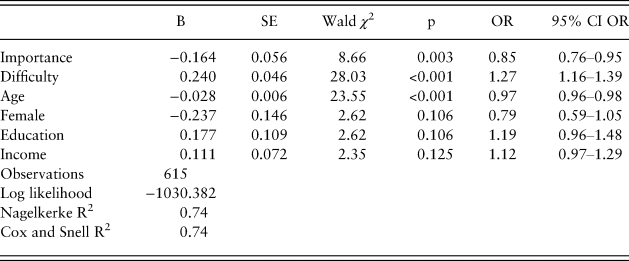
Ordinal logistic regression analysis with propensity to procrastinate as the dependent variable. CI = confidence interval; OR = odds ratio

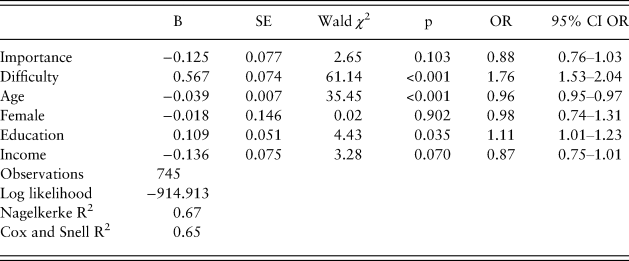
The results in Tables 8 and 9 rely on data from the same surveys that were used in Studies 1 and 2, respectively. This time, we regressed responses to a single-item measure of propensity to procrastinate retirement saving decisions (i.e., “If I would have to arrange my retirement saving individually, I would unnecessarily postpone making decisions”) on importance and difficulty of retirement preparation, while including age, gender, income and financial literacy as covariates.
The results in Table 10 rely on an additional survey administered in 2013 by market research company GfK on behalf of Wijzer in Geldzaken (Money Wise) – the financial literacy platform of the Dutch Ministry of Finance (n = 986, 45% female, M age = 44.39, SD = 11.44, range = 21–66).Footnote 7 To assess propensity to procrastinate in preparation for retirement, we used reverse-coded responses to the statement “I frequently take time to learn about my retirement situation” (all questions were answered on five-point Likert scales with 1 = completely agree and 5 = completely disagree). Importance of retirement income was measured with the statement “After retirement, I want to be able to spend as much money as I do right now.” Difficulty of retirement preparation was measured with the statement “I find it difficult to understand retirement information.” We performed an ordinal logistic regression analysis examining the relationship between importance and difficulty as predictors, age, gender, education and income as covariates and propensity to procrastinate as the dependent variable.
For each regression, we performed a linear test of the hypothesis that the absolute effects of importance and difficulty on propensity to procrastinate are equal. For the regression shown in Table 8, the absolute size of the effect of difficulty was significantly larger than the absolute size of the effect of importance, χ 2(1, 925) = 37.60, p < 0.001. For the regression shown in Table 9, the absolute size of the effect of difficulty was larger than the absolute size of the effect of importance, but this difference was not significant, χ 2(1, 603) = 1.09, p = 0.297. For the regression shown in Table 10, the absolute size of the effect of difficulty was significantly larger than the absolute size of the effect of importance, χ 2(1, 734) = 18.89, p < 0.001.
Taken together, the pattern of results that emerges from these robustness checks is consistent with the pattern of results in Studies 1 and 2: considerations of difficulty are more influential in driving procrastination than considerations of importance. Naturally, we recognize that the items used in these surveys are indirect and imperfect measures of the key constructs. For one, because we use single-item measures of propensity to procrastinate, we cannot disentangle intentions to act from completed actions as we could in Studies 1 and 2. However, we believe that this characteristic actually makes these analyses conservative tests of the hypothesis; we expect people, on average, to underestimate the actual discrepancy between their intentions and their actions.
Because of their limitations, we should be cautious about drawing conclusions from any of these tests in isolation. However, as a series of robustness checks supplementing and supporting the general pattern of results observed in Studies 1 and 2, these tests bolster the confidence we have in our key conjecture: whereas the perceived importance of retirement saving may be predictive of intentions to prepare for retirement, the perception of difficulty is the key factor determining whether people take action or remain inert.
General discussion
Sometimes, well-intentioned policies and interventions do not deliver the desired result because the premises underlying the interventions turn out to be false. We believe that this might be the case for many contemporary policies and interventions aimed at motivating people to prepare for retirement, because these are built on the idea that increasing the perceived importance of retirement saving should lead to increased actual preparations. As the data presented in this article suggest, higher perceived importance may indeed be associated with people's intentions to prepare for retirement, but it is perceived difficulty that drives whether such intentions are put into practice.
We conducted two survey studies to examine the roles of importance and difficulty in intention and action separately. The results clearly showed that perceptions of importance do play a role in people's retirement preparation. People who perceived retirement saving as important were more likely to form the intention to take preparatory action than people who perceived retirement saving as unimportant. However, the relative weight of importance and difficulty changed markedly when the focus of analysis shifted from intentions to actions. By performing three additional tests using different measures of the key variables, we were able to confirm the robustness of this finding. Even though the findings from these surveys may be limited in the sense that they are correlational in nature, relying on self-reported intentions and behaviors, we believe that the finding of converging evidence across various datasets collected by different organizations and spanning a combined sample of 2989 participants does lend some credibility as to the stability of these findings.
Finding that people's actions in preparing for retirement are more strongly predicted by perceived difficulty than by importance raises the question of why this is the case. We suspect that part of the explanation lies in the temporal dynamics of retirement saving. The costs, in terms of invested effort, time and money, usually precede the projected benefits, in terms of an adequate retirement income, by various decades. People perceive retirement saving as important to the extent that they value the distant-future benefits; however, people perceive retirement saving as difficult to the extent that they anticipate greater upfront investment. The current findings thus fit with the model of procrastination outlined by O'Donoghue and Rabin (Reference O'Donoghue and Rabin2001). When forming intentions, people take into account both the upfront investment and the distant-future benefits; when considering whether to act on intentions, people primarily focus on the upfront investments. As such, these findings help us to understand why many people insufficiently prepare for retirement, even when they understand, appreciate and agree with the benefits of taking action (Choi et al., Reference Choi, Laibson, Madrian, Metrick and Poterba2002; Nibud, 2015; Krijnen et al., Reference Krijnen, Zeelenberg and Breugelmans2016) and when they worry about the consequences of inaction (Gallup, 2017a).
The distinction between those factors predicting intentions and those predicting actions may also account for the observation that certain policies are more successful than others in bringing about retirement preparations and increasing downstream savings. In many countries, saving for retirement is indirectly subsidized, such as through the provision of favorable tax treatment of contributions or payments, through the provision of a government match or through enrollment bonuses (OECD, 2017). Between 2007 and 2017, New Zealand introduced its KiwiSaver program with a ‘kickstart’ government match and enrollment bonus (OECD, 2009, 2015). In Poland, a special lower tax rate was introduced to a voluntary pension plan (OECD, 2015). To the extent that these changes are intended to motivate voluntary contributions, the current research and other recent studies may justify some pessimism regarding their effectiveness. Interventions that increase or emphasize the importance of retirement saving, including generous tax advantages and contribution matching, can be expected to yield modest success, if any at all, in promoting adequate retirement preparation (Choi et al., Reference Choi, Laibson and Madrian2011; Chetty et al., Reference Chetty, Friedman, Leth-Peterson, Nielsen and Olsen2014).
Why do governments, financial institutions and employers invest considerable resources in policies that are relatively ineffective? One possibility is that policy-makers are insufficiently aware of the gap between people's intentions and actions. In a recent study, executives of Australian retirement plans were interviewed about why they thought that many of their plan members were passive and stayed with the default option (Butt et al., Reference Butt, Donald, Foster, Thorp and Warren2018). Many of the executives thought that passive members were best characterized as uninterested and disengaged. When passive plan members were interviewed, many instead indicated that they either felt insufficiently skilled to switch or that they trusted the plan provider enough to stay with the default. These findings, which closely match those of our studies, may illustrate a tragic misunderstanding of the reasons for inertia – one that leads to overly pessimistic views by retirement experts and policy-makers on the motivation and interest in proper retirement planning by the general population, as well as to policies and interventions that yield modest results at best. At the same time, acknowledging the role of both importance and difficulty may lead to a more optimistic view and more effective policies.
Based on the current findings, we suggest that a policy strategy of emphasizing importance – for instance, through the provision of favorable tax treatment – can become more effective when complemented by policies that reduce the effort that is required to save for retirement, such as automatic enrollment, automatic escalation of contribution and reducing the number of plans offered. In many countries, initial steps have been taken toward the simplification and streamlining of retirement saving. For instance, automatic enrollment has been introduced in recent years in Turkey, New Zealand, Italy and the UK and is now encouraged through regulation in Canada and the USA (OECD, 2017). Initial evidence suggests that these kinds of simplifying policies are effective at changing people's behavior and boosting downstream retirement savings (Madrian & Shea, Reference Madrian and Shea2001; Thaler & Benartzi, Reference Thaler and Benartzi2004; Keim & Mitchell, Reference Keim and Mitchell2018), especially when compared to the effectiveness of more traditional policies (Benartzi et al., Reference Benartzi, Beshears, Milkman, Sunstein, Thaler, Shankar and Galing2017). In light of this, it is particularly troubling that, for many people, access to a retirement plan is still either very complex and time-consuming or completely absent (Benartzi & Thaler, Reference Benartzi and Thaler2013). Making retirement saving plans available to all and easily accessible to those who want to enroll are two basic requirements of effective retirement policy.
Attempts to streamline the process of retirement preparation may be effective, but they should not divert attention away from the fact that difficulty is in the eye of the beholder. The effect of objective financial literacy on prudent financial behaviors – such as setting aside an emergency fund or figuring out how much to save for retirement – greatly diminishes when one accounts for the much stronger effect of confidence in one's financial marketplace decisions and behaviors (Fernandes et al., Reference Fernandes, Lynch and Netemeyer2014). In fact, attempts to increase the objective financial knowledge of consumers may inadvertently lead to a diminished sense of subjective financial knowledge, thereby causing people to shy away from wise financial investments (Hadar et al., Reference Hadar, Sood and Fox2013). Both researchers and policy-makers should thus be on the lookout for ways to boost consumer confidence and subjective financial knowledge.
Given the current findings, there are other policy tools that may carry great promise in helping people save for retirement. First, putting in place ‘planning prompts’ – timely reminders that nudge people to come up with simple plans (Gollwitzer, Reference Gollwitzer1999; Rogers et al., Reference Rogers, Milkman, John and Norton2015) – may help people turn their intentions into actions. Second, research shows that directing attention toward the immediate benefits of a seemingly unattractive action may increase persistence in goal pursuit (Woolley & Fishbach, Reference Woolley and Fishbach2016, Reference Woolley and Fishbach2017). In the context of retirement policy, prompting people to consider the peace of mind or contentment that comes with taking care of one's retirement preparations may help them pursue their long-term financial goals. Third, policies focused on the long-term importance of retirement saving may be more effective when paired with interventions that increase the vividness of the distant future (Hershfield et al., Reference Hershfield, John and Reiff2018). Again, the key insight is that policy-makers should be mindful of the psychological weight that people put on distant-future considerations relative to immediate considerations.
The retirement system of The Netherlands, where all participants of the current studies are residents, is relatively paternalistic. For a majority of Dutch employees, enrollment in an employer-sponsored retirement savings plan is mandatory, savings rates are fixed and withdrawal before retirement is not allowed. We have no reasons to suspect that the present findings, providing insight into the psychological mechanisms underlying intentions and actions in retirement preparation, would be markedly different in other countries. However, one could argue that under the circumstances specific to The Netherlands, retirement saving inertia will have a relatively small effect on accumulated retirement wealth. The psychological mechanisms discussed in this article are expected to have much greater negative downstream effects – post-retirement poverty, for instance – when saving for retirement is optional for a majority of residents. We therefore agree with the argument put forward by Loewenstein and Chater (Reference Loewenstein and Chater2017) that a focus on non-paternalistic or soft-paternalistic policies should not go at the cost of neglecting options for behaviorally informed hard paternalism. Mandated retirement saving may simply be the most effective way to help people overcome inertia. The latest report on pension systems in OECD countries (OECD, 2017) seems to indirectly support this point: the two countries with highest replacement rates for the average worker – 96.9% in The Netherlands and 86.4% in Denmark – are both characterized by a quasi-mandatory private component. Whether such policies are desirable or feasible is a matter of politics and falls outside the scope of the current article. We simply wish to argue that, from a perspective of efficiency, paternalist policies might often be a good option.
To summarize, the importance of retirement saving predicts intentions but not actions in retirement preparation. Therefore, well-intentioned policies aimed at increasing the awareness and perceived importance of retirement preparation may have little effect on behavior and savings. The difficulty of retirement preparation is a crucial factor in predicting actions, which explains why interventions aimed at simplifying retirement preparation appear to be more successful.
Supplementary Material
To view supplementary material for this article, please visit https://doi.org/10.1017/bpp.2018.39.
Acknowledgments
We thank Niels van de Ven and Jürgen Warnecke for their help in obtaining the data for Study 2.
Financial support
This research was supported by a NETSPAR Small Vision Grant.