INTRODUCTION
Sphyrnids sharks have become an important group in conservation researches and recreational and commercial fishing (Brill et al., Reference Brill, Bushnell, Schroff, Seifert and Galvin2008; Mandelman & Skomal, Reference Mandelman and Skomal2008). Sharks have been often captured as by-catch in commercial fisheries not always being considered as primary target, but still suffering high harvest rates and showing declining populations (Mandelman et al., Reference Mandelman, Cooper, Werner and Lagueux2008; Frick et al., Reference Frick, Reina and Walker2009; Walsh et al., Reference Walsh, Bigelow and Sender2009). This pattern of population decline has received urgent attention over the past decade, since studies have indicated rapid and widespread declines as a consequence of direct and indirect effects of fishing activities (Dulvy et al., Reference Dulvy, Baum, Clarke, Compagno, Cortés, Domingo, Fordham, Fowler, Francis, Gibson, Martínez, Musick, Soldo, Stevens and Valenti2008; Ferretti et al., Reference Ferretti, Worm, Britten, Heithaus and Lotze2010).
In this context, marine biologists and governmental managers have debated the existence of patterns of decline for different species, the apparent community changes, and whether sharks play unique and fundamental roles in such patterns or not (Myers et al., Reference Myers, Baum, Shepherd, Powers and Peterson2007; Heithaus et al., Reference Heithaus, Frid, Wirsing and Worm2008). Additionally, this debate highlights that Fish Monitoring Programmes carried out by governmental agencies can be an inefficient approach to elucidate trends and occurrences as these programmes ignore the heterogeneity in species' responses to fishing by aggregating catch data for all species (see Halls et al., Reference Halls, Welcomme and Burn2006; Lorenzen et al., Reference Lorenzen, Almeida, Arthur, Garaway and Khoa2006).
The bonnethead shark Sphyrna tiburo (Linnaeus, 1758) is one of the smallest species of hammerhead shark with a maximum total length of 1.5 m (Cervigon et al., Reference Cervigon, Cipriani, Fischer, Garibaldi, Hendrickx, Lemus, Márquez, Poutiers, Robaina and Rodriguez1992; Compagno, Reference Compagno, Fowler, Cavanagh, Camhi, Burgess, Cailliet, Fordham, Simpfendorfer and Musick2005; Compagno et al., Reference Compagno, Dando and Fowler2005). Among Sphyrna genera, S. tiburo differs from other species by having the pre-branchial head shovel shaped with a broadly rounded anterior margin and electrosensory pores distributed across the width of the head on dorsal and ventral surfaces; other differences include pore density and the width of head when compared to trunk (Kajiura, Reference Kajiura2001; Compagno, Reference Compagno, Fowler, Cavanagh, Camhi, Burgess, Cailliet, Fordham, Simpfendorfer and Musick2005). It has a wide-ranging geographical distribution across the Atlantic Ocean, inhabiting especially coastal areas of the continental shelf in tropical and warm temperate zones (Compagno et al., Reference Compagno, Dando and Fowler2005). In the south-western Atlantic the species is present on the Brazilian coast, its distribution ranging from the north coast of Amapá State to southern Brazil, where its limit is still not determined, being possibly Santa Catarina State (Godoy, Reference Godoy1987; Compagno et al., Reference Compagno, Dando and Fowler2005)—well known as the southernmost limit of most tropical fish species in the Atlantic Ocean (Barneche et al., Reference Barneche, Anderson, Floeter, Silveira and Carvalho-Filho2009). Despite this apparent occurrence, S. tiburo is considered to be extinct or extremely rare on the south-western Brazilian coast (Bornatowski et al., Reference Bornatowski, Abilhoa and Charvet-Almeida2009).
According to the IUCN Red List of Threatened Species (IUC, 2013), S. tiburo is globally classified as ‘least concern’ due to its high population growth rates when compared to other sharks, making this species less susceptible to extinction (Cortés, Reference Cortés2008). In northern Brazil, S. tiburo represented about 10% of the total elasmobranch catches in the 1980s (Lessa, Reference Lessa1986) being frequently captured as by-catch in gill nets, bottom trawl and block nets (Frédou & Asano-Filho, Reference Frédou and Asano-Filho2006). In the early 2000s, in south-east Brazil, S. tiburo was considered to be regionally extinct, vulnerable or collapsed (Gadig et al., Reference Gadig, Motta, Namora and Duarte2002; Motta et al., Reference Motta, Gadig, Namora and Braga2005; Motta, Reference Motta2006; Bressan et al., Reference Bressan, Kierulff and Sugieda2009).
Thus we report the rediscovery of the bonnethead shark S. tiburo on the Brazilian eastern coast, more specifically in Todos os Santos Bay (TSB) (Bahia State). These records are one of the results of a Long Term Fish Monitoring Programme carried out in the area since April 2012. In Todos os Santos Bay, the Governmental Fish Monitoring Programmes do not identify specimens caught at the species level. The aggregation of data without making such distinction may obscure trends in the abundance and occurrence of certain species, as total catch rate often tends to remain constant despite variation in short-time and short-scale in the relative abundance of these species (Van Oostenbrugge et al., Reference van Oostenbrugge, Bakker, van Densen, Machiels and van Zwieten2002).
MATERIALS AND METHODS
All individuals (N = 8) of Sphyrna tiburo were caught, at 10–30 m depth, by gill nets and artisanal long line of the local fishing fleet between August and December 2012 and in March 2013. For the area where the individuals were caught there are semi-diurnal tides, with spring tides ranging between 1.8 and 2.9 m and neap tide of 0.6–1.5 m. For the Todos os Santos Bay, the salinity values between 30 and 35 are found for the entire year and for the River Paraguaçu estuary, salinity values between 5 and 32 are found due to the saline gradient from river flow. The regional scale (west of Todos os Santos Bay) also presents preserved mangrove forests besides a marine–estuarine habitat mosaic linking different depth zones with specific bottom type and benthic cover. Hence the region presents a high aquatic complexity habitat (for more information see Reis-Filho et al., Reference Reis-Filho, Nunes and Ferreira2010; Reis-Filho & Santos, Reference Reis-Filho and Santos2014). Three specimens were deposited in the Museum of Zoology at the Federal University of Bahia (MZUFBA 7152, 7153, 7681) while the five specimens remaining were used to obtain information such as size, biomass, sex and stomach contents, and had muscles and vertebrae removed for future molecular and age growth analyses.
RESULTS
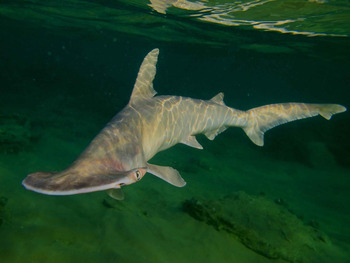
In the present paper, we report the capture of eight individuals of S. tiburo (Figure 1), recently found in the Paraguaçu–TSB estuarine complex (Bahia State, Brazil) as a result of a Long Term Fish Monitoring Programme. This monitoring programme has well defined rules, parameters and methodology regarding the identification of species as well as an experienced team responsible for gathering and analysing catch data of fishing (both commercial artisanal and subsistence fishing).
Sphyrna tiburo a few minutes after being captured by artisanal fisheries in the Todos os Santos Bay (Bahia State, Brazil): female of 54.5 cm total length and weighting 245.5 g.

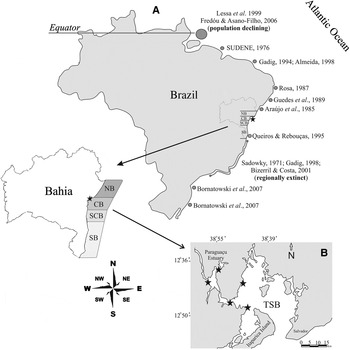
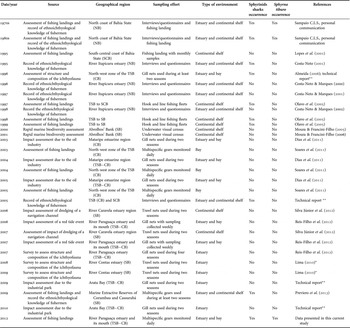
According to several studies carried out on the coast of Bahia State, principally those developed in estuarine and marine environments, S. tiburo has not been recorded for the last two decades (Table 1). The lack of records may be related to the complete absence of the species in the area, to the difficulty of identifying the species or the deficiency of collecting data systematically in the past. For other Brazilian coastal regions S. tiburo had its last record over a decade ago (see Figure 2). Additionally, when we analyse the bulletins produced by the National Fisheries Departments (IBAMA and MPA), which are the agencies responsible for collecting national statistics on effort, and fish catches, there is a lack of records for S. tiburo in the last decade (IBAMA, 2002–2012). All species of sharks and rays recorded by the National Fish Monitoring Programme are only listed by common name, which may change regionally, and therefore these data are not reliable for either scientific purposes or for improving the national database on these groups.
Locations along the Brazilian coast where the bonnethead shark Sphyrna tiburo was last time recorded according to official information: (A) published reports represented by grey circles; (B) current reports made during the present study represented by black stars. NB, north coast of Bahia; CB, central coast of Bahia; SCB, south-central coast of Bahia; SB, south coast of Bahia; TSB, Todos os Santos Bay.

Records from 1970s to 2012 of sphyrinds sharks and Sphyrna tiburo at Bahia State (Brazilian eastern coast). Some characteristics relative to the studies, such as geographical region (NB, north coast of Bahia; CB , central coast of Bahia; SCB, south-central coast of Bahia; SB, south coast of Bahia), sampling effort and types of environment are also presented. *, thesis and/or dissertation; **, technical reports.

Among the five specimens, two were females (35.5 and 54.5 cm, 193 g and 245.5 g, respectively) and three were males (44.5, 52 and 56.5 cm, 210, 240 and 275.5 g of total length and weight, respectively). All individuals had umbilical scar, indicative of neonate stage. The stomachs analysed were partially filled, consisting mainly of shrimps belonging to the Farfapenaeus genus, presenting also stomatopod telsons, species of Callinectes crabs and digested organic matter.
DISCUSSION
Abundant in the 1970s and 1980s in most landings of the artisanal fleet on the northern coast of Bahia, and also known as the second most often captured species among small coastal sharks (Rhizoprionodon porosus (Poey, 1861) was the most common), S. tiburo have virtually disappeared from the coast of Bahia, Sergipe, Alagoas, and Paraíba States in recent decades (Sampaio C.L.S., personal communication). Although at present it is not a targeted species on the Brazilian coast, mainly due to its rarity, S. tiburo is ocassionally caught as by-catch in fisheries (SUDEPE, 1980; Lessa & Almeida, Reference Lessa and Almeida1998; Menezes et al., Reference Menezes, Buckup, Figueiredo and Moura2003). Menezes et al. (Reference Menezes, Buckup, Figueiredo and Moura2003) have reported the rare and incidental presence of S. tiburo in the landings of the shrimp fishing fleet in Sergipe, with only 2 records over 5 years of monitoring. The lack of records between 1997 and 2012 confirms how extremely rare this species is on the Brazilian coast, including in Todos os Santos Bay. The apparent absence on the Brazilian coast highlights the relevance of this recent record for the species in TSB waters.
Stomach contents found here (basically crabs, shrimps and mantis shrimps) have also been documented as common prey items for S. tiburo in coastal areas in South Florida (Cortés et al., Reference Cortés, Manieri and Hueter1996) and Maranhão on the northern Brazilian coast (Lessa & Almeida, Reference Lessa and Almeida1998). The partially digested content as well as the abundance of these prey items in the region suggest that individuals captured were foraging in the area which may in turn suggest a resident, new population slowly reoccupying a former feeding ground.
The umbilical scars found in each of the sampled individuals were indicative of neonate stages and therefore point out the ecological function of the TSB habitats as nursery area for this remaining or re-colonizing population of S. tiburo, as suggested for others small sharks R. porosus and R. lalandei (Amado-Gama, Reference Amado-Gama1991). Nursery areas can be defined as habitats where females give birth to their young and where juveniles spend their early life (Castro, Reference Castro1993). According to the hypothesis of Branstetter (Reference Branstetter1990), the Paraguaçu estuary may be considered as either primary nurseries (habitats where parturition occurs and in which the young live for a short time) or secondary nurseries (habitats in which juveniles are found after leaving the primary nursery and before reaching maturity); further studies on the population dynamics of S. tiburo and other species are necessary in this specific area in order to confirm or deny this hypothesis.
The environmental conditions in the TSB can vary dramatically due to anthropogenic effects (overview in Hatje & Andrade, Reference Hatje and Andrande2009) as more than one million people are locally employed in fishing, agriculture and industrial activities (Reis-Filho et al., Reference Reis-Filho, da Silva, Nunes and Barros2012). In the region where S. tiburo was recorded (Paraguaçu estuary), changes in water flow due to a dam located upstream result in variable salinity conditions within the bay, which are not part of the natural dynamics of this area, and may affect the conservation status of this and other coastal species (Ubeda et al., Reference Ubeda, Simpfendorfer and Heupel2009; Reis-Filho et al., Reference Reis-Filho, da Silva, Nunes and Barros2012). Moreover, for an efficient fisheries management along the Brazilian coast, a reliable programme including multiple surveys on the resources, fleets and fishing efforts is necessary. Data collection on both industrial and artisanal fisheries might represent inestimable information about the marine biodiversity, especially regarding rare and/or threatened sharks species. This record also demonstrates that the nursery areas of bonnethead shark, S. tiburo, still remain inadequately documented, and suggest that future studies regarding the natural history of the species and the geographical area of its distribution and reproduction are necessary.
ACKNOWLEDGEMENTS
We thank Yuri Costa, Bruno Lima de Menezes, Linalice Specht and Igor Andrade for their help, ICHTUS, BMA and EPP for logistic support. J.A.R-F and J.A.C.C.N acknowledge financial support by CAPES, Coordenação de Aperfeiçoamento de Pessoal de Nível Superior. Biological material was collected with permit from the Instituto Chico Mendes de Biodiversidade e Conservação (ICMBIO).