Introduction
Twins are two babies produced from the same pregnancy. There are two types: dizygotic (DZ) and monozygotic (MZ) twins, with very different aetiology (Bulmer, Reference Bulmer1970; Hall, Reference Hall2003). Dizygotic twins are fraternal twins, which occur when two separate oocytes are released during the same menstrual cycle and fertilized by two sperm. They can be same sex (boy–boy or girl–girl) or opposite sex (boy–girl) twin pairs. On the other hand, MZ twins arise when an embryo splits soon after fertilization. Monozygotic twins are always of the same sex (boy–boy or girl–girl) (Bomsel-Helmreich & Al Mufti, Reference Bomsel-Helmreich and Al Mufti1995). As MZ twins are thought to occur at a relatively constant rate of 3.5–4 per 1000 births across human populations, differences in twinning rates among countries and over time are mostly due to variation in DZ twinning (Bulmer, Reference Bulmer1970, Hall, Reference Hall2003; Astolfi et al., Reference Astolfi, Ullizi and Zonta2003).
The incidence of twin births is lower than that of singletons, but not rare. Available information indicates high regional variations in twinning rates, which can be categorized as low (fewer than 9 twins/1000 live births) in East Asia and Oceania, intermediate (9–16 twins/1000 live births) in the USA and Europe and high (17 and above twins/1000 live births) in African countries (Bulmer, Reference Bulmer1970; Hoekstra et al., Reference Hoekstra, Zhao, Lambalk, Willemsen and Martin2008; Smits & Monden, Reference Smits and Monden2011). Based on hospital data, the highest twinning rates in the world have been recorded to be as high as 45 twins per 1000 live births in some parts of Nigeria (Nylander, Reference Nylander1969; Akinboro et al., Reference Akinboro, Azeez and Bakare2008). Recently, using data from 150 Demographic and Health Surveys conducted between 1987 and 2010 in 75 low- and middle-income countries in Asia, Africa and Latin America, Smits and Monden (Reference Smits and Monden2011) observed that central Africa had the highest twin birth rates, with Benin having the highest rate of 27.7 twins per 1000 live births, while Nigeria was found to have a twining rate of 19.0 twins per 1000 live births. The study also revealed that twinning rates in Latin America were as low as those in Asia.
Over the last few decades, the rate of twin pregnancy has increased considerably in developed countries (Imaizumi, Reference Imaizumi2003; Pison & D’Addato, Reference Pison and d’Addato2006; Pison et al., Reference Pison, Monden and Smits2015). For instance, it increased from 9.5 twin births per 1000 live births in 1975 to 16.9 in 2011 in the USA (Martin et al., Reference Martin, Hamilton and Osterman2012). Over the same period, it has roughly doubled in many other developed countries: from 9.9 twin births per 1000 live births to 16.1 in England and Wales, from 9.2 to 17.2 in Germany, from 9.3 to 17.4 in France, from 9.6 to 21.2 in Denmark and 5.0 to 14.6 in South Korea (Pison et al., Reference Pison, Monden and Smits2015). However, the changes in low- and middle-income countries have been small and not in same direction – some countries showed an increase, some showed a decrease and others remained stable (Smits & Monden, Reference Smits and Monden2011).
The increase in twin births across the world has been attributed to several factors. Major factors include increasing maternal age, rise in contraceptive use, increased use of medically assisted reproduction (MAR) or fertility treatment (Fauser et al., Reference Fauser, Devroey and Macklon2005; Hoekstra et al., Reference Hoekstra, Zhao, Lambalk, Willemsen and Martin2008; Pison et al., Reference Pison, Monden and Smits2015). Other important factors include genetic inheritance, family history of twinning, maternal body composition and diet (Patel & Hall, Reference Patel and Hall2004; Mutihir & Pam, Reference Mutihir and Pam2007; Hoekstra et al., Reference Hoekstra, Zhao, Lambalk, Willemsen and Martin2008).
The rise in twin rates is seen as an important public health issue, because twin pregnancies are associated with increased complications and adverse outcomes and twin babies are more fragile than singletons (Kiely & Kiely, Reference Kiely and Kiely2001; Dera et al., Reference Dera, Breborowiczg and Keith2007). Twin births are usually premature and of low birth weight, which leads to an increased risk of infant mortality and morbidity (Larroque et al., Reference Larroque, Bréart, Kaminski, Dehan, André, Burguet and Grandjean2004; Delobel-Ayoub et al., Reference Delobel-Ayoub, Arnaud, White-Koning, Casper, Pierrat and Garel2009; Johnson & Schoeni, Reference Johnson and Schoeni2011). Previous studies have documented a higher rate of pregnancy wastage (stillbirth and miscarriage) among twin pregnancies and higher childhood mortality rates among twin births than among singletons (Rutstein, Reference Rutstein1983; Guo & Grummer-Strawn, Reference Guo and Grummer-Strawn1993; Monden & Smits, Reference Monden and Smits2017). Although twin births constitute only a small percentage (less than 1–4%) of total births, they account for a disproportionately large percentage of infant mortality in both developed and less-developed countries. For example, Kleinman et al. (Reference Kleinman, Fowler and Kessel1991) observed that twins accounted for 2% of live births, but 10% of infant mortality in the US in 1960 and 1983. Using data from 29 developing countries, Rutstein (Reference Rutstein1983) observed more than four times higher infant mortality among twin and multiple births than singleton births. Twin pregnancies also produce reproductive health problems for mothers, such as gestational diabetes, pre-eclampsia, postpartum haemorrhage and postpartum depression (Choi et al., Reference Choi, Bishai and Minkovitz2009; Rauh-Hain et al., Reference Rauh-Hain, Rana, Tamez, Wang, Cohen and Cohen2009; Jena et al., Reference Jena, Goldman and Joyce2011).
Twin pregnancies in low- and middle-income countries pose higher risks for mothers and their offspring due to poor maternal and child health care services (Obiechina et al., Reference Obiechina, Okolie, Eleje, Okechukwu and Anemeje2011; Su et al., Reference Su, Zhu, Wei, Wang, Feng and Lin2015; Monden & Smits, Reference Monden and Smits2017). As twin births can contribute significantly to maternal and perinatal morbidity and mortality, it is important to investigate the magnitude of the maternal and perinatal mortality and morbidity associated with twinning in developing countries. In most developed countries, the magnitude of the risk associated with twin births and their health and survival are well documented due to the availability of a good data collection system and well-established birth registration systems (Hartikainen-Sorri et al., Reference Hartikainen-Sorri, Rantakallio and Sipila1990; Kleinman et al., Reference Kleinman, Fowler and Kessel1991; Guo & Grummer-Strawn, Reference Guo and Grummer-Strawn1993). However, research on twin births across developing countries is still limited due to a lack of proper or adequate data collection and registration systems (Vogel et al., Reference Vogel, Torloni, Seuc, Betra’n, Widmer, Souza and Merialdi2013). Despite the numerous studies on child mortality in less-developed countries conducted over the last few decades, little is known about twin survival in these countries, because twin births have essentially been ignored in these studies of child mortality due to lack of data or data limitations. In this respect, the large national-level household survey data that are available through the Demographic and Health Survey (DHS) programme in most developing countries since the mid-1980s can be utilized to update our knowledge about twin births in developing countries, including Jordan – an Arab kingdom in western Asia in the cradle of old civilization. In Jordan, studies on the incidence of twin births are very limited. Based on hospital data Ziadeh (Reference Ziadeh2000) observed a twining rate of 11.6 twins per 1000 live births in the country, while using DHS data, Smits and Monden (Reference Smits and Monden2011) reported it to be 14.4 twin births per 1000 live births in 2002. The rate seems to be increasing.
Like in most other Arab countries, consanguinity is a deeply rooted social and cultural trend in Jordan. Previous studies have shown a high prevalence (ranging from 56% to 35%) of consanguineous marriages in Jordan over the last few decades (Islam, Reference Islam2018). Although consanguinity does not increase the allele frequency of common disorders, it increases the probability of mating between two heterozygous individuals for the same mutant allele. The increased frequency of some recessive disorders in the Arab world has been largely attributed to the practice of consanguineous marriage (Al Gazali et al., Reference Al-Gazali, Hamamy and Al-Arrayad2006; Hamamy et al., Reference Hamamy, Antonarakis, Cavalli-Sforza, Temtamy, Romeo and Ten Kate2011). In view of the multifactorial aetiology of twinning, it is important to examine whether consanguinity is a risk factor for twinning in the country. Thus the objectives of this study were to examine level of, trends in and risk factors for twin births in Jordan and determine whether twins are associated with a higher risk of mortality under age five years of age.
Methods
Data and survey design
Data for the study were extracted from the 2012 Jordan Population and Family Health Survey (JPFHS). The JPFHS is part of the worldwide Demographic and Health Survey (DHS) programme run with the technical assistance of ICF International through the Measure DHS programme. The DHSs provide the largest global sources of statistically sound and internationally comparable data on socioeconomic, demographic and maternal and child health. The 2012 JPFHS was designed to produce reliable estimates of major survey indicators such as fertility, mortality, maternal and child health and nutrition for the country as a whole, and for urban and rural areas, three major regions (Central, North and South) and for two special domains: the Badia areas and people living in refugee camps. The Badia area is the area where mostly Bedouin (nomadic) tribes are living. The survey was implemented by the Department of Statistics (DoS), Jordan, and funded by the Jordanian government and the US Agency for International Development (USAID), UNFPA and UNICEF.
The 2012 JPFHS sample was selected from the 2004 Jordan Population and Housing Census sampling frame following a two-stage stratified cluster sampling design. Stratification was achieved by first separating each governorate into urban and rural areas and then, within each urban and rural area, by Badia areas, refugee camps and others (Department of Statistics & ICF International, 2013). In the first stage, 806 clusters were selected with probability proportional to the cluster size. A household listing operation was then carried out in all of the selected clusters, and the resulting list of households served as the sampling frame for the selection of households in the second stage. Ultimately, the survey covered a nationally representative sample of 11,352 ever-married women aged 15–49 years from 15,190 households. The fieldwork was carried out between 9 September and 20 December 2012.
The study was based on information from 9859 children born within five years prior to the survey. In the 2012 JPFHS all women interviewed in the survey were asked to provide a detailed history of all their live births in chronological order, including whether a birth was single or multiple, sex of the child, date of birth, survival status, age of the child on the date of interview if alive, and if not alive, age at death of each live birth along with socioeconomic and demographic characteristics of the mothers. This birth history data were used to identify twin and singleton live births, obstetric outcomes and to calculate the child mortality rate. Twins were counted as two live births and the twin birth rate was calculated among the total live births. Stillbirths, resulting from either twin pregnancy or singleton pregnancy, were excluded. This meant that if one of the outcomes of a twin pregnancy was a stillbirth and another one a live birth, only the live birth was counted. The study considered live births as the unit of analysis rather than individual women respondents, because the aim was to estimate twinning rate, not the twin set. Besides, many women had more than one birth within the observation period of five years. Triplets were excluded from the study.
Variables
‘Live birth’ was considered a binary outcome variable, categorizing as twin or singleton, and maternal, child and socio-demographic factors were considered as explanatory variables. Maternal factors included mother’s age at birth of child, parity, mother’s education, mother’s employment, contraceptive use status and consanguinity status. Child factors included the child’s sex, physical size at birth (small, average or large), weight at birth (in grams) and mode of delivery. Socio-demographic factors included household wealth quintile, Badia or non-Badia community, living in camps or not, rural/urban residence and region of residence. The wealth quintile was a composite indicator of the economic status of the family, which is used by the DHS surveys globally (Rutstein and Johnson, Reference Rutstein and Johnson2004). The wealth quintile was generated using principal components analysis of household asset variables such as possession of TV, refrigerator, car, household construction materials. Infant’s size at birth was obtained in the survey by asking mothers: When [NAME] was born, was he/she: very large, larger than average, average, smaller than average, or very small? These five categories were reduced to two categories: namely, ‘small size’, consisting of smaller than average and very small; and ‘average or larger size’, comprising average, larger than average and very large. Several studies have shown that there is good consistency between reported physical size at birth and weight at birth of infants on an aggregate level and concluded that ‘small size’ at birth can be used as a proxy indicator of low birth weight (LBW) (i.e. birth weight <2500g) in the absence of birth weight data (Boerma et al., Reference Boerma, Weinstein, Rutstein and Sommerfelt1996; Mbuagbaw & Gofin, Reference Mbuagbaw and Gofin2010; Channon, Reference Channon2011; Islam, Reference Islam2014). The 2012 JPFHS also collected information of weight of babies at birth. Infants with birth weights of less than 2500 g were defined as ‘low birth weight’. Small size, low birth weight and Caesarian section delivery were considered as adverse pregnancy outcomes. The survey also collected information about the survival status of each live birth on the date of interview and if dead, age at death of each live birth.
Statistical analysis
First the incidence rate of twin births was estimated using information on all live births that occurred within five years prior to the survey date. In this study, the rate of twin births was defined as the number of twin live births per 1000 live births. Then the differentials of twin birth across the maternal, child, socioeconomic and demographic factors were analysed using the bivariate (or cross-tabulation) technique to identify statistically significant relations between twinning and the selected factors. The statistical significance was tested using a χ 2 test as both the dependent and explanatory variables were categorical. A p-value <0.05 was considered statistically significant. Multiple logistic regression analysis was done to identify the adjusted significant risk factors of twin births and to estimate the adjusted impact of twinning on neonatal, post-neonatal, infant and under-five mortality. Adjustment was done by controlling the effect of the factors that were found to have significant association with twinning risk in the bivariate analysis. Similarly, the adjusted impact of twinning on childhood mortality was estimated by controlling the effects of potential confounders of childhood mortality, including socio-demographic characteristics, birth weight and birth size. The adjusted effects were measured using odds ratios. Neonatal deaths were defined as those occurring within 28 days of birth among live births, post-neonatal deaths as those occurring between 28 days and one year of life, infant deaths as those occurring within one year of birth and under-five deaths as those occurring within 59 months of age. Neonatal, post-neonatal, infant and under-five mortality rates of twin births and singleton births were estimated by dividing the cumulative number of deaths in each age interval by the number of live births at the beginning of that interval. The logistic regression analysis was done by taking care of the clustering effect of twin births and more than one birth from same mother. A multilevel logistic regression model was used to overcome the clustering effects (Goldstein, Reference Goldstein1995). To analyse trends in twin birth rates, point estimates from different JPFHS were calculated. All statistical analyses were conducted using IBM SPSS Statistics for Windows Version 21 and statistical software R. As the 2012 JPFHS was conducted with the technical assistance of the US-based organization Measure DHS, who hold the database for all the DHSs, permission to access datasets was granted by Measure DHS in March 2015.
Results
Characteristics of twin births
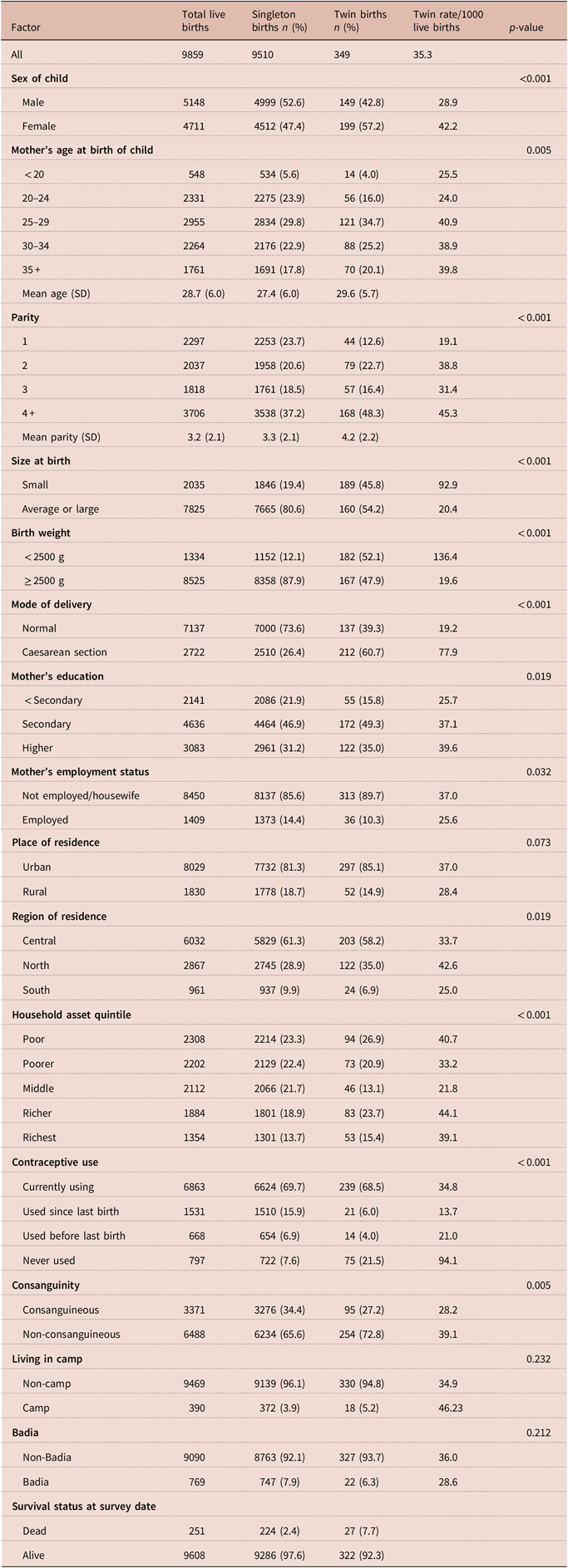
The birth history data of the 2012 JPFHS provided information on 9859 live births (excluding 6 triplets) experienced by 11,352 women within 5 years of the survey date, i.e. between 2007 and 2012. Of the total live births, 9510 (96.5%) were singletons and 349 (3.5%) were twins. Table 1 presents the characteristics of twin births in comparison with singletons as well as twin birth rates across a set of explanatory variables. The data indicate that twins had some distinct characteristics from those of singletons. Twins were more likely to be girls than boys. The proportion of girls was significantly higher (1.2 times) than that of boys among the twins compared with among singletons. The sex ratio at birth was 75 boys per 100 girls among twins, while for singletons the ratio was 110 boys per 100 girls. As expected, twins were more likely to be associated with low birth weights (LBW) or small physical size than singletons. For example, more than half (52%) of the twin births were LBW compared with 12% among the singletons. Caesarian section as the mode of delivery was found to be more common among twins (61%) than among singletons (26%). Twins were more likely to occur at a higher age of mothers and at higher order of births than the singletons. The mean age of mothers was 29.6 years among twins as opposed to 27.4 years among singletons. Average parity was 4.2 and 3.3 among twins and singletons, respectively. Twin births were more likely to occur to mothers with higher education than were singletons. The distributions of twins and singletons were found to have similar pattern across the urban/rural place of residence, region of residence, mother’s contraceptive use status, living in camp/non-camp and Badia/non-Badia region. However, the pattern was different for household assets quintile. Although the proportion of singletons decreased with an increase in household asset quintile indices, the proportion of twins was observed to be higher among the poor and richer groups of mothers.
Percentage distribution of twin and singleton births, and twin birth rates by maternal, child and socioeconomic characteristics, Jordan 2012

Levels and differentials of the twin birth rate
According to the 2012 JPFHS birth history data, the twin birth rate was around 35 births per 1000 live births in Jordan (Table 1). Mother’s age showed a significant positive association with twinning rate. The rate was found to increase monotonically up to age 30–34 years and then slightly decreased. Twin birth rates increased with the mother’s parity and education. For example, the twin birth rate increased from 19/1000 live births among mothers with parity one to 45/1000 live births among mothers with parity four or more. The twin birth rate was 40/1000 live births among mothers with higher education compared with 26/1000 live births among mothers with less than secondary education. Among the three major regions, the North region had the highest rate of twin births (43/1000 live births) and the South region the lowest (25/1000 live births). Twining rate showed no orderly variations across household asset quintiles indices. Economically poor and richer groups of mothers had higher rates of twin births than the middle group. The twinning rate was found to be higher among mothers with no employment, those living in urban areas and/or the North region, those living in camps or the non-Badia region, those who had never used contraceptive methods, and those with a non-consanguineous marriage (Table 1). The results of the bivariate analysis, presented in Table 1, revealed that all the selected socioeconomic and demographic factors, except urban/rural place of residence, living in camps or Badia area, were significantly associated with the twinning rate.
Trends in the twin birth rate
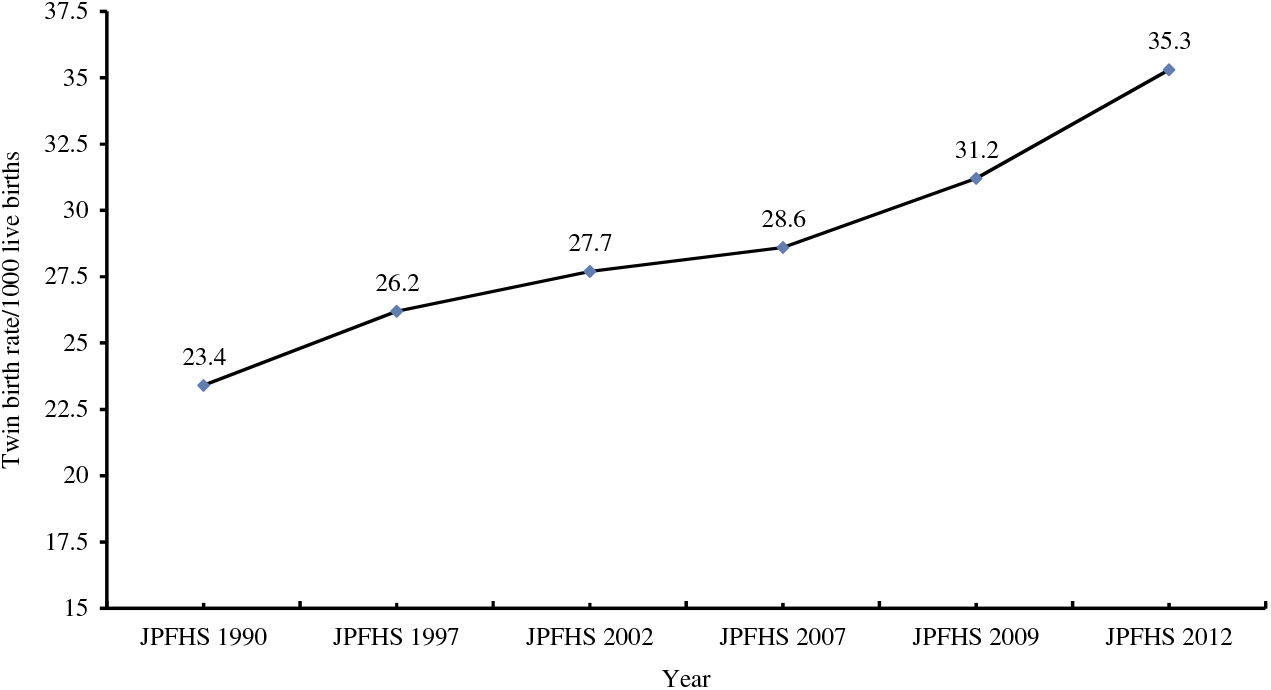
Since 1990 there have been six successive JPFHSs conducted in Jordan. Figure 1 presents the point estimates of the twin birth rates obtained from all these JPFHSs. The results indicate an increasing trend in twinning rate in Jordan. The rate increased from 24.4/1000 live births in 1990 to 35.3/1000 live births in 2012 – an increase of 45% over a period of 22 years. However, these changes in twinning rate were based on the experience of ever-married women regardless of their timing of marriage or birth.
Trend in twin birth rates (per 1000 live births) in Jordan, 1990–2012. Twin rates were calculated from JPFHS data sets from the Measure DHS+ website with due permission.

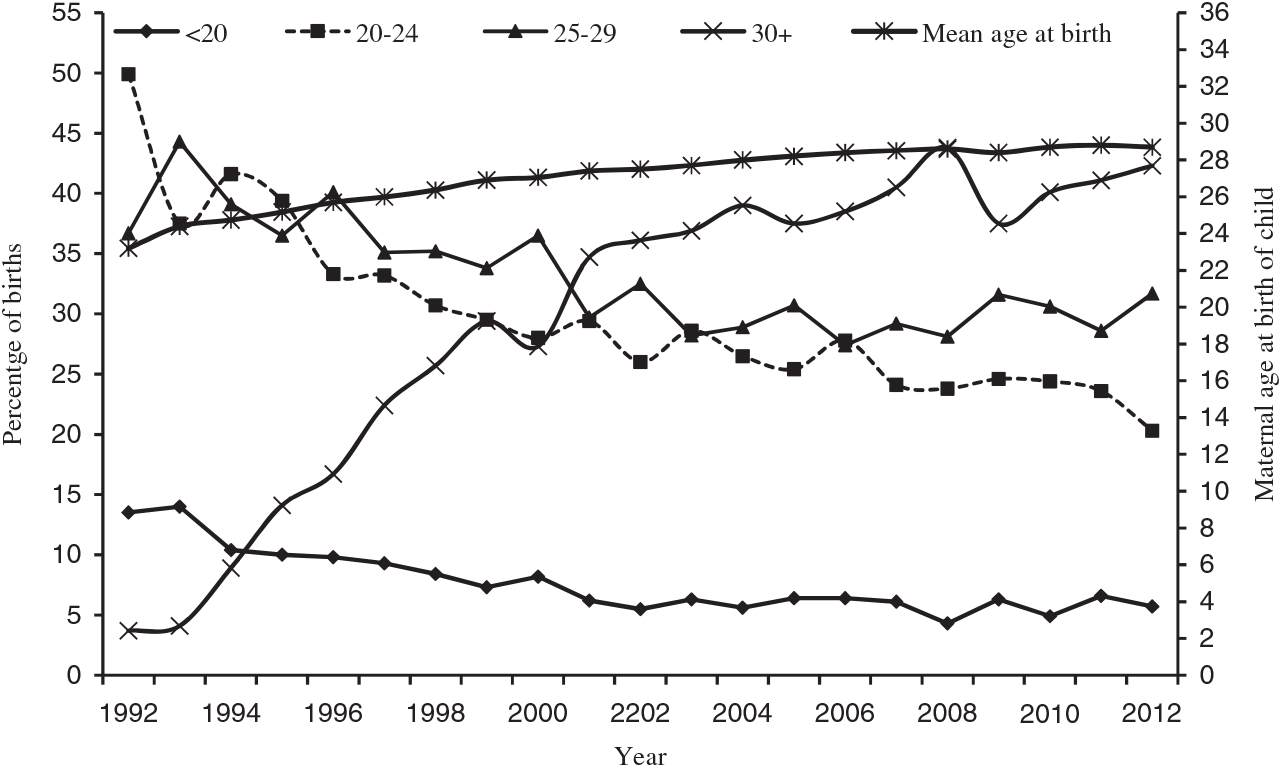
The increasing trends in twinning rates in Jordan can also be attributed to the increasing trends in age at childbearing of mothers. On analysing birth history data for the two decades (since 1992 to 2012), an increasing trend in age at childbearing was observed: from 23 years in 1992 to 29.6 years in 2012 (Fig. 2). Over the two decades, the proportion of births to mothers in their thirties rose steadily. In 1992, 4% of all births were to mothers aged 30 years and above, which increased to 41% in 2012 (Fig. 2). The proportion of births to mothers aged 25–29 years showed a slight decline during 1992–2000, and then stabilized. However, the proportion of births to women aged less than 20 and 20–24 showed declining trends. Since 2001, however, the highest proportion of women was found among women in their 30s or above.
Trend in proportion of age-specific childbearing and mean age at childbearing, JPFHS 2012.

Risk factors for twin births
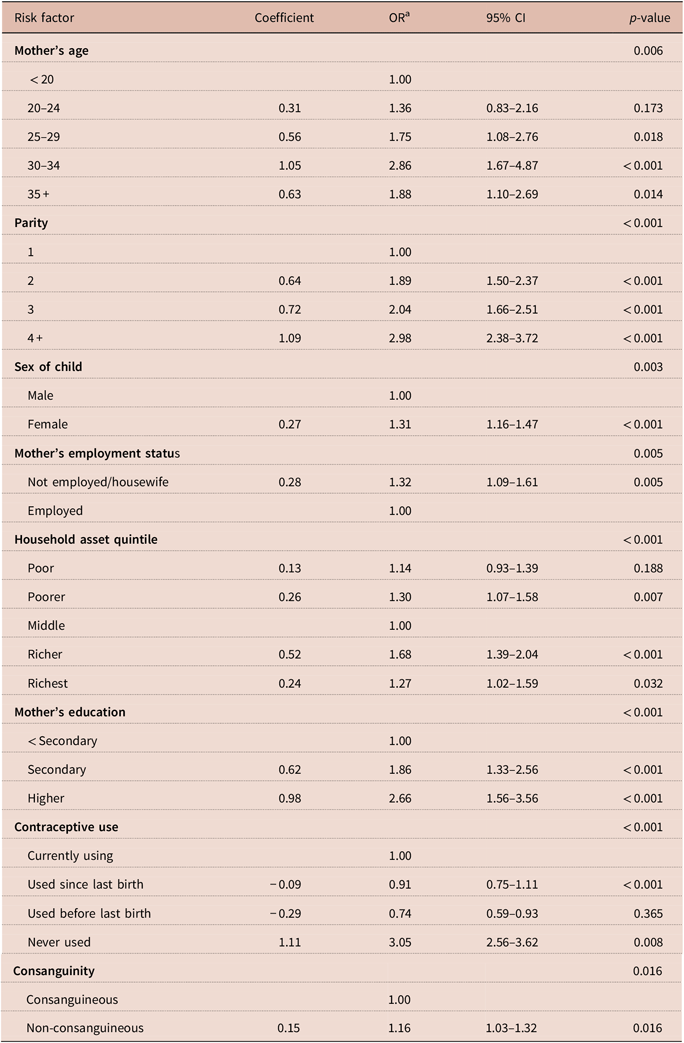
Table 2 presents the results of the multiple logistic regression analysis showing the adjusted effects of socioeconomic and demographic factors on twinning in Jordan. The bivariate analysis presented in Table 1 identified many factors with significant association with twinning. However, bivariate analysis provides unadjusted effects of a particular factor on an outcome variable without controlling for the effects of other potential confounders. To obtain the adjusted effect of a factor, a multiple logistic regression model was fitted by controlling the effects of those potential confounders that have been found to have significant association with twinning in bivariate analysis. The results are presented in Table 2. Only statistically significant factors are presented in the table. The analysis identified mother’s age, parity, sex of child, mother’s education, employment status, household asset, contraceptive use status and consanguinity status as significant predictors of twin births. Mother’s age showed a significant positive association with twin births. Mothers aged 30–34 years had an almost three times higher risk of having a twin birth than those aged less than 20 years (AOR=2.86, CI: 1.67–4.87). However, the considerable wide range of the 95% CI for this variable compared with other variables indicates that the estimate of the parameter is less precise. There are various reasons for the wide range of CI, including the presence of multicollinearity or outliers. Mother’s parity also showed a significant positive association with twinning. For example, mothers of third parity had two times higher odds of having a twin baby than the mothers of parity one (AOR=2.04, 95% CI: 1.66–2.51). A female child was found to have a 1.3 times higher risk of being a twin than a male child. Mothers who were employed were less likely to have twin births compared with mothers with no employment. Twin births were found to be more prevalent among the children born to mothers from the richer group of households (AOR=1.68, 95% CI: 1.39–2.04) as well as the poorer group of households (AOR=1.30, 95% CI: 1.07–1.58) than those of the middle-income group. Mother’s education showed a significant positive association with twining. Mothers with a higher level of education had a 2.66 times higher risk of having twin births than those with less than secondary education (AOR=2.66, 95% CI: 1.56–3.56). Twin births were found to be more prevalent among the mothers who never used family planning methods (AOR=3.05, 95% CI: 2.56–3.62). The odds of being a twin were 1.16 times higher among the children born to non-consanguineous mothers than their consanguineous counterparts (AOR=1.16, 95% CI: 1.02–1.32).
Results of multivariable logistic regression analysis identifying factors associated with twin births, Jordan 2012

a All odds ratios (ORs) were adjusted for clustering of births to the same mother and for all other variables using a multilevel logistic regression approach.
The dependent variable was coded 1 if the live birth was a twin, and 0 otherwise.
Effect of twin births on mortality
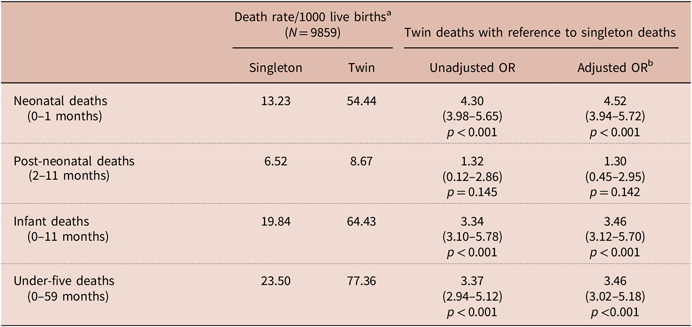
Of the 9859 live births considered in this study, 251 (2.5%) died within five years of their life at the time of survey. The corresponding figures for singletons and twins were 224 (i.e. 2.4%) and 27 (i.e. 7.7%), respectively. This indicates that twins have a 3 times higher mortality rate than their singleton counterparts. It is worth mentioning here that twins constituted only 3.5% (349/9859) of the total live births, but twin deaths constituted about 10.7% (27/251) of the total deaths among live births.
Table 3 presents the mortality rates among twins and singletons during the neonatal, post-neonatal, infant and under-five-years age periods. The infant mortality rate (IMR) among the twins was 64.4 deaths per 1000 twin births as opposed to 19.8 deaths per 1000 singletons. This indicates that the IMR was 3.3 times higher among twins than among singletons. Most of these infant deaths occurred during the neonatal period, which is true for both twins and singletons. The neonatal mortality rates were found to be 54.4 deaths per 1000 twins and 13.2 deaths per 1000 singletons.
Neonatal, post-neonatal, infant and under-five death rates of twin and singleton live births and the unadjusted and adjusted odds ratios of twin death with 95% confidence intervals (95% CI), Jordan 2012

a Children alive at the beginning of each interval.
b Adjusted for all factors associated with twin births.
Table 3 also presents the unadjusted and adjusted effects of twinning on different types of mortality under the age 5 years. The effects were measured using odds ratios obtained by univariate and multivariate logistic regression models, respectively. The results indicate that the odds of all types of childhood mortality were significantly higher among twins compared with singletons. For instance, the adjusted odds ratio of a death under one year of age was found to be 3.5 (95% CI: 3.1–5.7) among twins compared with singletons, indicating that twins have a 3.5 times higher risk of dying under one year of age than singletons. The highest effect of twinning on death was found to occur during the neonatal (age 0–1 month) period. Neonatal deaths were about 4.5 times higher among the twins compared with singletons (AOR=4.5, 95% CI: 3.9–5.7). It is to be noted that the adjusted odds ratios of all types of deaths were found to be higher than the unadjusted odds ratios of deaths, indicating higher significant independent predictive power of type of live births (i.e. twin or singleton) on childhood mortality.
Discussion
This analysis of recent national-level population and family health survey data from the 2012 JPFHS demonstrates a very high rate of twinning in Jordan and higher rate of neonatal, infant and under-five mortality among twins than singletons. Overall, there are 35 twin births per 1000 live births (one twin birth in 28 live births) in the country and the rate shows an increasing trend. This estimated twinning rate is remarkably higher than that observed in previous studies in Jordan. Ziadeh (Reference Ziadeh2000), using hospital-based data, observed a twining rate of 11.6 twins per 1000 live births in Jordan during 1997–1999, while Smits and Monden (Reference Smits and Monden2011), using JPFHS data, observed a rate of 14.4 twin births per 1000 live births in 2002.
This study’s estimated twinning rate for Jordan surpasses that of Benin, which was reported to have the highest rate of twinning by Smits and Monden (Reference Smits and Monden2011). While estimating twinning rate using DHS data, Smits and Monden (Reference Smits and Monden2011) considered live births (stillbirths were excluded) that occurred within ten years of the survey date. The present study also considered live births, but the observation period was five years before survey date, giving the most recent experience of twin births. However, the estimate is very close to the very recent estimate of twinning rate in Jordan observed by Khan and Beshanski-Pedersen (Reference Khan and Beshanski-Pedersen2016). Using the 2007 Multiple Indicator Cluster Survey (MICS) data and an exposure period of two years preceding the survey date, Khan and Beshanski-Pedersen obtained an estimate of the twinning rate in Jordan of 31 twins per 1000 live births. Khan and Beshanski-Pedersen (Reference Khan and Beshanski-Pedersen2016) also observed the highest twinning rate in Benin (55 twins per 1000 live births). Like the DHS, the MICS is another large global source of statistically sound and internationally comparable data on children and women, carried out by government organizations, with technical support from the United Nations Children’s Fund (UNICEF).
It is worth mentioning here that the variations in twinning rates across different studies, countries or regions could be due to variations in the definition of twinning rate; whether rates were calculated among pregnancies or live births and whether stillbirths were included, keeping all other factors constant. Besides, variations could also be due to variations in the period of observation as well as variations in study design such as population based or hospital based, cross-sectional or longitudinal study design and the age distributions of sample respondents. The estimate of twinning rate in this study was based only on live births that occurred within the five years preceding the survey date, excluding stillbirths. Since the proportion of twins is higher among stillbirths than among live births (Hartley et al., Reference Hartley, Emanuel and Hitti2001; Dodd et al., Reference Dodd, Robinson, Crowther and Chan2003), the present estimate of twin birth rate, by excluding stillbirths, is likely to be underestimated.
The age distribution of mothers and their parity pattern have significant influences on the twinning rate. The sample contained a small proportion (5.5%) of mothers of age less than 20, but a substantial proportion (41%) of mothers were aged 30 and above and the mean age at childbearing was 29 years. On the other hand, more than half (56%) of the mothers in the sample had a parity of 3 and above with a mean parity 3.2. Thus, considering the higher age and parity pattern of the sample respondents, the present estimate of a high twinning rate in Jordan seems to be plausible. ‘Those women who give birth more (i.e. having high parity) accumulate a greater opportunity to become mother of twins than women who give birth less’ (Rickard et al., Reference Rickard, Courtiol and Lummaa2012; p. 2510).
The estimated high twinning rate in Jordan might have implications for the reproductive performance of Jordanian women, or vice versa. Several studies have documented a causal relation between twinning and reproductive life (Sear et al., Reference Sear, Shanley, McGregor and Mace2001; Robson & Smith, Reference Robson and Smith2011; Rickard et al., Reference Rickard, Courtiol and Lummaa2012). Using life history data of more than 50,000 women born in 19th century Utah, USA, Robson and Smith (Reference Robson and Smith2011) observed that mothers of twins tend to have lower post-reproductive mortality, shorter interbirth intervals, later ages at last reproduction, longer reproductive lifespan and higher lifetime fertility compared with mothers of singletons. A similar finding was reported by Sear et alet al. (Reference Sear, Shanley, McGregor and Mace2001). Jordan is a high-fertility country with a total fertility rate (TFR) of 3.5 births per woman and the TFR has stalled over the last decade in the vicinity of 3.6 births per woman. Thus, the high twinning rate in Jordan might be related to the high fertility in the country, or vice versa.
Since twin pregnancies have a higher risk of maternal and neonatal complications than singleton pregnancies (Kiely, Reference Kiely1990; Sibai et al., Reference Sibai, Hauth, Caritis, Lindheimer, MacPherson and Klebanoff2000; Luo et al., Reference Luo, Simonet, An, Bao, Audibert and Fraser2006), Caesarean section is the optimal mode of delivery for twin pregnancies. The present analysis shows a remarkably high rate of Caesarean delivery among twins compared with singletons (61% vs 26%). According to the 2012 JPFHS, 28% of births in the five years preceding the survey were delivered by Caesarean section, and the rate has increased substantially since the 2007 JPFHS (19%) (Department of Statistics & ICF International, 2013). The high rate of Caesarean section delivery and its increasing trends in Jordan might be related to the high rate of twinning in the country.
This analysis reveals that over a period of 22 years, the twinning rate increased markedly (by 45%) in Jordan – from 2.4% in 1990 to 3.5 % in 2012. Given the relationship between mother’s age at childbearing and the twinning rate, the increasing trends in twinning rates in Jordan can be attributed to the increasing age at childbearing in the country. The increasing trends in age at childbearing in the country might be due to the increasing age at marriage and postponement of pregnancy at younger ages as women increasingly pursue education and a career before having children.
The increase in twinning rates may also be due to increasing use of medically assisted reproduction (MAR). Many studies in developed countries have indicated that techniques such as ovarian stimulation and in vitro fertilization (IVF) are associated with an increased risk of multiple births since 1970 (Bergh et al., Reference Bergh, Ericson, Hillensjö, Nygren and Wennerholm1999; Wilcox et al., Reference Wilcox, Kiely, Melvin and Martin1996; Pison et al., Reference Pison, Monden and Smits2015). However, due to lack of data, the prevalence of MAR and its effect on multiple births could not be established in Jordan. There may be other factors, such as genetic predisposition in families, differences across regions, ethnic groups and parity, that play a role in determining the twinning rate, but their contribution towards a change the twinning rate is likely to be small (Bulmer, Reference Bulmer1970; Montgomery et al., Reference Montgomery, Duffy, Hall, Kudo, Martin and Hsueh2001; Hoekstra et al., Reference Hoekstra, Zhao, Lambalk, Willemsen and Martin2008).
The study found the sex ratio at birth for twins to be 75 boys per 100 girls. In a recent study, Pa’ri (Reference Pa’ri2014) also observed a lower sex ratio among Hungarian twin and multiple births. The lower sex ratio at birth for twins in Jordan implies that there were disproportionately more girl twins in the sample of mothers than boy twins. This might be due to a higher rate of stillbirths among co-twin boys, while the co-twin girls survive (Sear et al., Reference Sear, Shanley, McGregor and Mace2001). The analysis also showed that twins had a several times higher risk of being small in size and having a low birth weight. The greater risk of low birth weight among twins has also been reported in several studies (Gardner et al., Reference Gardner, Goldenberg, Cliver, Tucker, Nelson and Copper1995; Kiely, Reference Kiely1998; Blondel & Kaminski, Reference Blondel and Kaminski2002).
This study identified various significant independent determinants of twin births in Jordan. Higher maternal age at child birth, higher parity, poor and richer economic status, never using contraceptive methods, secondary and above level of education of mothers, and non-consanguinity were found to be associated with higher rates of twin births in Jordan. Previous studies in both developed countries (e.g. US, France, England and Wales, Japan) and developing countries (e.g. Bangladesh, Nepal, Nigeria) have documented that the incidence of twinning has a strong association with increasing maternal age at childbearing and parity (e.g. Katz et al., Reference Katz, West, Khatry, Le Clerq, Christian, Pradhan and Shrestha2001; Alam et al., Reference Alam, Van Ginneken and Bosch2007; Pison et al., Reference Pison, Monden and Smits2015). This study’s results corroborate these findings. The mean maternal age in the twin group was observed to be 29 years compared with 27 years for singletons. The analysis shows that the incidence of twinning increases with maternal age. The results of the multivariate analysis show that after controlling for the effect of all other confounding factors associated with twinning, children born to mothers aged 30–34 years are almost three times (OR=2.86, 95% CI: 1.67–4.87) more likely to be twins than children born to mothers aged less than 20 years. The incidence of twinning increases with the parity of mothers. Third and higher order births had a more than 2 times higher risk of being twins compared with first-order births. These differences, however, were independent of the age of mothers and were not due to the older ages of women having high-order births. The multivariate analysis shows that for all maternal ages, the twinning rate increased with birth order and was substantially higher for high- than for low-birth orders. An independent effect of parity of equal or greater importance than that of maternal age has been observed elsewhere (Katz et al., Reference Katz, West, Khatry, Le Clerq, Christian, Pradhan and Shrestha2001).
Household economic status, as measured by wealth quintile, showed significant association with twinning. Children born to richer households and those born to poorer households had a significantly higher risk of being twins than those born to middle-income households. This might be related to differences in mother’s reproductive pattern, eating habits, use of contraceptives or MAR or ethnicity/race. For example, mothers of poor economic status usually have longer reproductive lives due to early marriages, and thus have higher fertility/parities, which creates a greater chance of having a twin birth, while richer mothers might have different eating habits and life styles and be more likely to use contraceptives or MAR. A higher rate of twinning in poorer mothers has been reported in studies conducted in Nigeria and Scotland (Parazzini et al., Reference Parazzini, Restelli, Moroni and Crosingnani1994).
Mother’s education also showed significant association with twinning. In addition, the incidence of twins was higher among never users of family planning methods, which contradicts a previous finding that contraceptive use, or discontinuation of use, increased the risk of twin births (Murphy et al., Reference Murphy, Campbell and Bone1989; Hoekstra et al., Reference Hoekstra, Zhao, Lambalk, Willemsen and Martin2008).
This study’s findings support the claims of previous studies that children born as twins are more likely to die during childhood than those born as singletons, irrespective of developing and developed countries (Kleinman et al., Reference Kleinman, Fowler and Kessel1991; Guo & Grummer-Strawn, Reference Guo and Grummer-Strawn1993; Katz et al., Reference Katz, West, Khatry, Le Clerq, Christian, Pradhan and Shrestha2001; Hong, Reference Hong2006; Uthman et al., Reference Uthman, Uthman and Yahaya2008). The infant mortality rate of twins was found to be 3.5 times higher than that of singletons (77.4 vs 23.5 per 1000 live births), and about four times higher in the neonatal period (54.4 vs 13.2 per 1000 live births). The importance of twin birth as a risk factor for childhood mortality is further emphasized in the adjusted analysis of the determinants of childhood mortality by considering twin births as a risk factor after controlling for the effect of all other potential determinants of childhood mortality. The adjusted odds ratios of the death of a twin birth in the neonatal period of 4.5 and that in infancy of 3.5 (compared with the risk of the death of a singleton) in Jordan is comparable to the findings of other population-based studies (Justesen & Kunst, Reference Justesen and Kunst2000; Hong, Reference Hong2006; Uthman et al., Reference Uthman, Uthman and Yahaya2008; Miyahara et al., Reference Miyahara, Jasseh, Mackenzie, Bottomley, Hossain, Greenwood and Roca2016). Using 5-year prospective data from the Demographic Surveillance System (DSS) in Gambia, Miyahara et al. (Reference Miyahara, Jasseh, Mackenzie, Bottomley, Hossain, Greenwood and Roca2016) observed 4.3 and 3.5 times higher risks of death among twins than singletons during the neonatal and infancy periods, respectively. Our findings are very close to the findings of Miyahara et al. (Reference Miyahara, Jasseh, Mackenzie, Bottomley, Hossain, Greenwood and Roca2016). Hong (Reference Hong2006) observed 6.18 times higher odds of death of twin infants than singletons in Bangladesh, while Justesen and Kunst (Reference Justesen and Kunst2000) reported 6.24 times higher risk of neonatal deaths among twins than singletons in southern and eastern Africa. Based on data from 193 countries, the major causes of neonatal death globally have been estimated to be infections (sepsis/pneumonia, tetanus and diarrhoea, 35%), preterm birth (28%) and asphyxia (23%) (Lawn et al., Reference Lawn, Cousens and Zupan2005). Twins are more vulnerable than singletons in terms of all of these major causes of neonatal deaths. Our analysis indicates that the prevalence of overall low birth weight in Jordan is moderately high (about 13.5%), but more than half (52%) of these twins had low birth weight. Thus, the high prevalence of low birth weight among twins could be one of the major causes of high twin mortality in Jordan. In addition, twins are usually associated with high-risk pregnancies as they occur to mother with higher parities and ages, and therefore accounted for a larger percentage of deaths in the early days of life. In a hospital-based study in Jordan, Ziadeh (Reference Ziadeh2000) observed that lack of prenatal care and diagnosis, low socioeconomic status factors, preterm labour, pregnancy-induced hypertension, low birth weight and respiratory distress syndrome were associated with increased maternal and fetal neonatal morbidity and mortality.
Jordan is a middle-income country with a quite advanced health care system. It has been ranked the number one medical tourism provider in the Middle East and North Africa by the World Bank. Utilization of reproductive health care and child health care services is almost universal. According to the 2012 JPFHS (Department of Statistics & ICF International, 2013), almost all women (99%) had received health care during pregnancy by medically trained personnel (96% receiving health care from a doctor) in 2012. Jordan was also found to have maintained a high rate of births in medical facilities, and was almost the best in the world (99%). The proportion of mothers who received postnatal care by a doctor, nurse or midwife during the two critical days after birth reached 82%. Jordan strides with clear steps towards achieving the reproductive health Millennium Development Goals – especially the fourth goal related to reducing the mortality rate of children under five years. Despite the notable decline in deaths of children under five and the rate of infant mortality over the period, the neonatal mortality rate did not fall to the desired level. According to the 2012 JPFHS, there was no decline in neonatal, post-neonatal, child or under-five mortality in the 5 years preceding survey. In fact, all types of childhood mortality seemed to have increased in the last five years compared with the 5–9 years preceding the survey (Department of Statistics & ICF International, 2013, Table 8.1, p. 93). These increases in all types of childhood mortality might be linked to the recent increasing trends in twinning coupled with prematurity, low birth weight, genetic and epigenetic factors and quality of obstetric care. The issue, however, needs further investigation.
This study has both strength and limitations. The main strength lies in the fact that it is based on a large data set of the nationally representative JPFHS, which used ‘validated questionnaires and methodology’ (Vaessen et al., Reference Vaessen, Thiam and Le2005). As a result, the findings are generalizable to the national as well as subnational level. The study findings may have important policy implications for further improvement of maternal and child health services in Jordan. They may also have the potential to contribute to the literature by presenting updated information about level, trends and determinants of twinning in a developing country. Nevertheless, the study is not free of limitations. The findings are likely to suffer from selection biases, because the data used in the study were cross-sectional in nature, being obtained through retrospective interview of a selected group of women who had a live birth within five years of the survey. While collecting birth history data, the survey focused on live births, excluding other types of pregnancy outcomes as well as the mothers who had died during pregnancy or delivery. Moreover, the retrospective nature of the data may have introduced recall biases. As a result, it is possible that this study under-reported twin births and twin deaths. Since the probability of maternal mortality is higher with twin births (Obiechina et al., Reference Obiechina, Okolie, Eleje, Okechukwu and Anemeje2011; Vogel et al., Reference Vogel, Torloni, Seuc, Betra’n, Widmer, Souza and Merialdi2013), it is likely that the survey data underestimated the number of twin births and deaths. There might be further under-reporting of twin births and twin mortality because only live births were registered in the survey. When one of the twins was stillborn, it is most likely that the surviving co-twin was registered as a singleton (Monden & Smits, Reference Monden and Smits2017). However, to minimize the level of recall bias, a shorter observation period of five years was considered.
To summarize, twin births constitute 3.5% of all live births in Jordan, which is one of the highest rate of twinning in developing countries. There is an increasing trend in twinning rate in Jordan, which has almost doubled over the last two decades. Increasing age at childbearing, coupled with the increasing age at marriage for females, and a substantial proportion of women bearing children at higher parity, are the major contributing factors to the high twinning rate and its increasing trends. The increased use of fertility treatment may also have played a role in recent rises in twinning rate in Jordan. However, further studies are needed to determine if this is the case. The increasing trends of high rate of twin births and the associated higher risk of mortality and adverse health outcome such as low birth weight among twins in Jordan is an important public health issue for the country. With over one in 29 children being a twin and having several times higher mortality and adverse health outcomes compared with singletons, the socioeconomic, psychological and medical impacts of twin pregnancies should not be underestimated. In order to improve maternal and child health, antenatal, delivery and postnatal care should be tailored towards the special needs of twin births. Twin pregnancies should be detected at an early stage of pregnancy by clinical examination so that the perinatal outcomes can be improved by frequent prenatal visits, health education, counselling and proper management of peripartum complications.
Ethical Approval
This study is based on secondary analysis of the publicly available dataset of the 2012 JPFHSs with all identifier information removed. Permission to access the datasets was granted by Measure DHS before the analyses were made. Thus the study did not need any ethical approval.
Conflicts of Interest
The authors have no conflicts of interest to declare.
Funding
This research received no specific grant from any funding agency, commercial entity or not-for-profit organization.
Acknowledgments
The authors would like to thank Measure DHS for granting access to the datasets of the Jordan Population and Family Health Surveys (JPFHSs). They are also thankful to two anonymous reviewers for their constructive and insightful comments and suggestions. The views expressed herein are solely those of the authors and do not necessarily reflect the views of any institution or organization.