In 2000, growing frustrated with the widespread illegal activities in the inland fisheries sector, Cambodian Prime Minister Hun Sen publicly rebuked his officials: ‘Some government officials have been using the fishing lot systems as their “chhnangbai” [cooking pots], in exchange for pay-offs guaranteeing impunity for any violation of the law by the concessionaires. Some of these men, they are really corrupt. They don't eat fish, [sic] they eat money’.Footnote 1 Since his reprimand, the fisheries sector has seen little positive change, however. This article thus examines evidence that the Cambodian state's capacity to manage its fisheries is greatly limited by powerful social forces, i.e. fishing lot concessionaires and operators. It shows how these social groups became powerful, as well as how the interactions and various forms of collusion between concessionaires and some state agents have hindered the proper management of Cambodian fisheries.
The research is qualitative. Besides using data from primary and secondary documents, I employed in-depth and focus group interviews with key informants to collect necessary data. Snowball sampling was used to identify and contact respondents for the interviews and discussions. In all, 65 individuals in two provincesFootnote 2 around the Great Lake were interviewed by the author between March and July 2011; there were 19 solo and paired interviews and 5 focus group discussions. Participants included fishers, community fisheries committee (CFC) members, lot concessionaires and operators, fisheries officials at all levels, local authorities, NGO staff, and a researcher (Appendix A).
The article begins with an overview of theories of state capacity in relation to the fragmentation of social control. It then discusses the origins, development, and current state of the fishing lot system in Cambodia. The next section investigates why and how these concessionaires have impeded the state's capacity to manage its fisheries. The subsequent section examines how these social forces emerged and how they maintain their de facto dominance.
Social control fragmentation and state capacity
A state's capacity to manage its resources and govern society can be affected by a number of intertwining factors. Joel Migdal explains what happens when social control is fragmented, and a state is unable to subordinate ‘people's own inclinations of social behavior or behaviors sought by other social organisations in favor of the behavior prescribed by state rules’.Footnote 3 In such conditions, some societal actors will recognise the state's dominance and its rule-making authority, while others will try to capture sufficient control over material and human resources to adopt their own rules and/or to endorse desired practices,Footnote 4 for their own benefit, at the expense of the state and other citizens. In developing countries, given the fierce struggle for domination between the state and social forces, ‘social control exercised even by small social organisations tucked away in remote areas constrains the state tremendously’.Footnote 5 When power is fragmented in this way, neither the state nor society can claim to have precedence over the other because ‘[s]ocieties affect states as much as, or possibly more than, states affect societies.’ In policy areas, especially ones which ‘demand changes in behavior’ of a broad segment of the citizens, the state usually fares poorly.Footnote 6
Jeff Haynes concurs that the incapacity of many least developed countries results from ‘political and societal fragmentation’. Similarly, Neil Englehart and Harold Crouch argue that a state with limited capacity may have difficulty enforcing its rules and experience blatant violations of its laws by private actors, and hence cannot exercise ‘full control over society’.Footnote 7 Formal and informal groups, forces or social movements heavily influence policy and vie for ‘who establishes the procedures’ by deploying different ‘sanctions, rewards, and symbols’.Footnote 8 Moreover, as Gunnar Myrdal points out, in a ‘soft state’ there is a ‘general inclination of people in all strata to resist public controls and hinder policy implementation’.Footnote 9 In the Philippines and Papua New Guinea, for instance, when policies and programmes do not conform to the interests of local power brokers or strongmen, compliance and implementation is usually weak.Footnote 10 The impact of social fragmentation on state capacity is not confined to this part of the world, of course.Footnote 11
To maintain and reinforce their de facto control, such groups often co-opt state agents who are empowered to manage particular resources. Such accommodation and collusion blurs the line between state and society, exacerbates power abuses by particular groups, and further weakens the state. In addition, tacit support from powerful central state agents may be necessary to gain access to state resources and/or to facilitate the accommodation of local state agents.Footnote 12 Such ‘heterogeneity of rule making in society’ limits the state's capacity to penetrate, regulate, and extract from society and appropriate its resources to meet its goals, making joint project implementation between the state and society unviable.Footnote 13
Fishing lots in Cambodia: A brief overview
Cambodia has a fairly long history of trying to manage its fisheries systematically. In 1296 Chou Ta-Kuan reported the abundance of fish in the Great Lake,Footnote 14 but made no observations about the management of fisheries. Stone steles, which provide the main epigraphic evidence before and during the age of Angkor, are not informative on this matter either; anecdotal evidence seems to suggest that there was probably little formal management of fisheries.
More formal arrangements were introduced by the French during the reign of King Norodom (1864–1904) through the centralised leasing of fishing rights in selected areas for large-scale exploitation. Under the reigns of Norodom and his predecessors, the king was entitled to collect arbitrary taxes on fishing. Sino–Cambodian traders and investors purchased the use-rights and paid their dues to the Royal Treasury. They then sub-leased them to others, some of whom continued to sub-lease, with a chain of five or more go-betweens. The French colonial regime further reinforced this system. Under the protectorate, the monarch continued to collect fisheries taxes and paid a portion of these to the French. From 1889, however, the French instituted a system of direct collection of payments, formalising the fishing lot system in 1900 by passing a number of ordinances.Footnote 15
The first two post-independence regimes retained the colonial lot system. After 1953 the Department of Hydrology, Forestry, Wildlife and Fisheries was established, and in 1960 a separate Department of Fisheries (DoF) was founded. In the early 1960s fishing was modernised, along with the increased use of motorised boats and nylon filaments in bag and seine nets in large-scale fisheries. The Khmer Republic (1970–75) largely maintained the fishing lot system. However, due to increasing conflicts between concessionaires and small-scale fishers, some lot licences were later revoked. The Democratic Kampuchea (DK) regime (1975–79) abandoned ‘commercial’ fishing, and small-scale fishing was neglected, although fish was exported to Thailand on a large scale. Some lots continued to be operated by special Khmer Rouge fishing units; some of this catch was also supplied to collectives, cadres, and officials in Phnom Penh.Footnote 16
There were some remarkable developments in fisheries management during the People's Republic of Kampuchea (PRK) and the State of Cambodia (SoC) (1979–93). In late 1979, the Ministry of Agriculture and Forestry and its provincial departments were re-established and Cambodia's fisheries were generally collectively managed. Between 1979 and 1987, this was done mostly by state-sanctioned fishing solidarity groups, which paid use-rights fees in the form of dried or salted fish to the PRK, and by some PRK departments and army units. In 1987 the cash-strapped regime reintroduced the fishing lot system in an attempt to privatise resource exploitation and to earn more revenue.Footnote 17 To manage this privatisation, the socialist PRK/SoC enacted the Fisheries Law (FL) and a subdecree on fishing lot leasing in 1987 and 1989, respectively.
According to these regulations, designated areas of the freshwater body are demarcated and allocated as fishing lots. A lot can be a vast area of a few square kilometres or just an anchor point for the large commercial bag net, dai. ‘Competitive bidding’ for fishing rights is supposed to be conducted and supervised by DoF, although in reality the process is open to abuse and manipulation. Successful bidders, the lot concessionaires, usually hold fishing rights for two consecutive (open) fishing seasons. In addition, all fishing conducted within a lot was to conform to the lot's burden book — which stipulates fees, the permitted fishing season, the concessionaire's responsibilities and liabilities, and legally allowed fishing activities and gear. In practice, lot concessionaires and (sub)leasees largely ignored their burden book and its official rules and regulations.
Since 1993 fisheries management in Cambodia has witnessed more transformation. The prioritisation of revenue generation over rural livelihoods had worsened conflicts between concessionaires/operators and rural folk. DoF then introduced the ‘research lot system’ in 1997 with the stated purpose of lot rehabilitation, but in actual practice the more lucrative lots were allocated to well-connected concessionaires without public bidding on extended lease terms of four to six years. Initially fishing rights to selected lots were granted to concessionaires during closed-door negotiations between DoF and interested individuals, often with assistance from a facilitator — usually a fisheries official — who did this for a commission. The arrangement was criticised by the Ministry of Economy and Finance, which asked the prime minister to annul it on the grounds that it caused a loss of revenue. Yet, the system has been kept, but with a proviso that the granting of such fishing rights to an ‘investor’ requires a recommendation from DoF at the Ministry of Agriculture, Forestry and Fisheries (MAFF) to the prime minister, who then decides whether or not to grant such rights.Footnote 18
In 2000–2001 Hun Sen implemented a reform — appropriating 56 per cent of the lot areas from the concessionaires and reallocating them to new or to-be-formed CFCs, or designating them as protected areas; this was followed four years later by the passage of the community fisheries (CFi) management sub-decree, both aimed at improving community representation in fisheries management.Footnote 19
After years of preparation and multiple revisions, a new Fisheries Law was enacted in 2006, and the Strategic Planning Framework for Fisheries 2010–2019 was passed in 2011. Other supporting sub-laws have also been passed. A decade after the first reform, fishing rights to 35 ‘research lots’ in the Great Lake were suspended because of large-scale illegalities. These and other lake or stream ‘research lots’ in four provinces along the Mekong River were nullified in March 2012. Once again, this reform was initiated by the prime minister, rather than through a well-articulated policy or by the Fisheries Administration (FiA).Footnote 20
Fishing lots: An impediment to state capacity
In a less capable state (what some scholars label a ‘weak state’), social forces can present a great challenge to the state. The (mis)management of fishing lots in Cambodia is a telling example: a handful of concessionaires/operators, roughly one per cent of all fishers, were able to challenge the state, and their role in augmenting state capacity to conserve and develop resources was limited. The rest of the article discusses concessionaires/operators' disregard for state fishing regulations and their poor record of participation in resource conservation and development; their power in relation to other state and non-state stakeholders. It also describes the rapid emergence of these strongmen and how they have maintained their dominance in Cambodian society.
Fisheries regulations have been widely defied: first, gear/activity stipulation was ignored. Countless illegal activities and the widespread use of unlawful gear have been reported over a long period of time. A Mekong River Commission (MRC)-supported survey of 30 lots across seven provinces in 1999 reported the extensive use of illegal fishing methods: 27 per cent of lots allegedly used pumping; 40 per cent electro-fishing; 70 per cent multiple sweeping and 73 per cent brush parks.Footnote 21 Even some concessionaires and provincial administrators admitted that concessionaires/operators used illegal gear. Stakeholders and fisheries experts alike described these practices as illegal, ‘beyond rule of law’, and ‘common’.Footnote 22
Interviews with various stakeholders and a report filed by Chhin Bin, the deputy prime minister tasked with investigating illegal activities within the 36 so-called research lots suspended in 2011, all point to the fact that this state of affairs persisted as late as 2011. Collusion and an imbalance of power between stronger concessionaires/operators and weaker state agents, tacit support from prominent political figures, and limited coordination and cooperation between relevant agencies meant that there were few crackdowns on fisheries violations. Concessionaires/operators deliberately deployed larger fishing gear or more of them than permitted. Some anchored their gear in locations they were not allowed to fish in or operated beyond the fishing seasons stipulated in their burden books. In 2011, in response to a Tonle Sap Authority (TSA) report, an MAFF undersecretary of state acknowledged in an internal report that ‘there are always illegal activities within lots’, though he had some doubts about the picture given by the Ministry of Water Resources and Meteorology.Footnote 23 These operators used gear that had enabled them to maximise profits with few sanctions from the state. Notably, the lot system and extra-legal practices stayed intact for more than two decades, in mostly the same hands.
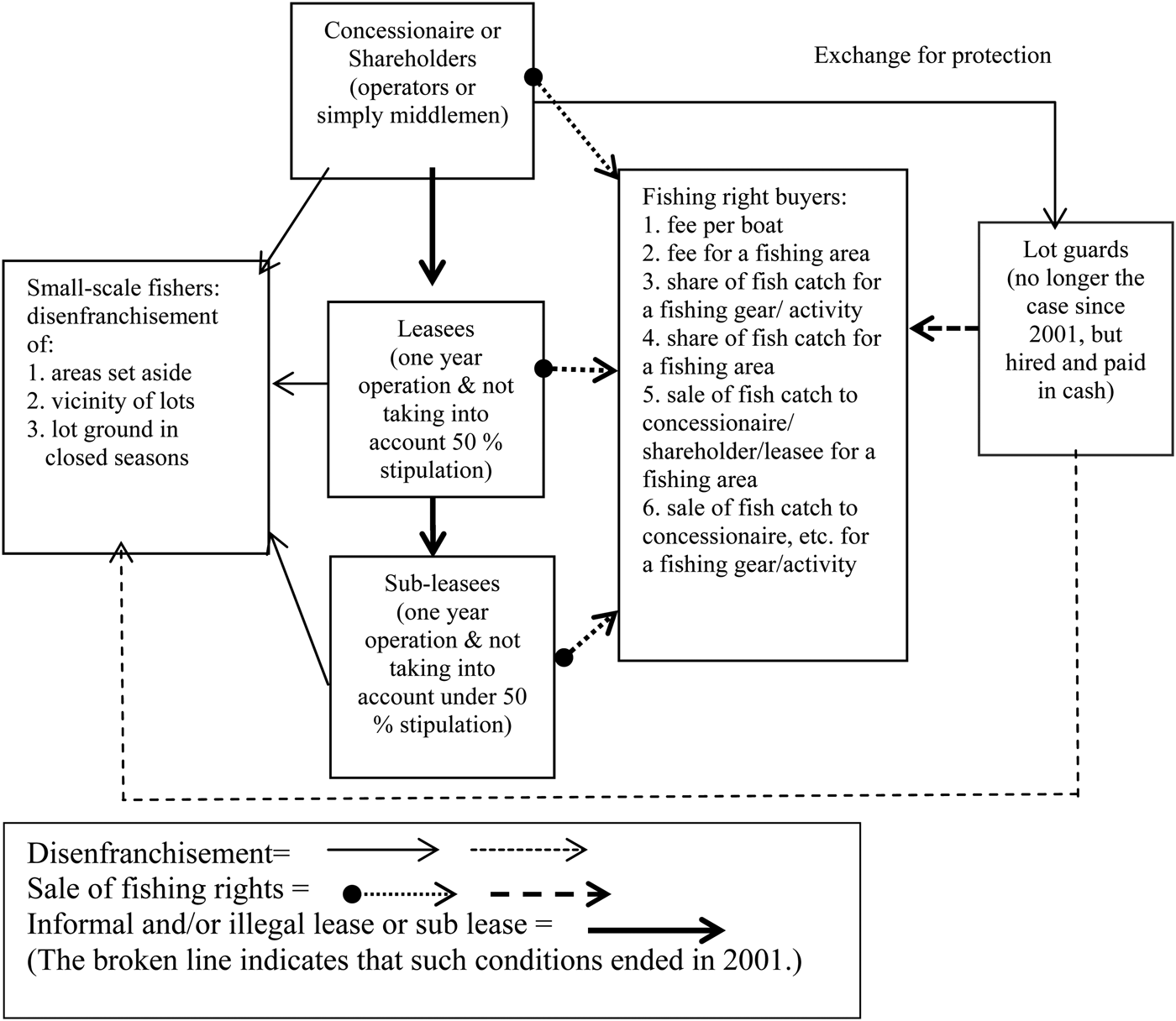
Figures 1 and 2 present the gap between formal state fisheries regulations pertaining to commercial operations in Cambodia and actual practices up till 2012. Fig. 1 presents the formal rules and official framework for the commercial fishing industry. The state decrees that lot operations be conducted by the concessionaires and/or shareholders only during the open season. Before the passage of the 2010 sub-decree on lot exploitation, which bans all types of lot lease arrangements, concessionaires could enter into a lease arrangement with other fishers as long as their catch did not exceed 50 per cent of the total catch; the leasees were to abide by the burden book and fisheries regulations, and a written contract was made and authenticated by relevant provincial fisheries offices (PFOs). Family-scale fishing was not allowed in a lot during the open season, except within special areas set aside for small-scale fishers all year round and in the lots during closed seasons.
Fishing operations allowed by the state

Typical actual fishing operations in a lot before 2012
Fig. 2 depicts how concessionaires/shareholders translated the formal lot system into actual practice from the late 1980s till around 2012, with little resemblance to what the state desired and dictated. Concessionaires often entered into informal lease arrangements with leasees, who then sub-leased parts of the lot. Concessionaires and (sub)leasees even illegally sold fishing rights to their lots, even in areas set aside for small-scale fishers. Thus, they disenfranchised small-scale fishers through de facto expropriation of the water bodies the latter were entitled to access and benefit from. To protect these informal illegal arrangements and activities, concessionaires hired armed guards who were paid in cash or in kind. Indeed, official rules and regulations were reconfigured beyond recognition.
There were varying degrees of (sub)leasing and illegal activities. Some concessionaires and shareholders who held rights to small lots operated them on their own with little or no further sub-leasing. However, the practice of profiting from illegal (sub)leasing was common — one study regards it as ‘the standard system for commercial fishing lot management’.Footnote 24 Leasing and multiple sub-leasing were usually organised without a formal contract; while leases were usually granted on an annual basis, the sale of fishing rights, as seen in Fig. 2, was more ad hoc. While the de facto (sub)leasing was already illegal, some concessionaries/operators further leased some areas to others for illegal activities.Footnote 25 It was impossible to impose the legal limit of less than 50 per cent of the catch. Other studies have detailed the (sub)leasing practised in Lot 19 in Takeo in 1997 and Lot 2 in Battambang in 2007–08.Footnote 26 My interviews support these studies, showing that sub-leasing was widespread in other lots as recently as 2011 despite the ban.Footnote 27
As mentioned, concessionaires and sub-leasees challenged or disenfranchised small-scale fishers and expropriated the areas set aside for them, public areas and CFi areas. Though it is impossible to gauge the extent of such practices, ample case studies, reports, and my own field interviews show many instances of disenfranchisement as recently as 2011. The Kampong Chhnang fisheries office head in 2000 described illegal expropriation as ‘customary practice’. The expropriation has probably become less common after the withdrawal of the armed forces into their barracks in 2001. However, even after the 2000–2001 reforms, some concessionaires/operators continued to expropriate CFi areas or bought fishing rights from CFis.Footnote 28
The state's capacity to manage its fisheries had also been weakened by a 1989 sub-decree which gave concessionaires the authority to temporarily arrest illegal fishers within their lots, while the burden book stipulates that they can cooperate with FiA officials to crack down on illegal fishing. However, with power, wealth and weapons on their side, such arrangements were open to abuse and manipulation. Concessionaires and sub-leasees (or their guards) sometimes arrested, levied fines, detained, injured, or even murdered fishers for alleged poaching and passing through lots, while protecting their own illegal fishing activities. Given the de facto privatisation of fines, arrests, and lack of state supervision, ‘equitable and consistent rule and application of law’ was ‘reduced or no longer available’.Footnote 29
An NGO case study in Kampong Chhnang in 2000 shows two concessionaires taking the law into their own hands: 28 people were arrested, 13 of them were forced to work between one week and one month to pay for their alleged illegal fishing, 9 were detained in a camp, 5 were forced to pay US$25–50Footnote 30 for their freedom, and one saw his/her fishing gear confiscated. The source explained further:
These people were forced to stay at the lot camp and were not allowed to come home in the evening. The life in the camp could be compared to a prison. There is a guard, keeping an eye on these people to avoid them escaping from the center. They were forced to do a variety of work including fishing, cutting forest and making samras [brush parks] etc. The people were arrested mainly because they were accused of trying to fish in the fishing lot areas. Most of these people were unaware that these areas belong to the lots, many years people used to fish there.Footnote 31
Another study of one lot reported that a guard had killed one fisher and that another fisher was on the run after being accused of illegal fishing. With power, money, political support, ‘legal loopholes and weak enforcement, fishing lot owners [read: concessionaires] continue to practice these methods but are never convicted’.Footnote 32
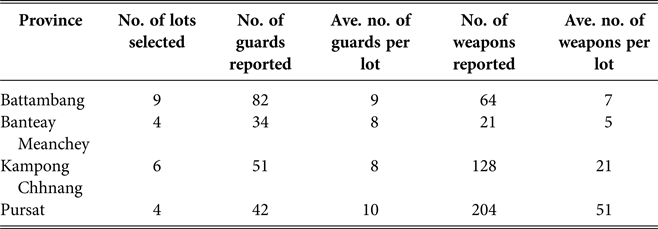
These strongmen were supported by a small colony of private guards from the army, police and/or local militia. As Table 1 shows, there were a sizeable number of military guards and weapons per lot before 2000. Concessionaires hired armed men to guard their lots up until recently. Lot 2 in Battambang and Lot 7 in Siem Reap in 2008, for instance, had more than a dozen armed guards each.Footnote 33 Two fishers in a village in Province B reported that a few lots near their village were protected by armed men in 2011.Footnote 34 Lot 2 in Battambang could be compared to a ‘small empire’ with each entrance to the lot being guarded, a resident armed soldier protecting each outer fenced pen.Footnote 35 Besides de facto support from elements of the armed forces, many concessionaires were well connected to powerful individuals within the state and often managed to accommodate or sideline local and regional state agents.Footnote 36 In a country like Cambodia where power, wealth, weapons, political–military khsae (connection), and/or khnong (backing) meet and reinforce each other, especially in the hinterlands, the power of these neakthom (‘big people’) is immense. Overall, the arrangements within a lot could be compared to a ‘small state within a state’ with each lot having its rules, norms, sanctions, rewards, partial sovereignty, and armed guards to enforce rules.
Fishing lot guards and weapons
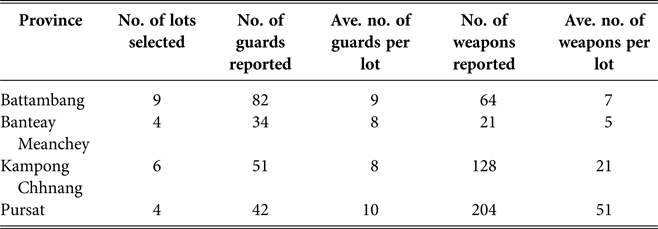
Source: Saroeun as cited in FACT and EJF, Feast or Famine? 2001, p. 25.
The academic and development literature on Cambodia clearly shows that similar patterns of relative societal domination and accommodation of state agents occur in other sectors such as land transactions and land, forest and mine concessions.Footnote 37 Caroline Hughes, for instance, argues that the loyalty of the Cambodian state's agents to its vision and missions is divided and that it is incapable of maintaining its coherence and projecting its power vis-à-vis society. Other observers agree. In Cambodia, ‘paper [law] does not have power, people have power’; that is, power comes from a person and/or a weapon.Footnote 38 In the fisheries sector, the ‘state may order but it does not exist in a void’.Footnote 39 Powerful concessionaires, often with covert or overt support from state agents, take the law into their own hands and make up and impose their own rules on ‘almost all aspects of the local fisheries, including decisions violating the burden book stipulations and requirements’.Footnote 40
The state's capacity to regulate its fisheries, to penetrate into the lot areas and to appropriate its resources was obstructed by lot concessionaires/operators, usually through collusion with and accommodation of some state agents and tacit support from powerful figures. These local chiefs also thwarted the state's capacity to extract necessary and appropriate rents. While the annual fish catch was estimated at more than US$200 million, the state obtained from the sector on average less than US$2 million in tax and non-tax revenues per annum (of which roughly two-thirds was from fishing lots and from medium-scale fishing fees before 2001). While commercial fishing lots could make on average US$50–60 million per annum from fishing, the state extracted a little over a million dollars in leasing fees (including a 5 per cent tax on the lease fees) annually from the fishing industry as a whole.Footnote 41 Given the widespread underreporting of the fish catch, the takings for commercial operations were certainly much greater than US$50–60 million per annum. In 2001, for example, Degen and others estimated the commercial value at US$110.3 million with a total value of US$276 million. The Cambodia National Mekong Committee (CNMC) in 1998 put the landed value of the catch from commercial and middle-scale fishing from the Tonle Sap Lake alone at between US$62–80 million.Footnote 42 All in all, the state managed to extract a tiny fraction of actual revenue from the fishing industry, while the lion's share went to private pockets and some state agents. There were also numerous complaints, even by provincial fisheries officials, about catch underreporting, yet serious investigation and punishment were rare. The involvement of the business community in Cambodia's countryside with its weak institutions tends to be ‘exploitative [rather than developmental], as illustrated by commercial logging and fisheries’.Footnote 43
To recap, these powerful social forces, often with support from state agents and powerful political figures, were particularly capable of weakening state capacity to penetrate, regulate, appropriate, and extract fisheries resources. To maintain their de facto rules and regulations, concessionaires used both positive and negative sanctions, including offering protection and a livelihood to those loyal to them and intimidation, fines, threats, violence or even death to those who were not.
Despite their dominant presence, the concessionaires' involvement in bolstering the state's developmental capacity was poor. According to Peter Evans, a shared developmental project between the private sector and the state is possible when societal actors see positive–sum outcomes from their cooperation with the state.Footnote 44 In the case of auctioned lots, a two-year contract did not guarantee that the current concessionaires would reap the benefits from participating in resource conservation and development programmes. A DoF report in 1999, for instance, stated that auction lot concessionaires did not seek to conserve and develop Cambodia's fisheries, but focused instead on maximal short-term exploitation of this resource.Footnote 45 The (sub)leasees, including fishers, found it even more meaningless to adhere to proper resource management and conservation of the fisheries.Footnote 46
With limited oversight from state agencies and civil society, even the longer-term leases (at least four to six years) did not make much difference to the management of fisheries. A former fisheries official interviewed underscores that even when the terms and conditions were lighter and less costly, many ‘research lot’ concessionaires did not even bother to fulfil their contractual obligations regarding conservation and development. Deputy prime minister Chhin Bin likewise reported blatant breaches of contracts by all but one lot in the Great Lake.Footnote 47
Possibly the only exception were some concessionaires who took some measures to protect flooded forests and wildlife within their lots. The concessionaire of Lot 2 in Battambang prohibited the burning of forests by its (sub)leasees, failing of which the verbal contract would be nullified or not renewed. Further, flooded forests within lots were often better protected than those outside.Footnote 48 Still, the concessionaires' contributions to some conservation and development measures were overshadowed by their general bypassing of state rules and regulations. As Thuok Nao, Mahfuzuddin Ahmed and Nov Sam reported in 1996: ‘Fishing operations in a fishing lot uses on average 20 to 40 km of bamboo fences and 40,000 to 80,000 poles to encircle the fish shoal each fishing season.’Footnote 49
In fact, the concessionaires were far more powerful in terms of fisheries management than state and other non-state actors. More than three-fourths of conflict managers Sithirith Mak and Sokkhoeun Te interviewed believe that powerful individuals, and in this case, lot concessionaires and to some extent operators, were able ‘to win their conflicts over the less powerful’ fishers,Footnote 50 except when there was political support from the ‘centre’, which was rare and then only when the state was under intense pressure to pass reforms, as in 2001 and 2011. Those reforms were prompted by massive illegal fishing and imminent open conflicts between the concessionaires/operators and fishers. Such conflicts in Cambodia are usually settled by force rather than through the rule of law; indeed, ‘rule by law’ and a culture of impunity prevail. As van Acker describes, ‘a local process to determine exclusion and access, based on equal voice and opportunity, has limited currency in the world of the wealthy and powerful [and] there is no other way to stop the wealthy and powerful from railroading local rule setting’.Footnote 51
The power of CFis as entities vis-à-vis the concessionaires was hardly an improvement. For example, with an official's facilitation, a boundary dispute between Lot 8 in Province A and a nearby CFC in 2010 ended in compromise. The concessionaire agreed to contribute to rehabilitating a CFi lake, constructing two concrete guard posts, placing 25 concrete tubes in and releasing 350 kilograms of fingerlings into the conservation area.Footnote 52 While this CFC could demand some contribution from the lot concessionaire as compensation for its illegal expansion into the CFi area, the placement of bor (bamboo-fenced traps) by a lot operator in another CFi in the same province did not see any protest from the CFC, nor was there any support from the local authority or officials. Some members in the community chastised: ‘The CFi does not lodge a complaint against the lot operator. How can we lodge a complaint against him when we are not even able to deal with the smaller-scale fishers — such as fishers using electro-fishing?’ A CFC head in the nearby province admitted the difficulty of making the concessionaires obey rules because ‘these people have money and power’. Referring to the period before the CFC union (the establishment of a coalition of neighbouring CFCs), a commune council leader overseeing the commune above where the lot–CFi boundary dispute had ended up with a compromise noted that ‘the CFCs were never in the eyes of the lot concessionaires’.Footnote 53
Because of the concessionaires' connections to powerful political figures and other state agents' tacit support, the commune councillors and village chiefs were no match for concessionaires and they too were often co-opted. A report by an NGO accuses concessionaires of having little respect and regard for the less powerful local authorities. Peter Swift describes concessionaires as ‘probably more powerful than the district chief’.Footnote 54 According to the commune council leader quoted earlier, there were illegal activities within lots in his commune; nevertheless, they were usually not dealt with unless such an act affected his villagers and their interests. Villagers in Kampong Chhnang believe that such an attitude from their ‘parents’ — a euphemism used to refer to the local authorities — is because they have been bribed by the concessionaires/operators either with cash or in kind (fish).Footnote 55
The power of field implementors — sangkat [commune-level fisheries office] and division officials — vis-à-vis the concessionaires' was not much different from that of the local politicians. These people had limited power to enforce compliance with fisheries regulations, and in many cases the implementors were also co-opted by the more powerful concessionaires. They were perceived as ‘allies of the wealthier lot operators [concessionaires] and less concerned or supportive of small-scale operators’.Footnote 56 The deputy PM's report reveals an absence of oversight on gear and activities; nor were there crackdowns on illegal activities within lots by fisheries officials and other officials. The report alleges that there had been collusion between state agents and concessionaires/operators. A cantonment leader in Province A and a division leader in Province B agreed that there were illegal activities within lots that they rarely clamped down on unless they affected nearby communities. A former NGO director believes that ‘lot concessionaires are even more powerful than the RGC [Royal Government of Cambodia] staff stationed in the field to manage the fisheries resources’.Footnote 57 The repercussion of dealing with these big businesses, when they had big backers, could be a loss of one's position, alleged a former fisheries official. A sangkat leader in Province A described his request for fisheries statistics from concessionaires as ‘begging for it’, signalling his powerlessness, while his provincial boss identified ‘research lot’ concessionaires as less ‘afraid of the FiA’ than auction lot concessionaires — suggesting that the latter were even more powerful than the state agents who were tasked to oversee their activities.Footnote 58 According to the sangkat leader above:
Lot concessionaires are usually powerful as they have good relationships with officials of all levels. They have good relationships with officials from the commune officials, provincial joint armed forces, provincial officials, and even officials at the central FiA and ministerial levels. Sangkat officials are just very ‘small’ and how can they dare challenge lot concessionaires. The field implementors are also afraid of their security as they live in a remote area, while those lot concessionaires and the other state armed apparatus have money and/or power.Footnote 59
The other, a division leader in Province B, added:
The relationship between lot concessionaires/operators and sangkat and division officials is generally not so good as the former (the rich ones, particularly) do not respect the roles of the latter as they think that they have nothing to fear from these officials. They only need the cooperation from and build good relationships with the cantonment head and provincial governors as they need their support to propose a research lot hiring.Footnote 60
Emergence of strongmen in the fishing industry
How did these strongmen emerge and sustain their dominance? As with many local and national tycoons in other sectors of the economy, they emerged from the quick and manipulated liberalisation in the late 1980s and early 1990s. Their power has grown along with their fortunes, their business diversification, and in a majority of cases, behind-the-scenes support from powerful military or political figures. Daniel Levy notes that the Mexican corporatist state under the ‘hegemonic party’ gives special treatment to privileged groups for political stability.Footnote 61 The situation is not much different in Cambodia, where ‘[e]lite groups often receive differential access to public services, national resources, and business opportunities’.Footnote 62 The granting of land, forest and other concessions and licensing to Cambodian tycoons are telling examples.Footnote 63 As discussed in this article, fishing lots are concentrated in the hands of a small group of ‘politically and financially powerful’ Cambodians. In the 1990s they were in the hands of just 135 concessionairesFootnote 64 — and this number has subsquently decreased.
One plausible explanation for their rise is the manipulated post-communist privatisation of state resources. Post-communist state-building is rapid and unstable and is dominated by both formal and informal structures and practices, which ‘are used to varying degrees by both [international and domestic] actors seeking to establish their authority’. This usually privileges those who participate in the initial stage of the transition; therefore, those accessing the ‘economic, political and/or ideational resources’ have an upper hand in resource access and exploitation, and collusion between state agents and the business elite are common.Footnote 65 The transformation of Cambodia was a more forced version of this. Indeed, the socialist PRK/SoC regime was not conducive to the rise of a business class. But there was little choice, given that the country's economic elite had perished during the brutal Khmer Rouge years. Therefore, during the swift liberalisation of the late 1980s and early 1990s, the group that emerged from informal commercial activities and trading was too small to handle the enterprises that were to be controlled privately. Specifically, in terms of fishing lot operations, two main phenomena helped establish an ‘artificial’ business elite — rich enough to bid for a lot — simulated wealth accumulation and simulated lot auctions.
The state formally prohibits bidders from collecting fees from leasees before the auction. Yet since the late 1980s and beyond, many concessionaires have collected fees from potential leasees beforehand to deposit to the auction committee as required by law.Footnote 66 This informal practice allowed mediocre businesses to have enough start-up capital to bid for the lots. Other sources of initial capital included having relatives or friends as shareholders, and loans from relatives, friends, or informal moneylenders.
To acquire an auction lot, two more informal steps are necessary: negotiation with other bidders and arrangements with the auction committee. Due to the capital-intensive and highly organised nature of lot operations, the business is dominated by a few individuals — therefore there were a limited number of bidders.Footnote 67 State and non-state stakeholders in the sector agree that there exist collusion and prior arrangements between concessionaires to keep the offering prices low. A Battambang deputy governor and the former DoF director, for example, concurred that there was collusion amongst bidders for either ‘tea money’ or low lot fees.Footnote 68 A concessionaire recalled the competition in the early 1990s:
When the krom samaki system ended in 1991, many in the krom samaki leadership did not become lot owners [concessionaires]; it was business people who bid for the lots and hired dangkhao [lead fishers] to fish on their behalf. There was a lot of cut-throat competition between and amongst those who had expertise in fishing and those business people who had money but no fishing technical expertise. This was especially true between 1993 and 1997.Footnote 69
A DoF report refers to the collusion as ‘too complicated for the committees to identify’ and to a majority of bidders as ‘rogue’. According to a cantonment leader, there were two main types of collusion: in the first, a discussion takes place between the bidder who wants to hire a lot and other bidders on the highest price to be offered with ‘tea money’ for the latter; in the second, the bidders exchange mutual promises not to bid above a certain level.Footnote 70
Besides such negotiations, there had to be arrangements with the auction committees, usually facilitated by a fisheries official in exchange for a bribe. Seang Tana Touch and Bruce Todd described the auction scene as ‘a mob in the auction hall’ with poor organisation, collusion and corruption. Large kick-backs were unavoidable in order to accommodate bureaucrats and skilled intermediaries. In 1999, letters from many fishers in Kampong Cham accused bidders and committees of collusion in price-setting, though DoF was quick to reject the allegation.Footnote 71 Even as late as 2011, there were accusations of irregularity and corruption from TSA in the bidding of seven lots in three provinces, leading to the nullification of the results by the prime minister.Footnote 72 Likewise, two fisheries officials reported that there was collusion between bidders and auction committees; a cantonment leader referred to the money paid as ‘rotka’ — ‘money for facilitation’.Footnote 73 If the collusion with all actors failed to produce any result, competitive (or bloated) bidding took place or else an arrangement with the central administration was needed before another round of bidding.Footnote 74
Given the undeveloped market mechanisms, the post-communist simulated transition in Cambodia has allowed ‘political capital to substitute for economic capital’ or the ‘recycling of the old political elite as an economic one’. That is, ‘[a]s the state withdrew, informal alliances of state patronage (state bureaucrats, former communist party members and cronies) appropriated these assets. Network contacts … were transformed into power, and power into property relations and private ownership of economic capital.’Footnote 75 With this high incidence of patronage and collusion, ‘many privatized assets did not [necessarily] end up in the hands of entrepreneurs who could make them productive.’Footnote 76 Overall, the fisheries resources fell into the hands of those who could accumulate enough capital to benefit from the liberalisation and who had some form of connection to the committees or central DoF/MAFF and so could gain access to the lots and then exploit and partition them for profit-making. While the law clearly states that any collusion in the bidding process will lead to the nullification of results, such a penalty has rarely been imposed.Footnote 77
The collusion and corruption in the bidding process has allowed the consolidation of an elite group of fishing industry concessionaires. And it was the introduction of the ‘research lots’ system that solidified their power. While many statist thinkers draw a line between the state and society, the experience of post-communist countries, including Cambodia, demonstrates that there is little distinction between the private and public.Footnote 78 Donald Crone shows that even in non-communist countries where the business elite is small the state finds it hard to resist the economically dominant groups' interests. And when these interests are implicitly linked to political, military or bureaucratic leaders, it is even much harder to resist.Footnote 79 This holds true in Cambodia. Big businesses through their connections and ‘power of the purse’ have favourable access to ‘state resources, protection and a wide range of kickbacks … based upon the proliferation of multiple inter-personal power relationships in which those with wealth, arms or political protection were privileged’.Footnote 80 In the fisheries sector, the FL and the sub-decree on lot leasing provide the legal basis for granting ‘research lots’. Nevertheless, due to the opaque and non-participatory nature in which these lots are granted, the laws are manipulated by ‘means of informal alliances and negotiations outside legal frameworks’, through which key figures within the state interfere in DoF's affairs on behalf of big concessionaires and their relatives.Footnote 81 Business elites probably find it much easier to bank on a central or provincial powerful backer to intervene on their behalf than to deal with the auction committees and other ‘rogue’ bidders on more favourable terms.
Migdal theorises that to maintain or to expand their domination, strongmen have three options, two of which are more concentration in a particular field and expansion into other sectors. The introduction of the ‘research lot’ system feeds into this thesis thanks partly to the way it enabled concessionaires to make handsome profits from exploiting auction lots for a few consecutive seasons. Since the establishment of the ‘research lots’, the productive lots have been further concentrated in the hands of just a few dozen individuals. Peter Evans correctly warns that when embeddedness takes place with no autonomy, the distinction between embeddedness and capture simply disappears.Footnote 82 Besides, the rich concessionaires have expanded their businesses into other sectors of the economy.Footnote 83 All these simply build up and consolidate their social control and strengthens their power vis-à-vis the state and civil society.
Conclusion
In Cambodia, the state was (and is) far from being the sole dominant actor in the fisheries sector.Footnote 84 Concessionaires/operators, often with the collusion of sections of the state itself, held substantial control of the fisheries before 2012 and this had (and still has) severe repercussions on state capacity. Because of this ‘heterogeneity in rulemaking’, and limited state capability to check and stem abuses of power and legal violations, the state could not effectively penetrate fishing lots and regulate fishing activities, or collect appropriate resource rents. Moreover, it could barely make concessionaires comply with their contractual obligations to conserve and develop the resources either.
One board member of an NGO remarked on the danger that local staff may face in their day-to-day operations: Since they are ‘working on natural resources [and] working on projects that may challenge those that may make a profit … what is probably more dangerous is the upsetting of local power men — like the one clearing flooded forest, for example, to create an irrigation scheme …’.Footnote 85 Although top-down state reforms may curtail their power, these social forces with their ability to accommodate state agents, if left unchecked, will continue to pose a significant challenge to the state's capacity, and to its desire for sustainable resource exploitation and development.
Appendix A: List of interviewees