

Music lessons are, most evidently, contexts for learning musical material and developing performance skills.Footnote 1 In this article, however, I explore them as settings for performing and audiencing, and propose that these aspects are key to many of the rewards experienced by musicians in lessons. Acts of performing and audiencing comprise bodily and vocal interaction, which can range from subtle shifts in gaze and posture to more overt gestures and utterances. Focusing on the performative, relational, and dynamic qualities of performance and audiency, this article presents analyses of bodily and vocal interaction in lessons, illustrating how these help teachers and students create a better grip on both the musical material and their social interaction. Through this analysis, I develop the concept of audiency as an active and embodied ‘adjustment to the other’ — the other in this case being the other person and the musical vocalizations. I further consider how the details of performer–audience interactions contribute to Goffmanian social role validation in this musical context, and suggest that this validation is part of the pleasure and significance of lessons. Adopting a concept of music in which performing and audiencing interactions are central, I aim to make a music-theoretical contribution through these analyses of bodily and vocal interactions.
The lessons analysed here are Karnatak vocal lessons that were given in Bengaluru and Chennai in South India. Karnatak music (Karṇāṭaka Saṅgīta) is a style of art and devotional music with origins in the music and dance traditions of the royal courts and temples of South India.Footnote 2 My involvement with this tradition was initially as a student; I studied for some years in Mysuru before moving to Srirangam in 2010 to learn with the violinist T. K. V. Ramanujacharyulu and the mridangist Trichy B. Harikumar. These experiences inspired me to move into research, focusing on the practices, perspectives, and concepts of Karnatak musicians. The lesson videos analysed here were recorded in 2014, with the kind permission and generous participation of the teachers and students involved.
The audiencing and performing that occur in these lessons do of course differ in many respects from that found in Karnatak concerts. Most obviously, lessons are structured around pedagogic goals while concerts are not. Furthermore, lessons are often given in small groups or one-to-one where participants are known to each other. This makes them more intimate affairs than most concerts, and as a result, some degree of overt interaction is necessary — there is nowhere to hide in lessons. Notwithstanding such differences, lessons nevertheless involve significant performing and audiencing elements, both in the sense of ‘performing music’/‘audiencing a music performance’, but also in the Goffmanian social interaction sense, in which teacher and student ‘perform’ their roles in the lesson.Footnote 3 The two modes are combined in this context: the social interaction ‘performance’ is that of a lesson (rather than a concert), but within that scenario teacher and student perform music and audience each other. Therefore I propose that the lessons can be viewed as a form of music performance, in addition to their pedagogic role.
Lying at the heart of this article are close analyses of the bodily and vocal interactions of teacher and student, including details of gesture, gaze, utterance, and facial expression. Drawing on work from gesture studies, I examine interactional phenomena referred to as addressee gestures, gestural backchannelling, and gestural feedback.Footnote 4 These are all gestures made by the addressee or auditor rather than the person speaking, vocalizing, or signing, and so they can also be considered audiencing gestures. Paying attention to these phenomena can help gain insight into how teachers and students audience and support each other in lessons, validating each other in their respective social roles. The notion of ‘role’ used here draws on the work of Erving Goffman, who theorized that people in face-to-face interaction aim to manage the impression that others have of them through their manner of presenting themselves in their assumed social role.Footnote 5 Rainer Polak has in turn applied Goffman’s theories to examine how audiency in Malian celebrations can act to socially validate performers in their roles.Footnote 6 Such ideas are key to the present article, which explores how audiency-related gestures and utterances contribute to role validation in Karnatak vocal lessons.
In another theoretical layer, drawing on work from phenomenological and pragmatist traditions, I explore how the audiencing gestures and utterances of teachers and students contribute to their grip on their interactions, both with the other person and with the music performed.Footnote 7 The goal of these analyses is to better understand how such audiencing actions might contribute to the flow and success of lessons, where success comprises not only musical learning but also includes the maintenance of positive relationships between student and teacher. Through this investigation, I aim to further the proposal that the analysis of bodily interaction in music-related scenarios can be considered a form of music analysis, helping us to gain greater insight into what is pleasurable and artful in musicking activities beyond the sound itself.
Background in Phenomenology and Pragmatism
While audiency can be given fleetingly and almost accidentally, the mode of audiency explored in these lessons is a more deliberate engagement.Footnote 8 Although teachers and students may become disengaged, irritated, or bored, this is not typical in the Karnatak music lessons I have observed. In contrast, the lessons analysed here consist of focused interactions, where both teacher and student pay close attention to each other throughout and appear enthusiastically involved in the process. When people audience in an intentional way, as opposed to accidentally hearing or seeing something, there is often a corresponding desire to gain a good view of the performance. Social pressures and personal preferences might lead the person who is audiencing to minimize any sign of their engagement.Footnote 9 However, if the person audiencing is content to be seen doing so, then they might position their body in a way that assists with their engagement, perhaps by turning towards or moving closer to the performer. Maurice Merleau-Ponty explores the phenomenology of such bodily adjustments that are intrinsic to audiencing, noting that ‘for each object, as for each picture in an art gallery, there is an optimum distance from which it requires to be seen, a direction viewed from which it vouchsafes most of itself’.Footnote 10 He characterizes the distance between himself and an object as ‘a tension which fluctuates round a norm’, rather than a size that increases or decreases, and then extends this observation on the interdependence of object appearance and bodily attitude, connecting it to the sense of grip we have on things in the world:
If I draw the object closer to me or turn it round in my fingers in order ‘to see it better’, this is because each attitude of my body is for me, immediately, the power of achieving a certain spectacle, and because each spectacle is what it is for me in a certain kinaesthetic situation. In other words, because my body is permanently stationed before things in order to perceive them and, conversely, appearances are always enveloped for me in a certain bodily attitude. In so far, therefore, as I know the relation of appearances to the kinaesthetic situation, this is not in virtue of any law or in terms of any formula, but to the extent that I have a body, and that through that body I am at grips with the world.Footnote 11
Merleau-Ponty’s influential ideas on the central role in perception of bodily interaction with the world underlie work by Hubert Dreyfus and Sean Kelly on the notion of ‘optimal’ or ‘maximal’ grip.Footnote 12 In their account, objects ‘require our taking up certain stances with respect to them in order to get an optimal grip on them’, and in such interaction, ‘we experience our current bodily situation as a tension away from that optimal stance’.Footnote 13 They provide the following example as an illustration:
Consider the example of walking along the wall at a museum and having your attention caught by an enormous picture just to your right. At first one is simply overwhelmed by its size, perhaps confused about how to respond. Quickly, though, one feels oneself pushed to step away from the wall in order to get the painting into view. One does not decide to step away, as if it were a pure and spontaneous act of the will. Rather, one responds immediately to a felt demand of the situation.Footnote 14
Cases such as this, where there is no reflective decision made regarding where best to position oneself but still the appropriate action is taken, support Dreyfus and Kelly’s proposal that ‘skillful coping’ involves a form of intentional content without reflection, namely ‘motorintentional content that is experienced as a solicitation to act’.Footnote 15 I will revisit the notion of motor intentionality later, as it provides a plausible framework for considering the audiencing actions of teachers and students in the Karnatak vocal lessons analysed here.
The topic of grip in skilled activity has been explored with a more explicit social dimension by Erik Rietveld and his collaborators. For example, van den Herik and Rietveld suggest that ‘skilled people have a tendency to be drawn to those possibilities for action that will improve their grip on the situation, in the sense that it becomes more appropriate with respect to sociomaterial practices’.Footnote 16 Rietveld emphasizes the socially constituted nature of situated normativity, defined as ‘the normative aspect of embodied cognition in unreflective skillful action’.Footnote 17 An example given is the tendency for people to maintain appropriate interpersonal distance, which can vary across cultures and depends on the situation, the space, and the relationships between the individuals.Footnote 18 This socially constituted aspect of bodily interaction is also at play in the music lesson contexts explored below, where the gestural responses of individuals are influenced by the social norms of the practice, which both constrain and influence each individual’s actions.
Turning towards the pragmatist philosophical tradition, a related and influential contribution to theorizing human interaction is found in the work of George Herbert Mead.Footnote 19 He famously theorizes interaction as a ‘conversation of gestures’, using the term gesture to refer to any action (vocalization or wider bodily movement) that is perceived by another person and that evokes a response in them.Footnote 20 Mead elucidates how the conversation of gestures allows interactants to adjust to the attitude of the other:
Within any given social act, an adjustment is effected, by means of gestures, of the actions of one organism involved to the actions of another; the gestures are movements of the first organism which act as specific stimuli calling forth the (socially) appropriate responses of the second organism.Footnote 21
In this way, interaction can be viewed as chains of overlapping actions and responses where each response is also itself an action that calls forth a response and, furthermore, where each response is an adjustment to the action of the other. For Mead, gesture functions ‘to make adjustment possible among the individuals implicated in any given social act with reference to the object or objects with which that act is concerned’.Footnote 22
Although Mead did not write directly about a concept of ‘grip’, his account of adjusting to the stance of the other is relevant for considering how people maintain grip in social interaction. If we consider his notion of ‘adjustment to the response of the other’ in relation to Merleau-Ponty’s ‘tension which fluctuates round a norm’, in Mead’s context of human interaction, Merleau-Ponty’s felt tension would be between the actions of two or more people, where each adjusts their gestures in response to the other in light of whichever goals they might have for the interaction.Footnote 23 Applying this line of thought to performing–audiencing interactions in musical contexts, I suggest it may be more rewarding to consider audiencing as an ‘adjusting to’ than an ‘observation of’, a proposal that will be explored through this article’s analyses.
It is perhaps unsurprising to find connections between Mead on the one hand and Merleau-Ponty and Dreyfus on the other. Shaun Gallagher, for example, suggests there is a persistent pragmatic note to be found throughout phenomenology.Footnote 24 Common to each of the theoretical approaches discussed above is an understanding of perception and action that emphasizes the foundational importance of bodily interaction with things and other people in the world. I will now turn to relevant background in another field, gesture studies, which often takes a more systematic and empirical approach to considering such bodily interaction.
Background in Gesture Studies
Within the fields of gesture and interaction studies, there is a body of literature on gestures that are produced while audiencing another person. Such gestures made by the auditor rather than the speaker have been referred to by terms including gestural backchannelling, gestural feedback, and addressee gestures.Footnote 25 Notwithstanding their shared identity as auditor or audiencing gestures, there are differences between some of these terms, notably between those that can be grouped under ‘backchannels’ and those commonly referred to as ‘addressee gestures’.
Backchannels have been defined by Ziedune Degutyte and Arlene Astell as ‘short verbal and non-verbal signals used by listeners to acknowledge the speaker and to convey their understanding’, and are described by Roxane Bertrand et al. as short verbal utterances and vocal or gestural signals ‘produced by listeners to signal sustained attention to the speaker while the latter is talking’.Footnote 26 ‘Response token’ is another term found in the literature, largely equivalent to backchannel.Footnote 27 The term ‘gestural feedback’ is used similarly for those hand and head movements that provide feedback to the person who is vocalizing.Footnote 28 Typical non-verbal backchannels or response tokens include head nods, shakes, and tilts, facial expressions, and hand gestures. Several writers propose that gestural and vocal backchannels assist in streamlining turn-taking, the shifting back and forth between speaker and addressee roles that occurs in typical conversation.Footnote 29
Meanwhile, the term ‘addressee gesture’ has been used largely in the context of classroom teaching, particularly in studies on mathematics lessons, where they have been defined as ‘gestures produced by addressees to correspond with other speakers’ utterances’.Footnote 30 Such addressee gestures take a variety of forms; for example, while a student explains their calculations the teacher might point to symbols on the board to correspond with and thereby support the student’s explanation, or alternatively a teacher might use gesture to represent, through metaphor or iconicity, some aspect of the student’s utterance.Footnote 31 Addressee gestures therefore differ in their placement and form to backchannels, which consist largely of conventional feedback gestures, such as nods and head shakes, and which often occur at the ends of conversational turns. Through their deictic (pointing) and representational qualities, teachers’ addressee gestures, produced while a student is speaking, may act to guide student attention, clarify referents, support students’ understanding by making connections between instructional elements, and foster common ground.Footnote 32 As both addressee and backchannel gestures have the potential to improve understanding for interactants in various ways, they can be used skilfully by an individual to gain a better grip on the scenario, as I will explore in the core analyses below.
A notable difference between some of the work on bodily interaction in gesture studies and that found in the phenomenological approaches of Merleau-Ponty and Dreyfus and Kelly lies in their respective conceptualizations of intent.Footnote 33 In gesture studies, gesture is often viewed as either an act of deliberate communicative intent, or alternatively as arising without any intent, for example in the following:
There are two ways in which people express themselves through gestures: Speakers can ‘give’ or ‘give off’ information (Goffman, 1956) in gestures. In the former case, speakers deliberately encode information in gestures to be received by the recipient. In the latter case, speakers express information in gestures without deliberate communicative intent, but the information is nevertheless taken up by the recipient.Footnote 34
Other researchers propose gradients of intention: for example, Kensy Cooperrider suggests a distinction between foreground and background gestures, defined in part by their respective degrees of intent.Footnote 35 Meanwhile, Emanuela Campisi and Marco Mazzone address the issue more directly by discussing what it means for gesture and speech to be intentional, concluding that these may be intentional even in the absence of conscious communicative intent prior to each speech/gesture act.Footnote 36 Following the approaches of Merleau-Ponty, Dreyfus and Kelly, and Rietveld, this article’s account of gesturing in lessons views the gesturer as having the overarching intent to gain a better grip on the interaction for the purpose of teaching or learning, and being able to recognize affordances to these ends, without making deliberate decisions regarding each individual gestural or vocal act.Footnote 37 I suggest that this motorintentional approach is fruitful for understanding gesturing intent in many contexts, and therefore this article combines the theoretical insights found in the phenomenological and pragmatist literature discussed above with the empirical and analytical power of gesture studies.
Karnatak Vocal Lessons
Lesson structure and context
The details provided here on the context in which Karnatak music lessons take place are based on my experience in South India of learning to play the style as well as my observation of lessons given by numerous teachers during my research.Footnote 38 Although lessons do take place in institutional settings such as music schools and colleges, a typical locale for lessons is the teacher’s home. For example, my violin teacher, T. K. V. Ramanujacharyulu, would return from his work as a staff artist at the local All India Radio station and then often teach students for several hours in the evening. These lessons might sometimes be watched by other students waiting their turn in the same room, as well as by other visitors to the home. However, it is typically the teacher and student who most actively audience each other, and so it is on these two roles that I focus. From the student’s perspective, in addition to the goal of learning, lessons can be viewed as opportunities to perform in the hope of pleasing the teacher, and sometimes to play together with the teacher. In turn, the student audiences their teacher’s demonstrated phrases largely with the intent to understand and learn, but occasionally also showing evidence of appreciation, as one might do at a concert. In these ways, interactional modes of performing, audiencing, teaching, and learning interweave throughout the lessons in ways that can be intensely engaging for those involved.
The focus of a lesson might be either a composition or one of the more extemporized formats referred to collectively as manodharma saṅgīta. Footnote 39 In manodharma formats, musicians extemporize based on their knowledge of typical phrases and ornamentations that characterize a rāga. Rāgas can be defined as melodic types, consisting of characteristic phrases (sañcāras) that use a limited number of pitch positions (svarasthānas) and notes (svaras), which are often performed with ornamentations (gamakas) that are also characteristic of the rāga. As can be observed from this description, all the various melodic elements point to the rāga, which is the primary melodic organizing principle in the style. There are hundreds of commonly performed rāgas, and each is considered to have its own bhāva (mood or character), which arises from the proper performance of the rāga’s characteristic sañcāras, gamakas, and svaras.Footnote 40
Much of the teaching, for both composition and manodharma formats, is based on a pedagogic structure of demonstration and imitation, in which the teacher demonstrates a phrase that the student must then imitate.Footnote 41 Notation in this tradition, which is often handwritten during the lessons, is used only as an aid to memory.Footnote 42 When the student’s imitation is either correct or good enough, the teacher moves on to the next phrase and thus progresses through the music being taught. An alternative pedagogic approach is for the teacher to perform a composition together with the student, picking up on any errors as they progress, which are then corrected through brief demonstration–imitation interactions. The demonstration–imitation format can be musically attractive in itself, and indeed skilled versions of this appear in concerts in the form of musical challenges where one performer presents complex melodic-rhythmic patterns that another performer should immediately imitate.Footnote 43 In this musical structure, we see a strong overlap between ‘lesson performance’ and ‘concert performance’, where something that works for teaching is also pleasurable as performance. This means that the demonstration–imitation parts of lessons, when running smoothly, resemble the musical challenge segments of concert performances.
It is within the context of such lessons that I will explore audiencing–performing interactions, looking at how gesture, gaze, and utterance help both student and teacher to maintain their grip on the interactions and musical phrases, while also supporting and validating each other in their respective social roles.Footnote 44
Gesture and bodily interaction in lessons
Karnatak music lessons in teachers’ homes are typically conducted either with small groups of students or one-to-one. Teacher and student sit facing each other and usually look towards each other with a gaze that takes in the face and upper body of the other person. Although music notation might be present at the lesson, it is not the focus of attention due to the demonstration–imitation pedagogic method described above. Not needing to read notation frees the student and teacher to look towards each other, allowing observation of the other’s gestures and facial expressions.
While singing, both teacher and student tend to gesture with their hands, head, and upper body. Typically, students’ gestures are less expansive than those of their teacher, for at least two reasons. Firstly, in many cultural contexts, there is the expectation that those with a lower status will gesture less than those with higher status.Footnote 45 In Karnatak music lessons it would be considered impolite if a student were to use more expansive gestures than those of their teacher.Footnote 46 Secondly, I have observed that the tendency to gesture while singing is acquired gradually during the learning process, and that such gesturing starts to become more prominent during the vocalist’s early performance experiences. Therefore younger students have often not yet fully acquired the habit of gesturing. It is important to note that the gestures made by Karnatak performers are neither taught nor deliberately learnt, and that such gesturing is not based on any formalized system of symbols and referents.Footnote 47 However, similarities between gestures of performers can nevertheless be seen, partly due to gestures being unintentionally picked up from the teacher during the lengthy learning process.
Gestures are used by Karnatak music teachers and performers in ways that tend to index musical features such as pitch movement and emphasis, as well as more subtle qualities of articulation and flow.Footnote 48 This indexing is often based on crossmodal perceptual correspondences between movement and sonic features; for example, studies have found that people reliably make connections between pitch movement and spatial movement, as well as between an increase in sonic loudness and the application of external force.Footnote 49 As a result of these perceptual correspondences, students find it easy to understand, for example, that a forceful sudden movement of the hand is more likely to index to a loud musical accent than a soft held note.Footnote 50 In the music lessons analysed below, a typical example is the indexing of pitch movement through hand movement in space, often in a way that expresses the ‘high–low’ pitch metaphor through crossmodal iconicity in which ‘high’ pitches are indexed with the hand as high in space and ‘low’ pitches as relatively lower in space.Footnote 51 Another example is the indexing of sonic emphasis through gestures that iconically express effort.Footnote 52 Such crossmodal iconicity between musical qualities and gesture can be seen in both co-singing and addressee gestures, and in the case of addressee gestures, this iconic quality allows the auditor to refer to musical features while the other person is singing.
During several periods of ethnographic fieldwork undertaken between 2011 and 2015, I interviewed over thirty teachers and students to learn from their perspectives on their own gesturing practices. It became clear that although teachers and students do not typically comment on gestures during lessons, it was easy for them to discuss the topic when prompted. As a result, they contributed many significant insights into the role played by gesture in their performance and teaching/learning practices. Several performers mentioned the forms of iconicity between hand movement and melodic movement discussed above. For example, when the teacher Dr T. S. Sathyavathi was asked about her gesturing, she explained that such gestures are needed to help students understand ‘the movement of the svaras’, referring to the entirety of the melodic movement, including the svaras (notes) and the gamakas (ornamentation) with which they are performed:
You can’t sit like a rock and teach Karnatak music and make the student understand the beauty of it or the particular sangatis [phrases] […] The movement of the svaras, they are so different, so varied. To make them understand, make the student understand […] you have to use the gestures.Footnote 53
Some students also referred to connections between their teacher’s gestures and the force of their vocalizations. For instance, one student made the following observations when I asked whether her teacher’s gestures help her learn:
Yes, definitely they do. […] When she [her teacher] shows this [she gestures with emphasis], I can understand that I have to give some force to that place […], to give some force to that svara. So in that way, the gestures do help a lot.Footnote 54
These comments on the role played by gesture in vocal lessons are just two examples among many related observations made by students and teachers during my research. They demonstrate performers’ understanding of the iconicity between gesture and vocalization: in these examples, between hand movement and pitch movement, and between gestural emphasis and sonic emphasis (as well as the physical effort of producing sonic emphasis). Such connections between gesture and sonic/vocal qualities provide the embodied semiotic foundations for many of the interactional structures explored here.
Methods and Methodologies
In the ensuing analyses, I use the theoretical frames of ‘optimizing grip’ and ‘adjustment to the other’ as lenses through which to explore the movements and utterances of teachers and students during lessons.Footnote 55 The analytical focus is on how teacher and student adjust to the other through their acts of audiencing and how such acts can contribute to optimizing grip. The processes over which a student might wish to optimize grip include, firstly, singing the musical phrases demonstrated by the teacher, and secondly, their interactions with their teacher. When aiming to imitate their teacher, the student may make gestural adjustments with respect to both the music being sung and the physical movements and utterances of their teacher. Although we can conceptualize the two separately, in practice they will overlap due to the iconicity that exists between them; adjusting to the teacher’s sung phrase and adjusting to the teacher’s gestures may look very similar considering that each tends to index the other. However, if we take music to comprise both musical sound and the physical movement with which it co-occurs, these can anyway be interpreted as two aspects of the same thing.
Two lessons are analysed in this article, one given by Suguna Varadachari and the other by Dr T. S. Sathyavathi, both of whom are highly esteemed as teachers and performers.Footnote 56 Their students who kindly consented to be recorded are S. Hiranmayee and Ashwini Satish. The lesson with Suguna Varadachari took place in 2014 in her home in Chennai with three of her students. After teaching a composition to all three students, Suguna Varadachari led one of them, S. Hiranmayee, through a manodharma format known as rāga ālāpana in rāga Mukhari. The lesson I recorded with T. S. Sathyavathi took place in 2014 in her home in Bengaluru, with her student Ashwini Satish. This lesson also began with a composition, followed by guidance in ālāpana for rāga Sahana.
Although other sections of the lessons could have been the focus of this study, I focus here on the rāga ālāpana segments. This musical format is chosen instead of compositions because while singing compositions, Karnatak vocalists tend to use one hand to indicate the passage of the musical metre (known as ‘putting tala’), while during rāga ālāpana, which has no metre, both hands are free. Rāga ālāpana is a form of melodic extemporization without lyrics, based around motifs that are characteristic of the rāga.Footnote 57 Traditionally, manodharma formats such as rāga ālāpana were not taught to students; instead, young performers were expected to acquire the skills from listening to others perform. In my experience, however, contemporary teachers will often give some guidance on manodharma formats during lessons. In the case of rāga ālāpana this often begins with the teacher asking the student to perform ālāpana in a particular rāga, following which the teacher might increasingly interrupt and correct the student, leading to the type of demonstration–imitation interactions seen in the lessons analysed here. In these interactions, when the student imitates correctly, the teacher then either progresses to another phrase that could logically follow in an actual rāga ālāpana performance or indicates that the student should do the same. The overall structure of the lessons analysed therefore follow that of a typical ālāpana performance, starting in the middle and lower octaves of the performer’s vocal range, moving up to the higher octaves, then gradually working down to the lowest part of their range, before usually rising back to the middle octave sa (ṣaḍja) to close.Footnote 58 In this way, an entire rāga ālāpana performance is sketched out by the teacher during the lesson through the demonstration–imitation format.
During these lesson interactions, when the teacher is dissatisfied with the student’s imitation, she repeats the phrase as it should be sung so that the student can attempt it again. Such moments, when a student experiences difficulty in grasping what the teacher is trying to convey, have been referred to in gesture studies literature as ‘trouble spots’.Footnote 59 On these occasions in Karnatak lessons, there can be several interactions back and forth where the teacher repeats the phrase in an attempt to clarify.
Analytical method
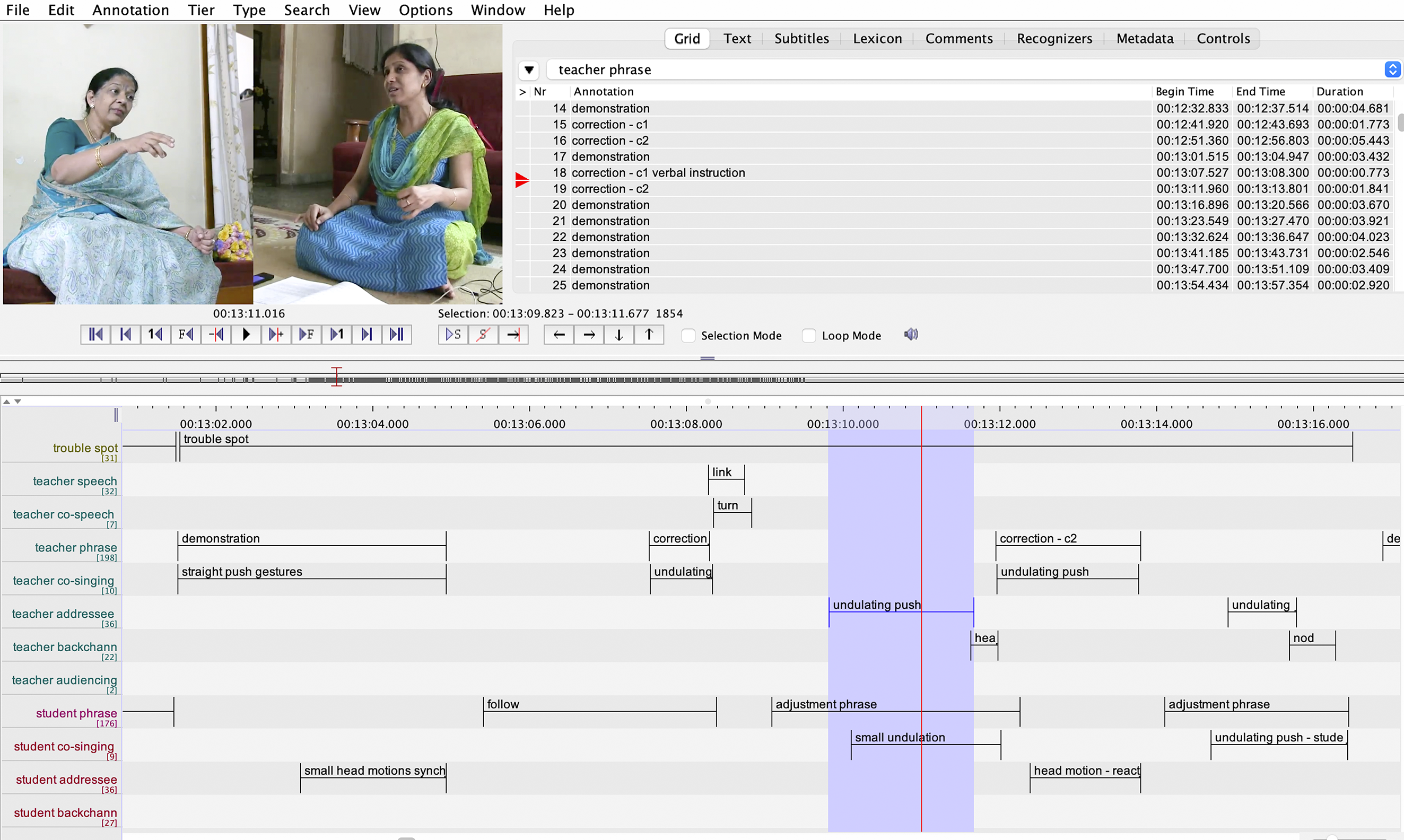
The lesson videos were recorded using two cameras, one facing the teacher and the other the student. I then synchronized and combined these two images into one, as can be seen in the top left of Figure 4. The manual coding for the analyses was created in ELAN video annotation software.Footnote 60 The coding scheme was based on a combination of three factors: what I observed in the videos themselves, my own experience as a student in this pedagogic context, and the concepts drawn from the gesture studies literature, outlined earlier. As seen in Figure 4, tiers were created in ELAN for both teacher and student for the categories speech, co-speech gesture, sung phrase, co-singing gesture, addressee gesture, backchannels, and trouble spots (periods during which the teacher corrects the student). In addition, I included tiers for teacher and student audiencing in which I added any other notes on audiencing events. The backchannel tier is used for conventionalized utterances and gestures such as head nods and shakes or short utterances that provide feedback on agreement and understanding, while the addressee gesture tier is used for gestures that accompany and correspond with another person’s speech or singing.Footnote 61 However, as will be seen, the two types of gesture overlap to some extent; for example, addressee gestures can also provide feedback for the other person and so can have some of the same qualities as backchannels.
An example of annotations created manually in ELAN annotation software. The tier names run down the far left side and annotations are in the central timeline panel. The lesson video with teacher and student images combined is in the top left. Images by Lara Pearson.

Figure 4. Long description
At the top left, two video frames show a teacher and a student seated indoors. To the right, a table lists annotation events with columns for annotation type, begin time, end time, and duration. The central panel displays a horizontal timeline divided into labeled tiers: trouble spot, teacher speech, teacher co-speech, teacher phrase, teacher co-signing, teacher addressee, teacher backchannel, teacher audiencing, student phrase, student co-signing, student addressee, and student backchannel. Each tier contains rectangular blocks representing annotated events, such as ‘demonstration’, ‘correction - c2’, ‘undulating push’, ‘small head motions synch’, and ‘adjustment phrase’, aligned with specific timecodes. The timeline is marked with a vertical red line and a highlighted blue segment, indicating the current selection. Navigation controls and menu options are visible at the top.
Using this coding system, I annotated the entire rāga ālāpana section of the lessons. In T. S. Sathyavathi’s lesson, the ālāpana segment was twenty minutes long and rāga Sahana was performed; in Suguna Varadachari’s lesson, the ālāpana segment was sixteen minutes long and rāga Mukhari was performed. As a first step, I coded the ‘in’ and ‘out’ point of vocal and gestural events and added details on gesture form or type of utterance (see Figure 4). Focusing especially on audiencing gestures (backchannels and addressee gestures), I then explored the annotated recordings in detail, noting the structures and specifics of interactions where audiency was apparent. The results of these analyses are discussed below. Videos of all the interactions discussed in this analysis can be viewed through the links given in the footnotes.
A note on analytical methodologies
Despite the benefits of the methods used here, for example in revealing interactional structures and processes, there is a friction I experience in the resulting analysis, namely the tendency for such detailed analysis to create a sense of distance from what is analysed. In the case of music analysis, in the moment of reading the analysis, we might feel distanced from the human experience of playing or listening to that music. As this article focuses on human interaction — vocalists’ gestures and utterances — it can therefore appear that I distance myself (and the reader) from the performers whose interactions are discussed. This is problematic, because although I am aware that the micro-analysis of human interaction as it appears on the page may temporarily render the holistic individual somewhat distant, I personally do not feel this distance. This then creates a potential difference or friction between my experience and that of readers. Some of the performers in the videos analysed are my long-term collaborators; while watching the videos and making these analyses, I feel close to these performers because of the memories I hold of them beyond the videos themselves. In addition, I experience a resonance with the students because their actions and position remind me of my own experiences of learning in the same way, in similar contexts. In line with these observations, Julia Katila and Sanna Raudaskoski note that the analysis of interaction is itself embodied and interactive, often involving a bodily empathizing with the research participants.Footnote 62 As a result, when I create these analyses, I feel closer to, rather than more distant from, the performers. However, it is challenging to convey this human and holistic experience in a primarily analytical text, which is a disadvantage of such close analysis.
My desire to explore musical interactions in depth emerges from my experiences of learning to play Karnatak violin in South India. I would argue that, particularly when supported by such personal experience, an analytical focus on the bodily interactions that are part of making music is consistent with a practice-oriented research approach. In looking at bodily interaction, I am discussing the moment-to-moment details of what students and teachers do to make the lesson process work. Therefore, although this analysis may fail to do justice to the holistic experience of the performers who appear in the videos, my goal is for it to engage sympathetically with details of their practice that are likely to be of significance to them.
Analyses
Spatial orientation and gaze
In the two lessons analysed, teacher and student sit facing each other at a distance that allows easy view of the other person while not being uncomfortably close (c. 1.5–2 metres apart). In both lessons, the teacher sits on a chair or raised bench and the student sits on a floor mat. Although the raised sitting position may signal the teacher’s higher status, the choice may also be influenced by a need for physical comfort, considering that the teacher sometimes sits for extended periods of time while giving multiple lessons.
Although teachers and students tend to look towards each other throughout the lessons, students sometimes close their eyes while singing and then open them again to watch the teacher demonstrate the next phrase. In the lesson given by T. S. Sathyavathi, there is a notable interaction that reveals something of her attitude towards her student’s gaze, as can be seen in the first video excerpt.Footnote 63 Soon after the beginning of the rāga ālāpana, her student, Ashwini Satish, closes her eyes and then keeps them closed both while singing and during the teacher’s demonstration. This continues for approximately three demonstration–imitation turns, almost twenty seconds, before the teacher speaks up, saying ‘nōḍu nanna’, meaning ‘look at me’ (0:22 in the video).Footnote 64 The student immediately opens her eyes and smiles. T. S. Sathyavathi then repeats the phrase while her student watches her, and they each smile warmly at the other for a short time as they continue with the lesson.
The interaction makes it clear that T. S. Sathyavathi prefers her student to watch her as she sings. Furthermore, the teacher’s co-speech gesture at this point is worth noting. As she says the phrase ‘nōḍu nanna’, she moves one hand forwards with an upward-facing palm. ‘Palm-up’ gestures in which the hand moves forwards towards the interlocuter are discussed in the gesture literature as being ‘presentational’, with some authors highlighting the possible meaning of ‘offering’.Footnote 65 So in this example, the teacher’s gesture could be interpreted as emphasizing that she is offering something to the student. However, as most gestures do not have standardized meanings, it is important to look at the immediate context of the gesture and to consider the intent of the person making it.Footnote 66 In this case, co-occurring with the instruction to look at her, it seems as though the teacher is reaching out towards the student in an attempt to connect with her, and the smiles that follow confirm that the connection is made. The teacher then keeps her hand in this ‘palm-up’ posture while repeating the melodic phrase — maintaining a sense of offering a connection — before returning to a more typical co-singing hand posture for the phrases that follow (0:23 onwards in the video). From this point, teacher and student look towards each other most of the time, with the student only occasionally closing her eyes while singing. In the other lesson analysed, given by Suguna Varadachari, her student, S. Hiranmayee, also sometimes closes her eyes while singing, as though to concentrate better, but always opens them soon afterwards to watch her teacher’s demonstration or correction phrase. In these lessons at least, there is a clear unspoken understanding that looking as well as listening is important for the pedagogic process.
Backchannelling as audiencing
In both lessons, teacher and student regularly audience each other through gesture and utterance. A large proportion of such audiencing actions fall under the category of backchannelling, including head nods or shakes, brief hand gestures, and utterances that provide feedback from the auditor. The analyses below describe two stretches of interaction that highlight the typical use of backchannels for audiencing in these lessons, as well as a more distinctive example.
A common use of backchannels can be seen in the lesson given by Suguna Varadachari.Footnote 67 The first backchannel from the student occurs during a short hiatus within the teacher’s demonstration phrase (0:03) and is almost imperceptible, consisting only of a slight head nod and eye blink. The student’s second backchannel (0:07) is clearer and comprises a head tilt combined with a small up-and-down movement of her hand and a slight ‘tut’ utterance (0:06–0:07). Based on their immediate context, these backchannels produced by the student appear to be positive acknowledgements of the teacher’s phrases. The second, more obvious student backchannel, towards the end of the teacher’s demonstration (0:07), could additionally signal the student’s understanding that she should now take her turn and imitate the phrase.Footnote 68
The teacher’s backchannels that follow while the student sings are larger in extent and more emphatic. After the first part of the student’s phrase (0:10), the teacher nods, makes a two-handed downward pressing gesture, and utters the interjection ‘mm’.Footnote 69 Based on the context, this backchannel appears to act as a positive acknowledgement, signalling that the student’s imitation was adequate and that she should continue with the rest of the phrase, which she then does. Before the student has finished the second part of the phrase, her teacher already starts to provide supportive gestural feedback with a head nod and then hand gestures that correspond to the upward pitch movement of the student’s singing at that end of the phrase (0:14). While the head nod is a typical backchannel gesture, providing feedback on the correctness of the student’s performance, the hand gestures (0:14) fit the category of ‘addressee gestures’, in that they are performed by the addressee to correspond with an aspect of the speaker’s or singer’s utterance, in this case corresponding to the singer’s upward pitch movement. At the very end of the student’s phrase (0:15), the teacher provides another clear backchannel with a head nod and an ‘uh’ utterance, while placing her hands down in a neutral position, effectively closing the student’s interaction turn.
Throughout this interaction, backchannels can be seen to help both teacher and student maintain a grip on the interaction by conveying understanding (on the student’s side) and correctness (on the teacher’s side). In this way, the backchannels facilitate smooth turn-taking and aid the flow of the lesson. The teacher’s backchannels in this excerpt also act to audience and support the student in her performance, informing the student that her teacher is closely following what she is doing. The student’s more subtle backchannels act similarly; her acknowledgements are an example of audiencing, showing that she is paying attention to her teacher, and as a result they actively support and validate the teacher in her role.
A distinctive form of backchannelling, also sometimes made by audience members and co-performers at Karnatak concerts, can be seen in the lesson given by T. S. Sathyavathi.Footnote 70 At the ends of the first demonstration and imitation turns (0:02), the student and then the teacher give short head-nod backchannels. As the teacher completes her next demonstration phrase, the student shakes her head and utters a single ‘tut’ sound (0:05) — a dental click, sometimes transcribed in Jefferson-style transcription as ‘.tch’.Footnote 71 A similar but more emphatic slow head shake is given by the student again at the closure of the teacher’s final demonstration phrase of the excerpt (0:12–0:15), this time without the ‘tut’ interjection. These slow head shake and ‘tut’ backchannels are interesting for their similarity to a gesture–utterance combination sometimes made by audience members and co-performers at Karnatak music concerts, an observation based on my own experience of attending concerts in India and subsequently confirmed in conversation with Karnatak musicians.
An example can be seen in a performance given in Mangaluru in 2014, where the vocalist, Hemmige Prashanth, produces head-shake backchannels at the ends of several phrases performed by the violinist T. K. V. Ramanujacharyulu, one of which (0:24) coincides with a ‘tut’ interjection.Footnote 72 As in the lessons analysed here, the head shake and ‘tut’ are sometimes combined, but often the head shake occurs alone. Although I could find no discussion of this particular interjection in scholarly texts, the general tendency for concert audiences in India to show appreciation for outstanding passages through interjections is well documented.Footnote 73 Chloe Alaghband-Zadeh, writing on music connoisseurs, known as rasikas, at North Indian classical music concerts, notes:
when rasikas hear something they consider praiseworthy, they might indicate this by waving one arm in the direction of the performers, moving their heads, glancing at the people around them, or uttering stereotypical expressions of appreciation, comments such as ‘Shābāsh!’ (Well done!), ‘Vāh!’ or ‘Vāh vāh!’ (Wow!), ‘Kyā bāt hai!’ (What a thing!), or simply ‘Ah!’Footnote 74
I suggest that the slow head shake and ‘tut’ interjection seen in this lesson is a variation on these, expressing in a more understated way that the auditor is impressed by and appreciates something about the performance. In literature on interjections outside music contexts, the ‘tut’ dental click is discussed as expressing either affect or affirmation/negation.Footnote 75 Regarding the expression of affect, David Gil notes that while the ‘tut’ is most often used for instances of negative affect, in some languages and situations it can be used to express positive affect, such as amazement and appreciation.Footnote 76
Another factor to consider is the extent to which expressions of appreciation and understanding are likely to overlap in this context. The dictionary meanings of the two terms are related, with appreciation meaning to understand and grasp the implications of a situation.Footnote 77 Furthermore, in both the Hindustani (North Indian) and Karnatak (South Indian) traditions, knowledge of rāga is highly valued, even in audience members.Footnote 78 As a result of the common idea that some understanding is necessary to fully appreciate a performance, expressions of appreciation are likely to overlap with expressions of understanding.
In the lessons analysed here, slow head shakes and ‘tut’ interjections are given several times by both students. For example, in Suguna Varadachari’s lesson, her student frequently gives a single shake of the head together with the ‘tut’ interjection while the teacher demonstrates a phrase.Footnote 79 By providing this backchannel that can also be found in concert settings, the student audiences the teacher, signalling understanding and appreciation, thereby validating her teacher in both her teaching and her performing roles.
Addressee gestures as audiencing
In addition to backchannels, the lessons include numerous examples of addressee gestures for audiencing. Addressee gestures have been defined as gestures made by the addressee that correspond with the speaker’s utterances, but in this musical scenario, they correspond with the singer’s vocalizations.Footnote 80 A key difference between addressee gestures and backchannels is that backchannels are short, conventionalized gestures and utterances, such as head nods or shakes and ‘mm’ or ‘uh’ utterances, while addressee gestures, as we shall see, are less conventionalized.
Although teachers often make addressee gestures when they are in the process of correcting the student, they also sometimes produce such gestures in the absence of any correction. In a later part of the lesson given by Suguna Varadachari, the teacher begins by demonstrating a descending phrase, and while doing so she produces a co-singing gesture where her hands pull apart from each other three times in gentle undulations, before she points downwards for the lowest pitch at the end of the phrase (0:00–0:03).Footnote 81 During the student’s imitation of the same phrase, the teacher makes a highly similar set of two-handed undulating gestures that rhythmically correspond to the vocal articulations of her student’s rendition as they did in her own demonstration phrase (0:04–0:05). This is a clear, straightforward addressee gesture: the person who is not singing (the teacher in this case) is gesturing while the other person sings, and the gesture corresponds with the singing of the other person.
It is interesting that in this excerpt, the teacher makes the addressee gesture even though her student’s eyes are closed at the time. In this case, it appears that Suguna Varadachari is not making a determined attempt to communicate with the student through gesture, but rather her gestures at this point seem to arise more from her overarching intent to teach and her desire that her student should sing the phrase correctly. Nevertheless, the gesture can still be considered an act of audiency. If the student had opened her eyes a little earlier, she would have seen that her teacher was supporting her performance by gesturing along with it in a way that provides information on the correct articulation of the phrase.
The connection between gesture and melodic movement in this phrase is crossmodally iconic in several ways. Firstly, each of the teacher’s gesture strokes coincides with each of the vocal articulations, so each gestural articulation is crossmodally iconic of a vocal articulation. Secondly, the gesture shows iconicity between pitch movement and vocal movement, based on the underlying embodied metaphor and crossmodal correspondence between pitch ‘height’ and vertical hand position in space. We can see this iconicity most clearly in the teacher’s first co-singing gesture (0:00–0:03), where her hand movements outline small curves that are iconic of the co-occurring melodic curves — short, gliding upward movements. Also, towards the end of the phrase (0:02), the teacher points her hands downwards, which is iconic of the downward pitch movement at that point.
An important feature of this example, also seen in most addressee gestures given by teachers in the videos analysed, is that the teacher’s addressee gesture is highly similar in its form and trajectory to her co-singing gesture that precedes it. In this way, a connection is forged between the teacher’s performance of the phrase and the student’s performance with which the addressee gesture co-occurs. The next example provides a more emphatic demonstration of such connections across times and modalities.
Later in the lesson given by T. S. Sathyavathi, the teacher’s addressee gestures occur in the more complex context of an attempted correction to her student’s imitation.Footnote 82 In her initial demonstration phrase, T. S. Sathyavathi produces a co-singing gesture with three ‘pushing forwards’ strokes that each coincide with a point of vocal emphasis (0:01–0:03). As the student starts her imitation, the teacher quickly notices a problem and interrupts by singing and gesturing over her attempt (0:05–0:06). The teacher’s gesture here differs from her original demonstration phrase’s co-singing gesture — it is now an ‘undulating push’ gesture, with a swooping down and then up movement that travels towards the student (0:06). Immediately following this the teacher utters the word ‘link’, indicating that she wants the student to link the svaras (notes) more smoothly.
The student then makes another attempt at singing this part of the phrase (0:08–0:10), during which the teacher produces the new ‘undulating push’ gesture as an addressee gesture, timed to coincide with the relevant points of the student’s phrase. Interestingly, these ‘undulating push’ gestures are also mirrored in the teacher’s head movements, demonstrating how gestures can sometimes be distributed across different bodily effectors.Footnote 83 The teacher shakes her head and grimaces to indicate that the student’s second attempt is still not correct, and then demonstrates this part of the phrase again, together with the ‘undulating push’ gestures (0:10–0:12). During the student’s final and successful attempt at the phrase, the teacher once again produces the same addressee gesture to coincide with the relevant points of the student’s phrase (0:13–0:14).
The excerpt discussed above is a nice example of how Karnatak vocal teachers often spontaneously use gesture to emphasize, through crossmodal iconicity, qualities of articulation or musical motion that they wish to hear in their student’s performance. It also highlights how teacher addressee gestures can facilitate the correction. In this example, the teacher alters her original demonstration gesture (three straight pushes forward) to something that better expresses the linked quality she wants to hear — an undulating pushing-forwards movement. She then produces this gesture repeatedly with both her own singing and with her student’s singing, forging connections between the two.
Another matter of interest in this same lesson is that, during the last two of the student’s renditions (0:08–0:10, 0:13–0:14), the student’s own co-singing gesture shows signs of convergence or alignment with her teacher’s ‘undulating push’ gesture.Footnote 84 Such gestural alignment has previously been noted in co-speech contexts.Footnote 85 Through this alignment of her gestures with those of her teacher, the student adjusts physically to her teacher’s performance — an example of ‘adjustment to the response of the other’.Footnote 86 The next and final excerpt will provide a further example of student gestural alignment.
There are several occasions in the two lessons where a student produces small hand gestures that subtly appear to track the melodic and bodily motion of the teacher while she sings. However, in the final excerpt of the lesson given by T. S. Sathyavathi, the student adjusts to the teacher not only through her hand movement but also across her entire upper body, producing addressee gestures that effectively audience the teacher’s performance.Footnote 87 T. S. Sathyavathi first demonstrates a phrase with rapid, undulating pitch movements, simultaneously producing a co-singing gesture that closely indexes this pitch movement with rising and falling movements of her hand (0:00–0:03). This hand movement also distributes across her body and can be seen to some extent in her head motion. During this demonstration phrase, the student pays close attention and moves her head slightly in alignment with the teacher’s melodic movement and hand movement, although it is extremely subtle at this point.
When the student starts her imitation of the phrase (0:03), her teacher interrupts immediately to demonstrate again, this time singing the phrase with sargam (the names of the notes being sung) to clarify the pitch movement (0:04–0:06). During this second demonstration phrase, the student maps both the melodic and the gestural movements of her teacher with her own hand and head gestures, leading the two performers to appear joined to an extent, moving together. Through her bodily movement at this point, the student adjusts to the responses of her teacher.Footnote 88 The student’s gestures here actively audience the teacher, in that they provide visible evidence to her teacher that her performance is being followed closely. These gestures do not seem to be based on a deliberate decision to provide feedback in this moment; rather, they appear more as the outcome of the student’s overall intent to imitate the teacher and to properly perform her role as a receptive student, which in this moment leads to her aligning closely with her teacher’s movements, both melodic and physical.
Discussion and Conclusions
The analyses above highlight some of the ways that gestures and utterances contribute to audiencing and how such audiencing facilitates the fluent and productive progress of the lessons, as well as supporting and validating both teacher and student in their social roles. In this Karnatak vocal lesson context, skilled gesturing practices enable teacher and student to proceed smoothly through the musical material being taught, without the breaks in flow that would occur if errors and corrections were explained verbally. Instead, gestures and shifts in facial expression are used alongside repetitions of the sung phrase, to index, clarify to, and correct the student.
Two forms of audiencing gestures are identified in the analyses: backchannels, which are typically brief and often occur at the ends of phrases, and addressee gestures, which tend to move along with the vocalist’s performance, usually having an iconic or indexical relationship with the sung phrase and accompanying body movement. The analyses show how backchannels can help student and teacher maintain their grip on the interaction by efficiently communicating either understanding (in the case of the student) or correctness (in the case of the teacher) so that the next interaction turn can be taken without delay or confusion. In addition, such backchannelling explicitly audiences and therefore supports the other person, providing evidence that they are actively listened to and demonstrating that the teacher and student are placing effort into their teaching and learning, all of which contributes to validating the other person in their role.Footnote 89 I would argue that such dynamic validation is key to the social pleasure that can be experienced in lessons.
In the lessons analysed, addressee gestures made by the teacher while audiencing the student appear as attempts to help the student sing correctly, highlighting those aspects of the phrase that the teacher feels to be important (for example, articulation, emphasis, or pitch movement) while the student sings. Such addressee gestures can be viewed as attempts by the teacher to control and maintain some grip on the student’s performance, which of course may or may not be successful. When the teacher’s addressee gestures occur sufficiently ahead of the student’s singing, the gestures have the potential to guide the student in that moment, acting as a form of conducting. However, most teacher addressee gestures do not appear sufficiently early to enable this. In such cases it is possible that any information conveyed is more cumulative; over the course of the interaction or lesson, the student may gradually come to understand what the teacher aims to convey through the gesture–vocalization connections. In this way, gestures can help to create ‘common ground’, a shared understanding between teacher and student.Footnote 90 Beyond the immediate pedagogical goals of addressee gestures, Martha Alibali et al. make the important point that they can act to ‘support others’ turns at talk’.Footnote 91 So in addition to any potential benefit through facilitating student learning, teachers’ addressee gestures are an explicit indication of support, showing an active interest in the student’s ability to perform correctly and thereby contributing positively to the teacher–student relationship.
As students audience their teachers, they can be seen making bodily adjustments to the teacher’s gestural and vocal movements. The students’ adjustments in these lessons are often subtle, evident only in small hand and head movements. But sometimes they are more obvious, and can be visible across the student’s upper body movements, as seen in the final excerpt.Footnote 92 Student addressee gestures that align with the singing and gesturing of their teacher may help the student gain a grip on the phrase — to feel it through their own bodily movement before attempting to vocalize it.Footnote 93 Equally, such gesturing may express their confidence that they understand the phrase. Either way, these bodily adjustments made during audiencing are consistent with Mead’s theorizing of a ‘conversation of gestures’, in which each person adjusts to the response of the other, although in the case of addressee gestures the adjustment occurs almost simultaneously.Footnote 94 Such bodily adjustments suggest that audiencing might be better understood as an ‘adjustment to’ rather than as simply an ‘observation of’ the other person, in line with Mead’s theorizing of social interaction. Students’ addressee gestures also explicitly demonstrate to the teacher that the student is trying to understand and learn, and thereby validate the teacher in her role. Like backchannels, addressee gestures can also express the auditor’s support for the other person, and so these bodily interactions are likely to be positive for the teacher–student relationship, as well as providing a pleasurable experience of the immediate social interaction.
Regarding the intent behind gesturing, I suggest that the gestural interactions analysed here appear not to arise from multiple deliberate decisions to communicate certain details but instead are driven by a strong overarching intent to either teach or learn. In Merleau-Ponty’s words, the gesturing is not a matter of ‘I think’;Footnote 95 the gestures are not arising from reflection at that moment but instead are guided by a more generalized intent and ability to recognize affordances that further the interactants’ goals. As such, their gesturing aligns well with the concept of motor intentionality, with teacher and student responding skilfully to the felt demands of the situation through their gestures, gaze, and stance in ways that are founded on both their immediate intent and wider experience.Footnote 96 This experience includes not only their history of lessons and the skills they have developed over many years but also the norms of the wider social environment.Footnote 97
Although the process through which people become competent performers varies greatly across music traditions, there is much in these Karnatak music lessons that is relevant more widely, both to other music lesson scenarios and to music-making in general. Playing in various configurations either with or for your teacher is part of many musical traditions, and so audiencing and performing necessarily play a role in such performance training settings. Therefore the analysis presented here should resonate beyond this particular tradition.
In conclusion, I propose that the types of gestural interactions and bodily adjustments explored in this article lie at the heart of musical experience and should be understood as key aspects of what music is, beyond sound alone. I refer here not only to the pleasure of bodily movement but also to the sociality of such interaction and the role validation it affords. In the Karnatak lessons analysed, this sociality is a key element of the lesson performance, with the extended and active audiencing given to both teacher and student likely providing significant rewards to all involved. Also beyond this context, music is inherently interactional, with bodily and sonic interplay being two facets of the same phenomenon.Footnote 98 This being the case, the analysis of bodily interaction in a wide range of performance settings should make a significant contribution to music theory, revealing the structures and processes that constitute music and helping us to gain insight into how aspects of musicking beyond the sound itself can be artfully constructed and pleasurable. By focusing on audiency as an action that co-constitutes performance, we necessarily throw the focus onto music as interaction. It is hoped, therefore, that the concept of audiency as an active and embodied adjustment to the other can be productive for music theory in general and audiency studies in particular.

 Open access

