1. Introduction
The fact that adult learners of L2 Spanish can indeed achieve native-like competence with the formal subject syntactic properties of Spanish has been attested in several studies. These learners know from relatively early that null and overt subjects can alternate and that both preverbal and postverbal subjects are allowed in Spanish (Liceras, Reference Liceras, Gass and Schachter1989; Al-Kasey and Pérez-Leroux, Reference Al-Kasey, Pérez-Leroux, Flynn, Martohardjono and O'Neil1998; Hertel, Reference Hertel2003; Lozano, Reference Lozano2002, Reference Lozano2006; Montrul and Rodríguez Louro, Reference Montrul, Rodríguez Louro, Torrens and Escobar2006, Belletti, Bennati and Sorace, Reference Belletti, Bennati and Sorace2007). Yet the discursive properties which constrain the native use of null vs. overt subjects and subject–verb inversion at the syntax–discourse interface might remain problematic even for advanced or near-native L2 learners of Spanish (Pérez-Leroux and Glass, Reference Pérez-Leroux, Glass, Pérez-Leroux and Glass1997, Reference Pérez-Leroux and Glass1999; Liceras and Díaz, Reference Liceras and Díaz1999; Lozano, Reference Lozano2002, Reference Lozano2006; Hertel, Reference Hertel2003; Montrul, Reference Montrul2004b; Belletti et al., Reference Belletti, Bennati and Sorace2007; Sorace and Filiaci, Reference Sorace and Filiaci2006). The development of syntactic and discourse properties of subjects has also been studied in the context of early bilingual first language acquisition involving English and Spanish or Italian (Paradis and Navarro, Reference Paradis and Navarro2003; Serratrice, Sorace and Paoli, Reference Serratrice, Sorace and Paoli2004; Liceras, Fernández-Fuertes and Pérez-Tattam, Reference Liceras, Fernández-Fuertes, Pérez-Tattam, Pérez, Bel and Juan2008, among others). However, this non-native development of stylistic and syntactic properties of Spanish subjects has not been explored in child second language acquisition (henceforth L2A), which might provide relevant results to the existing research.
The status of child L2A in itself and in comparison to adult L2A and monolingual and bilingual L1A has lately become a research focus (Schwartz, Reference Schwartz, van Kampen and Baauw2004; Meisel, Reference Meisel2007, Reference Meisel, Haznedar and Gavruseva2008; Unsworth, Reference Unsworth, Brugos, Micciulla and Smith2005a, Reference Unsworthb; Haznedar and Gavruseva, Reference Haznedar, Gavruseva, Haznedar and Gavruseva2008, among others). The present study examines the acquisition of both syntactic and stylistic subject properties of child L2 Spanish and provides elements of comparison to child L1A by means of data from the control groups and, more indirectly and only in qualitative terms, to adult L2A studies of the same constructions. Three experimental age groups are tested, namely five-, ten- and seventeen-year-old British children, who were all first exposed to Spanish at the age of four in the context of an immersion Spanish school in London. A contextualized acceptance and preference test with paired target sentences was carried out orally and with puppets as a prompt for the five-year-olds and by means of a written test for the older children. Children were presented with paired sentences which contained syntactically and stylistically (im)possible null and overt subjects in main and embedded clauses and instances of subject–verb inversion with both unergative and unaccusative constructions in neutral and focused contexts and with transitive verbs. Three control groups of Spanish native children of the same ages were also tested. Results suggest that the purely syntactic properties of Spanish subjects can be acquired by child learners, although not fully by the first two age groups. Constraints at the syntax–discourse interface prove more difficult to acquire and some optionality still remains in the seventeen-year-old group.
This paper is organized as follows: section 2 presents the syntactic account of subjects in Romance languages adopted in this study; section 3 reviews the discourse–syntactic constraints on Spanish subject use and explores the L2A research conducted in the field; section 4 focuses on the present study and its methodological aspects; section 5 analyses the results, focusing on subject development through the age groups and on the differences between experimental and control groups; and section 6 discusses the results and draws basic concluding remarks.
2. Preverbal, postverbal and null subjects in Spanish
The present research follows Platzack's (Reference Platzack2004) syntactic account of subjects, the Person Phrase Hypothesis, which provides a unified way of accounting for subjects and agreement in both null- and non-null-subject languages according to a minimalist view of parameters and the EPP (extended projection principle).Footnote 1, Footnote 2 Following Ritter (Reference Ritter1995), Platzack (Reference Platzack2004) argues that agreement (Agr) originates as the head of a Person Phrase (PersP), which can take a Determiner Phrase (DP) as a complement and which is merged in a theta position, as the subject in Spec-vP. Depending on the element taken from the lexicon to express Pers°, several possibilities arise. If the element expressing Pers° has grammatical but not phonological features, PersP will appear as a DP. This could be the case of the DP the girl in English, analysed as in (1):
(1) [PersP [Pers° G(rammatical features) [DP the [NP girl]]]]
If the element merged as Pers° has grammatical as well as phonological features, this element can either be a free morpheme or a bound morpheme. If it is a free morpheme, it will be a pronoun with or without a DP complement, as in (2a) and (2b) below:
- (2)
a. [PersP [Pers° he [DP the [NP handsome man]]]]
b. [PersP [Pers° he [DP G(rammatical features)]]]
If it is a bound morpheme (Agr), as happens in languages with rich agreement, such as Spanish or Italian, it should find a host outside PersP. T will assign Case to PersP and the EPP feature in T will attract Pers° (Agr) to T, projecting a new PersP. V will also be attracted to T and then internally merged to PersP without projecting. Finally, morphological merger will take place and Pers°+T will be realized as an affix on V. In languages without V-raising, such as English, agreement is not an argumental affix and Pers° is either a free morpheme (i.e., a pronoun) or it is not phonologically realized and PersP is represented as an ordinary DP. In those languages, PersP (i.e., the subject) would subsequently raise to Spec-T attracted by the EPP feature in T.
In a Spanish subjectless sentence such as (3) Compraron manzanas “(They) bought (some) apples”, the derivation would work as follows: the subject is a PersP (with no DP complement) in Spec-vP, where it is assigned an Agent theta-role. T assigns Case to PersP and the EPP feature in T attracts Pers° (-ron) to T. The verb (compra-) is also attracted to T and then internally merged to PersP. After morphological merger, Pers°+T is realized as an affix on V. Under this approach, the existence of pro as a null subject is therefore unnecessary, as the EPP feature is already satisfied and Case and theta-role are already assigned to PersP:
(3) Compraron manzanas
“(They) bought (some) apples.”


As for structures where Pers° has a complement DP, this DP subject can either remain in situ (in Spec-vP), thus resulting in a postverbal subject, as in (4), or it can move out of the PersP to an A′-position in the C-domain, presumably checking pragmatic features, as in (5). This overt DP can either be a full DP or a focused pronoun in SpanishFootnote 3:
(4) Llamaron mis padres
“Called my parents”
(5) Mis padres llamaron
“My parents called”
The DP subject mis padres is the complement of Pers° in Spec-vP. Platzack assumes that PersP is a phase and, as such, no element can move out of it before being moved to Spec-PersP. The author further assumes that such movement within PersP must be an instance of A′-movement, since if it were an instance of A-movement, we would expect the DP to bind Agr, and Agr would be an anaphor. As previously noted, Agr is pronominal in Spanish and hence does not need an antecedent within the clause, as subjectless derivations such as (3) indicate. If movement of the DP to Spec-PersP is an instance of A′-movement, Platzack concludes that the movement of the DP out of PersP to the C domain must be A′-movement as well.Footnote 4 Thus preverbal subjects cannot ultimately be in an argument position. Such an approach to Spanish preverbal subjects is in line with previous accounts of Agr as [+interpretable] (Alexiadou and Anagnostopoulou, Reference Alexiadou and Anagnostopoulou1998; Ordóñez and Treviño, Reference Ordóñez and Treviño1999, among others).
In short, the contrast between Spanish and languages with obligatorily overt subjects within the present approach is captured by Platzack's claim that “T with [uф]EPP can be satisfied either by PersP raising to Spec-TP (visible subject) or agreement merging to TP (potential null subject)” (2004, p. 107). That is to say, the way in which T, which bears uninterpretable ф-features and the EPP-feature, satisfies and checks all its features is parameterized. Spanish merges Agr to TP and languages such as English raise PersP to Spec-TP. It follows then that English will only allow preverbal overt subjects, whereas Spanish, by virtue of the fact that the EPP feature in T is already checked by Agr merging, does not require preverbal overt subjects but allows null and postverbal subjects. In the case of having a preverbal overt subject in Spanish, this will not be in Spec-TP but in an A′-position within the C-domain as its movement is not due to syntactic but to pragmatic reasons.Footnote 5
3. Discourse constraints on Spanish subject use and L2A research
3.1 Null versus overt pronominal subjects and preverbal versus postverbal subjects
Although Spanish has the grammatical option of omitting lexical and pronominal subjects, their omission is not entirely optional but constrained by discourse–pragmatic considerations.Footnote 6 In general terms, the overt use of a personal pronoun in a position where it could normally be omitted results from emphatic or contrastive reasons, whereas its omission indicates neutrality or lack of emphasis, as the examples below illustrate:
(6) ¡Él hizo trampas!
“He cheated!” (and not me or anyone else – emphatic use)
(7) ¡Ø Hizo trampas! (neutral use)
Overt subject pronouns are hence used for emphasis and the disambiguation of the referent and are interpreted as focused elements which give new and contrastive information whereas null-subject pronouns represent continuity in discourse topic and hence cannot be used when the information of the subject is new in the discourse:
- (8)
a. ¿Quién viene?
“Who comes?”
b. Ella viene.
“She comes”
c. *Viene.
“(She) comes”
- (9)
a. ¿Quién cree Juani que __ ganará el premio?
“Who does Juan believe will win the prize?”
b. Juani cree que éli/*proi ganará el premio.
“Juan believes that he will win the prize”
c. ¿Qué cree Juani que obtendrá __ en el concurso?
“What does Juan believe he will get in the contest?”
d. Juani cree que *éli/proi ganará el premio.
“Juan believes that he will win the prize”
(Pérez-Leroux and Glass, Reference Pérez-Leroux and Glass1999, p. 226)
In (8), an overt pronoun is required as the subject encodes new information. In (9), the questions set the discourse interpretation. Thus (9a) focuses the discourse on the subject of the embedded clause and hence a null pronoun is disallowed, whereas in (9c) the question is about the object of the embedded clause, and therefore the subject represents old information in the discourse (i.e., the topic) and may remain null.
Given that pronoun omission indicates lack of emphasis, it has been claimed that the expression vs. omission of pronouns in Spanish has the same function and anaphoric use as strong (emphatic use) vs. weak pronouns (neutral use) in languages such as English, which do not permit pronoun omission and in which the use of overt pronouns is non-emphatic by default (Luján, Reference Luján, Bosque and Demonte1999). Thus English (10a) would correspond to Spanish (10b) in terms of pronoun use:
- (10)
a. He/He (and not me or anyone else) cheated!
b. ¡Ø/Él (and not me or anyone else) hizo trampas!
In the case of a series of sentences or complex sentences with a subordinate clause, the use of pronouns and their co-reference is also constrained by discourse–pragmatic considerations. According to Montrul (Reference Montrul2004a), if we have two sentences in a discourse with the same reference, an overt pronoun in the second sentence is pragmatically odd and an overt lexical subject is ungrammatical, as in (11). Yet pronoun omission is odd when there is a switch in reference, as in (12):
(11) Pepe no vino hoy a trabajar. *Pepe/?Él/Ø estará enfermo.
Pepe no came today to work. Pepe/He/Ø will be sick.
“Pepe did not come to work today. He must be sick.”
(12) Hoy no fui a trabajar. Pepe/Él/*Ø pensó que estaba enferma.
Today no I went to work. Pepe/He/Ø thought that I was sick.
“Today I did not go to work. Pepe/He though I was sick.” (2004a, p. 176)
Within sentences with a main and a subordinate clause, the presence vs. the omission of a subject pronoun also gives rise to significant differences in co-reference and interpretation. The following sentences (Luján, Reference Luján, Bosque and Demonte1999) illustrate this:
- (13)
a. Cuando él/Ø trabaja, Juan no bebe. (él ≠ Juan; Ø = Juan)
a′. “When he/he works, Juan doesn't drink.” (he ≠ Juan; he = Juan)
b. Cuando Juan trabaja, él/Ø no bebe. (él ≠ Juan; Ø = Juan)
b′. “When Juan works, he/he doesn't drink.” (he ≠ Juan; he = Juan)
c. Juan no bebe cuando él/Ø trabaja. (él = Juan; Ø = Juan)
c′. “Juan doesn't drink when he/he works.” (he = Juan; he = Juan)
d. Él/Ø no bebe cuando Juan trabaja. (él/Ø ≠ Juan)
d′. “He/he doesn't drink when Juan works.” (He/he ≠ Juan)
As the examples indicate, the differences in co-reference between the referential element Juan and the pronominal element él or the null element in Spanish correspond to the differences in co-reference between the referential expression Juan and the strong emphatic pronoun he or the weak neutral pronoun he in English. In (13a) and (13b), the overt pronoun él gives rise to “disjunctive reference” (Luján, Reference Luján, Bosque and Demonte1999, p. 1279) with respect to the antecedent Juan, whereas the null pronoun can co-refer with it. That is to say, él necessarily designates someone different from Juan, whereas the null pronoun can refer to it. In (13c), the subordinate clause, where the overt and null pronoun are, is postposed and hence part of the predicate of the main clause. According to Luján (Reference Luján, Bosque and Demonte1999), in that case both the overt pronoun and the null element can co-refer with the lexical referential element Juan. The overt pronoun is not necessarily “disjunctive” here. In (13d), both the overt and the null pronouns give rise to “disjunctive reference” in that neither él nor the null element can co-refer with Juan. A referential expression (i.e., Juan) cannot be given an antecedent.Footnote 7 The above-mentioned “disjunctive” effects of the overt pronoun may disappear and the pronoun can indeed co-refer with its antecedent (preceding or following the pronoun) if the discourse provides a context where the emphatic and contrastive use of the pronoun is required.
Regarding the apparently free word order in Spanish, the possibility for subjects to appear pre -and postverbally is strongly determined by lexical verb class and discourse structure factors, which follow from the minimalist syntactic accounts of Spanish preverbal subjects by which subjects are moved from spec-vP to a preverbal non-argumental position higher than TP and within the CP-domain for pragmatic reasons (Platzack, Reference Platzack2004; Rizzi, Reference Rizzi and Belletti2004, Reference Rizzi2005; Alexiadou and Anagnostopoulou, Reference Alexiadou and Anagnostopoulou1998; Ordóñez and Treviño, Reference Ordóñez and Treviño1999). In sentences with transitive verbs, the subject can appear either preverbally (SVO), postverbally (VSO) or after the object (VOS), although in neutral focus structures, native Spanish speakers tend to prefer SVO orders. Both VSO and VOS orders are possible in contrastive focus (i.e., emphatic) structures and information/presentational focus (i.e., new versus old information) although native Spanish speakers tend to prefer VOS orders and consider VSO orders unnatural and strongly marked.
As for intransitive verbs, they are classified into unergatives and unaccusatives according to the Unaccusative Hypothesis or the Split-Intransitivity Hypothesis (Burzio, Reference Burzio1986; Levin and Rappaport-Hovav, Reference Levin and Rappaport-Hovav1995) and on the basis of where the subject is base-generated. The subject of unergative verbs like gritar “to shout” is generated preverbally in spec-VP, whereas the subject of unaccusative verbs like llegar “to arrive” is base-generated postverbally in object position. The discourse neutral word order for unergative verbs is thus SV, whereas for unaccusative verbs it is VS. Neutral contexts are elicited by the “out of the blue” question “What happened?”, which requires an unfocused answer, as the whole sentence is new information. Spanish inappropriate word order, though not ungrammatical, yields pragmatic anomaly, whereas inappropriate word order in English results in ungrammaticality:
(14)
(15)
While word order is constrained in Spanish by the Unaccusative Hypothesis in unfocused contexts, it is constrained by discourse structure and more specifically by information focus at the syntax–discourse interface. Informationally focused elements (i.e., new information) are placed in sentence-final position in Spanish (Zubizarreta, Reference Zubizarreta1998) and hence syntactic word order is affected. When the subject is informationally focused, as in the answer to the question “Who called while I was gone?”, both unergative and unaccusative verbs trigger VS word orders. In contrast, informational focus is realized only phonologically, but not syntactically, in English, where the focused element is stressed:
(16)
(17)
The syntactic account of information focus to be followed in this study is based on Belletti's (Reference Belletti, Hulk and Pollock2000, Reference Belletti and Rizzi2003) TP-internal presentational focus hypothesis, by which the functional projection Focus Phrase (FocP) is internally merged in TP and above VP. The informationally focused subject is displaced to Spec-FocP, that is to say, in a postverbal position in Spanish, whose verbs typically raise to TP and whose subjects do not raise obligatorily to Spec-TP, as has been seen above. The focus head contains a [+strong] focus feature in Spanish, which triggers movement of the presentationally focused element to Spec-FocP. At the same time, the uninterpretable focus feature in the focus head attracts the interpretable focus feature in the focused subject for checking purposes. In contrast, the focus feature is [–strong] in English and hence requires the focused subject to remain in situ. Recall that English subjects obligatorily raise to Spec-TP from Spec-vP in order to check the EPP feature on T, and that the verb does not raise to TP. The result is that even if the subject is focused, word order remains SV and focus is marked by prosody. Yet interpretative facts also hold in English. The focused subject in Spec-TP carries the interpretable focus feature, which is attracted by and agrees with the uninterpretable focus feature under T.
3.2 L2A research on the discourse distribution of null and overt subjects
Although most L2A studies on the syntactic and discourse properties of L2 Spanish have been conducted with adult learners, and hence direct comparisons with the child L2A data in the present study cannot be made, some of the most relevant and recent research is briefly reviewed here, as it contributes to our understanding of the data presented.
As for the distribution of null and overt subject pronouns, Pérez-Leroux and Glass (Reference Pérez-Leroux, Glass, Pérez-Leroux and Glass1997, Reference Pérez-Leroux and Glass1999) conducted experimental research on elementary, intermediate and advanced adult English speakers learning L2 Spanish and focused on topic/focus environments and Montalbetti's (Reference Montalbetti1984) Overt Pronoun Constraint (OPC) environments.Footnote 8 The Topic/Focus study focused on adult English-speaking learners of Spanish in a classroom setting, who were required to read eight short stories illustrated by a picture to fix the interpretation of the embedded subject as co-referent with the subject in the main clause, and followed by a subject/object comprehension question which they had to answer. Subject questions required an answer with a focused and hence overt subject in the embedded clause, whereas an object question elicited an answer in which the focus was not placed on the embedded subject and hence this was a topic and should be null.Footnote 9
Results indicate that L2 learners increased their use of null pronouns with proficiency in the topic condition and kept them relatively low in the focus condition, although the elementary and intermediate groups produced very similar percentages of overt and null pronouns in this condition. However, the fact that the task involved answering an open question contributed to the large number of “other” responses, which were not relevant for the study. Results were not significantly different between groups and according to story type but, according to the authors, their findings still indicate that all groups discriminate in their use of null-pronoun subjects in topic and focus environments, as the percentages of null pronouns are higher when the pronoun is interpreted as topic than when the pronoun is interpreted as the focus of the sentence. Pérez-Leroux and Glass (Reference Pérez-Leroux, Glass, Pérez-Leroux and Glass1997) conclude that pragmatic/discourse constraints are acquired later, over time and experience, than syntactic constraints, but that results indeed show that L2 learners of Spanish can learn the syntactic and pragmatic distribution properties of null pronouns and the fact that overt and null pronouns are not in free variation.
Also related to null/overt pronominal subject distribution, Sorace and Filiaci (Reference Sorace and Filiaci2006) provided a processing account for the interpretation of intrasentential anaphora by English adult near-native speakers of L2 Italian and native Italian speakers. The authors claim that the syntax–pragmatics interface vulnerability results “not so much from representational deficits, but from inadequate processing resources or ‘shallow’ parsing strategies” (p. 341), along the lines of Clahsen and Felser (Reference Clahsen and Felser2006) and Carminati (Reference Carminati2002, Reference Carminati2005). Participants were presented with complex sentences in which the subordinate clause included an overt or null pronominal subject and either preceded (backwards anaphora) or followed (forwards anaphora) the main clause, and carried out a picture verification task interpreting the possible antecedents of the null/overt pronominal subject.
The authors predicted that the interpretation of anaphoric overt pronouns would be more problematic than that of null pronouns (Belletti, Bennati and Sorace, Reference Belletti, Bennati and Sorace2005; Filiaci, Reference Filiaci2003), allowing overt pronouns in subordinate clauses to co-refer with the subject of the main clause, and that backwards anaphora would create more processing difficulties than forwards anaphora for the near-native group. Results supported these predictions and the authors conclude that although near-native speakers had acquired the syntactic constraints of a null-subject grammar, they did not have the necessary processing strategies to coordinate syntactic and discourse knowledge when linking pronouns to their antecedents, as the optionality found in the interpretation of overt pronouns indicates.
Also focusing on adult L1 English near-native speakers of Italian, Belletti et al. (Reference Belletti, Bennati and Sorace2007) conducted several experiments on the controlled and spontaneous production and interpretation of null and overt pronominal subjects and postverbal subjects across verb types and established comparisons with a group of control native speakers of Italian in order to examine the role of syntactic and discourse factors in near-native subject use. Participants were tested on spontaneous production of null and overt subjects with a story-telling task, on their controlled production of focus new information postverbal subjects with videos and comprehension questions, on their interpretation of null and overt pronominal subjects in anaphora contexts with a picture verification task and on their production of preverbal and postverbal subjects with a headline creation task.
Results indicate that near-native speakers of Italian mastered the crucial properties of the null-subject parameter in their L2, although they showed residual optionality of some grammatical and discourse subject features of their L1 English which are not native-like but compatible with the L2 grammatical system. More specifically, near-native speakers displayed a native-like use and interpretation of null pronominal subjects but an overuse of overt pronouns in inappropriate discourse contexts and a non-native-like interpretation of overt pronominal subjects in anaphora contexts. Likewise, postverbal subjects were underused across verb classes (except with unaccusatives) and new information focused preverbal subjects were overproduced. The authors concluded that the differences found between native and near-native grammars did not only involve the presence of formal grammatical principles but “rather the interplay of formal principles and grammatical options in domains at the interface with discourse” (Belletti et al., Reference Belletti, Bennati and Sorace2007, p. 682). The authors also point out that the dissociation between the accurate use of null subjects and the non-native use of postverbal subjects suggests that the traditional formulation of the null-subject parameter in terms of pro-licensing (Rizzi, Reference Rizzi1982) may not be sufficient to account for both properties in L2 grammars and that discourse factors need to be seriously considered and incorporated in the theory.Footnote 10
Hertel (Reference Hertel2003) and Lozano (Reference Lozano2006)Footnote 11 tested native English adult L2 learners of Spanish on their acquisition of subject inversion according to both syntactic and discourse structure properties. Both studies predicted that L2 learners would present more difficulties acquiring word order with informationally focused structures than in neutral contexts, where the distribution is determined by the unaccusative–unergative distinction.
Hertel's (Reference Hertel2003) study included beginner, low-intermediate, high-intermediate and advanced English-speaking adult learners of Spanish, who completed a contextualized written production task in which they were presented with short stories and had to answer a question which targeted unaccusative and unergative verbs with different information structures. The questions focused on the entire sentence or on the subject, thus triggering a discourse-neutral interpretation or an informationally focused subject, respectively.
Results on the answers to the global questions show that inversion in unaccusatives was mainly produced by the advanced learners and the control group, as the lower-proficiency learners produced little or no inversion, possibly transferring their L1 word order. As for global questions with unergative verbs, percentages of VS orders were very low, though advanced learners produced significantly more inverted sentences than the other learner groups and the native speakers. According to the author, advanced learners seem to have generalized inversion to the unergative verbs in this type of questions. All groups except for beginners produced more VS sentences with unaccusatives than with unergatives, though the difference in verb type was only significant in the case of advanced learners and the native group. Results on focused subject questions revealed that beginner and low-intermediate learners transferred their L1 SV order again, showing that they were not sensitive to Spanish discourse structure and producing practically no VS responses with either type of verb. High-intermediate and advanced learners increasingly produced more VS orders with unaccusative and unergative verbs.
Hertel concluded that the word order effects of verb class and discourse structure are acquired late in L2 Spanish, namely at the advanced level, and preceded by L1 Transfer. Thus the prediction that discourse constraints on word order would be acquired after verb class lexical constraints on word order was not met in this study, as VS percentages rise earlier for focused subject questions in the two verb types than for global questions in the unaccusative verb type. Although, according to the author, advanced learners show native-like sensitivity to verb class and discourse structure, the lexical and focus-related inversion remains optional.Footnote 12
Lozano (Reference Lozano2006) carried out a very similar study to test the distribution of SV and VS word order in adult advanced L2 Spanish, which included two experimental groups of Greek and English adult advanced learners of Spanish and native Spanish speakers. Learners completed a contextualized acceptability judgment test with paired target sentences. Each contextualized stimulus and question represented an unfocused or informationally focused environment with unergative and unnacusative verbs, thus favouring an SV or VS word order. Learners were provided with both orders and were required to rate their acceptability on a five-point rating scale.
Results on unfocused contexts with unergative verbs revealed that both Greek and English learners of Spanish significantly prefer SV to VS, as native speakers do and as predicted by the author's hypothesis. The acceptance of SV did not differ between groups, though the acceptance of the pragmatically odd VS order did differ between groups, with the English and Greek groups accepting a higher percentage of VS orders than the native control group. As for the unfocused contexts with unaccusative verbs, results showed that both groups of learners significantly prefer VS to SV, as the native control group did, and supporting the author's predictions. In this case, the acceptance of both VS and SV did not differ between groups, showing native-like knowledge.
Regarding informationally focused contexts, where VS is the preferred order with both unergative and unaccusative verbs, results revealed that whereas the native control group significantly preferred VS to SV order with both types of verbs, L2 learners simultaneously accepted both SV and VS orders, resulting in non-native optionality. Between-group comparisons show that although the learners’ acceptance of the preferred VS order did not differ significantly from that of the native control group, their acceptance of the pragmatically odd SV order was significantly higher that that of the control group. Overall, results clearly indicate that properties at the syntax–discourse interface were persistently more problematic for advanced speakers than syntactic properties, as was observed in previous studies.
I would like to point out that the L2 studies reviewed in this section cannot be directly compared to the child L2 data obtained and discussed in the present study, since these studies deal with L2 adult informants, whose input and type of exposure are radically different from the ones children in the present study received and since the data elicitation techniques also differ in each study. However, and as cross-sectional studies on the child L2A of subjects are practically non-existent, the present review of the literature contributes to the relevance of the data presented here.
4. The study
4.1 Aims, research questions and hypothesis
This study examines the acquisition of both syntactic and stylistic subject properties of L2 Spanish in five-, ten- and seventeen-year-old British children, who were all first exposed to Spanish at the age of four in the context of an immersion Spanish school. More specifically, and in the light of previous L2 studies on the syntactic and discourse subject properties focusing only on adult learners, it aims to explore whether and to what extent British child L2 learners of Spanish can indeed achieve native-like results in their judgment and preference of overt vs. null pronominal subjects and preverbal vs. postverbal subjects in a cross-sectional experimental task.
As all the children tested in the study started their L2 acquisition of Spanish at the age of four in an immersion context, and Spanish was not their home language, we can safely assume that these children are true child L2 learners, whose acquisition will be compared to L1 Spanish children. The study of child L2A has lately become a focus of research, particularly regarding its similarities and differences in different grammatical areas with respect to child L1A and adult L2A (Schwartz, Reference Schwartz, van Kampen and Baauw2004; Unsworth, Reference Unsworth2005b; Blom, Reference Blom, Haznedar and Gavruseva2008; Meisel, Reference Meisel2007, Reference Meisel, Haznedar and Gavruseva2008). Unsworth (Reference Unsworth2005b) studied and compared the acquisition of Dutch direct object scrambling over negation by L1 English child and adult L2 learners and also compared it to L1A. In general terms, and with respect to the production of this particular property, learners were found to go through the same developmental stages in child and adult L2A which, on the assumption that child L2A is guided by UG, was taken to imply that adult L2A is also guided by UG. Both child and adult learners’ production was affected by L1 transfer, and this was the only difference found with respect to the developmental stages in L1A. Schwartz (Reference Schwartz, van Kampen and Baauw2004) compared L1A and L2A in terms of ultimate attainment and course of development and with regard to syntax and inflectional morphology. As for ultimate attainment, she found differences between L1A and adult L2A and, regarding developmental course, she claims that child L2A is like adult L2A and that both differ from L1A with respect to syntax but that child L2A is like L1A and different from adult L2A in terms of inflectional morphology. In Meisel (Reference Meisel2007, Reference Meisel, Haznedar and Gavruseva2008), results suggested that child L2A is like adult L2A and different from bilingual L1A in the morphological domain and possibly also in the syntactic domain. Further research needs to be done and, as the author also claims, child and adult L2A clearly differ in many other aspects, such as rate of acquisition.
Yet what is clear is that the L2 child shares representational and developmental properties of both L1A and adult L2A and hence is a valuable tool in the general picture of language acquisition (Lakshmanan, Reference Lakshmanan1995; Schwartz, Reference Schwartz1992, Reference Schwartz, Beachley, Brown and Conlin2003, Reference Schwartz, van Kampen and Baauw2004). The child L2 learner is cognitively more mature than the child L1 acquirer but less mature than the adult L2 learner; she is affected by the existence of the L1 grammar and she is remarkably successful in ultimate attainment studies. It is also important to distinguish child L2A from bilingual L1A. The former is defined as successive child bilingualism, whereas the latter is defined as simultaneous child bilingualism, which refers to the acquisition of two languages from birth. Child L2A implies acquiring an L1 and starting L2 exposure at least when most grammatical principles of the native language are assumed to have been acquired, around the age of four (Guasti, Reference Guasti2002). Yet, and on the basis of maturational effects on successful ultimate attainment, another age of onset needs to be established as the limit after which native-like ultimate attainment is no longer possible, namely around the age of seven (Schwartz, Reference Schwartz, van Kampen and Baauw2004; Unsworth, Reference Unsworth, Brugos, Micciulla and Smith2005a, Reference Unsworthb; DeKeyser, Reference DeKeyser2000). Non-native acquirers who are first exposed to an L2 between the ages of four and seven are thus child L2 acquirers, like the ones tested in the present research. Following Schwartz (Reference Schwartz, van Kampen and Baauw2004), reaching native-like levels of ultimate attainment implies that child L2A is indeed constrained and guided by UG, which does not necessarily mean that child L2A and L1A are alike. Rather, UG clearly plays a role in child L2A but L1 influence is also argued to be present. Therefore, I follow the assumption that child L2 development is characterized by Full Access to UG, initial presence of Full L1 Transfer and possible but not inevitable successful ultimate attainment (Schwartz and Sprouse, Reference Schwartz and Sprouse1996; Schwartz, Reference Schwartz1998, Reference Schwartz, Beachley, Brown and Conlin2003, Reference Schwartz, van Kampen and Baauw2004). It remains to be seen if and how L2 discourse–pragmatic properties are acquired.
In the context of this study, we seek to explore whether children are able to acquire the L2 feature values responsible for the target syntactic and discourse properties of Spanish subjects and how this acquisition compares to that of the control children. More specifically, we want to test whether L1 English children acquire the strong pronominal [+interpretable] Agreement features on the verb, by which Spanish checks the EPP by raising the verb to T, and therefore empty subjects and postverbal subjects are allowed (as outlined in Platzack, Reference Platzack2004). Once they have acquired empty and postverbal subjects, we also want to test whether these children acquire the syntactic and discourse factors which apply in L2 Spanish subject use, namely topic vs. focus contexts and co-reference in null/overt subjects in backwards anaphora contexts, and lexical verb class and the presence of a [+strong] uninterpretable functional focus feature (Belletti, Reference Belletti, Hulk and Pollock2000, Reference Belletti and Rizzi2003) in preverbal/postverbal subject contexts.
We hypothesize that child L2 learners of Spanish will develop their judgment and preference of both the syntactic and discursive properties of subjects towards native-like results. However, L1 transfer is predicted to be present and discourse properties are predicted to be more complex to acquire and hence delayed, if child and adult L2A pattern alike in this respect and given that most studies in the field indicate that properties at the syntax–discourse interface are vulnerable and residual optionality is observed at least in adult advanced learners and even near-native speakers (Lozano, Reference Lozano2002, Reference Lozano2006; Hertel, Reference Hertel2003; Montrul, Reference Montrul2004b; Montrul and Rodríguez Louro, Reference Montrul, Rodríguez Louro, Torrens and Escobar2006; Belletti et al., Reference Belletti, Bennati and Sorace2007; Sorace and Filiaci, Reference Sorace and Filiaci2006). This delay in acquisition is also to be expected as discourse contrasts are expressed prosodically but not syntactically in the children's L1, English, and non-native-like word order or empty subject distribution do not result in ungrammaticality or lack of comprehension and hence input data may be confusing.
4.2 Method
An elicited oral paired grammaticality judgment and preference experiment was designed for five-year-olds and a corresponding five-year-old control group, and its written and slightly longer version was designed for ten- and seventeen-year-old children and their parallel control groups. Pairs of sentences which either gave two grammatical options displaying a discourse contrast or presented the grammatical and ungrammatical options were designed to test not only the acceptance of sentences but also preference. Informants were asked to judge the grammaticality of each sentence within each pair, choose a sentence and state the reason for their preference. This allowed the informants to justify their choices in the judgment of the sentences and the researcher to make sure that informants were paying attention to the task and not responding randomly. Sentences including preverbal/postverbal subjects and null/overt pronominal subjects in stylistically (im)possible environments were presented with a context, which clarified the discourse properties of the subject in the sentences to be judged.
Experimental data
The experimental data were collected in a Spanish immersion school in London. Children whose parents are Spanish, British–Spanish, British and from other nationalities attend the school from Educación Infantil (four years old) to 2° Bachillerato (seventeen to eighteen years old). The school follows the Spanish curriculum and children are taught entirely in the Iberian variety of Spanish, though they attend English language classes. The majority of the children were born in Spain or in the UK but their parents were from Spain. A great percentage of children were born of mixed Spanish–British couples and another remarkable percentage of children formed the third generation of Spanish immigrants whose children and grandchildren stayed in the UK and married British people. Some other children had parents from other nationalities and a small percentage of children had British parents. The study obviously focused on the cases of children whose parents were British and thus had Spanish as their L2 in the immersion school programme. This school was chosen as it provided the most intensive Spanish immersion programme as compared to other bilingual schools in the UK.
The study was aimed at three different groups in the school, namely Infantil B (five-year-olds), 5° Primaria (ten-year-olds) and 2° Bachillerato (seventeen-year-olds). Seven, thirteen and eight students in each age group were eligible for the study and made up the final number of experimental informants. Pre-tests were carried out in all the groups and a week of observation and familiarization with the children was required in the case of the five-year-old group. At the time of testing, the five-year-old group had been exposed to Spanish for about 1,350 hours during one and a half school years, the ten-year-old group had been exposed to Spanish for about 5,850 hours during six and a half school years and the seventeen-year-old group had been exposed to Spanish for about 12,150 hours during thirteen and a half school years.
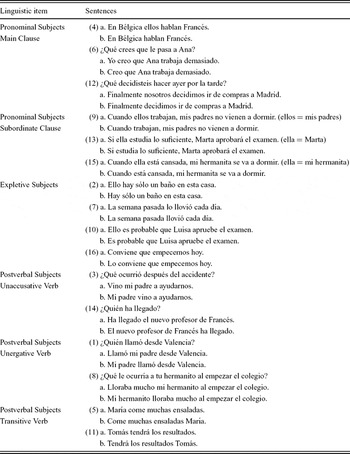
The five-year-old group was presented with thirteen pairs of sentences uttered by finger puppets, which were designed according to the properties to be tested and using vocabulary items which were accessible to children. The specific linguistic elements to be tested in the pairs of sentences are presented in Table 1 and include:
• null/overt pronominal subjects in main clauses: items (4) and (9), which test whether learners accept null subjects (syntactic property) and whether learners are sensitive to the topic/focus distinction (discourse property).
• null/overt pronominal subjects in subordinate clauses: items (2), (7) and (12), which test whether learners accept null subjects (syntactic property) and whether learners prefer co-referring the overt pronominal subject of the subordinate clause with the lexical subject of the main clause or prefer a null subject in the subordinate clause (assigning reference to pronouns in backwards anaphora contexts and possible violation of Principle C (Chomsky, Reference Chomsky1986) – syntactic–discourse property).
• null/overt expletive subjectsFootnote 13: items (3), (6) and (8), which test whether learners accept and/or prefer null or overt expletive subjects (syntactic property).
• postverbal/preverbal subjects with unaccusative verbs: items (1) (presentational focus environment) and (5) (neutral environment), both triggering VS, which test whether learners accept postverbal subjects (syntactic property) and whether they are sensitive to the lexical verb class (lexical class property).
• postverbal/preverbal subjects with unergative verbs: items (10) (presentational focus environment) and (13) (neutral environment), the former triggering VS and the latter SV, which test whether learners accept postverbal subjects (syntactic property), whether they are aware of the information focus feature and its syntactic consequences (discourse–syntactic property) and whether they are sensitive to the lexical verb class (lexical class property).
• postverbal/preverbal subjects with transitive verbs: item (11), which tests whether learners accept postverbal subjects (syntactic property) and whether they are sensitive to the lexical verb class (lexical class property).
The sentences containing pronominal null/overt subjects in main clauses and postverbal subjects with unaccusative and unergative verbs were preceded by a question which set up the appropriate context of interpretation to be taken into account in the preference analysis.
Sentences and linguistic items in the experimental task in the five-year-old groups.

Children were individually taken to a classroom where a puppet theatre was set up. Two experimenters were involved in the task, Experimenter 1 (EXP1), who sat by the child, explained the task, prompted the child to react to the sentences uttered by the puppets and took notes of the child's responses (i.e., acceptance, rejection and preference choice), and Experimenter 2 (EXP2), who did the puppet show, uttered the sentences and also prompted the child to react to the stimuli. In this experiment, several finger puppets, which were animals, were involved. Children had to pick up one finger puppet which they would use as they reacted to the sentences. EXP2 had two finger puppets, which uttered the pairs of sentences, and EXP1 had another puppet, which explained the task and encouraged the child to take part in it. EXP1's puppet told the children that the two puppets at the puppet theatre were learning Spanish because they wanted to go on holiday to Spain in the summer. Before going to Spain, they were doing a Spanish course and the children had to help EXP1's puppet be their teachers and decide whether what the puppets were saying sounded right or funny. It was emphasized that what the puppets said was true and that the children had to pay more attention to the way they said it. Each of EXP2's puppets uttered a sentence in each pair. After every sentence was uttered, EXP1's puppet asked the child whether the sentence sounded right or funny, and after the two sentences were uttered the child was asked which sentence in each pair they preferred, or which puppet had spoken better. Once the child had responded, EXP1's puppet thanked and praised them for every pair of sentences. The presentation of the pairs of sentences was ordered in a way that could not create a pattern for the child and hence sentences which tested the same properties were not presented together. Sentences could be repeated twice, either by the puppet or by EXP1, if the child did not understand or hear them well. At the same time, if the child was not paying attention or was responding randomly without reflecting upon the sentences, the task was stopped or the response was counted as a drop-out. The task could either take place in one or several sessions, depending on the child's tiredness and willingness. In this case, the majority of the children could carry out the task in one session of approximately 15 minutes.
The ten- and seventeen-year-old groups were presented with sixteen written pairs of sentences. Some sentences were taken from the experimental task previously carried out in the Infantil B class, though more pairs of sentences were added to the test. The specific linguistic elements to be tested in the pairs of sentences are presented in Table 2 and include the same elements and properties as for the five-year-old group (see characteristics above):
• null/overt pronominal subjects in main clauses: items (4), (6) and (12).Footnote 14
• null/overt pronominal subjects in subordinate clauses: items (9), (13) and (15).
• null/overt expletive subjectsFootnote 15: items (2), (7), (10) and (16).
• postverbal/preverbal subjects with unaccusative verbs: items (14) (presentational focus environment) and (3) (neutral environment), both triggering VS.
• postverbal/preverbal subjects with unergative verbsFootnote 16: items (1) (presentational focus environment) and (8) (neutral environment), the former triggering VS and the latter SV.
• postverbal/preverbal subjects with transitive verbs: item (5) and (11).
Sentences and linguistic items in the experimental task in the ten- and seventeen-year-old groups.

The presentation of the pairs of sentences was ordered in a way that could not create a pattern for the students. Children were told to imagine that they were language teachers and that the sentences had been written by learners of Spanish. Thus children had to carefully and individually read the pairs of sentences and specify whether each of the sentences sounded right or wrong. They were told not to focus on the content of the sentences but on their structure, and once they had analyzed each sentence within a pair, students had to choose which sentence they preferred, or they would most often say and specify why. It was also emphasized that the task was not evaluating their knowledge and that any kind of answer was equally relevant. Children were also told to carry out the task in the specified order, to react intuitively to every sentence and not to go back to any of them. They were allowed to ask the experimenter if they had any doubts about the task or the sentences. After 25–30 minutes, the tests were collected.
Control data
Control data from Spanish children were collected in two primary and secondary schools in Spain, which offer education to children from P-3 (three–four years old) to 2° Bachillerato (seventeen–eighteen years old) and which are located in Spanish-speaking neighbourhoods. Although the official teaching language is Catalan, children in these schools are Spanish speakers at home and mainly speak Spanish to one another within school. The language of communication between teachers and students is expected to be Catalan, but children often address teachers in Spanish.
In order to collect control data parallel to the three experimental groups of L2 Spanish, Spanish-speaking informants of the same age were needed.Footnote 17 Research focused on the P-5 class (five–six-year-olds), the 5° Primaria class (ten–eleven-year-olds) and the 2° Bachillerato class (seventeen–eighteen-year-olds). The general procedure and structure of the tasks, the number of sentences, the linguistic items to be tested and the order of presentation remained the same as in the experimental groups. The number of informants in each group also remained the same.
Data analysis procedures
The informants’ responses in the grammaticality judgment and preference tasks were first transcribed and then coded and analyzed according to instances of correct judgments (i.e., acceptance of grammatical sentences and rejection of ungrammatical sentences) and instances of preference for the L1 option (i.e., overt expletives, overt pronominal subjects and preverbal subjects in the contexts where null and postverbal subjects would be required under syntactic–discourse constraints).
The analysis was carried out for each experimental and control group and for each linguistic structure tested in the tasks, and in order to provide an explanation of our research question and test our hypothesis, the statistical analysis focuses on the two following objectives:
1 Compare the three age groups (five-, ten- and seventeen-year-olds) in child L2A with respect to all the conditions testing subject properties in the tasks. It should be noted here that the data obtained from the five-year-old group were orally collected, whereas the data from the ten- and seventeen-year-old groups came from written material. Although the different collection methods were chosen to suit the informants’ age, this methodological aspect might have had an influence on the results, as will be seen in the Discussion section.
2 Compare control native and non-native data in the three age groups and for each condition examined in the tasks.
Acceptance/rejection variables (i.e., conditions) and Preference variables (i.e., preference for the L1 option) are summarized in Table 3.
Variables in the data analysis.

5. ResultsFootnote 18
5.1 A comparison of the three age groups: non-native five-, ten- and seventeen-year-olds
With the aim of comparing the percentages of correct judgments and preference judgments of the three age groups of non-native child L2 learners of Spanish, and in order to detect significant differences among the three groups, a non-parametric one-way analysis of variance Kruskal–Wallis H test was first applied. As for the correct judgments, the Kruskal–Wallis H test showed that at least one of the age groups has a significantly different median in each linguistic variable (H = 7.214, p = .027; H = 13.255, p = .001; H = 9.848, p = .007; and H = 9 .613, p = .008), except “Preverbal/Postverbal Subjects with Transitive Verbs” and “Preverbal/Postverbal Subjects with Unergative Verbs”, which display similar results along the three age groups (H = 3.089, p = .213; H = 1.533, p = .465). Regarding the preference judgments, the Kruskal–Wallis H test also showed that at least one of the age groups has a significantly different median in each linguistic variable (H = 12.649, p = .002; H = 15.788, p < .001; H = 7.349, p = .025; H = 6.120, p = .047; H = 6.247, p = .044; and H = 7.784, p = .020) except “Preference for Preverbal Subjects with Transitive Verbs”, which displays identical constant results along the three age groups (H = .000, p = 1.000).
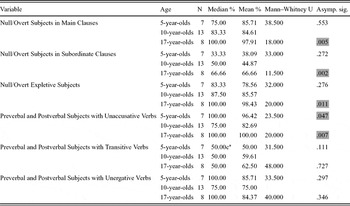
In order to find out where in the groups the significant difference emerges and to analyze the development of correct judgments and of preference judgments through the three age groups, the Mann–Whitney U-test was applied to each variable and between the five- and the ten-year-old groups and the ten- and seventeen-year-old groups. Table 4 shows the results obtained from the acceptance/rejection variables. Shadowed results indicate where the difference between the groups was significant.
Mann–Whitney U-test: acceptance/rejection variables.

Note *: c stands for “constant”, that is to say, all values are identical.
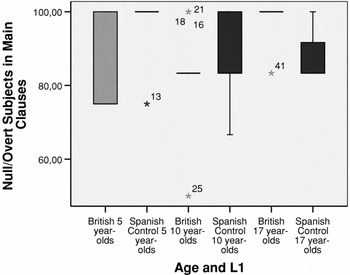
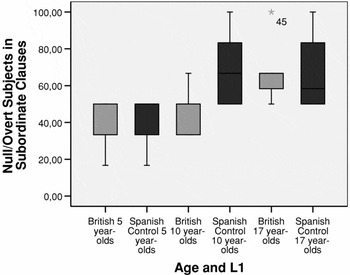
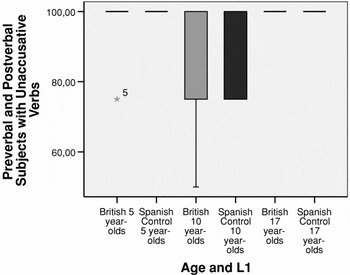
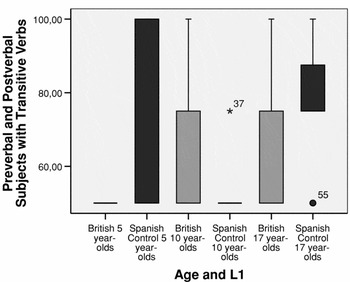
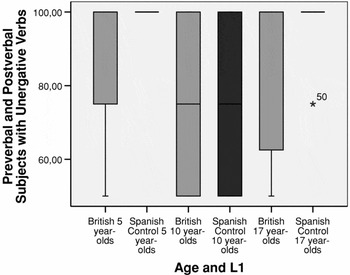
As can be seen in Table 4, there is a general increase-by-age tendency in all variables, although significant differences between the age groups are different in each variable. As for “Null/Overt Subjects in Main Clauses” (see Figure 1), a significant difference is observed between the ten- and the seventeen-year-old groups (U = 18.000, p = .005), whereas the first two age groups show a rather similar percentage of correct judgements. “Null/Overt Subjects in Subordinate Clauses” (see Figure 2) display much lower results in the three age groups in comparison to the other variables, showing that child learners of L2 Spanish seem to have more problems accepting/rejecting subjects in subordinate clauses than in main clauses. A statistically significant difference is also observed between the ten- and the seventeen-year-old groups (U = 11.500, p = .002) and overall development is discrete, its median values ranging from 33.33% in the five-year-old group to 66.66% in the seventeen-year-old group. “Null/Overt Expletive Subjects” (see Figure 3) present high percentages of correct judgments, which also increase by age. A significant difference is also found between the ten- and the seventeen-year-old groups (U = 20.000, p = .011). Two significant differences emerge in the results of correct judgments of “Preverbal and Postverbal Subjects with Unaccusative Verbs” (see Figure 4), namely between the five- and ten-year-old groups and the ten- and seventeen-year-old groups (U = 23.500, p = .047 and U = 20.000, p = .007), although an increase-by-age tendency is not observed here. No significant differences are observed in the “Preverbal and Postverbal Subjects with Transitive Verbs” variable (see Figure 5), as the three groups have a median of 50.00%, although their mean values present a slight increasing tendency from 50.00% to 62.50%. “Preverbal and Postverbal Subjects with Unergative Verbs” (see Figure 6) displays a great deal of overlapped variability and no significant differences emerge among the three groups of child L2 learners either.Footnote 19
Box-and-whiskers plot of “Null/Overt Subjects in Main Clauses” (median %) for the three experimental and the three control groups.

Box-and-whiskers plot of “Null/Overt Subjects in Subordinate Clauses” (median %) for the three experimental and the three control groups.

Box-and-whiskers plot of “Null/Overt Expletive Subjects” (median %) for the three experimental and the three control groups.

Box-and-whiskers plot of “Preverbal/Postverbal Subjects with Unaccusative Verbs” (median %) for the three experimental and the three control groups.

Box-and-whiskers plot of “Preverbal/Postverbal Subjects with Transitive Verbs” (median %) for the three experimental and the three control groups.

Box-and-whiskers plot of “Preverbal/Postverbal Subjects with Unergative Verbs” (median %) for the three experimental and the three control groups.

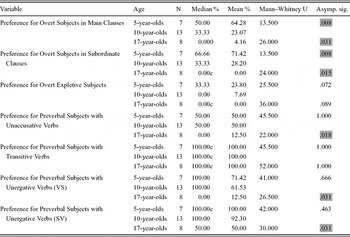
The Mann–Whitney U-test was also applied to the set of preference variables, which tested the learners’ preference for the L1 option. Except for the “Preference for Preverbal Subjects with Transitive Verbs”, which is the most natural expected order, and the “Preference for Preverbal Subjects with Unergative Verbs” in contexts triggering SV orders, results are expected to follow a general falling tendency, since the L1 option is expected to gradually disappear. Results are displayed in Table 5.
Mann–Whitney U-test: preference variables.

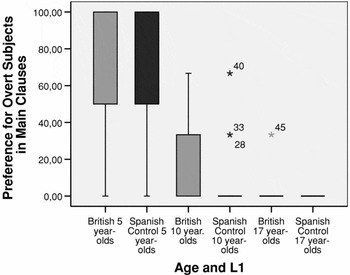
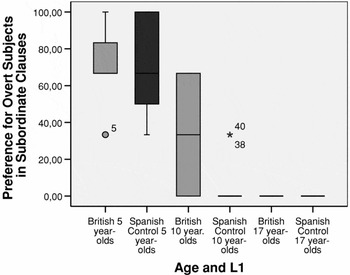
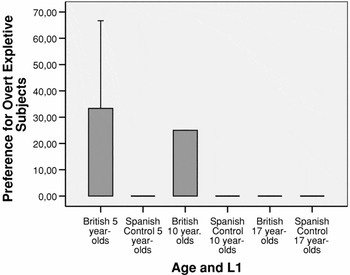
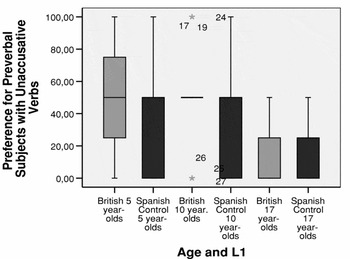
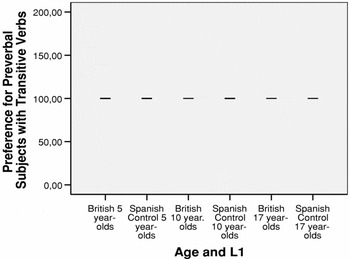
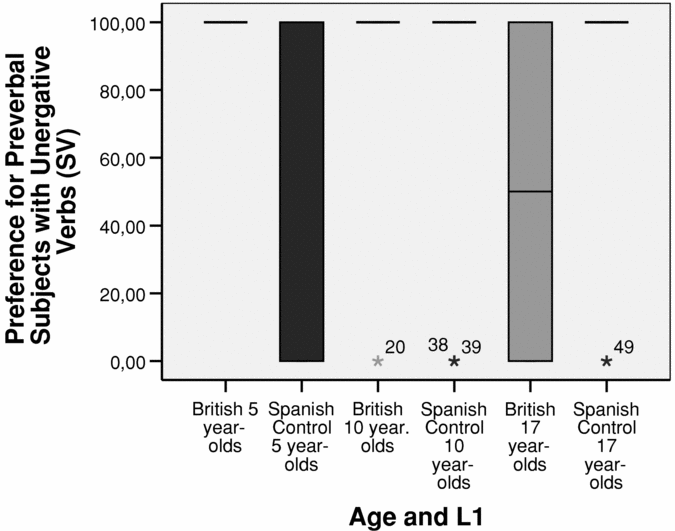
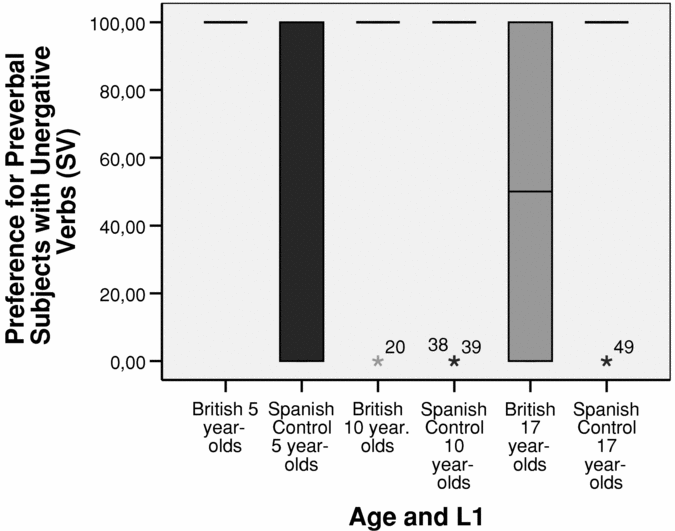
As Table 5 illustrates, the “Preference for Overt Subjects in Main Clauses” (see Figure 7) shows a clear decrease-by-age tendency, as was expected. The sentences included in the task to test this variable (i.e., sentences (4) and (9) from Table 1 and sentences (4), (6) and (12) from Table 2) involved a neutral non-emphatic context and hence a null subject was expected. Significant differences can be observed between the five- and the ten-year-old groups (U = 13.500, p = .008) and the ten- and seventeen-year-old groups (U = 26.000, p = .031). In “Preference for Overt Subjects in Subordinate Clauses” (see Figure 8), similar results are obtained. Sentences testing this variable in the task (i.e., sentences (2), (7) and (12) from Table 1 and sentences (9), (15) and (13) from Table 2) triggered missing subjects as no contrastive context was provided and the pronoun in the subordinate clause could not co-refer with the referential expression in the main clause. A declining tendency is observed and both the five- and ten-year-old groups and the ten- and seventeen-year-old groups differ significantly (U = 13.500, p = .008 and U = 24.000, p = .015). “Preference for Overt Expletive Subjects” (see Figure 9) already displays lower (i.e., more target-like) results from the five-year-old group. No significant differences are found between the five- and ten-year-old groups or the ten- and seventeen-year-old groups. As was explained in section 3.1, the discourse neutral word order for unergative verbs is SV whereas for unaccusative verbs it is VS and in informationally focused structures both unergative and unaccusative verbs trigger VS word orders. The sentences in the task that tested “Preference for Preverbal Subjects with Unaccusative Verbs” (i.e., sentences (1) and (5) from Table 1 and sentences (3) and (14) from Table 2; see Figure 10) present neutral and focused environments and trigger VS word order. A significant difference is observed between the ten- and seventeen-year-old groups (U = 22.000, p = .018). Results from the five-year-old group, whose median and mean are identical to those of the ten-year-old group, show a great deal of variability, thus implying, as will be explained in the Discussion section, that these children are not yet aware of the syntactic–discourse constraints applying here or to lexical verb class. Median and mean values of 100.00% for “Preference for Preverbal Subjects with Transitive Verbs” (see Figure 11) is observed in the three experimental groups and with no variability of results. A VS order in transitive constructions is indeed a marked or unnatural order, which native speakers often reject and which non-native speakers clearly do not prefer. As for “Preference for Preverbal Subjects with Unergative Verbs” in focused contexts (i.e., sentence (10) from Table 1 and sentence (1) from Table 2; see Figure 12), where a VS order is triggered, a significant difference is observed between the ten- and the seventeen-year-old groups (U = 26.500, p = .031). “Preference for Preverbal Subjects with Unergative Verbs” in neutral contexts (i.e., sentence (13) from Table 1 and sentence (8) from Table 2; see Figure 13), where an SV order is expected, shows a clear preference for preverbal subjects in the five- and ten-year-old groups, not resulting from their awareness of verb class or syntax–discourse focus factors but probably due to their generalized preverbal preference. In the seventeen-year-old group, we find a significant difference with respect to the ten-year-old group (U = 30.000, p = .031), indicating alternation between preverbal and postverbal subjects at chance level, which shows some awareness of verb class and syntax–discourse focus factors in this context but clearly not complete mastery.
Box-and-whiskers plot of “Preference for Overt Subjects in Main Clauses” (median %) for the three experimental and the three control groups.

Box-and-whiskers plot of “Preference for Overt Subjects in Subordinate Clauses” (median %) for the three experimental and the three control groups.

Box-and-whiskers plot of “Preference for Overt Expletive Subjects” (median %) for the three experimental and the three control groups.

Box-and-whiskers plot of “Preference for Preverbal Subjects with Unaccusative Verbs” (median %) for the three experimental and the three control groups.

Box-and-whiskers plot of “Preference for Preverbal Subjects with Transitive Verbs” (median %) for the three experimental and the three control groups.

Box-and-whiskers plot of “Preference for Preverbal Subjects with Unergative Verbs (VS)” (median %) for the three experimental and the three control groups.

Box-and-whiskers plot of “Preference for Preverbal Subjects with Unergative Verbs (SV)” (median %) for the three experimental and the three control groups.
5.2 A comparison between native and non-native control responses
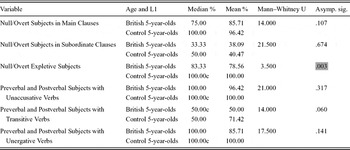
L2 Spanish and native Spanish groups’ results on each age group were statistically compared for each acceptance/rejection and preference variable with the Mann–Whitney U-test. As Table 6 indicates, the non-native five-year-old group's percentages of correct judgments are rather high but still lower than those of the control group in all variables. Yet they are only significantly different in “Null/Overt Expletive Subjects” (U = 3.500, p = .003), which is the only variable expressing a strict syntactic contrast. “Null/Overt Subjects in Subordinate Clauses” display similarly low results in both the experimental and the control group (i.e., below 50%), which indicates the children's difficulty in judging the grammaticality of subjects in subordinate clauses in anaphora contexts, although we will see in the Discussion section that methodological aspects may have influenced the results. “Preverbal/Postverbal Subjects with Transitive Verbs” yield percentages of median results of only 50%, as instances of postverbal subjects with this type of verb have been considered extremely marked and have been judged as ungrammatical by both the experimental and the control groups.
Mann–Whitney U-test between the experimental and control five-year-old groups: acceptance variables.

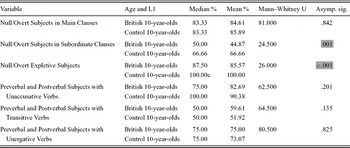
Table 7 shows that the percentages of correct judgments from the ten-year-old experimental group have generally increased but are still slightly lower than those of the control group. Two variables present significant differences between the non-native and the native ten-year-old groups, namely “Null/Overt Subjects in Subordinate Clauses” (U = 24.500, p = .001), which continues to display low results in comparison to the other variables, and “Null/Overt Expletive Subjects” (U = 26.000, p < .001), which might still indicate some difficulty in fully acquiring the syntactic properties of Spanish L2 subjects. Similarly to the five-year-old groups, “Preverbal/Postverbal Subjects with Transitive Verbs” seem to present difficulties for native and non-native informants, whose medians only reach 50.00%, mostly rejecting postverbal subjects in this construction. As has been observed, postverbal subjects with this kind of verb are judged as ungrammatical or impossible by virtue of rendering an extremely marked interpretation. A remarkable drop in percentage of correct judgments should be noticed with respect to “Preverbal/Postverbal Subjects” with unaccusative and unergative verbs, which obtained higher percentages in the five-year-old groups. This will be addressed in the Discussion section.
Mann–Whitney U-test between the experimental and control ten-year-old groups: acceptance variables.

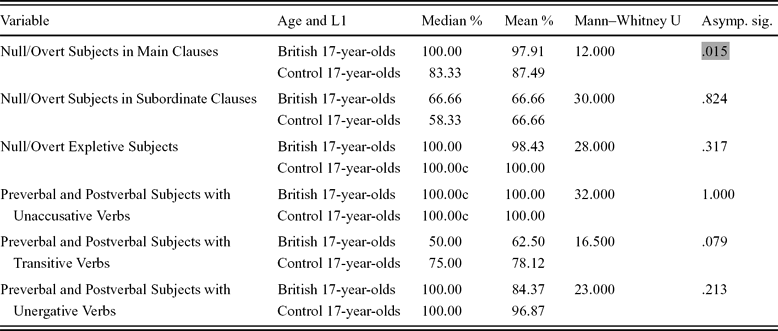
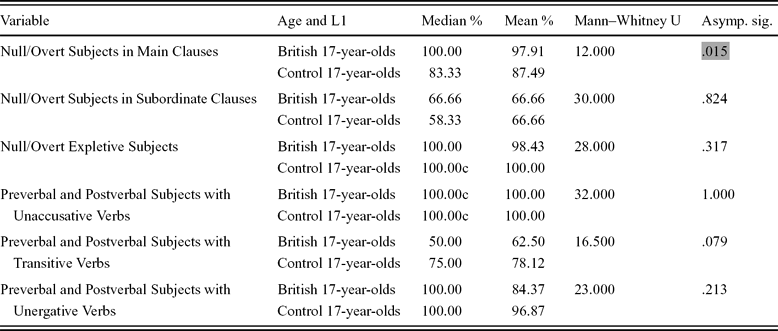
As for the seventeen-year-old experimental and control groups, Table 8 indicates further increase of correct judgments in all variables, although “Null/Overt Subjects in Subordinate Clauses” and “Preverbal/Postverbal Subjects with Transitive Verbs” present much lower median and mean values than in the other variables, and we can observe that not much development has taken place in such constructions. The only significant difference between native and non-native children emerges in “Null/Overt Subjects in Main Clauses” (U = 12.000, p = .015). Unexpectedly, non-native children's results are significantly higher than those of the control group, whose percentage median and mean are high but in which some variability of results is observed. Figures 1 to 6 also illustrate the graphic representation of the differences between the experimental and the control groups for each acceptance/rejection variable.
Mann–Whitney U-test between the experimental and control seventeen-year-old groups: acceptance variables.
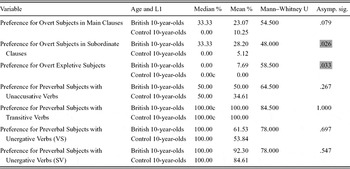
With respect to the preference variables in the control and experimental five-year-old groups, Table 9 shows that results are similar to those of the acceptance variables, in that significantly different medians occur in the same corresponding variable, namely “Preference for Overt Expletive Subjects”. This L1 option variable is preferred by non-native children significantly more (U = 10.500, p = .024) than by native children, who never chose it. Both the experimental and the control groups prefer overt subjects in main and subordinate clauses, when a null subject would be required, with high median and mean values (i.e., a strong preference for the L1 option), showing the great difficulty in judging derivations at the syntax–discourse interface. Unaccusative verbs yield a preference for preverbal subjects at chance level for the experimental group and a bit lower for the control group when a postverbal subject would be required. As for “Preverbal Subjects with Transitive Verbs”, they were preferred with constant value results of 100.00% by both groups and hence postverbal subjects with transitive verbs were totally dispreferred. Likewise, no significant differences between groups were found in “Preference for Preverbal Subjects with Unergative Verbs” in focused structures triggering VS word order and in neutral contexts triggering SV word order. In contexts triggering VS word order, the non-native children have a stronger preference for preverbal subjects than native children, as their medians indicate, yet their mean values come closer to each other and, as can be observed in Figure 12, their variability of results overlaps completely and ranges from 100.00% to 0.00%, which makes the difference of the results non-significant. Finally, unergative verbs in neutral contexts, which should trigger preverbal subjects, yield an almost significantly higher preference for preverbal subjects in experimental children than in control children, who might be generalizing postverbal subjects, as Figure 13 indicates.
Mann–Whitney U-test between the experimental and control five-year-old groups: preference variables.

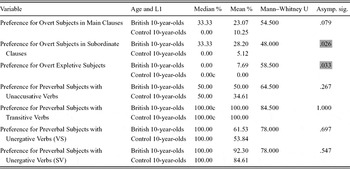
The preference for the L1 option lowers considerably as age and exposure to the L2 increase, and thus the results get closer and closer to those of the native group in the ten-year-old children. As Table 10 illustrates, only two variables display significantly different results between native and non-native speakers, namely “Preference for Overt subjects in Subordinate Clauses” and “Preference for Overt Expletive Subjects” (U = 48.000, p = .026; U = 58.500, p = .033). Yet the experimental group's median and mean values are reasonably low, which indicates clear development. The preverbal/postverbal distinction still remains problematic. Preverbal and postverbal subjects are still equally preferred (i.e., with a median value of 50.00%) with unaccusative verbs by both native and non-native children, whereas the expected word order is VS in both focused and neutral contexts in Spanish. As was the case with the five-year-old groups, preverbal subjects are preferred with transitive verbs by both groups with constant result values of 100.00%, which confirms the strongly marked status of postverbal subjects with transitive verbs. Regarding the preferred word order with neutral and focused contexts with unergative verbs, preverbal subjects are highly preferred by the two groups, even in the focused context where a postverbal subject should be preferred. In short, lexical verb class and syntactic–discourse factors related to word order remain problematic for both native and non-native speakers at this age/stage, as will be explained in the Discussion section.
Mann–Whitney U-test between the experimental and control ten-year-old groups: preference variables.
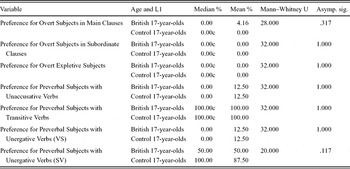
Almost target-like preference is achieved by the seventeen-year-old group, as Table 11 indicates. No significant differences in the results emerge between the experimental and the control group, whose preference judgments are syntactically and pragmatically native-like, accurately showing 0.00% median values in all variables favouring the L1 option. Overt subjects are no longer preferred by either group. Postverbal subjects are correctly preferred with unergative verbs in focused contexts (VS) and with unaccusative verbs. Not surprisingly, preverbal subjects are strongly preferred with transitive verbs with constant result values of 100.00%, as the transitive structures presented in the task do not involve focused contexts. Yet, and even if no significant difference is observed with respect to the control group, results in “Preference for Preverbal Subjects with Unergative Verbs (SV)” in neutral contexts do not pattern alike, with only 50% preference for preverbal subjects, which, as will be seen in the Discussion section, might indicate overgeneralization of postverbal subjects to inappropriate discourse contexts with unergative verbs. Figures 7 to 13 also illustrate the graphic representation of the differences between the experimental and the control groups for each preference variable.
Mann–Whitney U-test between the experimental and control seventeen-year-old groups: preference variables.

6. Discussion
These findings suggest that there is indeed development, by the British child L2 learners of Spanish examined here, of the syntactic, discourse and lexical properties of subjects towards near native-like results, as predicted. Development is observed all through the three experimental age groups, although it is only the seventeen-year-old group that shows near native-like interpretation of subjects with some residual optionality in their judgment of null/overt pronominal subjects in subordinate clauses and in the preverbal/postverbal subject distinction with unergative verbs in neutral contexts. Subject properties at the syntax–discourse interface, namely the choice and interpretation of null/overt or preverbal/postverbal subjects show delayed development with respect to the acceptance of null and postverbal subjects by the L2 children in this study, also as predicted, although the five- and ten-year-old groups still showed some (minor) problems in their incorrect acceptance of overt expletive subjects, which is a purely syntactic property. These and further issues will be addressed in the present section, first focusing on the comparison of the results of the three age groups and then discussing the acquisition of the syntactic, discourse and lexical properties of subjects by each age group with respect to their corresponding control groups. Methodological aspects which might have influenced the results will also be addressed.
6.1 Development across age groups
Regarding the development of the children's correct judgments (i.e., acceptance/rejection variables), as expected an increase-by-age tendency is generally observed. Although results are already remarkably high in the five-year-old experimental group, the presence of significant differences between the percentages of correct judgments from the three age groups in practically all variables indicates a clear and relevant developmental process in child L2 Spanish subjects.
“Null/Overt Subjects in Subordinate Clauses” prove to be rather problematic in the three age groups, as its results are quite low in comparison to the other variables. The fact that subjects might be null or overt seems to be quite readily acquired in L2 Spanish. Yet native-like use in main or subordinate clauses, where null subjects tend to be used to avoid redundancy in non-emphatic constructions, proves a bit more difficult to acquire. At the same time, an important methodological aspect arises here. The low acceptance results obtained in “Null/Overt Subjects in Subordinate Clauses” might be due to the way the data on this variable were coded and to what the children actually judged in the task, and not completely to lack of competence. Children considered a great number of overt subjects in subordinate clauses as grammatical, regardless of the incorrect co-reference with the lexical overt subject in the matrix clause, whereas we coded them as ungrammatical, thus resulting in a greater percentage of incorrect judgments. In fact, and as will be seen below, results from the “Preference for Overt Subjects in Subordinate Clauses” accurately decrease with age and exposure towards a native-like preference for null subjects in these contexts, thus showing that the low results on the acceptance variable might be well due to methodological problems. Below are some examples of these sentences (sentences (7) and (12) from Table 1):
- (18)
a. Cuando ella está cansada, mi hermanita se va a dormir. (ella = mi hermanita)
b. Cuando está cansada, mi hermanita se va a dormir.
- (19)
a. Si ella se porta bien en casa, Marta vendrá a la fiesta. (ella = Marta)
b. Si se porta bien en casa, Marta vendrá a la fiesta.
According to our coding, children were expected to judge (18a) and (19a) as ungrammatical, since the subject pronoun cannot co-refer to the lexical antecedent but only to another entity (Luján, Reference Luján, Bosque and Demonte1999), as follows from Principle C (Chomsky, Reference Chomsky1986). Children showed growing awareness of this syntactic property in the preference variables, although backwards anaphora interpretation requires more processing effort (as has been shown in Sorace and Filiaci (Reference Sorace and Filiaci2006) with near-native adult speakers of Italian), but in the acceptance variables they still judged them as grammatical without considering co-reference with the lexical subject. This has been even more problematic in the case of the five-year-old group and the fact that their task was carried out orally. Given their early age and lack of metalinguistic knowledge, five-year-old children were not explicitly given the information that in the prompt sentences the overt pronoun co-referred with the subject in the matrix clause, and hence was unacceptable, and therefore most instances were considered grammatical by the children.
“Preverbal/Postverbal Subjects with Transitive Verbs” also display different results with respect to the other variables. As has been mentioned in the Results section, postverbal subjects with transitive verbs are extremely unnatural for native speakers, though possible in marked or focused utterances. In the present task, the sentences with transitive verbs (i.e., sentence (11) from Table 1 and sentences (5) and (11) from Table 2) were completely neutral and children generally tended to judge them as correct with preverbal subjects and as incorrect with postverbal subjects.
“Preverbal and Postverbal Subjects with Unaccusative and Unergative Verbs” do not follow a strict increasing tendency along the three age groups, as the ten-year-old group unexpectedly obtained lower results than the five-year-old group. Yet the results from the seventeen-year-old group are accurately very high, indicating the seventeen-year-old group's awareness of (at least) the preverbal/postverbal distinction and the expected outcome of development. An explanation for this might also be found in a methodological factor, namely the fact that the experimental task was carried out orally in the five-year-old group but in written form in the other two groups. It might be the case that written prompt sentences were too difficult for ten-year-old children to judge or that the way the sentences were orally conveyed influenced the children to make the correct judgements. As will be seen, though, this might point to the children's lack of complete acquisition of syntactic properties.
The general picture emerging from the results of “Preference Variables” is a decreasing tendency, since the L1 option is expected to gradually disappear. This falling tendency is not observed, as expected, in “Preference for Preverbal Subjects with Transitive Verbs”, where the three experimental age groups preferred preverbal subjects due to the reasons outlined above. In “Preference for Preverbal Subjects with Unergative Verbs (SV)”, where preverbal subjects were triggered by a discourse neutral context, an inaccurate falling tendency is observed, thus indicating a generalization of postverbal subjects as children acquire the L2 subject syntactic properties, but a certain residual lack of knowledge of lexical verb class and syntax–discourse focus factors in this context (to be discussed in more detail in the experimental/control group comparison in the next sections). Yet the general presence of significant differences between the different groups’ results in all the remaining variables, including “Preference for Overt Subjects in Subordinate Clauses”, points to the children's relevant development (although not complete) of subject properties in L2 Spanish.
This relevant development, evident in the significant differences among the three age groups, could be potentially explained in terms of the growing amount of input and exposure that the three groups had had in the immersion setting. As was mentioned in section 4.2, at the time of testing, the five-year-old group had been exposed to Spanish for about 1,350 hours during one and a half school years, the ten-year-old group had been exposed to Spanish for about 5,850 hours during six and a half school years and the seventeen-year-old group had been exposed to Spanish for about 12,150 hours during thirteen and a half school years. However, the pattern observed in some acceptance and preference variables, where no significant differences were found between the five- and ten-year-old groups but were found between the ten- and seventeen-year-old groups, might indicate that we are dealing with age (i.e., cognitive maturity) development rather than with a question of input/exposure. In other words, it might be the case that the five- and the ten-year-old groups do not represent two different stages of L2 development because the age factor is at play. In fact, the acquisition of linguistic structures that involve interfaces, and in the context of our study the ability to acquire syntactic, lexical and discourse properties, have been shown to be limited by processing constraints in L1 children, and these tend to rely on syntactic knowledge in order to process such linguistic structures more than on lexical/semantic information (Clahsen and Felser, Reference Clahsen and Felser2006), whereas adult native speakers rely on both syntactic and lexical/semantic information and adult L2 learners are guided by lexical/semantic information but not so much by syntactic information. In the context of our study, where L2 children are analyzed, it might be the case that L2 development interacts with the development of age-related processing abilities. The comparison between the results of the non-native children and those of the control groups can shed some light on this.
6.2 Experimental and control five-year-old groups
The generally high correct acceptance/rejection of null and overt subjects and preverbal and postverbal subjects by experimental children points to the gradual acquisition of the syntactic properties of Spanish subjects. In other words, if no development had taken place, children should consistently reject null and postverbal subjects with any kind of verb. In the syntactic terms followed in this study (Platzack, Reference Platzack2004), five-year-old children are starting to acquire the pronominal [+interpretable] Agr feature value of Spanish, by which null and postverbal subjects are explained in terms of EPP satisfaction by the agreement feature of the verb. However, acquisition is far from complete and hence optionality still persists, as the significant differences with respect to the control group in the correct acceptance/rejection of and preference for overt expletive subjects indicate, although the percentages are not that low/high in any case. The low percentages in the acceptance/rejection of null/overt subjects in subordinate clauses in both the experimental and control groups in comparison to the other variables might be explained by the methodological considerations outlined above (section 6.1), although, as has been reported in the literature, the interpretation and judgment of backwards anaphora presents more processing difficulties, at least for adults (Sorace and Filiaci, Reference Sorace and Filiaci2006). As was seen in the results section, the preference results for this variable are similarly problematic for both groups.
Subject properties at the discourse–syntax interface proved too complex for the experimental five-year-old group, as the relatively high preference for overt subjects in main and subordinate clauses and the high preference for preverbal subjects with any kind of lexical verb class show. Sentences displaying overt/null subjects in main clauses (i.e., sentences (4) and (9) from Table 1 and (4), (6) and (12) from Table 2) were unfocused and non-emphatic and represented continuity in discourse topic, thus triggering a null subject. Results show that experimental five-year-old children are not aware of this discourse property of Spanish subjects, as they quite strongly prefer overt subjects. Sentences displaying null/overt pronominal subjects in subordinate clauses co-referring with the subject in the matrix clause (i.e., sentences (2), (7) and (12) from Table 1 and (9), (15) and (13) from Table 2) represent cases of backwards anaphora, which are harder to process with overt subjects even for near-native speakers (Sorace and Filiaci, Reference Sorace and Filiaci2006) and represent a violation of Principle C (Chomsky, Reference Chomsky1986). This property of subjects was also not acquired by the experimental five-year-old group.
Children similarly show strong preference for preverbal subjects regardless of lexical verb class. The case of preverbal/postverbal subjects with transitive verbs has already been commented upon, in that the postverbal subjects with these verbs are strongly marked and unnatural and that sentences in the task were clearly neutral and non-emphatic (i.e., sentence (11) from Table 1 and sentences (5) and (11) from Table 2). Unaccusative verbs in focused and non-focused contexts (i.e., sentences (1) and (5) from Table 1 and (3) and (14) from Table 2) should trigger VS word orders (Burzio, Reference Burzio1986; Zubizarreta, Reference Zubizarreta1998; Belletti, Reference Belletti and Rizzi2003), whereas the experimental five-year-old children prefer SV orders at chance level, which shows that they are not aware of lexical verb class or of the presence of the [+strong] functional focus feature (Belletti, Reference Belletti and Rizzi2003) displacing informationally focused subjects to a postverbal position. Likewise, unergative verbs in focused contexts (i.e., sentence (10) from Table 1 and sentence (1) from Table 2) should also trigger VS orders, but the experimental children strongly preferred SV orders, not being aware of the syntax–discourse properties involved. In neutral contexts (i.e., sentence (13) from Table 1 and (8) from Table 2), an SV word order should be preferred and is indeed preferred by the experimental children. Yet this is clearly not the result of awareness of lexical verb class and focus contrasts, but it is due to their generalized strong preference for preverbal subjects, thus relying on their L1 English option.
That experimental five-year-old children would show difficulties with some syntactic properties of L2 Spanish subjects and with practically all subject properties at the discourse–syntax interface was predicted. However, although control results on syntactic properties were obviously more accurate, we found similarly problematic results with the sentences expressing syntax–discourse properties in the control children, who seem to prefer overt and preverbal subjects in a similar way to experimental children. This tendency is not observed in the case of expletive subjects, and is observed in the case of preverbal subjects to a lesser extent than in overt subjects. In the case of unergative verbs in neutral contexts, which should trigger preverbal subjects, the control group obtained much lower (almost significantly lower) results than the experimental children. In this case, control children are generalizing postverbal subjects to the inappropriate discourse context. That five-year-old child native speakers also have problems with discourse factors could be potentially explained in methodological terms, in that orally presented data might blur the actual discourse preferences. Yet, and as was mentioned above, L1 children have been reported in the literature to have limited processing abilities with respect to integrating syntactic and discourse–lexical information and they tend to rely on grammatical information alone (Clahsen and Felser, Reference Clahsen and Felser2006). This would explain why control children have more difficulties with subject properties which involve the syntax–discourse interface. This poses the question as to whether the difficulty that child L2 learners have with discourse factors is due to lack of L2 competence or is age-related and due to cognitive maturity alone. What is clear so far from this study is that child L2A does not pattern like child L1A in all respects, since syntactic properties are affected by L1 influence in child L2A, which is obviously not the case in child L1A.
6.3 Experimental and control ten-year-old groups
General development is observed in the acceptance/rejection of null/overt subjects and preverbal/postverbal subjects in the experimental ten-year-old group, and the percentages of correct judgments are high enough to posit that these children are well aware of the possibility of having null and postverbal subjects in Spanish. However, acquisition of the subject syntactic properties, namely the pronominal [+interpretable] Agr feature value of Spanish (Platzack, Reference Platzack2004), is not yet completely achieved. This is shown by the significant differences with respect to the control group in the correct acceptance/rejection of and preference for overt expletive subjects, although it should be considered that the percentages are really high/low respectively. Another significant difference was also found in the acceptance/rejection of null/overt subjects in subordinate clauses, although the percentage has risen with respect to the younger learners and the control group also obtained rather low results. This adds evidence to the claim that the experimental ten-year-old children in this study had not yet fully acquired the syntactic feature value responsible for Spanish subject use. However, the methodological issues outlined above with respect to the general low results in this variable also need to be taken into account. It should be noted that, contrary to what was expected, results from the acceptance/rejection of preverbal/postverbal subjects have slightly lowered with respect to the five-year-olds, which also points to the fact that these children do not master the syntactic properties of the Spanish subject completely, although percentages are still high and very similar to the control group. As was mentioned in the previous section, the oral versus written nature of the tasks in the five- and ten-year-old groups might have been involved in this slight decrease of correct judgments, since it also affected the control children.
Subject properties at the discourse–syntax interface continue being problematic for the experimental ten-year-old group, as the existence of a preference for overt subjects in main and subordinate clauses (the latter significantly higher than in the control group) and the still rather high preference for preverbal subjects with any kind of lexical verb class show. Results have shown that the experimental ten-year-old children in this study, even if with slightly more accurate results than the five-year-old group, still do not master the discourse topic/focus distinction involved in the preference for overt subjects in main clauses and the syntax–discourse properties involved in the preference for overt subjects in subordinate clauses in the context of backwards anaphora.
With respect to the experimental ten-year-old children's preference for preverbal subjects, it continues to be the preferred option regardless of lexical verb class. Leaving aside the case of transitive verbs, which clearly trigger preverbal subjects, children continue to have serious difficulty with the syntax–discourse and the lexical properties involved with unaccusative and unergative verbs. More specifically, they are not aware of lexical verb class or of the presence of the [+strong] functional focus feature (Belletti, Reference Belletti and Rizzi2003) displacing informationally focused subjects to a postverbal position. Hence, their correct high preference for preverbal subjects with unergative verbs in neutral contexts again does not result from their awareness of lexical verb class and focus contrasts, but it still might be due to their generalized strong preference for preverbal subjects, and they are thus still relying on their L1 English option, as the five-year-olds did.
As for the control ten-year-old group, although their L1 syntactic subject properties are already acquired, they still present difficulty and residual optionality in some of the linguistic structures involving the syntax–discourse interface, namely the preverbal/postverbal contrast involving lexical verb class and focus contrasts. Whereas the preference for overt subjects in main and subordinate clauses evident in the control five-year-olds has already vanished in the ten-year-olds, the preverbal/postverbal choice still presents processing limitations. Methodological considerations are not relevant here, as the data elicitation technique was in written form this time and the children continued to have problems with the preverbal/postverbal distinction.
In short, and although development has undoubtedly taken place, the ten-year-old experimental children had not fully acquired either the syntactic or the syntactic–discourse properties of subjects in L2 Spanish. That the properties at the syntax–discourse interface are problematic might be an age-related question independent of L2A, as has been reported for L1 children (Clahsen and Felser, Reference Clahsen and Felser2006), but the lack of complete acquisition of syntactic properties points to very distinct processes in child L2A and child L1A, as had already been seen in the five-year-old groups. The ten-year-old group had actually had more exposure to L2 Spanish than the five-year-old group, and development is indeed present, which indicates that these two groups represent two different developmental stages in this study, even if the syntactic properties were not yet fully acquired by the ten-year-old children.
6.4 Experimental and control seventeen-year-old groups
The acceptance/rejection of null/overt subjects and preverbal/postverbal subjects in the seventeen-year-old experimental group has reached target-like levels in all subject properties except “Null/Overt Subjects in Subordinate Clauses” and “Preverbal/Postverbal Subjects with Transitive Verbs”, as expected. Neither the former nor the latter are significantly different from their control group's results, although the development of the first has been almost unnoticeable from the five-year-old group, and the apparent lack of development of the second confirms the strongly marked and unnatural status of these constructions even for the native speakers. The fact that the acceptance/rejection of null/overt subjects in subordinate clauses is the only property that remains problematic in the experimental seventeen-year-old group, that it is likewise problematic for the control group, and that the results of this property are completely target-like in the preference variable, suggest that these low results stem from the methodological issues outlined above in section 6.2, and do not result from lack of syntactic competence. Indeed, we posit that acquisition of the L2 Spanish subject syntactic properties, namely the pronominal [+interpretable] Agr feature value of Spanish (Platzack, Reference Platzack2004) as outlined in the present study is completely achieved by the experimental seventeen-year-old group. Complete acquisition of formal syntactic subject properties in L2 Spanish has also been reported in the adult L2A studies reviewed above (Pérez-Leroux and Glass, Reference Pérez-Leroux, Glass, Pérez-Leroux and Glass1997, Reference Pérez-Leroux and Glass1999; Liceras and Díaz, Reference Liceras and Díaz1999; Lozano, Reference Lozano2002, Reference Lozano2006; Hertel, Reference Hertel2003; Montrul, Reference Montrul2004b; Montrul and Rodríguez Louro, Reference Montrul, Rodríguez Louro, Torrens and Escobar2006; Belletti et al., Reference Belletti, Bennati and Sorace2007), which, due to the differences in terms of the type of input and elicitation techniques, cannot be directly compared with the present research but which are worth mentioning as a reference point in the field.
Subject properties at the discourse–syntax interface are clearly near native-like in this experimental group, although some minor residual indeterminacy persists. The L1 option has almost vanished and hence a preference for overt subjects is practically inexistent in both main and subordinate clauses (and also a preference for overt expletives is absent given that syntactic properties have been fully acquired). The discourse topic/focus distinction involved in the interpretation of null/overt subjects in main clauses and the syntax–discourse properties involved in the correct interpretation of pronoun co-reference in the context of backwards anaphora have been acquired by this group. A preference for preverbal subjects is almost non-existent and in fact it patterns with the results from the control group. This suggests that seventeen-year-old learners are indeed sensitive to lexical verb class and to the presence of the [+strong] functional focus feature (Belletti, Reference Belletti and Rizzi2003) displacing informationally focused subjects to a postverbal position, in the case of focused and unfocused subjects with unaccusative verbs and focused subjects with unergative verbs. Yet residual optionality also persists in the preference judgments of unfocused subjects with unergative verbs, which trigger SV word order and where the results reach only chance levels. It might be the case that learners are generalizing postverbal subjects to inappropriate discourse contexts, which clearly indicates incomplete mastery of L2 subject properties which involve discourse. Such residual optionality in discourse factors (in both the null/overt and the preverbal/postverbal distinctions) found here in child L2A is clearly in line with previous studies on adult L2A of subject properties of null-subject languages which persist even in near-native speakers (Belletti et al., Reference Belletti, Bennati and Sorace2007; Sorace and Filiaci, Reference Sorace and Filiaci2006). The strong preference for preverbal subjects with transitive verbs by both the experimental and control groups is expected and is in line with the previous two groups.
With respect to the seventeen-year-old control group and in comparison to the difficulty with subject properties at the syntax–discourse interface observed in the other two control age groups, the appropriate distinctions between null and overt subjects and preverbal and postverbal subjects in different discourse contexts and with verbs pertaining to different lexical classes are observed here. It is clear that processing limitations with regards to these linguistic phenomena which applied to L1 younger children are absent at this age.
6.5 Concluding remarks
The data from this study have shown that L2 Spanish subject properties at the syntax–discourse interface are indeed more difficult to acquire than purely formal syntactic linguistic aspects, since in the seventeen-year-old experimental group, when formal aspects are fully acquired, some residual optionality related to subject discourse properties remains. At first sight, this could add further evidence to corroborate that the syntax–discourse interface is vulnerable in L2A even in advanced and near-native stages, as other studies have shown (Belletti et al., Reference Belletti, Bennati and Sorace2007; Sorace and Filiaci, Reference Sorace and Filiaci2006; Hertel, Reference Hertel2003; Lozano, Reference Lozano2006), and, more specifically in the case of the present study, in child L2A in immersion settings. However, we have seen how certain syntactic aspects of Spanish subjects have not been fully acquired by the five- and ten-year-old experimental children, which makes us wonder whether the syntactic formal aspects are vulnerable for these children as well. Yet the syntactic properties of subjects have clearly been acquired by the seventeen-year-old group and some residual indeterminacy in the syntax–discourse properties remains, which suggests at least the delay or persistent optionality of these properties.
As was hypothesized, British child L2 learners of Spanish in this study have developed their judgment and preference for both the syntactic and discursive properties of subjects towards native-like results from the five-year-old group, where some awareness of the possibility of having null and postverbal subjects was already evident. However, L1 transfer was also present and it is not until the seventeen-year-old group that we can confirm full acquisition of the strong pronominal [+interpretable] Agreement features on the verb, by which Spanish checks the EPP by raising the verb to T and therefore empty subjects and postverbal subjects are allowed (as outlined in Platzack, Reference Platzack2004). Subject properties involving the syntax–discourse interface (i.e., topic versus focus contexts and co-reference in backwards anaphora contexts in null/overt subjects, and lexical verb class and the presence of [+strong] uninterpretable functional focus feature (Belletti, Reference Belletti, Hulk and Pollock2000, Reference Belletti and Rizzi2003) in preverbal/postverbal subject contexts) are not acquired in the first two age groups and present some delay and optionality in the seventeen-year-old group. Hence, and as has been mentioned in other studies (Belletti et al., Reference Belletti, Bennati and Sorace2007), we see how complete mastery of subject properties and their ultimate attainment, at least in these linguistic structures, does not involve only universal formal principles, but also their interaction with grammatical properties at the interface with discourse properties, which are harder to acquire and to process, even by native speakers, as has been seen in the control groups in this study.
Through the development of subject properties, this study has contributed to the field of child L2A and has attempted to characterize it and give some insights into the differences and similarities with respect to other native and non-native acquisition contexts. In this respect, and in the context of our study, child L2A has been shown to be clearly different from child L1A, as far as purely syntactic aspects are concerned, but similar to it in terms of discourse properties in the five- and ten-year-old groups, where processing limitations with respect to discourse properties affected both native and non-native children. Regarding adult L2A, no direct comparison can be made with respect to previous studies, since they dealt with instructional settings and employed very different data elicitation techniques. However, we have seen in our study how, once syntactic properties are fully acquired, some optionality remains in the properties involving discourse, as has been shown is the case in adult L2A in the studies cited above.
Yet, and since the present study mainly focuses on judgment experimental tasks, further research should point towards production data which can actually test children's usage, and not only interpretation, of subjects. Likewise, more studies are needed that analyze the L2 Spanish subjects of children with different L1s so as to test if subject properties are acquired cross-linguistically or if L1 effects might persist for longer.