Implications
Clinical studies have shown that donkey milk can be used as an alternative food for infants suffering from cow's milk protein allergy. Available data on minerals in donkey milk are limited. This study aims to provide data on trace element (TE) concentrations in milk and blood serum of lactating donkeys, also considering the effect of lactation stage and of two levels of dietary TE supply. Data from this study will be useful both in human nutrition and in animal nutrition, as a basis to support the assessment of dietary mineral requirements, and to establish serum reference values for lactating donkeys.
Introduction
Donkey milk and horse milk are traditional foods, but only recently has the scientific attention been focused upon them as being functional foods for sensitive consumers. Clinical studies indicate that donkey milk can be used successfully as an alternative to the available hypoallergenic formulas for infants suffering from cow's milk protein allergy (Iacono et al., Reference Iacono, Carroccio, Cavataio, Montaldo, Soresi and Balsamo1992; Carroccio et al., Reference Carroccio, Cavataio, Montalto, D'Amico, Alabrese and Iacono2000; Tesse et al., Reference Tesse, Paglialunga, Braccio and Armenio2009). This allergy mainly occurs in childhood, affecting ∼3% of children below the age of 3, but in some cases it can persist for life (El Agami, Reference El Agami2007). Owing to the fact that this allergy may require a change in diet because of allergenic sensitization, research into new hypoallergenic foods for infants is growing. The use of donkey milk is also reported to be useful, from an immunological point of view, in the treatment of human immune-related diseases and in the prevention of atherosclerosis (Tafaro et al., Reference Tafaro, Magrone, Jirillo, Martemucci, D'alessandro, Amati and Jirillo2007).
As reviewed by Salimei and Fantuz (Reference Salimei and Fantuz2012), in recent years, several studies on donkey milk have enhanced existing knowledge of milk yield and milking technique, as well as milk composition, for example, nitrogenous fraction, lipid fraction and some human-like peptides. Donkey milk composition is similar to human milk with regard to average total solid, CP, lactose and ash content. The protein fraction also showed particular properties characterized by low casein content and high antibacterial activity. Despite the importance of dietary minerals in human nutrition, only limited data are available on this topic for donkey milk (Salimei et al., Reference Salimei, Fantuz, Coppola, Chiofalo, Polidori and Varisco2004; Fantuz et al., Reference Fantuz, Maglieri, Lebboroni and Salimei2009 and Reference Fantuz, Ferraro, Todini, Piloni, Mariani and Salimei2012). It is well known that mineral milk composition depends on endogenous factors such as species, stage of lactation and health status of the mammary gland, as well as on exogenous factors such as diet. On the basis of data from other species, the milk concentration of some TE (i.e. Se and I) can be manipulated by dietary supplementation, making the milk more suitable for human consumption (Nudda et al., Reference Nudda, Battacone, Decandia, Acciaro, Aghini-Lombardi, Frigeri and Pulina2009; Moschini et al., Reference Moschini, Battaglia, Beone, Piva and Masoero2010). However, dietary TE requirements for donkeys are not available.
The objectives of this trial were: (1) to study the zinc (Zn), iron (Fe), copper (Cu), manganese (Mn), selenium (Se), cobalt (Co) and iodine (I) concentrations in milk and serum of lactating donkeys; and (2) to study the effects of lactation stage and dietary supplementation with TE.
Material and methods
Animals, diets and sampling
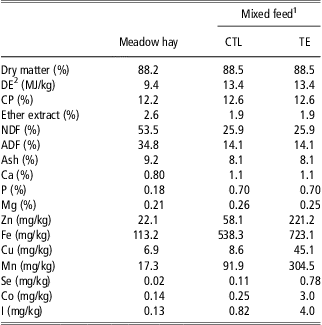
The research protocol was in accordance with the European Commission guidelines (1986/609/EC) concerning the protection of animals used for experimental and other scientific purposes. This on-field experiment was carried out at a private dairy farm, which produces donkey milk, located in Reggio Emilia province, Italy. During a 3-month period (from the end of winter to the end of spring, without implementing specific programs of artificial lighting), 16 clinically healthy lactating donkeys (Martina-Franca derived population; 6 to 12 years old; three to seven parities) were used to provide milk and blood samples. At the first sampling time, donkeys were 32 to 58 days from foaling, averaging 205.4 kg of BW and 3.43 body condition score (on a scale of 1 to 5; Martin-Rosset, Reference Martin-Rosset1990). Donkeys were randomly divided into two homogeneous groups: control (CTL) and TE. Donkeys of each group were housed in the same stall, in two adjacent boxes of the same size, allowing contemporary access to the manger. The boxes, provided with large external paddock, were bedded with wheat straw. Donkeys had continuous access to fresh water and to meadow hay. Donkeys were group fed 2.5 kg of mixed feed, divided into two meals. Although nutrient requirements of lactating donkeys are not yet well defined, assuming dry matter intake at 3.2% of BW, diets were formulated to fall within the range of digestible energy (8.5 to 10.0 MJ/kg) and protein content (10% to 13%) implemented in the scientific literature for lactating donkeys (Salimei, Reference Salimei2011). Samples of hay and mixed feeds were analyzed for chemical composition (Association of Official Analytical Chemists (AOAC), 1990; Table 1). Mixed feed for the TE group had the same ingredients as CTL, but was supplemented with a commercial TE premix. Such a premix was, as a basal complete trace mineral additive, formulated to meet dietary recommendations for lactating light mares (Martin-Rosset, Reference Martin-Rosset1990). The TE concentrations of hay and mixed feeds (Table 1) were measured by inductively coupled plasma-MS (ICP-MS; 7500cx series; Agilent Technologies, Santa Clara, CA, USA; Moschini et al., Reference Moschini, Battaglia, Beone, Piva and Masoero2010; Schone et al., Reference Schone, Leiterer, Lebzien, Bemmann, Spolders and Flachowsky2009). The TE supplementation provided 163 mg Zn (zinc oxide), 185 mg Fe (ferrous carbonate), 36 mg Cu (copper sulfate), 216 mg Mn (manganese oxide), 0.67 mg Se (sodium selenite), 2.78 mg Co (cobalt sulfate) and 3.20 mg I (calcium iodate)/kg mixed feed. The calculated TE concentrations (as fed basis) of diet (assuming a daily intake of 5.0 and 2.5 kg, respectively, for hay and mixed feed) for the experimental groups were as follows: CTL group = Zn 34.1 mg/kg, Fe 254.9 mg/kg, Cu 7.5 mg/kg, Mn 42.1 mg/kg, Se 0.05 mg/kg, Co 0.17 mg/kg, I 0.36 mg/kg. TE group = Zn 88.5 mg/kg, Fe 316.5 mg/kg, Cu 19.6 mg/kg, Mn 113.0 mg/kg, Se 0.27 mg/kg, Co 1.10 mg/kg and I 1.42 mg/kg. As a point of comparison, the TE intake calculated for donkeys in CTL group would meet or exceed the TE requirements of lactating mares (mature BW of 200 kg), except for Se (National Research Council (NRC), 2007). Both groups were fed the CTL diet 2 weeks before the beginning of sampling. The supplemented mixed feed was gradually administered to animals in the TE group starting at the 1st sampling period, immediately following milking. Donkeys were housed with the foals that were separated from the dam 3 h before milking. Individual and bulk milk samples were collected every 2 weeks at 1100 h by mechanical milking as described by Salimei et al. (Reference Salimei, Fantuz, Coppola, Chiofalo, Polidori and Varisco2004). Donkeys, managed as dairy animals, were accustomed to machine-milking procedure as they were milked during the previous lactation. Aliquots of milk samples were frozen and stored at −20°C until analysis. All glasses and polyethylene tubes used for collection, storage and analysis of samples were previously washed with 3% nitric acid (Suprapur quality, Merck, Darmstadt, Germany) solution. Blood samples were collected just after milking by jugular venipuncture in evacuated tubes (Venoject, Terumo Europe NV, Leuven, Belgium) without anticoagulant. Tubes were centrifuged and serum aliquots stored at −20°C until analysis. Milk hygiene and mammary health were monitored during the trial in fresh bulk milk samples by measuring total bacteria (Bactoscan 8000, Foss, Hillerod, Denmark) and somatic cell count (Fossomatic 360, Foss, Hillerod, Denmark).
Energy and nutrient composition (as fed basis) of meadow hay and mixed feeds fed to control (CTL) and trace element (TE)-supplemented donkeys

1Mixed feed for CTL group was composed of barley, dehydrated alfalfa (15% CP), wheat, wheat bran, pea, calcium carbonate, bicalcium phosphate and sodium chloride. In TE mixed feed, 0.25% trace element premix was included, providing 163 mg Zn (zinc oxide), 185 mg Fe (ferrous carbonate), 36 mg Cu (copper sulfate), 216 mg Mn (manganese oxide), 0.67 mg Se (sodium selenite), 2.78 mg Co (cobalt sulfate) and 3.20 mg I (calcium iodate)/kg mixed feed.
2Digestible energy, calculated for horses, according to NRC (2007).
Milk and serum analyses
All solutions were prepared using ultrapure water obtained from a Millipore Milli-Q system (resistivity 18.2 MΩ cm). For Zn, Fe, Cu, Mn, Se and Co determination, mineralization of milk samples (n = 112) was obtained modifying the method reported by Fantuz et al. (Reference Fantuz, Ferraro, Todini, Piloni, Mariani and Salimei2012). Optimized digestion of thawed milk samples was carried out by placing 1 ml of milk sampled in a Teflon digestion vessel, followed by 3 ml of HNO3 (65%). Fifty microliters of tellurium solution (5 mg/l) was added as recovery standard. The vessel was immediately sealed and placed in a microwave closed vessel system (Berghof Speedwave four, Berghof, Eningen, Germany) for digestion. Digested solutions were transferred to a 10 ml volumetric flask and diluted with ultrapure water.
The extraction of milk I was carried out according to the method described by Reid et al. (Reference Reid, Bashammakh, Goodall, Landon, O'Connor and Sharp2008), optimized as follows: 500 μl of milk was added to a centrifuge tube followed by 1 ml of tetramethylammonium hydroxide (TMAH; ultrapure grade, Aldrich, Milan, Italy) solution (25%). Fifty microliters of tellurium solution (1 mg/l) was also added as recovery standard. The tube was placed in a water bath and kept 2 h at 70°C. Subsequently, the tube was centrifuged for 20 min at 5000 r.p.m., and the supernatant was transferred into a 10 ml volumetric flask and diluted with TMAH solution (2.5%). For determination of blood serum TE, except iodine, 0.5 ml serum samples (n = 112) were diluted 1 : 20 with an HNO3 solution (1%) before the analysis, as described by Abou-Shakra et al. (Reference Abou-Shakra, Rayman, Ward, Hotton and Bastian1997). Iodine determination in serum samples were carried out diluting (1 : 10) 1 ml of samples with a TMAH solution (2.5%) as described by Schramel and Hasse (Reference Schramel and Hasse1994).
The concentrations of Zn, Fe, Cu, Mn, Se, Co and I in the processed samples were measured by ICP-MS (7500cx series) with the following operating conditions: power 1550 W, carrier gas 1.03 l/min, make-up gas 0.00 l/min, sample depth 8 mm, nebulizer pump 0.1 r.p.s. and spray chamber temperature 2°C. The 7500cx series instrumentation can be operated in He mode in order to overcome most of the polyatomic interference by the collision cell. A typical performance test in He mode was as follows: He flux 4.2 ml/min, m/z 89 (1153 cps), m/z 205 (1659 cps), m/z 56 (1029 cps), m/z 52 (10 cps) and m/z 8 (2 cps). A solution containing Indium (50 μg/l) was used as internal standard for ICP-MS measurements. Calibration curves for investigated elements were obtained using aqueous (1% nitric acid or 2.5% TMAH for iodine) standard solutions prepared with appropriate dilution of stock standards (Fluka Analytical, Aldrich, Milan, Italy). The accuracy of the analytical procedure was regularly checked by analysis of certified reference material, nonfat milk powder NIST SRM 1549 (National Institute of Standards and Technology, Gaithersburg, MD, USA) and Seronorm™ Trace Elements Serum Level 2 (Sero As, Billingstad, Norway).
Statistical analysis
Statistical analyses were performed using SPSS 12.0 (SPSS Inc., Chicago, IL, USA). All the investigated variables were checked for normal distribution using the Kolmogoroff–Smirnoff test. Data on Fe, Mn and I in milk, and on Zn, Fe and Cu in serum, showed a log normal distribution and were transformed accordingly before statistical elaboration. As donkeys were group-fed with no replication of pens within treatments, the investigators assumed no pen effect, and that errors within pens were independent, allowing for the donkey to serve as the experimental unit. Data were processed by ANOVA for repeated measures to evaluate the effects of dietary treatment (between subject factor) and of lactation stage (within subject factor). Data from the 1st sampling were used as covariate when significant. In the case of significant effects (P < 0.05), differences between means were analyzed by LSD. Owing to the fact that the serum Mn concentration did not follow a normal distribution and remained this way even after transformation, data on Mn were subjected to the Kruskal–Wallis test. Associations between milk and serum elements were examined by calculating simple linear correlations. Significant correlations were declared strong (r > 0.7), moderate (r = 0.3 to 0.7) or weak (r < 0.3).
Results
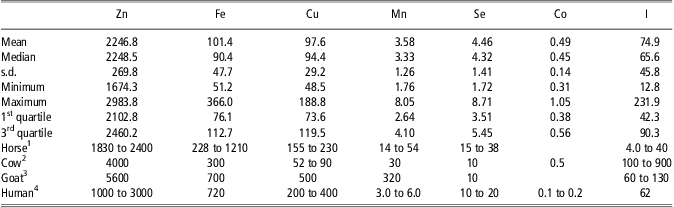
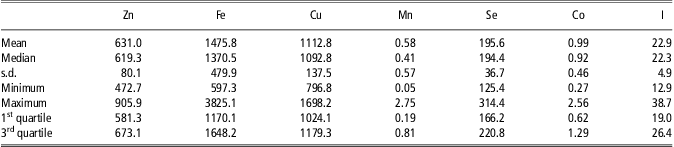
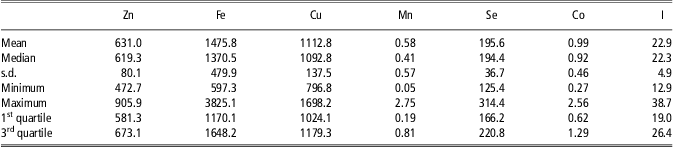
Good milk hygiene and health status of the udders were demonstrated by the low-average milk total bacteria (7300 CFU/ml) and somatic cell count (3400 SCC/ml) observed in bulk milk samples during the trial. Descriptive statistics on TE in donkey milk and blood serum are summarized in Tables 2 and 3, respectively. Literature data about TE concentration in milk from other species are also given in Table 2 for comparison. Milk and serum Se concentrations, as well as Co milk and serum concentrations, were moderately correlated (r = 0.31; P < 0.01 and r = 0.36; P < 0.01, respectively), whereas milk I concentrations were weakly correlated (r = 0.27; P < 0.05) with their serum counterpart. Correlation coefficients between milk and serum Zn, Fe, Cu and Mn were not significant.
Descriptive statistics for essential trace elements (μg/l) in donkey milk (n = 96) and literature data on milk from other species (horse, cow, goat and human)
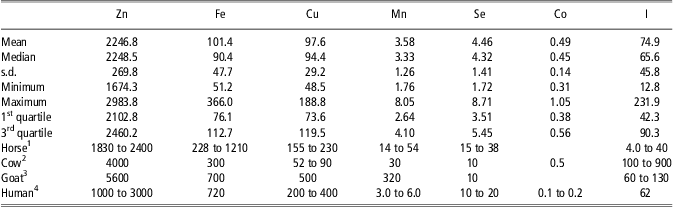
1On the basis of data from Anderson (Reference Anderson1992), Csapó-Kiss et al. (Reference Csapó-Kiss, Stefler, Martin, Makray and Csapó1995), Grace et al. (Reference Grace, Pearce, Firth and Fennessy1999), Doreau and Martin-Rosset (Reference Doreau and Martin-Rosset2011) and Montgomery et al. (Reference Montgomery, Wichtel, Wichtel, McNiven, McClure, Markham and Horohov2012).
2On the basis of data from Anderson (Reference Anderson1992), Cashman (Reference Cashman2011) and Moschini et al. (Reference Moschini, Battaglia, Beone, Piva and Masoero2010).
3Data from Park et al. (Reference Park, Juarez, Ramos and Haenlein2007) and Nudda et al. (Reference Nudda, Battacone, Decandia, Acciaro, Aghini-Lombardi, Frigeri and Pulina2009).
4Data from Dorea (Reference Dorea2002) and Darragh and Lonnerdal (Reference Darragh and Lonnerdal2011).
Descriptive statistics for essential trace elements (μg/l) in blood serum (n = 96) of lactating donkeys
The milk concentrations of all the investigated minerals were not significantly affected by the dietary supplementation with TE (results not shown). Blood serum concentrations of Zn, Fe, Cu, Mn and Se were not affected by dietary treatment (result not shown), but serum from TE supplemented donkeys contained higher concentrations of Co (1.34 v. 0.69 μg/l; s.e.m. 0.09; P < 0.01) and I (24.42 v. 21.43 μg/l; s.e.m. 0.9; P < 0.05), compared with animals in the CTL group.
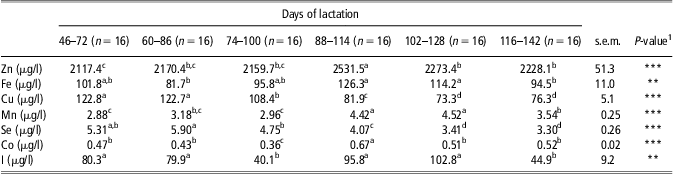
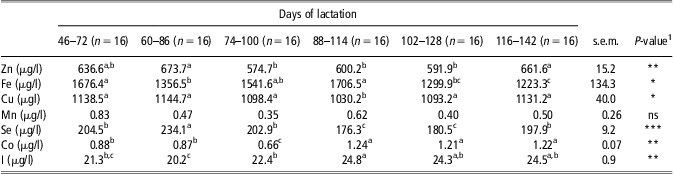
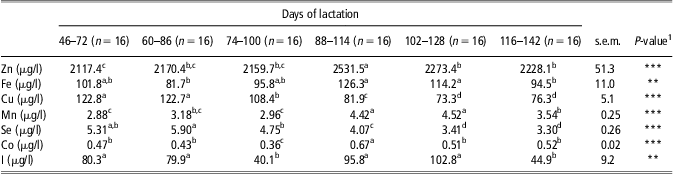
The effect of lactation stage was significant for all the investigated elements in milk (Table 4) and blood serum (Table 5), except serum manganese, of which the concentration did not change significantly with the progressing of lactation. A clear negative trend during lactation was observed for milk concentrations of Cu and Se (−38%), whereas Mn milk concentrations showed higher values during the second part of the trial. The trends of Zn, Fe, Co and I milk concentrations were not consistent. The Cu serum concentration was generally constant, apart from a significant drop at the 5th sampling time. The concentration of serum Co showed higher values from the 5th to the 7th sampling time, whereas the serum Zn, Fe, Se and I concentration showed no definite trend during lactation. The effect of treatment × lactation stage interaction was not significant for all variables.
Effect of lactation stage on essential trace element concentrations in donkey milk
a,b,c,dMeans within a row with different superscripts differ at P < 0.05.
Means and s.e.m. are from absolute data.
1P values for Fe, Mn and I are from log-transformed data. **P < 0.01; ***P < 0.001.
Effect of lactation stage on essential trace element concentrations in blood serum of lactating donkeys
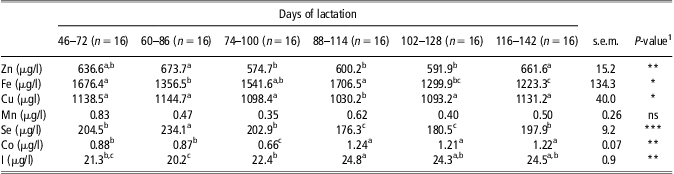
a,b,c,dMeans within a row with different superscripts differ at P < 0.05.
Means and s.e.m. are from absolute data.
1P values for Zn, Fe and Cu are from log-transformed data. *P < 0.05; **P < 0.01; ***P < 0.001.
Discussion
Overall, average donkey milk Zn and Cu concentrations fell within the range already observed for the same species, but the Cu level was close to the lower limit (Fantuz et al., Reference Fantuz, Maglieri, Lebboroni and Salimei2009). Similar Zn but higher Cu concentrations were reported for mare milk (Table 2; Anderson, Reference Anderson1992; Csapó-Kiss et al., Reference Csapó-Kiss, Stefler, Martin, Makray and Csapó1995; Grace et al., Reference Grace, Pearce, Firth and Fennessy1999). The observed donkey milk Fe concentration was ∼10 times lower than that previously reported by Fantuz et al. (Reference Fantuz, Maglieri, Lebboroni and Salimei2009). Such discrepancy may be related to differences in analytical method, sampling, breed or lactation stage. Reported Fe concentrations in mare milk are higher and extremely variable (Anderson, Reference Anderson1992; Csapó-Kiss et al., Reference Csapó-Kiss, Stefler, Martin, Makray and Csapó1995). Average donkey milk concentrations of Mn and Se were lower than in mare milk (Anderson, Reference Anderson1992; Csapó-Kiss et al., Reference Csapó-Kiss, Stefler, Martin, Makray and Csapó1995; Montgomery et al., Reference Montgomery, Wichtel, Wichtel, McNiven, McClure, Markham and Horohov2012), but I concentration was higher (Table 2; Doreau and Martin-Rosset, Reference Doreau and Martin-Rosset2011).
Donkey milk contains lower concentrations of Zn, Fe, Mn and Se compared with milk commonly used for human consumption, such as cow and goat (Park et al., Reference Park, Juarez, Ramos and Haenlein2007; Cashman, Reference Cashman2011), whereas the Cu concentration is similar to or higher than cow (Anderson, Reference Anderson1992; Cashman, Reference Cashman2011) but lower than goat milk (Park et al., Reference Park, Juarez, Ramos and Haenlein2007). The average donkey milk Co concentration was similar to or slightly lower than that in cow milk (Cashman, Reference Cashman2011). A wide range of variation is reported for the I concentration in cow and goat milk, strongly depending on dietary factors (Nudda et al., Reference Nudda, Battacone, Decandia, Acciaro, Aghini-Lombardi, Frigeri and Pulina2009; Moschini et al., Reference Moschini, Battaglia, Beone, Piva and Masoero2010; Cashman, Reference Cashman2011).
Compared with human milk, donkey milk contains similar concentrations of Zn, Mn and Co, whereas those of Fe, Cu and Se are lower (Darragh and Lonnerdal, Reference Darragh and Lonnerdal2011). A wide range of variation, owing to maternal I intake, is reported in the literature for I concentrations in human milk; however, as reviewed by Dorea (Reference Dorea2002), the median for I concentrations in human milk was similar to that observed in donkey milk. No data on Co concentration in mare and goat milk are available in literature for comparison. The characterization of the mineral profile in donkey milk is of interest in human nutrition when donkey milk is used in pediatric and geriatric nutrition. The relatively low content of Fe, Cu and Se in donkey milk compared with human milk should be considered when donkey milk is included in pediatric diets.
To the authors’ knowledge, there are no published data on TE in donkey serum; however, concentrations of Fe found in the present study on lactating donkeys were consistent with those in lactating mares (1440 to 1530 μg/l; Grace et al., Reference Grace, Pearce, Firth and Fennessy1999), and Zn concentrations were slightly higher (500 to 540 μg/l; Okumura et al., Reference Okumura, Asano, Tagami, Tsukiyama and Fujinaga1998). Compared with the current study, higher serum concentrations of Cu (∼1300 μg/l) and Mn (2.1 to 2.7 μg/l) were previously observed for lactating mares (Okumura et al., Reference Okumura, Asano, Tagami, Tsukiyama and Fujinaga1998). The serum Se concentration found in the present study was higher than the normal range expected for adult horses (130 to 160 μg/l; Stowe and Herdt, Reference Stowe and Herdt1992). No data are available on serum Co in lactating mares. Similarly, no data are available on serum total I concentrations in equids; however, the observed results on donkey serum were more than two times lower than in serum from cows fed similar dietary I concentrations (Schone et al., Reference Schone, Leiterer, Lebzien, Bemmann, Spolders and Flachowsky2009).
Compared with blood serum, the concentrations of Zn, Mn and I were higher in milk, whereas those of Fe, Cu, Se and Co were lower. These observations suggest that the milk concentration of the investigated elements is regulated by the mammary gland, which actively transports Zn, Mn and I from blood to milk, whereas mammary epithelium appears to inhibit the passage of Fe, Cu, Se and Co. However, the correlations between milk and serum Se, Co and I may indicate that, besides the active role of the mammary gland, homeostatic mechanisms regulating the serum concentration of TE also play a role in determining the level of Se, Co and I in milk, through passive diffusion to varying extents. In contrast, the observed absence of relationships indicates that Zn, Fe, Cu and Mn milk concentrations are independent from maternal status.
The observed effects of dietary TE supplementation on donkey Zn, Fe and Cu milk and serum concentrations are similar to those previously observed in mares whose diet was supplemented with Zn, Fe or Cu at levels higher than recommended (Baucus et al., Reference Baucus, Ralston, Rich and Squires1989; Grace et al., Reference Grace, Pearce, Firth and Fennessy1999; Kavazis et al., Reference Kavazis, Kivipelto and Ott2002). The lack of significant response to the dietary treatment may indicate that dietary concentrations of the investigated elements were sufficient to cover their nutrient requirements in lactating donkeys. On the other hand, such a hypothesis needs confirmation, considering that the levels of some elements in milk are known to be determined by complex biochemical homeostatic mechanisms, not directly related to the dietary intake (Lonnerdal, Reference Lonnerdal2007).
Karren et al. (Reference Karren, Thorson, Cavinder, Hammer and Coverdale2010) reported that in late pregnancy the plasma Se concentration was higher in mares fed organic Se supplement than in unsupplemented mares. Furthermore, the study reported a higher colostrum Se concentration in Se-supplemented mares. Calamari et al. (Reference Calamari, Ferrari and Bertin2009) evaluated Se source and level in supplemented mature horses: when horses were supplemented with Se at a dietary level consistent with that used in the current study, higher plasma Se was observed compared with the unsupplemented group. It must be highlighted that in the latter study the plasma Se concentration for the unsupplemented group was (1) ca. two times lower than that reported for lactating donkeys in the present study, and (2) below the reference range reported for serum in adult horses (Stowe and Herdt, Reference Stowe and Herdt1992). Similar increase of the plasma Se concentration for Se supplemented horses was also observed by Richardson et al. (Reference Richardson, Siciliano, Engle, Larson and Ward2006), when plasma Se concentrations of the unsupplemented animals were below the reference range for adult horses (Stowe and Herdt, Reference Stowe and Herdt1992). It is worth noting that in the present study, the Se concentration in the CTL diet was ca. three times lower than that reported for horses by Richardson et al. (Reference Richardson, Siciliano, Engle, Larson and Ward2006), but the serum Se concentration was ∼2.3 times higher. Compared with donkeys, lower values of plasma Se in mares supplemented with inorganic or organic Se were also observed by Montgomery et al. (Reference Montgomery, Wichtel, Wichtel, McNiven, McClure, Markham and Horohov2012). Moreover, in the study by Richardson et al. (Reference Richardson, Siciliano, Engle, Larson and Ward2006), the plasma Se content of supplemented horses plateaued within 28 days from supplementation at ∼150 to 180 μg/l, which is similar but still lower than that observed in the current study. The lack of significant response of milk and serum Se to dietary Se supplementation in lactating donkeys may be attributed to different factors such as level of dietary Se intake, Se source or pre-experimental Se status. Moreover, contrary to the mentioned studies, in the current experiment, Se was supplemented together with other TE that may have interfered with Se absorption.
In horses, as hindgut fermenters, Co is used by microorganisms in the lower digestive tract to produce vitamin B12, which is then absorbed (Stillion et al., Reference Stillion, Teeter and Nelson1971). The higher serum concentration in TE-supplemented donkeys may be related to the higher Co intake, resulting in enhanced bacterial synthesis of vitamin B12 and in subsequent absorption in the large intestine. Serum vitamin B12 concentration is reported to be affected by Co supplementation in horses (NRC, 2007).
Average I in milk from supplemented donkeys was ∼25% higher than in the CTL group, although the significant threshold was not reached (82.1 v. 65.8 μg/l; s.e.m. 8.3; P > 0.05). This may be due to the observed variability of milk I concentrations. Schone et al. (Reference Schone, Leiterer, Lebzien, Bemmann, Spolders and Flachowsky2009) observed that cow milk and serum I concentrations were higher with increasing levels of dietary I supplement, and similar responses were observed in other studies on cow milk (Moschini et al., Reference Moschini, Battaglia, Beone, Piva and Masoero2010). Iodine in milk is reported to increase after dietary I supplementation also in goats (Nudda et al., Reference Nudda, Battacone, Decandia, Acciaro, Aghini-Lombardi, Frigeri and Pulina2009). It must be noted that in ruminant studies the considered range of I supplement reached higher maximum levels than that implemented in the current study owing to the sensitivity to dietary I excess reported for horses (NRC, 2007).
Data found in the literature concerning the effect of lactation stage on TE in mare milk are not conclusive: in mature mare milk, the Zn concentration is reported to increase from the second to the fourth month of lactation, whereas Fe and Cu concentrations remained unchanged (Grace et al., Reference Grace, Pearce, Firth and Fennessy1999). Previously, Ullrey et al. (Reference Ullrey, Ely and Covert1974) reported that in mare milk Zn, Fe and Cu concentrations tended to decline within 4 months of lactation and, similarly Csapó-Kiss et al. (Reference Csapó-Kiss, Stefler, Martin, Makray and Csapó1995) reported a decrease of Zn and Cu, but considering only the first 45 days of lactation. The obtained results in donkey serum are not in agreement with those found by Grace et al. (Reference Grace, Pearce, Firth and Fennessy1999) who observed no significant effect of lactation stage on plasma Zn, Fe and Cu concentrations in mares fed on pasture within 135 to 150 days of lactation.
The stage of lactation and diet are the major factors affecting seasonal changes in milk composition. The observed negative trends for donkey milk Cu and Se cannot be attributed to changes in dietary mineral supply, which remained constant during the trial. Therefore, it seems that the mammary gland of lactating donkeys regulates milk Cu and Se concentrations by reducing transport from blood to milk as lactation progresses. There are no clear explanations for the sudden changes of some TE in milk and blood serum observed during the trial. However, a superimposed effect of photoperiod and climate on the investigated variables can not be excluded. Nevertheless, the observed decrease of milk Cu and Se and the decrease in milk yield reported for donkeys during lactation (D'Alessandro and Martemucci, Reference D'Alessandro and Martemucci2012; Salimei and Fantuz, Reference Salimei and Fantuz2012) suggest that Cu and Se dietary requirements for lactating donkeys decreases as lactation progresses.
Conclusions
Compared with human milk, donkey milk contains similar concentrations of Zn, Mn, Co and I, whereas those of Fe, Cu and Se are lower. Donkey milk contains lower concentrations of Zn, Fe, Mn and Se compared with cow milk, whereas the Cu concentration is similar or higher. Results from this study indicate that the concentration of TE in donkey milk and blood serum is not dependent on dietary TE supply, except serum Co, and I, of which concentrations increased following dietary TE supplementation. The milk Cu and Se concentrations clearly decrease with progressing lactation stage. Data from this study represent a basis for practical applications, as well as for further research. Such data may be useful both in human nutrition, in which donkey milk is used as a food for infants or elderly consumers, and in animal nutrition to support the assessment of TE nutritional requirements of dams and newborns and as a basis to establish reference serum values for lactating donkeys.
Acknowledgements
This paper was partially funded by the University of Camerino (F. Fantuz, S. Ferraro, L. Todini). The authors thank D. Borghi, G. Borghi and T. Faietti (Azienda Agricola Montebaducco, Salvarano di Quattro Castella, Reggio Emilia, Italy) for their valuable collaboration; M. B. Dunbar for language revision, and V. Brunetti, G. Lebboroni and A. El Jeddad for technical assistance.