Introduction
Avian coccidiosis is an infectious parasitic disease of poultry which is caused by one or more of the seven species of protozoan belonging to the Eimeria genus (Blake and Tomley, Reference BLAKE and TOMLEY2014). These pathogenic species of Eimeria include E. tenella, E. acervulina, E. mitis, E. brunetti, E. praecox, E. necatrix and E. maxima. Each species of Eimeria is responsible for its characteristic lesions according to pathogenicity (moderate to severe), immunogenicity and site of infection in epithelial cells of the intestinal tract in poultry birds (Alnassan et al., Reference ALNASSAN, KOTSCH, SHEHATA, KRUGER, DAUGSCHIES and BANGOURA2014; Ali et al., Reference ALI, KHATER, SEDDIEK and NADA2015). The oocysts of Eimeria species were recovered, for the first time, in 1891 from the caeca of chicken (Chapman, Reference CHAPMAN2014). The coccidiosis infection is highly host specific with a period of infection ranging from four to six days depending upon high host density and other associated factors such as contact with droppings (Akhtar et al., Reference AKHTAR, ANWAR, IQBAL, MUHAMMAD, AWAIS, HAQ and SAWICKA2012; Bachaya et al., Reference BACHAYA, ABBAS, RAZA, IQBAL, REHMAN, BABER and HUSSAIN2015). The parasite colonises itself in the intestinal cells of the host leading to malabsorption, diarrhoea and reduced weight gain because of massive destruction of epithelial cells of the intestinal tract (Bozkurt et al., Reference BOZKURT, GIANNENAS, KUCUKYILMAZ, CHRISTAKI and FLOROU-PANERI2013).
Coccidiosis has a major economic impact worldwide because of financial losses in terms of poor weight gain, stunted growth, reduced production and high mortality and morbidity of the host (Dalloul and Lillehoj, Reference DALLOUL and LILLEHOJ2006; Chapman et al., Reference CHAPMAN, JEFFERS and WILLIAMS2010). It leads to an annual loss of €2 billion to the poultry sector worldwide, compelling emergent efficient strategic planning for the control of this parasite (Peek and Landman, Reference PEEK and LANDMAN2011; Ramadan et al., Reference RAMADAN, KHATER, SEDDIEK and ABD EL-ATY2015). Use of botanicals and their secondary metabolites as antimicrobial and antiparasitic agent dates back centuries (Khater, Reference KHATER2011; Reference KHATER2014) but their potential role as an anticoccidial agent is relatively new (Christaki et al., Reference CHRISTAKI, BONOS, GIANNENAS and FLOROU-PANERI2012). Anticoccidial drugs have been used for over 60 years for the control of parasites (Arczewska-Wlosek and Swiatkiewicz, Reference ARCZEWSKA-WLOSEK and SWIATKIEWICZ2013). However, long-term and extensive use of these drugs has led to the potential development of resistance against these drugs (Abbas et al., Reference ABBAS, IQBAL, BLAKE, KHAN and SALEEMI2011a). In addition, serious public health and food safety concerns regarding drug residues in animal products stress stakeholders and researchers to develop alternative strategies for the control of parasitic problems (Huyghebaert et al., Reference HUYGHEBAERT, DUCATELLE and IMMERSEEL2011; Abu-Akkada and Awad, Reference ABU-AKKADA and AWAD2015; Mondal et al., Reference MONDAL, HOSSAIN, WANGK, SAHA, RASHID, ISLAM, RAHMAN, JAHAN, RAHMAN and SHILPI2015). Organic acids, short chain fatty acids, live vaccine, plant extracts and EOs have been used as alternatives to insecticides and antiparasitic agents (Khater et al., Reference KHATER, RAMADAN and MAGEID2013; Ali et al., Reference ALI, SEDDIEK and KHATER2014).
Vaccines for coccidiosis have been reported as another effective tool (Dalloul and Lillehoj, Reference DALLOUL and LILLEHOJ2006). These vaccines enhance host immune resistance against infectious Eimeria species and live vaccines have been the most popular and convenient to enhance host immunity. However, in cases of poor management, live vaccines can trigger reactions that may affect the performance of flocks, mainly in broilers because of their rearing period (Chapman, Reference CHAPMAN2000). As a result of this drawback, attenuated vaccines (with reduced pathogenicity) have been developed, but these are expensive to produce (Sharman et al., Reference SHARMAN, SMITH, WALLACH and KATRIB2010).
Essential oils and their components belonging to different plant species have been extensively studied and reported to impart positive effects on controlling avian coccidiosis (Christaki et al., Reference CHRISTAKI, BONOS, GIANNENAS and FLOROU-PANERI2012). Supplementation of feed with botanical products (Bozkurt et al., Reference BOZKURT, GIANNENAS, KUCUKYILMAZ, CHRISTAKI and FLOROU-PANERI2013) especially EOs can effectively act as alternatives to anticoccidial drugs by eliminating and/or decreasing the use of drugs for treating and controlling avian coccidiosis (McCloud, Reference MCCLOUD2010; Tsinas et al., Reference TSINAS, GIANNENAS, VOIDAROU, TZORA and SKOUFOS2011).
Composition of essential oils
EOs are aromatic oily liquids comprising of mainly cyclic hydrocarbons (monoterpenes) and their alcohol, aldehyde or ester derivatives (Wallace et al., Reference WALLACE, OLESZEK, FRANZ, HAHN, BASER, MATHE and TEICHMANN2010). These EOs can be derived using high-performance liquid chromatography (HPLC), gas chromatography and distillation methods (Juliano et al., Reference JULIANO, MATTANA and USAI2000; Delaquis et al., Reference DELAQUIS, STANICH, GIRARD and MAZZA2002). The composition of EOs obtained from the same plant species can be variable because of variation in geographical region, the parts of plant used, season, and the stage of harvesting plants and method of isolation (Bauer et al., Reference BAUER, GARBE and SURBURG2001; Greathead, Reference GREATHEAD2003). However, EOs obtained from plants around the full bloom stage possess the most potent activity (Burt, Reference BURT2004). The major active constituents of EOs responsible for their biological effects with antiparasitic activity are phenylpropanoids (eugenol, methyl chavicol, and cinnamaldehyde), sesquiterpenes (β-caryophyllene, nerolidol, α-copaene, cyperene, and germacrene D), monoterpenoids (linalool, terpinen-4-ol, thymol, carvacrol, citral, limonene, α-pinene, γ-terpinene, α-phellandrene, and p-cymene) and other aromatic aldehydes such as cuminal and phellandral (Dorman and Deans, Reference DORMAN and DEANS2000). Essential oils are complex chemical mixtures and this complexity makes it difficult to understand their precise activities (Russo et al., Reference RUSSO, GALLETTI, BOCCHINI and CARNACINI1998).
Mechanism of action of essential oils
The mechanism of action of EOs has not been studied extensively due to the complexity in their composition. Each component of the EO imparts an individual effect contributing to a collective effect depending upon the nature and concentration of each component in the specific oil. For ease of understanding, the antiparasitic effect of EOs can further be explained as direct and indirect antiparasitic actions, especially for the control of coccidiosis (Ueda-Nakamura et al., Reference UEDA-NAKAMURA, MENDONCA-FILHO, MORGADO-DIAZ, KOREHISA, PRADO, APARICIO, ALVIANO, ROSA, LOPES, ALVIANO and NAKAMURA2006; Machado et al., Reference MACHADO, DINIS, SALGUEIRO, CAVALEIRO, CUSTODIO and DO CEU SOUSA2010).
Direct anticoccidial actions include ultra-structural changes in the mitochondrial membrane (Ueda-Nakamura et al., Reference UEDA-NAKAMURA, MENDONCA-FILHO, MORGADO-DIAZ, KOREHISA, PRADO, APARICIO, ALVIANO, ROSA, LOPES, ALVIANO and NAKAMURA2006), inhibition of glycoprotein synthesis (Rodrigues et al., Reference RODRIGUES, KIMURA, PERES, COUTO, AQUINO and KATZIN2004) and inhibition of cysteine protease cruzain enzyme (Ogungbe and Setzer, Reference OGUNGBE and SETZER2008). The indirect antiparasitic actions of EOs include supporting the host by immunomodulatory effects (Machado et al., Reference MACHADO, DINIS, SALGUEIRO, CAVALEIRO, CUSTODIO and DO CEU SOUSA2010) and providing protection against free radicals by scavenging reactive oxygen species (ROS) that are produced during parasitic invasion (Pedroso et al., Reference PEDROSO, UEDA-NAKAMURA, DIAS FILHO, CORTEZ, CORTEZ, MORGADO-DIAZ and NAKAMURA2006; Bakkali et al., Reference BAKKALI, AVERBECK, AVERBECK and IDAOMAR2008). EOs are potent botanical products which either interfere directly with parasitic metabolism or indirectly by enhancing the host immune response and antioxidant defence systems for the effective control and eradication of parasitic invasion.
Most researchers suggested that the antimicrobial, immunomodulatory, antifungal, insecticidal (Khater and Khater, Reference KHATER and KHATER2009; Khater et al., Reference KHATER, HANAFY, ABDEL-MAGEED, RAMADAN and EL-MADAWY2011) and antioxidant properties of EOs are associated with their antiparasitic (Khater et al., Reference KHATER, EL-SHORBAGY and SEDDIEK2014) and anticoccidial activity (Liu et al., Reference LIU, ZENG, CHEN and YAO2007; Zhai et al., Reference ZHAI, YI, WU, SENCHINA, WURTELE, MURPHY, KOHUT and CUNNIK2007). The anticoccidial effects of the individual components have been reported to be more effective than complete EOs. Phenolic components of the essential oils have been studied in Eimeria infection by Williams (Reference WILLIAMS1997) and Giannenas et al. (Reference GIANNENAS, FLOROU-PANERI, PAPAZAHARIADOU, BOTSOGLOU, CHRISTAKI and SPAIS2004). The phenolic components of EOs directly change the permeability of cytoplasmic membrane to various cations especially for hydrogen (H+) and potassium (K+) ions. This alteration in cationic transfer across membrane hinders biochemical processes at the cellular level. These alterations result in the loss of membrane potential which allows leakage of essential cellular constituents, inhibition of protein, ATP synthesis and cellular death (Ultee et al., Reference ULTEE, KETS and SMID1999; Giannenas et al., Reference GIANNENAS, FLOROU-PANERI, PAPAZAHARIADOU, CHRISTAKI, BOTSOGLOU and SPAIS2003; Christaki et al., Reference CHRISTAKI, FLOROU-PANERI, GIANNENAS, PAPAZAHARIADOU, BOTSOGLOU and SPAIS2004; Giannenas et al., Reference GIANNENAS, FLOROU-PANERI, PAPAZAHARIADOU, BOTSOGLOU, CHRISTAKI and SPAIS2004) of the disease-causing organism.
Anticoccidial activity of essential oils
The most potent EOs with antiparasitic properties are obtained from the aromatic plants belonging to the Apiaceae, Lamiaceae and Asteraceae family (Abbas et al., Reference ABBAS, COLWELL and GILLEARD2012a; Reference ABBAS, IQBAL, KHAN, SINDHU, KHAN, KHAN and RAZA2012b; Christaki et al., Reference CHRISTAKI, BONOS, GIANNENAS and FLOROU-PANERI2012). The plant materials and EOs obtained from Origanum vulgare, (Milhau et al., Reference MILHAU, VALENTIN, BENOIT, MALLIE, BASTIDE, PELISSIER and BESSIERE1997) Allium cepa, Echinacea purpure, (Zhai et al., Reference ZHAI, YI, WU, SENCHINA, WURTELE, MURPHY, KOHUT and CUNNIK2007) Chenopodium ambrosioides, Mentha spp. and Allium sativumare have been reported effective against intestinal parasites including the Eimeria species. The EOs obtained from O. vulgare have widely been investigated for anticoccidial activity against E. tenella (Da Silva et al., Reference DA SILVA, PESSOTTI, ZANINI, COLNAGO, RODRIGUES, NUNES, ZANINI and MARTINS2009), E. maxima (Tsinas et al., Reference TSINAS, GIANNENAS, VOIDAROU, TZORA and SKOUFOS2011), E. acervulina (Ibrir et al., Reference IBRIR, GREATHEAD and FORBES2001; Reference IBRIR, GREATHEAD and FORBES2002; Reference IBRIR, GREATHEAD and FORBES2009), and mixed Eimeria spp. infection (Hume et al., Reference HUME, CLEMENTE-HERNÁNDEZ and OVIEDO-RONDON2006).
The oregano based dietary supplement (Orego-Stim®) has been investigated to exert a protective effect in birds challenged with E. acervulina and E. maxima infection and experimental birds showed better performance parameters. Tsinas et al. (Reference TSINAS, GIANNENAS, VOIDAROU, TZORA and SKOUFOS2011) studied the effects of Orego-Stim® on the performance of one day-old cobb-500 broiler male chickens experimentally challenged with E. acervulina and maxima infections. The feed conversion ratio and feed intake of the birds were not affected, however; there was a reduction in lesion score and the number of oocysts in excreta of experimental birds. Similarly, Saini et al. (Reference SAINI, DAVIS and DUDLEY-CASH2003) reported a reduction in coccidiosis expression, following supplementation with Orego-Stim® in broilers challenged with coccidian oocysts. The birds were supplemented from 11 to 19 days of age with levels of 330 and 660 g/t of feed. Supplemented birds showed improved lesion scores when compared with control indicating better protective response against coccidial infection. Giannenas et al. (Reference GIANNENAS, FLOROU-PANERI, PAPAZAHARIADOU, CHRISTAKI, BOTSOGLOU and SPAIS2003) studied carvacrol and thymol as major components of supplemented oregano EOs. Supplementation with these components exerted a considerable anticoccidial effect in 14 days old broiler chickens following experimental infection with sporulated oocysts of E. tenella.
In a subsequent study Greathead and Kamel (Reference GREATHEAD and KAMEL2006) investigated the impact of thymol and carvacrol supplementation in broiler chickens. Birds at the age of 28 days were experimentally infected with sporulated oocysts of E. acervulina. It was concluded that supplementation with these oregano components to infected birds enhanced intestinal integrity by reducing expression of coccidiosis.
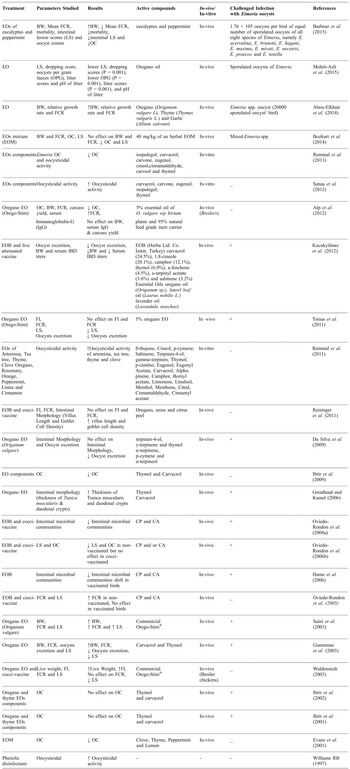
Essential oils obtained from plants other than Origanum spp. include thyme (Ibrir et al., Reference IBRIR, GREATHEAD and FORBES2001; Reference IBRIR, GREATHEAD and FORBES2002), clove (Syzygium aromaticum), peppermint (Mentha x piperita L.), lemon (C. limon) as studied by Evans et al. (Reference EVANS, PLUNKETT and BANFIELD2001). Others include laurel leaf oil (Laurus nobilis L.), lavender oil (Lavandula stoechas) (Kucukyilmaz et al., Reference KUCUKYILMAZ, BOZKURT, SELEK, GUVEN, EREN, ATASEVER, BINTAS, CATLI and CINAR2012) artemisia (Artemisia vulgaris), tea tree (Melaleuca alternifolia), (Remmal et al., Reference REMMAL, ACHAHBAR, BOUDDINE, CHAMI and CHAMI2011) anise (Pimpinella anisum) (Reisinger et al., Reference REISINGER, STEINER, NITSCH, SCHATZMAYR and APPLEGATE2011), commercial blended products Crina Poultry and Crina Alternate (Hume et al., Reference HUME, CLEMENTE-HERNÁNDEZ and OVIEDO-RONDON2006), bushwillow (Combretum woodii), society garlic (Tulbaghia violacea), grape vine (Vitis vinifera), wild wormwood (Artemisia afra) (Naidoo et al., Reference NAIDOO, MCGAW, BISSCHOP, DUNCAN and ELOFF2008), agrimony (Agrimonia eupatoria), narrow-leaf coneflower (Echinacea angustifolia), black currant (Ribes nigrum) and cinchona (Cinchona succirubra) (Christaki et al., Reference CHRISTAKI, FLOROU-PANERI, GIANNENAS, PAPAZAHARIADOU, BOTSOGLOU and SPAIS2004) have shown promising results in various in-vivo and in-vitro experiments against Eimeria species. Supplementation of EOs and essential oil blends in combination with a coccidial vaccination challenge to birds have been reported by many researchers as an effective alternative for controlling avian coccidiosis (Waldenstedt, Reference WALDENSTEDT2003; Kucukyilmaz et al., Reference KUCUKYILMAZ, BOZKURT, SELEK, GUVEN, EREN, ATASEVER, BINTAS, CATLI and CINAR2012). Moreover, researchers have investigated the role of phenols as oocysticides against E. tenella (Williams, Reference WILLIAMS1997). In addition to the general effect of EOs and essential oil blends obtained from plant materials, anticoccidial effects of the components of EOs and other commercial preparations are summarised in Table 1 .
Effect of essential oils (EOs) for controlling coccidiosis.

EOs: essential oils; EOB: essential oil blend; ↑: increase/higher; ↓: decrease/lower; BW: body weight; FCR: feed conversion ratio; FI: feed intake; LS: lesion scores; OC: oocyst count; CP: crina poultry; CA: crina alternate; Positive sign (+): challenged infection with Eimeria oocysts; Negative sign (-): No challenge
Essential oils obtained from Echinacea plants (Echinacea purpure) comprised of substances which are proven to have beneficial effects for the treatment and control of various parasitic infections (Abbas et al., Reference ABBAS, COLWELL and GILLEARD2012a). The exact mechanism by which the plants belonging to Echinacea family gives anti-coccidial effect has not been completely known yet. However, the antimicrobial, anti-inflammatory, immunomodulatory and mainly antioxidant properties of Echinacea purpure have been suggested being associated with its anticoccidial activity (Liu et al., Reference LIU, ZENG, CHEN and YAO2007; Zhai et al., Reference ZHAI, YI, WU, SENCHINA, WURTELE, MURPHY, KOHUT and CUNNIK2007).
Commercially available Crina EO blends, have extensively been studied by many researchers for controlling avian coccidiosis. Oviedo-Rondon et al. (Reference OVIEDO-RONDON, CLEMENTE-HERNÁNDEZ, SALVADOR, WILLIAMS and LOSA2006b) conducted a study to evaluate the effects of two specific essential oil blend either Crina Poultry and or Alternate at 100 ppm in 19 days old broiler birds infected with viable oocysts of mixed Eimeria spp. The dietary inclusion of Crina products were used as an alternative to anticoccidials in mixed Eimeria spp. infections for non-vaccinated broilers, but no beneficial effects were found for vaccinated broilers. Furthermore, coccidial challenge causes drastic shifts in intestinal microbial communities. Supplementation of blends like Crina in birds challenged with mixed coccidian infection, prevented this drastic shift in intestinal microbial communities in broilers vaccinated against avian coccidiosis (Hume et al., Reference HUME, CLEMENTE-HERNÁNDEZ and OVIEDO-RONDON2006; Oviedo-Rondon et al., Reference OVIEDO-RONDON, HUME, HERNANDEZ and CLEMENTE-HERNANDEZ2006a).
Some researchers have suggested that the combination of EO components with vaccination may serve as a popular alternative to coccidiostats. Oviedo-Rondon et al. (Reference OVIEDO-RONDON, CLEMENTE-HERNANDEZ, WILLIAMS and LOSA2005) studied responses of vaccinated broilers to supplementation of EO Crina blends up to 49 days of age as an alternative treatment. No significant beneficial or deleterious effects were found in vaccinated birds following the supplementation with these products. Similar results were found by Oviedo-Rondon et al. (Reference OVIEDO-RONDON, CLEMENTE-HERNÁNDEZ, SALVADOR, WILLIAMS and LOSA2006b) after supplementation of an essential oils blend to 19 days old vaccinated broiler chickens. In another study, Waldenstedt (Reference WALDENSTEDT2003) investigated the effect of vaccine (Paracox®), against avian coccidiosis, in combination with an oregano extract. Supplementation resulted in a reduction in intestinal lesions and faecal oocyst shedding in the litter. Although supplementation of EOs in combination with cocci-vaccine has been suggested to be an effective alternate, further research is needed to determine safety in a large-scale commercial production system.
Oocyst shedding
Shedding Eimeria oocysts in the excreta of birds is generally considered as the main parameter for the estimation of coccidial infection. Essential oils (Kucukyilmaz et al., Reference KUCUKYILMAZ, BOZKURT, SELEK, GUVEN, EREN, ATASEVER, BINTAS, CATLI and CINAR2012) and bioactive plant extracts (Giannenas et al., Reference GIANNENAS, FLOROU-PANERI, PAPAZAHARIADOU, BOTSOGLOU, CHRISTAKI and SPAIS2004; Naidoo et al., Reference NAIDOO, MCGAW, BISSCHOP, DUNCAN and ELOFF2008) of selected herbs can have a positive effect in the reduction of coccidial faecal oocyst shedding and minimise damage to intestinal epithelium in infected birds (Bozkurt et al., Reference BOZKURT, GIANNENAS, KUCUKYILMAZ, CHRISTAKI and FLOROU-PANERI2013). Waldenstedt (Reference WALDENSTEDT2003) reported a reduction in coccidial oocyst shedding in the litter after supplementation of broiler birds with a combination of oregano EO and vaccination. Similar results were given by Da Silva et al. (Reference DA SILVA, PESSOTTI, ZANINI, COLNAGO, RODRIGUES, NUNES, ZANINI and MARTINS2009), Tsinas et al. (Reference TSINAS, GIANNENAS, VOIDAROU, TZORA and SKOUFOS2011) and Alp et al. (Reference ALP, MIDILLI, KOCABAGLI, YILMAZ, TURAN, GARGILI and ACAR2012), who reported that the supplementation of broilers with commercial oregano EOs exerted a protective effect against avian coccidiosis through reduced oocyst shedding in excreta compared to control birds. In another study, Evans et al. (Reference EVANS, PLUNKETT and BANFIELD2001) reported that a mixture of EOs from thyme, peppermint, clove and lemon could impart negative effects on coccidia oocyte output in experimentally challenged broiler chicks. Similar results were seen by Kucukyilmaz et al. (Reference KUCUKYILMAZ, BOZKURT, SELEK, GUVEN, EREN, ATASEVER, BINTAS, CATLI and CINAR2012) using cocci-vaccine alone or in combination with essential oil blend. In contrast, other researchers observed no significant effect on oocyst shedding in excreta following supplementation of birds with thyme (Ibrir et al., Reference IBRIR, GREATHEAD and FORBES2002), oregano (Giannenas et al., Reference GIANNENAS, FLOROU-PANERI, PAPAZAHARIADOU, CHRISTAKI, BOTSOGLOU and SPAIS2003) and other commercial EO preparations (Christaki et al., Reference CHRISTAKI, FLOROU-PANERI, GIANNENAS, PAPAZAHARIADOU, BOTSOGLOU and SPAIS2004). From the data, they suggested EOs as an alternate to coccidiostats on the basis of improvements in performance parameters and a significant reduction in the post infection faecal blood discharge. These studies validated the use of EOs alone and in combination with vaccination for limiting faecal oocysts shedding. Use of EOs for reduction in coccidial oocysts in excreta could lead to the development of new strategy for the prevention of avian coccidiosis.
Antioxidant activity of essential oils
Oxidative stress may be defined as an imbalance between reactive oxygen species (ROS) and a body's ability to detoxify ROS or to repair resulting damage. During normal metabolism, toxic ROS are generated in low concentration which are necessary for many normal physiological processes (Masood et al., Reference MASOOD, ABBAS, IQBAL, MANSOOR, SINDHU, ZIA and KHAN2013). Accumulation of excess ROS into cells results in disturbance of several physiological processes. Under normal circumstances, excessive generation of ROS and resulting damage at cellular and tissue level are controlled by the antioxidant defence system. This includes enzymes like glutathione peroxidase (GSHPx), catalase (CAT), glutathione (GSH) and non-enzymatic antioxidant vitamins such as vitamins A, C, E and β carotene. When oxidative defence mechanisms against ROS, although activated, might not be enough efficient, clinical symptoms of illness may occur. In most diseases, oxidative stress aggravates the situation (Georgieva et al., Reference GEORGIEVA, GABRASHANSKA, KOINARSKI and ERMIDOU-POLLET2011a).
Free radicals produced as a result of coccidial infection could lead to intestinal lesions in infected birds (Georgieva et al., Reference GEORGIEVA, GABRASHANSKA, KOINARSKI and YANEVA2011b). These ROS not only destroy invading infectious agents but also cause lipid peroxidation and cytotoxic effects leading to abnormal changes in the intestinal morphology of infected birds (Georgieva et al., Reference GEORGIEVA, GABRASHANSKA, KOINARSKI and ERMIDOU-POLLET2011a). Natural and synthetic antioxidant compounds can alleviate destructive effects to the intestine by reducing lipid peroxidation and cytotoxic effects caused by ROS. Supplementation with plants EO which have known antioxidant properties can be helpful in limiting the negative effects of coccidial infection (Masood et al., Reference MASOOD, ABBAS, IQBAL, MANSOOR, SINDHU, ZIA and KHAN2013). Reisinger et al. (Reference REISINGER, STEINER, NITSCH, SCHATZMAYR and APPLEGATE2011) examined the effects of oregano, citrus peel and anise EO blend supplementation, supplying extra antioxidant activity to support performance and intestinal morphology of broiler birds during coccidial vaccine exposure. Supplemented birds had increased goblet cell density and villus length. Similarly, Jamroz et al. (Reference JAMROZ, WERTELECKI, HOUSZKA and KAMEL2006) reported that supplementation of broilers with carvacrol, capsicum oleoresin, and cinnamaldehyde increased goblet cells number and increased secretion of mucin on the surface of villi, providing better protection against invading infectious agents to experimentally infected birds.
Limitations in the use of essential oils
Although EOs are alternatives to commercially available anticoccidial drugs, they are less effective as compared to chemical coccidiostats. Giannenas et al. (Reference GIANNENAS, FLOROU-PANERI, PAPAZAHARIADOU, CHRISTAKI, BOTSOGLOU and SPAIS2003) studied the effect of dietary supplementation of oregano EOs at a level of 300 mg/kg, or with the anti-coccidial lasalocid at 75 mg/kg on the performance of broiler chickens experimentally infected with E. tenella at 14 days of age. Oregano EO exerted anticoccidial effects against E. tenella, but protection was less effective than that exhibited by lasalocid. Similarly, Alp et al. (Reference ALP, MIDILLI, KOCABAGLI, YILMAZ, TURAN, GARGILI and ACAR2012) reported lowered protective effect of oregano EOs as compared to commercial anticoccidial drug Cygro®.
Likewise, toxicity and side effects of EOs limit their potential use as alternative strategic control measures for avian coccidiosis. The use of botanicals, EOs and isolated components can impart cytotoxic effects in experimental animals (Christaki et al., Reference CHRISTAKI, FLOROU-PANERI, GIANNENAS, PAPAZAHARIADOU, BOTSOGLOU and SPAIS2004). Essential oils generally impart cytotoxic effects by damaging cell membranes and cell wall structures (Bakkali et al., Reference BAKKALI, AVERBECK, AVERBECK and IDAOMAR2008). Essential oils aggravate the condition by disrupting cytoplasmic membranes of other membrane-bound structures like mitochondria and peroxisomes. They affect depolarisation of mitochondrial membrane by affecting ionic channels, decreasing membrane potential, reducing pH gradient, the collapse of proton pump and ATP pool (Vercesi et al., Reference VERCESI, KOWALTOWSKI, GRIJALBA, MEINICKE and CASTILHO1997). These actions of EOs change membrane permeability and make them leaky to proteins, radicals, cytochrome C, calcium and other ions. This abnormal permeability of mitochondrial membranes leads to cellular death by necrosis and apoptosis (Burt, Reference BURT2004; Barbehenn et al., Reference BARBEHENN, CHEEK, GASPERUT, LISTER and MABEN2005; Armstrong, Reference ARMSTRONG2006). Similarly, major components of oregano EO; thymol and carvacrol have been reported to impart a toxic effect on enterocytes of the mucosal layer of the intestine because of hydrophobic and lipophilic nature of carvacrol (Sikkema et al., Reference SIKKEMA, BONT and POOLMAN1995; Giannenas et al., Reference GIANNENAS, FLOROU-PANERI, PAPAZAHARIADOU, CHRISTAKI, BOTSOGLOU and SPAIS2003). Therefore, EOs should be thoroughly studied for their modes of action, the effectiveness of dose, toxic effects and their corresponding protective response against avian coccidiosis before incorporation of EOs in coccidiosis control strategies.
Antinutritional factors
Another hindrance in the large-scale use of botanicals is that certain plant secondary metabolites (PSM) may contain anti-nutritional properties (Athanasiadou and Kyriazakis, Reference ATHANASIADOU and KYRIAZAKIS2004). PSM may act independently in synergistic, antagonistic or additive fashion. Consumption of PSM in EOs by animals may lead to loss of appetite, toxicity, depression, stunted growth, weight loss and even death in some cases. In livestock, PSM-like phenolics, saponins and tannins have been reported to reduce feed intake and impair digestibility (Waghorn and McNabb, Reference WAGHORN and MCNABB2003; Athanasiadou and Kyriazakis, Reference ATHANASIADOU and KYRIAZAKIS2004; Lee et al., Reference LEE, EVERTS and BEYNEN2004). Similarly, carvacrol; an important component of various EOs (oregano, pepperwort, thyme, and wild bergamot) has been reported to lower feed intake and weight loss in poultry birds (Lee et al., Reference LEE, EVERTS, KAPPERT, YEOM and BEYNEN2003).
Researchers proposed that EOs of such plants containing PSM can be used for parasitic control if their negative effects were reduced to short-term conditions leading to long-term benefits in terms of lowering parasitic load and oocysts shedding. Therefore, before using EOs as anticoccidials, these plant materials and their secondary metabolites (Athanasiadou et al., Reference ATHANASIADOU, GITHIORI and KYRIAZAKIS2007; Akthar et al., Reference AKTHAR, DEGAGA and AZAM2014) should be thoroughly evaluated for potential anti-nutritional effects in such a way that they should not outweigh the desired antiparasitic effects.
Conclusions
The idea of using EOs as an alternative to coccidiostats for modulating avian coccidiosis is a novelty for getting rid of issues such as anticoccidial drug resistance, public health hazards and food safety concerns regarding drug residues in poultry and poultry products. The use of essential oils as an alternative to anticoccidials is limited because of their antinutritional factors, toxicity, poor dose effectiveness and their less protective response. However, further extensive investigations to explore their mechanisms of action, and protective response have to be performed alone or in combination with a vaccine or anticoccidial drugs before incorporation in coccidiosis control strategies.