In a.d. 208 the emperor Septimius Severus, aged 63 but ‘in his heart more enthusiastic than any youth’, set out for Britain, knowing, we are told, from astrology and omens that he would not return and would die in his third year in the island. With him travelled the empress Julia Domna, his 20-year-old elder son and co-Augustus Caracalla, his younger son Geta and the whole of the imperial court and retinue, including the praetorian prefect Papinian. After careful preparations, while Geta and trusted officials administered the Empire from York, a vast army (including troops from outside Britain), led in person by Severus and Caracalla, moved into what is now Scotland.
In 1967 Frere wrote that ‘[t]he accounts of the campaigns that have come down to us in the writings of Herodian and Dio are meagre in content and hostile in outlook, nor is their confusion at present greatly illuminated by archaeological evidence’. Almost 50 years later, the archaeological evidence can contribute much more, both on military sites which have been associated with the campaigns (South Shields, Cramond, Carpow, the temporary camps) and on the indigenous societies with which Rome was dealing in Scotland. Yet confusion and disagreement abound, with more than one scholar recently arguing that the forts usually associated with the Severan campaigns, along with a fragmentary gate inscription from Carpow, actually date to the Commodan period (from c. a.d. 184). There is also continuing disagreement about the motives of Severus in coming to Britain, what the long-term objectives were, and the outcomes of the campaigns. The purpose of this paper is to review the archaeological evidence that has emerged in recent times to see whether a clearer perspective can be reached on these controversies and the aims and achievements of the Severan expedition.Footnote 1 The principal place names and geographical terms referred to are located on figs 1 and 2.
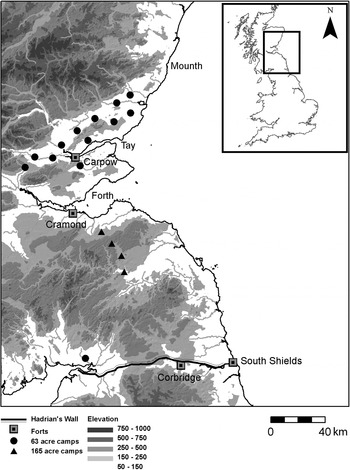
Distribution of 63-acre marching camps, with principal names and places mentioned in the text. Scale 1:2,000,000. (Drawn by J.D. Bruhn)

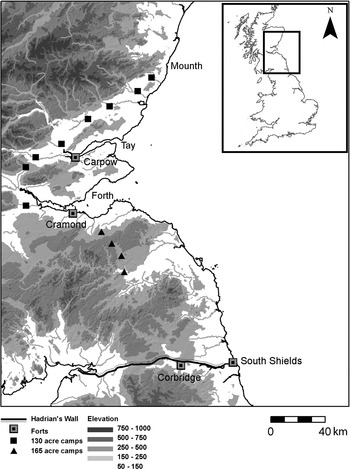
Distribution of 130-acre marching camps, with principal names and places mentioned in the text. Scale 1:2,000,000. (Drawn by J.D. Bruhn)

THE HISTORICAL FRAMEWORK (Table 1)
A sketchy narrative of the events is well known to us through the works of two historians, Cassius Dio and Herodian.Footnote 2 Dio (from Nicaea, Bithynia) was a direct contemporary, a senator who governed military provinces, and personally acquainted with Septimius Severus; on one level he should clearly have a good knowledge and understanding of a military expedition of the period, but he is also hostile to Severus (‘[His actions] showed clearly that he possessed none of the qualities of a good ruler’),Footnote 3 and even more so to Caracalla — and only excerpts of the relevant part of his history survive. Herodian, an easterner and possibly an official in Rome who wrote a history of the Empire in his times, gives less information, is also hostile in tone and notoriously unreliable. If not a contemporary, he wrote a short time after the reign of Severus. Both histories are in Greek.
According to Dio the people north of ‘the wall which cuts the island in half’ — in this period probably Hadrian's Wall — were the Maeatae, with the Caledonii living further north beyond them.Footnote 4 Dio specifically states that Severus started by invading Caledonia, suggesting that (if this is taken literally) the Maeatae immediately came to terms and allowed their territory to be used as a springboard.
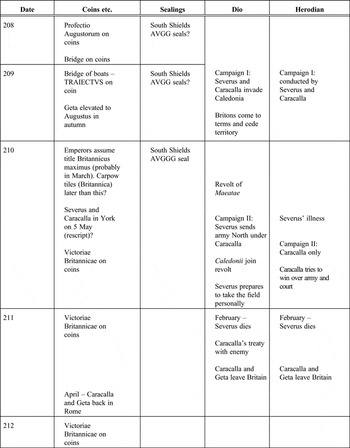
The Greek historians, combined with the evidence of coin issues which allude to the campaigns, indicate an imperial departure for Britain in a.d. 208, and a campaign launched against Caledonia by Severus and Caracalla. The Britons came to terms over the winter of a.d. 209–10, and ceded territory, after which all three emperors took the title Britannicus maximus (31 March 210).Footnote 5 This was followed by a revolt, first by the Maeatae, a second, allegedly genocidal, campaign by Caracalla alone (a.d. 210), during which the Caledonii joined the revolt. Severus died (in February 211), while preparing to take the field in person.Footnote 6 It is not clear whether the first campaign was launched in a.d. 208 or 209. There is hardly time for Caracalla himself to have done any active campaigning after his father's death; he and Geta were certainly back at Rome by the end of 211, and probably as early as April.Footnote 7
CHRONOLOGICAL TABLE OF EVENTS ACCORDING TO THE AVAILABLE SOURCES

THE TARGET
We start, like Dio, with the peoples beyond the frontier in Britain. The Maeatae probably occupied the northern Scottish lowlands, the Antonine Wall area and Fife, while the heartlands of the Caledonii lay in north-east Scotland, perhaps beyond the Tay.Footnote 8 The name Maeatae is heard of for the first time in Dio, in his account of events in the 190s. Caledonii, although not a new name, now apparently had a much wider application: Dio says that the names of all other peoples had become merged in these two. These names may in part be Roman simplifications or glosses, but a newly emerged regional response to the Roman Empire is indicated, now much more north-east centred than the south-western Scotland area which seems to have been the source of opposition in the days of Hadrian and Antoninus Pius.Footnote 9
In recent years the study of the occurrence of ‘Roman’ finds found in non-Roman military contexts in Scotland has begun to show how — with the Roman Empire as a permanent neighbour (its northern boundary permanently fixed on Hadrian's Wall since c. a.d. 160) — society in north-east Scotland apparently changed. A low-level but general uptake of Roman material seen in the early period of contact with Rome gave way in the period c. a.d. 160–250 to what has been seen as a ‘key phase’,Footnote 10 where there is a lower absolute number of ‘Roman’ objects, but a more targeted concentration of high quality Roman material and silver coin hoards. The distribution maps of these items coincide with the seats of the Maeatae and Caledonii which were the targets of the Severan expedition.Footnote 11 The widespread and numerous warrior élite of north-east Scotland had access to certain valued categories of Roman material and to silver denarii distributed as presents or subsidies from the Empire. The excavations at Birnie on the Moray Firth have given an insight into a specific (presumably ‘Caledonian’) settlement of this period, where two hoards of Severan subsidy-denarii ending in a.d. 193 and 196 were found.Footnote 12 Ability to play the Roman Empire for subsidies or to raid the Roman province might have rapidly overtaken traditional routes to status in the most fertile and populous areas of north-east Scotland, significantly at a greater and safer remove from the Empire than the former centre of resistance in the upland south-west. The so-called Caledonii occupied a zone between 160 and 320 km (100 and 200 miles) distant from Hadrian's Wall. With these social changes there evidently developed the ability to launch long-distance raids into the Empire, less easily done from lowland Scotland immediately north of Hadrian's Wall, which was controlled by a system of outpost forts and within reach of Roman retaliation.
Despite the lurid — and inaccurate — descriptions of the Greek historians, these people were not utterly alien to the invading Romans: the leading warriors of north-east Scotland were on familiar terms with the Roman Empire and its officials. Dio's storyFootnote 13 of a Caledonian noble's wife (presumably an aristocratic ‘hostage’ accommodated at the Roman court) chatting to the empress Julia Domna about the differing sexual practices of their two worlds is not in principle implausible: it is important to realise that the campaigns of a.d. 208–11 were an episode within a long-running policy of dealing with societies beyond the imperial frontier by means of silver-coin subsidies, present-giving, hostage-taking and exchange, treaties, and only from time to time outright warfare: these were standard techniques for managing trans-frontier peoples, as they have been on more recent imperial frontiers,Footnote 14 and most are directly attested in the pages of Dio.
WHAT REALLY BROUGHT SEVERUS TO BRITAIN?
Herodian tells us of a letter from the governor of Britain informing the emperor ‘that the barbarians were in revolt and overrunning the country … he told Severus that he needed either a stronger army for the defence of the province, or the presence of the emperor himself. Severus was delighted with this news …’,Footnote 15 but it was argued long ago by A.R. BirleyFootnote 16 that the governor's appeal is probably a clichéd invention of Herodian. Indeed modern accounts have followed Dio in seeing Severus’ personal preoccupations — particularly his concerns about the dissolute habits and mutual hatred of his two sons — as decisive in bringing about the expedition, and have tended to minimise the seriousness of warfare in Britain itself. So, for example, it is said to be ‘far from clear why Severus should have judged that disturbances on the fringes of one of Rome's remotest provinces demanded the continuing presence of the emperor and his court from 208 until his death early in 211 …’.Footnote 17 For another recent historian, ‘the expedition [was] … as much concerned with re-establishing the loyalty of the army as with dealing with barbarian incursions or the conquest of Scotland for its own sake’.Footnote 18 Boris Rankov's argument is that having dealt with the rebellion of Niger in the East, Severus turned to the base of his former rival Albinus in Britain, and in this version, rather than an invention, the governor's letter was concocted with the emperor's knowledge to engineer a reason for intervention. If the loyalty of the British army was really the only issue, one wonders why Severus left it so long: he was freed up from his eastern wars by a.d. 201. Rankov may be right to sense Severus’ long-standing fear of disloyalty in Britain, but wrong to dismiss the seriousness of the ‘barbarian incursions’. Severus’ legates had failed to overcome problems that stemmed from the weakening of the British army following its defeat at Lugdunum in a.d. 197. Britain may deliberately have been left under-manned while Severus was in the East: Paul Bidwell has examined archaeological indications of reduced garrisons in northern forts in the last years of the second century and at the opening of the third, and concluded that ‘[a]n army well below full strength, in terms both of overall numbers and its cadre of commanders, certainly fits the circumstances at Bainbridge, South Shields and Bowes, and might also have caused the problems which brought Severus to northern Britain’.Footnote 19 Severus’ concerns about Britain as a potential seat of revolt may therefore have led to real frontier troubles that he had eventually to deal with in person. Continual trouble and warfare with the peoples beyond Hadrian's Wall are implied by Cassius Dio for the period from the a.d. 190s through to the eve of the expedition.Footnote 20 The silver denarius subsidy hoards, evident in the archaeological as well as the literary record, are a clear enough attestation of how seriously Rome took her northern neighbours in Britain, and the expense to which she was prepared to go to manage them. In Scotland these hoards persisted as a phenomenon for longer than on the continental mainland (where they have generally been thought to cease c. a.d. 194).Footnote 21
If the northern garrisons had been neglected after a.d. 197, the work of bringing the frontier army back into shape significantly pre-dated the imperial expedition. At Bainbridge, one of the forts with evidence for a reduced garrison c. a.d. 200, barracks were being built under Severus’ governor Pudens in a.d. 205,Footnote 22 and under Alfenus Senecio, most likely to be the succeeding governor in a.d. 205–207/8, a programme of fort-refurbishment extended across the whole of the North.Footnote 23 As the work of placing the province on a more secure military footing came to completion, Severus may well have judged it to be the right moment to intervene personally — an energetic and belligerent emperor taking the field to bring final resolution to the problem and unite his sons, now grown into mutually antagonistic young men, in an urgent and worthwhile task.Footnote 24
THE ARCHAEOLOGY AND THE EXTENT OF THE EXPEDITION
Owing to the extreme vagueness of both literary sources — ‘but Severus did not desist until he had approached the extremity of the island’Footnote 25 is the best we get — the only evidence for the extent on the ground of the Severan campaigning is provided by archaeology.
THE SUPPLY-BASES
Supply-bases, in the Hadrian's Wall zone far south of the theatre of war, have been identified at Corbridge, on Dere Street, and at South Shields, at the mouth of the Tyne. Corbridge — which by this time had long ceased to be a conventional fort and, following the abandonment of the Antonine Wall c. a.d. 160, had been turned into a legionary-detachment base and supply depot — lies at the Tyne crossing of Dere Street, the main land route north towards the Firth of Forth. An altar re-used in the western of the two large granaries at the centre of the site, and probably originally displayed in front of these buildings, was dedicated by an officer proud to have been responsible for these facilities during an expeditio felicissima Britannica — almost but not quite certainly the imperial campaigns of a.d. 208–11.Footnote 26 The granaries themselves are probably of Severan date in their completed form.Footnote 27 Other undated granaries north of the central site at Corbridge might also have been built for the expedition.Footnote 28 On the other hand, the immense stores or market building known as Site XI, once canonically seen as Severan, appears to have been started before the fire marked by the ‘Corbridge destruction deposit’, which is dated most comfortably to the period between the mid-160s and mid-180s.Footnote 29
South Shields was recognised as a Severan supply-base by Richmond,Footnote 30 who drew attention to the significance of a rare series of lead sealings which portray Severus and his two sons, with the legend AVGG, i.e. Severus and Caracalla as joint Augusti, dating the objects to between a.d. 198 and 209. This establishes that supplies for the imperial expedition were passing through South Shields before autumn a.d. 209.Footnote 31 Until recently none of these sealings was known from a stratified context, and although the use of the supply-base during the Severan expedition was incontrovertible, its construction could not be closely dated by coins or pottery, which could do no more than offer a later second- or earlier third-century date.
Excavations between 1990 and 2000 have shown how, when the mid-Antonine fort at South Shields was extended to 2.1 ha in order to create the well-known supply-base, this happened in two stages.Footnote 32 In the first phase (Period 5A), a dividing wall separated a supply-base of 11 granaries from a proposed accommodation area, whose planned arrangement of buildings was never finished. Two granaries and an isolated barrack-like building (III) were completed, and work begun on a possible praetorium, of which only fragments of foundations were laid, directly over the remains of the preceding fort barracks. In a second phase (Period 5B), six more granaries were built to the south of the dividing wall and the wall itself now removed. Thus the supply-base had expanded to 23 granaries and spilled over into the intended accommodation area. A stratified lead sealing indicates that by Period 5B the unit associated with the supply-base was cohors V Gallorum.
The discovery in 2000 of six more of the AVGG-type sealings in the primary make-up of a street between two of the granaries in the second phase enlargement now gives a firm terminus post quem of a.d. 208 (the year of the arrival of the emperors in Britain) for that stage of construction (5B).Footnote 33 Because the first phase (5A) had never been completed, it cannot predate the 5B enlargement by any significant interval. The 5B enlargement is, therefore, linked firmly to the Severan expedition or its immediate aftermath, and the incomplete 5A supply-base must belong either to the inception of the campaigns or possibly to the governorship of Alfenus Senecio in c. a.d. 205–8. That the supply-base was originally conceived as part of the refurbishment of the Wall-system under Senecio (and intended to supply the Wall forts) must be a strong possibility, for two reasons. First, it explains the almost immediate enlargement of the supply-base in Period 5B — i.e. before the supply-base had been completed it had to be enlarged to meet the requirements of the imperial expedition. Second, the supply-base at South Shields was apparently retained in use until the late third or early fourth century, evidently serving some purpose long outlasting the supply of the Severan campaigns. This could have been the supply of the units permanently based on Hadrian's Wall.
The finding of these sealings proves once and for all that the South Shields supply-base was founded in connection with, or immediately preceding, the Severan expedition and not earlier, under Commodus, which had always been a theoretical possibility — despite it being certain from the imperial sealings that it was used by Severus. The character of the coarse pottery in the pre-supply-base levels (Period 4) contrasts sharply with that from Period 5A onwards, which sees the introduction of various new types. Although the pottery is not intrinsically datable, the new precision about the date of the construction of the supply-base in Period 5A–B allows the introduction in significant quantity of certain types of pottery at South Shields, formerly datable to the late second or early third century, to be dated to c. a.d. 208 or later. We shall return to the significance of this later.
A sealing marked AVGGG from South Shields shows that after Geta had been elevated to Augustus in autumn 209 the supply-base served a further campaign, which must be that of a.d. 210.Footnote 34
It has been estimated that the enlarged supply-base was capable of holding rations for 25,000 men for almost six months, and its role was perhaps one of transhipment of supplies gathered in the security of the Wall-zone to the theatre of war in Scotland, where, as Bidwell has remarked in his penetrating analysis of the role of South Shields in the Severan expedition, the inland line of march indicated by the marching camps most likely to be Severan seldom lay more than 15 miles from the east coast.Footnote 35
MARCHING CAMPS
It is traditional to associate two of the recognisable series of marching camps in Scotland with the Severan campaigns, the 63-acre (25 ha) and 130-acre (54 ha) groups. There is also a series of extremely large (165-acre) camps running up Dere Street in south-east Scotland often ascribed to Severus.Footnote 36 The two northern series follow much the same route, from the Forth crossing, via Strathmore to the Mounth (the eastern extent of the Highlands that reaches the sea at Stonehaven), transiting the heartlands of the Maeatae and Caledonii. Two 63-acre camps occur in Fife, possibly on a route leading to the presumed crossing of the Tay at Carpow. All these series of camps have been linked with the campaigns in various different ways.Footnote 37 But there is no direct dating evidence for any of them and the link with Severus is purely circumstantial. These camps are however post-Flavian, and excavation at the superimposed series of camps at Ardoch seems to establish that the 130-acre camps are the latest of all.Footnote 38 It has recently been claimed that the Ardoch–Bertha road (Antonine in construction at the latest) overlies one of the 63-acre series, which if correct would remove them from the Severan equation and make them more likely to be early Antonine.Footnote 39 If any run of camps is really Severan, it is most likely to be the largest, the 165/130-acre ones, which look as if they could be part of the same series, with an army (which could have numbered 40,000 to judge from the 165-acre camps) advancing to Cramond and then splitting into a group indicated by the 130-acre camps and a smaller section crossing to Fife and heading for the Tay crossing.
If caution is still required in assigning any series of camps to the Severan period, radiocarbon dating now at least rules out a Severan date for the construction of a further series of camps, 110 acres in area, which extends from the Mounth to the Moray Firth. Recently published work at Kintore now shows that these camps, once seen as Severan, are Flavian in origin and main period of use, although on the basis of isolated finds and radiocarbon dates outside the main first-century cluster the excavator has suggested possible re-use in later campaigns.Footnote 40
There is thus now no firm archaeological suggestion that Severus’ great army marched as far north as the Moray Firth; the distribution of those camps that are most likely to be Severan, the 130-acre series, suggests an advance to the Mounth and no further. Could more 130-acre camps await discovery further north? This is always possible but the mutual exclusiveness of both near-complete series (130-acre camps south of the Mounth and the 110-acre series to the north) suggests a genuine stopping (and, for the Flavians, starting) point in this area. There is not a single known example of a 130-acre camp to the north or a 110-acre camp to the south. The northernmost known camp in the 130-acre series is Kair House, on the Bervie Water 13 km south-west of Stonehaven. Here, where his advancing army saw the edge of the Highlands converging with the sea, Severus might have claimed to have ‘approached the extremity of the island’.Footnote 41 On the other hand Dio's statement may indicate that the expedition was extended further north by coastal reconnaissance and sea-raiding.
CRAMOND
Cramond is one of only two permanent Roman bases in Scotland known to have been occupied in Severan times. A 2.43 ha fort at a presumed port on the Firth of Forth it originated in the Antonine period, but was possibly in use after the a.d. 160s, and certainly in use under Severus, when a very large annexe was attached to the east side of the fort (defences and a double-portalled stone gate being found 300 m distant), accommodating manufacturing, including furniture and window frames for a high status residence.Footnote 42 An altar was dedicated at Cramond by the commander of the Fifth Cohort of Gauls, probably, but not certainly, in the Severan period.Footnote 43 This is the unit that was based at the supply-base at South Shields, and it has often been suggested that it was split between the two sites for some time in the early third century. The Period 5B supply-base at South Shields has insufficient accommodation for the whole unit so this would support the traditional suggestion.Footnote 44
CARPOW
Carpow was an 11 ha legionary fortress (about half the standard second-century size) on the south bank of the Firth of Tay. The identity of the site as a Severan legionary base was established by R.E. Birley in 1961–62,Footnote 45 and subsequent excavations by J.D. Leach and J.J. Wilkes between 1964 and 1979 were finally published in 1999.Footnote 46 The enclosing rampart was of turf, the gates of stone. Stone internal buildings explored include a legionary principia, baths (incorrectly interpreted as the praetorium in the reportsFootnote 47 ) and a granary. The fortress has produced many tile stamps of legio VI Britannica Pia Fidelis and fragments of an inscription from the east gate employing symbols of legio II.Footnote 48 Despite the brave attempt of R.P. Wright to restore the titles of a single emperor, Caracalla, meaning a dedication date after a.d. 211,Footnote 49 unfortunately it is not possible to restore the fragmentary text with confidence.
The fortress was preceded by two large enclosures which have been ascribed to the Flavian period and the first Severan campaigning phase (linked with the 63-acre series of camps) respectively, though there is no direct evidence for either attribution.Footnote 50 Carpow is often thought to be the place where the Tay could have been crossed by a bridge of boats, commemorated on a coin of a.d. 209Footnote 51 with the legend TRAIECTVS and vaguely alluded to in the literary sources. Although we have to be cautious in our attribution of even the 130-acre camps to the Severan period, the situation of the fortress at Carpow, and the crossing of the Firth of Tay implied there, does confirm that the Roman objective was the area of Angus and Lowland Perthshire towards which these camps are directed.
The idea has long been floated that the fortress at Carpow may have been founded in connection with an earlier set of campaigns, specifically those of Ulpius Marcellus in the early a.d. 180s.Footnote 52 Now this tendency has gathered pace, with a recent article from John Casey,Footnote 53 while Roger Tomlin writes in RIB III that the fragmentary east gate inscription ‘should be provisionally attributed to Commodus’.Footnote 54 Casey's main point is numismatic: the lack of coins later than a.d. 205 means that Carpow and Cramond were given up before the start of the expedition in a.d. 208. In his view Carpow was built after the British war conducted by Ulpius Marcellus early in Commodus’ reign, and occupied c. a.d. 184–205, then abandoned in favour of Hadrian's Wall (restored c. a.d. 205–8). But Casey misses coins of a.d. 206 and 207 from Carpow,Footnote 55 and disregards coins — not from stratified contexts — of a.d. 206, 207 and 209 from Cramond.Footnote 56 The Carpow coins date the demolition of the fortress to a.d. 207 or later, so its abandonment seems unlikely to have preceded the restoration of Hadrian's Wall under Senecio in c. a.d. 205–8 as Casey supposes.
Casey also makes much of the difficulty of restoring the imperial titles on the Carpow inscription to a form paralleled in the Severan period and restores it with a Commodan titulature. For RIB the critical thing is the ornamentation, particularly the use of beak-headed peltae to decorate the inscription (also on the even more fragmentary RIB III, 3154 from the south gate). These are indeed usually a sign of Antonine date, very common, for example, on the Antonine Wall distance slabs. Neither argument is, however, decisive: the imperial titles can no more be restored to anything paralleled in Commodus’ reign. The pelta motif adorns RIB I, 658 (York) which probably dates to the a.d. 190s.Footnote 57 In short, if it is thought possible that this motif could occur at Carpow in the a.d. 180s, a full 40 years after the Antonine Wall distance slabs, it seems impossible to be confident that it could not still occur 25 years later under the Severans. As for the significance placed on the Severan coins, we will return to this below.
RIB III also invokes an argument by WarryFootnote 58 that the stamped tiles from Carpow are transitional between his Type B, which he dates a.d. 100–60, and his Type C, which he dates 160–260, inclining him to date the Carpow tile to the 180s. Warry himself gives an immediate warning: ‘This analysis should be regarded as highly speculative as it depends on the dimensions taken from a single tegula’. The argument that tile typology changes over time is sound enough, but Warry's dating of his types in this period relies entirely on the stamps of military units which in themselves cannot be closely dated. The date ranges for the tile-types are open ended, as Warry himself concedes. For example, his Type B, supposedly passing out of use around a.d. 160–80, is used by ala I Asturum at Benwell and cohors II Asturum at Greatchesters on Hadrian's Wall, where the tiles were not necessarily manufactured upon the arrival of these units at those forts, no earlier than c. a.d. 180, and could date to any time in the later second or earlier third century. It is simply unsustainable on present evidence to claim that we can pinpoint a type of tile that could have been made around a.d. 185, but not around a.d. 210.
The pottery recovered from Carpow, now fully published, comprised very little samian ware and a restricted range of coarse pottery types which ‘could be interpreted as resulting from a short occupation of the site’.Footnote 59 Conspicuous in the assemblage are types of BB2 (particularly bowls with plain exterior and rounded rim profiles) and related Thames estuary products. In the 1999 Carpow report by John Dore this pottery is dated broadly to the later second or earlier third century.
However, at South Shields the round-rimmed BB2 bowls and related products do not occur in significant quantities before the construction of the supply-base (Period 5) which, as already explained, can now be firmly dated to the Severan period.Footnote 60 At present it is impossible to be categorical that these types should not occur in pottery groups of the a.d. 180s or 190s. It is not easy to characterise pottery of the period a.d. 160–200, because with one exception no large pottery groups firmly dated to that period have been excavated and published on the northern frontier. The one well-known assemblage of this period, the so-called Corbridge destruction deposit, is dominated by types common on the Antonine Wall (a.d. 140–60), including BB2 bowls with beak-shaped rims, and probably dates to the early a.d. 180s or earlier, incorporating much material from the earlier phases of a site that had been occupied continuously from Flavian times.Footnote 61 However, BB2 of any kind is largely absent from an unpublished group of pottery recovered from the barracks of the ‘Period 4’ (pre-supply-base) fort at South Shields, newly founded around a.d. 160. BB1 featured heavily, as did the absence of BB2, in a still unpublished group found in 1990–91 which had accumulated between Hadrian's Wall and the road ramp leading onto the west abutment of Bridge 2 at Chesters, soon after its construction around a.d. 160. BB2 comes suddenly back onto the scene with the construction of the supply-base (Period 5A) at South Shields in the form of round-rimmed bowls, with related south-eastern reduced ware; the occurrence in the construction levels of the Period 5B supply-base of lead sealings of a.d. 198–209 effectively gives a terminus post quem for the introduction to this site in any significant quantity of these new types. The types in question were manufactured in south-east England and shipped up the east coast to South Shields; their procurement was perhaps directly connected to the military requirements of the Severan campaigns (just as the sudden influx of pre-160 types of BB2 may have been connected to the requirements of the Antonine invasion of Scotland). The second wave of BB2 and related products went on to dominate the pottery profile at South Shields and other Tyneside forts in the early decades of the third century. Their predominance at Carpow suggests strongly that the brief life of the fortress belongs to this time.
On more general grounds, if it was possible to maintain a legionary fortress on the Tay throughout the period between a.d. 185 and 205, one wonders why the massive Severan expedition would have been necessary. In fact Ulpius Marcellus, having campaigned in retribution for the breaching of Hadrian's Wall in the early 180s seems to have withdrawn from enemy territory (Newstead was given up about this time) and managed the northern peoples through treaties (those which were being broken in a.d. 197). Commodan policy in Britain can be compared with that on the contemporary Danube frontier, where in return for undertakings Roman armies were withdrawn from barbarian territory and subsidies paid. Both the circumstantial and — despite the difficulties surrounding the Carpow inscription — the archaeological evidence, particularly the clear post-208 date of the South Shields supply-base and the similarity of the pottery found within it to that at Carpow, favour a fortress founded in connection with the Severan expedition.
WHAT WERE THE REAL OBJECTIVES OF THE EXPEDITION?
Having decided to embark on an expedition in Britain, what did Severus and his advisers hope to achieve? Cassius Dio says: ‘Wishing to subjugate the whole of [the island], Severus invaded Caledonia’.Footnote 62 This definition of a war aim by a contemporary who was in a position to know the truth has led to a widespread assumption that Severus wanted to do away with Hadrian's Wall and absorb Scotland into the province. There are in fact two distinct British historiographical traditions. Haverfield was in no doubt that Severus ‘did not march to annexe. His reconstruction of Hadrian's Wall proves conclusively that the day of Roman annexation was over’.Footnote 63 This interpretation of the Severan expedition as a brutal raid rather than an attempt to assimilate territory was maintained by Collingwood, Richmond, and most recently Frere.Footnote 64 It was the recognition of the Carpow fortress in the early 1960s that brought about the current tendency to think in terms of territorial absorption, and to see this as the last chance that the Romans had to effect the conquest of the whole of Britain, frustrated only by the death of Severus before his enterprise could be completed, and by the lack of interest of his successors.Footnote 65
For this to be true there would have to have been a sudden change of policy in a.d. 208: inscriptions show that the forts on Hadrian's Wall underwent a major programme of refurbishment in the years immediately before the arrival of the emperors under their governor Alfenus Senecio (c. a.d. 205–8) and this work probably extended to the Wall itself, to such an extent that by later historians Severus was credited with first building the Wall. If territorial expansion was the aim, the Severan expedition would mark a U-turn, from frontier consolidation to imperial expansion.
Severus is often characterised as an expansionist propagator imperii. This he clearly was, but not all his frontier advances were of a territorial character. Real additions to the directly governed Empire are seen in cases like Mesopotamia and Mauretania Caesariensis — in the latter a linear arrangement of military sites (termed ‘nova praetentura’ on inscriptions) was advanced, nomadic hill tribes were incorporated and civil development took place in the newly acquired zone.Footnote 66 But elsewhere his frontier advances did not always entail networks of forts and the development of a provincial landscape; new forts were advanced deep into the Wadi Sirhan in Arabia,Footnote 67 and into the Libyan desert oases,Footnote 68 but in these cases no new directly governed territory was enclosed within the Empire. Rather than extension to better lines these cases represent aggressive expansion into positions of greater strength, to control neighbouring peoples and their routes of movement towards the settled zones of the Empire.Footnote 69 Carpow can be interpreted as such a projected position of strength, and like the far-flung Libyan and Arabian outposts it was garrisoned by a legionary vexillation or vexillations. So it is perhaps wrong to think that the intention was to occupy and directly govern Scotland. There were at least three years of opportunity to build roads and forts other than the boldly projected coastal outposts of Cramond and Carpow, but it is striking that nothing like the Antonine fort network of the Scottish lowlands was even begun.Footnote 70 There was time to complete and occupy the fortress at Carpow and the final publication gives no substance to the claim that it was unfinished.Footnote 71 This suggests that there would have been time for some fort-building north of Hadrian's Wall, had it ever been intended. So we can see how the Roman response to frontier problems in north Britain shifts in the two or three generations between Antoninus Pius and Severus from expansion of directly Roman occupied territory to management of neighbouring peoples through aggressive and far-reaching war and the establishment of a powerful advance fort near the source of the trouble.
The idea of frontier advance to solve problems may indeed be anachronistic for North-West Europe by the third century. Possibly we should see the British expedition as presaging the character of fourth-century Roman frontier policy in Europe, where emperors such as Valentinian I take aggressive action against specific peoples beyond the frontier, but at the same time invest in frontier defences which have become irredeemably fixed. Seen in this light there is no contradiction between the Severan work of restoring Hadrian's Wall and the subsequent invasion of Scotland. Indeed the delay until a.d. 208 before setting out for Britain may be explained by the precautionary renovation of Hadrian's Wall in advance of the expedition. Nor is this suggestion of aggressive warfare beyond a fixed frontier incompatible with the language of Cassius Dio, when he speaks of the aim being to subjugate the whole island. It is true that the agreement with the Britons that concluded the first phase of the war entailed them ‘abandoning a considerable part of their country’, but this indicates that rather than assimilating them the Romans were seeking to drive them out of zones from which they could threaten the Empire — Dio describes elsewhere the creation of a cleared or neutral zone on the north side of the Danube. Perhaps the Maeatae were confined to the north of the Forth-Clyde Isthmus, and elements of the Maeatae or Calededonii restricted to the north side of the Tay.
Carpow is not suitable for a ‘campaign base’ as it is sometimes described; it could only have held about 3,000 men, a fraction of the 25,000 or more that the 130-acre camps would have accommodated and which is within the numerical range of many later Roman campaigning and expeditionary armies whose strength is plausibly attested.Footnote 72 Carpow makes more sense as a permanent, coastally supplied outpost for legionary detachments (and perhaps some auxiliary cavalry?) to maintain watch over the Caledonian heartland, and hence fits best into a phase following the expedition itself. The 200 km distance from Hadrian's Wall seems great but is reminiscent of the forts around the eastern Black Sea Coast described for the Hadrianic period by Arrian in his Periplus. Apsaros lay 180 km beyond the northern end of the Cappadocian frontier at Trapezus, and contained five cohorts (not dissimilar to the garrison strength of Carpow). Phasis, a further 70 km along the coast from Apsaros, was ‘so fortified in every respect, as to afford no access to the barbarians’.Footnote 73 In Severan Scotland these coastal outpost forts may well have been intended from the outset; they could have been supported by the supply-base at South Shields, although this was perhaps one of several intended functions: it has already been suggested that its primary function may have been as a supply-base for the Hadrian's Wall forts, provided as part of the general renovation of the Wall under Alfenus Senecio (c. a.d. 205–8) that prepared the ground for the Severan expedition.
WHAT DID THE CAMPAIGNS ACHIEVE?
The literary sources paint a picture of a Roman army struggling through difficult terrain and failing to bring its elusive enemies to any decisive battle. Dio's report of the numbers of Roman casualties — 50,000 — must be a wild exaggeration, but even taking into account the hostility of the sources, the British expedition, like certain ground invasions launched into remote places in recent times, cannot have been the hoped-for rapid success. The simple failure to land a decisive blow might explain why Severus was obliged to reside for three years ‘in one of Rome's remotest provinces’.
Dio says of Caracalla that after his father's death ‘with the enemy he came to terms, withdrew from their territory, and abandoned the forts’.Footnote 74 We have seen how the absence of coins certainly later than a.d. 209 from Cramond and later than a.d. 207 from Carpow has convinced some archaeologists and numismatists that these sites were occupied and abandoned before the Severan campaigns, and even those who do not go this far have taken the coins to imply abandonment at the latest immediately after the death of Severus in a.d. 211 — as Dio says.Footnote 75 An analysis of the date distribution of the Severan coins from South Shields published by Casey in 1979 shows the same surge in the period immediately before the campaigns as seen at Cramond and Carpow, and the same fall off in the number of coins dated to the imperial expedition and its aftermath.Footnote 76 Yet there is no doubt that South Shields was continuously occupied during the campaigns and after a.d. 211. The absolute number of Severan coins from Cramond and Carpow on which historical conclusions have been based is very small (19 at Cramond, 11 at Carpow), and the situation at South Shields — where Severan coins do not occur in occupation levels known to date to the period immediately after a.d. 211, but only residually in later third- and fourth-century levels — shows the danger of working from an absence of evidence.Footnote 77 It could be, then, that the dates of the Severan coins reflect the coin supply rather than the actual period of occupation: we recall Dio's statementFootnote 78 that Severus ‘took along with him [to Britain] an immense amount of money’, which of course would all have to be earlier than a.d. 208.
It can be argued, therefore, that at present the numismatic evidence from Cramond and Carpow cannot safely be used to suggest abandonment before the campaigns, and might even allow the possibility that these sites were held for some years beyond a.d. 211 as coastal outposts north of Hadrian's Wall. The period of occupation at Carpow was short, but there is nothing to say it did not last for several years. Indeed, the road surface bearing the fallen east gate inscription itself contained worn fragments of an earlier broken-up inscription.Footnote 79 The fortress baths had also been completed and fired.
If such a system of coastal outposts was one of the legacies of the Severan expedition, it was short-lived. The baths at Carpow did not display the many alterations that one would expect if they had been used for a considerable time and it will be recalled that the restricted range of pottery types led to the suspicion of a short occupation. As we have seen, the published pottery from Carpow corresponds most closely to the profile of the pottery current at South Shields in the period immediately after the construction of the Severan supply-base, in the second decade of the third century. Some types which become common in the second quarter of the third century (e.g. BB1 with obtuse-angled lattice) are present at Cramond, but not at Carpow, suggesting that while there may have been continuing activity at Cramond, the Carpow fortress was abandoned no later than c. a.d. 220.Footnote 80 The evidence is compatible with construction in a.d. 210–11 and abandonment and demolition around 215 or perhaps a little later. Cramond may have been occupied later than this. A replanning of South Shields to accommodate the whole of the Fifth Cohort of Gauls (probably in the a.d. 220s) might possibly indicate the end of that unit's association with Cramond.Footnote 81 Even now, though, the supply-base arrangement of South Shields, with its 24 granaries, continued in use, and although this may largely have been to do with the supply of Hadrian's Wall, there is pottery from Cramond that should be later in the third century, ‘potentially rather more than can be accounted for by “Roman patrols or by local native inhabitants through trade”’.Footnote 82 Perhaps Cramond was used episodically as an outpost in the third century, or became a trading place where relations were mediated between Rome and the local polity with its seat at Traprain Law, 30 km away.Footnote 83
Those parts of Scotland reached by Severus’ forces must have been terribly damaged. As part of the Caledonian surrender of a.d. 210 or the settlement made by Caracalla in a.d. 211 it is likely that the Caledonii and Maeatae supplied recruits to be formed into units and transported to other provinces. Evidence for this has been seen in an inscription of a.d. 232 from Upper Germany mentioning Brit(tones) dediticii,Footnote 84 and a Caledonian called Lossio Veda, grandson of Vepogenus, turns up in Colchester, also in the reign of Severus Alexander.Footnote 85 However, north-eastern Scottish society was not ravaged out of existence, for the diplomatic contacts indicated by the denarius subsidy hoards continued down to the reign of Severus Alexander (a.d. 222–35).Footnote 86 Woodland regeneration in the Roman period detected by pollen analysis at a number of places in north-east Scotland has been linked by some with the activities of the Roman army, including the genocide of the Maeatae in the second Severan campaign,Footnote 87 but such changes are as likely to do with the long-term restructuring of Iron Age society (already discussed), which a third-century fall-off in radiocarbon dates from indigenous settlements shows eventually to have involved abandonment of traditional Iron Age settlement patterns.Footnote 88 The decline of the pre-Roman Iron Age agrarian landscape of eastern Scotland signified by woodland regeneration at certain places is a vaguely dated, complex, and potentially centuries-long process which cannot be specifically linked to this Roman invasion or that. The same might be said of the abandonment of the souterrains that characterise the Perth–Angus focus of the expedition.Footnote 89 This is not to deny that these wide-ranging changes are connected to the presence of the Roman Empire (the argument here is precisely that the permanent presence of the imperial border transformed the societies beyond it), but merely to reject a simplistic link with the short-term presence or absence of Roman forces, or the specific actions of the Severan campaigns.
There is a long historical tradition of seeing the Severan expedition as successful because of the peaceful state of Britain in the third century. But the ‘third-century peace’ may really be an effect of the silence of the literary sources about third-century Britain. It is even conceivable that the few we have might omit or even have suppressed imperial visits to Britain after a.d. 211.Footnote 90 The strength in which the outpost forts north of Hadrian's Wall were held in the early third century shows how necessary a system of early-warning against incursion from Scotland remained. If Scotland had been pacified, what was a vexillation of legio VI doing on the main route north, at Piercebridge on the Tees, in a.d. 217, accompanied by legionary detachments from both Upper and Lower Germany?Footnote 91 Later emperors were to manage this frontier problem — in the fourth century, the Picts — by aggressive campaigning in Scotland in a.d. 305, possibly between 310 and 315, and in 343, 360, 367 and 396–8, but nothing after the Severan expedition has left any archaeological trace.
ACKNOWLEDGEMENTS
The trigger for writing this paper was the 1,800th anniversary in 2011 of Severus’ death in Britain, which brought kind invitations to lecture on the subject from the Society of Antiquaries of Scotland, the Roman Society and the Association for Roman Archaeology. I am grateful to those societies and to many individuals who have heard or read earlier versions of this paper and offered valuable criticism, information or discussion, particularly: Anthony Birley, David Breeze, James Bruhn, Fraser Hunter and Beccy Jones. Above all I am grateful to Paul Bidwell for discussion of these problems over 25 years of research work at South Shields and for suggesting many improvements to the present paper. None of the above necessarily share the opinions put forward here and all errors are the responsibility of the author.