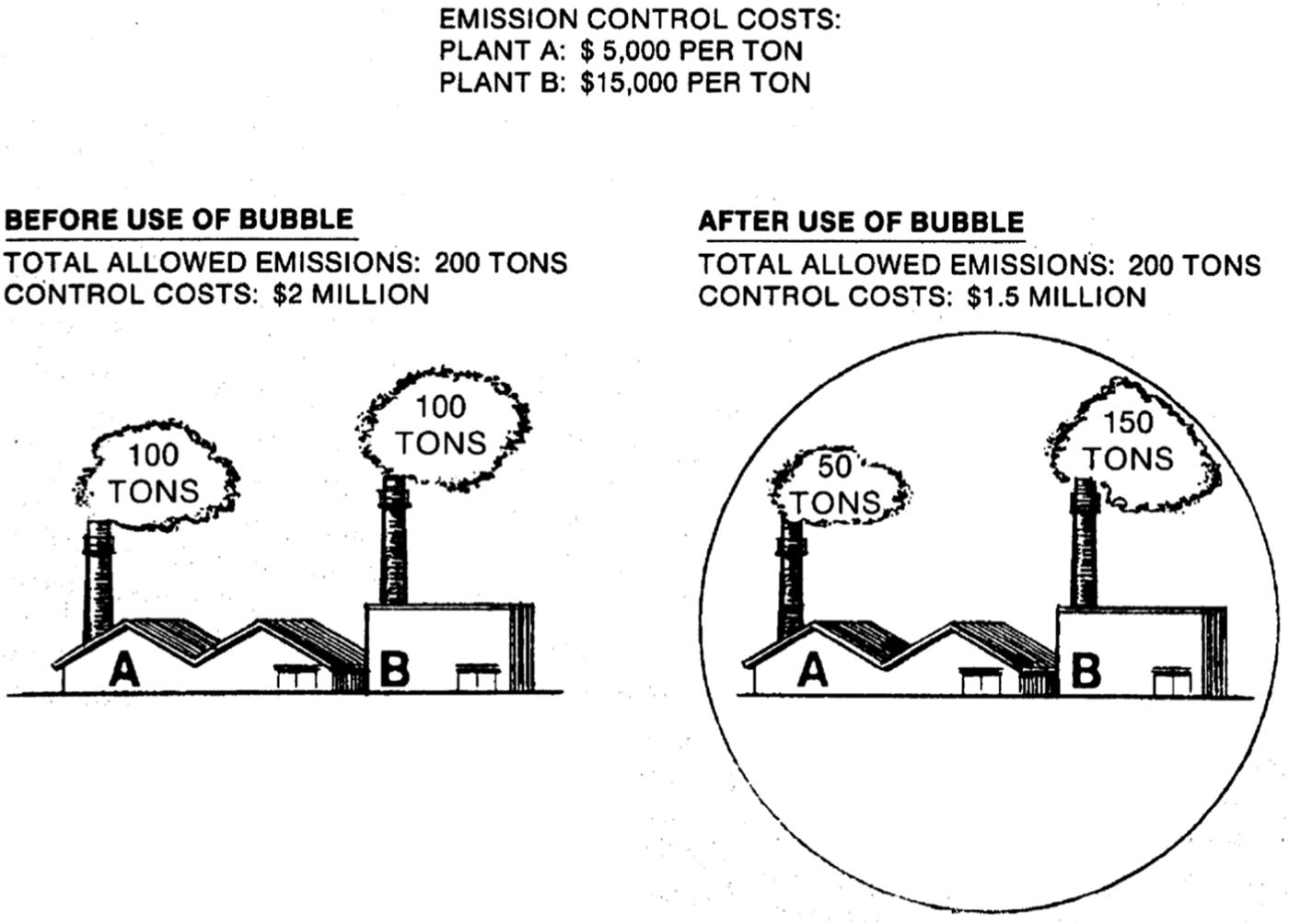
In the summer of 1980, Mike Levin hit the road with a slide deck to sell business representatives and environmental regulators on something called the bubble policy. As the head of the U.S. Environmental Protection Agency's (EPA's) new Regulatory Reform Office explained to his audiences, the bubble offered a new approach to controlling air pollution. The bubble drew a legal dome over industrial facilities, under which business managers could add or modify sources of air pollution so long as the aggregate emissions did not increase (Figure 1). Departing from the existing proscriptive regulatory model, the bubble let corporate engineers rather than government regulators decide how their firms met air quality requirements. Exactly how much authority the bubble would return to industry depended on a multitude of variables, many of which the EPA was still working out when Levin set off on his tour. But Levin and other supporters of the bubble were certain about one thing: the bubble would significantly reduce compliance costs for businesses as corporate managers “put the profit motive to work for pollution control.”Footnote 1
EPA illustration of the advantages of the bubble policy over the proscriptive model. (Source: EPA, The Bubble and Its Use with Emission Reduction Banking [Washington, DC, 1982], cover.)

Though his presentation enthusiastically explained the mechanics and the merits of the bubble, Levin faced skeptical crowds. Regulators feared that the new policy would sabotage further improvements of air quality, not least because bubbles seemed easy for industry to exploit. For business representatives, the resistance of regulators added to already unwelcome levels of uncertainty around the new policy. Over the next decade, the bubble's proponents convinced businesses ranging from steel producers to electric utilities to develop approximately 150 bubbles, which saved a remarkable $500 million in compliance costs for those companies. The bubble and the regulatory reforms of which it was a part also helped to usher in the nation's first major cap-and-trade program in the Clean Air Act Amendments of 1990—a program that serves as a model for taking on climate change today. But despite those attractive savings and that genealogical significance, the bubble itself was not widely adopted. Instead, the vast majority of the nation's industrial producers continued on under the EPA's direction, even as they disparaged “command-and-control” mandates as unnecessarily expensive and a constraint on technological innovation in pollution control.
The bubble's halting development reveals an enduring gap between the theoretical promise of economic incentive pollution controls and the practical obstacles of grafting such policies onto an existing regulatory system. In 1960, the economist Ronald Coase published “The Problem of Social Cost,” a seminal article that suggested that an expansion of property rights to environmental resources could allow competing users to arrive at a socially optimal allocation of those resources.Footnote 2 Though Coase himself warned that this market approach to resource allocation would run aground on debilitating transaction costs in any attempt to scale it up into a system of pollution control, the fantasy of markets replacing government directives caught hold of the imagination of both Democratic and Republican policymakers in the 1970s. As historians have begun to show, it was Jimmy Carter and not Ronald Reagan who initiated the deregulatory turn that characterized the last quarter of the twentieth century. Concerned about the complexity of the administrative state and the costs it imposed on individual firms and the overall economy, Carter opened regulated industries to competition, expanded White House control over the rule-making process, and encouraged his regulatory agencies to embrace reforms that used economic incentives in place of government mandates.Footnote 3 Building on that scholarship, this article argues that Carter's reforms might have gone even further but for the resistance of regulators whose experience left them rightly wary of any shift in power toward industry.
Contrary to the arguments of its supporters, the bubble was not simply a cheaper route to the same air quality. The EPA's technology standards for new emission sources and its effective veto power over pollution-control plans in areas with poor air quality gave the agency powerful tools to govern polluting industry. By substituting negotiated compliance plans for standards and constraining the EPA's veto, the bubble and other incentive-based policies curtailed the EPA's discretionary authority—authority that many regulators saw as essential to continued improvements in the nation's air quality. In addition, at the time the bubble was proposed, the EPA lacked good monitoring data on the actual emissions of particular firms, making the effects of bubbles hard to judge.
Skeptical EPA staff and officials, state regulators, and environmental advocates resisted the bubble accordingly. Like their counterparts elsewhere in the administrative state, the bubble's skeptics recognized that industry had too much political power for it to reject the policy outright. Instead, these opponents larded the bubble and other regulatory reforms with onerous conditions that successfully turned most businesses away from uncertain policies with high transaction costs. As historian Daniel Carpenter has shown with new drug approval at the Food and Drug Administration, even the most powerful firms typically limit capital investments to only those projects that seem likely to win regulatory approval.Footnote 4 As well, by the time of the bubble's proposal, firms had already made major adjustments to comply with the EPA's mandates, quite literally investing themselves in that older proscriptive model.
By the time Reagan was elected in 1980, reform proponents had addressed many of the concerns raised by the bubble's critics and were working toward a set of general rules to make the bubble and other reforms easier for businesses to use. But those fledging policies were hobbled by the Reagan administration's hostility to regulation writ large. Having staked themselves to the simplistic position that government could only be the problem, Reagan and his EPA administrator proved unwilling or unable to continue the substantive regulatory work necessary to create viable policies. The same small-government philosophy that made the idea of economic incentive reforms popular among policymakers in the Reagan era ironically undercut a turn away from government directives. Ultimately, the bubble's story underscores the debilitating effects of uncertainty on regulatory reform, revealing how entrenched interests intentionally and inadvertently deflated a real alternative to the proscriptive model for the country's regulated industry.
Costly Controls and the Origins of the Bubble Policy
With the enactment of the Clean Air Act Amendments of 1970 and the formation of the EPA that same year, Congress and President Richard Nixon created an ambitious set of national air quality standards and a new federal agency to keep the states on a strict timetable for reaching those targets. The EPA was also responsible for ensuring that new emissions sources applied technologically advanced control equipment. To take an electric utility for example, managers worked with state officials to reduce emissions to meet EPA standards for six major pollutants, with the federal agency overseeing state plans to reach those standards. If and when the utility's executives decided to build a new boiler at one of their power plants, they looked to another set of EPA standards to determine which smokestack desulfurization devices needed to be installed. This proscriptive regulatory model differed from European countries such as Sweden, where the same electric utility could choose where to reduce emissions and what equipment to use so long as it met general performance standards for the industry.Footnote 5 In the United States, business executives often chafed under the EPA's directives, decrying the agency's many regulations as uninformed and costly “command-and-control” intrusions into industrial operations that should instead be managed by corporate engineers. But with environmental protection widely popular among the American public, the proscriptive approach prevailed in the first half of the 1970s.
By the beginning of the Carter administration, however, proscriptive rules faced mounting criticism. With the prosperity of the postwar period run up on the shoals of the energy crisis and stagflation, Congress and the president were eager to reduce the cost of environmental protection to individual firms and the overall economy. Incentivizing businesses to control pollution as cheaply as possible held great promise in driving down compliance costs. To head the EPA, Carter chose Douglas Costle, who had recently implemented an economic incentive–based enforcement system as Connecticut's top environmental official. Carter also appointed William Drayton, a former McKinsey & Company business consultant who had created the Connecticut program, to run the EPA's Office of Planning and Management, where Drayton would later recount that finding alternatives to the direct mandate model was his “number one priority.”Footnote 6
Like many policies, the bubble emerged in bits and pieces. Richard Liroff, who wrote a lengthy report on the bubble for the Conservation Foundation, explained that a large part of the bubble's impetus came from the steel industry. In the early 1970s, American steel producers had run into a perfect storm of foreign competition, labor strife, aging technology, and expensive new mandates from the EPA. The industry's well-publicized plight made it a principal focus of the Carter administration's efforts to reform environmental policy to lower compliance costs and free up capital for modernization. Steel firms served as testing grounds for the bubble policy and as cheerleaders for the policy in the business world.Footnote 7
In December 1977, Charles Schultze, a well-known proponent of regulatory reform whom Carter had appointed to chair his Council of Economic Advisors, released a set of recommendations for how the EPA might handle the steel problem. Among other ideas, Schultze proposed letting firms reduce emissions however they wanted so long as aggregate pollutants from a given factory remained below the total amount that would have been emitted under the older proscriptive approach. As an added bonus, Schultze noted that his proposal would extricate the EPA from decisions about capital investments.Footnote 8
The EPA had already introduced an analogous program in 1975 whereby heavy metal smelters could avoid stringent control requirements on new equipment if they reduced emissions elsewhere in their plants so that overall pollution did not increase. As well, individual firms had sometimes received special dispensations in complying with the Clean Air Act's uniform standards. But while environmental advocates tolerated such deviations from regulatory standards under specific circumstances, they fiercely resisted reformers’ attempts to introduce this flexibility into the EPA's basic template, and the Sierra Club had sued the agency over the 1975 proposal.Footnote 9 As historian Paul Sabin and others have shown, Congress intentionally provided for this legal check on the EPA in the agency-forcing lawsuit provisions of the Clean Air Act and other legislation.Footnote 10 Throughout the bubble's story, environmental advocates would use lawsuits to tug a liberalizing EPA back toward more conservative policies. Indeed, in January 1978, the Second Circuit Court of Appeals ruled against the EPA in the smelter case, holding that the agency did not have authority under the Clean Air Act for its plant-wide definition of an emissions source.Footnote 11
By this point, however, Costle, Drayton, and other top officials in the Carter administration were busy developing a range of regulatory reforms. While the smelter case was being litigated, the steel manufacturer Armco, Inc., the cleanest firm in the industry, had approached the EPA with a novel proposal to bring one of its mills into compliance.Footnote 12 Instead of installing expensive scrubber devices to reduce particulate emissions from the mill's smokestacks, Armco would invest a much smaller sum in water sprayers for the mill's unpaved roads and in tarps to cover raw material piles—investments that Armco claimed would substantially reduce the particulates blown up into the air by the wind. The substitution would save the firm millions of dollars in capital and maintenance costs, Armco estimated, while achieving greater overall particulate reductions.Footnote 13 Substituting tarps and sprinklers for advanced scrubber technology was, at that point, too far afield and the EPA rejected Armco's proposal. But EPA Administrator Costle formed a Bubble Concept Task Force to pursue the idea, putting policy head Bill Drayton in charge.Footnote 14 Chemical manufacturers joined steel producers in encouraging this shift, noting as they did that the new policies should be as permissive as possible and that an overly restrictive bubble would be of no use in the dirtiest areas, where a new, flexible approach was most needed.Footnote 15 Costle himself had been recently appointed by Carter as the first chair of his new Regulatory Council, which collected together the heads of agencies across the executive branch to disseminate ideas like the bubble policy.Footnote 16 From his position at the front of Carter's regulatory reform efforts, Costle treated the Second Circuit Court's ruling as a minor speed bump.Footnote 17
But in addition to convincing the courts of the bubble's legality, Drayton and the Bubble Concept Task Force had to overcome strong opposition to the policy within the EPA, especially from the Office of Air, Noise, and Radiation (air office), which was headed by former Natural Resources Defense Council (NRDC) attorney Dave Hawkins. Like many of the staff in the air office, Hawkins believed that the bubble let firms claim a right to existing emission levels from outmoded production facilities, foregoing the slow but steady improvements in air quality obtained by forcing businesses to meet stringent emission standards whenever they built new facilities.
As the Bubble Policy Task Force worked at implementing the policy, Hawkins repeatedly introduced constraints. In September 1977, Hawkins cordoned off the bubble from revisions to state implementation plans, telling EPA regional administrators that the states should revise their plans according to the Clean Air Act Amendments of 1977, which had no bubble component.Footnote 18 The next month, Hawkins critiqued Armco's proposed bubble for “fugitive dust” emissions, telling Costle that the switch from stack controls to open dust controls presented a monitoring headache and might prove more dangerous to human health.Footnote 19 As Costle prepared to formally propose the bubble in November, Hawkins went so far as to object to the wording of the announcement, advocating for language that conveyed the EPA's “neutral position” toward the policy rather than Costle's “more positive statement of encouragement.”Footnote 20
As Hawkins would later recount, his repeated introduction of qualifications and constraints on the bubble policy was a strategy born of the recognition that the steel industry had too much clout for the air office to simply kill the policy. Instead, Hawkins set out “to restrain, and condition, and limit [the bubble's] use as much as possible by negotiating all of these criteria conditions.” By weighing down the bubble with onerous requirements, Hawkins calculated that state agencies would spurn the policy as a drain on their limited budgets and staffs. At the same time that the EPA's policy office was encouraging state regulators to embrace the bubble, Hawkins was making sure that they would have “to jump through seven hoops to do it.”Footnote 21
The Bubble's Slow Expansion
Costle's announcement of the bubble policy in December 1978 immediately aroused concerns at the state level about the bubble's potential disruption to existing programs—exactly the sort of objections that Hawkins was counting on to limit the policy's adoption. George Ferreri, administrator of Maryland's Air Quality Program, wrote Hawkins in December 1978 that the bubble contained enough hidden problems that “to call it a can of worms would be a gross understatement.” Passing Ferreri's note along to Drayton, Hawkins urged delay, noting that Ferreri was upset about being pressured into adopting the policy “before he has figured out where and how to apply it.”Footnote 22 The EPA's regional offices, which dealt most closely with the states, likewise reported in December 1978 that state regulators strongly supported a delay in the EPA's announcement of the bubble policy to avoid interfering with the state implementation plan revisions and to allow time to consider the policy in more depth.Footnote 23 In public letters and complaints to the agency, environmental advocates also voiced concerns about the imposition of the bubble on the limited resources of state and local regulators.Footnote 24
Beyond worries about the taxing or disruptive effects of the bubble, state and local regulators shared the opinion of many in the air office that the bubble threatened continued improvements in air quality by removing the requirement that new sources of emissions apply the most advanced pollution-control technologies. Bill Becker, who became president of the national association of state air regulators in 1980, noted that regulators and regulated industry alike understood that the cheapest time to apply pollution controls was in the design phase of a new facility. Once the factory or steam boiler was built, controls could be added only through expensive retrofitting, if at all. By allowing a new facility to be constructed without the most advanced controls, the bubble constrained the ability of regulators to later compel that firm to install more advanced pollution controls if a future decline in air quality warranted.Footnote 25 John Wise, who helped states formulate their implementation plans in the EPA's Region IV office, recalls that state regulators were especially leery of the bubble's use in poor neighborhoods and communities of color, which had historically been exposed to higher levels of dangerous pollution.Footnote 26 Proponents of the bubble wrestled with both problems, eventually devising trade-off requirements such that any bubble would result in a net air quality improvement. But many regulators remained convinced that the best way to clean up the air was to stick with strict standards that every new source had to meet.
Regulators also recognized side effects of the bubble that Drayton and others in the policy office back in Washington probably never foresaw. Becker described one such issue in how businesses hedged against the risk of control-equipment failure. In designing a new plant or major modification, corporate engineers typically included pollution-control devices that reduced emissions below what EPA standards required. This margin of error was not required by law, but firms preferred to spend the extra money to hedge the risk that the control device would fail to deliver the promised reductions, a failure that could bring fines and expensive retrofitting. If a given stack had to meet an emissions standard of no more than 100 tons per year, Becker estimated that the typical firm would install controls that limited emissions to 80 or 90 tons. Since that hedge more often than not went unused, it yielded a 10 to 20 percent bonus in reduced emissions from that emissions source. Under the bubble policy, the risk of control equipment not performing up to expectations would be spread over the plant as a whole. Engineers would still build overly stringent controls to guard against control-device failure, but the hedge could be much smaller, since the chance of all the control equipment simultaneously failing to meet expectations was vanishingly slim. Under the bubble, that substantial air quality bonus would largely disappear.Footnote 27
Tracing a related line of critique, Liroff found that many state-level regulators objected to the EPA's policy because they were already striking similar bargains with industry. As the parties responsible for writing the actual compliance plans for individual firms, local and state regulators had always enjoyed some leeway in deciding what technical standards would apply to emission sources under their jurisdiction. According to Liroff, local and state regulators periodically allowed sources to exceed one of these technological standards in exchange for tightening controls in another part of their operations—informal deals that gave local regulators valuable flexibility in negotiating with politically powerful firms.Footnote 28 EPA staff in the regional offices and at headquarters could in theory identify and reject such accommodations through a careful review of the applications that state agencies were required to submit for any proposed modification of their implementation plans. But the practical difficulty of such painstaking review and the political consequences of rejecting all but impeccable state plans obviated against such intervention. As with the unrecorded air quality bonus from risk hedging, informal bubbling was an instance in which the dynamics of pollution control in the real world created entrenched interests against regulatory reform.
Predicting legal difficulties and counseling an abundance of caution, Hawkins and his fellow skeptics at the EPA convinced Costle to propose a conservative bubble in January 1979. Announced with great fanfare and the enthusiastic endorsement of prominent economists and advocates of regulatory reform, the initial bubble policy in reality changed very little about how most firms actually complied with the Clean Air Act.Footnote 29 Bubbles were only allowed in areas with EPA-approved plans for meeting statutory deadlines, no open dust swaps were allowed, trading between pollutants was not allowed, and each bubble proposal had to be reviewed by EPA headquarters as an official revision to the state implementation plan.Footnote 30 Nevertheless, representatives from the steel and other industries pressed on, hoping that Drayton and other regulatory reform advocates would prevail over Hawkins and other skeptics to create a more liberal bubble before the final policy was implemented.Footnote 31 And indeed, Drayton was busy trying to resolve each issue raised by Hawkins and other critics.Footnote 32
In addition to pushing for the continued liberalization of reforms like the bubble, Drayton and his staff imagined a transformed regulatory landscape in which such reforms would function, discussing, for instance, how financial firms might be enticed into creating insurance policies for bubbles.Footnote 33 Recognizing the need to sell the bubble outside of the EPA, Drayton extolled the policy's merits in speeches and publications.Footnote 34 In 1979, Drayton created a regulatory reform staff in the policy office, hiring attorney Michael Levin as its first director.
In December 1979, Costle issued a final bubble policy that removed many of the constraints that the air office had fought to include. Fulfilling Armco's request, firms could control fugitive dust in place of particulates emitted by smokestacks, provided they could establish through monitoring that the promised reductions were in fact occurring. Businesses could also draw bubbles across multiple plants in the same geographic vicinity. To make firms feel more secure about their right to use the emission reductions they created, the final policy deleted a provision that allowed regulators to tighten standards in the future.Footnote 35
Nevertheless, significant constraints limited the new policy's effect on how the majority of businesses controlled pollution. As Hawkins and the air office had long insisted, firms that wanted to use the bubble still had to complete an implementation plan revision, allowing regulators who were wary of the policy to closely interrogate each proposed usage. The review process could take a year or more—an unappealing prospect for firms that needed to build new facilities in response to market signals and did not want to hear eighteen months later that their application under the novel policy had been rejected.Footnote 36 Though the potential savings of the bubble were substantial, most firms chose to avoid the uncertainty of a policy that many regulators plainly mistrusted.
Within industry, enthusiasm about the new direction the EPA seemed to be taking under Carter and Costle was soon replaced with disappointment. As National Steel executive Fred Tucker complained to a reporter, “What we asked EPA to do was to legalize the bubble, not to qualify it so badly that nobody uses it.”Footnote 37 Anticipating the challenges that would arise from the permitting requirements, New Jersey asked for permission in 1979 to approve bubbles without revising its implementation plan for each application—an arrangement that became known as a “generic bubble.” Wary of surrendering control to state authorities who might not insist on the same high standards for each and every bubble, the EPA rejected New Jersey's request in March 1980, prompting an immediate legal challenge from the Manufacturing Chemists’ Association.Footnote 38
In summer 1980, the bubble's proponents fanned out to promote the policy. Levin toured the country explaining the mechanics and merits of the bubble and other market alternatives to skeptical business representatives and state and local regulators. To convince regulators of the benefits of adopting such reforms, Levin's staff collected data from industry adopters such as DuPont that showed significant improvements in air quality to go along with the economic savings.Footnote 39 Drayton's policy office formed a Bubble Clearinghouse to collect and disseminate positive reports for every proposed bubble in the country along with other promotional literature.Footnote 40 Costle met with industry representatives, including the Council of Industrial Boiler Owners, to try to nudge them into proposing bubbles for new and expanded plants.Footnote 41 Writing to the president in August 1980, deputy EPA administrator Barbara Blum touted several of the bubble's imminent success stories, including DuPont's projected savings of $12 million on its Chambers Works facility in New Jersey.Footnote 42
As EPA staff promoted the bubble, proponents within the agency fought for further liberalization of the policy. In 1980, the policy office's Roy Gamse put together a list of remaining constraints. In addition to the problem of delays in revisions of state implementation plans (for which Gamse singled out the air office's Dave Hawkins as the principal obstacle), Gamse flagged restrictions on using bubbles in the areas without a plan to attain the national air quality standards.Footnote 43 Drayton took Gamse's analysis to Costle, emphasizing that this nonattainment prohibition, despite appearing legitimate at the time the bubble policy had been formulated, now revealed itself to bar bubbles where they were most appealing. Acknowledging that environmental groups would object, Drayton advised Costle to lift the restriction to prove to industry that the bubble had not been a “hollow gesture.”Footnote 44 Meanwhile, Drayton's staff pushed Hawkins and the air office to accept other liberalizations of the bubble policy, including bubbling across different oxidants.Footnote 45 Though Hawkins did eventually give in on a number of fronts, he managed to protect key restrictions, including the nonattainment provision, withstanding even White House pressure.Footnote 46
The hobbling effect of these remaining constraints on the bubble policy was made clear during a September 1980 conference organized by the EPA that collected regulators, business executives, local elected officials, academic economists, union leaders, Congressional leaders, and EPA staff to consider the implementation of regulatory reform initiatives to date.Footnote 47 According to Liroff, the results were not pretty. Conference participants expressed deep disappointment with EPA reforms, particularly the bubble policy. For all the hype, the EPA had yet to approve a single bubble. Of the many hindrances to the policy's success, participants singled out the state implementation plan review requirement as the most pernicious. Liroff argued that the conference represented something of a turning point for Costle, with the avalanche of criticism convincing him that the promised benefits of the bubble would never be realized unless the EPA removed the bulk of the remaining constraints.Footnote 48 Two weeks later, Costle announced that the EPA would allow states to submit plans for generic bubbles that did not require EPA review. Writing Carter's economic advisor Stuart Eizenstat to inform him of the impending change, Costle noted that DuPont would be among the first companies to take advantage of the change, finally realizing that $12 million in savings that the EPA had bragged about back in August.Footnote 49
On October 22, 1980, the EPA announced its provisional approval of the nation's first bubble. Its press release explained that the bubble would allow Narragansett Electric Company of Rhode Island to burn high-sulfur oil at one plant in exchange for shutting down another plant or converting it to natural gas. Behind the scenes, Drayton and others had tried and failed to speed through approval of a 3M bubble to make it the nation's first, in place of Narragansett's less politically appealing fuel swap.Footnote 50 Nevertheless, the EPA celebrated the “landmark regulatory reform action,” which promised to reduce sulfur dioxide emissions by nearly 1,400 tons and imported oil by 600,000 barrels each year while saving the utility and its customers almost $3 million annually in projected costs.Footnote 51 Another press release touted Armco's soon-to-be-approved bubble for open dust control at its Ohio plant, with anticipated savings of $14 million to $16 million and exciting prospects of reproducibility across Armco's other facilities.Footnote 52 In a private letter to two of his former McKinsey colleagues, Drayton pointed to the Narragansett and Armco bubbles together with the generic bubble program as the long-awaited “clear commitment to making regulatory reform work.”Footnote 53 Critics and supporters alike made the imminent bubble an important topic in policy circles.Footnote 54
The difficulties that Costle faced in implementing a workable bubble were part and parcel of the Carter administration's larger challenge of defending complex and careful reforms in an increasingly intemperate political climate. Carter held out reforms like the bubble policy as the solution to any economic crunch that regulations might create.Footnote 55 But tweaks around the edges could not compete with Republican challenger Ronald Reagan's promise to restore prosperity by simply getting the federal government off the back of the American people. In November 1980, that vision of prosperity through deregulation helped to secure Reagan's election as the nation's fortieth president.
Even after Carter's loss in the election, Costle and Drayton continued to actively promote the bubble and other regulatory reforms at the EPA. In November, it held a conference on regulatory innovation to improve what was now called the Controlled Trading Program, which encompassed both internal shuffling of emissions under a bubble as well as the trading of emission rights to other firms.Footnote 56 And, in December 1980, Costle convened a roundtable of key agency officials with the goal of “easing restrictions in the bubble policy.”Footnote 57 But there again in December was Hawkins, articulating another set of qualifying conditions.Footnote 58 And in January, the NRDC's David Doniger spoke for other environmental advocates when he registered his protest against the continued liberalization.Footnote 59 Overcoming this continued resistance would require strong support from the new president.
Deregulation, Not Reform
Though Drayton and Costle would soon be replaced by new political appointees, proponents of the bubble and other regulatory reforms looked to the incoming Reagan administration with optimism. During the campaign, Reagan had repeatedly stressed the need for a regulatory overhaul to put pollution control back in the hands of corporate managers, and his environmental policy transition team saw the bubble and other Carter reforms as the logical starting point for that transfer of power.Footnote 60 EPA staff, led by Levin, were busy dreaming up ways to build on those reforms. In January 1981, departing EPA administrator Costle promised that a consolidated controlled trading policy would be released within weeks.Footnote 61
Even more promising for reformers, several prominent firms had created bubbles by the time Reagan took office. An article in Chemical Week in January 1981 described DuPont's newly approved bubble to control volatile organic compounds (VOCs) at its Chambers Works plant in New Jersey. Prior to the bubble, DuPont had been required to install control equipment on every one of the 205 sources of VOCs at Chambers Works—a system that yielded an 85 percent reduction in smog-causing VOCs, but at considerable cost. Using the bubble policy, DuPont installed advanced control technology far surpassing EPA standards on the five largest emission sources, leaving the other 200 uncontrolled, managing in the process to reduce overall VOC emissions by 99.9 percent while saving $1 million a month in compliance costs. As Chemical Week reported, those savings quickly attracted the attention of other chemical manufacturers.Footnote 62 Cheering on such successes even as he left the EPA, Drayton published an article in the Harvard Business Review urging business managers to come forward with other proposals, which he insisted would have “the new administration's strong support.”Footnote 63
But by the time Drayton's article appeared in summer 1981, the bubble and the EPA's wider regulatory reform program were in jeopardy, this time due not to regulators’ skepticism but to Reagan's neglect. Fulfilling campaign promises to scale back the federal government, Reagan took indiscriminate aim at the administrative state. In one of his first acts as president, Reagan implemented a sixty-day freeze on the enactment and proposal of all new federal rules. The EPA and other agencies were told to bring forward recommendations for reducing their own programs, but otherwise to sit on their hands.Footnote 64 Reagan's EPA administrator, former Colorado state representative Anne Gorsuch, likewise showed little interest in anything but deregulation. In Gorsuch's first month in office, staff from the American Enterprise Institute (AEI) met with the administrator to present several opportunities where economic incentive alternatives could be implemented. To their surprise, AEI's representatives found Gorsuch to be ignorant of and totally disinterested in such reforms. As one participant recounted, Gorsuch made it clear that she was not interested in better regulation, but simply less regulation.Footnote 65 In another testament to Reagan's crude approach to regulation, economic advisor Chris DeMuth cheerfully reported in November that the White House had reduced proposals for new regulations by 50 percent, lopping off a third of the pages such proposals had formerly taken up in the Federal Register.Footnote 66
Even though Reagan's freeze technically exempted rules that reduced the “regulatory burden,” his administration's disdain for regulation writ large had a chilling effect on the nascent reforms he inherited from Carter. Levin and his regulatory reform staff at the EPA found this out the hard way in January 1981, when they began mailing Smarter Regulation, a primer on the bubble and other incentive alternatives developed by Drayton, to tens of thousands of business representatives and policymakers across the country. Before even 5 percent of the mailings had been sent, an abrupt hold came down from the White House. Smarter Regulation had run afoul of the blanket prohibition on new activities. Though the White House later released the mailing, the episode revealed a disturbing inability or unwillingness on the part of key Reagan advisors to distinguish reforms like the bubble from the EPA's older, proscriptive model.Footnote 67 Three months later, Levin was once again appealing to his superiors to make an exception to a printing freeze so that he could publish promotional reports on marketable emission rights.Footnote 68
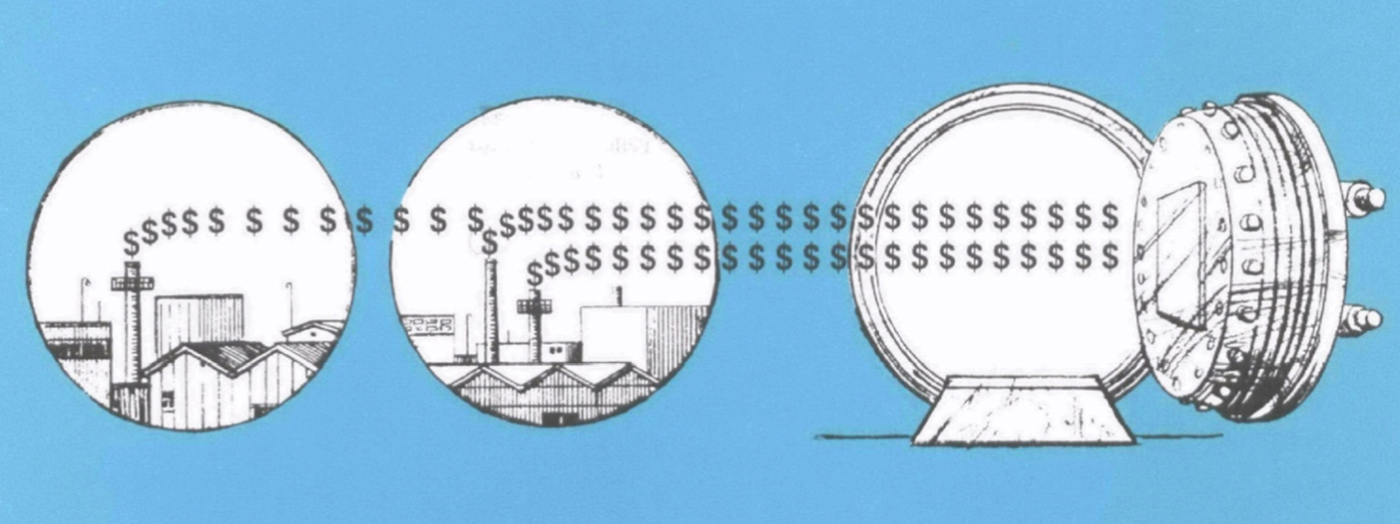
Nonetheless, under Levin's direction, the EPA's regulatory reform staff slowly expanded the use of the bubble and other economic incentive policies. The policy office produced guides marketing the bubble to business representatives and regulators, including one whose cover drawing depicted smokestacks emitting dollar signs directly into a corporate bank vault (Figure 2).Footnote 69 To build support in the wider policy world, Levin published celebratory accounts in forums on regulatory reform.Footnote 70 In winter 1981 and spring 1982, Levin organized a series of regulatory reform conferences across the country, each cosponsored by the EPA and a corporate leader in pollution control such as 3M or Armco.Footnote 71 Along with summaries of the great savings to be had, Levin sent business representatives home with personal letters of praise from the EPA in the hopes of raising the stature of environmental compliance managers within their companies.Footnote 72
EPA illustration of the potential compliance cost savings for businesses that adopted economic inventive approaches to controlling pollution. (Source: EPA, The Bubble and Its Use with Emission Reduction Banking [Washington, DC, 1982], 3.)

But without support from EPA senior officials, innovations like the bubble languished. At a dinner hosted by AEI in December 1981, Brookings Institution economist Robert Crandall articulated a bipartisan disappointment among the Beltway's public policy experts when he lamented that Reagan had managed “almost no accomplishments” in regulatory reform.Footnote 73 Throughout the following spring, criticism of Reagan's disinterest in new policies like the bubble continued to mount.Footnote 74 The EPA did finally issue its Emissions Trading Policy Statement in the Federal Register in April 1982—nearly a year and a half after the previous administration had promised.Footnote 75 But that formal proposal for expanding economic incentive regulations did little to quiet the critics who by now could see that Reagan and his appointees had little interest in substantive reform.
For bipartisan supporters of the bubble and the alternative model it represented, Reagan's blunt deregulatory ambitions posed a threat not just to specific initiatives but to the very project of regulatory reform. Proponents of reform had long faced charges from environmental and public health advocates that innovations like the bubble were merely a cloak for deregulation. By rhetorically supporting regulatory reform while in practice pursuing deregulation, Reagan threatened to validate those accusations, delegitimizing the bubble and other economic incentive reforms as sincere attempts to protect the environment. In June 1982, the Council for a Competitive Economy organized a dinner with the Brookings Institution, the Heritage Foundation, and other think tanks along with representatives of major regulated industries including the American Petroleum Institute in an attempt to demonstrate to Reagan's administration the merits of the regulatory alternatives they were ignoring. The dinner invitation left no doubt about the perceived danger of Reagan's current approach, warning that “the free market perspective has been discredited even though it has not been tried.”Footnote 76
By the fall of 1982, this chorus of criticism finally prompted the Reagan administration to question whether deregulation was indeed the best policy. In October, Reagan's top advisors gathered for the first meeting of the Working Group on Regulatory Reform. As a memo for a later meeting explained the group's rationale, Reagan's regulatory relief program had lost momentum, taking on a “stop-gap character” because “the Administration had failed to develop and articulate a unified approach to regulation.”Footnote 77 Developing that unified approach evidently required educating many of Reagan's advisors on the basics of economic incentive alternatives, as an earlier memo circulated a reading list to bring members of the working group up to speed.Footnote 78
Having at last expressed an interest in substantive regulatory reforms, Reagan could fall back on the foundation laid by Carter as well as the ongoing work of EPA regulatory reform staff. In the fall of 1982, Levin took advantage of the Reagan administration's changing attitudes to create the Emissions Trading Standing Committee, to coordinate the development of economic incentive approaches, dispense advice to EPA regional offices, and push the EPA's air office to incorporate trading schemes into the “main stream” air pollution control program.Footnote 79 After a long period of disinterest, the free-market president was finally supporting the legwork needed to create viable alternatives to proscriptive regulations.
Yet Reagan's earlier neglect continued to present obstacles. Though Gorsuch eventually gave her support to reforms like Emissions Trading, her earlier restrictions on the agency's work delayed the EPA from developing the theoretical and empirical support needed to protect such rule changes from environmentalists’ legal challenges. In August 1982, following a suit brought by the NRDC, the Second Circuit Court of Appeals rejected EPA expansion of the bubble policy to the many industrialized and polluted areas of the country that did not have approved plans toward compliance. The justices explained in their ruling that Gorsuch's EPA had changed critical definitions in the rule without producing a single study or other piece of supporting evidence.Footnote 80 For supporters of substantive reforms, the ruling represented a significant setback.Footnote 81 Policy advisor DeMuth angrily denounced the Second Circuit's “liberal Democratic judges” in a letter to Vice President Bush and the Office of Management and Budget Director David Stockman.Footnote 82 But in reality, Reagan had only himself to blame for appointing EPA officials focused on deregulation at all costs. Over the next year, environmental advocates including the NRDC, the Environmental Defense Fund, and Citizens for a Better Environment continued to take advantage of the EPA's poor planning, limiting the bubble's expansion through administrative hearings and public complaints that challenged the technical basis for proposed bubbles from Illinois to California.Footnote 83
Gorsuch resigned in 1983 amid a scandal over her management of the Superfund program. In her place, Reagan convinced the agency's first head, William Ruckelshaus, to return as EPA administrator. Ruckelshaus arrived at an agency that had introduced glittering incentive and market incentive policies without transforming how most firms controlled their emissions. A report on alternative approaches prepared for Ruckelshaus on his return counted 179 approved bubbles, with estimated compliance cost savings of over $600 million.Footnote 84 But despite the urging of reform champions, most firms continued to forgo the potential economic savings of the bubble to stick with the certainty of the EPA's proscriptive rules. After a long legal battle, the EPA finally prevailed in its definition of a plant-wide emissions source in a 1984 Supreme Court decision that also affirmed the doctrine of administrative deference.Footnote 85 But the years of litigation it took the EPA to win the case did little to inspire business confidence.
As Ruckelshaus described it, Gorsuch's tenure left Congress deeply suspicious of any attempts to change how the EPA operated for the remainder of Reagan's presidency.Footnote 86 Reform proponents had to settle for the incremental expansion of voluntary compliance alternatives like the bubble, contending all the while with resistance from the air office as well as in EPA regional offices and at the local and state levels.Footnote 87 When bubble advocates finally won permission in 1985 for bubbling in areas that had not attained national air quality standards, the air office quickly moved to restrict this expansion to only those areas with approved attainment plans—a stipulation that conveniently prohibited the use of the bubble in the heavily polluted areas where the bubble was the most appealing to industry.Footnote 88
EPA regulatory reform chief Mike Levin devoted much of his time during this period to assuaging concerns within and without the agency about the efficacy of his alternatives. Levin's staff kept a running list of issues raised by critics and his Standing Committee on Emissions Trading met frequently to address questions and concerns from the air office and regional offices.Footnote 89 In an effort to build and maintain support for the bubble and other reforms, Levin continued to promote the policies in academic and policymaking circles.Footnote 90 Ruckelshaus supported the development of economic incentive reforms during his second tenure as EPA administrator, though he prioritized restoring the agency's integrity in the eyes of the environmental community and Congress.Footnote 91 During Ruckelshaus's tenure, the EPA consolidated its various economic incentive programs in the long-awaited Final Emissions Trading Policy Statement, which was issued in 1986—a year after Ruckelshaus had left the agency.Footnote 92
Conclusion
By the 1990s, bubbles had mostly dissipated as compliance mechanisms. Writing in 1989, economists Robert Hahn and Gordon Hester counted forty-two EPA-approved bubbles, with another eighty-nine approved at the state level under the generic bubble rule. As with the EPA's wider emissions trading program, Hahn and Hester found that persistent uncertainty around the bubble prompted most businesses to steer clear of the policy.Footnote 93 A decade later, a 2001 EPA report affirmed that bubbling had not been widespread, with the agency ceasing to track bubbles after 1986.Footnote 94 Back in the 1970s, Carter air office head Dave Hawkins could not have predicted Reagan's debilitating disinterest in regulatory reform, but the persistent uncertainty around the bubble that Hawkins helped to foster had worked like a charm in hobbling the bubble's adoption by businesses.
While not widely used as compliance mechanisms, the idea of the bubble and the wider regulatory reforms of which it was a part helped to inspire cap-and-trade programs that did transform how businesses across the country controlled pollution. Beginning in 1982, the EPA used tradable credits to phase lead out of gasoline. In 1990, Congress amended the Clean Air Act to create what turned out to be a highly successful cap-and-trade program to control acid rain. Over the next two decades, cap-and-trade programs were successfully introduced for various pollutants at the state level, with California leading the way.Footnote 95 At the international level, the European Union developed a cap-and-trade program to combat climate change—a model that environmental advocates currently hope to replicate in a global agreement.Footnote 96 This disjuncture between the bubble's intellectual lineage and its practical insignificance testifies to the relative difficulty of transforming existing regulatory systems, where entrenched interests militate against disruptions like the bubble that do not encounter such resistance in areas being regulated for the first time.
The bubble's story begs the question of whether a second Carter administration or a more supportive Reagan administration might have shifted the country away from proscriptive mandates and toward a model in which business managers had greater discretion. As this article has described, many of the conditions for such a shift were in place in 1980: the policy community overwhelmingly endorsed alternatives that promised to reduce the costs of environmental protection to the general economy, the EPA was led by officials who shared that enthusiasm, and major firms including DuPont and Armco had thrown in their support. Skeptics at the EPA, in state and local regulatory agencies, and in environmental advocacy organizations had raised a flurry of objections, limiting the uncertain policy's uptake by the vast majority of businesses. But Drayton, Levin, and other supporters were slowly addressing many of those concerns. And environmental advocates and regulators would soon come around to a market model in programs like cap-and-trade. As it happened, Reagan's crude deregulatory program undercut the fledging reforms left by Carter, confirming for both the bubble's critics and regulated industry that their suspicions of the bubble and other reforms were right all along.
Business neglect of the bubble despite the considerable compliance cost savings enjoyed by a few pioneering firms also raises the possibility that regulated businesses in the United States preferred proscriptive mandates because those directives permitted firms to take a combative approach to environmental protection. As political historian David Vogel describes, the business community recognized in the early 1970s that it could not avoid or abolish environmental regulations that had broad public support. Confronted with the EPA's insistence on the ambitious standards created by Congress, businesses settled into a slow contest with the agency, marked by enduring complaints about economically ruinous mandates and periodic relief from sympathetic elected officials.Footnote 97 Introduced into a regulatory system in which contest had been the norm, the bubble and other economic incentive policies could actually undercut the political power of businesses by opening up a wider range of pollution control between firms, undermining that narrative of economically impossible regulations that was so valuable to business from the 1970s onward. By incentivizing firms to control pollution in cheap and innovative ways, the bubble could end up revealing a particular industry's true capacity to reduce pollution. Perhaps not coincidently, several of the bubble's early adopters in the United States were firms like 3M with a record of leadership in pollution control. Business historians have long noted the tendency of incumbent firms to shape industry-specific regulations into shields against disruptive competition and further government intervention.Footnote 98 The implicit preference of most businesses for proscriptive rules over the flexibility of the bubble may mark another instance in which existing regulations work to the benefit of established firms.
Refined during a hypothetical second Carter administration, the bubble could have been a part of a careful shift away from proscriptive rules to a regulatory system that gave businesses greater prerogative but also greater responsibility over pollution control. As mentioned earlier, most European nations adopted such a model, giving businesses wide latitude to meet emissions targets as managers saw fit.Footnote 99 While this article focused on the bubble in the U.S. policy, the international comparison is illustrative, not least in the relative absence of environmental regulation as a partisan issue in Europe during the same period that such regulation became very politicized in the United States.Footnote 100 Reagan's election was part and parcel of a new Republican politics that staked an ideological opposition to environmental protection and encouraged regulated industry to pursue deregulation instead of reform. The hopes for substantive regulatory reform that the bubble represented were left deflated.