Implications
Assessing pain is crucial for pain prevention and alleviation. The aim of the present paper is to review relevant indicators in several farm species, including fish. Four types of indicators, related to physiology, behaviour, lesions and performance, are discussed. Some indicators are very specific and sensitive to pain, whereas others are more general indicators of stressful situations, but can be used to alert persons in charge of the animals that these animals are suffering from something, which could be pain. A single behavioural indicator may be sufficient to detect pain, but combining indicators improves efficiency of pain assessment.
Introduction
Welfare of animals includes both physical and mental aspects and implies that animals should be free from pain, injury or disease (Farm Animal Welfare Council, 1992). Therefore, it is crucial to assess, that is, to detect and, if possible, to evaluate the intensity of pain, in order to prevent pain or to alleviate it as rapidly as possible (Guatteo et al., Reference Guatteo, Levionnois, Fournier, Guémené, Latouche, Leterrier, Mormède, Prunier, Servière, Terlouw and Le Neindre2012). Molony and Kent (Reference Molony and Kent1997) defined pain in animals as ‘an aversive sensory and emotional experience […], it changes the animal's physiology and behaviour to reduce or avoid damage, to reduce the likelihood of recurrence and to promote recovery’. According to this definition, pain has an emotional component, and one important question is whether animals, especially fish, have the conscious emotional states needed to experience pain. It is not the purpose of the present review to debate about this question. Therefore, we will use the term pain for all species included in the present review, even though the degree of conscious emotional states may vary greatly between species (Le Neindre et al., Reference Le Neindre, Guattéo, Guémené, Guichet, Latouche, Leterrier, Levionnois, Mormède, Prunier, Serrie and Serviere2009).
In humans, the best evaluation of pain is self-report, on the basis of oral or written communication (Herr et al., Reference Herr, Bjoro and Decker2006). In animals, it is necessary to use indicators that can be detected by external observers. Consequently, pain assessment in animals is difficult. The numerous reviews of literature or guidelines that have been written focussed mainly on mammalian species (e.g. see: Morton and Griffiths, Reference Morton and Griffiths1985; Molony and Kent, Reference Molony and Kent1997; Holton et al., Reference Holton, Reid, Scott, Pawson and Nolan2001) and more recently on birds (Gentle, Reference Gentle2011). Indicators used for animals are often similar to those described for humans. Most of them are based on physiological or behavioural reactions aiming at stopping the cause or reducing the consequences of the noxious stimuli (Molony and Kent, Reference Molony and Kent1997; Mellor et al., Reference Mellor, Cook and Stafford2000). Indicators of injuries and lesions may be used additionally as they often cause pain. Finally, pain can lead to a decrease in production performance, such as growth rate (bulls: Earley and Crowe, Reference Earley and Crowe2002) or milk production (Fourichon et al., Reference Fourichon, Seegers, Bareille and Beaudeau1999), which may also be used as a pain indicator.
The aim of the present paper is to describe the four main types of indicators (behavioural, physiological, lesional and production indicators) of pain in mammals (essentially in sheep, cattle and pigs), birds (mainly in poultry) and fish, on the basis of examples from the literature without attempting to be exhaustive. Strengths and weaknesses of each type of indicator will be evaluated. This review is based on a comprehensive report of the French National Institute for Agricultural Research (INRA) on pain in food-producing farm animals, with the aims to propose methods for assessment and solutions to prevent or alleviate pain (Le Neindre et al., Reference Le Neindre, Guattéo, Guémené, Guichet, Latouche, Leterrier, Levionnois, Mormède, Prunier, Serrie and Serviere2009). A review on the means to prevent and alleviate pain was also published (Guatteo et al., Reference Guatteo, Levionnois, Fournier, Guémené, Latouche, Leterrier, Mormède, Prunier, Servière, Terlouw and Le Neindre2012).
Situations of pain evaluation
Pain indicators in farm animals have been described for various situations using (a) experimental models of pain, (b) application of painful procedures that are commonly performed in commercial farms for production purposes (e.g. tail docking in mammals or beak trimming in birds) or (c) animals that are suffering from pain due to diseases or lesions (e.g. arthritis). Experimental models of pain often mimicked situations of ‘natural’ pain like intra-articular pain induced by urate injection (Hocking et al., Reference Hocking, Gentle, Bernard and Dunn1997) or feather pecking mimicked by feather removal (Gentle and Hunder, Reference Gentle and Hunder1991). Some models were more artificial, such as subcutaneous injection of acetic acid in the lips of fish (Sneddon, Reference Sneddon2003).
In some experiments, authors compared various combinations of experimental treatments including a painful procedure, a sham procedure, an analgesic treatment (local anaesthetic treatment with lidocaine in most cases and/or a non-steroidal anti-inflammatory drug (NSAID)), a sham treatment and/or non-handled animals to validate potential pain indicators. Animals used in experimental models of pain as well as animals suffering from ‘natural’ pain, receiving or not analgesic treatments, were also used in validation studies.
Postural and behavioural indicators
In pigs and ruminants
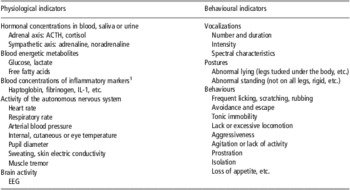
Numerous postural and behavioural indicators of pain have been described in mammals (Table 1). They can be distinguished in five main categories. Four of these aim directly or indirectly to avoid or alleviate the painful stimulus: (1) avoidance and defensive behaviours, (2) vocalisations, (3) behaviours directed towards the painful areas and (4) postures and behaviours aiming to reduce stimulation of the painful area. The fifth category is related to general changes in activity, being motionless or agitated, feeding, drinking, social and grooming behaviours. These categories will be discussed in more detail below.
List of physiological and behavioural changes that may indicate the existence of pain in mammals

ACTH = adrenocorticotropic hormone; IL = interleukin; EEG = electroencephalogram.
Adapted from Mellor et al. (Reference Mellor, Cook and Stafford2000), Prunier et al. (Reference Prunier, Hay and Servrière2002) and Hay et al. (Reference Hay, Vulin, Génin, Sales and Prunier2003).
1Inflammatory markers indicate the existence of an inflammatory state that may generate pain.
The nociceptive withdrawal reflex is the simplest form of avoidance and defensive behaviours. The withdrawal movement is involuntary and rapid, mediated by a reflex arc synapsing in the spinal cord. The brain receives the sensory input but does not intervene in the reflex action. The withdrawal reflex protects the animal from potentially damaging stimuli. The reflex is frequently used to measure the response to a controlled painful stimulus in order to test the efficiency of analgesic drugs or the influence of the physiological state of the animal. An example is the latency to the occurrence of a withdrawal or kicking movement when a limited area of the leg, shoulder or rump is subjected to a painful stimulus, for instance, by heating the skin locally with a laser beam (pigs: Jarvis et al., Reference Jarvis, McLean, Chirnside, Deans, Calvert, Molony and Lawrence1997; calves: Veissier et al., Reference Veissier, Rushen, Colwell and De Passille2000; cows: Herskin et al., Reference Herskin, Muller, Schrader and Ladewig2003). Avoidance and defensive behaviours, including leg and body movements as if animals were trying to avoid or escape the painful stimuli, were observed during castration (Marx et al., Reference Marx, Horn, Thielebein, Knubel and Von Borell2003), teeth resection and tail docking in young piglets (Noonan et al., Reference Noonan, Rand, Priest, Ainscow and Blackshaw1994; Torrey et al., Reference Torrey, Devillers, Lessard, Farmer and Widowski2009). Similarly, dairy cows or growing calves jumped or kicked when subjected to hot-iron or liquid-nitrogen branding (Lay et al., Reference Lay, Friend, Randel, Bowers, Grissom and Jenkins1992a; Schwartzkopf-Genswein et al., Reference Schwartzkopf-Genswein, Stookey, Crowe and Genswein1998). These behaviours may also be observed during palpation of a painful area. Reactions to palpation of the scrotum or of the neck of the scrotum in lambs that were castrated with constriction rings, ranged from no reaction or a slight tension of the hind limbs to bucking (Thornton and Waterman-Pearson, Reference Thornton and Waterman-Pearson1999).
Vocalisations are often used to identify pain in pigs, sheep and cattle. Many studies found that the number and features of these vocalisations were modified in case of painful situations (reviewed by Watts and Stookey, Reference Watts and Stookey2000; Manteuffel et al., Reference Manteuffel, Puppe and Schon2004). For example, during painful interventions, the number or duration of vocalisations increased in lambs (Molony et al., Reference Molony, Kent, Hosie and Graham1997), cattle (Schwartzkopf-Genswein et al., Reference Schwartzkopf-Genswein, Stookey and Welford1997) and pigs (Weary et al., Reference Weary, Braithwaite and Fraser1998). Detailed studies on pigs found that high-frequency screams (>1000 Hz) were more frequent, lasted longer and were more powerful when piglets were castrated than when they were just handled to simulate castration, and the high-frequency screams were much reduced when piglets received a local anaesthetic before castration (White et al., Reference White, Deshazer, Tressler, Borcher, Davey, Waninge, Parkhurst, Milanuk and Clemens1995; Marx et al., Reference Marx, Horn, Thielebein, Knubel and Von Borell2003). In addition, Puppe et al. (Reference Puppe, Schon, Tuchscherer and Manteuffel2005) showed that the entropy of the high-frequency vocalisation was lower during castration compared with the pre-surgical period. Similarly, Watts and Stookey (Reference Watts and Stookey1999) observed that, compared with controls, calves subjected to hot-iron branding showed a greater frequency range in the fundamental or lowest harmonic of the audiospectrogram of their vocalisations, a higher maximum frequency and a higher peak sound level. However, many animals also vocalise during non-painful handling. Consequently, sometimes, no differences are found between the control and painful situation (Lay et al., Reference Lay, Friend, Bowers, Grissom and Jenkins1992a; Schwartzkopf-Genswein et al., Reference Schwartzkopf-Genswein, Stookey, Crowe and Genswein1998). It was further shown in ruminants that after the acute response to a painful intervention, monitoring of vocalisations was of little efficacy to detect pain (Molony et al., Reference Molony, Kent and McKendrick2002; Grant, Reference Grant2004).
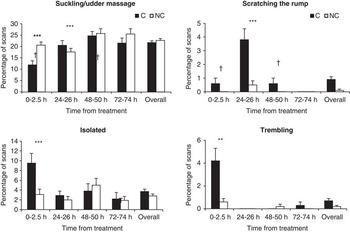
Behaviours directed towards the painful areas are relatively easy to observe. Licking or scratching are probably performed to relieve the pain, as simultaneous activation of non-nociceptive sensory receptors of the skin inhibits the transmission of nociceptive signals (Melzack and Wall, Reference Melzack and Wall1965). Thus, calves licked the end of their tail after tail docking (Eicher et al., Reference Eicher, Morrow-Tesch, Albright, Dailey, Young and Stanker2000) or the scrotal area for 48 days following castration (Molony et al., Reference Molony, Kent and Robertson1995). When licking is not possible for anatomical reasons, animals may scratch the painful area. For example, calves scratched their head with the hind foot after heat cauterisation of the horn-producing area (i.e. disbudding; Morisse et al., Reference Morisse, Cotte and Huonnic1995). Similarly, the days following surgical castration, pigs displayed scratching of the scrotum against the floor (Hay et al., Reference Hay, Vulin, Génin, Sales and Prunier2003; Llamas Moya et al., Reference Llamas Moya, Boyle, Lynch and Arkins2008; Figure 1) or dog-sitting postures (Llamas Moya et al., Reference Llamas Moya, Boyle, Lynch and Arkins2008). Other specific movements directed to the painful area may involve head movements towards the painful area after castration and/or tail docking in lambs (Molony et al., Reference Molony, Kent and McKendrick2002), teeth champing (opening and closing of the mouth not associated to feeding) after teeth clipping in pigs (Noonan et al., Reference Noonan, Rand, Priest, Ainscow and Blackshaw1994) and head shaking after disbudding in calves (Morisse et al., Reference Morisse, Cotte and Huonnic1995).
Comparison of some behavioural indicators of pain in piglets castrated at 5 days of age (C) or not (NC) at various periods from treatment (adapted from Hay et al., Reference Hay, Vulin, Génin, Sales and Prunier2003). Symbols indicate statistical differences between treatments within periods at †P < 0.1, **P < 0.01 and ***P < 0.001.

Postures and behaviours to reduce stimulation of the painful area can also indicate the presence of pain. The most common example is lameness. Foot lesions frequently stop the animal putting weight on the affected leg (O'Callaghan et al., Reference O'Callaghan, Cripps, Downham and Murray2003; Flower and Weary, Reference Flower and Weary2006). Administration of an analgesic treatment reduced the degree of lameness in cattle, demonstrating the implication of pain in this behaviour (Rushen et al., Reference Rushen, Pombourcq and Passillé2007). Pigs (Hay et al., Reference Hay, Vulin, Génin, Sales and Prunier2003), lambs (Molony et al., Reference Molony, Kent and Robertson1993) and calves (Robertson et al., Reference Robertson, Kent and Molony1994) were more often lying on their sides with their legs extended after castration than before. Abnormal ventral lying also occurred in lambs after castration combined or not with tail docking (Molony et al., Reference Molony, Kent and Robertson1993 and Reference Molony, Kent and McKendrick2002). Animals that suffer from pain may lie with legs tucked under the body (=huddle up; lambs: Molony et al., Reference Molony, Kent and Robertson1993; pigs: Hay et al., Reference Hay, Vulin, Génin, Sales and Prunier2003; Llamas Moya et al., Reference Llamas Moya, Boyle, Lynch and Arkins2008). All these postures supposedly reduce stretching of tissues, and hence painful stimulation of the injured area. The reduction in locomotion is observed not only in lame animals (cows: O'Callaghan et al., Reference O'Callaghan, Cripps, Downham and Murray2003) but also after castration (pigs: Llamas Moya et al., Reference Llamas Moya, Boyle, Lynch and Arkins2008), probably because it also reduces stimulation of the painful area.
Being motionless or agitated may both occur after a painful procedure and can be a pain indicator. For example, ‘statue standing’ (standing still for more than 10 s) and being awake without any activity were more frequent after rubber-ring castration in lambs (Molony et al., Reference Molony, Kent and McKendrick2002) and after surgical castration in pigs (Hay et al., Reference Hay, Vulin, Génin, Sales and Prunier2003), respectively, compared with non-castrated controls. Jumping, foot stamping and kicking, rolling from one side to the other side and restlessness measured by the frequency of alternating standing and lying postures were also more frequent after rubber-ring castration and/or tail docking (Molony et al., Reference Molony, Kent and Robertson1995; Grant, Reference Grant2004). Injection of a local anaesthetic into the two sides of the neck of the scrotum of lambs subjected to rubber-ring castration reduced these behaviours (Molony et al., Reference Molony, Kent and Robertson1995 and Reference Molony, Kent and McKendrick2002). Tail wagging can be interpreted as a sign of agitation and/or as a signal masking nociceptive signals from the rear part of the body and was observed after castration in piglets (Hay et al., Reference Hay, Vulin, Génin, Sales and Prunier2003), lambs (Molony et al., Reference Molony, Kent and McKendrick2002) or calves (Robertson et al., Reference Robertson, Kent and Molony1994).
Pain may influence other behaviours such as those related to feeding, drinking, social and grooming. For example, less suckling or feeding behaviour, social isolation, behavioural desynchronisation with littermates and/or less social interactions with the dam were observed in pigs after surgical castration (McGlone and Hellman, Reference McGlone and Hellman1988; Hay et al., Reference Hay, Vulin, Génin, Sales and Prunier2003; Llamas Moya et al., Reference Llamas Moya, Boyle, Lynch and Arkins2008) or tail docking (Torrey et al., Reference Torrey, Devillers, Lessard, Farmer and Widowski2009). Similarly in calves, reduction in feed intake was observed after castration (Fisher et al., Reference Fisher, Crowe, delaVarga and Enright1996).
In poultry
Like mammals, poultry show withdrawal reactions when an area is painfully stimulated. For example, automatic withdrawal of the foot occurred when the foot of a Japanese quail was plunged in hot water (Evrard and Balthazart, Reference Evrard and Balthazart2002). Defensive or flight behaviours during painful interventions involve attempts to escape (jumps, wing flapping) observed in chickens submitted to feather removal (Gentle and Hunder, Reference Gentle and Hunder1991). In a situation where birds could not escape from painful stimulations, they stopped to perform defensive and flight behaviours and crouched immobile (Gentle and Hunder, Reference Gentle and Hunder1991).
Vocalisations can also be an expression of pain. Several studies show that hens vocalise during repeated removal of feathers from different anatomical regions (leg, cape, etc.) and during pecking (Collias, Reference Collias1987; Gentle and Hunder, Reference Gentle and Hunder1991). Collias (Reference Collias1987) described the vocalisations of hens during pecking. They were characterised by a short duration (0.1 to 0.2 s) and a high frequency (>8 kHz). They were moderately loud and of lower intensity than distress calls emitted during capture. In flocks where pecking was present, laying hens emitted more vocalisations, particularly more squawks (Bright, Reference Bright2008).
Similar to mammals, birds can adopt postures and/or change their behaviour to reduce stimulation of the painful area. For example, after beak trimming, hens and turkeys gave fewer pecks (Gentle and Hunder, Reference Gentle and Hunder1991). To avoid musculoskeletal pain, birds can limp or take relieving postures, ranging from a slight change in the positioning of the leg to a complete loss of support by the painful member (Kestin et al., Reference Kestin, Knowles, Tinch and Gregory1992; Leterrier and Nys, Reference Leterrier and Nys1992). Lame chickens spent more time lying and walked less (Weeks et al., Reference Weeks, Davies and Hunt1997 and Reference Weeks, Danbury, Davies, Hunt and Kestin2000), and turkeys with musculoskeletal disorders were less generally active than controls (Duncan et al., Reference Duncan, Beatty, Hocking and Duff1991). Administration of analgesic treatments (local anaesthesia or NSAID) reduced dose dependently the time spent lying or standing on a single foot (Hocking et al., Reference Hocking, Gentle, Bernard and Dunn1997 and Reference Hocking, Robertson and Gentle2001).
Chickens with intra-articular pain induced by an urate injection reduced their grooming, feeding and drinking activities (Hocking et al., Reference Hocking, Gentle, Bernard and Dunn1997 and Reference Hocking, Robertson and Gentle2001), and chickens with musculoskeletal disorders dust-bathed less than healthy chickens (Vestergaard and Sanotra, Reference Vestergaard and Sanotra1999).
In fish
It has long been known that fish also demonstrate avoidance/escape behaviours when they are submitted to nociceptive stimuli such as electric shocks, and that they are able to learn to avoid these stimuli (e.g. Bintz, Reference Bintz1971; Ehrensing et al., Reference Ehrensing, Michell and Kastin1982 with goldfish). Learning did not occur if fish received an analgesic treatment with morphine (Ehrensing et al., Reference Ehrensing, Michell and Kastin1982), showing the implication of pain in the behaviour. Two types of escape behaviours were described both in goldfish and trout: a high speed ‘panic’ swimming response ceasing immediately after leaving the electrical zone and a more calm response (‘tail-flip’), allowing the fish to cruise from the zone (Dunlop et al., Reference Dunlop, Millsopp and Laming2006).
Administration of a noxious stimulus, such as a subcutaneous injection of acetic acid in the lips, may cause reduction in frequency of swimming, cessation of food intake or induce abnormal behaviours such as rocking from side to side or rubbing the lips against the tank (Sneddon, Reference Sneddon2003; Reilly et al., Reference Reilly, Quinn, Cossins and Sneddon2008). One or more of these behavioural changes occurred in the three studied species: zebrafish, trout and carp (Reilly et al., Reference Reilly, Quinn, Cossins and Sneddon2008). Experiments in rainbow trout showed that morphine or local anaesthesia with lidocaine reduced these behavioural changes in acid-treated animals (Sneddon, Reference Sneddon2003; Mettam et al., Reference Mettam, Oulton, McCrohan and Sneddon2011), indicating that they were dependant on pain.
Drawbacks and advantages of using postural and behavioural indicators
A frequent criticism of behavioural assessment of pain is its supposed subjectivity, because of differences in perception and interpretation by observers. In order to avoid biases, it is necessary to ensure the validity and reproducibility of the behavioural measures.
First, it should be checked that behavioural indicators are specifically influenced by pain and not by handling or stress resulting from the procedure. For many indicators, this was verified by comparing the behaviour of animals submitted or not to painful/nociceptive stimuli with and without a pharmacological pain-relieving treatment (see above). However, some behavioural changes may also be observed during illness and situations of stress or discomfort without a nociceptive component. Apathy, social isolation and loss of appetite are examples. These behaviours cannot specifically identify pain but they can contribute to its overall evaluation if they are associated with more specific indicators.
Reproducibility of pain detecting measures was rarely evaluated except for lameness for which reliability between two observers was assessed (for example in sheep: Welsh et al., Reference Welsh, Gettinby and Nolan1993 and in cattle: Flower and Weary, Reference Flower and Weary2006; Leach et al., Reference Leach, Dippel, Huber, March, Winckler and Whay2009). Lack of reliability may come from the observers and from the animal variability in the expression of pain. Regarding observers, many potential sources of biases identified for ratings (Meagher, Reference Meagher2009) may be relevant for behavioural and postural observations: insufficient precision of the definitions of the behavioural categories, insufficient experience and training of the observers, as well as a lack of impartiality. Solutions include improvement of definitions, better training of observers, the assurance of their independency and, if relevant, the use of blind protocols. Regarding animals, the expression of pain may vary over time and across animals. For example, they can be modulated by endogenous analgesic processes. In some contexts, highly motivated behaviours, such as laying in hens, or feeding, may be expressed despite pain, and may reduce or even cancel pain expression (Gentle and Corr, Reference Gentle and Corr1995; Wylie and Gentle, Reference Wylie and Gentle1998).
Although caution should be taken, postural and behavioural indicators have many advantages. First, they are not invasive, do not need any intervention on the animals and can be carried out by direct observation. Therefore, they can be used under field conditions, by veterinarians, technicians or farmers. Second, postural and behavioural indicators are sensitive and appear immediately during acute pain. Third, numerous pain-related behaviours are specific and help identify the location of the pain, thus facilitating its treatment.
Methods to record and analyse behavioural indicators can be very sophisticated and time-consuming but necessary for research purposes (e.g. Molony et al., Reference Molony, Kent and Robertson1993 in lambs; Hay et al., Reference Hay, Vulin, Génin, Sales and Prunier2003 in pigs). However, at the farm level, rapid and simple systems of observation should be developed, for example, systems of scoring or systems of automatic recording of the behavioural activity on the basis of localisation of the animals by telemetry.
Physiological indicators
Physiological variations related to pain are mainly because of two interrelated mechanisms. First, pain is a powerful stressor stimulating directly the release of hormones from the hypothalamic–pituitary–adrenal (HPA) and sympathetic axes in mammals and birds and their equivalents in fish. Second, tissue damage activates the immune system and the release of numerous inflammatory mediators, which, in turn, may also activate the adrenal axis (reviewed by Turnbull and Rivier, Reference Turnbull and Rivier1999; Lamont et al., Reference Lamont, Tranquilli and Grimm2000). For example, the pro-inflammatory cytokine, interleukin-1, released by immune cells after a tissue lesion, stimulates the release of adrenocorticotropic hormone (ACTH) and cortisol and plays an active role in transmitting nociceptive stimuli to the brain (Turnbull and Rivier, Reference Turnbull and Rivier1999; Ren and Torres, Reference Ren and Torres2009). Third, some substances (haptoglobin, fibrinogen, etc.) that are not involved in the control of pain but are released during inflammation can be used as indirect indicators of pain, as inflammatory states are highly susceptible to generate pain. Therefore, physiological indicators of pain involve hormones from the adrenal and sympathetic axes, their metabolic and physiological consequences, plasma markers of an inflammatory state and mediators involved in the physiological mechanisms of pain.
In pigs and ruminants
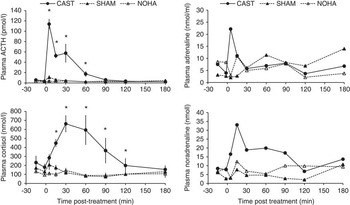
Various physiological indicators of pain have been used in mammals (Table 1). Many studies have examined cortisol concentrations in blood or saliva samples collected at regular intervals before and after painful interventions in pigs (castration: Prunier et al., Reference Prunier, Mounier and Hay2005; Carroll et al., Reference Carroll, Berg, Strauch, Roberts and Kattesh2006; Sutherland et al., Reference Sutherland, Davis, Brooks and McGlone2010, snaring (=squeezing the upper jaw with a nose sling) or tattooing: Merlot et al., Reference Merlot, Mounier and Prunier2011; Figure 2), calves (castration: Cohen et al., Reference Cohen, King, Thomas and Janzen1990; dehorning: Morisse et al., Reference Morisse, Cotte and Huonnic1995; Fisher et al., Reference Fisher, Crowe, delaVarga and Enright1996; Sylvester et al., Reference Sylvester, Mellor, Stafford, Bruce and Ward1998) and lambs (castration: Lester et al., Reference Lester, Mellor, Ward and Holmes1991 and Reference Lester, Mellor, Holmes, Ward and Stafford1996). Handling had no significant effect on plasma cortisol in pigs (Prunier et al., Reference Prunier, Mounier and Hay2005), lambs (Mellor and Murray, Reference Mellor and Murray1989) or calves (Lay et al., 1992a, Reference Lay, Friend, Bowers, Grissom and Jenkins1992b), whereas the painful intervention induced a significant increase in the hours and sometimes days following its application in all cases except after tail docking and tooth resection in very young piglets. If local anaesthesia was used, the amplitude and duration of the cortisol increase were lower following castration (lambs: Graham et al., Reference Graham, Kent and Molony1997; Molony et al., Reference Molony, Kent and McKendrick2002; pigs: Prunier, Reference Prunier2002; Courboulay et al., Reference Courboulay, Hémonic, Gadonna and Prunier2010; calves: Stafford et al., Reference Stafford, Mellor, Todd, Bruce and Ward2002; Ting et al., Reference Ting, Earley, Hughes and Crowe2003), tail docking (lambs: Graham et al., Reference Graham, Kent and Molony1997) or dehorning (calves: reviewed by Stafford and Mellor, Reference Stafford and Mellor2005). Similarly, post-surgery increases in plasma cortisol were reduced in animals treated with caudal epidural anaesthesia or NSAID in calves submitted to castration (Earley and Crowe, Reference Earley and Crowe2002; Stafford et al., Reference Stafford, Mellor, Todd, Bruce and Ward2002; Ting et al., Reference Ting, Earley, Hughes and Crowe2003) or in lambs submitted to tail docking (Graham et al., Reference Graham, Kent and Molony1997).
Comparison of plasma concentrations of adrenocorticotropic hormone (ACTH), cortisol, adrenaline and noradrenaline in 5- to 6-day-old piglets that were submitted to surgical castration (CAST) or sham castration (SHAM) at time 0 or were not handled (NOHA) (adapted from Prunier et al., Reference Prunier, Mounier and Hay2005 and Reference Prunier, Bonneau, Von Borell, Cinotti, Gunn, Frediksen, Giersing, Morton, Tuyttens and Velarde2006). *Within experimental groups, concentration at a given time differs at P < 0.05 from concentration at time 0.

Variations in plasma ACTH, the pituitary hormone that stimulates cortisol release, were more marked than variations in plasma cortisol after a painful procedure such as castration and other common procedures applied to pigs (Prunier et al., Reference Prunier, Mounier and Hay2005; Merlot et al., Reference Merlot, Mounier and Prunier2011; Figure 2). The increase occurred earlier and amplitude of the peaks was higher. Thus, ACTH is a more sensitive pain indicator than cortisol. In parallel to ACTH, endogenous β-endorphin may be released in the general circulation in response to pain. An increase in plasma concentration of β-endorphin was observed after snaring or painful orthopaedic surgery in horses (McCarthy et al., Reference McCarthy, Jeffcott and Clarke1993; Roozen et al., Reference Roozen, Tsuma and Magnusson1995), tooth resection by grinding in piglets (Marchant-Forde et al., Reference Marchant-Forde, Lay, McMunn, Cheng, Pajor and Marchant-Forde2009) and after surgical mulesing (removal of strips of skin from the rump area) in sheep (Shutt et al., Reference Shutt, Fell, Connell, Bell, Wallace and Smith1987). In contrast, horses with painful chronic lameness had plasma concentrations of β-endorphin similar to those of normal horses (McCarthy et al., Reference McCarthy, Jeffcott and Clarke1993). Therefore, the relevance of β-endorphin as a chronic pain indicator may be limited contrarily to its usefulness in detecting acute pain.
Plasma adrenaline increased rapidly but briefly after painful procedures such as castration in pigs (Prunier et al., Reference Prunier, Bonneau, Von Borell, Cinotti, Gunn, Frediksen, Giersing, Morton, Tuyttens and Velarde2006), dehorning in calves, castration and tail docking in lambs (Mellor et al., Reference Mellor, Stafford, Todd, Lowe, Gregory, Bruce and Ward2002). In the same experiments, plasma noradrenaline also increased, but the increase occurred later and lasted longer compared with adrenaline. In pigs, painful procedures resulted further in an increase in plasma lactate, probably because of the catabolism of muscular glycogen (Prunier et al., Reference Prunier, Mounier and Hay2005; Merlot et al., Reference Merlot, Mounier and Prunier2011) triggered, at least in part, by the adrenaline release (Fernandez et al., Reference Fernandez, Levasseur, Ecolan and Wittmann1995). Similarly, increases in free fatty acids or glucose due to release of catecholamines and/or cortisol are expected. The increased muscular activity associated with the defence movements during acute pain may also contribute to higher plasma lactate in response to anaerobic muscular glycogen mobilisation.
The activity of the sympathetic axis can also be evaluated by other physiological variables. For example, arterial blood pressure and heart rate increased during castration in piglets (White et al., Reference White, Deshazer, Tressler, Borcher, Davey, Waninge, Parkhurst, Milanuk and Clemens1995; Haga and Ranheim, Reference Haga and Ranheim2005), and respiratory and heart rates increased during freeze or hot-iron branding in cattle (Lay et al., Reference Lay, Friend, Bowers, Grissom and Jenkins1992b and 1992Reference Lay, Friend, Grissom, Bowers and Malc; Stewart et al., Reference Stewart, Stafford, Dowling, Schaefer and Webster2008). These increases were less pronounced when a local anaesthesia was applied before surgery (pigs: White et al., Reference White, Deshazer, Tressler, Borcher, Davey, Waninge, Parkhurst, Milanuk and Clemens1995; Haga and Ranheim, Reference Haga and Ranheim2005). Heart rate variability (HRV) is under the control of both the sympathetic and parasympathetic systems and could thus be influenced by chronic pain (Von Borell et al., Reference Von Borell, Langbein, Despres, Hansen, Leterrier, Marchant-Forde, Marchant-Forde, Minero, Mohr, Prunier, Valance and Veissier2007a). However, HRV as a pain indicator has been poorly investigated. To our knowledge, there is only one study showing that treatment of horses, suffering from laminitis, with NSAID resulted in changes in HRV with an increase of high-frequency components and a decrease of low-frequency components together with less weight shifting behaviours (Rietmann et al., Reference Rietmann, Stauffacher, Bernasconi, Auer and Weishaupt2004). Trembling resulting probably from activation of the sympathetic nervous system was observed during the first hours following castration in piglets (Hay et al., Reference Hay, Vulin, Génin, Sales and Prunier2003; Llamas Moya et al., Reference Llamas Moya, Boyle, Lynch and Arkins2008) and in lambs (Molony et al., Reference Molony, Kent and McKendrick2002). The activity of the sympathetic axis may further be measured by maximal eye temperature, using an infrared camera recording, at regular intervals. The area measured includes the medial posterior palpebral border of the lower eyelid and the lacrimal caruncle, the distance and angle of the beam being standardised. Calves with the head blocked in a restraint system and submitted to various treatments showed a transient decrease in eye temperature after disbudding without local anaesthesia followed by a prolonged increase, whereas only the prolonged increase was observed after disbudding with anaesthesia (Stewart et al., Reference Stewart, Stafford, Dowling, Schaefer and Webster2008). Similarly, a prolonged increase was observed in calves after surgical castration (Stewart et al., Reference Stewart, Verkerk, Stafford, Schaefer and Webster2010).
Acute phase proteins may be used as markers of an inflammatory state susceptible to generate pain. An increase in plasma haptoglobin in the days following surgery occurred after surgical castration in lambs (Paull et al., Reference Paull, Lee, Colditz and Fisher2009) and calves (Earley and Crowe, Reference Earley and Crowe2002; Ting et al., Reference Ting, Earley, Hughes and Crowe2003) and after tail docking in heifers (Eicher et al., Reference Eicher, Morrow-Tesch, Albright, Dailey, Young and Stanker2000).
Electrical activity of the brain was modified by nociceptive stimuli as shown by variations in the electroencephalographic signals (EEG) in piglets undergoing surgical castration under isoflurane anaesthesia (Haga and Ranheim, Reference Haga and Ranheim2005). These variations, especially a decrease in the absolute theta power, were less marked in piglets receiving local anaesthesia with lidocaine before surgery (Haga and Ranheim, Reference Haga and Ranheim2005). Similarly, EEG was modified by scoop dehorning of calves maintained under general anaesthesia by halothane. These variations were reversed by local anaesthesia with lidocaine (Gibson et al., Reference Gibson, Johnson, Stafford, Mitchinson and Mellor2007).
Variations in substances from the nervous system that are directly involved in the detection, perception or control of pain were also investigated. For instance, in piglets, after surgical castration, the expression of the protein c-fos in neurons from the spinal cord was lower when, before castration, local anaesthesia was administered (Nyborg et al., Reference Nyborg, Srig, Lykkegaard and Svendsen2000).
In poultry
The responses of the adrenal and sympathetic axes to painful stimuli have been poorly investigated in birds. Results from a study by Davis et al. (Reference Davis, Anderson and Jones2004) indicated that corticosterone (the main glucocorticoid in birds) increased after beak trimming. An increase in the mean blood pressure (systole and diastole pressures) was observed after feather removal and this increase was followed by a gradual return to pre-stimulus levels, indicating a temporal activation of the sympathetic nervous system (Gentle and Hunder, Reference Gentle and Hunder1991). Heart rate increased in chickens submitted to beak trimming as well as in sham-handled controls, but trimmed chickens took longer to return to basal heart rates (Glatz, Reference Glatz1987; Glatz and Lunam, Reference Glatz and Lunam1994). However, pain may induce opposite effects on heart rate. For example, after feather removal, heart rate decreased in 20% of the chickens, whereas it increased in 62% of them (Gentle and Hunder, Reference Gentle and Hunder1991). To our knowledge, there are no available data regarding the use of HRV as an indicator of pain in poultry. Cardiovascular changes can also be detected by changes in the colour of the crest that turns pale in case of peripheral vasoconstriction. Changes in the colour of the crest were observed after feather removal but with a high variability between animals and even within animals when observations were repeated over time (Gentle and Hunder, Reference Gentle and Hunder1991).
EEG patterns were also evaluated in birds. Electrodes were implanted at the surface of the telencephalon several weeks before feather removal (Gentle, Reference Gentle1974; Gentle and Hunder, Reference Gentle and Hunder1991). During the period of immobility following feather removal, the EEG showed a characteristic high amplitude and low-frequency pattern similar to that observed during states of tonic immobility (Gentle et al., Reference Gentle, Jones and Woolley1989) that are indicative of fear.
In fish
Submitting teleost fish to a stressor activates the brain–sympathetic–chromaffin cell axis (equivalent of the sympathetic axis in mammals and birds) and the hypothalamic–pituitary–interrenal axis (equivalent of the HPA axis in mammals and birds), which influence the respiratory and cardiovascular systems, the hydromineral balance and the energetic metabolism (reviewed by Bonga, Reference Bonga1997). Only a few studies have examined the influence of nociceptive stressors on these axes. The injection of acetic acid in the lips of rainbow trout did not influence cortisol levels (Mettam et al., Reference Mettam, Oulton, McCrohan and Sneddon2011), but increased the opercular beat rate indicating an increase in the ventilation rate during the first hours following the administration (Sneddon, Reference Sneddon2003; Mettam et al., Reference Mettam, Oulton, McCrohan and Sneddon2011). This increase was reversed when trouts were treated with morphine, indicating the nociceptive implication of the changes (Sneddon, Reference Sneddon2003).
Drawbacks and advantages of using physiological indicators
As most of these indicators can also be related to stress or to illness without a pain component, their interpretation should be made with caution. Handling or restraining an animal to sample blood, urine or saliva, to measure heart rate, blood pressure, eye temperature or EEG may induce stress reactions (Moberg, Reference Moberg2000). For example, fattening pigs that are not fitted with permanent catheters are generally blood sampled from the anterior vena cava under restraint with a nose sling (snaring), and this procedure is sufficient to increase plasma cortisol and ACTH within a few minutes (Merlot et al., Reference Merlot, Mounier and Prunier2011). Variables related to the sympathetic axis are even more sensitive and may change within seconds, reaching high levels with a large range of stimuli (Matteri et al., Reference Matteri, Crarroll and Dyer2000). For example, in chickens, physical restraint alone or physical restraint combined with beak trimming caused similar increases in heart rate (Glatz and Lunam, Reference Glatz and Lunam1994). In order to avoid the effects of handling and restraint, remote data acquisition techniques, such as telemetric measures in freely moving animals, should be used as much as possible. However, even in this situation, data should be interpreted with care as spontaneous activities such as feeding, sleeping or moving may also influence the sympathetic and parasympathetic activities, their balance and all related variables (Von Borell et al., Reference Von Borell, Langbein, Despres, Hansen, Leterrier, Marchant-Forde, Marchant-Forde, Minero, Mohr, Prunier, Valance and Veissier2007a).
The release of indicators of inflammation is not closely related to the occurrence of pain. For example, in lambs, haptoglobin levels increased after surgical but not after rubber-ring castration, while rubber-ring castration resulted in more pain-related behaviour (Paull et al., Reference Paull, Lee, Colditz and Fisher2009).
Physiological measurements may require sophisticated equipment that can be fitted on the animals or specialised laboratory techniques to analyse biological markers. Some methods may require surgery and maintenance of the animals in especially adapted buildings. Owing to these specific requirements and the need to avoid other disturbances causing stress, physiological methods are difficult to use in commercial farms. However, they are very useful in experimental situations to identify sources of pain, compare painful procedures and test the efficacy of pharmacological treatments to relieve pain.
Injuries and other lesional indicators
The physiological mechanisms underlying pain perception are very similar in humans and other mammals. There are also many similarities with birds and fish. By analogy, it can be expected that lesions susceptible to cause pain in humans do so in animals. The most common are: fractures, cutaneous lesions, tissue trauma after amputation, abscesses and neuromas (random proliferations of axons and glial support cells). Therefore, clinical examination of live animals or carcasses as well as histopathological analyses can reveal possible sources of pain even though a lesion is not necessarily accompanied by pain.
In pigs and ruminants
Macroscopic lesions, including wounds and abscesses, have been used to assess the effect of resection of teeth of piglets on the sows’ teats or on the other piglets (Brown et al., Reference Brown, Edwards, Smith, Thompson and Duncan1996; Gallois et al., Reference Gallois, Cozler and Prunier2005). Many studies evaluated pain-causing lesions including lesions on the tail, ears and feet of pigs (Mouttotou et al., Reference Mouttotou, Hatchell and Green1999; Widowski et al., Reference Widowski, Cottrell, Dewey and Friendship2003; Valros et al., Reference Valros, Ahlstrom, Rintala, Hakkinen and Saloniemi2004; Gillman et al., Reference Gillman, KilBride, Ossent and Green2009) and on the feet of heifers and cows (Logue et al., Reference Logue, Offer and Hyslop1994; Capion et al., Reference Capion, Thamsborg and Enevoldsen2009).
Histopathological analysis allowed demonstrating, for example, neuromas in histological sections of tail stumps of pigs following tail docking (Simonsen et al., Reference Simonsen, Klinken and Bindseil1991; Done et al., Reference Done, Guise and Chennells2003). Such neuromas could be responsible for neuropathic pain that is chronic but often intermittent as shown in human amputees (Lewin-Kowalik et al., Reference Lewin-Kowalik, Marcol, Kotulska, Mandera and Klimczak2006; Wolff et al., Reference Wolff, Vanduynhoven, van Kleef, Huygen, Pope and Mekhail2011). Histological analysis of longitudinal sections of teeth at different ages demonstrated anomalies in teeth clipped the day after birth, including dentin fractures, pulpitis and abscesses (Hutter et al., Reference Hutter, Heinritzi, Reich and Ehret1994; Hay et al., Reference Hay, Rue, Sansac, Brunel and Prunier2004). Such anomalies are very likely sources of pain.
In poultry
In laying hens, plumage condition and wounds resulting from pecking may be used to assess possible sources of pain. Similarly, scores used to measure pododermatitis in chickens indicated whether it involves inflammation only or ulceration arising from secondary infection (Allain et al., Reference Allain, Mirabito, Arnould, Colas, LeBouquin, Lupo and Michel2009). High scores of pododermatitis were associated with withdrawal reactions of chickens when touched, indicative of pain.
A few histopathological studies were carried out after beak trimming. In contrast to early beak trimming, late beak trimming in chickens resulted in the development of painful neuromas (Breward and Gentle, Reference Breward and Gentle1985). However, this effect of age on beak trimming was not found in a later study on turkeys (Gentle et al., Reference Gentle, Thorp and Hughes1995).
In fish
Lesions of various origins (bacterial or viral infections, UV light, dietary deficiency, attacks by conspecifics, etc.) have been described in farmed fish (Abbott and Dill, Reference Abbott and Dill1985; Turnbull et al., Reference Turnbull, Adams, Richards and Robertson1998), particularly fin or skin erosion and eye lesions. They have a detrimental influence on health and welfare of the animals (Turnbull et al., Reference Turnbull, Adams, Richards and Robertson1998), but no study was conducted to investigate the nociceptive character of such lesions.
Drawbacks and advantages of clinical measures
One important problem of using lesions as indicators of pain is that they are not necessarily sources of pain. Other difficulties are related to the constraints in conditions of observation: animals should be clean, light and space should be sufficient to examine animals or carcasses.
Applied to live or even to slaughtered animals, clinical measures are part of the diagnosis to determine a treatment to alleviate pain in commercial or in experimental situations. Histopathological methods are additional measurements often, but not exclusively, reserved to experimentation. They can help identifying sources of pain only detectable at a microscopic level.
Indicators related to production performance
Sustained behavioural and physiological changes due to pain can induce decreases in performance of the animals. Pain may reduce feeding behaviour (see: postural and behavioural indicators) or induce stress and immune reactions known to influence nutrient fluxes (see: physiological indicators) and utilisation (Elsasser et al., Reference Elsasser, Klasing, Filipov and Thompson2000) or to inhibit physiological axes such as the gonadotropic axis (reviewed by Tilbrook et al., Reference Tilbrook, Turner and Clarke2000; Von Borell et al., Reference Von Borell, Dobson and Prunier2007b) or the somatotropic axis (Carroll, Reference Carroll2008; Borghetti et al., Reference Borghetti, Saleri, Mocchegiani, Corradi and Martelli2009), thus influencing performance.
In pigs and ruminants
Studies in pigs on the effects of painful procedures such as tooth resection, tail docking or surgical castration often include data on growth rate. Most of them did not show significant effects on growth (tooth resection: Brown et al., Reference Brown, Edwards, Smith, Thompson and Duncan1996; Gallois et al., Reference Gallois, Cozler and Prunier2005; castration: Hay et al., Reference Hay, Vulin, Génin, Sales and Prunier2003; Carroll et al., Reference Carroll, Berg, Strauch, Roberts and Kattesh2006; Marchant-Forde et al., Reference Marchant-Forde, Lay, McMunn, Cheng, Pajor and Marchant-Forde2009; tail docking: Torrey et al., Reference Torrey, Devillers, Lessard, Farmer and Widowski2009). However, some studies investigating the influence of castration in very young piglets (McGlone et al., Reference McGlone, Nicholson, Hellman and Herzog1993; Kielly et al., Reference Kielly, Dewey and Cochran1999) or the influence of clipping teeth of the heaviest piglets of the litter (Fraser and Thompson, Reference Fraser and Thompson1991; Robert et al., Reference Robert, Thompson and Fraser1995) showed a negative impact on growth, possibly because the pain due to the treatment is a disadvantage when competing for teats before the teat order is established.
In cattle, lameness has a negative influence on reproductive performance of both males and females. For example, 88% of the bulls culled for infertility had lesions of at least one joint (Persson et al., Reference Persson, Soderquist and Ekman2007). Similarly, in lactating cows, lameness was associated with a higher frequency of ovarian cysts in early lactation, a prolonged interval between calving and subsequent conception and higher rates of culling and mortality (Melendez et al., Reference Melendez, Bartolome, Archbald and Donovan2003; Bicalho et al., Reference Bicalho, Vokey, Erb and Guard2007). Many studies found that lameness is associated with lower milk production (reviewed by Fourichon et al., Reference Fourichon, Seegers, Bareille and Beaudeau1999). In bull calves, pain had a negative influence on growth rate. Indeed, when an analgesic treatment was applied to castrated animals, pain was alleviated and the negative impact of surgical castration on growth was less marked (Earley and Crowe, Reference Earley and Crowe2002).
In poultry
Cannibalism, feather and vent pecking in laying hens increased mortality rate and decreased egg production (reviewed by Glatz, Reference Glatz2000; Cheng, Reference Cheng2006). The decrease in egg production may be explained, at least in part, by less feeding behaviour consecutive to pain in the victims. Lameness may reduce growth rate, at least partly because of reduced feeding and feed conversion as reviewed in broilers (Bizeray et al., Reference Bizeray, Faure and Leterrier2004). In adult male turkeys, hip disorders were associated with lower spontaneous activity and slower movements in sexual activity tests (Duncan et al., Reference Duncan, Beatty, Hocking and Duff1991). The effects were reduced by anti-inflammatory corticosteroid administration. In poultry, performances are generally registered at the flock level, which makes it difficult to identify problems at the individual level.
In fish
As in other vertebrates, exposure of aquacultured fish to stressful situations has negative consequences on growth, reproduction, immunity and their ability to cope with their environment and therefore may reduce performance (reviewed by Barton and Iwama, Reference Barton and Iwama1991). Pain is a stressor and consequently may reduce performance; however, to our knowledge, there is no study available on this subject.
Drawbacks and advantages of measurements of performance
Performance measurements as pain indicators have many disadvantages that are related to their lack of sensitivity and specificity, and to the fact that they are often measured at the flock level. Indeed, reductions in performance will occur only if changes in behaviour and physiology are sufficiently marked and prolonged. Performance indicators are often retrospective and of little value for treatment of individuals suffering from pain. In addition, changes in performance may have many other causes than pain, such as environmental conditions, disease or stressors. Moreover, good production performance does not preclude the existence of pain.
The advantage of performance measurements is their facility of use under field conditions and the relevance for the producers who are interested and register performance for economic reasons.
General conclusion
It is not possible to allocate a ‘pain score’ on the basis of a simple biochemical or electrophysiological test in farm animals, but many indicators allow monitoring of pain in farm animals. The amount of documentation on indicators of pain varies between species. In mammals, numerous indicators have been described, less in birds and even less in fish. Research is still necessary to describe or validate new indicators, especially in birds and fish. In the context of commercial farms, only indicators that can be measured directly and easily are useful for assessing pain. They are mainly related to behaviour, clinical examination and performance. Behavioural indicators have the best potential for an early detection in the process of pain and hence for an efficient treatment to alleviate pain. In some cases, one indicator, usually a behavioural indicator, is sufficient to detect pain, but combining various types of indicators increases the chance of detecting and evaluating the intensity of pain.
Acknowledgements
The authors thank the INRA-DEPE team for their help during the preparation of the Collective Scientific Survey Report on pain in farm animals that formed the basis of the present literature review. They are especially grateful to C. Sabbagh, H. Chiapello and D. Fournier for their contributions.