The coronavirus disease 2019 (COVID-19) pandemic has ravaged the world with more than 170 million confirmed cases and 3.5 million deaths globally. India has reported more than 28 million cases and 3.3 lakh deaths until May 31, 2021. 1 During the initial stages of the pandemic, there were no approved therapeutics or vaccines to control the infection. As more research was conducted into the mode of transmission of the severe acute respiratory syndrome coronavirus 2 (SARS COV-2) virus, the appropriate use of facemasks was found to be critical in preventing of spread of COVID-19. Reference Chu, Akl and Duda2 Public health measures became the best available approach to tackle this deadly virus, and even with the advent of vaccination and newer treatments, it remains an irreplaceable part of our daily lives. The World Health Organization (WHO) has recommended various measures, such as handwashing for at least 20 s with soap and water or alcohol-based hand sanitizer, use of facemasks, avoid touching face (nose, eyes, and mouth), and social distancing. 3 An illustrative guide on COVID-appropriate behavior was issued by the Ministry of Health and Family Welfare, Government of India, that contains 15 preventive behavioral practices deemed to be critical in the fight against the pandemic. 4
Vaccine development, trials, and emergency approvals have proceeded at an unprecedented rate, but, in our country, sufficient vaccine coverage to halt the pandemic remains months away. Nonpharmaceutical interventions remain the most promising way forward, which if consistently adhered to will help mitigate the problem. When the number of cases had declined in our country and lockdown restrictions had been somewhat relaxed, the second wave swept through the country, and created pressure on health-care resources. Apart from the pace of vaccination, new variants of concern and widespread slack in following COVID appropriate behavior were thought to be reasons for the severity of the second wave. 5 On April 4, 2021, the Prime Minister emphasized on the need to continue Jan Andolan (Community Campaign) for COVID-19 awareness focusing on COVID appropriate behavior with emphasis on 100% mask use, personal hygiene, and sanitation at public places, workplaces, and health facilities. 6
However, little is currently known about the compliance of these measures by people in India. Estimating the extent to which people adopt these public health norms is of paramount importance and will help us understand where the deficiencies lie in the countrywide awareness program. The study can help policy-makers direct their efforts in making the behavior change communication more focused and impactful toward compliance of COVID appropriate behavior and improve acceptance and uptake of vaccination for COVID-19. The objective of the study was to find out the compliance toward social distancing and use of masks, status of vaccination and reasons for vaccine hesitancy, among the general population on the premises of a tertiary care hospital during a COVID-19 Health education campaign.
Methodology
The Department of Community Medicine, Vardhaman Mahavir Medical College, and Safdarjung Hospital, a tertiary care hospital in New Delhi, organized a health education campaign for raising awareness on COVID-19 in the Safdarjung hospital premises over a period of 15 d from May 8, 2021, to May 22, 2021. Educational and interactive sessions were conducted by medical residents, interns, and staff at several sites throughout the hospital, including the outpatient department, outside the New Emergency block, the pharmacy, the USG registration counter, at the college canteen, and waiting area, covering 668 individuals, from among people visiting the hospital for any reason. Proper social distancing and protocols were maintained while conducting these sessions.
During the awareness program, the audience was observed by an observer and data were collected using a predesigned semi-structured observation sheet. The observers were postgraduate residents of the Department of Community Medicine, who were trained by the primary researcher with the aim of standardizing the process and ensuring quality in data collection. Data collected included site of session, number of people attending each session, maintenance of social distancing, number of people wearing a mask, types of masks worn, status of vaccination, queries asked, and reasons for not getting vaccinated. These behaviors were selected as they could be observed and verified and would amount to least bias as opposed to questions on other COVID appropriate behavior. Before concluding each session, the audience members were invited to ask questions and mention their reasons for not getting vaccinated, if applicable. These responses were recorded verbatim, but without any individual identifiers. The observation time was started when the site was selected for the current session and terminated at the end of health talk given in the session. The data gathering was based on observation because the observation method usually is more accurate and more valid than the self-reporting approach for assessing behaviors. Data collected were scrutinized daily, and a report was submitted by each observer at the end of each day.
Sites for the health education sessions were selected by identifying common areas of the hospital where a larger audience could be reached. Before the session, it was ensured that in the particular area, a minimum of 5 persons were present. All the beneficiaries of the Jan Andolan session being conducted were included in the study and observed. Studies on the topic are scarce in India. The representative target sample size needed was calculated considering a 50% response distribution. A total of 668 beneficiaries were observed, which was greater than the sample size required to achieve sufficient statistical power, considering a 5% absolute error, and 95% confidence interval.
Data were entered using the data validation feature of MS Excel 2013 to maintain the data quality and exported to IBM SPSS Statistics for Windows, version 21 (IBM Corp., Armonk, NY) for the analysis. No individual data identifiers were recorded. All quantitative variables were analyzed using frequency and proportion. Qualitative data including field observations, and responses from the audience were grouped into themes by 2 researchers independently who were initially trained with sample statements to ensure understanding of the process. The qualitative data were then narratively analyzed. Participant confidentiality was ensured, and the study was conducted within ethical boundaries of the Declaration of Helsinki.
Results
A total of 41 sessions were conducted as a part of the Jan Andolan, covering 16 sites on the hospital premises. During these sessions, 668 individuals were observed.
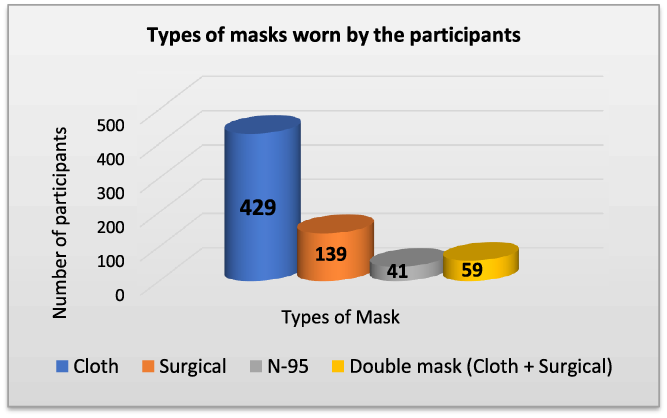
Social distancing at each site before the session was observed, and it was found to be inadequate at 16 (39%) of the sites (Figure 1). Overall, compliance for wearing a face mask was good. All the observed individuals were wearing masks. However, 84 (12.57%) of those observed were wearing their mask incorrectly before and during the session (Figure 2; Table 1).
Distribution of study sites according to social distancing adequacy before sessions (n = 41).

Distribution of study participants according to type of mask worn (n = 688).

Distribution of observed subjects according to mask wearing practices, type of mask worn, and COVID-19 vaccination

Among the 668 subjects observed, 429 (64.22%) wore cloth mask, 139 (20.81%) wore a surgical mask, 41 (6.40%) wore a N-95 mask, while only 59 (8.83%) chose to double mask themselves with a cloth mask and a surgical mask. When asked about COVID-19 vaccination, the majority of the respondents, 599 (89.67%) were not vaccinated yet. Only 69 (10.33%) reported to have received single or both doses of vaccine.
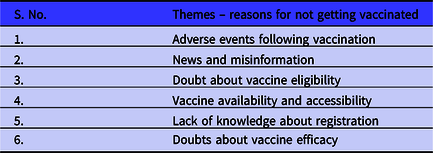
The responses of the audience to reasons for not getting vaccinated were many. They can be broadly grouped into specific themes as listed in Table 2.
Themes - responses regarding reasons for not getting vaccinated

Theme 1 – Adverse events following vaccination: There was fear regarding side effects of the vaccine, ranging from fear of disruption of daily routine and lifestyle, to fear of long-term effects on life. Responses included “I am here to take care of my child admitted in the hospital. What if I take the vaccine and suffer from side effects and get ill? Who will take care of my child then?”, “I consider the vaccine to be dangerous, it will cause illness rather than protect.”, “I haven’t taken the vaccine because I am scared of the unknown nature of the side effects.”
Theme 2 – News and misinformation: Some of the common reasons for not getting vaccinated included “I saw on the news that people including doctors had died after getting vaccinated. There is no point in getting vaccinated then.”, “My friend got the disease even after getting vaccinated, so he told me it’s of no use.”, “I read somewhere about people getting the disease after vaccination and getting admitted in the hospital.”, “My relative is a doctor, he got vaccinated, still he got the disease. It is not of use.”
Theme 3 – Doubt about vaccine eligibility: It was observed that many of the responses to reason for not getting vaccinated involved a lack of knowledge and understanding about whether they were eligible to take the vaccine. Responses included “I have had fever for quite a long time. I don’t think I should take the vaccine.”, “I am taking many medicines already, and I am not sure I can take the vaccine.”, “What if someone is already suffering from a serious disease? Can they take the vaccine?”, “My father has been COVID-19 positive and recovered 2 weeks back. Is he eligible to take the vaccine?” Less people turn up for vaccination if they do not have a clear idea of whether they are eligible for the vaccine or not.
Theme 4 – Vaccine availability and accessibility: There were complaints of not getting slots for vaccination for the 18-44 y age group, despite having made the attempt to register for the process. Responses included “I have tried to register for me and my family but I have not gotten slots for the past 2 weeks in spite of repeated attempts.”, “I got a slot for vaccination but it was so far away and not possible to travel to the site because of the lockdown, so I missed it.”, “I heard that the vaccine stocks are not available in the city, therefore, I have not attempted to register for it.”
Theme 5 – Lack of knowledge about registration: Many of the responses revealed that the audience were not comfortable with the process of online registration or lacked basic information about it. The technological barrier is still a major hurdle among much of the population. “I have been unable to use the COWIN app yet; I will have to tellx my son to help me.”, “I don’t know how to get myself registered to get the vaccine.”, “I want to take the vaccine as soon as possible, but I don’t know where to register myself.”, I don’t have a mobile phone myself.” were some of the responses for the reason of not getting vaccinated.
Theme 6 – Doubts about vaccine efficacy: The effectiveness of the vaccine in protecting from disease was also doubted by many, citing it as the reason for not getting vaccinated. “I don’t want to take the vaccine, I believe it will not be effective and cause more harm than good.”, “I don’t feel there is need for the vaccine. It does not work, and I will be fine anyway.”, “I don’t think the vaccine works.”, and “It is just a publicity attempt to make money for the corporations.” were some responses recorded from the audience.
Discussion
From the very beginning, the WHO has recommended prevention of disease and reduction of transmission through ensuring personal hygiene, social distancing, and later, vaccination as effective measures against COVID-19 disease. 7–Reference Manikandan9 Despite Information, Education, and Communication (IEC) efforts from the Government of India, compliance to COVID appropriate behavior is low and hesitancy for vaccination is being reported among the general population. Reference Sharun, Faslu Rahman and Haritha10–Reference Zhou, Gao and Wang12 Our study found 100% use of mask among participants compared with values ranging between 73% and 82% found in other studies in India. Reference Supehia, Singh and Sharma13,Reference Dkhar, Quansar and Saleem14 The reason for such high compliance could be high monetary penalties for not complying with the advisory. Other reasons could be fear of COVID infection in the hospital setting and increasing COVID cases and deaths amid the second wave of the pandemic. Reference Richterman, Meyerowitz and Cevik15,Reference Christy, Kaur and Gurnani16
Among 668 subjects observed, 12.5% (84) participants wore mask incorrectly. Similar behavior patterns in a study from South India have been previously attributed to lack of awareness, education of the participants, and limited observation time of the study. Reference Christy, Kaur and Gurnani16
In our study, 64.22% (429) subject wore cloth masks, 20.81% (139) used surgical masks, 8.83% (59) were wearing double masks [surgical + cloth mask], while 6.40% (45) wore N95 masks. This is understandably different in our study population from the use patterns seen among health-care workers in India, with 60.2% wearing surgical masks, 12% wearing N-95 masks, and 7.8% wearing cloth masks. Reference Supehia, Singh and Sharma13 Despite N95 masks giving maximum protection against COVID-19 infection, this study revealed that cloth masks were predominantly worn by participants, followed by surgical masks and double masking. Widespread use of cloth masks could be because of low cost, reusability after washing, and approval from WHO and CDC. 17,Reference Chughtai, Seale and Macintyre18
Vaccination is being touted as the most important step for COVID-19 mitigation, and India is conducting the world’s largest vaccination drive. In this study, we observed a small percentage (10%) of subjects who reported to have received either single or both doses of vaccination, which was similar to the proportion of the population vaccinated in India at the time. The qualitative findings of our study are similar to findings from several studies on reasons for vaccine hesitancy in general. According to Miko et al. in Romania, themes identified included “perceived risks/benefits”; role of media, leaders, and lobbies; pharmaceutical industry; and attitude of health-care practitioners. Reference Miko, Costache and Colosi19 Reasons such as “I’m not anti-vaccine, I’m pro-safe vaccines.” “Vaccines are toxic!”, “You cannot prove vaccines are safe.”, and “Vaccines are unnatural.” have been identified in scientific research previously. Reference Kanozia and Arya20 Past risk perception research has shown that risks are weighted against benefits and the perceived benefit of vaccines has decreased because of their effectiveness and that the less control we feel over a certain risk, the more worried we are likely to be. People are also more worried about risks produced by entities they do not trust. Reference Kata21 Studies have suggested that more efforts made to communicate the scientific and medical consensus around vaccines tend to increase public support of vaccination. Reference Ropeik22 However, that scientific knowledge is not the sole skill identified for influencing vaccine-related behavior. One study found that health-care providers are not adequately equipped or trained to manage difficult conversations with reluctance. Reference Van der Linden, Clarke and Maibach23 Although the current pandemic throws up a special situation, it must be noted that the reasons for vaccine hesitancy have some common roots.
According to a study conducted by Dkhar et al. Reference Dkhar, Quansar and Saleem14 regarding COVID-19 vaccine acceptance among the general population in India, prevailing observations regarding the vaccine included “I am concerned about the vaccine’s side effects.”, “I don’t believe the vaccine will stop the infection.”, and “I don’t need the vaccine because I am young, healthy, and immune.” A large proportion of the population were unsure about safety (36.5%) and efficacy (45%) of the vaccine. According to the same study, confidence about the vaccine would increase if doctors recommended it, more studies proved vaccine efficacy and safety, and if it was made compulsory by the Government of India. Reference Sharun, Faslu Rahman and Haritha10 In a multicentric study conducted in India by Christy et al. on knowledge, attitude, and practices regarding COVID-19, it was found that illiterate individuals had poor knowledge, attitude, and practice patterns that could be due to the limited use of social media for awareness and poor understanding of written sources such as the newspaper. Reference Christy, Kaur and Gurnani16 In the qualitative study conducted by Kumari et al. in India, major themes identified contributing to negative views toward the vaccine include mistrust in safety and efficacy of the vaccine, lack of awareness about vaccines launched, rumors and misinformation, and casual attitudes toward the vaccine and other COVID precautions. Reference Kumari, Ranjan and Chopra24 As seen from our study as well, many people followed social media closely for advice and updates on how to deal with the situation, often unable to get access to a doctor’s advice. There was heavy influence of the news media as well, with information from television channels leading to people forming opinions. With the recent situation of vaccine availability in our country, many were unsure about whether they would get the vaccines even if they registered. Better and clearer communication of verified information by means of audio and visual means is required to address misinformation and remove doubts about vaccine efficacy, safety, as well as provide clarity on vaccine availability and registration process.
Limitations
The study had several limitations. The data were collected only at the tertiary care hospital, with participants mostly being those who are patients or taking care of patients. Awareness and behaviors regarding COVID are likely to be better in this environment. This limits the generalizability of the study findings for which a community-based survey is needed. Another limitation is it was conducted over a short period of time, so the responses may vary over time.
At the same time, the study also benefited from certain factors. The components of COVID appropriate behavior have been assessed by observation. Other methods to study the behavior using interviewer administered or self-administered questionnaire can have questionable reliability of reporting of inappropriate behavior. The study was done during the second wave of COVID-19 infection, and the regulations regarding obligatory mask use in public space were in practice. There was little chance of the behavior of the participants being altered. The type of mask used and correct mask use could be determined well with the method used. The study also gauged the responses of the general population in the hospital premises, on questions related to vaccination at a time the country was conducting the vaccination drive for all above the age of 45 y, compared with most of the other studies in India, which assessed the situation at a time when the vaccine was still in the final days of development or had just been launched.
With the evolution of the pandemic, further studies are needed to identify the reasons for lack of compliance and vaccine hesitancy and to pinpoint the focus areas that need to be targeted in future awareness programs. As was the purpose of the campaign, it is important to continue stressing on maintaining COVID appropriate behavior, including wearing masks, social distancing, etc. Although mask use was universal which is important that the imposition of penalties has resulted in compliance, directions on correct methods of wearing the mask need to be widely circulated. Credible information about the vaccination process and its safety and efficacy need to be continuously communicated to the general population to improve trust and confidence in the vaccination program.
Conflict(s) of interest
None.