International Investment Agreements (IIAs)Footnote 1 are treaties signed at the bilateral, regional, or multilateral level by two or more countries to protect investments made by one country's investors in the other country.Footnote 2 Close to three thousand such IIAs exist to date.Footnote 3 IIAs protect foreign investments by imposing limitations on the regulatory behaviour of the host state. Typically, an IIA contains provisions on expropriation, fair and equitable treatment (FET), national treatment and most favoured nation, monetary transfer provisions, and, most importantly, gives investors the right to bring cases against host states at international arbitration (investment treaty arbitration—ITA).Footnote 4 Once successful in ITA, the investor is awarded damages to be paid by the host country. From 1989 to 2009, 357 known investor-state IIA cases have been reported, out of which fifty-seven percent have come up since 2005.Footnote 5 The disputes that have emerged between foreign investors and host state's regulatory power cover a very wide array of regulatory measures, such as environmental policy,Footnote 6 sovereign decisions regarding privatization,Footnote 7 urban policy,Footnote 8 monetary policy,Footnote 9 taxation,Footnote 10 and many others.Footnote 11 This is not to suggest that in each of these disputes the host state's regulatory measure was found illegal. In fact, limited empirical work done in this area (based on fifty-two decided cases), shows that in twenty cases foreign investors were awarded damages whereas in thirty cases host countries paid nothing to foreign investors.Footnote 12
Nevertheless, adjudication of such a wide range of sovereign regulatory measures by ITA tribunals, sometimes in unexpected and undesired ways,Footnote 13 coupled with other factors like inconsistent legal conclusions and poor reasoning of arbitral tribunalsFootnote 14 and the award of substantive damages to foreign investors,Footnote 15 have generated an intense debate on compromise of regulatory power of the host state to adopt measures for pursuing non-investment objectives due to their IIA obligations in both the developing and the developed world. For example, South Africa is reviewing its entire IIA programme,Footnote 16 Bolivia and Ecuador have given up their membership of the International Centre for the Settlement of Investment Disputes (ICSID),Footnote 17 Ecuador terminated nine IIAs in 2008,Footnote 18 the Russian Federation decided to terminate the provisional application of the Energy Charter Treaty in July 2009,Footnote 19 and the United States and Canada have adopted new model IIAs.Footnote 20
There are various aspects to this debate,Footnote 21 such as whether IIAs result in a regulatory chill in the host state,Footnote 22 if the conflict between regulation and investment protection is a result of the textual indeterminacy of IIAsFootnote 23 or a result of the nature and character of ITAFootnote 24 (which includes expansive interpretation of IIA provisions to suit foreign investors),Footnote 25 and whether IIAs are aimed at pursuing neoliberal policies at the cost of the regulatory power of developing countries.Footnote 26
An important textual feature of IIAs related to the preservation of host country's regulatory power that has surfaced in all Argentine disputes under the US-Argentina IIA is the Non-Precluded Measures (NPM) provision.Footnote 27 NPM provisions in an IIA (starting with words like “nothing in this agreement precludes”) provide the regulatory latitude to host countries to deal with threats to important national interests.Footnote 28 NPM provisions in IIAs provide flexibility to countries to deviate from the substantive obligations in certain circumstances that warrant giving preference to non-investment policy goals over investment protection. Thus, given the larger debate on conflict between investment protection and the host country's regulatory power, NPM provisions in IIAs are a useful tool because they allow the host country to adopt measures for the pursuance of non-investment objectives without incurring any liability under international law. A measure falling under the NPM provision will be legal, notwithstanding its inconsistency with all other IIA provisions.Footnote 29 NPM provisions are important in maintaining a balance between investment protection and the regulatory power of the host states, much like Article XX of the General Agreement on Tariffs and Trade (GATT) (the general exceptions clause), which is a key provision to balance free trade with non-trade policies.Footnote 30 It has also been argued that NPM provisions in IIAs perform a risk allocation function by transferring the costs of harming an investment from host states to investors in exceptional circumstances.Footnote 31 NPM provisions can also be called other names, like a general exception clause.
NPM provisions in IIAs were put to a test when a spate of arbitration cases were brought against Argentina for adopting measures aimed at addressing an economic crisis in early 2000.Footnote 32 For example, US investors claimed that the regulatory measures adopted by Argentina violated many provisions of the US-Argentina IIA; whereas Argentina relied on the NPM provision given in Article XI of the IIA as a defence for these claims.Footnote 33 Article XI provides:
This treaty shall not preclude the application by either party of measures necessary for the maintenance of public order, the fulfillment of its obligations with respect to the maintenance or restoration of international peace or security, or the protection of its own essential security interests.Footnote 34
Although in all these cases it was the same NPM provision that had to be interpreted, the tribunals gave divergent rulings. The CMS, Sempra, and Enron tribunals interpreted the NPM provision by reading the customary law necessity defence given in Article 25 of the International Law Commission (ILC) Articles [Article 25]Footnote 35 into the treaty defence (NPM). Article 25 is an extremely stringent exception to escape liability from an international wrongful act. Its strict character is confirmed by the commentary on the ILC Draft Articles.Footnote 36 On the other hand, the LG&E and Continental tribunals and the CMS and Sempra annulment committees distinguished between the NPM in the US-Argentina IIA and the Article 25 defence. All these cases, besides the debate on investment protection and regulatory power, have also generated the debate not just on the interpretative methodology followed by these tribunals to interpret the NPM provisionFootnote 37 but also on the interpretation and significance of the NPM provision in IIAs to protect the host country's regulatory power.Footnote 38
In the light of this, and given the global debate on investment protection and host country's regulatory power, the purpose of this article is to assess whether India can rely on NPM provisions in its IIAs to safeguard its regulatory power or not. In order to achieve this purpose, the article will interpret the NPM provisions to find plausible interpretations and will then assess the effect of these interpretations on the “regulatory power” of India.
It is important to mention that one cannot have a per se rule for interpreting NPM provisions occurring in different IIAs.Footnote 39 The actual interpretation of an NPM provision, in a specific IIA, will depend on the application of treaty interpretation rules given in Articles 31 and 32 of the Vienna Convention on Law of Treaties (VCLT).Footnote 40 Thus, one will have to interpret the treaty in good faith by giving ordinary meaning to the words used in their context and in the light of the object and purpose. The context will have to be determined by examining the text, preamble, annexes, and other factors like any subsequent agreement between the parties on the interpretation of the treaty. Other important factors include any subsequent practice in the application of the treaty that establishes the agreement of the parties on its interpretation.Footnote 41 The role of Article 31(3)(c) of the VCLT, which states that any relevant rule of international law applicable in the relations between the parties shall also be taken into account, is also important in this regard.Footnote 42
This article will use these treaty interpretation tools to interpret the NPM provisions in Indian IIAs. Although India is not party to VCLT,Footnote 43 it can still be used to interpret Indian IIAs in the light of the fact that treaty interpretation rules are widely recognized as customary international law.Footnote 44 The process of interpreting the NPM provisions using the VCLT treaty interpretation tools will be guided by the case-law developments in international investment arbitration.Footnote 45 This treaty interpretation will adequately reflect upon the differences in treaty language of NPM provisions in different Indian IIAs. The differences in treaty language are important as they will have different implications on regulatory power. The analytical template used in this article to analyse the NPM provisions in Indian IIAs is the same as the one used by Burke-White and von Staden.Footnote 46
The rest of the article is divided into six sections. Section I introduces the Indian IIA programme and discusses Foreign Direct Investment (FDI) inflows to India and some fact-situations of conflicts between investment protection and India's regulatory power. Section II discusses the anatomy of NPM provisions in Indian IIAs. Section III discusses the permissible objectives (non-investment objectives given in the NPM provision for which India can deviate from IIA obligations) found in all the NPM provisions in Indian IIAs. Permissible objectives provide the “heads” under which India can adopt different policy needs. Thus, the article will first discuss the strength of the existing “heads” under the NPM provision for the different policy needs of India. Once this determination has been made, the article will then turn to study the nexus requirement in Section IV. The nexus requirement is the link between the regulatory measure adopted and the non-investment objective that is sought through that measure. The discussion on nexus requirement will examine the regulatory latitude that India has under the existing NPM provisions to adopt measures for different policy needs. Section V discusses the conditions that have to be satisfied while invoking NPM provisions in Indian IIAs. Finally, Section VI gives the conclusion, emphasizing that India should reformulate its NPM provisions in its IIAs for better exercise of its regulatory power.
I. Foreign Investment in India and the Indian IIA Programme
A. Number of IIAs and FDI Flows
India started its IIA programme in the early 1990s as part of its overall economic liberalization programme. Since 1994, India has signed IIAs with seventy-eight countries,Footnote 47 out of which sixty-nine are already in force and nine are yet to be enforced or ratified.Footnote 48 Further, in the last few years, India has entered into Comprehensive Economic Cooperation Agreements (CECAs) containing a chapter on investment with KoreaFootnote 49 and Singapore. CECAs are comprehensive economic agreements covering trade liberalization (goods and services), investment protection and liberalization, competition policy, trade facilitation, rules of origin, and intellectual property rights. The investment chapters in these CECAs, along with provisions on investment protection, also contain market access provisions (such as national treatment to establishment) which do not exist in any of the existing stand-alone Indian IIAs.
India has also entered into CECA with Malaysia,Footnote 50 and has completed negotiations with Japan.Footnote 51 Apart from this, India is negotiating CECAs with Indonesia, Mauritius, and New Zealand,Footnote 52 is negotiating an IIA with CanadaFootnote 53 and the US,Footnote 54 and a Free Trade Agreement (FTA) with a chapter on investment with the EU.Footnote 55 The primary policy objective behind India entering into IIAs is to protect foreign investment, on the assumption that increased protection will result in more investment flows.Footnote 56
It is true that the last two decades (coinciding with the India's gigantic IIA programme) have seen an increase in FDI flows to India. FDI flows to India rose from US$393 million in 1992–93 to US$55.5 billion in 2005–06.Footnote 57 After 2005–06, FDI inflows to India showed a remarkable jump. The FDI equity inflows for the period 2006–07 and 2007–08 stood at US$ 15.7 billionFootnote 58 and US$24.6 billionFootnote 59 respectively—an increase of almost three and five times respectively from 2005–06. FDI inflows continued their upward movement in the year 2008–09 stood at US $2,7309 million.Footnote 60 In 2009–10,Footnote 61 these inflows came down only marginally to US$25.9 billion.Footnote 62 Notwithstanding these substantive FDI flows, there is no evidence to show what role IIAs have played in these FDI inflows. The reason for the lack of evidence is lack of research on this issue.Footnote 63 In the absence of any such evidence, the assumption of the Indian government that IIAs result in increased foreign investment is challengeable.
Despite this lack of evidence, the number of IIAs signed since 1994 makes it clear that India is vigorously pursuing its IIA programme with an average of almost four to five IIAs signed each year. This article has studied fifty-seven Indian IIAs, including the Indian model IIA ratified by India from the period of 1994 to early 2009. These fifty-seven Indian IIAs include IIAs with developed countries such as the UK, Germany, France, Switzerland, and Australia; with developing countries in the Asian region such as China, Thailand, Korea, Singapore, Indonesia, and Israel; and with Latin American countries such as Argentina and Mexico. A collective examination of the title, the preambles, and the text (as a whole) of these fifty-seven Indian IIAs shows that a large majority of them emphasize investment protection by limiting the title of the IIAs to investment protection and promotion; containing investment promotion and protection as primary objectives in the preamble; providing treaty protection to every asset owned or controlled by the foreign investor irrespective of duration, risk, or economic benefits; having a broad formulation of the strong substantive provisions like national treatment (without having the “like circumstances” clause in the majority of them), fair and equitable treatment (without defining the content in the majority of IIAs), unabated right to transfer funds related to investment (with no or limited deviations), and guarantees against expropriation (without any indication as to how to distinguish between legitimate regulation and expropriation in the majority of IIAs); and having narrowly defined treaty exceptions. In other words, the object and purpose of a large majority of Indian IIAs is investment protection.Footnote 64 The preamble and the substantive provisions in only a handful of Indian IIAs (such as the India-Korea and India-Singapore IIAs) contain provisions aimed at preserving the host state's regulatory power along with investment protection.Footnote 65 It has been argued that determination of object and purpose may be deceptive because commonly IIAs contain preambular statements that their purpose is investment protection.Footnote 66 One concedes that object and purpose should not be reached solely on the basis of the preamble, and thus, for these fifty-seven IIAs, the author has studied the title and, more importantly, read the treaty provisions as a whole, of each treaty to gauge a fuller indication of the object and purpose of Indian IIAs.Footnote 67
B. Conflicts Between Investment Protection and Regulation
The figures on FDI inflows show that the Indian economy is fast integrating with the global economy, which in turn is increasing the interactions between the Indian state and foreign investors. This is capable of creating situations of conflict between investment protection and regulation. Discussed below are five situations of conflict between investment protection and India's regulatory power. The first one gave rise to an IIA claim; the second one depicts an ongoing IIA dispute between India and an Australian investor; and while the other examples have not yet taken the form of an IIA dispute, they are important to show that regulatory conflicts can arise while regulating foreign investment.
1. The Dabhol power project case
This relates to an FDI project related to building an electrical power plant in India in the early 1990s soon after the adoption of the liberalization programme by India in 1991. Enron Corporation along with General Electric (GE) Corporation and Bechtel Enterprises formed a company called Dabhol Power Company (DPC) in Maharashtra (a western Indian state) to generate electrical power. This formed the biggest FDI investment at that time in India. DPC entered into an agreement with the Maharashtra State Electricity Board (MSEB), a public sector enterprise, as the sole purchaser of the power generated by DPC. Subsequently, due to political opposition to the project on grounds of alleged irregularities and the high cost of power charged by DPC, MSEB cancelled the contract to purchase power, leaving DPC without a consumer to sell electrical power to and thus having a huge adverse impact on DPC's business.Footnote 68 Further, the central government of India, which acted as a counter guarantor, after making some payments, also declined to pay DPC for different reasons.Footnote 69 DPC was restrained from starting international arbitration by anti-arbitration injunctions issued by Indian courts.Footnote 70 The Mauritius-based subsidiaries of GE and Bechtel, relying on the India-Mauritius Bilateral Investment Treaty (BIT), challenged India's regulatory decisions, including sovereign functions such as issuing anti-arbitration injunctions by courts as a violation of the BIT provisions such as expropriation. However, before an ITA award could be issued, a mutual settlement was reachedFootnote 71 whereby a mammoth compensation (allegedly about US$1 billion)Footnote 72 was awarded to foreign investors by India. The significance of this case is in illustrating how India's exercise of regulatory powers (which includes the Indian judiciary) has the potential to violate the broad IIA provisions.
2. The Australian mining company IIA dispute
India is currently involved in an IIA dispute brought by an Australian mining company under the India-Australia IIA.Footnote 73 While the details of this dispute are not publicly available, it stems from the readiness of Indian courts to consider setting aside an earlier commercial arbitration ruling.Footnote 74 The IIA arbitration is being conducted under the United Nations Commission on International Trade Law (UNCITRAL) rules.Footnote 75
3. The Vodafone B.V. tax dispute
This relates to the case involving the imposition of capital gains tax on a US$11.2 billion transaction where Vodafone B.V. International (Vodafone's Netherlands entity) in December 2006 entered into an agreement with Hutchison Telecommunications International Ltd (HTIL—a Cayman Island company) to buy HTIL's share of a sixty-seven percent interest in an Indian company, Hutchison Essar Ltd (HEL).Footnote 76 Vodafone B.V. contended that the transactions did not involve a capital asset situated in India and hence no capital gains tax was payable, whereas the Indian tax authorities contended otherwise. The Bombay High Court decided the case against Vodafone B.V. in 2010.Footnote 77 Nevertheless, an appeal has been filed against the judgment in the Supreme Court of India. The ruling is pending.Footnote 78
4. The Posco's steel FDI project
This relates to the biggest FDI project to date in India, made by South Korean steel giant Posco in Orissa, a state in eastern India. The Orissa government recommended that a licence to mine iron ore be granted to Posco. However, this was challenged by another company in the Orissa High Court, which held that the Orissa government's decision to recommend that a licence be granted to Posco was illegal.Footnote 79 The Orissa government has filed an appeal against the High Court's decision in the Supreme Court of India, which is pending.Footnote 80
5. The Cairn-Vedanta deal
Cairn Energy, a UK company, struck a deal with London-based Vedanta resources to sell a majority stake in its Indian unit (Cairn India) in August 2010. However, this deal required the approval of the Indian government as per Cairn's existing contractual obligations. In June 2011, the Indian government gave conditional approval of the deal.Footnote 81 The conditions imposed by the Indian government are making royalty paid as costs recoverable from oil sales and asking Cairn to withdraw the cess arbitration it has initiated.Footnote 82 India's Ministry of External Affairs (MEA) circulated a note cautioning the government that imposing such conditions on the Cairn-Vedanta deal would violate the India-UK IIA.Footnote 83
C. Lack of Research on Indian IIAs
Notwithstanding the large number of Indian IIAs, increasing FDI inflows, and cases of conflict between investment protection and India's regulation, apart from few articlesFootnote 84 not much work has been done to analyse and understand Indian IIAs. As a result of this, and coupled with a lack of arbitral jurisprudence on Indian IIAs, the implications of the provisions of Indian IIAs on regulatory power remain unknown. This article aims to fill this gap by analysing an important feature of Indian IIAs—the NPM provision.
II. Anatomy of NPM provisions in Indian IIAS
All the fifty-seven IIAs studied for this article contain an NPM provision. However, the NPM provisions are differently formulated. On the basis of varying textual formulation, the NPM provisions can be divided into three groups: the “model-NPM”, “modified-model-NPM”, and “Article-XX” types (see Table 1).
Different formulation of NPM provisions in Indian IIAs

source: Author's study of fifty-seven Indian IIAs contained in the Compendium of the Ministry of Finance, Government of India, published from 1995 to 2009 (on file with author).
A. The “Model-NPM” Type
Twenty-three Indian IIAs have exactly the same formulation as contained in the Indian model IIA and hence this group is called the “model-NPM” type. The Indian model IIA states in Article 12(2):
Notwithstanding paragraph (1) of this Article nothing in this Agreement precludes the host Contracting Party from taking action for the protection of its essential security interests or in circumstances of extreme emergency in accordance with its laws normally and reasonably applied on a non discriminatory basis.Footnote 85
Article 12(2) starts with a non-obstante clause making it clear that, in spite of whatever is stated in Article 12(1),Footnote 86 nothing in this agreement prevents the host contracting party from taking measures to fulfil the listed permissible objectives subject to specified conditions. The words “nothing in this Agreement precludes” gives the non-precluded character to this provision.
B. The “Modified-Model-NPM” Type
Thirty-two IIAs have NPM provisions that can be described as “modified-model-NPM” type, because these provisions, though different, do not vary much from the “model-NPM” type provisions. The difference is mainly in the form of either having more number of permissible objectives or having “necessary” as the nexus requirement. For example, Article 11(2) of the India-Qatar IIA states:
[N]othing in this Agreement precluded the host contracting party from taking action for the protection of its essential security interests or public order or morality affecting public order or in circumstances of extreme emergency in accordance with its laws normally and reasonably applied on a non discriminatory basis.Footnote 87
C. The “Article-XX” Type
NPM provisions in two IIAs can be described as “Article-XX” type (India-Korea and India-Singapore) because of their being very close to the general exceptions provision given in Article XX of GATT.Footnote 88 This type of NPM provision is different from the “model-NPM” type and “modified-model-NPM” type. In fact, it is interesting to note that both these IIAs also contain GATT Article XXIFootnote 89 type security exceptions.
D. Common Points in NPM Provisions in Indian IIAs
There is no one trend or pattern that can be discerned about the NPM provisions in Indian IIAs. For example, one can find NPM provisions belonging to all three categories signed almost at the same time. For instance, the NPM provision in the India-China IIA entered in 2006 is of “model-NPM” type, the NPM provision in the India-Saudi Arabia IIA entered in 2006 is of “modified-model-NPM” type, and the NPM provision in the India-Singapore IIA entered in 2005 is of “Article-XX” type. Further, the same “model-NPM” type provision exists in an IIA with a developed country such as the UK and also with developing countries such as Mongolia and Indonesia.
The study of the NPM provisions in these fifty-seven IIAs reveals the following important points about the structure and formulation of the NPM provisions.
First, the NPM provision starts with the words “nothing in this agreement precludes the host contracting party from taking action for”. Thus, India can move away from any IIA obligation in order to achieve certain objectives. In the majority of Indian IIAs, these objectives are protection of “essential security interest” (ESI) or in “circumstances of extreme emergency” (CEE).Footnote 90 This means that India is prevented from taking action for any other objective that is not ESI or a CEE relying on the NPM provision.
Second, the majority of NPM provisions in Indian IIAs do not contain “necessary” as a nexus requirement. The absence of “necessary” as the nexus requirement means that a thin level of nexus is required between the measure taken and the objective sought through that measure.
Third, it is important to note the immediate context in which the NPM provisions in Indian IIAs occur, such as the title of the provision containing the NPM provision.Footnote 91 NPM provisions in forty-six IIAs, out of fifty-seven, do not occur under headings such as “Exceptions” or “Non-Conforming Measures or Non-Precluded Measures”, which one would expect, given their basic character of being an exception to the treaty. In the India-Russia IIA, the NPM provisionFootnote 92 is part of a provision titled “Promotion and Mutual Protection of Investment”. In only eleven IIAs, NPM provisions are under titles such as “Exceptions”Footnote 93 or “Prohibitions and Restrictions”.Footnote 94
Given the divergent nature of NPM provisions in Indian IIAs, this article will find out how broad or narrow these NPM provisions are. A broad NPM provision (such as one that has more non-investment objectives) will offer greater scope for India to exercise its regulatory power, as compared to a narrow one.
This article, next, will closely study the variations in NPM provisions under Indian IIAs by focusing on permissible objectives (Section III), nexus requirement (Section IV), and conditions imposed on the adoption of NPMs (Section V).
III. Permissible Objectives
Permissible objectives mean those non-investment objectives that are listed in NPM provisions and for which the host country can deviate from IIA obligations. For example, the NPM provision (Article XI) in the US-Argentina IIA has three permissible objectives: (1) maintenance of public order, (2) maintenance or restoration of international peace or security, and (3) protection of its own essential security interests. It is important to note the preliminary point that the host country can deviate from its substantive obligations in the IIA, relying on an NPM provision, only for those non-investment objectives that are listed in the NPM provision.
Permissible objectives in NPM provisions can be divided into two categories: “security-” and “non-security-” related permissible objectives. Security-related permissible objectives include objectives such as protection from “armed conflicts” or “war”. Non-security-related permissible objectives include adopting measures for public health, the environment, and the like. The “model-NPM” provisions contain only ESI and CEE as the two permissible objectives. NPM provisions that are the “modified-model-NPM” type contain more permissible objectives as compared to the “model-NPM” types. The most comprehensive list of permissible objectives is contained in the NPM provisions belonging to the “Article-XX” type that contains both “security-” and “non-security”-related permissible objectives. Overall, as can be seen from Table 2, NPM provisions in Indian IIAs contain fewer permissible objectives.
Different permissible objectives occurring in NPM provisions in Indian IIAs

source: Author's survey of the fifty-seven Indian IIAs contained in the Compendium of the Ministry of Finance, Government of India, published from 1995 to 2009 (on file with author).
The discussion below will focus on different permissible objectives found in NPM provisions in Indian IIAs, starting with ESI for two reasons. First, ESI is the most common permissible objective present in forty-eight out of the fifty-seven IIAs studied, and second, since Indian IIAs contain fewer permissible objectives, ESI assumes further importance as a permissible objective that can potentially be used both for “security” and “non-security” concerns.
A. Essential Security Interest
The discussion on ESI in Indian NPM provisions is divided into two heads: (1) those Indian IIAs that do not contain “self-judging” language and do not have a list of activities related to ESI and (2) those that have self-judging language and contain a list of activities related to ESI.
1. Interpretation of ESI in NPM provisions without self-judging language
Out of the forty-eight IIAs that contain ESI as a permissible objective, forty-six of them do not contain a self-judging NPM provision. In other words, there is nothing in these forty-six IIAs to show that India can unilaterally decide what constitutes ESI or unilaterally decide on the measures adopted to achieve ESI (discussed in Section IV on nexus requirement). Thus, India's determination of ESI in these forty-six IIAs can be reviewed by an arbitral body.
To use ESI as a “ground” to deviate from IIA obligations, India will have to show that the “security interests” are “essential”. The ordinary meaning of the word “essential” is “vitally important”. Thus, to invoke ESI as a ground to deviate from IIA obligations, India will have to show that the “security interests” are most important and not ordinary. In other words, all security interests will not fall under ESI but only those that reach the threshold of “most important”. Had the intention of the parties been that countries are allowed to deviate for all “security interests”, they would not have prefixed it with the word “essential”.Footnote 95
However, “essential” “security interests” in these forty-six Indian IIAs does not mean only those circumstances where the very existence and independence of India is compromised, as was held by the Enron and Sempra tribunals while interpreting ESI in the NPM provision in US-Argentina IIA.Footnote 96 Such situations are undoubtedly “essential” “security interests” and thus shall fall under ESI. However, the ordinary meaning of the word “essential” ESI is not limited only to such situations. The fact that India can invoke ESI only when the most important “security interests” are involved means that ESI also covers those situations which are “severe” even if this “severe” situation has not become “most severe” and thus not reached the highest threshold of “compromising the existence and independence of the state”.Footnote 97 India need not wait for the situation to reach this highest threshold before taking measures to protect it, because acting at such a late stage will imply that nothing will be left to protect.Footnote 98
The next important issue is whether ESI in these forty-six IIAs cover only pure “security- related” interests, such as safeguarding the country from “war” or “external aggression”, or whether they also cover health, environmental, and economic interests provided these interests fulfil the threshold of being an “essential” interest.
It has been argued that ESI, unlike “war” and “armed conflicts”, is a broad category and could be interpreted to include non-military emergencies such as economic emergencies as well.Footnote 99 Similarly, according to the Continental tribunal, ESI must be interpreted broadly and thus a severe economic crisis will qualify as an ESI.Footnote 100 The International Court of Justice (ICJ) has also interpreted provisions similar to ESI, occurring in the Friendship Commerce and Navigation (FCN) treaties between the US and Nicaragua, by stating that “the concept of essential security interests certainly extends beyond the concept of an armed attack, and has been subject to very broad interpretations in the past”.Footnote 101
On the other hand, it has been argued that from a plain meaning of ESI one cannot conclude that it includes economic emergencies because ESI primarily relates to military and strategic considerations.Footnote 102 In the context of Article XI of the US-Argentina IIA it has been argued that “security” normally refers to defence and military matters.Footnote 103
In the light of these two different viewpoints on the meaning of ESI, and since Indian IIAs do not define ESI, the discussion below will show that ESI in Indian IIAs can be interpreted in two different ways: narrowly and broadly.
(a) Narrow interpretation: In order to find out which “security interests” will fall under the purview of ESI in Indian IIAs, one can have recourse to an important tool given in Article 31(3)(c) of the VCLT, which states that any international rule applicable in the relations between the countries shall also be taken into account in interpreting the treaty. Thus, for more than thirty Indian IIAs, where India's treaty partner is also a World Trade Organization (WTO) member, one can have recourse to Article XXI(b) of GATT that gives activities related to ESI. Article XXI(b) of GATT refers to those situations of security concerns, which are essentially military type situations. It does not talk of feeling secure from any economic or financial or health crisis. Further, Article XXI(b) can be invoked only for grounds given under itFootnote 104 and not for any other ground.Footnote 105 Thus, one can argue that, in the absence of a definition of ESI in these thirty Indian IIAs, the meaning of ESI can be gathered from the list of activities related to ESI given in Article XXI(b) of GATT. In other words, ESI in these IIAs will be limited to narrow “security” interests limited to military type threats. A narrow interpretation of ESI, on these lines, can also be supported in the light of the object and purpose of the majority of Indian IIAs being investment protection, and thus exception from investment protection should be narrowly construed.Footnote 106
(b) Broad interpretation: A broad interpretation of ESI implies an interpretation where “state of being or feeling secure” includes both security from external threat or war and security from non-military threats. It can be argued that ESI in these forty-six Indian IIAs cannot be limited to the list of activities given in Article XXI of GATT because in all these IIAs, ESI is open-ended. ESI has been kept open-ended because, unlike in the India-Singapore and India-Korea IIAs, in no other Indian IIA has a distinction been made between “security” and “non-security” permissible objectives. Thus, ESI is intended to cover both “security” and “non-security” policy objectives. Had the parties intended to limit the meaning of ESI only to “security” objectives, they would have expressly done that. Furthermore, there is a key distinction between Article XXI of GATT and the NPM provisions in these forty-six Indian IIAs—the former is self-judging whereas the latter are not.Footnote 107 In other words, the context (an integral part of treaty interpretation under Article 31 of VCLT) of the NPM provisions in Indian IIAs is different from the context of Article XXI of GATT. Thus, ESI in NPM provisions in Indian IIAs has a different meaning from ESI in GATT Article XXI.
(c) Limitations of ESI as a permissible objective: The critical outcome of the above discussion is that a narrow interpretation of ESI will certainly restrict India's regulatory power. Even if a broader interpretation is adopted, which goes beyond a pure military threat approach, due to the presence of the word “essential”, it will include only those situations that are of a high threshold or situations of gravity which can be described as a serious threat to India's security interest. Burke-White and von Staden, in their 2010 article, have argued that giving adequate margin of appreciation to countries in public law matters like dealing with an “essential” “security interest” will allow regulatory latitude to countries to use NPM provisions for their national needs.Footnote 108 A deferential standard of review within the treaty interpretative framework will certainly help India in situations such as a grave economic crisis engulfing the entire country to decide when an economic crisis does reach the threshold of an “essential” “security interest” and hence serve India's regulatory power. However, it cannot be used to cover those policy needs that require adoption of measures that might affect the rights of foreign investors, such as adopting measures to boost domestic industry in situations of economic downturn (to be distinguished from situations of economic crisis) or adopting measures to boost industrial development in certain regions of the country. Such policy objectives, though important, will fail to satisfy the requirement of an “essential” “security interest” when ESI is interpreted using the VCLT rules of treaty interpretation as discussed above. In other words, in such situations, ESI will be inadequate as a permissible objective notwithstanding the deferential standard of review followed by an ITA tribunal.
2. Interpretation of ESI in NPM provisions containing self-judging language
There are two Indian IIAs—India-Korea and India-Singapore—which contain “self-judging” language in the NPM provision. Article 10(18)(2)(b) of the India-Korea IIAFootnote 109 and Article 6(12)(1)(b) of the India-Singapore IIA,Footnote 110 which are almost mirror images of GATT Article XXI(b), provide that nothing in the investment chapter shall be construed to prevent a party from taking any actions “which it considers” necessary for the protection of its ESI. This chapeau is then followed by a list of activities related to ESI.Footnote 111 The words—“which it considers”—in the respective provisions of these two IIAs imply that the host state will unilaterally determine the legality of measures taken to meet ESI. Thus, these words confer greater deference to the host state in determining which measure to adopt to achieve the desired permissible objectiveFootnote 112 (this issue will also be discussed later in the section on the necessity requirement).
The interesting question is whether the self-judging language also applies to identifying what is an ESI. This can be interpreted in two ways:
(a) First interpretation: Article 10(18)(2)(a) of the India-Korea IIA states that a country is not required to furnish any information, the disclosure of “which it considers” contrary to its ESI. In other words, this provision allows India to consider whether the disclosure of information is contrary to its ESI. India can decide on whether disclosing particular information will adversely affect its ESI only if it is allowed to decide, free of review, what this ESI is. Hence, if India can determine ESI under sub-clause (a), free of review, then India should be allowed to self-decide what constitutes an ESI under sub-clause (b) also. It will be unusual if India is allowed to determine its ESI under paragraph (a) but not under paragraph (b). The same argument applies for the India-Singapore IIA, which contains similar provisions.Footnote 113
(b) Second interpretation: Notwithstanding the above argument, there is a fundamental difference in sub-clause (a) and sub-clause (b). Sub-clause (a) does not provide a list of activities related to ESI, whereas in sub-clause (b), ESI is related to a list of activities and situations.Footnote 114 This list contains all military type threats or where the security of the state is endangered due to a war. Thus, arguably, in sub-clause (a), ESI has a broader scope as compared to sub-clause (b).
Further, in both Articles 10(18)(2)(b) of the India-Korea and 6(12)(1)(b) of the India-Singapore IIA, “which it considers” (the self-judging phrase) is placed between “taking any actions” and “necessary”.Footnote 115 Thus, India can only decide the necessary measures to be adopted for the protection of ESI. There is nothing in the provision to show that the host state also has to decide, on its own, what constitutes an ESI for the purpose of sub-clause (b).
On the basis of these arguments, one can argue that ESI can be self-determined in sub-clause (a) but not in sub-clause (b).
Thus different arguments can be made on whether the determination of ESI by the host state under sub-clause (b) is reviewable or not by the arbitral tribunal. What is certain is that determination of ESI under sub-clause (b) can only be for the activities or situations given under the clause and not for any activity that falls outside this clause.Footnote 116 In other words, even if India were to self determine ESI under sub-clause (b), that self-determination can only be for the list of activities given under sub-clause (b).
This is supported by the context (Article 31(1) of VCLT) in the India-Singapore and India-Korea IIAs. In the India-Singapore IIA, ESI, as a permissible objective, occurs under the heading “security exceptions” distinct from the “general exceptions” provision. The “general exceptions” provision covers other permissible objectives such as public health, public order, public morals, and conservation of exhaustible natural resources. Similarly, in the India-Korea IIA, although ESI falls under the generic heading “Exceptions”, Article 10(18)(3) states that Article 10(18) (2) (which gives ESI provision) shall be interpreted in accordance with the “understanding” of the parties on “Security Exceptions”.Footnote 117 Thus, Article 10(18)(3) provides that ESI, in the India-Korea IIA, has been conceived and adopted as “security exceptions”. Further, the India-Korea IIA, like the India-Singapore IIA, has provisions where NPMs can be adopted under categories such as “public health” and public order”.
It can be argued that countries intended to limit interpretation of ESI, in these IIAs, because of the presence of other permissible objectives in the “non-security” part of the NPM provision. Thus, in the case of a public health emergency, India does not need ESI and can rely on the “public health” permissible objective occurring in the “non-security” part of the NPM provision in both the IIAs.
(c) Non-justiciability: Both these IIAs provide that the “security exceptions” are non-justiciable. For instance, Annex 10-C of the India-Korea IIA provides that “any decision of the disputing Party taken on such security considerations shall be non-justiciable in that it shall not be open to any arbitral tribunal to review the merits of any such decision”.Footnote 118
This provision makes it amply clear that the arbitral tribunal cannot review the action of the host states related to the security considerations and this will include the determination of ESI. It has been argued that the purpose behind making security exceptions non-justiciable is to avoid uncertainties as to the application of the security-related measures.Footnote 119
Since these provisions are non-justiciable, India can self-determine both the ESI and the measure to be adopted to achieve this ESI. Thus the debate on whether ESI can be self-determined under both the sub-clauses (a) and (b) in these two IIAs is immaterial. However, even then, India can determine ESI in sub-clause (b) of both the IIAs only with regard to the list of activities provided and not with regard to those activities not given in sub-clause (b). Doing otherwise will be against the intent of the countries as reflected in the text.
It has been argued that this type of express non-justiciable language will push the invocation of the security exception completely outside the purview of arbitral review even with regard to whether it was made in good faith.Footnote 120 Complete preclusion might result in India abusing its regulatory power.
B. Circumstances of Extreme Emergency
Before discussing CEE, it is important to mention that, strictly speaking, CEE is not a permissible objective. CEE actually means circumstances that are of extreme emergency where India can deviate from IIA obligations provided other conditions are satisfied. So, it essentially refers to certain circumstances and not to an objective that India seeks to achieve, like ESI. However, in this article, CEE is discussed as a permissible objective because it is capable of including different regulatory objectives within its ambit.
CEE exists in twenty-seven NPM provisions in Indian IIAs as an independent permissible objective, as shown in Table 2. In five IIAs, this permissible objective is linked to other permissible objectives. For example, in the India-Denmark IIA, the provision is: “In circumstances of extreme emergency for the prevention of diseases or pests.” The plain meaning of a provision like this is that it refers to only those circumstances of extreme emergency which are related to prevention of diseases or pests and not to all circumstances of extreme emergency. Similarly, the India-Spain IIA provides “in circumstances of extreme emergency posing a threat to life and health of human beings, animals and plants”.
In CEE the word “emergency” is preceded by the word “extreme”. The word “emergency”, according to the English Oxford Dictionary connotes a serious, unexpected, and potentially dangerous situation requiring immediate action. This word is preceded by “extreme”. By giving ordinary meaning to the terms used, as per Article 31(1) of VCLT, the presence of the word “extreme” before “emergency” implies an even higher threshold for invocation and thus the situation has to be “very serious” and “very potentially dangerous”, not just “serious” or “potentially dangerous”, to qualify as CEE.Footnote 121 Therefore, CEE represents the existence of an exceptional circumstance whereby there is a real and grave situation calling for drastic action. In such circumstances, India can invoke CEE not just on grounds related to security concerns but also on grounds related to health (such as the spread of an epidemic) or environment or major political crises or natural disasters,Footnote 122 provided the high threshold as warranted by CEE is reached. This is because the text of the IIA does not limit invoking CEE only for pure security-related threats. In the absence of any explicit or implicit restriction on the purposes for which CEE can be invoked in Indian IIAs, the correct interpretation is that CEE can be invoked for all policy needs provided the “extreme emergency” threshold is reached. However, CEE also has its limitations as a permissible objective. Even if India is granted a deferential standard of review, as argued by Burke-White and von Staden,Footnote 123 to judge whether the “extreme emergency” threshold has been reached in a particular circumstance, it will be extremely difficult for India to justify measures adopted for a policy need such as adopting measures to boost industrial development in a backward region as a “circumstance” of “extreme emergency”. In other words, a deferential standard of review is useful in providing regulatory latitude to India. However, such deference will operate within the treaty interpretative framework and hence cannot be used if a policy need cannot be brought under the ambit of CEE as understood pursuant to the application of the VCLT treaty interpretation tools.
The formulation in the India-Italy and India-Uzbekistan IIAs is noteworthy because it imposes a lower degree of threshold by the use of the terms “emergency” and “national emergency” respectively, not prefixed with the word “extreme”.
C. Public Order
Public order as a permissible objective occurs in six Indian IIAs as an independent permissible objective, as shown in Table 2. Out of these six, four IIAs (India-Qatar, India-Argentina, India-Portugal, and India-Saudi Arabia) are “modified-model-NPM” type IIAs and two of them (India-Korea and India-Singapore) are of the “Article-XX” type. The India-Qatar IIA provides not just for “public order” as a permissible objective but also for “morality affecting public order”. One can find the meaning of the term “public order” by giving ordinary meaning to the terms used. “Public” in the Shorter Oxford English Dictionary means “of or pertaining to people as a whole”.Footnote 124 “Order” in the Shorter Oxford English Dictionary means “a condition in which the laws regulating the public conduct of members of a community are maintained and observed; the rule of law or constituted authority; absence of violence or violent crimes”.Footnote 125 Reading the two together means that “public order” implies a situation where affairs related to people as a whole, which are reflected in the society's public policy and laws, are maintained and observed. Every society's public policy and laws regulating the affairs of its people are different, and hence India should be given some regulatory latitude in applying concepts like “public order” based on what India considers is its fundamental interest or affair pertaining to its people as a whole within the treaty interpretative framework.Footnote 126
The Continental tribunal interpreted “public order” in a broad manner and held that an economic crisis could also result in putting “maintenance of public order” at stake.Footnote 127 The Continental tribunal said that “public order” is intended as a broad synonym for “public peace”, which can be threatened by actual or potential insurrections, riots, and violent disturbances of the peace.Footnote 128
One can also have recourse to Article 31(3)(c) of the VCLT to substantiate and further shed light on “public order” in these six Indian IIAs. Since all the six countries (Qatar, Argentina, Portugal, Saudi Arabia, Singapore, and Korea) are WTO member countries along with India, one can look at the WTO agreement. Article XIV of the WTO General Agreement on Trade in Services (GATS) mentions public order as a permissible objective for which a country can deviate from GATS obligations. However, Article XIV does not define “public order”, though footnote 5 to Article XIV(a) states that public order exception may be invoked only where a genuine and sufficiently serious threat is posed to one of the fundamental interests of society.
The WTO Panel, while interpreting “public order” in Article XIV of GATS in US-Antigua gambling,Footnote 129 recognized that the content of a concept like “public order” for countries can vary in time and space, contingent upon a series of factors such as existing social, cultural, ethical, and religious values,Footnote 130 and hence countries should be given some scope in defining and applying concepts such as “public order” based on their own values and systems,Footnote 131 which was later upheld by the Appellate Body.Footnote 132 After recognizing that countries enjoy some deference in defining “public order”, the tribunal said that as a matter of effective treaty interpretation it should give meaning to the term “public order”.Footnote 133 Thus, after considering the dictionary meanings and footnote 5 to Article XIV(a) of GATS, the tribunal held that “public order refers to the preservation of the fundamental interests of a society, as reflected in public policy and law. These fundamental interests can relate, inter alia, to standards of law, security, and morality.”Footnote 134
Article 27(2) of the WTO Agreement on Trade Related Aspects of Intellectual Property Rights (TRIPS) contains the term “ordre public”, which is deemed to be narrower than “public order”.Footnote 135 Although ordre public is not defined in the TRIPS agreement, Article 27(2) mentions that ordre public includes the protection of “human, animal or plant life or health or to avoid serious prejudice to the environment”, thus indicating its broad interpretation.Footnote 136 In European law, ordre public encompasses protection of public security and physical integration of individuals as part of the society.Footnote 137
The Indian Supreme court in Supdt. v. Lohia,Footnote 138 said that the expression “public order” is synonymous with public peace, safety, and tranquillity.Footnote 139 Courts have held that public order implies absence of violence and an orderly state of affairs, in which citizens can peacefully pursue their normal avocation of life,Footnote 140 and that it signifies absence of disorder which involves breaches of local significance.Footnote 141
Thus, what follows from the discussion above is that India should be able to make use of “public order” as a permissible objective in order to adopt measures in cases of health, economic, and environment exigencies, provided that India is able to show that Indian society's fundamental interest or affair related to people as a whole has been disturbed or is at risk. Within the treaty interpretative framework of the VCLT, India will also have due deference in this regard. However, the major limitation is that India will be able to do so only in case of six IIAs, as the remaining fifty-one do not contain “public order” as a permissible objective.
D. Public Health
Another important permissible objective is “public health”. However, there is only one Indian IIA (India-Mauritius IIA) that contains “public health” as a permissible objective. Article 11(3) of the India-Mauritius IIA allows the host country to impose prohibitions or restrictions of any kind to protect “public health”. A somewhat related formulation is given in the India-Korea and India-Singapore IIAs. The NPM provision in these IIAs states “protection of human, animal or plant life or health” as the permissible objective.
The India-Spain IIA provides “circumstances of extreme emergency posing a threat to the life or health of human beings, animals or plants” as the permissible objective. This goes beyond mere public health and also includes the life and health of animals and plants. Thus, in this sense, it is broader than “public health”. However, “threat to life or health of human beings, animals or plants” is prefixed by the phrase “circumstances of extreme emergency”. Thus, measures to protect human, animal, and plant life or health are to be taken only when circumstances of extreme emergency pose a threat to their life and health and not otherwise. This formulation is narrower than the “protection of public health” given in the India-Mauritius IIA or even in the India-Singapore and India-Korea IIAs.
A further narrowing of the permissible objective is evident in the India-Germany, India-Italy, India-Czech Republic, India-France, India-Belgo-Luxembourg-EU, India-Australia, India-Kuwait, and India-Malaysia IIAs, where the permissible objective is stated as “circumstances of extreme emergency for the prevention of diseases”. Thus, this health-related objective can be used only for adopting NPMs for the prevention of diseases, and that too only in circumstances of extreme emergency and not for other reasons related to the life or health of humans, animals, and plants.
E. Environment
Barring the India-Singapore and India-Korea IIAs, none of the Indian IIAs has “environment” as a permissible objective. In the India-Korea IIA, Article 10(18)(1)(b) allows the host country to take measures necessary to protect the environment. Apart from this, the same IIA also contains a permissible objective related to environment which allows the host country to take measures necessary to conserve exhaustible natural resources (Article 10(18)(1)(e)).
The India-Singapore IIA, unlike the India-Korea IIA, does not contain “protection of environment” as a specific permissible objective. Rather, it allows the host country to deviate from its IIA obligations by taking measures related to “conservation of exhaustible natural resources”. This formulation, though related to environmental protection, is narrower in scope in comparison to “protection of environment”.
Furthermore, both the India-Singapore IIA and the India-Korea IIA have environment as one of the objectives in the provision titled “measures in the public interest”. Thus, under both the IIAs, India can adopt an environmental measure if adopting such a measure is in the public interest. This particular provision, coupled with the NPM provision, gives enough regulatory power to India to fulfil its environmental needs in these two IIAs. In the rest of the Indian IIAs, reliance on NPM provision for environmental purposes will be difficult.
F. Other Permissible Objectives
Some other permissible objectives present in Indian IIAs are public morals (India-Korea and India-Singapore), morality affecting public order (India-Qatar), protection of national treasures of artistic, historic, or archaeological value (India-Korea and India-Singapore), and taking action in pursuance of its obligations under the United Nations Charter for the maintenance of international peace and security (India-Korea and India-Singapore). The India-Singapore IIA and India-Korea IIA are the two IIAs that provide a more comprehensive list of permissible objectives.
IV. Nexus Requirement
Nexus requirement in an NPM provision is the link between adopted measures and the permissible objective sought through that measure. For instance, in the Indian Model IIA the word that links “nothing precludes the host country from taking action” and “protection of its essential security interests” is “for”. Thus “for” is the nexus requirement in this NPM provision. Other words that often occur in NPM provisions as the nexus requirement are “necessary”, “related to”, “directed to”, and the like.
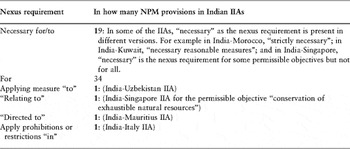
As one can see from Table 3, out of fifty-seven IIAs studied, thirty-four of them have “for” as the nexus requirement and only nineteen have “necessary” as the nexus requirement. Other nexus requirements are “to”, “relating to”, and “directed to”. The significance of the nexus requirement is in establishing the degree of connection between the adopted measure and the permissible objective sought. The stricter the nexus requirement, the stricter will be the degree of connection between the measure adopted and the permissible objective sought. Thus, a nexus requirement such as “necessary” is stricter than “related to”.Footnote 142
Nexus requirement in Indian NPMs

source: Author's survey of fifty-seven Indian IIAs contained in the Compendium of the Ministry of Finance, Government of India, published from 1995 to 2009 (on file with author).
The discussion below will examine the meaning of the word “necessary” and then subsequently will look at the meaning of the other “nexus requirements” in the Indian IIAs.
A. Necessity Requirement
The discussion on “necessary” as the nexus requirement in the Indian IIAs is under two heads: “necessary” in NPM provisions that are non-self-judging and those that are self-judging—the India-Korea IIA and the India-Singapore IIA. In these two IIAs, the “non-security” exception contains “necessary” as the nexus requirement, but is not self-judging. Only the “security” exceptions are self-judging.
1. “Necessary” in the non-self-judging NPM provision
As has been mentioned above, “necessary” as a nexus requirement in the NPM provision occurs in only nineteen Indian IIAs. In the India-Kuwait IIA, the nexus requirement is “strictly necessary”. Thus, in this IIA, India will have to show that the measure is “strictly necessary” and not just “necessary”, requiring an even stricter nexus. Another interesting variation to be noted is in the India-Austria IIA and India-Finland IIA, which state “taking necessary action in abnormal circumstances”. Thus, India will have to show that the measure is “necessary” and that “abnormal circumstances” exist.
However, in other NPM provisions where the word “necessary” has not been qualified, the question is: Should “necessary” be interpreted using the customary defence of necessity as it was done by the CMS, Enron, and Sempra tribunals while interpreting “necessary” in the NPM provision in the US-Argentina IIA? These three tribunals read the customary law necessity defence given in Article 25 into the treaty defence and came to the conclusion that since Argentina's measures did not satisfy Article 25, the measures were illegal.Footnote 143 However, the LG&E tribunal first used Article XI (the NPM provision) and subsequently used Article 25 to support its conclusion that the measures were consistent under Article XI.Footnote 144 The CMS annulment committee, the Continental tribunal and the Sempra annulment committee emphasized the difference between the two provisions and held that Article XI of the US-Argentina IIA differed in material respects from Article 25.Footnote 145 Extensive scholarly analysis exists on these cases and hence it will not be discussed here.Footnote 146
“Necessary” in the NPM provisions in the Indian IIAs is different from Article 25 for two reasons. First and most important, in the Indian IIAs, adoption of necessary measures is subject to the following condition: measures should be applied on normal, reasonable, and non-discriminatory basis (see Section V). These conditions are completely different from the conditions that have to be fulfilled in invoking Article 25. Thus, the intent clearly is to have a different meaning of “necessary” from Article 25.
Second, interpreting the “necessity” requirement in NPM provisions in accordance with the stringent requirements of necessity in Article 25, and in a manner where the latter supplants the former, shall make the treaty defence (NPM) inseparable from the customary law defence of necessity and thus will render NPM provisions in the Indian IIAs futile. If Indian treaty makers intended to use the Article 25 defence to achieve the permissible objectives given in NPM provisions, there was no need to have an NPM provision because the customary defence is anyway available. Article 25 deals with wrongfulness in international law, whereas the NPM provision in the Indian IIAs deals with those alleged violations of the IIA that can be excused under the treaty.Footnote 147 Another reason advanced by Burke-White and von Staden for “necessary” in NPM provisions to be interpreted differently from the strict standard of review of Article 25 of the ILC Articles is based on the context of the term—“necessary” occurs in the NPM provision which is a general exception and hence indicates that the term “necessary” is intended to provide countries with some flexibility in achieving the permissible objectives.Footnote 148
This brings us to the next issue in interpreting “necessary” in these nineteen Indian IIAs. Although the NPM text and context in the Indian IIAs makes it clear that it is different from Article 25, and thus the meaning of “necessary” is not just indispensability, and that India should have some flexibility in deciding which measures are “necessary” to achieve its permissible objectives, the “ordinary” meaning of the word “necessary” (under Article 31 of VCLT) gives room for the application of two tests:Footnote 149 the least-treaty-inconsistent-alternatives-reasonably-available test (LTIARA),Footnote 150 and a proportionality or a weighing and balancing test where the LTIARA test could be one component.Footnote 151
The WTO jurisprudence on “necessary” in GATT Article XX and GATS Article XIV has developed a two-tier test involving both proportionality and LTIARA.Footnote 152 First, the proportionality or the weighing and balancing test will weigh and balance different factors, such as the importance of the regulatory value pursued, the contribution made by the challenged measure to the regulatory value, and the restrictive effect of the measure on international trade. Second, if the first step yields a preliminary conclusion of the measure being “necessary”, then the second step should compare this measure with other least trade restrictive measures, which are reasonably available to the importing countryFootnote 153—the LTIARA test. The proportionality test in WTO has been criticized for encroaching onto the host country's sovereignty because it allows the WTO adjudicator to compare trade and non-trade values and, based on this assessment, the adjudicator can replace the importing country's assessment with his/her own assessment.Footnote 154
The Continental tribunal used the WTO Article XX jurisprudenceFootnote 155 to determine whether Argentina's measures satisfied the test of “necessity”. The Continental tribunal asked the following: whether the measures contributed materially to the realization of ESI (the legitimate aim under Article XI)Footnote 156 and whether a reasonable alternative measure consistent with the IIA and which would yield the same result might have been available to Argentina.Footnote 157 The tribunal answered the first question in the affirmativeFootnote 158 and the second question negatively,Footnote 159 and thus came to the conclusion that the measures adopted by Argentina were “necessary” to protect its ESI.Footnote 160
In the context of ITA, the arbitral tribunal should not engage in finding out how the benefit of the goal will balance the restrictive effect on investment.Footnote 161 Given the debate on IIAs and ITAs intruding too much on the host country's regulatory power and the institutional position of arbitrators, once it is established that the host country's regulatory measure falls under one of the permissible objectives, the arbitral tribunal should engage only in finding out whether a less investment restrictive measure is reasonably availableFootnote 162 to the host country that would achieve the same benefit. If indeed such a measure is available, then the measure adopted by the host country should be held not “necessary”. Thus, the LTIARA test will serve India's regulatory power better by dissuading the arbitral tribunal from judging the relative importance of India's regulatory objective with the restriction on foreign investment. Furthermore, by requiring that only the least investment restrictive measure which is reasonably available to the host country be adopted, this test will also ensure that foreign investment is not unduly restricted.
However, in the absence of the meaning of “necessary” in the NPM provision in nineteen Indian IIAs, both tests are applicable and it will depend on the arbitral tribunal as to which standard of review is followed in interpreting “necessary”.Footnote 163
2. “Necessary” in NPM provisions containing self-judging language
In the India-Singapore IIA and India-Korea IIA, the chapeau of the “security” exception clause allows countries to adopt measures which the countries consider are necessary for the protection of ESI, as has been mentioned before.
The presence of the phrase “which it considers” before “necessary” in these two IIAs means that the determination of whether the measures are necessary or not will be made by India for achieving the ESI. In this regard, a question arises as to whether a “good faith” review of the “necessary” measures adopted is nevertheless possible?
In the context of Article XXI of GATT, it has been argued that although a WTO panel cannot determine whether the measure adopted by a state under Article XXI is necessary to protect its security interests, nevertheless a “good faith” review of the measure is possible.Footnote 164 This “good faith” review should examine whether the country considered (genuinely believed) the measure to be taken necessary to tackle the essential security threat.Footnote 165 Complete preclusion from judicial review may result in countries abusing the self-judging NPM provision and adopting protectionist measures and thus not balancing investment protection with the host state's regulatory power.Footnote 166
However, as mentioned above, both these IIA provisions are non-justiciable and thus even a “good faith” review of the “necessary” measure may not be possible.
B. Non-“Necessary” Nexus Requirements
More than thirty-five Indian IIAs do not contain “necessary” as the nexus requirement but do include other requirements, such as “for”, “relating to”, “to”, and “directed to”. In fact, the majority of Indian IIAs (thirty-two out of the fifty-seven studied) have “for” as the nexus requirement. It has been argued that “for” as the nexus requirement suggests a relatively thin nexus whereby measures will be allowed as long as they merely further a permissible objective.Footnote 167 A weak nexus requirement like “for” implies that India will be able to adopt a large number of measures to achieve permissible objectives (provided it is able to show that there exists a permissible objective as per the NPM provision) even if such measures are not “necessary”. However, the presence of “for” as the nexus requirement creates a genuine apprehension that the NPM provision could be abused by India. With “for” as the nexus requirement, India can adopt a large range of measures to achieve a permissible objective even if other least restrictive alternative measures are reasonably available.
Similarly, the nexus requirement “relating to” suggests a weaker nexus requirement as compared to “necessary”,Footnote 168 although stronger than the nexus requirement “for”. In US-Shrimp, “relating to” was interpreted to mean that there should be a rational connection between the measure taken and the objective sought.Footnote 169 The India-Singapore IIA has “relating to” as the nexus requirement for the objective of conservation of “exhaustible natural resources”.
V. Conditions in Indian IIAS to which NPMS are subjected
Indian NPM provisions subject adoption of NPMs to certain conditions as mentioned above. For example, the NPM provision in India Model IIA states that measures adopted to meet the permissible objectives must be “in accordance with its laws normally and reasonably applied on a non-discriminatory basis”. A condition such as this is intended to ensure that measures adopted to achieve permissible objectives should be applied in a manner that is just and rational. These conditions are applicable to all permissible objectives, whether ESI, CEE, or other objectives such as protecting the spread of diseases and pests. In other words, even when India has to act for its security interests, which are serious in nature (meeting the high threshold of ESI), it has to adopt NPMs on a normal, reasonable, and non-discriminatory basis.
Amongst the Indian IIAs, as many as thirty-two IIAs have the same condition as given in the Indian Model IIA. These thirty-two IIAs include both “model-NPM” type IIAs and “modified-model-NPM” type IIAs. There are another twelve IIAs that contain conditions which are in slight variation from the one contained in these thirty-two IIAs. For example, the India-Netherlands IIA, India-France IIA, and India-Bosnia Herzegovina IIA state that measures adopted should be imposed in a non-discriminatory manner and in good faith. Similarly, the India-Croatia IIA, apart from the requirement that measures adopted should be applied normally, reasonably, and on a non-discriminatory basis, also includes the requirement of imposing measures on a non-arbitrary basis. The NPM provision in the India-Bosnia Herzegovina IIA, apart from the non-discriminatory requirement, also states that measures adopted should give the same treatment to all investors in like situations.
The India-Singapore IIA and India-Korea IIA contain many elaborate conditions in the form of a chapeau, such as the chapeau of Article XX of GATT or Article XIV of GATS. These conditions are the same as those given in the chapeau of GATT Article XX and GATS Article XIV. On the other hand, a few Indian IIAs, such as the India-Germany IIA, India-Russia IIA, and India-Argentina IIA, do not contain any such conditions for the application of the measures under the NPM.
VI. Conclusion
After a critical examination of the NPM provisions in fifty-seven Indian IIAs, one can conclude that, barring the India-Korea IIA and India-Singapore IIA, NPM provisions in the rest of the IIAs are inadequate in allowing India to fully exercise regulatory power for a wide number of policy objectives. This is mainly because the Indian NPM provisions contain a limited number of permissible objectives. Thus, notwithstanding the weak nexus requirement that gives the possibility of invoking a large range of regulatory measures, India will not be able to adopt regulatory measures for many policy objectives relying on the existing permissible objectives in the currently formulated NPM provision. An arbitral tribunal adopting a deferential standard of review for India's existing permissible objectives, as argued by Burke-White and von Staden, will not solve the problem entirely because these standard of reviews have to be operationalized within the VCLT treaty interpretative framework. Thus, a deferential standard of review in NPM provisions in the Indian IIAs that contain limited permissible objectives like ESI and CEE can be used if a serious economic crisis or a serious national security issue engulfs the entire country, because such an economic crisis can be brought within the ambit of “essential” “security interest” pursuant to the application of formal treaty interpretation rules, and then deference can be accorded to determine whether the required “threshold” has been reached or not. However, such a deferential standard of review will be of limited value for those policy needs that cannot be brought under the ambit of ESI or CEE pursuant to formal treaty interpretation rules. Thus, if India wishes to deviate from an IIA temporarily because it wishes to promote indigenous industries in a backward region of India which otherwise cannot compete with foreign corporations operating in that region, a deferential standard of review will be of limited value because promoting industrialization in a backward region of India, though an important policy need, is neither an “essential” “security interest” nor a “circumstance” of “extreme emergency” as understood by the application of treaty interpretation tools.
This textual indeterminacy can be overcome if India reformulates its NPM provisions by adding “non-security”-related permissible objectives such as “economic and social development”, “public health”, “environment”, “public order and public interest”, and “economic crises”. Thus, with “economic and social development” as a permissible objective in the IIA, India will not be worried to show that its NPM for such economic and social development needs falls under ESI (which will require a high threshold). These “non-security”-related permissible objectives should not be self-judging, although the “security”-related permissible objectives may be made self-judging but not non-justiciable, and thus open for a good faith review. Making “security”-related permissible objectives non-justiciable might be misused to the detriment of investment protection.
Besides this, since the NPM provision will have permissible objectives divided into “security”- and “non-security”-related objectives, CEE as a permissible objective will not be needed because any circumstance of extreme emergency related to “non-security” situations will be dealt with under the “non-security”-related permissible objectives and any circumstance related to a security situation under “security”-related permissible objectives.
The counter-argument to reformulating NPM provisions aimed at including more permissible objectives is that a large number of permissible objectives may result in excessive regulatory power for India jeopardizing investment protection. Such fears can be quelled by having “necessary” or “related to” as the nexus requirement for different permissible objectives, instead of “for”. In the case of having “necessary” as the nexus requirement, the NPM provision should provide that “necessary” will be interpreted using the LTIARA test so as to bar the tribunal from undertaking a proportionality test to find out whether a measure is “necessary”.
Likewise, in order to make sure that NPM provisions balance investment protection with regulatory power and are not abused, the imposition of NPMs should be subjected to conditions such as: measures shall be applied normally, reasonably, and on a non-discriminatory basis, as presently formulated in the majority of NPM provisions in Indian IIAs. However, these conditions should exist for “non-security”-related permissible objectives and not for security-related permissible objectives.
Another factor that will act as a check on India not abusing the broadly formulated permissible objectives in NPM provision is the fact that India needs a “quantum leap” in FDI in the coming years if it wishes to achieve double-digit growth,Footnote 170 and also needs FDI to finance its current account deficit.Footnote 171 Thus, India will be conscious of the fact that any abuse of the NPM provision will hurt the sentiment of foreign investors and affect India's reputation as an attractive FDI destination.
A suitably formulated NPM provision will preserve India's regulatory power along with investment protection.Footnote 172 One question that may arise is that since, under general international law, India has the right to adopt “non-discriminatory”, “good faith” regulatory measures without attracting any international liabilityFootnote 173 (the “police power” argument), an inadequately drafted NPM provision should not come in the way of India's regulatory power.
In some ITA expropriation disputes, the host country's regulatory measures adopted for “public policy” objectives have been held as not “expropriation”.Footnote 174 Similarly, North American Free Trade Agreement (NAFTA) tribunals have interpreted the “in like circumstances” phrase in Article 1102 on national treatment as a de facto “public policy” justification mechanism.Footnote 175 The tribunals have held that discrimination is allowed if it is for a “public policy” purpose.Footnote 176 However, there are inconsistencies in tribunal rulings with regard to the relationship between the discriminatory measure and the “public policy” pursued by the measure.Footnote 177
Notwithstanding this, the precise boundaries of justified “public policy” are unclear.Footnote 178 There is no consensus on how broad or narrow the “police powers” are.Footnote 179 Will a regulatory measure for furthering public interest, which takes back the assurances given to foreign investors, be allowed under the “police power” argument? There is no clear answer. For example, the tribunal in LG&E v. Argentina discussed the significance of “police power” while undertaking an analysis on expropriation,Footnote 180 but did not discuss it while undertaking the analysis of FET.Footnote 181 Only in the last paragraph of the “tribunal's conclusion” on FET, once it had already reached the conclusion that Argentina had violated the FET standard,Footnote 182 did it merely recognize the hardships faced by Argentina during that time.Footnote 183 Recognizing that Argentina faced a severe economic crisis, after determining a violation of the FET standard, does not protect the country's regulatory power. So, while Argentina's regulatory measures to combat the severe economic crisis were in accordance with its “police powers” in the context of expropriation, the same regulatory measures did attract liability for violating the FET standard. Such decisions and analysis raise a question mark on when “police powers” are permitted and when they are not in the context of an IIA. What matters for a host country is whether its regulatory measure attracts liability or not; it does not much matter whether that liability is for violating provision “A” of the IIA and not “B”.
The Saluka tribunal said that since there is no consensus on which regulatory measures are permitted, this has to be determined by the adjudicator.Footnote 184 Instead of leaving such complex questions for ad hoc arbitral tribunals,Footnote 185 it will be better that India as the law-maker of international investment treaty law formulates an NPM provision in the IIA, by keeping in mind its diverse non-investment goals based on its own developmental priorities. Thus, once a measure falls under the NPM provision it will act as an exception to all IIA provisions. This will bring more certainty and predictability in the IIA regime, benefiting both India and the investor. This will also play a role in changing the tone of the Indian IIAs, from a legal instrument primarily aimed at investment protection, to an instrument aimed at investment protection in a manner that is supportive of India's regulatory power.Footnote 186
In any case, a comprehensive NPM provision in the IIA and the rights and defences under CIL can co-exist unless the IIA states anything to the contrary. In other words, the NPM provision is activated only once the country has violated one of the substantive IIA provisions. For example, there can be cases where India successfully uses the “police power” argument to convince the tribunal that it has not expropriated the investment, but nevertheless fails in doing the same with FET, say, because it violated the “legitimate expectations” of the investor. In such a situation, India can still rely on the NPM provision to argue that the FET violation is excused by showing that the measure falls under the NPM provision even if the adopted NPM revokes the assurances given to the foreign investor and thus violates the “legitimate expectations” of the investor. Thus, the NPM provision operates at a different level and does not necessarily compete with the “police power” argument,Footnote 187 and can help India justify those regulatory measures that the “police power” argument will fail to justify.
Recent treaty practice suggests that countries are adopting comprehensive NPM provisions in their IIAsFootnote 188 in order to ensure that specific policy objectives are achieved without violating the IIA.Footnote 189 This practice indicates that countries are starting to realize the limitations of the “police power” argument, which is often advanced as a response to a critique of textual indeterminacy in IIAs affecting the host country's regulatory power. It seems that countries want to make sure that their IIAs are more precise and clear so as to avoid unexpected restrictions on regulatory power.
A final point that needs to be dealt with is that India is fast becoming an exporter of capital,Footnote 190 and thus a narrow NPM provision, as presently exists in the majority of Indian IIAs, will be beneficial to Indian companies investing abroad, and thus India should not reformulate its NPM provisions or, even if it does have to reformulate them, it should do so only in those IIAs where India is a net capital importing country. The latter argument stems from the view that India should have a binary investment protection policy, and thus broad or narrow investment protection provisions in different IIAs depending on whether it is a net capital exporting or importing country vis-à-vis a particular country.Footnote 191 There are many reasons to reject such approaches.
First, India is still a net capital importing country. India's net FDI for the period April to September 2009 stood at US$14.1 billion.Footnote 192 India is also a net capital importing country vis-à-vis many developed countries. For all these foreign investment inflows, India will act as a host state needing regulatory power to pursue different policy objectives in the light of the hugeness and vastness of India and its diverse needs.
Second, India receives capital not just from developed countries such as the US, the UK, Germany, and Italy but also from developing countries such as Malaysia, Thailand, the Philippines, Indonesia, South Africa, Iran, Sri Lanka, Kenya, and others.Footnote 193 Even if India is a net capital exporting country vis-à-vis some of these developing countries, there is nothing to stop a Sri Lankan or a Kenyan investor from bringing a case against India challenging a regulatory act allegedly violating the IIA.Footnote 194 In other words, disputes can arise with investors, irrespective of whether India is a net capital exporter or importer vis-à-vis a particular country. Moreover, capital exporting or importing country status is not a static one; if this status changes, then the same IIA provisions can be used against India, making the entire argument of having binary investment protection policy counter-productive.
Third, having different IIAs based on capital exporting or importing interest will result in inconsistent treaty practice, adding unnecessary confusion amongst India's IIA partner countries and foreign investors regarding India's foreign investment protection policy.
Fourth, the Indian investment treaty practice is itself contrary to this argument. India has started inserting provisions that boost India's regulatory power in some of the IIAs only in recent years, i.e. during the time when India is emerging as an exporter of capital, and that too with countries with whom India has an offensive interest, such as countries in Africa. For example, few recent Indian IIAs state that the purpose behind regulatory measure should be taken into account in determining expropriation.
Fifth, taking a position on the shape of international investment law solely from the viewpoint of a capital exporting or capital importing country will further skew the international investment law regime. The need is to avoid extreme viewpoints and to take a balanced position on investment protection and regulation in the interest of the international investment law regime—which should serve the needs of both capital exporting and capital importing nations, especially at a time when the regime is under severe attack.Footnote 195
In any case, this article has argued for a balanced NPM provision, which will also protect Indian investment abroad from any undue regulatory measures.
Countries such as the US have faced such dilemmas—the US IIA programme that was initially designed to regulate the behaviour of host states (mainly developing countries) so as to protect investments made by US nationals in these states, has undergone changes—with the most prominent change being the “self-interpreting” nature of the clause for the protection of essential security in the 2004 US Model IIA. While the US policy-makers knew that the adoption of a “self-interpreting” measure would give more leeway to treaty partners of the US in dealing with investments made by US nationals, they were happy to pay this price in return for ensuring that their own regulatory power to take measures in certain exigencies was not jeopardized.Footnote 196
This article has made the first detailed contribution to the understanding of the NPM provisions in Indian IIAs. It is expected that this article will spur further research and discussion, not just on NPM provision in Indian IIAs but also on the larger issue of investment protection and regulation in Indian IIAs amongst policy-makers and other academics.