Introduction
Lagenaria is a genus in the Cucurbitaceae family with vine growth habit. There are seven known species: the wild Lagenaria breviflora (Benth.) G. Roberty, Lagenaria abyssinica (Hook. F.) C. Jeffrey, Lagenaria rufa (Gilg.) C. Jeffrey, Lagenaria sphaerica (Sonder) Naudin and Lagenaria guineensis (G. Don) C. Jeffrey, and the domesticated Lagenaria siceraria (Mol.) Standl. and L. vulgaris Ser. which was previously combined with L. siceraria. The L. siceraria is thought to be among the earliest domesticated plant species (Cutler and Whitaker, Reference Cutler, Whitaker and Byers1967). The name Lagenaria is derived from ‘lagena’, the Latin name for the Florence flask, referring to the shape of the L. siceraria fruit. The species name siceraria refers to its dry (siccus) mature fruit used by people throughout the world for making jars, utensils, tubes and musical instruments. For this reason, it is commonly known as the ‘bottle gourd’ (Decker-Walters et al., Reference Decker-Walters, Staub, Chung and Nakata2001; Reference Decker-Walters, Wilkins-Ellert, Chung and Staub2004; Erickson et al., Reference Erickson, Smith, Clarke, Sandweiss and Tuross2005). It is also known as the white-flowered gourd ‘Calabash’ (Jeffrey, Reference Jeffrey, Milne-Redlead and Polhill1967; Reference Jeffrey1980). L. siceraria is indigenous to Africa (Richardson, Reference Richardson1972; Morimoto et al., Reference Morimoto, Maundu, Kawase, Fujimaki and Morishima2006); however, remains of L. siceraria in archaeological digs point to the possibility that it reached temperate and tropical areas in Asia and the Americas over 10,000 years ago, perhaps with human migration (Erickson et al., Reference Erickson, Smith, Clarke, Sandweiss and Tuross2005) or dispersed through natural ways. L. siceraria fruits are known to have the capacity to float on seas for many months without losing seed viability (Decker-Walters et al., Reference Decker-Walters, Wilkins-Ellert, Chung and Staub2004).
L. siceraria thrives in a wide range of soil types, including alluvial sandy soils along river banks, red silt, clay loam soils and rocky soils. It is more tolerant of a high water table (Yetisir et al., Reference Yetisir, Çaliskan, Soylu and Sakar2006) and to salt than watermelon (Colla et al., Reference Colla, Fanasca, Cardarelli, Rouphael, Saccardo, Graifenberg and Curadi2005). The ability of Lagenaria to thrive in different soils and its natural resistance to soil-borne diseases makes it desirable for grafting different cucurbit crops susceptible to soil pathogens. Grafting cucurbits, particularly watermelon, on Lagenaria rootstocks has been practiced in Eastern Asia for many years, and in recent years there has been an increased interest in Europe and in the USA in adopting this practice as one of the alternatives for methyl bromide fumigation for the control of fusarium wilt (Miguel et al., Reference Miguel, Maroto, San Bautista, Baixauli, Cebolla, Pascual, López and Guardiola2004; Cohen et al., Reference Cohen, Burger, Horev, Koren and Edelstein2007). In a recent study (Ling and Levi, Reference Ling and Levi2007), a number of United States plant introductions (PIs) of L. siceraria were found to be resistant to zucchini yellow mosaic virus (ZYMV), and were moderately resistant to powdery mildew (Kousik et al., Reference Kousik, Levi, Ling and Wechter2008). Edelstein et al. (Reference Edelstein, Tadmore, Abo-Moch, Karchi and Mansur2000) reported that Lagenaria rootstocks may confer resistance to the carmine spider mite (Tetranychus cinnabarinus) in the grafted scion of Cucurbita cv. Brava. In addition, L. siceraria rootstocks appeared to enhance lycopene content in watermelon fruits of grafted vines (Perkins-Veazie et al., Reference Perkins-Veazie, Zhang, Lu and Huan2007). For these reasons, there is an increased interest by researchers and breeders of watermelon in exploring the utility of L. siceraria germplasm for improving watermelon yield and quality.
Over 235 PIs of L. siceraria that were collected in different regions of the world are maintained by the USDA, ARS, Plant Genetic Resources and Conservation Unit (PGRCU) in Griffin, GA, USA (http://www.ars-grin.gov). These PIs can be valuable for the development of superior L. siceraria rootstock lines for grafting watermelon. However, information is insufficient with respect to genetic relationships among these L. siceraria PIs and their phylogenetic relations to important cucurbit crops [including Cucurbita maxima Duchesne (winter squash), Cucurbita pepo L. (squash and pumpkin), Citrullus spp. (watermelon), Cucumis melo L. (melon) and Cucumis sativus L. (cucumber)] that are being used as rootstocks for grafting watermelon (Miguel et al., Reference Miguel, Maroto, San Bautista, Baixauli, Cebolla, Pascual, López and Guardiola2004). Also, there is no information with respect to the resistance of L. siceraria PIs to southern root-knot nematode (RKN) [Meloidogyne incognita (Kofoid and White) Sandground], which can be a serious pest of cucurbit crops (Thies and Levi, Reference Thies and Levi2003; Reference Thies and Levi2007). In addition, information is lacking with respect to the resistance of these L. siceraria PIs to the sweetpotato whitefly [Bemisia tabaci (Gennadius)] which not only damages plants by its feeding, but it also transfers viruses in cucurbit crops. Furthermore, information is lacking with respect to grafting compatibility of L. siceraria PIs [representing different phylogenetic groups (PGs)] with cucurbit cultivars, particularly watermelon.
Decker-Walters et al. (Reference Decker-Walters, Staub, Chung and Nakata2001; Reference Decker-Walters, Wilkins-Ellert, Chung and Staub2004) and Morimoto et al. (Reference Morimoto, Maundu, Kawase, Fujimaki and Morishima2006) examined genetic diversity among L. siceraria and related Lagenaria species employing random amplified polymorphic DNA marker analysis, and were able to differentiate among the Lagenaria species. Molecular markers can be useful in examining genetic diversity among the L. siceraria PIs, and in elucidating their genetic relations before setting up a breeding scheme for the development of superior rootstock lines with enhanced pest and disease resistance.
The objectives of this study were to: (1) examine genetic diversity among L. siceraria PIs collected in different parts of the world and examine their relatedness to PIs of important cucurbit species [including C. maxima, C. pepo, Citrullus lanatus and Citrullus colocynthis (L.) Schrader, C. melo and C. sativus], (2) examine resistance of the Lagenaria PIs to southern RKN (M. incognita race 3) and to the B-biotype sweetpotato (B. tabaci) whitefly, (3) examine the genetic relations among those L. siceraria PIs showing disease or pest resistances and (4) determine whether there are any significant differences in grafting compatibility of Lagenaria PIs with watermelon cultivars. The information found in this study can be useful for researchers and plant breeders interested in developing superior L. siceraria rootstock lines with enhanced disease and pest resistance.
Materials and methods
Plant material
Seeds of L. siceraria PIs (Table 1) were obtained from USDA, ARS, PGRCU, Griffin, GA, USA. The Cucurbita moschata and C. pepo PIs (Table 1) were obtained from USDA, ARS, Plant Genetic Resources Unit, Northeast Regional PI Station, Geneva, NY, USA. The Cucumis sp. PIs (Table 1) were obtained from the USDA, ARS, North Central Regional PI Station, Ames, IA, USA (http://www.ars-grin.gov). The squash cultivar ESPN, the melon cultivar ‘Ananas Yokneam’ and the cucumber cultivar SMR58 were from seeds that have been maintained at the USDA, ARS, US Vegetable Laboratory, Charleston, SC, USA.
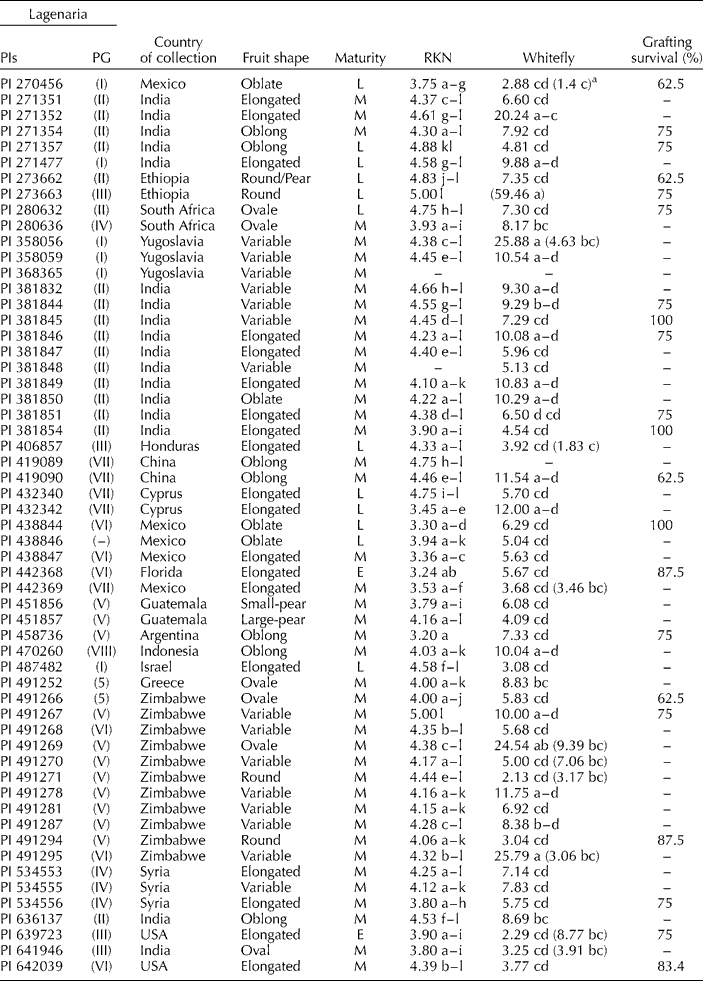
Lagenaria siceraria plant introductions (PIs), the phylogenetic group (PG) they belong to (as shown in Fig. 1), the country they were collected from, their fruit shape, time-to-fruit maturity, gall indices of root-knot nematodes (RKN; Meloidogyne incognita race 3) and the average number of adult B-biotype sweetpotato whitefly (Bemisia tabaci) found on each PI

E, early season; M, mid season; L, late season.
a Data in parenthesis are from the second experiment for whiteflies.
PIs of C. moschata, C. pepo, C. sativus, C. melo, Citrullus spp. and L. siceraria (Table 1) were grown in the greenhouse (day and night temperatures were ~27 and 22°C, respectively), and in the field during the summers of 2006 and 2007 in Charleston, SC, USA.
DNA isolation
Samples of young leaves (10 g) were collected from three to four plants (3-week old) of each PI, and stored in − 80°C. DNA was isolated from the frozen leaves using an improved procedure [as described by Levi and Thomas (Reference Levi and Thomas1999); Levi et al. (Reference Levi, Thomas, Keinath and Wehner2001)].
Sequence-related amplified polymorphism (SRAP) analysis
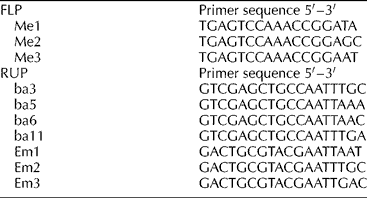
The sequence-related amplified polymorphism (SRAP) procedure was based on polymerase chain reaction amplification of open reading frames, using forward and reverse primers (Table 2) designed to preferentially amplify exon (rich in C and G nucleotides) and intron regions (rich in A and T nucleotides), respectively. The forward primer was a 14 nucleotide sequence rich in C and G, and three selective bases at the 3′ end, while the reverse primer was a 15 nucleotide sequence rich in A and T and three selective bases at the 3′ end. The variation in exon, intron or promoter region sequences produced the polymorphism (Li and Quiros, Reference Li and Quiros2001). We used 24 SRAP primer combinations (Tables 2 and 3). The SRAP markers were tested for polymorphism among the PIs using the same procedure recently described for the mapping of watermelon genome (Levi et al., Reference Levi, Thomas, Trebitsh, Salman, King, Karalius, Newman, Reddy, Xu and Zhang2006). The oligonucleotides were synthesized by International DNA Technologies, Inc. (Coralville, IA, USA), and were tested for polymorphism among PIs. Those primer pairs that yielded sufficient polymorphism among PIs were selected for repeated tests.
The sequence-related amplified polymorphism (SRAP) forward primers that were labeled with a DNA sequencing dye forward labeled primers (FLP) and the reverse unlabeled primers (RUP) used in different combinations to produce the SRAP markers (in Table 3) in watermelon

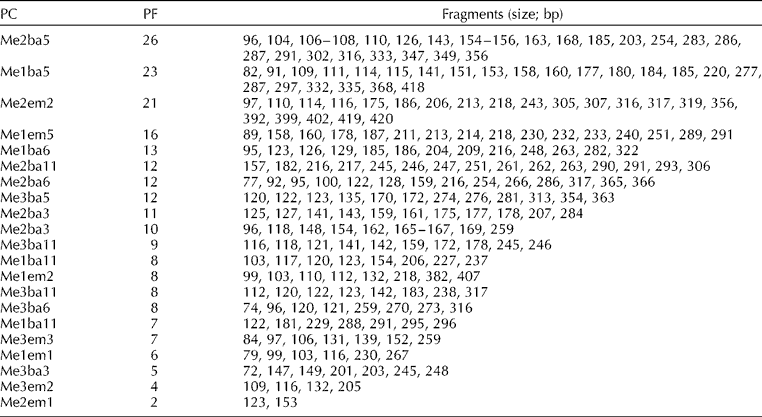
The sequence-related amplified polymorphism primer pair combinations (PC), the number of polymorphic fragments (PF) produced in Lagenaria siceraria and/or in cucurbit species (Fig. 1) by each of these primer pairs

bp, base pair.
Marker data collection and analysis
The markers were scored based on their presence or absence using the built-in fragment analysis software [provided with the Beckman CEQ-8800 system (Fullerton, CA, USA)] for DNA markers. Polymorphic markers were scored for the presence and absence of the corresponding bands among the genotypes. The scores ‘1’ and ‘0’ indicate the presence and absence of bands, respectively. A pairwise similarity matrix was generated using the Nei–Li similarity index (Nei and Li, Reference Nei and Li1979) as follows: similarity = 2N ab/(N a+N b), where N ab is the number of SRAP fragments shared by two genotypes (a and b) and N a and N b are the total number of SRAP fragments analysed in each genotype. A cluster analysis was performed based on the SRAP marker data using the NTSYS-PC Version 2.02 (Rohlf, Reference Rohlf1993) with the unweighted pair group method on arithmetic averages method.
Root-knot nematode experiment and analyses
M. incognita race 3 were cultured and prepared for inoculation of the 57 L. siceraria PIs. Commercial L. siceraria ‘Emphasis’ and C. maxima × C. moschata ‘Strong Tosa’ were included as susceptible reference controls. All PIs and cultivars were evaluated for resistance to M. incognita race 3 in replicated greenhouse tests, as described by Thies and Levi (Reference Thies and Levi2003; Reference Thies and Levi2007). The experimental design was a randomized complete block for all genotypes with three replicates and five plants per replicate (n = 15) in each test. The seeds were sown in plastic trays containing 50 individual 0.2-l cells filled with Metro-Mix 360 (The Scotts Company, Marysville, OH, USA) and placed in a greenhouse maintained between 26 and 31°C. When seedlings were at the first true leaf stage, 3 ml distilled water containing approximately 2500 eggs of M. incognita race 3 were pipetted into the rhizosphere soil of each plant at a 1-cm depth. Plants were fertilized 2 and 5 weeks after sowing with one-half strength 20N–20P–16K water-soluble fertilizer (Peter's Fertilizer; United Industries Corporation, St Louis, MO, USA). Eight weeks later, the shoots of all plants were clipped at the crown, and the roots were removed from each cell and carefully washed. The root system of each plant was then submerged in a 15% solution of McCormick's (McCormick & Company, Inc., Sparks, MD, USA) red food colour (Thies et al., Reference Thies, Merrill and Corley2002) for 15–20 min to stain the M. incognita egg masses. The root systems were carefully rinsed under running tap water and evaluated for galling severity and egg mass production using a 1–5 scale in which 1 = 0–3%, 2 = 4–25%, 3 = 26–50%, 4 = 51–79% and 5>80% of root system galled (Thies and Fery, Reference Thies and Fery1998). Gall index data were converted to the midpoint of the percentage range designated for each gall index score. Then, percentage of root system galled was arcsine transformed before analysis. Data were analysed using the general linear model (GLM) procedure of Statistical Analysis Systems (SAS) for Windows, Version 8.0 (SAS Institute, 2002), and means were separated using Fisher's protected least significant difference test. Non-transformed data are shown in Table 1.
Whitefly experiments
Trials for infestation of the B-biotype B. tabaci on L. siceraria PIs were conducted in the greenhouse. Each PI entry was established in a seedling tray (10.2 cm wide × 10.2 cm long × 6.4 cm deep) in Fafard Heavyweight Mix #52 (Conrad Fafard, Inc., Agawam, MA, USA) potting soil. There was a 10-seedling set for each of the PI entries, which were replicated thrice. Each replicate of each set was randomly placed on separate tables in an otherwise empty greenhouse. During the experiment, temperature in the greenhouse averaged 25.2°C (range 19–32°C) and relative humidity (RH) averaged 65% (range 46–77% RH). The seedlings were maintained free of pests until the first true leaf stage. Collard seedlings that were infested with whiteflies were then taken from a whitefly colony and placed on empty tables, about 1.2 m from the test plants. Leaf growth was variable among the test plants and was 1–3 true leaf stage during the start of the evaluation. The upper leaf was sampled from one random plant in the 10-plant set of each replicate. The number of adult whiteflies was counted from the top and lower leaf surfaces of each sampled plant. Sampling was conducted seven times over a 3-week period, and mean whitefly counts were averaged across sample dates. Whitefly data were analysed using SAS (SAS Institute, 2002) computations, and significance was determined at P < 0.05. Significantly different means for whitefly counts among PIs were separated using the Student–Newman–Keuls test.
Based on the results from the initial trial, an additional replicated trail was conducted for PI 270456, PI 273663, PI 358056, PI 406857, PI 442369, PI 491269, PI 491270, PI 491271, PI 491295, PI 639723 and PI 641946. A total of 14 samples were collected during the 2 months.
Grafting experiment
Pilot experiments for grafting compatibility with watermelon cultivars were conducted with 23 PIs in this study (Table 1). About 8 seeds out of 23 selected L. siceraria PIs (Table 1) were sown in trays containing Jiffy Mix soil and beach sand (mixed in ratio of 9:1). Four days later, seeds of the watermelon cultivars ‘Crimson Sweet’ and ‘Charleston Gray’ were sown in the same type of soil. The watermelon seedlings (2- to 3-d old) were grafted (as scions) on L. siceraria rootstocks (6- to 7-d old seedlings) using the ‘hole insertion’ grafting procedure optimized for cucurbits as described by Amaido (Reference Amaido, Batchelor and Alfarroba2004) and Hassell et al. (Reference Hassell, Memmott and Liere2008). Post-grafting plants were kept in humid conditions for 1 week as described by Hassell et al. (Reference Hassell, Memmott and Liere2008). The grafted plants were kept in plastic trays (1.75 in. deep) in the greenhouse and their development was observed during 4 weeks following grafting. Rootstocks that gave rise to healthy grafted watermelon plants with elongated stems and new healthy leaves and flower buds during 4 weeks post-grafting were considered to be compatible for grafting with watermelon.
Results
Genetic analysis based on SRAP markers
The SRAP markers in this study are polymorphic among the L. siceraria PIs and are reproducible from experiment to experiment. The 21 SRAP primer pair combinations (Tables 2 and 3) produced 236 markers polymorphic among the PIs of L. siceraria and cucurbit species (Table 1). About 2–26 polymorphic markers were produced by each of the SRAP primer pairs (Tables 2 and 3).
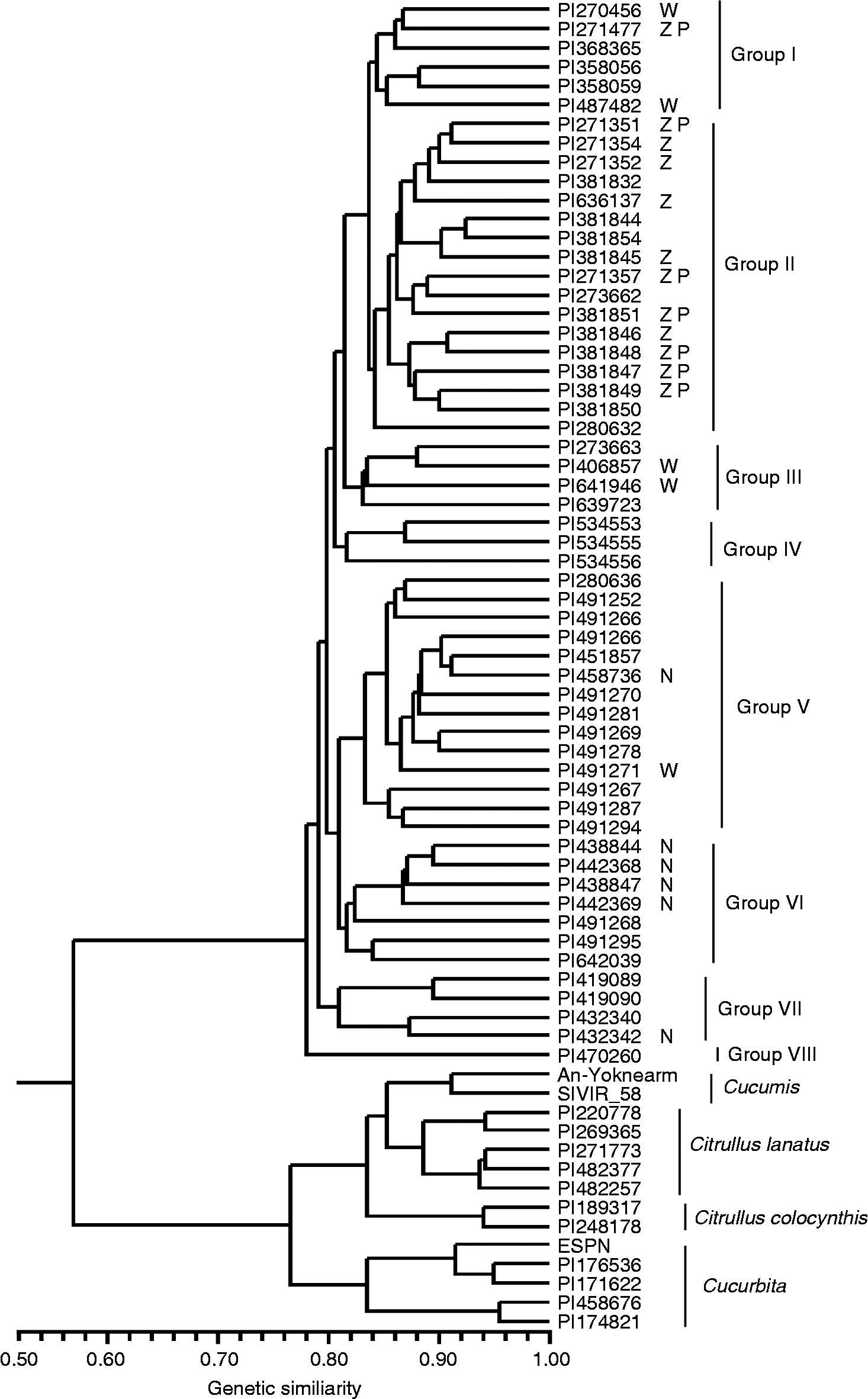
The L. siceraria group is distinct from the three other cucurbit genera examined in this study (Cucurbita spp., Citrullus spp. and Cucumis spp.; Fig. 1). The cluster analysis (based on 236 polymorphic SRAP markers) produced genetic similarity of 77–93% among the L. siceraria PIs, which is comparable with the genetic diversity that exists among the Citrullus species and subspecies (C. lanatus var. lanatus, and C. lanatus var. citroides versus C. colocynthis PIs; genetic similarity ranges from 79 to 94%) and among Cucurbita spp. examined here (C. pepo versus C. maxima PIs; genetic similarity ranges from 83 to 95%; Fig. 1).
Genetic diversity among Lagenaria siceraria, Cucumis, Citrullus and Cucurbita plant introduction (PIs) collected throughout the world, and the phylogenetic L. siceraria groups with PIs resistant to zucchini yellow mosaic virus (Z; Ling and Levi, Reference Ling and Levi2007) and tolerant to powdery mildew (P; Kousik et al., Reference Kousik, Levi, Ling and Wechter2008), and moderate tolerance to the root-knot nematode (Meloidogyne incognita race 3; N), or less appealing to whiteflies (B-biotype Bemisia tabaci; W) (as indicated in Table 1).

The L. siceraria PIs were assembled into two major clusters (Fig. 1). The first major cluster includes PIs collected mostly in South Asia (India) and a few PIs collected in the Mediterranean region (Israel, Syria and Yugoslavia) and Northeast Africa (Ethiopia; Fig. 1; groups I–IV). The second major cluster includes PIs collected mainly in Southern Africa (South Africa and Zimbabwe) and in North, Central and South America (Florida, Mexico, Guatemala, and Argentina), and a few PIs collected in China, Indonesia and Cyprus (Fig. 1; groups V–VIII). The cluster analysis (Fig. 1) indicated that the PIs collected in India, but not those collected in China, are distinct from the PIs collected in Southern Africa and in the Americas.
Root-knot nematode resistance
All L. siceraria PIs evaluated in this study were susceptible to the southern RKN (Table 1). The gall indices (GIs) were 4.7 and 5.0 for the control commercial cultivars ‘Emphasis’ (L. siceraria) and ‘Strong Tosa’ (Cucurbita), respectively. The GIs of the PIs examined herein ranged from 3.20 to 5.00 (P < 0.05; Table 1). However, six PIs exhibited moderate galling response and may be classified as moderately susceptible (GI range: 3.2–3.5). Although these six PIs allowed nematode reproduction in their roots (egg mass data not shown), they had a moderate root galling response to southern RKN compared with the other PIs examined herein. Four out of the six PIs (PI 438844, PI 438847, PI 442369 collected in Mexico, and PI 442368 collected in Florida) are in the same PG (Fig. 1, group VI), indicating that their similar genetic background may play a role in reaction to southern RKNs. The two other PIs with moderate susceptibility were in the adjunct PG V (PI 458736 collected in Argentina) and group VII (PI 432342 collected in Cyprus; Fig. 1).
Resistance to whiteflies
In this study, all PIs examined were infested with the B-biotype sweetpotato whitefly (B. tabaci). Mean counts among all PIs evaluated ranged from 0.4 to 25.8 adult whiteflies per leaf in the first experiment, and from 1.4 to 59.5 adult whiteflies per leaf in the second experiment (Table 1). However, several PIs including PI 270456 and PI 442369 (collected in Mexico), PI 487482 (collected in Israel), PI 641946 (collected in India), PI 491271 and PI 491294 (collected in Zimbabwe), and PI 406857 (collected in Honduras) had the least whiteflies (>4 adult whiteflies per leaf in both the experiments). Although the whitefly counts were not significantly different from those on other PIs, these PIs consistently had low counts for whitefly adult, egg and nymphal counts.
Discussion
Genetic analysis based on SRAP markers
The SRAP markers were polymorphic among the L. siceraria PIs, and are useful in determining intraspecific and interspecific genetic relations among the cucurbit species examined herein. The high reproducibility of SRAP markers is a result of amplification with two specific primers (each primer is 17–18 bp) that represent sequences in the proximity of coding regions (Li and Quiros, Reference Li and Quiros2001). A large number of the SRAP markers in this study are polymorphic in one or a few base pairs (Table 3). These small differences could not be detected using standard gel electrophoresis system. However, they could be detected in this study using the advanced capillary electrophoresis technology employed in DNA sequencing and genotyping (as shown for DNA markers for watermelon genome by Levi et al. (Reference Levi, Thomas, Trebitsh, Salman, King, Karalius, Newman, Reddy, Xu and Zhang2006)).
The L. siceraria PIs clustered into distinct groups and have overall genetic similarity of 57% from the PIs of three cucurbit genera examined in this study (Cucurbita spp., Citrullus spp. and Cucumis spp.; Fig. 1). Kocyan et al. (Reference Kocyan, Zhang, Schäfer and Renner2007) evaluated evolutionary relationships among cucurbit species using chloroplast gene sequences. Their comprehensive cucurbit dendrogram based on chloroplast gene markers showed that the Lagenaria, Citrullus and Cucumis species belong to the Benincaseae clade which is adjunct to the Cucurbitae clade. The similar genetic diversity that exists within the Lagenaria, Citrullus and Cucurbita groups might be due to the fact that they belong to the same monophyletic group and are descended from common ancestors. Furthermore, the SRAP markers are related to gene sequences (Li and Quiros, Reference Li and Quiros2001) that are know to be conserved within and among species compared with non-coding regions (Fulton et al., Reference Fulton, Van der Hoeven, Eannetta and Tanksley2002).
The assembly of L. siceraria PIs into two major clusters is in agreement with the supposition that African and American landraces of L. siceraria (subsp. siceraria) are distinctly different from Asian landraces (subsp. asiatica; Decker-Walters et al., Reference Decker-Walters, Staub, Chung and Nakata2001; Reference Decker-Walters, Wilkins-Ellert, Chung and Staub2004). Whitaker (Reference Whitaker1972) suggested that the origin of L. siceraria is in Africa because all known wild Lagenaria species are also found in that continent. Richardson (Reference Richardson1972) also suggested that L. siceraria may have originated in Africa and that it was dispersed from there to Asia and to the Americas, where it was domesticated (Decker-Walters et al., Reference Decker-Walters, Staub, Chung and Nakata2001). Erickson et al. (Reference Erickson, Smith, Clarke, Sandweiss and Tuross2005) suggested that the L. siceraria that was domesticated over 10,000 years ago in America may have originated in Asia, and that it was introduced to the Americas by the Palaeo-Indians (the ancient inhabitants of the Americas) during their migration into the continent at the last ice age, over 10,000 years ago. The cluster analysis in this study (Fig. 1) indicated that the PIs collected in India, but not those collected in China, are distinct from the PIs collected in Southern Africa and in the Americas. It is possible that the PIs examined in this study are derived from L. siceraria genotypes that were introduced from Southern Africa to North and South America in recent times.
L. siceraria has been domesticated throughout the world and evolved into different types that have been classified into subspecies according to their fruit shape (Widjaja and Reyes, Reference Widjaja, Reyes, Siemonsma and Piluek1993). Additional studies using chloroplast and mitochondrial DNA sequence (as has been shown for Cucumis spp.; Renner and Schaefer, Reference Renner, Schaefer and Pitrat2008) may be needed to determine the centre of origin of Lagenaria and the phylogenetic relations among Lagenaria species and among L. siceraria subspecies.
Root-knot nematode resistance
The results in this study indicate that the PIs in group VI (collected in Mexico and Florida) are the least susceptible to RKNs. Evaluating additional germplasm collected in Florida and Mexico may result in the identification of an accession that is tolerant or resistant to RKNs. Root-knot nematodes cause serious damages to cucurbit rootstocks (Thies and Levi, Reference Thies and Levi2003; Reference Thies and Levi2007) and are known to increase the incidence and severity of fusarium wilt in different crops (Mai and Abawi, Reference Mai and Abawi1987). L. siceraria proved to be useful in reducing soil-borne diseases in grafted watermelon scions (Lee and Oda, Reference Lee and Oda2003; Taylor et al., Reference Taylor, Bruton, Fish, Roberts and Holms2006; Cohen et al., Reference Cohen, Burger, Horev, Koren and Edelstein2007; Yetisir et al. Reference Yetisir, Kurt, Sari and Tok2007), and is known to be resistant to Fusarium oxysporum Schlechtend.: Fr. f. sp. niveum (E.F. Sm.; W.C. Snyder and H.N. Hans) that causes fusarium wilt in watermelon (Murata and Ohara, Reference Murata and Ohara1936; Miguel et al., Reference Miguel, Maroto, San Bautista, Baixauli, Cebolla, Pascual, López and Guardiola2004; Cohen et al., Reference Cohen, Burger, Horev, Koren and Edelstein2007). In Asia, L. siceraria is the preferred rootstock for grafting watermelon (Davis et al., Reference Davis, Perkins-Veazie, Sakata, López-Galarza, Maroto, Lee, Huh, Sun, Miguel, King, Cohen and Jung-Myung2008). However, Fusarium oxysporum f. sp. lagenariae Matsuo and Yamamoto was identified in infected roots of L. siceraria (Sato and Ito, Reference Sato and Ito1962; Sakata et al., Reference Sakata, Takayoshi and Mitsuhiro2007) and has been related to its extensive use as a rootstock throughout Asia (Davis et al., Reference Davis, Perkins-Veazie, Sakata, López-Galarza, Maroto, Lee, Huh, Sun, Miguel, King, Cohen and Jung-Myung2008). Identifying and selecting Lagenaria PIs with tolerance to RKNs should be useful in developing superior rootstock lines. Different Lagenaria germplasms, including the entire US Lagenaria PI collection, should be evaluated to identify potential sources with the lowest response to RKNs. Additional studies to evaluate plant growth performance in nematode-infested fields are being conducted (in Charleston, SC, USA) to determine the development of plants grafted on Lagenaria PIs with different root galling response.
Resistance to whiteflies
All PIs examined were infested with whiteflies, and the counts were not significantly different among PIs (Table 1). However, the few PIs that consistently had low whitefly adult, egg and nymph counts may be considered moderately susceptible [but not resistant to whiteflies, as indicated for the bitter watermelon C. colocynthis that thrives in desert regions (C. lanatus var. lanatus; Simmons and Levi, Reference Simmons and Levi2002)]. These PIs were selected for further evaluation and experiments to select and develop lines that are less appealing for whiteflies.
Whiteflies are serious pests that attack and transmit viruses into cucurbit crops (Simmons and Levi, Reference Simmons and Levi2002; Lecoq et al., Reference Lecoq, Desbiez, Wipf-Scheibel and Girard2003). Edelstein et al. (Reference Edelstein, Tadmore, Abo-Moch, Karchi and Mansur2000) indicated that L. siceraria rootstocks reduced carmine spider mite infestation on grafted watermelon scions. Thus, identifying and developing Lagenaria rootstocks resistant to whiteflies and/or melon aphids might be useful in reducing their presence in grafted cucurbit vines. Further studies are needed to evaluate the US Lagenaria PI collection for whitefly and/or melon aphid infestation.
Grafting experiments
The high grafting compatibility between the L. siceraria rootstocks and the watermelon cultivar scions confirms the findings of high compatibility in grafting watermelon on L. siceraria rootstocks (Yetisir et al. Reference Yetisir, Kurt, Sari and Tok2007). The results herein indicate that L. siceraria of different genetic backgrounds are compatible with watermelon. In Asia, L. siceraria is considered a valuable rootstock for grafting watermelon (Davis et al., Reference Davis, Perkins-Veazie, Sakata, López-Galarza, Maroto, Lee, Huh, Sun, Miguel, King, Cohen and Jung-Myung2008).
A number of the L. siceraria PIs in this study are likely to be derived from landraces that, over many years of domestication, developed tolerance to biotic and abiotic stress unique to their geographical region. Indeed, in this study, L. siceraria PIs that belong to certain geographical regions (South Asia versus Africa or South America) showed different disease or pest resistance (Table 1). A number of the PIs collected in India, including PI 271351, PI 271352, PI 271353, PI 271354, PI 271357, PI 271477, PI 381845, PI 381846, PI 381847, PI 381848, PI 381849, PI 381851 and PI 636137 (Fig. 1; group II) showed high resistance to ZYMV (Ling and Levi, Reference Ling and Levi2007). A few of these PIs (including PI 271351, PI 271353, PI 271357 and PI 271477, PI 381847, PI 381848, PI 381849 and PI 381851; Fig. 1; group II) also have intermediate resistance to powdery mildew (Kousik et al., Reference Kousik, Levi, Ling and Wechter2008).
Edelstein et al. (Reference Edelstein, Tadmore, Abo-Moch, Karchi and Mansur2000) indicated the potential of L. siceraria rootstocks in reducing infestation of the carmine spider mite on grafted watermelon scions. However, not all disease or pest resistance modes are transferable through grafting (Edelstein et al., Reference Edelstein, Tadmore, Abo-Moch, Karchi and Mansur2000; Cohen et al., Reference Cohen, Burger, Horev, Koren and Edelstein2007). Further studies are needed to evaluate the effect of virus-resistant Lagenaria rootstock on grafted watermelon vines.
Conclusions
The L. siceraria PIs examined in this study belong to different PGs and show different levels of resistance to diseases or whitefly pests. A significant number of the L. siceraria PIs that were collected in India (PGs I and II) contain resistance to ZYMV and/or tolerance to powdery mildew. Some of the L. siceraria PIs that were collected in South, Central or North America (PGs V–VII) showed lower response to RKNs. The phylogenetic data in this study should be useful in developing breeding schemes aiming to develop superior rootstock lines with enhanced disease and pest resistance, valuable for grafting watermelon and other important cucurbit crops.
Acknowledgements
The authors gratefully acknowledge Laura Pence, Brad Peck and Sharon Merrill for their excellent technical assistance. Use of trade names does imply neither the endorsement of the products names nor the criticism of similar ones not named. The cost of publishing this paper was defrayed in part by the payment of page charges. Under postal regulations, this paper therefore must be hereby marked advertisement solely to indicate this fact.